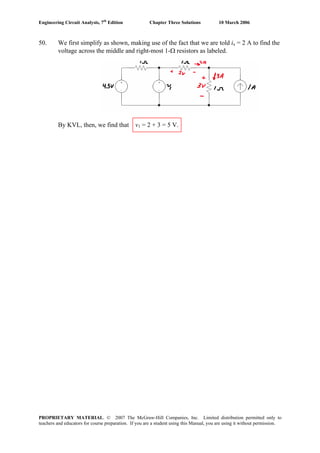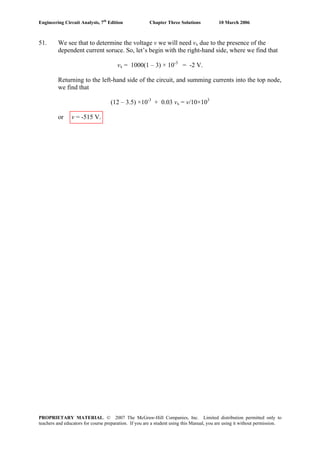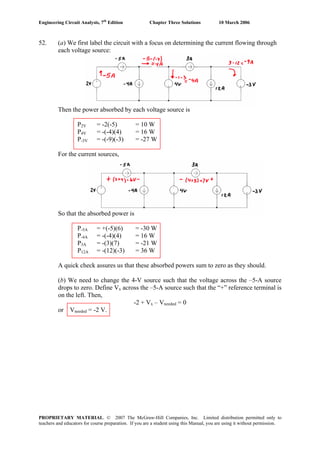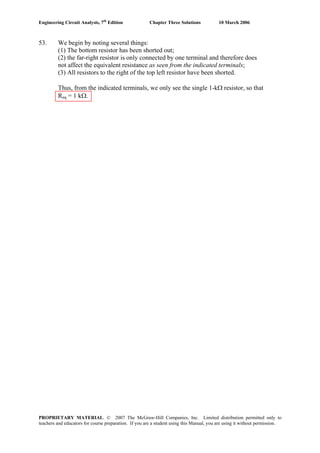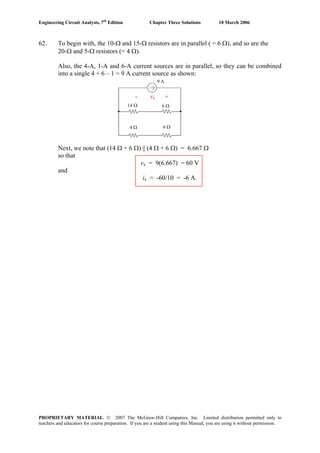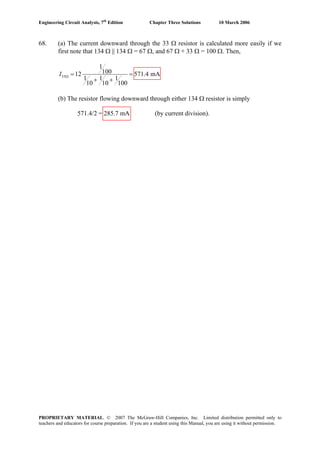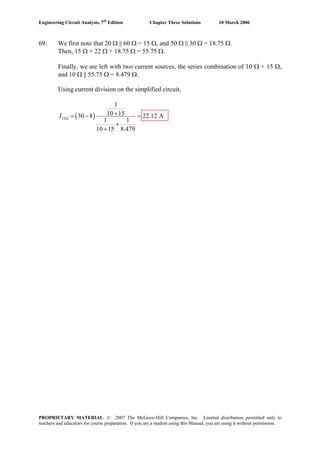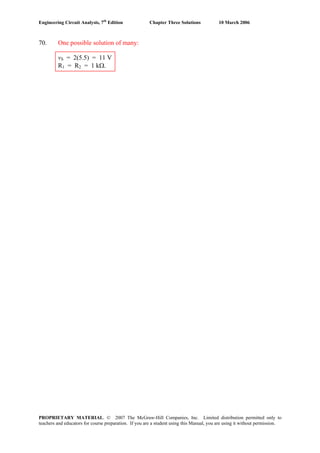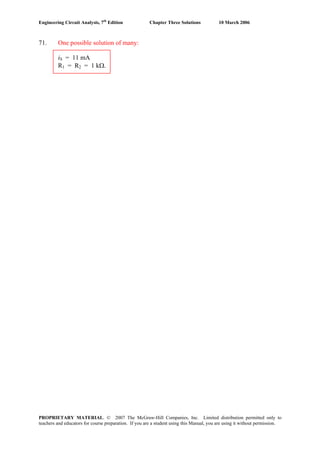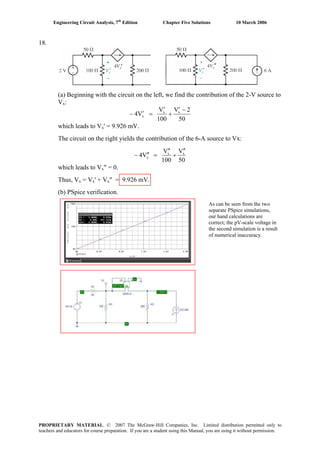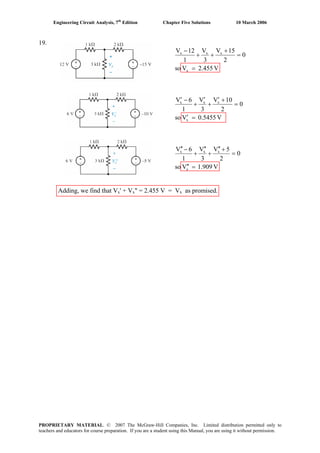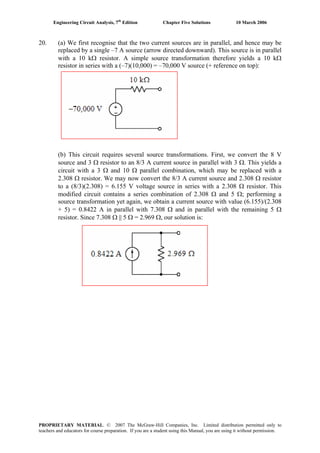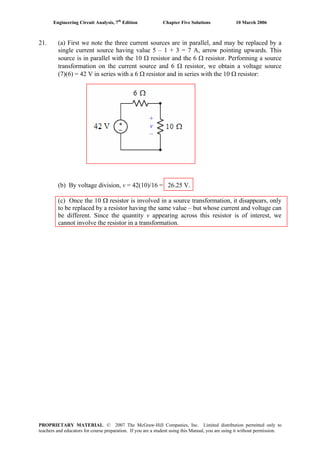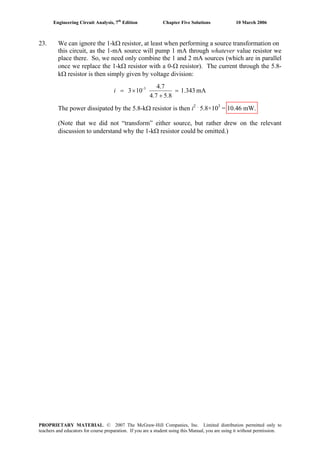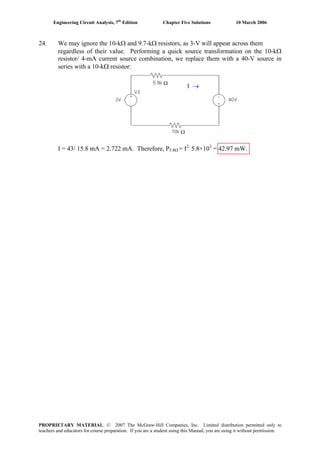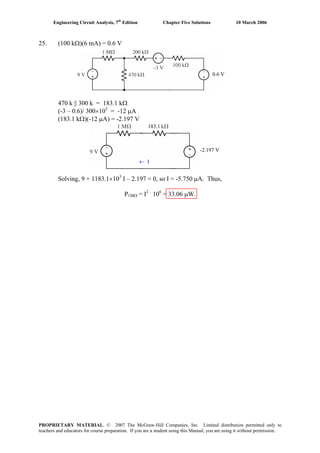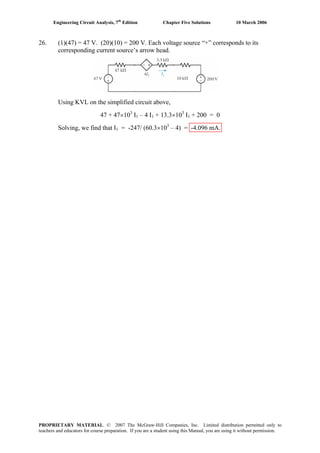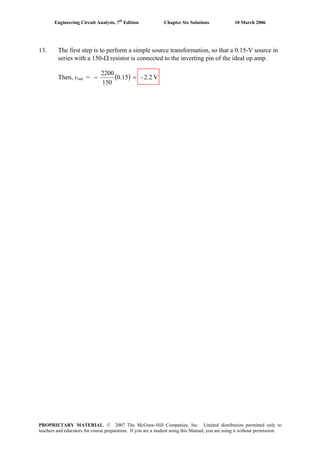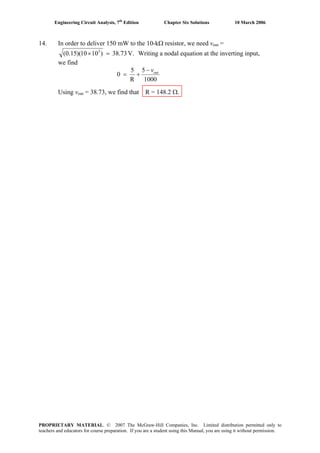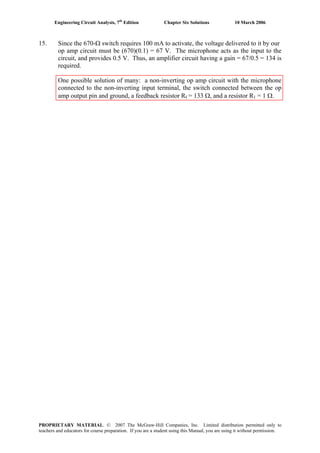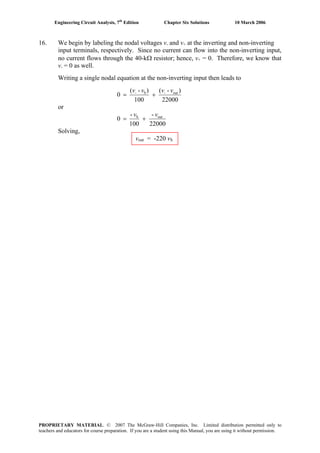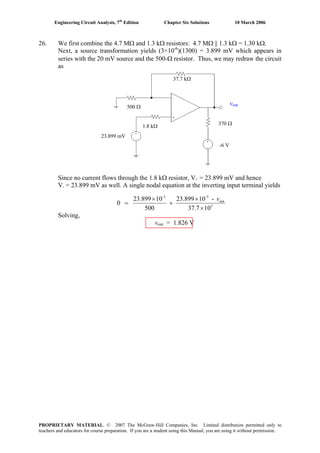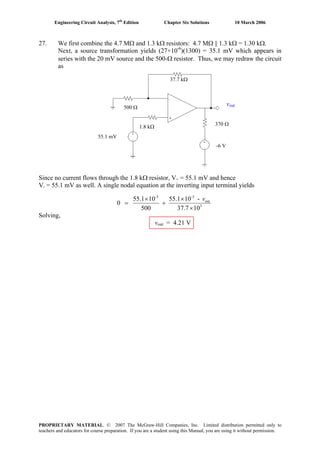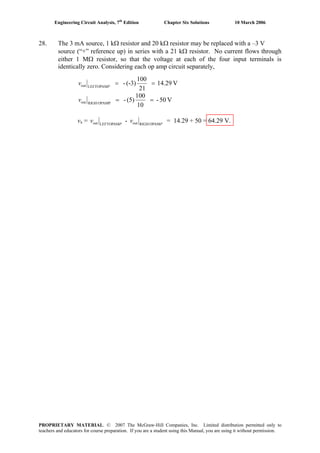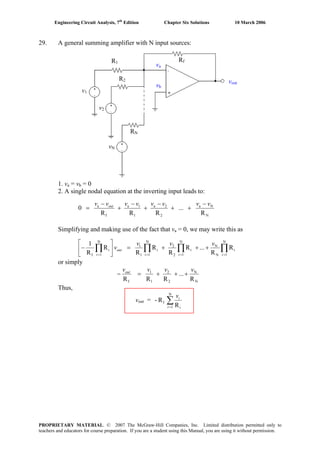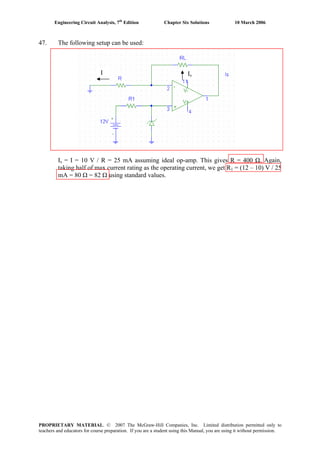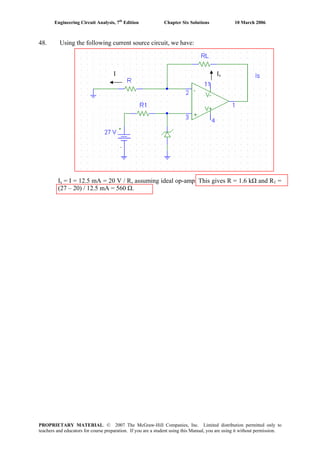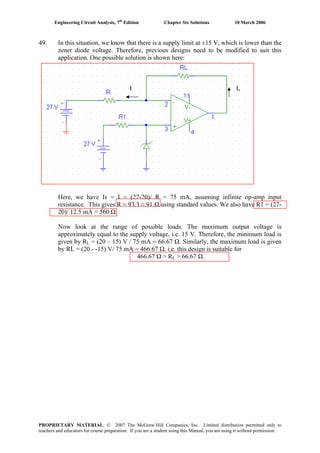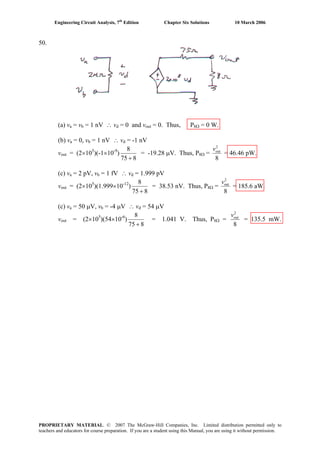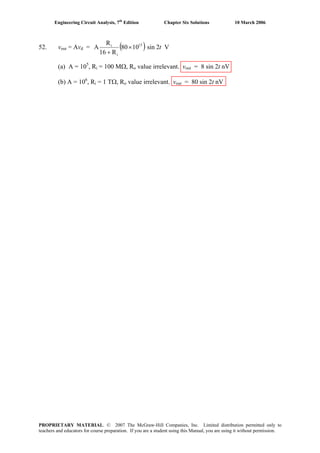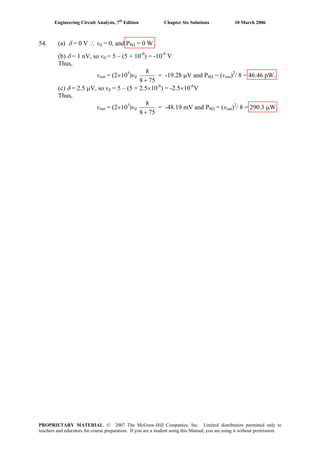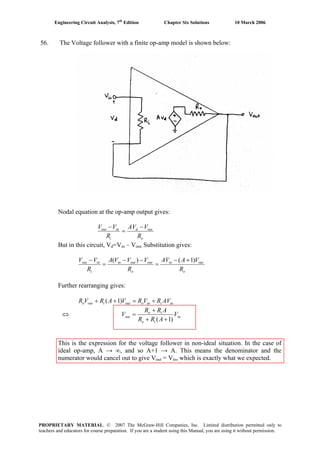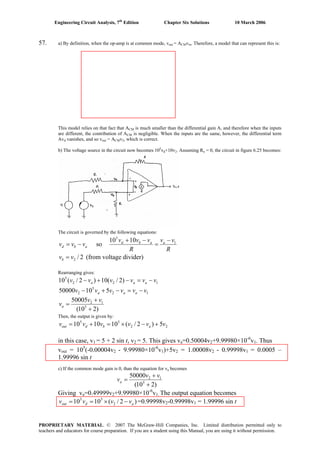
Engineering Circuit Analysis, 7th
Edition Chapter Two Solutions 10 March 2006
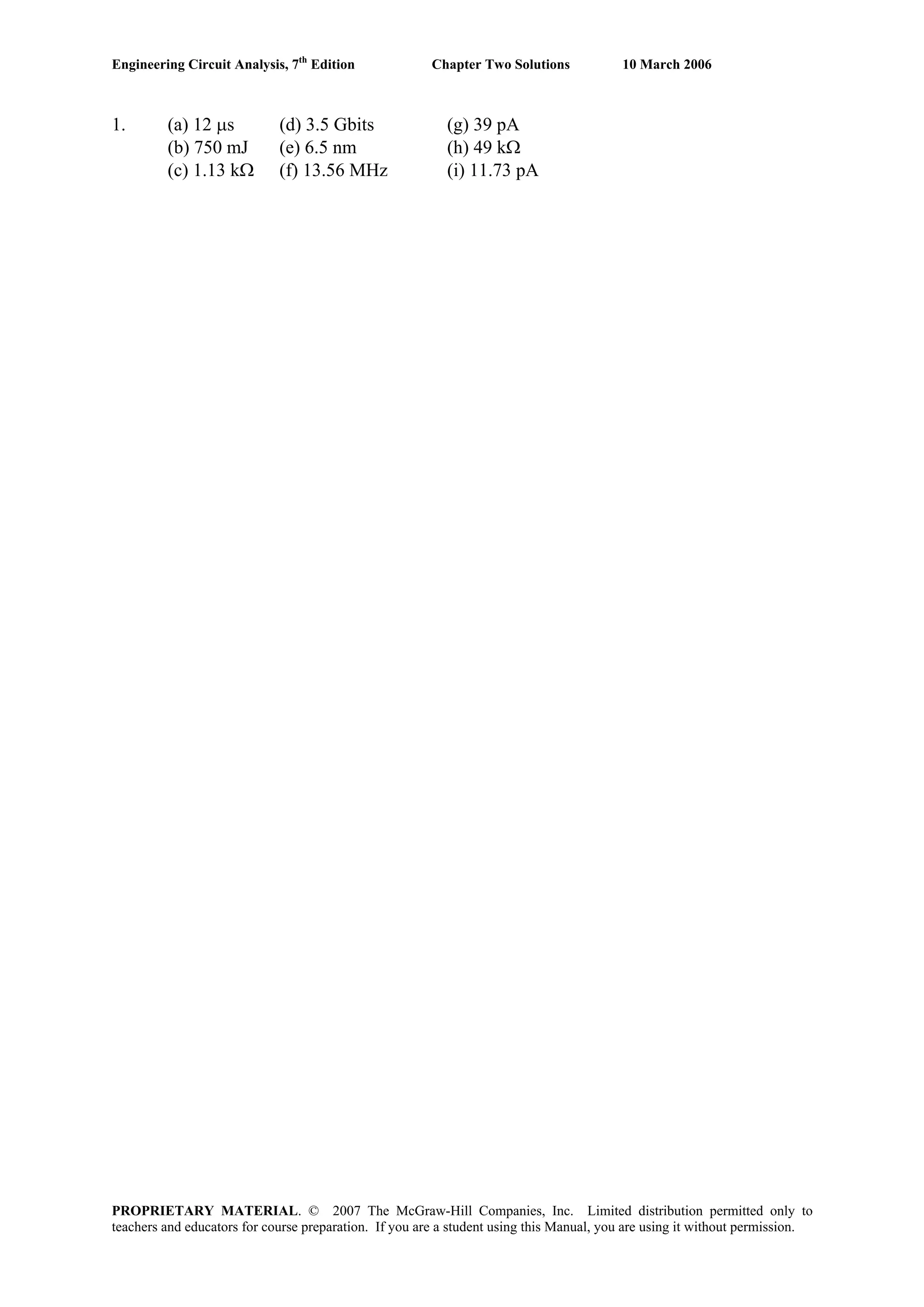
1. (a) 12 μs (d) 3.5 Gbits (g) 39 pA
(b) 750 mJ (e) 6.5 nm (h) 49 kΩ
(c) 1.13 kΩ (f) 13.56 MHz (i) 11.73 pA
PROPRIETARY MATERIAL. © 2007 The McGraw-Hill Companies, Inc. Limited distribution permitted only to
teachers and educators for course preparation. If you are a student using this Manual, you are using it without permission.
Engineering Circuit Analysis, 7th
Edition Chapter Two Solutions 10 March 2006
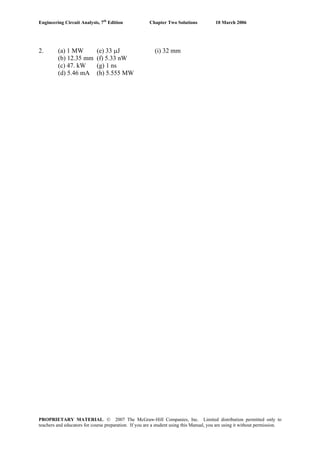
2. (a) 1 MW (e) 33 μJ (i) 32 mm
(b) 12.35 mm (f) 5.33 nW
(c) 47. kW (g) 1 ns
(d) 5.46 mA (h) 5.555 MW
PROPRIETARY MATERIAL. © 2007 The McGraw-Hill Companies, Inc. Limited distribution permitted only to
teachers and educators for course preparation. If you are a student using this Manual, you are using it without permission.
Engineering Circuit Analysis, 7th
Edition Chapter Two Solutions 10 March 2006
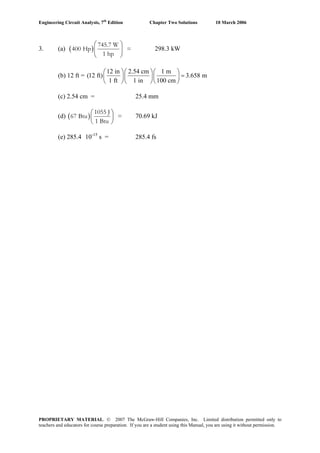
3. (a) ( )
⎛ ⎞
⎜ ⎟
⎝ ⎠
745.7 W
400 Hp =
1 hp
298.3 kW
(b) 12 ft =
12 in 2.54 cm 1 m
(12 ft) 3.658 m
1 ft 1 in 100 cm
⎛ ⎞⎛ ⎞⎛ ⎞
=⎜ ⎟⎜ ⎟⎜ ⎟
⎝ ⎠⎝ ⎠⎝ ⎠
(c) 2.54 cm = 25.4 mm
(d) ( )
1055 J
67 Btu =
1 Btu
⎛ ⎞
⎜ ⎟
⎝ ⎠
70.69 kJ
(e) 285.4´10-15
s = 285.4 fs
PROPRIETARY MATERIAL. © 2007 The McGraw-Hill Companies, Inc. Limited distribution permitted only to
teachers and educators for course preparation. If you are a student using this Manual, you are using it without permission.
Engineering Circuit Analysis, 7th
Edition Chapter Two Solutions 10 March 2006
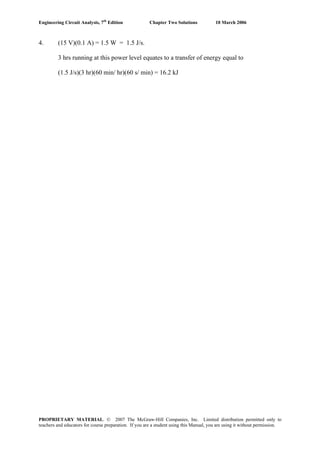
4. (15 V)(0.1 A) = 1.5 W = 1.5 J/s.
3 hrs running at this power level equates to a transfer of energy equal to
(1.5 J/s)(3 hr)(60 min/ hr)(60 s/ min) = 16.2 kJ
PROPRIETARY MATERIAL. © 2007 The McGraw-Hill Companies, Inc. Limited distribution permitted only to
teachers and educators for course preparation. If you are a student using this Manual, you are using it without permission.
Engineering Circuit Analysis, 7th
Edition Chapter Two Solutions 10 March 2006
5. Motor power = 175 Hp
(a) With 100% efficient mechanical to electrical power conversion,
(175 Hp)[1 W/ (1/745.7 Hp)] = 130.5 kW
(b) Running for 3 hours,
Energy = (130.5×10³
W)(3 hr)(60 min/hr)(60 s/min) = 1.409 GJ
(c) A single battery has 430 kW-hr capacity. We require
(130.5 kW)(3 hr) = 391.5 kW-hr therefore one battery is sufficient.
PROPRIETARY MATERIAL. © 2007 The McGraw-Hill Companies, Inc. Limited distribution permitted only to
teachers and educators for course preparation. If you are a student using this Manual, you are using it without permission.
Engineering Circuit Analysis, 7th
Edition Chapter Two Solutions 10 March 2006
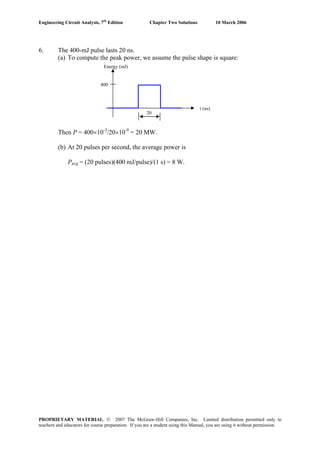
6. The 400-mJ pulse lasts 20 ns.
(a) To compute the peak power, we assume the pulse shape is square:
400
Energy (mJ)
t (ns)
20
Then P = 400×10-3
/20×10-9
= 20 MW.
(b) At 20 pulses per second, the average power is
Pavg = (20 pulses)(400 mJ/pulse)/(1 s) = 8 W.
PROPRIETARY MATERIAL. © 2007 The McGraw-Hill Companies, Inc. Limited distribution permitted only to
teachers and educators for course preparation. If you are a student using this Manual, you are using it without permission.
Engineering Circuit Analysis, 7th
Edition Chapter Two Solutions 10 March 2006
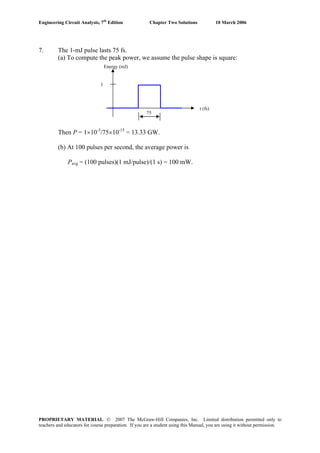
7. The 1-mJ pulse lasts 75 fs.
(a) To compute the peak power, we assume the pulse shape is square:
1
Energy (mJ)
t (fs)
75
Then P = 1×10⁻³
/75×10-15
= 13.33 GW.
(b) At 100 pulses per second, the average power is
Pavg = (100 pulses)(1 mJ/pulse)/(1 s) = 100 mW.
PROPRIETARY MATERIAL. © 2007 The McGraw-Hill Companies, Inc. Limited distribution permitted only to
teachers and educators for course preparation. If you are a student using this Manual, you are using it without permission.
Engineering Circuit Analysis, 7th
Edition Chapter Two Solutions 10 March 2006
8. The power drawn from the battery is (not quite drawn to scale):
5 7 17 24
P (W)
10
6
t (min)
(a) Total energy (in J) expended is
[6(5) + 0(2) + 0.5(10)(10) + 0.5(10)(7)]60 = 6.9 kJ.
(b) The average power in Btu/hr is
(6900 J/24 min)(60 min/1 hr)(1 Btu/1055 J) = 16.35 Btu/hr.
PROPRIETARY MATERIAL. © 2007 The McGraw-Hill Companies, Inc. Limited distribution permitted only to
teachers and educators for course preparation. If you are a student using this Manual, you are using it without permission.
Engineering Circuit Analysis, 7th
Edition Chapter Two Solutions 10 March 2006
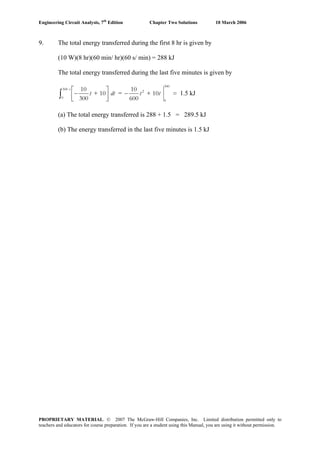
9. The total energy transferred during the first 8 hr is given by
(10 W)(8 hr)(60 min/ hr)(60 s/ min) = 288 kJ
The total energy transferred during the last five minutes is given by
300 s
0
10
+ 10
300
t dt
⎡ ⎤
−⎢ ⎥⎣ ⎦
∫ =
300
2
0
10
+ 10 =
600
t t− 1.5 kJ
(a) The total energy transferred is 288 + 1.5 = 289.5 kJ
(b) The energy transferred in the last five minutes is 1.5 kJ
PROPRIETARY MATERIAL. © 2007 The McGraw-Hill Companies, Inc. Limited distribution permitted only to
teachers and educators for course preparation. If you are a student using this Manual, you are using it without permission.
Engineering Circuit Analysis, 7th
Edition Chapter Two Solutions 10 March 2006
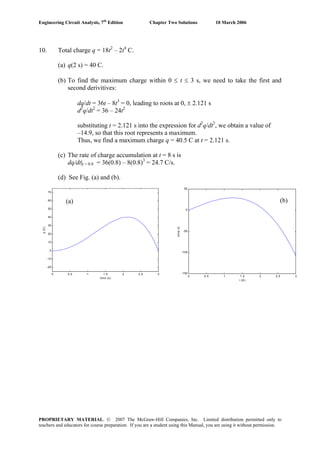
10. Total charge q = 18t2
– 2t4
C.
(a) q(2 s) = 40 C.
(b) To find the maximum charge within 0 ≤ t ≤ 3 s, we need to take the first and
second derivitives:
dq/dt = 36t – 8t3
= 0, leading to roots at 0, ± 2.121 s
d2
q/dt2
= 36 – 24t2
substituting t = 2.121 s into the expression for d2
q/dt2
, we obtain a value of
–14.9, so that this root represents a maximum.
Thus, we find a maximum charge q = 40.5 C at t = 2.121 s.
(c) The rate of charge accumulation at t = 8 s is
dq/dt|t = 0.8 = 36(0.8) – 8(0.8)3
= 24.7 C/s.
(d) See Fig. (a) and (b).
0 0.5 1 1.5 2 2.5 3
-20
-10
0
10
20
30
40
50
60
70
time (s)
q(C)
0 0.5 1 1.5 2 2.5 3
-150
-100
-50
0
50
i (A)
time(t)
(a) (b)
PROPRIETARY MATERIAL. © 2007 The McGraw-Hill Companies, Inc. Limited distribution permitted only to
teachers and educators for course preparation. If you are a student using this Manual, you are using it without permission.
Engineering Circuit Analysis, 7th
Edition Chapter Two Solutions 10 March 2006
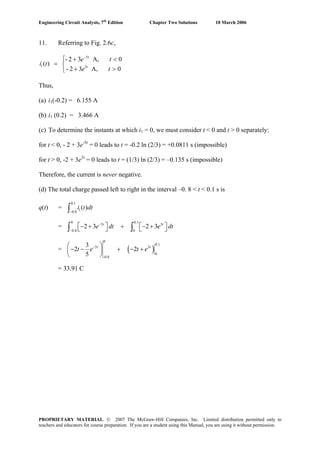
11. Referring to Fig. 2.6c,
0A,32-
0A,32-
)( 3
5
1
⎩
⎨
⎧
>+
<+
=
−
te
te
ti t
t
Thus,
(a) i1(-0.2) = 6.155 A
(b) i1 (0.2) = 3.466 A
(c) To determine the instants at which i1 = 0, we must consider t < 0 and t > 0 separately:
for t < 0, - 2 + 3e-5t
= 0 leads to t = -0.2 ln (2/3) = +0.0811 s (impossible)
for t > 0, -2 + 3e3t
= 0 leads to t = (1/3) ln (2/3) = –0.135 s (impossible)
Therefore, the current is never negative.
(d) The total charge passed left to right in the interval –0. 8 < t < 0.1 s is
q(t) =
0.1
10.8
( )i t dt
−∫
=
0 0.1
5 3
0.8 0
2 3 2 3t t
e dt e d−
−
⎡ ⎤ ⎡− + + − +⎣ ⎦ ⎣∫ ∫ t⎤⎦
= ( )
0
0.1
5 3
0
-0.8
3
2 2
5
t t
t e t e−⎛ ⎞
− − + − +⎜ ⎟
⎝ ⎠
= 33.91 C
PROPRIETARY MATERIAL. © 2007 The McGraw-Hill Companies, Inc. Limited distribution permitted only to
teachers and educators for course preparation. If you are a student using this Manual, you are using it without permission.
Engineering Circuit Analysis, 7th
Edition Chapter Two Solutions 10 March 2006
12. Referring to Fig. 2.28,
(a) The average current over one period (10 s) is
iavg = [-4(2) + 2(2) + 6(2) + 0(4)]/10 = 800 mA
(b) The total charge transferred over the interval 1 < t < 12 s is
∫=
12
1
total )( dttiq = -4(1) + 2(2) + 6(2) + 0(4) – 4(2) = 4 C
(c) See Fig. below
2 4 6
8
10 12
16
q (C)
t(s)
-16
8
16
-8
14
PROPRIETARY MATERIAL. © 2007 The McGraw-Hill Companies, Inc. Limited distribution permitted only to
teachers and educators for course preparation. If you are a student using this Manual, you are using it without permission.
Engineering Circuit Analysis, 7th
Edition Chapter Two Solutions 10 March 2006
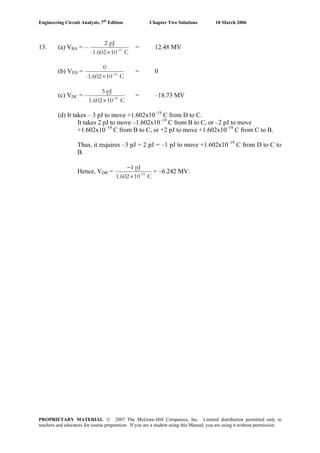
13. (a) VBA = – -19
2 pJ
-1.602 10 C×
= 12.48 MV
(b) VED = -19
0
-1.602 10 C×
= 0
(c) VDC = – -19
3 pJ
1.602 10 C×
= –18.73 MV
(d) It takes – 3 pJ to move +1.602x10⁻¹⁹
C from D to C.
It takes 2 pJ to move –1.602x10⁻¹⁹
C from B to C, or –2 pJ to move
+1.602x10⁻¹⁹
C from B to C, or +2 pJ to move +1.602x10⁻¹⁹
C from C to B.
Thus, it requires –3 pJ + 2 pJ = –1 pJ to move +1.602x10⁻¹⁹
C from D to C to
B.
Hence, VDB =
−
× -19
1 pJ
1.602 10 C
= –6.242 MV.
PROPRIETARY MATERIAL. © 2007 The McGraw-Hill Companies, Inc. Limited distribution permitted only to
teachers and educators for course preparation. If you are a student using this Manual, you are using it without permission.
Engineering Circuit Analysis, 7th
Edition Chapter Two Solutions 10 March 2006
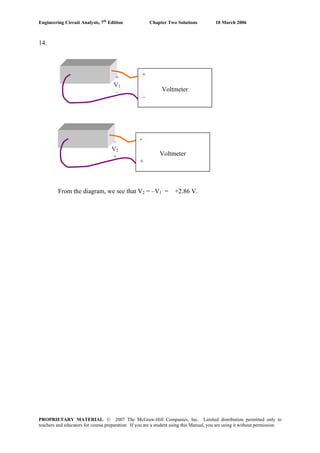
14.
+
Voltmeter
–
+
V1
–
-
Voltmeter
+
–
V2
+
From the diagram, we see that V2 = –V1 = +2.86 V.
PROPRIETARY MATERIAL. © 2007 The McGraw-Hill Companies, Inc. Limited distribution permitted only to
teachers and educators for course preparation. If you are a student using this Manual, you are using it without permission.
Engineering Circuit Analysis, 7th
Edition Chapter Two Solutions 10 March 2006
15. (a) Pabs = (+3.2 V)(-2 mA) = –6.4 mW (or +6.4 mW supplied)
(b) Pabs = (+6 V)(-20 A) = –120 W (or +120 W supplied)
(d) Pabs = (+6 V)(2 ix) = (+6 V)[(2)(5 A)] = +60 W
(e) Pabs = (4 sin 1000t V)(-8 cos 1000t mA)| t = 2 ms = +12.11 W
PROPRIETARY MATERIAL. © 2007 The McGraw-Hill Companies, Inc. Limited distribution permitted only to
teachers and educators for course preparation. If you are a student using this Manual, you are using it without permission.
Engineering Circuit Analysis, 7th
Edition Chapter Two Solutions 10 March 2006
16. i = 3te-100t
mA and v = [6 – 600t] e-100t
mV
(a) The power absorbed at t = 5 ms is
Pabs = ( )[ ] W36006 5
100100
μmst
tt
teet =
−−
⋅−
= 0.01655 μW = 16.55 nW
(b) The energy delivered over the interval 0 < t < ∞ is
( )∫ ∫
∞ ∞
−
−=
0 0
200
J60063 μdtettdtP t
abs
Making use of the relationship
10
!
+
∞
−
=∫ n
axn
a
n
dxex where n is a positive integer and a > 0,
we find the energy delivered to be
= 18/(200)2
- 1800/(200)3
= 0
PROPRIETARY MATERIAL. © 2007 The McGraw-Hill Companies, Inc. Limited distribution permitted only to
teachers and educators for course preparation. If you are a student using this Manual, you are using it without permission.
Engineering Circuit Analysis, 7th
Edition Chapter Two Solutions 10 March 2006
17. (a) Pabs = (40i)(3e-100t
)| t = 8 ms = [ ]2
8
100
360 mst
t
e =
−
= 72.68 W
(b) Pabs = [ ] W36.34-180-2.0
2
8
100
==⎟
⎠
⎞
⎜
⎝
⎛
=
−
mst
t
ei
dt
di
(c) Pabs = ( )
mst
t
t
eidt
8
100
0
32030
=
−
⎟
⎠
⎞⎜
⎝
⎛ +∫
=
mst
t
t
tt
etdee
8
100
0
100100
60390
=
−′−−
⎟
⎠
⎞⎜
⎝
⎛ +′∫ = 27.63 W
PROPRIETARY MATERIAL. © 2007 The McGraw-Hill Companies, Inc. Limited distribution permitted only to
teachers and educators for course preparation. If you are a student using this Manual, you are using it without permission.
Engineering Circuit Analysis, 7th
Edition Chapter Two Solutions 10 March 2006
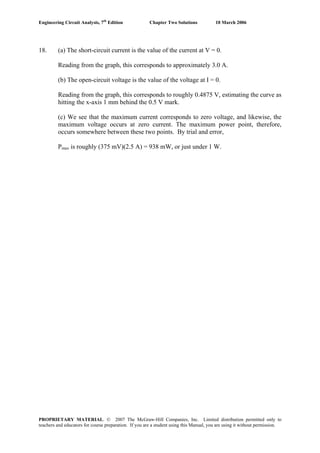
18. (a) The short-circuit current is the value of the current at V = 0.
Reading from the graph, this corresponds to approximately 3.0 A.
(b) The open-circuit voltage is the value of the voltage at I = 0.
Reading from the graph, this corresponds to roughly 0.4875 V, estimating the curve as
hitting the x-axis 1 mm behind the 0.5 V mark.
(c) We see that the maximum current corresponds to zero voltage, and likewise, the
maximum voltage occurs at zero current. The maximum power point, therefore,
occurs somewhere between these two points. By trial and error,
Pmax is roughly (375 mV)(2.5 A) = 938 mW, or just under 1 W.
PROPRIETARY MATERIAL. © 2007 The McGraw-Hill Companies, Inc. Limited distribution permitted only to
teachers and educators for course preparation. If you are a student using this Manual, you are using it without permission.
Engineering Circuit Analysis, 7th
Edition Chapter Two Solutions 10 March 2006
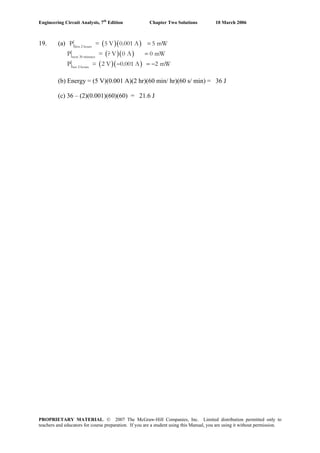
19. (a) ( )( ) =first 2 hours
P = 5 V 0.001 A 5 mW
( )( ) =next 30 minutes
P = ? V 0 A 0 mW
( )( )− = −last 2 hours
P = 2 V 0.001 A 2 mW
(b) Energy = (5 V)(0.001 A)(2 hr)(60 min/ hr)(60 s/ min) = 36 J
(c) 36 – (2)(0.001)(60)(60) = 21.6 J
PROPRIETARY MATERIAL. © 2007 The McGraw-Hill Companies, Inc. Limited distribution permitted only to
teachers and educators for course preparation. If you are a student using this Manual, you are using it without permission.
Engineering Circuit Analysis, 7th
Edition Chapter Two Solutions 10 March 2006
20. Note that in the table below, only the –4-A source and the –3-A source are actually
“absorbing” power; the remaining sources are supplying power to the circuit.
Source Absorbed Power Absorbed Power
2 V source (2 V)(-2 A) - 4 W
8 V source (8 V)(-2 A) - 16 W
-4 A source (10 V)[-(-4 A)] 40 W
10 V source (10 V)(-5 A) - 50 W
-3 A source (10 V)[-(-3 A)] 30 W
The 5 power quantities sum to –4 – 16 + 40 – 50 + 30 = 0, as demanded from
conservation of energy.
PROPRIETARY MATERIAL. © 2007 The McGraw-Hill Companies, Inc. Limited distribution permitted only to
teachers and educators for course preparation. If you are a student using this Manual, you are using it without permission.
Engineering Circuit Analysis, 7th
Edition Chapter Two Solutions 10 March 2006
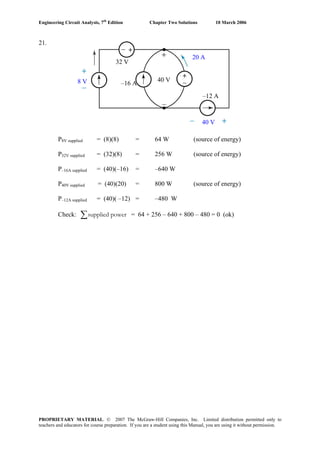
21.
40 V
40 V
32 V
8 V
20 A
–12 A
–16 A
P8V supplied = (8)(8) = 64 W (source of energy)
P32V supplied = (32)(8) = 256 W (source of energy)
P–16A supplied = (40)(–16) = –640 W
P40V supplied = (40)(20) = 800 W (source of energy)
P–12A supplied = (40)( –12) = –480 W
Check: = 64 + 256 – 640 + 800 – 480 = 0 (ok)supplied power∑
PROPRIETARY MATERIAL. © 2007 The McGraw-Hill Companies, Inc. Limited distribution permitted only to
teachers and educators for course preparation. If you are a student using this Manual, you are using it without permission.
Engineering Circuit Analysis, 7th
Edition Chapter Two Solutions 10 March 2006
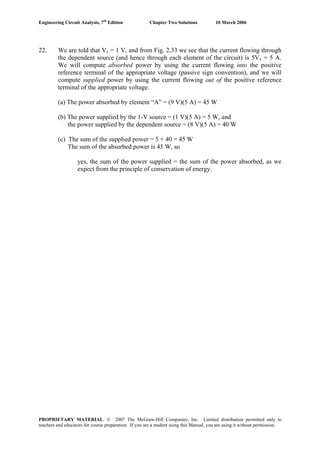
22. We are told that Vx = 1 V, and from Fig. 2.33 we see that the current flowing through
the dependent source (and hence through each element of the circuit) is 5Vx = 5 A.
We will compute absorbed power by using the current flowing into the positive
reference terminal of the appropriate voltage (passive sign convention), and we will
compute supplied power by using the current flowing out of the positive reference
terminal of the appropriate voltage.
(a) The power absorbed by element “A” = (9 V)(5 A) = 45 W
(b) The power supplied by the 1-V source = (1 V)(5 A) = 5 W, and
the power supplied by the dependent source = (8 V)(5 A) = 40 W
(c) The sum of the supplied power = 5 + 40 = 45 W
The sum of the absorbed power is 45 W, so
yes, the sum of the power supplied = the sum of the power absorbed, as we
expect from the principle of conservation of energy.
PROPRIETARY MATERIAL. © 2007 The McGraw-Hill Companies, Inc. Limited distribution permitted only to
teachers and educators for course preparation. If you are a student using this Manual, you are using it without permission.
Engineering Circuit Analysis, 7th
Edition Chapter Two Solutions 10 March 2006
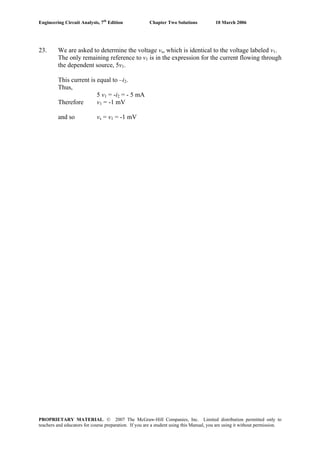
23. We are asked to determine the voltage vs, which is identical to the voltage labeled v1.
The only remaining reference to v1 is in the expression for the current flowing through
the dependent source, 5v1.
This current is equal to –i2.
Thus,
5 v1 = -i2 = - 5 mA
Therefore v1 = -1 mV
and so vs = v1 = -1 mV
PROPRIETARY MATERIAL. © 2007 The McGraw-Hill Companies, Inc. Limited distribution permitted only to
teachers and educators for course preparation. If you are a student using this Manual, you are using it without permission.
Engineering Circuit Analysis, 7th
Edition Chapter Two Solutions 10 March 2006
24. The voltage across the dependent source = v2 = –2ix = –2(–0.001) = 2 mV.
PROPRIETARY MATERIAL. © 2007 The McGraw-Hill Companies, Inc. Limited distribution permitted only to
teachers and educators for course preparation. If you are a student using this Manual, you are using it without permission.
Engineering Circuit Analysis, 7th
Edition Chapter Two Solutions 10 March 2006
25. The battery delivers an energy of 460.8 W-hr over a period of 8 hrs.
(a) The power delivered to the headlight is therefore (460.8 W-hr)/(8 hr) = 57.6 W
(b) The current through the headlight is equal to the power it absorbs from the battery
divided by the voltage at which the power is supplied, or
I = (57.6 W)/(12 V) = 4.8 A
PROPRIETARY MATERIAL. © 2007 The McGraw-Hill Companies, Inc. Limited distribution permitted only to
teachers and educators for course preparation. If you are a student using this Manual, you are using it without permission.
Engineering Circuit Analysis, 7th
Edition Chapter Two Solutions 10 March 2006
26. The supply voltage is 110 V, and the maximum dissipated power is 500 W. The fuses
are specified in terms of current, so we need to determine the maximum current that
can flow through the fuse.
P = V I therefore Imax = Pmax/V = (500 W)/(110 V) = 4.545 A
If we choose the 5-A fuse, it will allow up to (110 V)(5 A) = 550 W of power to be
delivered to the application (we must assume here that the fuse absorbs zero power, a
reasonable assumption in practice). This exceeds the specified maximum power.
If we choose the 4.5-A fuse instead, we will have a maximum current of 4.5 A. This
leads to a maximum power of (110)(4.5) = 495 W delivered to the application.
Although 495 W is less than the maximum power allowed, this fuse will provide
adequate protection for the application circuitry. If a fault occurs and the application
circuitry attempts to draw too much power, 1000 W for example, the fuse will blow,
no current will flow, and the application circuitry will be protected. However, if the
application circuitry tries to draw its maximum rated power (500 W), the fuse will
also blow. In practice, most equipment will not draw its maximum rated power
continuously—although to be safe, we typically assume that it will.
PROPRIETARY MATERIAL. © 2007 The McGraw-Hill Companies, Inc. Limited distribution permitted only to
teachers and educators for course preparation. If you are a student using this Manual, you are using it without permission.
Engineering Circuit Analysis, 7th
Edition Chapter Two Solutions 10 March 2006
27. (a) imax = 5/ 900 = 5.556 mA
imin = 5/ 1100 = 4.545 mA
(b) p = v2
/ R so
pmin = 25/ 1100 = 22.73 mW
pmax = 25/ 900 = 27.78 mW
PROPRIETARY MATERIAL. © 2007 The McGraw-Hill Companies, Inc. Limited distribution permitted only to
teachers and educators for course preparation. If you are a student using this Manual, you are using it without permission.
Engineering Circuit Analysis, 7th
Edition Chapter Two Solutions 10 March 2006
28. p = i2
R, so
pmin = (0.002)2
(446.5) = 1.786 mW and (more relevant to our discussion)
pmax = (0.002)2
(493.5) = 1.974 mW
1.974 mW would be a correct answer, although power ratings are typically expressed
as integers, so 2 mW might be more appropriate.
PROPRIETARY MATERIAL. © 2007 The McGraw-Hill Companies, Inc. Limited distribution permitted only to
teachers and educators for course preparation. If you are a student using this Manual, you are using it without permission.
Engineering Circuit Analysis, 7th
Edition Chapter Two Solutions 10 March 2006
29. (a) Pabs = i2
R = [20e-12t
] 2
(1200) μW
= [20e-1.2
] 2
(1200) μW
= 43.54 mW
(b) Pabs = v2
/R = [40 cos 20t] 2
/ 1200 W
keep in mind we
are using radians= [40 cos 2] 2
/ 1200 W
= 230.9 mW
(c) Pabs = v i = 8t 1.5
W
= 253.0 mW
PROPRIETARY MATERIAL. © 2007 The McGraw-Hill Companies, Inc. Limited distribution permitted only to
teachers and educators for course preparation. If you are a student using this Manual, you are using it without permission.
Engineering Circuit Analysis, 7th
Edition Chapter Two Solutions 10 March 2006
30. It’s probably best to begin this problem by sketching the voltage waveform:
6040
20
t (ms)
v (V)
+10
-10
(a) vmax = +10 V
(b) vavg = [(+10)(20×10-3
) + (-10)(20×10-3
)]/(40×10-3
) = 0
(c) iavg = vavg /R = 0
(d)
R
v
pabs
2
max
max
= = (10)2
/ 50 = 2 W
(e) ⎥
⎦
⎤
⎢
⎣
⎡
⋅
−
+⋅
+
= 20
)10(
20
)10(
40
1 22
RR
p avgabs = 2 W
PROPRIETARY MATERIAL. © 2007 The McGraw-Hill Companies, Inc. Limited distribution permitted only to
teachers and educators for course preparation. If you are a student using this Manual, you are using it without permission.
Engineering Circuit Analysis, 7th
Edition Chapter Two Solutions 10 March 2006
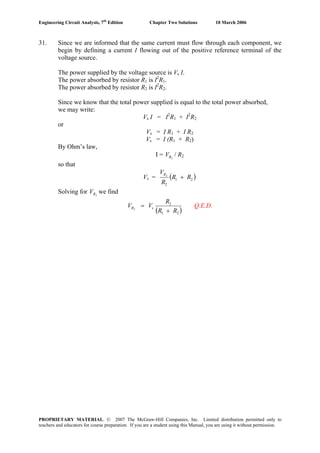
31. Since we are informed that the same current must flow through each component, we
begin by defining a current I flowing out of the positive reference terminal of the
voltage source.
The power supplied by the voltage source is Vs I.
The power absorbed by resistor R1 is I2
R1.
The power absorbed by resistor R2 is I2
R2.
Since we know that the total power supplied is equal to the total power absorbed,
we may write:
Vs I = I2
R1 + I2
R2
or
Vs = I R1 + I R2
Vs = I (R1 + R2)
By Ohm’s law,
I = / R2RV 2
so that
Vs = ( )21
2
2
RR
R
VR
+
Solving for we find2RV
( )21
2
s2
RR
R
VVR
+
= Q.E.D.
PROPRIETARY MATERIAL. © 2007 The McGraw-Hill Companies, Inc. Limited distribution permitted only to
teachers and educators for course preparation. If you are a student using this Manual, you are using it without permission.
Engineering Circuit Analysis, 7th
Edition Chapter Two Solutions 10 March 2006
32. (a)
-1.5 -1 -0.5 0 0.5 1 1.5 2 2.5
-4
-3
-2
-1
0
1
2
3
4
5
6
voltage (V)
current(mA)
(b) We see from our answer to part (a) that this device has a reasonably linear
characteristic (a not unreasonable degree of experimental error is evident in the data).
Thus, we choose to estimate the resistance using the two extreme points:
Reff = [(2.5 – (-1.5)]/[5.23 – (-3.19)] kΩ = 475 Ω
Using the last two points instead, we find Reff = 469 Ω, so that we can state with some
certainty at least that a reasonable estimate of the resistance is approximately 470 Ω.
(c)
-1.5 -1 -0.5 0 0.5 1 1.5 2 2.5
-1.5
-1
-0.5
0
0.5
1
1.5
2
voltage (V)
current(mA)
PROPRIETARY MATERIAL. © 2007 The McGraw-Hill Companies, Inc. Limited distribution permitted only to
teachers and educators for course preparation. If you are a student using this Manual, you are using it without permission.
Engineering Circuit Analysis, 7th
Edition Chapter Two Solutions 10 March 2006
33. Top Left Circuit: I = (5/10) mA = 0.5 mA, and P10k = V2
/10 mW = 2.5 mW
Top Right Circuit: I = -(5/10) mA = -0.5 mA, and P10k = V2
/10 mW = 2.5 mW
Bottom Left Circuit: I = (-5/10) mA = -0.5 mA, and P10k = V2
/10 mW = 2.5 mW
Bottom Right Circuit: I = -(-5/10) mA = 0.5 mA, and P10k = V2
/10 mW = 2.5 mW
PROPRIETARY MATERIAL. © 2007 The McGraw-Hill Companies, Inc. Limited distribution permitted only to
teachers and educators for course preparation. If you are a student using this Manual, you are using it without permission.
Engineering Circuit Analysis, 7th
Edition Chapter Two Solutions 10 March 2006
34. The voltage vout is given by
vout = -10-3
vπ (1000)
= - vπ
Since vπ = vs = 0.01 cos 1000t V, we find that
vout = - vπ = -0.01 cos 1000t V
PROPRIETARY MATERIAL. © 2007 The McGraw-Hill Companies, Inc. Limited distribution permitted only to
teachers and educators for course preparation. If you are a student using this Manual, you are using it without permission.
Engineering Circuit Analysis, 7th
Edition Chapter Two Solutions 10 March 2006
35. vout = -vπ = -vS = -2sin 5t V
vout (t = 0) = 0 V
vout (t = 0.324 s) = -2sin (1.57) = -2 V
(use care to employ radian mode on your calculator or convert 1.57 radians to
degrees)
PROPRIETARY MATERIAL. © 2007 The McGraw-Hill Companies, Inc. Limited distribution permitted only to
teachers and educators for course preparation. If you are a student using this Manual, you are using it without permission.
Engineering Circuit Analysis, 7th
Edition Chapter Two Solutions 10 March 2006
36. 18 AWG wire has a resistance of 6.39 Ω / 1000 ft.
Thus, we require 1000 (53) / 6.39 = 8294 ft of wire.
(Or 1.57 miles. Or, 2.53 km).
PROPRIETARY MATERIAL. © 2007 The McGraw-Hill Companies, Inc. Limited distribution permitted only to
teachers and educators for course preparation. If you are a student using this Manual, you are using it without permission.
Engineering Circuit Analysis, 7th
Edition Chapter Two Solutions 10 March 2006
37. We need to create a 470-Ω resistor from 28 AWG wire, knowing that the ambient
temperature is 108o
F, or 42.22o
C.
Referring to Table 2.3, 28 AWG wire is 65.3 mΩ/ft at 20o
C, and using the equation
provided we compute
R2/R1 = (234.5 + T2)/(234.5 + T1) = (234.5 + 42.22)/(234.5 + 20) = 1.087
We thus find that 28 AWG wire is (1.087)(65.3) = 71.0 mΩ/ft.
Thus, to repair the transmitter we will need
(470 Ω)/(71.0 × 10-3 Ω/ft) = 6620 ft (1.25 miles, or 2.02 km).
Note: This seems like a lot of wire to be washing up on shore. We may find we don’t
have enough. In that case, perhaps we should take our cue from Eq. [6], and try to
squash a piece of the wire flat so that it has a very small cross-sectional area…..
PROPRIETARY MATERIAL. © 2007 The McGraw-Hill Companies, Inc. Limited distribution permitted only to
teachers and educators for course preparation. If you are a student using this Manual, you are using it without permission.
Engineering Circuit Analysis, 7th
Edition Chapter Two Solutions 10 March 2006
38. We are given that the conductivity σ of copper is 5.8×10⁷
S/m.
(a) 50 ft of #18 (18 AWG) copper wire, which has a diameter of 1.024 mm, will have
a resistance of l/(σ A) ohms, where A = the cross-sectional area and l = 50 ft.
Converting the dimensional quantities to meters,
l = (50 ft)(12 in/ft)(2.54 cm/in)(1 m/100 cm) = 15.24 m
and
r = 0.5(1.024 mm)(1 m/1000 mm) = 5.12×10⁻⁴
m
so that
A = π r2
= π (5.12×10⁻⁴
m)2
= 8.236×10⁻⁷
m2
Thus, R = (15.24 m)/[( 5.8×10⁷
)( 8.236×10⁻⁷
)] = 319.0 mΩ
(b) We assume that the conductivity value specified also holds true at 50o
C.
The cross-sectional area of the foil is
A = (33 μm)(500 μm)(1 m/106
μm)( 1 m/106
μm) = 1.65×10⁻⁸
m2
So that
R = (15 cm)(1 m/100 cm)/[( 5.8×10⁷
)( 1.65×10⁻⁸
)] = 156.7 mΩ
A 3-A current flowing through this copper in the direction specified would
lead to the dissipation of
I2
R = (3)2
(156.7) mW = 1.410 W
PROPRIETARY MATERIAL. © 2007 The McGraw-Hill Companies, Inc. Limited distribution permitted only to
teachers and educators for course preparation. If you are a student using this Manual, you are using it without permission.
Engineering Circuit Analysis, 7th
Edition Chapter Two Solutions 10 March 2006
39. Since R = ρ l / A, it follows that ρ = R A/ l .
From Table 2.4, we see that 28 AWG soft copper wire (cross-sectional area = 0.0804
mm2
) is 65.3 Ω per 1000 ft. Thus,
R = 65.3 Ω.
l = (1000 ft)(12 in/ft)(2.54 cm/in)(10 mm/cm) = 304,800 mm.
A = 0.0804 mm2
.
Thus, ρ = (65.3)(0.0804)/304800 = 17.23 μΩ/ mm
or
ρ = 1.723 μΩ.
cm
which is in fact consistent with the representative data for copper in Table 2.3.
PROPRIETARY MATERIAL. © 2007 The McGraw-Hill Companies, Inc. Limited distribution permitted only to
teachers and educators for course preparation. If you are a student using this Manual, you are using it without permission.
Engineering Circuit Analysis, 7th
Edition Chapter Two Solutions 10 March 2006
40. (a) From the text,
(1) Zener diodes,
(2) Fuses, and
(3) Incandescent (as opposed to fluorescent) light bulbs
This last one requires a few facts to be put together. We have stated that temperature
can affect resistance—in other words, if the temperature changes during operation, the
resistance will not remain constant and hence nonlinear behavior will be observed.
Most discrete resistors are rated for up to a specific power in order to ensure that
temperature variation during operation will not significantly change the resistance
value. Light bulbs, however, become rather warm when operating and can experience
a significant change in resistance.
(b) The energy is dissipated by the resistor, converted to heat which is transferred to
the air surrounding the resistor. The resistor is unable to store the energy itself.
PROPRIETARY MATERIAL. © 2007 The McGraw-Hill Companies, Inc. Limited distribution permitted only to
teachers and educators for course preparation. If you are a student using this Manual, you are using it without permission.
Engineering Circuit Analysis, 7th
Edition Chapter Two Solutions 10 March 2006
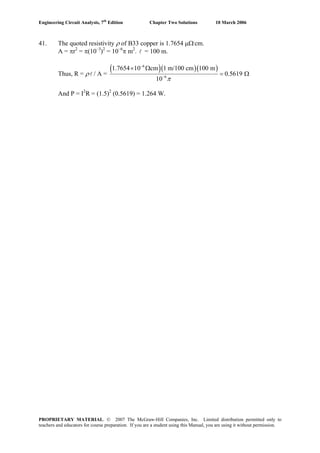
41. The quoted resistivity ρ of B33 copper is 1.7654 μΩ.
cm.
A = πr2
= π(10–3
)2
= 10–6
π m2
. = 100 m.l
Thus, R = ρ / A =l
( )( )( )6
6
1.7654 10 cm 1 m/100 cm 100 m
0.5619
10 π
−
−
× Ω
= Ω
And P = I2
R = (1.5)2
(0.5619) = 1.264 W.
PROPRIETARY MATERIAL. © 2007 The McGraw-Hill Companies, Inc. Limited distribution permitted only to
teachers and educators for course preparation. If you are a student using this Manual, you are using it without permission.
Engineering Circuit Analysis, 7th
Edition Chapter Two Solutions 10 March 2006
42. We know that for any wire of cross-sectional area A and length l , the resistance is
given by R = ρ l / A.
If we keep ρ fixed by choosing a material, and A fixed by choosing a wire gauge (e.g.
28 AWG), changing will change the resistance of our “device.”l
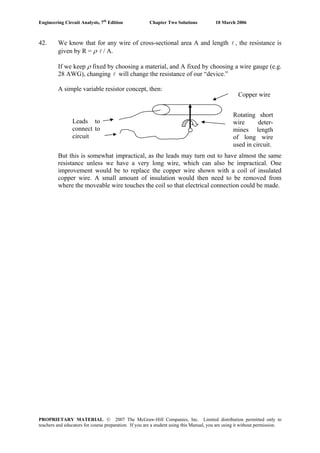
A simple variable resistor concept, then:
Leads to
connect to
circuit
Copper wire
Rotating short
wire deter-
mines length
of long wire
used in circuit.
But this is somewhat impractical, as the leads may turn out to have almost the same
resistance unless we have a very long wire, which can also be impractical. One
improvement would be to replace the copper wire shown with a coil of insulated
copper wire. A small amount of insulation would then need to be removed from
where the moveable wire touches the coil so that electrical connection could be made.
PROPRIETARY MATERIAL. © 2007 The McGraw-Hill Companies, Inc. Limited distribution permitted only to
teachers and educators for course preparation. If you are a student using this Manual, you are using it without permission.
Engineering Circuit Analysis, 7th
Edition Chapter Two Solutions 10 March 2006
43. (a) We need to plot the negative and positive voltage ranges separately, as the positive
voltage range is, after all, exponential!
-0.7 -0.6 -0.5 -0.4 -0.3 -0.2 -0.1 0 0.1
-2
0
2
4
6
8
10
12
14
16
x 10
-6
voltage (V)
current(A)
0 0.01 0.02 0.03 0.04 0.05 0.06 0.07
10
-8
10
-7
10
-6
10
-5
10
-4
voltage (V)
current(A)(b) To determine the resistance of the device at V = 550 mV, we compute the
corresponding current:
I = 10-9
[e39(0.55)
– 1] = 2.068 A
Thus, R(0.55 V) = 0.55/2.068 = 266 mΩ
(c) R = 1 Ω corresponds to V = I. Thus, we need to solve the transcendental equation
I = 10-9
[e39I
– 1]
Using a scientific calculator or the tried-and-true trial and error approach, we find that
I = 514.3 mA
PROPRIETARY MATERIAL. © 2007 The McGraw-Hill Companies, Inc. Limited distribution permitted only to
teachers and educators for course preparation. If you are a student using this Manual, you are using it without permission.
Engineering Circuit Analysis, 7th
Edition Chapter Two Solutions 10 March 2006
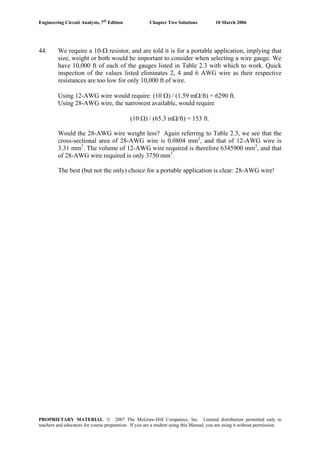
44. We require a 10-Ω resistor, and are told it is for a portable application, implying that
size, weight or both would be important to consider when selecting a wire gauge. We
have 10,000 ft of each of the gauges listed in Table 2.3 with which to work. Quick
inspection of the values listed eliminates 2, 4 and 6 AWG wire as their respective
resistances are too low for only 10,000 ft of wire.
Using 12-AWG wire would require (10 Ω) / (1.59 mΩ/ft) = 6290 ft.
Using 28-AWG wire, the narrowest available, would require
(10 Ω) / (65.3 mΩ/ft) = 153 ft.
Would the 28-AWG wire weight less? Again referring to Table 2.3, we see that the
cross-sectional area of 28-AWG wire is 0.0804 mm2
, and that of 12-AWG wire is
3.31 mm2
. The volume of 12-AWG wire required is therefore 6345900 mm3
, and that
of 28-AWG wire required is only 3750 mm3
.
The best (but not the only) choice for a portable application is clear: 28-AWG wire!
PROPRIETARY MATERIAL. © 2007 The McGraw-Hill Companies, Inc. Limited distribution permitted only to
teachers and educators for course preparation. If you are a student using this Manual, you are using it without permission.
Engineering Circuit Analysis, 7th
Edition Chapter Two Solutions 10 March 2006
45. Our target is a 100-Ω resistor. We see from the plot that at ND = 1015
cm-3
, μn ~ 2x10³
cm2
/V-s, yielding a resistivity of 3.121 Ω-cm.
At ND = 1018
cm-3
, μn ~ 230 cm2
/ V-s, yielding a resistivity of 0.02714 Ω-cm.
Thus, we see that the lower doping level clearly provides material with higher
resistivity, requiring less of the available area on the silicon wafer.
Since R = ρL/A, where we know R = 100 Ω and ρ = 3.121 Ω-cm for a phosphorus
concentration of 1015
cm-3
, we need only define the resistor geometry to complete the
design.
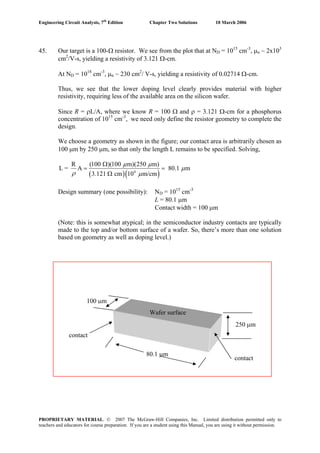
We choose a geometry as shown in the figure; our contact area is arbitrarily chosen as
100 μm by 250 μm, so that only the length L remains to be specified. Solving,
( )( )4
R (100 )(100 m)(250 m)
L = A 80.1 m
3.121 cm 10 m/cm
μ μ
μ
ρ μ
Ω
= =
Ω
Design summary (one possibility): ND = 1015
cm-3
L = 80.1 μm
Contact width = 100 μm
(Note: this is somewhat atypical; in the semiconductor industry contacts are typically
made to the top and/or bottom surface of a wafer. So, there’s more than one solution
based on geometry as well as doping level.)
250 μm
80.1 μm
contact
100 μm
contact
Wafer surface
PROPRIETARY MATERIAL. © 2007 The McGraw-Hill Companies, Inc. Limited distribution permitted only to
teachers and educators for course preparation. If you are a student using this Manual, you are using it without permission.
Engineering Circuit Analysis, 7th
Edition Chapter Three Solutions 10 March 2006
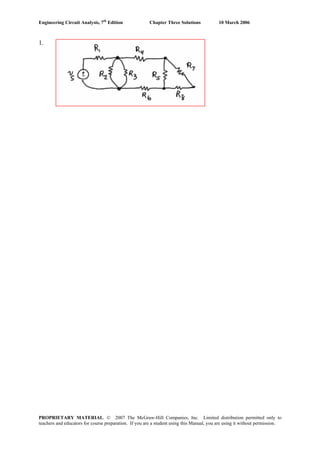
1.
PROPRIETARY MATERIAL. © 2007 The McGraw-Hill Companies, Inc. Limited distribution permitted only to
teachers and educators for course preparation. If you are a student using this Manual, you are using it without permission.
Engineering Circuit Analysis, 7th
Edition Chapter Three Solutions 10 March 2006
2. (a) six nodes; (b) nine branches.
PROPRIETARY MATERIAL. © 2007 The McGraw-Hill Companies, Inc. Limited distribution permitted only to
teachers and educators for course preparation. If you are a student using this Manual, you are using it without permission.
Engineering Circuit Analysis, 7th
Edition Chapter Three Solutions 10 March 2006
3. (a) Four nodes; (b) five branches; (c) path, yes – loop, no.
PROPRIETARY MATERIAL. © 2007 The McGraw-Hill Companies, Inc. Limited distribution permitted only to
teachers and educators for course preparation. If you are a student using this Manual, you are using it without permission.
Engineering Circuit Analysis, 7th
Edition Chapter Three Solutions 10 March 2006
4. (a) Five nodes;
(b) seven branches;
(c) path, yes – loop, no.
PROPRIETARY MATERIAL. © 2007 The McGraw-Hill Companies, Inc. Limited distribution permitted only to
teachers and educators for course preparation. If you are a student using this Manual, you are using it without permission.
Engineering Circuit Analysis, 7th
Edition Chapter Three Solutions 10 March 2006
5. (a) The number of nodes remains the same – four (4).
(b) The number of nodes is increased by one – to five (5).
(c) i) YES
ii) NO – does not return to starting point
iii) YES
iv) NO – does not return to starting point
v) NO – point B is crossed twice
PROPRIETARY MATERIAL. © 2007 The McGraw-Hill Companies, Inc. Limited distribution permitted only to
teachers and educators for course preparation. If you are a student using this Manual, you are using it without permission.
Engineering Circuit Analysis, 7th
Edition Chapter Three Solutions 10 March 2006
6. (a) By KCL at the bottom node: 2 – 3 + iZ – 5 – 3 = 0
So iZ = 9 A.
(b) If the left-most resistor has a value of 1 Ω, then 3 V appears across the parallel
network (the ‘+’ reference terminal being the bottom node) Thus, the value of the
other resistor is given by
R =
3
600 m
( 5)
= Ω
− −
.
PROPRIETARY MATERIAL. © 2007 The McGraw-Hill Companies, Inc. Limited distribution permitted only to
teachers and educators for course preparation. If you are a student using this Manual, you are using it without permission.
Engineering Circuit Analysis, 7th
Edition Chapter Three Solutions 10 March 2006
7. (a) 3 A;
(b) –3 A;
(c) 0.
PROPRIETARY MATERIAL. © 2007 The McGraw-Hill Companies, Inc. Limited distribution permitted only to
teachers and educators for course preparation. If you are a student using this Manual, you are using it without permission.
Engineering Circuit Analysis, 7th
Edition Chapter Three Solutions 10 March 2006
8. By KCL, we may write:
5 + iy + iz = 3 + ix
(a) ix = 2 + iy + iz = 2 + 2 + 0 = 4 A
(b) iy = 3 + ix – 5 – iz
iy = –2 + 2 – 2 iy
Thus, we find that iy = 0.
(c) 5 + iy + iz = 3 + ix → 5 + ix + ix = 3 + ix so ix = 3 – 5 = -2A.
PROPRIETARY MATERIAL. © 2007 The McGraw-Hill Companies, Inc. Limited distribution permitted only to
teachers and educators for course preparation. If you are a student using this Manual, you are using it without permission.
Engineering Circuit Analysis, 7th
Edition Chapter Three Solutions 10 March 2006
9. Focusing our attention on the bottom left node, we see that ix = 1 A.
Focusing our attention next on the top right node, we see that iy = 5 A.
PROPRIETARY MATERIAL. © 2007 The McGraw-Hill Companies, Inc. Limited distribution permitted only to
teachers and educators for course preparation. If you are a student using this Manual, you are using it without permission.
Engineering Circuit Analysis, 7th
Edition Chapter Three Solutions 10 March 2006
10. We obtain the current each bulb draws by dividing its power rating by the operating
voltage (115 V):
I100W = 100/115 = 896.6 mA
I60W = 60/115 = 521.7 mA
I40W = 347.8 mA
Thus, the total current draw is 1.739 A.
PROPRIETARY MATERIAL. © 2007 The McGraw-Hill Companies, Inc. Limited distribution permitted only to
teachers and educators for course preparation. If you are a student using this Manual, you are using it without permission.
Engineering Circuit Analysis, 7th
Edition Chapter Three Solutions 10 March 2006
11. The DMM is connected in parallel with the 3 load resistors, across which develops the
voltage we wish to measure. If the DMM appears as a short, then all 5 A flows
through the DMM, and none through the resistors, resulting in a (false) reading of 0 V
for the circuit undergoing testing. If, instead, the DMM has an infinite internal
resistance, then no current is shunted away from the load resistors of the circuit, and a
true voltage reading results.
PROPRIETARY MATERIAL. © 2007 The McGraw-Hill Companies, Inc. Limited distribution permitted only to
teachers and educators for course preparation. If you are a student using this Manual, you are using it without permission.
Engineering Circuit Analysis, 7th
Edition Chapter Three Solutions 10 March 2006
12. In either case, a bulb failure will adversely affect the sign.
Still, in the parallel-connected case, at least 10 (up to 11) of the other characters will
be lit, so the sign could be read and customers will know the restaurant is open for
business.
PROPRIETARY MATERIAL. © 2007 The McGraw-Hill Companies, Inc. Limited distribution permitted only to
teachers and educators for course preparation. If you are a student using this Manual, you are using it without permission.
Engineering Circuit Analysis, 7th
Edition Chapter Three Solutions 10 March 2006
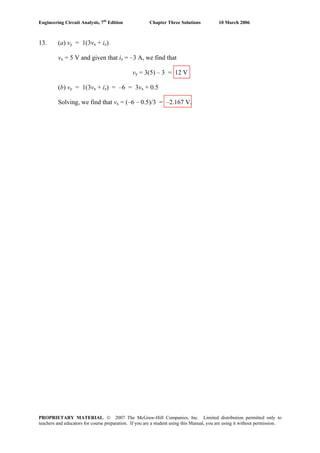
13. (a) vy = 1(3vx + iz)
vx = 5 V and given that iz = –3 A, we find that
vy = 3(5) – 3 = 12 V
(b) vy = 1(3vx + iz) = –6 = 3vx + 0.5
Solving, we find that vx = (–6 – 0.5)/3 = –2.167 V.
PROPRIETARY MATERIAL. © 2007 The McGraw-Hill Companies, Inc. Limited distribution permitted only to
teachers and educators for course preparation. If you are a student using this Manual, you are using it without permission.
Engineering Circuit Analysis, 7th
Edition Chapter Three Solutions 10 March 2006
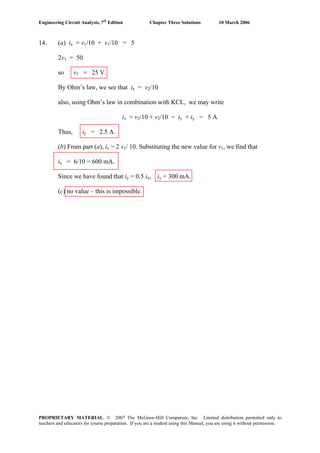
14. (a) ix = v1/10 + v1/10 = 5
2v1 = 50
so v1 = 25 V.
By Ohm’s law, we see that iy = v2/10
also, using Ohm’s law in combination with KCL, we may write
ix = v2/10 + v2/10 = iy + iy = 5 A
Thus, iy = 2.5 A.
(b) From part (a), ix = 2 v1/ 10. Substituting the new value for v1, we find that
ix = 6/10 = 600 mA.
Since we have found that iy = 0.5 ix, iy = 300 mA.
(c) no value – this is impossible.
PROPRIETARY MATERIAL. © 2007 The McGraw-Hill Companies, Inc. Limited distribution permitted only to
teachers and educators for course preparation. If you are a student using this Manual, you are using it without permission.
Engineering Circuit Analysis, 7th
Edition Chapter Three Solutions 10 March 2006
PROPRIETARY MATERIAL. © 2007 The McGraw-Hill Companies, Inc. Limited distribution permitted only to
teachers and educators for course preparation. If you are a student using this Manual, you are using it without permission.
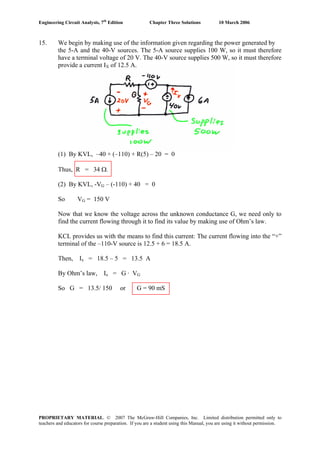
15. We begin by making use of the information given regarding the power generated by
the 5-A and the 40-V sources. The 5-A source supplies 100 W, so it must therefore
have a terminal voltage of 20 V. The 40-V source supplies 500 W, so it must therefore
provide a current IX of 12.5 A.
(1) By KVL, –40 + (–110) + R(5) – 20 = 0
Thus, R = 34 Ω.
(2) By KVL, -VG – (-110) + 40 = 0
So VG = 150 V
Now that we know the voltage across the unknown conductance G, we need only to
find the current flowing through it to find its value by making use of Ohm’s law.
KCL provides us with the means to find this current: The current flowing into the “+”
terminal of the –110-V source is 12.5 + 6 = 18.5 A.
Then, Ix = 18.5 – 5 = 13.5 A
By Ohm’s law, Ix = G · VG
So G = 13.5/ 150 or G = 90 mS
Engineering Circuit Analysis, 7th
Edition Chapter Three Solutions 10 March 2006
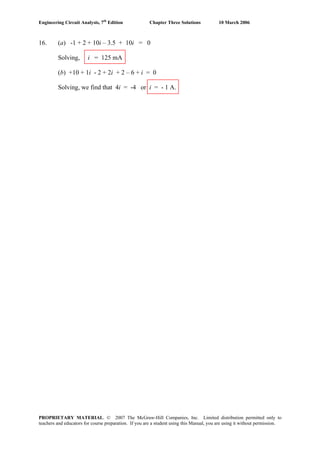
16. (a) -1 + 2 + 10i – 3.5 + 10i = 0
Solving, i = 125 mA
(b) +10 + 1i - 2 + 2i + 2 – 6 + i = 0
Solving, we find that 4i = -4 or i = - 1 A.
PROPRIETARY MATERIAL. © 2007 The McGraw-Hill Companies, Inc. Limited distribution permitted only to
teachers and educators for course preparation. If you are a student using this Manual, you are using it without permission.
Engineering Circuit Analysis, 7th
Edition Chapter Three Solutions 10 March 2006
17. Circuit I.
Starting at the bottom node and proceeding clockwise, we can write the KVL equation
+7 – 5 – 2 – 1(i) = 0
Which results in i = 0.
Circuit II.
Again starting with the bottom node and proceeding in a clockwise direction, we write
the KVL equation
-9 +4i + 4i = 0 (no current flows through either the -3 V source or the 2 Ω resistor)
Solving, we find that i = 9/8 A = 1.125 A.
PROPRIETARY MATERIAL. © 2007 The McGraw-Hill Companies, Inc. Limited distribution permitted only to
teachers and educators for course preparation. If you are a student using this Manual, you are using it without permission.
Engineering Circuit Analysis, 7th
Edition Chapter Three Solutions 10 March 2006
18. Begin by defining a clockwise current i.
-vS + v1 + v2 = 0 so vS = v1 + v2 = i(R1 + R2)
and hence i =
1 2
Sv
R R+
.
Thus, 1
1 1
1 2
S
R
v R i v
R R
= =
+
and 2
2 2
1 2
S
R
v R i v
R R
= =
+
.
Q.E.D.
PROPRIETARY MATERIAL. © 2007 The McGraw-Hill Companies, Inc. Limited distribution permitted only to
teachers and educators for course preparation. If you are a student using this Manual, you are using it without permission.
Engineering Circuit Analysis, 7th
Edition Chapter Three Solutions 10 March 2006
19. Given: (1) Vd = 0 and (2) no current flows into either terminal of Vd.
Calculate Vout by writing two KVL equations.
Begin by defining current i1 flowing right through the 100 Ω resistor, and i2 flowing
right through the 470 Ω resistor.
-5 + 100i1 + Vd = 0 [1]
-5 + 100i1 + 470i2 + Vout = 0 [2]
Making use of the fact that in this case Vd = 0, we find that i1 = 5/100 A.
Making use of the fact that no current flows into the input terminals of the op amp,
i1 = i2. Thus, Eq. [2] reduces to
-5 + 570(5/100) + Vout = 0 or
Vout = -23.5 V (hence, the circuit is acting as a voltage amplifier.)
PROPRIETARY MATERIAL. © 2007 The McGraw-Hill Companies, Inc. Limited distribution permitted only to
teachers and educators for course preparation. If you are a student using this Manual, you are using it without permission.
Engineering Circuit Analysis, 7th
Edition Chapter Three Solutions 10 March 2006
20. (a) By KVL, -2 + vx + 8 = 0
so that vx = -6 V.
(b) By KCL at the top left node,
iin = 1 + IS + vx/4 – 6
or iin = 23 A
(c) By KCL at the top right node,
IS + 4 vx = 4 - vx/4
So IS = 29.5 A.
(d) The power provided by the dependent source is 8(4vx) = -192 W.
PROPRIETARY MATERIAL. © 2007 The McGraw-Hill Companies, Inc. Limited distribution permitted only to
teachers and educators for course preparation. If you are a student using this Manual, you are using it without permission.
Engineering Circuit Analysis, 7th
Edition Chapter Three Solutions 10 March 2006
21. (a) Working from left to right,
v1 = 60 V
v2 = 60 V
i2 = 60/20 = 3 A
i4 = v1/4 = 60/4 = 15 A
v1 = 60 V i1 = 27 A
v2 = 60 V i2 = 3 A
v3 = 15 V i3 = 24 A
v4 = 45 V i4 = 15 A
v5 = 45 V i5 = 9 A
v3 = 5i2 = 15 V
By KVL, -60 + v3 + v5 = 0
v5 = 60 – 15 = 45 V
v4 = v5 = 45
i5 = v5/5 = 45/5 = 9 A
i3 = i4 + i5 = 15 + 9 = 24 A
i1 = i2 + i3 = 3 + 24 = 27
(b) It is now a simple matter to compute the power absorbed by each element:
p1 = -v1i1 = -(60)(27) = -1.62 kW
p2 = v2i2 = (60)(3) = 180 W
p3 = v3i3 = (15)(24) = 360 W
p4 = v4i4 = (45)(15) = 675 W
p5 = v5i5 = (45)(9) = 405 W
and it is a simple matter to check that these values indeed sum to zero as they should.
PROPRIETARY MATERIAL. © 2007 The McGraw-Hill Companies, Inc. Limited distribution permitted only to
teachers and educators for course preparation. If you are a student using this Manual, you are using it without permission.
Engineering Circuit Analysis, 7th
Edition Chapter Three Solutions 10 March 2006
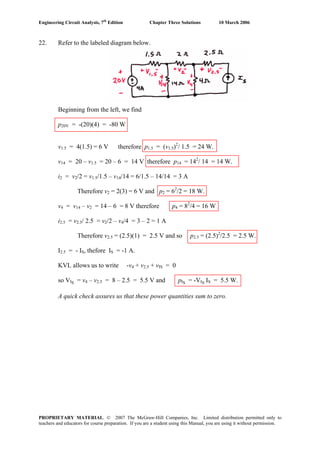
22. Refer to the labeled diagram below.
Beginning from the left, we find
p20V = -(20)(4) = -80 W
v1.5 = 4(1.5) = 6 V therefore p1.5 = (v1.5)2
/ 1.5 = 24 W.
v14 = 20 – v1.5 = 20 – 6 = 14 V therefore p14 = 142
/ 14 = 14 W.
i2 = v2/2 = v1.5/1.5 – v14/14 = 6/1.5 – 14/14 = 3 A
Therefore v2 = 2(3) = 6 V and p2 = 62
/2 = 18 W.
v4 = v14 – v2 = 14 – 6 = 8 V therefore p4 = 82
/4 = 16 W
i2.5 = v2.5/ 2.5 = v2/2 – v4/4 = 3 – 2 = 1 A
Therefore v2.5 = (2.5)(1) = 2.5 V and so p2.5 = (2.5)2
/2.5 = 2.5 W.
I2.5 = - IS, thefore IS = -1 A.
KVL allows us to write -v4 + v2.5 + vIS = 0
so VIS = v4 – v2.5 = 8 – 2.5 = 5.5 V and pIS = -VIS IS = 5.5 W.
A quick check assures us that these power quantities sum to zero.
PROPRIETARY MATERIAL. © 2007 The McGraw-Hill Companies, Inc. Limited distribution permitted only to
teachers and educators for course preparation. If you are a student using this Manual, you are using it without permission.
Engineering Circuit Analysis, 7th
Edition Chapter Three Solutions 10 March 2006
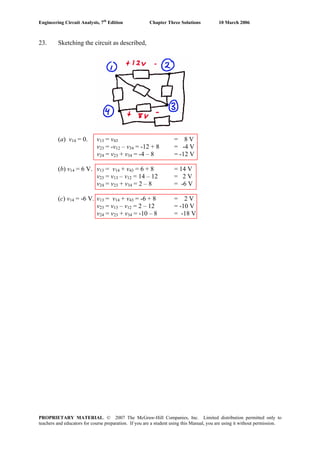
23. Sketching the circuit as described,
(a) v14 = 0. v13 = v43 = 8 V
v23 = -v12 – v34 = -12 + 8 = -4 V
v24 = v23 + v34 = -4 – 8 = -12 V
(b) v14 = 6 V. v13 = v14 + v43 = 6 + 8 = 14 V
v23 = v13 – v12 = 14 – 12 = 2 V
v24 = v23 + v34 = 2 – 8 = -6 V
(c) v14 = -6 V. v13 = v14 + v43 = -6 + 8 = 2 V
v23 = v13 – v12 = 2 – 12 = -10 V
v24 = v23 + v34 = -10 – 8 = -18 V
PROPRIETARY MATERIAL. © 2007 The McGraw-Hill Companies, Inc. Limited distribution permitted only to
teachers and educators for course preparation. If you are a student using this Manual, you are using it without permission.
Engineering Circuit Analysis, 7th
Edition Chapter Three Solutions 10 March 2006
24. (a) By KVL, -12 + 5000ID + VDS + 2000ID = 0
Therefore, VDS = 12 – 7(1.5) = 1.5 V.
(b) By KVL, - VG + VGS + 2000ID = 0
Therefore, VGS = VG – 2(2) = -1 V.
PROPRIETARY MATERIAL. © 2007 The McGraw-Hill Companies, Inc. Limited distribution permitted only to
teachers and educators for course preparation. If you are a student using this Manual, you are using it without permission.
Engineering Circuit Analysis, 7th
Edition Chapter Three Solutions 10 March 2006
25. Applying KVL around this series circuit,
-120 + 30ix + 40ix + 20ix + vx + 20 + 10ix = 0
where vx is defined across the unknown element X, with the “+” reference on top.
Simplifying, we find that 100ix + vx = 100
To solve further we require specific information about the element X and its
properties.
(a) if X is a 100-Ω resistor,
vx = 100ix so we find that 100 ix + 100 ix = 100.
Thus
ix = 500 mA and px = vx ix = 25 W.
(b) If X is a 40-V independent voltage source such that vx = 40 V, we find that
ix = (100 – 40) / 100 = 600 mA and px = vx ix = 24 W
(c) If X is a dependent voltage source such that vx = 25ix,
ix = 100/125 = 800 mA and px = vx ix = 16 W.
(d) If X is a dependent voltage source so that vx = 0.8v1,
where v1 = 40ix, we have
100 ix + 0.8(40ix) = 100
or ix = 100/132 = 757.6 mA and px = vx ix = 0.8(40)(0.7576)2
= 18.37 W.
(e) If X is a 2-A independent current source, arrow up,
100(-2) + vx = 100
so that vx = 100 + 200 = 300 V and px = vx ix = -600 W
PROPRIETARY MATERIAL. © 2007 The McGraw-Hill Companies, Inc. Limited distribution permitted only to
teachers and educators for course preparation. If you are a student using this Manual, you are using it without permission.
Engineering Circuit Analysis, 7th
Edition Chapter Three Solutions 10 March 2006
26. (a) We first apply KVL:
-20 + 10i1 + 90 + 40i1 + 2v2 = 0
where v2 = 10i1. Substituting,
70 + 70 i1 = 0
or i1= -1 A.
(b) Applying KVL,
-20 + 10i1 + 90 + 40i1 + 1.5v3 = 0 [1]
where
v3 = -90 – 10i1 + 20 = -70 – 10 i1
alternatively, we could write
v3 = 40i1 + 1.5v3 = -80i1
Using either expression in Eq. [1], we find i1 = 1 A.
(c) Applying KVL,
-20 + 10i1 + 90 + 40i1 - 15 i1 = 0
Solving, i1 = - 2A.
PROPRIETARY MATERIAL. © 2007 The McGraw-Hill Companies, Inc. Limited distribution permitted only to
teachers and educators for course preparation. If you are a student using this Manual, you are using it without permission.
Engineering Circuit Analysis, 7th
Edition Chapter Three Solutions 10 March 2006
27. Applying KVL, we find that
-20 + 10i1 + 90 + 40i1 + 1.8v3 = 0 [1]
Also, KVL allows us to write
v3 = 40i1 + 1.8v3
v3 = -50i1
So that we may write Eq. [1] as
50i1 – 1.8(50)i1 = -70
or i1 = -70/-40 = 1.75 A.
Since v3 = -50i1 = -87.5 V, no further information is required to determine its value.
The 90-V source is absorbing (90)(i1) = 157.5 W of power and the dependent source
is absorbing (1.8v3)(i1) = -275.6 W of power.
Therefore, none of the conditions specified in (a) to (d) can be met by this circuit.
PROPRIETARY MATERIAL. © 2007 The McGraw-Hill Companies, Inc. Limited distribution permitted only to
teachers and educators for course preparation. If you are a student using this Manual, you are using it without permission.
Engineering Circuit Analysis, 7th
Edition Chapter Three Solutions 10 March 2006
28. (a) Define the charging current i as flowing clockwise in the circuit provided.
By application of KVL,
-13 + 0.02i + Ri + 0.035i + 10.5 = 0
We know that we need a current i = 4 A, so we may calculate the necessary resistance
R = [13 – 10.5 – 0.055(4)]/ 4 = 570 mΩ
(b) The total power delivered to the battery consists of the power absorbed by the
0.035-Ω resistance (0.035i2
), and the power absorbed by the 10.5-V ideal battery
(10.5i). Thus, we need to solve the quadratic equation
0.035i2
+ 10.5i = 25
which has the solutions i = -302.4 A and i = 2.362 A.
In order to determine which of these two values should be used, we must recall that
the idea is to charge the battery, implying that it is absorbing power, or that i as
defined is positive. Thus, we choose i = 2.362 A, and, making use of the expression
developed in part (a), we find that
R = [13 – 10.5 – 0.055(2.362)]/ 2.362 = 1.003 Ω
(c) To obtain a voltage of 11 V across the battery, we apply KVL:
0.035i + 10.5 = 11 so that i = 14.29 A
From part (a), this means we need
R = [13 – 10.5 – 0.055(14.29)]/ 14.29 = 119.9 mΩ
PROPRIETARY MATERIAL. © 2007 The McGraw-Hill Companies, Inc. Limited distribution permitted only to
teachers and educators for course preparation. If you are a student using this Manual, you are using it without permission.
Engineering Circuit Analysis, 7th
Edition Chapter Three Solutions 10 March 2006
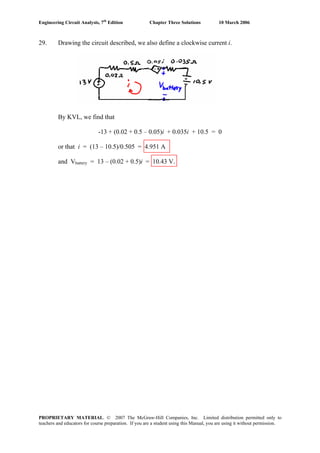
29. Drawing the circuit described, we also define a clockwise current i.
By KVL, we find that
-13 + (0.02 + 0.5 – 0.05)i + 0.035i + 10.5 = 0
or that i = (13 – 10.5)/0.505 = 4.951 A
and Vbattery = 13 – (0.02 + 0.5)i = 10.43 V.
PROPRIETARY MATERIAL. © 2007 The McGraw-Hill Companies, Inc. Limited distribution permitted only to
teachers and educators for course preparation. If you are a student using this Manual, you are using it without permission.
Engineering Circuit Analysis, 7th
Edition Chapter Three Solutions 10 March 2006
30. Applying KVL about this simple loop circuit (the dependent sources are still linear
elements, by the way, as they depend only upon a sum of voltages)
-40 + (5 + 25 + 20)i – (2v3 + v2) + (4v1 – v2) = 0 [1]
where we have defined i to be flowing in the clockwise direction, and
v1 = 5i, v2 = 25i, and v3 = 20i.
Performing the necessary substition, Eq. [1] becomes
50i - (40i + 25i) + (20i – 25i) = 40
so that i = 40/-20 = -2 A
Computing the absorbed power is now a straightforward matter:
p40V = (40)(-i) = 80 W
p5Ω = 5i2
= 20 W
p25Ω = 25i2
= 100 W
p20Ω = 20i2
= 80 W
pdepsrc1 = (2v3 + v2)(-i) = (40i + 25i) = -260 W
pdepsrc2 = (4v1 - v2)(-i) = (20i - 25i) = -20 W
and we can easily verify that these quantities indeed sum to zero as expected.
PROPRIETARY MATERIAL. © 2007 The McGraw-Hill Companies, Inc. Limited distribution permitted only to
teachers and educators for course preparation. If you are a student using this Manual, you are using it without permission.
Engineering Circuit Analysis, 7th
Edition Chapter Three Solutions 10 March 2006
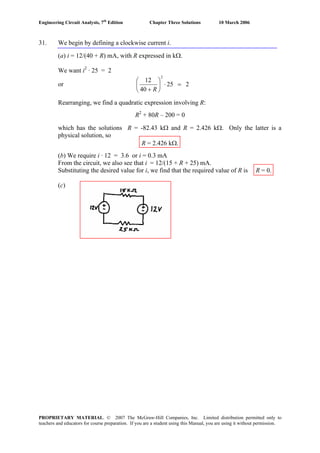
31. We begin by defining a clockwise current i.
(a) i = 12/(40 + R) mA, with R expressed in kΩ.
We want i2
· 25 = 2
or 225
40
12
2
=⋅⎟
⎠
⎞
⎜
⎝
⎛
+ R
Rearranging, we find a quadratic expression involving R:
R2
+ 80R – 200 = 0
which has the solutions R = -82.43 kΩ and R = 2.426 kΩ. Only the latter is a
physical solution, so
R = 2.426 kΩ.
(b) We require i · 12 = 3.6 or i = 0.3 mA
From the circuit, we also see that i = 12/(15 + R + 25) mA.
Substituting the desired value for i, we find that the required value of R is R = 0.
(c)
PROPRIETARY MATERIAL. © 2007 The McGraw-Hill Companies, Inc. Limited distribution permitted only to
teachers and educators for course preparation. If you are a student using this Manual, you are using it without permission.
Engineering Circuit Analysis, 7th
Edition Chapter Three Solutions 10 March 2006
32. By KVL,
–12 + (1 + 2.3 + Rwire segment) i = 0
The wire segment is a 3000–ft section of 28–AWG solid copper wire. Using Table
2.3, we compute its resistance as
(16.2 mΩ/ft)(3000 ft) = 48.6 Ω
which is certainly not negligible compared to the other resistances in the circuit!
Thus,
i = 12/(1 + 2.3 + 48.6) = 231.2 mA
PROPRIETARY MATERIAL. © 2007 The McGraw-Hill Companies, Inc. Limited distribution permitted only to
teachers and educators for course preparation. If you are a student using this Manual, you are using it without permission.
Engineering Circuit Analysis, 7th
Edition Chapter Three Solutions 10 March 2006
33. We can apply Ohm’s law to find an expression for vo:
vo = 1000(–gm vπ)
We do not have a value for vπ, but KVL will allow us to express that in terms of vo,
which we do know:
–10×10–3
cos 5t + (300 + 50×103
) i = 0
where i is defined as flowing clockwise.
Thus, vπ = 50×103
i = 50×103
(10×10–3
cos 5t) / (300 + 50×103
)
= 9.940×10⁻³
cos 5t V
and we by substitution we find that
vo = 1000(–25×10–3
)( 9.940×10⁻³
cos 5t )
= –248.5 cos 5t mV
PROPRIETARY MATERIAL. © 2007 The McGraw-Hill Companies, Inc. Limited distribution permitted only to
teachers and educators for course preparation. If you are a student using this Manual, you are using it without permission.
Engineering Circuit Analysis, 7th
Edition Chapter Three Solutions 10 March 2006
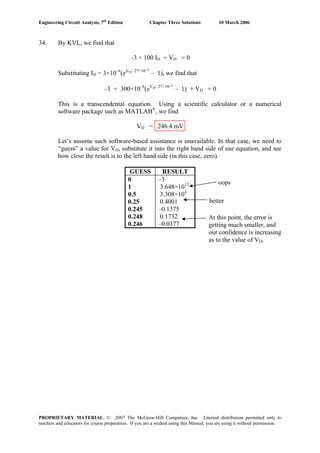
34. By KVL, we find that
–3 + 100 ID + VD = 0
Substituting ID = 3×10⁻⁶
(eVD / 27×10–3
– 1), we find that
–3 + 300×10–6
(eVD / 27×10–3
– 1) + VD = 0
This is a transcendental equation. Using a scientific calculator or a numerical
software package such as MATLAB®
, we find
VD = 246.4 mV
Let’s assume such software-based assistance is unavailable. In that case, we need to
“guess” a value for VD, substitute it into the right hand side of our equation, and see
how close the result is to the left hand side (in this case, zero).
GUESS RESULT
0 –3
1 3.648×10¹²
0.5 3.308×10⁴
0.25 0.4001
0.245 –0.1375
0.248 0.1732
0.246 –0.0377
oops
better
At this point, the error is
getting much smaller, and
our confidence is increasing
as to the value of VD.
PROPRIETARY MATERIAL. © 2007 The McGraw-Hill Companies, Inc. Limited distribution permitted only to
teachers and educators for course preparation. If you are a student using this Manual, you are using it without permission.
Engineering Circuit Analysis, 7th
Edition Chapter Three Solutions 10 March 2006
35. Define a voltage vx, “+” reference on the right, across the dependent current source.
Note that in fact vx appears across each of the four elements. We first convert the 10
mS conductance into a 100–Ω resistor, and the 40–mS conductance into a 25–Ω
resistor.
(a) Applying KCL, we sum the currents flowing into the right–hand node:
5 – vx / 100 – vx / 25 + 0.8 ix = 0 [1]
This represents one equation in two unknowns. A second equation to introduce at this
point is
ix = vx /25 so that Eq. [1] becomes
5 – vx / 100 – vx / 25 + 0.8 (vx / 25) = 0
Solving for vx, we find vx = 277.8 V. It is a simple matter now to compute the power
absorbed by each element:
P5A = –5 vx = –1.389 kW
P100Ω = (vx)2
/ 100 = 771.7 W
P25Ω = (vx)2
/ 25 = 3.087 kW
Pdep = –vx(0.8 ix) = –0.8 (vx)2
/ 25 = –2.470 kW
A quick check assures us that the calculated values sum to zero, as they should.
(b) Again summing the currents into the right–hand node,
5 – vx / 100 – vx / 25 + 0.8 iy = 0 [2]
where iy = 5 – vx/100
Thus, Eq. [2] becomes
5 – vx / 100 – vx / 25 + 0.8(5) – 0.8 (iy) / 100 = 0
Solving, we find that vx x = 155.2 V and iy = 3.448 A
So that
P5A = –5 vx = –776.0 W
P100Ω = (vx)2
/ 100 = 240.9 W
P25Ω = (vx)2
/ 25 = 963.5 W
Pdep = –vx(0.8 iy) = –428.1 W
A quick check shows us that the calculated values sum to 0.3, which is reasonably
close to zero compared to the size of the terms (small roundoff errors accumulated).
PROPRIETARY MATERIAL. © 2007 The McGraw-Hill Companies, Inc. Limited distribution permitted only to
teachers and educators for course preparation. If you are a student using this Manual, you are using it without permission.
Engineering Circuit Analysis, 7th
Edition Chapter Three Solutions 10 March 2006
36. Define a voltage v with the “+” reference at the top node. Applying KCL and
summing the currents flowing out of the top node,
v/5,000 + 4×10⁻³
+ 3i1 + v/20,000 = 0 [1]
This, unfortunately, is one equation in two unknowns, necessitating the search for a
second suitable equation. Returning to the circuit diagram, we observe that
i1 = 3 i1 + v/2,000
or i1 = –v/40,000 [2]
Upon substituting Eq. [2] into Eq. [1], Eq. [1] becomes,
v/5,000 + 4×10⁻³
– 3v/40,000 + v/20,000 = 0
Solving, we find that
v = –22.86 V
and
i1 = 571.4 μA
Since ix = i1, we find that ix = 571.4 μA.
PROPRIETARY MATERIAL. © 2007 The McGraw-Hill Companies, Inc. Limited distribution permitted only to
teachers and educators for course preparation. If you are a student using this Manual, you are using it without permission.
Engineering Circuit Analysis, 7th
Edition Chapter Three Solutions 10 March 2006
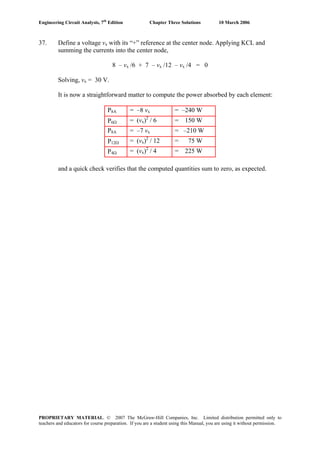
37. Define a voltage vx with its “+” reference at the center node. Applying KCL and
summing the currents into the center node,
8 – vx /6 + 7 – vx /12 – vx /4 = 0
Solving, vx = 30 V.
It is now a straightforward matter to compute the power absorbed by each element:
P8A = –8 vx = –240 W
P6Ω = (vx)2
/ 6 = 150 W
P8A = –7 vx = –210 W
P12Ω = (vx)2
/ 12 = 75 W
P4Ω = (vx)2
/ 4 = 225 W
and a quick check verifies that the computed quantities sum to zero, as expected.
PROPRIETARY MATERIAL. © 2007 The McGraw-Hill Companies, Inc. Limited distribution permitted only to
teachers and educators for course preparation. If you are a student using this Manual, you are using it without permission.
Engineering Circuit Analysis, 7th
Edition Chapter Three Solutions 10 March 2006
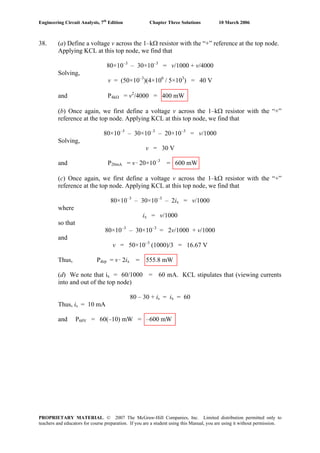
38. (a) Define a voltage v across the 1–kΩ resistor with the “+” reference at the top node.
Applying KCL at this top node, we find that
80×10–3
– 30×10–3
= v/1000 + v/4000
Solving,
v = (50×10–3
)(4×10⁶
/ 5×10³
) = 40 V
and P4kΩ = v2
/4000 = 400 mW
(b) Once again, we first define a voltage v across the 1–kΩ resistor with the “+”
reference at the top node. Applying KCL at this top node, we find that
80×10–3
– 30×10–3
– 20×10–3
= v/1000
Solving,
v = 30 V
and P20mA = v · 20×10–3
= 600 mW
(c) Once again, we first define a voltage v across the 1–kΩ resistor with the “+”
reference at the top node. Applying KCL at this top node, we find that
80×10–3
– 30×10–3
– 2ix = v/1000
where
ix = v/1000
so that
80×10–3
– 30×10–3
= 2v/1000 + v/1000
and
v = 50×10–3
(1000)/3 = 16.67 V
Thus, Pdep = v · 2ix = 555.8 mW
(d) We note that ix = 60/1000 = 60 mA. KCL stipulates that (viewing currents
into and out of the top node)
80 – 30 + is = ix = 60
Thus, is = 10 mA
and P60V = 60(–10) mW = –600 mW
PROPRIETARY MATERIAL. © 2007 The McGraw-Hill Companies, Inc. Limited distribution permitted only to
teachers and educators for course preparation. If you are a student using this Manual, you are using it without permission.
Engineering Circuit Analysis, 7th
Edition Chapter Three Solutions 10 March 2006
39. (a) To cancel out the effects of both the 80-mA and 30-mA sources, iS must be set to
iS = –50 mA.
(b) Define a current is flowing out of the “+” reference terminal of the independent
voltage source. Interpret “no power” to mean “zero power.”
Summing the currents flowing into the top node and invoking KCL, we find that
80×10-3
- 30×10-3
- vS/1×103
+ iS = 0
Simplifying slightly, this becomes
50 - vS + 103
iS = 0 [1]
We are seeking a value for vS such that vS · iS = 0. Clearly, setting vS = 0 will achieve
this. From Eq. [1], we also see that setting vS = 50 V will work as well.
PROPRIETARY MATERIAL. © 2007 The McGraw-Hill Companies, Inc. Limited distribution permitted only to
teachers and educators for course preparation. If you are a student using this Manual, you are using it without permission.
Engineering Circuit Analysis, 7th
Edition Chapter Three Solutions 10 March 2006
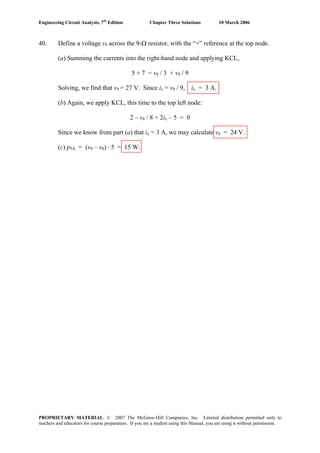
40. Define a voltage v9 across the 9-Ω resistor, with the “+” reference at the top node.
(a) Summing the currents into the right-hand node and applying KCL,
5 + 7 = v9 / 3 + v9 / 9
Solving, we find that v9 = 27 V. Since ix = v9 / 9, ix = 3 A.
(b) Again, we apply KCL, this time to the top left node:
2 – v8 / 8 + 2ix – 5 = 0
Since we know from part (a) that ix = 3 A, we may calculate v8 = 24 V.
(c) p5A = (v9 – v8) · 5 = 15 W.
PROPRIETARY MATERIAL. © 2007 The McGraw-Hill Companies, Inc. Limited distribution permitted only to
teachers and educators for course preparation. If you are a student using this Manual, you are using it without permission.
Engineering Circuit Analysis, 7th
Edition Chapter Three Solutions 10 March 2006
41. Define a voltage vx across the 5-A source, with the “+” reference on top.
Applying KCL at the top node then yields
5 + 5v1 - vx/ (1 + 2) – vx/ 5 = 0 [1]
where v1 = 2[vx /(1 + 2)] = 2 vx / 3.
Thus, Eq. [1] becomes
5 + 5(2 vx / 3) – vx / 3 – vx / 5 = 0
or 75 + 50 vx – 5 vx – 3 vx = 0, which, upon solving, yields vx = -1.786 V.
The power absorbed by the 5-Ω resistor is then simply (vx)2
/5 = 638.0 mW.
PROPRIETARY MATERIAL. © 2007 The McGraw-Hill Companies, Inc. Limited distribution permitted only to
teachers and educators for course preparation. If you are a student using this Manual, you are using it without permission.
Engineering Circuit Analysis, 7th
Edition Chapter Three Solutions 10 March 2006
42. Despite the way it may appear at first glance, this is actually a simple node-pair
circuit. Define a voltage v across the elements, with the “+” reference at the top node.
Summing the currents leaving the top node and applying KCL, we find that
2 + 6 + 3 + v/5 + v/5 + v/5 = 0
or v = -55/3 = -18.33 V. The power supplied by each source is then computed as:
p2A = -v(2) = 36.67 W
p6A = -v(6) = 110 W
p3A = -v(3) = 55 W
The power absorbed by each resistor is simply v2
/5 = 67.22 W for a total of 201.67 W,
which is the total power supplied by all sources. If instead we want the “power
supplied” by the resistors, we multiply by -1 to obtain -201.67 W. Thus, the sum of
the supplied power of each circuit element is zero, as it should be.
PROPRIETARY MATERIAL. © 2007 The McGraw-Hill Companies, Inc. Limited distribution permitted only to
teachers and educators for course preparation. If you are a student using this Manual, you are using it without permission.
Engineering Circuit Analysis, 7th
Edition Chapter Three Solutions 10 March 2006
43. Defining a voltage Vx across the 10-A source with the “+” reference at the top node,
KCL tells us that 10 = 5 + I1Ω, where I1Ω is defined flowing downward through the
1-Ω resistor.
Solving, we find that I1Ω = 5 A, so that Vx = (1)(5) = 5 V.
So, we need to solve
Vx = 5 = 5(0.5 + Rsegment)
with Rsegment = 500 mΩ.
From Table 2.3, we see that 28-AWG solid copper wire has a resistance of 65.3
mΩ/ft. Thus, the total number of miles needed of the wire is
miles101.450
ft/mi)/ft)(5280m(65.3
m500 3-
×=
Ω
Ω
PROPRIETARY MATERIAL. © 2007 The McGraw-Hill Companies, Inc. Limited distribution permitted only to
teachers and educators for course preparation. If you are a student using this Manual, you are using it without permission.
Engineering Circuit Analysis, 7th
Edition Chapter Three Solutions 10 March 2006
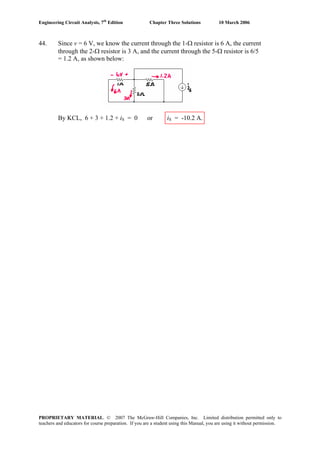
44. Since v = 6 V, we know the current through the 1-Ω resistor is 6 A, the current
through the 2-Ω resistor is 3 A, and the current through the 5-Ω resistor is 6/5
= 1.2 A, as shown below:
By KCL, 6 + 3 + 1.2 + iS = 0 or iS = -10.2 A.
PROPRIETARY MATERIAL. © 2007 The McGraw-Hill Companies, Inc. Limited distribution permitted only to
teachers and educators for course preparation. If you are a student using this Manual, you are using it without permission.
Engineering Circuit Analysis, 7th
Edition Chapter Three Solutions 10 March 2006
45. (a) Applying KCL, 1 – i – 3 + 3 = 0 so i = 1 A.
(b) Looking at the left part of the circuit, we see 1 + 3 = 4 A flowing into the
unknown current source, which, by virtue of KCL, must therefore be a 4-A current
source. Thus, KCL at the node labeled with the “+” reference of the voltage v gives
4 – 2 + 7 – i = 0 or i = 9 A
PROPRIETARY MATERIAL. © 2007 The McGraw-Hill Companies, Inc. Limited distribution permitted only to
teachers and educators for course preparation. If you are a student using this Manual, you are using it without permission.
Engineering Circuit Analysis, 7th
Edition Chapter Three Solutions 10 March 2006
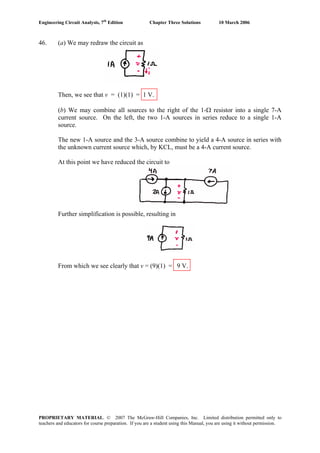
46. (a) We may redraw the circuit as
Then, we see that v = (1)(1) = 1 V.
(b) We may combine all sources to the right of the 1-Ω resistor into a single 7-A
current source. On the left, the two 1-A sources in series reduce to a single 1-A
source.
The new 1-A source and the 3-A source combine to yield a 4-A source in series with
the unknown current source which, by KCL, must be a 4-A current source.
At this point we have reduced the circuit to
Further simplification is possible, resulting in
From which we see clearly that v = (9)(1) = 9 V.
PROPRIETARY MATERIAL. © 2007 The McGraw-Hill Companies, Inc. Limited distribution permitted only to
teachers and educators for course preparation. If you are a student using this Manual, you are using it without permission.
Engineering Circuit Analysis, 7th
Edition Chapter Three Solutions 10 March 2006
47. (a) Combine the 12-V and 2-V series connected sources to obtain a new 12 – 2 = 10 V
source, with the “+” reference terminal at the top. The result is two 10-V sources in
parallel, which is permitted by KVL. Therefore,
i = 10/1000 = 10 mA.
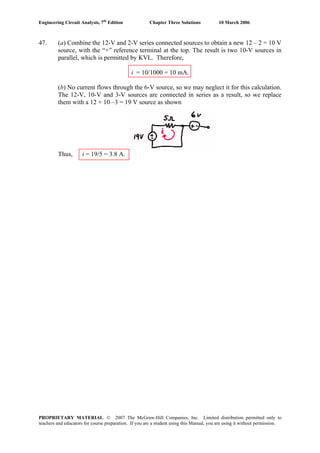
(b) No current flows through the 6-V source, so we may neglect it for this calculation.
The 12-V, 10-V and 3-V sources are connected in series as a result, so we replace
them with a 12 + 10 –3 = 19 V source as shown
Thus, i = 19/5 = 3.8 A.
PROPRIETARY MATERIAL. © 2007 The McGraw-Hill Companies, Inc. Limited distribution permitted only to
teachers and educators for course preparation. If you are a student using this Manual, you are using it without permission.
Engineering Circuit Analysis, 7th
Edition Chapter Three Solutions 10 March 2006
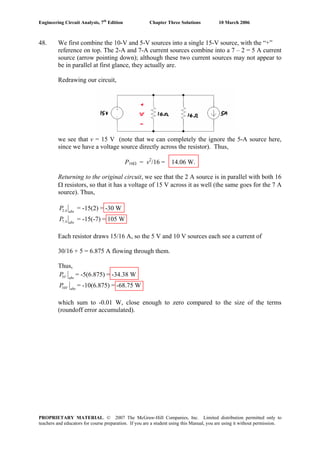
48. We first combine the 10-V and 5-V sources into a single 15-V source, with the “+”
reference on top. The 2-A and 7-A current sources combine into a 7 – 2 = 5 A current
source (arrow pointing down); although these two current sources may not appear to
be in parallel at first glance, they actually are.
Redrawing our circuit,
we see that v = 15 V (note that we can completely the ignore the 5-A source here,
since we have a voltage source directly across the resistor). Thus,
P16Ω = v2
/16 = 14.06 W.
Returning to the original circuit, we see that the 2 A source is in parallel with both 16
Ω resistors, so that it has a voltage of 15 V across it as well (the same goes for the 7 A
source). Thus,
2A abs
P = -15(2) = -30 W
7 A abs
P = -15(-7) = 105 W
Each resistor draws 15/16 A, so the 5 V and 10 V sources each see a current of
30/16 + 5 = 6.875 A flowing through them.
Thus,
5V abs
P = -5(6.875) = -34.38 W
10V abs
P = -10(6.875) = -68.75 W
which sum to -0.01 W, close enough to zero compared to the size of the terms
(roundoff error accumulated).
PROPRIETARY MATERIAL. © 2007 The McGraw-Hill Companies, Inc. Limited distribution permitted only to
teachers and educators for course preparation. If you are a student using this Manual, you are using it without permission.
Engineering Circuit Analysis, 7th
Edition Chapter Three Solutions 10 March 2006
49. We can combine the voltage sources such that
i = vS/ 14
(a) vS = 10 + 10 – 6 – 6 = 20 –12 = 8
Therefore
i = 8/14 = 571.4 mA.
(b) vS = 3 + 2.5 – 3 – 2.5 = 0 Therefore i = 0.
(c) vS = -3 + 1.5 – (-0.5) – 0 = -1 V
Therefore
i = -1/14 = -71.43 mA.
PROPRIETARY MATERIAL. © 2007 The McGraw-Hill Companies, Inc. Limited distribution permitted only to
teachers and educators for course preparation. If you are a student using this Manual, you are using it without permission.
Engineering Circuit Analysis, 7th
Edition Chapter Three Solutions 10 March 2006
50. We first simplify as shown, making use of the fact that we are told ix = 2 A to find the
voltage across the middle and right-most 1-Ω resistors as labeled.
By KVL, then, we find that v1 = 2 + 3 = 5 V.
PROPRIETARY MATERIAL. © 2007 The McGraw-Hill Companies, Inc. Limited distribution permitted only to
teachers and educators for course preparation. If you are a student using this Manual, you are using it without permission.
Engineering Circuit Analysis, 7th
Edition Chapter Three Solutions 10 March 2006
51. We see that to determine the voltage v we will need vx due to the presence of the
dependent current soruce. So, let’s begin with the right-hand side, where we find that
vx = 1000(1 – 3) × 10-3
= -2 V.
Returning to the left-hand side of the circuit, and summing currents into the top node,
we find that
(12 – 3.5) ×10-3
+ 0.03 vx = v/10×103
or v = -515 V.
PROPRIETARY MATERIAL. © 2007 The McGraw-Hill Companies, Inc. Limited distribution permitted only to
teachers and educators for course preparation. If you are a student using this Manual, you are using it without permission.
Engineering Circuit Analysis, 7th
Edition Chapter Three Solutions 10 March 2006
52. (a) We first label the circuit with a focus on determining the current flowing through
each voltage source:
Then the power absorbed by each voltage source is
P2V = -2(-5) = 10 W
P4V = -(-4)(4) = 16 W
P-3V = -(-9)(-3) = -27 W
For the current sources,
So that the absorbed power is
P-5A = +(-5)(6) = -30 W
P-4A = -(-4)(4) = 16 W
P3A = -(3)(7) = -21 W
P12A = -(12)(-3) = 36 W
A quick check assures us that these absorbed powers sum to zero as they should.
(b) We need to change the 4-V source such that the voltage across the –5-A source
drops to zero. Define Vx across the –5-A source such that the “+” reference terminal is
on the left. Then,
-2 + Vx – Vneeded = 0
or Vneeded = -2 V.
PROPRIETARY MATERIAL. © 2007 The McGraw-Hill Companies, Inc. Limited distribution permitted only to
teachers and educators for course preparation. If you are a student using this Manual, you are using it without permission.
Engineering Circuit Analysis, 7th
Edition Chapter Three Solutions 10 March 2006
53. We begin by noting several things:
(1) The bottom resistor has been shorted out;
(2) the far-right resistor is only connected by one terminal and therefore does
not affect the equivalent resistance as seen from the indicated terminals;
(3) All resistors to the right of the top left resistor have been shorted.
Thus, from the indicated terminals, we only see the single 1-kΩ resistor, so that
Req = 1 kΩ.
PROPRIETARY MATERIAL. © 2007 The McGraw-Hill Companies, Inc. Limited distribution permitted only to
teachers and educators for course preparation. If you are a student using this Manual, you are using it without permission.
Engineering Circuit Analysis, 7th
Edition Chapter Three Solutions 10 March 2006
54. (a) We see 1Ω || (1 Ω + 1 Ω) || (1 Ω + 1 Ω + 1 Ω)
= 1Ω || 2 Ω || 3 Ω
= 545.5 mΩ
(b) 1/Req = 1 + 1/2 + 1/3 + … + 1/N
Thus, Req = [1 + 1/2 + 1/3 + … + 1/N]-1
PROPRIETARY MATERIAL. © 2007 The McGraw-Hill Companies, Inc. Limited distribution permitted only to
teachers and educators for course preparation. If you are a student using this Manual, you are using it without permission.
Engineering Circuit Analysis, 7th
Edition Chapter Three Solutions 10 March 2006
55. (a) 5 kΩ = 10 kΩ || 10 kΩ
(b) 57 333 Ω = 47 kΩ + 10 kΩ + 1 kΩ || 1kΩ || 1kΩ
(c) 29.5 kΩ = 47 kΩ || 47 kΩ + 10 kΩ || 10 kΩ + 1 kΩ
PROPRIETARY MATERIAL. © 2007 The McGraw-Hill Companies, Inc. Limited distribution permitted only to
teachers and educators for course preparation. If you are a student using this Manual, you are using it without permission.
Engineering Circuit Analysis, 7th
Edition Chapter Three Solutions 10 March 2006
PROPRIETARY MATERIAL. © 2007 The McGraw-Hill Companies, Inc. Limited distribution permitted only to
teachers and educators for course preparation. If you are a student using this Manual, you are using it without permission.
0 V 1 A5 Ω 7 Ω
5 Ω
1 A 2.917 Ω
56. (a) no simplification is possible using only source and/or resistor combination
techniques.
(b) We first simplify the circuit to
and then notice that the 0-V source is shorting out one of the 5-Ω resistors, so a
further simplification is possible, noting that 5 Ω || 7 Ω = 2.917 Ω:
Engineering Circuit Analysis, 7th
Edition Chapter Three Solutions 10 March 2006
57. Req = 1 kΩ + 2 kΩ || 2 kΩ + 3 kΩ || 3 kΩ + 4 kΩ || 4 kΩ
= 1 kΩ + 1 k Ω + 1.5 kΩ + 2 kΩ
= 5.5 kΩ.
PROPRIETARY MATERIAL. © 2007 The McGraw-Hill Companies, Inc. Limited distribution permitted only to
teachers and educators for course preparation. If you are a student using this Manual, you are using it without permission.
Engineering Circuit Analysis, 7th
Edition Chapter Three Solutions 10 March 2006
PROPRIETARY MATERIAL. © 2007 The McGraw-Hill Companies, Inc. Limited distribution permitted only to
teachers and educators for course preparation. If you are a student using this Manual, you are using it without permission.
58. (a) Working from right to left, we first see that we may combine several resistors as
100 Ω + 100 Ω || 100 Ω + 100 Ω = 250 Ω, yielding the following circuit:
Req →
100 Ω
100 Ω
100 Ω
100 Ω
100 Ω
250 Ω
100 Ω
100 Ω
10 Ω
20 Ω
5 Ω
14.4 ΩReq →
2 Ω
15 Ω 10 Ω
50 Ω
8 Ω 20 Ω 30 Ω
2 Ω 16.67 Ω
8 Ω 50 Ω
Next, we see 100 Ω + 100 Ω || 250 Ω + 100 Ω = 271.4 Ω,
and subsequently 100 Ω + 100 Ω || 271.4 Ω + 100 Ω = 273.1 Ω,
and, finally,
Req = 100 Ω || 273.1 Ω = 73.20 Ω.
(b) First, we combine 24 Ω || (50 Ω + 40 Ω) || 60 Ω = 14.4 Ω, which leaves us with
Thus, Req = 10 Ω + 20 Ω || (5 + 14.4 Ω) = 19.85 Ω.
(c) First combine the 10-Ω and 40-Ω resistors and redraw the circuit:
We now see we have (10 Ω + 15 Ω) || 50 Ω = 16.67 Ω. Redrawing once again,
where the equivalent resistance is seen to be 2 Ω + 50 Ω || 16.67 Ω + 8 Ω = 22.5 Ω.
Engineering Circuit Analysis, 7th
Edition Chapter Three Solutions 10 March 2006
59. (a) Req = [(40 Ω + 20 Ω) || 30 Ω + 80 Ω] || 100 Ω + 10 Ω = 60 Ω.
(b) Req = 80 Ω = [(40 Ω + 20 Ω) || 30 Ω + R] || 100 Ω + 10 Ω
70 Ω = [(60 Ω || 30 Ω) + R] || 100 Ω
1/70 = 1/(20 + R) + 0.01
20+ R = 233.3 Ω therefore R = 213.3 Ω.
(c) R = [(40 Ω + 20 Ω) || 30 Ω + R] || 100 Ω + 10 Ω
R – 10 Ω = [20 + R] || 100
1/(R – 10) = 1/(R + 20) + 1/ 100
3000 = R2
+ 10R – 200
Solving, we find R = -61.79 Ω or R = 51.79 Ω.
Clearly, the first is not a physical solution, so R = 51.79 Ω.
PROPRIETARY MATERIAL. © 2007 The McGraw-Hill Companies, Inc. Limited distribution permitted only to
teachers and educators for course preparation. If you are a student using this Manual, you are using it without permission.
Engineering Circuit Analysis, 7th
Edition Chapter Three Solutions 10 March 2006
60. (a) 25 Ω = 100 Ω || 100 Ω || 100 Ω || 100 Ω
(b) 60 Ω = [(100 Ω || 100 Ω) + 100 Ω] || 100 Ω
(c) 40 Ω = (100 Ω + 100 Ω) || 100 Ω || 100 Ω
PROPRIETARY MATERIAL. © 2007 The McGraw-Hill Companies, Inc. Limited distribution permitted only to
teachers and educators for course preparation. If you are a student using this Manual, you are using it without permission.
Engineering Circuit Analysis, 7th
Edition Chapter Three Solutions 10 March 2006
61. Req = [(5 Ω || 20 Ω) + 6 Ω] || 30 Ω + 2.5 Ω = 10 Ω
The source therefore provides a total of 1000 W and a current of 100/10 = 10 A.
P2.5Ω = (10)2
· 2.5 = 250 W
V30Ω = 100 - 2.5(10) = 75 V
P30Ω = 752
/ 30 = 187.5 W
I6Ω = 10 – V30Ω /30 = 10 – 75/30 = 7.5 A
P6Ω = (7.5)2
· 6 = 337.5 W
V5Ω = 75 – 6(7.5) = 30 V
P5Ω = 302
/ 5 = 180 W
V20Ω = V5Ω = 30 V
P20Ω = 302
/20 = 45 W
We check our results by verifying that the absorbed powers in fact add to 1000 W.
PROPRIETARY MATERIAL. © 2007 The McGraw-Hill Companies, Inc. Limited distribution permitted only to
teachers and educators for course preparation. If you are a student using this Manual, you are using it without permission.
Engineering Circuit Analysis, 7th
Edition Chapter Three Solutions 10 March 2006
PROPRIETARY MATERIAL. © 2007 The McGraw-Hill Companies, Inc. Limited distribution permitted only to
teachers and educators for course preparation. If you are a student using this Manual, you are using it without permission.
62. To begin with, the 10-Ω and 15-Ω resistors are in parallel ( = 6 Ω), and so are the
20-Ω and 5-Ω resistors (= 4 Ω).
Also, the 4-A, 1-A and 6-A current sources are in parallel, so they can be combined
into a single 4 + 6 – 1 = 9 A current source as shown:
- vx +
9 A
14 Ω 6 Ω
6 Ω4 Ω
Next, we note that (14 Ω + 6 Ω) || (4 Ω + 6 Ω) = 6.667 Ω
so that
vx = 9(6.667) = 60 V
and
ix = -60/10 = -6 A.
Engineering Circuit Analysis, 7th
Edition Chapter Three Solutions 10 March 2006
PROPRIETARY MATERIAL. © 2007 The McGraw-Hill Companies, Inc. Limited distribution permitted only to
teachers and educators for course preparation. If you are a student using this Manual, you are using it without permission.
63. (a) Working from right to left, and borrowing x || y notation from resistance
calculations to indicate the operation xy/(x + y),
Gin = {[(6 || 2 || 3) + 0.5] || 1.5 || 2.5 + 0.8} || 4 || 5 mS
= {[(1) + 0.5] || 1.5 || 2.5 + 0.8} || 4 || 5 mS
13.64 mS
100 mS
22.22 mS
Gin →
= {1.377} || 4 || 5
= 0.8502 mS = 850.2 mS
(b) The 50-mS and 40-mS conductances are in series, equivalent to (50(40)/90 =
22.22 mS. The 30-mS and 25-mS conductances are also in series, equivalent to 13.64
mS. Redrawing for clarity,
we see that Gin = 10 + 22.22 + 13.64 = 135.9 mS.
Engineering Circuit Analysis, 7th
Edition Chapter Three Solutions 10 March 2006
64. The bottom four resistors between the 2-Ω resistor and the 30-V source are shorted
out. The 10-Ω and 40-Ω resistors are in parallel (= 8 Ω), as are the 15-Ω and 60-Ω
(=12 Ω) resistors. These combinations are in series.
Define a clockwise current I through the 1-Ω resistor:
I = (150 – 30)/(2 + 8 + 12 + 3 + 1 + 2) = 4.286 A
P1Ω = I2
· 1 = 18.37 W
To compute P10Ω, consider that since the 10-Ω and 40-Ω resistors are in parallel, the
same voltage Vx (“+” reference on the left) appears across both resistors. The current I
= 4.286 A flows into this combination. Thus, Vx = (8)(4.286) = 34.29 V and
P10Ω = (Vx)2
/ 10 = 117.6 W.
P13Ω = 0 since no current flows through that resistor.
PROPRIETARY MATERIAL. © 2007 The McGraw-Hill Companies, Inc. Limited distribution permitted only to
teachers and educators for course preparation. If you are a student using this Manual, you are using it without permission.
Engineering Circuit Analysis, 7th
Edition Chapter Three Solutions 10 March 2006
65. With the meter being a short circuit and no current flowing through it, we can write
R1i1 = R2i2
R3i3 = RiR
And since i1 = i3, and i2 = iR, Eq [1] becomes 1 2
3
R R
R R
= , or 3
2
1
R
R R
R
= . Q.E.D.
→ 1 1 2 2
3 3 R
R i R i
R i Ri
= [1]
PROPRIETARY MATERIAL. © 2007 The McGraw-Hill Companies, Inc. Limited distribution permitted only to
teachers and educators for course preparation. If you are a student using this Manual, you are using it without permission.
Engineering Circuit Analysis, 7th
Edition Chapter Three Solutions 10 March 2006
66. The total resistance in the series string sums to 75 Ω.
The voltage dropped across the 2.2 Ω resistor is
2.2
2.2
V 10 293.3 mV
75
Ω = =
and the voltage dropped across the 47 Ω resistor is
47
47
V 10 6.267 mV
75
Ω = =
PROPRIETARY MATERIAL. © 2007 The McGraw-Hill Companies, Inc. Limited distribution permitted only to
teachers and educators for course preparation. If you are a student using this Manual, you are using it without permission.
Engineering Circuit Analysis, 7th
Edition Chapter Three Solutions 10 March 2006
67. We first note that the 4.7 kΩ and 2.2 kΩ resistors can be combined into a single 1.5
kΩ resistor, which is then in series with the 10 kΩ resistor. Next we note that the 33
kΩ / 47 kΩ parallel combination can be replaced by a 19.39 kΩ resistance, which is
in series with the remaining 33 kΩ resistor.
By voltage division, then, and noting that V47kΩ is the same voltage as that across the
19.39 kΩ resistance,
V47kΩ =
19.39
2 607.0 mV
10 1.5 33 19.39
=
+ + +
PROPRIETARY MATERIAL. © 2007 The McGraw-Hill Companies, Inc. Limited distribution permitted only to
teachers and educators for course preparation. If you are a student using this Manual, you are using it without permission.
Engineering Circuit Analysis, 7th
Edition Chapter Three Solutions 10 March 2006
68. (a) The current downward through the 33 Ω resistor is calculated more easily if we
first note that 134 Ω || 134 Ω = 67 Ω, and 67 Ω + 33 Ω = 100 Ω. Then,
33
1
10012 571.4 mA
1 1 1
10 10 100
I Ω = =
+ +
(b) The resistor flowing downward through either 134 Ω resistor is simply
571.4/2 = 285.7 mA (by current division).
PROPRIETARY MATERIAL. © 2007 The McGraw-Hill Companies, Inc. Limited distribution permitted only to
teachers and educators for course preparation. If you are a student using this Manual, you are using it without permission.
Engineering Circuit Analysis, 7th
Edition Chapter Three Solutions 10 March 2006
69. We first note that 20 Ω || 60 Ω = 15 Ω, and 50 Ω || 30 Ω = 18.75 Ω.
Then, 15 Ω + 22 Ω + 18.75 Ω = 55.75 Ω.
Finally, we are left with two current sources, the series combination of 10 Ω + 15 Ω,
and 10 Ω || 55.75 Ω = 8.479 Ω.
Using current division on the simplified circuit,
( )15
1
10 1530 8 22.12 A
1 1
10 15 8.479
I Ω
+= − =
+
+
PROPRIETARY MATERIAL. © 2007 The McGraw-Hill Companies, Inc. Limited distribution permitted only to
teachers and educators for course preparation. If you are a student using this Manual, you are using it without permission.
Engineering Circuit Analysis, 7th
Edition Chapter Three Solutions 10 March 2006
70. One possible solution of many:
vS = 2(5.5) = 11 V
R1 = R2 = 1 kΩ.
PROPRIETARY MATERIAL. © 2007 The McGraw-Hill Companies, Inc. Limited distribution permitted only to
teachers and educators for course preparation. If you are a student using this Manual, you are using it without permission.
Engineering Circuit Analysis, 7th
Edition Chapter Three Solutions 10 March 2006
71. One possible solution of many:
iS = 11 mA
R1 = R2 = 1 kΩ.
PROPRIETARY MATERIAL. © 2007 The McGraw-Hill Companies, Inc. Limited distribution permitted only to
teachers and educators for course preparation. If you are a student using this Manual, you are using it without permission.
Engineering Circuit Analysis, 7th
Edition Chapter Three Solutions 10 March 2006
72. p15Ω = (v15)2
/ 15×103
A
v15 = 15×103
(-0.3 v1)
where v1 = [4 (5)/ (5 + 2)] · 2 = 5.714 V
Therefore v15 = -25714 V and p15 = 44.08 kW.
PROPRIETARY MATERIAL. © 2007 The McGraw-Hill Companies, Inc. Limited distribution permitted only to
teachers and educators for course preparation. If you are a student using this Manual, you are using it without permission.
Engineering Circuit Analysis, 7th
Edition Chapter Three Solutions 10 March 2006
73. Replace the top 10 kΩ, 4 kΩ and 47 kΩ resistors with 10 kΩ + 4 kΩ || 47 kΩ =
13.69 kΩ.
Define vx across the 10 kΩ resistor with its “+” reference at the top node: then
vx = 5 · (10 kΩ || 13.69 kΩ) / (15 kΩ + 10 || 13.69 kΩ) = 1.391 V
ix = vx/ 10 mA = 139.1 μA
v15 = 5 – 1.391 = 3.609 V and p15 = (v15)2
/ 15×103
= 868.3 μW.
PROPRIETARY MATERIAL. © 2007 The McGraw-Hill Companies, Inc. Limited distribution permitted only to
teachers and educators for course preparation. If you are a student using this Manual, you are using it without permission.
Engineering Circuit Analysis, 7th
Edition Chapter Three Solutions 10 March 2006
74. We may combine the 12-A and 5-A current sources into a single 7-A current source
with its arrow oriented upwards. The left three resistors may be replaced by a 3 +
6 || 13 = 7.105 Ω resistor, and the right three resistors may be replaced by a 7 + 20 || 4
= 10.33 Ω resistor.
By current division, iy = 7 (7.105)/(7.105 + 10.33) = 2.853 A
We must now return to the original circuit. The current into the 6 Ω, 13 Ω parallel
combination is 7 – iy = 4.147 A. By current division,
ix = 4.147 . 13/ (13 + 6) = 2.837 A
and px = (4.147)2
· 3 = 51.59 W
PROPRIETARY MATERIAL. © 2007 The McGraw-Hill Companies, Inc. Limited distribution permitted only to
teachers and educators for course preparation. If you are a student using this Manual, you are using it without permission.
Engineering Circuit Analysis, 7th
Edition Chapter Three Solutions 10 March 2006
75. The controlling voltage v1, needed to obtain the power into the 47-kΩ resistor, can be
found separately as that network does not depend on the left-hand network.
The right-most 2 kΩ resistor can be neglected.
By current division, then, in combination with Ohm’s law,
v1 = 3000[5×10⁻³
(2000)/ (2000 + 3000 + 7000)] = 2.5 V
Voltage division gives the voltage across the 47-kΩ resistor:
V0.9228
16.6747
7)0.5(2.5)(4
20||10047
47
5.0 1 =
+
=
+
v
So that p47kΩ = (0.9928)2
/ 47×103
= 18.12 μW
PROPRIETARY MATERIAL. © 2007 The McGraw-Hill Companies, Inc. Limited distribution permitted only to
teachers and educators for course preparation. If you are a student using this Manual, you are using it without permission.
Engineering Circuit Analysis, 7th
Edition Chapter Three Solutions 10 March 2006
76. The temptation to write an equation such as
v1 =
2020
20
10
+
must be fought!
Voltage division only applies to resistors connected in series, meaning that the same
current must flow through each resistor. In this circuit, i1 ≠ 0 , so we do not have the
same current flowing through both 20 kΩ resistors.
PROPRIETARY MATERIAL. © 2007 The McGraw-Hill Companies, Inc. Limited distribution permitted only to
teachers and educators for course preparation. If you are a student using this Manual, you are using it without permission.
Engineering Circuit Analysis, 7th
Edition Chapter Three Solutions 10 March 2006
77. (a)
)]R(R||[RR
)R(R||R
V
4321
432
S2
++
+
=v
=
( )
( )4324321
432432
S
RRR)R(RRR
RRR)R(RR
V
++++
+++
=
( ) )R(RRRRRR
)R(RR
V
4324321
432
S
++++
+
(b)
)]R(R||[RR
R
V
4321
1
S1
++
=v
=
( )4324321
1
S
RRR)R(RRR
R
V
++++
=
( ) )R(RRRRRR
)RR(RR
V
4324321
4321
S
++++
++
(c) ⎟⎟
⎠
⎞
⎜⎜
⎝
⎛
++⎟⎟
⎠
⎞
⎜⎜
⎝
⎛
=
432
2
1
1
4
RRR
R
R
v
i
=
( )
[ ])RR)(RR(RR)RR(RRR
RRRRR
V
43243243211
24321
S
++++++
++
=
( ) )R(RRRRRR
R
V
4324321
2
S
++++
PROPRIETARY MATERIAL. © 2007 The McGraw-Hill Companies, Inc. Limited distribution permitted only to
teachers and educators for course preparation. If you are a student using this Manual, you are using it without permission.
Engineering Circuit Analysis, 7th
Edition Chapter Three Solutions 10 March 2006
78. (a) With the current source open-circuited, we find that
v1 = V8-
6000||3000500
500
40 =
+
−
(b) With the voltage source short-circuited, we find that
i2 = ( )3 1/3000
3 10 400 A
1/ 500 1/3000 1/6000
μ−
× =
+ +
i3 = ( )3 500
3 10 600 A
500 3000 || 6000
μ−
× =
+
PROPRIETARY MATERIAL. © 2007 The McGraw-Hill Companies, Inc. Limited distribution permitted only to
teachers and educators for course preparation. If you are a student using this Manual, you are using it without permission.
Engineering Circuit Analysis, 7th
Edition Chapter Three Solutions 10 March 2006
79. (a) The current through the 5-Ω resistor is 10/5 = 2 A. Define R as 3 || (4 + 5)
= 2.25 Ω. The current through the 2-Ω resistor then is given by
25.5
I
R)(21
1
I S
S =
++
The current through the 5-Ω resistor is
A2
93
3
25.5
IS
=⎟
⎠
⎞
⎜
⎝
⎛
+
so that IS = 42 A.
(b) Given that IS is now 50 A, the current through the 5-Ω resistor becomes
A2.381
93
3
25.5
IS
=⎟
⎠
⎞
⎜
⎝
⎛
+
Thus, vx = 5(2.381) = 11.90 V
(c) 0.2381
I
93
3
5.25
5I
I S
S
S
=
⎥
⎦
⎤
⎢
⎣
⎡
⎟
⎠
⎞
⎜
⎝
⎛
+
=xv
PROPRIETARY MATERIAL. © 2007 The McGraw-Hill Companies, Inc. Limited distribution permitted only to
teachers and educators for course preparation. If you are a student using this Manual, you are using it without permission.
Engineering Circuit Analysis, 7th
Edition Chapter Three Solutions 10 March 2006
80. First combine the 1 kΩ and 3 kΩ resistors to obtain 750 Ω.
By current division, the current through resistor Rx is
IRx =
750R2000
2000
1010
x
3
++
× −
and we know that Rx · IRx = 9
so
x
x
R2750
R20
9
+
=
9 Rx + 24750 = 20 Rx or Rx = 2250 W. Thus,
PRx = 92
/ Rx = 36 mW.
PROPRIETARY MATERIAL. © 2007 The McGraw-Hill Companies, Inc. Limited distribution permitted only to
teachers and educators for course preparation. If you are a student using this Manual, you are using it without permission.
Engineering Circuit Analysis, 7th
Edition Chapter Three Solutions 10 March 2006
81. Define R = R3 || (R4 + R5)
Then ⎟⎟
⎠
⎞
⎜⎜
⎝
⎛
+
=
2
SR
RR
R
Vv
=
( )
( ) ⎟⎟
⎠
⎞
⎜⎜
⎝
⎛
++++
+++
2543543
543543
S
RRRR)R(RR
RRR)R(RR
V
= ⎟⎟
⎠
⎞
⎜⎜
⎝
⎛
++++
+
)R(RR)RR(RR
)R(RR
V
5435432
543
S
Thus,
⎟⎟
⎠
⎞
⎜⎜
⎝
⎛
+
=
54
5
R5
RR
R
vv
= ⎟⎟
⎠
⎞
⎜⎜
⎝
⎛
++++ )R(RR)RR(RR
RR
V
5435432
53
S
PROPRIETARY MATERIAL. © 2007 The McGraw-Hill Companies, Inc. Limited distribution permitted only to
teachers and educators for course preparation. If you are a student using this Manual, you are using it without permission.
Engineering Circuit Analysis, 7th
Edition Chapter Three Solutions 10 March 2006
82. Define R1 = 10 + 15 || 30 = 20 Ω and R2 = 5 + 25 = 30 Ω.
(a) Ix = I1 . 15 / (15 + 30) = 4 mA
(b) I1 = Ix . 45/15 = 36 mA
(c) I2 = IS R1 / (R1 + R2) and I1 = IS R2 / (R1 + R2)
So I1/I2 = R2/R1
Therefore
I1 = R2I2/R1 = 30(15)/20 = 22.5 mA
Thus, Ix = I1
.
15/ 45 = 7.5 mA
(d) I1 = IS R2/ (R1 + R2) = 60 (30)/ 50 = 36 mA
Thus, Ix = I1 15/ 45 = 12 mA.
PROPRIETARY MATERIAL. © 2007 The McGraw-Hill Companies, Inc. Limited distribution permitted only to
teachers and educators for course preparation. If you are a student using this Manual, you are using it without permission.
Engineering Circuit Analysis, 7th
Edition Chapter Three Solutions 10 March 2006
83. vout = -gm vπ (100 kΩ || 100 kΩ) = -4.762×10³
gm vπ
where vπ = (3 sin 10t) · 15/(15 + 0.3) = 2.941 sin 10t
Thus, vout = -56.02 sin 10t V
PROPRIETARY MATERIAL. © 2007 The McGraw-Hill Companies, Inc. Limited distribution permitted only to
teachers and educators for course preparation. If you are a student using this Manual, you are using it without permission.
Engineering Circuit Analysis, 7th
Edition Chapter Three Solutions 10 March 2006
84. vout = -1000gm vπ
where vπ = V10sin2.679
0.33)||(15
3||15
10sin3 tt =
+
therefore
vout = -(2.679)(1000)(38×10-3
) sin 10t = -101.8 sin 10t V.
PROPRIETARY MATERIAL. © 2007 The McGraw-Hill Companies, Inc. Limited distribution permitted only to
teachers and educators for course preparation. If you are a student using this Manual, you are using it without permission.
Engineering Circuit Analysis, 7th
Edition Chapter Four Solutions 10 March 2006
1. (a) 0.1 -0.3 -0.4 v1 0
-0.5 0.1 0 v2 = 4
-0.2 -0.3 0.4 v3 6
Solving this matrix equation using a scientific calculator, v2 = -8.387 V
(b) Using a scientific calculator, the determinant is equal to 32.
PROPRIETARY MATERIAL. © 2007 The McGraw-Hill Companies, Inc. Limited distribution permitted only to
teachers and educators for course preparation. If you are a student using this Manual, you are using it without permission.
Engineering Circuit Analysis, 7th
Edition Chapter Four Solutions 10 March 2006
2. (a) 1 1 1 vA 27
-1 2 3 vB = -16
2 0 4 vC -6
Solving this matrix equation using a scientific calculator,
vA = 19.57
vB = 18.71
vC = -11.29
(b) Using a scientific calculator,
1 1 1
-1 2 3 = 16
2 0 4
PROPRIETARY MATERIAL. © 2007 The McGraw-Hill Companies, Inc. Limited distribution permitted only to
teachers and educators for course preparation. If you are a student using this Manual, you are using it without permission.
Engineering Circuit Analysis, 7th
Edition Chapter Four Solutions 10 March 2006
3.
(a) We begin by simplifying the equations prior to solution:
1 2 3
1 2
1 2
4 0.08 0.05 0.02
8 0.02 0.025 0.045
2 0.05 0.115 0.025
v v v
v v
v v
= − −
= − − +
− = − + −
3
3
v
v
⎤ ⎡ ⎤
⎥ ⎢ ⎥
⎥ ⎢ ⎥
⎥ ⎢ ⎥
Then, we can solve the matrix equation:
1
2
3
0.08 -0.05 -0.02 4
-0.02 -0.025 0.045 8
-0.05 0.115 -0.025 2
v
v
v
⎡ ⎤ ⎡
⎢ ⎥ ⎢ =⎢ ⎥ ⎢
⎢ ⎥ ⎢ −⎣ ⎦ ⎣ ⎦ ⎣ ⎦
to obtain v1 = 264.3 V, v2 = 183.9 V and v3 = 397.4 V.
(b) We may solve the matrix equation directly using MATLAB, but a better check is to
invoke the symbolic processor:
>> e1 = '4 = v1/100 + (v1 - v2)/20 + (v1 - vx)/50';
>> e2 = '10 - 4 - (-2) = (vx - v1)/50 + (vx - v2)/40';
>> e3 = '-2 = v2/25 + (v2 - vx)/40 + (v2 - v1)/20';
>> a = solve(e1,e2,e3,'v1','v2','vx');
>> a.v1
ans =
82200/311
>> a.v2
ans =
57200/311
>> a.vx
ans =
123600/311
PROPRIETARY MATERIAL. © 2007 The McGraw-Hill Companies, Inc. Limited distribution permitted only to
teachers and educators for course preparation. If you are a student using this Manual, you are using it without permission.
Engineering Circuit Analysis, 7th
Edition Chapter Four Solutions 10 March 2006
4. We select the bottom node as our reference terminal and define two nodal voltages:
Ref.
Next, we write the two required nodal equations:
Node 1: 1 1 2
1
2 3
v v v−
= +
Node 2: 2 2
3
1 3
v v v−
− = + 1
Which may be simplified to: 5v1 – 2v2 = 6
and -v1 + 4v2 = -9
Solving, we find that v1 = 333.3 mV.
PROPRIETARY MATERIAL. © 2007 The McGraw-Hill Companies, Inc. Limited distribution permitted only to
teachers and educators for course preparation. If you are a student using this Manual, you are using it without permission.
Engineering Circuit Analysis, 7th
Edition Chapter Four Solutions 10 March 2006
5. We begin by selecting the bottom node as the reference terminal, and defining
two nodal voltages VA and VB, as shown. (Note if we choose the upper right
node, v1 becomes a nodal voltage and falls directly out of the solution.)
VA VB
Ref.
We note that after completing nodal analysis, we can find v1 as v1 = VA – VB.
At node A: A AV V VB
10 5
4
−
= + [1]
At node B: B BV V V
( 6)
8 5
A−
− − = + [2]
Simplifying, 3VA – 2VB = 40 [1]
–8VA + 13VB = 240 [2]
Solving, VA = 43.48 V and VB = 45.22 V, so v1 = –1.740 V.
PROPRIETARY MATERIAL. © 2007 The McGraw-Hill Companies, Inc. Limited distribution permitted only to
teachers and educators for course preparation. If you are a student using this Manual, you are using it without permission.
Engineering Circuit Analysis, 7th
Edition Chapter Four Solutions 10 March 2006
6. By inspection, no current flows through the 2 Ω resistor, so i1 = 0.
We next designate the bottom node as the reference terminal, and define VA and
VB as shown:
VA VB
Ref.
At node A: A A BV V V
2 [1]
3 1
−
= +
At node B: B B B AV V V V
2 [
6 6 1
2]
−
− = + +
Note this yields VA and VB, not v1, due to our choice of reference node. So, we
obtain v1 by KVL: v1 = VA – VB.
Simplifying Eqs. [1] and [2],
4VA – 3VB = 6 [1]
–3VA + 4VB = –6 [2]
Solving, VA = 0.8571 V and VB = -0.8571 V, so v1 = 1.714 V.
PROPRIETARY MATERIAL. © 2007 The McGraw-Hill Companies, Inc. Limited distribution permitted only to
teachers and educators for course preparation. If you are a student using this Manual, you are using it without permission.
Engineering Circuit Analysis, 7th
Edition Chapter Four Solutions 10 March 2006
7. The bottom node has the largest number of branch connections, so we choose that as
our reference node. This also makes vP easier to find, as it will be a nodal voltage.
Working from left to right, we name our nodes 1, P, 2, and 3.
NODE 1: 10 = v1/ 20 + (v1 – vP)/ 40 [1]
NODE P: 0 = (vP – v1)/ 40 + vP/ 100 + (vP – v2)/ 50 [2]
NODE 2: -2.5 + 2 = (v2 – vP)/ 50 + (v2 – v3)/ 10 [3]
NODE 3: 5 – 2 = v3/ 200 + (v3 – v2)/ 10 [4]
Simplifying,
60v1 - 20vP = 8000 [1]
-50v1 + 110 vP - 40v2 = 0 [2]
- vP + 6v2 - 5v3 = -25 [3]
-200v2 + 210v3 = 6000 [4]
Solving,
vP = 171.6 V
PROPRIETARY MATERIAL. © 2007 The McGraw-Hill Companies, Inc. Limited distribution permitted only to
teachers and educators for course preparation. If you are a student using this Manual, you are using it without permission.
Engineering Circuit Analysis, 7th
Edition Chapter Four Solutions 10 March 2006
8. The logical choice for a reference node is the bottom node, as then vx will
automatically become a nodal voltage.
NODE 1: 4 = v1/ 100 + (v1 – v2)/ 20 + (v1 – vx)/ 50 [1]
NODE x: 10 – 4 – (-2) = (vx – v1)/ 50 + (vx – v2)/ 40 [2]
NODE 2: -2 = v2 / 25 + (v2 – vx)/ 40 + (v2 – v1)/ 20 [3]
Simplifying,
4 = 0.0800v1 – 0.0500v2 – 0.0200vx [1]
8 = -0.0200v1 – 0.02500v2 + 0.04500vx [2]
-2 = -0.0500v1 + 0.1150v2 – 0.02500vx [3]
Solving,
vx = 397.4 V.
PROPRIETARY MATERIAL. © 2007 The McGraw-Hill Companies, Inc. Limited distribution permitted only to
teachers and educators for course preparation. If you are a student using this Manual, you are using it without permission.
Engineering Circuit Analysis, 7th
Edition Chapter Four Solutions 10 March 2006
9. Designate the node between the 3-Ω and 6-Ω resistors as node X, and the right-hand
node of the 6-Ω resistor as node Y. The bottom node is chosen as the reference node.
(a) Writing the two nodal equations, then
NODE X: –10 = (vX – 240)/ 3 + (vX – vY)/ 6 [1]
NODE Y: 0 = (vY – vX)/ 6 + vY/ 30 + (vY – 60)/ 12 [2]
Simplifying, -180 + 1440 = 9 vX – 3 vY [1]
10800 = - 360 vX + 612 vY [2]
Solving, vX = 181.5 V and vY = 124.4 V
Thus, v1 = 240 – vX = 58.50 V and v2 = vY – 60 = 64.40 V
(b) The power absorbed by the 6-Ω resistor is
(vX – vY)2
/ 6 = 543.4 W
PROPRIETARY MATERIAL. © 2007 The McGraw-Hill Companies, Inc. Limited distribution permitted only to
teachers and educators for course preparation. If you are a student using this Manual, you are using it without permission.
Engineering Circuit Analysis, 7th
Edition Chapter Four Solutions 10 March 2006
10. Only one nodal equation is required: At the node where three resistors join,
0.02v1 = (vx – 5 i2) / 45 + (vx – 100) / 30 + (vx – 0.2 v3) / 50 [1]
This, however, is one equation in four unknowns, the other three resulting from the
presence of the dependent sources. Thus, we require three additional equations:
i2 = (0.2 v3 - vx) / 50 [2]
v1 = 0.2 v3 - 100 [3]
v3 = 50i2 [4]
Simplifying,
v1 – 0.2v3 = -100 [3]
– v3 + 50 i2 = 0 [4]
–vx + 0.2v3 – 50 i2 = 0 [2]
0.07556vx – 0.02v1 – 0.004v3 – 0.111i2 = 33.33 [1]
Solving, we find that v1 = -103..8 V and i2 = -377.4 mA.
PROPRIETARY MATERIAL. © 2007 The McGraw-Hill Companies, Inc. Limited distribution permitted only to
teachers and educators for course preparation. If you are a student using this Manual, you are using it without permission.
Engineering Circuit Analysis, 7th
Edition Chapter Four Solutions 10 March 2006
11. If v1 = 0, the dependent source is a short circuit and we may redraw the circuit as:
At NODE 1: 4 - 6 = v1/ 40 + (v1 – 96)/ 20 + (v1 – V2)/ 10
Since v1 = 0, this simplifies to
-2 = -96 / 20 - V2/ 10
so that V2 = -28 V.
20 Ω 10 Ω
40 Ω
+
v1 = 0
-
.
PROPRIETARY MATERIAL. © 2007 The McGraw-Hill Companies, Inc. Limited distribution permitted only to
teachers and educators for course preparation. If you are a student using this Manual, you are using it without permission.
Engineering Circuit Analysis, 7th
Edition Chapter Four Solutions 10 March 2006
12. We choose the bottom node as ground to make calculation of i5 easier. The left-most
node is named “1”, the top node is named “2”, the central node is named “3” and the
node between the 4-Ω and 6-Ω resistors is named “4.”
NODE 1: - 3 = v1/2 + (v1 – v2)/ 1 [1]
NODE 2: 2 = (v2 – v1)/ 1 + (v2 – v3)/ 3 + (v2 – v4)/ 4 [2]
NODE 3: 3 = v3/ 5 + (v3 – v4)/ 7 + (v3 – v2)/ 3 [3]
NODE 4: 0 = v4/ 6 + (v4 – v3)/ 7 + (v4 – v2)/ 4 [4]
Rearranging and grouping terms,
3v1 – 2v2 = -6 [1]
-12v1 + 19v2 – 4v3 – 3v4 = 24 [2]
–35v2 + 71v3 – 15v4 = 315 [3]
-42v2 – 24v3 + 94v4 = 0 [4]
Solving, we find that v3 = 6.760 V and so i5 = v3/ 5 = 1.352 A.
PROPRIETARY MATERIAL. © 2007 The McGraw-Hill Companies, Inc. Limited distribution permitted only to
teachers and educators for course preparation. If you are a student using this Manual, you are using it without permission.
Engineering Circuit Analysis, 7th
Edition Chapter Four Solutions 10 March 2006
13. We can redraw this circuit and eliminate the 2.2-kΩ resistor as no current flows
through it:
At NODE 2: 7×10⁻³
– 5×10-3
= (v2 + 9)/ 470 + (v2 – vx)/ 10×10-3
[1]
At NODE x: 5×10⁻³
– 0.2v1 = (vx – v2)/ 10×103
[2]
The additional equation required by the presence of the dependent source and the fact
that its controlling variable is not one of the nodal voltages:
v1 = v2 – vx [3]
Eliminating the variable v1 and grouping terms, we obtain:
10,470 v2 – 470 vx = –89,518
and
1999 v2 – 1999 vx = 50
Solving, we find vx = –8.086 V.
↓9 V 7 mA
5 mA
0.2 v1
10 kΩ
470 Ω + v1 - vx
v2
PROPRIETARY MATERIAL. © 2007 The McGraw-Hill Companies, Inc. Limited distribution permitted only to
teachers and educators for course preparation. If you are a student using this Manual, you are using it without permission.
Engineering Circuit Analysis, 7th
Edition Chapter Four Solutions 10 March 2006
14. We need concern ourselves with the bottom part of this circuit only. Writing a single
nodal equation,
-4 + 2 = v/ 50
We find that v = -100 V.
PROPRIETARY MATERIAL. © 2007 The McGraw-Hill Companies, Inc. Limited distribution permitted only to
teachers and educators for course preparation. If you are a student using this Manual, you are using it without permission.
Engineering Circuit Analysis, 7th
Edition Chapter Four Solutions 10 March 2006
15. We choose the bottom node as the reference terminal. Then:
Node 1: 1 1
2
2 1
v v v− 2
+− = [1]
Node 2: 2 32 1 2 4
4
1 2 4
v vv v v v−− −
= + + [2]
Node 3: 3 2 3 3 4
2 [3]
2 5 10
v v v v v− −
= + +
Node 4: 4 34 4 2
6 10 4
v vv v v−
0
−
= + + [4]
Node 5: 5 5 7
1
2 1
v v v−
− = [5]+
Node 6: 6 6 7 6 8
5 2 10
v v v v v− −
= + +1 [6]
Node 7: 7 5 7 6 7 8
2 [7]
1 2 4
v v v v v v− − −
= + +
Node 8: 8 8 6 8 7
6 10 4
v v v v v− −
= + +0 [8]
Note that Eqs. [1-4] may be solved independently of Eqs. [5-8].
Simplifying,
to yield
1 2
1 2 3 4
2 3 4
2 3 4
3 2 4 [1]
4 7 2 16 [2]
5 8 20 [3]
15 6 31 0 [4]
v v
v v v v
v v v
v v v
− = −
− + − − =
− + − =
− − + =
1
2
3
4
3.370 V
7.055 V
7.518 V
4.869 V
v
v
v
v
=
=
=
=
and
5 7
6 7 8
5 6 7 8
6 7 8
3 2 2 [5]
8 5 10 [6]
4 2 7 8 [7]
6 15 31 0 [8]
v v
v v v
v v v v
v v v
− = −
− − =
− − + − =
− − + =
to yield
5
6
7
8
1.685 V
3.759 V
3.527 V
2.434 V
v
v
v
v
=
=
=
=
PROPRIETARY MATERIAL. © 2007 The McGraw-Hill Companies, Inc. Limited distribution permitted only to
teachers and educators for course preparation. If you are a student using this Manual, you are using it without permission.
Engineering Circuit Analysis, 7th
Edition Chapter Four Solutions 10 March 2006
16. We choose the center node for our common terminal, since it connects to the largest
number of branches. We name the left node “A”, the top node “B”, the right node
“C”, and the bottom node “D”. We next form a supernode between nodes A and B.
At the supernode: 5 = (VA – VD)/ 10 + VA/ 20 + (VB – VC)/ 12.5 [1]
At node C: VC = 150 [2]
At node D: -10 = VD/ 25 + (VD – VA)/ 10 [3]
Our supernode-related equation is VB – VA = 100 [4]
Simplifiying and grouping terms,
0.15 VA + 0.08 VB - 0.08 VC – 0.1 VD = 5 [1]
VC = 150 [2]
-25 VA + 35 VD = -2500 [3]
- VA + VB = 100 [4]
Solving, we find that VD = -63.06 V. Since v4 = - VD,
v4 = 63.06 V.
PROPRIETARY MATERIAL. © 2007 The McGraw-Hill Companies, Inc. Limited distribution permitted only to
teachers and educators for course preparation. If you are a student using this Manual, you are using it without permission.
Engineering Circuit Analysis, 7th
Edition Chapter Four Solutions 10 March 2006
17. Choosing the bottom node as the reference terminal and naming the left node “1”, the
center node “2” and the right node “3”, we next form a supernode about nodes 1 and
2, encompassing the dependent voltage source.
At the supernode, 5 – 8 = (v1 – v2)/ 2 + v3/ 2.5 [1]
At node 2, 8 = v2 / 5 + (v2 – v1)/ 2 [2]
Our supernode equation is v1 - v3 = 0.8 vA [3]
Since vA = v2, we can rewrite [3] as v1 – v3 = 0.8v2
Simplifying and collecting terms,
0.5 v1 - 0.5 v2 + 0.4 v3 = -3 [1]
-0.5 v1 + 0.7 v2 = 8 [2]
v1 - 0.8 v2 - v3 = 0 [3]
(a) Solving for v2 = vA, we find that vA = 25.91 V
(b) The power absorbed by the 2.5-Ω resistor is
(v3)2
/ 2.5 = (-0.4546)2
/ 2.5 = 82.66 mW.
PROPRIETARY MATERIAL. © 2007 The McGraw-Hill Companies, Inc. Limited distribution permitted only to
teachers and educators for course preparation. If you are a student using this Manual, you are using it without permission.
Engineering Circuit Analysis, 7th
Edition Chapter Four Solutions 10 March 2006
18. Selecting the bottom node as the reference terminal, we name the left node “1”, the
middle node “2” and the right node “3.”
NODE 1: 5 = (v1 – v2)/ 20 + (v1 – v3)/ 50 [1]
NODE 2: v2 = 0.4 v1 [2]
NODE 3: 0.01 v1 = (v3 – v2)/ 30 + (v3 – v1)/ 50 [3]
Simplifying and collecting terms, we obtain
0.07 v1 – 0.05 v2 – 0.02 v3 = 5 [1]
0.4 v1 – v2 = 0 [2]
-0.03 v1 – 0.03333 v2 + 0.05333 v3 = 0 [3]
Since our choice of reference terminal makes the controlling variable of both
dependent sources a nodal voltage, we have no need for an additional equation as we
might have expected.
Solving, we find that v1 = 148.2 V, v2 = 59.26 V, and v3 = 120.4 V.
The power supplied by the dependent current source is therefore
(0.01 v1) • v3 = 177.4 W.
PROPRIETARY MATERIAL. © 2007 The McGraw-Hill Companies, Inc. Limited distribution permitted only to
teachers and educators for course preparation. If you are a student using this Manual, you are using it without permission.
Engineering Circuit Analysis, 7th
Edition Chapter Four Solutions 10 March 2006
19. At node x: vx/ 4 + (vx – vy)/ 2 + (vx – 6)/ 1 = 0 [1]
At node y: (vy – kvx)/ 3 + (vy – vx)/ 2 = 2 [2]
Our additional constraint is that vy = 0, so we may simplify Eqs. [1] and [2]:
14 vx = 48 [1]
-2k vx - 3 vx = 12 [2]
Since Eq. [1] yields vx = 48/14 = 3.429 V, we find that
k = (12 + 3 vx)/ (-2 vx) = -3.250
PROPRIETARY MATERIAL. © 2007 The McGraw-Hill Companies, Inc. Limited distribution permitted only to
teachers and educators for course preparation. If you are a student using this Manual, you are using it without permission.
Engineering Circuit Analysis, 7th
Edition Chapter Four Solutions 10 March 2006
20. Choosing the bottom node joining the 4-Ω resistor, the 2-A current sourcee and the
4-V voltage source as our reference node, we next name the other node of the 4-Ω
resistor node “1”, and the node joining the 2-Ω resistor and the 2-A current source
node “2.” Finally, we create a supernode with nodes “1” and “2.”
At the supernode: –2 = v1/ 4 + (v2 – 4)/ 2 [1]
Our remaining equations: v1 – v2 = –3 – 0.5i1 [2]
and i1 = (v2 – 4)/ 2 [3]
Equation [1] simplifies to v1 + 2 v2 = 0 [1]
Combining Eqs. [2] and [3, 4 v1 – 3 v2 = –8 [4]
Solving these last two equations, we find that v2 = 727.3 mV. Making use of Eq. [3],
we therefore find that
i1 = – 1.636 A.
PROPRIETARY MATERIAL. © 2007 The McGraw-Hill Companies, Inc. Limited distribution permitted only to
teachers and educators for course preparation. If you are a student using this Manual, you are using it without permission.
Engineering Circuit Analysis, 7th
Edition Chapter Four Solutions 10 March 2006
21. We first number the nodes as 1, 2, 3, 4, and 5 moving left to right. We next select
node 5 as the reference terminal. To simplify the analysis, we form a supernode from
nodes 1, 2, and 3.
At the supernode,
-4 – 8 + 6 = v1/ 40 + (v1 – v3)/ 10 + (v3 – v1)/ 10 + v2/ 50 + (v3 – v4)/ 20 [1]
Note that since both ends of the 10-Ω resistor are connected to the supernode, the
related terms cancel each other out, and so could have been ignored.
At node 4: v4 = 200 [2]
Supernode KVL equation: v1 – v3 = 400 + 4v20 [3]
Where the controlling voltage v20 = v3 – v4 = v3 – 200 [4]
Thus, Eq. [1] becomes -6 = v1/ 40 + v2/ 50 + (v3 – 200)/ 20 or, more simply,
4 = v1/ 40 + v2/ 50 + v3/ 20 [1’]
and Eq. [3] becomes v1 – 5 v3 = -400 [3’]
Eqs. [1’], [3’], and [5] are not sufficient, however, as we have four unknowns. At this
point we need to seek an additional equation, possibly in terms of v2. Referring to the
circuit,
v1 - v2 = 400 [5]
Rewriting as a matrix equation,
⎥
⎥
⎥
⎦
⎤
⎢
⎢
⎢
⎣
⎡
=
⎥
⎥
⎥
⎦
⎤
⎢
⎢
⎢
⎣
⎡
⎥
⎥
⎥
⎥
⎦
⎤
⎢
⎢
⎢
⎢
⎣
⎡
400
400-
4
01-1
5-01
20
1
50
1
40
1
3
2
1
v
v
v
Solving, we find that
v1 = 145.5 V, v2 = -254.5 V, and v3 = 109.1 V. Since v20 = v3 – 200, we find that
v20 = -90.9 V.
PROPRIETARY MATERIAL. © 2007 The McGraw-Hill Companies, Inc. Limited distribution permitted only to
teachers and educators for course preparation. If you are a student using this Manual, you are using it without permission.
Engineering Circuit Analysis, 7th
Edition Chapter Four Solutions 10 March 2006
22. We begin by naming the top left node “1”, the top right node “2”, the bottom node of
the 6-V source “3” and the top node of the 2-Ω resistor “4.” The reference node has
already been selected, and designated using a ground symbol.
By inspection, v2 = 5 V.
Forming a supernode with nodes 1 & 3, we find
At the supernode: -2 = v3/ 1 + (v1 – 5)/ 10 [1]
At node 4: 2 = v4/ 2 + (v4 – 5)/ 4 [2]
Our supernode KVL equation: v1 – v3 = 6 [3]
Rearranging, simplifying and collecting terms,
v1 + 10 v3 = -20 + 5 = -15 [1]
and
v1 - v3 = 6 [2]
Eq. [3] may be directly solved to obtain v4 = 4.333 V.
Solving Eqs. [1] and [2], we find that
v1 = 4.091 V and v3 = -1.909 V.
PROPRIETARY MATERIAL. © 2007 The McGraw-Hill Companies, Inc. Limited distribution permitted only to
teachers and educators for course preparation. If you are a student using this Manual, you are using it without permission.
Engineering Circuit Analysis, 7th
Edition Chapter Four Solutions 10 March 2006
23. We begin by selecting the bottom node as the reference, naming the nodes as shown
below, and forming a supernode with nodes 5 & 6.
By inspection, v4 = 4 V.
By KVL, v3 – v4 = 1 so v3 = -1 + v4 = -1 + 4 or v3 = 3 V.
At the supernode, 2 = v6/ 1 + (v5 – 4)/ 2 [1]
At node 1, 4 = v1/ 3 therefore, v1 = 12 V.
At node 2, -4 – 2 = (v2 – 3)/ 4
Solving, we find that v2 = -21 V
Our supernode KVL equation is v5 - v6 = 3 [2]
Solving Eqs. [1] and [2], we find that
v5 = 4.667 V and v6 = 1.667 V.
The power supplied by the 2-A source therefore is (v6 – v2)(2) = 45.33 W.
4 A
2 A
1 V
4 V
3 V4 Ω
3 Ω
2 Ω
1 Ω
v2
v1
v3 v4 v5
v6
PROPRIETARY MATERIAL. © 2007 The McGraw-Hill Companies, Inc. Limited distribution permitted only to
teachers and educators for course preparation. If you are a student using this Manual, you are using it without permission.
Engineering Circuit Analysis, 7th
Edition Chapter Four Solutions 10 March 2006
24. We begin by selecting the bottom node as the reference, naming each node as shown
below, and forming two different supernodes as indicated.
By inspection, v7 = 4 V and v = (3)(4) = 12 V.1
At node 2: -4 – 2 = (v2 – v3)/ 4 or v2 -v3 = -24 [1]
At the 3-4 supernode:
0 = (v – v3 2)/ 4 + (v – v )/ 6 or -6v + 6v4 5 2 3 + 4v4 – 4v = 0 [2]5
At node 5:
0 = (v – v5 4)/ 6 + (v – 4)/ 7 + (v – v5 5 6)/ 2 or -14v + 68v4 5 – 42v = 48 [3]6
At the 6-8 supernode: 2 = (v – v6 5)/ 2 + v8/ 1 or -v + v5 6 + 2v8 = 4 [4]
3-4 supernode KVL equation: v3 - v4 = -1 [5]
6-8 supernode KVL equation: v6 – v = 3 [6]8
Rewriting Eqs. [1] to [6] in matrix form,
⎥
⎥
⎥
⎥
⎥
⎥
⎥
⎥
⎦
⎤
⎢
⎢
⎢
⎢
⎢
⎢
⎢
⎢
⎣
⎡
=
⎥
⎥
⎥
⎥
⎥
⎥
⎥
⎥
⎦
⎤
⎢
⎢
⎢
⎢
⎢
⎢
⎢
⎢
⎣
⎡
⎥
⎥
⎥
⎥
⎥
⎥
⎥
⎥
⎦
⎤
⎢
⎢
⎢
⎢
⎢
⎢
⎢
⎢
⎣
⎡
3
1-
4
48
0
24-
1-10000
0001-10
211-000
042-6814-00
004-466-
00001-1
8
6
5
4
3
2
v
v
v
v
v
v
Solving, we find that
v2 = -68.9 V, v3 = -44.9 V, v = -43.9 V, v = -7.9 V, v = 700 mV, v = -2.3 V.4 5 6 8
The power generated by the 2-A source is therefore (v8 – v )(2) = 133.2 W.6
v1
v2
v3
v4
v5
v6
v7
v8
Voltages in
volts.
Currents in
amperes.
Resistances
in ohms.
PROPRIETARY MATERIAL. © 2007 The McGraw-Hill Companies, Inc. Limited distribution permitted only to
teachers and educators for course preparation. If you are a student using this Manual, you are using it without permission.
Engineering Circuit Analysis, 7th
Edition Chapter Four Solutions 10 March 2006
25. With the reference terminal already specified, we name the bottom terminal of the
3-mA source node “1,” the left terminal of the bottom 2.2-kΩ resistor node “2,” the
top terminal of the 3-mA source node “3,” the “+” reference terminal of the 9-V
source node “4,” and the “-” terminal of the 9-V source node “5.”
Since we know that 1 mA flows through the top 2.2-kΩ resistor, v = -2.2 V.5
Also, we see that v4 – v = 9, so that v5 4 = 9 – 2.2 = 6.8 V.
Proceeding with nodal analysis,
At node 1: -3×10-3
= v1/ 10×103
+ (v1 – v2)/ 2.2×10³
[1]
At node 2: 0 = (v2 – v1)/ 2.2×10³
+ (v2 – v3)/ 4.7×10³
[2]
At node 3: 1×10³
+ 3×103
= (v3 – v2)/ 4.7×10³
+ v3/3.3×103
[3]
Solving, v1 = -8.614 V, v = -3.909 V and v2 3 = 6.143 V.
Note that we could also have made use of the supernode approach here.
PROPRIETARY MATERIAL. © 2007 The McGraw-Hill Companies, Inc. Limited distribution permitted only to
teachers and educators for course preparation. If you are a student using this Manual, you are using it without permission.
Engineering Circuit Analysis, 7th
Edition Chapter Four Solutions 10 March 2006
26. Mesh 1: –4 + 400i + 300i1 1 – 300i2 – 1 = 0 or 700i1 – 300i = 52
Mesh 2: 1 + 500i2 – 300i +2 – 2 = 0 or –300i + 500i1 1 2 = –3.2
Solving, i = 5.923 mA and i = -2.846 mA.1 2
PROPRIETARY MATERIAL. © 2007 The McGraw-Hill Companies, Inc. Limited distribution permitted only to
teachers and educators for course preparation. If you are a student using this Manual, you are using it without permission.
Engineering Circuit Analysis, 7th
Edition Chapter Four Solutions 10 March 2006
27. (a) Define a clockwise mesh current i1 in the left-most mesh; a clockwise mesh
current i in the central mesh, and note that i2 y can be used as a mesh current for the
remaining mesh.
Mesh 1: -10 + 7i – 2i1 2 = 0
Mesh 2: -2i + 5i = 01 2
Mesh y: -2i + 9i2 y = 0
Solve the resulting matrix equation:
to find that i
1
2
7 2 0 10
2 5 0 0
0 2 9 0y
i
i
i
⎡ ⎤−⎡ ⎤
⎢ ⎥⎢ ⎥− ⎢ ⎥⎢ ⎥
⎢ ⎥⎢ ⎥−⎣ ⎦ ⎣ ⎦
⎡ ⎤
⎢ ⎥= ⎢ ⎥
⎢ ⎥⎣ ⎦
1 = 1.613 A, and iy = 143.4 mA.
(b) The power supplied by the 10 V source is (10)(i1) = 10(1.613) = 16.13 W.
PROPRIETARY MATERIAL. © 2007 The McGraw-Hill Companies, Inc. Limited distribution permitted only to
teachers and educators for course preparation. If you are a student using this Manual, you are using it without permission.
Engineering Circuit Analysis, 7th
Edition Chapter Four Solutions 10 March 2006
28. Define three mesh currents as shown:
(a) The current through the 2 Ω resistor is i1.
Mesh 1: 5i1 – 3i2 = 0 or 5i – 3i = 01 2
Mesh 2: –212 +8i –3i2 1 = 0 or -3i1 +8i2 = 212
Mesh 3: 8i3 – 5i2 + 122 = 0 or –5i + 8i = –1222 3
Solving, i = 20.52 A, i = 34.19 A and i1 2 3 = 6.121 A.
(b) The current through the 5 Ω resistor is i3, or 6.121 A.
*** Note: since the problem statement did not specify a direction, only the current
magnitude is relevant, and its sign is arbitrary.
PROPRIETARY MATERIAL. © 2007 The McGraw-Hill Companies, Inc. Limited distribution permitted only to
teachers and educators for course preparation. If you are a student using this Manual, you are using it without permission.
Engineering Circuit Analysis, 7th
Edition Chapter Four Solutions 10 March 2006
29. We begin by defining three clockwise mesh currents i , i1 2 and i3 in the left-most,
central, and right-most meshes, respectively. Then,
(a) Note that ix = i2 – i3.
Mesh 1: i1 = 5 A (by inspection)
Mesh 3: i3 = –2 A (by inspection)
Mesh 2: –25i1 + 75i2 – 20i3 = 0, or, making use of the above,
–125 + 75i + 40= 0 so that i = 1.133 A.2 2
Thus, ix = i2 – i3 = 1.133 – (–2) = 3.133 A.
(b) The power absorbed by the 25 Ω resistor is
P25Ω = 25 (i1 – i2)2 2
= 25 (5 – 1.133) = 373.8 W.
PROPRIETARY MATERIAL. © 2007 The McGraw-Hill Companies, Inc. Limited distribution permitted only to
teachers and educators for course preparation. If you are a student using this Manual, you are using it without permission.
Engineering Circuit Analysis, 7th
Edition Chapter Four Solutions 10 March 2006
30. Define three mesh currents as shown. Then,
– 40iMesh 1: –2 + 80i1 2 – 30i3 = 0
Mesh 2: –40i1 + 70i2 = 0
Mesh 3: –30i1 +70i = 03
Solving, ⎢ ⎥
1
2
3
80 40 30 2
40 70 0 0
30 0 70 0
i
i
i
− −⎡ ⎤ ⎡ ⎤ ⎡ ⎤
⎢ ⎥ ⎢ ⎥− =⎢ ⎥ ⎢ ⎥ ⎢ ⎥
⎢ ⎥ ⎢ ⎥ ⎢ ⎥−⎣ ⎦ ⎣ ⎦ ⎣ ⎦
we find that i2 = 25.81 mA and i3 = 19.35 mA. Thus, i = i3 – i2 = –6.46 mA.
PROPRIETARY MATERIAL. © 2007 The McGraw-Hill Companies, Inc. Limited distribution permitted only to
teachers and educators for course preparation. If you are a student using this Manual, you are using it without permission.
Engineering Circuit Analysis, 7th
Edition Chapter Four Solutions 10 March 2006
31. Moving from left to right, we name the bottom three meshes, mesh “1”, mesh “2,”
and mesh “3.” In each of these three meshes we define a clockwise current. The
remaining mesh current is clearly 8 A. We may then write:
MESH 1: 12 i1 - 4 i = 1002
MESH 2: -4 i + 9 i - 3 i = 01 2 3
MESH 3: -3 i + 18 i = -802 3
Solving this system of three (independent) equations in three unknowns, we find that
i2 = ix = 2.791 A.
PROPRIETARY MATERIAL. © 2007 The McGraw-Hill Companies, Inc. Limited distribution permitted only to
teachers and educators for course preparation. If you are a student using this Manual, you are using it without permission.
Engineering Circuit Analysis, 7th
Edition Chapter Four Solutions 10 March 2006
32. We define four clockwise mesh currents. The top mesh current is labeled i4. The
bottom left mesh current is labeled i , the bottom right mesh current is labeled i1 3, and
the remaining mesh current is labeled i . Define a voltage “v2 4A” across the 4-A current
source with the “+” reference terminal on the left.
By inspection, i3 = 5 A and ia = i .4
MESH 1: -60 + 2i – 2i + 6i = 0 or 2i1 4 4 1 + 4i4 = 60 [1]
MESH 2: -6i4 + v4A + 4i2 – 4(5) = 0 or 4i2 - 6i + v4 4A = 20 [2]
MESH 4: 2i – 2i + 5i + 3i – 3(5) – v4 1 4 4 4A = 0 or -2i + 10i - v1 4 4A = 15 [3]
At this point, we are short an equation. Returning to the circuit diagram, we note that
i – i = 4 [4]2 4
Collecting these equations and writing in matrix form, we have
⎥
⎥
⎥
⎥
⎦
⎤
⎢
⎢
⎢
⎢
⎣
⎡
=
⎥
⎥
⎥
⎥
⎦
⎤
⎢
⎢
⎢
⎢
⎣
⎡
⎥
⎥
⎥
⎥
⎦
⎤
⎢
⎢
⎢
⎢
⎣
⎡
4
15
20
60
01-10
1-1002-
16-40
0402
A4
4
2
1
v
i
i
i
Solving, i = 16.83 A, i = 10.58 A, i = 6.583 A and v1 2 4 4A = 17.17 V.
Thus, the power dissipated by the 2-Ω resistor is
2
(i1 – i4) • (2) = 210.0 W
PROPRIETARY MATERIAL. © 2007 The McGraw-Hill Companies, Inc. Limited distribution permitted only to
teachers and educators for course preparation. If you are a student using this Manual, you are using it without permission.
Engineering Circuit Analysis, 7th
Edition Chapter Four Solutions 10 March 2006
33. We begin our analysis by defining three clockwise mesh currents. We will call the top
, the bottom left mesh current i , and the bottom right mesh current imesh current i3 1 2.
By inspection, i1 = 5 A [1] and i2 = -0.01 v1 [2]
MESH 3: 50 i3 + 30 i3 – 30 i2 + 20 i3 – 20 i1 = 0
– 30 i + 100 ior -20 i = 0 [3]1 2 3
These three equations are insufficient, however, to solve for the unknowns. It would
be nice to be able to express the dependent source controlling variable v1 in terms of
the mesh currents. Returning to the diagram, it can be seen that KVL around mesh 1
will yield
+ 20 i – 20 i- v1 1 3 + 0.4 v1 = 0
or v1 = 20 i1/ 0.6 – 20 i3/ 0.6 or v1 = (20(5)/ 0.6 - 20 i3/ 0.6 [4]
Substituting Eq. [4] into Eq. [2] and then the modified Eq. [2] into Eq. [3], we find
/ 0.6 + 100 i-20(5) – 30(-0.01)(20)(5)/0.6 + 30(-0.01)(20) i = 03 3
Solving, we find that i3 = (100 – 50)/ 90 = 555.6 mA
= 148.1 V, iThus, v1 2 = -1.481 A, and the power generated by the dependent voltage
source is
0.4 v1 (i2 – i1) = -383.9 W.
PROPRIETARY MATERIAL. © 2007 The McGraw-Hill Companies, Inc. Limited distribution permitted only to
teachers and educators for course preparation. If you are a student using this Manual, you are using it without permission.
Engineering Circuit Analysis, 7th
Edition Chapter Four Solutions 10 March 2006
34. We begin by defining four clockwise mesh currents i , i , i and i1 2 3 4, in the meshes of
our circuit, starting at the left-most mesh. We also define a voltage vdep across the
dependent current source, with the “+” on the top.
By inspection, i1 = 2A and i4 = -5 A.
At Mesh 2: 10 i2 - 10(2) + 20 i + v2 dep = 0 [1]
At Mesh 3: - vdep + 25 i3 + 5 i –5(-5) = 0 [2]3
Collecting terms, we rewrite Eqs. [1] and [2] as
30 i2 + vdep = 20 [1]
30 i3 – vdep = -25 [2]
This is only two equations but three unknowns, however, so we require an additional
equation. Returning to the circuit diagram, we note that it is possible to express the
current of the dependent source in terms of mesh currents. (We might also choose to
obtain an expression for vdep in terms of mesh currents using KVL around mesh 2 or
3.)
Thus, 1.5ix = i - i where i3 2 x = i1 – i2 so -0.5 i2 - i = -3 [3]3
In matrix form,
⎥
⎥
⎥
⎦
⎤
⎢
⎢
⎢
⎣
⎡
=
⎥
⎥
⎥
⎦
⎤
⎢
⎢
⎢
⎣
⎡
⎥
⎥
⎥
⎦
⎤
⎢
⎢
⎢
⎣
⎡
3-
25-
20
01-0.5-
1-300
1030
3
2
depv
i
i
Solving, we find that i2 = -6.333 A so that i = i – ix 1 2 = 8.333 A.
PROPRIETARY MATERIAL. © 2007 The McGraw-Hill Companies, Inc. Limited distribution permitted only to
teachers and educators for course preparation. If you are a student using this Manual, you are using it without permission.
Engineering Circuit Analysis, 7th
Edition Chapter Four Solutions 10 March 2006
35. We define a clockwise mesh current i in the bottom left mesh, a clockwise mesh1
in the top left mesh, a clockwise mesh current icurrent i2 3 in the top right mesh, and a
clockwise mesh current i in the bottom right mesh.4
MESH 1: -0.1 va + 4700 i1 – 4700 i2 + 4700 i1 – 4700 i4 = 0 [1]
MESH 2: 9400 i2 – 4700 i1 – 9 = 0 [2]
MESH 3: 9 + 9400 i – 4700 i3 4 = 0 [3]
MESH 4: 9400 i4 – 4700 i1 – 4700 i3 + 0.1 ix = 0 [4]
The presence of the two dependent sources has led to the introduction of two
additional unknowns (i and vx a) besides our four mesh currents. In a perfect world, it
would simplify the solution if we could express these two quantities in terms of the
mesh currents.
Referring to the circuit diagram, we see that i = ix 2 (easy enough) and that
va = 4700 i3 (also straightforward). Thus, substituting these expressions into our
four mesh equations and creating a matrix equation, we arrive at:
⎥
⎥
⎥
⎥
⎦
⎤
⎢
⎢
⎢
⎢
⎣
⎡
=
⎥
⎥
⎥
⎥
⎦
⎤
⎢
⎢
⎢
⎢
⎣
⎡
⎥
⎥
⎥
⎥
⎦
⎤
⎢
⎢
⎢
⎢
⎣
⎡
0
9-
9
0
94004700-0.14700-
4700-940000
0094004700-
4700-470-4700-9400
4
3
2
1
i
i
i
i
Solving,
i1 = 239.3 μA, i = 1.077 mA, i = -1.197 mA and i = -478.8 μA.2 3 4
PROPRIETARY MATERIAL. © 2007 The McGraw-Hill Companies, Inc. Limited distribution permitted only to
teachers and educators for course preparation. If you are a student using this Manual, you are using it without permission.
Engineering Circuit Analysis, 7th
Edition Chapter Four Solutions 10 March 2006
36. We define a clockwise mesh current i in the upper right mesh, a clockwise mesh3
in the lower left mesh, and a clockwise mesh current icurrent i1 2 in the lower right
mesh.
MESH 1: -6 + 6 i - 2 = 0 [1]1
MESH 2: 2 + 15 i – 12 i2 3 – 1.5 = 0 [2]
MESH 3: i3 = 0.1 vx [3]
Eq. [1] may be solved directly to obtain i1 = 1.333 A.
It would help in the solution of Eqs. [2] and [3] if we could express the dependent
source controlling variable vx in terms of mesh currents. Referring to the circuit
diagram, we see that v = (1)( i ) = i , so Eq. [3] reduces tox 1 1
i3 = 0.1 vx = 0.1 i = 133.3 mA.1
As a result, Eq. [1] reduces to i2 = [-0.5 + 12(0.1333)]/ 15 = 73.31 mA.
PROPRIETARY MATERIAL. © 2007 The McGraw-Hill Companies, Inc. Limited distribution permitted only to
teachers and educators for course preparation. If you are a student using this Manual, you are using it without permission.
Engineering Circuit Analysis, 7th
Edition Chapter Four Solutions 10 March 2006
37. (a) Define a mesh current i in the second mesh. Then KVL allows us to write:2
MESH 1: -9 + R i1 + 47000 i1 – 47000 i2 = 0 [1]
MESH 2: 67000 i2 – 47000 i1 – 5 = 0 [2]
Given that i = 1.5 mA, we may solve Eq. [2] to find that1
mA1.127mA
67
47(1.5)5
2 =
+
=i
and so
3-
101.5
47(1.127)47(1.5)-9
×
+
=R = -5687 Ω.
(b) This value of R is unique; no other value will satisfy both Eqs. [1] and [2].
PROPRIETARY MATERIAL. © 2007 The McGraw-Hill Companies, Inc. Limited distribution permitted only to
teachers and educators for course preparation. If you are a student using this Manual, you are using it without permission.
Engineering Circuit Analysis, 7th
Edition Chapter Four Solutions 10 March 2006
38. Define three clockwise mesh currents i , i and i . The bottom 1-kΩ resistor can be1 2 3
ignored, as no current flows through it.
MESH 1: -4 + (2700 + 1000 + 5000) i – 1000 i1 2 = 0 [1]
MESH 2: (1000 + 1000 + 4400 + 3000) i – 1000 i2 1 – 4400 i3 + 2.2 – 3 = 0 [2]
MESH 3: (4400 + 4000 + 3000) i - 4400 i – 1.5 = 0 [3]3 2
Combining terms,
8700 i1 – 1000 i2 = 4 [1]
–1000 i1 + 9400 i2 – 4400 i3 = 0.8 [2]
– 4400 i2 + 11400 i = 1.5 [3]3
Solving,
i1 = 487.6 μA, i = 242.4 μA and i = 225.1 μA.2 3
The power absorbed by each resistor may now be calculated:
P5k = 5000 (i )2
= 1.189 mW1
P2.7k = 2700 (i )2
= 641.9 μW1
2
P1ktop = 1000 (i – i ) = 60.12 μW1 2
P1kmiddle = 1000 (i )2
= 58.76 μW2
P1kbottom = 0 = 0
2
P4.4k = 4400 (i – i ) = 1.317 μW2 3
P3ktop = 3000 (i )2
= 152.0 μW3
P4k = 4000 (i )2
= 202.7 μW3
P3kbottom = 3000 (i )2
= 176.3 μW2
Check: The sources supply a total of
4(487.6) + (3 – 2.2)(242.4) + 1.5(225.1) = 2482 μW.
The absorbed powers add to 2482 μW.
PROPRIETARY MATERIAL. © 2007 The McGraw-Hill Companies, Inc. Limited distribution permitted only to
teachers and educators for course preparation. If you are a student using this Manual, you are using it without permission.
Engineering Circuit Analysis, 7th
Edition Chapter Four Solutions 10 March 2006
PROPRIETARY MATERIAL. © 2007 The McGraw-Hill Companies, Inc. Limited distribution permitted only to
teachers and educators for course preparation. If you are a student using this Manual, you are using it without permission.
39. (a) We begin by naming four mesh currents as depicted below:
Proceeding with mesh analysis, then, keeping in mind that Ix = -i ,4
MESH 1: (4700 + 300) i - 4700 i = 0 [1]1 2
MESH 2: (4700 + 1700) i – 4700 i2 1 – 1700 i3 = 0 [2]
Since we have a current source on the perimeter of mesh 3, we do not require a KVL
equation for that mesh. Instead, we may simply write
i3 = -0.03 vπ [3a] where vπ = 4700(i – i1 2) [3b]
MESH 4: 3000 i4 – 3000 i3 + 1 = 0 [4]
Simplifying and combining Eqs. 3a and 3b,
5000 i1 – 4700 i2 = 0
–4700 i1 + 6400 i2 – 1700 i3 = 0
–141 i1 + 141 i2 – i3 = 0
– 3000 i3 + 3000 i = –14
Solving, we find that i4 = -333.3 mA, so I = 333.3 μA.x
(b) At node “π” : 0.03 vπ = vπ / 300 + vπ / 4700 + vπ /1700
Solving, we find that vπ = 0, therefore no current flows through the dependent source.
Hence, I = 333.3 μA as found in part (a).x
(c) V / Is x has units of resistance. It can be thought of as the resistance “seen” by the
voltage source V …. more on this in Chap. 5….s
Engineering Circuit Analysis, 7th
Edition Chapter Four Solutions 10 March 2006
40. We begin by naming each mesh and the three undefined voltage sources as shown
below:
MESH 1: –Vz + 9i – 2i1 2 – 7i4 = 0
MESH 2: –2i1 + 7i2 – 5i3 = 0
– 5iMESH 3: Vx 2 + 8i3 – 3i4 = 0
MESH 4: Vy – 7i – 3i1 3 + 10i4 = 0
Rearranging and setting i1 – i2 = 0, i2 – i3 = 0, i1 – i4 = 0 and i – i4 3 = 0,
9i1 - 2i -7i = V2 4 z
-2i1 + 7i - 5i2 3 = 0
+ 8i-5i2 3 – 3i4 = - Vx
-7i1 -3i + 10i3 4 = - Vy
Since i1 = i2 = i = i , these equations produce:3 4
Vz = 0
0 = 0
-V = 0x
-Vy = 0
This is a unique solution. Therefore,
the request that nonzero values be
found cannot be satisfied.
PROPRIETARY MATERIAL. © 2007 The McGraw-Hill Companies, Inc. Limited distribution permitted only to
teachers and educators for course preparation. If you are a student using this Manual, you are using it without permission.
Engineering Circuit Analysis, 7th
Edition Chapter Four Solutions 10 March 2006
41. The “supermesh” concept is not required (or helpful) in solving this problem, as there
are no current sources shared between meshes. Starting with the left-most mesh and
moving right, we define four clockwise mesh currents i1, i , i and i2 3 4. By inspection,
we see that i = 2 mA.1
MESH 2: -10 + 5000i + 4 + 1000i = 0 [1]2 3
MESH 3: -1000i + 6 + 10,000 – 10,000i3 4 = 0 [2]
MESH 4: i4 = -0.5i [3]2
Reorganising, we find
5000 i2 + 1000 i3 = 6 [1]
9000 i3 – 10,000 i4 = -6 [2]
0.5 i2 + i4 = 0 [3]
We could either subtitute Eq. [3] into Eq. [2] to reduce the number of equations, or
simply go ahead and solve the system of Eqs. [1-3]. Either way, we find that
i1 = 2 mA, i = 1.5 mA, i = -1.5 mA and i = -0.75 mA.2 3 4
The power generated by each source is:
P2mA = 5000(i – i1 2)(i ) = 5 mW1
P4V = 4 (-i2) = -6 mW
P6V = 6 (-i3) = 9 mW
PdepV = 1000 i (i – i3 3 2) = 4.5 mW
PdepI = 10,000(i – i3 4)(0.5 i ) = -5.625 mW2
PROPRIETARY MATERIAL. © 2007 The McGraw-Hill Companies, Inc. Limited distribution permitted only to
teachers and educators for course preparation. If you are a student using this Manual, you are using it without permission.
Engineering Circuit Analysis, 7th
Edition Chapter Four Solutions 10 March 2006
42. This circuit does not require the supermesh technique, as it does not contain any
current sources. Redrawing the circuit so its planar nature and mesh structure are
clear,
MESH 1: -20 + i1 – i2 + 2.5 iA = 0 [1]
MESH 2: 2 i2 + 3 i2 + i2 – 3 i3 – i1 = 0 [2]
MESH 3: -2.5 iA + 7 i3 – 3 i2 = 0 [3]
Combining terms and making use of the fact that iA = - i3,
i1 – i2 – 2.5 i3 = 20 [1]
- i1 + 6i2 – 3 i3 = 0 [2]
–3 i2 + 9.5 i3 = 0 [3]
Solving, i1 = 30.97 A, i2 = 6.129 A, and i3 = 1.936 A. Since iA = - i3,
iA = –1.936 A.
20 V 2.5 iA
1 Ω
4 Ω
2 Ω
iA →
i2
i3
i1
•
•
3 Ω
PROPRIETARY MATERIAL. © 2007 The McGraw-Hill Companies, Inc. Limited distribution permitted only to
teachers and educators for course preparation. If you are a student using this Manual, you are using it without permission.
Engineering Circuit Analysis, 7th
Edition Chapter Four Solutions 10 March 2006
43. Define four mesh currents
By inspection, i1 = -4.5 A.
We form a supermesh with meshes 3 and 4 as defined above.
MESH 2: 2.2 + 3 i + 4 i2 2 + 5 – 4 i = 0 [1]3
SUPERMESH: 3 i4 + 9 i4 – 9 i1 + 4 i3 – 4 i2 + 6 i3 + i3 – 3 = 0 [2]
Supermesh KCL equation: i4 - i = 2 [3]3
Simplifying and combining terms, we may rewrite these three equations as:
7 i2 – 4 i3 = -7.2 [1]
-4 i2 + 11 i + 12 i = -37.5 [2]3 4
- i + i = 2 [3]3 4
Solving, we find that i2 = -2.839 A, i3 = -3.168 A, and i = -1.168 A.4
The power supplied by the 2.2-V source is then 2.2 (i – i ) = -3.654 W.1 2
i1 i2
i4i3
PROPRIETARY MATERIAL. © 2007 The McGraw-Hill Companies, Inc. Limited distribution permitted only to
teachers and educators for course preparation. If you are a student using this Manual, you are using it without permission.
Engineering Circuit Analysis, 7th
Edition Chapter Four Solutions 10 March 2006
44. We begin by defining six mesh currents as depicted below:
i5 i6
i3i2i1 i4
We form a supermesh with meshes 1 and 2 since they share a current source.•
• We form a second supermesh with meshes 3 and 4 since they also share a current
source.
1, 2 Supermesh:
(4700 + 1000 + 10,000) i1 – 2200 i5 + (2200 + 1000 + 4700) i2 – 1000 i3 = 0 [1]
3, 4 Supermesh:
– 1000 i(4700 + 1000 + 2200) i3 2 – 2200 i6 + (4700 + 10,000 + 1000) i = 0 [2]4
MESH 5: (2200 + 4700) i – 2200 i5 2 + 3.2 – 1.5 = 0 [3]
MESH 6: 1.5 + (4700 + 4700 + 2200) c – 2200 i3 = 0 [4]
1, 2 Supermesh KCL equation: i1 – i2 = 3×10⁻³
[5]
3, 4 Supermesh KCL equation: i4 – i3 = 2×10⁻³
[6]
We can simplify these equations prior to solution in several ways. Choosing to retain
six equations,
15,700 i1 + 7900 i2 - 1000 i3 -2200 i5 = 0 [1]
- 1000 i2 + 7900 i3 + 15,700 i4 -2200 i = 0 [2]6
- 2200 i2 + 6900 i5 = -1.7 [3]
+ 11,600 i- 2200 i3 6 = -1.5 [4]
i1 – i2 = 3×10⁻³
[5]
- i3 + i = 2×10⁻³
[6]4
Solving, we find that i4 = 540.8 mA. Thus, the voltage across the 2-mA source is
(4700 + 10,000 + 1000) (540.8×10⁻⁶
) = 8.491 V
PROPRIETARY MATERIAL. © 2007 The McGraw-Hill Companies, Inc. Limited distribution permitted only to
teachers and educators for course preparation. If you are a student using this Manual, you are using it without permission.
Engineering Circuit Analysis, 7th
Edition Chapter Four Solutions 10 March 2006
45. We define a mesh current ia in the left-hand mesh, a mesh current i in the top right1
mesh, and a mesh current i in the bottom right mesh (all flowing clockwise).2
The left-most mesh can be analysed separately to determine the controlling voltage va,
as KCL assures us that no current flows through either the 1-Ω or 6-Ω resistor.
Thus, -1.8 + 3 ia – 1.5 + 2 ia = 0, which may be solved to find ia = 0.66 A. Hence,
va = 3 ia = 1.98 V.
Forming one supermesh from the remaining two meshes, we may write:
-3 + 2.5 i + 3 i1 2 + 4 i2 = 0
and the supermesh KCL equation: i2 – i1 = 0.5 va = 0.5(1.98) = 0.99
Thus, we have two equations to solve:
2.5 i1 + 7 i2 = 3
+ i-i = 0.991 2
Solving, we find that i1 = -413.7 mA and the voltage across the 2.5-Ω resistor
(arbitrarily assuming the left terminal is the “+” reference) is 2.5 i1 = -1.034 V.
PROPRIETARY MATERIAL. © 2007 The McGraw-Hill Companies, Inc. Limited distribution permitted only to
teachers and educators for course preparation. If you are a student using this Manual, you are using it without permission.
Engineering Circuit Analysis, 7th
Edition Chapter Four Solutions 10 March 2006
46. There are only three meshes in this circuit, as the botton 22-mΩ resistor is not
connected connected at its left terminal. Thus, we define three mesh currents, i , i1 2,
and i , beginning with the left-most mesh.3
We next create a supermesh from meshes 1 and 2 (note that mesh 3 is independent,
and can be analysed separately).
Thus, -11.8 + 10×10-3
i1 + 22×10-3
i2 + 10×10-3
i2 + 17×10-3
i1 = 0
and applying KCL to obtain an equation containing the current source,
i1 – i2 = 100
Combining terms and simplifying, we obtain
27×10-3 i1 + 32×10-3
i = 11.82
i1 – i2 = 100
Solving, we find that i1 = 254.2 A and i = 154.2 A.2
The final mesh current is easily found: i = 13×103
/ (14 + 11.6 + 15) = 320.2 A.3
PROPRIETARY MATERIAL. © 2007 The McGraw-Hill Companies, Inc. Limited distribution permitted only to
teachers and educators for course preparation. If you are a student using this Manual, you are using it without permission.
Engineering Circuit Analysis, 7th
Edition Chapter Four Solutions 10 March 2006
47. MESH 1: -7 + i – i = 0 [1]1 2
MESH 2: i2 – i1 + 2i2 + 3i – 3i2 3 = 0 [2]
MESH 3: 3i3 – 3i2 + xi +2i – 7 = 0 [3]3 3
Grouping terms, we find that
i1 – i2 = 7 [1]
+ 6i – 3i-i = 0 [2]1 2 3
-3i + (5 + x)i2 3 = 7 [3]
This, unfortunately, is four unknowns but only three equations. However, we have not
yet made use of the fact that we are trying to obtain i2 = 2.273 A. Solving these “four”
equations, we find that
– 5 i )/ ix = (7 + 3 i2 3 3 = 4.498 Ω.
PROPRIETARY MATERIAL. © 2007 The McGraw-Hill Companies, Inc. Limited distribution permitted only to
teachers and educators for course preparation. If you are a student using this Manual, you are using it without permission.
Engineering Circuit Analysis, 7th
Edition Chapter Four Solutions 10 March 2006
PROPRIETARY MATERIAL. © 2007 The McGraw-Hill Companies, Inc. Limited distribution permitted only to
teachers and educators for course preparation. If you are a student using this Manual, you are using it without permission.
7 V
7 A
1 Ω
2 Ω
3 Ω
300 mΩ
2 Ωi2 i3
i1
48. We begin by redrawing the circuit as instructed, and define three mesh currents:
By inspection, i3 = 7 A.
MESH 1: -7 + i – i = 0 or i1 2 1 – i2 = 7 [1]
MESH 2: (1 + 2 + 3) i – i –3(7) = 0 or -i + 6i = 21 [2]2 1 1 2
There is no need for supermesh techniques for this situation, as the only current
source lies on the outside perimeter of a mesh- it is not shared between meshes.
Solving, we find that i = 12.6 A, i = 5.6 A and i1 2 3 = 7 A.
Engineering Circuit Analysis, 7th
Edition Chapter Four Solutions 10 March 2006
49. (a) We are asked for a voltage, and have one current source and one voltage source.
Nodal analysis is probably best then- the nodes can be named so that the desired
voltage is a nodal voltage, or, at worst, we have one supernode equation to solve.
Name the top left node “1” and the top right node “x”; designate the bottom node as
the reference terminal. Next, form a supernode with nodes “1” and “x.”
At the supernode: 11 = v1/ 2 + vx/ 9 [1]
and the KVL Eqn: v1 – v = 22 [2]x
Rearranging, 11(18) = 9 v1 + 2 v [1]x
22 = v1 – v [2]x
Solving, v = 0x
(b) We are asked for a voltage, and so may suspect that nodal analysis is preferrable;
with two current sources and only one voltage source (easily dealt with using the
supernode technique), nodal analysis does seem to have an edge over mesh analysis
here.
Name the top left node “x,” the top right node “y” and designate the bottom node as
the reference node. Forming a supernode from nodes “x” and “y,”
At the supernode: 6 + 9 = v / 10 + vx y/ 20 [1]
and the KVL Eqn: vy – v = 12 [2]x
Rearranging, 15(20) = 2 vx + v [1]y
and 12 = - vx + v [2]y
Solving, we find that vx = 96 V.
(c) We are asked for a voltage, but would have to subtract two nodal voltages (not
much harder than invoking Ohm’s law). On the other hand, the dependent current
source depends on the desired unknown, which would lead to the need for another
equation if invoking mesh analysis. Trying nodal analysis,
0.1 vx = (v1 – 50) / 2 + vx / 4 [1]
referring to the circuit we see that v = vx 1 – 100. Rearranging so that we may
eliminate v in Eq. [1], we obtain v = v1 1 x + 100. Thus, Eq. [1] becomes
0.1 vx = (vx + 100 – 50)/ 2 + vx / 4
and a little algebra yields vx = -38.46 V.
PROPRIETARY MATERIAL. © 2007 The McGraw-Hill Companies, Inc. Limited distribution permitted only to
teachers and educators for course preparation. If you are a student using this Manual, you are using it without permission.
Engineering Circuit Analysis, 7th
Edition Chapter Four Solutions 10 March 2006
PROPRIETARY MATERIAL. © 2007 The McGraw-Hill Companies, Inc. Limited distribution permitted only to
teachers and educators for course preparation. If you are a student using this Manual, you are using it without permission.
Both ends of the
resistor are
connected to the
supernode, so we
could actually just
ignore it…
(a) (b)
Ref.
50.
v1
(a) We begin by noting that it is a voltage that is required; no current values are
requested. This is a three-mesh circuit, or a four-node circuit, depending on your
perspective. Either approach requires three equations…. Except that applying the
supernode technique reduces the number of needed equations by one.
At the 1, 3 supernode:
– 80)/ 10 + (v – v0 = (v1 1 3)/ 20 + (v3 – v )/ 20 + v1 3/ 40 + v / 303
and v3 - v1 = 30
We simplify these two equations and collect terms, yielding
0.1 v1 + 0.05833 v3 = 8
+ v- v1 3 = 30
Solving, we find that v3 = 69.48 V
(b) Mesh analysis would be straightforward, requiring 3 equations and a (trivial)
application of Ohm’s law to obtain the final answer. Nodal analysis, on the other
hand, would require only two equations, and the desired voltage will be a nodal
voltage.
At the b, c, d supernode: 0 = (v – 80)/ 10 + vb d/ 40 + vc/ 30
and: vd – v = 30 vb c – vd = 9
Simplify and collect terms: 0.1 vb + 0.03333 vc + 0.025 vd = 80
-v + vb d = 30
vc - v = 9d
Solving, v (= v ) = 67.58 Vd 3
(c) We are now faced with a dependent current source whose value depends on a
mesh current. Mesh analysis in this situation requires 1 supermesh, 1 KCL equation
and Ohm’s law. Nodal analysis requires 1 supernode, 1 KVL equation, 1 other nodal
equation, and one equation to express i1 in terms of nodal voltages. Thus, mesh
analysis has an edge here. Define the left mesh as “1,” the top mesh as “2”, and the
bottom mesh as “3.”
Mesh 1: -80 + 10 i + 20 i1 1 – 20 i2 + 30 i – 30 i1 3 = 0
2, 3 supermesh: 20 i2 – 20 i1 – 30 + 40 i + 30 i – 30 i3 3 1 = 0
and: i2 - i = 5 i3 1
Rewriting, 60 i1 – 20 i2 – 30 i3 = 80
+ 20 i + 70 i-50 i1 2 3 = 30
5 i1 – i2 + i = 03
= 4.727 A so vSolving, i3 3 = 40 i3 = 189 V.
Engineering Circuit Analysis, 7th
Edition Chapter Four Solutions 10 March 2006
51. This circuit consists of 3 meshes, and no dependent sources. Therefore 3 simultaneous
equations and 1 subtraction operation would be required to solve for the two desired
currents. On the other hand, if we use nodal analysis, forming a supernode about the
30-V source would lead to 5 – 1 – 1 = 3 simulataneous equations as well, plus several
subtraction and division operations to find the currents. Thus, mesh analysis has a
slight edge here.
Define three clockwise mesh currents: ia in the left-most mesh, ib in the top right
mesh, and i in the bottom right mesh. Then our mesh equations will be:c
Mesh a: -80 + (10 + 20 + 30) ia – 20 ib – 30 ic = 0 [1]
– 12 i – 20 iMesh b: -30 + (12 + 20) ib c a = 0 [2]
Mesh c: (12 + 40 + 30) ic – 12 i – 30 ib a = 0 [3]
Simplifying and collecting terms,
60 ia – 20 i – 30 ib c = 80 [1]
-20 ia + 32 ib – 12 ic = 30 [2]
-30 ia – 12 i + 82 ib c = 0 [3]
Solving, we find that ia = 3.549 A, i = 3.854 A, and ib c = 1.863 A. Thus,
i1 = ia = 3.549 A and i2 = ia – ic = 1.686 A.
PROPRIETARY MATERIAL. © 2007 The McGraw-Hill Companies, Inc. Limited distribution permitted only to
teachers and educators for course preparation. If you are a student using this Manual, you are using it without permission.
Engineering Circuit Analysis, 7th
Edition Chapter Four Solutions 10 March 2006
52. Approaching this problem using nodal analysis would require 3 separate nodal
equations, plus one equation to deal with the dependent source, plus subtraction and
division steps to actually find the current i10. Mesh analysis, on the other hand, will
require 2 mesh/supermesh equations, 1 KCL equation, and one subtraction step to find
i10. Thus, mesh analysis has a clear edge. Define three clockwise mesh currents: i1 in
the bottom left mesh, i in the top mesh, and i in the bottom right mesh.2 3
MESH 1: i1 = 5 mA by inspection [1]
SUPERMESH: i1 – i2 = 0.4 i10
i1 – i2 = 0.4(i3 – i2)
i1 – 0.6 i2 – 0.4 i3 = 0 [2]
MESH 3: -5000 i – 10000 i1 2 + 35000 i3 = 0 [3]
Simplify: 0.6 i2 + 0.4 i = 5×10⁻³
[2]3
+ 35000 i-10000 i2 3 = 25 [3]
Solving, we find i2 = 6.6 mA and i = 2.6 mA. Since i3 10 = i3 – i2, we find that
i10 = -4 mA.
PROPRIETARY MATERIAL. © 2007 The McGraw-Hill Companies, Inc. Limited distribution permitted only to
teachers and educators for course preparation. If you are a student using this Manual, you are using it without permission.
Engineering Circuit Analysis, 7th
Edition Chapter Four Solutions 10 March 2006
53. For this circuit problem, nodal analysis will require 3 simultaneous nodal equations,
then subtraction/ division steps to obtain the desired currents. Mesh analysis requires
1 mesh equation, 1 supermesh equation, 2 simple KCL equations and one subtraction
step to determine the currents. If either technique has an edge in this situation, it’s
probably mesh analysis. Thus, define four clockwise mesh equations: ia in the bottom
left mesh, i in the top left mesh, ib c in the top right mesh, and id in the bottom right
mesh.
At the a, b, c supermesh: -100 + 6 ia + 20 ib + 4 ic + 10 ic – 10 id = 0 [1]
Mesh d: 100 + 10 id – 10 ic + 24 id = 0 [2]
KCL: - ia + ib = 2 [3]
+ iand - ib c = 3 i3 = 3 ia [4]
Collecting terms & simplifying,
6 ia + 20 i + 14 ib c – 10 i = 100 [1]d
-10 ic + 34 i = -100 [2]d
- ia + ib = 2 [3]
-3 ia – i + ib c = 0 [4]
Solving,
ia = 0.1206 A, i = 2.121 A, ib c = 2.482 A, and id = -2.211 A. Thus,
i3 = ia = 120.6 mA and i10 = ic – i = 4.693 A.d
PROPRIETARY MATERIAL. © 2007 The McGraw-Hill Companies, Inc. Limited distribution permitted only to
teachers and educators for course preparation. If you are a student using this Manual, you are using it without permission.
Engineering Circuit Analysis, 7th
Edition Chapter Four Solutions 10 March 2006
54. With 7 nodes in this circuit, nodal analysis will require the solution of three
simultaneous nodal equations (assuming we make use of the supernode technique)
and one KVL equation. Mesh analysis will require the solution of three simultaneous
mesh equations (one mesh current can be found by inspection), plus several
subtraction and multiplication operations to finally determine the voltage at the
central node. Either will probably require a comparable amount of algebraic
manoeuvres, so we go with nodal analysis, as the desired unknown is a direct result of
solving the simultaneous equations. Define the nodes as:
v1
v2
v3
v4
v5
v6
NODE 1: -2×10-3
= (v1 – 1.3)/ 1.8×10³
→ v = -2.84 V.1
2, 4 Supernode:
-3
2.3×10 = (v2 – v5)/ 1x10³
+ (v4 – 1.3)/ 7.3×10³
+ (v4 – v5)/ 1.3×10³ 3
+ v / 1.5×10⁴
KVL equation: -v + v2 4 = 5.2
Node 5: 0 = (v5 – v2)/ 1x10³
+ (v5 – v4)/ 1.3x10³
+ (v5 – 2.6)/ 6.3x10³
Simplifying and collecting terms,
14.235 v + 22.39 v – 25.185 v = 35.275 [1]2 4 5
-v2 + v = 5.2 [2]4
-8.19 v2 – 6.3 v + 15.79 v = 3.38 [3]4 5
Solving, we find the voltage at the central node is v4 = 3.460 V.
PROPRIETARY MATERIAL. © 2007 The McGraw-Hill Companies, Inc. Limited distribution permitted only to
teachers and educators for course preparation. If you are a student using this Manual, you are using it without permission.
Engineering Circuit Analysis, 7th
Edition Chapter Four Solutions 10 March 2006
55. Mesh analysis yields current values directly, so use that approach. We therefore
in the left-most mesh, then i , idefine four clockwise mesh currents, starting with i1 2 3
and i moving towards the right.4
Mesh 1: -0.8i + (2 + 5) i – 5 i = 0 [1]x 1 2
Mesh 2: i2 = 1 A by inspection [2]
Mesh 3: (3 + 4) i3 – 3(1) – 4(i ) = 0 [3]4
Mesh 4: (4 + 3) i4 – 4 i3 – 5 = 0 [4]
Simplify and collect terms, noting that i = i – i = i – 1x 1 2 1
-0.8(i1 – 1) + 7 i – 5(1) = 0 yields i = 677.4 mA1 1
Thus, [3] and [4] become: 7 i3 – 4 i4 = 3 [3]
-4 i + 7 i = 5 [4]3 4
Solving, we find that i = 1.242 A and i3 4 = 1.424 A. A map of individual branch
currents can now be drawn:
↑
677.4 mA
677.4 mA
→
-322.6 mA
↓ -242.0 mA
↓
↑
182.0 mA
↑
-1.424 A
PROPRIETARY MATERIAL. © 2007 The McGraw-Hill Companies, Inc. Limited distribution permitted only to
teachers and educators for course preparation. If you are a student using this Manual, you are using it without permission.
Engineering Circuit Analysis, 7th
Edition Chapter Four Solutions 10 March 2006
56. If we choose to perform mesh analysis, we require 2 simultaneous equations (there are
four meshes, but one mesh current is known, and we can employ the supermesh
technique around the left two meshes). In order to find the voltage across the 2-mA
source we will need to write a KVL equation, however. Using nodal analysis is less
desirable in this case, as there will be a large number of nodal equations needed.
Thus, we define four clockwise mesh currents i1, i , i and i2 3 4 starting with the left-
most mesh and moving towards the right of the circuit.
At the 1,2 supermesh: 2000 i1 + 6000 i2 – 3 + 5000 i2 = 0 [1]
and i1 – i2 = 2×10⁻³
[2]
by inspection, i4 = -1 mA. However, this as well as any equation for mesh
four are unnecessary: we already have two equations in two unknowns and i and i1 2
are sufficient to enable us to find the voltage across the current source.
Simplifying, we obtain 2000 i1 + 11000 i2 = 3 [1]
1000 i1 - 1000 i2 = 2 [2]
Solving, i = 1.923 mA and i = -76.92 μA.1 2
Thus, the voltage across the 2-mA source (“+” reference at the top of the source) is
v = -2000 i1 – 6000 (i1 – i2) = -15.85 V.
PROPRIETARY MATERIAL. © 2007 The McGraw-Hill Companies, Inc. Limited distribution permitted only to
teachers and educators for course preparation. If you are a student using this Manual, you are using it without permission.
Engineering Circuit Analysis, 7th
Edition Chapter Four Solutions 10 March 2006
57. Nodal analysis will require 2 nodal equations (one being a “supernode” equation), 1
KVL equation, and subtraction/division operations to obtain the desired current. Mesh
analysis simply requires 2 “supermesh” equations and 2 KCL equations, with the
desired current being a mesh current. Thus, we define four clockwise mesh currents
ia, i , ib c, i starting with the left-most mesh and proceeding to the right of the circuit.d
At the a, b supermesh: -5 + 2 ia + 2 ib + 3 ib – 3 ic = 0 [1]
At the c, d supermesh: 3 ic – 3 i + 1 + 4 i = 0 [2]b d
and ia - i = 3 [3]b
ic - i = 2 [4]d
Simplifying and collecting terms, we obtain
2 ia + 5 i – 3 ib c = 5 [1]
-3 i + 3 ib c + 4 i = -1 [2]d
ia - i = 3 [3]b
ic - i = 2 [4]d
Solving, we find ia = 3.35 A, i = 350 mA, ib c = 1.15 A, and id = -850 mA. As i1 = ib,
i1 = 350 mA.
PROPRIETARY MATERIAL. © 2007 The McGraw-Hill Companies, Inc. Limited distribution permitted only to
teachers and educators for course preparation. If you are a student using this Manual, you are using it without permission.
Engineering Circuit Analysis, 7th
Edition Chapter Four Solutions 10 March 2006
58. Define a voltage v at the top node of the current source Ix 2, and a clockwise mesh
current i in the right-most mesh.b
We want 6 W dissipated in the 6-Ω resistor, which leads to the requirement i = 1 A.b
Applying nodal analysis to the circuit,
I1 + I2 = (v – vx 1)/ 6 = 1
so our requirement is I1 + I2 = 1. There is no constraint on the value of v other than1
we are told to select a nonzero value.
= 500 mA and vThus, we choose I = I1 2 1 = 3.1415 V.
PROPRIETARY MATERIAL. © 2007 The McGraw-Hill Companies, Inc. Limited distribution permitted only to
teachers and educators for course preparation. If you are a student using this Manual, you are using it without permission.
Engineering Circuit Analysis, 7th
Edition Chapter Four Solutions 10 March 2006
59. Inserting the new 2-V source with “+” reference at the bottom, and the new 7-mA
source with the arrow pointing down, we define four clockwise mesh currents i1, i2, i3,
i4 starting with the left-most mesh and proceeding towards the right of the circuit.
Mesh 1: (2000 + 1000 + 5000) i – 6000 i1 2 – 2 = 0 [1]
2, 3 Supermesh:
– 6000 i2 + (5000 + 5000 + 1000 + 6000) i2 1 + (3000 + 4000 + 5000) i – 5000 i3 4
= 0 [2]
and i2 - i = 7×10⁻³
[3]3
Mesh 4: i4 = -1 mA by inspection [4]
Simplifying and combining terms,
8000 i1 – 6000 i2 = 2 [1]
1000 i2 – 1000 i3 = 7 [4]
-6000 i + 17000 i1 2 + 12000 i3 = -7 [2]
Solving, we find that
i1 = 2.653 A, i2 = 3.204 A, i = -3.796 A, i = -1 mA3 4
PROPRIETARY MATERIAL. © 2007 The McGraw-Hill Companies, Inc. Limited distribution permitted only to
teachers and educators for course preparation. If you are a student using this Manual, you are using it without permission.
Engineering Circuit Analysis, 7th
Edition Chapter Four Solutions 10 March 2006
60. This circuit is easily analyzed by mesh analysis; it’s planar, and after combining the
2A and 3 A sources into a single 1 A source, supermesh analysis is simple.
, i , i and iFirst, define clockwise mesh currents ix 1 2 3 starting from the left-most mesh
and moving to the right. Next, combine the 2 A and 3 A sources temporarily into a 1
A source, arrow pointing upwards. Then, define four nodal voltages, V , V , V1 2 3 and
V moving from left to right along the top of the circuit.4
= –5 iAt the left-most mesh, i [1]x 1
– 2iFor the supermesh, we can write 4i1 x + 2 + 2i3 = 0 [2]
– iand the corresponding KCL equation: i = 1 [3]3 1
Substituting Eq. [1] into Eq. [2] and simplifying,
14i1 + 2i3 = –2
–i1 + i3 = 1
Solving, i = –250 mA and i1 3 = 750 mA.
Then, i = -5 ix 1 = 1.35 A and i = i – 2 = –2.25 A2 1
Nodal voltages are straightfoward to find, then:
V = 2i = 1.5 V4 3
V = 2 + V = 3.5 V3 4
V = 2 i = 2 i– V2 3 1 or V + V = 3 V2 1 3
V = 2 i = 2 i– V1 2 x or V + V = 5.5 V1 x 2
PROPRIETARY MATERIAL. © 2007 The McGraw-Hill Companies, Inc. Limited distribution permitted only to
teachers and educators for course preparation. If you are a student using this Manual, you are using it without permission.
Engineering Circuit Analysis, 7th
Edition Chapter Four Solutions 10 March 2006
61. Hand analysis:
Define three clockwise mesh currents: i in the bottom left mesh, i1 2 in the top mesh,
and i in the bottom right mesh.3
MESH 1: i1 = 5 mA by inspection [1]
SUPERMESH: i1 – i2 = 0.4 i10
i1 – i2 = 0.4(i3 – i2)
i1 – 0.6 i2 – 0.4 i3 = 0 [2]
MESH 3: -5000 i – 10000 i1 2 + 35000 i3 = 0 [3]
Simplify: 0.6 i2 + 0.4 i = 5×10⁻³
[2]3
+ 35000 i-10000 i2 3 = 25 [3]
Solving, we find i2 = 6.6 mA and i = 2.6 mA. Since i3 10 = i3 – i2, we find that
i10 = -4 mA.
PSpice simulation results:
i10
→
Summary: The current entering the right-hand node of the 10-kΩ resistor R2 is
equal to 4.000 mA. Since this current is –i10, i10 = -4.000 mA as found by hand.
PROPRIETARY MATERIAL. © 2007 The McGraw-Hill Companies, Inc. Limited distribution permitted only to
teachers and educators for course preparation. If you are a student using this Manual, you are using it without permission.
Engineering Circuit Analysis, 7th
Edition Chapter Four Solutions 10 March 2006
62. Hand analysis:
Define the nodes as:
v1
v2
v3
v4
v5
v6
NODE 1: -2×10-3
= (v1 – 1.3)/ 1.8×10³
→ v = -2.84 V.1
2, 4 Supernode:
-3
2.3×10 = (v2 – v5)/ 1x10³
+ (v4 – 1.3)/ 7.3×10³
+ (v4 – v5)/ 1.3×10³ 3
+ v / 1.5×10⁴
KVL equation: -v + v2 4 = 5.2
Node 5: 0 = (v5 – v2)/ 1x10³
+ (v5 – v4)/ 1.3x10³
+ (v5 – 2.6)/ 6.3x10³
Simplifying and collecting terms,
14.235 v + 22.39 v – 25.185 v = 35.275 [1]2 4 5
-v2 + v = 5.2 [2]4
-8.19 v2 – 6.3 v + 15.79 v = 3.38 [3]4 5
Solving, we find the voltage at the central node is v4 = 3.460 V.
PSpice simulation results:
Summary: The voltage at the center node is found to be 3.460 V, which is in
agreement with our hand calculation.
PROPRIETARY MATERIAL. © 2007 The McGraw-Hill Companies, Inc. Limited distribution permitted only to
teachers and educators for course preparation. If you are a student using this Manual, you are using it without permission.
Engineering Circuit Analysis, 7th
Edition Chapter Four Solutions 10 March 2006
63. Hand analysis:
At the 1,2 supermesh: 2000 i1 + 6000 i2 – 3 + 5000 i2 = 0 [1]
and i1 – i2 = 2×10⁻³
[2]
by inspection, i4 = -1 mA. However, this as well as any equation for mesh
four are unnecessary: we already have two equations in two unknowns and i and i1 2
are sufficient to enable us to find the voltage across the current source.
Simplifying, we obtain 2000 i1 + 11000 i2 = 3 [1]
1000 i1 - 1000 i2 = 2 [2]
Solving, i = 1.923 mA and i = -76.92 μA.1 2
Thus, the voltage across the 2-mA source (“+” reference at the top of the source) is
v = -2000 i1 – 6000 (i1 – i2) = -15.85 V.
PSpice simulation results:
Summary: Again arbitrarily selecting the “+” reference as the top node of the
2-mA current source, we find the voltage across it is –5.846 – 10 = -15.846 V, in
agreement with our hand calculation.
PROPRIETARY MATERIAL. © 2007 The McGraw-Hill Companies, Inc. Limited distribution permitted only to
teachers and educators for course preparation. If you are a student using this Manual, you are using it without permission.
Engineering Circuit Analysis, 7th
Edition Chapter Four Solutions 10 March 2006
64. Hand analysis:
Define a voltage v at the top node of the current source Ix 2, and a clockwise mesh
current i in the right-most mesh.b
We want 6 W dissipated in the 6-Ω resistor, which leads to the requirement i = 1 A.b
Applying nodal analysis to the circuit,
I1 + I2 = (v – vx 1)/ 6 = 1
so our requirement is I1 + I2 = 1. There is no constraint on the value of v other than1
we are told to select a nonzero value.
= 500 mA and vThus, we choose I = I1 2 1 = 3.1415 V.
PSpice simulation results:
Summary: We see from the labeled schematic above that our choice for I1, I and2
lead to 1 A through the 6-Ω resistor, or 6 W dissipated in that resistor, as desired.V1
PROPRIETARY MATERIAL. © 2007 The McGraw-Hill Companies, Inc. Limited distribution permitted only to
teachers and educators for course preparation. If you are a student using this Manual, you are using it without permission.
Engineering Circuit Analysis, 7th
Edition Chapter Four Solutions 10 March 2006
65. Hand analysis:
Define node 1 as the top left node, and node 2 as the node joining the three 2-Ω
resistors. Place the “+” reference terminal of the 2-V source at the right. The right-
most 2-Ω resistor has therefore been shorted out. Applying nodal analysis then,
= (v – vNode 1: -5 i1 1 2)/ 2 [1]
– vNode 2: 0 = (v2 1)/ 2 + v2/ 2 + (v – 2)/ 2 [2]2
and, i1 = (v – 2)/ 2 [3]2
Simplifying and collecting terms,
v1 + v = 10 [1]2
+ 3 v-v1 2 = 2 [2]
Solving, we find that v1 = 3.143 V and v2 = 1.714 V.
Defining clockwise mesh currents ia, i , ib c, id starting with the left-most mesh and
proceeding right, we may easily determine that
ia = -5 i1 = 714.3 mA
ib = -142.9 mA
ic = i – 2 = -2.143 A1
id = 3 + ic = 857.1 mA
PSpice simulation results:
Summary: The simulation results agree with the hand calculations.
PROPRIETARY MATERIAL. © 2007 The McGraw-Hill Companies, Inc. Limited distribution permitted only to
teachers and educators for course preparation. If you are a student using this Manual, you are using it without permission.
Engineering Circuit Analysis, 7th
Edition Chapter Four Solutions 10 March 2006
66. (a) One possible circuit configuration of many that would satisfy the requirements:
↑5 V 3 A 2 vx
100 Ω
50 Ω
20 Ω
10 Ω
+ vx -
At node 1: -3 = (v1 – 5)/ 100 + (v – v2)/ 50 [1]1
At node 2: 2 vx = (v2 – v1)/ 50 + v / 30 [2]2
and, vx = 5 – v [3]1
Simplifying and collecting terms,
150 v1 – 100 v2 = -14750 [1]
2970 v1 + 80 v2 = 15000 [2]
Solving, we find that v1 = 1.036 V and v2 = 149.1 V.
The current through the 100-Ω resistor is simply (5 – v )/100 = 39.64 mA1
– vThe current through the 50-Ω resistor is (v1 2)/ 50 = -2.961 A,
and the current through the 20-Ω and 10-Ω series combination is v2/ 30 = 4.97 A.
Finally, the dependent source generates a current of 2 v = 7.928 A.x
(b) PSpice simulation results
Summary: The simulated results agree with the hand calculations.
PROPRIETARY MATERIAL. © 2007 The McGraw-Hill Companies, Inc. Limited distribution permitted only to
teachers and educators for course preparation. If you are a student using this Manual, you are using it without permission.
Engineering Circuit Analysis, 7th
Edition Chapter Four Solutions 10 March 2006
67. One possible solution of many:
+ 5 V -
Choose R so that 3R = 5; then the voltage across the current source will be 5 V, and
so will the voltage across the resistor R.
R = 5/3 Ω. To construct this from 1-Ω resistors, note that
5/3 Ω = 1 Ω + 2/3 Ω = 1 Ω + 1 Ω || 1Ω || 1Ω + 1Ω || 1Ω || 1Ω
* Solution to Problem 4.57
.OP
V1 1 0 DC 10
I1 0 4 DC 3
R1 1 2 1
R2 2 3 1
R3 2 3 1
R4 2 3 1
R5 3 4 1
R6 3 4 1
R7 3 4 1
.END
**** SMALL SIGNAL BIAS SOLUTION TEMPERATURE = 27.000 DEG C
******************************************************************************
NODE VOLTAGE NODE VOLTAGE NODE VOLTAGE NODE VOLTAGE
( 1) 10.0000 ( 2) 7.0000 ( 3) 6.0000 ( 4) 5.0000
VOLTAGE SOURCE CURRENTS
NAME CURRENT
V1 -3.000E+00
PROPRIETARY MATERIAL. © 2007 The McGraw-Hill Companies, Inc. Limited distribution permitted only to
teachers and educators for course preparation. If you are a student using this Manual, you are using it without permission.
Engineering Circuit Analysis, 7th
Edition Chapter Four Solutions 10 March 2006
68. We first name each node, resistor and voltage source:
We next write an appropriate input deck for SPICE:
And obtain the following output:
We see from this simulation result that the voltage v5 = 2.847 V.
1 2 3
4
5
0
R1
R2
R3
R4
R5
R6
R7
R8
R9
R10
V1
* Solution to Problem 4.58
.OP
V1 1 0 DC 20
R1 1 2 2
R2 2 0 3
R3 2 3 4
R4 2 4 10
R5 3 0 5
R6 3 4 6
R7 3 5 11
R8 4 0 7
R9 4 5 8
R10 5 0 9
.END
PROPRIETARY MATERIAL. © 2007 The McGraw-Hill Companies, Inc. Limited distribution permitted only to
teachers and educators for course preparation. If you are a student using this Manual, you are using it without permission.
Engineering Circuit Analysis, 7th
Edition Chapter Four Solutions 10 March 2006
PROPRIETARY MATERIAL. © 2007 The McGraw-Hill Companies, Inc. Limited distribution permitted only to
teachers and educators for course preparation. If you are a student using this Manual, you are using it without permission.
69. One possible solution of many:
v1
v2
v3
All resistors are
1 Ω, except R1,
which represents
5 1-Ω resistors
in series.
R1
R2
R3
R4
R5
Verify: v1 = 9(4/9) = 4 V
v2 = 9(3/9) = 3 V
v3 = 9(2/9) = 2 V
SPICE INPUT DECK: * Solution to Problem 4.59
.OP
V1 1 0 DC 9
R1 1 2 5
R2 2 3 1
R3 3 4 1
R4 4 5 1
R5 5 0 1
.END
**** 07/29/01 21:36:26 *********** Evaluation PSpice (Nov 1999) **************
* Solution to Problem 4.59
**** SMALL SIGNAL BIAS SOLUTION TEMPERATURE = 27.000 DEG C
***********************************************************************
*******
NODE VOLTAGE NODE VOLTAGE NODE VOLTAGE NODE
VOLTAGE
( 1) 9.0000 ( 2) 4.0000 ( 3) 3.0000 ( 4) 2.0000
( 5) 1.0000 1 2
3
4
5
0
R1
R4
R5
R2
R3
Engineering Circuit Analysis, 7th
Edition Chapter Four Solutions 10 March 2006
70. (a) If only two bulbs are not lit (and thinking of each bulb as a resistor), the bulbs
must be in parallel- otherwise, the burned out bulbs, acting as short circuits, would
prevent current from flowing to the “good” bulbs.
(b) In a parallel connected circuit, each bulb “sees” 115 VAC. Therefore, the
individual bulb current is 1 W/ 115 V = 8.696 mA. The resistance of each “good”
bulb is V/I = 13.22 kΩ. A simplified, electrically-equivalent model for this circuit
would be a 115 VAC source connected in parallel to a resistor R such thateq
1/Req = 1/13.22×103
+ 1/13.22×103
+ …. + 1/13.22×103
(400 – 2 = 398 terms)
= 33.22 Ω. We expect the source to provide 398 W.or Req
* Solution to Problem 4.60
.OP
V1 1 0 AC 115 60
R1 1 0 33.22
.AC LIN 1 60 60
.PRINT AC VM(1)IM(V1)
.END
**** 07/29/01 21:09:32 *********** Evaluation PSpice (Nov 1999) **************
* Solution to Problem 4.60
**** SMALL SIGNAL BIAS SOLUTION TEMPERATURE = 27.000 DEG C
******************************************************************************
NODE VOLTAGE NODE VOLTAGE NODE VOLTAGE NODE VOLTAGE
( 1) 0.0000
VOLTAGE SOURCE CURRENTS
NAME CURRENT
V1 0.000E+00
TOTAL POWER DISSIPATION 0.00E+00 WATTS
**** 07/29/01 21:09:32 *********** Evaluation PSpice (Nov 1999) **************
* Solution to Problem 4.60
**** AC ANALYSIS TEMPERATURE = 27.000 DEG C
******************************************************************************
FREQ VM(1) IM(V1)
6.000E+01 1.150E+02 3.462E+00
This calculated power is not the value
sought. It is an artifact of the use of
an ac source, which requires that we
perform an ac analysis. The supplied
power is then separately computed as
(1.15×10 )(3.462) = 398.1 W.2
(c) The inherent series resistance of the wire connections leads to a voltage drop
which increases the further one is from the voltage source. Thus, the furthest bulbs
actually have less than 115 VAC across them, so they draw slightly less current and
glow more dimly.
PROPRIETARY MATERIAL. © 2007 The McGraw-Hill Companies, Inc. Limited distribution permitted only to
teachers and educators for course preparation. If you are a student using this Manual, you are using it without permission.
Engineering Circuit Analysis, 7th
Edition Chapter Five Solutions 10 March 2006
1. Define percent error as 100 [ex
– (1 + x)]/ ex
x 1 + x ex
% error
0.001 1.001 1.001 5×10⁻⁵
0.005 1.005 1.005 1×10⁻³
0.01 1.01 1.010 5×10⁻³
0.05 1.05 1.051 0.1
0.10 1.10 1.105 0.5
0.50 1.50 1.649 9
1.00 2.00 2.718 26
5.00 6.00 148.4 96
Of course, “reasonable” is a very subjective term. However, if we choose x < 0.1, we
ensure that the error is less than 1%.
PROPRIETARY MATERIAL. © 2007 The McGraw-Hill Companies, Inc. Limited distribution permitted only to
teachers and educators for course preparation. If you are a student using this Manual, you are using it without permission.
Engineering Circuit Analysis, 7th
Edition Chapter Five Solutions 10 March 2006
2. (a) Short-circuit the 10 V source.
Note that 6 || 4 = 2.4 Ω. By voltage division, the voltage across the 6 Ω
resistor is then
2.4
4 1.778 V
3 2.4
=
+
So that 1
1.778
0.2963 A
6
i′ = = .
(b) Short-circuit the 4 V source.
Note that 3 || 6 = 2 Ω. By voltage division, the voltage across the 6 Ω
resistor is then
2
10 3.333 V
6
− = −
So that 1
3.333
0.5556 A
6
i
−
′′= = − .
(c) 1 1 2 -259.3 mAi i i′ ′′= + =
PROPRIETARY MATERIAL. © 2007 The McGraw-Hill Companies, Inc. Limited distribution permitted only to
teachers and educators for course preparation. If you are a student using this Manual, you are using it without permission.
Engineering Circuit Analysis, 7th
Edition Chapter Five Solutions 10 March 2006
3. Open circuit the 4 A source. Then, since
(7 + 2) || (5 + 5) = 4.737 Ω, we can calculate 1 (1)(4.737)v′ = = 4.737 V.
To find the total current flowing through the 7 Ω resistor, we first determine the total
voltage v1 by continuing our superposition procedure. The contribution to v1 from the
4 A source is found by first open-circuiting the 1 A source, then noting that current
division yields:
5 20
4 1.053 A
5 (5 7 2) 19
= =
+ + +
Then, 9.477 V. Hence,1 (1.053)(9)v′′= = 1 1 1v v v′ ′′= + = 14.21 V.
We may now find the total current flowing downward through the 7 Ω resistor as
14.21/7 = 2.03 A.
PROPRIETARY MATERIAL. © 2007 The McGraw-Hill Companies, Inc. Limited distribution permitted only to
teachers and educators for course preparation. If you are a student using this Manual, you are using it without permission.
Engineering Circuit Analysis, 7th
Edition Chapter Five Solutions 10 March 2006
4. One approach to this problem is to write a set of mesh equations, leaving the voltage
source and current source as variables which can be set to zero.
We first rename the voltage source as Vx. We next define three clockwise mesh
currents in the bottom three meshes: i1, iy and i4. Finally, we define a clockwise mesh
current i3 in the top mesh, noting that it is equal to –4 A.
Our general mesh equations are then:
-Vx + 18i1 – 10iy = 0
–10i1 + 15iy – 3i4 = 0
–3iy + 16i4 – 5i3 = 0
** Set Vx = 10 V, i3 = 0. Our mesh equations then become:
18i1 – 10 = 10yi′
–10i1 + 15 – 3iyi′ 4 = 0
– 3 + 16iyi′ 4 = 0
Solving, = 0.6255 A.yi′
** Set Vx = 0 V, i3 = – 4 A. Our mesh equations then become:
18i1 – 10 = 0yi′′
–10i1 + 15 – 3iyi′′ 4 = 0
– 3 + 16iyi′′ 4 = -20
Solving, = –0.4222 A.yi′′
Thus, iy = + = 203.3 mA.yi′ yi′′
PROPRIETARY MATERIAL. © 2007 The McGraw-Hill Companies, Inc. Limited distribution permitted only to
teachers and educators for course preparation. If you are a student using this Manual, you are using it without permission.
Engineering Circuit Analysis, 7th
Edition Chapter Five Solutions 10 March 2006
5. We may solve this problem without writing circuit equations if we first realise that the
current i1 is composed of two terms: one that depends solely on the 4 V source, and
one that depends solely on the 10 V source.
This may be written as i1 = 4K1 + 10K2, where K1 and K2 are constants that depend
on the circuit topology and resistor values.
We may not change K1 or K2, as only the source voltages may be changed. If we
increase both sources by a factor of 10, then i1 increases by the same amount.
Thus, 4 V → 40 V and 10 V → 100 V.
PROPRIETARY MATERIAL. © 2007 The McGraw-Hill Companies, Inc. Limited distribution permitted only to
teachers and educators for course preparation. If you are a student using this Manual, you are using it without permission.
Engineering Circuit Analysis, 7th
Edition Chapter Five Solutions 10 March 2006
6. iA, vB “on”, vC = 0: ix = 20 A
iA, vC “on”, vB = 0: ix = -5 A
iA, vB, vC “on” : ix = 12 A
so, we can write ix’ + ix” + ix”’ = 12
ix’ + ix” = 20
ix’ + ix”’ = - 5
In matrix form,
⎥
⎥
⎥
⎦
⎤
⎢
⎢
⎢
⎣
⎡
=
⎥
⎥
⎥
⎦
⎤
⎢
⎢
⎢
⎣
⎡
′′′
′′
′
⎥
⎥
⎥
⎦
⎤
⎢
⎢
⎢
⎣
⎡
5-
20
12
101
011
111
x
x
x
i
i
i
(a) with iA on only, the response ix = ix’ = 3 A.
(b) with vB on only, the response ix = ix” = 17 A.
(c) with vC on only, the response ix = ix”’ = -8 A.
(d) iA and vC doubled, vB reversed: 2(3) + 2(-8) + (-1)(17) = -27 A.
PROPRIETARY MATERIAL. © 2007 The McGraw-Hill Companies, Inc. Limited distribution permitted only to
teachers and educators for course preparation. If you are a student using this Manual, you are using it without permission.
Engineering Circuit Analysis, 7th
Edition Chapter Five Solutions 10 March 2006
7. One source at a time:
The contribution from the 24-V source may be found by shorting the 45-V source and
open-circuiting the 2-A source. Applying voltage division,
vx’ = V10
182010
20
24
30||452010
20
24 =
++
=
++
We find the contribution of the 2-A source by shorting both voltage sources and
applying current division:
vx” = V8.333
182010
10
220 =⎥
⎦
⎤
⎢
⎣
⎡
++
Finally, the contribution from the 45-V source is found by open-circuiting the 2-A
source and shorting the 24-V source. Defining v30 across the 30-Ω resistor with the
“+” reference on top:
0 = v30/ 20 + v30/ (10 + 20) + (v30 – 45)/ 45
solving, v30 = 11.25 V and hence vx”’ = -11.25(20)/(10 + 20) = -7.5 V
Adding the individual contributions, we find that vx = vx’ + vx” + vx”’ = 10.83 V.
PROPRIETARY MATERIAL. © 2007 The McGraw-Hill Companies, Inc. Limited distribution permitted only to
teachers and educators for course preparation. If you are a student using this Manual, you are using it without permission.
Engineering Circuit Analysis, 7th
Edition Chapter Five Solutions 10 March 2006
8. The contribution of the 8-A source is found by shorting out the two voltage sources
and employing simple current division:
i3' = A5-
3050
50
8 =
+
−
The contribution of the voltage sources may be found collectively or individually. The
contribution of the 100-V source is found by open-circuiting the 8-A source and
shorting the 60-V source. Then,
i3" = A6.25
30||60||)3050(
100
=
+
The contribution of the 60-V source is found in a similar way as i3"' = -60/30 = -2 A.
The total response is i3 = i3' + i3" + i3"' = -750 mA.
PROPRIETARY MATERIAL. © 2007 The McGraw-Hill Companies, Inc. Limited distribution permitted only to
teachers and educators for course preparation. If you are a student using this Manual, you are using it without permission.
Engineering Circuit Analysis, 7th
Edition Chapter Five Solutions 10 March 2006
9. (a) By current division, the contribution of the 1-A source i2’ is
i2’ = 1 (200)/ 250 = 800 mA.
The contribution of the 100-V source is i2” = 100/ 250 = 400 mA.
The contribution of the 0.5-A source is found by current division once the 1-A source
is open-circuited and the voltage source is shorted. Thus,
i2”’ = 0.5 (50)/ 250 = 100 mA
Thus, i2 = i2’ + i2” + i2”’ = 1.3 A
(b) P1A = (1) [(200)(1 – 1.3)] = 60 W
P200 = (1 – 1.3)2
(200) = 18 W
P100V = -(1.3)(100) = -130 W
P50 = (1.3 – 0.5)2
(50) = 32 W
P0.5A = (0.5) [(50)(1.3 – 0.5)] = 20 W
Check: 60 + 18 + 32 + 20 = +130.
PROPRIETARY MATERIAL. © 2007 The McGraw-Hill Companies, Inc. Limited distribution permitted only to
teachers and educators for course preparation. If you are a student using this Manual, you are using it without permission.
Engineering Circuit Analysis, 7th
Edition Chapter Five Solutions 10 March 2006
10. We find the contribution of the 4-A source by shorting out the 100-V source and
analysing the resulting circuit:
4 = V1' / 20 + (V1' – V')/ 10 [1]
0.4 i1' = V1'/ 30 + (V' – V1')/ 10 [2]
where i1' = V1'/ 20
Simplifying & collecting terms, we obtain 30 V1' – 20 V' = 800 [1]
-7.2 V1' + 8 V' = 0 [2]
Solving, we find that V' = 60 V. Proceeding to the contribution of the 60-V source, we
analyse the following circuit after defining a clockwise mesh current ia flowing in the
left mesh and a clockwise mesh current ib flowing in the right mesh.
30 ia – 60 + 30 ia – 30 ib = 0 [1]
ib = -0.4 i1" = +0.4 ia [2]
Solving, we find that ia = 1.25 A and so V" = 30(ia – ib) = 22.5 V.
Thus, V = V' + V" = 82.5 V.
'
'
"
"
'
"
PROPRIETARY MATERIAL. © 2007 The McGraw-Hill Companies, Inc. Limited distribution permitted only to
teachers and educators for course preparation. If you are a student using this Manual, you are using it without permission.
Engineering Circuit Analysis, 7th
Edition Chapter Five Solutions 10 March 2006
11. (a) Linearity allows us to consider this by viewing each source as being scaled by
25/ 10. This means that the response (v3) will be scaled by the same factor:
25 iA'/ 10 + 25 iB'/ 10 = 25 vB
3'/ 10
∴ v3 = 25v3'/ 10 = 25(80)/ 10 = 200 V
(b) iA' = 10 A, iB' = 25 A → v4' = 100 V
iA" = 10 A, iB" = 25 A → v4" = -50 V
iA = 20 A, iB = -10 A → v4 = ?
We can view this in a somewhat abstract form: the currents iA and iB multiply
the same circuit parameters regardless of their value; the result is v4.
Writing in matrix form, , we can solve to find⎥
⎦
⎤
⎢
⎣
⎡
=⎥
⎦
⎤
⎢
⎣
⎡
⎥
⎦
⎤
⎢
⎣
⎡
50-
100
b
a
1025
2510
a = -4.286 and b = 5.714, so that 20a – 10b leads to v4 = -142.9 V
PROPRIETARY MATERIAL. © 2007 The McGraw-Hill Companies, Inc. Limited distribution permitted only to
teachers and educators for course preparation. If you are a student using this Manual, you are using it without permission.
Engineering Circuit Analysis, 7th
Edition Chapter Five Solutions 10 March 2006
12. With the current source open-circuited and the 7-V source shorted, we are left with
100k || (22k + 4.7k) = 21.07 kΩ.
Thus, V3V = 3 (21.07)/ (21.07 + 47) = 0.9286 V.
In a similar fashion, we find that the contribution of the 7-V source is:
V7V = 7 (31.97) / (31.97 + 26.7) = 3.814 V
Finally, the contribution of the current source to the voltage V across it is:
V5mA = (5×10⁻³
) ( 47k || 100k || 26.7k) = 72.75 V.
Adding, we find that V = 0.9286 + 3.814 + 72.75 = 77.49 V.
PROPRIETARY MATERIAL. © 2007 The McGraw-Hill Companies, Inc. Limited distribution permitted only to
teachers and educators for course preparation. If you are a student using this Manual, you are using it without permission.
Engineering Circuit Analysis, 7th
Edition Chapter Five Solutions 10 March 2006
13. We must find the current through the 500-kΩ resistor using superposition, and then
calculate the dissipated power.
The contribution from the current source may be calculated by first noting that
1M || 2.7M || 5M = 636.8 kΩ. Then,
i60μA = A43.51
0.636830.5
3
1060 6
μ=⎟
⎠
⎞
⎜
⎝
⎛
++
× −
The contribution from the voltage source is found by first noting that 2.7M || 5M =
1.753 MΩ. The total current flowing from the voltage source (with the current source
open-circuited) is –1.5/ (3.5 || 1.753 + 1) μA = -0.6919 μA. The current flowing
through the 500-kΩ resistor due to the voltage source acting alone is then
i1.5V = 0.6919 (1.753)/ (1.753 + 3.5) mA = 230.9 nA.
The total current through the 500-kΩ resistor is then i60μA + i1.5V = 43.74 μA and the
dissipated power is (43.74×10⁻⁹
)2
(500×103
) = 956.6 μW.
PROPRIETARY MATERIAL. © 2007 The McGraw-Hill Companies, Inc. Limited distribution permitted only to
teachers and educators for course preparation. If you are a student using this Manual, you are using it without permission.
Engineering Circuit Analysis, 7th
Edition Chapter Five Solutions 10 March 2006
14. We first determine the contribution of the voltage source:
'
↑
I1'
'
Via mesh analysis, we write: 5 = 18000 I1' – 17000 Ix'
-6 Ix' = -17000 Ix' + 39000 Ix'
Solving, we find I1' = 472.1 mA and Ix' = 205.8 mA, so V' = 17×103
(I1' - Ix')
= 4.527 V. We proceed to find the contribution of the current source:
Vx"V"
Via supernode: -20×10-3
= Vx"/ 22×103
+ V"/ 0.9444×10³
[1]
and V" – Vx" = 6Ix" or V" – Vx" = 6 Vx"/ 22×103
[2]
Solving, we find that V" = -18.11 V. Thus, V = V' + V" = -13.58 V.
The maximum power is V2
/ 17×103
= V2
/ 17 mW = 250 mW, so
V = ( )(17)(250) 65.19 V - -18.11′= = . Solving, we find = 83.3 V.maxV′
The 5-V source may then be increased by a factor of 83.3/ 4.527, so that its
maximum positive value is 92 V; past this value, and the resistor will overheat.
PROPRIETARY MATERIAL. © 2007 The McGraw-Hill Companies, Inc. Limited distribution permitted only to
teachers and educators for course preparation. If you are a student using this Manual, you are using it without permission.
Engineering Circuit Analysis, 7th
Edition Chapter Five Solutions 10 March 2006
15. It is impossible to identify the individual contribution of each source to the power
dissipated in the resistor; superposition cannot be used for such a purpose.
Simplifying the circuit, we may at least determine the total power dissipated in the
resistor:
i →
Via superposition in one step, we may write
i = mA195.1
2.12
2.1
2-
1.22
5
=
++
Thus,
P2Ω = i2 .
2 = 76.15 mW
PROPRIETARY MATERIAL. © 2007 The McGraw-Hill Companies, Inc. Limited distribution permitted only to
teachers and educators for course preparation. If you are a student using this Manual, you are using it without permission.
Engineering Circuit Analysis, 7th
Edition Chapter Five Solutions 10 March 2006
16. We will analyse this circuit by first considering the combined effect of both dc
sources (left), and then finding the effect of the single ac source acting alone (right).
IB
IB
V1
V2
V3
vx'
1, 3 supernode: V1/ 100 + V1/ 17×103
+ (V1 – 15)/ 33×103
+ V3/ 103
= 20 IB [1]
and: V1 – V3 = 0.7 [2]
Node 2: -20 IB = (V2 – 15)/ 1000 [3]
We require one additional equation if we wish to have IB as an unknown:
20 IB + IB = V3/ 1000 [4]
Simplifying and collecting terms,
10.08912 V1 + V3 – 20×103
IB = 0.4545 [1]
V1 - V3 = 0.7 [2]
V2 + 20×103
IB = 15 [3]
-V3 + 21×103 IB = 0 [4]
Solving, we find that IB = -31.04 μA.
To analyse the right-hand circuit, we first find the Thévenin equivalent to the left of
the wire marked iB', noting that the 33-kΩ and 17-kΩ resistors are now in parallel. We
find that VTH = 16.85 cos 6t V by voltage division, and RTH = 100 || 17k || 33k =
99.12 Ω. We may now proceed:
20 iB' = vB
x' / 1000 + (vx' – 16.85 cos 6t)/ 99.12 [1]
20 iB' + iB
B'' = vx'/ 1000 [2]
Solving, we find that iB' = 798.6 cos 6t mA. Thus, adding our two results, we find the
complete current is
iB = iB
B' + IB = -31.04 + 798.6 cos 6t μA.
PROPRIETARY MATERIAL. © 2007 The McGraw-Hill Companies, Inc. Limited distribution permitted only to
teachers and educators for course preparation. If you are a student using this Manual, you are using it without permission.
Engineering Circuit Analysis, 7th
Edition Chapter Five Solutions 10 March 2006
17.
We first consider the effect of the 2-A source separately, using the left circuit:
Vx' = V1.765
143
3
25 =⎥
⎦
⎤
⎢
⎣
⎡
+
Next we consider the effect of the 6-A source on its own using the right circuit:
Vx" = V15.88
89
9
65 =⎥
⎦
⎤
⎢
⎣
⎡
+
Thus, Vx = Vx' + Vx" = 17.65 V.
(b) PSpice verification (DC Sweep)
The DC
sweep
results
below
confirm
that Vx' =
1.765 V
PROPRIETARY MATERIAL. © 2007 The McGraw-Hill Companies, Inc. Limited distribution permitted only to
teachers and educators for course preparation. If you are a student using this Manual, you are using it without permission.
Engineering Circuit Analysis, 7th
Edition Chapter Five Solutions 10 March 2006
18.
'
(a) Beginning with the circuit on the left, we find the contribution of the 2-V source to
Vx:
50
2V
100
V
V4 xx
x
−′
+
′
=′−
which leads to Vx' = 9.926 mV.
The circuit on the right yields the contribution of the 6-A source to Vx:
50
V
100
V
V4 xx
x
′′
+
′′
=′′−
which leads to Vx" = 0.
Thus, Vx = Vx' + Vx" = 9.926 mV.
(b) PSpice verification.
As can be seen from the two
separate PSpice simulations,
our hand calculations are
correct; the pV-scale voltage in
the second simulation is a result
of numerical inaccuracy.
PROPRIETARY MATERIAL. © 2007 The McGraw-Hill Companies, Inc. Limited distribution permitted only to
teachers and educators for course preparation. If you are a student using this Manual, you are using it without permission.
Engineering Circuit Analysis, 7th
Edition Chapter Five Solutions 10 March 2006
19.
V2.455Vso
0
2
15V
3
V
1
12V
x
xxx
=
=
+
++
−
V0.5455Vso
0
2
10V
3
V
1
6V
x
xxx
=′
=
+′
+
′
+
−′
V1.909Vso
0
2
5V
3
V
1
6V
x
xxx
=′′
=
+′′
+
′′
+
−′′
Adding, we find that Vx' + Vx" = 2.455 V = Vx as promised.
PROPRIETARY MATERIAL. © 2007 The McGraw-Hill Companies, Inc. Limited distribution permitted only to
teachers and educators for course preparation. If you are a student using this Manual, you are using it without permission.
Engineering Circuit Analysis, 7th
Edition Chapter Five Solutions 10 March 2006
20. (a) We first recognise that the two current sources are in parallel, and hence may be
replaced by a single –7 A source (arrow directed downward). This source is in parallel
with a 10 kΩ resistor. A simple source transformation therefore yields a 10 kΩ
resistor in series with a (–7)(10,000) = –70,000 V source (+ reference on top):
(b) This circuit requires several source transformations. First, we convert the 8 V
source and 3 Ω resistor to an 8/3 A current source in parallel with 3 Ω. This yields a
circuit with a 3 Ω and 10 Ω parallel combination, which may be replaced with a
2.308 Ω resistor. We may now convert the 8/3 A current source and 2.308 Ω resistor
to a (8/3)(2.308) = 6.155 V voltage source in series with a 2.308 Ω resistor. This
modified circuit contains a series combination of 2.308 Ω and 5 Ω; performing a
source transformation yet again, we obtain a current source with value (6.155)/(2.308
+ 5) = 0.8422 A in parallel with 7.308 Ω and in parallel with the remaining 5 Ω
resistor. Since 7.308 Ω || 5 Ω = 2.969 Ω, our solution is:
PROPRIETARY MATERIAL. © 2007 The McGraw-Hill Companies, Inc. Limited distribution permitted only to
teachers and educators for course preparation. If you are a student using this Manual, you are using it without permission.
Engineering Circuit Analysis, 7th
Edition Chapter Five Solutions 10 March 2006
21. (a) First we note the three current sources are in parallel, and may be replaced by a
single current source having value 5 – 1 + 3 = 7 A, arrow pointing upwards. This
source is in parallel with the 10 Ω resistor and the 6 Ω resistor. Performing a source
transformation on the current source and 6 Ω resistor, we obtain a voltage source
(7)(6) = 42 V in series with a 6 Ω resistor and in series with the 10 Ω resistor:
+
v
–
(b) By voltage division, v = 42(10)/16 = 26.25 V.
(c) Once the 10 Ω resistor is involved in a source transformation, it disappears, only
to be replaced by a resistor having the same value – but whose current and voltage can
be different. Since the quantity v appearing across this resistor is of interest, we
cannot involve the resistor in a transformation.
PROPRIETARY MATERIAL. © 2007 The McGraw-Hill Companies, Inc. Limited distribution permitted only to
teachers and educators for course preparation. If you are a student using this Manual, you are using it without permission.
Engineering Circuit Analysis, 7th
Edition Chapter Five Solutions 10 March 2006
22. (a) [120 cos 400t] / 60 = 2 cos 400t A. 60 || 120 = 40 Ω.
[2 cos 400t] (40) = 80 cos 400t V. 40 + 10 = 50 Ω.
[80 cos 400t]/ 50 = 1.6 cos 400t A. 50 || 50 = 25 Ω.
25 Ω1.6 cos 400t A
(b) 2k || 3k + 6k = 7.2 kΩ. 7.2k || 12k = 4.5 kΩ
(20)(4.5) = 90 V.
4.5 kΩ
3.5 kΩ
8 kΩ
PROPRIETARY MATERIAL. © 2007 The McGraw-Hill Companies, Inc. Limited distribution permitted only to
teachers and educators for course preparation. If you are a student using this Manual, you are using it without permission.
Engineering Circuit Analysis, 7th
Edition Chapter Five Solutions 10 March 2006
23. We can ignore the 1-kΩ resistor, at least when performing a source transformation on
this circuit, as the 1-mA source will pump 1 mA through whatever value resistor we
place there. So, we need only combine the 1 and 2 mA sources (which are in parallel
once we replace the 1-kΩ resistor with a 0-Ω resistor). The current through the 5.8-
kΩ resistor is then simply given by voltage division:
mA1.343
5.84.7
4.7
103 3-
=
+
×=i
The power dissipated by the 5.8-kΩ resistor is then i2 .
5.8×103
= 10.46 mW.
(Note that we did not “transform” either source, but rather drew on the relevant
discussion to understand why the 1-kΩ resistor could be omitted.)
PROPRIETARY MATERIAL. © 2007 The McGraw-Hill Companies, Inc. Limited distribution permitted only to
teachers and educators for course preparation. If you are a student using this Manual, you are using it without permission.
Engineering Circuit Analysis, 7th
Edition Chapter Five Solutions 10 March 2006
24. We may ignore the 10-kΩ and 9.7-kΩ resistors, as 3-V will appear across them
regardless of their value. Performing a quick source transformation on the 10-kΩ
resistor/ 4-mA current source combination, we replace them with a 40-V source in
series with a 10-kΩ resistor:
I = 43/ 15.8 mA = 2.722 mA. Therefore, P5.8Ω = I2.
5.8×103
= 42.97 mW.
Ω
Ω
I →
PROPRIETARY MATERIAL. © 2007 The McGraw-Hill Companies, Inc. Limited distribution permitted only to
teachers and educators for course preparation. If you are a student using this Manual, you are using it without permission.
Engineering Circuit Analysis, 7th
Edition Chapter Five Solutions 10 March 2006
25. (100 kΩ)(6 mA) = 0.6 V
0.6 V
470 k || 300 k = 183.1 kΩ
(-3 – 0.6)/ 300×103
= -12 μA
(183.1 kΩ)(-12 μA) = -2.197 V
Solving, 9 + 1183.1×103
I – 2.197 = 0, so I = -5.750 μA. Thus,
P1MΩ = I2 .
106
= 33.06 μW.
183.1
-2.197 V
← I
PROPRIETARY MATERIAL. © 2007 The McGraw-Hill Companies, Inc. Limited distribution permitted only to
teachers and educators for course preparation. If you are a student using this Manual, you are using it without permission.
Engineering Circuit Analysis, 7th
Edition Chapter Five Solutions 10 March 2006
26. (1)(47) = 47 V. (20)(10) = 200 V. Each voltage source “+” corresponds to its
corresponding current source’s arrow head.
Using KVL on the simplified circuit above,
47 + 47×103
I1 – 4 I1 + 13.3×10³
I1 + 200 = 0
Solving, we find that I1 = -247/ (60.3×10³
– 4) = -4.096 mA.
PROPRIETARY MATERIAL. © 2007 The McGraw-Hill Companies, Inc. Limited distribution permitted only to
teachers and educators for course preparation. If you are a student using this Manual, you are using it without permission.
Engineering Circuit Analysis, 7th
Edition Chapter Five Solutions 10 March 2006
27. (a) (2 V1)(17) = 34 V1
34
← I
Analysing the simplified circuit above,
34 V1 – 0.6 + 7 I + 2 I + 17 I = 0 [1] and V1 = 2 I [2]
Substituting, we find that I = 0.6/ (68 + 7 + 2 + 17) = 6.383 mA. Thus,
V1 = 2 I = 12.77 mV
(b)
V1 is the top-labelled voltage (12.77 mV).
PROPRIETARY MATERIAL. © 2007 The McGraw-Hill Companies, Inc. Limited distribution permitted only to
teachers and educators for course preparation. If you are a student using this Manual, you are using it without permission.
Engineering Circuit Analysis, 7th
Edition Chapter Five Solutions 10 March 2006
28. (a) 12/ 9000 = 1.333 mA. 9k || 7k = 3.938 kΩ. → (1.333 mA)(3.938 kΩ) = 5.249
V.
5.249 V
3.938
5.249/ 473.938×103
= 11.08 μA
473.9 kΩ 10 kΩ
11.08 μA
473.9 k || 10 k = 9.793 kΩ. (11.08 mA)(9.793 kΩ) = 0.1085 V
Ix = 0.1085/ 28.793×103
= 3.768 μA.
0.1085 V 17 kΩ
11.793 kΩ
(b)
Ix
↓
PROPRIETARY MATERIAL. © 2007 The McGraw-Hill Companies, Inc. Limited distribution permitted only to
teachers and educators for course preparation. If you are a student using this Manual, you are using it without permission.
Engineering Circuit Analysis, 7th
Edition Chapter Five Solutions 10 March 2006
29. First, (-7 μA)(2 MΩ) = -14 V, “+” reference down. 2 MΩ + 4 MΩ = 6 MΩ.
+14 V/ 6 ΜΩ = 2.333 μA, arrow pointing up; 6 M || 10 M = 3.75 MΩ.
2.333
3.75 MΩ
(2.333)(3.75) = 8.749 V. Req = 6.75 MΩ
∴ Ix = 8.749/ (6.75 + 4.7) μA = 764.1 nA.
PROPRIETARY MATERIAL. © 2007 The McGraw-Hill Companies, Inc. Limited distribution permitted only to
teachers and educators for course preparation. If you are a student using this Manual, you are using it without permission.
Engineering Circuit Analysis, 7th
Edition Chapter Five Solutions 10 March 2006
30. To begin, note that (1 mA)(9 Ω) = 9 mV, and 5 || 4 = 2.222 Ω.
The above circuit may not be further simplified using only source transformation
techniques.
9
15
2.222 Ω
PROPRIETARY MATERIAL. © 2007 The McGraw-Hill Companies, Inc. Limited distribution permitted only to
teachers and educators for course preparation. If you are a student using this Manual, you are using it without permission.
Engineering Circuit Analysis, 7th
Edition Chapter Five Solutions 10 March 2006
31. Label the “–” terminal of the 9-V source node x and the other terminal node x'. The
9-V source will force the voltage across these two terminals to be –9 V regardless of
the value of the current source and resistor to its left. These two components may
therefore be neglected from the perspective of terminals a & b. Thus, we may draw:
7.25 A
2 Ω
PROPRIETARY MATERIAL. © 2007 The McGraw-Hill Companies, Inc. Limited distribution permitted only to
teachers and educators for course preparation. If you are a student using this Manual, you are using it without permission.
Engineering Circuit Analysis, 7th
Edition Chapter Five Solutions 10 March 2006
32. Beware of the temptation to employ superposition to compute the dissipated power- it
won’t work!
Instead, define a current I flowing into the bottom terminal of the 1-MΩ resistor.
Using superposition to compute this current,
I = 1.8/ 1.840 + 0 + 0 μA = 978.3 nA.
Thus,
P1MΩ = (978.3×10⁻⁹
)2
(106
) = 957.1 nW.
PROPRIETARY MATERIAL. © 2007 The McGraw-Hill Companies, Inc. Limited distribution permitted only to
teachers and educators for course preparation. If you are a student using this Manual, you are using it without permission.
Engineering Circuit Analysis, 7th
Edition Chapter Five Solutions 10 March 2006
33. Let’s begin by plotting the experimental results, along with a least-squares fit to part
of the data:
Least-squares fit results:
Voltage (V) Current (mA)
1.567 1.6681
1.563 6.599
1.558 12.763
We see from the figure that we cannot draw a very good line through all data points
representing currents from 1 mA to 20 mA. We have therefore chosen to perform a
linear fit for the three lower voltages only, as shown. Our model will not be as
accurate at 1 mA; there is no way to know if our model will be accurate at 20 mA,
since that is beyond the range of the experimental data.
Modeling this system as an ideal voltage source in series with a resistance
(representing the internal resistance of the battery) and a varying load resistance, we
may write the following two equations based on the linear fit to the data:
1.567 = Vsrc – Rs (1.6681×10⁻³
)
1.558 = Vsrc – Rs (12.763×10⁻³
)
Solving, Vsrc = 1.568 V and Rs = 811.2 mΩ. It should be noted that depending on the
line fit to the experimental data, these values can change somewhat, particularly the
series resistance value.
PROPRIETARY MATERIAL. © 2007 The McGraw-Hill Companies, Inc. Limited distribution permitted only to
teachers and educators for course preparation. If you are a student using this Manual, you are using it without permission.
Engineering Circuit Analysis, 7th
Edition Chapter Five Solutions 10 March 2006
34. Let’s begin by plotting the experimental results, along with a least-squares fit to part
of the data:
Least-squares fit results:
Voltage (V) Current (mA)
1.567 1.6681
1.563 6.599
1.558 12.763
We see from the figure that we cannot draw a very good line through all data points
representing currents from 1 mA to 20 mA. We have therefore chosen to perform a
linear fit for the three lower voltages only, as shown. Our model will not be as
accurate at 1 mA; there is no way to know if our model will be accurate at 20 mA,
since that is beyond the range of the experimental data.
Modeling this system as an ideal current source in parallel with a resistance Rp
(representing the internal resistance of the battery) and a varying load resistance, we
may write the following two equations based on the linear fit to the data:
1.6681×10-3
= Isrc – 1.567/ Rp
12.763×10-3
= Isrc – 1.558/ Rp
Solving, Isrc = 1.933 A and Rs = 811.2 mΩ. It should be noted that depending on the
line fit to the experimental data, these values can change somewhat, particularly the
series resistance value.
PROPRIETARY MATERIAL. © 2007 The McGraw-Hill Companies, Inc. Limited distribution permitted only to
teachers and educators for course preparation. If you are a student using this Manual, you are using it without permission.
Engineering Circuit Analysis, 7th
Edition Chapter Five Solutions 10 March 2006
35. Working from left to right,
2 μA – 1.8 μA = 200 nA, arrow up.
1.4 MΩ + 2.7 MΩ = 4.1 MΩ
A transformation to a voltage source yields (200 nA)(4.1 MΩ) = 0.82 V in series with
4.1 MΩ + 2 MΩ = 6.1 MΩ, as shown below:
Then, 0.82 V/ 6.1 MΩ = 134.4 nA, arrow up.
6.1 MΩ || 3 MΩ = 2.011 MΩ
4.1 μA + 134.4 nA = 4.234 mA, arrow up.
(4.234 μA) (2.011 MΩ) = 8.515 V.
The final circuit is an 8.515 V voltage source
in series with a 2.011 MΩ resistor, as shown:
PROPRIETARY MATERIAL. © 2007 The McGraw-Hill Companies, Inc. Limited distribution permitted only to
teachers and educators for course preparation. If you are a student using this Manual, you are using it without permission.
Engineering Circuit Analysis, 7th
Edition Chapter Five Solutions 10 March 2006
36. To begin, we note that the 5-V and 2-V sources are in series:
3
Next, noting that 3 V/ 1 Ω = 3 A, and 4 A – 3 A = +1 A (arrow down), we obtain:
The left-hand resistor and the current
source are easily transformed into a
1-V source in series with a 1-Ω
resistor:
By voltage division, the voltage across the
5-Ω resistor in the circuit to the right is:
(-1)
25||2
5||2
+
= -0.4167 V.
Thus, the power dissipated by the 5-Ω resistor is (-0.4167)2
/ 5 = 34.73 mW.
±-1 V
PROPRIETARY MATERIAL. © 2007 The McGraw-Hill Companies, Inc. Limited distribution permitted only to
teachers and educators for course preparation. If you are a student using this Manual, you are using it without permission.
Engineering Circuit Analysis, 7th
Edition Chapter Five Solutions 10 March 2006
37. (a) We may omit the 10 Ω resistor from the circuit, as it does not affect the voltage or
current associated with RL since it is in parallel with the voltage source. We are thus
left with an 8 V source in series with a 5 Ω resistor. These may be transformed to an
8/5 A current source in parallel with 5 Ω, in parallel with RL.
(b)
We see from simulating both circuits simultaneously that the
voltage across RL is the same (4 V).
PROPRIETARY MATERIAL. © 2007 The McGraw-Hill Companies, Inc. Limited distribution permitted only to
teachers and educators for course preparation. If you are a student using this Manual, you are using it without permission.
Engineering Circuit Analysis, 7th
Edition Chapter Five Solutions 10 March 2006
38. (a) We may begin by omitting the 7 Ω and 1 Ω resistors. Performing the indicated
source transformations, we find a 6/4 A source in parallel with 4 Ω, and a 5/10 A
source in parallel with 10 Ω. These are both in parallel with the series combination of
the two 5 Ω resistors. Since 4 Ω || 10 Ω = 2.857 Ω, and 6/4 + 5/10 = 2 A, we may
further simplify the circuit to a single current source (2 A) in parallel with 2.857 Ω
and the series combination of two 5 Ω resistors. Simple current division yields the
current flowing through the 5 Ω resistors:
I =
2(2.857)
0.4444 A
2.857 10
=
+
The power dissipated in either of the 5 Ω resistors is then I2
R = 987.6 mW.
(b) We note that PSpice will NOT allow the 7 Ω resistor to be left floating! For both
circuits simulated, we observe 987.6 mW of power dissipated for the 5 Ω resistor,
confirming our analytic solution.
(c) Neither does. No current flows through the 7 Ω resistor; the 1 Ω resistor is in
parallel with a voltage source and hence cannot affect any other part of the circuit.
PROPRIETARY MATERIAL. © 2007 The McGraw-Hill Companies, Inc. Limited distribution permitted only to
teachers and educators for course preparation. If you are a student using this Manual, you are using it without permission.
Engineering Circuit Analysis, 7th
Edition Chapter Five Solutions 10 March 2006
39. We obtain a 5v3/4 A current source in parallel with 4 Ω, and a 3 A current source in
parallel with 2 Ω. We now have two dependent current sources in parallel, which may
be combined to yield a single –0.75v3 current source (arrow pointing upwards) in
parallel with 4 Ω. Selecting the bottom node as a reference terminal, and naming the
top left node Vx and the top right node Vy, we write the following equations:
–0.75v3 = Vx/4 + (Vx – Vy)/3
3 = Vy/2 + (Vy – Vx)/3
v3 = Vy – Vx
Solving, we find that v3 = –2 V.
PROPRIETARY MATERIAL. © 2007 The McGraw-Hill Companies, Inc. Limited distribution permitted only to
teachers and educators for course preparation. If you are a student using this Manual, you are using it without permission.
Engineering Circuit Analysis, 7th
Edition Chapter Five Solutions 10 March 2006
40. (a) RTH = 25 || (10 + 15) = 25 || 25 = 12.5 Ω.
VTH = Vab = ⎟
⎠
⎞
⎜
⎝
⎛
++
+
+⎟
⎠
⎞
⎜
⎝
⎛
++ 251015
1015
100
251510
25
50 = 75 V.
(b) If Rab = 50 Ω,
P50Ω = W72
50
1
12.550
50
75
2
=⎟
⎠
⎞
⎜
⎝
⎛
⎥
⎦
⎤
⎢
⎣
⎡
⎟
⎠
⎞
⎜
⎝
⎛
+
(c) If Rab = 12.5 Ω,
P12.5Ω = W112.5
12.5
1
12.55.21
12.5
75
2
=⎟
⎠
⎞
⎜
⎝
⎛
⎥
⎦
⎤
⎢
⎣
⎡
⎟
⎠
⎞
⎜
⎝
⎛
+
PROPRIETARY MATERIAL. © 2007 The McGraw-Hill Companies, Inc. Limited distribution permitted only to
teachers and educators for course preparation. If you are a student using this Manual, you are using it without permission.
Engineering Circuit Analysis, 7th
Edition Chapter Five Solutions 10 March 2006
41. (a) Shorting the 14 V source, we find that RTH = 10 || 20 + 10 = 16.67 Ω.
Next, we find VTH by determining VOC (recognising that the right-most 10 Ω resistor
carries no current, hence we have a simple voltage divider):
VTH = VOC =
10 10
14 9.333 V
10 10 10
+
=
+ +
Thus, our Thevenin equivalent is a 9.333 V source in series with a 16.67 Ω resistor,
which is in series with the 5 Ω resistor of interest.
(b) I5Ω = 9.333/ (5 + 16.67) = 0.4307 A. Thus,
P5Ω = (0.4307)2 .
5 = 927.5 mW
(c) We see from the PSpice simulation that keeping four significant digits in
calculating the Thévenin equivalent yields at least 3 digits’ agreement in the results.
PROPRIETARY MATERIAL. © 2007 The McGraw-Hill Companies, Inc. Limited distribution permitted only to
teachers and educators for course preparation. If you are a student using this Manual, you are using it without permission.
Engineering Circuit Analysis, 7th
Edition Chapter Five Solutions 10 March 2006
42. (a) Replacing the 7 Ω resistor with a short circuit, we find
ISC = 15 (8)/ 10 = 12 A.
Removing the short circuit, and open-circuiting the 15 A source, we see that
RTH = 2 + 8 = 10 Ω.
Thus, VTH = ISCRTH = (12)(10) = 120 V.
Our Thévenin equivalent is therefore a 120 V source in series with 10 Ω.
(b) As found above, IN = ISC = 12 A, and RTH = 10 Ω.
(c) Using the Thévenin equivalent circuit, we may find v1 using voltage division:
v1 = 120 (7)/17 = 49.41 V.
Using the Norton equivalent circuit and a combination of current division and
Ohm’s law, we find
v1 =
10
7 12 49.41 V
17
⎛ ⎞
=⎜ ⎟
⎝ ⎠
As expected, the results are equal.
(d) Employing the more convenient Thévenin equivalent model,
v1 = 120(1)/17 = 7.059 V.
PROPRIETARY MATERIAL. © 2007 The McGraw-Hill Companies, Inc. Limited distribution permitted only to
teachers and educators for course preparation. If you are a student using this Manual, you are using it without permission.
Engineering Circuit Analysis, 7th
Edition Chapter Five Solutions 10 March 2006
43. (a) RTH = 10 mV/ 400 μA = 25 Ω
(b) RTH = 110 V/ 363.6×10⁻³
A = 302.5 Ω
(c) Increased current leads to increased filament temperature, which results in a
higher resistance (as measured). This means the Thévenin equivalent must apply to
the specific current of a particular circuit – one model is not suitable for all operating
conditions (the light bulb is nonlinear).
PROPRIETARY MATERIAL. © 2007 The McGraw-Hill Companies, Inc. Limited distribution permitted only to
teachers and educators for course preparation. If you are a student using this Manual, you are using it without permission.
Engineering Circuit Analysis, 7th
Edition Chapter Five Solutions 10 March 2006
44. (a) We begin by shorting both voltage sources, and removing the 1 Ω resistor of
interest. Looking into the terminals where the 1 Ω resistor had been connected, we see
that the 9 Ω resistor is shorted out, so that
RTH = (5 + 10) || 10 + 10 = 16 Ω.
To continue, we return to the original circuit and replace the 1 Ω resistor with a short
circuit. We define three clockwise mesh currents: i1 in the left-most mesh, i2 in the
top-right mesh, and isc in the bottom right mesh. Writing our three mesh equations,
– 4 + 9i1 – 9i2 + 3 = 0
– 9i1 + 34i2 – 10isc = 0
– 3 – 10i2 + 20isc = 0
Solving using MATLAB:
>> e1 = '-4 + 9*i1 - 9*i2 + 3 = 0';
>> e2 = '-9*i1 + 34*i2 - 10*isc = 0';
>> e3 = '-3 + 20*isc - 10*i2 = 0';
>> a = solve(e1,e2,e3,'i1','i2','isc');
we find isc = 0.2125 A, so IN = 212.5 mA and VTH = INRTH = (0.2125)(16) = 3.4 V.
(b) Working with the Thévenin equivalent circuit, I1Ω = VTH/(RTH + 1) = 200 mA.
Thus, P1Ω = (0.2)2.1 = 40 mW.
Switching to the Norton equivalent, we find I1Ω by current division:
I1Ω = (0.2125)(16)/(16+1) = 200 mA. Once again, P1Ω = 40 mW (as
expected).
(c) As we can see from simulating the original circuit simultaneously with its
Thevenin and Norton equivalents, the 1 Ω resistor does in fact dissipate 40 mW, and
either equivalent is equally applicable. Note all three SOURCES provide a different
amount of power in total.
PROPRIETARY MATERIAL. © 2007 The McGraw-Hill Companies, Inc. Limited distribution permitted only to
teachers and educators for course preparation. If you are a student using this Manual, you are using it without permission.
Engineering Circuit Analysis, 7th
Edition Chapter Five Solutions 10 March 2006
45. (a) Removing terminal c, we need write only one nodal equation:
0.1 =
15
5V
12
2V bb −
+
−
, which may be solved to
yield Vb = 4 V. Therefore, Vab = VTH = 2 – 4
= -2 V.
RTH = 12 || 15 = 6.667 Ω. We may then
calculate IN as IN = VTH/ RTH
= -300 mA (arrow pointing upwards).
(b) Removing terminal a, we again find RTH = 6.667 Ω, and only need write a single
nodal equation; in fact, it is identical to that written for the circuit above, and we once
again find that Vb = 4 V. In this case, VTH = Vbc = 4 – 5 = -1 V, so IN = -1/ 6.667
= –150 mA (arrow pointing upwards).
PROPRIETARY MATERIAL. © 2007 The McGraw-Hill Companies, Inc. Limited distribution permitted only to
teachers and educators for course preparation. If you are a student using this Manual, you are using it without permission.
Engineering Circuit Analysis, 7th
Edition Chapter Five Solutions 10 March 2006
46. (a) Shorting out the 88-V source and open-circuiting the 1-A source, we see looking
into the terminals x and x' a 50-Ω resistor in parallel with 10 Ω in parallel with
(20 Ω + 40 Ω), so
RTH = 50 || 10 || (20 + 40) = 7.317 Ω
Using superposition to determine the voltage Vxx' across the 50-Ω resistor, we find
Vxx' = VTH = ⎥
⎦
⎤
⎢
⎣
⎡
++
+⎥
⎦
⎤
⎢
⎣
⎡
++
+
)10||50(2040
40
10)||(1)(50
)]4020(||50[10
)4020(||50
88
= ⎥
⎦
⎤
⎢
⎣
⎡
++
+⎥
⎦
⎤
⎢
⎣
⎡
333.82040
40
(1)(8.333)
27.37
27.27
88 = 69.27 V
(b) Shorting out the 88-V source and open-circuiting the 1-A source, we see looking
into the terminals y and y' a 40-Ω resistor in parallel with [20 Ω + (10 Ω || 50 Ω)]:
RTH = 40 || [20 + (10 || 50)] = 16.59 Ω
Using superposition to determine the voltage Vyy' across the 1-A source, we find
Vyy' = VTH = (1)(RTH) + ⎟
⎠
⎞
⎜
⎝
⎛
+⎥
⎦
⎤
⎢
⎣
⎡
+ 4020
40
27.2710
27.27
88
= 59.52 V
PROPRIETARY MATERIAL. © 2007 The McGraw-Hill Companies, Inc. Limited distribution permitted only to
teachers and educators for course preparation. If you are a student using this Manual, you are using it without permission.
Engineering Circuit Analysis, 7th
Edition Chapter Five Solutions 10 March 2006
47. (a) Select terminal b as the reference terminal, and define a nodal voltage V1 at the
top of the 200-Ω resistor. Then,
0 =
200
V
100
VV
40
20V 1TH11
+
−
+
−
[1]
1.5 i1 = (VTH – V1)/ 100 [2]
where i1 = V1/ 200, so Eq. [2] becomes 150 V1/ 200 + V1 - VTH = 0 [2]
Simplifying and collecting terms, these equations may be re-written as:
(0.25 + 0.1 + 0.05) V1 – 0.1 VTH = 5 [1]
(1 + 15/ 20) V1 – VTH = 0 [2]
Solving, we find that VTH = 38.89 V. To find RTH, we short the voltage source and
inject 1 A into the port:
0 =
200
V
40
V
100
VV 11in1
++
−
[1]
1.5 i1 + 1 =
100
VV 1in −
[2]
i1 = V1/ 200 [3]
1 A
+
Vin
-
V1
Ref.
Combining Eqs. [2] and [3] yields 1.75 V1 – Vin = -100 [4]
Solving Eqs. [1] & [4] then results in Vin = 177.8 V, so that RTH = Vin/ 1 A = 177.8 Ω.
(b) Adding a 100-Ω load to the original circuit or our Thévenin equivalent, the
voltage across the load is
V100Ω = V14.00
177.8100
100
VTH =⎟
⎠
⎞
⎜
⎝
⎛
+
, and so P100Ω = (V100Ω)2
/ 100 = 1.96 W.
PROPRIETARY MATERIAL. © 2007 The McGraw-Hill Companies, Inc. Limited distribution permitted only to
teachers and educators for course preparation. If you are a student using this Manual, you are using it without permission.
Engineering Circuit Analysis, 7th
Edition Chapter Five Solutions 10 March 2006
48. We inject a current of 1 A into the port (arrow pointing up), select the bottom terminal
as our reference terminal, and define the nodal voltage Vx across the 200-Ω resistor.
Then, 1 = V1/ 100 + (V1 – Vx)/ 50 [1]
-0.1 V1 = Vx/ 200 + (Vx – V1)/ 50 [2]
which may be simplified to
3 V1 – 2 Vx = 100 [1]
16 V1 + 5 Vx = 0 [2]
Solving, we find that V1 = 10.64 V, so RTH = V1/ (1 A) = 10.64 Ω.
Since there are no independent sources present in the original network, IN = 0.
PROPRIETARY MATERIAL. © 2007 The McGraw-Hill Companies, Inc. Limited distribution permitted only to
teachers and educators for course preparation. If you are a student using this Manual, you are using it without permission.
Engineering Circuit Analysis, 7th
Edition Chapter Five Solutions 10 March 2006
49. With no independent sources present, VTH = 0.
We decide to inject a 1-A current into the port:
Ref.
vx
vf
•
A
Node ‘x’: 0.01 vab = vx/ 200 + (vx – vf)/ 50 [1]
Supernode: 1 = vab/ 100 + (vf – vx) [2]
and: vab – vf = 0.2 vab [3]
Rearranging and collecting terms,
-2 vab + 5 vx – 4 vf = 0 [1]
vab – 2 vx + 2 vf = 100 [2]
0.8 vab - vf = 0 [3]
Solving, we find that vab = 192.3 V, so RTH = vab/ (1 A) = 192.3 Ω.
PROPRIETARY MATERIAL. © 2007 The McGraw-Hill Companies, Inc. Limited distribution permitted only to
teachers and educators for course preparation. If you are a student using this Manual, you are using it without permission.
Engineering Circuit Analysis, 7th
Edition Chapter Five Solutions 10 March 2006
50. We first find RTH by shorting out the voltage source and open-circuiting the current
source.
Looking into the terminals a & b, we see
RTH = 10 || [47 + (100 || 12)]
= 8.523 Ω.
Returning to the original circuit, we decide to perform nodal analysis to obtain VTH:
-12×103
= (V1 – 12)/ 100×103
+ V1/ 12×103
+ (V1 – VTH)/ 47×103
[1]
12×103
= VTH/ 10×103
+ (VTH – V1)/ 47×103
[2]
Rearranging and collecting terms,
0.1146 V1 - 0.02128 VTH = -11.88 [1]
-0.02128 V1 + 0.02128 VTH = 12 [2]
Solving, we find that VTH = 83.48 V.
PROPRIETARY MATERIAL. © 2007 The McGraw-Hill Companies, Inc. Limited distribution permitted only to
teachers and educators for course preparation. If you are a student using this Manual, you are using it without permission.
Engineering Circuit Analysis, 7th
Edition Chapter Five Solutions 10 March 2006
51. (a) RTH = 4 + 2 || 2 + 10 = 15 Ω.
(b) same as above: 15 Ω.
PROPRIETARY MATERIAL. © 2007 The McGraw-Hill Companies, Inc. Limited distribution permitted only to
teachers and educators for course preparation. If you are a student using this Manual, you are using it without permission.
Engineering Circuit Analysis, 7th
Edition Chapter Five Solutions 10 March 2006
52. For Fig. 5.78a, IN = 12/ ~0 → ∞ A in parallel with ~ 0 Ω.
For Fig. 5.78b, VTH = (2)(~∞) → ∞ V in series with ~∞ Ω.
PROPRIETARY MATERIAL. © 2007 The McGraw-Hill Companies, Inc. Limited distribution permitted only to
teachers and educators for course preparation. If you are a student using this Manual, you are using it without permission.
Engineering Circuit Analysis, 7th
Edition Chapter Five Solutions 10 March 2006
53. With no independent sources present, VTH = 0.
Connecting a 1-V source to the port and measuring the current that flows as a result,
I = 0.5 Vx + 0.25 Vx = 0.5 + 0.25 = 0.75 A.
RTH = 1/ I = 1.333 Ω.
The Norton equivalent is 0 A in parallel with 1.333 Ω.
+
-
← I
PROPRIETARY MATERIAL. © 2007 The McGraw-Hill Companies, Inc. Limited distribution permitted only to
teachers and educators for course preparation. If you are a student using this Manual, you are using it without permission.
Engineering Circuit Analysis, 7th
Edition Chapter Five Solutions 10 March 2006
54. Performing nodal analysis to determine VTH,
100×10-3
= Vx/ 250 + Voc/ 7.5×10³
[1]
and Vx – Voc = 5 ix
where ix = Vx/ 250. Thus, we may write the second equation as
0.98 Vx – Voc = 0 [2]
Solving, we find that Voc = VTH = 23.72 V.
In order to determine RTH, we inject 1 A into the port:
Vab/ 7.5×10³
+ Vx/ 250 = 1 [1]
and Vx – Vab = 5 ix = 5Vx/ 250 or
-Vab + (1 – 5/ 250) Vx = 0 [2]
Solving, we find that Vab = 237.2 V. Since RTH = Vab/ (1 A), RTH = 237.2 Ω.
Finally, IN = VTH/ RTH = 100 mA.
PROPRIETARY MATERIAL. © 2007 The McGraw-Hill Companies, Inc. Limited distribution permitted only to
teachers and educators for course preparation. If you are a student using this Manual, you are using it without permission.
Engineering Circuit Analysis, 7th
Edition Chapter Five Solutions 10 March 2006
55. We first note that VTH = Vx, so performing nodal analysis,
-5 Vx = Vx/ 19 which has the solution Vx = 0 V.
Thus, VTH (and hence IN) = 0. (Assuming RTH ≠ 0)
To find RTH, we inject 1 A into the port, noting that RTH = Vx/ 1 A:
-5 Vx + 1 = Vx/ 19
Solving, we find that Vx = 197.9 mV, so that RTH = RN = 197.9 mΩ.
PROPRIETARY MATERIAL. © 2007 The McGraw-Hill Companies, Inc. Limited distribution permitted only to
teachers and educators for course preparation. If you are a student using this Manual, you are using it without permission.
Engineering Circuit Analysis, 7th
Edition Chapter Five Solutions 10 March 2006
56. Shorting out the voltage source, we redraw the circuit with a 1-A source in place of
the 2-kΩ resistor:
Noting that 300 Ω || 2 MΩ ≈ 300 Ω,
0 = (vgs – V)/ 300 [1]
1 – 0.02 vgs = V/ 1000 + (V – vgs)/ 300 [2]
Simplifying & collecting terms,
vgs – V = 0 [1]
0.01667 vgs + 0.00433 V = 1 [2]
Solving, we find that vgs = V = 47.62 V. Hence, RTH = V/ 1 A = 47.62 Ω.
1 A
Ref.
V
PROPRIETARY MATERIAL. © 2007 The McGraw-Hill Companies, Inc. Limited distribution permitted only to
teachers and educators for course preparation. If you are a student using this Manual, you are using it without permission.
Engineering Circuit Analysis, 7th
Edition Chapter Five Solutions 10 March 2006
57. We replace the source vs and the 300-Ω resistor with a 1-A source and seek its
voltage:
By nodal analysis, 1 = V1/ 2×10⁶
so V1 = 2×10⁶
V.
Since V = V1, we have Rin = V/ 1 A = 2 MΩ.
1 A
+
V
-
Ref.
V1 V2
PROPRIETARY MATERIAL. © 2007 The McGraw-Hill Companies, Inc. Limited distribution permitted only to
teachers and educators for course preparation. If you are a student using this Manual, you are using it without permission.
Engineering Circuit Analysis, 7th
Edition Chapter Five Solutions 10 March 2006
58. Removing the voltage source and the 300-Ω resistor, we replace them with a 1-A
source and seek the voltage that develops across its terminals:
1 A
+
V
-
Ref.
We select the bottom node as our reference terminal, and define nodal voltages V1
and V2. Then,
1 = V1 / 2×10⁶
+ (V1 – V2)/ rπ [1]
0.02 vπ = (V2 – V1)/ rπ + V2/ 1000 + V2/ 2000 [2]
where vπ = V1 – V2
Simplifying & collecting terms,
(2×10⁶
+ rπ) V1 – 2×10⁶
V2 = 2×10⁶
rπ [1]
-(2000 + 40 rπ) V1 + (2000 + 43 rπ) V2 = 0 [2]
Solving, we find that V1 = V = ⎟⎟
⎠
⎞
⎜⎜
⎝
⎛
++×
+
×
π
π
r14.33666.7102
r14.33666.7
102 6
6
.
Thus, RTH = 2×10⁶
|| (666.7 + 14.33 rπ) Ω.
PROPRIETARY MATERIAL. © 2007 The McGraw-Hill Companies, Inc. Limited distribution permitted only to
teachers and educators for course preparation. If you are a student using this Manual, you are using it without permission.
Engineering Circuit Analysis, 7th
Edition Chapter Five Solutions 10 March 2006
59. (a) We first determine vout in terms of vin and the resistor values only; in this case,
VTH = vout. Performing nodal analysis, we write two equations:
( ) ( )
1
0 d in d od
i f
v v v vv
R R R
− − − −−
= + + [1] and
( ) ( )0 o d o d
f o
v v v Av
R R
+ −
= + [2]
Solving using MATLAB, we obtain:
>> e1 = 'vd/Ri + (vd + vin)/R1 + (vd + vo)/Rf = 0';
>> e2 = '(vo + vd)/Rf + (vo – A*vd)/Ro = 0';
>> a = solve(e1,e2,'vo','vd');
>> pretty(a.vo)
Ri vin (–Ro + Rf A)
– -----------------------------------------------
R1 Ro + Ri Ro + R1 Rf + Ri Rf + R1 Ri + A R1 Ri
Thus, VTH =
1 1 1 1
( )in i o f
o i o f i f i i
v R R AR
R R R R R R R R R R AR R
−
+ + + + +
, which in the limit of A → ∞,
approaches –Rf/R1.
To find RTH, we short out the independent source vin, and squirt 1 A into the terminal
marked vout, renamed VT. Analyzing the resulting circuit, we write two nodal
equations:
( )
1
0 d Td d
i f
v vv v
R R R
− −−
= − + [1] and
( ) ( )1 [2]T d T d
f o
v v v Av
R R
+ −
= +
Solving using MATLAB:
>> e1 = 'vd/R1 + vd/Ri + (vd + VT)/Rf = 0';
>> e2 = '1 = (VT + vd)/Rf + (VT - A*vd)/Ro';
>> a = solve(e1,e2,'vd','VT');
>> pretty(a.VT)
Ro (Ri Rf + R1 Rf + R1 Ri)
--------------------------------------------------------------
Ri Ro + R1 Ro + Ri Rf + R1 Rf + R1 Ri + A R1 Ri
Since VT/1 = VT, this is our Thévenin equivalent resistance (RTH).
+
vout
–
PROPRIETARY MATERIAL. © 2007 The McGraw-Hill Companies, Inc. Limited distribution permitted only to
teachers and educators for course preparation. If you are a student using this Manual, you are using it without permission.
Engineering Circuit Analysis, 7th
Edition Chapter Five Solutions 10 March 2006
60. Such a scheme probably would lead to maximum or at least near-maximum power
transfer to our home. Since we pay the utility company based on the power we use,
however, this might not be such a hot idea…
PROPRIETARY MATERIAL. © 2007 The McGraw-Hill Companies, Inc. Limited distribution permitted only to
teachers and educators for course preparation. If you are a student using this Manual, you are using it without permission.
Engineering Circuit Analysis, 7th
Edition Chapter Five Solutions 10 March 2006
61. We need to find the Thévenin equivalent resistance of the circuit connected to RL, so
we short the 20-V source and open-circuit the 2-A source; by inspection, then
RTH = 12 || 8 + 5 + 6 = 15.8 Ω
Analyzing the original circuit to obtain V1 and V2 with RL removed:
V1 = 20 8/ 20 = 8 V; V2 = -2 (6) = -12 V.
We define VTH = V1 – V2 = 8 + 12 = 20 V. Then,
PRL
|max = W6.329
4(15.8)
400
R4
V
L
2
TH
==
V1
V2
+ VTH -
Ref.
PROPRIETARY MATERIAL. © 2007 The McGraw-Hill Companies, Inc. Limited distribution permitted only to
teachers and educators for course preparation. If you are a student using this Manual, you are using it without permission.
Engineering Circuit Analysis, 7th
Edition Chapter Five Solutions 10 March 2006
62. (a) RTH = 25 || (10 + 15) = 12.5 Ω
Using superposition, Vab = VTH =
50
1015
100
251015
25
50
+
+
++
= 75 V.
(b) Connecting a 50-Ω resistor,
Pload = W90
5012.5
75
RR
V 2
loadTH
2
TH
=
+
=
+
(c) Connecting a 12.5-Ω resistor,
Pload =
( )
W112.5
12.54
75
R4
V 2
TH
2
TH
==
PROPRIETARY MATERIAL. © 2007 The McGraw-Hill Companies, Inc. Limited distribution permitted only to
teachers and educators for course preparation. If you are a student using this Manual, you are using it without permission.
Engineering Circuit Analysis, 7th
Edition Chapter Five Solutions 10 March 2006
63. (a) By inspection, we see that i10 = 5 A, so
VTH = Vab = 2(0) + 3 i10 + 10 i10 = 13 i10 = 13(5) = 65 V.
To find RTH, we open-circuit the 5-A source, and connect a 1-A source between
terminals a & b:
A simple KVL equation yields Vx = 2(1) + 3i10 + 10 i10.
Since i10 = 1 A in this circuit, Vx = 15 V.
We thus find the Thevenin equivalent resistance is 15/1 = 15 Ω.
(b) Pmax =
2 2
TH
TH
V 65
70.42 W
4 R 4(15)
= =
+
Vx
–
1 A
PROPRIETARY MATERIAL. © 2007 The McGraw-Hill Companies, Inc. Limited distribution permitted only to
teachers and educators for course preparation. If you are a student using this Manual, you are using it without permission.
Engineering Circuit Analysis, 7th
Edition Chapter Five Solutions 10 March 2006
64.
(a) Replacing the resistor RL with a 1-A source, we seek the voltage that develops across
its terminals with the independent voltage source shorted:
1 1 1
1 1
1
1
10 20 40 0 [1] 30 20 0 [1]
and 1 [2] 1 [2]
Solving, 400mA
So 40 16V and 16
1A
− + + = ⇒ + =
− = ⇒ − =
=
= = = = Ω
x x
x x
TH
i i i i i
i i i i
i
V
V i R
(b) Removing the resistor RL from the original circuit, we seek the resulting open-circuit
voltage:
+
VTH
-
1
1
10 50
0 [1]
20 40
50
where
40
1 50 5
so [1] becomes 0
20 2 40 40
50
0
20 80
0 4 50
5 50
or 10V
− −
= +
−
=
− −⎛ ⎞ ⎛ ⎞
= − +⎜ ⎟ ⎜ ⎟
⎝ ⎠ ⎝ ⎠
−
= +
= + −
=
=
TH TH
TH
TH TH TH
TH TH
TH TH
TH
TH
V i V
V
i
V V V
V V
V V
V
V
0
Thus, if 16 ,
5V
2
= = Ω
= =
+L
L TH
L TH
R TH
L TH
R R
R V
V V
R R
=
PROPRIETARY MATERIAL. © 2007 The McGraw-Hill Companies, Inc. Limited distribution permitted only to
teachers and educators for course preparation. If you are a student using this Manual, you are using it without permission.
Engineering Circuit Analysis, 7th
Edition Chapter Five Solutions 10 March 2006
65.
(a) 2.5A=NI
2
20 80
2A
=
=
i
i
R 20N Ω
↓
2 A
By current division,
2 2.5
20
=
+
N
N
R
R
Solving, 80= =N THR R Ω
Thus, 2.5 80 200V= = × =TH OCV V
(b)
2 2
max
200
125W
80
=
4 4
= =
×
TH
TH
V
P
R
Ω(c) 80= =L THR R
PROPRIETARY MATERIAL. © 2007 The McGraw-Hill Companies, Inc. Limited distribution permitted only to
teachers and educators for course preparation. If you are a student using this Manual, you are using it without permission.
Engineering Circuit Analysis, 7th
Edition Chapter Five Solutions 10 March 2006
66.
By Voltage ÷, =
+
N
R N
N
R
I I
R R
So
Solving, and1.7A=NI 33.33= ΩNR
(a) If
(b) If
(c) If
is a maximum,
33.33
33.33
1.7 850mA
33.33 33.33
33.33 28.33V
= = Ω
= × =
+
= =
L L
L N
L
L L
v i
R R
i
v i
ii s a maximum
; max when 0
So 1.7A
0V
= = Ω
+
=
=
L
N
L N L
N L
L
L
R
i i R
R R
i
v
0.2 = [1]
250
0.5 [2]
80
+
=
+
N
N
N
N
N
N
R
I
R
R
I
R
10W to 250 corresp to 200mA.
20W to 80 corresp to 500mA.RN R
IN
Ω
Ω
is av maximum
( )
So is a maximum when is a maximum, which occurs at .
Then 0 and 1.7 56.66V
=
= ∞
= = × =
L
L N N L
L N L L
L L N
V I R R
v R R R
i v R
PROPRIETARY MATERIAL. © 2007 The McGraw-Hill Companies, Inc. Limited distribution permitted only to
teachers and educators for course preparation. If you are a student using this Manual, you are using it without permission.
Engineering Circuit Analysis, 7th
Edition Chapter Five Solutions 10 March 2006
67. There is no conflict with our derivation concerning maximum power. While a dead
short across the battery terminals will indeed result in maximum current draw from
the battery, and power is indeed proportional to i2
, the power delivered to the load is
i2
RLOAD = i2
(0) = 0 watts. This is the minimum, not the maximum, power that the
battery can deliver to a load.
PROPRIETARY MATERIAL. © 2007 The McGraw-Hill Companies, Inc. Limited distribution permitted only to
teachers and educators for course preparation. If you are a student using this Manual, you are using it without permission.
Engineering Circuit Analysis, 7th
Edition Chapter Five Solutions 10 March 2006
68. Remove RE: =TH E inR R R
bottom node: 3
3
1 3 10 [1]
300 70 10
− π π
π
− −
− × = +
×
V v V v
v
at other node: 3 3
0
10 10 300 70 10
π π π− −
= + +
× ×
v v V v V
1 A
V
[2]
Simplifying and collecting terms,
210×105
= 70×103
V + 300V + 63000 vπ – 70x103
vπ - 300 vπ
3 5
3 3
3 3
or 70.3 10 7300 210 10 [1]
0 2100 70 10 70 10 300 300
or 69.7 10 72.4 10 0 [2]
solving, 331.9 So 331.9
π
π π π
π
× − = ×
= + × − × + −
− × + × =
= = ΩTH E
V v
v v V v
V v
V V R R
V
2i
2
0
Next, we determine vTH using mesh analysis:
3 3
1 270.3 10 70 10 0 [1]− + × − × =sv i i
3 3
2 1 380 10 70 10 0 [2]× − × + =Ei i R i
and: 3
3 2 3 10 [3]−
π− = ×i i v
or i i 3 3
3 2 3 10 (10 10 )−
− = × ×
or 3 2 30− =i i i
or
2 331 0 [3]− + =i i
Solving :
3 3
1
3 3
2
3
70.3 10 70 10 0
70 10 80 10 0
0 31 1
⎡ ⎤× − × ⎡ ⎤ ⎡ ⎤
⎢ ⎥ ⎢ ⎥ ⎢ ⎥− × × =⎢ ⎥ ⎢ ⎥ ⎢ ⎥
⎢ ⎥ ⎢ ⎥ ⎢ ⎥− ⎣ ⎦ ⎣ ⎦⎣ ⎦
s
E
i v
R i
i
We seek i3:
3
3 6 3
21.7 10
7.24 10 21.79 10
− ×
=
× + ×
s
E
v
i
R
So
3
3 6 3
21.7 10
7.24 10 21.79 10
− ×
= = =
× + ×
E
OC TH E s
E
R
V V R i v
R
2 23 2
8 26 3
6 2
2
6 3 2
21.7 10 8
8
8 7.24 10 21.79 10 331.9
331.9
11.35 10 (331.9 )
(7.24 10 21.79 10 )
Ω
⎡ ⎤ ⎡ ⎤− ×
= =⎢ ⎥ ⎢ ⎥
+ × + × ⎡ ⎤⎣ ⎦ ⎣ ⎦
⎢ ⎥+⎣ ⎦
× +
=
× + ×
TH E
TH E E
E
E
E
V R
P
R R R
R
R
vs
R
vs
This is maximized by setting .= ∞ER
PROPRIETARY MATERIAL. © 2007 The McGraw-Hill Companies, Inc. Limited distribution permitted only to
teachers and educators for course preparation. If you are a student using this Manual, you are using it without permission.
Engineering Circuit Analysis, 7th
Edition Chapter Five Solutions 10 March 2006
69. Thévenize the left-hand network, assigning the nodal voltage Vx at the free end of
right-most 1-kΩ resistor.
A single nodal equation: 3
3
40 10
7 10
−
× =
×
x oc
V
So 280V= =TH x oc
V V
RTH = 1 k + 7 k = 8 kΩ
Select R1 = RTH = 8 kΩ.
PROPRIETARY MATERIAL. © 2007 The McGraw-Hill Companies, Inc. Limited distribution permitted only to
teachers and educators for course preparation. If you are a student using this Manual, you are using it without permission.
Engineering Circuit Analysis, 7th
Edition Chapter Five Solutions 10 March 2006
1 MΩ
100 kΩ
850 MΩ
70.
6
6 5
1
5 6
2 6
6 6
3 6
1 850 0.1 851.1 10
10 10
117.5
10 850 10
99.87
851.1 10
850 10 10
998.7
851.1 10
= + + = + + = ×
×
= = = Ω
× ×
= = = Ω
×
× ×
= = = Ω
×
A B C
A B
B C
C A
D R R R
R R
R
D D
R R
R k
D
R R
R k
D
PROPRIETARY MATERIAL. © 2007 The McGraw-Hill Companies, Inc. Limited distribution permitted only to
teachers and educators for course preparation. If you are a student using this Manual, you are using it without permission.
Engineering Circuit Analysis, 7th
Edition Chapter Five Solutions 10 March 2006
71.
R1 R2
R3
1 2 2 3 3 1
2
3
1
0.1 0.4 0.4 0.9 0.9 0.1
0.49
1.225
544.4m
4.9
= + +
= × + × + ×
= Ω
= = Ω
= = Ω
= = Ω
A
B
C
N R R R R R R
N
R
R
N
R
R
N
R
R
PROPRIETARY MATERIAL. © 2007 The McGraw-Hill Companies, Inc. Limited distribution permitted only to
teachers and educators for course preparation. If you are a student using this Manual, you are using it without permission.
Engineering Circuit Analysis, 7th
Edition Chapter Five Solutions 10 March 2006
72.
1
2
:1 6 3 10
6 1 6 3 3 1
0.6, 1.8 , 0.3
10 10 10
: 5 1 4 10
5 1 1 4 5 4
0.5 , 0.4 , 2
10 10 10
1.8 2 0.5 4.3
0.3 0.6 0.4 1.3
1.3 4.3 0.9982
0.9982 0.6 2 3.598
3.598 6 2.249
Δ + + = Ω
× × ×
= = =
Δ + + = Ω
× × ×
= = =
= Ω
= Ω
= Ω
+ + = Ω
= Ω
+ +
+ +
PROPRIETARY MATERIAL. © 2007 The McGraw-Hill Companies, Inc. Limited distribution permitted only to
teachers and educators for course preparation. If you are a student using this Manual, you are using it without permission.
Engineering Circuit Analysis, 7th
Edition Chapter Five Solutions 10 March 2006
73.
2
2
6 2 2 3 3 6 36
36 36 36
6 , 18 , 12
6 2 3
12 4 3 , 6 12 4
4 3 18 25
18
3 2.16
25
18
4 2.88
25
3
4 0.48
25
9.48 2.16 9.48 2.88 2.88 2.16 54
54 54
18.75 5.696
2.88 9.48
54
25
2.16
75 18.75 15
100 25 20
(15 20) 5.696
× + × + × = Ω
= Ω = Ω = Ω
= Ω Ω = Ω
+ + = Ω
× = Ω
× = Ω
× = Ω
× + × + × = Ω
= Ω = Ω
= Ω
= Ω
= Ω
+ = 4.899
5 4.899 9.899
Ω
∴ = + = ΩinR
96
PROPRIETARY MATERIAL. © 2007 The McGraw-Hill Companies, Inc. Limited distribution permitted only to
teachers and educators for course preparation. If you are a student using this Manual, you are using it without permission.
Engineering Circuit Analysis, 7th
Edition Chapter Five Solutions 10 March 2006
74. We begin by converting the Δ-connected network consisting of the 4-, 6-, and 3-Ω
resistors to an equivalent Y-connected network:
RA
RB
RC
1
2
3
6 4 3 13
6 4
1.846
13
4 3
923.1m
13
3 6
1.385
13
= + + = Ω
×
= = = Ω
×
= = =
×
= = = Ω
A B
B C
C A
D
R R
R
D
R R
R
D
R R
R
D
Ω
Then network becomes:
1.846 Ω 0.9231 Ω
1.385 Ω
Then we may write
12 [13.846 (19.385 6.9231)]
7.347
= +
= Ω
inR
PROPRIETARY MATERIAL. © 2007 The McGraw-Hill Companies, Inc. Limited distribution permitted only to
teachers and educators for course preparation. If you are a student using this Manual, you are using it without permission.
Engineering Circuit Analysis, 7th
Edition Chapter Five Solutions 10 March 2006
75.
1
2
3
1 1 2 4
1 2 1
4 2
2 1 1
4 2
1 1
0.25
4
+ + = Ω
×
= = Ω
×
= = Ω
×
= = Ω
R
R
R
0.5 0.5
0.25
Next, we convert the Y-connected network on the left to a Δ-connected network:
2
1 0.5 0.5 2 2 1 3.5× + × + × = Ω
3.5
7
0.5
3.5
1.75
2
3.5
3.5
1
= = Ω
= =
= = Ω
A
B
C
R
R
R
Ω
After this procedure, we have a 3.5-Ω resistor in parallel with the 2.5-Ω resistor. Replacing
them with a 1.458-Ω resistor, we may redraw the circuit:
7
1.75 0.25
1.458
This circuit may be easily analysed to find:
12 1.458
5.454V
1.75 1.458
0.25 1.458 1.75
1.045
×
= =
+
= +
= Ω
oc
TH
V
R
PROPRIETARY MATERIAL. © 2007 The McGraw-Hill Companies, Inc. Limited distribution permitted only to
teachers and educators for course preparation. If you are a student using this Manual, you are using it without permission.
Engineering Circuit Analysis, 7th
Edition Chapter Five Solutions 10 March 2006
76. We begin by converting the Y-network to a Δ-connected network:
2
1.1 1.1 1.1 3
3
3
1
3
3
1
3
3
1
= + + = Ω
= = Ω
= = Ω
= = Ω
A
B
C
N
R
R
R
33
3 Ω
Next, we note that 1 3 0.75= Ω, and hence have a simple Δ-network. This is easily
converted to a Y-connected network:
1
2
3
0.75 3 3 6.75
0.75 3
0.3333
6.75
3 3
1.333
6.75
3 0.75
0.3333
6.75
+ + = Ω
×
= = Ω
×
= = Ω
×
= = Ω
R
R
R
1 A
1.333 0.3333
1.667
1/3
1
1/3 1 1/3
1 1
1 3 1 5
0.2A
200mA
= +
= Ω
= = ×
+ +
= =
+ +
=
=
N
N SC
R
I I
Analysing this final
circuit,
PROPRIETARY MATERIAL. © 2007 The McGraw-Hill Companies, Inc. Limited distribution permitted only to
teachers and educators for course preparation. If you are a student using this Manual, you are using it without permission.
Engineering Circuit Analysis, 7th
Edition Chapter Five Solutions 10 March 2006
77. Since 1 V appears across the resistor associated with I1, we know that I1 = 1 V/ 10 Ω
= 100 mA. From the perspective of the open terminals, the 10-Ω resistor in parallel
with the voltage source has no influence if we replace the “dependent” source with a
fixed 0.5-A source:
Then, we may write:
-1 + (10 + 10 + 10) ia – 10 (0.5) = 0
so that ia = 200 mA.
We next find that VTH = Vab = 10(-0.5) + 10(ia – 0.5) + 10(-0.5) = -13 V.
To determine RTH, we first recognise that with the 1-V source shorted, I1 = 0 and
hence the dependent current source is dead. Thus, we may write RTH from inspection:
RTH = 10 + 10 + 10 || 20 = 26.67 Ω.
0.5 A
PROPRIETARY MATERIAL. © 2007 The McGraw-Hill Companies, Inc. Limited distribution permitted only to
teachers and educators for course preparation. If you are a student using this Manual, you are using it without permission.
Engineering Circuit Analysis, 7th
Edition Chapter Five Solutions 10 March 2006
78. (a) We begin by splitting the 1-kΩ resistor into two 500-Ω resistors in series. We then
have two related Y-connected networks, each with a 500-Ω resistor as a leg.
Converting those networks into Δ-connected networks,
Σ = (17)(10) + (1)(4) + (4)(17) = 89×106 Ω2
89/0.5 = 178 kΩ; 89/ 17 = 5.236 kΩ; 89/4 = 22.25 kΩ
Following this conversion, we find that we have two 5.235 kΩ resistors in parallel,
and a 178-kΩ resistor in parallel with the 4-kΩ resistor. Noting that 5.235 k || 5.235 k
= 2.618 kΩ and 178 k || 4 k = 3.912 kΩ, we may draw the circuit as:
We next attack the Y-connected network in the center:
178 kΩ
233.6 kΩ
27.49 kΩ
27.49 kΩ 3.912 kΩ
Σ = (22.25)(22.25) + (22.25)(2.618) + (2.618)(22.25) = 611.6×10⁶ Ω2
611.6/ 22.25 = 27.49 kΩ; 611.6/ 2.618 = 233.6 kΩ
Noting that 178 k || 27.49 k = 23.81 kΩ and 27.49 || 3.912 = 3.425 kΩ, we are left
with a simple Δ-connected network. To convert this to the requested Y-network,
312.6 Ω
21.33 kΩ 3.068 kΩ
Σ = 23.81 + 233.6 + 3.425 = 260.8 kΩ
(23.81)(233.6)/ 260.8 = 21.33 kΩ
(233.6)(3.425)/ 260.8 = 3.068 kΩ
(3.425)(23.81)/ 260.8 = 312.6 Ω
(b)
PROPRIETARY MATERIAL. © 2007 The McGraw-Hill Companies, Inc. Limited distribution permitted only to
teachers and educators for course preparation. If you are a student using this Manual, you are using it without permission.
Engineering Circuit Analysis, 7th
Edition Chapter Five Solutions 10 March 2006
79. (a) Although this network may be simplified, it is not possible to replace it with a
three-resistor equivalent.
(b) See (a).
PROPRIETARY MATERIAL. © 2007 The McGraw-Hill Companies, Inc. Limited distribution permitted only to
teachers and educators for course preparation. If you are a student using this Manual, you are using it without permission.
Engineering Circuit Analysis, 7th
Edition Chapter Five Solutions 10 March 2006
80. First, replace network to left of the 0.7-V source with its Thévenin equivalent:
15
20 2.609V
100 15
100 15 13.04
= × =
+
= = Ωk k
TH
TH
V
R k
Redraw:
Analysing the new circuit to find IB, we note that IC = 250 IB:
3
3
4
2.609 13.04 10 0.7 5000( 250 ) 0
2.609 0.7
1.505 A
13.04 10 251 5000
250 3.764 10 A
376.4 A
−
− + × + + + =
−
= = μ
× + ×
= = ×
= μ
B B
B
C B
I I
I
I I
BI
2.609 V
13.04 kΩ
PROPRIETARY MATERIAL. © 2007 The McGraw-Hill Companies, Inc. Limited distribution permitted only to
teachers and educators for course preparation. If you are a student using this Manual, you are using it without permission.
Engineering Circuit Analysis, 7th
Edition Chapter Five Solutions 10 March 2006
81. (a) Define a nodal voltage V1 at the top of the current source IS, and a nodal voltage
V2 at the top of the load resistor RL. Since the load resistor can safely dissipate 1 W,
and we know that
PRL
=
1000
V2
2
then V31.62V max2 = . This corresponds to a load resistor (and hence lamp) current
of 32.62 mA, so we may treat the lamp as a 10.6-Ω resistor.
Proceeding with nodal analysis, we may write:
IS = V1/ 200 + (V1 – 5 Vx)/ 200 [1]
0 = V2/ 1000 + (V2 – 5 Vx)/ 10.6 [2]
Vx = V1 – 5 Vx or Vx = V1/ 6 [3]
Substituting Eq. [3] into Eqs. [1] and [2], we find that
7 V1 = 1200 IS [1]
-5000 V1 + 6063.6 V2 = 0 [2]
Substituting V31.62V max2 = into Eq. [2] then yields V1 = 38.35 V, so that
IS| max
= (7)(38.35)/ 1200 = 223.7 mA.
(b) PSpice verification.
The lamp current does not exceed 36 mA in the range of operation allowed
(i.e. a load power of < 1 W.) The simulation result shows that the load will dissipate
slightly more than 1 W for a source current magnitude of 224 mA, as predicted by
hand analysis.
PROPRIETARY MATERIAL. © 2007 The McGraw-Hill Companies, Inc. Limited distribution permitted only to
teachers and educators for course preparation. If you are a student using this Manual, you are using it without permission.
Engineering Circuit Analysis, 7th
Edition Chapter Five Solutions 10 March 2006
82. Short out all but the source operating at 104
rad/s, and define three clockwise mesh
currents i1, i2, and i3 starting with the left-most mesh. Then
608 i1 – 300 i2 = 3.5 cos 104
t [1]
-300 i1 + 316 i2 – 8 i3 = 0 [2]
-8 i2 + 322 i3 = 0 [3]
Solving, we find that i1(t) = 10.84 cos 104
t mA
i2(t) = 10.29 cos 104
t mA
i3(t) = 255.7 cos 104
t μA
Next, short out all but the 7 sin 200t V source, and and define three clockwise mesh
currents ia, ib, and ic starting with the left-most mesh. Then
608 ia – 300 ib = -7 sin 200t [1]
-300 ia + 316 ib – 8 ic = 7 sin 200t [2]
-8 ib + 322 ic = 0 [3]
Solving, we find that ia(t) = -1.084 sin 200t mA
ib(t) = 21.14 sin 200t mA
ic(t) = 525.1 sin 200t μA
Next, short out all but the source operating at 103
rad/s, and define three clockwise
mesh currents iA, iB, and iC starting with the left-most mesh. Then
608 iA – 300 iB = 0 [1]B
-300 iA + 316 iB – 8 iB
C = 0 [2]
-8 iB + 322 iC = -8 cos 104
t [3]
Solving, we find that iA(t) = -584.5 cos 103
t μA
iB(t) = -1.185 cos 10 t mAB
3
iC(t) = -24.87 cos 103
t mA
We may now compute the power delivered to each of the three 8-Ω speakers:
p1 = 8[i1 + ia + iA]2
= 8[10.84×10⁻³
cos 104
t -1.084×10⁻³
sin 200t -584.5×10⁻⁶
cos 103
t]2
p2 = 8[i2 + ib + iB]2
= 8[10.29×10⁻³
cos 104
t +21.14×10⁻³
sin 200t –1.185×10⁻³
cos 103
t]2
p3 = 8[i3 + ic + iC]2
= 8[255.7×10⁻⁶
cos 104
t +525.1×10⁻⁶
sin 200t –24.87×10⁻³
cos 103
t]2
PROPRIETARY MATERIAL. © 2007 The McGraw-Hill Companies, Inc. Limited distribution permitted only to
teachers and educators for course preparation. If you are a student using this Manual, you are using it without permission.
Engineering Circuit Analysis, 7th
Edition Chapter Five Solutions 10 March 2006
83. Replacing the DMM with a possible Norton equivalent (a 1-MΩ resistor in parallel
with a 1-A source):
1 A
Vin
We begin by noting that 33 Ω || 1 MΩ ≈ 33 Ω. Then,
0 = (V1 – Vin)/ 33 + V1/ 275×103
[1]
and
1 - 0.7 V1 = Vin/ 106
+ Vin/ 33×103
+ (Vin – V1)/ 33 [2]
Simplifying and collecting terms,
(275×103
+ 33) V1 - 275×103
Vin = 0 [1]
22.1 V1 + 1.001 Vin = 33 [2]
Solving, we find that Vin = 1.429 V; in other words, the DMM sees 1.429 V across its
terminals in response to the known current of 1 A it’s supplying. It therefore thinks
that it is connected to a resistance of 1.429 Ω.
PROPRIETARY MATERIAL. © 2007 The McGraw-Hill Companies, Inc. Limited distribution permitted only to
teachers and educators for course preparation. If you are a student using this Manual, you are using it without permission.
Engineering Circuit Analysis, 7th
Edition Chapter Five Solutions 10 March 2006
84. We know that the resistor R is absorbing maximum power. We might be tempted to
say that the resistance of the cylinder is therefore 10 Ω, but this is wrong: The larger
we make the cylinder resistance, the small the power delivery to R:
PR = 10 i2
= 10
2
10
120
⎥
⎥
⎦
⎤
⎢
⎢
⎣
⎡
+cylinderR
Thus, if we are in fact delivering the maximum possible power to the resistor from the
120-V source, the resistance of the cylinder must be zero.
This corresponds to a temperature of absolute zero using the equation given.
PROPRIETARY MATERIAL. © 2007 The McGraw-Hill Companies, Inc. Limited distribution permitted only to
teachers and educators for course preparation. If you are a student using this Manual, you are using it without permission.
Engineering Circuit Analysis, 7th
Edition Chapter Five Solutions 10 March 2006
85. We note that the buzzer draws 15 mA at 6 V, so that it may be modeled as a 400-Ω
resistor. One possible solution of many, then, is:
Note: construct the 18-V source from 12 1.5-V batteries in series, and the two 400-Ω
resistors can be fabricated by soldering 400 1-Ω resistors in series, although there’s
probably a much better alternative…
PROPRIETARY MATERIAL. © 2007 The McGraw-Hill Companies, Inc. Limited distribution permitted only to
teachers and educators for course preparation. If you are a student using this Manual, you are using it without permission.
Engineering Circuit Analysis, 7th
Edition Chapter Five Solutions 10 March 2006
86. To solve this problem, we need to assume that “45 W” is a designation that applies
when 120 Vac is applied directly to a particular lamp. This corresponds to a current
draw of 375 mA, or a light bulb resistance of 120/ 0.375 = 320 Ω.
Original wiring scheme New wiring scheme
3
In the original wiring scheme, Lamps 1 & 2 draw (40)2 / 320 = 5 W of power each,
and Lamp 3 draws (80)2 / 320 = 20 W of power. Therefore, none of the lamps is
running at its maximum rating of 45 W. We require a circuit which will deliver the
same intensity after the lamps are reconnected in a Δ configuration. Thus, we need a
total of 30 W from the new network of lamps.
There are several ways to accomplish this, but the simplest may be to just use one
120-Vac source connected to the left port in series with a resistor whose value is
chosen to obtain 30 W delivered to the three lamps.
In other words,
30
320
213.3Rs
213.3
06
2
320
213.3Rs
213.3
120
22
=
⎥
⎦
⎤
⎢
⎣
⎡
+
+
⎥
⎦
⎤
⎢
⎣
⎡
+
Solving, we find that we require Rs = 106.65 Ω, as confirmed by the PSpice
simulation below, which shows that both wiring configurations lead to one lamp with
80-V across it, and two lamps with 40 V across each.
PROPRIETARY MATERIAL. © 2007 The McGraw-Hill Companies, Inc. Limited distribution permitted only to
teachers and educators for course preparation. If you are a student using this Manual, you are using it without permission.
Engineering Circuit Analysis, 7th
Edition Chapter Five Solutions 10 March 2006
87.
Maximum current rating for the LED is 35 mA.•
•
•
•
Its resistance can vary between 47 and 117 Ω.
A 9-V battery must be used as a power source.
Only standard resistance values may be used.
One possible current-limiting scheme is to connect a 9-V battery in series with a
resistor Rlimiting and in series with the LED.
From KVL,
LEDlimiting RR
9
+
ILED =
The maximum value of this current will occur at the minimum LED resistance, 47 Ω.
Thus, we solve
35×10-3
=
47R
9
limiting +
to obtain Rlimiting ≥ 210.1 Ω to ensure an LED current of less than 35 mA. This is not a
standard resistor value, however, so we select
Rlimiting = 220 Ω.
PROPRIETARY MATERIAL. © 2007 The McGraw-Hill Companies, Inc. Limited distribution permitted only to
teachers and educators for course preparation. If you are a student using this Manual, you are using it without permission.
Engineering Circuit Analysis, 7th
Edition Chapter Six Solutions 10 March 2006
1. This is an inverting amplifier, therefore, in
f
out V
R
R
V
1
−=
So:
a) VVout 303
10
100
−=×−=
b) V
M
M
Vout 5.25.2
1
1
−=×−=
c) VVout 42.11
3.3
7.4
=−×−=
PROPRIETARY MATERIAL. © 2007 The McGraw-Hill Companies, Inc. Limited distribution permitted only to
teachers and educators for course preparation. If you are a student using this Manual, you are using it without permission.
Engineering Circuit Analysis, 7th
Edition Chapter Six Solutions 10 March 2006
2. This is also an inverting amplifier. The loading resistance Rs only affects the output
current drawn from the op-amp. Therefore,
a) VVout 05.75.1
10
47
−=×−=
b) VVout 9=
c) mVVout 680−=
PROPRIETARY MATERIAL. © 2007 The McGraw-Hill Companies, Inc. Limited distribution permitted only to
teachers and educators for course preparation. If you are a student using this Manual, you are using it without permission.
Engineering Circuit Analysis, 7th
Edition Chapter Six Solutions 10 March 2006
3. For this inverting amplifier, ininout vv
k
k
v 10
1
10
−=×−= . Therefore,
a) tvv inout 5sin2010 −=−=
-25
-20
-15
-10
-5
0
5
10
15
20
25
2π / 5 6π / 54π /5 2π8π / 5
b) tvv inout 5sin51010 −−=−=
-16
-14
-12
-10
-8
-6
-4
-2
0
-5 V
-10 V
-15 V
2π / 5 6π / 54π /5 2π8π / 5
PROPRIETARY MATERIAL. © 2007 The McGraw-Hill Companies, Inc. Limited distribution permitted only to
teachers and educators for course preparation. If you are a student using this Manual, you are using it without permission.
Engineering Circuit Analysis, 7th
Edition Chapter Six Solutions 10 March 2006
4. For this inverting amplifier, inin
f
out vv
R
R
v 1.0
1
−=−= , hence,
a) tvv inout 4cos1.0 −=−=
-1.5
-1
-0.5
0
0.5
1
1.5
b) tvv inout 4cos4.05.11.0 −−=−=
-2
-1.8
-1.6
-1.4
-1.2
-1
-0.8
-0.6
-0.4
-0.2
0
π / 2 3π / 2π 2π
π / 2 3π / 2π 2π
-1.5 V
-1.9 V
-1.1 V
PROPRIETARY MATERIAL. © 2007 The McGraw-Hill Companies, Inc. Limited distribution permitted only to
teachers and educators for course preparation. If you are a student using this Manual, you are using it without permission.
Engineering Circuit Analysis, 7th
Edition Chapter Six Solutions 10 March 2006
5. One possible solution is by using an inverting amplifier design, we have
in
in
f
out V
R
R
V −=
⇔
5
9
=−=
in
out
in
f
V
V
R
R
Using standard resistor values, we can have Rf=9.1kΩ and Rin=5.1kΩ
PROPRIETARY MATERIAL. © 2007 The McGraw-Hill Companies, Inc. Limited distribution permitted only to
teachers and educators for course preparation. If you are a student using this Manual, you are using it without permission.
Engineering Circuit Analysis, 7th
Edition Chapter Six Solutions 10 March 2006
6. One possible solution is by using an inverting amplifier design, and a -5V input to
give a positive output voltage:
The resistance values are given by:
5
20
=
in
f
R
R
Giving possible resistor values Rf = 20 kΩ and Rin = 5.1 kΩ
PROPRIETARY MATERIAL. © 2007 The McGraw-Hill Companies, Inc. Limited distribution permitted only to
teachers and educators for course preparation. If you are a student using this Manual, you are using it without permission.
Engineering Circuit Analysis, 7th
Edition Chapter Six Solutions 10 March 2006
7. To get a positive output that is smaller than the input, the easiest way is to use
inverting amplifier with an inverted voltage supply to give a negative voltage:
The resistances are given by:
5
5.1
=
in
f
R
R
Giving possible resistor values Rf = 1.5 kΩ and Rin = 5.1 kΩ
PROPRIETARY MATERIAL. © 2007 The McGraw-Hill Companies, Inc. Limited distribution permitted only to
teachers and educators for course preparation. If you are a student using this Manual, you are using it without permission.
Engineering Circuit Analysis, 7th
Edition Chapter Six Solutions 10 March 2006
8. Similar to question 7, the following is proposed:
The resistances are given by:
9
3
=
in
f
R
R
Giving possible resistor values Rf = 3.0kΩ and Rin = 9.1 kΩ
PROPRIETARY MATERIAL. © 2007 The McGraw-Hill Companies, Inc. Limited distribution permitted only to
teachers and educators for course preparation. If you are a student using this Manual, you are using it without permission.
Engineering Circuit Analysis, 7th
Edition Chapter Six Solutions 10 March 2006
9. This circuit is a non-inverting amplifier, therefore, in
f
out V
R
R
V )1(
1
+=
So:
a) V71.1300)
10
47
1( =×+= mVout
b) V35.1)
1
1
1( =×+=
M
M
Vout
c) V42.21)
3.3
7.4
1( −=−×+=outV
PROPRIETARY MATERIAL. © 2007 The McGraw-Hill Companies, Inc. Limited distribution permitted only to
teachers and educators for course preparation. If you are a student using this Manual, you are using it without permission.
Engineering Circuit Analysis, 7th
Edition Chapter Six Solutions 10 March 2006
10. This is again a non-inverting amplifier. Similar to question 9, we have:
a) V14.1)7.41(200 =+×= mVout
b) V189)11( −=×+=outV
c) V78.01008.7 =×= mVout
PROPRIETARY MATERIAL. © 2007 The McGraw-Hill Companies, Inc. Limited distribution permitted only to
teachers and educators for course preparation. If you are a student using this Manual, you are using it without permission.
Engineering Circuit Analysis, 7th
Edition Chapter Six Solutions 10 March 2006
11. ininout vvv 2)
1
1
1( =+= for this non inverting amplifier circuit, therefore:
a) tvv inout 10sin82 ==
-10
-8
-6
-4
-2
0
2
4
6
8
10
b) tvv inout 10sin5.022 +==
1
1.2
1.4
1.6
1.8
2
2.2
2.4
2.6
2π / 5 6π / 54π /5 2π8π / 5
2 V
1.5 V
2.5 V
2π / 5 6π / 54π /5 2π8π / 5
PROPRIETARY MATERIAL. © 2007 The McGraw-Hill Companies, Inc. Limited distribution permitted only to
teachers and educators for course preparation. If you are a student using this Manual, you are using it without permission.
Engineering Circuit Analysis, 7th
Edition Chapter Six Solutions 10 March 2006
12. inin
in
f
out vv
R
R
v 5.1)1( =+= for this non inverting op-amp circuit. Hence,
a) tvv inout 2cos35.1 ==
-4
-3
-2
-1
0
1
2
3
4
π / 2 2π
b) tvv inout 2cos5.165.1 +==
0
1
2
3
4
5
6
7
8
6 V
5.5 V
7.5 V
π / 2 2π
PROPRIETARY MATERIAL. © 2007 The McGraw-Hill Companies, Inc. Limited distribution permitted only to
teachers and educators for course preparation. If you are a student using this Manual, you are using it without permission.
Engineering Circuit Analysis, 7th
Edition Chapter Six Solutions 10 March 2006
13. The first step is to perform a simple source transformation, so that a 0.15-V source in
series with a 150-Ω resistor is connected to the inverting pin of the ideal op amp.
Then, vout = ( ) V2.2-15.0
150
2200
=−
PROPRIETARY MATERIAL. © 2007 The McGraw-Hill Companies, Inc. Limited distribution permitted only to
teachers and educators for course preparation. If you are a student using this Manual, you are using it without permission.
Engineering Circuit Analysis, 7th
Edition Chapter Six Solutions 10 March 2006
14. In order to deliver 150 mW to the 10-kΩ resistor, we need vout =
V.38.73)1010)(15.0( 3
=× Writing a nodal equation at the inverting input,
we find
1000
5
R
5
0 outv−
+=
Using vout = 38.73, we find that R = 148.2 Ω.
PROPRIETARY MATERIAL. © 2007 The McGraw-Hill Companies, Inc. Limited distribution permitted only to
teachers and educators for course preparation. If you are a student using this Manual, you are using it without permission.
Engineering Circuit Analysis, 7th
Edition Chapter Six Solutions 10 March 2006
15. Since the 670-Ω switch requires 100 mA to activate, the voltage delivered to it by our
op amp circuit must be (670)(0.1) = 67 V. The microphone acts as the input to the
circuit, and provides 0.5 V. Thus, an amplifier circuit having a gain = 67/0.5 = 134 is
required.
One possible solution of many: a non-inverting op amp circuit with the microphone
connected to the non-inverting input terminal, the switch connected between the op
amp output pin and ground, a feedback resistor Rf = 133 Ω, and a resistor R1 = 1 Ω.
PROPRIETARY MATERIAL. © 2007 The McGraw-Hill Companies, Inc. Limited distribution permitted only to
teachers and educators for course preparation. If you are a student using this Manual, you are using it without permission.
Engineering Circuit Analysis, 7th
Edition Chapter Six Solutions 10 March 2006
16. We begin by labeling the nodal voltages v- and v+ at the inverting and non-inverting
input terminals, respectively. Since no current can flow into the non-inverting input,
no current flows through the 40-kΩ resistor; hence, v+ = 0. Therefore, we know that
v- = 0 as well.
Writing a single nodal equation at the non-inverting input then leads to
22000
)-(
100
)-(
0 out-S- vvvv
+=
or
22000
-
100
-
0 outS vv
+=
Solving,
vout = -220 vS
PROPRIETARY MATERIAL. © 2007 The McGraw-Hill Companies, Inc. Limited distribution permitted only to
teachers and educators for course preparation. If you are a student using this Manual, you are using it without permission.
Engineering Circuit Analysis, 7th
Edition Chapter Six Solutions 10 March 2006
17. We first label the nodal voltage at the output pin Vo. Then, writing a single nodal
equation at the inverting input terminal of the op amp,
17000
V-4
1000
3-4
0 o
+=
Solving, we find that Vo = 21 V. Since no current can flow through the 300-kΩ
resistor, V1 = 21 as well.
PROPRIETARY MATERIAL. © 2007 The McGraw-Hill Companies, Inc. Limited distribution permitted only to
teachers and educators for course preparation. If you are a student using this Manual, you are using it without permission.
Engineering Circuit Analysis, 7th
Edition Chapter Six Solutions 10 March 2006
18. A source transformation and some series combinations are well worthwhile prior to
launching into the analysis. With 5 kΩ || 3 kΩ = 1.875 kΩ and (1 mA)(1.875 kΩ) =
1.875 V, we may redraw the circuit as
Ω
Ω
V2
This is now a simple inverting amplifier with gain – Rf/ R1 = -75.33/ 1.975 = -38.14.
Thus, V2 = -38.14(3.975) = -151.6 V.
PROPRIETARY MATERIAL. © 2007 The McGraw-Hill Companies, Inc. Limited distribution permitted only to
teachers and educators for course preparation. If you are a student using this Manual, you are using it without permission.
Engineering Circuit Analysis, 7th
Edition Chapter Six Solutions 10 March 2006
19. This is a simple inverting amplifier, so we may write
( ) ( )V3sin14-3sin22
1000
2000-
out ttv +=+=
vout(t = 3 s) = -5.648 V.
PROPRIETARY MATERIAL. © 2007 The McGraw-Hill Companies, Inc. Limited distribution permitted only to
teachers and educators for course preparation. If you are a student using this Manual, you are using it without permission.
Engineering Circuit Analysis, 7th
Edition Chapter Six Solutions 10 March 2006
20. We first combine the 2 MΩ and 700 kΩ resistors into a 518.5 kΩ resistor.
We are left with a simple non-inverting amplifier having a gain of
1 + 518.5/ 250 = 3.074. Thus,
vout = (3.074) vin = 18 so vin = 5.856 V.
PROPRIETARY MATERIAL. © 2007 The McGraw-Hill Companies, Inc. Limited distribution permitted only to
teachers and educators for course preparation. If you are a student using this Manual, you are using it without permission.
Engineering Circuit Analysis, 7th
Edition Chapter Six Solutions 10 March 2006
21. This is a simple non-inverting amplifier circuit, and so it has a gain of 1 + Rf/ R1.
We want vout = 23.7 cos 500t V when the input is 0.1 cos 500t V, so a gain of 23.7/0.1
= 237 is required.
One possible solution of many: Rf = 236 kΩ and R1 = 1 kΩ.
PROPRIETARY MATERIAL. © 2007 The McGraw-Hill Companies, Inc. Limited distribution permitted only to
teachers and educators for course preparation. If you are a student using this Manual, you are using it without permission.
Engineering Circuit Analysis, 7th
Edition Chapter Six Solutions 10 March 2006
22. Define a nodal voltage V- at the inverting input, and a nodal voltage V+ at the non-
inverting input. Then,
At the non-inverting input: -3×10-6
= 6
101.5
V
×
+
[1]
Thus, V+ = -4.5 V, and we therefore also know that V- = -4.5 V.
At the inverting input:
7
out-
6
-
R
V-V
R
V
0 += [2]
Solving and making use of the fact that V- = -4.5 V,
vout = ( ) V1
R
R
4.5-4.5-5.4
R
R
6
7
6
7
⎟⎟
⎠
⎞
⎜⎜
⎝
⎛
+=−
PROPRIETARY MATERIAL. © 2007 The McGraw-Hill Companies, Inc. Limited distribution permitted only to
teachers and educators for course preparation. If you are a student using this Manual, you are using it without permission.
Engineering Circuit Analysis, 7th
Edition Chapter Six Solutions 10 March 2006
23. (a) B must be the non-inverting input: that yields a gain of 1 + 70/10 = 8 and an
output of 8 V for a 1-V input.
(b) R1 = ∞, RA = 0. We need a gain of 20/10 = 2, so choose R2 = RB = 1 Ω.
(c) A is the inverting input since it has the feedback connection to the output pin.
PROPRIETARY MATERIAL. © 2007 The McGraw-Hill Companies, Inc. Limited distribution permitted only to
teachers and educators for course preparation. If you are a student using this Manual, you are using it without permission.
Engineering Circuit Analysis, 7th
Edition Chapter Six Solutions 10 March 2006
24. It is probably best to first perform a simple source transformation:
(1 mA)(2 kΩ) = 2 V.
Since no current can flow into the non-inverting input pin, we know that V+ = 2 V,
and therefore also that V- = 2 V. A single nodal equation at the inverting input yields:
13000
-2
1000
3-2
0 outv
+=
which yields vout = -11 V.
2 V
3 V
vout
13 kΩ
1 kΩ
2 kΩ V+
V-
PROPRIETARY MATERIAL. © 2007 The McGraw-Hill Companies, Inc. Limited distribution permitted only to
teachers and educators for course preparation. If you are a student using this Manual, you are using it without permission.
Engineering Circuit Analysis, 7th
Edition Chapter Six Solutions 10 March 2006
25. We begin by find the Thévenin equivalent to the left of the op amp:
Vth = -3.3(3) vπ = -9.9 vπ =
1100
1000
9.9 Sv
− = -9 vS
Rth = 3.3 kΩ, so we can redraw the circuit as:
which is simply a classic inverting op amp circuit with gain of -100/3.3 = -30.3.
Thus, vout = (-30.3)( -9 vS) = 272.7 vS
For vS = 5 sin 3t mV, vout = 1.364 sin 3t V, and vout(0.25 s) = 0.9298 V.
vout
-9 vS
3.3 kΩ
100 kΩ
PROPRIETARY MATERIAL. © 2007 The McGraw-Hill Companies, Inc. Limited distribution permitted only to
teachers and educators for course preparation. If you are a student using this Manual, you are using it without permission.
Engineering Circuit Analysis, 7th
Edition Chapter Six Solutions 10 March 2006
26. We first combine the 4.7 MΩ and 1.3 kΩ resistors: 4.7 MΩ || 1.3 kΩ = 1.30 kΩ.
Next, a source transformation yields (3×10⁻⁶
)(1300) = 3.899 mV which appears in
series with the 20 mV source and the 500-Ω resistor. Thus, we may redraw the circuit
as
23.899 mV
-6 V
370 Ω
37.7 kΩ
1.8 kΩ
vout
500 Ω
Since no current flows through the 1.8 kΩ resistor, V+ = 23.899 mV and hence
V- = 23.899 mV as well. A single nodal equation at the inverting input terminal yields
3
out
-3-3
1037.7
-1023.899
500
1023.899
0
×
×
+
×
=
v
Solving,
vout = 1.826 V
PROPRIETARY MATERIAL. © 2007 The McGraw-Hill Companies, Inc. Limited distribution permitted only to
teachers and educators for course preparation. If you are a student using this Manual, you are using it without permission.
Engineering Circuit Analysis, 7th
Edition Chapter Six Solutions 10 March 2006
27. We first combine the 4.7 MΩ and 1.3 kΩ resistors: 4.7 MΩ || 1.3 kΩ = 1.30 kΩ.
Next, a source transformation yields (27×10-6
)(1300) = 35.1 mV which appears in
series with the 20 mV source and the 500-Ω resistor. Thus, we may redraw the circuit
as
Since no current flows through the 1.8 kΩ resistor, V+ = 55.1 mV and hence
V- = 55.1 mV as well. A single nodal equation at the inverting input terminal yields
3
out
-3-3
1037.7
-101.55
500
101.55
0
×
×
+
×
=
v
Solving,
vout = 4.21 V
55.1 mV
-6 V
370 Ω
37.7 kΩ
1.8 kΩ
vout
500 Ω
PROPRIETARY MATERIAL. © 2007 The McGraw-Hill Companies, Inc. Limited distribution permitted only to
teachers and educators for course preparation. If you are a student using this Manual, you are using it without permission.
Engineering Circuit Analysis, 7th
Edition Chapter Six Solutions 10 March 2006
28. The 3 mA source, 1 kΩ resistor and 20 kΩ resistor may be replaced with a –3 V
source (“+” reference up) in series with a 21 kΩ resistor. No current flows through
either 1 MΩ resistor, so that the voltage at each of the four input terminals is
identically zero. Considering each op amp circuit separately,
V14.29
21
100
(-3)-AMLEFTOPout ==P
v
V50-
10
100
(5)-AMPOPRIGHout ==v
vx = PP
vv AMOPRIGHoutAMLEFTOPout - = 14.29 + 50 = 64.29 V.
PROPRIETARY MATERIAL. © 2007 The McGraw-Hill Companies, Inc. Limited distribution permitted only to
teachers and educators for course preparation. If you are a student using this Manual, you are using it without permission.
Engineering Circuit Analysis, 7th
Edition Chapter Six Solutions 10 March 2006
29. A general summing amplifier with N input sources:
1. va = vb = 0
2. A single nodal equation at the inverting input leads to:
N
Na
2
2a
1
1a
f
a
R
...
RRR
0
vvvvvvvv out −
++
−
+
−
+
−
=
Simplifying and making use of the fact that va = 0, we may write this as
∏∏∏∏ ====
+++=⎥
⎦
⎤
⎢
⎣
⎡
−
N
1
i
N
N
N
1
i
2
2
N
1
i
1
1
N
1
i
f
R
R
...R
R
R
R
R
R
1
iii
out
i
vvv
v
or simply
N
N
2
2
1
1
f R
...
RRR
vvvvout
+++=−
Thus,
vout = ∑=
N
1
f
R
R-
i i
iv
v1
v2
vN
vout
RN
R1
R2
Rf
va
vb
PROPRIETARY MATERIAL. © 2007 The McGraw-Hill Companies, Inc. Limited distribution permitted only to
teachers and educators for course preparation. If you are a student using this Manual, you are using it without permission.
Engineering Circuit Analysis, 7th
Edition Chapter Six Solutions 10 March 2006
30. A general difference amplifier:
Writing a nodal equation at the inverting input,
v1
v2
R1
R2
R3
R4
vout
f
a
1
1a
R
-
R
-
0 outvvvv
+=
Writing a nodal equation at the non-inverting input,
2
2b
3
b
R
-
R
0
vvv
+=
Simplifying and collecting terms, we may write
(Rf + R1) va – R1 vout = Rf v1 [1]
(R2 + R3) vb = R3 v2 [2]
From Eqn. [2], we have vb = 2
32
3
RR
R
v
+
Since va = vb, we can now rewrite Eqn. [1] as
( )
2
32
31f
1f1
RR
RRR
RR vvvout
+
+
−=−
and hence
2
32
1f
1
3
1
1
f
RR
RR
R
R
R
R
- vvvout ⎟⎟
⎠
⎞
⎜⎜
⎝
⎛
+
+
+=
PROPRIETARY MATERIAL. © 2007 The McGraw-Hill Companies, Inc. Limited distribution permitted only to
teachers and educators for course preparation. If you are a student using this Manual, you are using it without permission.
Engineering Circuit Analysis, 7th
Edition Chapter Six Solutions 10 March 2006
31. In total darkness, the CdS cell has a resistance of 100 kΩ, and at a light intensity L of
6 candela it has a resistance of 6 kΩ. Thus, we may compute the light-dependent
resistance (assuming a linear response in the range between 0 and 6 candela) as RCdS =
-15L + 100 Ω.
Our design requirement (using the standard inverting op amp circuit shown) is that the
voltage across the load is 1.5 V at 2 candela, and less than 1.5 V for intensities greater
than 2 candela.
Thus, vout(2 candela) = -RCdS vS/ R1 = -70 VS/ R1 = 1.5 (R1 in kΩ).
Pick R1 = 10 kΩ. Then vS = -0.2143 V.
PROPRIETARY MATERIAL. © 2007 The McGraw-Hill Companies, Inc. Limited distribution permitted only to
teachers and educators for course preparation. If you are a student using this Manual, you are using it without permission.
Engineering Circuit Analysis, 7th
Edition Chapter Six Solutions 10 March 2006
32. We want Rf/ Rinstrument = 2K, and Rf/ Rvocal = 1K, where K is a constant not specified.
Assuming K = 1, one possible solution of many is:
vout
vocals
microphone
instruments
microphone
Rvocal = 1 Ω
Rinstruments = 2 Ω
Rf = 2 Ω
PROPRIETARY MATERIAL. © 2007 The McGraw-Hill Companies, Inc. Limited distribution permitted only to
teachers and educators for course preparation. If you are a student using this Manual, you are using it without permission.
Engineering Circuit Analysis, 7th
Edition Chapter Six Solutions 10 March 2006
33. One possible solution of many:
vS
vout
2 V
1 kΩ
99 kΩ
PROPRIETARY MATERIAL. © 2007 The McGraw-Hill Companies, Inc. Limited distribution permitted only to
teachers and educators for course preparation. If you are a student using this Manual, you are using it without permission.
Engineering Circuit Analysis, 7th
Edition Chapter Six Solutions 10 March 2006
34. To get the average voltage value, we want
3
321 vvv
vout
++
= . This voltage stays
positive and therefore a one stage summing circuit (which inverts the voltage) is not
sufficient. Using the cascade setup as shown figure 6.15 and modified for three inputs
we have:
The nodal equation at the inverting input of the first op-amp gives
13
3
2
2
1
1
f
o
R
v
R
v
R
v
R
v −
=++
If we assume R1=R2=R3=R, then
R
vvv
Rv f
321
0 1
++
−=
Using the nodal equation at the inverting input of the second op-amp, we have:
R
vvv
R
R
R
v
R
v fo
f
out 321
44
1
2
++−
==
−
Or,
R
vvv
R
RR
v
ff
out
321
4
2 1
++
=
For simplicity, we can take Rf2 = Rf1 = R4= Rx, then, to give a voltage average,
3
321321 vvv
R
vvv
Rv xout
++
=
++
=
I.e. Rx/R = 3. Therefore, the circuit can be completed with R1 = R2= R3 = 30 kΩ and
Rf2 = Rf1 = R4 = 10 kΩ
PROPRIETARY MATERIAL. © 2007 The McGraw-Hill Companies, Inc. Limited distribution permitted only to
teachers and educators for course preparation. If you are a student using this Manual, you are using it without permission.
Engineering Circuit Analysis, 7th
Edition Chapter Six Solutions 10 March 2006
35. The first stage is to subtract each voltage signal from the scale by the voltage
corresponding to the weight of the pallet (Vtare). This can be done by using a
differential amplifier:
The resistance of R can be arbitary as long as they resistances of each resistor is the
same and the current rating is not exceeded. A good choice would be R = 10 kΩ.
The output voltage of the differential amps from each of the scale, V1 – V4 (now gives
the weight of the items only), is then added by using a two stage summing amplifier:
The output is given by:
R
vvvv
R
RR
v
in
ff
out
43212 1
+++
=
Therefore, to get the sum of the voltages v1 to v4, we only need to set all resistances to
be equal, so setting Rf2 = Rf1 = Rin = R =10 kΩ would give an output that is
proportional to the total weight of the items
PROPRIETARY MATERIAL. © 2007 The McGraw-Hill Companies, Inc. Limited distribution permitted only to
teachers and educators for course preparation. If you are a student using this Manual, you are using it without permission.
Engineering Circuit Analysis, 7th
Edition Chapter Six Solutions 10 March 2006
36. a) Using a difference amplifier, we can provide a voltage that is the difference
between the radar gun output and police speedometer output, which is proportional to
the speed difference between the targeted car and the police car. Note that since a
positive voltage is required which the police car is slower, the police speedometer
voltage would be feed into the inverting input:
Again, R can be arbitary as long as they are equal and doesn’t give an excessive
current. 10 kΩ is a good choice here.
b) To convert to kph (km per hour) from mph (miles per hour), it is noted that 1 mph
= 1.609 kph. Therefore, the voltage output from each device must be multiplied by
1.609. This can be done by using a non-inverting amplifier, which has an output given
by:
inin
in
f
out vv
R
R
v 609.1)1( =+=
This gives Rf/Rin =0.609 ≈ 61/100, i.e. Rf = 6.2 kΩ and Rin = 10 kΩ
PROPRIETARY MATERIAL. © 2007 The McGraw-Hill Companies, Inc. Limited distribution permitted only to
teachers and educators for course preparation. If you are a student using this Manual, you are using it without permission.
Engineering Circuit Analysis, 7th
Edition Chapter Six Solutions 10 March 2006
37. vout of stage 1 is (1)(-20/ 2) = -10 V.
vout of stage 2 is (-10)(-1000/ 10) = 1000 V
Note: in reality, the output voltage will be limited to a value less than that used to
power the op amps.
PROPRIETARY MATERIAL. © 2007 The McGraw-Hill Companies, Inc. Limited distribution permitted only to
teachers and educators for course preparation. If you are a student using this Manual, you are using it without permission.
Engineering Circuit Analysis, 7th
Edition Chapter Six Solutions 10 March 2006
38. We have a difference amplifier as the first amplifier stage, and a simple voltage
follower as the second stage. We therefore need only to find the output voltage of the
first stage: vout will track this voltage. Using voltage division, then, we find that the
voltage at the non-inverting input pin of the first op amp is:
⎟⎟
⎠
⎞
⎜⎜
⎝
⎛
+ 32
3
2
RR
R
V
and this is the voltage at the inverting input terminal also. Thus, we may write a
single nodal equation at the inverting input of the first op amp:
⎥
⎥
⎦
⎤
⎢
⎢
⎣
⎡
⎟⎟
⎠
⎞
⎜⎜
⎝
⎛
+
+
⎥
⎥
⎦
⎤
⎢
⎢
⎣
⎡
⎟⎟
⎠
⎞
⎜⎜
⎝
⎛
+
= 1out
32
3
2
f
1
32
3
2
1
V-
RR
R
V
R
1
V-
RR
R
V
R
1
0 Stage
which may be solved to obtain:
1
1
f
2
32
3
1
f
1outout V
R
R
-V
RR
R
1
R
R
VV
+⎟⎟
⎠
⎞
⎜⎜
⎝
⎛
+== Stage
PROPRIETARY MATERIAL. © 2007 The McGraw-Hill Companies, Inc. Limited distribution permitted only to
teachers and educators for course preparation. If you are a student using this Manual, you are using it without permission.
Engineering Circuit Analysis, 7th
Edition Chapter Six Solutions 10 March 2006
39. The output of the first op amp stage may be found by realising that the voltage at the
non-inverting input (and hence the voltage at the inverting input) is 0, and writing a
ingle nodal equation at the inverting input:
7
3-0
1
2-0
47
V-0
0
1stageout
++= which leads to 1steageoutV = -114.1 V
This voltage appears at the input of the second op amp stage, which has a gain of
–3/ 0.3 = 10. Thus, the output of the second op amp stage is –10(-114.1) = 1141 V.
This voltage appears at the input of the final op amp stage, which has a gain of
–47/ 0.3 = -156.7.
Thus, the output of the circuit is –156.7(1141) = -178.8 kV, which is completely and
utterly ridiculous.
PROPRIETARY MATERIAL. © 2007 The McGraw-Hill Companies, Inc. Limited distribution permitted only to
teachers and educators for course preparation. If you are a student using this Manual, you are using it without permission.
Engineering Circuit Analysis, 7th
Edition Chapter Six Solutions 10 March 2006
40. The output of the top left stage is –1(10/ 2) = -5 V.
The output of the middle left stage is –2(10/ 2) = -10 V.
The output of the bottom right stage is –3(10/ 2) = -15 V.
These three voltages are the input to a summing amplifier such that
Vout = ( ) 1015105
100
R
=−−−−
Solving, we find that R = 33.33 Ω.
PROPRIETARY MATERIAL. © 2007 The McGraw-Hill Companies, Inc. Limited distribution permitted only to
teachers and educators for course preparation. If you are a student using this Manual, you are using it without permission.
Engineering Circuit Analysis, 7th
Edition Chapter Six Solutions 10 March 2006
41. Stage 1 is configured as a voltage follower: the output voltage will be equal to the
input voltage. Using voltage division, the voltage at the non-inverting input (and
hence at the inverting input, as well), is
V1.667
50100
50
5 =
+
The second stage is wired as a voltage follower also, so vout = 1.667 V.
PROPRIETARY MATERIAL. © 2007 The McGraw-Hill Companies, Inc. Limited distribution permitted only to
teachers and educators for course preparation. If you are a student using this Manual, you are using it without permission.
Engineering Circuit Analysis, 7th
Edition Chapter Six Solutions 10 March 2006
42. a) Since the voltage supply is higher than the Zener voltage of the diode, the diode is
operating in the breakdown region. This means V2 = 4.7 V, and assuming ideal op-
amp, V1 = V2= 4.7 V. This gives a nodal equation at the inverting input:
k
V
k 1.1
7.4
1
7.4 3 −
=
Solving this gives V3 = 9.87 V
b) PSpice simulation gives:
It can be seen that all voltage values are very close to what was calculated. The
voltage output V3 is 9.88Vinstead of 9.87 V. This can be explained by the fact that the
operating voltage is slightly higher than the breakdown voltage, and also the non-ideal
characteristics of the op-amp.
PROPRIETARY MATERIAL. © 2007 The McGraw-Hill Companies, Inc. Limited distribution permitted only to
teachers and educators for course preparation. If you are a student using this Manual, you are using it without permission.
Engineering Circuit Analysis, 7th
Edition Chapter Six Solutions 10 March 2006
43. The following circuit can be used:
The circuit is governed by the equations:
13 )1( V
R
R
V
in
f
+=
And
diodeVVV == 21
Since the diode voltage is 5.1 V, and the desired output voltage is 5.1 V, we have
Rf/Rin = 0. In other words, a voltage follower is needed with Rf = 0Ω, and Rin can be
arbitary – Rin =100 kΩ would be sufficient.
The resistor value of R2 is determined by:
ref
diodes
I
VV
R
−
=2
At a voltage of 5.1 V, the current is 76 mA, as described in the problem. This gives
R2≈ 51 Ω using standard resistor values.
PROPRIETARY MATERIAL. © 2007 The McGraw-Hill Companies, Inc. Limited distribution permitted only to
teachers and educators for course preparation. If you are a student using this Manual, you are using it without permission.
Engineering Circuit Analysis, 7th
Edition Chapter Six Solutions 10 March 2006
44. For the Zener diode to operate in the breakdown region, a voltage supply greater than
the breakdown voltage, in this case 10 V is needed. With only 9 V batteries, the
easiest way is the stack two battery to give a 18 V power supply. Also, as the input is
inverted, an inverting amplifier would be needed. Hence we have the following
circuit:
in
in
f
out V
R
R
V −=
Here, the input voltage is the diode voltage = 10 V, and the desired output voltage is -
2.5 V. This gives Rf/Rin = 25 / 100 = 50 / 200, or Rf = 51 kΩ and Rin = 200 kΩ using
standard values. Note that large values are chosen so that most current flow through
the Zener diode to provide sufficient current for breakdown condition.
The resistance R is given by R = (18-10) V /25 mA = 320 Ω = 330 Ω using standard
values.
PROPRIETARY MATERIAL. © 2007 The McGraw-Hill Companies, Inc. Limited distribution permitted only to
teachers and educators for course preparation. If you are a student using this Manual, you are using it without permission.
Engineering Circuit Analysis, 7th
Edition Chapter Six Solutions 10 March 2006
45. For a 20 V Zener diode, three 9 V batteries giving a voltage of 27 V would be needed.
However, because the required voltage is smaller than the Zener voltage, a non-
inverting amplifier can not be used. To use a inverting amplifier to give a positive
voltage, we first need to invert the input to give a negative input:
In this circuit, the diode is flipped but so is the power supply, therefore keeping the
diode in the breakdown region, giving Vin = -20 V. Then, using the inverting amp
equation, we have Rf / Rin = 12/20 giving Rf = 120 kΩ and Rin = 200 kΩ using
standard resistor values.
The resistance R is then given by R = (-20 - -27) V / 12.5 mA = 560 Ω using standard
resistor values.
PROPRIETARY MATERIAL. © 2007 The McGraw-Hill Companies, Inc. Limited distribution permitted only to
teachers and educators for course preparation. If you are a student using this Manual, you are using it without permission.
Engineering Circuit Analysis, 7th
Edition Chapter Six Solutions 10 March 2006
46. a) using inverting amplifier:
Rf/Rin = 5/3.3 giving Rf = 51 kΩ and Rin = 33 kΩ. R = (9-3.3) V / 76 mA = 75 Ω using
standard resistor values.
b) To give a voltage output of +2.2 V instead, the same setup can be used, with supply
and diode inverted:
Correspondingly, the resistor values needs to be changed:
Rf / Rin = 3.3/2.2 giving Rf = 33 kΩ and Rin = 22 kΩ. R would be the same as before
as the voltage difference between supply and diode stays the same i.e. R = 75 Ω.
PROPRIETARY MATERIAL. © 2007 The McGraw-Hill Companies, Inc. Limited distribution permitted only to
teachers and educators for course preparation. If you are a student using this Manual, you are using it without permission.
Engineering Circuit Analysis, 7th
Edition Chapter Six Solutions 10 March 2006
47. The following setup can be used:
I Is
Is = I = 10 V / R = 25 mA assuming ideal op-amp. This gives R = 400 Ω. Again,
taking half of max current rating as the operating current, we get R1 = (12 – 10) V / 25
mA = 80 Ω = 82 Ω using standard values.
PROPRIETARY MATERIAL. © 2007 The McGraw-Hill Companies, Inc. Limited distribution permitted only to
teachers and educators for course preparation. If you are a student using this Manual, you are using it without permission.
Engineering Circuit Analysis, 7th
Edition Chapter Six Solutions 10 March 2006
48. Using the following current source circuit, we have:
I Is
Is = I = 12.5 mA = 20 V / R, assuming ideal op-amp. This gives R = 1.6 kΩ and R1 =
(27 – 20) / 12.5 mA = 560 Ω.
PROPRIETARY MATERIAL. © 2007 The McGraw-Hill Companies, Inc. Limited distribution permitted only to
teachers and educators for course preparation. If you are a student using this Manual, you are using it without permission.
Engineering Circuit Analysis, 7th
Edition Chapter Six Solutions 10 March 2006
49. In this situation, we know that there is a supply limit at ±15 V, which is lower than the
zener diode voltage. Therefore, previous designs need to be modified to suit this
application. One possible solution is shown here:
I Is
Here, we have Is = I = (27-20)/ R = 75 mA, assuming infinite op-amp input
resistance. This gives R = 93.3 ≈ 91 Ω using standard values. We also have R1 = (27-
20)/ 12.5 mA = 560 Ω.
Now look at the range of possible loads. The maximum output voltage is
approximately equal to the supply voltage, i.e. 15 V. Therefore, the minimum load is
given by RL = (20 – 15) V / 75 mA = 66.67 Ω. Similarly, the maximum load is given
by RL = (20 - -15) V/ 75 mA = 466.67 Ω. i.e. this design is suitable for
466.67 Ω > RL > 66.67 Ω.
PROPRIETARY MATERIAL. © 2007 The McGraw-Hill Companies, Inc. Limited distribution permitted only to
teachers and educators for course preparation. If you are a student using this Manual, you are using it without permission.
Engineering Circuit Analysis, 7th
Edition Chapter Six Solutions 10 March 2006
50.
(a) va = vb = 1 nV ∴ vd = 0 and vout = 0. Thus, P8Ω = 0 W.
(b) va = 0, vb = 1 nV ∴ vd = -1 nV
vout = (2×10⁵
)(-1×10⁻⁹
)
875
8
+
= -19.28 μV. Thus, P8Ω =
8
2
outv
= 46.46 pW.
(c) va = 2 pV, vb = 1 fV ∴ vd = 1.999 pV
vout = (2×10⁵
)(1.999×10⁻¹²
)
875
8
+
= 38.53 nV. Thus, P8Ω =
8
2
outv
= 185.6 aW.
(c) va = 50 μV, vb = -4 μV ∴ vd = 54 μV
vout = (2×10⁵
)(54×10-6
)
875
8
+
= 1.041 V. Thus, P8Ω =
8
2
outv
= 135.5 mW.
PROPRIETARY MATERIAL. © 2007 The McGraw-Hill Companies, Inc. Limited distribution permitted only to
teachers and educators for course preparation. If you are a student using this Manual, you are using it without permission.
Engineering Circuit Analysis, 7th
Edition Chapter Six Solutions 10 March 2006
51.
Writing a nodal equation at the “-vd” node,
f
outd
1
Sd
in
d
R
--
R
V--
R
-
0
vvvv
++= [1]
or (R1Rf + RinRf + RinR1) vd + RinR1vout = -RinRfVS [1]
Writing a nodal equation at the “vout” node,
f
dout
o
dout
R
)(--
R
A--
0
vvvv
+= [2]
Eqn. [2] can be rewritten as:
( )
out
fo
of
d
AR-R
RR-
vv
+
= [2]
so that Eqn. [1] becomes:
vout =
( )
ino1o1infin1f1in
Sofin
RRRRRRRRRRRAR
VR-ARR
-
+++++
where for this circuit, A = 106
, Rin = 10 TΩ, Ro = 15 Ω, Rf = 1000 kΩ, R1 = 270 kΩ.
(a) –3.704 mV; (b) 27.78 mV; (c) –3.704 V.
PROPRIETARY MATERIAL. © 2007 The McGraw-Hill Companies, Inc. Limited distribution permitted only to
teachers and educators for course preparation. If you are a student using this Manual, you are using it without permission.
Engineering Circuit Analysis, 7th
Edition Chapter Six Solutions 10 March 2006
52. vout = Avd = ( ) V2sin1080
R16
R
A 15
i
i
t×
+
(a) A = 105
, Ri = 100 MΩ, Ro value irrelevant. vout = 8 sin 2t nV
(b) A = 106
, Ri = 1 TΩ, Ro value irrelevant. vout = 80 sin 2t nV
PROPRIETARY MATERIAL. © 2007 The McGraw-Hill Companies, Inc. Limited distribution permitted only to
teachers and educators for course preparation. If you are a student using this Manual, you are using it without permission.
Engineering Circuit Analysis, 7th
Edition Chapter Six Solutions 10 March 2006
53.
(a) Find vout/ vin if Ri = ∞, Ro = 0, and A is finite.
The nodal equation at the inverting input is
100
--
1
--
0 outdind vvvv
+= [1]
At the output, with Ro = 0 we may write vout = Avd so vd = vout/ A. Thus, Eqn. [1]
becomes
100100AA
0 outout
in
out vv
v
v
+++=
from which we find
A101
100A-
in
out
+
=
v
v
[2]
(b) We want the value of A such that vout/ vin = -99 (the “ideal” value would be –100
if A were infinite). Substituting into Eqn. [2], we find
A = 9999
PROPRIETARY MATERIAL. © 2007 The McGraw-Hill Companies, Inc. Limited distribution permitted only to
teachers and educators for course preparation. If you are a student using this Manual, you are using it without permission.
Engineering Circuit Analysis, 7th
Edition Chapter Six Solutions 10 March 2006
54. (a) δ = 0 V ∴ vd = 0, and P8Ω = 0 W.
(b) δ = 1 nV, so vd = 5 – (5 + 10-9
) = -10-9
V
Thus,
vout = (2×10⁵
)vd
758
8
+
= -19.28 μV and P8Ω = (vout)2
/ 8 = 46.46 pW.
(c) δ = 2.5 μV, so vd = 5 – (5 + 2.5×10⁻⁶
) = -2.5×10⁻⁶
V
Thus,
vout = (2×10⁵
)vd
758
8
+
= -48.19 mV and P8Ω = (vout)2
/ 8 = 290.3 μW.
PROPRIETARY MATERIAL. © 2007 The McGraw-Hill Companies, Inc. Limited distribution permitted only to
teachers and educators for course preparation. If you are a student using this Manual, you are using it without permission.
Engineering Circuit Analysis, 7th
Edition Chapter Six Solutions 10 March 2006
55.
AD549
Writing a single nodal equation at the output, we find that
o
dout
i
inout
R
A-
R
-
0
vvvv
+= [1]
Also, vin – vout = vd, so Eqn. [1] becomes
0 = (vout – vin) Ro + (vout – Avin + Avout) Ri
and
vout =
( )
inv
A R)1(R
ARR
io
io
++
+
To within 4 significant figures (and more, actually), when vin = -16 mV, vout = -16 mV
(this is, after all, a voltage follower circuit).
PROPRIETARY MATERIAL. © 2007 The McGraw-Hill Companies, Inc. Limited distribution permitted only to
teachers and educators for course preparation. If you are a student using this Manual, you are using it without permission.
Engineering Circuit Analysis, 7th
Edition Chapter Six Solutions 10 March 2006
56. The Voltage follower with a finite op-amp model is shown below:
Nodal equation at the op-amp output gives:
o
outd
i
inout
R
VAV
R
VV −
=
−
But in this circuit, Vd=Vin – Vout. Substitution gives:
o
outin
o
outoutin
i
inout
R
VAAV
R
VVVA
R
VV )1()( +−
=
−−
=
−
Further rearranging gives:
iniinooutiouto AVRVRVARVR +=++ )1(
⇔ in
io
io
out V
ARR
ARR
V
)1( ++
+
=
This is the expression for the voltage follower in non-ideal situation. In the case of
ideal op-amp, A → ∞, and so A+1 → A. This means the denominator and the
numerator would cancel out to give Vout = Vin, which is exactly what we expected.
PROPRIETARY MATERIAL. © 2007 The McGraw-Hill Companies, Inc. Limited distribution permitted only to
teachers and educators for course preparation. If you are a student using this Manual, you are using it without permission.
Engineering Circuit Analysis, 7th
Edition Chapter Six Solutions 10 March 2006
57. a) By definition, when the op-amp is at common mode, vout = ACMvin. Therefore, a model that can represent this is:
This model relies on that fact that ACM is much smaller than the differential gain A, and therefore when the inputs
are different, the contribution of ACM is negligible. When the inputs are the same, however, the differential term
Avd vanishes, and so vout = ACMv2, which is correct.
b) The voltage source in the circuit now becomes 105
vd+10v2. Assuming Ro = 0, the circuit in figure 6.25 becomes:
The circuit is governed by the following equations:
abd vvv −= so
R
vv
R
vvv aabd 1
5
1010 −
=
−+
2/2vvb = (from voltage divider)
Rearranging gives:
122
5
)2/(10)2/(10 vvvvvv aaa −=−+−
12
5
2 51050000 vvvvvv aaa −=−+−
)210(
50005
5
12
+
+
=
vv
va
Then, the output is given by:
22
55
5)2/(101010 vvvvvv abdout +−×=+=
in this case, v1 = 5 + 2 sin t, v2 = 5. This gives va=0.50004v2+9.99980×10⁻⁶
v1. Thus
vout = 105
(-0.00004v2 - 9.99980×10⁻⁶
v1)+5v2 = 1.00008v2 - 0.99998v1 = 0.0005 –
1.99996 sin t
c) If the common mode gain is 0, than the equation for va becomes
)210(
50000
5
12
+
+
=
vv
va
Giving va=0.49999v2+9.99980×10⁻⁶
v1. The output equation becomes
)2/(1010 2
55
adout vvvv −×== =0.99998v2-0.99998v1 = 1.99996 sin t
PROPRIETARY MATERIAL. © 2007 The McGraw-Hill Companies, Inc. Limited distribution permitted only to
teachers and educators for course preparation. If you are a student using this Manual, you are using it without permission.
Engineering Circuit Analysis, 7th
Edition Chapter Six Solutions 10 March 2006
58. Slew rate is the rate at which output voltage can respond to changes in the input. The
higher the slew rate, the faster the op-amp responds to changes. Limitation in slew
rate – i.e. when the change in input is faster than the slew rate, causes degradation in
performance of the op-amp as the change is delayed and output distorted.
PROPRIETARY MATERIAL. © 2007 The McGraw-Hill Companies, Inc. Limited distribution permitted only to
teachers and educators for course preparation. If you are a student using this Manual, you are using it without permission.
Engineering Circuit Analysis, 7th
Edition Chapter Six Solutions 10 March 2006
59. a) V2 = 4.7 V from the Zener diode, V1 = V2 = 4.7 V assuming ideal op-amp, and V3
is given by the nodal equation at the inverting input:
k
V
k
VV
17.4
113
=
−
Solving gives V3 = 26.79 V
b) The simulation result is shown below
There are considerable discrepancies between calculated and simulated voltages. In particular, V1 = 3.090 V is
considerably lower than the expected 4.7 V. This is due to the non-ideal characteristics of uA741 which has a finite
input resistance, inducing a voltage drop between the two input pins. A more severe limitation, however, is the
supply voltage. Since the supply voltage is 18V, the output cannot exceed 18 V. This is consistent with the
simulation result which gives V3 = 17.61 V but is quite different to the calculated value as the mathematical model
does not account for supply limitations.
c) By using a DC sweep, the voltage from the diode (i.e. V2) was monitored as the
battery voltage changes from 12 V to 4V.
It can be seen that the diode
voltage started dropping when
batteries drop below 10 V.
However, the diode can still be
considered as operating in the
breakdown region, until it hit
the knee of the curve. This
occurs at Vsupply = 5.28 V
PROPRIETARY MATERIAL. © 2007 The McGraw-Hill Companies, Inc. Limited distribution permitted only to
teachers and educators for course preparation. If you are a student using this Manual, you are using it without permission.
Engineering Circuit Analysis, 7th
Edition Chapter Six Solutions 10 March 2006
60. The ideal op amp model predicts a gain vout/ vin = -1000/ 10 = -100, regardless of the
value of vin. In other words, it predicts an input-output characteristic such as:
vout (V)
vin (V)
-100
1
From the PSpice simulation result shown below, we see that the ideal op amp model
is reasonably accurate for |vin| × 100 < 15 V (the supply voltage, assuming both have
the same magnitude), but the onset of saturation is at ±14.5 V, or |vin| ~ 145 mV.
Increasing |vin| past this value does not lead to an increase in |vout|.
PROPRIETARY MATERIAL. © 2007 The McGraw-Hill Companies, Inc. Limited distribution permitted only to
teachers and educators for course preparation. If you are a student using this Manual, you are using it without permission.
Engineering Circuit Analysis, 7th
Edition Chapter Six Solutions 10 March 2006
61. Positive voltage supply, negative voltage supply, inverting input, ground, output pin.
PROPRIETARY MATERIAL. © 2007 The McGraw-Hill Companies, Inc. Limited distribution permitted only to
teachers and educators for course preparation. If you are a student using this Manual, you are using it without permission.
Engineering Circuit Analysis, 7th
Edition Chapter Six Solutions 10 March 2006
62. This op amp circuit is an open-loop circuit; there is no external feedback path from
the output terminal to either input. Thus, the output should be the open-loop gain
times the differential input voltage, minus any resistive losses.
From the simulation results below, we see that all three op amps saturate at a voltage
magnitude of approximately 14 V, corresponding to a differential input voltage of 50
to 100 μV, except in the interest case of the LM 324, which may be showing some
unexpected input offset behavior.
op amp onset of
negat
ive
satur
ation
negative
satur
ation
volta
ge
onset of
positi
ve
satur
ation
positive
satur
ation
volta
ge
μA 741 -92 μV -14.32 V 54.4 mV 14.34 V
LM 324 41.3 μV -14.71 V 337.2 mV 13.87 V
LF 411 -31.77 μV -13.81 V 39.78 mV 13.86 V
PROPRIETARY MATERIAL. © 2007 The McGraw-Hill Companies, Inc. Limited distribution permitted only to
teachers and educators for course preparation. If you are a student using this Manual, you are using it without permission.
Engineering Circuit Analysis, 7th
Edition Chapter Six Solutions 10 March 2006
63. This is a non-inverting op amp circuit, so we expect a gain of 1 + 1000/4.7 = 213.8.
With ±15 V DC supplies, we need to sweep the input just above and just below this
value divided by the gain to ensure that we see the saturation regions. Performing the
indicated simulation and a DC sweep from –0.1 V to +0.1 V with 0.001 V steps, we
obtain the following input-output characteristic:
Using the cursor tool, we see that the linear region is in the range of
–68.2 mV < Vin < 68.5 mV.
The simulation predicts a gain of 7.103 V/ 32.87 mV = 216.1, which is reasonably
close to the value predicted using the ideal op amp model.
PROPRIETARY MATERIAL. © 2007 The McGraw-Hill Companies, Inc. Limited distribution permitted only to
teachers and educators for course preparation. If you are a student using this Manual, you are using it without permission.
Engineering Circuit Analysis, 7th
Edition Chapter Six Solutions 10 March 2006
64. To give a proper simulation, the inputs are grounded to give an input of 0. This gives:
As can be seen, a current of 18.57 mA is drawn from the uA741. Assuming the output
voltage from the op-amp before Ro is 0, we have Ro = (1-18.57m)/18.57m = 52.9 Ω.
This is close to the value given in table 6.3. There is difference between the two as
here we are still using the assumption that the voltage output is independent to the
loading circuit. This is illustrated by the fact that as the supplied voltage to the 1 ohm
resistor changes, the voltage at the output pin actually increases, and is always higher
than the voltage provided by the battery, as long as the supplied to the op-amp is
greater than the battery voltage. When the supply voltage drops to 1V, the output
current increased greatly and gave an output resistance of only 8 Ω. This suggests that
the inner workings of the op-amp depend on both the supply and the loading.
For LF411, a current of 25.34 mA is drawn from the op-amp. This gives a output
resistance of 38.4 Ω. This value is quite different to the 1 Ω figure given in the table.
PROPRIETARY MATERIAL. © 2007 The McGraw-Hill Companies, Inc. Limited distribution permitted only to
teachers and educators for course preparation. If you are a student using this Manual, you are using it without permission.
Engineering Circuit Analysis, 7th
Edition Chapter Six Solutions 10 March 2006
65. Based on the detailed model of the LF 411 op amp, we can write the following nodal
equation at the inverting input:
o
6
dd
4
dx
in
d
R10
-A
10
-
R
-
0
+
++=
vvvvv
Substituting values for the LF 411 and simplifying, we make appropriate
approximations and then solve for vd in terms of vx, finding that
199.9
-
10199.9
10- x
x6
6
d
v
vv =
×
=
With a gain of –1000/10 = -100 and supply voltage magnitudes of 15 V, we are
effectively limited to values of |vx| < 150 mV.
For vx = -10 mV, PSpice predicts vd = 6 μV, where the hand calculations based on the
detailed model predict 50 μV, which is about one order of magnitude larger. For the
same input voltage, PSpice predicts an input current of -1 μA, whereas the hand
calculations predict 99.5vx mA = -995 nA (which is reasonably close).
PROPRIETARY MATERIAL. © 2007 The McGraw-Hill Companies, Inc. Limited distribution permitted only to
teachers and educators for course preparation. If you are a student using this Manual, you are using it without permission.
Engineering Circuit Analysis, 7th
Edition Chapter Six Solutions 10 March 2006
66. (a) The gain of the inverting amplifier is –1000. At a sensor voltage of –30 mV, the
predicted output voltage (assuming an ideal op amp) is +30 V. At a sensor voltage of
+75 mV, the predicted output voltage (again assuming an ideal op amp) is –75 V.
Since the op amp is being powered by dc sources with voltage magnitude equal to 15
V, the output voltage range will realistically be limited to the range
–15 < Vout < 15 V.
(b) The peak input voltage is 75 mV. Therefore, 15/ 75×10-3
= 200, and we should set
the resistance ratio Rf/ R1 < 199 to ensure the op amp does not saturate.
PROPRIETARY MATERIAL. © 2007 The McGraw-Hill Companies, Inc. Limited distribution permitted only to
teachers and educators for course preparation. If you are a student using this Manual, you are using it without permission.
Engineering Circuit Analysis, 7th
Edition Chapter Six Solutions 10 March 2006
67. (a)
We see from the simulation result that negative saturation begins at Vin = –4.72 V,
and positive saturation begins at Vin = +4.67 V.
(b) Using a 1 pΩ resistor between the output pin and ground, we obtain an output
current of 40.61 mA, slightly larger than the expected 35 mA, but not too far off.
PROPRIETARY MATERIAL. © 2007 The McGraw-Hill Companies, Inc. Limited distribution permitted only to
teachers and educators for course preparation. If you are a student using this Manual, you are using it without permission.
Engineering Circuit Analysis, 7th
Edition Chapter Six Solutions 10 March 2006
68. We assume that the strength of the separately-broadcast chaotic “noise” signal is
received at the appropriate intensity such that it may precisely cancel out the chaotic
component of the total received signal; otherwise, a variable-gain stage would need to
be added so that this could be adjusted by the user. We also assume that the signal
frequency is separate from the “carrier” or broadcast frequency, and has already been
separated out by an appropriate circuit (in a similar fashion, a radio station
transmitting at 92 MHz is sending an audio signal of between 20 and 20 kHz, which
must be separated from the 92 MHz frequency.)
One possible solution of many (all resistances in ohms):
PROPRIETARY MATERIAL. © 2007 The McGraw-Hill Companies, Inc. Limited distribution permitted only to
teachers and educators for course preparation. If you are a student using this Manual, you are using it without permission.
Engineering Circuit Analysis, 7th
Edition Chapter Six Solutions 10 March 2006
69. One possible solution of many:
This circuit produces an output equal to the average of V1, V2, and V3, as shown in the
simulation result: Vaverage = (1.45 + 3.95 + 7.82)/ 3 = 4.407 V.
PROPRIETARY MATERIAL. © 2007 The McGraw-Hill Companies, Inc. Limited distribution permitted only to
teachers and educators for course preparation. If you are a student using this Manual, you are using it without permission.
Engineering Circuit Analysis, 7th
Edition Chapter Six Solutions 10 March 2006
70. Assuming ideal situations (ie slew rate = infinite)
a)
-5
0
5
10
15
20
-5 -3 -1 1 3 5
Vactive (V)
Vout(V)
b)
-5
0
5
10
15
20
-5 -3 -1 1 3 5
Vactive (V)
Vout(V)
18 V
18 V
PROPRIETARY MATERIAL. © 2007 The McGraw-Hill Companies, Inc. Limited distribution permitted only to
teachers and educators for course preparation. If you are a student using this Manual, you are using it without permission.
Engineering Circuit Analysis, 7th
Edition Chapter Six Solutions 10 March 2006
71. a)
-15
-10
-5
0
5
10
15
-2 -1 0 1 2
Vactive (V)
Vout(V)
b) The simulation is performed using the following circuit:
12 V
-12 V
Where RL = load resistor which is needed for the voltage probe to perform properly.
The battery is swept from -2V to +2 V and the voltage sweep is displayed on the next
page.
It can be seen that the sweep is very much identical to what was expected, with a
discontinuity at 0V. The only difference is the voltage levels which are +11.61V and –
11.61 V instead of ±12 V. This is because the output of an op-amp or comparator can
never quite reach the supplied voltage.
PROPRIETARY MATERIAL. © 2007 The McGraw-Hill Companies, Inc. Limited distribution permitted only to
teachers and educators for course preparation. If you are a student using this Manual, you are using it without permission.
Engineering Circuit Analysis, 7th
Edition Chapter Six Solutions 10 March 2006
72. a)
-15
-10
-5
0
5
10
15
-5 -3 -1 1 3 5
Vactive (V)
Vout(V)
b)
-15
-10
-5
0
5
10
15
-5 -3 -1 1 3 5
V2 (V)
Vout(V)
PROPRIETARY MATERIAL. © 2007 The McGraw-Hill Companies, Inc. Limited distribution permitted only to
teachers and educators for course preparation. If you are a student using this Manual, you are using it without permission.
Engineering Circuit Analysis, 7th
Edition Chapter Six Solutions 10 March 2006
73. The following comparator setup would give a logic 0 for voltages below 1.5 V and
logic 1 for voltages above 1.5 V
PROPRIETARY MATERIAL. © 2007 The McGraw-Hill Companies, Inc. Limited distribution permitted only to
teachers and educators for course preparation. If you are a student using this Manual, you are using it without permission.
Engineering Circuit Analysis, 7th
Edition Chapter Six Solutions 10 March 2006
74. The voltage output of the circuit is given by
−+ −
+
+
= v
R
R
v
RR
RR
R
R
vout
1
2
34
12
3
4
)
/1
/1
(
a) When R1 = R3 and R2 = R4, the equation reduces to
)(
3
4
−+ −= vv
R
R
vout
When v+ = v-, vout = 0, thus ACM = 0. Hence CMRR = ∞
b) If R1, R2, R3 and R4 are all different, then when v+ = v- = v,
v
R
R
RR
RR
R
R
vout ))
/1
/1
((
1
2
34
12
3
4
−
+
+
=
Simplifying the algebra gives
v
RRRR
RRRR
vout
4131
4341
+
−
=
If v+ and v- are different, it turns out that it is impossible to separate vout and vd
completely. Therefore, it is not possible to obtain A or CMRR in symbolic form.
PROPRIETARY MATERIAL. © 2007 The McGraw-Hill Companies, Inc. Limited distribution permitted only to
teachers and educators for course preparation. If you are a student using this Manual, you are using it without permission.
Engineering Circuit Analysis, 7th
Edition Chapter Six Solutions 10 March 2006
75. a) The voltage at node between R1 and R2 is
⎟⎟
⎠
⎞
⎜⎜
⎝
⎛
+
=
21
2
1
RR
R
VV ref
by treating it as a voltage divider. Similarly, the voltage at node between RGauge and
R3 is:
⎟
⎟
⎠
⎞
⎜
⎜
⎝
⎛
+
=
Gauge
ref
RR
R
VV
3
3
2
Therefore, the output voltage is
⎟
⎟
⎠
⎞
⎜
⎜
⎝
⎛
+
−
+
=−=
Gauge
refout
RR
R
RR
R
VVVV
3
3
21
2
21
b) If R1 = R2 = R3 = Rgauge then the two terms in the bracket cancels out, giving Vout =
0.
c) The amplifier has a maximum gain of 1000 and minimum gain of 2. Therefore to
get a voltage of 1V at maximum loading, the voltage input into the amplifier must fall
between 0.001 and 0.5, i.e. 0.5 > Vout > 0.001.
To simplify the situation, let R1 = R2 = R3 = R, then at maximum loading,
⎟
⎠
⎞
⎜
⎝
⎛
++
−=
⎟
⎟
⎠
⎞
⎜
⎜
⎝
⎛
Δ++
−
+
=
mkR
R
RRR
R
RR
R
VV
Gauge
refout
5052
1
12
Using this we can set up two inequalities according to the two limits. The first one is:
001.0
505
12
6 ≥⎟
⎠
⎞
⎜
⎝
⎛
++
−
mkR
R
Solving gives
05.5000
12
999.5
+
≥
R
R
R≥38.4998
Similarly, the lower gain limit gives:
05.5000
12
5.5
+
≤
R
R
⇒ R≤4230
This gives 4998.38 > R > 4230. Using standard resistor values, the only possible
resistor values are R = 4.3 kΩ and R = 4.7 kΩ.
If we take R = 4.7 kΩ, then
1855.0
5057.4
7.4
2
1
12 =⎟
⎠
⎞
⎜
⎝
⎛
++
−=
mkk
k
Vout
Giving a gain of 5.388. This means a resistor value of R = 50.5/(5.388 – 1) = 11.5 kΩ
or 11kΩ using standard value is needed between pin 1 and pin 8 of the amplifier.
PROPRIETARY MATERIAL. © 2007 The McGraw-Hill Companies, Inc. Limited distribution permitted only to
teachers and educators for course preparation. If you are a student using this Manual, you are using it without permission.
Engineering Circuit Analysis, 7th
Edition Chapter Seven Solutions 10 March 2006
1.
dv
i C
dt
=
(a) i = 0 (DC)
(b) ( )( )( )6
10 10 115 2 120 sin120 613sin120 mA
dv
i C t t
dt
π π π−
= = − × = −
(c) ( )( )6 3
10 10 4 10 40 nAt tdv
i C e e
dt
− − − −
= = − × × = −
PROPRIETARY MATERIAL. © 2007 The McGraw-Hill Companies, Inc. Limited distribution permitted only to teachers
and educators for course preparation. If you are a student using this Manual, you are using it without permission.
Engineering Circuit Analysis, 7th
Edition Chapter Seven Solutions 10 March 2006
2.
dv
i C
dt
=
6 0
6 6
0 6
v t
−
= + =
−
t− , therefore 6
4.7 10
dv
i C −
dt
= = − × μA
t (s)
i (μA)
–4.7
PROPRIETARY MATERIAL. © 2007 The McGraw-Hill Companies, Inc. Limited distribution permitted only to teachers
and educators for course preparation. If you are a student using this Manual, you are using it without permission.
Engineering Circuit Analysis, 7th
Edition Chapter Seven Solutions 10 March 2006
3.
dv
i C
dt
=
(a) ( )3
30 therefore 10 30 1 mAt t tdv dv
e te i t e
dt dt
− − − −
⎡ ⎤= − = = −⎣ ⎦
(b)
( )
5 5
3 5
4 5 sin100 100 cos100
therefore 10 4 100cos100 5sin100 mA
t t
t
dv
e t e t
dt
dv
i e t t
dt
− −
− −
⎡ ⎤= − +⎣ ⎦
= = −
PROPRIETARY MATERIAL. © 2007 The McGraw-Hill Companies, Inc. Limited distribution permitted only to teachers
and educators for course preparation. If you are a student using this Manual, you are using it without permission.
Engineering Circuit Analysis, 7th
Edition Chapter Seven Solutions 10 March 2006
4. 21
2
W CV=
(a) ( )61
2000 10 1600 1.6 J
2
−⎛ ⎞
× =⎜ ⎟
⎝ ⎠
(b) ( )( )
231
25 10 35 15.3 J
2
−⎛ ⎞
× =⎜ ⎟
⎝ ⎠
(c) ( )( )
241
10 63 198 mJ
2
−⎛ ⎞
=⎜ ⎟
⎝ ⎠
(d) ( )( )31
2.2 10 2500 2.75 J
2
−⎛ ⎞
× =⎜ ⎟
⎝ ⎠
(e) ( )( )
21
55 2.5 171.9 J
2
⎛ ⎞
=⎜ ⎟
⎝ ⎠
(f) ( )( )
231
4.8 10 50 6 J
2
−⎛ ⎞
× =⎜ ⎟
⎝ ⎠
PROPRIETARY MATERIAL. © 2007 The McGraw-Hill Companies, Inc. Limited distribution permitted only to teachers
and educators for course preparation. If you are a student using this Manual, you are using it without permission.
Engineering Circuit Analysis, 7th
Edition Chapter Seven Solutions 10 March 2006
5. (a)
( ) pF
d
A
C 954.6
10100
1054.7810854.8
6
612
=
×
××
== −
−−
ε
(b)
( )3
2
12
2 1 101 2
, 16.96 kV
2 6.954 10
E
Energy E CV V
C
−
−
×
= ∴ = = =
×
(c)
( )
( )
pF
V
E
CCVE 500
100
105.222
2
1
2
6
2
2
=
×
==∴=
−
( )( )
( )
1
6
612
.62.636
1054.78
1010010500 −
−
−−
=
×
××
==∴= mpF
A
Cd
d
A
C ε
ε
12
12
0
636.62 10
Relative permittivity : 71.9
8.854 10
ε
ε
−
−
×
= =
×
PROPRIETARY MATERIAL. © 2007 The McGraw-Hill Companies, Inc. Limited distribution permitted only to teachers
and educators for course preparation. If you are a student using this Manual, you are using it without permission.
Engineering Circuit Analysis, 7th
Edition Chapter Seven Solutions 10 March 2006
6. (a) For VA = –1V, ( ) ( )( )
( )( )( )157.0
101106.1
10854.88.1122
2419
12
0
+
××
×
=−= −
−
Abi
s
VV
qN
K
W
ε
m9
10281.45 −
×=
( )( ) fFC j 307.2
10281.45
10110854.88.11
9
1212
=
×
××
= −
−−
(b) For VA = –5V, ( ) ( )( )
( )( )( )557.0
101106.1
10854.88.1122
2419
12
0
+
××
×
=−= −
−
Abi
s
VV
qN
K
W
ε
m9
10289.85 −
×=
( )( ) fFC j 225.1
10289.85
10110854.88.11
9
1212
=
×
××
= −
−−
(c) For VA = –10V,
( ) ( )( )
( )( )( )1057.0
101106.1
10854.88.1122
2419
12
0
+
××
×
=−= −
−
Abi
s
VV
qN
K
W
ε
m9
10491.117 −
×=
( )( ) aFC j 239.889
10491.117
10110854.88.11
9
1212
=
×
××
= −
−−
PROPRIETARY MATERIAL. © 2007 The McGraw-Hill Companies, Inc. Limited distribution permitted only to teachers
and educators for course preparation. If you are a student using this Manual, you are using it without permission.
Engineering Circuit Analysis, 7th
Edition Chapter Seven Solutions 10 March 2006
7. We require a capacitor that may be manually varied between 100 and 1000 pF by rotation
of a knob. Let’s choose an air dielectric for simplicity of construction, and a series of 11
half-plates:
Constructed as shown, the half-plates are in parallel, so that each of the 10 pairs must
have a capacitance of 1000/ 10 = 100 pF when rotated such that they overlap completely.
If we arbitrarily select an area of 1 cm2
for each half-plate, then the gap spacing between
each plate is d = εA/C = (8.854×10⁻¹⁴
F/cm)(1 cm2
)/ (100×10-12
F) = 0.8854 mm. This is
tight, but not impossible to achieve. The final step is to determine the amount of overlap
which corresponds to 100 pF for the total capacitor structure. A capacitance of 100 pF is
equal to 10% of the capacitance when all of the plate areas are aligned, so we need a pie-
shaped wedge having an area of 0.1 cm2
. If the middle figure above corresponds to an
angle of 0o
and the case of perfect alignment (maximum capacitance) corresponds to an
angle of 180o
, we need to set out minimum angle to be 18o
.
Side view with no
overlap between plates
Top view Side view with a small
overlap between plates.
fixed
PROPRIETARY MATERIAL. © 2007 The McGraw-Hill Companies, Inc. Limited distribution permitted only to teachers
and educators for course preparation. If you are a student using this Manual, you are using it without permission.
Engineering Circuit Analysis, 7th
Edition Chapter Seven Solutions 10 March 2006
8. (a) Energy stored
3
0
2 10
5 5
0
3
3 1.080
5
t t
t
t
dv
v C C e e dt J
dt
μ
−
− −× ⎛ ⎞
= ⋅ = ⋅ − = −⎜ ⎟
⎝ ⎠
∫ ∫
(b) Vmax = 3 V
Max. energy at t=0, JEmJCV μ5.499%3735.1
2
1
max
2
=∴==
V at 37% Emax = 1.825 V
( ) sstetv
t
2486.23825.1 5 ⇒≈=∴==
−
(c) Ae
dt
dv
Ci μ593.141
5
3
10300 5
2.1
6
−=
⎟
⎟
⎠
⎞
⎜
⎜
⎝
⎛
−×==
−
−
(d) ( ) WviP μ6.24210658.120011.2 6
−=×−== −
PROPRIETARY MATERIAL. © 2007 The McGraw-Hill Companies, Inc. Limited distribution permitted only to teachers
and educators for course preparation. If you are a student using this Manual, you are using it without permission.
Engineering Circuit Analysis, 7th
Edition Chapter Seven Solutions 10 March 2006
9. (a) ( ) ( )( ) mV
C
v 421.33101
2
14159.3
.
1047
1
101
2
.
1 23
6
23
=×
×
=×= −
−
−π
(b) ( ) ( )( ) mV
C
v 421.33101
2
14159.3
.
1047
1
0101
2
.
1 23
6
23
=×
×
=⎟
⎠
⎞
⎜
⎝
⎛
+×= −
−
−π
(c) ( ) ( ) ( ) mV
C
v 132.50101
4
3
.
1047
1
101
4
101
2
.
1 23
6
2323
=⎟
⎠
⎞
⎜
⎝
⎛
×
×
=⎟
⎠
⎞
⎜
⎝
⎛
×+×= −
−
−− πππ
PROPRIETARY MATERIAL. © 2007 The McGraw-Hill Companies, Inc. Limited distribution permitted only to teachers
and educators for course preparation. If you are a student using this Manual, you are using it without permission.
Engineering Circuit Analysis, 7th
Edition Chapter Seven Solutions 10 March 2006
10.
C
t
C
idt
C
V
ms
ms 426.0
cos
10711
200
0
3200
0
=
⎥
⎥
⎦
⎤
⎢
⎢
⎣
⎡
⎟
⎟
⎠
⎞
⎜
⎜
⎝
⎛ ×
−==
−
∫ π
π
( ) FC
C
CVE μ30181
1032
10086.181
2
10086.181
103
2
1
6
99
62
=
×
×
=∴
×
=×== −
−−
−
PROPRIETARY MATERIAL. © 2007 The McGraw-Hill Companies, Inc. Limited distribution permitted only to teachers
and educators for course preparation. If you are a student using this Manual, you are using it without permission.
Engineering Circuit Analysis, 7th
Edition Chapter Seven Solutions 10 March 2006
11.
(a)
(b) 2 7 2 2 7
max
1 1
2 10 (5 3cos 200 ) 10 64 6.4 J
2 2
c c cw cv t w μ− −
= = × × + ∴ = × =
(c) 6 100 3 3 100 100
0
1
10 8 10 10 40( 0.01)( 1) 400(1 )V
0.2
− − −
= × × = × − − = −∫
t
t t
cv e dt e t
e
(d) 100
500 400 Vt
cv e−
= −
0.12sin 400 mA= −ci t
t2 6
0.2 F, 5 3cos 200 V; 0.2 10 (3)( 2)200sin 200 cos 200−
= = + ∴ = × −c cc v t i tμ
∴
PROPRIETARY MATERIAL. © 2007 The McGraw-Hill Companies, Inc. Limited distribution permitted only to teachers
and educators for course preparation. If you are a student using this Manual, you are using it without permission.
Engineering Circuit Analysis, 7th
Edition Chapter Seven Solutions 10 March 2006
0.1
0
0.2
0.1
0.9
2 2
(0) 250V, 2mF ( ) (0.1) 250 500 5
(0.1) 500V; (0.2) 500 10 1000V
(0.6) 1750V, (0.9) 2000V
0.9 1: 2000 500 10 2000 5000( 0.9)
2100 2000 5000( 0.9) 0.92 0.9 0
= = = +
∴ = = =
∴ = =
∴ < < = + = + −
∴ = = + − ∴ = ∴ < <
∫
∫
∫
c c
c c
c c
t
c
c
v c a v dt
v v dt
v v
t v dt t
v t t .92s
12.
t
PROPRIETARY MATERIAL. © 2007 The McGraw-Hill Companies, Inc. Limited distribution permitted only to teachers
and educators for course preparation. If you are a student using this Manual, you are using it without permission.
Engineering Circuit Analysis, 7th
Edition Chapter Seven Solutions 10 March 2006
13.
(a)
(b)
2 6 2 2 1000 500
6 500 500
1 1
C 10 2 10 200 V
2 2
C 10 ( 200)( 500) 0.1
200
R 2
0.1
− − − −
− − −
= = × = × ∴ = ±
′= = ± − =
−
∴ = = = Ω
m
t t
c
t t
w v v e v e
i v e e
v
k
i
2 1000 1000
1000 1000
R 0
0
P R 0.01 2000 20 W
W 20 0.02 0.02J∞
− −
∞
− −
= = × =
∴ = = −∫
t t
R
t t
i e e
e dt e =
PROPRIETARY MATERIAL. © 2007 The McGraw-Hill Companies, Inc. Limited distribution permitted only to teachers
and educators for course preparation. If you are a student using this Manual, you are using it without permission.
Engineering Circuit Analysis, 7th
Edition Chapter Seven Solutions 10 March 2006
14. (a) Left circuit:
By Voltage division, ( ) V
kk
k
VC 877.05
17.4
1
=
+
=
Right circuit:
( ) VV
3
2
2//111 ==
By Voltage Division, VVVV C
3
1
3
1
2 −=∴=
(b)
PROPRIETARY MATERIAL. © 2007 The McGraw-Hill Companies, Inc. Limited distribution permitted only to teachers
and educators for course preparation. If you are a student using this Manual, you are using it without permission.
Engineering Circuit Analysis, 7th
Edition Chapter Seven Solutions 10 March 2006
15.
di
v L
dt
=
(a) v = 0 since i = constant (DC)
(b) ( )( )8
10 115 2 120 sin120 613sin120 Vv t tπ π π= − μ−
= −
(c) ( )( )8 3 6
240 pVt t6
10 115 2 24 10 e− − − −
= − × = −v e
PROPRIETARY MATERIAL. © 2007 The McGraw-Hill Companies, Inc. Limited distribution permitted only to teachers
and educators for course preparation. If you are a student using this Manual, you are using it without permission.
Engineering Circuit Analysis, 7th
Edition Chapter Seven Solutions 10 March 2006
16.
di
v L
dt
=
( )
( )
9
9 9
3
6 0 10
6 10 6 10 10
0 6 10
i t
−
− −
−
⎡ ⎤− ×
= + × = ×⎢ ⎥
− ×⎢ ⎥⎣ ⎦
6
t−
− , therefore
( )( )12 6 18
10 10 10 V = 1 aV
di
v L
dt
− − −
= = − = − −
t (s)
v (aV)
–1
PROPRIETARY MATERIAL. © 2007 The McGraw-Hill Companies, Inc. Limited distribution permitted only to teachers
and educators for course preparation. If you are a student using this Manual, you are using it without permission.
Engineering Circuit Analysis, 7th
Edition Chapter Seven Solutions 10 March 2006
17.
di
v L
dt
=
(a) ( ) ( )6 9
5 10 30 10 150 1 fVt t tdi
L e te
dt
− − −
t e⎡ ⎤= × × −⎣ ⎦
− −
= −
(b)
( )( )
( )5
e 100 20cos100 sin100 pVt
v e t t−
= −
6 3 5 5
5 10 4 10 5 sin100 100 cos100
therefor
t tdi
L e t e t
dt
− − − −
⎡ ⎤= × × − +⎣ ⎦
PROPRIETARY MATERIAL. © 2007 The McGraw-Hill Companies, Inc. Limited distribution permitted only to teachers
and educators for course preparation. If you are a student using this Manual, you are using it without permission.
Engineering Circuit Analysis, 7th
Edition Chapter Seven Solutions 10 March 2006
18. 21
2
W L= I . Maximum energy corresponds to maximum current flow, so
( )( )
23
max
1
5 10 1.5
2
W −
= × 5.625 mJ=
PROPRIETARY MATERIAL. © 2007 The McGraw-Hill Companies, Inc. Limited distribution permitted only to teachers
and educators for course preparation. If you are a student using this Manual, you are using it without permission.
Engineering Circuit Analysis, 7th
Edition Chapter Seven Solutions 10 March 2006
19.
(a)
(b) maxP P ( 100)( 5) 500W at 40 ms−
= ∴ = − − = =LL Li Lv t
(c) minP 100( 5) 500W at 20 and 40 ms+ +
= − = − =L t
(d) 2 21 1
W L W (40ms) 0.2( 5) 2.5J
2 2
= ∴ = × − =LL Li
PROPRIETARY MATERIAL. © 2007 The McGraw-Hill Companies, Inc. Limited distribution permitted only to teachers
and educators for course preparation. If you are a student using this Manual, you are using it without permission.
Engineering Circuit Analysis, 7th
Edition Chapter Seven Solutions 10 March 2006
20.
3 100 100
-100t 100 1
max
100
max
100 100
L 50 10 , 0: 0; 0 80 mA 0.08 A
i =0.08e 8 0.08 8 , , 0.01 , 0.08 0.01
0.2943mA; 0.05 (0.004 0.4 )
( 0.4) 100 (0.004 0.4 ) 0.4 0.4 40 ,
− − −
− −
−
− −
= × < = > = =
′∴ − ∴ = = = ×
′∴ = = = −
′∴ = − − − ∴− = −
t t
t
m
t
t t
t i t i te te
te t t s i e
i v i e t
v e e t t
2
max
0.8
0.02
40
(0.004 0.008) 0.5413mV this is minimum 0.004Vat t=0−
= =
= − = − ∴ =
t s
v e v
PROPRIETARY MATERIAL. © 2007 The McGraw-Hill Companies, Inc. Limited distribution permitted only to teachers
and educators for course preparation. If you are a student using this Manual, you are using it without permission.
Engineering Circuit Analysis, 7th
Edition Chapter Seven Solutions 10 March 2006
21.
(a) 2 2
0: 0.4 A 10 5 4 4 V′> = ∴ = + = +s in s st i t v i i t t
(b) 2
0
1
0.1 40 5 4 4 5A
5
′ = + + = + +∫
t
in si v tdt t t
PROPRIETARY MATERIAL. © 2007 The McGraw-Hill Companies, Inc. Limited distribution permitted only to teachers
and educators for course preparation. If you are a student using this Manual, you are using it without permission.
Engineering Circuit Analysis, 7th
Edition Chapter Seven Solutions 10 March 2006
22. 20cos1000 V, L 25mH, (0) 0= =L Lv t i =
= =∫
t
Li tdt t(a)
0
40 20 cos 1000 0.8sin 1000 A 8sin 2000 W∴ =t p
(b) 3 2 2
8sin 1000 mJ=
1
25 10 0.64sin 1000
2
w t t−
= × × ×
PROPRIETARY MATERIAL. © 2007 The McGraw-Hill Companies, Inc. Limited distribution permitted only to teachers
and educators for course preparation. If you are a student using this Manual, you are using it without permission.
Engineering Circuit Analysis, 7th
Edition Chapter Seven Solutions 10 March 2006
23.
(a)
0
0 10 ms: 2 5 100 2 500 (10ms) 3A, (8ms) 2A< < = − + = − + ∴ = =∫
t
L Lt i dt t i iL
(b)
(c) If the circuit has been connected for a long time, L appears like short circuit.
( ) VVV 80100
82
8
8 =
+
=Ω
A
V
I 10
2
20
2 =
Ω
=Ω
A
V
ix 1
80
80
=
Ω
=∴
0.02
4
0.01
4 0.02 4
0.01
2
(0) 0 (10ms) 500 0.01 5A (20ms) 5 5 10 (0.02 )
(20ms) 5 5 10 (0.02 0.5 ) 5 5 10 (0.0002 0.00015) 7.5A
1
0.2 7.5 5.625J
2
L L L
L
L
i i i t d
i t t
w
= ∴ = × = ∴ = + − t
∴ = + × − = + × − =
∴ = × × =
∫
PROPRIETARY MATERIAL. © 2007 The McGraw-Hill Companies, Inc. Limited distribution permitted only to teachers
and educators for course preparation. If you are a student using this Manual, you are using it without permission.
Engineering Circuit Analysis, 7th
Edition Chapter Seven Solutions 10 March 2006
24. After a very long time connected only to DC sources, the inductors act as short circuits.
The circuit may thus be redrawn as
And we find that
80
1009 1 A
80 2 880
9
xi
⎛ ⎞
⎜ ⎟⎛ ⎞
= =⎜ ⎟⎜ ⎟
+⎝ ⎠⎜ ⎟+
⎝ ⎠
PROPRIETARY MATERIAL. © 2007 The McGraw-Hill Companies, Inc. Limited distribution permitted only to teachers
and educators for course preparation. If you are a student using this Manual, you are using it without permission.
Engineering Circuit Analysis, 7th
Edition Chapter Seven Solutions 10 March 2006
25. 2
L 5H,V 10( )V, (0) 0.08A− −
= = − =t t
L Le e i
(a) 1 2
(1) 10( ) 2.325 VLv e e− − +
= − =
(b)
(c) ( ) 1.08ALi ∞ =
2 2
0
0
2 2
0.08 0.2 10( ) 0.08 2( 0.5 )
0.08 2( 0.5 1 0.5) 1.08 2 (1) 0.4796A=
− − − −
− − − −
= + − = + − +
= + − + + − = + − ∴
∫
t
t t t t t
L
t t t t
L L
i e e dt e e
e e e ii e
PROPRIETARY MATERIAL. © 2007 The McGraw-Hill Companies, Inc. Limited distribution permitted only to teachers
and educators for course preparation. If you are a student using this Manual, you are using it without permission.
Engineering Circuit Analysis, 7th
Edition Chapter Seven Solutions 10 March 2006
26.
(a)
(b)
40 12
120 40 5
12 20 40 12 20 40
200 100
100V
3 3
= × + × ×
+ + + +
= + =
xv
15 12120 15
40 40 5
12 15 60 15 60 15 12 60
120 1 6.667
40 200
12 12 5 66.667
40 20 60V=
= × × + ×
+ + +
= × × +
+
= +
xv
PROPRIETARY MATERIAL. © 2007 The McGraw-Hill Companies, Inc. Limited distribution permitted only to teachers
and educators for course preparation. If you are a student using this Manual, you are using it without permission.
Engineering Circuit Analysis, 7th
Edition Chapter Seven Solutions 10 March 2006
27.
(a) 21
5 1.6 6.4J
2
Lw = × × =
(b) 6 21
20 10 100 0.1J
2
cw −
= × × × =
(c) Left to right (magnitudes): 100, 0, 100, 116, 16, 16, 0 (V)
(d) Left to right (magnitudes): 0, 0, 2, 2, 0.4, 1.6, 0 (A)
PROPRIETARY MATERIAL. © 2007 The McGraw-Hill Companies, Inc. Limited distribution permitted only to teachers
and educators for course preparation. If you are a student using this Manual, you are using it without permission.
Engineering Circuit Analysis, 7th
Edition Chapter Seven Solutions 10 March 2006
28.
(a) 2
5 2
400 V, 0; (0) 0.5A; 0.4
1
400 0.16 64V, 10 64 20.48mJ
2
−
= > = =
= × = × × =
s L
c c
v t t i t s
v w
(b)
(c)
0.4
2 4 4 5
0
4 , P 100 16 1600 320 0.4 3.277J= = × ∴ = = × =∫R R Ri t t w t dt
0.4
2 3
0
2
1
0.5 0.1 400 0.5 40 0.4 1.3533A
3
1
10 1.3533 9.1581J
2
= + = + × × =
∴ = × × =
∫L
L
i t dt
w
PROPRIETARY MATERIAL. © 2007 The McGraw-Hill Companies, Inc. Limited distribution permitted only to teachers
and educators for course preparation. If you are a student using this Manual, you are using it without permission.
Engineering Circuit Analysis, 7th
Edition Chapter Seven Solutions 10 March 2006
29. (a)
( ) W
R
V
PWP 4.0
10
2
;0
22
107 ==== ΩΩ
(b) PSpice verification
We see from the PSpice
simulation that the
voltage across the 10-Ω
resistor is –2 V, so that
it is dissipating 4/10
= 400 mW.
The 7-Ω resistor has
zero volts across its
terminals, and hence
dissipates zero power.
Both results agree with
the hand calculations.
PROPRIETARY MATERIAL. © 2007 The McGraw-Hill Companies, Inc. Limited distribution permitted only to teachers
and educators for course preparation. If you are a student using this Manual, you are using it without permission.
Engineering Circuit Analysis, 7th
Edition Chapter Seven Solutions 10 March 2006
30. (a) We find RTH by first short-circuiting the voltage source, removing the inductor, and
looking into the open terminals.
Simplifying the network from the right, 3 || 6 + 4 = 6 Ω, which is in parallel with 7 Ω.
6 || 7 + 5 = 8.23 Ω. Thus, RTH = 8.23 || 8 = 4.06 Ω. To find VTH, we remove the inductor:
+ VTH –
REF
V1 V2 V3
Writing the nodal equations required:
(V1 – 9)/3 + V1/6 + (V1 – V2)/4 = 0
(V2 – V1)/4 + V2/7 + (V2 – V3)/5 = 0
V3/8 + (V3 – V2)/5 = 0
Solving, V3 = 1.592 V, therefore VTH = 9 – V3 = 7.408 V.
(b) iL = 7.408/4.06 = 1.825 A (inductor acts like a short circuit to DC).
(c)
PROPRIETARY MATERIAL. © 2007 The McGraw-Hill Companies, Inc. Limited distribution permitted only to teachers
and educators for course preparation. If you are a student using this Manual, you are using it without permission.
Engineering Circuit Analysis, 7th
Edition Chapter Seven Solutions 10 March 2006
31.
⎟
⎟
⎟
⎟
⎠
⎞
⎜
⎜
⎜
⎜
⎝
⎛
+
+≡
μμ
μ
10
1
10
1
1
10equivC in series with μ10 in series with
⎟
⎟
⎟
⎟
⎠
⎞
⎜
⎜
⎜
⎜
⎝
⎛
+
+
μμ
μ
10
1
10
1
1
10
Fμ286.4≡
PROPRIETARY MATERIAL. © 2007 The McGraw-Hill Companies, Inc. Limited distribution permitted only to teachers
and educators for course preparation. If you are a student using this Manual, you are using it without permission.
Engineering Circuit Analysis, 7th
Edition Chapter Seven Solutions 10 March 2006
32. ( )( ) ( )( ) pHpppppppLequiv 6.1797777//77777777//77 &=++++≡
PROPRIETARY MATERIAL. © 2007 The McGraw-Hill Companies, Inc. Limited distribution permitted only to teachers
and educators for course preparation. If you are a student using this Manual, you are using it without permission.
Engineering Circuit Analysis, 7th
Edition Chapter Seven Solutions 10 March 2006
33. (a) Assuming all resistors have value R, all inductors have value L, and all capacitors
have value C,
(b) At dc, 20μF is open circuit; 500μH is short circuit.
Using voltage division, ( ) V
kk
k
Vx 6.39
1510
10
=
+
=
PROPRIETARY MATERIAL. © 2007 The McGraw-Hill Companies, Inc. Limited distribution permitted only to teachers
and educators for course preparation. If you are a student using this Manual, you are using it without permission.
Engineering Circuit Analysis, 7th
Edition Chapter Seven Solutions 10 March 2006
34. (a) As all resistors have value R, all inductors value L, and all capacitors value C,
(b) as L is short circuit at dc.0 VxV =
+
Vx
-
PROPRIETARY MATERIAL. © 2007 The McGraw-Hill Companies, Inc. Limited distribution permitted only to teachers
and educators for course preparation. If you are a student using this Manual, you are using it without permission.
Engineering Circuit Analysis, 7th
Edition Chapter Seven Solutions 10 March 2006
35. Cequiv = { [(100 n + 40 n) || 12 n] + 75 n} || {7 μ + (2 μ || 12 μ)}
nFCequiv 211.85≡
PROPRIETARY MATERIAL. © 2007 The McGraw-Hill Companies, Inc. Limited distribution permitted only to teachers
and educators for course preparation. If you are a student using this Manual, you are using it without permission.
Engineering Circuit Analysis, 7th
Edition Chapter Seven Solutions 10 March 2006
36. Lequiv = {[ (17 p || 4 n) + 77 p] || 12 n} + {1 n || (72 p + 14 p)}
pHLequiv 388.172≡
PROPRIETARY MATERIAL. © 2007 The McGraw-Hill Companies, Inc. Limited distribution permitted only to teachers
and educators for course preparation. If you are a student using this Manual, you are using it without permission.
Engineering Circuit Analysis, 7th
Edition Chapter Seven Solutions 10 March 2006
37. ( ) FCC xT μ171100161477 =++++=−
( ) ( )( ) JVCCE xTCC xT
μμ 375.5345.2171
2
1
2
1 22
==−=−
( ) nJJEEE xTTx CCCC 425375.5348.534 =−=−= − μ
( )
( )
nF
n
CVCnE xxCx
136
5.2
2425
2
1
425 2
2
==⇒==∴
PROPRIETARY MATERIAL. © 2007 The McGraw-Hill Companies, Inc. Limited distribution permitted only to teachers
and educators for course preparation. If you are a student using this Manual, you are using it without permission.
Engineering Circuit Analysis, 7th
Edition Chapter Seven Solutions 10 March 2006
38.
(a) For all L = 1.5H, HLequiv 75.2
5.1
1
5.1
1
5.1
1
1
5.1
1
5.1
1
1
5.1 =
⎟
⎟
⎟
⎟
⎠
⎞
⎜
⎜
⎜
⎜
⎝
⎛
++
+
⎟
⎟
⎟
⎟
⎠
⎞
⎜
⎜
⎜
⎜
⎝
⎛
+
+=
(b) For a general network of this type, having N stages (and all L values equiv),
∑
=
−
=
n
N
N
N
equiv
NL
L
L
1
1
PROPRIETARY MATERIAL. © 2007 The McGraw-Hill Companies, Inc. Limited distribution permitted only to teachers
and educators for course preparation. If you are a student using this Manual, you are using it without permission.
Engineering Circuit Analysis, 7th
Edition Chapter Seven Solutions 10 March 2006
39.
(a) HLequiv 3
3
1
3
1
3
1
1
2
1
2
1
1
1 =
⎟
⎟
⎟
⎟
⎠
⎞
⎜
⎜
⎜
⎜
⎝
⎛
++
+
⎟
⎟
⎟
⎟
⎠
⎞
⎜
⎜
⎜
⎜
⎝
⎛
+
+=
(b) For a network of this type having 3 stages,
( ) ( )
( )
( )
( )
( )2
32
22
33
3
22
2
1
3
1
3
33
1
2
22
1
1 ++=
+
+
+
+
+=equivL
Extending for the general case of N stages,
N
1
N
1
1
3
1
3
1
3
1
1
2
1
2
1
1
1
K
K
+
++
++
+
+
+=equivL
N
N(1/N)
1
)3/1(3
1
)2/1(2
1
1 =++++= K
PROPRIETARY MATERIAL. © 2007 The McGraw-Hill Companies, Inc. Limited distribution permitted only to teachers
and educators for course preparation. If you are a student using this Manual, you are using it without permission.
Engineering Circuit Analysis, 7th
Edition Chapter Seven Solutions 10 March 2006
40.
( )( ) pF
pp
pp
Cequiv 231.0
25.03
25.03
=
+
=
PROPRIETARY MATERIAL. © 2007 The McGraw-Hill Companies, Inc. Limited distribution permitted only to teachers
and educators for course preparation. If you are a student using this Manual, you are using it without permission.
Engineering Circuit Analysis, 7th
Edition Chapter Seven Solutions 10 March 2006
41.
( )( ) nH
n
nn
Lequiv 6291.0
6.2
3.03.2 &
&
&&
==
PROPRIETARY MATERIAL. © 2007 The McGraw-Hill Companies, Inc. Limited distribution permitted only to teachers
and educators for course preparation. If you are a student using this Manual, you are using it without permission.
Engineering Circuit Analysis, 7th
Edition Chapter Seven Solutions 10 March 2006
42. (a) Use 2 x 1μH in series with 4 x 1μH in parallel.
(b) Use 2 x 1μH in parallel, in series with 4 x 1μH in parallel.
(c) Use 5 x 1μH in parallel, in series with 4 x 1μH in parallel.
PROPRIETARY MATERIAL. © 2007 The McGraw-Hill Companies, Inc. Limited distribution permitted only to teachers
and educators for course preparation. If you are a student using this Manual, you are using it without permission.
Engineering Circuit Analysis, 7th
Edition Chapter Seven Solutions 10 March 2006
43.
(a)
(b) L 10H L 11.379H= ∴ =eq
(c)
10 10 55
R 10 :10 10 10 , 10 10 10
3 3 3
55
R 30 11.379
3
= Ω = + + =
∴ = = Ωeq
1
C 10F: 5.4545
1/30 1/10 1/ 20
10
C 5.4545 8.788F
3
= =
+ +
∴ = +eq =
PROPRIETARY MATERIAL. © 2007 The McGraw-Hill Companies, Inc. Limited distribution permitted only to teachers
and educators for course preparation. If you are a student using this Manual, you are using it without permission.
Engineering Circuit Analysis, 7th
Edition Chapter Seven Solutions 10 March 2006
44.
(a)
1 7 1
:1 , 1.3125F
1/ 4 1/ 2 3 3/ 7 1/ 2
1 5 5
: ,C 4 4.833F
1/5 1 6 6
+ = = =
+ +
= = + =
+
eq
eq
oc c
sc
:L 6 1 3 3.857H
: L (3 2 1) 4 2.2 4
= + =
= + =
eq
eq
oc
sc 1.4194H=
(b)
PROPRIETARY MATERIAL. © 2007 The McGraw-Hill Companies, Inc. Limited distribution permitted only to teachers
and educators for course preparation. If you are a student using this Manual, you are using it without permission.
Engineering Circuit Analysis, 7th
Edition Chapter Seven Solutions 10 March 2006
45.
(a)
(b)
(c)
PROPRIETARY MATERIAL. © 2007 The McGraw-Hill Companies, Inc. Limited distribution permitted only to teachers
and educators for course preparation. If you are a student using this Manual, you are using it without permission.
Engineering Circuit Analysis, 7th
Edition Chapter Seven Solutions 10 March 2006
46. 200
160 mA, (0) 20mAt
si e i−
= =
(a)
200
200
6 4 2.4H L 2.4 0.06( 200)
or 28.8 V
−
−
′= ∴ = = × −
= −
t
eq s
t
v i e
v e
(b)
(c) 200 200 200
2 1 60 24 4 36 4mA( 0)t t t
si i i e e e t− − −
= − = − + = + >
200 200
1
200
1 4.8
28.8 0.02 ( 1) 0.02
6 200
24 4mA( 0)
− −
−
= − + = − +
= − >
∫
t
t t
o
t
i e dt e
e t
PROPRIETARY MATERIAL. © 2007 The McGraw-Hill Companies, Inc. Limited distribution permitted only to teachers
and educators for course preparation. If you are a student using this Manual, you are using it without permission.
Engineering Circuit Analysis, 7th
Edition Chapter Seven Solutions 10 March 2006
47. 80
1100 , (0) 20Vt
sv e V v−
= =
(a) 6 80 3
C 0.8 10 ( 80)100 80− − −
′= = × −eq si v e 6.4 10 A−
= − ×t t
e
(b)
6 3 80 80
1
80
1
6400
10 ( 6.4 10 ) 20 ( 1) 20
80
80 60V
− − −
−
= − × + = − +
∴ = −
∫
t
t t
o
t
v e dt e
v e
(c)
6
3 80 80
2
80
10 1600
( 6.4 10 ) 80 ( 1) 80
4 80
20 60V
− − −
−
− × + = − +
= +
∫
t
t t
o
t
v e dt e
e
PROPRIETARY MATERIAL. © 2007 The McGraw-Hill Companies, Inc. Limited distribution permitted only to teachers
and educators for course preparation. If you are a student using this Manual, you are using it without permission.
Engineering Circuit Analysis, 7th
Edition Chapter Seven Solutions 10 March 2006
48.
(a) 6
3
5 10 0
20 10
1
2 0
10 8 10
−
−
− −′+ × + =
−
+ +
× ∫
c s c L
c
t
L c
L
o
v v v v
v
v v
v dt =
(b) 20 206
3
206
1
20 ( ) 12
5 10
1
( ) 12 10 8 10 0
5 10
−
−
−
+ − + =
×
′− − + + × =
×
∫
∫
t
L s
o
t
L L
o
i i i dt v
i i dt i iL
PROPRIETARY MATERIAL. © 2007 The McGraw-Hill Companies, Inc. Limited distribution permitted only to teachers
and educators for course preparation. If you are a student using this Manual, you are using it without permission.
Engineering Circuit Analysis, 7th
Edition Chapter Seven Solutions 10 March 2006
49.
3
3 3
( ): 30mA: 0.03 20 0.6V, 0.6V
9V: 9V, 20mA: 0.02 20 0.4V
0.04cos10 : 0
( ) 9.2V
( ): 30mA,20mA,
9V: 0; 0.04cos10 : 0.06 0.04( 1000)sin10 2.4sin10 V
× = =
= = − × =
=
∴ =
= = − × − =
c c
c c
c
c
L
L L
v t v
v v
t v
v t
v t
v t v t 3
t
PROPRIETARY MATERIAL. © 2007 The McGraw-Hill Companies, Inc. Limited distribution permitted only to teachers
and educators for course preparation. If you are a student using this Manual, you are using it without permission.
Engineering Circuit Analysis, 7th
Edition Chapter Seven Solutions 10 March 2006
50. We begin by selecting the bottom node as the reference and assigning four nodal
voltages:
1, 4 Supernode: 20×10-3
e-20t
= ( )∫ ′−×+ −
t
t
tde
0
20
4
321
40V100.02
50
V-V
[1]
and: V1 – V4 = 0.2 Vx or 0.8V1 + 0.2 V2 – V4 = 0 [2]
Node 2:
dt
de t
26-
20
212 V
10
100
40-V
50
V-V
0 ++=
−
[3]
Ref.
V1
V2
V3
V4
PROPRIETARY MATERIAL. © 2007 The McGraw-Hill Companies, Inc. Limited distribution permitted only to teachers
and educators for course preparation. If you are a student using this Manual, you are using it without permission.
Engineering Circuit Analysis, 7th
Edition Chapter Seven Solutions 10 March 2006
51. (a) R , R 0, A 0 C
also 0 R 0 RC
1
R A 0,
1 1 A
A
A R
1 1 1 1 A
A A RC A
1 A 1 A
A or A
RC
0
RC
′= ∞ = = ∞∴ = ∴ =
′+ + = ∴ = −
− + − =
− +
= − ∴ = ∴ =
+
∴ = − = − + −
+ +′ ′ ′ ′∴ = − − + + =
∫ ∫
i o i s
s
i i i
o i i o i
o
s o o
s o o o o s
v i v
i v v v
v i v
v v v v i v
v
v idt v v dt
c
v v v v v v
(b)
= +∫
o o
sv idt v
c
PROPRIETARY MATERIAL. © 2007 The McGraw-Hill Companies, Inc. Limited distribution permitted only to teachers
and educators for course preparation. If you are a student using this Manual, you are using it without permission.
Engineering Circuit Analysis, 7th
Edition Chapter Seven Solutions 10 March 2006
52. Place a current source in parallel with a 1-MΩ resistor on the positive input of a buffer
with output voltage, v. This feeds into an integrator stage with input resistor, R2, of
1-MΩ and feedback capacitor, Cf, of 1 μF.
sec
10602.1 19 ions
dt
dv
Ci
fc
f ××== −
sec
10602.1
101101
0 19
66
ionsVV
dt
dv
C
VV ac
f
a f −
×+
×
−
=+
×
−
=
sec
10602.1
101
0 19
6
2
ionsV
dt
dv
C
R
V fc
f
−
×+
×
−
=+
−
=
Integrating current with respect to t, ( )( )0'
1
0
2
ff cc
t
f VVCvdt
R
−=∫
fcf VC
R
ions
=
×× −
2
19
10602.1
ions
C
Vions
CR
R
VVVV
f
out
f
outoutacf
×××
−
=⇒×××
−
=⇒−= −− 1919
2
1
10602.1
1
10602.1
R1 = 1 MΩ, Cf = 1μF
PROPRIETARY MATERIAL. © 2007 The McGraw-Hill Companies, Inc. Limited distribution permitted only to teachers
and educators for course preparation. If you are a student using this Manual, you are using it without permission.
Engineering Circuit Analysis, 7th
Edition Chapter Seven Solutions 10 March 2006
53. R 0.5M , C 2 F, R , R 0, cos10 1V= Ω = = ∞ = = −i o ov tμ
(a) 1 1
Eq. (16) is: 1 (0)
A RC A
1 1 1 1
1 1 ( 10sin10 ) 1
A RC A A A
1 1 1
1 10sin10 cos10 Let A 2000
A A A
10.005sin10 0.0005 0.0005c
⎛ ⎞⎛ ⎞
+ = − + −⎜ ⎟ ⎜ ⎟
⎝ ⎠ ⎝ ⎠
⎛ ⎞⎛ ⎞ ⎛ ⎞ ⎛′ 1
cos10
A
⎞
∴ + = − + ∴ + − = − + −⎜ ⎟ ⎜ ⎟ ⎜⎜ ⎟
⎝ ⎠ ⎝ ⎠ ⎝⎝ ⎠
⎛ ⎞
(b) Let A 10sin10 Vsv t= ∞∴ =
⎟
⎠
∴ = + + − =⎜ ⎟
⎝ ⎠
∴ = + −
∫
t
o
o s c
o
o
o s s
s
s
v
v v dt v
v
v v t v t
v t t
v t os10t
PROPRIETARY MATERIAL. © 2007 The McGraw-Hill Companies, Inc. Limited distribution permitted only to teachers
and educators for course preparation. If you are a student using this Manual, you are using it without permission.
Engineering Circuit Analysis, 7th
Edition Chapter Seven Solutions 10 March 2006
54. Create a op-amp based differentiator using an ideal op amp with input capacitor C1 and
feedback resistor Rf followed by inverter stage with unity gain.
min/
1
601
rpm
mV
dt
dvs
CR
R
R
V fout ×=+=
RfC1=60 so choose Rf = 6 MΩ and C1 = 10 μF.
PROPRIETARY MATERIAL. © 2007 The McGraw-Hill Companies, Inc. Limited distribution permitted only to teachers
and educators for course preparation. If you are a student using this Manual, you are using it without permission.
Engineering Circuit Analysis, 7th
Edition Chapter Seven Solutions 10 March 2006
55. (a) ∫
−
+=
f
outa
R
VV
vdt
L
1
0
'
1
,0
0
dtv
L
R
V
R
V
dtv
L
VV
t
s
f
out
f
out
La ∫∫
−
=⇒=∴==
(b) In practice, capacitors are usually used as capacitor values are more readily
available than inductor values.
PROPRIETARY MATERIAL. © 2007 The McGraw-Hill Companies, Inc. Limited distribution permitted only to teachers
and educators for course preparation. If you are a student using this Manual, you are using it without permission.
Engineering Circuit Analysis, 7th
Edition Chapter Seven Solutions 10 March 2006
56. One possible solution:
1
3
1
3
0
1 1
1
we want 1 V for 1 mV over 1 s.
1 1
In other words, 1 10
out in
f
out in
0
f f
v v dt
R C
v v
dt
R C R C
−
−
= −
= =
= − = −
∫
∫vin
Neglecting the sign (we can reverse terminals of output connection if needed),
we therefore need R1Cf = 10–3
.
Arbitrarily selecting Cf = 1 μF, we find R1 = 1 kΩ.
PROPRIETARY MATERIAL. © 2007 The McGraw-Hill Companies, Inc. Limited distribution permitted only to teachers
and educators for course preparation. If you are a student using this Manual, you are using it without permission.
Engineering Circuit Analysis, 7th
Edition Chapter Seven Solutions 10 March 2006
57. One possible solution of many:
vin
100 mV
maximum .
60s
100 mV
In other words, 1 V =
60s
600
in
out
in
out
dv
v RC
dt
dv
dt
v RC
or RC
= −
⎛ ⎞
=⎜ ⎟
⎝ ⎠
⎛ ⎞
= ⎜ ⎟
⎝ ⎠
=
Arbitrarily selecting C = 1000 μF, we find that R = 600 kΩ.
PROPRIETARY MATERIAL. © 2007 The McGraw-Hill Companies, Inc. Limited distribution permitted only to teachers
and educators for course preparation. If you are a student using this Manual, you are using it without permission.
Engineering Circuit Analysis, 7th
Edition Chapter Seven Solutions 10 March 2006
58. One possible solution of many:
vin
100 mV
At 1 litre/s, .
s
100 mV
In other words, 1 V =
1s
10
in
out
in
out
dv
v RC
dt
dv
dt
v RC
or RC
= −
⎛ ⎞
=⎜ ⎟
⎝ ⎠
⎛ ⎞
= ⎜ ⎟
⎝ ⎠
=
Arbitrarily selecting C = 10 μF, we find that R = 1 MΩ.
PROPRIETARY MATERIAL. © 2007 The McGraw-Hill Companies, Inc. Limited distribution permitted only to teachers
and educators for course preparation. If you are a student using this Manual, you are using it without permission.
Engineering Circuit Analysis, 7th
Edition Chapter Seven Solutions 10 March 2006
59. One possible solution:
vin
The power into a 1 Ω load is I2
, therefore energy = W = I2
Δt.
( )
2
1
2
3 3
1
we want 1 mV for 1 mV (corresponding to 1 A ).
, 10 10 , so 1
out
f
out in
v I dt
R C
v v
Thus RC RC− −
=
= =
= =
∫
Arbitrarily selecting C = 1 μF, we find that we need R = 1 MΩ.
PROPRIETARY MATERIAL. © 2007 The McGraw-Hill Companies, Inc. Limited distribution permitted only to teachers
and educators for course preparation. If you are a student using this Manual, you are using it without permission.
Engineering Circuit Analysis, 7th
Edition Chapter Seven Solutions 10 March 2006
60. One possible solution of many:
vin
in
out
dv
v RC
dt
= −
Input: 1 mV = 1 mph, 1 mile = 1609 metres.
Thus, on the input side, we see 1 mV corresponding to 1609/3600 m/s.
Output: 1 mV per m/s2
. Therefore,
2.237 1
0.447
outv R
so RC
= =
=
C
Arbitrarily selecting C = 1 μF, we find that R = 447 kΩ.
PROPRIETARY MATERIAL. © 2007 The McGraw-Hill Companies, Inc. Limited distribution permitted only to teachers
and educators for course preparation. If you are a student using this Manual, you are using it without permission.
Engineering Circuit Analysis, 7th
Edition Chapter Seven Solutions 10 March 2006
61.
(a)
(b) 20 206
3
206
1
20 ( ) 12
5 10
1
( ) 12 10 8 10 0
5 10
−
−
−
+ − + =
×
′− − + + × =
×
∫
∫
t
c s
o
t
c c
o
v v v dt i
v v dt v vc
(c) 6
3
5 10 0
20 10
1
2 0
10 8 10
−
−
− −
′+ × + =
−
+ + =
× ∫
L s L c
L
t
c L
c
o
i i i i
i
i i
i dt
PROPRIETARY MATERIAL. © 2007 The McGraw-Hill Companies, Inc. Limited distribution permitted only to teachers
and educators for course preparation. If you are a student using this Manual, you are using it without permission.
Engineering Circuit Analysis, 7th
Edition Chapter Seven Solutions 10 March 2006
62.
PROPRIETARY MATERIAL. © 2007 The McGraw-Hill Companies, Inc. Limited distribution permitted only to teachers
and educators for course preparation. If you are a student using this Manual, you are using it without permission.
Engineering Circuit Analysis, 7th
Edition Chapter Seven Solutions 10 March 2006
63.
PROPRIETARY MATERIAL. © 2007 The McGraw-Hill Companies, Inc. Limited distribution permitted only to teachers
and educators for course preparation. If you are a student using this Manual, you are using it without permission.
Engineering Circuit Analysis, 7th
Edition Chapter Seven Solutions 10 March 2006
64.
(a)
(b) “Let is = 100e-80t
A and i1 (0) = 20 A in the circuit of (new) Fig. 7.62.
(a) Determine v(t) for all t.
(b) Find i1(t) for t ≥ 0.
(c) Find v2(t) for t ≥ 0.”
(c) (a) 6 8
-80t
L 1 4 0.8 H ( ) L 0.8 10 100( 80) V
v(t) 6.43 mV
− −
′= = ∴ = = × × − 0
∴ = −
t
eq eq sv t i rμ
(b) 6 3 80 80 80
1 1
6400
( ) 10 6.4 10 20 ( ) ( 1) 80 60A
80
− − − −
= − × + ∴ = − = −∫
t
t t
o
t
e dt i t e
i i t i t e−
= − ∴ = +
i t e
(c) i t 80
2 1 2( ) ( ) ( ) 20 60At
s
PROPRIETARY MATERIAL. © 2007 The McGraw-Hill Companies, Inc. Limited distribution permitted only to teachers
and educators for course preparation. If you are a student using this Manual, you are using it without permission.
Engineering Circuit Analysis, 7th
Edition Chapter Seven Solutions 10 March 2006
65.
In creating the dual of the original circuit, we have lost both vs and vout. However, we
may write the dual of the original transfer function: iout/ is. Performing nodal analysis,
)V-(VGV
L
1
21in
0
1
1
S +′= ∫
t
tdi [1]
iout = Aid = GfV2 + Gin (V2 – V1) [2]
Dividing, we find that
)V-(VGV
L
1
VG)V-(VG
21in
0
1
1
2f12in
S
out
+′
+
=
∫
t
tdi
i
PROPRIETARY MATERIAL. © 2007 The McGraw-Hill Companies, Inc. Limited distribution permitted only to teachers
and educators for course preparation. If you are a student using this Manual, you are using it without permission.
Engineering Circuit Analysis, 7th
Edition Chapter Seven Solutions 10 March 2006
66. IL = 4/10 = 400 mA. 21
2
LW LI= = 160 mJ
PSpice verification:
PROPRIETARY MATERIAL. © 2007 The McGraw-Hill Companies, Inc. Limited distribution permitted only to teachers
and educators for course preparation. If you are a student using this Manual, you are using it without permission.
Engineering Circuit Analysis, 7th
Edition Chapter Seven Solutions 10 March 2006
67. IL = 4/(4/3) = 3 A. 21
2
LW LI= = 31.5 J
PSpice verification:
PROPRIETARY MATERIAL. © 2007 The McGraw-Hill Companies, Inc. Limited distribution permitted only to teachers
and educators for course preparation. If you are a student using this Manual, you are using it without permission.
Engineering Circuit Analysis, 7th
Edition Chapter Seven Solutions 10 March 2006
68. We choose the bottom node as the reference node, and label the nodal voltage at the top
of the dependent source VA.
Then, by KCL,
4
0.8
100 20 25 25
A A AV V V−
+ + = AV
Solving, we find that VA = 588 mV.
Therefore, VC, the voltage on the capacitor, is 588 mV (no DC current can flow through
the 75 Ω resistor due to the presence of the capacitor.)
Hence, the energy stored in the capacitor is ( )(
22 31 1
10 0.588
2 2
CV −
= ) = 173 μJ
PROPRIETARY MATERIAL. © 2007 The McGraw-Hill Companies, Inc. Limited distribution permitted only to teachers
and educators for course preparation. If you are a student using this Manual, you are using it without permission.
Engineering Circuit Analysis, 7th
Edition Chapter Seven Solutions 10 March 2006
69. By inspection, noting that the capacitor is acting as an open circuit,
the current through the 4 kΩ resistor is 8 mA. Thus, Vc = (8)(4) = 32 V.
Hence, the energy stored in the capacitor = ( )( )
22 61 1
5 10 32 2.56 mJ
2 2
CV −
= × =
PSpice verification:
PROPRIETARY MATERIAL. © 2007 The McGraw-Hill Companies, Inc. Limited distribution permitted only to teachers
and educators for course preparation. If you are a student using this Manual, you are using it without permission.
Engineering Circuit Analysis, 7th
Edition Chapter Seven Solutions 10 March 2006
70. C1 = 5 nF, Rf = 100 MΩ.
( )( )( )9 8
1 5 10 10 30cos100 15cos10 Vs
out f
dv
v R C t t
dt
−
= − = − × = −
Verifying with PSpice, choosing the LF411 and ±18 V supplies:
PROPRIETARY MATERIAL. © 2007 The McGraw-Hill Companies, Inc. Limited distribution permitted only to teachers
and educators for course preparation. If you are a student using this Manual, you are using it without permission.
Engineering Circuit Analysis, 7th
Edition Chapter Seven Solutions 10 March 2006
71. PSpice verification
w = ½ Cv2
= 0.5 (33×10-6
)[5 cos (75×10-2
)]2
= 220.8 μJ. This is in agreement with the
PSpice simulation results shown below.
PROPRIETARY MATERIAL. © 2007 The McGraw-Hill Companies, Inc. Limited distribution permitted only to teachers
and educators for course preparation. If you are a student using this Manual, you are using it without permission.
Engineering Circuit Analysis, 7th
Edition Chapter Seven Solutions 10 March 2006
72. PSpice verification
w = ½ Li2
= 0.5 (100×10-12
)[5 cos (75×10-2
)]2
= 669.2 pJ. This is in agreement with
the PSpice simulation results shown below.
PROPRIETARY MATERIAL. © 2007 The McGraw-Hill Companies, Inc. Limited distribution permitted only to teachers
and educators for course preparation. If you are a student using this Manual, you are using it without permission.
Engineering Circuit Analysis, 7th
Edition Chapter Seven Solutions 10 March 2006
73. ∫+
−
= dtv
LR
VV
fL
sa 1
0
1
,0== ba VV ∫+
−
= dtv
LR
V
fL
s 1
0
1
dt
dVs
R
L
VVVV outoutaLf
1
0 =−=−=
( ) LetRLtA
dt
d
R
L
dt
dVs
R
L
V f
ff
out π _;2102cos 1
3
11
=⇒−=−= R = 1 Ω and L = 1 H.
PSpice Verification: clearly, something rather odd is occuring in the simulation of this
particular circuit, since the output is not a pure sinusoid, but a combination of several
sinusoids.
PROPRIETARY MATERIAL. © 2007 The McGraw-Hill Companies, Inc. Limited distribution permitted only to teachers
and educators for course preparation. If you are a student using this Manual, you are using it without permission.
Engineering Circuit Analysis, 7th
Edition Chapter Seven Solutions 10 March 2006
74. PSpice verification
w = ½ Cv2
= 0.5 (33×10-6
)[5 cos (75×10-2
) - 7]2
= 184.2 μJ. This is in reasonable
agreement with the PSpice simulation results shown below.
PROPRIETARY MATERIAL. © 2007 The McGraw-Hill Companies, Inc. Limited distribution permitted only to teachers
and educators for course preparation. If you are a student using this Manual, you are using it without permission.
Engineering Circuit Analysis, 7th
Edition Chapter Seven Solutions 10 March 2006
75. PSpice verification
w = ½ Li2
= 0.5 (100×10-12
)[5 cos (75×10-2
) - 7]2
= 558.3 pJ. This is in agreement with
the PSpice simulation results shown below.
PROPRIETARY MATERIAL. © 2007 The McGraw-Hill Companies, Inc. Limited distribution permitted only to teachers
and educators for course preparation. If you are a student using this Manual, you are using it without permission.
Engineering Circuit Analysis, 7th
Edition Chapter Eight Solutions 10 March 2006
1.
9
4.7 10
( ) (0) 2 mA
R t tL
i t i e e
− − ×
= =
(a) i(100 ps) =
( )9 12
4.7 10 100 10
2 = 1.25 mAe
−
− × ×
(b) i(212.8 ps) =
( )9 12
4.7 10 212.8 10
2 = 736 Ae μ
−
− × ×
(c) vR = –iR
vR(75 ps) = ( ) ( )9 12
4.7 10 75 10
2 4700 = 6.608 Ve
−
− × ×
− −
(d) vL(75 ps) = vR(75 ps) = –6.608 V
PROPRIETARY MATERIAL. © 2007 The McGraw-Hill Companies, Inc. Limited distribution permitted only to teachers
and educators for course preparation. If you are a student using this Manual, you are using it without permission.
Engineering Circuit Analysis, 7th
Edition Chapter Eight Solutions 10 March 2006
2.
2
/ 2
1
100 mJ at 0.
2
, (0) 0.1 316 mA
and ( ) (0) 316 mA
R
t
tL
W Li t
Thus i
i t i e e
−
−
= = =
= =
= =
(a) At t = 1 s, 1/ 2
( ) 316 mA = 192 mAi t e−
=
(b) At t = 5 s, 5/ 2
( ) 316 mA = 25.96 mAi t e−
=
(c) At t = 10 s, 10/ 2
( ) 316 mA = 2.13 mAi t e−
=
(d) At t = 2 s, . Thus, the energy remaining is1
( ) 316 mA = 116.3 mAi t e−
=
21
(2) (2) 13.53 mJ
2
W Li= =
PROPRIETARY MATERIAL. © 2007 The McGraw-Hill Companies, Inc. Limited distribution permitted only to teachers
and educators for course preparation. If you are a student using this Manual, you are using it without permission.
Engineering Circuit Analysis, 7th
Edition Chapter Eight Solutions 10 March 2006
3. We know that
100
3
( ) (0) 2 10
R
t
L
i t i e e
−
−
= = ×
t
L
−
, and that i(500 μs) = 735.8 μA.
Thus,
( ) ( )6 6
6 6
3 3
100 500 10 100 500 10
(500 10 ) 735.8 10
ln ln
2 10 2 10
L
i
− −
− −
− −
− × − ×
= =
⎛ ⎞ ⎛ ⎞× ×
⎜ ⎟ ⎜ ⎟
× ×⎝ ⎠ ⎝ ⎠
= 50 mH
PROPRIETARY MATERIAL. © 2007 The McGraw-Hill Companies, Inc. Limited distribution permitted only to teachers
and educators for course preparation. If you are a student using this Manual, you are using it without permission.
Engineering Circuit Analysis, 7th
Edition Chapter Eight Solutions 10 March 2006
4. We know that
3
3 10
( ) (0) 1.5
RR
tt
L
i t i e e
−
−−
×
= = , and that i(2) = 551.8 mA.
Thus,
3 3
3 10 (2) 3 10 0.5518
ln ln
2 1.5 2 1.5
i
R
− −
× ×⎛ ⎞ ⎛ ⎞
= −⎜ ⎟ ⎜ ⎟
⎝ ⎠ ⎝ ⎠
= − = 1.50 mΩ
PROPRIETARY MATERIAL. © 2007 The McGraw-Hill Companies, Inc. Limited distribution permitted only to teachers
and educators for course preparation. If you are a student using this Manual, you are using it without permission.
Engineering Circuit Analysis, 7th
Edition Chapter Eight Solutions 10 March 2006
5. We know that
3
3 10
( ) (0) 1.5
RR
tt
L
i t i e e
−
−−
×
= = , and that W(0) = 1 J; W(10–3
) = 100 mJ.
At t = 0, ( ) ( )
231
3 10 0 1 therefore (0) 25.82 A.
2
i i−
⎡ ⎤× = =⎣ ⎦
At t = 1 ms, ( ) ( )
2
3 3 31
3 10 10 0.1 therefore (10 ) 8.165 A.
2
i i− − −
⎡ ⎤× = =⎣ ⎦
Thus,
3 3
3 10 ( ) 3 10 8.165
ln ln 3.454
(0) 0.001 25.82
i t
R
t i
− −
⎛ ⎞× × ⎛ ⎞
= − = − = Ω⎜ ⎟ ⎜ ⎟
⎝ ⎠⎝ ⎠
PROPRIETARY MATERIAL. © 2007 The McGraw-Hill Companies, Inc. Limited distribution permitted only to teachers
and educators for course preparation. If you are a student using this Manual, you are using it without permission.
Engineering Circuit Analysis, 7th
Edition Chapter Eight Solutions 10 March 2006
6.
(a) Since the inductor current can’t change instantaneously, we simply need to find iL while
the switch is closed. The inductor is shorting out both of the resistors, so iL(0+
) = 2 A.
(b) The instant after the switch is thrown, we know that 2 A flows through the inductor. By
KCL, the simple circuit must have 2 A flowing through the 20-Ω resistor as well. Thus,
v = 4(20) = 80 V.
PROPRIETARY MATERIAL. © 2007 The McGraw-Hill Companies, Inc. Limited distribution permitted only to teachers
and educators for course preparation. If you are a student using this Manual, you are using it without permission.
Engineering Circuit Analysis, 7th
Edition Chapter Eight Solutions 10 March 2006
7. (a) Prior to the switch being thrown, the 12-Ω resistor is isolated and we have a simple
two-resistor current divider (the inductor is acting like a short circuit in the DC circuit,
since it has been connected in this fashion long enough for any transients to have
decayed). Thus, the current iL through the inductor is simply 5(8)/ (8 + 2) = 4 A.
The voltage v must be 0 V.
(b) The instant just after the switch is thrown, the inductor current must remain the same,
so iL = 4 A. KCL requires that the same current must now be flowing through the 12-Ω
resistor, so v = 12(-4) = -48 V.
PROPRIETARY MATERIAL. © 2007 The McGraw-Hill Companies, Inc. Limited distribution permitted only to teachers
and educators for course preparation. If you are a student using this Manual, you are using it without permission.
Engineering Circuit Analysis, 7th
Edition Chapter Eight Solutions 10 March 2006
8.
6
3 6
3
10 /4 1.25
10 10
(a) (0) 4.5mA, R/L
4 10 4
4.5 mA (5 ) 4.5
−
− −
= = =
×
∴ = ∴ =
L
t
L Li e i s eμ
i
= 1.289 mA.
(b) iSW( 5 μs) = 9 – 1.289 = 7.711 mA.
PROPRIETARY MATERIAL. © 2007 The McGraw-Hill Companies, Inc. Limited distribution permitted only to teachers
and educators for course preparation. If you are a student using this Manual, you are using it without permission.
Engineering Circuit Analysis, 7th
Edition Chapter Eight Solutions 10 March 2006
9.
(a)
80 /0.2
400
100
(0) 2A ( ) 2
50
2 A, 0
−
−
= = ∴ =
= >
t
L L
t
i i t
e t
(b) 4
(0.01) 2 36.63mALi e−
= =
(c) 1 1400 400
12 1, 2, 1.7329ms−
= = =t t
e e t
e
PROPRIETARY MATERIAL. © 2007 The McGraw-Hill Companies, Inc. Limited distribution permitted only to teachers
and educators for course preparation. If you are a student using this Manual, you are using it without permission.
Engineering Circuit Analysis, 7th
Edition Chapter Eight Solutions 10 March 2006
10. (a)
5 0 [1]
2 so Eq. [1] can be written as
2
5 0 or
2
2.5 2.5 0
R
R
R
R
R
di
L i
dt
v i
v
d
v
L
dt
dv
v
dt
+ =
= −
−⎛ ⎞
⎜ ⎟ −⎛ ⎞⎝ ⎠ − =⎜ ⎟
⎝ ⎠
+ =
(b) Characteristic equation is 2.5s + 2.5 = 0, or s + 1 = 0
Solving, s = –1, ( ) t
Rv t Ae−
=
(c) At t = 0–
, i(0–
) = 5 A = i(0+
). Thus, ( ) 10 , 0t
Rv t e t−
= − >
( )
2
(0 ) 10 6.667 V
3
Rv −
= =
v (0 ) 10 VR
+
= −
1
(1) 10 3.679 VRv e−
= − = −
PROPRIETARY MATERIAL. © 2007 The McGraw-Hill Companies, Inc. Limited distribution permitted only to teachers
and educators for course preparation. If you are a student using this Manual, you are using it without permission.
Engineering Circuit Analysis, 7th
Edition Chapter Eight Solutions 10 March 2006
11.
(a) / I I
, , 10 10 2.303;
I
I I
100, 4.605; 1000, 6.908
−
= = = ∴ = =
= = = =
l lt o o
o
o o
i t t
e n n
i i
t t
i i
τ
τ τ
τ τ
(b) / / 1
1 1
1 1
( / I ) ()
, ; at / 1,
I ( / ) ()
Now, ( 1) ( 1) ,
I
At 0, ( 1) 2 / 2
− −
− −
− −
= = − = = −
⎛ ⎞
= − + = − − + = =⎜ ⎟
⎝ ⎠
= − = ∴ = ∴ =
t to
o
o
d ii d
e e t e
d t d
t i
y m x b e x e x y
y e x e x t
τ τ
τ
τ
τ
τ
PROPRIETARY MATERIAL. © 2007 The McGraw-Hill Companies, Inc. Limited distribution permitted only to teachers
and educators for course preparation. If you are a student using this Manual, you are using it without permission.
Engineering Circuit Analysis, 7th
Edition Chapter Eight Solutions 10 March 2006
12. Reading from the graph current is at 0.37 at 2 ms
A10I
ms2
0 =
=∴ τ
PROPRIETARY MATERIAL. © 2007 The McGraw-Hill Companies, Inc. Limited distribution permitted only to teachers
and educators for course preparation. If you are a student using this Manual, you are using it without permission.
Engineering Circuit Analysis, 7th
Edition Chapter Eight Solutions 10 March 2006
13. w = ½ Li2
, so an initial energy of 15 mJ in a 10-mH inductor corresponds to an initial
inductor current of 1.732 A. For R = 1 kΩ, τ = L/R = 10 μs, so iL(t) = 1.732 e–0.1t
A.
For R = 10 kΩ, τ = 1 μs so iL(t) = 1.732 e-t
. For R = 100 kΩ, τ = 100 ns or 0.1 μs so
iL(t) = 1.732 e-10t
A. For each current expression above, it is assumed that time is
expressed in microseconds.
To create a sketch, we first realise that the maximum current for any of the three cases
will be 1.732 A, and after one time constant (10, 1, or 0.1 μs), the current will drop to
36.79% of this value (637.2 mA); after approximately 5 time constants, the current will
be close to zero.
Sketch based on hand analysis Circuit used for PSpice
verification
As can be seen by
comparing the two plots,
which probably should
have the same x-axis scale
labels for easier
comparison, the PSpice
simulation results obtained
using a parametric sweep
do in fact agree with our
hand calculations.
PROPRIETARY MATERIAL. © 2007 The McGraw-Hill Companies, Inc. Limited distribution permitted only to teachers
and educators for course preparation. If you are a student using this Manual, you are using it without permission.
Engineering Circuit Analysis, 7th
Edition Chapter Eight Solutions 10 March 2006
14.
(a) 12
6
6
103.3
101
103.3 −
−
×=
×
×
=τ
(b)
( ) A1.121.55
A1.5
103.3
10432
..
2
1
6126
103.3/105101
6
6
0
2
0
==
=
×
××
=
=
−−
××××−
−
−
epsi
I
ILω
(c)
From the PSpice
simulation, we see that
the inductor current is
1.121 A at t = 5 ps, in
agreement with the hand
calculation.
PROPRIETARY MATERIAL. © 2007 The McGraw-Hill Companies, Inc. Limited distribution permitted only to teachers
and educators for course preparation. If you are a student using this Manual, you are using it without permission.
Engineering Circuit Analysis, 7th
Edition Chapter Eight Solutions 10 March 2006
15. Assume the source Thévenin resistance is zero, and assume the transient is measured to
5τ. Then,
9
6
7
L 5L
5 100 10 secs
R R
(5)(125.7)10
R
10
−
−
−
τ = ∴ τ = = ×
∴ >
so R must be greater than 6.285 kΩ.
(If 1τ assumed then
6.285
R 125.7
5
> = Ω)
PROPRIETARY MATERIAL. © 2007 The McGraw-Hill Companies, Inc. Limited distribution permitted only to teachers
and educators for course preparation. If you are a student using this Manual, you are using it without permission.
Engineering Circuit Analysis, 7th
Edition Chapter Eight Solutions 10 March 2006
16. For t < 0, we have a current divider with iL(0-
) = ix(0-
) = 0.5 [ 10 (1/ (1 + 1.5)] mA
= 2 mA. For t > 0, the resistor through which ix flows is shorted, so that ix(t > 0) = 0.
The remaining 1-kΩ resistor and 1-mH inductor network exhibits a decaying current such
that iL(t) = 2e-t/τ
mA where τ = L/R = 1 μS.
(a)
(b)
t (μs)
ix (mA)
2
PROPRIETARY MATERIAL. © 2007 The McGraw-Hill Companies, Inc. Limited distribution permitted only to teachers
and educators for course preparation. If you are a student using this Manual, you are using it without permission.
Engineering Circuit Analysis, 7th
Edition Chapter Eight Solutions 10 March 2006
17. ( ) ( )
3
2 3
6
1 2
0 10 so 0 44.72 V
2 1
C v v
−
−
−
×
⎡ ⎤ = = =⎣ ⎦
10
0
.01
v e e− −
(a) τ = RC = 100 s
(b) v t / 0
( ) (0) 44.72 Vt RC t
= =
= 36.62 Ve−
Thus, v(20) = 44.72= .0.01(20)
Since 6
36.62
100 10
v
i 366 nA
R
= = =
×
(c)
PROPRIETARY MATERIAL. © 2007 The McGraw-Hill Companies, Inc. Limited distribution permitted only to teachers
and educators for course preparation. If you are a student using this Manual, you are using it without permission.
Engineering Circuit Analysis, 7th
Edition Chapter Eight Solutions 10 March 2006
18. If i(0) = 10 A, v(0) = 10 V. / /
( ) (0) 10 Vt RC t
v t v e e− −
= = 2
−
=
−
=
−
=
−
=
(a) At t = 1 s, v e 1/2
(1) 10 = 6.065 V
(b) At t = 2 s, v e 1
(2) 10 = 3.679 V
(c) At t = 5 s, v e 2.5
(5) 10 = 821 mV
(d) At t = 10 s, v e 5
(10) 10 = 67.4 mV
PROPRIETARY MATERIAL. © 2007 The McGraw-Hill Companies, Inc. Limited distribution permitted only to teachers
and educators for course preparation. If you are a student using this Manual, you are using it without permission.
Engineering Circuit Analysis, 7th
Edition Chapter Eight Solutions 10 March 2006
19. Referring to Fig. 8.62, we note that τ = RC = 4 s. Thus,
./ 0.25
( ) (0) 5 Vt RC t
v t v e e− −
= =
(a) v(1 ms) = ( )0.25 0.001
5 = 4.999 Ve−
(b) v(2 ms) = ( )0.25 0.002
5 = 4.998 Ve−
Therefore i(2 ms) = 4.998 / 1000 = 4.998 mA
(c) v(4 ms) = ( )0.25 0.004
5 = 4.995 Ve−
21
2
W Cv= = 49.9 mJ
PROPRIETARY MATERIAL. © 2007 The McGraw-Hill Companies, Inc. Limited distribution permitted only to teachers
and educators for course preparation. If you are a student using this Manual, you are using it without permission.
Engineering Circuit Analysis, 7th
Edition Chapter Eight Solutions 10 March 2006
20. (a) / /
( ) (0) 1.5 Vt RC t RC
v t v e e− −
= =
( )
ln
1.5
t v t
RC
− ⎡ ⎤
= ⎢ ⎥
⎣ ⎦
Thus,
9
10
2 10
7.385
( ) 0.1
ln 10 ln
1.5 1.5
t
R
v t
C
−
−
− − ×
= = =
⎡ ⎤ ⎡ ⎤
⎢ ⎥ ⎢ ⎥⎣ ⎦ ⎣ ⎦
Ω
(b)
We see from the PSpice
simulation that our
predicted voltage at 2 ns
agrees with the
information used to
calculate R = 7.385 Ω.
PROPRIETARY MATERIAL. © 2007 The McGraw-Hill Companies, Inc. Limited distribution permitted only to teachers
and educators for course preparation. If you are a student using this Manual, you are using it without permission.
Engineering Circuit Analysis, 7th
Edition Chapter Eight Solutions 10 March 2006
21. The film acts as an intensity integrator. Assuming that we may model the intensity as a
simple decaying exponential,
φ(t) = φo e-t/ τ
where the time constant τ = RTHC represents the effect of the Thévenin equivalent
resistance of the equipment as it drains the energy stored in the two capacitors, then the
intensity of the image on the film Φ is actually proportional to the integrated exposure:
Φ = dte t
∫
−
timeexposure
0
/
oK τ
φ
where K is some constant. Solving the integral, we find that
Φ = [ ]1-K- time)/osure(exp
o
τ
τφ −
e
The maximum value of this intensity function is –Kφoτ.
With 150 ms yielding an image intensity of approximately 14% of the maximum
observed and the knowledge that at 2 s no further increase is seen leads us to estimate
that 1 – e–150×10–3/ τ
= 0.14, assuming that we are observing single-exponential decay
behavior and that the response speed of the film is not affecting the measurement. Thus,
we may extract an estimate of the circuit time constant as τ = 994.5 ms.
This estimate is consistent with the additional observation that at t = 2 s, the image
appears to be saturated.
With two 50-mF capacitors connected in parallel for a total capacitance of 100 mF, we
may estimate the Thévenin equivalent resistance from τ = RC as Rth = τ / C
= 9.945 Ω.
PROPRIETARY MATERIAL. © 2007 The McGraw-Hill Companies, Inc. Limited distribution permitted only to teachers
and educators for course preparation. If you are a student using this Manual, you are using it without permission.
Engineering Circuit Analysis, 7th
Edition Chapter Eight Solutions 10 March 2006
22.
3000 / 24 125
30
(a) (v 0) 8(50 200) 192V
50
( ) 192
c
cv t e e− −
= × =
= =
(b) 125
0.1 18.421mst
e t−
= ∴ =
192 Vt t
PROPRIETARY MATERIAL. © 2007 The McGraw-Hill Companies, Inc. Limited distribution permitted only to teachers
and educators for course preparation. If you are a student using this Manual, you are using it without permission.
Engineering Circuit Analysis, 7th
Edition Chapter Eight Solutions 10 March 2006
23.
(a)
6 4 4
10 /100 10 10
80 80 V, 0; 0.5 69.31− − −
= = > = ∴ =t t t
cv e e t e t sμ
(b) 2 20,000 21 1
80 80 34.66
2 4
−
= = ∴ =t
cw C e C t sμ
PROPRIETARY MATERIAL. © 2007 The McGraw-Hill Companies, Inc. Limited distribution permitted only to teachers
and educators for course preparation. If you are a student using this Manual, you are using it without permission.
Engineering Circuit Analysis, 7th
Edition Chapter Eight Solutions 10 March 2006
24.
4 6
4
/ 2 10 2 10
25 25 25
3
2
0: ( ) 0, 10 5000 10 mA
3
20
( ) 6.667V
3
0: 0 ( ) 6.667
6.667
( ) 6.667 V ( ) 0.3333 mA
20 10
−
− × × ×
− − −
< = = + ∴ =
∴ = =
> = ∴ =
−
∴ = ∴ = =
×
c s s s
c
t
s c
t t t
c c
t i t i i i
v t
t i v t e
v t e i t e e
vC(t)
iC(t)
PROPRIETARY MATERIAL. © 2007 The McGraw-Hill Companies, Inc. Limited distribution permitted only to teachers
and educators for course preparation. If you are a student using this Manual, you are using it without permission.
Engineering Circuit Analysis, 7th
Edition Chapter Eight Solutions 10 March 2006
25.
( )
( )
( )
( )
( )
( ) Amsi
Vemsv
Amsi
Vemsv
Ai
Vv
03
1203
05.1
5.4205.1
1.00
200
63
63
102050/103
102050/105.1
=
==
=
==
=
=
−−
−−
×××−
×××−
+
+
PROPRIETARY MATERIAL. © 2007 The McGraw-Hill Companies, Inc. Limited distribution permitted only to teachers
and educators for course preparation. If you are a student using this Manual, you are using it without permission.
Engineering Circuit Analysis, 7th
Edition Chapter Eight Solutions 10 March 2006
26.
(a)
1 2
(0 ) 60 30 mA, (0 ) 30 20 mA
2 3
L xi i− −
= × = = × =
(b) (0 ) 30 mA, (0 ) 30 mAL xi i+ +
= = −
(c) 250 /0.05 5000
1.5
( ) 30 30 mA, (0.3ms)
30 6.694mA
t t
L L
x
i t e e i
e i
− −
−
= =
= = = −
Thus, ix = –6.694 mA.
PROPRIETARY MATERIAL. © 2007 The McGraw-Hill Companies, Inc. Limited distribution permitted only to teachers
and educators for course preparation. If you are a student using this Manual, you are using it without permission.
Engineering Circuit Analysis, 7th
Edition Chapter Eight Solutions 10 March 2006
27.
(a) i i 500
0.4
(0) 4A ( ) 4 A (0 1ms)
(0.8ms) 4 2.681A
t
L L
L
t e t
i e
−
−
= ∴ = ≤ ≤
= =
(b)
0.5
250( 0.001)
0.25
(1ms) 4 2.426A
( ) 2.426
(2ms) 2.426 1.8895 A
L
t
L
L
i e
i t e
i e
−
− −
= =
∴ =
− −
= =∴
PROPRIETARY MATERIAL. © 2007 The McGraw-Hill Companies, Inc. Limited distribution permitted only to teachers
and educators for course preparation. If you are a student using this Manual, you are using it without permission.
Engineering Circuit Analysis, 7th
Edition Chapter Eight Solutions 10 March 2006
28.
(a) 50,000 50,000
140 mA 10 40 , 27.73− −
= ∴ = ∴ =t t
Li e e t sμ
(b)
6
0.5
(1000 )50
(1000 )5 10
3 3
(10 ) 40 24.26mA
24.26 ( 10 )
10 24.26 2.426 0.8863
0.25(1000 R)10 ,1000 R 0.8863 4 10 R 2545
L L
R t
R
i s e i
e t s
e n
μ
μ
−
−
− +
− + ×
= = ∴
= >
∴
− +
= ∴ =
= + + = × × Ω
l
∴ =
PROPRIETARY MATERIAL. © 2007 The McGraw-Hill Companies, Inc. Limited distribution permitted only to teachers
and educators for course preparation. If you are a student using this Manual, you are using it without permission.
Engineering Circuit Analysis, 7th
Edition Chapter Eight Solutions 10 March 2006
29.
(a) 1 2(0) 20mA, (0) 15mA= =i i
50000 100000
( ) 40 45 V (0) 85V− −
∴ = + ∴ =t t
v t e e v
(b) 0.75 1.5
(15 ) 40 45 28.94Vv s e eμ − −
= + =
(c) 50000 100000 . 50000
2
50000
40 45 Let
10
45 40 8.5 0
40 1600 1530
0.17718, 0
90
0.17718, 34.61
t t t
t
e e e x
x x
x
e t sμ
− − −
−
=
85
= +
∴ + − =
− ± +
∴ = = <
= =∴
PROPRIETARY MATERIAL. © 2007 The McGraw-Hill Companies, Inc. Limited distribution permitted only to teachers
and educators for course preparation. If you are a student using this Manual, you are using it without permission.
Engineering Circuit Analysis, 7th
Edition Chapter Eight Solutions 10 March 2006
30.
2 2
2
1 2 1
1 2 1 2
50 501 1 2
1 2 1 2
1 2
1 2
1 2
50 /1000
2 2
1
1
2R R 2R
0: , (0)
R +R R R
2R 2R R
0: ( )
R R R +R
2R R
(0 ) 10 R R 5 . Also, (1ms)
R +R
5 10 0.05R 0.6931 R 13.863
1 1 1
R 7.821
13.863 R 5
− −
+
−
< = ↓ =
+
> = ∴ =
+
∴ = = ∴ = Ω
= = ∴ = ∴ = Ω
∴ + = ∴ = Ω
R L
R t R t
L R
R R
R
t v i
t i t e v e
v v
e
PROPRIETARY MATERIAL. © 2007 The McGraw-Hill Companies, Inc. Limited distribution permitted only to teachers
and educators for course preparation. If you are a student using this Manual, you are using it without permission.
Engineering Circuit Analysis, 7th
Edition Chapter Eight Solutions 10 March 2006
31.
(a) 75024
(0) 0.4A ( ) 0.4 A, 0
60
−
= = ∴ = >t
L Li i t e t
(b)
750
5
24 20V, 0
6
3
(0 ) 50 0.4 7.5V
8
( ) 7.5 V, 0
+
−
= × = <
= × × =
∴ = >
x
x
t
x
v t
v
v t e t
PROPRIETARY MATERIAL. © 2007 The McGraw-Hill Companies, Inc. Limited distribution permitted only to teachers
and educators for course preparation. If you are a student using this Manual, you are using it without permission.
Engineering Circuit Analysis, 7th
Edition Chapter Eight Solutions 10 March 2006
32.
25 /0.5 50
3
20 10 25
4
25 10 10 A, 0− −
= × + =
∴ = Ω∴ = = >
L
in L L
t tin
in L
L
i
v i i
v
v i e e
i
t
PROPRIETARY MATERIAL. © 2007 The McGraw-Hill Companies, Inc. Limited distribution permitted only to teachers
and educators for course preparation. If you are a student using this Manual, you are using it without permission.
Engineering Circuit Analysis, 7th
Edition Chapter Eight Solutions 10 March 2006
33.
= 2.5 A
24 /8 3
3
1 1
1 1
64 40
(0) 5A
4 40 8 48
5 5 A
( ) 2.5 A, 0; ( 0.1)
(0.03) 2.285 A, (0.1) 1.8
− −
−
−
= × =
+
∴ = =
∴ = > −
= =
L
t t
L
t
i
i e e
i t e t i
i i 52 A
PROPRIETARY MATERIAL. © 2007 The McGraw-Hill Companies, Inc. Limited distribution permitted only to teachers
and educators for course preparation. If you are a student using this Manual, you are using it without permission.
Engineering Circuit Analysis, 7th
Edition Chapter Eight Solutions 10 March 2006
34.
(a) 100
1.5
(0) 4A 4 A, 0 15ms
(15ms) 4 0.8925 A
−
− +
= ∴ = < <
∴ = =
t
L L
L
i i e t
i e
(b) 20( 0.015)
0.3
15ms: 0.8925 A
(30ms) 0.8925 0.6612A
t
L
L
t i e
i e
+ − −
+ −
> =
∴ = =
PROPRIETARY MATERIAL. © 2007 The McGraw-Hill Companies, Inc. Limited distribution permitted only to teachers
and educators for course preparation. If you are a student using this Manual, you are using it without permission.
Engineering Circuit Analysis, 7th
Edition Chapter Eight Solutions 10 March 2006
35.
(a) 1 1 2 2(0 ) (0 ) 10A, (0 ) (0 ) 20A (0 ) 30Ai i i i i+ − + − +
= = = = ∴ =
(b)
0.08 5
L / R ms 1.6667ms;
48 3
eq eqτ = = = =
(c) ;1 2(0 ) 10A, (0 ) 20Ai i− −
= = 600
( ) 30 At
i t e−
=
(d) 600
48 1440 Vt
v i e−
= − = −
(e) 600 600 600
1 0
0
600
2
0
600 600
0
10( 440) 10 24 10 24 14A
2.5( 1440) 20
6 20 6 14A
− − −
−
− −
= − + = + = −
= − +
= + = +
∫
∫
t
t t t t
t
t
t t t
i e dt e e
dt
e e
i e
2 2
2 2
L
2 1200
R
0 0
1 1
W (0) 0.1 10 0.4 20 5 80 85J
2 2
1 1
W ( ) 0.1 14 0.4 14 9.8 39.2 49J
2 2
900 48
W 48 900 48 ( 1) 36J
1200
49 36 85 checks
L
t
i dt e dt
∞ ∞
−
= × × + × × = + =
∞ = × × + × × = + =
×
= = × = − =
−
(f)
+ =
∫ ∫
∴
PROPRIETARY MATERIAL. © 2007 The McGraw-Hill Companies, Inc. Limited distribution permitted only to teachers
and educators for course preparation. If you are a student using this Manual, you are using it without permission.
Engineering Circuit Analysis, 7th
Edition Chapter Eight Solutions 10 March 2006
36.
(a) 1
c 1
2 2 100 2
(0) 100 33.33V; (0 ) 16.667mA
2 2 3 2 2 3
v (9:59) 33.33V, (9:59) 16.667mA
cv i
i
−
= × × = = × =
+ +
∴ = =
(b)
/ 400 300/ 400
1
( ) 33.33 , 10:00 (10:05) 33.33
15.745
15.745 V, (10:05) 3.936mA
4000
t
c ce t v e
i
− −
+
= > ∴ =
= = =
(c) τ = 400 s, so 1.2τ = 480 s. vC(1.2τ) = 33.33 e–1.2
= 10.04 V.
Using Ohm’s law, we find that i1(1.2τ) = vC(1.2τ)/ 4000 = 2.51 mA.
(d) PSpice Verification:
v t
We see from the DC analysis of the circuit that our initial value is correct; the Probe
output confirms our hand calculations, especially for part (c).
PROPRIETARY MATERIAL. © 2007 The McGraw-Hill Companies, Inc. Limited distribution permitted only to teachers
and educators for course preparation. If you are a student using this Manual, you are using it without permission.
Engineering Circuit Analysis, 7th
Edition Chapter Eight Solutions 10 March 2006
37.
25
0: 1.25 34 100(1.25 0.8 ) 25 0.2A
20
x
x x x x x x
i
t i i i i i i> = ∴ = − + + ∴ =
(a) (0 ) (1.25 0.8 1)0.2 0.290Asi −
= − + =
(b) (0 ) 0.2Axi −
=
(c)
5
( ) 25 0.2 5 V (0 ) 0.05A
100
t t
c xv t e e i− − +
= × = ∴ = =
(d)
34 20 33.2
0.8 (0 ) 0.04A (0 ) 0.04 0.2767A
120 120 120
x si i+ +
= ∴ = − × = =
(e) 0.41
(0.4) 5 0.03352A
100
xi e−
= × =
PROPRIETARY MATERIAL. © 2007 The McGraw-Hill Companies, Inc. Limited distribution permitted only to teachers
and educators for course preparation. If you are a student using this Manual, you are using it without permission.
Engineering Circuit Analysis, 7th
Edition Chapter Eight Solutions 10 March 2006
38.
(a)
6
10 /(10 50 200) 20000
(0) 10V ( ) 10 10 V
t t
c cv v t e e
− + −
= ∴ = =
(b)
2
10
( 100 ) (0 ) 50mA
200
1 50
(100 ) 10 5.413mA
10 40 250
A A
A
i s i
i s e
μ
μ
−
−
− = =
⎛ ⎞
= =⎜ ⎟
+⎝ ⎠
(c) PSpice Verification.
=
From the DC simulation, we see that PSpice verifies our hand calculation of iA = 50 mA.
The transient response plotted using Probe indicates that at 100 μs, the current is approximately
5.46 mA, which is within acceptable round-off error compared to the hand calculated value.
PROPRIETARY MATERIAL. © 2007 The McGraw-Hill Companies, Inc. Limited distribution permitted only to teachers
and educators for course preparation. If you are a student using this Manual, you are using it without permission.
Engineering Circuit Analysis, 7th
Edition Chapter Eight Solutions 10 March 2006
39.
(a) 1
12
( ) 8( 1) 6mA ( 0)
12 4
i t t= − = − <
+
(b)
6 3
10 /5 2 10 100
100
4 12 6
( ) , 0
( )
2 , (0) 48V
48 48 V
12 mA, 0
− × × −
−
= Ω =
∴ = = >
∴ = >
c
t t
t
k v
e e
e t
cv t t
i t
PROPRIETARY MATERIAL. © 2007 The McGraw-Hill Companies, Inc. Limited distribution permitted only to teachers
and educators for course preparation. If you are a student using this Manual, you are using it without permission.
Engineering Circuit Analysis, 7th
Edition Chapter Eight Solutions 10 March 2006
40.
(a)
6 6
10 /8 10 /0.8
1,250,000 125,000
(0) 20V, (0) 80V
20 , 80
80 20 V, 0
− −
− −
= =
∴ = =
∴ = − = − >
CLeft CRIGHT
t t
CL CR
t t
out CR CL
v v
(b)
v e v e
v v v e e t
1.25 0.125
6.25 0.625
(0 ) 60V; (1 ) 80 20 5.270V
(5 ) 80 20 10.551V
+ − −
− −
= = − =
= − = −
out out
out
s e e
v s e e
μ
μ
v v
PROPRIETARY MATERIAL. © 2007 The McGraw-Hill Companies, Inc. Limited distribution permitted only to teachers
and educators for course preparation. If you are a student using this Manual, you are using it without permission.
Engineering Circuit Analysis, 7th
Edition Chapter Eight Solutions 10 March 2006
41. (a)
6
10 /4 250,000
0.25 40
0: 0 20V( 0)
5 10 4
1 0.25
0: Apply 1V 0.1 0.25A
5
1
R 4
0.25
( ) 20 20 V( 0)− −
− −
< + + = ∴ = <
−
> = ∴ + − =
∴ = = Ω
∴ = = >
c c c c
c
c in
eq
t t
c
v v v v
t v t
i
v t e e t
(b) vC(3 μs) = 9.447 V
(c) PSpice verification. Note that the switch parameters had to be changed in order to
perform this simulation.
t v
As can be seen from the simulation results, our hand calculations are accurate.
PROPRIETARY MATERIAL. © 2007 The McGraw-Hill Companies, Inc. Limited distribution permitted only to teachers
and educators for course preparation. If you are a student using this Manual, you are using it without permission.
Engineering Circuit Analysis, 7th
Edition Chapter Eight Solutions 10 March 2006
42.
6
6 3
10 /( 1000) 500/( 1000)
1000/2742.4
10 ( 10 )
1
10
0: (0) 60V
50
0 1ms: 60
60
R500
1.2 0.18232 2 5.4848, 1742.4
R 1000 500
(1ms) 60 41.67V
1ms : 41.67 /(1742.4 R 1000)
25 41.67
o o
c
t R R
c
o
o
o
c
t
c
t v
t v e e
n R
v e
t v e
e
−
− + − +
−
− −
−
< =
< < = ∴
∴ = = ∴ + = = Ω
+
∴ = =
> = +
∴ =
l
00()
1
1
3
1 1
1
.1000
0.5108 ,1742.4 R 1000
1742.4 R 1000
1 1
1957.6, R 1000 215.2 10 R 274.2
R 215.2
−
∴ = +
+
= = + = ∴ = Ω
PROPRIETARY MATERIAL. © 2007 The McGraw-Hill Companies, Inc. Limited distribution permitted only to teachers
and educators for course preparation. If you are a student using this Manual, you are using it without permission.
Engineering Circuit Analysis, 7th
Edition Chapter Eight Solutions 10 March 2006
43.
(a) With the switch closed, define a nodal voltage V1 at the top of the 5-kΩ resistor.
Then,
0 = (V1 – 100)/ 2 + (V1 – VC)/ 3 + V1/ 5 [1]
0 = VC/ 10 + (VC – V1)/ 3 + (VC – 100) [2]
Solving, we find that VC = vC(0-
) = 99.76 V.
(b)
7
10 /3939 2539
0: R 10 6.5 3.939 87.59 87.59 V( 0)− −
> = = Ω∴ = = >t t
eq ct k v e e t
PROPRIETARY MATERIAL. © 2007 The McGraw-Hill Companies, Inc. Limited distribution permitted only to teachers
and educators for course preparation. If you are a student using this Manual, you are using it without permission.
Engineering Circuit Analysis, 7th
Edition Chapter Eight Solutions 10 March 2006
44. t < 0:
3 9 6
1 1 1 1 1 1
1 1 1 1
/75 10 2 10 10 /150 6667
6667
1 4
12 4 20 0.5mA (0) 6 20 26
(0v ) 13V
0: Apply 1mA 1 0.6 2.5mA; 30 75V R 75
( ) 13 13 13
( ) 0.4333 mA ( 0)
3 10
−
− × × × − −
−
= + ∴ = ∴ = + =
=
> ← ∴ + = ∴ = ± = = ∴ = Ω
∴ = = =
∴ = = >
×
c
c
in eq
t t t
c
to
i i i v i i i
t i i i v i k
v t e e e
v
i t e t
PROPRIETARY MATERIAL. © 2007 The McGraw-Hill Companies, Inc. Limited distribution permitted only to teachers
and educators for course preparation. If you are a student using this Manual, you are using it without permission.
Engineering Circuit Analysis, 7th
Edition Chapter Eight Solutions 10 March 2006
45.
(a) 1 2(0 ) 100V. (0 ) 0, (0 ) 0Rv v v− − −
= = =
(b) 1 2(0 ) 100V. (0 ) 0, (0 ) 100VRv v v− + +
= = =
(c) 6 420 5
10 2 10 8 10
20 5
sτ − −×
= × × = ×
+
2
(d) 12.5
( ) 100 V, 0t
Rv t e t−
= >
(e) 12.5
4
( )
( ) 5 mA
2 10
tRv t
i t e−
= =
×
(f)
6 3
3 12.5 12.5 12.5
1
12.5 12.5 12.5
2
10 10
( ) 5 10 100 100 20 80V
20 50
1000
( ) 5 0 80 0 80 80V
5
− − − −
− − −
= − × + = + = − +
= + = − + = − +
∫
∫
t
t t t t
o
o
t
t t t t
o
o
e dt e e
v t e dt e e
v t
(g) 6 2 6 2
1 2
6 2
1 2
6 25 4 4 6
1 1
( ) 20 10 80 64mJ, ( ) 5 10 80 16mJ
2 2
1
(0) 20 10 100 100mJ, (0) 0
2
25
25 10 2 10 2 10 ( 1)10 20mJ
25
64 16 20 100 checks
− −
−
∞
− − −
∞ = × × × = ∞ × × × =
= × × × = =
= × × × = × × − =
−
+ + =
∫
c c
c c
t
R
o
w w
w e dt
w w
PROPRIETARY MATERIAL. © 2007 The McGraw-Hill Companies, Inc. Limited distribution permitted only to teachers
and educators for course preparation. If you are a student using this Manual, you are using it without permission.
Engineering Circuit Analysis, 7th
Edition Chapter Eight Solutions 10 March 2006
46.
(a) 0: 1mA (0) 10V, (0) 1mA (0) 10V, 0s c L xt i v i v t< = ∴± = ↓ = − ∴ = <
(b) 0:t>
4 9
/10 20 10 5000
3 3 /0.1 3 10000 10000
L
5000 10000
( ) 10 10 V
i ( ) 10 10 10 A ( ) V, 0
( )
t t
c
t t t
L
x c L
v t e e
t e e v t e t
v v v t e e t
−
− × × −
− − − −
− −
= =
= − − = − ∴ ± = >
10 V, 0t t
∴ = − = − >
PROPRIETARY MATERIAL. © 2007 The McGraw-Hill Companies, Inc. Limited distribution permitted only to teachers
and educators for course preparation. If you are a student using this Manual, you are using it without permission.
Engineering Circuit Analysis, 7th
Edition Chapter Eight Solutions 10 March 2006
47.
(a) 0: 20V 20V, 20mA ( ) 20mA, 0< = ∴ = = ∴ = <s c L xt v v i i t t
(b) 0:
8 4
10000 /2 10 10 5000
8 5000 5000
10000 5000 10000 5000
0 ( ) 0.02 A; (
( ) 2 10 20( 5000)
( ) ( ) ( ) 0.02 0.002
) 20 20 V
2 mA
A 20 2 mA
t t
c
t t
t t t
t
s L
c
t
x L c
i t e v t e e
i t e e
i t i t i t e e e e
−
− − × −
− − −
− − − −
> = ∴ = = =
↓ = × × − = −
= + = − = −
t v
PROPRIETARY MATERIAL. © 2007 The McGraw-Hill Companies, Inc. Limited distribution permitted only to teachers
and educators for course preparation. If you are a student using this Manual, you are using it without permission.
Engineering Circuit Analysis, 7th
Edition Chapter Eight Solutions 10 March 2006
48.
PSpice verification: Note that the switch properties were changed.
( )
blow.notdoesfusethems,100prior toA1thanlesstodroppedhascurrentthesince
A.868501.11.0
A)(:0
A1.1
909.0
1
R
V
)0(
1.0363.2
363.2
=∴
==
=>
===
×−
−
−
t
esi
etit
i
L
t
L
L
We see from the simulation result that the current through the fuse (R3) is 869 mA, in
agreement with our hand calculation.
PROPRIETARY MATERIAL. © 2007 The McGraw-Hill Companies, Inc. Limited distribution permitted only to teachers
and educators for course preparation. If you are a student using this Manual, you are using it without permission.
Engineering Circuit Analysis, 7th
Edition Chapter Eight Solutions 10 March 2006
49. ( ) 6 ( ) 6 ( 2) 3 ( 4) Vv t u t u t u t= − − + −
PROPRIETARY MATERIAL. © 2007 The McGraw-Hill Companies, Inc. Limited distribution permitted only to teachers
and educators for course preparation. If you are a student using this Manual, you are using it without permission.
Engineering Circuit Analysis, 7th
Edition Chapter Eight Solutions 10 March 2006
50. ( ) 2 ( ) 2 ( 2) 8 ( 3) 6 ( 4) Ai t u t u t u t u t= + − − − + −
PROPRIETARY MATERIAL. © 2007 The McGraw-Hill Companies, Inc. Limited distribution permitted only to teachers
and educators for course preparation. If you are a student using this Manual, you are using it without permission.
Engineering Circuit Analysis, 7th
Edition Chapter Eight Solutions 10 March 2006
51. (a) f(–1) = 6 + 6 – 3 = 9
(b) f(0–
) = 6 + 6 – 3 = 9
(c) f(0+
) = 6 + 6 – 3 = 9
(d) f(1.5) = 0 + 6 – 3 = 3
(e) f(3) = 0 + 6 – 3 = 3
PROPRIETARY MATERIAL. © 2007 The McGraw-Hill Companies, Inc. Limited distribution permitted only to teachers
and educators for course preparation. If you are a student using this Manual, you are using it without permission.
Engineering Circuit Analysis, 7th
Edition Chapter Eight Solutions 10 March 2006
52. (a) g(–1) = 0 – 6 + 3 = –3
(b) g(0+
) = 9 – 6 + 3 = 6
(c) g(5) = 9 – 6 + 3 = 6
(d) g(11) = 9 – 6 + 3 = 6
(e) g(30) = 9 – 6 + 3 = 6
PROPRIETARY MATERIAL. © 2007 The McGraw-Hill Companies, Inc. Limited distribution permitted only to teachers
and educators for course preparation. If you are a student using this Manual, you are using it without permission.
Engineering Circuit Analysis, 7th
Edition Chapter Eight Solutions 10 March 2006
53. (a)
1
1
1 1
300 ( 1)V, 120 ( 1)V; 3 ( )A
100
1.5: ( 1.5) 3 1A
300
120
0.5: ( 0.5) 1 0.6A;
300
120 300 120
0.5: 0.4A; 1.5: 0.6A
300 300 300
= − = − + = −
= − − = × =
−
= − = + =
= = − = − = = − =
A B cv u t v u t i u t
t i
t i
t i t i
PROPRIETARY MATERIAL. © 2007 The McGraw-Hill Companies, Inc. Limited distribution permitted only to teachers
and educators for course preparation. If you are a student using this Manual, you are using it without permission.
Engineering Circuit Analysis, 7th
Edition Chapter Eight Solutions 10 March 2006
54.
600 ( 1) , 600( 1) ( )V, 6( 1) ( 1)AA B cv tu t v v t u t i t u t↑ = + = + = − −
(a) 1 1
1
1
1.5: 0; 0.5: 600( 0.5) /300 1A
600(0.5) 600(1.5)
0.5: 4A
300 300
600(1.5) 600(2.5) 1
1.5: 6 0.5 3 5 1 9A
300 300 3
= − = = − = − = −
= = + =
= = + + × × = + + =
t i t i
t i
t i
(b)
PROPRIETARY MATERIAL. © 2007 The McGraw-Hill Companies, Inc. Limited distribution permitted only to teachers
and educators for course preparation. If you are a student using this Manual, you are using it without permission.
Engineering Circuit Analysis, 7th
Edition Chapter Eight Solutions 10 March 2006
55.
(a) 2 ( 1) 3 (1) 4 (3) 3 4 1u u u− − + = − + =
(b) [5 u u− (2)] [2 (1)] [1 ( 1)]
4 3 1 12
u+ − −
= × × =
(c) (1) 1
4 (1) 4 1.4715u
e u e− − +
= =
PROPRIETARY MATERIAL. © 2007 The McGraw-Hill Companies, Inc. Limited distribution permitted only to teachers
and educators for course preparation. If you are a student using this Manual, you are using it without permission.
Engineering Circuit Analysis, 7th
Edition Chapter Eight Solutions 10 March 2006
56.
(a) 100 20
0: 0 10 6A
50 50
60
0: 0 0 2A
30
x
x
t i
(b) t < 0: The voltage source is shorting out the 30-Ω resistor, so ix = 0.
t > 0: ix = 60/ 30 = 2 A.
t i
< = + + × =
> = + + =
PROPRIETARY MATERIAL. © 2007 The McGraw-Hill Companies, Inc. Limited distribution permitted only to teachers
and educators for course preparation. If you are a student using this Manual, you are using it without permission.
Engineering Circuit Analysis, 7th
Edition Chapter Eight Solutions 10 March 2006
57. 0.5:t = −
200 1/50 1
50 25 16.667, 2 3 2.5A
66.67 1/50 1/ 25 1/50 2
xi= = − = − =
+ +
0.5:t =
200
3A
66.67
xi = =
1.5:t =
100 1
3 2
66.67
xi = − .5A
3
× =
2.5:t =
200 100
2A
50
xi
−
= =
3.5:t =
100
2A
50
xi = − = −
PROPRIETARY MATERIAL. © 2007 The McGraw-Hill Companies, Inc. Limited distribution permitted only to teachers
and educators for course preparation. If you are a student using this Manual, you are using it without permission.
Engineering Circuit Analysis, 7th
Edition Chapter Eight Solutions 10 March 2006
58. ( ) 4 16 ( ) 20 ( 4) 6 ( 6)Vv t u t u t u t= − + − − −
t (s)
v(t) (V)
4
-12
8
2
0 4 6
PROPRIETARY MATERIAL. © 2007 The McGraw-Hill Companies, Inc. Limited distribution permitted only to teachers
and educators for course preparation. If you are a student using this Manual, you are using it without permission.
Engineering Circuit Analysis, 7th
Edition Chapter Eight Solutions 10 March 2006
59. (a) 7 ( ) 0.2 ( ) 8( 2) 3
(1) 9.8 volts
− + −
=
u t u t t
v
+
(b) Resistor of value 2Ω
PROPRIETARY MATERIAL. © 2007 The McGraw-Hill Companies, Inc. Limited distribution permitted only to teachers
and educators for course preparation. If you are a student using this Manual, you are using it without permission.
Engineering Circuit Analysis, 7th
Edition Chapter Eight Solutions 10 March 2006
60.
( )( ) 1 ( ) A and ( )
R
t
o L
R
V
i t e u t v t i t R
R
−⎛ ⎞
= − =⎜ ⎟
⎝ ⎠
(a) ( )1000
( ) 1 ( ) V = 1.2 1 ( ) V
R
t
tL
R ov t V e u t e u t
−
−⎛ ⎞
= − −⎜ ⎟
⎝ ⎠
(b) ( )3 2
(2 10 ) = 1.2 1 V = 1.038 VRv e− −
× −
(c)
PROPRIETARY MATERIAL. © 2007 The McGraw-Hill Companies, Inc. Limited distribution permitted only to teachers
and educators for course preparation. If you are a student using this Manual, you are using it without permission.
Engineering Circuit Analysis, 7th
Edition Chapter Eight Solutions 10 March 2006
61.
(a) 200000
( ) (2 2 ) ( )mt
Li t e u t−
= − mA
(b) v t 3 3
200000 200000
( ) L 15 10 10 ( 2)
( 200000 ) ( ) 6 ( )V
− −
− −
′= = × × −
− =
L L
t t
i
e u t e u t
PROPRIETARY MATERIAL. © 2007 The McGraw-Hill Companies, Inc. Limited distribution permitted only to teachers
and educators for course preparation. If you are a student using this Manual, you are using it without permission.
Engineering Circuit Analysis, 7th
Edition Chapter Eight Solutions 10 March 2006
62.
(a) 2.5
1( ) 2 2(1 ) ( )A ( 0.5) 2At
Li t e u t i−
= + − ∴ − =
(b) 1.25
(0.5) 2 2(1 ) 3.427ALi e−
= + − =
(c) 3.75
(1.5) 2 2(1 ) 3.953ALi e−
= + − =
PROPRIETARY MATERIAL. © 2007 The McGraw-Hill Companies, Inc. Limited distribution permitted only to teachers
and educators for course preparation. If you are a student using this Manual, you are using it without permission.
Engineering Circuit Analysis, 7th
Edition Chapter Eight Solutions 10 March 2006
63.
(a) i t
(b) 1000
1( ) (100 80 ) ( )Vt
v t e u t−
= −
20 /0.02
1000
( ) (4 4 ) ( )
( ) 4(1 ) ( )A
t
L
t
L
e u t
i t e u t
−
−
= −
∴ = −
PROPRIETARY MATERIAL. © 2007 The McGraw-Hill Companies, Inc. Limited distribution permitted only to teachers
and educators for course preparation. If you are a student using this Manual, you are using it without permission.
Engineering Circuit Analysis, 7th
Edition Chapter Eight Solutions 10 March 2006
64. (a) 0 W
(b) The total inductance is 30 || 10 = 7.5 mH. The Thévenin equivalent resistance is
12 || 11 = 5.739 kΩ. Thus, the circuit time constant is L/R = 1.307 μs. The final value of
the total current flowing into the parallel inductor combination is 50/12 mA = 4.167 mA.
This will be divided between the two inductors, so that i(∞) = (4.167)(30)/ (30 + 10) =
3.125 mA.
We may therefore write i(t) = 3.125[1 – e-106t/ 1.307
] A. Solving at t = 3 μs,
we find 2.810 A.
(c) PSpice verification
We see from the Probe output that our hand calculations are correct by verifying using
the cursor tool at t = 3 μs.
PROPRIETARY MATERIAL. © 2007 The McGraw-Hill Companies, Inc. Limited distribution permitted only to teachers
and educators for course preparation. If you are a student using this Manual, you are using it without permission.
Engineering Circuit Analysis, 7th
Edition Chapter Eight Solutions 10 March 2006
65. τ = L/RTH =
6 6
630 10 30 10
9 10 s
5||10 3.333
− −
−× ×
= = ×
(a) ( ) ( ) ( )f ni t i t i t= +
6
10
9
9
and
5
t
n fi Ae i
−
= =
Thus,
6
10
9
9
( )
5
t
i t Ae
−
= +
At t = 0, i(0-
) = i(0+
) = 4.5/5. Thus, A = –4.5/5 = 0.9
so
6
10
9
9
( ) 0.9
5
t
i t e
−
= − A
(b) At t = 1.5 μs, i =
1.5
9
9
( ) 0.9 1.038 A
5
t
i t e
−
= − =
(c)
PROPRIETARY MATERIAL. © 2007 The McGraw-Hill Companies, Inc. Limited distribution permitted only to teachers
and educators for course preparation. If you are a student using this Manual, you are using it without permission.
Engineering Circuit Analysis, 7th
Edition Chapter Eight Solutions 10 March 2006
66. τ = L/Req =
3 3
45 10 45 10
0.0135 s
10 || 5 3.333
− −
× ×
= =
(a) v ( )R f nt v v= +
vf(t) = 0 since inductor acts as a short circuit.
Thus, .74.07
( ) t
R nv t v Ae−
= =
At t = 0, iL = 12/10 = 1.2 A = iL(0-
) = iL(0+
).
Writing KVL for this instant in time, 16 – 10(1.2 + vR/5) = vR
74.074 4
Therefore (0 ) V and hence ( ) V
3 3
t
R Rv v t e+ −
= =
(b) At t = 2 ms,
( )3
74.07 2 104
(2 ms) V = 1.15 V
3
R
−
− ×
=v e
(c)
PROPRIETARY MATERIAL. © 2007 The McGraw-Hill Companies, Inc. Limited distribution permitted only to teachers
and educators for course preparation. If you are a student using this Manual, you are using it without permission.
Engineering Circuit Analysis, 7th
Edition Chapter Eight Solutions 10 March 2006
67. τ =
3
5 10
50 s
100eq
L
R
μ
−
×
= =
1 1( ) 1f nv t v v= + where v1 6 V since the inductor acts as a short circuitf =
Therefore
6
10
50
1( ) 6
t
v t .Ae
−
= +
At t = 0-
, iL = 0 = iL(0+
). Thus, v1(0+
) = 0 since no current flows through the resistor.
Hence
6
10
50
1( ) 6 1
t
v t V.e
−⎛ ⎞
= −⎜ ⎟
⎜ ⎟
⎝ ⎠
At t = 27 μs,
27
6 50
1(27 10 ) 6 1 = 2.5 Vv e
−
− ⎛ ⎞
× = −⎜ ⎟
⎝ ⎠
PROPRIETARY MATERIAL. © 2007 The McGraw-Hill Companies, Inc. Limited distribution permitted only to teachers
and educators for course preparation. If you are a student using this Manual, you are using it without permission.
Engineering Circuit Analysis, 7th
Edition Chapter Eight Solutions 10 March 2006
68.
(a) ( ) 10 , 0= <Li t A t
(b) ( )Li t 5 /0.5
10
8 2
( ) 8 2 A, 0
t
t
L
e
i t e t
−
−
= +
∴ = + >
PROPRIETARY MATERIAL. © 2007 The McGraw-Hill Companies, Inc. Limited distribution permitted only to teachers
and educators for course preparation. If you are a student using this Manual, you are using it without permission.
Engineering Circuit Analysis, 7th
Edition Chapter Eight Solutions 10 March 2006
69.
(a) ( ) 2A, 0Li t t= >
(b) ( )Li t 4 /0.1
40
5
( ) 5 3 A, 0
t
t
L
e
i t e t
−
−
= −
∴ = − >
PROPRIETARY MATERIAL. © 2007 The McGraw-Hill Companies, Inc. Limited distribution permitted only to teachers
and educators for course preparation. If you are a student using this Manual, you are using it without permission.
Engineering Circuit Analysis, 7th
Edition Chapter Eight Solutions 10 March 2006
70.
(a) 0, 0
(b) 0, 200V
(c) 1A, 100V
(d)
3
4000
4000
1 1
50 10 1
ms 1(1 ) ( )A, (0.2ms) 0.5507A
200 4
( ) (100 100 ) ( )V, (0.2ms) 144.93V
t
L L
t
i e u t i
v t e u t v
τ
−
−
−
×
= = ∴ = − =
= + =
PROPRIETARY MATERIAL. © 2007 The McGraw-Hill Companies, Inc. Limited distribution permitted only to teachers
and educators for course preparation. If you are a student using this Manual, you are using it without permission.
Engineering Circuit Analysis, 7th
Edition Chapter Eight Solutions 10 March 2006
71.
P Q, Q , R 125 , L 5H
L LP LQ LP 5P R 125 P 25
− −
= + = Ω =
∴ = ∴ = = = ∴ =
∫
Pt Pt Pt
i i e e dt Ae
dt
di
i
dt
+ =
di
(a) 25 25 25 25 25 25
25
10 2
) 2 2 A A
L 25
2 10 2 2
A , (0) A 0 0.08A
125 25 25
− − − −
−
= = ∴ = + = × +Q(
(b)
(c) 2510 10 ( )
Q( ) 2 2 ( ) 0.16 0.08 A, 0
5
−+
= = + ∴ = − >tu t
t u t i e t
(d)
25
= + = = ∴ = ∴ = =
∫
t
t t t t t t t
o
o
t
t i e e dt e e e e
i e i i∴
25 25 25 25
25
10 ( ) 2
) 2 ( ) 2 A A
5 25
2
(0) 0 A ( ) 0.08(1 )A, 0
25
− − −
−
= = ∴ = + = +
= ∴ = − ∴ = − >
∫
t
t t t t
o
t
u t
t u t i e e dt e e
i i t e t
Q(
25 25 25
25
25 25
2 2
25
25 25
10 ( )cos50
( ) 2 ( )cos50 2cos50
5
2 (25cos50 50sin50 ) A
50 25
1
2 (25cos50 50sin50 ) 25 A
3125 3125
2 4 2
cos50 sin50
125 125 125
− −
− −
− −
= = ∴ = × +
⎡ ⎤
Q
∴ = + +⎢ ⎥+⎣ ⎦
⎡ ⎤
= + − × +⎢ ⎥
⎣ ⎦
= + −
∫
t
t t t
o
tt
t t
o
t
t t
u t t
t u t t i e t e dt Ae
e
i e t t e
e
e t t e
t t e 25 25
25
A
2 2
(0) 0 0 A A 0
125 125
( ) 0.016cos50 0.032sin50 0.016 A, 0
− −
−
+
= ∴ = − + ∴ =
∴ = + − >
t t
t
e
i
i t t t e t
PROPRIETARY MATERIAL. © 2007 The McGraw-Hill Companies, Inc. Limited distribution permitted only to teachers
and educators for course preparation. If you are a student using this Manual, you are using it without permission.
Engineering Circuit Analysis, 7th
Edition Chapter Eight Solutions 10 March 2006
72.
(a)
100 100
( ) 15A, 0
20 5
Li t t= − = − <
(b) (0 ) (0 ) 15AL Li i+ −
= = −
(c)
100
( ) 5A
20
Li ∞ = =
(d) 40
( ) 5 20 A, 0t
Li t e t−
= − >
PROPRIETARY MATERIAL. © 2007 The McGraw-Hill Companies, Inc. Limited distribution permitted only to teachers
and educators for course preparation. If you are a student using this Manual, you are using it without permission.
Engineering Circuit Analysis, 7th
Edition Chapter Eight Solutions 10 March 2006
73.
L
9000
9000
9000
18 1
(0 ) 0.1A (0 ) 0.1A
60 30 2
i ( ) 0.1 0.1 0.2A
( ) 0.2 0.1 A, 0
( ) 0.1 ( ) (0.2 0.1 ) ( )A
or, ( ) 0.1 (0.1 0.1 ) ( )A
− +
−
−
−
= × = ∴ =
+
∞ = + =
∴ = − >
∴ = − + −
= + −
L L
t
L
t
L
t
L
i i
i t e t
i t u t e u t
i t e u t
PROPRIETARY MATERIAL. © 2007 The McGraw-Hill Companies, Inc. Limited distribution permitted only to teachers
and educators for course preparation. If you are a student using this Manual, you are using it without permission.
Engineering Circuit Analysis, 7th
Edition Chapter Eight Solutions 10 March 2006
74.
(a)
30 3
(0 ) 3A, (0 ) 4A
7.5 4
x Li i− −
= × = =
(b) (0 ) (0 ) 4Ax Li i+ +
= =
(c)
10 /0.5 20
0.8
( ) ( ) 3A
( ) 3 1 3 A (0.04)
3 3.449A
− −
−
∞ = ∞ =
∴ = + = + ∴
= + =
x L
t t
x x
i i
i t e e i
e
PROPRIETARY MATERIAL. © 2007 The McGraw-Hill Companies, Inc. Limited distribution permitted only to teachers
and educators for course preparation. If you are a student using this Manual, you are using it without permission.
Engineering Circuit Analysis, 7th
Edition Chapter Eight Solutions 10 March 2006
75.
(a)
30
(0 ) (0 ) 3A
10
x Li i− −
= = =
(b) 30 30 15
(0 ) 3 2.4A
30 7.5 40 10 15
+
= × + × =
+ +
xi
(c) 6 /0.5
12 0.48
30 30
( ) 3A ( ) 3 0.6
7.5 40
3 0.6 (0.04) 3 0.6 2.629A
t
x x
t
x
i i t
e
−
− −
∴ = −
= − =
e
e i
∞ = × =
= − ∴
PROPRIETARY MATERIAL. © 2007 The McGraw-Hill Companies, Inc. Limited distribution permitted only to teachers
and educators for course preparation. If you are a student using this Manual, you are using it without permission.
Engineering Circuit Analysis, 7th
Edition Chapter Eight Solutions 10 March 2006
76.
52 /0.2 260
260
OC: 0, 4 ( )V
0.2
S : 0C .1 ( ) ,12 ( ) 0.6 2
40 60
12 ( ) 12 ( ) ( )
2.6 60 2.6 60 13
4 ( ) ( )
4 13 52 (1 ) ( ) (1 ) ( )
52 13
60 4.615 (1 ) ( )V
− −
+ −
= =
−
= + = +
∴ = ∴ = = =
×
∴ = × = Ω∴ = − = −
∴ = = −
x oc
x x x
x x
x
x ab
t t
th L
t
x L
v v u t
v v v
u t u t v v
vu t u t u t
v i
u t u t
R i e u t e u t
v i e u t
PROPRIETARY MATERIAL. © 2007 The McGraw-Hill Companies, Inc. Limited distribution permitted only to teachers
and educators for course preparation. If you are a student using this Manual, you are using it without permission.
Engineering Circuit Analysis, 7th
Edition Chapter Eight Solutions 10 March 2006
77.
(a) OC : 1 1 1
1
40
100 30 20 0, 2A
80 ( )V
20 10
SC: 10A, 10 20A
20
R 4 ( ) 20(1 ) ( )A−
− + + = =
∴ =
×
= ↓ = + =
∴ = Ω∴ = −
oc
sc
t
th L
i i i
v u t
i i
i t e u t
(b) 40 40
40
40
1
0.1 20 40 ( ) 80 ( )
100 ( ) 80 ( )
( ) 10 8 ( )A
10
t t
L
t
t
u t e u t
u t e u t
i t e u t
− −
−
−
= × × =
−
v e
= = −∴
PROPRIETARY MATERIAL. © 2007 The McGraw-Hill Companies, Inc. Limited distribution permitted only to teachers
and educators for course preparation. If you are a student using this Manual, you are using it without permission.
Engineering Circuit Analysis, 7th
Edition Chapter Eight Solutions 10 March 2006
78. (5)(2) 10 seqR Cτ = = =
Thus, .0.2
( ) t
nv t Ae−
=
.0.1 5t t
n fv v v Ae Be− −
= + = +
At t = 0, v(0) = 0 since no source exists prior to t = 0. Thus, A + B = 0 [1].
As t , . We need another equation.→ ∞ ( ) 0v ∞ →
( )
0
4.7 4.7 4.7
(0) 2 therefore or 0.1 5
5 5t
dv dv
i C A B
dt dt +
=
= = = − − =
5
[2]
Solving our two equations, we find that A = –B = 0.192.
Thus, v t ( )0.1 5
( ) 0.192 t t
e e− −
= −
PROPRIETARY MATERIAL. © 2007 The McGraw-Hill Companies, Inc. Limited distribution permitted only to teachers
and educators for course preparation. If you are a student using this Manual, you are using it without permission.
Engineering Circuit Analysis, 7th
Edition Chapter Eight Solutions 10 March 2006
79. Begin by transforming the circuit such that it contains a 9.4 cos 4t u(t) V voltage source
in series with a 5 Ω resistor, in series with the 2 F capacitor.
Then we find that
9.4cos4 5
(5)(2)
t i v
dv
v
dt
= +
= +
or 0.1 0.94cos4
dv
v t
dt
+ = , so that ( )0.1 0.1 0.1
( ) 0.94cos4t t
v t e t e dt Ae− −
= + t
∫
Performing the integration, we find that
0.110cos4 400sin 4
( ) 0.94
1 1600
tt t
v t Ae−+⎡ ⎤
= +⎢ ⎥+⎣ ⎦
.
At t = 0, v = 0, so that ( )
0.94
10
1601
A = −
0.10.94
( ) 10 10cos4 400sin 4
1601
t
and v t e t t−
⎡ ⎤= − + +⎣ ⎦
PROPRIETARY MATERIAL. © 2007 The McGraw-Hill Companies, Inc. Limited distribution permitted only to teachers
and educators for course preparation. If you are a student using this Manual, you are using it without permission.
Engineering Circuit Analysis, 7th
Edition Chapter Eight Solutions 10 March 2006
80. (a)
9 3
10 /2 10 500000
1
6
(0 ) 3 2V (0 )
9
6
( ) 2 6(2 7) 6V
7
( ) 6 8 6 8 V, 0
( 2 ) (0 ) 2V, (2 ) 6 8 3.057V
− +
− × −
− −
= × = =
∞ = − = −
∴ = − + = − + >
− = = = − + = −
c c
c
t t
c
c c c
v v
v
v t e e t
v s v v s eμ μ
(b) PSpice verification.
As can be seen from the plot above, the PSpice simulation results confirm our hand
calculations of vC(t < 0) = 2 V and vC(t = 2 μs) = -3.06 V
PROPRIETARY MATERIAL. © 2007 The McGraw-Hill Companies, Inc. Limited distribution permitted only to teachers
and educators for course preparation. If you are a student using this Manual, you are using it without permission.
Engineering Circuit Analysis, 7th
Edition Chapter Eight Solutions 10 March 2006
81. ( )3
2 10 50 0.1RCτ −
= = × =
10t
nv Ae−
=
( )10
( ) 4.5 since 4.5 Vt
C Cn Cf Cv t v v Ae v−
= + = + ∞ =
Since (0 ) (0 ) 0C Cv v− +
= =
( )10 10
( ) 4.5 4.5 4.5 1t t
Cv t e e− −
= − + = −
PROPRIETARY MATERIAL. © 2007 The McGraw-Hill Companies, Inc. Limited distribution permitted only to teachers
and educators for course preparation. If you are a student using this Manual, you are using it without permission.
Engineering Circuit Analysis, 7th
Edition Chapter Eight Solutions 10 March 2006
82.
8 3
10 /1.75 10 57140
10
(0 ) 10mA, ( ) 2.5mA, (0) 0
1
10 1
(0 ) 1.4286mA 10mA, 0
1.75 4
2.5 (1.4286 2.5) 2.5 1.0714 mA, 0
A A c
A A
t t
A
i i v
i i t
i e e t
−
+
− × −
= = ∞ = =
= × ∴ = <
= + − = − >
PROPRIETARY MATERIAL. © 2007 The McGraw-Hill Companies, Inc. Limited distribution permitted only to teachers
and educators for course preparation. If you are a student using this Manual, you are using it without permission.
Engineering Circuit Analysis, 7th
Edition Chapter Eight Solutions 10 March 2006
83.
8 3 5
10 /10 10
10
(0 ) 2.5mA, ( ) 10mA
4
10 7.5
(0) 7.5V (0 ) 17.5mA
1 1
10 7.5 10 7.5 mA, 0, 2.5mA 0
−
+
− −
= = ∞ =
= ∴ = + =
= + = + > = <
A A
c A
t t
A A
i i
v i
i e e t i t
PROPRIETARY MATERIAL. © 2007 The McGraw-Hill Companies, Inc. Limited distribution permitted only to teachers
and educators for course preparation. If you are a student using this Manual, you are using it without permission.
Engineering Circuit Analysis, 7th
Edition Chapter Eight Solutions 10 March 2006
84.
(a) iin (-1.5) = 0
(b) iin (1.5) = 0
PROPRIETARY MATERIAL. © 2007 The McGraw-Hill Companies, Inc. Limited distribution permitted only to teachers
and educators for course preparation. If you are a student using this Manual, you are using it without permission.
Engineering Circuit Analysis, 7th
Edition Chapter Eight Solutions 10 March 2006
85.
(a)
3 7 3
500
500
12 ( ) 24 ( )V
0: (0 ) 8V (0 ) 8V
2
0: ( ) 24 16V
3
200
RC 10 3 10 2 10
30
( ) 16 24 V, 0
( ) 8 ( ) (16 24 ) ( )
s
c c
c
t
c
t
c
v u t u t
t v v
t v
v t e t
v t u t e u t
− +
− −
−
−
= − − +
< = − ∴ = −
> ∞ = × =
= × × × = ×
∴ = − >
∴ = − − + −
(b)
500
12 24 8
(0 ) 0.4mA, (0 ) 3.2mA
30 10
24
( ) 0.8mA
30
( ) 0.4 ( ) (0.8 2.4 ) ( )mA
in in
in
t
in
i i
i
i t u t e u t
− +
−
− +
= = − = =
∞ = =
= − + +
PROPRIETARY MATERIAL. © 2007 The McGraw-Hill Companies, Inc. Limited distribution permitted only to teachers
and educators for course preparation. If you are a student using this Manual, you are using it without permission.
Engineering Circuit Analysis, 7th
Edition Chapter Eight Solutions 10 March 2006
86.
6
/ 10 /33.33
30,000
3
OC
− −
: 0 1, 3 1 2V
100 100 100
SC: 3V 0.06A
100 100
R / 2/ 0.06 33.33
(1 ) 2(1 )
2(1 )V, 0
th
x x x
x oc
x x
x sc
th oc sc
t R C t
c oc
t
v v v
v v
v v
v i
v i
v v e e
e t
− −
−
− + = ∴ = = − =
= ∴ = + =
∴ = = = Ω
∴ = − = −
= − >
PROPRIETARY MATERIAL. © 2007 The McGraw-Hill Companies, Inc. Limited distribution permitted only to teachers
and educators for course preparation. If you are a student using this Manual, you are using it without permission.
Engineering Circuit Analysis, 7th
Edition Chapter Eight Solutions 10 March 2006
87.
(0 ) 10V (0 ), (0 ) 0
(0 ) 0 ( ) 0 for all
c c in
in in
v v i
i i t
− +
+
= = =
= ∴ = t
−
2.5
0.375 20( 0.5) 7.5( 0.5)
7.5(0.3)
0 0.5 : 10(1 )V
(0.4) 6.321V, (0.5) 7.135V
20 10 5 5 50 8
0.5: A ( ) 10 8 V, 4 8
12 6 6 3 3
50 50
( ) 7.135 16.667 9.532 V
3 3
(0.8) 16.667 9.532
t
c
c c
c
t t
c
c
t s v e
v v
t v
v t e e
v e
−
− × − − −
−
< < = −
= =
−
> = ∴ ∞ = + + = = Ω
⎛ ⎞
= + − = −⎜ ⎟
⎝ ⎠
15.∴ = − = 662V
PROPRIETARY MATERIAL. © 2007 The McGraw-Hill Companies, Inc. Limited distribution permitted only to teachers
and educators for course preparation. If you are a student using this Manual, you are using it without permission.
Engineering Circuit Analysis, 7th
Edition Chapter Eight Solutions 10 March 2006
88.
(a) For t < 0, there are no active sources, and so vC = 0.
For 0 < t < 1, only the 40-V source is active. Rth = 5k || 20 k = 4 kΩ and hence
τ = Rth C = 0.4 s. The “final” value (assuming no other source is ever added) is found
by voltage division to be vC(∞) = 40(20)/(20 + 5) = 32 V. Thus, we may write
vC(t) = 32 + [0 – 32] e–t/ 0.4
V = 32(1 – e-2.5t
) V.
For t > 1, we now have two sources operating, although the circuit time constant remains
unchanged. We define a new time axis temporarily: t' = t – 1. Then vC(t' = 0+
) =
vC(t = 1) = 29.37 V. This is the voltage across the capacitor when the second source
kicks on. The new final voltage is found to be vC(∞) = 40(20)/ (20 + 5) +
100(5)/ (20 + 5) = 52 V.
Thus, vC(t') = 52 + [29.37 – 52] e-2.5t'
= 52 – 22.63 e-2.5(t – 1)
V.
For t < 0,
vC = 0.
We see from the simulation results that
our hand calculations and sketch are
indeed correct.
(b)
(c)
PROPRIETARY MATERIAL. © 2007 The McGraw-Hill Companies, Inc. Limited distribution permitted only to teachers
and educators for course preparation. If you are a student using this Manual, you are using it without permission.
Engineering Circuit Analysis, 7th
Edition Chapter Eight Solutions 10 March 2006
89.
(a) 0: 8(10 20) 240V ( ) 80V, 0Rt v t t< + = = = <
(b)
(c) 0: ( ) 80VRt v t< =
(d)
6
/10 10 100000
100000
0: ( ) 8 30 240V (0 ) 240V
1
( ) : ( ) 8(10 10) 80V
2
( ) 80 160 80 160 V
( ) 80 160 V, 0
c c
c
t t
c
t
R
t v
t v
v t e e
v t e t
−
+
− × −
−
< = × = ∴ =
= ∞ ∞ = × + =
t v
∴ = + = +
∴ = + >
6
/50 10 20000
20000
(0 ) 80V, ( ) 240V ( ) 240 160 240 160 V
20 80
(0 ) 80V, (0 ) 8 10 10 32 16 48V
30 20 50
( ) 80V ( ) 80 32 V, 0
t t
c c c
R R
t
R R
v t e e
v v
v v t e t
−
− − × −
− +
−
= ∞ = ∴ = − = −
= = × + × = + =
+
∞ = ∴ = − >
v v
PROPRIETARY MATERIAL. © 2007 The McGraw-Hill Companies, Inc. Limited distribution permitted only to teachers
and educators for course preparation. If you are a student using this Manual, you are using it without permission.
Engineering Circuit Analysis, 7th
Edition Chapter Eight Solutions 10 March 2006
90.
6
1
1 1
6
2
10 /( 100)
1000/( 100) 1000/( 100)
1
1
10 /( 100) 3 1000
2
2
2
0: 0
0 1ms : 9(1 )
1
8 9(1 ),
9
1000
2.197, R 355.1
R 100
1ms : 8 , 10 1 8 (R 100)
1000
2.079, R 480.9 100 380.9
R 100
c
t R
c
R R
t R
c
t v
t v e
e e
t v e t t e
− +
− + − +
′− + − −
< =
< < = −
∴ = − =
∴ = = Ω
′> = = − ∴ − +
+
= = − = Ω
+
∴
PROPRIETARY MATERIAL. © 2007 The McGraw-Hill Companies, Inc. Limited distribution permitted only to teachers
and educators for course preparation. If you are a student using this Manual, you are using it without permission.
Engineering Circuit Analysis, 7th
Edition Chapter Eight Solutions 10 March 2006
91. 2000
,
1000
,
, ,
2000 1000
1000 1000 2
1000
1000
200 V
100(1 )V
0
200 100 100
100 200( ) 100 0,
100 10,000 80,000
0.25 0.75
400
0.5, 0.6931ms
−
−
− −
− −
−
−
=
= −
= − =
∴ = −
∴ + − =
− ± +
= =
∴ = =
t
x L
t
x c
x x L x c
t t
t t
t
t
v e
− ±
v v v
e e
e e
e
e t
v e
PROPRIETARY MATERIAL. © 2007 The McGraw-Hill Companies, Inc. Limited distribution permitted only to teachers
and educators for course preparation. If you are a student using this Manual, you are using it without permission.
Engineering Circuit Analysis, 7th
Edition Chapter Eight Solutions 10 March 2006
92.
( )
W0.02
V3.31000//900107
W0.08
V6.3900107.
W0.00110001.00
2
3
2
3
322
==
=ΩΩ××=
==
=××==
=×==<
−
−
R
V
P
V
R
V
P
RIV
RItP
final
final
init
init
8
6
4
2
Power (W)
0 7
Time (ms)
PROPRIETARY MATERIAL. © 2007 The McGraw-Hill Companies, Inc. Limited distribution permitted only to teachers
and educators for course preparation. If you are a student using this Manual, you are using it without permission.
Engineering Circuit Analysis, 7th
Edition Chapter Eight Solutions 10 March 2006
93. For t < 0, the voltage across all three capacitors is simply 9 (4.7)/ 5.7 = 7.421 V. The
circuit time constant is τ = RC = 4700 (0.5455×10⁻⁶
) = 2.564 ms.
When the circuit was first constructed, we assume no energy was stored in any of the
capacitors, and hence the voltage across each was zero. When the switch was closed, the
capacitors began to charge according to ½ Cv2
. The capacitors charge with the same
current flowing through each, so that by KCL we may write
dt
dv
C
dt
dv
C
dt
dv
C 3
3
2
2
1
1 ==
With no initial energy stored, integration yields the relationship C1v1 = C2v2 = C3v3
throughout the charging (i.e. until the switch is eventually opened). Thus, just prior to
the switch being thrown at what we now call t = 0, the total voltage across the capacitor
string is 7.421 V, and the individual voltages may be found by solving:
v1 + v2 + v3 = 7.421
10-6
v1 – 2×10⁻⁶
v2 = 0
2×10⁻⁶
v2 – 3×10⁻⁶
v3 = 0
so that v2 = 2.024 V.
With the initial voltage across the 2-uF capacitor now known, we may write
v(t) = 2.024 e-t/ 2.564×10⁻³
V
(a) v(t = 5.45 ms) = 241.6 mV.
(b) The voltage across the entire capacitor string can be written as 7.421 e-t/ 2.564×10⁻³
V.
Thus, the voltage across the 4.7-kΩ resistor at t = 1.7 ms = 3.824 V and the dissipated
power is therefore 3.111 mW.
(c) Energy stored at t = 0 is ½ Cv2
= 0.5(0.5455×10⁻⁶
)(7.421)2
= 15.02 μJ.
PROPRIETARY MATERIAL. © 2007 The McGraw-Hill Companies, Inc. Limited distribution permitted only to teachers
and educators for course preparation. If you are a student using this Manual, you are using it without permission.
Engineering Circuit Analysis, 7th
Edition Chapter Eight Solutions 10 March 2006
94. voltage follower 2( ) ( )ov t v t∴ =
6
2
10 /0.5 200
10,000
( ) 1.25 ( )V ( )
( ) 1.25 ( )
1.25 ( )V
− ×
−
= =
=
=
o
x
t
v t u t v t
v t e u t
e u t
PROPRIETARY MATERIAL. © 2007 The McGraw-Hill Companies, Inc. Limited distribution permitted only to teachers
and educators for course preparation. If you are a student using this Manual, you are using it without permission.
Engineering Circuit Analysis, 7th
Edition Chapter Eight Solutions 10 March 2006
95. This is a voltage follower 2( ) ( )ov t v t∴ = , where v2(t) is defined at the non-inverting input.
The time constant of the RC input circuit is 0.008(1000+250) = 10 s.
Considering initial conditions: vC(0-
) = 0 ∴ vC(0+
) = 0.
Applying KVL at t = 0+
,
5 = v250/250 + v2/1000.
Since at t = 0+
v250 = v2, we find that v2(0+
) = 1 V.
As t → ∞, v2→ 0, so we may write,
vo(t) = v2(t) = 1.0e-t/10
u(t) V.
PSpice verification:
In plotting both the hand-derived result and the PSpice simulation result, we see that the
ideal op amp approximation holds very well for this particular circuit. Although the 741
contains internal capacitors, it does not introduce any shorter time constants than that of
the input circuit.
PROPRIETARY MATERIAL. © 2007 The McGraw-Hill Companies, Inc. Limited distribution permitted only to teachers
and educators for course preparation. If you are a student using this Manual, you are using it without permission.
Engineering Circuit Analysis, 7th
Edition Chapter Eight Solutions 10 March 2006
96. For t < 0, the current source is an open circuit and so i1 = 40/ 50 = 0.8 A.
The current through the 5-Ω resistor is [40 – 10(0.8)]/ 5 = 7.2 A, so the inductor current
is equal to – 7.2 A
PSpice Simulation
From the PSpice simulation, we see that our t < 0 calculation is indeed correct, and find
that the inductor current at t = 50 ms is 7.82 A.
PROPRIETARY MATERIAL. © 2007 The McGraw-Hill Companies, Inc. Limited distribution permitted only to teachers
and educators for course preparation. If you are a student using this Manual, you are using it without permission.
Engineering Circuit Analysis, 7th
Edition Chapter Eight Solutions 10 March 2006
97. (a)
And we may write vo(t) = -0.2[1 + e-20×103t
]u(t) V.
(b) PSpice verification:
20,000
1 4
7 20,000 20,000
4
20,000
3 20,000
20,000 20,000
4
0 (virtual gnd) ( )A
10
4
10 0.2
10
( ) 0.2(1 ) ( )
( ) 10 ( ) 0.4 ( )V
( ) ( ) ( ) ( 0.2 0.2 0.4 ) ( )
t
t
t t t
c o
o
t
c
t
R
t t
o c R
v i e u t
v e dt e
v t e u t
v t i t e u t
v t v t v t e e u t
−
− −
−
−
− −
= ∴ =
∴ = = −
∴ = −
∴ = =
∴ = − − = − + −
∫
We can see from the simulation result that our ideal op amp approximation is not
providing a great deal of accuracy in modeling the transient response of an op amp in this
particular circuit; the output was predicted to be negative for t > 0.
PROPRIETARY MATERIAL. © 2007 The McGraw-Hill Companies, Inc. Limited distribution permitted only to teachers
and educators for course preparation. If you are a student using this Manual, you are using it without permission.
Engineering Circuit Analysis, 7th
Edition Chapter Eight Solutions 10 March 2006
98. One possible solution of many: implement a capacitor to retain charge; assuming the
light is left on long enough to fully charge the capacitor, the stored charge will run the
lightbulb after the wall switch is turned off. Taking a 40-W light bulb connected to 115
V, we estimate the resistance of the light bulb (which changes with its temperature) as
330.6 Ω. We define “on” for the light bulb somewhat arbitrarily as 50% intensity, taking
intensity as proportional to the dissipated power. Thus, we need at least 20 W (246 mA
or 81.33 V) to the light bulb for 5 seconds after the light switch is turned off.
The circuit above contains a 1-MΩ resistor in parallel with the capacitor to allow current
to flow through the light bulb when the light switch is on. In order to determine the
required capacitor size, we first recognise that it will see a Thevenin equivalent resistance
of 1 MΩ || 330.6 Ω = 330.5 Ω. We want vC(t = 5s) = 81.33 = 115e-5/τ
, so we need a
circuit time constant of t = 14.43 s and a capacitor value of τ/ Rth = 43.67 mF.
PROPRIETARY MATERIAL. © 2007 The McGraw-Hill Companies, Inc. Limited distribution permitted only to teachers
and educators for course preparation. If you are a student using this Manual, you are using it without permission.
Engineering Circuit Analysis, 7th
Edition Chapter Eight Solutions 10 March 2006
99. Assume at least 1 μA required otherwise alarm triggers.
Add capacitor C.
6
1
10
6
(1) 1 volt
1000
(0) .1.5 1.496 volts
1002.37
1
We have 1 1.496 or C 2.48 F
10 (1.496)
−
=
= =
∴ = = =
l
c
c
C
v
v
e
n
μ
PROPRIETARY MATERIAL. © 2007 The McGraw-Hill Companies, Inc. Limited distribution permitted only to teachers
and educators for course preparation. If you are a student using this Manual, you are using it without permission.
Engineering Circuit Analysis, 7th
Edition Chapter Eight Solutions 10 March 2006
100. (a) Note that negative times are not permitted in PSpice. The only way to model this
situation is to shift the time axis by a fixed amount, e.g., 1t t′ = + .
(b) Negative times are not permitted in PSpice. The only way to model this situation is to
shift the time axis by a fixed amount, e.g., 2t t′ = + .
PROPRIETARY MATERIAL. © 2007 The McGraw-Hill Companies, Inc. Limited distribution permitted only to teachers
and educators for course preparation. If you are a student using this Manual, you are using it without permission.
Engineering Circuit Analysis, 7th
Edition Chapter Eight Solutions 10 March 2006
101. (a) / 0.1 sL Rτ = = . This is much less than either the period or pulsewidth.
(b)
PROPRIETARY MATERIAL. © 2007 The McGraw-Hill Companies, Inc. Limited distribution permitted only to teachers
and educators for course preparation. If you are a student using this Manual, you are using it without permission.
Engineering Circuit Analysis, 7th
Edition Chapter Eight Solutions 10 March 2006
102. (a) / 1L R sτ = . This is much less than either the period or pulsewidth.=
(b)
PROPRIETARY MATERIAL. © 2007 The McGraw-Hill Companies, Inc. Limited distribution permitted only to teachers
and educators for course preparation. If you are a student using this Manual, you are using it without permission.
Engineering Circuit Analysis, 7th
Edition Chapter Eight Solutions 10 March 2006
103.
PROPRIETARY MATERIAL. © 2007 The McGraw-Hill Companies, Inc. Limited distribution permitted only to teachers
and educators for course preparation. If you are a student using this Manual, you are using it without permission.
Engineering Circuit Analysis, 7th
Edition Chapter Eight Solutions 10 March 2006
104.
6
3
500 10
34 ns
14.7 10eq
L
R
τ
−
×
= = =
×
The transient response will therefore have the form .
6
29.4 10 t
Ae− ×
(a)
(b)
(c)
PROPRIETARY MATERIAL. © 2007 The McGraw-Hill Companies, Inc. Limited distribution permitted only to teachers
and educators for course preparation. If you are a student using this Manual, you are using it without permission.
Engineering Circuit Analysis, 7th
Edition Chapter Nine Solutions 10 March 2006
1. Parallel RLC circuit:
(a)
( ) ( )
3 1
6 6
1 1 1
175 10 s
2 2 (4 ||10)(10 ) 2 (2.857)(10 )RC
α −
− −
= = = = ×
(b)
( )( )
0
3 6
1 1
22.4 krad/s
2 10 10LC
ω
− −
= = =
×
(c) The circuit is overdamped since 0α ω> .
PROPRIETARY MATERIAL. © 2007 The McGraw-Hill Companies, Inc. Limited distribution permitted only to teachers
and educators for course preparation. If you are a student using this Manual, you are using it without permission.
Engineering Circuit Analysis, 7th
Edition Chapter Nine Solutions 10 March 2006
2. Parallel RLC circuit:
(a) For an underdamped response, we require 0α ω< , so that
12
1 1 1 1 2
or ;
2 2
L
R R
RC CLC
−
< > >
2 10
.
Thus, R > 707 kΩ.
(b) For critical damping,
1
707 k
2
L
R
C
= = Ω
PROPRIETARY MATERIAL. © 2007 The McGraw-Hill Companies, Inc. Limited distribution permitted only to teachers
and educators for course preparation. If you are a student using this Manual, you are using it without permission.
Engineering Circuit Analysis, 7th
Edition Chapter Nine Solutions 10 March 2006
3. Parallel RLC circuit:
(a)
( ) ( )
8 1
6 9
1 1 1
5 10 s
2 2 (4 ||10)(10 ) 2 (1)(10 )RC
α −
− −
= = = = ×
( )( )
13
0
12 9
1 1
3.16 10 rad/s 31.6 Trad/s
10 10LC
ω
− −
= = = × =
(b) 2 2 9 21 18
1,2 0 0.5 10 10 (0.25)(10 ) 0.5 31.62 Grad/sj jα α ω= − ± − = − × ± − = − ±s
(c) The circuit is underdamped since 0α ω< .
PROPRIETARY MATERIAL. © 2007 The McGraw-Hill Companies, Inc. Limited distribution permitted only to teachers
and educators for course preparation. If you are a student using this Manual, you are using it without permission.
Engineering Circuit Analysis, 7th
Edition Chapter Nine Solutions 10 March 2006
4. Parallel RLC circuit:
(a) For an underdamped response, we require 0α ω< , so that
15
18
1 1 1 1 10
or ;
2 2 2
L
R R
RC CLC
−
−
< > >
×2 10
.
Thus, R > 11.18 Ω.
(b) For critical damping,
1
11.18
2
L
R
C
= = Ω
(c) For overdamped, R < 11.18 Ω.
PROPRIETARY MATERIAL. © 2007 The McGraw-Hill Companies, Inc. Limited distribution permitted only to teachers
and educators for course preparation. If you are a student using this Manual, you are using it without permission.
Engineering Circuit Analysis, 7th
Edition Chapter Nine Solutions 10 March 2006
5. 1 1
1 2
2 2 2 2
1
2 2
L 10 , 6 , 8
6 , 8 adding,
14 2 7
1
6 7 49 48 , 6.928
LC
rad/s 6.928L 10, L 1.4434H,
1 1
C 14.434mF, 7 R 4.949
48L 2RC
o
o o
o o o
s s s s
s
ω
α α ω α α ω
α α
ω ω ω
− −
−
= Ω = − = −
∴− = + − − = − − −
− = − ∴ =
∴− = − + − ∴ = =
∴ = =
= = = ∴ = Ω
PROPRIETARY MATERIAL. © 2007 The McGraw-Hill Companies, Inc. Limited distribution permitted only to teachers
and educators for course preparation. If you are a student using this Manual, you are using it without permission.
Engineering Circuit Analysis, 7th
Edition Chapter Nine Solutions 10 March 2006
6. 100 200
40 30 mA, C 1mF, (0) 0.25V− −
= − = = −t t
ci e e v
(a) 100 200
100 200
100 200
1
( ) 0.25 (40 30 ) 0.25
C
( ) 0.4( 1) 0.15( 1) 0.25
( ) 0.4 0.15 V
t t
t t
c
o o
t t
t t
v t = −i dt e e dt
v t e e
v t e e
− −
− −
− −
= − −
(b)
(c)
∴ = − − + − −
= − +
∫ ∫
∴
2 2 2 2
1 2
3
2 2
100 200
R
100 , 200
300 2 , 150 1
1 500
150 ,R 3.333 Also,
2R10 150
200 150 22500 20000
1 100
20000 , L 0.5H
LC L
i ( ) 0.12 0.045 A
R
−
− −
= − = −α + α − ω = − = −α − α − ω
∴− = − α α = −
∴ + = = Ω
− = − − − ω ∴ω =
∴ = = =
= = +
o o
o o
t t
s
v
t e e
s s
∴
100 200
100 200
) ( ) ( ) (0.12 0.04) ( 0.045 0.03)
( ) 80 15 mA, 0
t t
R c
t t
i t i t i t e e
i t e e t
− −
− −
= − − = − + − +(
= − >∴
PROPRIETARY MATERIAL. © 2007 The McGraw-Hill Companies, Inc. Limited distribution permitted only to teachers
and educators for course preparation. If you are a student using this Manual, you are using it without permission.
Engineering Circuit Analysis, 7th
Edition Chapter Nine Solutions 10 March 2006
7. Parallel RLC with ωo = 70.71 × 10¹²
rad/s. L = 2 pH.
(a)
2 12 2
12 2 12
1
(70.71 10 )
1
So 100.0aF
(70.71 10 ) (2 10 )−
ω = = ×
= =
× ×
o
LC
C
(b) 9 1
10 18
1
5 10
2
1
So 1 M
(10 )(100 10 )
−
−
α = = ×
= =
×
s
RC
R Ω
(c) α is the neper frequency: 5 Gs-1
(d) 2 2 9 12 1
1
2 2 1
2
5 10 70.71 10
9 12
5 10 70.71 10
−
−
= −α + α −ω = − × + ×
= −α − α − ω
o
o
S j s
s= − × − ×S j
(e)
9
5
12
5 10
7.071 10
70.71 10
−α ×
ζ = = = ×
ω ×o
PROPRIETARY MATERIAL. © 2007 The McGraw-Hill Companies, Inc. Limited distribution permitted only to teachers
and educators for course preparation. If you are a student using this Manual, you are using it without permission.
Engineering Circuit Analysis, 7th
Edition Chapter Nine Solutions 10 March 2006
8. Given: 2 1
4 ,
2
= α =L R C
RC
Show that is a solution to1 2( ) ( )−α
= +t
v t e At A
2
2
1 1
0 [+ + =
d v dv
C v
dt R dt L
1]
1 1 2
1 1 2
2
1 1 2 12
1 2 1 1
1 2 1
( ) ( )
( )
( )( )
( )
(2 ) [3]
−α −α
−α
−α −α
−α
−α
= − α +
= − α − α
= − α − α −α − α
= −α − α + − α
= −α − α − α
t t
t
t t
t
t
dv
e A e At A
dt
A At A e
d v
A At A e Ae
dt
A A A At e
A A At e
[2]
Substituting Eqs. [2] and [3] into Eq. [1], and using the information initially provided,
2
1 1 2
1 2 1 22 2
1 1 1
(2 ) ( ) ( )
2 2
1 1
( ) ( )
2 4
0
−α −α −α
−α −α
⎛ ⎞
− + + +⎜ ⎟
⎝ ⎠
− + + +
=
t t
t t
A e At A e A e
RC RC RC
At A e At A e
RC R C
1
t
Thus, is in fact a solution to the differential equation.1 2( ) ( )−α
= +t
v t e At A
Next, with 2(0) 16= =v A
and 1 2 1
0
( ) ( 16 )
=
= − α = − α =
t
dv
A A A
dt
4
we find that 1 4 16= + αA
PROPRIETARY MATERIAL. © 2007 The McGraw-Hill Companies, Inc. Limited distribution permitted only to teachers
and educators for course preparation. If you are a student using this Manual, you are using it without permission.
Engineering Circuit Analysis, 7th
Edition Chapter Nine Solutions 10 March 2006
9. Parallel RLC with ωo = 800 rad/s, and α = 1000 s-1
when R = 100 Ω.
2
1
so 5 F
2
1
so 312.5 mH
α = = μ
ω = =o
C
RC
L
LC
Replace the resistor with 5 meters of 18 AWG copper wire. From Table 2.3, 18 AWG soft solid
copper wire has a resistance of 6.39 Ω/1000ft. Thus, the wire has a resistance of
100cm 1in 1ft 6.39
(5m)
1m 2.54cm 12in 1000ft
0.1048 or 104.8m
⎛ ⎞⎛ ⎞⎛ ⎞⎛ ⎞Ω
⎜ ⎟⎜ ⎟⎜ ⎟⎜
⎝ ⎠⎝ ⎠⎝ ⎠⎝
= Ω Ω
⎟
⎠
(a) The resonant frequency is unchanged, so 800rad/sω =o
(b) 3 11
954.0 10
2
−
α = = × s
RC
(c)
Define the percent change as 100
ζ − ζ
×
ζ
new old
old
100
95300%=
old
α − α
= ×
α
new old
α
ζ =
ω
α
ζ =
ω
old
old
o
new
new
o
PROPRIETARY MATERIAL. © 2007 The McGraw-Hill Companies, Inc. Limited distribution permitted only to teachers
and educators for course preparation. If you are a student using this Manual, you are using it without permission.
Engineering Circuit Analysis, 7th
Edition Chapter Nine Solutions 10 March 2006
10. 5H, R 8 , C 12.5mF, (0 ) 40V+
= = Ω = =L v
(a) 2
2 8
1,2 1 2
1 2
1 2 1 2 2 2 1
1 1000 1
(0 )i 8A: 5, 16,
2RC 2 8 12.5 LC
4 5 25 16 2, 8 ( ) A A
1000 40
40 A A (0 ) (0 ) 80( 8 5) 1040
12.5 8
/ 2A 8A 520 A 4A 3A 480, A 160,A 120
( ) 120
o
t t
o
L
s v t e e
v i
v s
v t
+
− −
+ +
= α = = = ω = =
× ×
ω = = − ± − = − − ∴ = +
⎛ ⎞
′∴ = + = − − = − − = −⎜ ⎟
⎝ ⎠
= − − ∴− = − − ∴− = − = = −
= − 2 8
160 V, 0t t
e e t− −
+ >∴
(b) 2 8
3 4
3 4
3 4 3 4
2 8
4 4 3
(0 ) 40
(0 ) 8A Let ( ) A A ; (0 ) 5A
R 8
(0 ) A A (0 ) (0 ) 8 5 13A;
40
(0 ) 2A 8A 8 A / 4 A 4A
5
3A 13 4, A 3, A 16 ( ) 16 3 A, 0
+
+ − − +
+ + +
+
− −
= = + = = =
∴ = + = − − = − − = −
= − − = = ∴ = − −
∴− = − + = = − ∴ = − + >
t t
c R
R c
t t
v
i i t e e i
i i i
i s
i t e e t
PROPRIETARY MATERIAL. © 2007 The McGraw-Hill Companies, Inc. Limited distribution permitted only to teachers
and educators for course preparation. If you are a student using this Manual, you are using it without permission.
Engineering Circuit Analysis, 7th
Edition Chapter Nine Solutions 10 March 2006
11. (a)
3
4
1 1 10 1
10 1.581
2 2 10 2
C
L
R
C
−
−
= = = = Ω
Therefore
R = 0.1RC = 158.1 mΩ
(b) 4 1 3
0
1 1
3.162 10 s and 3.162 10 rad/s
2RC LC
α ω−
= = × = = ×
Thus, 2 2 1 4
1,2 0 158.5 s and 6.31 10 sα α ω 1− −
= −s ± − = − − ×
Ae A e− − ×
= +
v v− + − +
= = = =
So we may write i t
4
158.5 6.31 10
1 2( ) t t
With i i(0 ) (0 ) 4 A and (0 ) (0 ) 10 V
A1+ A2 = 4 [1]
Noting
0
(0 ) 10
t
di
v L
dt
+
=
= =
[2]( )3 4
1 210 158.5 6.31 10 10A A−
− − × =
Solving Eqs. [1] and [2] yields A1 = 4.169 A and A2 = –0.169 A
So that
4
158.5 6.31 10
( ) 4.169 0.169 At t
i t e e− − ×
= −
PROPRIETARY MATERIAL. © 2007 The McGraw-Hill Companies, Inc. Limited distribution permitted only to teachers
and educators for course preparation. If you are a student using this Manual, you are using it without permission.
Engineering Circuit Analysis, 7th
Edition Chapter Nine Solutions 10 March 2006
12. (a) 1
0
1 1
500 s and 100 rad/s
2RC LC
α ω−
= = = =
Thus, 2 2 1
1,2 0 10.10 s and 989.9 sα α ω 1− −
= −s ± − = − −
Ae A e− −
= +
v v− + − +
= = = =
So we may write i t [1]10.1 989.9
1 2( ) t t
R
With i i(0 ) (0 ) 2 mA and (0 ) (0 ) 0
A1+ A2 = 0 [2]
We need to find
0
R
t
di
dt =
. Note that
( ) 1Rdi t dv
dt R dt
= [3] and C R
dv
i C i i
dt
= = − − .
Thus, 3 3
0
(0 )
(0 ) (0 ) (0 ) 2 10 2 10C R
t
dv v
i C [4]i i
dt R+
+
+ + + − −
=
= = − − = − × − = − ×
Therefore, we may write based on Eqs. [3] and [4]:
0
(50)( 0.04) 2R
t
di
dt =
= − = − [5]. Taking the derivative of Eq. [1] and combining with
Eq. [5] then yields: s s [6].1 1 2 2 2A A+ = −
Solving Eqs. [2] and [6] yields A1 = 2.04− mA and A2 = 2.04 mA
So that ( )10.1 989.9
( ) 2.04 mAt t
Ri t e e− −
= − −
(b) (c) We see that the simulation agrees.
PROPRIETARY MATERIAL. © 2007 The McGraw-Hill Companies, Inc. Limited distribution permitted only to teachers
and educators for course preparation. If you are a student using this Manual, you are using it without permission.
Engineering Circuit Analysis, 7th
Edition Chapter Nine Solutions 10 March 2006
13.
1
(0) 40A, (0) 40V, L H, R 0.1 , C 0.2F
80
= = = = Ω =i v
(a)
2
1,2
10 40
1 2 1 2
1 2
1 2 2 2 1
10 40
1 80
25, 400,
2 0.1 0.2 0.2
20, 25 625 400 10, 40
( ) A A 40 A A ;
1 (0)
(0 ) 10A 40A (0 ) (0) 2200
C R
A 4A 220 3A 180 A 60, A 20
( ) 20 60 V,
− −
+ +
− −
α = = ω = =
× ×
ω = = − ± − = −
∴ = + ∴ = +
⎛ ⎞′ ′= − − = − = −⎜ ⎟
⎝ ⎠
∴− − = − ∴ − = − ∴ = = −
(b) i(t) = – v/ R – C
dt
dv
= tt-tt
eeee 40104010
-40)(0.2)(60)(10)0.2(-20)(-600200 −−−
−−−
= Att
ee 4010
120160 −−
−
∴ = − + >
o
o
t t
t t
s
v t e e
v
v v i
v t e e t 0
PROPRIETARY MATERIAL. © 2007 The McGraw-Hill Companies, Inc. Limited distribution permitted only to teachers
and educators for course preparation. If you are a student using this Manual, you are using it without permission.
Engineering Circuit Analysis, 7th
Edition Chapter Nine Solutions 10 March 2006
14. (a) 8 1 5
0
1 1
6.667 10 s and 10 rad/s
2RC LC
α ω−
= = × = =
Thus, 2 2 1 9
1,2 0 7.5 s and 1.333 10 sα α ω 1− −
= −s . So we may write
[1] With i i ,
± − = − − ×
t×
v v− + − +
= = = =
9
7.5 1.333 10
1 2( ) t
Ci t Ae A e− −
= + (0 ) (0 ) 0 A and (0 ) (0 ) 2 V
6
6
2
(0 ) (0 ) 0.133 10
15 10
C Ri i+ +
−
= − = − = − ×
×
so that
A1+ A2 = –0.133×10⁶
[2]
We need to find
0
R
t
di
dt =
. We know that 6
6
0 0
2
2 so 10
2 10t t
di di
L
dt dt −
= =
= =
×
= . Also,
1
and R
C
didv dv
C i
dt dt R dt
= = so ( )9
7.5 1.333 10
1 2
1 t tCR idi
Ae A e
dt CR CR
− − ×
= = + .
Using 9 6
1 2 1
0
1
0 so 7.5 1.33 10 10 ( )C CR
t
di didi
2A A A A
dt dt dt dt CR=
= = − − × = − − +
di
+ + [3]
Solving Eqs. [2] and [3] yields A1 = 0.75− mA and A2 = –0.133 MA (very different!)
So that ( )9
3 7.5 6 1.333 10
( ) 0.75 10 0.133 10 At t
Ci t e e− − − ×
= − × + ×
(b)
PROPRIETARY MATERIAL. © 2007 The McGraw-Hill Companies, Inc. Limited distribution permitted only to teachers
and educators for course preparation. If you are a student using this Manual, you are using it without permission.
Engineering Circuit Analysis, 7th
Edition Chapter Nine Solutions 10 March 2006
15. (a) 1
0
1 1
0.125 s and 0.112 rad/s
2RC LC
α ω−
= = = =
Thus, 2 2 1
1,2 0 0.069 s and 0.181 sα α ω 1− −
= −s . So we may write
v t [1]
± − = − −
Ae A e− −
= +
v v− + − +
= = − = =
0.069 0.181
1 2( ) t t
With i i ,(0 ) (0 ) 8 A and (0 ) (0 ) 0C C
A1+ A2 = 0 [2]
We need to find
0
R
t
di
dt =
. We know that
0.069 0.181
1 2( ) 4 0.069 0.181t t
C
dv
i t C Ae A e
dt
− −
⎡ ⎤= = − −⎣ ⎦ . So,
[ ]1 2(0) 4 0.069 0.181 8Ci A [3]A= − − = −
Solving Eqs. [2] and [3] yields A1 = 17.89− V and A2 = 17.89 V
So that 0.069 0.181
( ) 17.89 Vt t
v t e e− −
⎡ ⎤= − −⎣ ⎦
(b) 0.069 0.181
1.236 8.236t t
e e
dt
− −
−
dv
= . We set this equal to 0 and solve for tm:
0.069
0.112
0.181
3.236
1.236
m
m
m
t
t
t
e
e
e
−
−
= = , so that tm = 8.61 s.
Substituting into our expression for the voltage, the peak value is
v(8.61) = –6.1 V
(c) The simulation agrees with the analytic results.
PROPRIETARY MATERIAL. © 2007 The McGraw-Hill Companies, Inc. Limited distribution permitted only to teachers
and educators for course preparation. If you are a student using this Manual, you are using it without permission.
Engineering Circuit Analysis, 7th
Edition Chapter Nine Solutions 10 March 2006
16.
6 6 3
2 6
3
1,2
2000 6000
1 2 1
3
1 2 1 2
100
(0) 2A, (0) 100V
50
10 3 10
4000, 12 10
2 50 2.5 100 2.5
16 12 10 200, 4000 2000
( ) A A , 0 A A 2
10 3
(0 ) 100 3000 2000A 6000A 1.5 A 3A 0.5 2A
100
L c
o
t t
L s
L
i v
w
s
i t e e t
i
+
− −
+
= = =
×
α = = = = ×
× × ×
− × = = − ±
2
∴ = + > ∴ + =
− ×
′ = × = − = − − ∴− = − − ∴ = −
2000 6000
2 1
2000 6000
A 0.25, A 2.25 ( ) 2.25 0.25 A, 0
0: ( ) 2A ( ) 2 ( ) (2.25 0.25 ) ( )A
t t
L
t t
L L
i t e e t
t i t i t u t e e u t
− −
− −
∴ = − = ∴ = − >
> = ∴ = − + −
PROPRIETARY MATERIAL. © 2007 The McGraw-Hill Companies, Inc. Limited distribution permitted only to teachers
and educators for course preparation. If you are a student using this Manual, you are using it without permission.
Engineering Circuit Analysis, 7th
Edition Chapter Nine Solutions 10 March 2006
17.
2
2 1
1,2
50 450
1 2 1 2 1
1 2 2 2 1
12
(0) 2A, (0) 2V
5 1
1000 1000 45
= 250, 22500
2 1 2 2
250 250 22500 50, 450
A A A A 2; (0 ) 45( 2) 50A 450A
A 9A 1.8 8A 0.2 A 0.025, A 2.025(A)
( ) 2.025
−
− − +
−
= = =
+
×
= = =
× ×
= − ± − = − −
′∴ = + ∴ + = = − = − −
∴ + = ∴− = ∴ = − =
∴ =
L c
o
t t
L L
L
i v
s s
i e e i
i t e
α ω
50 450
0.025 A, 0−
− >t t
e t
2
PROPRIETARY MATERIAL. © 2007 The McGraw-Hill Companies, Inc. Limited distribution permitted only to teachers
and educators for course preparation. If you are a student using this Manual, you are using it without permission.
Engineering Circuit Analysis, 7th
Edition Chapter Nine Solutions 10 March 2006
18.
(a) 2
4 36
1,2 1 2
1 2
1 2 1 2 2 2 1
4 36
1 1440 1440
20, 144
2RC 72 10
20 400 144 4, 36: A A
1 18
(0) 18 , (0) 1440 0
2 36
0 4A 36A A 9A 18 8A , A 2.25, A 20.25
( ) 20.25 2.25 V, 0
o
t t
t
s v e e
v A A v
v t e e t
α ω
+
− −
− −
= = = = =
= − ± − = − − = +
⎛ ⎞′= = + = − =⎜ ⎟
⎝ ⎠
∴ = − − = − − = ∴ = − = − =
(b)
(c)
Solving using a scientific calculator, we find that ts = 1.181 s.
∴ = − >
4 36 4 36
4 36
1
( ) 0.5625 0.0625 0.05625 0.05625
36 1440
( ) 0.50625 0.00625 A, 0
t t t t
t t
v
v e e e e
i t e e t
− − − −
− −
′ = − − +i t = +
∴ = − >
4 36
max maxat 0 18V 0.18 20.25 2.25s st t
v e e− −
= ∴ = ∴ = −v t
PROPRIETARY MATERIAL. © 2007 The McGraw-Hill Companies, Inc. Limited distribution permitted only to teachers
and educators for course preparation. If you are a student using this Manual, you are using it without permission.
Engineering Circuit Analysis, 7th
Edition Chapter Nine Solutions 10 March 2006
19. Referring to Fig. 9.43,
L = 1250 mH
so Since α > ωo, this circuit is over damped.
1
1 4rad/s
1
5
2
−
ω = =
α = =
o
LC
s
RC
The capacitor stores 390 J at t = 0−
:
2
1
1
2
2
So (0 ) 125 V (0 )+
=
= = =
c c
c
c c
W C v
W
v v
C
The inductor initially stores zero energy,
so
2 2
1,2
(0 ) (0 ) 0
5 3 8, 2
− +
= =
= −α ± α − ω = − ± = − −
L L
o
i i
S
Thus, 8 2
( ) − −
= +t t
v t Ae Be
Using the initial conditions, (0) 125 [1]= = +v A B
3 8 2
3
(0 )
(0 ) (0 ) (0 ) 0 (0 ) 0
2
(0 ) 125
So (0 ) 62.5 V
2 2
50 10 [ 8 2 ]
(0 ) 62.5 50 10 (8 2 ) [2]
+
+ + + +
+
+
− − −
+ −
+ + = + + =
= − = − = −
= = × − −
= − = − × +
L R c c
c
t t
c
c
v
i i i i
v
i
dv
i C Ae Be
dt
i A B
Solving Eqs. [1] and [2], A = 150 V
B = −25 V
Thus, 8 2
( ) 166.7 41.67 , 0− −
= − >t t
v t e e t
PROPRIETARY MATERIAL. © 2007 The McGraw-Hill Companies, Inc. Limited distribution permitted only to teachers
and educators for course preparation. If you are a student using this Manual, you are using it without permission.
Engineering Circuit Analysis, 7th
Edition Chapter Nine Solutions 10 March 2006
20. (a) We want a response 4 6− −
= +t t
v Ae Be
1
2 2 2
1
2 2
2
1
5
2
4 5 25
6 5 25
−
α = =
= −α + α − ω = − = − + − ω
= −α − α − ω = − = − − − ω
o o
o o
s
RC
S
S 2
Solving either equation, we obtain ωo = 4.899 rad/s
Since 2
2
1 1
, 833.3 mHω = = =
ω
o
o
L
LC C
+ +
= =R c(b) If .i i(0 ) 10 A and (0 ) 15 A, find A and B
with
3 4 6
3
4 6
(0 ) 10 A, (0 ) (0 ) (0 ) 20 V
(0) 20 [1]
50 10 ( 4 6 )
(0 ) 50 10 ( 4 6 ) 15 [2]
Solving, 210 V, 190 V
Thus, 210 190 , 0
+ + + +
− − −
+ −
− −
= = = =
= + =
= = × − −
= × − − =
= = −
= − >
R R c
t t
c
c
t t
i v v v
v A B
dv
i C Ae Be
dt
i A B
A B
v e e t
PROPRIETARY MATERIAL. © 2007 The McGraw-Hill Companies, Inc. Limited distribution permitted only to teachers
and educators for course preparation. If you are a student using this Manual, you are using it without permission.
Engineering Circuit Analysis, 7th
Edition Chapter Nine Solutions 10 March 2006
21. Initial conditions:
50
(0 ) (0 ) 0 (0 ) 2 A
25
− + +
= = = =L L Ri i i
(a) (0 ) (0 ) 2(25) 50 V+ −
= = =c cv v
(b) (0 ) (0 ) (0 ) 0 2 2 A+ + +
= − − = − = −c L Ri i i
(c) t > 0: parallel (source-free) RLC circuit
11
4000
2
1
3464 rad/s
−
α = =
ω = =o
s
RC
LC
Since α > ω0, this system is overdamped. Thus,
Solving, we find A = −25 and B = 75
so that 2000 6000
( ) 25 75 , 0− −
= − + >t t
cv t e e t
(d)
(e) 2000 6000
25 75 0 274.7− −
− + = ⇒ =t t
e e μst
using a scientific calculator
2000 6000
6 2000 6000
( )
(5 10 )( 2000 6000 )
(0 ) 0.01 0.03 2 [1]
and (0 ) 50 [2]
− −
− − −
+
+
= +
= = × − −
= − − = −
= + =
t t
c
t t
c
c
c
v t Ae Be
dv
i C Ae Be
dt
i A B
v A B
2 2
2000, 6000
= −α ± α − ω
= − −
o
s1,2
(f) max
25 75 50 V= − + =cv
So, solving |− +2000 6000
25 75− −s st t
e e | = 0.5 in view of the graph in part (d),
we find ts = 1.955 ms using a scientific calculator’s equation solver routine.
PROPRIETARY MATERIAL. © 2007 The McGraw-Hill Companies, Inc. Limited distribution permitted only to teachers
and educators for course preparation. If you are a student using this Manual, you are using it without permission.
Engineering Circuit Analysis, 7th
Edition Chapter Nine Solutions 10 March 2006
22. Due to the presence of the inductor, (0 ) 0−
=cv . Performing mesh analysis,
1 2
2 1 2
1 2
9 2 2 0 [1]
2 2 3 7 0 [2]
and
− + − =
− + + =
− =
A
A
i i
i i i i
i i i
4.444 H
→i2→i1
Rearranging, we obtain 2i1 – 2i2 = 0 and –4i1 + 6 i2 = 0. Solving, i1 = 13.5 A and i2 = 9 A.
(a) 1 2 2(0 ) 4.5 A and (0 ) 9 A− −
= − = = =A Li i i i i
(b) t > 0:
(0 ) 7 (0 ) 3 (0 ) 2 (0 ) 0
so, (0 ) 0
+ + + +
+
− + − +
=
c A A A
A
v i i i
i
(c) due to the presence of the inductor.(0 ) 0−
=cv
=
around left mesh:
4.444 H
(d)
1 A
7 3(1) 2 0
6
6 V 6
1
− + − + =
= ∴ = = Ω
LC
LC TH
v
v R
(e) 1
2 2
1,2
1
3.333
2
1
3 rad/s
1.881, 4.785
−
α = =
ω = =
= −α ± α −ω = − −
o
o
s
RC
LC
S
1.881 4.785
( )
(0 ) 0 [1]
− −
+
= +
= = +
t t
A
A
i t Ae Be
i A B
Thus,
To find the second equation required to determine the coefficients, we write:
= − −
= − −
L c R
c
A
i i i
dv
C i
dt
3 1.881 4.785
1.881 4.785
25 10 1.881(6 ) 4.785(6 )− − −
− −
⎡ ⎤− × − −
3
(0 ) 9 25 10 [ 1.881(6 ) 4.785(6 )]+ −
= = − × − − − −Li A B A B
or 9 = -0.7178A – 0.2822B [2]
Solving Eqs. [1] and [2], A = −20.66 and B = +20.66
So that i t 4.785 1.881
( ) 20.66[ ]− −
= −t t
A e e
⎣ ⎦
−
t t
t t
A e B e
Ae Be-
=
PROPRIETARY MATERIAL. © 2007 The McGraw-Hill Companies, Inc. Limited distribution permitted only to teachers
and educators for course preparation. If you are a student using this Manual, you are using it without permission.
Engineering Circuit Analysis, 7th
Edition Chapter Nine Solutions 10 March 2006
23. Diameter of a dime: approximately 8 mm. Area = 2 2
0.5027cmπ =r
14 2
(88)(8.854 10 F/cm)(0.5027cm )
0.1cm
39.17pF
−
ε ε ×
= =
=
r o A
d
Capacitance
4 H= μL
1
79.89Mrad/sω = =o
LC
For an over damped response, we require α > ωo.
6
12 6
1
79.89 10
2
1
2(39.17 10 )(79.89 10 )−
> ×
<
× ×
RC
R
Thus,
or 159.8< ΩR
*Note: The final answer depends quite strongly on the choice of εr.
PROPRIETARY MATERIAL. © 2007 The McGraw-Hill Companies, Inc. Limited distribution permitted only to teachers
and educators for course preparation. If you are a student using this Manual, you are using it without permission.
Engineering Circuit Analysis, 7th
Edition Chapter Nine Solutions 10 March 2006
24. (a) For critical damping,
3
6
1 1 10
4.564
2 2 12 10
L
R
C
−
−
= = =
×
Ω .
(b)
( )( )
3 1
6
1 1
9.129 10 s
2 2 4.564 12 10RC
α −
−
= ×
×
e At A− ×
= +
A A= + = ∴ =
= =
Thus, v t [1]( ) ( )
3
9.129 10
1 2
t
C
At t = 0, v A .( )1 2 2(0) 0 12 12 VC
Taking the derivative of Eq. [1],
( )
( )
3
9.129 10 3 3
1 19.129 10 9.129 10 12C tdv t
e At A
dt
− ×
⎡ ⎤= − × + − ×⎣ ⎦
and also i i , so( )C R Li= − +
( )3
16
0
(0)1 1 12
0 0 9.129 10 12
12 10 4.565
C C
t
dv v
A
dt C R −
=
⎛ ⎞ ⎛ ⎞
= − + = − + − ×⎜ ⎟⎜ ⎟ × ⎝ ⎠⎝ ⎠
Solving,
, so we may write3
1 109.6 10 VA = − ×
.( ) ( )
3
9.129 10 3
109.6 10 12t
Cv t e t− ×
= − × +
(c) We see from plotting both the analytic result in Probe and the simulated voltage, the
two are in excellent agreement (the curves lie on top of one another).
PROPRIETARY MATERIAL. © 2007 The McGraw-Hill Companies, Inc. Limited distribution permitted only to teachers
and educators for course preparation. If you are a student using this Manual, you are using it without permission.
Engineering Circuit Analysis, 7th
Edition Chapter Nine Solutions 10 March 2006
25. (a) For critical damping,
8
3
1 1 10
1.581 m
2 2 10
L
R
C
−
−
= = = Ω .
(b)
( )( )
5 1
3 3
1 1
3.162 10 s
2 2 1.581 10 10RC
α −
− −
= = = ×
×
Thus, [1]( ) ( )
5
3.162 10
1 2
t
Li t e At A− ×
= +
At t = 0, .( )1 2 2(0) 0 10 10 ALi A A A= + = ∴ =
Taking the derivative of Eq. [1],
( )
( )
5
3.162 10 5 5
1 13.162 10 3.162 10 10L tdi t
e At A
dt
− ×
⎡ ⎤= − × + − ×⎣ ⎦ [2]
and also
0
(0) 0L
C
t
di
L v
dt =
= = [3], so
Solving Eqs. [2] and [3],
( )( )5
1 3.162 10 10 = 3.162 10 VA = × × 6
, so we may write
.( ) ( )
5
3.162 10 6
3.162 10 10t
Li t e t− ×
= × +
(c) We see from plotting both the analytic result in Probe and the simulated voltage, the
two are in reasonable agreement (some numerical error is evident).
PROPRIETARY MATERIAL. © 2007 The McGraw-Hill Companies, Inc. Limited distribution permitted only to teachers
and educators for course preparation. If you are a student using this Manual, you are using it without permission.
Engineering Circuit Analysis, 7th
Edition Chapter Nine Solutions 10 March 2006
26. It is unlikely to observe a critically damped response in real-life circuits, as it would be
virtually impossible to obtain the exact values required for R, L and C. However, using
carefully chosen components, it is possible to obtain a response which is for all intents
and purposes very close to a critically damped response.
PROPRIETARY MATERIAL. © 2007 The McGraw-Hill Companies, Inc. Limited distribution permitted only to teachers
and educators for course preparation. If you are a student using this Manual, you are using it without permission.
Engineering Circuit Analysis, 7th
Edition Chapter Nine Solutions 10 March 2006
27.
L
crit. damp. (a) 2 3
L 4R C 4 1 2 10 8mH−
= = × × × =
(b)
(c)
maL
t
x
250
max
: (250 2) 0, 1 250 2, 0 No!
0, 2A 0.02 (250 2); SOLVE: 23.96mss
m m m
t
m L s
i t t t
i e t t−
+ = = + <
∴ s= = ∴ = + =
250
1 2
250
1
3 3 1.25
1
1 1000
250 (A A )
2RC 2 1 2
(0) 2A, (0) 2V (A 2)
Then 8 10 (0 ) 2 8 10 (A 500), (1.25 2) 0.9311A
t
o L
t
L c L
L
i e t
i v i e t
i e
α ω −
−
− + − −
= = = ∴ = +
× ×
= = ∴ = +
′× = − = × − = + =
PROPRIETARY MATERIAL. © 2007 The McGraw-Hill Companies, Inc. Limited distribution permitted only to teachers
and educators for course preparation. If you are a student using this Manual, you are using it without permission.
Engineering Circuit Analysis, 7th
Edition Chapter Nine Solutions 10 March 2006
28.
R
crit. damp. (a) 2 3 2 6100
L 4R C 10 4R 10 R 57.74
3
− −
= = × = × ∴ = Ω
(b)
3 1
3464
1 2
2
6
5
1 2 1
3464 5
1
10 / 2.5 3464
30
( ) (A A ) (0) 100V
100
(0) 1.7321A 100 A
57.74
10 100
(0 ) 1.7321 0 A 3464A A 3.464 10
2.5 57.74
( ) (3.464 10 100)V, 0
o
t
c c
L
c
t
c
s
v t e t v
i
v
v t e t t
ω α −
−
+
−
= = × =
∴ = + =
= = ∴ =
⎛ ⎞′ = − = = − ∴ =⎜ ⎟
⎝ ⎠
×
∴ = × + >
PROPRIETARY MATERIAL. © 2007 The McGraw-Hill Companies, Inc. Limited distribution permitted only to teachers
and educators for course preparation. If you are a student using this Manual, you are using it without permission.
Engineering Circuit Analysis, 7th
Edition Chapter Nine Solutions 10 March 2006
29. Diameter of a dime is approximately 8 mm. The area, therefore, is πr2
= 0.5027 cm2
.
The capacitance is
14
(88)(8.854 10 )(0.5027)
0.1
39.17 pF
−
ε ε ×
=
=
r o A
d
with
1
4 H, 79.89 Mrad/s= μ ω = =oL
LC
For critical damping, we require
1
2
= ωo
RC
or
1
159.8
2
= =
ωo
R
C
Ω
PROPRIETARY MATERIAL. © 2007 The McGraw-Hill Companies, Inc. Limited distribution permitted only to teachers
and educators for course preparation. If you are a student using this Manual, you are using it without permission.
Engineering Circuit Analysis, 7th
Edition Chapter Nine Solutions 10 March 2006
30. 8
L 5mH, C 10 F, crit. damp. (0) 400V, (0) 0.1A−
= = = − =v i
(a) 2 3 2 8
L 4R C 5 10 4R 10 R 353.6− −
= = × = ∴ = Ω
(b)
(c) max (0) 0.1Ai i∴ = =
8
141,420
1 2
141,421 3
2 1
1 1
141,421
10
141,420 (A A )
2 353.6
A 0.1 (A 0.1), 5 10
(A 141,420 0.1) 400 A 65,860
( 65,860 0.1). 0
( 65860) 141,420 ( 65,860 0.1) 0
8.590 ( )
t
t
t
t t
m
m m
i e t
e t
i e t i
e e t
t s i t
α α
α
μ
−
− −
−
− −
= = ∴ = +
×
∴ = ∴= + ×
− × = − ∴ = −
′∴ = − + =
∴ + + − + =
∴ = ∴ =
6
141,420 8.590 10
6
max
( 65,860 8.590 10 0.1) 0.13821A
i ( ) 0.13821Am
e
i t
−
− × ×
−
− × × + = −
∴ = =
PROPRIETARY MATERIAL. © 2007 The McGraw-Hill Companies, Inc. Limited distribution permitted only to teachers
and educators for course preparation. If you are a student using this Manual, you are using it without permission.
Engineering Circuit Analysis, 7th
Edition Chapter Nine Solutions 10 March 2006
31. Critically damped parallel RLC with 3 1
10 , 1M− −
α = =s R Ω .
We know
3
3
6
1 10
10 , so 500 F
2 2 10
−
= = =
×
C
RC
μ
Since α = ωo, 3
6
1
10
1
or 10
so 2 GH (!)
−
−
=
=
=
o
LC
LC
L
2
9
2
7 2
9
2 9 2 2 9
13
2 10
50 turns 1 m
(4 10 H/m) . (0.5cm) . .
cm 100 cm
So
2 10
(4 10 )(50) (0.5) 2 10
So 8.106 10 cm
−
−
μ
= = ×
⎡ ⎤⎛ ⎞ ⎛
π× π⎜ ⎟ ⎜⎢ ⎥
⎝ ⎠ ⎝⎣ ⎦
= ×
π × = ×
= ×
N A
L
S
s
s
s
s
ω =
⎞
⎟
⎠If
PROPRIETARY MATERIAL. © 2007 The McGraw-Hill Companies, Inc. Limited distribution permitted only to teachers
and educators for course preparation. If you are a student using this Manual, you are using it without permission.
Engineering Circuit Analysis, 7th
Edition Chapter Nine Solutions 10 March 2006
32.
2
1 2
1 4 1 4 13
1, 26, 26 1 5
2RC 2 2 LC 2
( ) ( cos5 sin5 )
o d
t
cv t e B t B t
α ω ω
−
×
= = = = = = = − =
×
∴ = +
(a) (0 ) (0) 4AL Li i+
= =
(b) (0 ) (0) 0c cv v+
= =
(c)
1
(0 ) (0 ) 0
L
L ci v+ +
′ = =
(d)
(0 )1
(0 ) [ (0 ) (0 )] 4 4 4( 4 0) 16
2
c
c L R
v
v i i
c
+
+ + + ⎡ ⎤
′ = − − = − − = − + = −⎢ ⎥
⎣ ⎦
V/s
(e)
(f)
1 1 2 2
2
( )0 1(B ) B 0, ( ) B sin5 , (0 ) B (5) 16
B 3.2, ( ) 3.2 sin5 V, 0
t
c c
t
c
e v t e t v
v t e t t
− +
−
′∴ = ∴ = = = = −
∴ = − = − >
PROPRIETARY MATERIAL. © 2007 The McGraw-Hill Companies, Inc. Limited distribution permitted only to teachers
and educators for course preparation. If you are a student using this Manual, you are using it without permission.
Engineering Circuit Analysis, 7th
Edition Chapter Nine Solutions 10 March 2006
33. 6 6 3
2 7
6 6
4000
1 2
6
1 10 1 10
4000, 2 10
2RC 100 2.5 LC 50
20 10 16 10 2000
(B cos2000 B sin 2000 )
(0) 2A, (0) 0 (0 ) 2A; (0 ) (0 ) (0 )
1 1 1 2 10
(0 ) (0) (0 ) 0 (0 )
L R RC 125
o
d
t
c
L c c c L R
c c c c
i e t t
i v i i i i
i v v i
α ω
ω
+
−
+ + +
+ + +
= = = = = = ×
×
= × − × =
∴ = +
′′ ′= = ∴ = − = − −
×
′ ′− − = − =
∴
+
∴ =
6
1 2
4000
2 10
B 2A, 16,000 2000B ( 2)( 4000) B 4
125
( ) ( 2cos2000 4sin 2000 )A, 0t
ci t e t t t−
×
= − = = + − − ∴ =
∴ = − + >
2
PROPRIETARY MATERIAL. © 2007 The McGraw-Hill Companies, Inc. Limited distribution permitted only to teachers
and educators for course preparation. If you are a student using this Manual, you are using it without permission.
Engineering Circuit Analysis, 7th
Edition Chapter Nine Solutions 10 March 2006
34.
(a)
2 2
2
1 100 1 100
8, , 36 642
RC 12.5 LC L
100
100 L 1H
L
o d o
o
= = ω = = ω = = ω −
2
α =
(b)
(c)
∴ω = = ∴ =
8
1 2
8
1 2
2 2
8
0: ( ) 4A; 0: ( ) (B cos6 B sin 6 )
(0) 4A B 4A, (4cos6 B sin 6 ) (0) 0
(0 ) (0 ) 0 6B 8(4) 0, B 16/3
( ) 4 ( ) (4cos6 5.333sin 6 ) ( )A
−
−
+ +
−
< = > = +
= ∴ = = + =
′ = = ∴ − = =
∴ = − + +
t
L L
t
L L
L c
t
L
c
t t i t e t t
i i e t t v
i t v
i t u t e t t u t
t i
PROPRIETARY MATERIAL. © 2007 The McGraw-Hill Companies, Inc. Limited distribution permitted only to teachers
and educators for course preparation. If you are a student using this Manual, you are using it without permission.
Engineering Circuit Analysis, 7th
Edition Chapter Nine Solutions 10 March 2006
35.
(a)
9 3 9
2 8
2 2 6 6
5000 4 4
1 2
5000 4 4
2
9
1 10 1 10
5000, 1.25 10
2RC 2 20 5 LC 1.6 5
125 10 25 10 10,000
( ) (B cos10 B sin10 )
(0) 200V, (0) 10mA ( ) (200cos10 B sin10 )
1 10
(0 ) (0 ) (0)
5
−
−
−
+ +
α = = ω = = = ×
× × ×
ω = ω − α = × − × =
∴ = +
= = ∴ = +
′ = = −
o
d o
t
c
t
c L c
c
c c L
v t e t t
v i v t e t
v
v i i
c
t
9
2 4
2
5000 4 4
2
(0)
20,000
10 200
10 0 10 B 200(5000)
5 20,000
B 100V ( ) (200cos10 100sin10 ) V, 0
−
−
⎡ ⎤
⎢ ⎥
⎣ ⎦
⎛ ⎞
= − = = −⎜ ⎟
⎝ ⎠
∴ = ∴ = + >t
cv t e t t t
(b) 2
5000 4
500 6 6 5000 4
5000 9 6 5000 4
5
1
10 , C
R
[10 ( 200sin 100cos] 5000(200cos 100sin)]
[10 ( 2sin 0.5cos)] 2.5 10 sin10 /
1
(200cos 100sin) 5 10 2.5 10 sin10
20,000
−
−
− −
− −
−
′= − = +
′ = − + − +
= − − = − ×
⎡ ⎤−
∴ = + − × × ×⎢ ⎥
⎣ ⎦
=
sw L L c c
t
c
t t
t t
L
i i i v v
v e
e e t v
i e e t
e 000 4 4
5000 4 4
(0.01cos10 0.0075sin10 )A
10 (10cos10 7.5sin10 )mA, 0−
−
s
∴ = − − >
t
t
sw
t t
i e t t t
PROPRIETARY MATERIAL. © 2007 The McGraw-Hill Companies, Inc. Limited distribution permitted only to teachers
and educators for course preparation. If you are a student using this Manual, you are using it without permission.
Engineering Circuit Analysis, 7th
Edition Chapter Nine Solutions 10 March 2006
36.
(a)
6 6
2
2 2
20
1 2
1
20
2
2 2
6
1 10 1 1.01 10
20, 40,400
2RC 2000 25 LC 25
40,400 400 200
(A cos200 A sin 200 )
(0) 10V, (0) 9mA A 10V
(10cos200 A sin 200 ) V, 0
1
(0 ) 200A 20 10 200(A 1) (0 )
C
10
2
o
d o
t
L
t
o
v e t t
v i
v e t t t
v i
−
−
+ +
×
α = = = ω = = =
×
ω = ω − α = − =
∴ = +
= = ∴ =
∴ = + >
′ = − × = − =
= 3
2
20
( 10 ) 40 A 1 0.2 0.8
5
( ) (10cos200 0.8sin 200 ) V, 0t
v t e t t t
−
−
− = − ∴ = − =
∴ = + >
(b) 20
10.032 cos (200 4.574 )V
2
T 3.42ms
200
−
= − °
= =
t
v e t
π
PROPRIETARY MATERIAL. © 2007 The McGraw-Hill Companies, Inc. Limited distribution permitted only to teachers
and educators for course preparation. If you are a student using this Manual, you are using it without permission.
Engineering Circuit Analysis, 7th
Edition Chapter Nine Solutions 10 March 2006
37. 6 3
1 2 6
4 4
100
1 2
100
1 2
6 6
1
1 10 1
100 , 1.01 10
2RC 2 5 LC
60
101 10 10 100; (0) 6mA
10
(0) 0 ( ) (A cos1000 A sin1000 ), 0
A 0, ( ) A sin1000
1 1
(0 ) (0 ) 10 [ (0 ) (0 )] 10
C 5000
( 6 10
−
−
−
−
+ + + +
−
α = = = ω = = ×
×
∴ω = × − = = =
= ∴ = + >
∴ = =
′ = = − − =
− ×
o
d L
t
c c
t
c
c c c
s
i
v v t e t t t
v t e t
v i i v
3
2 2
100
1 4
4 100
100
1
) 6000 1000A A 6
1
( ) 6 sin1000 V, 0 ( )
10
( ) 10 ( 6) sin1000 A
( ) 0.6 sin1000 mA, 0
−
− −
−
= − = ∴ = −
∴ = − > ∴ = −
= − −
∴ = >
t
c
t
c
t
v t e t t i t
v t e t
i t e t t
PROPRIETARY MATERIAL. © 2007 The McGraw-Hill Companies, Inc. Limited distribution permitted only to teachers
and educators for course preparation. If you are a student using this Manual, you are using it without permission.
Engineering Circuit Analysis, 7th
Edition Chapter Nine Solutions 10 March 2006
38. We replace the 25-Ω resistor to obtain an underdamped response:
LC
1
and
2RC
1
0 == ωα ; we require α < ω0.
Thus, 3464
R1010
1
6
<
× −
or R > 34.64 mΩ.
For R = 34.64 Ω (1000× the minimum required value), the response is:
v(t) = e-αt
(A cos ωdt + B sin ωdt) where α = 2887 s-1
and ωd = 1914 rad/s.
iL(0+
) = iL(0-
) = 0 and vC(0+
) = vC(0-
) = (2)(25) = 50 V = A.
iL(t) =
dt
dv
dt
dv CL
LL =
= ( ) ( )[ ]tBtAettBttAe dd
t
dddd
t
ωωαωωωω αα
sincos-cossinL ++− −−
iL(0+
) = 0 = [ A-B
3
1050
d
3
αω
−
×
], so that B = 75.42 V.
Thus, v(t) = e-2887t
(50 cos 1914t + 75.42 sin 1914t) V.
From PSpice the settling time using R = 34.64 Ω is approximately 1.6 ms.
Sketch of v(t). PSpice schematic for t > 0 circuit.
PROPRIETARY MATERIAL. © 2007 The McGraw-Hill Companies, Inc. Limited distribution permitted only to teachers
and educators for course preparation. If you are a student using this Manual, you are using it without permission.
Engineering Circuit Analysis, 7th
Edition Chapter Nine Solutions 10 March 2006
39.
1 1
1
1
2 1 1
/
1 1 2
/2
1
1
(0) 0; (0) 10A
(Acos Bsin ) A 0,
B sin
[ Bsin Bcos ] 0
1
tan , tan
1
T ;
2
B sin B
sin ; let
V
m m d
d
t
d d
t
d
t
d d d
d d
d m
d
m m d m
d
t t
m d m m
m
d m
m
v i
v e t t
v e t
v e t t
t t
t t t
v e t v e
v
t e
α
−α
−α
−
−α −α −απ ω
−απ ω
= =
= ω + ω ∴ =
= ω
′ = −α ω + ω ω =
ω ω
∴ ω = =
α ω α
π
= + = +
ω
= ω = −
ω ∴ = − 2
1
/
2 2
0
2
2
1
2
1
100
1 21
100, 100; ,
2RC R
1 21 100
6 6 441/ R 6R 441
LC R R
21
R 1/ 6 441 10.3781 To keep
100
0.01, chose
2
(0 )
21 0
B B 6 4R 10
10.378 10.
d
m
m
d
d
m
d
m
v
v
e n
n
v
v
v
απ ω
+
=
ω
∴ = α = α = =
π
ω = = ∴ω = − ∴ −
π
⎡ ⎤π⎛ ⎞
R 10.3780
= + = Ω⎢ ⎥⎜ ⎟
⎝ ⎠⎢ ⎥⎣ ⎦
′Ω = ω
⎛ ⎞
= − = +⎜ ⎟
⎝ ⎠
l
l
< =
∴
2
2.02351
1
2 1
B 1.380363
3780
21 21
2.02351; 6 1.380363
10.378 10.378
304.268 sin 1.380363 0.434 ,
71.2926 Computed values show
0.7126 0.01
d
t
m
s m m
v e t v t s
v v
t v v
−
⎛ ⎞
∴ =⎜ ⎟
⎝ ⎠
⎛ ⎞
α = = ω = − =⎜ ⎟
⎝ ⎠
∴
1
2.145sec;
m
= =
=
= = <
PROPRIETARY MATERIAL. © 2007 The McGraw-Hill Companies, Inc. Limited distribution permitted only to teachers
and educators for course preparation. If you are a student using this Manual, you are using it without permission.
Engineering Circuit Analysis, 7th
Edition Chapter Nine Solutions 10 March 2006
40. (a) For t < 0 s, we see from the circuit that the capacitor and the resistor are shorted by
the presence of the inductor. Hence, iL(0-
) = 4 A and vC(0-
) = 0 V.
When the 4-A source turns off at t = 0 s, we are left with a parallel RLC circuit such that
α = 1/2RC = 0.4 s-1
and ω0 = 5.099 rad/s. Since α < ω0, the response will be
underdamped with ωd = 5.083 rad/s. Assume the form iL(t) = e-αt
(C cos ωdt + D sin ωdt)
for the response.
With iL(0+
) = iL(0-
) = 4 A, we find C = 4 A. To find D, we first note that
vC(t) = vL(t) = L
dt
diL
and so vC(t) = (2/13) [e-αt
(-Cωd sin ωdt + Dωd cos ωdt) - αe-αt
(C cos ωdt + D sin ωdt)]
With vC(0+
) = 0 = (2/13) (5.083D – 0.4C), we obtain D = 0.3148 A.
Thus, iL(t) = e-0.4t
(4 cos 5.083t + 0.3148 sin 5.083t) A and iL(2.5) = 1.473 A.
(b) α = 1/2RC = 4 s-1
and ω0 = 5.099 rad/s. Since α < ω0, the new response will still be
underdamped, but with ωd = 3.162 rad/s. We still may write
vC(t) = (2/13) [e-αt
(-Cωd sin ωdt + Dωd cos ωdt) - αe-αt
(C cos ωdt + D sin ωdt)]
and so with vC(0+
) = 0 = (2/13) (3.162D – 4C), we obtain D = 5.06 A.
Thus, iL(t) = e-4t
(4 cos 3.162t + 5.06 sin 3.162t) A and iL(.25) = 2.358 A.
(c)
We see from the simulation
result below that our hand
calculations are correct; the
slight disagreement is due to
numerical inaccuracy.
Changing the step ceiling
from the 10-ms value
employed to a smaller value
will improve the accuracy.
PROPRIETARY MATERIAL. © 2007 The McGraw-Hill Companies, Inc. Limited distribution permitted only to teachers
and educators for course preparation. If you are a student using this Manual, you are using it without permission.
Engineering Circuit Analysis, 7th
Edition Chapter Nine Solutions 10 March 2006
41. (a,b) For t < 0 s, we see from the circuit below that the capacitor and the resistor are
shorted by the presence of the inductor. Hence, iL(0-
) = 4 A and vC(0-
) = 0 V.
When the 4-A source turns off at t = 0 s, we are left with a parallel RLC circuit such that
α = 1/2RC = 1 s-1
and ω0 = 5.099 rad/s. Since α < ω0, the response will be underdamped
with ωd = 5 rad/s. Assume the form iL(t) = e-αt
(C cos ωdt + D sin ωdt) for the response.
With iL(0+
) = iL(0-
) = 4 A, we find C = 4 A. To find D, we first note that
vC(t) = vL(t) = L
dt
diL
and so vC(t) = (2/13) [e-αt
(-Cωd sin ωdt + Dωd cos ωdt) - αe-αt
(C cos ωdt + D sin ωdt)]
With vC(0+
) = 0 = (2/13) (5D – 4), we obtain D = 0.8 A.
Thus, iL(t) = e-t
(4 cos 5t + 0.8 sin 5t) A
(c) Using the cursor tool, the settling
time is approximately 4.65 s.
We see that the simulation
result confirms our hand
analysis; there is only a
slight difference due to
numerical error between
the simulation result and
our exact expression.
PROPRIETARY MATERIAL. © 2007 The McGraw-Hill Companies, Inc. Limited distribution permitted only to teachers
and educators for course preparation. If you are a student using this Manual, you are using it without permission.
Engineering Circuit Analysis, 7th
Edition Chapter Nine Solutions 10 March 2006
42.
2 2
20
1 2 1
20
2
20
2 2
R 80
(0) 50 80 2 210V, (0) 0, 20
2L 4
100
500: 500 20 10
2
( ) (A cos10 A sin10 ) A 210V
1
( ) (210cos10 A sin10 ); (0 ) (0 ) 0
C
0 10A 20(210), A 420 ( ) (210cos10
c L
o d
t
c
t
c c c
t
c
v i
v t e t t
v t e t t v i
v t e t
α
ω ω
−
− + +
−
= + × = = = = =
= = = − =
∴ = + ∴ =
′∴ = + = =
∴ = − = ∴ = +
0.8
20
1 2
2 2
20
20
420sin10 )
(40ms) (210cos0.4 420sin 0.4) 160.40V
Also, (B cos10 B sin10 ),
1 1 1
(0 ) (0 ) [0 (0 )] 210
L 2 2
(0 ) 105 10B B 10.5
( ) 10.5 sin10 A, 0
( ) 80 840 sin
c
t
L
L L c
L
t
L
t
R L
t
v e
i e t t
i v v
i
i t e t t
v t i e
−
−
+ + +
+
−
−
∴ = + =
= +
= = − = ×
′∴ = − = ∴ =
∴ = − >
∴ = =
0.8
20
20
0.8
10 V
(40ms) 840 sin 0.4 146.98V
( ) ( ) ( ) ( )
(40ms) 160.40 146.98 13.420V
[check: ( 210cos 420sin 840sin)
( 210cos10 420sin10 )V, 0
(40ms) ( 210cos 420sin 840
R
L c c R L
t
L
t
L
t
v e
v t v t v t v t v
v e
e t t t
v e
−
−
−
−
∴ = − = −
= − − − ∴
= − + = −
= − − +
= − + >
∴ = − − + 20
0.8
sin)
( 210cos10 420sin10 )V, 0
V (40ms)
(420sin 0.4 210cos0.4) 13.420VChecks]
t
L
e
t t t
e
−
−
=
− + >
∴ =
− = −
PROPRIETARY MATERIAL. © 2007 The McGraw-Hill Companies, Inc. Limited distribution permitted only to teachers
and educators for course preparation. If you are a student using this Manual, you are using it without permission.
Engineering Circuit Analysis, 7th
Edition Chapter Nine Solutions 10 March 2006
43. Series: 2
4
1 2
1
2 2
4
2 1 4
4, 20, 20 16 2
2L 1/ 2 LC 0.2
(A cos2 A sin 2 ); (0) 10A, (0) 20V
1
A 10; (0 ) (0 ) 4(20 20) 0
L
(0 ) 2A 4 10 A 20
( ) (10cos2 20sin 2 )A, 0
o d
t
L L
L L
L
t
L
R
i e t t i v
i v
i
i t e t t t
α ω ω
−
+ +
+
−
= = = = = = = − =
∴ = + = =
′∴ = = = − =
′∴ = − × ∴ =
∴ = + >
c
PROPRIETARY MATERIAL. © 2007 The McGraw-Hill Companies, Inc. Limited distribution permitted only to teachers
and educators for course preparation. If you are a student using this Manual, you are using it without permission.
Engineering Circuit Analysis, 7th
Edition Chapter Nine Solutions 10 March 2006
44. (a)
2
2 2 2
2
4 6 4
10000
1 2
10000
2 1
6
1
R 1 1
crit. damp; L R C
4L LC 4
1 200
L 4 10 0.01H, 10
4 0.02
( ) (A A ); (0) 10V, (0) 0.15A
1
A 10, ( ) (A 0); (0 )
C
(0) 10 ( 0.15) 150,000
Now, (0 ) A
−
−
− +
+
= = = ∴ =
∴ = × × = = = =
∴ = + = − = −
′∴ = − = − = −
= − − =
′ =
o
o
t
c c L
t
c c
L
c
v t e t v i
v t e t v
i
v
α ω
α ω
5
1
10,000
10 150,000 A 50,000
( ) (50,000 10) V, 0−
+ = ∴ =
= − >t
cv t e t t∴
(b) 10,000
3 3
max
( ) [50,000 10,000(50,000 10)]
15
5 50,000 10 0.3ms
50,000
( ) (15 10) 5 0.2489V
(0) 10V 10V
t
c
m m
c m
c c
e t
t t
v t e e
v v
−
− −
′ = − − =∴
= − ∴ = =
v t
∴
(c) ,max 0.2489Vcv =
= − = =
= − ∴ =
PROPRIETARY MATERIAL. © 2007 The McGraw-Hill Companies, Inc. Limited distribution permitted only to teachers
and educators for course preparation. If you are a student using this Manual, you are using it without permission.
Engineering Circuit Analysis, 7th
Edition Chapter Nine Solutions 10 March 2006
45. “Obtain an expression for vc(t) in the circuit of Fig. 9.8 (dual) that is valid for all t′′.
6 6
2 7
6 6
1,2
2000 6000
1 2
1 2
3
R 0.02 10 10 3
4000, 1.2 10
2L 2 2.5 2.5 10
4000 16 10 12 10 2000, 6000
1
( ) A A ; (0) 100 2V
50
1
(0) 100A 2 A A , (0 )
C
3
( (0)) 10 100 3000 /
100
3000 200A
o
t t
c c
L c
L
s
v t e e v
i v
i v s
α ω
− −
+
× ×
= = = = = ×
× ×
∴ = − ± × − × = − −
∴ = + = × =
′= ∴ = + =
− = − × × = −
∴− = − 1 2 1 2
2 1
200 6000
600A , 1.5 A 3A
0.5 2A , 0.25, A 2.25
( ) (2.25 0.25 ) ( ) 2 ( )V (checks)t t
cv t e e u t u t− −
− − = − −
∴ = − = − =
∴ = − + −
AΩ
μF
mF
PROPRIETARY MATERIAL. © 2007 The McGraw-Hill Companies, Inc. Limited distribution permitted only to teachers
and educators for course preparation. If you are a student using this Manual, you are using it without permission.
Engineering Circuit Analysis, 7th
Edition Chapter Nine Solutions 10 March 2006
46. (a) 2 2
1 2
1 2
1 2
2
R 2 1
1, 5, 2
2L 2 LC
(B cos2 B sin 2 ), (0) 0, (0) 10V
B 0, B sin 2
1
(0) (0 ) (0 ) V (0 ) 0 10 2B
1
B 5 5 sin 2 A, 0
o d o
t
L L
t
L
L R c
t
L
i e t t i v
i e t
i v v
i e t t
2
c
ω ω α
−
−
+ + +
−
= = = = = = − =α ω
∴ = + = =
∴ = =
= = − = − =
∴ = ∴ = − >
(b)
1 1
2 2
2 max
max
5[ (2cos2 sin 2 )] 0
2cos2 sin 2 ,tan 2 2
0.5536 , ( ) 2.571A
2 2 0.5536 , 2.124,
( ) 0.5345 2.571A
and 0.5345A
−
′ = − − =
∴ = =
∴ = = −
= × + =
= ∴ =
=
t
L
L
L L
L
t t
t t t
t s i t
t t
i t i
i
π
i e
PROPRIETARY MATERIAL. © 2007 The McGraw-Hill Companies, Inc. Limited distribution permitted only to teachers
and educators for course preparation. If you are a student using this Manual, you are using it without permission.
Engineering Circuit Analysis, 7th
Edition Chapter Nine Solutions 10 March 2006
47. (a) 6
2
2 2
1,2
10 40
1 2
1 2
1 2
1 1 1
1 1
R 250 1 10
25, 400
2L 10 LC 2500
25 15 10, 40
A A , (0) 0.5A, (0) 100V
1 1
0.5 A A , (0 ) (0 )
5 5
(100 25 100) 5 A / 10A 40A
5 10A 40 (0.5 A ) 10A 40
A 20 30A
o
o
t t
L L c
L L
s
i e e i v
i v
s
α ω
α α ω
− −
+ +
= = = = = =
= − ± − = − ± = − −
∴ = + = =
′∴ = + = =
− − = − = − −
∴ = + − = −
+ ∴− 1 2
10
15, A 0.5, A 0
( ) 0.5 A, 0t
Li t e t−
= − = =
(b)
∴ = >
10 40
3 4 3 4
6
3 4 4 4 3
10
A A 100 A A ;
1 10
(0 ) ( 0.5) 1000
500
10A 40A 1000 3A 0, A 0, A 100
( ) 100 V 0
t t
c
c c
t
c
e
v i
c
v t e t
− −
+
−
= + ∴ = +
′′ = − = −
v e
∴− − = − ∴− = = =
= >∴
PROPRIETARY MATERIAL. © 2007 The McGraw-Hill Companies, Inc. Limited distribution permitted only to teachers
and educators for course preparation. If you are a student using this Manual, you are using it without permission.
Engineering Circuit Analysis, 7th
Edition Chapter Nine Solutions 10 March 2006
48. Considering the circuit as it exists for t < 0, we conclude that vC(0-
) = 0 and iL(0-
) = 9/4 =
2.25 A. For t > 0, we are left with a parallel RLC circuit having α = 1/2RC = 0.25 s-1
and
ωo = 1/ LC = 0.3333 rad/s. Thus, we expect an underdamped response with ωd =
0.2205 rad/s:
iL(t) = e-αt
(A cos ωdt + B sin ωdt)
iL(0+
) = iL(0-
) = 2.25 = A
so iL(t) = e–0.25t
(2.25 cos 0.2205t + B sin 0.2205t)
In order to determine B, we must invoke the remaining boundary condition. Noting that
vC(t) = vL(t) = L
dt
diL
= (9)(-0.25)e-0.25t
(2.25 cos 0.2205t + B sin 0.2205t)
+ (9) e-0.25t
[-2.25(0.2205) sin 0.2205t + 0.2205B cos 0.2205t]
vC(0+
) = vC(0-
) = 0 = (9)(-0.25)(2.25) + (9)(0.2205B)
so B = 2.551 and
iL(t) = e-0.25t
[2.25 cos 0.2205t + 2.551 sin 0.2205t] A
Thus, iL(2) = 1.895 A
This answer is borne out by PSpice simulation:
PROPRIETARY MATERIAL. © 2007 The McGraw-Hill Companies, Inc. Limited distribution permitted only to teachers
and educators for course preparation. If you are a student using this Manual, you are using it without permission.
Engineering Circuit Analysis, 7th
Edition Chapter Nine Solutions 10 March 2006
49. We are presented with a series RLC circuit having
α = R/2L = 4700 s-1
and ωo = 1/ LC = 447.2 rad/s; therefore we expect an
overdamped response with s1 = -21.32 s-1
and s2 = -9379 s-1
.
From the circuit as it exists for t < 0, it is evident that iL(0-
) = 0 and vC(0-
) = 4.7 kV
Thus, vL(t) = A e–21.32t
+ B e-9379t
[1]
With iL(0+
) = iL(0-
) = 0 and iR(0+
) = 0 we conclude that vR(0+
) = 0; this leads to vL(0+
) =
-vC(0-
) = -4.7 kV and hence A + B = -4700 [2]
Since vL = L
dt
di
, we may integrate Eq. [1] to find an expression for the inductor current:
iL(t) = ⎥
⎦
⎤
⎢
⎣
⎡ −− tt
ee 937932.21
9379
B
-
21.32
A
-
L
1
At t = 0+
, iL = 0 so we have 0
9379
B
-
21.32
A
-
10500
1
3-
=⎥
⎦
⎤
⎢
⎣
⎡
×
[3]
Simultaneous solution of Eqs. [2] and [3] yields A = 10.71 and B = -4711. Thus,
vL(t) = 10.71e-21.32t
- 4711 e-9379t
V, t > 0
and the peak inductor voltage magnitude is 4700 V.
PROPRIETARY MATERIAL. © 2007 The McGraw-Hill Companies, Inc. Limited distribution permitted only to teachers
and educators for course preparation. If you are a student using this Manual, you are using it without permission.
Engineering Circuit Analysis, 7th
Edition Chapter Nine Solutions 10 March 2006
50. With the 144 mJ originally stored via a 12-V battery, we know that the capacitor has a
value of 2 mF. The initial inductor current is zero, and the initial capacitor voltage is 12
V. We begin by seeking a (painful) current response of the form
ibear = Aes1
t
+ Bes2
t
Using our first initial condition, ibear(0+
) = iL(0+
) = iL(0-
) = 0 = A + B
di/dt = As1 es1
t
+ Bs2 es2
t
vL = Ldi/dt = ALs1 es1
t
+ BLs2 es2
t
vL(0+
) = ALs1 + BLs2 = vC(0+
) = vC(0-
) = 12
What else is known? We know that the bear stops reacting at t = 18 μs, meaning that the
current flowing through its fur coat has dropped just below 100 mA by then (not a long
shock).
Thus, A exp[(18×10-6
)s1] + B exp[(18×10-6
)s2] = 100×10-3
Iterating, we find that Rbear = 119.9775 Ω.
This corresponds to A = 100 mA, B = -100 mA, s1 = -4.167 s-1
and s2 = -24×106
s-1
PROPRIETARY MATERIAL. © 2007 The McGraw-Hill Companies, Inc. Limited distribution permitted only to teachers
and educators for course preparation. If you are a student using this Manual, you are using it without permission.
Engineering Circuit Analysis, 7th
Edition Chapter Nine Solutions 10 March 2006
51. Considering the circuit at t < 0, we note that iL(0-
) = 9/4 = 2.25 A and vC(0-
) = 0.
For a critically damped circuit, we require α = ωo, or
LC
1
RC2
1
= , which, with
L = 9 H and C = 1 F, leads to the requirement that R = 1.5 Ω (so α = 0.3333 s-1
).
The inductor energy is given by wL = ½ L [iL(t)]2
, so we seek an expression for iL(t):
iL(t) = e-αt
(At + B)
Noting that iL(0+
) = iL(0-
) = 2.25, we see that B = 2.25 and hence
iL(t) = e-0.3333t
(At + 2.25)
Invoking the remaining initial condition requires consideration of the voltage across the
capacitor, which is equal in this case to the inductor voltage, given by:
vC(t) = vL(t) =
dt
diL
L = 9(-0.3333) e-0.3333t
(At + 2.25) + 9A e-0.3333t
vC(0+
) = vC(0-
) = 0 = 9(-0.333)(2.25) + 9A so A = 0.7499 amperes and
iL(t) = e-0.3333t
(0.7499t + 2.25) A
Thus, iL(100 ms) = 2.249 A and so wL(100 ms) = 22.76 J
PROPRIETARY MATERIAL. © 2007 The McGraw-Hill Companies, Inc. Limited distribution permitted only to teachers
and educators for course preparation. If you are a student using this Manual, you are using it without permission.
Engineering Circuit Analysis, 7th
Edition Chapter Nine Solutions 10 March 2006
52. Prior to t = 0, we find that 1 1
50
(10 ) and
15 5
v
v i i
⎛ ⎞
= + =⎜ ⎟
⎝ ⎠
Thus,
10 500
1 so 100 V
15 15
v v
⎛ ⎞
− = =⎜ ⎟
⎝ ⎠
.
Therefore, (0 ) (0 ) 100 V, and (0 ) (0 ) 0.C C L Lv v i i+ − + −
= = = =
The circuit for t > 0 may be reduced to a simple series circuit consisting of a 2 mH
inductor, 20 nF capacitor, and a 10 Ω resistor; the dependent source delivers exactly the
current to the 5 Ω that is required.
Thus,
( )
3 1
3
10
2.5 10 s
2 2 2 10
R
L
α −
−
= = = ×
×
and
( )( )
5
0
3 9
1 1
1.581 10 rad/s
2 10 20 10LC
ω
− −
= = = ×
× ×
With 0α ω< we find the circuit is underdamped, with
2 2 5
0 1.581 10 rad/sdω ω α= − = ×
We may therefore write the response as
( )1 2( ) cos sint
L di t e B t B tα
dω ω−
= +
At t = 0, i B .10 0L = ∴ =
Noting that ( ) ( )2 2sin sin cost tL
d d d d
d
e B t B e t t
dt dt
α αdi
ω α ω ω ω− −
= = − + and
0
100L
t
di
L
dt =
= − we find that BB
2 = -0.316 A.
Finally, i t 2500 5
( ) 316 sin1.581 10 mAt
L e t−
= − ×
PROPRIETARY MATERIAL. © 2007 The McGraw-Hill Companies, Inc. Limited distribution permitted only to teachers
and educators for course preparation. If you are a student using this Manual, you are using it without permission.
Engineering Circuit Analysis, 7th
Edition Chapter Nine Solutions 10 March 2006
53. Prior to t = 0, we find that vC = 100 V, since 10 A flows through the 10 Ω resistor.
Therefore, (0 ) (0 ) 100 V, and (0 ) (0 ) 0.C C L Lv v i i+ − + −
= = = =
The circuit for t > 0 may be reduced to a simple series circuit consisting of a 2 mH
inductor, 20 nF capacitor, and a 10 Ω resistor; the dependent source delivers exactly the
current to the 5 Ω that is required to maintain its current.
Thus,
( )
3 1
3
10
2.5 10 s
2 2 2 10
R
L
α −
−
= = = ×
×
and
( )( )
5
0
3 9
1 1
1.581 10 rad/s
2 10 20 10LC
ω
− −
= = = ×
× ×
With 0α ω< we find the circuit is underdamped, with
2 2 5
0 1.581 10 rad/sdω ω α= − = ×
We may therefore write the response as
( )1 2( ) cos sint
C dv t e B t B tα
dω ω−
= +
At t = 0, v B .1100 100 VC = ∴ =
Noting that C
L
dv
C i and
dt
=
( )
( )
2
2 2
100cos sin
100cos sin 100 sin cos
t
d d
t
d d d d d
d
e t B t
dt
e t B t t B
α
α
ω ω
α ω ω ω ω ω ω
−
−
⎡ ⎤+⎣ ⎦
⎡ ⎤= − + − +⎣ ⎦dt
which is equal to zero at t = 0 (since iL = 0)
we find that BB
2 = 1.581 V .
Finally, ( ) ( )2500 5 5
( ) 100cos 1.581 10 1.581sin 1.581 10 Vt
Cv t e t t−
⎡ ⎤= × + ×⎣ ⎦
PROPRIETARY MATERIAL. © 2007 The McGraw-Hill Companies, Inc. Limited distribution permitted only to teachers
and educators for course preparation. If you are a student using this Manual, you are using it without permission.
Engineering Circuit Analysis, 7th
Edition Chapter Nine Solutions 10 March 2006
54. Prior to t = 0, i1 = 10/4 = 2.5 A, v = 7.5 V, and vg = –5 V.
Thus, vC(0+
) = vC(0–
) = 7.5 + 5 = 12.5 V and iL = 0
After t = 0 we are left with a series RLC circuit where 1
4
Li
i = − . We may replace the
dependent current source with a 0.5 Ω resistor. Thus, we have a series RLC circuit with R
= 1.25 Ω, C = 1 F, and L = 3 H.
Thus, 11.25
0.208 s
2 6
R
L
α −
= = =
and 0
1 1
577 mrad/s
3LC
ω = = =
With 0α ω< we find the circuit is underdamped, so that
2 2
0 538 mrad/sdω ω α= − =
We may therefore write the response as
( )1 2( ) cos sint
L di t e B t B tα
dω ω−
= +
At t = 0, i B .10 0 AL = ∴ =
Noting that
0
(0)L
C
t
di
L v and
dt =
= −
( ) [ ]2 2
( ) 12.5
sin sin cos ( 0)
3
t t CL
d d d d
v tdi d
e B t B e t t t
dt dt L
α α
ω α ω ω ω− − −
⎡ ⎤= = − + = =⎣ ⎦ =
,
we find that BB
2 = –7.738 V.
Finally, i t for t > 0 and 2.5 A, t < 00.208
( ) 1.935 sin 0.538 At
L e t−
=
PROPRIETARY MATERIAL. © 2007 The McGraw-Hill Companies, Inc. Limited distribution permitted only to teachers
and educators for course preparation. If you are a student using this Manual, you are using it without permission.
Engineering Circuit Analysis, 7th
Edition Chapter Nine Solutions 10 March 2006
55. Prior to t = 0, i1 = 10/4 = 2.5 A, v = 7.5 V, and vg = –5 V.
Thus, vC(0+
) = vC(0–
) = 12.5 V and iL = 0
After t = 0 we are left with a series RLC circuit where 1
4
Li
i = − . We may replace the
dependent current source with a 0.5 Ω resistor. Thus, we have a series RLC circuit with R
= 1.25 Ω, C = 1 mF, and L = 3 H.
Thus, 11.25
0.208 s
2 6
R
L
α −
= = =
and
( )
0
3
1 1
18.26 rad/s
3 10LC
ω
−
= = =
×
With 0α ω< we find the circuit is underdamped, so that
2 2
0 18.26 rad/sdω ω α= − =
We may therefore write the response as
( )1 2( ) cos sint
C dv t e B t B tα
dω ω−
= +
At t = 0, v B .112.5 12.5 VC = ∴ =
Noting that
( )
[ ] [
1 2
2 2
cos sin
12.5cos sin 12.5 sin cos
tC
d d
t t
d d d d d
dv d
e B t B t
dt dt
e t B t e t B
α
α α
ω ω
]dtα ω ω ω ω ω
−
− −
⎡ ⎤= +⎣ ⎦
= − + + − + ω
and this expression is equal to 0 at t = 0,
we find that BB
2 = 0.143 V.
Finally, [ ]0.208
( ) 12.5cos18.26 0.143sin18.26 Vt
Cv t for t > 0 and 12.5 V, t < 0e t t−
= +
PROPRIETARY MATERIAL. © 2007 The McGraw-Hill Companies, Inc. Limited distribution permitted only to teachers
and educators for course preparation. If you are a student using this Manual, you are using it without permission.
Engineering Circuit Analysis, 7th
Edition Chapter Nine Solutions 10 March 2006
56. (a)
6
2
500
1 2 2 2
1
5000 500
1
R 100
Series, driven: 500,
2L 0.2
1 10 10
250,000
LC 40
Crit. damp ( ) 3(1 2) 3,
(0) 3, (0) 300V
3 (A A ) 3 3 A , A
1
(0 ) A 300 [ (0) (0 )] 0
L
A 3000 ( ) 3
o
L
L c
t
L
L c R
t
L
i f
6Ai e t
i v v
e i t e
α
ω
−
+ +
− −
= = =
×
= = =
∴
i v
= − = −
= =
∴ = − + + ∴ = − + =
= − = − =
∴ = ∴ = − +
500
(3000 6), 0
( ) 3 ( ) [ 3 (3000 6)] ( )A
t
t
L
t t
i t u t e t u t−
+ >
(b) 500
(3000 6) 3; by SOLVE, 3.357msot
o oe t t−
+ = =
= − + − + +∴
PROPRIETARY MATERIAL. © 2007 The McGraw-Hill Companies, Inc. Limited distribution permitted only to teachers
and educators for course preparation. If you are a student using this Manual, you are using it without permission.
Engineering Circuit Analysis, 7th
Edition Chapter Nine Solutions 10 March 2006
57.
2
4
1 2
4
, 1 2
4
1 1 2
R 2 1
(0) 0, (0) 0, 4, 4 5 20
2L 0.5 LC
20 16 2 ( ) (A cos2 A sin 2 )
10A ( ) 10 (A cos2 A sin 2 )
0 10 A , A 10, ( ) 10 (A sin 2 10cos2 )
1
(0 ) (0 ) 4 0 0 (0 )
L
c L o
t
d L
t
L f L
t
L
L L L
v i
i t e t t i
i i t e t t
i t e t t
i v i
α ω
ω −
−
−
+ + +
= = = = = = = × =
∴ = − = ∴ = + +
= ∴ = + +
∴ = + = − = + −
= = × = ∴ 2 20 2A 40, A 20
,L f
= = + = −
iL(t) = 10 - e-4t
(20 sin 2t + 10 cos 2t) A, t > 0
PROPRIETARY MATERIAL. © 2007 The McGraw-Hill Companies, Inc. Limited distribution permitted only to teachers
and educators for course preparation. If you are a student using this Manual, you are using it without permission.
Engineering Circuit Analysis, 7th
Edition Chapter Nine Solutions 10 March 2006
58.
6
2
1,2
,
10 40
1 2
1 2
R 250 1 10
25, 400
2L 10 LC 2500
25 625 400 10, 40
(0) 0.5A, (0) 100V, 0.5A
( ) 0.5 A A A
0 : (0 ) 100 50 1 200 0.5 50V 50 5 (0 )
(0 ) 10 10 10A 40A , 0.5 0.5
o
L c L f
t t
L
L L
L
s
i v i
i t e e
t v i
i
− −
+ + +
+
α = = = ω = = =
= − ± − = − −
= = = −
∴ = − + +
′= = − × − × = − ∴− =
′∴ = − ∴− = − − = − 1 2
1 2 2 1 1 1 2
10
A A
A A 1 10 10A 40( 1+A ) 50A 40, A 1,A 0
( ) 0.5 1 A, 0; ( ) 0.5A, 0t
L Li t e t i t t−
+ +
∴ + = ∴− = − − − = − + = =
∴ = − + > = >
PROPRIETARY MATERIAL. © 2007 The McGraw-Hill Companies, Inc. Limited distribution permitted only to teachers
and educators for course preparation. If you are a student using this Manual, you are using it without permission.
Engineering Circuit Analysis, 7th
Edition Chapter Nine Solutions 10 March 2006
59.
6 6 3
2 6
2 2
400
, , 1 2
4000
1 2 1
4000
2
1 10 1 10
4000, 20 10
2RC 100 2.5 LC 50
2000, (0) 2A, (0) 0
0, ( 0) (A cos2000 A sin 2000 )
work with : ( ) (B cos2000 B sin 2000 ) B 0
B sin 2000
o
d o L c
t
c f c f c
t
c c
t
c
i v
i v i e t t
v v t e t t
v e t
+
−
−
−
α = = = ω = = = ×
×
∴ω = ω − α = = =
= = ∴ = +
= + ∴ =
∴ =
6
5
5 4000
2 2
6 4000
6 3 3 4000
4000
1 10
, (0 ) (0 ) (2 1) 8 10
C 2.5
8 10 2000B , B 400, 400 sin 2000
( ) C 2.5 10 400 ( 4000sin 200 2000cos200 )
10 ( 4sin 2000 2cos2000 )
(2cos2000 4sin 2000
c c
t
c
t t
c c
t
t
v i
v e t
i t v e t
e t t
e t t
+ +
−
− −
− + + −
−
′ = = × = ×
∴ × = = =
′∴ = = × × − +
= − +
= − )A, 0t>
PROPRIETARY MATERIAL. © 2007 The McGraw-Hill Companies, Inc. Limited distribution permitted only to teachers
and educators for course preparation. If you are a student using this Manual, you are using it without permission.
Engineering Circuit Analysis, 7th
Edition Chapter Nine Solutions 10 March 2006
60. (a) 6 6
2 6
3
3
,
1000
1 2
6
1
2 2
1 8 10 8 10 13
1000, 26 10
2RC 2 4 10 4
26 1 10 5000, (0) 8V
(0) 8mA, 0
(A cos1000 A sin5000 )
1 8
A 8; (0 ) (0 ) 8 10 (0.01 0.008) 0
C 4000
5000A 1000 8 0, A 1.6
o
d c
L c f
t
c
c c
v
i v
v e t t
v i
−
+ +
× × ×
α = = = ω = = ×
× ×
∴ω = − × = =
= =
∴ = +
′∴ = = = × − − =
∴
So vc(t) = e-1000t
(8 cos 1000t + 1.6 sin 1000t) V, t > 0
(b)
− × = =
PROPRIETARY MATERIAL. © 2007 The McGraw-Hill Companies, Inc. Limited distribution permitted only to teachers
and educators for course preparation. If you are a student using this Manual, you are using it without permission.
Engineering Circuit Analysis, 7th
Edition Chapter Nine Solutions 10 March 2006
61.
2
,
1
1 1
R 1 1
1, 1 crit. damp
2L 1 LC
5
(0) 12 10V, (0) 2A, 12V
6
1 1
( ) 12 (A 2); (0 ) (0 ) (0 ) 1
C 2
1 A 2; A 1 ( ) 12 ( 2)V, 0
− + + +
α = = = ω = = ∴
= × = = =
′∴ = + − = = × =
∴ = + = −
o
c L c f
t
c c c L
v i v
v t e t v i i
−
∴ = − + >t
cv t e t t
PROPRIETARY MATERIAL. © 2007 The McGraw-Hill Companies, Inc. Limited distribution permitted only to teachers
and educators for course preparation. If you are a student using this Manual, you are using it without permission.
Engineering Circuit Analysis, 7th
Edition Chapter Nine Solutions 10 March 2006
62. (a)
(b) v u 500 1500
, 3 4
6
3 4
6
3 4
3 4 4 4 3
500 1500
10 ( )V, 10, 10 A A ,
(0) 0, (0) 0 A A 10V, (0 ) 2 10
[ (0) (0 )] 2 10 (0 0) 0 500A 1500A
A 3A 0, add: 2A 10, A 5 A 15
( ) 10 15 5 V, 0
( )
t t
s c f c
c L c
L R
t t
c
R
t v v e e
v i v
i i
v t e e t
i t
− −
+
+
− −
= = = + +
′= = ∴ + = − = ×
− = × − = = − −
∴− − = − = − = ∴ = −
∴ = − + >
500 1500
10 15 5 mA, 0t t
e e t−
= − + >∴
6
6
2 6
1,2
500 1500
1 2
6 6
1 2
1 2
1 10
10 ( ) V : 1000
2RC 2000 0.5
1 2 10 3
0.75 10 500, 1500
LC 8
A A , (0) 10V, (0) 10mA
A 10, (0 ) 2 10 [ (0) (0 )] 2 10
10
0.01 0 500A 1500A 0,
1000
A
s
o
t t
c o L
c L R
v u t
s
v e e v i
A v i i
− −
+ +
= − α = = =
×
× ×
ω = = = × ∴ = − −
∴ = + = =
′∴ + = = × − = ×
⎛ ⎞
− = ∴− − =⎜ ⎟
⎝ ⎠
− 1 2 2 2 1
500 1500
500 1500
3A 0; add: 2A 10, A 5, A 15
( ) 15 5 V 0
( ) 15 5 mA, 0
t t
c
t t
R
v t e e t
i t e e t
− −
− −
− = − = = − =
∴ = − >
∴ = − >
PROPRIETARY MATERIAL. © 2007 The McGraw-Hill Companies, Inc. Limited distribution permitted only to teachers
and educators for course preparation. If you are a student using this Manual, you are using it without permission.
Engineering Circuit Analysis, 7th
Edition Chapter Nine Solutions 10 March 2006
63. (a) 6
6
2 6 6
1,2
500 1500
, 1 2
6 6 4
1 2
4
1 1
1 10
( ) 10 ( )V: 1000
2RC 1000
1 10 3 3
1000 10 10 500, 1500
LC 4 4
0 A A , (0) 10V, (0) 0
10
10 A A , 10 (0 ) 10 0 2 10
500
2 10 500A 1500A 40 A
s
o
t t
c f c c L
c c
v t u t
s
v v e e v i
v i
− −
+
= − α = = =
×
ω = = ∴ = − ± − × = − −
= ∴ = + = =
⎡ ⎤′∴ = + = = − = − ×⎢ ⎥
⎣ ⎦
∴− × = − − ∴ = 2 2 2 1
500 1500
6 500 1500
500 1500
3A 30 2A , A 15, A 5
5 15 V, 0 C
10 (2500 22,500 )
2.5 22.5 mA, 0
t t
c s c c
t t
s
t t
v e e t i i v
i e e
e e t
− −
− − −
− −
+ ∴ = = = −
′∴ = − + > ∴ = =
∴ = −
= − >
(b) ,
500 1500
3 4 3 4
6 6 4
3 4
3 4 4 4 3
500 1500
6
( ) 10 ( )V 10V, (0) 0, (0) 0
10 A A A 10
10
(0 ) 10 (0 ) 10 0 2 10 500A 1500A
500
A 3A 40, add: 2A 30, A 15, A 5,
10 5 15 V,
10 (
s c f c L
t t
c
c c
t t
c s c
v t u t v v i
v A e e
v i
v e e i i
− −
+ +
− −
−
= ∴ = = =
∴ = + + ∴ + = −
⎛ ⎞′ = = + = × = − −⎜ ⎟
⎝ ⎠
∴− − = − = = − =
= + − = =
500 1500 500 1500
2500 22,500 ) 25 22.5 mA, 0t t t t
e e e e t− − − −
− + = + >
PROPRIETARY MATERIAL. © 2007 The McGraw-Hill Companies, Inc. Limited distribution permitted only to teachers
and educators for course preparation. If you are a student using this Manual, you are using it without permission.
Engineering Circuit Analysis, 7th
Edition Chapter Nine Solutions 10 March 2006
64. Considering the circuit at t < 0, we see that iL(0-
) = 15 A and vC(0-
) = 0.
The circuit is a series RLC with α = R/2L = 0.375 s-1
and ω0 = 1.768 rad/s. We therefore
expect an underdamped response with ωd = 1.728 rad/s. The general form of the
response will be
vC(t) = e-αt
(A cos ωdt + B sin ωdt) + 0 (vC(∞) = 0)
vC(0+
) = vC(0-
) = 0 = A and we may therefore write vC(t) = Be-0.375t
sin (1.728t) V
iC(t) = -iL(t) = C
dt
dvC
= (80×10-3
)(-0.375B e-0.375t
sin 1.728t
At t = 0+
, iC = 15 + 7 – iL(0+
) = 7 = (80×10-3
)(1.728B) so that B = 50.64 V.
Thus, vC(t) = 50.64 e–0.375t
sin 1.807t V and vC(t = 200 ms) = 16.61 V.
The energy stored in the capacitor at that instant is ½ CvC
2
= 11.04 J
PROPRIETARY MATERIAL. © 2007 The McGraw-Hill Companies, Inc. Limited distribution permitted only to teachers
and educators for course preparation. If you are a student using this Manual, you are using it without permission.
Engineering Circuit Analysis, 7th
Edition Chapter Nine Solutions 10 March 2006
65. (a) vS(0-
) = vC(0-
) = 2(15) = 30 V
(b) iL(0+
) = iL(0-
) = 15 A
Thus, iC(0+
) = 22 – 15 = 7 A and vS(0+
) = 3(7) + vC(0+
) = 51 V
(c) As t → ∞, the current through the inductor approaches 22 A, so vS(t→ ∞,) = 44 A.
(d) We are presented with a series RLC circuit having α = 5/2 = 2.5 s-1
and ωo = 3.536
rad/s. The natural response will therefore be underdamped with ωd = 2.501 rad/s.
iL(t) = 22 + e-αt
(A cos ωdt + B sin ωdt)
iL(0+
) = iL(0-
) = 15 = 22 + A so A = -7 amperes
Thus, iL(t) = 22 + e-2.5t
(-7 cos 2.501t + B sin 2.501t)
vS(t) = 2 iL(t) +
dt
di
i
dt
di L
L
L
2L += = 44 + 2e-2.5t
(-7cos 2.501t + Bsin 2.501t)
– 2.5e-2.5t
(-7cos 2.501t + Bsin 2.501t) + e-2.5t
[7(2.501) sin 2.501t + 2.501B cos 2.501t)]
vS(t) = 51 = 44 + 2(-7) – 2.5(-7) + 2.501B so B = 1.399 amperes and hence
vS(t) = 44 + 2e-2.5t
(-7cos 2.501t + 1.399sin 2.501t)
-2.5e-2.5t
(-7cos 2.501t + 1.399sin 2.501t) + e-2.5t
[17.51sin 2.501t + 3.499cos 2.501t)]
and vS(t) at t = 3.4 s = 44.002 V. This is borne out by PSpice simulation:
PROPRIETARY MATERIAL. © 2007 The McGraw-Hill Companies, Inc. Limited distribution permitted only to teachers
and educators for course preparation. If you are a student using this Manual, you are using it without permission.
Engineering Circuit Analysis, 7th
Edition Chapter Nine Solutions 10 March 2006
66. For t < 0, we have 15 A dc flowing, so that iL = 15 A, vC = 30 V, v3Ω = 0 and vS = 30 V.
This is a series RLC circuit with α = R/2L = 2.5 s-1
and ω0 = 3.536 rad/s. We therefore
expect an underdamped response with ωd = 2.501 rad/s.
0 < t < 1 vC(t) = e-αt
(A cos ωdt + B sin ωdt)
vC(0+
) = vC(0-
) = 30 = A so we may write vC(t) = e-2.5t
(30 cos 2.501t + B sin 2.501t)
C
=
dt
dv
-2.5e-2.5t
(30 cos 2.501t + B sin 2.501t)
+ e-2.5t
[-30(2.501)sin 2.501t + 2.501B cos 2.501t]
iC(0+
) =
0
C
+
=tdt
dv
C = 80×10-3
[-2.5(30) + 2.501B] = -iL(0+
) = -iL(0-
) = -15 so B = -44.98 V
Thus, vC(t) = e-2.5t
(30 cos 2.501t – 44.98 sin 2.501t) and
iC(t) = e-2.5t
(-15 cos 2.501t + 2.994 sin 2.501t).
Hence, vS(t) = 3 iC(t) + vC(t) = e-2.5t
(-15 cos 2.501t – 36 sin 2.501t)
Prior to switching, vC(t = 1) = -4.181 V and iL(t = 1) = -iC(t = 1) = -1.134 A.
t > 2: Define t' = t – 1 for notational simplicity. Then, with the fact that vC(∞) = 6 V,
our response will now be vC(t') = e-αt'
(A' cos ωdt' + B' sin ωdt') + 6.
With vC(0+
) = A' + 6 = -4.181, we find that A' = -10.18 V.
iC(0+
) =
0
C
+
=′
′ t
td
dv
C = (80×10-3
)[(-2.5)(-10.18) + 2.501B')] = 3 – iL(0+
) so B' = 10.48 V
Thus, vC(t') = e-2.5t
(-10.18 cos 2.501t' + 10.48 sin 2.501t') and
iC(t') = e-2.5t
(4.133 cos 2.501t' – 0.05919 sin 2.501t').
Hence, vS(t') = 3 iC(t') + vC(t') = e-2.5t
(2.219 cos 2.501t' + 10.36 sin 2.501t')
We see that our hand
calculations are supported by
the PSpice simulation.
PROPRIETARY MATERIAL. © 2007 The McGraw-Hill Companies, Inc. Limited distribution permitted only to teachers
and educators for course preparation. If you are a student using this Manual, you are using it without permission.
Engineering Circuit Analysis, 7th
Edition Chapter Nine Solutions 10 March 2006
67. It’s probably easiest to begin by sketching the waveform vx:
(a) The source current ( = iL(t) ) = 0 at t = 0-
.
(b) iL(t) = 0 at t = 0+
(c) We are faced with a series RLC circuit having α = R/2L = 2000 rad/s and ω0 = 2828
rad/s. Thus, an underdamped response is expected with ωd = 1999 rad/s.
The general form of the expected response is iL(t) = e-αt
(A cos ωdt + B sin ωdt)
iL(0+
) = iL(0-
) = 0 = A so A = 0. This leaves iL(t) = B e-2000t
sin 1999t
vL(t) = L
dt
diL
= B[(5×10⁻³
)(-2000 e-2000t
sin 1999t + 1999 e-2000t
cos 1999t)]
vL(0+
) = vx(0+
) – vC(0+
) – 20 iL(0+
) = B (5×10⁻³
)(1999) so B = 7.504 A.
Thus, iL(t) = 7.504 e-2000t
sin 1999t and iL(1 ms) = 0.9239 A.
(d) Define t' = t – 1 ms for notational convenience. With no source present, we expect a
new response but with the same general form:
iL(t') = e-2000t'
(A' cos 1999t' + B' sin 1999t')
vL(t) = L
dt
diL
, and this enables us to calculate that vL(t = 1 ms) = -13.54 V. Prior to the
pulse returning to zero volts, -75 + vL + vC + 20 iL = 0 so vC(t' = 0) = 69.97 V.
iL(t' = 0) = A' = 0.9239 and –vx + vL + vC + 20 iL = 0 so that B' = -7.925.
Thus, iL(t') = e-2000 t' (0.9239 cos 1999t' – 7.925 sin 1999t') and
hence iL(t = 2 ms) = iL(t' = 1 ms) = -1.028 A.
1 2 3 4
t (s)
vx (V)
75
PROPRIETARY MATERIAL. © 2007 The McGraw-Hill Companies, Inc. Limited distribution permitted only to teachers
and educators for course preparation. If you are a student using this Manual, you are using it without permission.
Engineering Circuit Analysis, 7th
Edition Chapter Nine Solutions 10 March 2006
68. The key will be to coordinate the decay dictated by α, and the oscillation period
determined by ωd (and hence partially by α). One possible solution of many:
Arbitrarily set ωd = 2π rad/s.
We want a capacitor voltage vC(t) = e-αt
(A cos 2πt + B sin 2πt). If we go ahead and
decide to set vC(0-
) = 0, then we can force A = 0 and simplify some of our algebra.
Thus, vC(t) = B e-αt
sin 2πt. This function has max/min at t = 0.25 s, 0.75 s, 1.25 s, etc.
Designing so that there is no strong damping for several seconds, we pick α = 0.5 s-1
.
Choosing a series RLC circuit, this now establishes the following:
R/2L = 0.5 so R = L and
ωd =
2
2
0
2
1
- ⎟
⎠
⎞
⎜
⎝
⎛
ω = 39.73 rad/s =
LC
1
Arbitrarily selecting R = 1 Ω, we find that L = 1 H and C = 25.17 mF. We need the first
peak to be at least 5 V. Designing for B = 10 V, we ∴need iL(0+
) = 2π(25.17×10⁻³
)(10) =
1.58 A. Our final circuit, then is:
And the operation is verified by a simple PSpice simulation:
PROPRIETARY MATERIAL. © 2007 The McGraw-Hill Companies, Inc. Limited distribution permitted only to teachers
and educators for course preparation. If you are a student using this Manual, you are using it without permission.
Engineering Circuit Analysis, 7th
Edition Chapter Nine Solutions 10 March 2006
69. The circuit described is a series RLC circuit, and the fact that oscillations are detected
tells us that it is an underdamped response that we are modeling. Thus,
iL(t) = e-αt
(A cos ωdt + B sin ωdt) where we were given that ωd = 1.825×10⁶
rad/s.
ω0 =
LC
1
= 1.914×10⁶
rad/s, and so ωd
2
= ω0
2
– α2
leads to α2
= 332.8×10⁹
Thus, α = R/2L = 576863 s-1
, and hence R = 1003 Ω.
Theoretically, this value must include the “radiation resistance” that accounts for the
power lost from the circuit and received by the radio; there is no way to separate this
effect from the resistance of the rag with the information provided.
PROPRIETARY MATERIAL. © 2007 The McGraw-Hill Companies, Inc. Limited distribution permitted only to teachers
and educators for course preparation. If you are a student using this Manual, you are using it without permission.
Engineering Circuit Analysis, 7th
Edition Chapter Nine Solutions 10 March 2006
70. For t < 0, iL(0-
) = 3 A and vC(0-
) = 25(3) = 75 V. This is a series RLC circuit with α =
R/2L = 5000 s-1
and ω0 = 4000 rad/s. We therefore expect an overdamped response with
s1 = -2000 s-1
and s2 = -8000 s-1
. The final value of vC = -50 V.
For t > 0, vC(t) = A e-2000t
+ B e-8000t
- 50
vC(0+
) = vC(0-
) = 75 = A + B – 50
so A + B = 125 [1]
dt
dvC
= -2000 Ae-2000t
– 8000 Be-8000t
iC(0+
) =
+
=0
C
tdt
dv
C = 3 – 5 – iL(0-
) = -5 = -25×10-6
(2000A + 8000B)
Thus, 2000A + 8000B = 5/25×10-6
[2]
Solving Eqs. [1] and [2], we find that A = 133.3 V and B = -8.333 V. Thus,
vC(t) = 133.3 e-2000t
– 8.333 e-8000t
– 50
and vC(1 ms) = -31.96 V. This is confirmed by the PSpice simulation shown below.
PROPRIETARY MATERIAL. © 2007 The McGraw-Hill Companies, Inc. Limited distribution permitted only to teachers
and educators for course preparation. If you are a student using this Manual, you are using it without permission.
Engineering Circuit Analysis, 7th
Edition Chapter Nine Solutions 10 March 2006
71. α = 0 (this is a series RLC with R = 0, or a parallel RLC with R = ∞)
ωo
2
= 0.05 therefore ωd = 0.223 rad/s. We anticipate a response of the form:
v(t) = A cos 0.2236t + B sin 0.2236t
v(0+
) = v(0-
) = 0 = A therefore v(t) = B sin 0.2236t
dv/dt = 0.2236B cos 0.2236t; iC(t) = Cdv/dt = 0.4472B cos 0.2236t
iC(0+
) = 0.4472B = -iL(0+
) = -iL(0-
) = -1×10⁻³
so B = -2.236×10⁻³
and thus
v(t) = -2.236 sin 0.2236t mV
In designing the op amp stage, we first write the differential equation:
)0(0210
10
1 3-
0
=+=++′∫ LC
t
ii
dt
dv
tdv
and then take the derivative of both sides:
v
dt
vd
20
1
-2
2
=
With 43
0
105)10236.2)(2236.0( −−
=
×−=×−=
+
tdt
dv
, one possible solution is:
PSpice simulations are very sensitive to parameter values; better results were obtained
using LF411 instead of 741s (both were compared to the simple LC circuit simulation.)
Simulation using 741 op amps Simulation using LF411 op amps
PROPRIETARY MATERIAL. © 2007 The McGraw-Hill Companies, Inc. Limited distribution permitted only to teachers
and educators for course preparation. If you are a student using this Manual, you are using it without permission.
Engineering Circuit Analysis, 7th
Edition Chapter Nine Solutions 10 March 2006
72. α = 0 (this is a series RLC with R = 0, or a parallel RLC with R = ∞)
ωo
2
= 50 therefore ωd = 7.071 rad/s. We anticipate a response of the form:
v(t) = A cos 7.071t + B sin 7.071t, knowing that iL(0-
) = 2 A and v(0-
) = 0.
v(0+
) = v(0-
) = 0 = A therefore v(t) = B sin 7.071t
dv/dt = 7.071B cos 7.071t; iC(t) = Cdv/dt = 0.007071B cos 7.071t
iC(0+
) = 0.007071B = -iL(0+
) = -iL(0-
) = -2 so B = -282.8 and thus
v(t) = -282.8 sin 7.071t V
In designing the op amp stage, we first write the differential equation:
)0(0102
20
1 3-
0
=+=++′∫ LC
t
ii
dt
dv
tdv
and then take the derivative of both sides:
v
dt
vd
05-2
2
=
With 2178)8.282)(071.7(
0
−=−=
+
=tdt
dv
, one possible solution is:
PROPRIETARY MATERIAL. © 2007 The McGraw-Hill Companies, Inc. Limited distribution permitted only to teachers
and educators for course preparation. If you are a student using this Manual, you are using it without permission.
Engineering Circuit Analysis, 7th
Edition Chapter Nine Solutions 10 March 2006
73.
(a)
v
dt
dv
dt
dvv
3.3
1
-
or
0103.3
1000
3-
=
=×+
(b) One possible solution:
PROPRIETARY MATERIAL. © 2007 The McGraw-Hill Companies, Inc. Limited distribution permitted only to teachers
and educators for course preparation. If you are a student using this Manual, you are using it without permission.
Engineering Circuit Analysis, 7th
Edition Chapter Nine Solutions 10 March 2006
74. We see either a series RLC with R = 0 or a parallel RLC with R = ∞; either way, α = 0.
ω0
2
= 0.3 so ωd = 0.5477 rad/s (combining the two inductors in parallel for the
calculation). We expect a response of the form i(t) = A cos ωdt + B sin ωdt.
i(0+
) = i(0-
) = A = 1×10⁻³
di/dt = -Aωd sin ωdt + Bωd cos ωdt
vL = 10di/dt = -10Aωd sin ωdt + 10Bωd cos ωdt
vL(0+
) = vC(0+
) = vC(0-
) = 0 = 10B(0.5477) so that B = 0
and hence i(t) = 10-3
cos 0.5477t A
The differential equation for this circuit is
and
+
=0tdt
di
= 0
v
dt
vd
tvdtvd
tt
3.0
or
2
1
10
10
1
2
2
0
3-
0
−=
+′++′ ∫∫ dt
dv
02 =
1 Ω
↓
i
One possible solution is:
PROPRIETARY MATERIAL. © 2007 The McGraw-Hill Companies, Inc. Limited distribution permitted only to teachers
and educators for course preparation. If you are a student using this Manual, you are using it without permission.
Engineering Circuit Analysis, 7th
Edition Chapter Nine Solutions 10 March 2006
75. (a) vR = vL
20(-iL) = 5
dt
diL
or L
L
4- i
dt
di
=
(b) We expect a response of the form iL(t) = A e-t/ τ
where τ = L/R = 0.25.
We know that iL(0-
) = 2 amperes, so A = 2 and iL(t) = 2 e-4t
+
=0
L
tdt
di
= -4(2) = -8 A/s.
One possible solution, then, is
1 MΩ
4 kΩ
1 kΩ
1 Ω
1 μF
8 V
i
↓
PROPRIETARY MATERIAL. © 2007 The McGraw-Hill Companies, Inc. Limited distribution permitted only to teachers
and educators for course preparation. If you are a student using this Manual, you are using it without permission.
Engineering Circuit Analysis, 7th
Edition Chapter Ten Solutions 10 March 2006
1.
3
3 3
3
rad rad
2 10
(a) T = −4(7.5 2.1)10 21.6 10 , 290.9 rad/s
21.6
( ) 8.5sin (290.9 ) 0 8.5sin (290.9 2.1 10 )
0.6109 2 5.672 or 325.0
( )
− −
−
π
= × ω = =
(b)
(c)
8.5sin (290.9 325.0 )
∴ = + Φ ∴ = × × + Φ
∴Φ = − + π = °
= + °
t
f t t
f t t∴
8.5sin (290.9 325.0 ) 8.5
cos(290.9 235 ) 8.5cos(290.9 125 )
t
t t
+ ° =
+ ° = − °
8.5cos( 125 )cos 8.5sin125
sin 4.875 cos 290.9 6.963sin 290.9+
− ° ω + °
ω = − +
t
t t t
PROPRIETARY MATERIAL. © 2007 The McGraw-Hill Companies, Inc. Limited distribution permitted only to teachers
and educators for course preparation. If you are a student using this Manual, you are using it without permission.
Engineering Circuit Analysis, 7th
Edition Chapter Ten Solutions 10 March 2006
2.
(a) 10cos 4sin ACos( ), A 0, 180 180
A 116 10.770, Acos 10, Asin 4 tan 0.4, 3 quad
21.80 201.8 ,too large 201.8 360 158.20
d
t t wt− ω + ω + + Φ > − ° < Φ ≤ °
= = Φ = − Φ = − ∴ Φ =
(b)
(c)
(d)
∴Φ = ° = ° ∴Φ = °− ° = − °
200cos(5 130 ) Fcos5 Gsin5 F 200cos130 128.6
G 200sin130 153.2
t t t+ ° = + ∴ = ° = −
= − ° = −
( ) 5cos10 3sin10 0, 0 1 s
sin10 5
, 10 1.0304,
cos10 3
0.10304 s; also, 10 1.0304 , 0.4172 s; 10 1.0304 2 , 0.7314 s
i t = −t t t
t
t
t
t t t t t
= ≤ ≤
∴ = =
= = + π = = + π =
0 < <10ms, 10cos100 12sin100 ; let 10cos100 =12sin100
10
tan100 = , 100 0.6947 2.211 ms 0 2.211 ms
12
t t t t t
t t t t
π ≥ π π π
∴ π π = ∴ = ∴ < <
PROPRIETARY MATERIAL. © 2007 The McGraw-Hill Companies, Inc. Limited distribution permitted only to teachers
and educators for course preparation. If you are a student using this Manual, you are using it without permission.
Engineering Circuit Analysis, 7th
Edition Chapter Ten Solutions 10 March 2006
3.
(a) Note that 2 2 1
cos sin cos tan
B
A x B x A B x
A
−⎛ −⎛ ⎞
+ = + + ⎜ ⎟⎜
⎝ ⎠⎝ ⎠
⎞
⎟ . For f(t), the angle is in the
second quadrant; most calculators will return –30.96o
, which is off by 180o
.
(b) ( ) leads ( ) by 149.04 15.255 133.8f t g t ° − ° = °
( ) 50cos 30sin 58.31cos( 149.04 )
( ) 55cos 15sin 57.01cos( 15.255 )
ampl. of ( ) 58.31, ampl. of ( ) 57.01
= − ω − ω = ω + °
= ω − ω = ω + °
∴ = =
f t t t t
g t t t t
f t g t
PROPRIETARY MATERIAL. © 2007 The McGraw-Hill Companies, Inc. Limited distribution permitted only to teachers
and educators for course preparation. If you are a student using this Manual, you are using it without permission.
Engineering Circuit Analysis, 7th
Edition Chapter Ten Solutions 10 March 2006
4. i t = ω( ) Acos( ), and
L( / ) R V cos
L[ Asin ( )] RAcos( ) V cos
LAsin cos LAcos sin RAcos cos RAsin sin
V cos
LAcos RAsin
and sin RAcos V
L
, tan
m
m
m
m
t
di dt i t
t t t
t t t t
t
LA
Thus
− θ
+ = ω
∴ −ω ω −θ + ω − θ = ω
−ω ω θ + ω ω θ+ ω θ+ ω θ
= ω
∴ ω θ = θ
ω θ+ θ =
ω
θ =
( ) ( )
2 2 2 2 2 2
2 2 2
2 2 2 2 2 2
2 2 2
2 2 2
L R
and LA RA V
R L R L
L R
so that A V
R L R L
V
, R L A V and therefore we may write A
R L
m
m
m
m
R
Thus
ω
ω + =
+ ω + ω
⎛ ⎞ω
+ =⎜ ⎟
+ ω + ω⎝ ⎠
+ ω = =
+ ω
*
*
PROPRIETARY MATERIAL. © 2007 The McGraw-Hill Companies, Inc. Limited distribution permitted only to teachers
and educators for course preparation. If you are a student using this Manual, you are using it without permission.
Engineering Circuit Analysis, 7th
Edition Chapter Ten Solutions 10 March 2006
5. f = 13.56 MHz so ω = 2πf = 85.20 Mrad/s.
Delivering 300 W (peak) to a 5-Ω load implies that 300
5
V2
m
= so Vm = 38.73 V.
Finally, (85.2×10⁶
)(21.15×10⁻³
) + φ = nπ, n = 1, 3, 5, …
Since (85.2×10⁶
)(21.15×10⁻³
) = 1801980, which is 573588π, we find that
φ = 573589π - (85.2×10⁶
)(21.15×10⁻³
) = 573589π - 573588π = π
PROPRIETARY MATERIAL. © 2007 The McGraw-Hill Companies, Inc. Limited distribution permitted only to teachers
and educators for course preparation. If you are a student using this Manual, you are using it without permission.
Engineering Circuit Analysis, 7th
Edition Chapter Ten Solutions 10 March 2006
6. (a) -33 sin(8t – 9o
) → -33∠(-9-90)o
= 33∠81o
12 cos (8t – 1o
) → 12∠-1o
(b) 15 cos (1000t + 66o
) → 15 ∠ 66o
-2 cos (1000t + 450o
) → -2 ∠ 450o
= -2 ∠90o
= 2 ∠ 270o
(c) sin (t – 13o
) → 1∠-103o
cos (t – 90o
) → 1 ∠ -90o
(d) sin t → 1 ∠ -90o
cos (t – 90o
) → 1 ∠ -90o
These two waveforms are in phase. Neither leads the other.
33∠81o
12∠-1o
-33 sin(8t – 9o
) leads 12 cos (8t – 1o
) by
81 – (-1) = 82o
.
1∠-103o
1 ∠ -90o
cos (t – 90o
) leads sin (t – 13o
)
by 66 – -90 = 156o
.
15∠66o
2∠270o
15 cos (1000t + 66o
) leads -2 cos (1000t + 450o
)
by 66 – -90 = 156o
.
PROPRIETARY MATERIAL. © 2007 The McGraw-Hill Companies, Inc. Limited distribution permitted only to teachers
and educators for course preparation. If you are a student using this Manual, you are using it without permission.
Engineering Circuit Analysis, 7th
Edition Chapter Ten Solutions 10 March 2006
7. (a) 6 cos (2π60t – 9o
) → 6∠-9o
-6 cos (2π60t + 9o
) → 6∠189o
6∠-9o
6∠189o
-6 cos (2π60t + 9o
) lags 6 cos (2π60t – 9o
)
by 360 – 9 – 189 = 162o
.
(b) cos (t - 100o
) → 1 ∠ -100o
-cos (t - 100o
) → -1 ∠ -100o
= 1 ∠80o
1∠80o
1∠-100o
-cos (t - 100o
) lags cos (t - 100o
) by 180o
.
(c) -sin t → -1∠-90o
= 1∠90o
sin t → 1∠ -90o
1∠90o
1 ∠ -90o
-sin t lags sin t by 180o
.
(d) 7000 cos (t – π) → 7000 ∠ -π = 7000 ∠ -180o
9 cos (t – 3.14o
) → 9 ∠ -3.14o
7000 cos (t – π) lags 9 cos (t – 3.14o
)
by 180 – 3.14 = 176.9o
.
9 ∠ -3.14o
7000 ∠ -180o
PROPRIETARY MATERIAL. © 2007 The McGraw-Hill Companies, Inc. Limited distribution permitted only to teachers
and educators for course preparation. If you are a student using this Manual, you are using it without permission.
Engineering Circuit Analysis, 7th
Edition Chapter Ten Solutions 10 March 2006
8. v(t) = V1 cos ωt - V2 sin ωt [1]
We assume this can be written as a single cosine such that
v(t) = Vm cos (ωt + φ) = Vm cos ωt cos φ - Vm sin ωt sin φ [2]
Equating terms on the right hand sides of Eqs. [1] and [2],
V1 cos ωt – V2 sin ωt = (Vm cos φ) cos ωt – (Vm sin φ) sin ωt
yields
V1 = Vm cos φ and V2 = Vm sin φ
Dividing, we find that φ
φ
φ
tan
cosV
sinV
V
V
m
m
1
2
== and φ = tan-1
(V2/ V1)
Next, we see from the above sketch that we may write Vm = V1/ cos φ or
2
2
2
11
1
m
VVV
V
V
+
= = 2
2
2
1 VV +
φ
V2
V1
2
2
2
1 VV +
Thus, we can write v(t) = Vm cos (ωt + φ) = 2
2
2
1 VV + cos [ ωt + tan-1
(V2/ V1)].
PROPRIETARY MATERIAL. © 2007 The McGraw-Hill Companies, Inc. Limited distribution permitted only to teachers
and educators for course preparation. If you are a student using this Manual, you are using it without permission.
Engineering Circuit Analysis, 7th
Edition Chapter Ten Solutions 10 March 2006
9. (a) In the range 0 ≤ t ≤ 0.5, v(t) = t/0.5 V.
Thus, v(0.4) = 0.4/0.5 = 0.8 V.
(b) Remembering to set the calculator to radians, 0.7709 V.
(c) 0.8141 V.
(d) 0.8046 V.
PROPRIETARY MATERIAL. © 2007 The McGraw-Hill Companies, Inc. Limited distribution permitted only to teachers
and educators for course preparation. If you are a student using this Manual, you are using it without permission.
Engineering Circuit Analysis, 7th
Edition Chapter Ten Solutions 10 March 2006
10. (a) Vrms =
2
1
T
0
2
2
m
cos
T
V
⎥
⎦
⎤
⎢
⎣
⎡
∫ dttω
=
2
1
T
0
2
2
m
T
2
cos
T
V
⎥
⎦
⎤
⎢
⎣
⎡
∫ dt
tπ
=
2
1
T
0
2
m
T
4
cos1
2T
V
⎥
⎦
⎤
⎢
⎣
⎡
⎟
⎠
⎞
⎜
⎝
⎛
+∫ dt
tπ
=
2
1
T
0
2
m
T
0
2
m
T
4
cos
2T
V
2T
V
⎥
⎦
⎤
⎢
⎣
⎡
+ ∫∫ dt
t
dt
π
=
2
1
4
0
2
m
2
m
cos
8
V
T
2T
V
⎥
⎦
⎤
⎢
⎣
⎡
+
π
π
u
=
2
Vm
*
(b) Vm = V155.62110 = , V162.62115 = , V169.72201 =
PROPRIETARY MATERIAL. © 2007 The McGraw-Hill Companies, Inc. Limited distribution permitted only to teachers
and educators for course preparation. If you are a student using this Manual, you are using it without permission.
Engineering Circuit Analysis, 7th
Edition Chapter Ten Solutions 10 March 2006
11. We begin by defining a clockwise current i. Then, KVL yields
–2×10⁻³
cos5t + 10i + vC = 0.
Since C
C
dv
i i C
dt
= = , we may rewrite our KVL equation as
3
30 2 10 cos5C
C
dv
v
dt
−
+ = × t [1]
We anticipate a response of the form vC(t) = Acos(5t + θ). Since 5 sin(5 )Cdv
A t
dt
θ= − + ,
we now may write Eq. [1] as –150Asin(5t + θ) + Acos(5t + θ) = 2×10⁻³
cos5t. Using a
common trigonometric identity, we may combine the two terms on the left hand side into
a single cosine function:
( )
2 2 1 150
150 cos 5 tan 2 10 cos5
A 3
A A t
A
θ − −⎛ ⎞
+ + + = ×⎜ ⎟
⎝ ⎠
t
Equating terms, we find that A = 13.33 μV and θ = –tan–1
150 = –89.62o
. Thus,
vC(t) = 13.33 cos (5t – 89.62o
) μV.
PROPRIETARY MATERIAL. © 2007 The McGraw-Hill Companies, Inc. Limited distribution permitted only to teachers
and educators for course preparation. If you are a student using this Manual, you are using it without permission.
Engineering Circuit Analysis, 7th
Edition Chapter Ten Solutions 10 March 2006
12. KVL yields
–6cos400t + 100i + vL = 0.
Since 2L
di di
v L
dt dt
= = , we may rewrite our KVL equation as
2 100 6cos400
di
i
dt
+ = t [1]
We anticipate a response of the form i(t) = Acos(400t + θ). Since
400 sin(400 )
di
A t
dt
θ= − + ,
we now may write Eq. [1] as
–800Asin(400t + θ) + 100Acos(400t + θ) = 6 cos400t.
Using a common trigonometric identity, we may combine the two terms on the left hand
side into a single cosine function:
( ) ( )
2 2 1 800
800 100 cos 400 tan 6cos400
100
A
A A t
A
θ −⎛ ⎞
+ + + =⎜ ⎟
⎝ ⎠
t
Equating terms, we find that A = 7.442 mA and θ = –tan–1
8 = –82.88o
. Thus,
i(t) = 7.442 cos (400t – 82.88o
) mV, so 2L
di di
v L
dt dt
= = = 5.954cos (400t + 7.12o
)
PROPRIETARY MATERIAL. © 2007 The McGraw-Hill Companies, Inc. Limited distribution permitted only to teachers
and educators for course preparation. If you are a student using this Manual, you are using it without permission.
Engineering Circuit Analysis, 7th
Edition Chapter Ten Solutions 10 March 2006
13. 20cos500t V → 20∠0o
V. 20 mH → j10 Ω.
Performing a quick source transformation, we replace the voltage source/20-Ω resistor
series combination with a 1∠0o
A current source in parallel with a 20-Ω resistor.
20 || 60k = 19.99 Ω. By current division, then,
IL =
19.99
19.99 5 10j+ +
= 0.7427∠-21.81o
A. Thus, iL(t) = 742.7 cos (500t – 21.81o
) mA.
PROPRIETARY MATERIAL. © 2007 The McGraw-Hill Companies, Inc. Limited distribution permitted only to teachers
and educators for course preparation. If you are a student using this Manual, you are using it without permission.
Engineering Circuit Analysis, 7th
Edition Chapter Ten Solutions 10 March 2006
14.
At : R 80 20 16
80
0.4(15 85) cos500
85
4.8cos500 V
th
oc
oc
x x
v t
v t
− = =
= −
Ω
∴ =
(a) 1
2 2
4.8 10
cos 500 tan
1516 10
0.2544cos(500 32.01 )A
−⎛ ⎞
= −⎜ ⎟
⎝ ⎠+
= − °
Li t
t
(b) L 0.02 0.02544( 500)
sin (500 32.01 ) 2.544sin (500 32.01 )V
2.544cos(500 57.99 )V,
31.80cos(500 57.99 )mA
L L
L x
t t
v t i
t
′= = × −
− ° =− − °
v i
∴ = + °
= + °
PROPRIETARY MATERIAL. © 2007 The McGraw-Hill Companies, Inc. Limited distribution permitted only to teachers
and educators for course preparation. If you are a student using this Manual, you are using it without permission.
Engineering Circuit Analysis, 7th
Edition Chapter Ten Solutions 10 March 2006
15.
(a) 5 5
2 2
5
100 800
cos 10 0.10600cos(10 57.99 )A
500500 800
57.99
0 when 0 10 , 25.83
180 2
R
i t t
p i t s
⎛ ⎞
= − = − °⎜ ⎟
⎝ ⎠+
° π
= = ∴ − π = μt =
(b) 3 5 5
5
5
5 5
5
L 8 10 0.10600( 10 ) sin (10 57.99 )
84.80sin (10 57.99 )
8.989sin (10 57.99 )
cos(10 57.99 ) 4.494 sin (2 16 115.989 )
0 when 2 10 115.989 0 , 180 ,
10.121 or 25.83
L
L
L L
L
v i t
v t
p v i t
t t
p t
t s
−
′± = = × × − − °
∴ = − − °
∴ = = − − °
− ° = − × − °
∴ = × − ° = ° °
= μ∴
(c) 5 5
5
10.600cos10 cos(10 57.99 )
0 when 10 , 15.708 and also 25.83
2
= = − °
π
∴ = = = μ =
s s L
s μ
i t tp v
p t t s st
PROPRIETARY MATERIAL. © 2007 The McGraw-Hill Companies, Inc. Limited distribution permitted only to teachers
and educators for course preparation. If you are a student using this Manual, you are using it without permission.
Engineering Circuit Analysis, 7th
Edition Chapter Ten Solutions 10 March 2006
16.
5 5
5
5
5
5 1 5
2 2
3cos10 V, 0.1cos10 A
in series with 30 0.1cos10 A 30
Add, getting 0.2cos10 A 30
change to 6 cos 10 Vin series with 30 ; 30 20 50
6 10
cos 10 tan 0.11767cos(10 11.310
5050 10
−
= =
Ω → Ω
Ω
Ω Ω + Ω = Ω
⎛ ⎞
∴ = − = −⎜ ⎟
⎝ ⎠+
s s
s
L
v t i t
v t
t
t
i t t
5 rad
rad
)A
At 10 , 10 1 0.1167cos(1 11.310 ) 81.76mA
0.11767 10cos(1 11.30 90 ) 0.8462V
= μ = ∴ = − ° =
°
∴ = × − ° + ° = −
L
L
t s t i
v
PROPRIETARY MATERIAL. © 2007 The McGraw-Hill Companies, Inc. Limited distribution permitted only to teachers
and educators for course preparation. If you are a student using this Manual, you are using it without permission.
Engineering Circuit Analysis, 7th
Edition Chapter Ten Solutions 10 March 2006
17. cos500t V → 1∠0o
V. 0.3 mH → j0.15 Ω.
Performing a quick source transformation, we replace the voltage source-resistor series
combination with at 0.01∠0o
A current source in parallel with a 100-Ω resistor. Current
division then leads to
( )L L
100
0.01 0.2 =
100 0.15j
+
+
I I
1 + 20IL = (100 + j0.15) IL
Solving, we find that IL = 0.0125∠-0.1074o
A,
so that iL(t) = 12.5cos(500t – 0.1074o
) mA.
PROPRIETARY MATERIAL. © 2007 The McGraw-Hill Companies, Inc. Limited distribution permitted only to teachers
and educators for course preparation. If you are a student using this Manual, you are using it without permission.
Engineering Circuit Analysis, 7th
Edition Chapter Ten Solutions 10 March 2006
18. 1 2
1
2 2
V 120cos120 V
120 120
2A, 1A, 2 1 3A, 60 120 40
60 12
3 40 120V, L 12 37.70
120 37.70
cos 120 tan
4040 37.70
2.183cos(120 43.30 )A
s s
L
v t
i t
t
−
= = π
= = + = = Ω
× = ω = π = Ω
⎛ ⎞
∴ = π −⎜ ⎟
⎝ ⎠+
= π − °
(a) 2 2
2
1
0.1 2.183 cos (120 43.30 )
2
0.2383cos (120 43.30 )J
ω = × × π − °
°
L t∴
(b) ,
1
0.2383 0.11916J
2
ω = × =L av
= π −t
PROPRIETARY MATERIAL. © 2007 The McGraw-Hill Companies, Inc. Limited distribution permitted only to teachers
and educators for course preparation. If you are a student using this Manual, you are using it without permission.
Engineering Circuit Analysis, 7th
Edition Chapter Ten Solutions 10 March 2006
19. 1 2120cos400 V, 180cos200 V
Performing two quick source transformations,
120 180
2 A, 1.5 A, and noting that 60 120 40 ,
60 120
results in two current sources (with different frequencies) in parallel,
a
s sv t v t= =
= = = Ω
nd also in parallel with a 40 resistor and the 100 mH inductor.
Next we employ superposition. Open-circuiting the 200 rad/s source first,
we perform a source transformation to obtain a voltage source
Ω
1
2 2 2
having
magnitude 2 40 80 V. Applying Eqn. 10.4,
80 400(0.1)
cos(400 tan )
4040 400 (0.1)
, we open-circuit the 400 rad/s current source, and perform a
source transformation to obtain a voltage
Li t
Next
−
× =
′ = −
+
1
2 2 2
source with magnitude
1.5 40 60 V. Its contribution to the inductor current is
60 200(0.1)
cos(200 tan )A
4040 200 (0.1)
so that 1.414cos(400 45 ) 1.342cos(200 26.57 )A
L
L
i t
i t t
−
× =
′′ = −
+
= − ° + − °
PROPRIETARY MATERIAL. © 2007 The McGraw-Hill Companies, Inc. Limited distribution permitted only to teachers
and educators for course preparation. If you are a student using this Manual, you are using it without permission.
Engineering Circuit Analysis, 7th
Edition Chapter Ten Solutions 10 March 2006
20.
1 1
1
1 1
1
1 1
L
R , R 0, A , ideal, R C
R
V cos
,
R R
( V cos ) C
R
L
V cos R C
R
For RL circuit, V cos L
R
L
V cos
R
By c
i o
m out
upper lower
c upper lower out m out
m out out out out
R
m r
m R R
t v
i i
i
i i i v t v
t v v v v
d v
t v
dt
t v v
ω
ω
ω
ω
ω
= ∞ = = ∞ =
= − =
′∴ = + = − = −
′ ′∴ = + = +
⎛ ⎞
= + ⎜ ⎟
⎝ ⎠
′∴ = +
omparison, R outv v=
*
PROPRIETARY MATERIAL. © 2007 The McGraw-Hill Companies, Inc. Limited distribution permitted only to teachers
and educators for course preparation. If you are a student using this Manual, you are using it without permission.
Engineering Circuit Analysis, 7th
Edition Chapter Ten Solutions 10 March 2006
21. 1
(a) V cos R (ignore I.C)
C
1
V sin R
= +
′∴− = +
∫m
m
t i idt
t i i
C
ω
ω ω
(b)
( )1
ssume Acos( )
A
V sin R Asin ( ) cos( )
C
A A
V sin R Acos sin R Asin cos cos cos sin sin
C C
Equating terms on the left and right side,
A 1
[1] R Asin cos tan so tan 1 CR ,
C CR
−
= + Φ
∴− = − + Φ + + Φ
∴− = − Φ Φ + Φ − Φ
Φ = Φ∴ Φ = Φ =
m
m
i t
t t t
t t t t t
A ω
ω ω ω ω ω
ω ω ω ω ω ω ω ω
ω ω
ω
2 2 2 2 2 2
2 2 2
2 2 2
2 2 2 2 2 2
1
2 2 2
and
CR A 1
[2] V R A
C1 C R 1 C R
CVA R C 1 A
V 1 C R A
C C1 C R 1 C R
CV 1
cos tan
CR1 C R
−
− = − −
+ +
⎡ ⎤+
∴ = = + ∴ =⎢ ⎥
+ +⎣ ⎦
⎛ ⎞
∴ = +⎜ ⎟
+ ⎝ ⎠
m
m
m
m
i t
ω
ω ω
ω ω
ωω
ω ω
ω ω
ω
ω
ωω
-
PROPRIETARY MATERIAL. © 2007 The McGraw-Hill Companies, Inc. Limited distribution permitted only to teachers
and educators for course preparation. If you are a student using this Manual, you are using it without permission.
Engineering Circuit Analysis, 7th
Edition Chapter Ten Solutions 10 March 2006
22. (a) 7 ∠ -90o
= -j 7
(b) 3 + j + 7 ∠ -17o
= 3 + j + 6.694 – j 2.047 = 9.694 – j 1.047
(c) 14ej15o
= 14 ∠ 15o
= 14 cos 15o
+ j 14 sin 15o
= 13.52 + j 3. 623
(d) 1 ∠ 0o
= 1
(e) –2 (1 + j 9) = -2 – j 18 = 18.11 ∠ - 96.34o
(f) 3 = 3 ∠ 0o
PROPRIETARY MATERIAL. © 2007 The McGraw-Hill Companies, Inc. Limited distribution permitted only to teachers
and educators for course preparation. If you are a student using this Manual, you are using it without permission.
Engineering Circuit Analysis, 7th
Edition Chapter Ten Solutions 10 March 2006
23. (a) 3 + 15 ∠ -23o
= 3 + 13.81 – j 5.861 = 16.81 – j 5.861
(b) (j 12)(17 ∠ 180o
) = (12 ∠ 90o
)(17 ∠ 180o
) = 204 ∠ 270o
= –j 204
(c) 5 – 16(9 – j 5)/ (33 ∠ -9o
) = 5 – (164 ∠ -29.05o
)/ (33 ∠ -9o
)
= 5 – 4.992 ∠ -20.05o
= 5 – 4.689 – j 1.712 = 0.3109 + j 1.712
PROPRIETARY MATERIAL. © 2007 The McGraw-Hill Companies, Inc. Limited distribution permitted only to teachers
and educators for course preparation. If you are a student using this Manual, you are using it without permission.
Engineering Circuit Analysis, 7th
Edition Chapter Ten Solutions 10 March 2006
24. (a) 5 ∠ 9o
– 9 ∠ -17o
= 4.938 + j 0.7822 – 8.607 + j 2.631 = -3.668 + j 3.414
= 5.011∠ 137.1o
(b) (8 – j 15)(4 + j 16) – j = 272 + j 68 – j = 272 + j 67 = 280.1 ∠ 13.84o
(c) (14 – j 9)/ (2 – j 8) + 5 ∠ -30o
= (16.64 ∠-32.74o
)/ (8.246 ∠ - 75.96o
) + 4.330 – j 2.5
= 1.471 + j 1.382 + 4.330 – j 2.5 = 5.801 – j 1.118 = 5.908 ∠ -10.91o
(d) 17 ∠ -33o
+ 6 ∠-21o
+ j 3 = 14.26 – j 9.259 + 5.601 – j 2.150 + j 3
= 19.86 – j 8.409 = 21.57 ∠ -22.95o
PROPRIETARY MATERIAL. © 2007 The McGraw-Hill Companies, Inc. Limited distribution permitted only to teachers
and educators for course preparation. If you are a student using this Manual, you are using it without permission.
Engineering Circuit Analysis, 7th
Edition Chapter Ten Solutions 10 March 2006
25. (a) ej14o
+ 9 ∠ 3o
– (8 – j 6)/ j2
= 1 ∠ 14o
+ 9 ∠ 3o
– (8 – j 6)/ (-1)
= 0.9703 + j 0.2419 + 8.988 + j 0.4710 + 8 – j 6 = 17.96 – j 5.287 = 18.72 ∠ -16.40o
(b) (5 ∠ 30o
)/ (2 ∠ -15o
) + 2 e j5o
/ (2 – j 2)
= 2.5 ∠ 45o
+ (2 ∠ 5o
)/ (2.828 ∠ -45o
) = 1.768 + j 1.768 + 0.7072 ∠ 50o
= 1.768 + j 1.768 + 0.4546 + j 0.5418
= 2.224 + j 2.310 = 3.207 ∠ 46.09o
PROPRIETARY MATERIAL. © 2007 The McGraw-Hill Companies, Inc. Limited distribution permitted only to teachers
and educators for course preparation. If you are a student using this Manual, you are using it without permission.
Engineering Circuit Analysis, 7th
Edition Chapter Ten Solutions 10 March 2006
26.
(a) 5 110 1.7101 4.698∠ − ° = − − j
(b) 160
6 5.638 2.052°
= − +j
e j
(c) (3 6)(2 50 ) 5.336 12.310+ ∠ ° = − +j j
(d) 100 40 107.70 158.20− − = ∠ −j °
∠ °+ ∠− °(e) 2 50 3 120 1.0873 101.37= ∠− °
PROPRIETARY MATERIAL. © 2007 The McGraw-Hill Companies, Inc. Limited distribution permitted only to teachers
and educators for course preparation. If you are a student using this Manual, you are using it without permission.
Engineering Circuit Analysis, 7th
Edition Chapter Ten Solutions 10 March 2006
27.
(a) 40 50 18 25 39.39 76.20∠− °− ∠ ° = ∠− °
(b)
2 2 5
3 4.050 69.78
1 2
j
j j
−−
+ + = ∠ − °
+
(c) 3
(2.1 25 ) 9.261 75 2.397 8.945+
∠ ° = ∠ ° = + j
(d) 0.3 rad
0.7 0.7 0.3 0.6687 0.2069= ∠ = +j
e j
PROPRIETARY MATERIAL. © 2007 The McGraw-Hill Companies, Inc. Limited distribution permitted only to teachers
and educators for course preparation. If you are a student using this Manual, you are using it without permission.
Engineering Circuit Analysis, 7th
Edition Chapter Ten Solutions 10 March 2006
28.
(40 30 ) (40 30 )
(40 30 ) (40 30 )
(40 30 ) (40 30 )
(40 30 ) (40 30 )
(40 53
20 A 100 20
50 , 10 A
(20 10) , 40 0.08(20 10)
(32 64) V (32 64 50)
34.93
+ ° + °
+ ° + °
+ ° + °
+ ° + °
−
= ∴ =
= − = −
∴ = − = × −
∴ = + ∴ = + −
∴ =
∫
t j t
c c
j t j t
c R
j t j t
L L
j t j t
L s
j t
s
i e v e dt
v j e i j e
i j e v j j e
v j e v j j e
v e .63 )
V°
PROPRIETARY MATERIAL. © 2007 The McGraw-Hill Companies, Inc. Limited distribution permitted only to teachers
and educators for course preparation. If you are a student using this Manual, you are using it without permission.
Engineering Circuit Analysis, 7th
Edition Chapter Ten Solutions 10 March 2006
29.
(10 25 )
(10 25 ) (10 25 )
(10 25 )
(10 25 ) (10 25 )
(10 25 ) (10 25 )
(10 125.62 )
20 A
0.2 [20 ] 40
80
(80 40) , 0.08(80 40) 10
( 32 64) ( 12 64)
65.12 A
j t
L
j t t
L
j t
R
j t j t
s c
j t j t
c s
j t
s
i e
d
v e j e
dt
v e
v j e i j j e
i j e i j e
i e
+ °
+ ° = °
+ °
+ ° + °
+ ° + °
+ °
=
= =
=
= + = +
∴ = − + ∴ = − +
∴ =
PROPRIETARY MATERIAL. © 2007 The McGraw-Hill Companies, Inc. Limited distribution permitted only to teachers
and educators for course preparation. If you are a student using this Manual, you are using it without permission.
Engineering Circuit Analysis, 7th
Edition Chapter Ten Solutions 10 March 2006
30. 80cos(500 20 )V 5cos(500 12 )A− ° → + °t t
(a) 40cos(500 10 ) 2.5cos(500 42 )As outv t i t= + ° ∴ = + °
+ ° = − °(b) = 40sin (500 10 ) 40cos(500 80 )
2.5cos(500 48 )A
(c)
(d)
∴ = − °
s
out
t
i t
v t
(500 10 )
(500 42 )
40 40cos(500 10 )
40sin (500 10 ) 2.5 A
+ °
+ °
= = + °
+ + ° ∴ =
j t
s
j t
out
v e t
j t i e
500 21.80 500
(500 53.80 )
(50 20) 53.85
3.366 A
+ °+
+ °
= + =
∴ =
j t j
s
j t
out
j t
e ev j
i e
PROPRIETARY MATERIAL. © 2007 The McGraw-Hill Companies, Inc. Limited distribution permitted only to teachers
and educators for course preparation. If you are a student using this Manual, you are using it without permission.
Engineering Circuit Analysis, 7th
Edition Chapter Ten Solutions 10 March 2006
31.
(a) 12sin (400 110 )A 12 20 A+ ° → ∠ °t
(b) 7sin800 3cos800 7 3
3 7 7.616 113.20 A
− − → −
= − + = ∠ °
t t j
j
(c)
(d)
(e)
4cos(200 30 ) 5cos(200 20 )
4 30 5 20 3.910 108.40 A
− ° − + °
→ ∠ − °− ∠ ° = ∠ − °
t t
3rad
600, 5ms : 70 30 V
70cos(600 5 10 30 ) 64.95 V
t
−
ω = = ∠ °
→ × × + ° = −
rad
600, 5ms : 60 40V 72.11 146.3
72.11cos(3 146.31 ) 53.75V
t jω = = + = ∠ °
→ + ° =
PROPRIETARY MATERIAL. © 2007 The McGraw-Hill Companies, Inc. Limited distribution permitted only to teachers
and educators for course preparation. If you are a student using this Manual, you are using it without permission.
Engineering Circuit Analysis, 7th
Edition Chapter Ten Solutions 10 March 2006
32. 4000, 1mstω = =
(a) I 5=
(b)
(c)
(d)
(e)
rad
80 A
5cos(4 80 ) 4.294A
∠− °
∴ = − ° = −
x
xi
I = −
rad
4 1.5 4.272 159.44 A
4.272cos(4 159.44 )
+ = ∠ °
3.750 A−
∴ = +
x
x
j
i ° =
( ) 50sin (250 40 )
50cos(250 130 ) V 50 130 V
= − °
= − ° → = ∠−
x
x
v t
°
t
t
20cos108 30sin108
20 30 36.06 56.31 V
= −
→ + = ∠ °
xv t t
j
33cos(80 50 ) 41cos(80 75 )
33 50 41 75 72.27 63.87 V
= − ° + − °
→ ∠ − °+ ∠ − ° = ∠ − °
xv t t
PROPRIETARY MATERIAL. © 2007 The McGraw-Hill Companies, Inc. Limited distribution permitted only to teachers
and educators for course preparation. If you are a student using this Manual, you are using it without permission.
Engineering Circuit Analysis, 7th
Edition Chapter Ten Solutions 10 March 2006
33. V1 2
3rad
rad rad
10 90 mV, 500; V 8 90 mV,
1200, M by 5, 0.5ms
( 5) [10cos(500 0.5 10 90 )
8cos(1.2 0.5 90 )]
50sin 0.25 40sin 0.6 34.96mV
out
t
v −
= ∠ ° ω = = ∠ °
ω = − =
= − × × + °
+ × + °
= + =
PROPRIETARY MATERIAL. © 2007 The McGraw-Hill Companies, Inc. Limited distribution permitted only to teachers
and educators for course preparation. If you are a student using this Manual, you are using it without permission.
Engineering Circuit Analysis, 7th
Edition Chapter Ten Solutions 10 March 2006
34. Begin with the inductor:
(2.5 ∠40o
) (j500) (20×10-3
) = 25∠130o
V across the inductor and the 25-Ω resistor.
The current through the 25-Ω resistor is then (25∠130o
) / 25 = 1∠130o
A.
The current through the unknown element is therefore 2.5∠40o
+ 1∠130o
=
2.693∠61.80o
A; this is the same current through the 10-Ω resistor as well.
Armed with this information, KVL provides that
Vs = 10(26.93∠61.8o
) + (25∠ -30o
) + (25∠130o
) = 35.47 ∠58.93o
and so vs(t) = 35.47 cos (500t + 58.93o
) V.
PROPRIETARY MATERIAL. © 2007 The McGraw-Hill Companies, Inc. Limited distribution permitted only to teachers
and educators for course preparation. If you are a student using this Manual, you are using it without permission.
Engineering Circuit Analysis, 7th
Edition Chapter Ten Solutions 10 March 2006
35. ω = 5000 rad/s.
(a) The inductor voltage = 48∠ 30o
= jωL IL = j(5000)(1.2×10⁻³
) IL
So IL = 8∠-60o
and the total current flowing through the capacitor is
10 ∠ 0o
- IL = 9.165∠49.11o
A and the voltage V1 across the capacitor is
V1 = (1/jωC)(9.165∠49.11o
) = -j2 (9.165∠49.11o
) = 18.33∠-40.89o
V.
Thus, v1(t) = 18.33 cos (5000t – 40.89o
) V.
(b) V2 = V1 + 5(9.165∠49.11o
) + 60∠120o
= 75.88∠79.48o
V
2 ( ) 75.88cos(5000 79.48 )V∴ = + °v t t
(c) V3 = V2 – 48∠30o
= 75.88 ∠79.48o
– 48∠30o
= 57.70∠118.7o
V
3 ( ) 57.70cos(5000 118.70 )V∴ = + °v t t
PROPRIETARY MATERIAL. © 2007 The McGraw-Hill Companies, Inc. Limited distribution permitted only to teachers
and educators for course preparation. If you are a student using this Manual, you are using it without permission.
Engineering Circuit Analysis, 7th
Edition Chapter Ten Solutions 10 March 2006
36. VR = 1∠0o
V, Vseries = (1 + jω –j/ω)(1∠0o
)
VR = 1 and Vseries = ( )1/-1
2
ωω+
We desire the frequency w at which Vseries = 2VR or Vseries = 2
Thus, we need to solve the equation ( ) 41/-1
2
=+ ωω
or 01-3-2
=ωω
Solving, we find that ω = 2.189 rad/s.
PROPRIETARY MATERIAL. © 2007 The McGraw-Hill Companies, Inc. Limited distribution permitted only to teachers
and educators for course preparation. If you are a student using this Manual, you are using it without permission.
Engineering Circuit Analysis, 7th
Edition Chapter Ten Solutions 10 March 2006
37. With an operating frequency of ω = 400 rad/s, the impedance of the 10-mH inductor is
jωL = j4 Ω, and the impedance of the 1-mF capacitor is –j/ωC = -j2.5 Ω.
V 2 40 ( 2.5) 5 50 A
I 3 2 40 1.9513 41.211 A
V 4 1.9513 90 4.211 7.805 48.79 V
V V V 7.805 48.79 5 50
V 9.892 78.76 V, 9.892cos(400 78.76 ) V
+
+
∴ = ∠ ° − = ∠ − °
∴ = − ∠ ° = ∠ − °
∴ = × ∠ ° − ° = ∠ °
∴ = − = ∠ °− ∠ − °
∴ = ∠ ° = + °
c
L
L
x L c
x x
j
v t
PROPRIETARY MATERIAL. © 2007 The McGraw-Hill Companies, Inc. Limited distribution permitted only to teachers
and educators for course preparation. If you are a student using this Manual, you are using it without permission.
Engineering Circuit Analysis, 7th
Edition Chapter Ten Solutions 10 March 2006
38.
2
1 2
1 2
out 1 2
If I 2 20 A, I 3 30 A V 80 10 V
I I 4 40 A V 90 30V
Now let I 2.5 60 A and I 2.5 60 A
Let V AI BI 80 10 A(2 20 ) B(3 30 )
90 30
and 90 30 (A B)(4 40 ) A B 12.415 20.2
4 40
+
= ∠ ° = ∠ − ° → = ∠ °
= = ∠ ° → = −
= ∠ − ° = ∠ °
= + ∴ ∠ ° = ∠ ° + ∠ − °
−
− = + ∠ ° ∴ + = = −
∠ °
si s out
s s out
s s
s s
j
j
j j 1
80 10 3 30
A B A 40 10 B(1.5 50 )
2 20 2 20
12.415 20.21 B 40 10 B(1.5 50 )
12.415 20.21 40 10 B(1 1.5 50 )
B(1.1496 88.21 )
30.06 153.82
B 26.148 117.97
1.1496 88.21
A 12.415 2
+
+
+
∠ ° ∠ − °
∴ = + ∴ = ∠ − °− ∠ − °
∠ ° ∠
∴ − − = ∠ − °− ∠ − °
∴ − − ∠ − ° = − ∠ − °
= ∠ + °
∠ − °
∴ = = ∠ °
∠ + °
∴ = −
j
j
j 0.21 10.800 23.81
49.842 60.32
V (49.842 60.32 )(2.5 60 )
(26.15 117.97 )(2.5 60 )
165.90 140.63 V
− +
= ∠ − °
= ∠ − ° ∠ − °
+ ∠ ° ∠ °
= ∠ − °
out
j
PROPRIETARY MATERIAL. © 2007 The McGraw-Hill Companies, Inc. Limited distribution permitted only to teachers
and educators for course preparation. If you are a student using this Manual, you are using it without permission.
Engineering Circuit Analysis, 7th
Edition Chapter Ten Solutions 10 March 2006
39. We begin by noting that the series connection of capacitors can be replaced by a single
equivalent capacitance of value
1
545.5 F
1 11
2 3
C μ= =
+ +
. Noting ω = 2πf,
(a) ω = 2π rad/s, therefore ZC = –j/ωC =
( )
6
10
291.8
2 545.5
j
j
π
−
= − Ω .
(b) ω = 200π rad/s, therefore ZC = –j/ωC =
( )
6
10
2.918
200 545.5
j
j
π
−
= − Ω .
(c) ω = 2000π rad/s, therefore ZC = –j/ωC =
( )
6
10
291.8 m
2000 545.5
j
j
π
−
= − Ω .
(d) ω = 2×10⁹
π rad/s, therefore ZC = –j/ωC =
( )
6
9
10
291.8 n
2 10 545.5
j
j
π
−
= − Ω
×
.
PROPRIETARY MATERIAL. © 2007 The McGraw-Hill Companies, Inc. Limited distribution permitted only to teachers
and educators for course preparation. If you are a student using this Manual, you are using it without permission.
Engineering Circuit Analysis, 7th
Edition Chapter Ten Solutions 10 March 2006
40. We begin by noting that the parallel connection of inductors can be replaced by a single
equivalent inductance of value
1 5
nH
1 5 6
L = =
+
. In terms of impedance, then, we have
9
9
5
5 10
6
5
5 1
6
j
j
ω
ω
−
0−
⎛ ⎞
×⎜ ⎟
⎝ ⎠=
+ ×
Z
Noting ω = 2πf,
(a) ω = 2π rad/s, therefore Z = j5.236×10–9
Ω (the real part is essentially zero).
(b) ω = 2×10³
π rad/s, therefore Z = 5.483×10⁻¹²
+ j5.236×10–6
Ω.
(c) ω = 2×10⁶
π rad/s, therefore Z = 5.483×10⁻⁶
+ j5.236×10–6
Ω.
(d) ω = 2×10⁹
π rad/s, therefore Z = 2.615 + j2.497 Ω.
(e) ω = 2×10¹²
π rad/s, therefore Z = 5 + j4.775×10–3
Ω .
PROPRIETARY MATERIAL. © 2007 The McGraw-Hill Companies, Inc. Limited distribution permitted only to teachers
and educators for course preparation. If you are a student using this Manual, you are using it without permission.
Engineering Circuit Analysis, 7th
Edition Chapter Ten Solutions 10 March 2006
41.
(a) 800: 2 F 625, 0.6H 480
300( 625) 600( 480)
Z
300 625 600 480
478.0 175.65
in
j j
j j
j j
j
ω = μ → − →
−
∴ = +
− +
= + Ω
(b)
300( 312.5)
1600: Z
300 312.5
600( 960)
587.6 119.79j
600 960
in
j
j
j
j
−
=
−
+ = Ω
+
ω =
+
PROPRIETARY MATERIAL. © 2007 The McGraw-Hill Companies, Inc. Limited distribution permitted only to teachers
and educators for course preparation. If you are a student using this Manual, you are using it without permission.
Engineering Circuit Analysis, 7th
Edition Chapter Ten Solutions 10 March 2006
42.
(a)
At 100 rad/s, 2 mF - 5 ; 0.1 H 10 .
50 50 10 10 2 1
(10 10) ( 5)
10 5 2 1 2 1
2 6 Z 20 2 6 22 6in
j j
j j j
j j
j j j
j j j
ω = → Ω → Ω
− − −
+ − = =
+ + −
= − Ω∴ = + − = − Ω
(b) SC , : 20 10 6.667, (6.667 5) 10
50 66.67 150 200 30 40 4 3
6.667 5 20 15 4 3 4 3
(1.2 1.6)(4 3)in in
a b j j
j j j j
j
9.6 2.8
j j j
Z Z j j
= −
+ + + −
= = = ×
+ + + −
= ∴ + − j= + Ω
PROPRIETARY MATERIAL. © 2007 The McGraw-Hill Companies, Inc. Limited distribution permitted only to teachers
and educators for course preparation. If you are a student using this Manual, you are using it without permission.
Engineering Circuit Analysis, 7th
Edition Chapter Ten Solutions 10 March 2006
43.
800: 2 F 625, 0.6H 480
300( 625) 600( 480)
Z
300 625 600 480
478.0 175.65
in
j j
j j
j j
j
ω = μ → − →
−
∴ = +
− +
= + Ω
120 625
I
478.0 175.65 300 625
or I 0.2124 45.82 A
−
∴ = ×
+ −
= ∠ − °
j
j j
Thus, i(t) = 212.4 cos (800t – 45.82o
) mA.
PROPRIETARY MATERIAL. © 2007 The McGraw-Hill Companies, Inc. Limited distribution permitted only to teachers
and educators for course preparation. If you are a student using this Manual, you are using it without permission.
Engineering Circuit Analysis, 7th
Edition Chapter Ten Solutions 10 March 2006
44.
(a) 3 2mH : V (3 20 ) (3 4) 15 33.13 VjΩ + = ∠ − ° + = ∠ °
(b) 3 125 F: V (3 20 ) (3 4) 15 73.3 VjΩ + μ = ∠ − ° − = ∠ − °
(c) 3 2mH 125 F: V (3 20 ) 3 9 20 VΩ μ = ∠ − ° = ∠ − °
(d) same: 4000 V (3 20 ) (3 8 2)
V (3 20 ) (3 6) 20.12 43.43 V
ω = ∴ = ∠ − ° + −
∴ = ∠ − ° + = ∠ °
j j
j
PROPRIETARY MATERIAL. © 2007 The McGraw-Hill Companies, Inc. Limited distribution permitted only to teachers
and educators for course preparation. If you are a student using this Manual, you are using it without permission.
Engineering Circuit Analysis, 7th
Edition Chapter Ten Solutions 10 March 2006
45.
(a) C = μ
6
20 F, 100
1 1
1 1 0.005 0.01 0.0021000 20 10
200 1000
1
196.12 11.310
0.005 0.001
in
in
j jj
j
j
−
ω =
= =
− ++ + × ×
(b)
(c)
∴ = = ∠ − °Ω
+
Z
Z
( )
( )
22
2-6 2
-3 -6
1
100 rad/s
0.005 0.001 100
1
125
0.005 100 0.001
64 10 0.005 100 0.001
6.245 10 39 10 100 0.001
72.45 F
in
in
j j C
C
or C
so C
or C
ω = ∴ =
− +
= =
+ −
× = + −
× = × = −
= μ
Z
Z
5
2 2
2 5 5 5
5 5 5 2 5
5 5
1 1
C = μ20 F 100
0.0005 0.1/ 2 10 0.01
0.1 0.1
0.005 2 10 0.0001, 2 10 7.5 10
0.01
2 10 866.0 10 0 2 10 866.0 10 0.1 0
866.0 10 7.5 10 8 10
use sign:
in
j j −
− − −
− − − −
− − −
∴ = = ∠ =
− ω+ × ω ∠
⎛ ⎞ ⎛ ⎞
∴ + × ω− = × − = ×⎜ ⎟ ⎜ ⎟
ω ω⎝ ⎠ ⎝ ⎠
× − × = ∴ × ω × ω− =
ω
× ± × + ×
− ω =
Z
∓ ∓∴
6
5
5 5 6
5
444.3 and 0
4 10
866.0 10 7.5 10 8 10
use + sign: 11.254 and <0
4 10
=11.254 and 444.3rad/s
−
− − −
−
= <
×
− × ± × + ×
ω = =
×
∴ω
PROPRIETARY MATERIAL. © 2007 The McGraw-Hill Companies, Inc. Limited distribution permitted only to teachers
and educators for course preparation. If you are a student using this Manual, you are using it without permission.
Engineering Circuit Analysis, 7th
Edition Chapter Ten Solutions 10 March 2006
46.
(a)
2
1 1 1 1
25 0.0016
1 1 0.04 900
30
X 45.23 0.002 , 2261rad/s
x
jx
= = ∴ + =
+
∴ = Ω = ω ω =
(b) 11 1 3
Y 25 of tan
30
64.34 0.02 , 3217rad/s
− 0−⎛ ⎞
∠ = − ° = ∠ − =⎜ ⎟
⎝ ⎠
= = ω ω =
in j
x x
x∴
2
2
2 2
2 2
30( 0.02 ) 30 0.092 0.012 18(c) Z = ×
30 0.02 30 0.02 900 0.0004
0.012 25 (900 0.0004 )
0.012 0.01 22,500,
ω − ω ω + ω
=
+ ω − ω + ω
∴ ω = + ω
3354rad/s
(d)
∴ ω = ω + ω
in
j j j
j j
=
2 2
2 6
6 6
18 10(900 0.0004 ),0.004 18 9000 0,
4500 2.25 10 0
4500 20.25 10 9 10 4500 3354
2 2
ω = + ω ω − ω+ =
ω − ω+ × =
± × − × ±
ω = = = 572.9, 3927rad/s
PROPRIETARY MATERIAL. © 2007 The McGraw-Hill Companies, Inc. Limited distribution permitted only to teachers
and educators for course preparation. If you are a student using this Manual, you are using it without permission.
Engineering Circuit Analysis, 7th
Edition Chapter Ten Solutions 10 March 2006
47. With an operating frequency of ω = 400 rad/s, the impedance of the 10-mH inductor is
j/jωL = j4 Ω, and the impedance of the 1-mF capacitor is – ωC = -j2.5 Ω.
V 2 40 ( 2.5) 5 50 A
I 3 2 40 1.9513 41.211 A
∴ = ∠ ° − = ∠− °
∴ = − ∠ ° = ∠− °
c
L
j
2
1
2
1
2
2
2 2
1
2 40 (R 2.5)
I
R 4
2 40 (R 2.5)
R 4
1.9513 41.21
1.0250 81.21 ( 2.5)
R (1.0250 81.21 ) 2.562 8.789
0.15662R 1.0130R 2.532 0.3915
R 2.532 0.
L
j
j
j
j
R j
j j
∠ ° −
=
+
∠ ° −
∴ + =
∠ − °
= ∠ ° −
= ∠ ° + ∠ − °
= + + −
∴ = + 2 2
2 1
15662R , 4 1.0130R 0.395
R 4.335 , R 3.211
−
+
= −
∴ = Ω = Ω
PROPRIETARY MATERIAL. © 2007 The McGraw-Hill Companies, Inc. Limited distribution permitted only to teachers
and educators for course preparation. If you are a student using this Manual, you are using it without permission.
Engineering Circuit Analysis, 7th
Edition Chapter Ten Solutions 10 March 2006
48. ω = 1200 rad/s.
(a)
2
2
1200
(200 80) (80 200 )[200 ( 80)]
200 (80 ) 40,000 6400 160
X 0 40,000 80 6400 0
1
46,400 80 , 580 1.437 F
1200
in
in
j j x j x j x
j x x x
x x x
x x C
C
ω =
− × + − + −
= =
+ − + − +
= ∴− + − =
∴ = = Ω = ∴ = μ
Z
(b)
2 2
2
2 2 2
2
80X 200X
100
200 (80 X)
6400X 40,000X
10,000
40,000 6400 160X X
0.64X 4X X 160X 46,400
3.64X 160 46,400 0,
160 25,600 675,600 160 837.4
X
7.28 7.28
1
X 93.05 ( 0) C 8.956 F∴ = μ
1200C
in in
j
j
X
−
−
= =
+ −
+
∴ =
+ − +
∴ + = − +
∴ + − =
− ± + − ±
= =
∴ = > =
Z Z
PROPRIETARY MATERIAL. © 2007 The McGraw-Hill Companies, Inc. Limited distribution permitted only to teachers
and educators for course preparation. If you are a student using this Manual, you are using it without permission.
Engineering Circuit Analysis, 7th
Edition Chapter Ten Solutions 10 March 2006
49. At ω = 4 rad/s, the 1/8-F capacitor has an impedance of –j/ωC = -j2 Ω, and the 4-H
inductor has an impedance of jωL = j16 Ω.
(a) Terminals ab open circuited: Zin = 8 + j16 || (2 – j2) = 10.56 – j1.92 Ω
(b) Terminals ab short-circuited: Zin = 8 + j16 || 2 = 9.969 + j0.2462 Ω
PROPRIETARY MATERIAL. © 2007 The McGraw-Hill Companies, Inc. Limited distribution permitted only to teachers
and educators for course preparation. If you are a student using this Manual, you are using it without permission.
Engineering Circuit Analysis, 7th
Edition Chapter Ten Solutions 10 March 2006
50. f = 1 MHz, ω = 2πf = 6.283 Mrad/s
2 μF → -j0.07958 Ω = Z1
3.2 μH → j20.11 Ω = Z2
1 μF → -j0.1592 Ω = Z3
1 μH → j6.283 Ω = Z4
20 μH → j125.7 Ω = Z5
200 pF → -j795.8 Ω = Z6
The three impedances at the upper right, Z3, 700 kΩ, and Z3 reduce to –j0.01592 Ω
Then we form Z2 in series with Zeq: Z2 + Zeq = j20.09 Ω.
Next we see 106
|| (Z2 + Zeq) = j20.09 Ω.
Finally, Zin = Z1 + Z4 + j20.09 = j26.29 Ω.
PROPRIETARY MATERIAL. © 2007 The McGraw-Hill Companies, Inc. Limited distribution permitted only to teachers
and educators for course preparation. If you are a student using this Manual, you are using it without permission.
Engineering Circuit Analysis, 7th
Edition Chapter Ten Solutions 10 March 2006
51. As in any true design problem, there is more than one possible solution. Model answers
follow:
(a) Using at least 1 inductor, ω = 1 rad/s. Z = 1 + j4 Ω.
Construct this using a single 1 Ω resistor in series with a 4 H inductor.
(b) Force jL = j/C, so that C = 1/L. Then we construct the network using
a single 5 Ω resistor, a 2 H inductor, and a 0.5 F capacitor, all in series (any values for
these last two will suffice, provided they satisfy the C = 1/L requirement).
(c) Z = 7∠80o
Ω. R = Re{Z} = 7cos80o
= 1.216 Ω, and X = Im{Z} = 7sin80o
= 6.894 Ω.
We can obtain this impedance at 100 rad/s by placing a resistor of value 1.216 Ω in
series with an inductor having a value of L = 6.894/ω = 68.94 mH.
(d) A single resistor having value R = 5 Ω is the simplest solution.
PROPRIETARY MATERIAL. © 2007 The McGraw-Hill Companies, Inc. Limited distribution permitted only to teachers
and educators for course preparation. If you are a student using this Manual, you are using it without permission.
Engineering Circuit Analysis, 7th
Edition Chapter Ten Solutions 10 March 2006
52. As in any true design problem, there is more than one possible solution. Model answers
follow:
(a) 1 + j4 kΩ at ω = 230 rad/s may be constructed using a 1 kΩ resistor in series with an
inductor L and a capacitor C such that j230L – j/(230C) = 4000. Selecting arbitrarily C =
1 F yields a required inductance value of L = 17.39 H.
Thus, one design is a 1 kΩ resistor in series with 17.39 H in series with 1 F.
(b) To obtain a purely real impedance, the reactance of the inductor must cancel the
reactance of the capacitor, In a series string, this is obtained by meeting the criterion ωL
= 1/ωC, or L = 1/ω2
C = 1/100C.
Select a 5 MΩ resistor in series with 1 F in series with 100 mH.
(c) If Z = 80∠–22o
Ω is constructed using a series combination of a single resistor R and
single capacitor C, R = Re{Z} = 80cos(–22o
) = 74.17 Ω. X = –1/ωC = Im{Z} =
80sin(–22o
) = –29.97 Ω. Thus, C = 667.3 μF.
(d) The simplest solution, independent of frequency, is a single 300 Ω resistor.
PROPRIETARY MATERIAL. © 2007 The McGraw-Hill Companies, Inc. Limited distribution permitted only to teachers
and educators for course preparation. If you are a student using this Manual, you are using it without permission.
Engineering Circuit Analysis, 7th
Edition Chapter Ten Solutions 10 March 2006
53. Note that we may replace the three capacitors in parallel with a single capacitor having
value .3 3 3
10 2 10 4 10 7 mF− − −
+ × + × =
(a) ω = 4π rad/s. Y = j4πC = j87.96 mS
(b) ω = 400π rad/s. Y = j400πC = j8.796 S
(c) ω = 4π×103
rad/s. Y = j4π×103
C = j879.6 S
(d) ω = 4π×1011
rad/s.Y = j4π×1011
C = j8.796×109
S
PROPRIETARY MATERIAL. © 2007 The McGraw-Hill Companies, Inc. Limited distribution permitted only to teachers
and educators for course preparation. If you are a student using this Manual, you are using it without permission.
Engineering Circuit Analysis, 7th
Edition Chapter Ten Solutions 10 March 2006
54. (a) Susceptance is 0
(b) B = ωC = 100 S
(c) Z = 1 + j100 Ω, so Y = 2
1 1 100
=G + B
1 100 1+100
j
j
j
−
=
+
, where B = –9.999 mS.
PROPRIETARY MATERIAL. © 2007 The McGraw-Hill Companies, Inc. Limited distribution permitted only to teachers
and educators for course preparation. If you are a student using this Manual, you are using it without permission.
Engineering Circuit Analysis, 7th
Edition Chapter Ten Solutions 10 March 2006
55.
2H 2, 1F 1 Let 1 0 A
2V 0.5 1 1
2 (1 1)( 1) 1 1
1 0 1 1 1
0.5 0.5
1 1 1 1
1
Now 0.5 S 2 , 0.5 S 2 H
2
L c in L
in
in
in
j j
j j
j j j j
j
j
j j
j
j
∈→ → − = ∠ °
∴ = ∴ = + = +
∴ = + + − = +
∠ ° −
∴ = = = −
+ −
→ Ω − = →
I
V I I V
V
V
V
PROPRIETARY MATERIAL. © 2007 The McGraw-Hill Companies, Inc. Limited distribution permitted only to teachers
and educators for course preparation. If you are a student using this Manual, you are using it without permission.
Engineering Circuit Analysis, 7th
Edition Chapter Ten Solutions 10 March 2006
56.
(a) 500, Z 5 10 1 5 9
1 5 9 9
Y Y 500C
5 9 106 106
9
C 169.8 F
53,000
inRLC
inRLC c
j j j
j
j
ω = = + − = +
−
∴ = = ∴ = =
+
(b) ,
106
R 2
5
= =in ab 1.2Ω
(c)
∴ = = μ
o
C
o
,
C
1000 rad/s
5 2 5 5 3 5.831 30.96
and = 58.89 .
Thus,
1 1
0.1808 35.58 S
147.1 105.2 mS
S
in ab
S
j j j
j
j
ω = ∴
= + − = − = ∠ − Ω
− Ω
= + = ∠
= +
Z
Z
Y
Z Z
PROPRIETARY MATERIAL. © 2007 The McGraw-Hill Companies, Inc. Limited distribution permitted only to teachers
and educators for course preparation. If you are a student using this Manual, you are using it without permission.
Engineering Circuit Analysis, 7th
Edition Chapter Ten Solutions 10 March 2006
57.
6 2
4 6 2
6 2
6
4 6 2
4 2 6 4 2
4 2
0.1(a) R = Ω550 : Z 500
100 0.001
50,000 0.6 100 0.001
Z
100 0.001 100 0.001
5 10 0.0006 (60 50 )
Z
10 10
5 10 0.006
R 550 5.5 10
10 10
5.5 10 5 10 10
0.5 10
in in
in
in
in
j
j
j j
j j
j
−
−
− −
−
ω
= +
+ ω
+ ω − ω
∴ = ×
+ ω − ω
× + ω + ω− ω
∴ =
+ ω
× + ω
∴ = = ∴ ×
+ ω
+ × ω = × × ω
× ω = 6 2 10
0.5 10 , 10 ,× ω = 5
10 rad/sω =∴
6 4 2
4 6 2
2 5 10
5 10 10
5 5
10
(b) X = Ω50 0.5 10 0.5 10 10
10 10
0, 2 10 10 0
2 10 4 10 4 10
10
2
−
−
ω
= = × + × ω − ω
+ ω
= ω − × ω+ =
× ± × − ×
10 rad/sω = = ∴ω =
in
∴
(c) 3
6 4 2
8 2
6 4 2
3
8 2
6 4 2 6 6 2
6 6 2
100 0.001 50,000 0.6
G 1.8 10 : Y
50,000 0.6 50,000 0.6
5 10 6 10 (50 6 )
25 10 0.36
5 10 6 10
1.8 10
25 10 0.36
5 10 6 10 4.5 10 648 10
0.5 10 48 10
in in
j j
j j
j
−
−
−
− −
−
+ ω − ω
= × = ×
+ ω − ω
× + × ω + ω− ω
=
× + ω
× + × ω
∴ × =
× + ω
∴ × + × ω = × + × ω
102.06× = × ω ∴ω = krad/s∴
4
8 2
4 6 2
6 2 4
6
10
B 1.5 10
25 10 0.36
10 37.5 10 54 10
54 10 10 37.5 10 0,
100 81
10 52.23 and 133.95krad/s
108 10
−
−
−
−
− ω
= × =
× + ω
∴ ω = × + × ω
∴ × ω − ω+ × =
−
ω = ± =
×
in(d)
PROPRIETARY MATERIAL. © 2007 The McGraw-Hill Companies, Inc. Limited distribution permitted only to teachers
and educators for course preparation. If you are a student using this Manual, you are using it without permission.
Engineering Circuit Analysis, 7th
Edition Chapter Ten Solutions 10 March 2006
58.
(a) 1
1 13
1
I 0.1 30
V 20 23.13 V 20V
Y (3 4)10−
∠ °
= = = ∠ − °∴ =
+ j
(b) 2 1 2V V V 20V= ∴ =
(c)
(d)
3
2 2 2
3 1 2
3
3 33
3
Y V (5 2)10 20 23.13 0.10770 1.3286 A
I I I 0.1 30 0.10770 1.3286 0.2 13.740 A
I 0.2 13.740
V 44.72 77.18 V V
Y (2 4)10
j
j
−
−
= = + × ∠ − ° = ∠ − °I
44.72V
∴ = + = ∠ °+ ∠ − ° = ∠ °
∠ °
∴ = = = ∠ ° ∴
−
=
1 3V = +V V 20 23.13 44.72 77.18 45.60 51.62
V
+ ∠− °+ ∠ ° = ∠ °
45.60V∴ =
in
in
PROPRIETARY MATERIAL. © 2007 The McGraw-Hill Companies, Inc. Limited distribution permitted only to teachers
and educators for course preparation. If you are a student using this Manual, you are using it without permission.
Engineering Circuit Analysis, 7th
Edition Chapter Ten Solutions 10 March 2006
59.
(a) 50 F
1
1
1 1
20 Y 0.1 0.05
1 1000 1
Y R 8 4
1000 C 0.1 0.05R
C
1
R 8 and C 250 F
4
in
in
j j
j j
jj
μ
μ → − Ω∴ = +
= ∴ − = = −
+−
(b)
ω
∴ = Ω = =
1
1
1 1 1 100 F
1
1
2000: 50 F 10 Y 0.1 0.1
500
R
C
500
R 5 5 R 5 , C
C
inj j
j
j j
= → − Ω ∴ = + =
−
ω μ
μ− = − ∴ = Ω =∴
PROPRIETARY MATERIAL. © 2007 The McGraw-Hill Companies, Inc. Limited distribution permitted only to teachers
and educators for course preparation. If you are a student using this Manual, you are using it without permission.
Engineering Circuit Analysis, 7th
Edition Chapter Ten Solutions 10 March 2006
60.
2
2
2
2 2
10 10(a)
ω Gin BB
in
0
1
2
5
10
20
∞
0
0.0099
0.0385
0.2
0.5
0.8
1
0
0.0099
0.1923
0.4
0.5
0.4
0
Z 1
10
Y
10 10
in
in
j
j j
j j
j j
10
Y
100
10
G , B
100 100
in
in in
j
ω
ω ω
ω ω
ω ω
ω ω
ω
ω ω
ω ω
+
= + =
−
∴ ×
+ −
+
∴ =
+
= =
+ +
PROPRIETARY MATERIAL. © 2007 The McGraw-Hill Companies, Inc. Limited distribution permitted only to teachers
and educators for course preparation. If you are a student using this Manual, you are using it without permission.
Engineering Circuit Analysis, 7th
Edition Chapter Ten Solutions 10 March 2006
61. As in any true design problem, there is more than one possible solution. Model answers
follow:
(a) Y = 1 – j4 S at ω = 1 rad/s.
Construct this using a 1 S conductance in parallel with an inductance L such that 1/ωL
= 4, or L = 250 mH.
(b) Y = 200 mS (purely real at ω = 1 rad/s). This can be constructed using a 200 mS
conductance (R = 5 Ω), in parallel with an inductor L and capacitor C such that ωC –
1/ωL = 0. Arbitrarily selecting L = 1 H, we find that C = 1 F.
One solution therefore is a 5 Ω resistor in parallel with a 1 F capacitor in parallel with a 1
H inductor.
(c) Y = 7∠80o
μS = G + jB at ω = 100 rad/s. G = Re{Y} = 7cos80o
= 1.216 S (an 822.7
mΩ resistor). B = Im{Y} = 7sin80o
= 6.894 S. We may realize this susceptance by
placing a capacitor C in parallel with the resistor such that jωC = j6.894, or C = 68.94
mF.
One solution therefore is an 822.7 mΩ resistor in parallel with a 68.94 mF.
(d) The simplest solution is a single conductance G = 200 mS (a 5 Ω resistor).
PROPRIETARY MATERIAL. © 2007 The McGraw-Hill Companies, Inc. Limited distribution permitted only to teachers
and educators for course preparation. If you are a student using this Manual, you are using it without permission.
Engineering Circuit Analysis, 7th
Edition Chapter Ten Solutions 10 March 2006
62. As in any true design problem, there is more than one possible solution. Model answers
follow:
(a) Y = 1 – j4 pS at ω = 30 rad/s.
Construct this using a 1 pS conductance (a 1 TΩ resistor) in parallel with an inductor L
such that –j4×10–12
= –j/ωL, or L = 8.333 GH.
(b) We may realise a purely real admittance of 5 μS by placing a 5 μS conductance (a
200 kΩ resistor) in parallel with a capacitor C and inductance L such that ωC – 1/ωL =
0. Arbitrarily selecting a value of L = 2 H, we find a value of C = 1.594 μF.
One possible solution, then, is a 200 kΩ resistor in parallel with a 2 H inductor and a
1.594 μF capacitor.
(c) Y = 4∠–10o
nS = G + jB at ω = 50 rad/s. G = Re{Y} = 4×10⁻⁹
cos(–10o
) = 3.939 nS
(an 253.9 MΩ resistor). B = Im{Y} = 4×10⁻⁹
sin(–10o
) = –6.946×10⁻¹⁰
S. We may realize
this susceptance by placing an inductor L in parallel with the resistor such that –j/ωL =
–j6.946×10–10
, or L = 28.78 μH.
One possible solution, then, is a 253.9 MΩ resistor in parallel with a 28.78 μH inductor.
(d) The simplest possible solution is a 60 nS resistor (a 16.67 MΩ resistor).
PROPRIETARY MATERIAL. © 2007 The McGraw-Hill Companies, Inc. Limited distribution permitted only to teachers
and educators for course preparation. If you are a student using this Manual, you are using it without permission.
Engineering Circuit Analysis, 7th
Edition Chapter Ten Solutions 10 March 2006
63.
1 1 2 1 2
1 1 2 1 2
1 2
2 1 2 1 2
2 1 2 1 2 1 2
2
V V V
5 , 75 5V 3V 3V 5V 5V
3 5 3
(5 2)V 2V 75
V V V V
10
3 5 6
10V 10V 6V 6V 5V 300 4V (5 4)V 300
5 2 75
4 300 1500 600 300 1200
V
5 2 2 17 30 8
4 5 4
v v
j j j j j
j j
j j j
v
j j
j j j j
j
j j
j j
j j j
j j
− −
− = + + − = + − − +
−
∴ − + = −
− −
+ + =
−
− + + − +
− −
∴ = =
−
−
j j= ∴ + − =
− − −
=
− +
600
34.36 23.63 V
25 30
j
j
= ∠ °
−
(1)
(2)
PROPRIETARY MATERIAL. © 2007 The McGraw-Hill Companies, Inc. Limited distribution permitted only to teachers
and educators for course preparation. If you are a student using this Manual, you are using it without permission.
Engineering Circuit Analysis, 7th
Edition Chapter Ten Solutions 10 March 2006
64.
3I 5(I I ) 0 2I 5I 0
3(I 5) 5(I I ) 6(I 10) 0
5I (9 5)I 60 15
0 5
60 15 9 5 75 300
I
2 5 15 18
5 9 5
13.198 154.23 A
B B D B D
D D B D
B D
B
j j j
j j
j j j
j
j j j
j j j
j j
− − = ∴− + =
+ − − + + =
∴ + − = − −
− − − − +
= =
− −
−
= ∠ °
PROPRIETARY MATERIAL. © 2007 The McGraw-Hill Companies, Inc. Limited distribution permitted only to teachers
and educators for course preparation. If you are a student using this Manual, you are using it without permission.
Engineering Circuit Analysis, 7th
Edition Chapter Ten Solutions 10 March 2006
65.
1 2
1 2
20cos1000 V, 20sin1000 V
V 20 0 V, V 20V
0.01H 10 , 0.1mF 10
20 20
0, 0.04 2 2 0,
10 25 10
V 25(2 2) 70.71 45 V
( ) 70.71cos(1000 45 )V
s s
s s
x x x
x
x
x
v t v t
j
j j
v v v j
v j
j j
j
v t t
= =
∴ = ∠ ° = −
→ Ω → − Ω
− +
∴ + + = + − =
−
= − = ∠ − °
∴ = − °
PROPRIETARY MATERIAL. © 2007 The McGraw-Hill Companies, Inc. Limited distribution permitted only to teachers
and educators for course preparation. If you are a student using this Manual, you are using it without permission.
Engineering Circuit Analysis, 7th
Edition Chapter Ten Solutions 10 March 2006
66.
(a) A 3 2 2
1
1
3
ssume V 1V V 1 0.5V, I 1 0.5mA
V 1 0.5 (2 0.5)( 0.5) 0.75 1.5V
I 0.75 1.5mA, I 0.75 1.5 2 0.5 2.75 2mA
V 0.75 1.5 1.5 (2.75 2)( 0.5)
100
0.25 2.875V V
0.25 2.875
in
in
j j
j j j j
j j j j
j j j j
j
j j
= ∴ = − = −
∴ = − + − − = −
∴ = − ∴ = − + − = −
∴
34.65 94.+
= − − + − −
= − − ∴ =
− −
= ∠ 97 V°
(b) 3 3
2 2 12
2 2
1 1
2 2 3 2 3 3
2
0.5 Assume 1V 1A,
1 X, 1 X, 2 X
1 X (2 X)( X) 1 X 3X, I 1 X 3X, 3 X 4
1 X 3X 4X X 3X 1 5X (X 6X) X 6X 0
X 6, X 6, 2.449k
in
in
c
j jx
j j j
2
j j j j j j
j j j j
j
X
− = ∴ =
= − = − → = −
− →
∴ = − + − − = − − = − − = − −
∴ = − − − + − = − + − ∴ − =
∴ = = Ω
V I
V I I
V I
V
Z = −
PROPRIETARY MATERIAL. © 2007 The McGraw-Hill Companies, Inc. Limited distribution permitted only to teachers
and educators for course preparation. If you are a student using this Manual, you are using it without permission.
Engineering Circuit Analysis, 7th
Edition Chapter Ten Solutions 10 March 2006
67. Define three clockwise mesh currents i1, i2, i3 with i1 in the left mesh, i2 in the top right
mesh, and i3 in the bottom right mesh.
Mesh 1: -10∠0o
+ (1 + 1 – j0.25)I1 – I2 – (-j0.25)I3 = 0
Mesh 2: – I1 + (1 + 1 + j4)I2 – I3 = 0
Mesh 3: (-j0.25 + 1 + 1)I3 – I2 – (-j0.25I1) = 0
2 0.25 1 10
1 2 4 0
0.25 1 0
2 0.25 1 0.25
1 2 4 1
0.25 1 2 0.25
10(1 1 0.5)
0.25(2 0.5) ( 2 0.25 0.25) (2 0.25)(4 1 0.5 8 1)
20 5
1.217 75.96 A, ( ) 1.2127cos(100 75.96 )A
8 15
− −
− +
−
=
− −
− + −
− −
+ −
∴ =
− + − + + + − + − + −
−
= ∴ = ∠ − ° = − °
+
x
x
x x
j
j
j
j j
j
j j
j
j j j j j j j
j
i t t
j
I
I
I
PROPRIETARY MATERIAL. © 2007 The McGraw-Hill Companies, Inc. Limited distribution permitted only to teachers
and educators for course preparation. If you are a student using this Manual, you are using it without permission.
Engineering Circuit Analysis, 7th
Edition Chapter Ten Solutions 10 March 2006
68.
1 1 1 2
1 2
2 1 2 2
1 2
1 2
1 2
V 10 0.25V 0.25V V V 0
(2 0.25)V V 0.25V 10
V V V V 4V 0
V (2 4)V V 0
0.25V 0.25V V V V
0.25V V (2 0.25)V 0
2 0.25 1 10
1 2 4 0
0.25 1 0
V
0.25 1 0.25
1 2 4 1
0.25 1 2
x
x
x
x
x x x
x
x
j j
j j
j
j
j j
j j
j
j
j
j j
j
j j
− − + + − =
∴ − − + =
− + − + =
− + + − =
− + + + −
∴ − + − =
− −
− +
−
=
− −
− + −
− − 0.25
10(1 1 0.5)
0.25(2 0.5) ( 2 0.25 0.25) (2 0.25)(4 1 0.5 8 1)
20 5
1.2127 75.96 V
8 15
1.2127cos(100 75.96 )Vx
j
j j j j j j j
j
j
v t
+ −
=
− + − + + + − + − + −
−
= = ∠− °
+
∴ = − °
PROPRIETARY MATERIAL. © 2007 The McGraw-Hill Companies, Inc. Limited distribution permitted only to teachers
and educators for course preparation. If you are a student using this Manual, you are using it without permission.
Engineering Circuit Analysis, 7th
Edition Chapter Ten Solutions 10 March 2006
69.
(a) 1
1
1
1 1
1 1
1
1
1
R , R 0, A V / V 0
V AV
I C (V V )
R
V (1 A C R ) C R V
V
V AV (1 A C R ) C R V
V V
As A , C R
V
o o i
i
s i
f
i f f s
o
o i f f s
o o
(b)
A
C R A
V 1 A C R
f
f
s f
j
j
ω
ω s
j
j j
j j
j
ω
ω ω
ω ω
ω
= ∞ = = − >>
+
= = −
∴ + + =
= − ∴− + + =
∴ = −
+ +
→ ∞ → −
1
1
1 1
1 1
1 1
1
R1
R C
1 1 C RC
R
(V AV )
I (1 C R ) (V V ) C , V AV
R
V (1 A)(1 C R ) V C R C R V ,
V [(1 A)(1 C R ) C R ] C R V
V
[(1 A)(1 C R ) C R ] C R V
A
C R AV
V (1 A)(1
f
f f
f f
f
f
i
f f s i o i
f
i f f s f f i
i f f f f s
o
f f f f s
fo
s
jj
j j
j j j
j j j
j j j
j
j
ωω
ω ω
ω ω ω
ω ω ω
ω ω ω
ω
= =
++
+
= + = − = −
∴ + + = −
+ + + =
∴− + + + =
−
∴ =
+ +
1
1
C RV
As A ,
C R ) C R V 1 C R
fo
f f f s
j
j j
ω
ω ω ω
−
→ ∞ →
+ + f f
PROPRIETARY MATERIAL. © 2007 The McGraw-Hill Companies, Inc. Limited distribution permitted only to teachers
and educators for course preparation. If you are a student using this Manual, you are using it without permission.
Engineering Circuit Analysis, 7th
Edition Chapter Ten Solutions 10 March 2006
70. Define the nodal voltage v1(t) at the junction between the two dependent sources.
The voltage source may be replaced by a 3∠-3o
V source, the 600-μF capacitor by a
–j/ 0.6 Ω impedance, the 500-μF capacitor by a –j2 Ω impedance, and the inductor by a
j2 Ω impedance.
5V2 + 3V2 =
2-
)-(
6.0/100
3-3- 21
o
1
jj
VVV
+
−
∠
[1]
-5V2 =
( )2 1 2
2 2j j
−
+
−
V V V
[2]
Solving, we find that V2 = 9.81 ∠ – 13.36o
mV.
Converting back to the time domain,
v2(t) = 9.81 cos (103
t – 13.36o
) mV
PROPRIETARY MATERIAL. © 2007 The McGraw-Hill Companies, Inc. Limited distribution permitted only to teachers
and educators for course preparation. If you are a student using this Manual, you are using it without permission.
Engineering Circuit Analysis, 7th
Edition Chapter Ten Solutions 10 March 2006
71. Define three clockwise mesh currents: i1(t) in the left-most mesh, i2(t) in the bottom right
mesh, and i3(t) in the top right mesh. The 15-μF capacitor is replaced with a –j/ 0.15 Ω
impedance, the inductor is replaced by a j20 Ω impedance, the 74 μF capacitor is
replaced by a –j1.351 Ω impedance, the current source is replaced by a 2∠0o
mA source,
and the voltage source is replaced with a 5∠0o
V source.
Around the 1, 2 supermesh: (1 + j20) I1 + (13 – j1.351) I2 – 5 I3 = 0
and
–I1 + I2 = 2×10⁻³
Mesh 3: 5∠0o
– 5 I2 + (5 – j6.667) I3 = 0
Solving, we find that I1 = 148.0∠179.6o
mA. Converting to the time domain,
i1(t) = 148.0cos (104
t + 179.6o
) μA
Thus, P1Ω = [i1(1 ms)]2 •
1
= (16.15×10⁻³
)(1) W = 16.15 mW.
PROPRIETARY MATERIAL. © 2007 The McGraw-Hill Companies, Inc. Limited distribution permitted only to teachers
and educators for course preparation. If you are a student using this Manual, you are using it without permission.
Engineering Circuit Analysis, 7th
Edition Chapter Ten Solutions 10 March 2006
72. We define an additional clockwise mesh current i4(t) flowing in the upper right-hand
mesh. The inductor is replaced by a j0.004 Ω impedance, the 750 μF capacitor is
replaced by a –j/ 0.0015 Ω impedance, and the 1000 μF capacitor is replaced by a –j/ 2
Ω impedance. We replace the left voltage source with a a 6 ∠ -13o
V source, and the
right voltage source with a 6 ∠ 0o
V source.
(1 – j/ 0.0015) I1 + j/0.0015I2 – I3 = 6 ∠ –13o
[1]
(0.005 + j/ 0.0015) I1 + (j0.004 – j/0.0015) I2 – j0.004 I4 = 0 [2]
–I1 + (1 – j500) I3 + j500 I4 = –6 ∠ 0o
[3]
–j0.004 I2 + j500I3 + (j0.004 – j500) I4 = 0 [4]
Solving, we find that
I1 = 2.002∠ –6.613o
mA, I2 = 2.038 ∠ –6.500o
mA, and I3 = 5.998 ∠ 179.8o
A.
Converting to the time domain,
i1(t) = 1.44 cos (2t – 6.613o
) mA
i2(t) = 2.038 cos (2t – 6.500o
) mA
i3(t) = 5.998 cos (2t + 179.8o
) A
PROPRIETARY MATERIAL. © 2007 The McGraw-Hill Companies, Inc. Limited distribution permitted only to teachers
and educators for course preparation. If you are a student using this Manual, you are using it without permission.
Engineering Circuit Analysis, 7th
Edition Chapter Ten Solutions 10 March 2006
73. We replace the voltage source with a 2115 ∠0o
V source, the capacitor with a
–j/ 2πC1 Ω impedance, and the inductor with a j0.03142 Ω impedance.
Define Z such that Z-1
= 2πC1 - j/0.03142 + 1/20
By voltage division, we can write that 6.014 ∠85.76o
= 2115
20+Z
Z
Thus, Z = 0.7411 ∠ 87.88o
Ω. This allows us to solve for C1:
2πC1 – 1/0.03142 = -1.348 so that C1 = 4.85 F.
PROPRIETARY MATERIAL. © 2007 The McGraw-Hill Companies, Inc. Limited distribution permitted only to teachers
and educators for course preparation. If you are a student using this Manual, you are using it without permission.
Engineering Circuit Analysis, 7th
Edition Chapter Ten Solutions 10 March 2006
74. Defining a clockwise mesh current i1(t), we replace the voltage source with a
2115 ∠0o
V source, the inductor with a j2πL Ω impedance, and the capacitor with a
–j1.592 Ω impedance.
Ohm’s law then yields
( )
o
1 08.132
592.1220
2115
∠=
−+
=
Lj π
I
Thus, 20 = ( )22
592.1220 −+ Lπ and we find that L = 253.4 mH.
PROPRIETARY MATERIAL. © 2007 The McGraw-Hill Companies, Inc. Limited distribution permitted only to teachers
and educators for course preparation. If you are a student using this Manual, you are using it without permission.
Engineering Circuit Analysis, 7th
Edition Chapter Ten Solutions 10 March 2006
75. (a) By nodal analysis:
0 = (Vπ – 1)/ Rs + Vπ / RB + Vπ / rπ + jωCπ Vπ + (Vπ – Vout) jωCμ [1]
-gmVπ = (Vout – Vπ) jωCμ + Vout / RC + Vout / RL [2]
Simplify and collect terms:
( )
S
out
BS R
1
C-CC
r
1
R
1
R
1
=
⎥
⎥
⎦
⎤
⎢
⎢
⎣
⎡
++⎟⎟
⎠
⎞
⎜⎜
⎝
⎛
++ VV μπμπ
π
ωω jj [1]
(-gm + jωCμ) Vπ - (jωCμ + 1/RC + 1/RL) Vout = 0 [2]
Define
πr
1
R
1
R
1
R
1
BSS
++=
′
and
′
LR = RC || RL
Then ( ) ⎟
⎟
⎠
⎞
⎜
⎜
⎝
⎛
′
+
′
+
+++
′′
=Δ
SL
22
LS R
C
R
CC
C-CC2C
RR
1- μπμ
μπμμ ωω mgj
And Vout =
( ) ⎟
⎟
⎠
⎞
⎜
⎜
⎝
⎛
′
+
′
+
+++
′′
−
SL
22
LS
SSm
R
C
R
CC
C-CC2C
RR
1-
RCRg
μπμ
μπμμ
μ
ωω
ω
mgj
j
Therefore, ang(Vout) = ⎟⎟
⎠
⎞
⎜⎜
⎝
⎛ −−
2
1
tan
SmRg
Cj μω
-
( )
⎟
⎟
⎟
⎟
⎟
⎟
⎠
⎞
⎜
⎜
⎜
⎜
⎜
⎜
⎝
⎛
++
′′
⎟
⎟
⎠
⎞
⎜
⎜
⎝
⎛
′
+
′
+
+−
−
πμμ
μπμ
μ
ω
ω
CC2C
RR
1-
R
C
R
CC
C
tan
22
LS
SL1
mg
(b)
(c) The output is ~180o
out of phase with the input for f < 105
Hz; only for f = 0 is it
exactly 180o
out of phase with the input.
PROPRIETARY MATERIAL. © 2007 The McGraw-Hill Companies, Inc. Limited distribution permitted only to teachers
and educators for course preparation. If you are a student using this Manual, you are using it without permission.
Engineering Circuit Analysis, 7th
Edition Chapter Ten Solutions 10 March 2006
76.
,
V 100 V
OC: 0.02V 0
20 10
10
10 (0.05 0.1 0.02) V ,V
0.07 0.1
V 67.11 46.98
V 100 V 32.89 46.98 57.35 55.01 V
100
SC:V 100 I 0.02 100 7A
20
57.35 55.01
Z 4.698 6.711
7
x x
x
x x
x
ab oc x
x SC
th
j
j
j j
j
j
j
j
−
− + − =
−
= + + =
+
∴ = +
∴ = − = − = ∠− °
= ∴↓ = × + =
∠− °
∴ = = − Ω
PROPRIETARY MATERIAL. © 2007 The McGraw-Hill Companies, Inc. Limited distribution permitted only to teachers
and educators for course preparation. If you are a student using this Manual, you are using it without permission.
Engineering Circuit Analysis, 7th
Edition Chapter Ten Solutions 10 March 2006
77.
Let 1 0. Then 2 2 0.5
1
(1 ) 2
1
1 2
1
1 2
1
At 1, 1 1 2 1
1
0.5 0.5
1 1
in L in L
in
in
in
in
in
j j j
j j
j
j
j
j
j
j j j
j
j
ω ω ω
ω ω
ω
ω
ω
ω
ω
ω
= ∠ = = ∴ =
∴ = + +
= + +
∴ = = + +
= = − + = +
∴ = = −
+
I V I V
V
V
Z
Z
Y
so Yin =
( )12 2
−+ ωω
ω
j
R = 1/0.5 = 2 Ω and L = 1/0.5 = 2 H.
PROPRIETARY MATERIAL. © 2007 The McGraw-Hill Companies, Inc. Limited distribution permitted only to teachers
and educators for course preparation. If you are a student using this Manual, you are using it without permission.
Engineering Circuit Analysis, 7th
Edition Chapter Ten Solutions 10 March 2006
78.
(a)
(b) Is:
1
2 1 2
2 1 0.8 0.4 V
1 2 1 2
0.8 0.4 10 20
25 11.785 135 V
1 1 0.8 0.4 1.8 0.6
j j
j j
j j
j j
j
j j j
+
−
= = + ∴
+ −
+ − +
= = = ∠
− + + −
°
so v1(t) = 11.79 cos (1000t + 135o
) V.
1
1 1
(1 1)1 2 1 3 1 15
V 0.6 0.2
2 1 2 1 5 2 0.6 0.2
V 5 90 ( ) 5cos(1000 90 )V
s
j j j
j
j j j j
v t t
− + − −
× = ∴ = × −
− + + −
V :
∴ = ∠ °∴ = + °
PROPRIETARY MATERIAL. © 2007 The McGraw-Hill Companies, Inc. Limited distribution permitted only to teachers
and educators for course preparation. If you are a student using this Manual, you are using it without permission.
Engineering Circuit Analysis, 7th
Edition Chapter Ten Solutions 10 March 2006
79.
,OC:V 0 V 1 0 V
SC: I V 2I 1 0 1[0.25( 2I ) I ] 2I
1 (0.5 2)I (0.5 1)I
I1
I 0.4 0.8 0.4 0.8
0.5 1 1 0
1 1 1 1
R 2.5 , 0.8, L 1.25H
0.4 L L 0.8
I 0.4 0.8 0.8944 63.43 A
L ab oc
N L N N N N
N N
N
N N
N N
N N
N
j j j j
j j j
j Y j
j
j
j j
j
ω
= ∴ = ∠ °
↓ ∴ = ∴ ∠ ° = − + +
∴ = − + = +
∴ = = − ∴ = = −
+ ∠ °
∴ = = Ω = = − = =
= − = ∠ − °
PROPRIETARY MATERIAL. © 2007 The McGraw-Hill Companies, Inc. Limited distribution permitted only to teachers
and educators for course preparation. If you are a student using this Manual, you are using it without permission.
Engineering Circuit Analysis, 7th
Edition Chapter Ten Solutions 10 March 2006
80. To solve this problem, we employ superposition in order to separate sources having
different frequencies. First considering the sources operating at w = 200 rad/s, we open-
circuit the 100 rad/s current source. This leads to L
′V = (j)(2∠0) = j2 V. Therefore, ( )Lv t′
= 2cos(200t + 90o
) V. For the 100 rad/s source, we find
( )
( )
1 0 , 0.5cos(100 90 )V
2
2cos(200 90 ) 0.5cos(100 90 )V
L L
L
j
v t
v t t t
′′ ′′= ∠ = + °
∴ = + ° + + °
V
PROPRIETARY MATERIAL. © 2007 The McGraw-Hill Companies, Inc. Limited distribution permitted only to teachers
and educators for course preparation. If you are a student using this Manual, you are using it without permission.
Engineering Circuit Analysis, 7th
Edition Chapter Ten Solutions 10 March 2006
81.
100
Use superposition. Left: V 100
100 300
300
50 0 V Right: V 100 150V
300 100
V 50 150 158.11 108.43 V
30,000
Z 100 300 150
200
ab
ab
th
th
j
j j
j
j j
j j
j
j j j
j
=
−
−
= − ∠ ° = =
− +
∴ = − + = ∠ °
= − = = Ω
−
PROPRIETARY MATERIAL. © 2007 The McGraw-Hill Companies, Inc. Limited distribution permitted only to teachers
and educators for course preparation. If you are a student using this Manual, you are using it without permission.
Engineering Circuit Analysis, 7th
Edition Chapter Ten Solutions 10 March 2006
82. This problem is easily solved if we first perform two source transformations to yield a
circuit containing only voltage sources and impedances:
Then I =
o o
5 17 0.240 -90 2.920 -45
73 10 13 4
o
j j
∠ + ∠ − ∠
+ + −
= (4.264∠ 50.42o
)/ (83.49 ∠ 6.189o
) = 51.07 ∠ 44.23 mA
Converting back to the time domain, we find that
i(t) = 51.07 cos (103
t + 43.23o
) mA
PROPRIETARY MATERIAL. © 2007 The McGraw-Hill Companies, Inc. Limited distribution permitted only to teachers
and educators for course preparation. If you are a student using this Manual, you are using it without permission.
Engineering Circuit Analysis, 7th
Edition Chapter Ten Solutions 10 March 2006
83.
(a) There are a number of possible approaches: Thévenizing everything to the left of the
capacitor is one of them.
VTH = 6(j2)/ (5 + j2) = 2.228 ∠ 68.2o
V
ZTH = 5 || j2 = j10/ (5 + j2) = 1.857 ∠ 68.2o
Ω
Then, by simple voltage division, we find that
VC = (2.228 ∠ 68.2o
)
73/-2.68857.1
3/
o
jj
j
+∠
−
= 88.21 ∠-107.1o
mV
Converting back to the time domain, vC(t) = 88.21 cos (t – 107.1o
) mV.
(b) PSpice verification.
Running an ac sweep at the
frequency f = 1/2π = 0.1592 Hz,
we obtain a phasor magnitude of
88.23 mV, and a phasor angle of
–107.1o
, in agreement with our
calculated result (the slight
disagreement is a combination
of round-off error in the hand
calculations and the rounding
due to expressing 1 rad/s in Hz.
PROPRIETARY MATERIAL. © 2007 The McGraw-Hill Companies, Inc. Limited distribution permitted only to teachers
and educators for course preparation. If you are a student using this Manual, you are using it without permission.
Engineering Circuit Analysis, 7th
Edition Chapter Ten Solutions 10 March 2006
84. (a) Performing nodal analysis on the circuit,
Node 1: 1 = V1/ 5 + V1/ (-j10) + (V1 – V2)/ (-j5) + (V1 – V2)/ j10 [1]
Node 2: j0.5 = V2/ 10 + (V2 – V1)/ (-j5) + (V2 – V1)/ j10 [2]
Simplifying and collecting terms,
(0.2 + j0.2) V1 – j0.1 V2 = 1 [1]
-j V1 + (1 + j) V2 = j5 [2]
Solving, we find that V2 = VTH = 5.423 ∠ 40.60o
V
ZTH = 10 || [(j10 || -j5) + (5 || -j10)] = 10 || (-j10 + 4 – j2) = 5.882 – j3.529 Ω.
FREQ VM($N 0002,0) VP($N 0002,0)
1.592E+01 4.474E+00 1.165E+02
FREQ VM($N_0005,0) VP($N_0005,0)
1.592E+01 4.473E+00 1.165E+02
(b)
PROPRIETARY MATERIAL. © 2007 The McGraw-Hill Companies, Inc. Limited distribution permitted only to teachers
and educators for course preparation. If you are a student using this Manual, you are using it without permission.
Engineering Circuit Analysis, 7th
Edition Chapter Ten Solutions 10 March 2006
85. Consider the circuit below:
Using voltage division, we may write:
Vout = Vin
CjR
Cj
ω
ω
/1
/1
+
, or
RCj ω+
=
1
1
in
out
V
V
The magnitude of this ratio (consider, for example, an input with unity magnitude and
zero phase) is
( )2
in
out
1
1
RCω+
=
V
V
As ω → 0, this magnitude → 1, its maximum value.
As ω → ∞, this magnitude → 0; the capacitor is acting as a short circuit to the ac signal.
Thus, low frequency signals are transferred from the input to the output relatively
unaffected by this circuit, but high frequency signals are attenuated, or “filtered out.”
This is readily apparent if we plot the magnitude as a function of frequency (assuming R
= 1 Ω and C = 1 F for convenience):
Cjω
1Vin
Vout
PROPRIETARY MATERIAL. © 2007 The McGraw-Hill Companies, Inc. Limited distribution permitted only to teachers
and educators for course preparation. If you are a student using this Manual, you are using it without permission.
Engineering Circuit Analysis, 7th
Edition Chapter Ten Solutions 10 March 2006
86. Consider the circuit below:
Vin
Vout1/jωC
R
Using voltage division, we may write:
Vout = Vin
CjR
R
ω/1+
, or
RCj
RCj
ω
ω
+
=
1in
out
V
V
The magnitude of this ratio (consider, for example, an input with unity magnitude and
zero phase) is
( )2
in
out
1 RC
RC
ω
ω
+
=
V
V
As ω → ∞, this magnitude → 1, its maximum value.
As ω → 0, this magnitude → 0; the capacitor is acting as an open circuit to the ac signal.
Thus, high frequency signals are transferred from the input to the output relatively
unaffected by this circuit, but low frequency signals are attenuated, or “filtered out.”
This is readily apparent if we plot the magnitude as a function of frequency (assuming R
= 1 Ω and C = 1 F for convenience):
PROPRIETARY MATERIAL. © 2007 The McGraw-Hill Companies, Inc. Limited distribution permitted only to teachers
and educators for course preparation. If you are a student using this Manual, you are using it without permission.
Engineering Circuit Analysis, 7th
Edition Chapter Ten Solutions 10 March 2006
87. (a) Removing the capacitor temporarily, we easily find the Thévenin equivalent:
Vth = (405/505) VS and Rth = 100 || (330 + 75) = 80.2 Ω
(b)
Cj
Cj
ω
ω
/12.80
1/
505
405
Sout
+
= VV so
ω12
S
out
10532.21
1
505
405
−
×+
⎟
⎠
⎞
⎜
⎝
⎛
=
jV
V
and hence
224
S
out
10411.61
0.802
ω−
×+
=
V
V
(c)
S
505
405
V
80.2 Ω
31.57 fF
+
Vout
-
Both the MATLAB plot of the
frequency response and the PSpice
simulation show essentially the
same behavior; at a frequency of
approximately 20 MHz, there is a
sharp roll-off in the transfer
function magnitude.
PROPRIETARY MATERIAL. © 2007 The McGraw-Hill Companies, Inc. Limited distribution permitted only to teachers
and educators for course preparation. If you are a student using this Manual, you are using it without permission.
Engineering Circuit Analysis, 7th
Edition Chapter Ten Solutions 10 March 2006
88. From the derivation, we see that
μ
μ
ω
ω
)CR||(R1
)CR||(R)R||(Rg-
LC
LCLCm
in
out
j
j
+
+
=
V
V
so that
2
1
2
2
LC
LC2
2
2
LC
LC2
2
LC
LC2
m
in
out
C
RR
RR
1
C
RR
RR
RR
RR
g
⎥
⎥
⎥
⎥
⎥
⎦
⎤
⎢
⎢
⎢
⎢
⎢
⎣
⎡
⎟⎟
⎠
⎞
⎜⎜
⎝
⎛
+
+
⎟⎟
⎠
⎞
⎜⎜
⎝
⎛
+
+⎟⎟
⎠
⎞
⎜⎜
⎝
⎛
+
=
μ
μ
ω
ω
V
V
This function has a maximum value of gm (RC || RL) at ω = 0. Thus, the capacitors reduce
the gain at high frequencies; this is the frequency regime at which they begin to act as
short circuits. Therefore, the maximum gain is obtained at frequencies at which the
capacitors may be treated as open circuits. If we do this, we may analyze the circuit
of Fig. 10.25b without the capacitors, which leads to
( )
BBS
B
LC
LC
m
BS
B
LC
LC
m
frequencylowS
out
Rr)Rr(R
Rr
RR
RR
g-
R||rR
R||r
RR
RR
g-
ππ
π
π
π
++⎟⎟
⎠
⎞
⎜⎜
⎝
⎛
+
=
+⎟⎟
⎠
⎞
⎜⎜
⎝
⎛
+
=
V
V
The resistor network comprised of rπ, RS, and RB acts as a voltage divider, leading to a
reduction in the gain of the amplifier. In the situation where rπ || RB >> RS, then it has
minimal effect and the gain will equal its “maximum” value of –gm (RC || RL).
(b) If we set RS = 100 Ω, RL = 8 Ω, RC | max = 10 kΩ and rπgm = 300, then we find that
B
B
m
S
tou
R||r100
R||r
(7.994)g-
π
π
+
=
V
V
We seek to maximize this term within the stated constraints. This requires a large value
of gm, but also a large value of rπ || RB. This parallel combination will be less than the
smaller of the two terms, so even if we allow RB → ∞, we are left with
ππ
π
r100
2398-
r100
rg
(7.994)- m
S
tou
+
=
+
≈
V
V
Considering this simpler expression, it is clear that if we select rπ to be small, (i.e.
rπ << 100), then gm will be large and the gain will have a maximum value of
approximately –23.98.
(c) Referring to our original expression in which the gain Vout/ Vin was computed, we
see that the critical frequency ωC = [(RC || RL) Cμ]-1
. Our selection of maximum RC,
RB → ∞, and rπ << 100 has not affected this frequency.
PROPRIETARY MATERIAL. © 2007 The McGraw-Hill Companies, Inc. Limited distribution permitted only to teachers
and educators for course preparation. If you are a student using this Manual, you are using it without permission.
Engineering Circuit Analysis, 7th
Edition Chapter Ten Solutions 10 March 2006
89. Considering the ω = 2×10⁴
rad/ s source first, we make the following replacements:
100 cos (2×10⁴
t + 3o
) V → 100 ∠3o
V
33 μF → -j1.515 Ω 112 μH → j2.24 Ω 92 μF → -j0.5435 Ω
Then
(V1´ – 100 ∠ 3o
)/ 47×103
+ V1´/ (-j1.515) + (V1´ – V2´)/ (56×103
+ j4.48) = 0 [1]
(V2´ – V1´)/ (56×103
+ j4.48) + V2´/ (-j0.5435) = 0 [2]
Solving, we find that
V1´ = 3.223 ∠ -87o
mV and V2´ = 31.28 ∠ -177o
nV
Thus, v1´(t) = 3.223 cos (2×10⁴
t – 87o
) mV and v2´(t) = 31.28 cos(2×10⁴
t – 177o
) nV
Considering the effects of the ω = 2×10⁵
rad/ s source next,
100 cos (2×10⁵
t - 3o
) V → 100 ∠-3o
V
33 μF → -j0.1515 Ω 112 μH → j22.4 Ω 92 μF → -j0.05435 Ω
Then
V1"/ -j0.1515 + (V1" – V2")/ (56×103
+ j44.8) = 0 [3]
(V2" – V1")/ (56×103
+ j44.8) + (V2" – 100 ∠ 3o
)/ 47×103
+ V2"/ (-j0.05435) = 0 [4]
Solving, we find that
V1" = 312.8 ∠ 177o
pV and V2" = 115.7 ∠ -93o
μV
Thus,
v1"(t) = 312.8 cos (2×10⁵
t + 177o
) pV and v2"(t) = 115.7 cos(2×10⁵
t – 93o
) μV
Adding, we find
v1(t) = 3.223×10⁻³
cos (2×10⁴
t – 87o
) + 312.8×10⁻¹²
cos (2×10⁵
t + 177o
) V and
v2(t) = 31.28×10⁻⁹
cos(2×10⁴
t – 177o
) + 115.7×10⁻¹²
cos(2×10⁵
t – 93o
) V
PROPRIETARY MATERIAL. © 2007 The McGraw-Hill Companies, Inc. Limited distribution permitted only to teachers
and educators for course preparation. If you are a student using this Manual, you are using it without permission.
Engineering Circuit Analysis, 7th
Edition Chapter Ten Solutions 10 March 2006
90. For the source operating at ω = 4 rad/s,
7 cos 4t → 7∠ 0o
V, 1 H → j4 Ω, 500 mF → -j0.5 Ω, 3 H → j12 Ω, and 2 F → -j/ 8 Ω.
Then by mesh analysis, (define 4 clockwise mesh currents I1, I2, I3, I4 in the top left, top
right, bottom left and bottom right meshes, respectively):
(9.5 + j4) I1 – j4 I2 – 7 I3 - 4 I4 = 0 [1]
-j4 I1 + (3 + j3.5) I2 – 3 I4 = -7 [2]
-7 I1 + (12 – j/ 8) I3 + j/ 8 I4 = 0 [3]
-3 I2 + j/ 8 I3 + (4 + j11.875) I4 = 0 [4]
Solving, we find that I3 = 365.3 ∠ -166.1o
mA and I4 = 330.97 ∠ 72.66o
mA.
For the source operating at ω = 2 rad/s,
5.5 cos 2t → 5.5∠ 0o
V, 1 H → j2 Ω, 500 mF → -j Ω, 3 H → j6 Ω, and 2 F → -j/ 4 Ω.
Then by mesh analysis, (define 4 clockwise mesh currents IA, IB, IC, ID in the top left, top
right, bottom left and bottom right meshes, respectively):
(9.5 + j2) IA – j2 IB – 7 IC – 4 ID = 0 [1]
-j2 IA + (3 + j) IB – 3 ID = -7 [2]
-7 IA + (12 – j/ 4) IC + j/ 4 ID = 0 [3]
-3 I2 + j/ 4 IC + (4 + j5.75) ID = 0 [4]
Solving, we find that IC = 783.8 ∠ -4.427o
mA and ID = 134 ∠ -25.93o
mA.
V1´ = -j0.25 (I3 – I4) = 0.1517∠131.7o
V and V1" = -j0.25(IC – ID) = 0.1652∠-90.17o
V
V2´ = (1 + j6) I4 = 2.013∠155.2o
V and V2" = (1 + j6) ID = 0.8151∠54.61o
V
Converting back to the time domain,
v1(t) = 0.1517 cos (4t + 131.7o
) + 0.1652 cos (2t - 90.17o
) V
v2(t) = 2.013 cos (4t + 155.2o
) + 0.8151 cos (2t + 54.61o
) V
PROPRIETARY MATERIAL. © 2007 The McGraw-Hill Companies, Inc. Limited distribution permitted only to teachers
and educators for course preparation. If you are a student using this Manual, you are using it without permission.
Engineering Circuit Analysis, 7th
Edition Chapter Ten Solutions 10 March 2006
91.
(a)
100 100(2 1)
I 57.26 76.76 (2.29 )
2 2.5 32.5
2 1
L
j
in
jj
j
−
= = = ∠− °
− ++
−
1
I (57.26 76.76 ) 25.61 140.19 (1.02 )
2 1
R
j
in
j
−
= ∠− ° = ∠− °
−
2
I (57.26 76.76 ) 51.21 50.19 (2.05 )
2 1
c in
j
= ∠ − ° = ∠ − °
−
V 2.5 57.26 90 76.76 143.15 13.24 (2.86 )L in= × ∠ °− ° = ∠ °
V 2 25.61 140.19 51.22 140.19 (1.02 )R in= × ∠− ° = ∠− °
V 51.21 140.19 (1.02 )c in= ∠− °
PROPRIETARY MATERIAL. © 2007 The McGraw-Hill Companies, Inc. Limited distribution permitted only to teachers
and educators for course preparation. If you are a student using this Manual, you are using it without permission.
Engineering Circuit Analysis, 7th
Edition Chapter Ten Solutions 10 March 2006
92.
(a)
(b)
(c)
1
2
3
120
3 30 A
40 30
120
50 30
120
30 40
j
j
∠− °
∠ °
= = ∠ °
−
= = ∠ − °
+
I
I
I I
= =I
2.058 30.96 A
2.4 53.13 A
1 2 3
6.265 22.14 A
s = + +
= ∠ − °
I I
PROPRIETARY MATERIAL. © 2007 The McGraw-Hill Companies, Inc. Limited distribution permitted only to teachers
and educators for course preparation. If you are a student using this Manual, you are using it without permission.
Engineering Circuit Analysis, 7th
Edition Chapter Ten Solutions 10 March 2006
93.
1 2
1 2 1 2
1 2
2 2 2
I 5A, I 7A
I I 10 0 , I lags V,I leads V
I lags I . Use 2.5A /
[Analytically: 5 7 10
5cos 5sin 7cos 7sin
sin 1.4sin
5 1 1.4 sin 7 1 1sin 10
By SOLVE, 40.54 27.66 ]
in
j j
α β
α α β
α β
β β
β
= =
+ = ∠ °
∠ + ∠ =
= + + +
α β
∴ = −
∴ − + − =
= − ° = °
PROPRIETARY MATERIAL. © 2007 The McGraw-Hill Companies, Inc. Limited distribution permitted only to teachers
and educators for course preparation. If you are a student using this Manual, you are using it without permission.
Engineering Circuit Analysis, 7th
Edition Chapter Ten Solutions 10 March 2006
94. V1 = 100∠0o
V, |V2| = 140 V, |V1 + V2| = 120 V.
Let 50 V = 1 inch. From the sketch, for ∠V2 positive,
V2 = 140∠122.5o
. We may also have V2 = 140∠-122.5o
V
[Analytically: |100 + 140∠α| = 120
so | 100 + 140 cos α + j140 sin α | = 120
Using the “Solve” routine of a scientific calculator,
α = ±122.88o
.]
PROPRIETARY MATERIAL. © 2007 The McGraw-Hill Companies, Inc. Limited distribution permitted only to teachers
and educators for course preparation. If you are a student using this Manual, you are using it without permission.
Engineering Circuit Analysis, 7th
Edition Chapter Eleven Solutions 10 March 2006
1.
6
2 2
50( 80)10
80 , 42.40 32.01
500 25 50 80
84.80 32.01 V, 1.696 32.01 A
1.0600 57.99 A
( / 2ms) 84.80cos(45 32.01 )2cos45 116.85W
50 1.696 cos (45 32.01 ) 136.55W
84.80cos(45 32
c
R
c
s
R
c
j
j
j j
p
p
p
π
−
= = − Ω = ∠ − °Ω
× −
∴ = ∠ − ° = ∠ − °
= ∠ °
= ° − ° ° =
= × ° − ° =
= ° −
Z
V I
I
.01 ) 1.060cos(45 57.99 ) 19.69W° = ° + ° = −
PROPRIETARY MATERIAL. © 2007 The McGraw-Hill Companies, Inc. Limited distribution permitted only to teachers
and educators for course preparation. If you are a student using this Manual, you are using it without permission.
Engineering Circuit Analysis, 7th
Edition Chapter Eleven Solutions 10 March 2006
2.
2 2 4
4 2 4 2
1 1(a) 2
2 1 4(4 ) 16 , 4(4 4 1)
2 2
8 8 2 (3) (1) 8 3 8 3 2 8 1 8 1 2 576 J
L
L L L
i t v Li t t w Li t t
w t t w w
′= − ∴ = = = = = × − +4H :
(b)
∴ = − + ∴ − = × − × + − × + × − =
2 3 3
1
1
1 2 2 2
: (2 1) 2 5 2 5 5 1 2
0.2 3 3 3
10 10 61 61
(2) 8 10 5 2 V P (2) 7 142.33W
3 3 3 3
t
t
c
c c
v t dt t t t t
v
⎛ ⎞ ⎛ ⎞ ⎛ ⎞
= − + = − + = − − − +⎜ ⎟ ⎜ ⎟ ⎜ ⎟
⎝ ⎠ ⎝ ⎠ ⎝ ⎠
= × − − + + = ∴ = × =
∫0.2F
∴
PROPRIETARY MATERIAL. © 2007 The McGraw-Hill Companies, Inc. Limited distribution permitted only to teachers
and educators for course preparation. If you are a student using this Manual, you are using it without permission.
Engineering Circuit Analysis, 7th
Edition Chapter Eleven Solutions 10 March 2006
3. 2
1,2
R 1
(0) 2V, (0) 4A, 2, 3, 2 1 1, 3
2L LC
c ov i sα ω= − = = = = = = − ± = − −
(a) 3
3
3 3
3
1
A B A B 4; (0 ) (0 ) ( 4 4 2) 14
1
A 38 14 B 5, A 1, 5 A
3 ( 5 ) 2 3( 5 ) 2 3 5 5 2
3 5 P (0 ) (3 5)( 1 5) 8W
t t
L
t t
t
t t t t t t t
c oo
t t
c c
3
e i v
i e e
v e e dt e e e e
v e e
− − + +
− −
− − − − − −
− − +
= + ∴ + = = = − × ×+ = −i e
∴− − = − ∴ = = − = − +
(b) 0.2 0.6 0.2 0.6
P (0.2) (3 5 )( 5 ) 0.5542Wc e e e e− − −
= − − + = −
(c) 0.4 1.2 1.2 0.4
P (0.4) (3 5 )(5 ) 0.4220Wc e e e e− − − −
= − − =
∴+ = − + − = − − = − − + −
= − ∴ = − − + = −
∫
∴
PROPRIETARY MATERIAL. © 2007 The McGraw-Hill Companies, Inc. Limited distribution permitted only to teachers
and educators for course preparation. If you are a student using this Manual, you are using it without permission.
Engineering Circuit Analysis, 7th
Edition Chapter Eleven Solutions 10 March 2006
4. We assume the circuit has already reached sinusoidal steady state by t = 0.
2.5 kΩ → 2.5 kΩ, 1 H → j1000 Ω, 4 μF → -j250 Ω, 10 kΩ → 10 kΩ
Zeq = j1000 || -j250 || 10000 = 11.10 – j333.0 Ω
Veq = o(20 30)(11.10 333.0)
2.631 50.54 V
2500 11.10 333.0
j
j
∠ −
= ∠ −
+ −
I10k = mA50.54-2631.0
10000
oeq
∠=
V
I1 H = mA140.5-631.2
1000
oeq
∠=
j
V
I4 μF = mA46.9352.10
250
oeq
∠=
− j
V
V2.5k = V55.3774.19
0.33310.112500
)2500)(3020( o
∠=
−+
∠
j
Thus, P2.5k =
[ ] mW97.97
2500
55.37cos74.19
2o
=
P1 H = ( )[ ][ ] mW3.395-)5.140cos(102.63154.50cos631.2 o-3o
=−×−
P4 μF = ( )[ ][ ] mW13.58)cos(39.461010.5254.50cos631.2 o-3o
=×−
P2.5k =
( )[ ] W279.6
10000
54.50cos631.2
2o
μ=
−
FREQ IM(V_PRINT1) IP(V_PRINT1)
1.592E+02 7.896E-03 3.755E+01
FREQ VM(R2_5k,$N_0002)VP(R2_5k,$N_0002)
1.592E+02 1.974E+01 3.755E+01
FREQ IM(V_PRINT2) IP(V_PRINT2)
1.592E+02 2.628E-03 -1.405E+02
FREQ VM(L,0) VP(L,0)
1.592E+02 2.629E+00 -5.054E+01
FREQ IM(V_PRINT11) IP(V_PRINT11)
1.592E+02 1.052E-02 3.946E+01
FREQ IM(V_PRINT12) IP(V_PRINT12)
1.592E+02 2.629E-04 -5.054E+01
PROPRIETARY MATERIAL. © 2007 The McGraw-Hill Companies, Inc. Limited distribution permitted only to teachers
and educators for course preparation. If you are a student using this Manual, you are using it without permission.
Engineering Circuit Analysis, 7th
Edition Chapter Eleven Solutions 10 March 2006
5.
rad rad
,
8
8
40 53.13
5 0 A, C 4 , 8 (3 4)
11 4
3.417 33.15 17.087 33.15 ,
17.087cos(25 33.15 )V
P (0.1) 17.087cos(2.5 33.147 ) 5cos2.5 23.51 W
17.087
cos(25 33.15 )
8
(0.1) 2.136c
s in
s
s
s abs
i j j
j
v t
i t
i
∠ − °
→ ∠ ° → − Ω = − =
−
= ∠ − °∴ = ∠ − °
= − ° ∴
= − − ° × = −
= − ° ∴
=
Z
V
rad
2
8,
3
rad
3
2
3,
os(2.5 33.15 ) 0.7338 A
P 0.7338 8 4.307 W;
17.087 33.15
3.417 19.98 A
3 4
(0.1) 3.417cos(2.5 19.98 ) 3.272A
P 3.272 3 32.12W
4(3.417 19.983 ) 13.67 70.02 ,
(0.1) 13.67
abs
abc
c
c
j
i
j
v
− ° = −
∴ = × =
∠ − °
= = ∠ °
−
∴ = + ° = − ∴
= × =
= − ∠ ° = ∠ − °
=
I
V
rad
,
0cos(2.5 70.02 ) 3.946V
P 3.946( 3.272) 12.911 W ( 0)c abc
− ° =
∴ = − = − Σ =
PROPRIETARY MATERIAL. © 2007 The McGraw-Hill Companies, Inc. Limited distribution permitted only to teachers
and educators for course preparation. If you are a student using this Manual, you are using it without permission.
Engineering Circuit Analysis, 7th
Edition Chapter Eleven Solutions 10 March 2006
6. For t > 0, i(t) = 2
8 8
R t tL
e e
− −
= .
(a) p(0+
) = (8)2
(1) = 64 W
(b) at t = 1 s, i = 8e–2
= 1.083 A; p(1) = i2
R = 1.723 W.
(c) at t = 2 s, i = 8e–4
= 146.5 mA; p(2) = i2
R = 21.47 mW
PROPRIETARY MATERIAL. © 2007 The McGraw-Hill Companies, Inc. Limited distribution permitted only to teachers
and educators for course preparation. If you are a student using this Manual, you are using it without permission.
Engineering Circuit Analysis, 7th
Edition Chapter Eleven Solutions 10 March 2006
7.
3
30 10
( ) (3)(6000)
t
v t e
−
−
×
=
(a) p(0+
) = v2
(0+
)/R = (18×103
)2
/ 6000 = 54 kW
(b) p(0.03) = v2
(0.03)/R = (18×103
e–1
)2
/ 6000 = 7.308 kW
(c) p(0.09) = v2
(0.09)/R = (18×103
e–3
)2
/ 6000 = 134 W
PROPRIETARY MATERIAL. © 2007 The McGraw-Hill Companies, Inc. Limited distribution permitted only to teachers
and educators for course preparation. If you are a student using this Manual, you are using it without permission.
Engineering Circuit Analysis, 7th
Edition Chapter Eleven Solutions 10 March 2006
8. (a) p = (30×103
)2
(1.2×10⁻³
) = 1.080 MW
(b) W = (1.080×10⁶
)(150×10–6
) = 162 J
PROPRIETARY MATERIAL. © 2007 The McGraw-Hill Companies, Inc. Limited distribution permitted only to teachers
and educators for course preparation. If you are a student using this Manual, you are using it without permission.
Engineering Circuit Analysis, 7th
Edition Chapter Eleven Solutions 10 March 2006
9. W = 21
2
CV . The initial voltage, v(0+
), is therefore
3
3
2 2(100 10 )
(0 ) 2 V
100 10
W
v
C
−
+
−
×
= = =
×
and so 0.12
( ) 2 2 V
t t
RC
v t e e
− −
= = .
The instantaneous power dissipated at t = 120 mS is therefore
p(120 ms) =
2 2
(120 ms) 2
226 mW
1.2
v e
R
−
= =
The energy dissipated over the first second is given by
2
2
1 1 2
0 0
( ) 2 2
1 100 mJ
2
t
RC
RC
v t e RC
dt dt e
R R R
−
−⎛ ⎞⎡ ⎤= = − − ≈⎜ ⎟⎢ ⎥⎣ ⎦⎝ ⎠
∫ ∫
ΔT = Q/mc, where Q = 100 mJ, c = 0.9 kJ/kg•K, and m = 10–3
kg.
Thus, the final temperature
= 271.15 + 23 +
( )
6
3
100 10 kJ
kJ
10 kG 0.9
kg K
−
−
×
=
⎛ ⎞
⎜ ⎟⋅⎝ ⎠
271.15 + 23 + 0.1111
= 294.3 K, representing a temperature increase of 0.1111 K.
PROPRIETARY MATERIAL. © 2007 The McGraw-Hill Companies, Inc. Limited distribution permitted only to teachers
and educators for course preparation. If you are a student using this Manual, you are using it without permission.
Engineering Circuit Analysis, 7th
Edition Chapter Eleven Solutions 10 March 2006
10. (a) p = (276)(130) = 358.8 mW
(b) v(t) = 2.76cos1000t V (given); we need to know the I-V relationship for this
(nonlinear) device.
PROPRIETARY MATERIAL. © 2007 The McGraw-Hill Companies, Inc. Limited distribution permitted only to teachers
and educators for course preparation. If you are a student using this Manual, you are using it without permission.
Engineering Circuit Analysis, 7th
Edition Chapter Eleven Solutions 10 March 2006
11.
,
2
4,
10
2
10,
5(10 5)
4 4 2.5 5 6.5 5
10
100
12.194 37.57 A
6.5 5
1
P 100 12.194cos37.57 483.3W
2
1
P (12.194) 4 297.4W,
2
P 0
100 5
6.097 52.43 so
6.5 5 10
1
P (6.097) 10 185.87
2
in
s
s abs
abs
cabs
abs
j j
j j
j
j
j
−
= + = + + = + Ω
∴ = = ∠ − °
+
∴ = − × × ° = −
= =
=
= = ∠ °
+
= × =
Z
I
I
W
P 0 ( 0)L = Σ =
PROPRIETARY MATERIAL. © 2007 The McGraw-Hill Companies, Inc. Limited distribution permitted only to teachers
and educators for course preparation. If you are a student using this Manual, you are using it without permission.
Engineering Circuit Analysis, 7th
Edition Chapter Eleven Solutions 10 March 2006
12.
10,
10,
2
5 50
2
8 20
40 30
(10 10) 52.44 69.18 V
5 50 8 20
1
P 10 52.44cos69.18 93.19 W
2
1
P 10 52.44cos(90 69.18 ) 245.1 W
2
1 52.44
P cos(50 ) 176.8 W
2 5
1 52.44
P cos( 20 ) 161
2 8
gen
j gen
abs
abs
j
∠
∠−
∠ °
= + = ∠ °
∠ °+ ∠− °
= × × ° =
= × × °− ° =
⎛ ⎞
= ° =⎜ ⎟
⎝ ⎠
⎛ ⎞
= − ° =⎜ ⎟
⎝ ⎠
V
.5 W ( )gen absΣ = Σ
PROPRIETARY MATERIAL. © 2007 The McGraw-Hill Companies, Inc. Limited distribution permitted only to teachers
and educators for course preparation. If you are a student using this Manual, you are using it without permission.
Engineering Circuit Analysis, 7th
Edition Chapter Eleven Solutions 10 March 2006
13.
1
3 3 1 3 4
0.1 0.3
2 5 5 29
Ignore 30 on , 5 ,
6 8 10
R
s R R
j j
j
j
j
= + = + + = + Ω
−
+
° = =
+
Z
V I I
3
(a)
2
3
1 5 29
P 3 10.875 W=
2 10
Ω
⎛ ⎞
= ×⎜ ⎟⎜ ⎟
⎝ ⎠
(b)
,
(2 5)(4 3)
V = ∠5 0 13.463 51.94 V
6 8
1
P 13.463 5cos 51.94 20.75 W
2
s
s gen
j j
j
+ +
° = ∠ °
+
= × × ° =∴
PROPRIETARY MATERIAL. © 2007 The McGraw-Hill Companies, Inc. Limited distribution permitted only to teachers
and educators for course preparation. If you are a student using this Manual, you are using it without permission.
Engineering Circuit Analysis, 7th
Edition Chapter Eleven Solutions 10 March 2006
14.
10 5
10 10 10
10
10
2
10
50
50
50
P P 0,
50 50
0
10 10 5
( 0.1 0.1 0.2) 5 10 0
79.06 16.57 V
1 79.06
P 312.5 W;
2 10
79.06 161.57 50
12.75 78.69 A
10
1
P 50 12.748cos78.69 62.50 W
2
79.06 161.57
j j
V
j
j
j j
j j j
j
−
Ω
= =
− −
+ + =
−
∴ − + + + + =
∴ = ∠ °
= =
∠ ° −
= = ∠ °
∴ = × × ° =
∠ °
=
V V V
V
V
I
I
50
50
15.811 7.57 :
5
1
P 50 15.811cos(90 71.57 ) 375.0 W
2
j
j
j
−
= ∠ − °
−
= × × ° + ° = −
PROPRIETARY MATERIAL. © 2007 The McGraw-Hill Companies, Inc. Limited distribution permitted only to teachers
and educators for course preparation. If you are a student using this Manual, you are using it without permission.
Engineering Circuit Analysis, 7th
Edition Chapter Eleven Solutions 10 March 2006
15.
20
2 [1]
2 3
0 [2]
2 3
which simplify to
5 14 = 60 [1] and
2 + (3 2) = 0 [2]
Solving,
9.233 83.88 V and 5.122 140.2 V
1
P 9.
2
x x c
c
c c x
x c
x c
x c
gen
and
j
j j
− −
+ =
−
= +
−
−
−
= ∠ − ° = ∠ − °
= ×
V V V
V
V V V
V V
V V
V V
( )233 2 5.122 cos( 83.88 140.2 ) 26.22 W× × − °+ ° =
PROPRIETARY MATERIAL. © 2007 The McGraw-Hill Companies, Inc. Limited distribution permitted only to teachers
and educators for course preparation. If you are a student using this Manual, you are using it without permission.
Engineering Circuit Analysis, 7th
Edition Chapter Eleven Solutions 10 March 2006
16.
(a) X 0 R 0in L th j= ∴Z
L L
= +
(b) R ,X independent R XL th th thj∗
∴ = = −Z Z
(c)
2
2 2
V1
R fixed P R R XL L L
2 (R R ) (X X )
th
L L th
th L th L
j∴ = ×
+ + +
∴ = −Z
(d) 2 2
2 2
22 2
2 2 2 2
2 2 2 2
2P RL
2
fixed, Let X X
(R R )
R R 2R (R R )
0
(R R )
R 2R R R 2R R 2R 0
R R
L
L L th
th Lth
th L L th L
L
th L
th th L L th L L
L th
a f
a
adf
dR a
a
a
+ = ∴ = =
(e) 2 2
X 0 R R XL L th th th= ∴ = + = Z
X
+
R (X X )th th L
+
+ + − +
= =
⎡ ⎤+ +⎣ ⎦
+ + + − = =
∴ = +
V
= + +
PROPRIETARY MATERIAL. © 2007 The McGraw-Hill Companies, Inc. Limited distribution permitted only to teachers
and educators for course preparation. If you are a student using this Manual, you are using it without permission.
Engineering Circuit Analysis, 7th
Edition Chapter Eleven Solutions 10 March 2006
17.
10
120 107.3 116.6 V
10 5
10(10 15)
8 14
10 5
th
th
j
j
j j
j
j
−
= = ∠ −
+
− +
= = −
+
V
Z
°
Ω
TH L= = ΩZ Z(a) ( )
*
8 14j+
(b)
( )
( )
( )
( )( )
( )( )
( )
*
*
*
,max
107.3 116.6
.
16
107.3 116.6 16.12 60.26
16
107.3 16.121 107.3
P cos 116.6 60.26 116.6 179.8 W
2 16 10
TH
L
TH TH
TH
L TH
TH TH
L
∠ − °
= =I
+
∠ − ° ∠ − °
= =
+
⎡ ⎤ ⎡ ⎤
= − ° − ° + ° =⎢ ⎥ ⎢ ⎥⎣ ⎦⎣ ⎦
V
Z Z
Z
V V
Z Z
PROPRIETARY MATERIAL. © 2007 The McGraw-Hill Companies, Inc. Limited distribution permitted only to teachers
and educators for course preparation. If you are a student using this Manual, you are using it without permission.
Engineering Circuit Analysis, 7th
Edition Chapter Eleven Solutions 10 March 2006
18. 2 2
2
2 2
R R 8 14 16.125
1 107.33
P 16.125 119.38W
2 (8 16.125) 14
L th L
L
= ∴ = + = Ω
= × =
+ +
Z
PROPRIETARY MATERIAL. © 2007 The McGraw-Hill Companies, Inc. Limited distribution permitted only to teachers
and educators for course preparation. If you are a student using this Manual, you are using it without permission.
Engineering Circuit Analysis, 7th
Edition Chapter Eleven Solutions 10 March 2006
19.
9.6 4.8I 1.92 I 4.8I
9.6
I 5
1.92
V (0.6 5)8 24V
1
P 24 1.6 5 96 W (
2
)
x x x
x
o
j j− = − − − +
∴ = =
∴ = × =
gen∴ = × × × =
PROPRIETARY MATERIAL. © 2007 The McGraw-Hill Companies, Inc. Limited distribution permitted only to teachers
and educators for course preparation. If you are a student using this Manual, you are using it without permission.
Engineering Circuit Analysis, 7th
Edition Chapter Eleven Solutions 10 March 2006
20.
(a)
max
480 80 60
80 60
80 60 80 60
28.8 38.4 28.8 38.4
th
L
j j
j
j j
j j
−
= =Z
+ −
= + Ω∴ = − ΩZ
(b)
2 2
,max 2
5(28.8 38.4) 144 192V,
144 192
2 28.8
1 144 192
and P 28.8 250 W
2 4 28.8
th
L
L
j j
j
= + = +
+
∴ =
×
+
= × =
×
I
V
PROPRIETARY MATERIAL. © 2007 The McGraw-Hill Companies, Inc. Limited distribution permitted only to teachers
and educators for course preparation. If you are a student using this Manual, you are using it without permission.
Engineering Circuit Analysis, 7th
Edition Chapter Eleven Solutions 10 March 2006
21. Zeq = (6 – j8) || (12 + j9) = 8.321 ∠ -19.44o
W
Veq = (5 ∠-30o
) (8.321 ∠ -19.44o
) = 41.61 ∠ -49.44o
V
Ptotal = ½ (41.61)(5) cos (-19.44o
) = 98.09 W
I6-j8 = Veq / (6 – j8) = 4.161 ∠ 3.69o
A
I4+j2 = I8+j7 = Veq/ 12+j9 = 2.774 ∠ -86.31o
A
P6-j8 = ½ (41.61)(4.161) cos (-49.44o
– 3.69o
) = 51.94 W
P4+j2 = ½ (2.774)2 (4) = 15.39 W
P8+j7 = ½ (2.774)2 (8) = 30.78 W
Check: Σ = 98.11 W (okay)
PROPRIETARY MATERIAL. © 2007 The McGraw-Hill Companies, Inc. Limited distribution permitted only to teachers
and educators for course preparation. If you are a student using this Manual, you are using it without permission.
Engineering Circuit Analysis, 7th
Edition Chapter Eleven Solutions 10 March 2006
22.
2 2
,max 2
10(20)10
100 20 40, 4 8
20 10 20 10
R R 8.944
1 20 40
P 8.944 38.63W
2 (4 8.944) 64
th th
L th L
L
jj
j j
j j
= = + = =
+ +
∴ = ∴ =
+ Ω
+
∴ = ×
+ +
V Z
Z Ω
=
PROPRIETARY MATERIAL. © 2007 The McGraw-Hill Companies, Inc. Limited distribution permitted only to teachers
and educators for course preparation. If you are a student using this Manual, you are using it without permission.
Engineering Circuit Analysis, 7th
Edition Chapter Eleven Solutions 10 March 2006
23. We may write a single mesh equation: 170 ∠0o
= (30 + j10) I1 – (10 – j50)(-λI1)
Solving,
I1 =
λλ 50101030
0170 o
jj −++
∠
(a) λ = 0, so I1 = A18.43-5.376
1030
0170 o
o
∠=
+
∠
j
and, with the same current flowing
through both resistors in this case,
P20 = ½ (5.376)2
(20) = 289.0 W
P10 = ½ (5.376)2
(10) = 144.5 W
(b) λ = 1, so I1 = A543.005
4040
0170 o
o
∠=
−
∠
j
P20 = ½ (3.005)2
(20) = 90.30 W
The current through the 10-Ω resistor is I1 + λI1 = 2 I1 = 6.01 ∠ 45o
so
P10 = ½ (6.01)2
(10) = 180.6 W
(a)
FREQ IM(V_PRINT3) IP(V_PRINT3)
6.000E+01 5.375E+00 -1.846E+01
FREQ IM(V_PRINT4) IP(V_PRINT4)
6.000E+01 5.375E+00 -1.846E+01
(b)
FREQ IM(V_PRINT3) IP(V_PRINT3)
6.000E+01 6.011E+00 4.499E+01
FREQ IM(V_PRINT4) IP(V_PRINT4)
6.000E+01 3.006E+00 4.499E+01
(c)
PROPRIETARY MATERIAL. © 2007 The McGraw-Hill Companies, Inc. Limited distribution permitted only to teachers
and educators for course preparation. If you are a student using this Manual, you are using it without permission.
Engineering Circuit Analysis, 7th
Edition Chapter Eleven Solutions 10 March 2006
24. (a) Waveform (a): Iavg = A667.1
3
)1(0)1)(5()1)(10(
=
+−+
Waveform (b): Iavg = A5
2
)1(0)1)(20(
2
1
=
+
Waveform (c):
Iavg = ( )
3
3
10
0
3
3
3
10
0 33
102
cos
2
104
108-
104
2
8sin
101
1
−
−
⎟
⎠
⎞
⎜
⎝
⎛
×⎟⎟
⎠
⎞
⎜⎜
⎝
⎛ ×
×=
×× −
−
−− ∫
t
dt
t π
π
π
= ( ) A
16
10
16
ππ
=−−
(b) Waveform (a): 22
avg A41.67
3
(0)(1)(25)(1)(100)(1)
I =
++
=
Waveform (b): i(t) = -20×103
t + 20
i2
(t) = 4×10⁸
t2
– 8×10⁵
t + 400
( )dttt∫ +××
×
=
-3
10
0
528
3-
2
avg 400108-104
102
1
I
= ( ) ( ) ( ) 2
3-
323
5
33
8
3-
A66.67
102
0.1333
1040010
2
108
-10
3
104
102
1
=
×
=⎥
⎦
⎤
⎢
⎣
⎡
+
××
×
−−−
Waveform (c):
( )
( ) 2
3
3
3
10
0
3
3
3
10
0 3
2
3
2
avg
A32
102
sin
2
10
1064
102
10sin
-
2
1064
104
2
64sin
101
1
I
3
3
=⎥
⎦
⎤
⎢
⎣
⎡
×
−×=
⎥
⎦
⎤
⎢
⎣
⎡
×
×
×=
××
=
−
−−
−
−
∫
π
π
π
ππ tt
dt
t
PROPRIETARY MATERIAL. © 2007 The McGraw-Hill Companies, Inc. Limited distribution permitted only to teachers
and educators for course preparation. If you are a student using this Manual, you are using it without permission.
Engineering Circuit Analysis, 7th
Edition Chapter Eleven Solutions 10 March 2006
25. At ω = 120π, 1 H → j377 Ω, and 4 μF → -j663.1 Ω
Define Zeff = j377 || -j663.1 || 10 000 = 870.5 ∠ 85.01o
Ω
V2.5k =
( ) V27.61-520.4
85.01870.52500
250092400 o
o
o
∠=
∠+
−∠
V10k =
( )( ) V40.75181.2
85.01870.52500
85.01870.592400 o
o
oo
∠=
∠+
∠−∠
Thus, P2.5k = ½ (520.4)2 / 2 500 = 54.16 W
P10k = ½ (181.2)2 / 10 000 = 1.642 W
P1H = 0
P4μF = 0 (A total absorbed power of 55.80 W.)
To check, the average power delivered by the source:
Isource = A27.61-0.2081
85.01870.52500
92400 o
o
o
∠=
∠+
−∠
and Psource = ½ ( 2400 )(0.2081) cos (-9o
+ 27.61o
) = 55.78 W (checks out).
FREQ IM(V_PRINT1) IP(V_PRINT1)
6.000E+01 2.081E-01 -2.760E+01
FREQ VM(R2_5k,$N_0002) VP(R2_5k,$N_0002)
6.000E+01 5.204E+02 -2.760E+01
FREQ IM(V_PRINT2) IP(V_PRINT2)
6.000E+01 4.805E-01 -3.260E+01
FREQ VM(L,0) VP(L,0)
6.000E+01 1.812E+02 5.740E+01
FREQ IM(V_PRINT11) IP(V_PRINT11)
6.000E+01 2.732E-01 1.474E+02
FREQ IM(V_PRINT12) IP(V_PRINT12)
6.000E+01 1.812E-02 5.740E+01
PROPRIETARY MATERIAL. © 2007 The McGraw-Hill Companies, Inc. Limited distribution permitted only to teachers
and educators for course preparation. If you are a student using this Manual, you are using it without permission.
Engineering Circuit Analysis, 7th
Edition Chapter Eleven Solutions 10 March 2006
26. (a) ( )
0
1 144 144
1 cos2000 8.485
2 2
T
t dt
T
+ = =∫
(b) ( )
0
1 144 144
1 cos2000 8.485
2 2
T
t dt
T
− = =∫
(c) ( )
0
1 144 144
1 cos1000 8.485
2 2
T
t dt
T
+ = =∫
(d) ( )o
0
1 144 144
1 cos 1000 176 8.485
2 2
T
t dt
T
⎡ ⎤+ − = =⎣ ⎦∫
PROPRIETARY MATERIAL. © 2007 The McGraw-Hill Companies, Inc. Limited distribution permitted only to teachers
and educators for course preparation. If you are a student using this Manual, you are using it without permission.
Engineering Circuit Analysis, 7th
Edition Chapter Eleven Solutions 10 March 2006
27. (a) ( )
0
1 4 2
1 cos20 1.414
2 2
T
t dt
T
+ = =∫
(b) ( )
0
1 4 2
1 cos20 1.414
2 2
T
t dt
T
− = =∫
(c) ( )
0
1 4 2
1 cos10 1.414
2 2
T
t dt
T
+ = =∫
(d) ( )o
0
1 4 2
1 cos 10 64 1.414
2 2
T
t dt
T
⎡ ⎤+ − = =⎣ ⎦∫
PROPRIETARY MATERIAL. © 2007 The McGraw-Hill Companies, Inc. Limited distribution permitted only to teachers
and educators for course preparation. If you are a student using this Manual, you are using it without permission.
Engineering Circuit Analysis, 7th
Edition Chapter Eleven Solutions 10 March 2006
28. T = 3 s; integrate from 1 to 4 s; need only really integrate from 1 to 3 s as function is zero
between t = 3 and t = 4 s.
33
2
11
1 100 100(2)
(10) 8.165 V
3 3 3
rmsV dt t= = = =∫
PROPRIETARY MATERIAL. © 2007 The McGraw-Hill Companies, Inc. Limited distribution permitted only to teachers
and educators for course preparation. If you are a student using this Manual, you are using it without permission.
Engineering Circuit Analysis, 7th
Edition Chapter Eleven Solutions 10 March 2006
29. T = 3 s; integrate from 2 to 5 s; need only really integrate from 2 to 3 s as function is zero
between t = 3 and t = 4 s.
33
2
22
1 49 49(1)
(7) 4.041 A
3 3 3
rmsI dt t= = = =∫
PROPRIETARY MATERIAL. © 2007 The McGraw-Hill Companies, Inc. Limited distribution permitted only to teachers
and educators for course preparation. If you are a student using this Manual, you are using it without permission.
Engineering Circuit Analysis, 7th
Edition Chapter Eleven Solutions 10 March 2006
30. (a) 1 V
(b)
2
2 2 2
1 2
1
1 1.225 V
2eff effrmsV V V
⎛ ⎞
= + = + =⎜ ⎟
⎝ ⎠
(c)
2
2 2 2
1 2
1
1 1.225 V
2eff effrmsV V V
⎛ ⎞
= + = + =⎜ ⎟
⎝ ⎠
PROPRIETARY MATERIAL. © 2007 The McGraw-Hill Companies, Inc. Limited distribution permitted only to teachers
and educators for course preparation. If you are a student using this Manual, you are using it without permission.
Engineering Circuit Analysis, 7th
Edition Chapter Eleven Solutions 10 March 2006
31.
(a) 10 9cos100 6sin100
1 1
V 100 81 36 158.5 12.590V
2 2
eff
v t t= + +
(b) 2 2 21
F (10 20 10 ) 150 12.247
4
eff = + + = =
(c) Favg = 10
4
40
4
)1)(10()1)(20()1)(10(
==
++
∴ = + × + × = =
PROPRIETARY MATERIAL. © 2007 The McGraw-Hill Companies, Inc. Limited distribution permitted only to teachers
and educators for course preparation. If you are a student using this Manual, you are using it without permission.
Engineering Circuit Analysis, 7th
Edition Chapter Eleven Solutions 10 March 2006
32.
(a) g(t) = 2 + 3cos100t + 4cos(100t – 120o
)
3 ∠0 + 4∠-120o
= 3.606 ∠-73.90o
so Geff =
2
606.3
4
2
+ = 3.240
(b) 2 2 2
( ) 2 3cos100 4cos(101 120 )
1 1
H 2 3 4 16.5 4.062
2 2
eff
h t t t= + + − °
∴ = + + = =
(c)
0.1
6 2
0
6 3
1
( ) 100 , 0 0.1 F 10
0.3
10 1
10 10 33.33
3 3
efff t t t t dt
−
= < < ∴ =
= × × × =
∫
PROPRIETARY MATERIAL. © 2007 The McGraw-Hill Companies, Inc. Limited distribution permitted only to teachers
and educators for course preparation. If you are a student using this Manual, you are using it without permission.
Engineering Circuit Analysis, 7th
Edition Chapter Eleven Solutions 10 March 2006
33. 2
( ) (2 3cos100 )f t t= −
(a) ( )f t 2
4 12cos100 9cos 100
( ) 4 12cos100 4.5 4.5cos200 F 4 4.5 8.5av
t t
f t t t
= − +
(b) 2 2 21 1
F 8.5 12 4.5 12.43
2 2
eff = + × + × =
∴ = − + + ∴ = + =
PROPRIETARY MATERIAL. © 2007 The McGraw-Hill Companies, Inc. Limited distribution permitted only to teachers
and educators for course preparation. If you are a student using this Manual, you are using it without permission.
Engineering Circuit Analysis, 7th
Edition Chapter Eleven Solutions 10 March 2006
34. (a) ieff = ( ) A6.4550)5(10
3
1 2
1
22
=⎥
⎦
⎤
⎢
⎣
⎡
+−+
(b) ieff = [ ] A2.236502020
2
1 2
1
1
0
==⎥
⎦
⎤
⎢
⎣
⎡
+⎟
⎠
⎞⎜
⎝
⎛ +−∫ dtt
(c) ieff = A2.257
2
cos
2
8-
4
2
sin8
1
1
1
0
2
1
1
0
=⎥
⎦
⎤
⎢
⎣
⎡
⎟
⎠
⎞
⎜
⎝
⎛
⎟
⎠
⎞
⎜
⎝
⎛
=⎥
⎦
⎤
⎢
⎣
⎡
⎟⎟
⎠
⎞
⎜⎜
⎝
⎛
⎟
⎠
⎞
⎜
⎝
⎛
∫
t
dtt
π
π
π
PROPRIETARY MATERIAL. © 2007 The McGraw-Hill Companies, Inc. Limited distribution permitted only to teachers
and educators for course preparation. If you are a student using this Manual, you are using it without permission.
Engineering Circuit Analysis, 7th
Edition Chapter Eleven Solutions 10 March 2006
35.
(a) o
2
A = =B 10V, C D 0 10 0 10 45 18.48 22.50
1 1
P 18.48 42.68 W
2 4
= = ∴ ∠ ° + ∠ − ° = ∠ −
(b)
(c)
(d)
(e)
2
10
// 10 P 55.18 80.18 W
4
avdc+ ∴ = + =
∴ = × × =
A = =
2 2
C 10V, B D 0, 10cos10 10cos40 ,
1 10 1 10
P 25 W
2 4 2 4
sv t t= = = +
= + =
o
2
10cos10 10sin (10 45 ) 10 10 45 7.654 67.50
1 7.654
P 7.322 W
2 4
sv t t= − + ° → − ∠ − ° = ∠
∴ = =
o
2 2
10cos10 10sin (10 45 ) 10cos40 ;
10 0 10 45 18.48 22.50
1 1 1 1
P 18.48 10 55.18 W
2 4 2 4
v t t t= + + ° +
∠ ° + ∠ − ° = ∠ −
∴ = × × + × × =
PROPRIETARY MATERIAL. © 2007 The McGraw-Hill Companies, Inc. Limited distribution permitted only to teachers
and educators for course preparation. If you are a student using this Manual, you are using it without permission.
Engineering Circuit Analysis, 7th
Edition Chapter Eleven Solutions 10 March 2006
36. Zeq = R || j0.3ω =
ω
ω
RjR
Rj
3.0
3.0
+
. By voltage division, then, we write:
V100mH =
ωω
ωω
ω
ω
ω
ω
Rj
Rj
jR
Rj
j
j
4.003.0
1.00.03-
0120
3.0
3.0
1.0
1.0
0120 2
2
+−
+
∠=
+
+
∠
V300mH =
Rω.jω.
Rj
jR
Rj
j
jR
Rj
40030
36
0120
3.0
3.0
1.0
3.0
3.0
0120 2
+−
∠=
+
+
+
∠
ω
ω
ω
ω
ω
ω
(a) We’re interested in the value of R that would lead to equal voltage magnitudes, or
( )R0.10.03-(120)36 2
ωωω jRj +=
Thus, 36Rω = 224
14496.12 Rωω + or R = 0.1061 ω
(b) Substituting into the expression for V100mH, we find that V100mH = 73.47 V,
independent of frequency.
To verify with PSpice, simulate the circuit at 60 Hz, or ω = 120π rad/s, so R = 40 Ω.
We also include a miniscule (1 pΩ) resistor to avoid inductor loop warnings. We see
from the simulation results that the two voltage magnitudes are indeed the same.
FREQ VM($N_0002,$N_0003)VP($N_0002,$N_0003)
6.000E+01 7.349E+01 -3.525E+01
FREQ VM($N_0001,$N_0002)VP($N_0001,$N_0002)
6.000E+01 7.347E+01 3.527E+01
PROPRIETARY MATERIAL. © 2007 The McGraw-Hill Companies, Inc. Limited distribution permitted only to teachers
and educators for course preparation. If you are a student using this Manual, you are using it without permission.
Engineering Circuit Analysis, 7th
Edition Chapter Eleven Solutions 10 March 2006
37.
(a) ,1V 30av V=
,2
1
V (10 30 50) 30V=
3
av = + +
3
2
(b)
(c) PSpice verification for Sawtooth waveform of Fig. 11.40a:
,1V
0
2 2 2
,2
1 1 1
(20 ) 400 27 1200 34.64V
3 3 3
1 1
V (10 30 50 ) 3500 34.16V
3 3
eff
eff
t dt= = × × × = =
= + + = × =
∫
PROPRIETARY MATERIAL. © 2007 The McGraw-Hill Companies, Inc. Limited distribution permitted only to teachers
and educators for course preparation. If you are a student using this Manual, you are using it without permission.
Engineering Circuit Analysis, 7th
Edition Chapter Eleven Solutions 10 March 2006
38. Zeff = R || 6
66
103
10
3
10
jR
jRj
−
−
=⎟⎟
⎠
⎞
⎜⎜
⎝
⎛ −
ωω
ISRC =
( )
( ) 666
6
6
66
1010310
10-R3120
103
1010
0120
RjjRj
j
jR
R
jj
ωω
ωω
ωω
−−−
=
−
−−
∠
I3μF = ISRC
ω3
106
jR
R
−
(a) For the two current magnitudes to be equal, we must have 1
3
106
=
−
ω
jR
R
. This is
only true when R = ∞; otherwise, current is shunted through the resistor and the two
capacitor currents will be unequal.
(b) In this case, the capacitor current is
A)90cos(90orA,90
3
1010
1
0120 o
66
μωωμω
ωω
+=
−−
∠ tj
jj
(c) PSpice verification: set f = 60 Hz, simulate a single 0.75-μF capacitor, and include a
100-MΩ resistor in parallel with the capacitor to prevent a floating node. This should
resit in a rms current amplitude of 33.93 mA, which it does.
FREQ IM(V_PRINT3) IP(V_PRINT3)
6.000E+01 3.393E-02 9.000E+01
PROPRIETARY MATERIAL. © 2007 The McGraw-Hill Companies, Inc. Limited distribution permitted only to teachers
and educators for course preparation. If you are a student using this Manual, you are using it without permission.
Engineering Circuit Analysis, 7th
Edition Chapter Eleven Solutions 10 March 2006
39.
0.5( 3)
2
2
1,
0
5
( 3) 3 5
2, 3
3
2 2
2 3
( ) 10 [ ( ) ( 2)] 16 [ ( 3) ( 5)] V
Find eff. value separately
1 20
V 100 8 7.303
5 3
1 256
V 256 ( ) 6.654
5 5
V 7.303 6.654 9.879
1
V 100 256
5
t
eff
t t
eff
eff
t
eff
v t t u t u t e u t u t
t dt
e dt e e
t dt e e
− −
− − −
−
= − − + − − −
= = × =
= = − =
∴ = + =
= +
∫
∫
2 5
0 3
3 3 5
2
1 100
8 256 ( )
5 3
1 800
256(1 ) 9.879VOK
5 3
dt
e e e
e
− −
−
⎡ ⎤
⎢ ⎥⎣ ⎦
⎡ ⎤
= × + −⎢ ⎥⎣ ⎦
⎡ ⎤
= + − =⎢ ⎥⎣ ⎦
∫ ∫
PROPRIETARY MATERIAL. © 2007 The McGraw-Hill Companies, Inc. Limited distribution permitted only to teachers
and educators for course preparation. If you are a student using this Manual, you are using it without permission.
Engineering Circuit Analysis, 7th
Edition Chapter Eleven Solutions 10 March 2006
40. The peak instantaneous power is 250 mW. The combination of elements yields
Z = 1000 + j1000 Ω = 1414 ∠45o
Ω.
Arbitrarily designate V = Vm ∠0 , so that I =
1414
45V0V o
mm −∠
=
∠
Z
A.
We may write p(t) = ½ Vm Im cos φ + ½ Vm Im cos (2ωt + φ) where φ = the angle of the
current (-45o
). This function has a maximum value of ½ VmIm cos φ + ½ VmIm.
Thus, 0.250 = ½ VmIm (1 + cos φ) = ½ (1414) Im
2
(1.707)
and Im = 14.39 mA.
In terms of rms current, the largest rms current permitted is 14.39 / 2 = 10.18 mA rms.
PROPRIETARY MATERIAL. © 2007 The McGraw-Hill Companies, Inc. Limited distribution permitted only to teachers
and educators for course preparation. If you are a student using this Manual, you are using it without permission.
Engineering Circuit Analysis, 7th
Edition Chapter Eleven Solutions 10 March 2006
41. 4 35 A rms= ∠ °I
(a) ,20 80 35 Vrms, P 80 10cos35 655.3 Ws gen= + ∠ ° = × ° =V I
(b)
2
P R 16 20 320 WR = = × =I
(c) P 655.3 320 335.3 WLoad = − =
(d) ,AP 80 10 800 VAs gen = × =
(e) AP P 320VAR R= =
(f) 10L =
(g)
0 4 35 7.104 18.84 A rms
AP 80 7.104 568.3 VAL
∠ ° − ∠ ° = ∠ − °
∴ = × =
I
P 335.3
PF cos 0.599
AP 568.3
since I lagsV, PF is lagging
L
L L
L
L L
θ= = = =
PROPRIETARY MATERIAL. © 2007 The McGraw-Hill Companies, Inc. Limited distribution permitted only to teachers
and educators for course preparation. If you are a student using this Manual, you are using it without permission.
Engineering Circuit Analysis, 7th
Edition Chapter Eleven Solutions 10 March 2006
42.
(a)
120
Is = = 9.214 26.25 A rms
192
4
12 16
PF cos26.25s
j
j
∠ − °
+
+
0.8969lag
(b) P 120 9.214 0.8969 991.7Ws = × × =
(c)
(d) PSpice verification
FREQ VM($N_0003,0) VP($N_0003,0)
6.000E+01 1.200E+02 0.000E+00
FREQ IM(V_PRINT1) IP(V_PRINT1)
6.000E+01 9.215E+00 -2.625E+01 ; (a) and (b) are correct
Next, add a 90.09-μF capacitor in parallel with the source:
FREQ IM(V_PRINT1) IP(V_PRINT1)
6.000E+01 8.264E+00 -9.774E-05 ;(c) is correct (-9.8×10⁻⁵
degrees
is essentially zero, for unity PF).
∴ = =
2 2
2 2
48 1
Z = +4 4 (192 144)
3 4 25
11.68 5.76
Z 11.68 5.76 , Y
11.68 5.76
5.76
120 C , C
11.68 5.76
L
L L
j
j
j
j
j
j
j
= + +
+
−
90.09 Fπ μ
∴ = + Ω =
+
∴ = =
+
PROPRIETARY MATERIAL. © 2007 The McGraw-Hill Companies, Inc. Limited distribution permitted only to teachers
and educators for course preparation. If you are a student using this Manual, you are using it without permission.
Engineering Circuit Analysis, 7th
Edition Chapter Eleven Solutions 10 March 2006
43.
1
2
5 2 , 20 10 , 10 30 8.660 5
10 60 5 8.660
200 20 10
0 33.66 13.660 7265 22.09
15.11 3.908 A rms
25 8 20 10 480.9 26.00
20 10 33.66 13.660
25 8 200
20 10 0 200
480.9 26.00
A B c
D
j j j
j
j
j
j j
j j
j
j
= + Ω = − Ω = ∠ ° Ω = + Ω
= ∠ − ° = − Ω
− +
− ∠ °
= = =
− − + ∠ − °
− + −
−
− +
= =
∠ − °
Z Z Z
Z
I
I
∠ °
2 2
1
2
1 2
2
2
2 2
2 1
1
(20 10)
9.300 0.5681 A rms
480.9 20.00
AP 15.108
AP 5.881
AP 2 9.3 10
AP 9.3 10
AP 200 200 15.108
A A
B B
C C
D
S
j−
= ∠ − °
∠ °
= =
= − =
= =
= = ×
= = ×
I Z
I I Z
I Z
I Z
I
2
29 1229 VA
10 5 773.5VA
86.49VA
864.9VA
3022VA
=
× =
× =
=
=
PROPRIETARY MATERIAL. © 2007 The McGraw-Hill Companies, Inc. Limited distribution permitted only to teachers
and educators for course preparation. If you are a student using this Manual, you are using it without permission.
Engineering Circuit Analysis, 7th
Edition Chapter Eleven Solutions 10 March 2006
44. 1 230 15 , 40 40= ∠ °Ω = ∠ °ΩZ Z
(a) tot = ∠Z 30 15 40 40 68.37 29.31
PF cos29.3 0.8719 lag
° + ∠ ° = ∠ °Ω
(b) V = IZtot = soo
683.8 29.31∠ Ω
S = VI* = ( ) .( )o o
683.8 29.31 10 0 6838 29.31 VA∠ ∠ = ∠
Thus, the apparent power = S = 6.838 kVA.
(c) The impedance has a positive angle; it therefore has a net inductive character.
∴ = ° =
PROPRIETARY MATERIAL. © 2007 The McGraw-Hill Companies, Inc. Limited distribution permitted only to teachers
and educators for course preparation. If you are a student using this Manual, you are using it without permission.
Engineering Circuit Analysis, 7th
Edition Chapter Eleven Solutions 10 March 2006
45. θ1 = cos-1
(0.92) = 23.07o
, θ 2 = cos-1
(0.8) = 36.87o
, θ 3 = 0
S1 = VA42.59100
92.0
23.07100 o
j+=
∠
S2 = VA5.871250
8.0
78.63250 o
j+=
∠
S3 = VA500
1
0500 o
=
∠
Stotal = S1 + S2 + S3 = 500 + j230.1 VA = 550.4 ∠24.71o
VA
(a) Ieff = rmsA4.786
115
550.4
V
S
eff
total
==
(b) PF of composite load = cos (24.71o
) = 0.9084 lagging
PROPRIETARY MATERIAL. © 2007 The McGraw-Hill Companies, Inc. Limited distribution permitted only to teachers
and educators for course preparation. If you are a student using this Manual, you are using it without permission.
Engineering Circuit Analysis, 7th
Edition Chapter Eleven Solutions 10 March 2006
46.
2
1
AP 10,000 VA, PF 0.8lag, 40A rms
Let 40 0 A rms; P 10,000 0.8 8000 W
8000
Let R X R 5
40
cos 0.8lag cos 0.8 36.87
X 5tan36.87 3.75 , 5 3.75, 5.2 3.75
40(5.2 3.75) 256.4
L L L
L L
L L L L
L L
L L tot
s
j
j j
j
θ θ −
= = =
= ∠ ° = × =
= + ∴ = = Ω
= ∴ = = °
∴ = ° = Ω = + = + Ω
∴ = + =
I
I
Z
Z Z
V
1
35.80 V;
5.2 3.75
0.12651 0.09124S, 0.12651 (120 C 0.09124),
PF 0.9 lag, 25.84 tan 25.84 0.4843
0.09124 120 C
0.12651
C 79.48 F
tot
new
new new
j
j j π
θ
π
μ
∠ ° =
+
= − = + −
= = °∴ ° =
−
= ∴
=
Y
Y
PROPRIETARY MATERIAL. © 2007 The McGraw-Hill Companies, Inc. Limited distribution permitted only to teachers
and educators for course preparation. If you are a student using this Manual, you are using it without permission.
Engineering Circuit Analysis, 7th
Edition Chapter Eleven Solutions 10 March 2006
47. Zeff = j100 + j300 || 200 = 237 ∠54.25o
. PF = cos 54.25o
= 0.5843 lagging.
(a) Raise PF to 0.92 lagging with series capacitance
Znew = j100 + jXC + j300 || 200 = 138.5 + j(192.3 + XC) Ω
o1-C1
23.070.92cos
138.5
X192.3
tan ==⎟
⎠
⎞
⎜
⎝
⎛ +−
Solving, we find that XC = -133.3 Ω = -1/ωC, so that C = 7.501 μF
(b) Raise PF to 0.92 lagging with parallel capacitance
Znew = j100 || jXC + j300 || 200 =
)X100(
X100
C
C
+
−
j
+138.5 + j92.31 Ω
= 138.5 + ⎟⎟
⎠
⎞
⎜⎜
⎝
⎛
+
+
C
C
X100
X100
31.92j Ω
o1-C
C
1
23.070.92cos
138.5
X100
100X
92.31
tan ==
⎟
⎟
⎟
⎟
⎠
⎞
⎜
⎜
⎜
⎜
⎝
⎛
+
+
−
Solving, we find that XC = -25 Ω = -1/ωC, so that C = 40 μF
General circuit for simulations. Results agree with hand calculations
FREQ IM(V_PRINT1) IP(V_PRINT1) θ PF
With no compensation: 1.592E+02 4.853E-01 -5.825E+01 54.25o
0.5843 lag
With series compensation: 1.592E+02 7.641E-01 -2.707E+01 23.07o
0.9200 lag
With parallel compensation: 1.592E+02 7.641E-01 -2.707E+01 23.07o
0.9200 lag
PROPRIETARY MATERIAL. © 2007 The McGraw-Hill Companies, Inc. Limited distribution permitted only to teachers
and educators for course preparation. If you are a student using this Manual, you are using it without permission.
Engineering Circuit Analysis, 7th
Edition Chapter Eleven Solutions 10 March 2006
48.
20
2
20
20(1 2)
10 10.769 3.846 11.435 19.65
3 2
100
8.745 19.65
11.435 19.654
100 8.745 19.65 823.5 294.1VA
10 20
8.745 19.65 5.423 49.40
30 20
20 5.432 588.2 0 VA
in
s
s s s
j
j j
j
j
j
j
j
+
∗
+
= − + = − = ∠ − ° Ω
+
∴ = = ∠ °
∠ − °
∴ = − = − × ∠ − ° = − +
+
= ∠ °× = ∠ °
+
∴ = × = +
Z
I
S V I
I
S
10
2
10
2
20
2
10
20 5.423 49.40
4.851 14.04
10 20
10 4.851 235.3 0 VA
20 4.851 470.6 VA,
10 8.745 764.7 VA, 0
j
j
j
j
j j
j j−
× ∠
= = ∠ − °
+
= × = +
= × =
= − × = − Σ =
I
S
S
S
PROPRIETARY MATERIAL. © 2007 The McGraw-Hill Companies, Inc. Limited distribution permitted only to teachers
and educators for course preparation. If you are a student using this Manual, you are using it without permission.
Engineering Circuit Analysis, 7th
Edition Chapter Eleven Solutions 10 March 2006
49.
1
1.
2
6,
4,
100 100
0
6 4 10 5
1 100
0.1 0.2 20
6 4 6 4
53.35 42.66 V
100 53.35 42.66
9.806 64.44 A
6 4
1
100 9.806 64.44 211.5 442.3VA
2
1
6 9.806 288.5 0VA
2
x x x
x
x
gen
abs
j abs
j
j j
j j
j j
j
j
j
−
−
− −
+ + =
+ −
⎛ ⎞
∴ + + = +⎜ ⎟
+ +⎝ ⎠
∴ = ∠ °
− ∠ °
∴ = = ∠ − °
+
∴ = × × ∠ ° = +
= × × = +
=
V V V
V
V
I
S
S
S 2
2
2
5
2,
10,
1
( 4)9.806 0 192.3VA
2
100 53.35 42.66
14.99 121.6 ,
5
1
5 14.99 561.5 0VA
2
1
( 100)14.99 121.57 638.4 392.3VA
2
1 53.35
( 10) 0 142.3VA 142.3 90 VA 0
2 10
abs
gen
j abs
j j
j
j
j j
j j
−
−
= +
− ∠ °
= = ∠ °
= × × = +
= ∠ − ° = −
⎛ ⎞
= − = − = ∠ − °⎜ ⎟
⎝ ⎠
I
S
S
S Σ =
PROPRIETARY MATERIAL. © 2007 The McGraw-Hill Companies, Inc. Limited distribution permitted only to teachers
and educators for course preparation. If you are a student using this Manual, you are using it without permission.
Engineering Circuit Analysis, 7th
Edition Chapter Eleven Solutions 10 March 2006
50.
(a) 500
(b)
(c)
1
VA, PF 0.75 lead
500 cos 0.75 375 330.7 VAj−
= ∴
= ∠ − = −S
500
1
W, PF 0.75 lead
500
500 sin (cos 0.75) 500 441.0 VA
.075
j
j
−
= ∴
= − = −S
1
500 VAR, PF 0.75(lead) cos 0.75 41.41
P500/ tan 41.41 566.9W,
566.9 500 VAj
θ −
− = ∴ = − = − °
∴ °=
= −S
PROPRIETARY MATERIAL. © 2007 The McGraw-Hill Companies, Inc. Limited distribution permitted only to teachers
and educators for course preparation. If you are a student using this Manual, you are using it without permission.
Engineering Circuit Analysis, 7th
Edition Chapter Eleven Solutions 10 March 2006
51. 1600 500VA(gen)s j= +S
(a)
1600 500
4 1.25 4 1.25
400
400
3.333A rms 4 1.25 3.333
120
4 4.583A rms
400(4 4.583) 1600 1833 VA
s s
c L s c
L
L
j
j j
j j
j
j
j j
∗ +
= = + ∴ = −
= = ∴ = − = − −
−
∴ = − ∴
= + = +
I I
jI I I I
I
S
(b) 1 1833.3
PF cos tan 0.6575 lag
1600
L
− +⎛ ⎞
= =⎜ ⎟
⎝ ⎠
(c) 1600 500 1676 17.35 VA PF cos17.35 0.9545 lags sj= + = ∠ ° ∴ = °=S
PROPRIETARY MATERIAL. © 2007 The McGraw-Hill Companies, Inc. Limited distribution permitted only to teachers
and educators for course preparation. If you are a student using this Manual, you are using it without permission.
Engineering Circuit Analysis, 7th
Edition Chapter Eleven Solutions 10 March 2006
52. 1 1
(cos 0.8 36.87 , cos 0.9 25.84 )− −
= ° = °
(a) 1200 36.87 1600 25.84 900
960 720 1440 697.4 900
3300 1417.4 3592 23.25 VA
3591.5
15.62 A rms
230
tot
s
j j
j
= ∠S ° + ∠ ° +
= + + + +
= + = ∠ °
∴ = =I
(b) PF cos23.245 0.9188s = ° =
(c) 3300 1417 VAj= +S
PROPRIETARY MATERIAL. © 2007 The McGraw-Hill Companies, Inc. Limited distribution permitted only to teachers
and educators for course preparation. If you are a student using this Manual, you are using it without permission.
Engineering Circuit Analysis, 7th
Edition Chapter Eleven Solutions 10 March 2006
53.
(a) ,P 20 25 0.8 30 0.75 70 kWs tot = + × + × =
(b)
1
2
1 o
2 2
3 3
1
3 3
20,000
80 0 A rms
250
25,000/ 250 100 A rms
cos 0.8 36.87 100 36.87 A rms
30,000 40,000
AP 40,000 VA, 160A rms
0.75 250
cos 0.75 41.41 160 41.41 A rms
80 0 100 36.87 160s
−
−
= = ∠ °
= =
∠ = − = − ∴ = ∠ −
= = = =
∠ = − = − ° ∴ = ∠ − °
∴ = ∠ ° + ∠ − ° + ∠ −
I
I
I I
I
I I
I 41.41 325.4 30.64 A rms
AP 250 325.4 81,360 VAs
° = ∠ − °
∴ = × =
(c) 3
70,000
PF 0.8604lag
81,360
= =
PROPRIETARY MATERIAL. © 2007 The McGraw-Hill Companies, Inc. Limited distribution permitted only to teachers
and educators for course preparation. If you are a student using this Manual, you are using it without permission.
Engineering Circuit Analysis, 7th
Edition Chapter Eleven Solutions 10 March 2006
54. 200 kW average power and 280 kVAR reactive result in a power factor of
PF = cos (tan-1
(280/200) = 0.5813 lagging, which is pretty low.
(a) 0.65 peak = 0.65(200) = 130 kVAR
Excess = 280 – 130 = 150 kVAR, for a cost of (12)(0.22)(150) = $396 / year.
(b) Target = S = P + j0.65 P
θ = tan-1
(0.65P/P) = 33.02o
, so target PF = cos θ = 0.8385
(c) A single 100-kVAR increment costs $200 to install. The excess kVAR would then be
280 – 100 – 130 = 50 kVAR, for an annual penalty of $332. This would result in a
first-year savings of $64.
A single 200-kVAR increment costs $395 to install, and would remove the entire excess
kVAR. The savings would be $1 (wow) in the first year, but $396 each year thereafter.
The single 200-kVAR increment is the most economical choice.
PROPRIETARY MATERIAL. © 2007 The McGraw-Hill Companies, Inc. Limited distribution permitted only to teachers
and educators for course preparation. If you are a student using this Manual, you are using it without permission.
Engineering Circuit Analysis, 7th
Edition Chapter Eleven Solutions 10 March 2006
55. Perhaps the easiest approach is to consider the load and the compensation capacitor
separately. The load draws a complex power Sload = P + jQ. The capacitor draws a
purely reactive complex power SC = -jQC.
θload = tan-1
(Q/P), or Q = P tan θload
QC = SC = Vrms
rms
( / C)j ω−
V
= 2
C rmsω V = 2
CVrmsω
Stotal = Sload + SC = P + j(Q – QC)
θnew = ang(Stotal) = 1 CQ-Q
tan
P
− ⎛
⎜
⎝ ⎠
⎞
⎟ , so that Q – QC = P tan θnew
Substituting, we find that QC = P tan θload – P tan θnew
or
= P (tan θ2
CVrmsω load – tan θnew)
Thus, noting that θold = θload,
( )old new
2
rms
P tan - tan
C =
V
θ θ
ω
PROPRIETARY MATERIAL. © 2007 The McGraw-Hill Companies, Inc. Limited distribution permitted only to teachers
and educators for course preparation. If you are a student using this Manual, you are using it without permission.
Engineering Circuit Analysis, 7th
Edition Chapter Eleven Solutions 10 March 2006
56. V = 339 ∠-66o
V, ω = 100π rad/ s, connected to Z = 1000 Ω.
(a) Veff = rmsV239.7
2
339
=
(b) pmax = 3392
/ 1000 = 114.9 W
(c) pmin = 0 W
(d) Apparent power = Veff Ieff = VA57.46
1000
V
1000
2
339
2
339 2
eff
==
⎟
⎟
⎟
⎠
⎞
⎜
⎜
⎜
⎝
⎛
⎟
⎠
⎞
⎜
⎝
⎛
(e) Since the load is purely resistive, it draws zero reactive power.
(f) S = 57.46 VA
PROPRIETARY MATERIAL. © 2007 The McGraw-Hill Companies, Inc. Limited distribution permitted only to teachers
and educators for course preparation. If you are a student using this Manual, you are using it without permission.
Engineering Circuit Analysis, 7th
Edition Chapter Eleven Solutions 10 March 2006
57. V = 339 ∠-66o
V, ω = 100π rad/s to a purely inductive load of 150 mH (j47.12 Ω)
(a) I = A156-7.194
12.47
66-339 o
o
∠=
∠
=
jZ
V
so Ieff = rmsA5.087
2
194.7
=
(b) p(t) = ½ VmIm cos φ + ½ VmIm cos(2ωt + φ)
where φ = angle of current – angle of voltage
pmax = ½ VmIm cos φ + ½ VmIm = (1 + cos(-90o
)) (339)(7.194)/ 2 = 1219 W
(c) pmin = ½ VmIm cos φ - ½ VmIm = -1219 W
(d) apparent power = Veff Ieff = ( ) VA1219087.5
2
339
=
(e) reactive power = Q = Veff Ieff sin (θ – φ) = 1219 VA
(f) complex power = j1219 VA
PROPRIETARY MATERIAL. © 2007 The McGraw-Hill Companies, Inc. Limited distribution permitted only to teachers
and educators for course preparation. If you are a student using this Manual, you are using it without permission.
Engineering Circuit Analysis, 7th
Edition Chapter Eleven Solutions 10 March 2006
58. 1 H → j Ω, 4 μF → –j250 Ω
Zeff = j || –j250 || 104
Ω = 1.004 ∠89.99o
Ω
V10k =
o
o
o
(5 0) (1.004 89.99 )
2.008 89.97 mV
2500 (1.004 89.99 )
∠ ∠
= ∠
+ ∠
(a) pmax = (0.002)2
/ 10×103
= 400 pW
(b) 0 W (purely resistive elements draw no reactive power)
(c) apparent power = VeffIeff = ½ VmIm = ½ (0.002)2
/ 10000 = 200 pVA
(d) Ssource = ( ) o1 5 0
5 0 0.005 -0.02292 VA
2 2500 0.02292
∠⎛ ⎞
∠ = ∠⎜ ⎟
∠⎝ ⎠
PROPRIETARY MATERIAL. © 2007 The McGraw-Hill Companies, Inc. Limited distribution permitted only to teachers
and educators for course preparation. If you are a student using this Manual, you are using it without permission.
Engineering Circuit Analysis, 7th
Edition Chapter Eleven Solutions 10 March 2006
59. (a) At ω = 400 rad/s, 1 μF → -j2500 Ω, 100 mH → j40 Ω
Define Zeff = -j2500 || (250 + j40) = 256 ∠ 3.287o
Ω
IS = rmsA3.049-43.48
287.325620
012000 o
o
∠=
∠+
∠
Ssource = (12000)(43.48) ∠ 3.049o
= 521.8 ∠3.049o
kVA
S20Ω = (43.48)2
(20) ∠0 = 37.81 ∠0 kVA
Veff = rmsV0.238111130
287.325620
)287.3256)(012000( o
∠=
∠+
∠∠
o
o
I1μF = rmsA90.244.452
0250-
oeff
∠=
j
V
so S1μF = (11130)(4.452) ∠-90o
= 49.55 ∠-90o
kVA
V100mH = rmsV15.181758
40250
)40)(2381.011130( o
∠=
+
∠
j
jo
I100mH = rmsA852.8-43.96
40
o100mH
∠=
j
V
so S100μΗ = (1758)(4.43.96) ∠90o
= 77.28 ∠90o
kVA
V250Ω = rmsV852.810990
40250
)250)(2381.011130( o
−∠=
+
∠
j
o
so S250Ω = (10990)2
/ 250 = 483.1 ∠0o
kVA
(b) 37.81 ∠0 + 49.55 ∠-90o
+77.28 ∠90o
+ 483.1 ∠0o
= 521.6 ∠3.014o
kVA,
which is within rounding error of the complex power delivered by the source.
(c) The apparent power of the source is 521.8 kVA. The apparent powers of the passive
elements sum to 37.81 + 49.55 + 77.28 + 483.1 = 647.7 kVA, so NO! Phase angle is
important!
(d) P = Veff Ieff cos (ang VS – ang IS) = (12000)(43.48) cos (3.049o
) = 521 kW
(e) Q = Veff Ieff sin (ang VS – ang IS) = (12000)(43.48) sin (3.049o
) = 27.75 kVAR
PROPRIETARY MATERIAL. © 2007 The McGraw-Hill Companies, Inc. Limited distribution permitted only to teachers
and educators for course preparation. If you are a student using this Manual, you are using it without permission.
Engineering Circuit Analysis, 7th
Edition Chapter Eleven Solutions 10 March 2006
60. (a) Peak current = 28 2 = 39.6 A
(b) θload = cos-1
(0.812) = +35.71o
(since lagging PF). Assume ang (V) = 0o
.
p(t) = ( )( )2300 2 39.6 cos(120 ) cos (120 35 71 )o
πt πt - .
at t = 2.5 ms, then, p(t) = 71.89 kW
(c) P = Veff Ieff cos θ = (2300)(28) cos (35.71o
) = 52.29 kW
(d) S = Veff Ieff ∠θ = 64.4 ∠ 35.71o
kVA
(e) apparent power = |S| = 64.4 kVA
(f) |Zload| = |V/ I| = 2300/28 = 82.14 Ω. Thus, Zload = 82.14 ∠ 35.71o
Ω
(g) Q = Veff Ieff sin θ = 37.59 kVAR
PROPRIETARY MATERIAL. © 2007 The McGraw-Hill Companies, Inc. Limited distribution permitted only to teachers
and educators for course preparation. If you are a student using this Manual, you are using it without permission.

Engineering circuit analysis_solutions_7ed_-hayt

  • 1.
    Engineering Circuit Analysis,7th Edition Chapter Two Solutions 10 March 2006 1. (a) 12 μs (d) 3.5 Gbits (g) 39 pA (b) 750 mJ (e) 6.5 nm (h) 49 kΩ (c) 1.13 kΩ (f) 13.56 MHz (i) 11.73 pA PROPRIETARY MATERIAL. © 2007 The McGraw-Hill Companies, Inc. Limited distribution permitted only to teachers and educators for course preparation. If you are a student using this Manual, you are using it without permission.
  • 2.
    Engineering Circuit Analysis,7th Edition Chapter Two Solutions 10 March 2006 2. (a) 1 MW (e) 33 μJ (i) 32 mm (b) 12.35 mm (f) 5.33 nW (c) 47. kW (g) 1 ns (d) 5.46 mA (h) 5.555 MW PROPRIETARY MATERIAL. © 2007 The McGraw-Hill Companies, Inc. Limited distribution permitted only to teachers and educators for course preparation. If you are a student using this Manual, you are using it without permission.
  • 3.
    Engineering Circuit Analysis,7th Edition Chapter Two Solutions 10 March 2006 3. (a) ( ) ⎛ ⎞ ⎜ ⎟ ⎝ ⎠ 745.7 W 400 Hp = 1 hp 298.3 kW (b) 12 ft = 12 in 2.54 cm 1 m (12 ft) 3.658 m 1 ft 1 in 100 cm ⎛ ⎞⎛ ⎞⎛ ⎞ =⎜ ⎟⎜ ⎟⎜ ⎟ ⎝ ⎠⎝ ⎠⎝ ⎠ (c) 2.54 cm = 25.4 mm (d) ( ) 1055 J 67 Btu = 1 Btu ⎛ ⎞ ⎜ ⎟ ⎝ ⎠ 70.69 kJ (e) 285.4´10-15 s = 285.4 fs PROPRIETARY MATERIAL. © 2007 The McGraw-Hill Companies, Inc. Limited distribution permitted only to teachers and educators for course preparation. If you are a student using this Manual, you are using it without permission.
  • 4.
    Engineering Circuit Analysis,7th Edition Chapter Two Solutions 10 March 2006 4. (15 V)(0.1 A) = 1.5 W = 1.5 J/s. 3 hrs running at this power level equates to a transfer of energy equal to (1.5 J/s)(3 hr)(60 min/ hr)(60 s/ min) = 16.2 kJ PROPRIETARY MATERIAL. © 2007 The McGraw-Hill Companies, Inc. Limited distribution permitted only to teachers and educators for course preparation. If you are a student using this Manual, you are using it without permission.
  • 5.
    Engineering Circuit Analysis,7th Edition Chapter Two Solutions 10 March 2006 5. Motor power = 175 Hp (a) With 100% efficient mechanical to electrical power conversion, (175 Hp)[1 W/ (1/745.7 Hp)] = 130.5 kW (b) Running for 3 hours, Energy = (130.5×10³ W)(3 hr)(60 min/hr)(60 s/min) = 1.409 GJ (c) A single battery has 430 kW-hr capacity. We require (130.5 kW)(3 hr) = 391.5 kW-hr therefore one battery is sufficient. PROPRIETARY MATERIAL. © 2007 The McGraw-Hill Companies, Inc. Limited distribution permitted only to teachers and educators for course preparation. If you are a student using this Manual, you are using it without permission.
  • 6.
    Engineering Circuit Analysis,7th Edition Chapter Two Solutions 10 March 2006 6. The 400-mJ pulse lasts 20 ns. (a) To compute the peak power, we assume the pulse shape is square: 400 Energy (mJ) t (ns) 20 Then P = 400×10-3 /20×10-9 = 20 MW. (b) At 20 pulses per second, the average power is Pavg = (20 pulses)(400 mJ/pulse)/(1 s) = 8 W. PROPRIETARY MATERIAL. © 2007 The McGraw-Hill Companies, Inc. Limited distribution permitted only to teachers and educators for course preparation. If you are a student using this Manual, you are using it without permission.
  • 7.
    Engineering Circuit Analysis,7th Edition Chapter Two Solutions 10 March 2006 7. The 1-mJ pulse lasts 75 fs. (a) To compute the peak power, we assume the pulse shape is square: 1 Energy (mJ) t (fs) 75 Then P = 1×10⁻³ /75×10-15 = 13.33 GW. (b) At 100 pulses per second, the average power is Pavg = (100 pulses)(1 mJ/pulse)/(1 s) = 100 mW. PROPRIETARY MATERIAL. © 2007 The McGraw-Hill Companies, Inc. Limited distribution permitted only to teachers and educators for course preparation. If you are a student using this Manual, you are using it without permission.
  • 8.
    Engineering Circuit Analysis,7th Edition Chapter Two Solutions 10 March 2006 8. The power drawn from the battery is (not quite drawn to scale): 5 7 17 24 P (W) 10 6 t (min) (a) Total energy (in J) expended is [6(5) + 0(2) + 0.5(10)(10) + 0.5(10)(7)]60 = 6.9 kJ. (b) The average power in Btu/hr is (6900 J/24 min)(60 min/1 hr)(1 Btu/1055 J) = 16.35 Btu/hr. PROPRIETARY MATERIAL. © 2007 The McGraw-Hill Companies, Inc. Limited distribution permitted only to teachers and educators for course preparation. If you are a student using this Manual, you are using it without permission.
  • 9.
    Engineering Circuit Analysis,7th Edition Chapter Two Solutions 10 March 2006 9. The total energy transferred during the first 8 hr is given by (10 W)(8 hr)(60 min/ hr)(60 s/ min) = 288 kJ The total energy transferred during the last five minutes is given by 300 s 0 10 + 10 300 t dt ⎡ ⎤ −⎢ ⎥⎣ ⎦ ∫ = 300 2 0 10 + 10 = 600 t t− 1.5 kJ (a) The total energy transferred is 288 + 1.5 = 289.5 kJ (b) The energy transferred in the last five minutes is 1.5 kJ PROPRIETARY MATERIAL. © 2007 The McGraw-Hill Companies, Inc. Limited distribution permitted only to teachers and educators for course preparation. If you are a student using this Manual, you are using it without permission.
  • 10.
    Engineering Circuit Analysis,7th Edition Chapter Two Solutions 10 March 2006 10. Total charge q = 18t2 – 2t4 C. (a) q(2 s) = 40 C. (b) To find the maximum charge within 0 ≤ t ≤ 3 s, we need to take the first and second derivitives: dq/dt = 36t – 8t3 = 0, leading to roots at 0, ± 2.121 s d2 q/dt2 = 36 – 24t2 substituting t = 2.121 s into the expression for d2 q/dt2 , we obtain a value of –14.9, so that this root represents a maximum. Thus, we find a maximum charge q = 40.5 C at t = 2.121 s. (c) The rate of charge accumulation at t = 8 s is dq/dt|t = 0.8 = 36(0.8) – 8(0.8)3 = 24.7 C/s. (d) See Fig. (a) and (b). 0 0.5 1 1.5 2 2.5 3 -20 -10 0 10 20 30 40 50 60 70 time (s) q(C) 0 0.5 1 1.5 2 2.5 3 -150 -100 -50 0 50 i (A) time(t) (a) (b) PROPRIETARY MATERIAL. © 2007 The McGraw-Hill Companies, Inc. Limited distribution permitted only to teachers and educators for course preparation. If you are a student using this Manual, you are using it without permission.
  • 11.
    Engineering Circuit Analysis,7th Edition Chapter Two Solutions 10 March 2006 11. Referring to Fig. 2.6c, 0A,32- 0A,32- )( 3 5 1 ⎩ ⎨ ⎧ >+ <+ = − te te ti t t Thus, (a) i1(-0.2) = 6.155 A (b) i1 (0.2) = 3.466 A (c) To determine the instants at which i1 = 0, we must consider t < 0 and t > 0 separately: for t < 0, - 2 + 3e-5t = 0 leads to t = -0.2 ln (2/3) = +0.0811 s (impossible) for t > 0, -2 + 3e3t = 0 leads to t = (1/3) ln (2/3) = –0.135 s (impossible) Therefore, the current is never negative. (d) The total charge passed left to right in the interval –0. 8 < t < 0.1 s is q(t) = 0.1 10.8 ( )i t dt −∫ = 0 0.1 5 3 0.8 0 2 3 2 3t t e dt e d− − ⎡ ⎤ ⎡− + + − +⎣ ⎦ ⎣∫ ∫ t⎤⎦ = ( ) 0 0.1 5 3 0 -0.8 3 2 2 5 t t t e t e−⎛ ⎞ − − + − +⎜ ⎟ ⎝ ⎠ = 33.91 C PROPRIETARY MATERIAL. © 2007 The McGraw-Hill Companies, Inc. Limited distribution permitted only to teachers and educators for course preparation. If you are a student using this Manual, you are using it without permission.
  • 12.
    Engineering Circuit Analysis,7th Edition Chapter Two Solutions 10 March 2006 12. Referring to Fig. 2.28, (a) The average current over one period (10 s) is iavg = [-4(2) + 2(2) + 6(2) + 0(4)]/10 = 800 mA (b) The total charge transferred over the interval 1 < t < 12 s is ∫= 12 1 total )( dttiq = -4(1) + 2(2) + 6(2) + 0(4) – 4(2) = 4 C (c) See Fig. below 2 4 6 8 10 12 16 q (C) t(s) -16 8 16 -8 14 PROPRIETARY MATERIAL. © 2007 The McGraw-Hill Companies, Inc. Limited distribution permitted only to teachers and educators for course preparation. If you are a student using this Manual, you are using it without permission.
  • 13.
    Engineering Circuit Analysis,7th Edition Chapter Two Solutions 10 March 2006 13. (a) VBA = – -19 2 pJ -1.602 10 C× = 12.48 MV (b) VED = -19 0 -1.602 10 C× = 0 (c) VDC = – -19 3 pJ 1.602 10 C× = –18.73 MV (d) It takes – 3 pJ to move +1.602x10⁻¹⁹ C from D to C. It takes 2 pJ to move –1.602x10⁻¹⁹ C from B to C, or –2 pJ to move +1.602x10⁻¹⁹ C from B to C, or +2 pJ to move +1.602x10⁻¹⁹ C from C to B. Thus, it requires –3 pJ + 2 pJ = –1 pJ to move +1.602x10⁻¹⁹ C from D to C to B. Hence, VDB = − × -19 1 pJ 1.602 10 C = –6.242 MV. PROPRIETARY MATERIAL. © 2007 The McGraw-Hill Companies, Inc. Limited distribution permitted only to teachers and educators for course preparation. If you are a student using this Manual, you are using it without permission.
  • 14.
    Engineering Circuit Analysis,7th Edition Chapter Two Solutions 10 March 2006 14. + Voltmeter – + V1 – - Voltmeter + – V2 + From the diagram, we see that V2 = –V1 = +2.86 V. PROPRIETARY MATERIAL. © 2007 The McGraw-Hill Companies, Inc. Limited distribution permitted only to teachers and educators for course preparation. If you are a student using this Manual, you are using it without permission.
  • 15.
    Engineering Circuit Analysis,7th Edition Chapter Two Solutions 10 March 2006 15. (a) Pabs = (+3.2 V)(-2 mA) = –6.4 mW (or +6.4 mW supplied) (b) Pabs = (+6 V)(-20 A) = –120 W (or +120 W supplied) (d) Pabs = (+6 V)(2 ix) = (+6 V)[(2)(5 A)] = +60 W (e) Pabs = (4 sin 1000t V)(-8 cos 1000t mA)| t = 2 ms = +12.11 W PROPRIETARY MATERIAL. © 2007 The McGraw-Hill Companies, Inc. Limited distribution permitted only to teachers and educators for course preparation. If you are a student using this Manual, you are using it without permission.
  • 16.
    Engineering Circuit Analysis,7th Edition Chapter Two Solutions 10 March 2006 16. i = 3te-100t mA and v = [6 – 600t] e-100t mV (a) The power absorbed at t = 5 ms is Pabs = ( )[ ] W36006 5 100100 μmst tt teet = −− ⋅− = 0.01655 μW = 16.55 nW (b) The energy delivered over the interval 0 < t < ∞ is ( )∫ ∫ ∞ ∞ − −= 0 0 200 J60063 μdtettdtP t abs Making use of the relationship 10 ! + ∞ − =∫ n axn a n dxex where n is a positive integer and a > 0, we find the energy delivered to be = 18/(200)2 - 1800/(200)3 = 0 PROPRIETARY MATERIAL. © 2007 The McGraw-Hill Companies, Inc. Limited distribution permitted only to teachers and educators for course preparation. If you are a student using this Manual, you are using it without permission.
  • 17.
    Engineering Circuit Analysis,7th Edition Chapter Two Solutions 10 March 2006 17. (a) Pabs = (40i)(3e-100t )| t = 8 ms = [ ]2 8 100 360 mst t e = − = 72.68 W (b) Pabs = [ ] W36.34-180-2.0 2 8 100 ==⎟ ⎠ ⎞ ⎜ ⎝ ⎛ = − mst t ei dt di (c) Pabs = ( ) mst t t eidt 8 100 0 32030 = − ⎟ ⎠ ⎞⎜ ⎝ ⎛ +∫ = mst t t tt etdee 8 100 0 100100 60390 = −′−− ⎟ ⎠ ⎞⎜ ⎝ ⎛ +′∫ = 27.63 W PROPRIETARY MATERIAL. © 2007 The McGraw-Hill Companies, Inc. Limited distribution permitted only to teachers and educators for course preparation. If you are a student using this Manual, you are using it without permission.
  • 18.
    Engineering Circuit Analysis,7th Edition Chapter Two Solutions 10 March 2006 18. (a) The short-circuit current is the value of the current at V = 0. Reading from the graph, this corresponds to approximately 3.0 A. (b) The open-circuit voltage is the value of the voltage at I = 0. Reading from the graph, this corresponds to roughly 0.4875 V, estimating the curve as hitting the x-axis 1 mm behind the 0.5 V mark. (c) We see that the maximum current corresponds to zero voltage, and likewise, the maximum voltage occurs at zero current. The maximum power point, therefore, occurs somewhere between these two points. By trial and error, Pmax is roughly (375 mV)(2.5 A) = 938 mW, or just under 1 W. PROPRIETARY MATERIAL. © 2007 The McGraw-Hill Companies, Inc. Limited distribution permitted only to teachers and educators for course preparation. If you are a student using this Manual, you are using it without permission.
  • 19.
    Engineering Circuit Analysis,7th Edition Chapter Two Solutions 10 March 2006 19. (a) ( )( ) =first 2 hours P = 5 V 0.001 A 5 mW ( )( ) =next 30 minutes P = ? V 0 A 0 mW ( )( )− = −last 2 hours P = 2 V 0.001 A 2 mW (b) Energy = (5 V)(0.001 A)(2 hr)(60 min/ hr)(60 s/ min) = 36 J (c) 36 – (2)(0.001)(60)(60) = 21.6 J PROPRIETARY MATERIAL. © 2007 The McGraw-Hill Companies, Inc. Limited distribution permitted only to teachers and educators for course preparation. If you are a student using this Manual, you are using it without permission.
  • 20.
    Engineering Circuit Analysis,7th Edition Chapter Two Solutions 10 March 2006 20. Note that in the table below, only the –4-A source and the –3-A source are actually “absorbing” power; the remaining sources are supplying power to the circuit. Source Absorbed Power Absorbed Power 2 V source (2 V)(-2 A) - 4 W 8 V source (8 V)(-2 A) - 16 W -4 A source (10 V)[-(-4 A)] 40 W 10 V source (10 V)(-5 A) - 50 W -3 A source (10 V)[-(-3 A)] 30 W The 5 power quantities sum to –4 – 16 + 40 – 50 + 30 = 0, as demanded from conservation of energy. PROPRIETARY MATERIAL. © 2007 The McGraw-Hill Companies, Inc. Limited distribution permitted only to teachers and educators for course preparation. If you are a student using this Manual, you are using it without permission.
  • 21.
    Engineering Circuit Analysis,7th Edition Chapter Two Solutions 10 March 2006 21. 40 V 40 V 32 V 8 V 20 A –12 A –16 A P8V supplied = (8)(8) = 64 W (source of energy) P32V supplied = (32)(8) = 256 W (source of energy) P–16A supplied = (40)(–16) = –640 W P40V supplied = (40)(20) = 800 W (source of energy) P–12A supplied = (40)( –12) = –480 W Check: = 64 + 256 – 640 + 800 – 480 = 0 (ok)supplied power∑ PROPRIETARY MATERIAL. © 2007 The McGraw-Hill Companies, Inc. Limited distribution permitted only to teachers and educators for course preparation. If you are a student using this Manual, you are using it without permission.
  • 22.
    Engineering Circuit Analysis,7th Edition Chapter Two Solutions 10 March 2006 22. We are told that Vx = 1 V, and from Fig. 2.33 we see that the current flowing through the dependent source (and hence through each element of the circuit) is 5Vx = 5 A. We will compute absorbed power by using the current flowing into the positive reference terminal of the appropriate voltage (passive sign convention), and we will compute supplied power by using the current flowing out of the positive reference terminal of the appropriate voltage. (a) The power absorbed by element “A” = (9 V)(5 A) = 45 W (b) The power supplied by the 1-V source = (1 V)(5 A) = 5 W, and the power supplied by the dependent source = (8 V)(5 A) = 40 W (c) The sum of the supplied power = 5 + 40 = 45 W The sum of the absorbed power is 45 W, so yes, the sum of the power supplied = the sum of the power absorbed, as we expect from the principle of conservation of energy. PROPRIETARY MATERIAL. © 2007 The McGraw-Hill Companies, Inc. Limited distribution permitted only to teachers and educators for course preparation. If you are a student using this Manual, you are using it without permission.
  • 23.
    Engineering Circuit Analysis,7th Edition Chapter Two Solutions 10 March 2006 23. We are asked to determine the voltage vs, which is identical to the voltage labeled v1. The only remaining reference to v1 is in the expression for the current flowing through the dependent source, 5v1. This current is equal to –i2. Thus, 5 v1 = -i2 = - 5 mA Therefore v1 = -1 mV and so vs = v1 = -1 mV PROPRIETARY MATERIAL. © 2007 The McGraw-Hill Companies, Inc. Limited distribution permitted only to teachers and educators for course preparation. If you are a student using this Manual, you are using it without permission.
  • 24.
    Engineering Circuit Analysis,7th Edition Chapter Two Solutions 10 March 2006 24. The voltage across the dependent source = v2 = –2ix = –2(–0.001) = 2 mV. PROPRIETARY MATERIAL. © 2007 The McGraw-Hill Companies, Inc. Limited distribution permitted only to teachers and educators for course preparation. If you are a student using this Manual, you are using it without permission.
  • 25.
    Engineering Circuit Analysis,7th Edition Chapter Two Solutions 10 March 2006 25. The battery delivers an energy of 460.8 W-hr over a period of 8 hrs. (a) The power delivered to the headlight is therefore (460.8 W-hr)/(8 hr) = 57.6 W (b) The current through the headlight is equal to the power it absorbs from the battery divided by the voltage at which the power is supplied, or I = (57.6 W)/(12 V) = 4.8 A PROPRIETARY MATERIAL. © 2007 The McGraw-Hill Companies, Inc. Limited distribution permitted only to teachers and educators for course preparation. If you are a student using this Manual, you are using it without permission.
  • 26.
    Engineering Circuit Analysis,7th Edition Chapter Two Solutions 10 March 2006 26. The supply voltage is 110 V, and the maximum dissipated power is 500 W. The fuses are specified in terms of current, so we need to determine the maximum current that can flow through the fuse. P = V I therefore Imax = Pmax/V = (500 W)/(110 V) = 4.545 A If we choose the 5-A fuse, it will allow up to (110 V)(5 A) = 550 W of power to be delivered to the application (we must assume here that the fuse absorbs zero power, a reasonable assumption in practice). This exceeds the specified maximum power. If we choose the 4.5-A fuse instead, we will have a maximum current of 4.5 A. This leads to a maximum power of (110)(4.5) = 495 W delivered to the application. Although 495 W is less than the maximum power allowed, this fuse will provide adequate protection for the application circuitry. If a fault occurs and the application circuitry attempts to draw too much power, 1000 W for example, the fuse will blow, no current will flow, and the application circuitry will be protected. However, if the application circuitry tries to draw its maximum rated power (500 W), the fuse will also blow. In practice, most equipment will not draw its maximum rated power continuously—although to be safe, we typically assume that it will. PROPRIETARY MATERIAL. © 2007 The McGraw-Hill Companies, Inc. Limited distribution permitted only to teachers and educators for course preparation. If you are a student using this Manual, you are using it without permission.
  • 27.
    Engineering Circuit Analysis,7th Edition Chapter Two Solutions 10 March 2006 27. (a) imax = 5/ 900 = 5.556 mA imin = 5/ 1100 = 4.545 mA (b) p = v2 / R so pmin = 25/ 1100 = 22.73 mW pmax = 25/ 900 = 27.78 mW PROPRIETARY MATERIAL. © 2007 The McGraw-Hill Companies, Inc. Limited distribution permitted only to teachers and educators for course preparation. If you are a student using this Manual, you are using it without permission.
  • 28.
    Engineering Circuit Analysis,7th Edition Chapter Two Solutions 10 March 2006 28. p = i2 R, so pmin = (0.002)2 (446.5) = 1.786 mW and (more relevant to our discussion) pmax = (0.002)2 (493.5) = 1.974 mW 1.974 mW would be a correct answer, although power ratings are typically expressed as integers, so 2 mW might be more appropriate. PROPRIETARY MATERIAL. © 2007 The McGraw-Hill Companies, Inc. Limited distribution permitted only to teachers and educators for course preparation. If you are a student using this Manual, you are using it without permission.
  • 29.
    Engineering Circuit Analysis,7th Edition Chapter Two Solutions 10 March 2006 29. (a) Pabs = i2 R = [20e-12t ] 2 (1200) μW = [20e-1.2 ] 2 (1200) μW = 43.54 mW (b) Pabs = v2 /R = [40 cos 20t] 2 / 1200 W keep in mind we are using radians= [40 cos 2] 2 / 1200 W = 230.9 mW (c) Pabs = v i = 8t 1.5 W = 253.0 mW PROPRIETARY MATERIAL. © 2007 The McGraw-Hill Companies, Inc. Limited distribution permitted only to teachers and educators for course preparation. If you are a student using this Manual, you are using it without permission.
  • 30.
    Engineering Circuit Analysis,7th Edition Chapter Two Solutions 10 March 2006 30. It’s probably best to begin this problem by sketching the voltage waveform: 6040 20 t (ms) v (V) +10 -10 (a) vmax = +10 V (b) vavg = [(+10)(20×10-3 ) + (-10)(20×10-3 )]/(40×10-3 ) = 0 (c) iavg = vavg /R = 0 (d) R v pabs 2 max max = = (10)2 / 50 = 2 W (e) ⎥ ⎦ ⎤ ⎢ ⎣ ⎡ ⋅ − +⋅ + = 20 )10( 20 )10( 40 1 22 RR p avgabs = 2 W PROPRIETARY MATERIAL. © 2007 The McGraw-Hill Companies, Inc. Limited distribution permitted only to teachers and educators for course preparation. If you are a student using this Manual, you are using it without permission.
  • 31.
    Engineering Circuit Analysis,7th Edition Chapter Two Solutions 10 March 2006 31. Since we are informed that the same current must flow through each component, we begin by defining a current I flowing out of the positive reference terminal of the voltage source. The power supplied by the voltage source is Vs I. The power absorbed by resistor R1 is I2 R1. The power absorbed by resistor R2 is I2 R2. Since we know that the total power supplied is equal to the total power absorbed, we may write: Vs I = I2 R1 + I2 R2 or Vs = I R1 + I R2 Vs = I (R1 + R2) By Ohm’s law, I = / R2RV 2 so that Vs = ( )21 2 2 RR R VR + Solving for we find2RV ( )21 2 s2 RR R VVR + = Q.E.D. PROPRIETARY MATERIAL. © 2007 The McGraw-Hill Companies, Inc. Limited distribution permitted only to teachers and educators for course preparation. If you are a student using this Manual, you are using it without permission.
  • 32.
    Engineering Circuit Analysis,7th Edition Chapter Two Solutions 10 March 2006 32. (a) -1.5 -1 -0.5 0 0.5 1 1.5 2 2.5 -4 -3 -2 -1 0 1 2 3 4 5 6 voltage (V) current(mA) (b) We see from our answer to part (a) that this device has a reasonably linear characteristic (a not unreasonable degree of experimental error is evident in the data). Thus, we choose to estimate the resistance using the two extreme points: Reff = [(2.5 – (-1.5)]/[5.23 – (-3.19)] kΩ = 475 Ω Using the last two points instead, we find Reff = 469 Ω, so that we can state with some certainty at least that a reasonable estimate of the resistance is approximately 470 Ω. (c) -1.5 -1 -0.5 0 0.5 1 1.5 2 2.5 -1.5 -1 -0.5 0 0.5 1 1.5 2 voltage (V) current(mA) PROPRIETARY MATERIAL. © 2007 The McGraw-Hill Companies, Inc. Limited distribution permitted only to teachers and educators for course preparation. If you are a student using this Manual, you are using it without permission.
  • 33.
    Engineering Circuit Analysis,7th Edition Chapter Two Solutions 10 March 2006 33. Top Left Circuit: I = (5/10) mA = 0.5 mA, and P10k = V2 /10 mW = 2.5 mW Top Right Circuit: I = -(5/10) mA = -0.5 mA, and P10k = V2 /10 mW = 2.5 mW Bottom Left Circuit: I = (-5/10) mA = -0.5 mA, and P10k = V2 /10 mW = 2.5 mW Bottom Right Circuit: I = -(-5/10) mA = 0.5 mA, and P10k = V2 /10 mW = 2.5 mW PROPRIETARY MATERIAL. © 2007 The McGraw-Hill Companies, Inc. Limited distribution permitted only to teachers and educators for course preparation. If you are a student using this Manual, you are using it without permission.
  • 34.
    Engineering Circuit Analysis,7th Edition Chapter Two Solutions 10 March 2006 34. The voltage vout is given by vout = -10-3 vπ (1000) = - vπ Since vπ = vs = 0.01 cos 1000t V, we find that vout = - vπ = -0.01 cos 1000t V PROPRIETARY MATERIAL. © 2007 The McGraw-Hill Companies, Inc. Limited distribution permitted only to teachers and educators for course preparation. If you are a student using this Manual, you are using it without permission.
  • 35.
    Engineering Circuit Analysis,7th Edition Chapter Two Solutions 10 March 2006 35. vout = -vπ = -vS = -2sin 5t V vout (t = 0) = 0 V vout (t = 0.324 s) = -2sin (1.57) = -2 V (use care to employ radian mode on your calculator or convert 1.57 radians to degrees) PROPRIETARY MATERIAL. © 2007 The McGraw-Hill Companies, Inc. Limited distribution permitted only to teachers and educators for course preparation. If you are a student using this Manual, you are using it without permission.
  • 36.
    Engineering Circuit Analysis,7th Edition Chapter Two Solutions 10 March 2006 36. 18 AWG wire has a resistance of 6.39 Ω / 1000 ft. Thus, we require 1000 (53) / 6.39 = 8294 ft of wire. (Or 1.57 miles. Or, 2.53 km). PROPRIETARY MATERIAL. © 2007 The McGraw-Hill Companies, Inc. Limited distribution permitted only to teachers and educators for course preparation. If you are a student using this Manual, you are using it without permission.
  • 37.
    Engineering Circuit Analysis,7th Edition Chapter Two Solutions 10 March 2006 37. We need to create a 470-Ω resistor from 28 AWG wire, knowing that the ambient temperature is 108o F, or 42.22o C. Referring to Table 2.3, 28 AWG wire is 65.3 mΩ/ft at 20o C, and using the equation provided we compute R2/R1 = (234.5 + T2)/(234.5 + T1) = (234.5 + 42.22)/(234.5 + 20) = 1.087 We thus find that 28 AWG wire is (1.087)(65.3) = 71.0 mΩ/ft. Thus, to repair the transmitter we will need (470 Ω)/(71.0 × 10-3 Ω/ft) = 6620 ft (1.25 miles, or 2.02 km). Note: This seems like a lot of wire to be washing up on shore. We may find we don’t have enough. In that case, perhaps we should take our cue from Eq. [6], and try to squash a piece of the wire flat so that it has a very small cross-sectional area….. PROPRIETARY MATERIAL. © 2007 The McGraw-Hill Companies, Inc. Limited distribution permitted only to teachers and educators for course preparation. If you are a student using this Manual, you are using it without permission.
  • 38.
    Engineering Circuit Analysis,7th Edition Chapter Two Solutions 10 March 2006 38. We are given that the conductivity σ of copper is 5.8×10⁷ S/m. (a) 50 ft of #18 (18 AWG) copper wire, which has a diameter of 1.024 mm, will have a resistance of l/(σ A) ohms, where A = the cross-sectional area and l = 50 ft. Converting the dimensional quantities to meters, l = (50 ft)(12 in/ft)(2.54 cm/in)(1 m/100 cm) = 15.24 m and r = 0.5(1.024 mm)(1 m/1000 mm) = 5.12×10⁻⁴ m so that A = π r2 = π (5.12×10⁻⁴ m)2 = 8.236×10⁻⁷ m2 Thus, R = (15.24 m)/[( 5.8×10⁷ )( 8.236×10⁻⁷ )] = 319.0 mΩ (b) We assume that the conductivity value specified also holds true at 50o C. The cross-sectional area of the foil is A = (33 μm)(500 μm)(1 m/106 μm)( 1 m/106 μm) = 1.65×10⁻⁸ m2 So that R = (15 cm)(1 m/100 cm)/[( 5.8×10⁷ )( 1.65×10⁻⁸ )] = 156.7 mΩ A 3-A current flowing through this copper in the direction specified would lead to the dissipation of I2 R = (3)2 (156.7) mW = 1.410 W PROPRIETARY MATERIAL. © 2007 The McGraw-Hill Companies, Inc. Limited distribution permitted only to teachers and educators for course preparation. If you are a student using this Manual, you are using it without permission.
  • 39.
    Engineering Circuit Analysis,7th Edition Chapter Two Solutions 10 March 2006 39. Since R = ρ l / A, it follows that ρ = R A/ l . From Table 2.4, we see that 28 AWG soft copper wire (cross-sectional area = 0.0804 mm2 ) is 65.3 Ω per 1000 ft. Thus, R = 65.3 Ω. l = (1000 ft)(12 in/ft)(2.54 cm/in)(10 mm/cm) = 304,800 mm. A = 0.0804 mm2 . Thus, ρ = (65.3)(0.0804)/304800 = 17.23 μΩ/ mm or ρ = 1.723 μΩ. cm which is in fact consistent with the representative data for copper in Table 2.3. PROPRIETARY MATERIAL. © 2007 The McGraw-Hill Companies, Inc. Limited distribution permitted only to teachers and educators for course preparation. If you are a student using this Manual, you are using it without permission.
  • 40.
    Engineering Circuit Analysis,7th Edition Chapter Two Solutions 10 March 2006 40. (a) From the text, (1) Zener diodes, (2) Fuses, and (3) Incandescent (as opposed to fluorescent) light bulbs This last one requires a few facts to be put together. We have stated that temperature can affect resistance—in other words, if the temperature changes during operation, the resistance will not remain constant and hence nonlinear behavior will be observed. Most discrete resistors are rated for up to a specific power in order to ensure that temperature variation during operation will not significantly change the resistance value. Light bulbs, however, become rather warm when operating and can experience a significant change in resistance. (b) The energy is dissipated by the resistor, converted to heat which is transferred to the air surrounding the resistor. The resistor is unable to store the energy itself. PROPRIETARY MATERIAL. © 2007 The McGraw-Hill Companies, Inc. Limited distribution permitted only to teachers and educators for course preparation. If you are a student using this Manual, you are using it without permission.
  • 41.
    Engineering Circuit Analysis,7th Edition Chapter Two Solutions 10 March 2006 41. The quoted resistivity ρ of B33 copper is 1.7654 μΩ. cm. A = πr2 = π(10–3 )2 = 10–6 π m2 . = 100 m.l Thus, R = ρ / A =l ( )( )( )6 6 1.7654 10 cm 1 m/100 cm 100 m 0.5619 10 π − − × Ω = Ω And P = I2 R = (1.5)2 (0.5619) = 1.264 W. PROPRIETARY MATERIAL. © 2007 The McGraw-Hill Companies, Inc. Limited distribution permitted only to teachers and educators for course preparation. If you are a student using this Manual, you are using it without permission.
  • 42.
    Engineering Circuit Analysis,7th Edition Chapter Two Solutions 10 March 2006 42. We know that for any wire of cross-sectional area A and length l , the resistance is given by R = ρ l / A. If we keep ρ fixed by choosing a material, and A fixed by choosing a wire gauge (e.g. 28 AWG), changing will change the resistance of our “device.”l A simple variable resistor concept, then: Leads to connect to circuit Copper wire Rotating short wire deter- mines length of long wire used in circuit. But this is somewhat impractical, as the leads may turn out to have almost the same resistance unless we have a very long wire, which can also be impractical. One improvement would be to replace the copper wire shown with a coil of insulated copper wire. A small amount of insulation would then need to be removed from where the moveable wire touches the coil so that electrical connection could be made. PROPRIETARY MATERIAL. © 2007 The McGraw-Hill Companies, Inc. Limited distribution permitted only to teachers and educators for course preparation. If you are a student using this Manual, you are using it without permission.
  • 43.
    Engineering Circuit Analysis,7th Edition Chapter Two Solutions 10 March 2006 43. (a) We need to plot the negative and positive voltage ranges separately, as the positive voltage range is, after all, exponential! -0.7 -0.6 -0.5 -0.4 -0.3 -0.2 -0.1 0 0.1 -2 0 2 4 6 8 10 12 14 16 x 10 -6 voltage (V) current(A) 0 0.01 0.02 0.03 0.04 0.05 0.06 0.07 10 -8 10 -7 10 -6 10 -5 10 -4 voltage (V) current(A)(b) To determine the resistance of the device at V = 550 mV, we compute the corresponding current: I = 10-9 [e39(0.55) – 1] = 2.068 A Thus, R(0.55 V) = 0.55/2.068 = 266 mΩ (c) R = 1 Ω corresponds to V = I. Thus, we need to solve the transcendental equation I = 10-9 [e39I – 1] Using a scientific calculator or the tried-and-true trial and error approach, we find that I = 514.3 mA PROPRIETARY MATERIAL. © 2007 The McGraw-Hill Companies, Inc. Limited distribution permitted only to teachers and educators for course preparation. If you are a student using this Manual, you are using it without permission.
  • 44.
    Engineering Circuit Analysis,7th Edition Chapter Two Solutions 10 March 2006 44. We require a 10-Ω resistor, and are told it is for a portable application, implying that size, weight or both would be important to consider when selecting a wire gauge. We have 10,000 ft of each of the gauges listed in Table 2.3 with which to work. Quick inspection of the values listed eliminates 2, 4 and 6 AWG wire as their respective resistances are too low for only 10,000 ft of wire. Using 12-AWG wire would require (10 Ω) / (1.59 mΩ/ft) = 6290 ft. Using 28-AWG wire, the narrowest available, would require (10 Ω) / (65.3 mΩ/ft) = 153 ft. Would the 28-AWG wire weight less? Again referring to Table 2.3, we see that the cross-sectional area of 28-AWG wire is 0.0804 mm2 , and that of 12-AWG wire is 3.31 mm2 . The volume of 12-AWG wire required is therefore 6345900 mm3 , and that of 28-AWG wire required is only 3750 mm3 . The best (but not the only) choice for a portable application is clear: 28-AWG wire! PROPRIETARY MATERIAL. © 2007 The McGraw-Hill Companies, Inc. Limited distribution permitted only to teachers and educators for course preparation. If you are a student using this Manual, you are using it without permission.
  • 45.
    Engineering Circuit Analysis,7th Edition Chapter Two Solutions 10 March 2006 45. Our target is a 100-Ω resistor. We see from the plot that at ND = 1015 cm-3 , μn ~ 2x103 cm2 /V-s, yielding a resistivity of 3.121 Ω-cm. At ND = 1018 cm-3 , μn ~ 230 cm2 / V-s, yielding a resistivity of 0.02714 Ω-cm. Thus, we see that the lower doping level clearly provides material with higher resistivity, requiring less of the available area on the silicon wafer. Since R = ρL/A, where we know R = 100 Ω and ρ = 3.121 Ω-cm for a phosphorus concentration of 1015 cm-3 , we need only define the resistor geometry to complete the design. We choose a geometry as shown in the figure; our contact area is arbitrarily chosen as 100 μm by 250 μm, so that only the length L remains to be specified. Solving, ( )( )4 R (100 )(100 m)(250 m) L = A 80.1 m 3.121 cm 10 m/cm μ μ μ ρ μ Ω = = Ω Design summary (one possibility): ND = 1015 cm-3 L = 80.1 μm Contact width = 100 μm (Note: this is somewhat atypical; in the semiconductor industry contacts are typically made to the top and/or bottom surface of a wafer. So, there’s more than one solution based on geometry as well as doping level.) 250 μm 80.1 μm contact 100 μm contact Wafer surface PROPRIETARY MATERIAL. © 2007 The McGraw-Hill Companies, Inc. Limited distribution permitted only to teachers and educators for course preparation. If you are a student using this Manual, you are using it without permission.
  • 46.
    Engineering Circuit Analysis,7th Edition Chapter Three Solutions 10 March 2006 1. PROPRIETARY MATERIAL. © 2007 The McGraw-Hill Companies, Inc. Limited distribution permitted only to teachers and educators for course preparation. If you are a student using this Manual, you are using it without permission.
  • 47.
    Engineering Circuit Analysis,7th Edition Chapter Three Solutions 10 March 2006 2. (a) six nodes; (b) nine branches. PROPRIETARY MATERIAL. © 2007 The McGraw-Hill Companies, Inc. Limited distribution permitted only to teachers and educators for course preparation. If you are a student using this Manual, you are using it without permission.
  • 48.
    Engineering Circuit Analysis,7th Edition Chapter Three Solutions 10 March 2006 3. (a) Four nodes; (b) five branches; (c) path, yes – loop, no. PROPRIETARY MATERIAL. © 2007 The McGraw-Hill Companies, Inc. Limited distribution permitted only to teachers and educators for course preparation. If you are a student using this Manual, you are using it without permission.
  • 49.
    Engineering Circuit Analysis,7th Edition Chapter Three Solutions 10 March 2006 4. (a) Five nodes; (b) seven branches; (c) path, yes – loop, no. PROPRIETARY MATERIAL. © 2007 The McGraw-Hill Companies, Inc. Limited distribution permitted only to teachers and educators for course preparation. If you are a student using this Manual, you are using it without permission.
  • 50.
    Engineering Circuit Analysis,7th Edition Chapter Three Solutions 10 March 2006 5. (a) The number of nodes remains the same – four (4). (b) The number of nodes is increased by one – to five (5). (c) i) YES ii) NO – does not return to starting point iii) YES iv) NO – does not return to starting point v) NO – point B is crossed twice PROPRIETARY MATERIAL. © 2007 The McGraw-Hill Companies, Inc. Limited distribution permitted only to teachers and educators for course preparation. If you are a student using this Manual, you are using it without permission.
  • 51.
    Engineering Circuit Analysis,7th Edition Chapter Three Solutions 10 March 2006 6. (a) By KCL at the bottom node: 2 – 3 + iZ – 5 – 3 = 0 So iZ = 9 A. (b) If the left-most resistor has a value of 1 Ω, then 3 V appears across the parallel network (the ‘+’ reference terminal being the bottom node) Thus, the value of the other resistor is given by R = 3 600 m ( 5) = Ω − − . PROPRIETARY MATERIAL. © 2007 The McGraw-Hill Companies, Inc. Limited distribution permitted only to teachers and educators for course preparation. If you are a student using this Manual, you are using it without permission.
  • 52.
    Engineering Circuit Analysis,7th Edition Chapter Three Solutions 10 March 2006 7. (a) 3 A; (b) –3 A; (c) 0. PROPRIETARY MATERIAL. © 2007 The McGraw-Hill Companies, Inc. Limited distribution permitted only to teachers and educators for course preparation. If you are a student using this Manual, you are using it without permission.
  • 53.
    Engineering Circuit Analysis,7th Edition Chapter Three Solutions 10 March 2006 8. By KCL, we may write: 5 + iy + iz = 3 + ix (a) ix = 2 + iy + iz = 2 + 2 + 0 = 4 A (b) iy = 3 + ix – 5 – iz iy = –2 + 2 – 2 iy Thus, we find that iy = 0. (c) 5 + iy + iz = 3 + ix → 5 + ix + ix = 3 + ix so ix = 3 – 5 = -2A. PROPRIETARY MATERIAL. © 2007 The McGraw-Hill Companies, Inc. Limited distribution permitted only to teachers and educators for course preparation. If you are a student using this Manual, you are using it without permission.
  • 54.
    Engineering Circuit Analysis,7th Edition Chapter Three Solutions 10 March 2006 9. Focusing our attention on the bottom left node, we see that ix = 1 A. Focusing our attention next on the top right node, we see that iy = 5 A. PROPRIETARY MATERIAL. © 2007 The McGraw-Hill Companies, Inc. Limited distribution permitted only to teachers and educators for course preparation. If you are a student using this Manual, you are using it without permission.
  • 55.
    Engineering Circuit Analysis,7th Edition Chapter Three Solutions 10 March 2006 10. We obtain the current each bulb draws by dividing its power rating by the operating voltage (115 V): I100W = 100/115 = 896.6 mA I60W = 60/115 = 521.7 mA I40W = 347.8 mA Thus, the total current draw is 1.739 A. PROPRIETARY MATERIAL. © 2007 The McGraw-Hill Companies, Inc. Limited distribution permitted only to teachers and educators for course preparation. If you are a student using this Manual, you are using it without permission.
  • 56.
    Engineering Circuit Analysis,7th Edition Chapter Three Solutions 10 March 2006 11. The DMM is connected in parallel with the 3 load resistors, across which develops the voltage we wish to measure. If the DMM appears as a short, then all 5 A flows through the DMM, and none through the resistors, resulting in a (false) reading of 0 V for the circuit undergoing testing. If, instead, the DMM has an infinite internal resistance, then no current is shunted away from the load resistors of the circuit, and a true voltage reading results. PROPRIETARY MATERIAL. © 2007 The McGraw-Hill Companies, Inc. Limited distribution permitted only to teachers and educators for course preparation. If you are a student using this Manual, you are using it without permission.
  • 57.
    Engineering Circuit Analysis,7th Edition Chapter Three Solutions 10 March 2006 12. In either case, a bulb failure will adversely affect the sign. Still, in the parallel-connected case, at least 10 (up to 11) of the other characters will be lit, so the sign could be read and customers will know the restaurant is open for business. PROPRIETARY MATERIAL. © 2007 The McGraw-Hill Companies, Inc. Limited distribution permitted only to teachers and educators for course preparation. If you are a student using this Manual, you are using it without permission.
  • 58.
    Engineering Circuit Analysis,7th Edition Chapter Three Solutions 10 March 2006 13. (a) vy = 1(3vx + iz) vx = 5 V and given that iz = –3 A, we find that vy = 3(5) – 3 = 12 V (b) vy = 1(3vx + iz) = –6 = 3vx + 0.5 Solving, we find that vx = (–6 – 0.5)/3 = –2.167 V. PROPRIETARY MATERIAL. © 2007 The McGraw-Hill Companies, Inc. Limited distribution permitted only to teachers and educators for course preparation. If you are a student using this Manual, you are using it without permission.
  • 59.
    Engineering Circuit Analysis,7th Edition Chapter Three Solutions 10 March 2006 14. (a) ix = v1/10 + v1/10 = 5 2v1 = 50 so v1 = 25 V. By Ohm’s law, we see that iy = v2/10 also, using Ohm’s law in combination with KCL, we may write ix = v2/10 + v2/10 = iy + iy = 5 A Thus, iy = 2.5 A. (b) From part (a), ix = 2 v1/ 10. Substituting the new value for v1, we find that ix = 6/10 = 600 mA. Since we have found that iy = 0.5 ix, iy = 300 mA. (c) no value – this is impossible. PROPRIETARY MATERIAL. © 2007 The McGraw-Hill Companies, Inc. Limited distribution permitted only to teachers and educators for course preparation. If you are a student using this Manual, you are using it without permission.
  • 60.
    Engineering Circuit Analysis,7th Edition Chapter Three Solutions 10 March 2006 PROPRIETARY MATERIAL. © 2007 The McGraw-Hill Companies, Inc. Limited distribution permitted only to teachers and educators for course preparation. If you are a student using this Manual, you are using it without permission. 15. We begin by making use of the information given regarding the power generated by the 5-A and the 40-V sources. The 5-A source supplies 100 W, so it must therefore have a terminal voltage of 20 V. The 40-V source supplies 500 W, so it must therefore provide a current IX of 12.5 A. (1) By KVL, –40 + (–110) + R(5) – 20 = 0 Thus, R = 34 Ω. (2) By KVL, -VG – (-110) + 40 = 0 So VG = 150 V Now that we know the voltage across the unknown conductance G, we need only to find the current flowing through it to find its value by making use of Ohm’s law. KCL provides us with the means to find this current: The current flowing into the “+” terminal of the –110-V source is 12.5 + 6 = 18.5 A. Then, Ix = 18.5 – 5 = 13.5 A By Ohm’s law, Ix = G · VG So G = 13.5/ 150 or G = 90 mS
  • 61.
    Engineering Circuit Analysis,7th Edition Chapter Three Solutions 10 March 2006 16. (a) -1 + 2 + 10i – 3.5 + 10i = 0 Solving, i = 125 mA (b) +10 + 1i - 2 + 2i + 2 – 6 + i = 0 Solving, we find that 4i = -4 or i = - 1 A. PROPRIETARY MATERIAL. © 2007 The McGraw-Hill Companies, Inc. Limited distribution permitted only to teachers and educators for course preparation. If you are a student using this Manual, you are using it without permission.
  • 62.
    Engineering Circuit Analysis,7th Edition Chapter Three Solutions 10 March 2006 17. Circuit I. Starting at the bottom node and proceeding clockwise, we can write the KVL equation +7 – 5 – 2 – 1(i) = 0 Which results in i = 0. Circuit II. Again starting with the bottom node and proceeding in a clockwise direction, we write the KVL equation -9 +4i + 4i = 0 (no current flows through either the -3 V source or the 2 Ω resistor) Solving, we find that i = 9/8 A = 1.125 A. PROPRIETARY MATERIAL. © 2007 The McGraw-Hill Companies, Inc. Limited distribution permitted only to teachers and educators for course preparation. If you are a student using this Manual, you are using it without permission.
  • 63.
    Engineering Circuit Analysis,7th Edition Chapter Three Solutions 10 March 2006 18. Begin by defining a clockwise current i. -vS + v1 + v2 = 0 so vS = v1 + v2 = i(R1 + R2) and hence i = 1 2 Sv R R+ . Thus, 1 1 1 1 2 S R v R i v R R = = + and 2 2 2 1 2 S R v R i v R R = = + . Q.E.D. PROPRIETARY MATERIAL. © 2007 The McGraw-Hill Companies, Inc. Limited distribution permitted only to teachers and educators for course preparation. If you are a student using this Manual, you are using it without permission.
  • 64.
    Engineering Circuit Analysis,7th Edition Chapter Three Solutions 10 March 2006 19. Given: (1) Vd = 0 and (2) no current flows into either terminal of Vd. Calculate Vout by writing two KVL equations. Begin by defining current i1 flowing right through the 100 Ω resistor, and i2 flowing right through the 470 Ω resistor. -5 + 100i1 + Vd = 0 [1] -5 + 100i1 + 470i2 + Vout = 0 [2] Making use of the fact that in this case Vd = 0, we find that i1 = 5/100 A. Making use of the fact that no current flows into the input terminals of the op amp, i1 = i2. Thus, Eq. [2] reduces to -5 + 570(5/100) + Vout = 0 or Vout = -23.5 V (hence, the circuit is acting as a voltage amplifier.) PROPRIETARY MATERIAL. © 2007 The McGraw-Hill Companies, Inc. Limited distribution permitted only to teachers and educators for course preparation. If you are a student using this Manual, you are using it without permission.
  • 65.
    Engineering Circuit Analysis,7th Edition Chapter Three Solutions 10 March 2006 20. (a) By KVL, -2 + vx + 8 = 0 so that vx = -6 V. (b) By KCL at the top left node, iin = 1 + IS + vx/4 – 6 or iin = 23 A (c) By KCL at the top right node, IS + 4 vx = 4 - vx/4 So IS = 29.5 A. (d) The power provided by the dependent source is 8(4vx) = -192 W. PROPRIETARY MATERIAL. © 2007 The McGraw-Hill Companies, Inc. Limited distribution permitted only to teachers and educators for course preparation. If you are a student using this Manual, you are using it without permission.
  • 66.
    Engineering Circuit Analysis,7th Edition Chapter Three Solutions 10 March 2006 21. (a) Working from left to right, v1 = 60 V v2 = 60 V i2 = 60/20 = 3 A i4 = v1/4 = 60/4 = 15 A v1 = 60 V i1 = 27 A v2 = 60 V i2 = 3 A v3 = 15 V i3 = 24 A v4 = 45 V i4 = 15 A v5 = 45 V i5 = 9 A v3 = 5i2 = 15 V By KVL, -60 + v3 + v5 = 0 v5 = 60 – 15 = 45 V v4 = v5 = 45 i5 = v5/5 = 45/5 = 9 A i3 = i4 + i5 = 15 + 9 = 24 A i1 = i2 + i3 = 3 + 24 = 27 (b) It is now a simple matter to compute the power absorbed by each element: p1 = -v1i1 = -(60)(27) = -1.62 kW p2 = v2i2 = (60)(3) = 180 W p3 = v3i3 = (15)(24) = 360 W p4 = v4i4 = (45)(15) = 675 W p5 = v5i5 = (45)(9) = 405 W and it is a simple matter to check that these values indeed sum to zero as they should. PROPRIETARY MATERIAL. © 2007 The McGraw-Hill Companies, Inc. Limited distribution permitted only to teachers and educators for course preparation. If you are a student using this Manual, you are using it without permission.
  • 67.
    Engineering Circuit Analysis,7th Edition Chapter Three Solutions 10 March 2006 22. Refer to the labeled diagram below. Beginning from the left, we find p20V = -(20)(4) = -80 W v1.5 = 4(1.5) = 6 V therefore p1.5 = (v1.5)2 / 1.5 = 24 W. v14 = 20 – v1.5 = 20 – 6 = 14 V therefore p14 = 142 / 14 = 14 W. i2 = v2/2 = v1.5/1.5 – v14/14 = 6/1.5 – 14/14 = 3 A Therefore v2 = 2(3) = 6 V and p2 = 62 /2 = 18 W. v4 = v14 – v2 = 14 – 6 = 8 V therefore p4 = 82 /4 = 16 W i2.5 = v2.5/ 2.5 = v2/2 – v4/4 = 3 – 2 = 1 A Therefore v2.5 = (2.5)(1) = 2.5 V and so p2.5 = (2.5)2 /2.5 = 2.5 W. I2.5 = - IS, thefore IS = -1 A. KVL allows us to write -v4 + v2.5 + vIS = 0 so VIS = v4 – v2.5 = 8 – 2.5 = 5.5 V and pIS = -VIS IS = 5.5 W. A quick check assures us that these power quantities sum to zero. PROPRIETARY MATERIAL. © 2007 The McGraw-Hill Companies, Inc. Limited distribution permitted only to teachers and educators for course preparation. If you are a student using this Manual, you are using it without permission.
  • 68.
    Engineering Circuit Analysis,7th Edition Chapter Three Solutions 10 March 2006 23. Sketching the circuit as described, (a) v14 = 0. v13 = v43 = 8 V v23 = -v12 – v34 = -12 + 8 = -4 V v24 = v23 + v34 = -4 – 8 = -12 V (b) v14 = 6 V. v13 = v14 + v43 = 6 + 8 = 14 V v23 = v13 – v12 = 14 – 12 = 2 V v24 = v23 + v34 = 2 – 8 = -6 V (c) v14 = -6 V. v13 = v14 + v43 = -6 + 8 = 2 V v23 = v13 – v12 = 2 – 12 = -10 V v24 = v23 + v34 = -10 – 8 = -18 V PROPRIETARY MATERIAL. © 2007 The McGraw-Hill Companies, Inc. Limited distribution permitted only to teachers and educators for course preparation. If you are a student using this Manual, you are using it without permission.
  • 69.
    Engineering Circuit Analysis,7th Edition Chapter Three Solutions 10 March 2006 24. (a) By KVL, -12 + 5000ID + VDS + 2000ID = 0 Therefore, VDS = 12 – 7(1.5) = 1.5 V. (b) By KVL, - VG + VGS + 2000ID = 0 Therefore, VGS = VG – 2(2) = -1 V. PROPRIETARY MATERIAL. © 2007 The McGraw-Hill Companies, Inc. Limited distribution permitted only to teachers and educators for course preparation. If you are a student using this Manual, you are using it without permission.
  • 70.
    Engineering Circuit Analysis,7th Edition Chapter Three Solutions 10 March 2006 25. Applying KVL around this series circuit, -120 + 30ix + 40ix + 20ix + vx + 20 + 10ix = 0 where vx is defined across the unknown element X, with the “+” reference on top. Simplifying, we find that 100ix + vx = 100 To solve further we require specific information about the element X and its properties. (a) if X is a 100-Ω resistor, vx = 100ix so we find that 100 ix + 100 ix = 100. Thus ix = 500 mA and px = vx ix = 25 W. (b) If X is a 40-V independent voltage source such that vx = 40 V, we find that ix = (100 – 40) / 100 = 600 mA and px = vx ix = 24 W (c) If X is a dependent voltage source such that vx = 25ix, ix = 100/125 = 800 mA and px = vx ix = 16 W. (d) If X is a dependent voltage source so that vx = 0.8v1, where v1 = 40ix, we have 100 ix + 0.8(40ix) = 100 or ix = 100/132 = 757.6 mA and px = vx ix = 0.8(40)(0.7576)2 = 18.37 W. (e) If X is a 2-A independent current source, arrow up, 100(-2) + vx = 100 so that vx = 100 + 200 = 300 V and px = vx ix = -600 W PROPRIETARY MATERIAL. © 2007 The McGraw-Hill Companies, Inc. Limited distribution permitted only to teachers and educators for course preparation. If you are a student using this Manual, you are using it without permission.
  • 71.
    Engineering Circuit Analysis,7th Edition Chapter Three Solutions 10 March 2006 26. (a) We first apply KVL: -20 + 10i1 + 90 + 40i1 + 2v2 = 0 where v2 = 10i1. Substituting, 70 + 70 i1 = 0 or i1= -1 A. (b) Applying KVL, -20 + 10i1 + 90 + 40i1 + 1.5v3 = 0 [1] where v3 = -90 – 10i1 + 20 = -70 – 10 i1 alternatively, we could write v3 = 40i1 + 1.5v3 = -80i1 Using either expression in Eq. [1], we find i1 = 1 A. (c) Applying KVL, -20 + 10i1 + 90 + 40i1 - 15 i1 = 0 Solving, i1 = - 2A. PROPRIETARY MATERIAL. © 2007 The McGraw-Hill Companies, Inc. Limited distribution permitted only to teachers and educators for course preparation. If you are a student using this Manual, you are using it without permission.
  • 72.
    Engineering Circuit Analysis,7th Edition Chapter Three Solutions 10 March 2006 27. Applying KVL, we find that -20 + 10i1 + 90 + 40i1 + 1.8v3 = 0 [1] Also, KVL allows us to write v3 = 40i1 + 1.8v3 v3 = -50i1 So that we may write Eq. [1] as 50i1 – 1.8(50)i1 = -70 or i1 = -70/-40 = 1.75 A. Since v3 = -50i1 = -87.5 V, no further information is required to determine its value. The 90-V source is absorbing (90)(i1) = 157.5 W of power and the dependent source is absorbing (1.8v3)(i1) = -275.6 W of power. Therefore, none of the conditions specified in (a) to (d) can be met by this circuit. PROPRIETARY MATERIAL. © 2007 The McGraw-Hill Companies, Inc. Limited distribution permitted only to teachers and educators for course preparation. If you are a student using this Manual, you are using it without permission.
  • 73.
    Engineering Circuit Analysis,7th Edition Chapter Three Solutions 10 March 2006 28. (a) Define the charging current i as flowing clockwise in the circuit provided. By application of KVL, -13 + 0.02i + Ri + 0.035i + 10.5 = 0 We know that we need a current i = 4 A, so we may calculate the necessary resistance R = [13 – 10.5 – 0.055(4)]/ 4 = 570 mΩ (b) The total power delivered to the battery consists of the power absorbed by the 0.035-Ω resistance (0.035i2 ), and the power absorbed by the 10.5-V ideal battery (10.5i). Thus, we need to solve the quadratic equation 0.035i2 + 10.5i = 25 which has the solutions i = -302.4 A and i = 2.362 A. In order to determine which of these two values should be used, we must recall that the idea is to charge the battery, implying that it is absorbing power, or that i as defined is positive. Thus, we choose i = 2.362 A, and, making use of the expression developed in part (a), we find that R = [13 – 10.5 – 0.055(2.362)]/ 2.362 = 1.003 Ω (c) To obtain a voltage of 11 V across the battery, we apply KVL: 0.035i + 10.5 = 11 so that i = 14.29 A From part (a), this means we need R = [13 – 10.5 – 0.055(14.29)]/ 14.29 = 119.9 mΩ PROPRIETARY MATERIAL. © 2007 The McGraw-Hill Companies, Inc. Limited distribution permitted only to teachers and educators for course preparation. If you are a student using this Manual, you are using it without permission.
  • 74.
    Engineering Circuit Analysis,7th Edition Chapter Three Solutions 10 March 2006 29. Drawing the circuit described, we also define a clockwise current i. By KVL, we find that -13 + (0.02 + 0.5 – 0.05)i + 0.035i + 10.5 = 0 or that i = (13 – 10.5)/0.505 = 4.951 A and Vbattery = 13 – (0.02 + 0.5)i = 10.43 V. PROPRIETARY MATERIAL. © 2007 The McGraw-Hill Companies, Inc. Limited distribution permitted only to teachers and educators for course preparation. If you are a student using this Manual, you are using it without permission.
  • 75.
    Engineering Circuit Analysis,7th Edition Chapter Three Solutions 10 March 2006 30. Applying KVL about this simple loop circuit (the dependent sources are still linear elements, by the way, as they depend only upon a sum of voltages) -40 + (5 + 25 + 20)i – (2v3 + v2) + (4v1 – v2) = 0 [1] where we have defined i to be flowing in the clockwise direction, and v1 = 5i, v2 = 25i, and v3 = 20i. Performing the necessary substition, Eq. [1] becomes 50i - (40i + 25i) + (20i – 25i) = 40 so that i = 40/-20 = -2 A Computing the absorbed power is now a straightforward matter: p40V = (40)(-i) = 80 W p5Ω = 5i2 = 20 W p25Ω = 25i2 = 100 W p20Ω = 20i2 = 80 W pdepsrc1 = (2v3 + v2)(-i) = (40i + 25i) = -260 W pdepsrc2 = (4v1 - v2)(-i) = (20i - 25i) = -20 W and we can easily verify that these quantities indeed sum to zero as expected. PROPRIETARY MATERIAL. © 2007 The McGraw-Hill Companies, Inc. Limited distribution permitted only to teachers and educators for course preparation. If you are a student using this Manual, you are using it without permission.
  • 76.
    Engineering Circuit Analysis,7th Edition Chapter Three Solutions 10 March 2006 31. We begin by defining a clockwise current i. (a) i = 12/(40 + R) mA, with R expressed in kΩ. We want i2 · 25 = 2 or 225 40 12 2 =⋅⎟ ⎠ ⎞ ⎜ ⎝ ⎛ + R Rearranging, we find a quadratic expression involving R: R2 + 80R – 200 = 0 which has the solutions R = -82.43 kΩ and R = 2.426 kΩ. Only the latter is a physical solution, so R = 2.426 kΩ. (b) We require i · 12 = 3.6 or i = 0.3 mA From the circuit, we also see that i = 12/(15 + R + 25) mA. Substituting the desired value for i, we find that the required value of R is R = 0. (c) PROPRIETARY MATERIAL. © 2007 The McGraw-Hill Companies, Inc. Limited distribution permitted only to teachers and educators for course preparation. If you are a student using this Manual, you are using it without permission.
  • 77.
    Engineering Circuit Analysis,7th Edition Chapter Three Solutions 10 March 2006 32. By KVL, –12 + (1 + 2.3 + Rwire segment) i = 0 The wire segment is a 3000–ft section of 28–AWG solid copper wire. Using Table 2.3, we compute its resistance as (16.2 mΩ/ft)(3000 ft) = 48.6 Ω which is certainly not negligible compared to the other resistances in the circuit! Thus, i = 12/(1 + 2.3 + 48.6) = 231.2 mA PROPRIETARY MATERIAL. © 2007 The McGraw-Hill Companies, Inc. Limited distribution permitted only to teachers and educators for course preparation. If you are a student using this Manual, you are using it without permission.
  • 78.
    Engineering Circuit Analysis,7th Edition Chapter Three Solutions 10 March 2006 33. We can apply Ohm’s law to find an expression for vo: vo = 1000(–gm vπ) We do not have a value for vπ, but KVL will allow us to express that in terms of vo, which we do know: –10×10–3 cos 5t + (300 + 50×103 ) i = 0 where i is defined as flowing clockwise. Thus, vπ = 50×103 i = 50×103 (10×10–3 cos 5t) / (300 + 50×103 ) = 9.940×10⁻³ cos 5t V and we by substitution we find that vo = 1000(–25×10–3 )( 9.940×10⁻³ cos 5t ) = –248.5 cos 5t mV PROPRIETARY MATERIAL. © 2007 The McGraw-Hill Companies, Inc. Limited distribution permitted only to teachers and educators for course preparation. If you are a student using this Manual, you are using it without permission.
  • 79.
    Engineering Circuit Analysis,7th Edition Chapter Three Solutions 10 March 2006 34. By KVL, we find that –3 + 100 ID + VD = 0 Substituting ID = 3×10⁻⁶ (eVD / 27×10–3 – 1), we find that –3 + 300×10–6 (eVD / 27×10–3 – 1) + VD = 0 This is a transcendental equation. Using a scientific calculator or a numerical software package such as MATLAB® , we find VD = 246.4 mV Let’s assume such software-based assistance is unavailable. In that case, we need to “guess” a value for VD, substitute it into the right hand side of our equation, and see how close the result is to the left hand side (in this case, zero). GUESS RESULT 0 –3 1 3.648×10¹² 0.5 3.308×10⁴ 0.25 0.4001 0.245 –0.1375 0.248 0.1732 0.246 –0.0377 oops better At this point, the error is getting much smaller, and our confidence is increasing as to the value of VD. PROPRIETARY MATERIAL. © 2007 The McGraw-Hill Companies, Inc. Limited distribution permitted only to teachers and educators for course preparation. If you are a student using this Manual, you are using it without permission.
  • 80.
    Engineering Circuit Analysis,7th Edition Chapter Three Solutions 10 March 2006 35. Define a voltage vx, “+” reference on the right, across the dependent current source. Note that in fact vx appears across each of the four elements. We first convert the 10 mS conductance into a 100–Ω resistor, and the 40–mS conductance into a 25–Ω resistor. (a) Applying KCL, we sum the currents flowing into the right–hand node: 5 – vx / 100 – vx / 25 + 0.8 ix = 0 [1] This represents one equation in two unknowns. A second equation to introduce at this point is ix = vx /25 so that Eq. [1] becomes 5 – vx / 100 – vx / 25 + 0.8 (vx / 25) = 0 Solving for vx, we find vx = 277.8 V. It is a simple matter now to compute the power absorbed by each element: P5A = –5 vx = –1.389 kW P100Ω = (vx)2 / 100 = 771.7 W P25Ω = (vx)2 / 25 = 3.087 kW Pdep = –vx(0.8 ix) = –0.8 (vx)2 / 25 = –2.470 kW A quick check assures us that the calculated values sum to zero, as they should. (b) Again summing the currents into the right–hand node, 5 – vx / 100 – vx / 25 + 0.8 iy = 0 [2] where iy = 5 – vx/100 Thus, Eq. [2] becomes 5 – vx / 100 – vx / 25 + 0.8(5) – 0.8 (iy) / 100 = 0 Solving, we find that vx x = 155.2 V and iy = 3.448 A So that P5A = –5 vx = –776.0 W P100Ω = (vx)2 / 100 = 240.9 W P25Ω = (vx)2 / 25 = 963.5 W Pdep = –vx(0.8 iy) = –428.1 W A quick check shows us that the calculated values sum to 0.3, which is reasonably close to zero compared to the size of the terms (small roundoff errors accumulated). PROPRIETARY MATERIAL. © 2007 The McGraw-Hill Companies, Inc. Limited distribution permitted only to teachers and educators for course preparation. If you are a student using this Manual, you are using it without permission.
  • 81.
    Engineering Circuit Analysis,7th Edition Chapter Three Solutions 10 March 2006 36. Define a voltage v with the “+” reference at the top node. Applying KCL and summing the currents flowing out of the top node, v/5,000 + 4×10⁻³ + 3i1 + v/20,000 = 0 [1] This, unfortunately, is one equation in two unknowns, necessitating the search for a second suitable equation. Returning to the circuit diagram, we observe that i1 = 3 i1 + v/2,000 or i1 = –v/40,000 [2] Upon substituting Eq. [2] into Eq. [1], Eq. [1] becomes, v/5,000 + 4×10⁻³ – 3v/40,000 + v/20,000 = 0 Solving, we find that v = –22.86 V and i1 = 571.4 μA Since ix = i1, we find that ix = 571.4 μA. PROPRIETARY MATERIAL. © 2007 The McGraw-Hill Companies, Inc. Limited distribution permitted only to teachers and educators for course preparation. If you are a student using this Manual, you are using it without permission.
  • 82.
    Engineering Circuit Analysis,7th Edition Chapter Three Solutions 10 March 2006 37. Define a voltage vx with its “+” reference at the center node. Applying KCL and summing the currents into the center node, 8 – vx /6 + 7 – vx /12 – vx /4 = 0 Solving, vx = 30 V. It is now a straightforward matter to compute the power absorbed by each element: P8A = –8 vx = –240 W P6Ω = (vx)2 / 6 = 150 W P8A = –7 vx = –210 W P12Ω = (vx)2 / 12 = 75 W P4Ω = (vx)2 / 4 = 225 W and a quick check verifies that the computed quantities sum to zero, as expected. PROPRIETARY MATERIAL. © 2007 The McGraw-Hill Companies, Inc. Limited distribution permitted only to teachers and educators for course preparation. If you are a student using this Manual, you are using it without permission.
  • 83.
    Engineering Circuit Analysis,7th Edition Chapter Three Solutions 10 March 2006 38. (a) Define a voltage v across the 1–kΩ resistor with the “+” reference at the top node. Applying KCL at this top node, we find that 80×10–3 – 30×10–3 = v/1000 + v/4000 Solving, v = (50×10–3 )(4×10⁶ / 5×10³ ) = 40 V and P4kΩ = v2 /4000 = 400 mW (b) Once again, we first define a voltage v across the 1–kΩ resistor with the “+” reference at the top node. Applying KCL at this top node, we find that 80×10–3 – 30×10–3 – 20×10–3 = v/1000 Solving, v = 30 V and P20mA = v · 20×10–3 = 600 mW (c) Once again, we first define a voltage v across the 1–kΩ resistor with the “+” reference at the top node. Applying KCL at this top node, we find that 80×10–3 – 30×10–3 – 2ix = v/1000 where ix = v/1000 so that 80×10–3 – 30×10–3 = 2v/1000 + v/1000 and v = 50×10–3 (1000)/3 = 16.67 V Thus, Pdep = v · 2ix = 555.8 mW (d) We note that ix = 60/1000 = 60 mA. KCL stipulates that (viewing currents into and out of the top node) 80 – 30 + is = ix = 60 Thus, is = 10 mA and P60V = 60(–10) mW = –600 mW PROPRIETARY MATERIAL. © 2007 The McGraw-Hill Companies, Inc. Limited distribution permitted only to teachers and educators for course preparation. If you are a student using this Manual, you are using it without permission.
  • 84.
    Engineering Circuit Analysis,7th Edition Chapter Three Solutions 10 March 2006 39. (a) To cancel out the effects of both the 80-mA and 30-mA sources, iS must be set to iS = –50 mA. (b) Define a current is flowing out of the “+” reference terminal of the independent voltage source. Interpret “no power” to mean “zero power.” Summing the currents flowing into the top node and invoking KCL, we find that 80×10-3 - 30×10-3 - vS/1×103 + iS = 0 Simplifying slightly, this becomes 50 - vS + 103 iS = 0 [1] We are seeking a value for vS such that vS · iS = 0. Clearly, setting vS = 0 will achieve this. From Eq. [1], we also see that setting vS = 50 V will work as well. PROPRIETARY MATERIAL. © 2007 The McGraw-Hill Companies, Inc. Limited distribution permitted only to teachers and educators for course preparation. If you are a student using this Manual, you are using it without permission.
  • 85.
    Engineering Circuit Analysis,7th Edition Chapter Three Solutions 10 March 2006 40. Define a voltage v9 across the 9-Ω resistor, with the “+” reference at the top node. (a) Summing the currents into the right-hand node and applying KCL, 5 + 7 = v9 / 3 + v9 / 9 Solving, we find that v9 = 27 V. Since ix = v9 / 9, ix = 3 A. (b) Again, we apply KCL, this time to the top left node: 2 – v8 / 8 + 2ix – 5 = 0 Since we know from part (a) that ix = 3 A, we may calculate v8 = 24 V. (c) p5A = (v9 – v8) · 5 = 15 W. PROPRIETARY MATERIAL. © 2007 The McGraw-Hill Companies, Inc. Limited distribution permitted only to teachers and educators for course preparation. If you are a student using this Manual, you are using it without permission.
  • 86.
    Engineering Circuit Analysis,7th Edition Chapter Three Solutions 10 March 2006 41. Define a voltage vx across the 5-A source, with the “+” reference on top. Applying KCL at the top node then yields 5 + 5v1 - vx/ (1 + 2) – vx/ 5 = 0 [1] where v1 = 2[vx /(1 + 2)] = 2 vx / 3. Thus, Eq. [1] becomes 5 + 5(2 vx / 3) – vx / 3 – vx / 5 = 0 or 75 + 50 vx – 5 vx – 3 vx = 0, which, upon solving, yields vx = -1.786 V. The power absorbed by the 5-Ω resistor is then simply (vx)2 /5 = 638.0 mW. PROPRIETARY MATERIAL. © 2007 The McGraw-Hill Companies, Inc. Limited distribution permitted only to teachers and educators for course preparation. If you are a student using this Manual, you are using it without permission.
  • 87.
    Engineering Circuit Analysis,7th Edition Chapter Three Solutions 10 March 2006 42. Despite the way it may appear at first glance, this is actually a simple node-pair circuit. Define a voltage v across the elements, with the “+” reference at the top node. Summing the currents leaving the top node and applying KCL, we find that 2 + 6 + 3 + v/5 + v/5 + v/5 = 0 or v = -55/3 = -18.33 V. The power supplied by each source is then computed as: p2A = -v(2) = 36.67 W p6A = -v(6) = 110 W p3A = -v(3) = 55 W The power absorbed by each resistor is simply v2 /5 = 67.22 W for a total of 201.67 W, which is the total power supplied by all sources. If instead we want the “power supplied” by the resistors, we multiply by -1 to obtain -201.67 W. Thus, the sum of the supplied power of each circuit element is zero, as it should be. PROPRIETARY MATERIAL. © 2007 The McGraw-Hill Companies, Inc. Limited distribution permitted only to teachers and educators for course preparation. If you are a student using this Manual, you are using it without permission.
  • 88.
    Engineering Circuit Analysis,7th Edition Chapter Three Solutions 10 March 2006 43. Defining a voltage Vx across the 10-A source with the “+” reference at the top node, KCL tells us that 10 = 5 + I1Ω, where I1Ω is defined flowing downward through the 1-Ω resistor. Solving, we find that I1Ω = 5 A, so that Vx = (1)(5) = 5 V. So, we need to solve Vx = 5 = 5(0.5 + Rsegment) with Rsegment = 500 mΩ. From Table 2.3, we see that 28-AWG solid copper wire has a resistance of 65.3 mΩ/ft. Thus, the total number of miles needed of the wire is miles101.450 ft/mi)/ft)(5280m(65.3 m500 3- ×= Ω Ω PROPRIETARY MATERIAL. © 2007 The McGraw-Hill Companies, Inc. Limited distribution permitted only to teachers and educators for course preparation. If you are a student using this Manual, you are using it without permission.
  • 89.
    Engineering Circuit Analysis,7th Edition Chapter Three Solutions 10 March 2006 44. Since v = 6 V, we know the current through the 1-Ω resistor is 6 A, the current through the 2-Ω resistor is 3 A, and the current through the 5-Ω resistor is 6/5 = 1.2 A, as shown below: By KCL, 6 + 3 + 1.2 + iS = 0 or iS = -10.2 A. PROPRIETARY MATERIAL. © 2007 The McGraw-Hill Companies, Inc. Limited distribution permitted only to teachers and educators for course preparation. If you are a student using this Manual, you are using it without permission.
  • 90.
    Engineering Circuit Analysis,7th Edition Chapter Three Solutions 10 March 2006 45. (a) Applying KCL, 1 – i – 3 + 3 = 0 so i = 1 A. (b) Looking at the left part of the circuit, we see 1 + 3 = 4 A flowing into the unknown current source, which, by virtue of KCL, must therefore be a 4-A current source. Thus, KCL at the node labeled with the “+” reference of the voltage v gives 4 – 2 + 7 – i = 0 or i = 9 A PROPRIETARY MATERIAL. © 2007 The McGraw-Hill Companies, Inc. Limited distribution permitted only to teachers and educators for course preparation. If you are a student using this Manual, you are using it without permission.
  • 91.
    Engineering Circuit Analysis,7th Edition Chapter Three Solutions 10 March 2006 46. (a) We may redraw the circuit as Then, we see that v = (1)(1) = 1 V. (b) We may combine all sources to the right of the 1-Ω resistor into a single 7-A current source. On the left, the two 1-A sources in series reduce to a single 1-A source. The new 1-A source and the 3-A source combine to yield a 4-A source in series with the unknown current source which, by KCL, must be a 4-A current source. At this point we have reduced the circuit to Further simplification is possible, resulting in From which we see clearly that v = (9)(1) = 9 V. PROPRIETARY MATERIAL. © 2007 The McGraw-Hill Companies, Inc. Limited distribution permitted only to teachers and educators for course preparation. If you are a student using this Manual, you are using it without permission.
  • 92.
    Engineering Circuit Analysis,7th Edition Chapter Three Solutions 10 March 2006 47. (a) Combine the 12-V and 2-V series connected sources to obtain a new 12 – 2 = 10 V source, with the “+” reference terminal at the top. The result is two 10-V sources in parallel, which is permitted by KVL. Therefore, i = 10/1000 = 10 mA. (b) No current flows through the 6-V source, so we may neglect it for this calculation. The 12-V, 10-V and 3-V sources are connected in series as a result, so we replace them with a 12 + 10 –3 = 19 V source as shown Thus, i = 19/5 = 3.8 A. PROPRIETARY MATERIAL. © 2007 The McGraw-Hill Companies, Inc. Limited distribution permitted only to teachers and educators for course preparation. If you are a student using this Manual, you are using it without permission.
  • 93.
    Engineering Circuit Analysis,7th Edition Chapter Three Solutions 10 March 2006 48. We first combine the 10-V and 5-V sources into a single 15-V source, with the “+” reference on top. The 2-A and 7-A current sources combine into a 7 – 2 = 5 A current source (arrow pointing down); although these two current sources may not appear to be in parallel at first glance, they actually are. Redrawing our circuit, we see that v = 15 V (note that we can completely the ignore the 5-A source here, since we have a voltage source directly across the resistor). Thus, P16Ω = v2 /16 = 14.06 W. Returning to the original circuit, we see that the 2 A source is in parallel with both 16 Ω resistors, so that it has a voltage of 15 V across it as well (the same goes for the 7 A source). Thus, 2A abs P = -15(2) = -30 W 7 A abs P = -15(-7) = 105 W Each resistor draws 15/16 A, so the 5 V and 10 V sources each see a current of 30/16 + 5 = 6.875 A flowing through them. Thus, 5V abs P = -5(6.875) = -34.38 W 10V abs P = -10(6.875) = -68.75 W which sum to -0.01 W, close enough to zero compared to the size of the terms (roundoff error accumulated). PROPRIETARY MATERIAL. © 2007 The McGraw-Hill Companies, Inc. Limited distribution permitted only to teachers and educators for course preparation. If you are a student using this Manual, you are using it without permission.
  • 94.
    Engineering Circuit Analysis,7th Edition Chapter Three Solutions 10 March 2006 49. We can combine the voltage sources such that i = vS/ 14 (a) vS = 10 + 10 – 6 – 6 = 20 –12 = 8 Therefore i = 8/14 = 571.4 mA. (b) vS = 3 + 2.5 – 3 – 2.5 = 0 Therefore i = 0. (c) vS = -3 + 1.5 – (-0.5) – 0 = -1 V Therefore i = -1/14 = -71.43 mA. PROPRIETARY MATERIAL. © 2007 The McGraw-Hill Companies, Inc. Limited distribution permitted only to teachers and educators for course preparation. If you are a student using this Manual, you are using it without permission.
  • 95.
    Engineering Circuit Analysis,7th Edition Chapter Three Solutions 10 March 2006 50. We first simplify as shown, making use of the fact that we are told ix = 2 A to find the voltage across the middle and right-most 1-Ω resistors as labeled. By KVL, then, we find that v1 = 2 + 3 = 5 V. PROPRIETARY MATERIAL. © 2007 The McGraw-Hill Companies, Inc. Limited distribution permitted only to teachers and educators for course preparation. If you are a student using this Manual, you are using it without permission.
  • 96.
    Engineering Circuit Analysis,7th Edition Chapter Three Solutions 10 March 2006 51. We see that to determine the voltage v we will need vx due to the presence of the dependent current soruce. So, let’s begin with the right-hand side, where we find that vx = 1000(1 – 3) × 10-3 = -2 V. Returning to the left-hand side of the circuit, and summing currents into the top node, we find that (12 – 3.5) ×10-3 + 0.03 vx = v/10×103 or v = -515 V. PROPRIETARY MATERIAL. © 2007 The McGraw-Hill Companies, Inc. Limited distribution permitted only to teachers and educators for course preparation. If you are a student using this Manual, you are using it without permission.
  • 97.
    Engineering Circuit Analysis,7th Edition Chapter Three Solutions 10 March 2006 52. (a) We first label the circuit with a focus on determining the current flowing through each voltage source: Then the power absorbed by each voltage source is P2V = -2(-5) = 10 W P4V = -(-4)(4) = 16 W P-3V = -(-9)(-3) = -27 W For the current sources, So that the absorbed power is P-5A = +(-5)(6) = -30 W P-4A = -(-4)(4) = 16 W P3A = -(3)(7) = -21 W P12A = -(12)(-3) = 36 W A quick check assures us that these absorbed powers sum to zero as they should. (b) We need to change the 4-V source such that the voltage across the –5-A source drops to zero. Define Vx across the –5-A source such that the “+” reference terminal is on the left. Then, -2 + Vx – Vneeded = 0 or Vneeded = -2 V. PROPRIETARY MATERIAL. © 2007 The McGraw-Hill Companies, Inc. Limited distribution permitted only to teachers and educators for course preparation. If you are a student using this Manual, you are using it without permission.
  • 98.
    Engineering Circuit Analysis,7th Edition Chapter Three Solutions 10 March 2006 53. We begin by noting several things: (1) The bottom resistor has been shorted out; (2) the far-right resistor is only connected by one terminal and therefore does not affect the equivalent resistance as seen from the indicated terminals; (3) All resistors to the right of the top left resistor have been shorted. Thus, from the indicated terminals, we only see the single 1-kΩ resistor, so that Req = 1 kΩ. PROPRIETARY MATERIAL. © 2007 The McGraw-Hill Companies, Inc. Limited distribution permitted only to teachers and educators for course preparation. If you are a student using this Manual, you are using it without permission.
  • 99.
    Engineering Circuit Analysis,7th Edition Chapter Three Solutions 10 March 2006 54. (a) We see 1Ω || (1 Ω + 1 Ω) || (1 Ω + 1 Ω + 1 Ω) = 1Ω || 2 Ω || 3 Ω = 545.5 mΩ (b) 1/Req = 1 + 1/2 + 1/3 + … + 1/N Thus, Req = [1 + 1/2 + 1/3 + … + 1/N]-1 PROPRIETARY MATERIAL. © 2007 The McGraw-Hill Companies, Inc. Limited distribution permitted only to teachers and educators for course preparation. If you are a student using this Manual, you are using it without permission.
  • 100.
    Engineering Circuit Analysis,7th Edition Chapter Three Solutions 10 March 2006 55. (a) 5 kΩ = 10 kΩ || 10 kΩ (b) 57 333 Ω = 47 kΩ + 10 kΩ + 1 kΩ || 1kΩ || 1kΩ (c) 29.5 kΩ = 47 kΩ || 47 kΩ + 10 kΩ || 10 kΩ + 1 kΩ PROPRIETARY MATERIAL. © 2007 The McGraw-Hill Companies, Inc. Limited distribution permitted only to teachers and educators for course preparation. If you are a student using this Manual, you are using it without permission.
  • 101.
    Engineering Circuit Analysis,7th Edition Chapter Three Solutions 10 March 2006 PROPRIETARY MATERIAL. © 2007 The McGraw-Hill Companies, Inc. Limited distribution permitted only to teachers and educators for course preparation. If you are a student using this Manual, you are using it without permission. 0 V 1 A5 Ω 7 Ω 5 Ω 1 A 2.917 Ω 56. (a) no simplification is possible using only source and/or resistor combination techniques. (b) We first simplify the circuit to and then notice that the 0-V source is shorting out one of the 5-Ω resistors, so a further simplification is possible, noting that 5 Ω || 7 Ω = 2.917 Ω:
  • 102.
    Engineering Circuit Analysis,7th Edition Chapter Three Solutions 10 March 2006 57. Req = 1 kΩ + 2 kΩ || 2 kΩ + 3 kΩ || 3 kΩ + 4 kΩ || 4 kΩ = 1 kΩ + 1 k Ω + 1.5 kΩ + 2 kΩ = 5.5 kΩ. PROPRIETARY MATERIAL. © 2007 The McGraw-Hill Companies, Inc. Limited distribution permitted only to teachers and educators for course preparation. If you are a student using this Manual, you are using it without permission.
  • 103.
    Engineering Circuit Analysis,7th Edition Chapter Three Solutions 10 March 2006 PROPRIETARY MATERIAL. © 2007 The McGraw-Hill Companies, Inc. Limited distribution permitted only to teachers and educators for course preparation. If you are a student using this Manual, you are using it without permission. 58. (a) Working from right to left, we first see that we may combine several resistors as 100 Ω + 100 Ω || 100 Ω + 100 Ω = 250 Ω, yielding the following circuit: Req → 100 Ω 100 Ω 100 Ω 100 Ω 100 Ω 250 Ω 100 Ω 100 Ω 10 Ω 20 Ω 5 Ω 14.4 ΩReq → 2 Ω 15 Ω 10 Ω 50 Ω 8 Ω 20 Ω 30 Ω 2 Ω 16.67 Ω 8 Ω 50 Ω Next, we see 100 Ω + 100 Ω || 250 Ω + 100 Ω = 271.4 Ω, and subsequently 100 Ω + 100 Ω || 271.4 Ω + 100 Ω = 273.1 Ω, and, finally, Req = 100 Ω || 273.1 Ω = 73.20 Ω. (b) First, we combine 24 Ω || (50 Ω + 40 Ω) || 60 Ω = 14.4 Ω, which leaves us with Thus, Req = 10 Ω + 20 Ω || (5 + 14.4 Ω) = 19.85 Ω. (c) First combine the 10-Ω and 40-Ω resistors and redraw the circuit: We now see we have (10 Ω + 15 Ω) || 50 Ω = 16.67 Ω. Redrawing once again, where the equivalent resistance is seen to be 2 Ω + 50 Ω || 16.67 Ω + 8 Ω = 22.5 Ω.
  • 104.
    Engineering Circuit Analysis,7th Edition Chapter Three Solutions 10 March 2006 59. (a) Req = [(40 Ω + 20 Ω) || 30 Ω + 80 Ω] || 100 Ω + 10 Ω = 60 Ω. (b) Req = 80 Ω = [(40 Ω + 20 Ω) || 30 Ω + R] || 100 Ω + 10 Ω 70 Ω = [(60 Ω || 30 Ω) + R] || 100 Ω 1/70 = 1/(20 + R) + 0.01 20+ R = 233.3 Ω therefore R = 213.3 Ω. (c) R = [(40 Ω + 20 Ω) || 30 Ω + R] || 100 Ω + 10 Ω R – 10 Ω = [20 + R] || 100 1/(R – 10) = 1/(R + 20) + 1/ 100 3000 = R2 + 10R – 200 Solving, we find R = -61.79 Ω or R = 51.79 Ω. Clearly, the first is not a physical solution, so R = 51.79 Ω. PROPRIETARY MATERIAL. © 2007 The McGraw-Hill Companies, Inc. Limited distribution permitted only to teachers and educators for course preparation. If you are a student using this Manual, you are using it without permission.
  • 105.
    Engineering Circuit Analysis,7th Edition Chapter Three Solutions 10 March 2006 60. (a) 25 Ω = 100 Ω || 100 Ω || 100 Ω || 100 Ω (b) 60 Ω = [(100 Ω || 100 Ω) + 100 Ω] || 100 Ω (c) 40 Ω = (100 Ω + 100 Ω) || 100 Ω || 100 Ω PROPRIETARY MATERIAL. © 2007 The McGraw-Hill Companies, Inc. Limited distribution permitted only to teachers and educators for course preparation. If you are a student using this Manual, you are using it without permission.
  • 106.
    Engineering Circuit Analysis,7th Edition Chapter Three Solutions 10 March 2006 61. Req = [(5 Ω || 20 Ω) + 6 Ω] || 30 Ω + 2.5 Ω = 10 Ω The source therefore provides a total of 1000 W and a current of 100/10 = 10 A. P2.5Ω = (10)2 · 2.5 = 250 W V30Ω = 100 - 2.5(10) = 75 V P30Ω = 752 / 30 = 187.5 W I6Ω = 10 – V30Ω /30 = 10 – 75/30 = 7.5 A P6Ω = (7.5)2 · 6 = 337.5 W V5Ω = 75 – 6(7.5) = 30 V P5Ω = 302 / 5 = 180 W V20Ω = V5Ω = 30 V P20Ω = 302 /20 = 45 W We check our results by verifying that the absorbed powers in fact add to 1000 W. PROPRIETARY MATERIAL. © 2007 The McGraw-Hill Companies, Inc. Limited distribution permitted only to teachers and educators for course preparation. If you are a student using this Manual, you are using it without permission.
  • 107.
    Engineering Circuit Analysis,7th Edition Chapter Three Solutions 10 March 2006 PROPRIETARY MATERIAL. © 2007 The McGraw-Hill Companies, Inc. Limited distribution permitted only to teachers and educators for course preparation. If you are a student using this Manual, you are using it without permission. 62. To begin with, the 10-Ω and 15-Ω resistors are in parallel ( = 6 Ω), and so are the 20-Ω and 5-Ω resistors (= 4 Ω). Also, the 4-A, 1-A and 6-A current sources are in parallel, so they can be combined into a single 4 + 6 – 1 = 9 A current source as shown: - vx + 9 A 14 Ω 6 Ω 6 Ω4 Ω Next, we note that (14 Ω + 6 Ω) || (4 Ω + 6 Ω) = 6.667 Ω so that vx = 9(6.667) = 60 V and ix = -60/10 = -6 A.
  • 108.
    Engineering Circuit Analysis,7th Edition Chapter Three Solutions 10 March 2006 PROPRIETARY MATERIAL. © 2007 The McGraw-Hill Companies, Inc. Limited distribution permitted only to teachers and educators for course preparation. If you are a student using this Manual, you are using it without permission. 63. (a) Working from right to left, and borrowing x || y notation from resistance calculations to indicate the operation xy/(x + y), Gin = {[(6 || 2 || 3) + 0.5] || 1.5 || 2.5 + 0.8} || 4 || 5 mS = {[(1) + 0.5] || 1.5 || 2.5 + 0.8} || 4 || 5 mS 13.64 mS 100 mS 22.22 mS Gin → = {1.377} || 4 || 5 = 0.8502 mS = 850.2 mS (b) The 50-mS and 40-mS conductances are in series, equivalent to (50(40)/90 = 22.22 mS. The 30-mS and 25-mS conductances are also in series, equivalent to 13.64 mS. Redrawing for clarity, we see that Gin = 10 + 22.22 + 13.64 = 135.9 mS.
  • 109.
    Engineering Circuit Analysis,7th Edition Chapter Three Solutions 10 March 2006 64. The bottom four resistors between the 2-Ω resistor and the 30-V source are shorted out. The 10-Ω and 40-Ω resistors are in parallel (= 8 Ω), as are the 15-Ω and 60-Ω (=12 Ω) resistors. These combinations are in series. Define a clockwise current I through the 1-Ω resistor: I = (150 – 30)/(2 + 8 + 12 + 3 + 1 + 2) = 4.286 A P1Ω = I2 · 1 = 18.37 W To compute P10Ω, consider that since the 10-Ω and 40-Ω resistors are in parallel, the same voltage Vx (“+” reference on the left) appears across both resistors. The current I = 4.286 A flows into this combination. Thus, Vx = (8)(4.286) = 34.29 V and P10Ω = (Vx)2 / 10 = 117.6 W. P13Ω = 0 since no current flows through that resistor. PROPRIETARY MATERIAL. © 2007 The McGraw-Hill Companies, Inc. Limited distribution permitted only to teachers and educators for course preparation. If you are a student using this Manual, you are using it without permission.
  • 110.
    Engineering Circuit Analysis,7th Edition Chapter Three Solutions 10 March 2006 65. With the meter being a short circuit and no current flowing through it, we can write R1i1 = R2i2 R3i3 = RiR And since i1 = i3, and i2 = iR, Eq [1] becomes 1 2 3 R R R R = , or 3 2 1 R R R R = . Q.E.D. → 1 1 2 2 3 3 R R i R i R i Ri = [1] PROPRIETARY MATERIAL. © 2007 The McGraw-Hill Companies, Inc. Limited distribution permitted only to teachers and educators for course preparation. If you are a student using this Manual, you are using it without permission.
  • 111.
    Engineering Circuit Analysis,7th Edition Chapter Three Solutions 10 March 2006 66. The total resistance in the series string sums to 75 Ω. The voltage dropped across the 2.2 Ω resistor is 2.2 2.2 V 10 293.3 mV 75 Ω = = and the voltage dropped across the 47 Ω resistor is 47 47 V 10 6.267 mV 75 Ω = = PROPRIETARY MATERIAL. © 2007 The McGraw-Hill Companies, Inc. Limited distribution permitted only to teachers and educators for course preparation. If you are a student using this Manual, you are using it without permission.
  • 112.
    Engineering Circuit Analysis,7th Edition Chapter Three Solutions 10 March 2006 67. We first note that the 4.7 kΩ and 2.2 kΩ resistors can be combined into a single 1.5 kΩ resistor, which is then in series with the 10 kΩ resistor. Next we note that the 33 kΩ / 47 kΩ parallel combination can be replaced by a 19.39 kΩ resistance, which is in series with the remaining 33 kΩ resistor. By voltage division, then, and noting that V47kΩ is the same voltage as that across the 19.39 kΩ resistance, V47kΩ = 19.39 2 607.0 mV 10 1.5 33 19.39 = + + + PROPRIETARY MATERIAL. © 2007 The McGraw-Hill Companies, Inc. Limited distribution permitted only to teachers and educators for course preparation. If you are a student using this Manual, you are using it without permission.
  • 113.
    Engineering Circuit Analysis,7th Edition Chapter Three Solutions 10 March 2006 68. (a) The current downward through the 33 Ω resistor is calculated more easily if we first note that 134 Ω || 134 Ω = 67 Ω, and 67 Ω + 33 Ω = 100 Ω. Then, 33 1 10012 571.4 mA 1 1 1 10 10 100 I Ω = = + + (b) The resistor flowing downward through either 134 Ω resistor is simply 571.4/2 = 285.7 mA (by current division). PROPRIETARY MATERIAL. © 2007 The McGraw-Hill Companies, Inc. Limited distribution permitted only to teachers and educators for course preparation. If you are a student using this Manual, you are using it without permission.
  • 114.
    Engineering Circuit Analysis,7th Edition Chapter Three Solutions 10 March 2006 69. We first note that 20 Ω || 60 Ω = 15 Ω, and 50 Ω || 30 Ω = 18.75 Ω. Then, 15 Ω + 22 Ω + 18.75 Ω = 55.75 Ω. Finally, we are left with two current sources, the series combination of 10 Ω + 15 Ω, and 10 Ω || 55.75 Ω = 8.479 Ω. Using current division on the simplified circuit, ( )15 1 10 1530 8 22.12 A 1 1 10 15 8.479 I Ω += − = + + PROPRIETARY MATERIAL. © 2007 The McGraw-Hill Companies, Inc. Limited distribution permitted only to teachers and educators for course preparation. If you are a student using this Manual, you are using it without permission.
  • 115.
    Engineering Circuit Analysis,7th Edition Chapter Three Solutions 10 March 2006 70. One possible solution of many: vS = 2(5.5) = 11 V R1 = R2 = 1 kΩ. PROPRIETARY MATERIAL. © 2007 The McGraw-Hill Companies, Inc. Limited distribution permitted only to teachers and educators for course preparation. If you are a student using this Manual, you are using it without permission.
  • 116.
    Engineering Circuit Analysis,7th Edition Chapter Three Solutions 10 March 2006 71. One possible solution of many: iS = 11 mA R1 = R2 = 1 kΩ. PROPRIETARY MATERIAL. © 2007 The McGraw-Hill Companies, Inc. Limited distribution permitted only to teachers and educators for course preparation. If you are a student using this Manual, you are using it without permission.
  • 117.
    Engineering Circuit Analysis,7th Edition Chapter Three Solutions 10 March 2006 72. p15Ω = (v15)2 / 15×103 A v15 = 15×103 (-0.3 v1) where v1 = [4 (5)/ (5 + 2)] · 2 = 5.714 V Therefore v15 = -25714 V and p15 = 44.08 kW. PROPRIETARY MATERIAL. © 2007 The McGraw-Hill Companies, Inc. Limited distribution permitted only to teachers and educators for course preparation. If you are a student using this Manual, you are using it without permission.
  • 118.
    Engineering Circuit Analysis,7th Edition Chapter Three Solutions 10 March 2006 73. Replace the top 10 kΩ, 4 kΩ and 47 kΩ resistors with 10 kΩ + 4 kΩ || 47 kΩ = 13.69 kΩ. Define vx across the 10 kΩ resistor with its “+” reference at the top node: then vx = 5 · (10 kΩ || 13.69 kΩ) / (15 kΩ + 10 || 13.69 kΩ) = 1.391 V ix = vx/ 10 mA = 139.1 μA v15 = 5 – 1.391 = 3.609 V and p15 = (v15)2 / 15×103 = 868.3 μW. PROPRIETARY MATERIAL. © 2007 The McGraw-Hill Companies, Inc. Limited distribution permitted only to teachers and educators for course preparation. If you are a student using this Manual, you are using it without permission.
  • 119.
    Engineering Circuit Analysis,7th Edition Chapter Three Solutions 10 March 2006 74. We may combine the 12-A and 5-A current sources into a single 7-A current source with its arrow oriented upwards. The left three resistors may be replaced by a 3 + 6 || 13 = 7.105 Ω resistor, and the right three resistors may be replaced by a 7 + 20 || 4 = 10.33 Ω resistor. By current division, iy = 7 (7.105)/(7.105 + 10.33) = 2.853 A We must now return to the original circuit. The current into the 6 Ω, 13 Ω parallel combination is 7 – iy = 4.147 A. By current division, ix = 4.147 . 13/ (13 + 6) = 2.837 A and px = (4.147)2 · 3 = 51.59 W PROPRIETARY MATERIAL. © 2007 The McGraw-Hill Companies, Inc. Limited distribution permitted only to teachers and educators for course preparation. If you are a student using this Manual, you are using it without permission.
  • 120.
    Engineering Circuit Analysis,7th Edition Chapter Three Solutions 10 March 2006 75. The controlling voltage v1, needed to obtain the power into the 47-kΩ resistor, can be found separately as that network does not depend on the left-hand network. The right-most 2 kΩ resistor can be neglected. By current division, then, in combination with Ohm’s law, v1 = 3000[5×10⁻³ (2000)/ (2000 + 3000 + 7000)] = 2.5 V Voltage division gives the voltage across the 47-kΩ resistor: V0.9228 16.6747 7)0.5(2.5)(4 20||10047 47 5.0 1 = + = + v So that p47kΩ = (0.9928)2 / 47×103 = 18.12 μW PROPRIETARY MATERIAL. © 2007 The McGraw-Hill Companies, Inc. Limited distribution permitted only to teachers and educators for course preparation. If you are a student using this Manual, you are using it without permission.
  • 121.
    Engineering Circuit Analysis,7th Edition Chapter Three Solutions 10 March 2006 76. The temptation to write an equation such as v1 = 2020 20 10 + must be fought! Voltage division only applies to resistors connected in series, meaning that the same current must flow through each resistor. In this circuit, i1 ≠ 0 , so we do not have the same current flowing through both 20 kΩ resistors. PROPRIETARY MATERIAL. © 2007 The McGraw-Hill Companies, Inc. Limited distribution permitted only to teachers and educators for course preparation. If you are a student using this Manual, you are using it without permission.
  • 122.
    Engineering Circuit Analysis,7th Edition Chapter Three Solutions 10 March 2006 77. (a) )]R(R||[RR )R(R||R V 4321 432 S2 ++ + =v = ( ) ( )4324321 432432 S RRR)R(RRR RRR)R(RR V ++++ +++ = ( ) )R(RRRRRR )R(RR V 4324321 432 S ++++ + (b) )]R(R||[RR R V 4321 1 S1 ++ =v = ( )4324321 1 S RRR)R(RRR R V ++++ = ( ) )R(RRRRRR )RR(RR V 4324321 4321 S ++++ ++ (c) ⎟⎟ ⎠ ⎞ ⎜⎜ ⎝ ⎛ ++⎟⎟ ⎠ ⎞ ⎜⎜ ⎝ ⎛ = 432 2 1 1 4 RRR R R v i = ( ) [ ])RR)(RR(RR)RR(RRR RRRRR V 43243243211 24321 S ++++++ ++ = ( ) )R(RRRRRR R V 4324321 2 S ++++ PROPRIETARY MATERIAL. © 2007 The McGraw-Hill Companies, Inc. Limited distribution permitted only to teachers and educators for course preparation. If you are a student using this Manual, you are using it without permission.
  • 123.
    Engineering Circuit Analysis,7th Edition Chapter Three Solutions 10 March 2006 78. (a) With the current source open-circuited, we find that v1 = V8- 6000||3000500 500 40 = + − (b) With the voltage source short-circuited, we find that i2 = ( )3 1/3000 3 10 400 A 1/ 500 1/3000 1/6000 μ− × = + + i3 = ( )3 500 3 10 600 A 500 3000 || 6000 μ− × = + PROPRIETARY MATERIAL. © 2007 The McGraw-Hill Companies, Inc. Limited distribution permitted only to teachers and educators for course preparation. If you are a student using this Manual, you are using it without permission.
  • 124.
    Engineering Circuit Analysis,7th Edition Chapter Three Solutions 10 March 2006 79. (a) The current through the 5-Ω resistor is 10/5 = 2 A. Define R as 3 || (4 + 5) = 2.25 Ω. The current through the 2-Ω resistor then is given by 25.5 I R)(21 1 I S S = ++ The current through the 5-Ω resistor is A2 93 3 25.5 IS =⎟ ⎠ ⎞ ⎜ ⎝ ⎛ + so that IS = 42 A. (b) Given that IS is now 50 A, the current through the 5-Ω resistor becomes A2.381 93 3 25.5 IS =⎟ ⎠ ⎞ ⎜ ⎝ ⎛ + Thus, vx = 5(2.381) = 11.90 V (c) 0.2381 I 93 3 5.25 5I I S S S = ⎥ ⎦ ⎤ ⎢ ⎣ ⎡ ⎟ ⎠ ⎞ ⎜ ⎝ ⎛ + =xv PROPRIETARY MATERIAL. © 2007 The McGraw-Hill Companies, Inc. Limited distribution permitted only to teachers and educators for course preparation. If you are a student using this Manual, you are using it without permission.
  • 125.
    Engineering Circuit Analysis,7th Edition Chapter Three Solutions 10 March 2006 80. First combine the 1 kΩ and 3 kΩ resistors to obtain 750 Ω. By current division, the current through resistor Rx is IRx = 750R2000 2000 1010 x 3 ++ × − and we know that Rx · IRx = 9 so x x R2750 R20 9 + = 9 Rx + 24750 = 20 Rx or Rx = 2250 W. Thus, PRx = 92 / Rx = 36 mW. PROPRIETARY MATERIAL. © 2007 The McGraw-Hill Companies, Inc. Limited distribution permitted only to teachers and educators for course preparation. If you are a student using this Manual, you are using it without permission.
  • 126.
    Engineering Circuit Analysis,7th Edition Chapter Three Solutions 10 March 2006 81. Define R = R3 || (R4 + R5) Then ⎟⎟ ⎠ ⎞ ⎜⎜ ⎝ ⎛ + = 2 SR RR R Vv = ( ) ( ) ⎟⎟ ⎠ ⎞ ⎜⎜ ⎝ ⎛ ++++ +++ 2543543 543543 S RRRR)R(RR RRR)R(RR V = ⎟⎟ ⎠ ⎞ ⎜⎜ ⎝ ⎛ ++++ + )R(RR)RR(RR )R(RR V 5435432 543 S Thus, ⎟⎟ ⎠ ⎞ ⎜⎜ ⎝ ⎛ + = 54 5 R5 RR R vv = ⎟⎟ ⎠ ⎞ ⎜⎜ ⎝ ⎛ ++++ )R(RR)RR(RR RR V 5435432 53 S PROPRIETARY MATERIAL. © 2007 The McGraw-Hill Companies, Inc. Limited distribution permitted only to teachers and educators for course preparation. If you are a student using this Manual, you are using it without permission.
  • 127.
    Engineering Circuit Analysis,7th Edition Chapter Three Solutions 10 March 2006 82. Define R1 = 10 + 15 || 30 = 20 Ω and R2 = 5 + 25 = 30 Ω. (a) Ix = I1 . 15 / (15 + 30) = 4 mA (b) I1 = Ix . 45/15 = 36 mA (c) I2 = IS R1 / (R1 + R2) and I1 = IS R2 / (R1 + R2) So I1/I2 = R2/R1 Therefore I1 = R2I2/R1 = 30(15)/20 = 22.5 mA Thus, Ix = I1 . 15/ 45 = 7.5 mA (d) I1 = IS R2/ (R1 + R2) = 60 (30)/ 50 = 36 mA Thus, Ix = I1 15/ 45 = 12 mA. PROPRIETARY MATERIAL. © 2007 The McGraw-Hill Companies, Inc. Limited distribution permitted only to teachers and educators for course preparation. If you are a student using this Manual, you are using it without permission.
  • 128.
    Engineering Circuit Analysis,7th Edition Chapter Three Solutions 10 March 2006 83. vout = -gm vπ (100 kΩ || 100 kΩ) = -4.762×10³ gm vπ where vπ = (3 sin 10t) · 15/(15 + 0.3) = 2.941 sin 10t Thus, vout = -56.02 sin 10t V PROPRIETARY MATERIAL. © 2007 The McGraw-Hill Companies, Inc. Limited distribution permitted only to teachers and educators for course preparation. If you are a student using this Manual, you are using it without permission.
  • 129.
    Engineering Circuit Analysis,7th Edition Chapter Three Solutions 10 March 2006 84. vout = -1000gm vπ where vπ = V10sin2.679 0.33)||(15 3||15 10sin3 tt = + therefore vout = -(2.679)(1000)(38×10-3 ) sin 10t = -101.8 sin 10t V. PROPRIETARY MATERIAL. © 2007 The McGraw-Hill Companies, Inc. Limited distribution permitted only to teachers and educators for course preparation. If you are a student using this Manual, you are using it without permission.
  • 130.
    Engineering Circuit Analysis,7th Edition Chapter Four Solutions 10 March 2006 1. (a) 0.1 -0.3 -0.4 v1 0 -0.5 0.1 0 v2 = 4 -0.2 -0.3 0.4 v3 6 Solving this matrix equation using a scientific calculator, v2 = -8.387 V (b) Using a scientific calculator, the determinant is equal to 32. PROPRIETARY MATERIAL. © 2007 The McGraw-Hill Companies, Inc. Limited distribution permitted only to teachers and educators for course preparation. If you are a student using this Manual, you are using it without permission.
  • 131.
    Engineering Circuit Analysis,7th Edition Chapter Four Solutions 10 March 2006 2. (a) 1 1 1 vA 27 -1 2 3 vB = -16 2 0 4 vC -6 Solving this matrix equation using a scientific calculator, vA = 19.57 vB = 18.71 vC = -11.29 (b) Using a scientific calculator, 1 1 1 -1 2 3 = 16 2 0 4 PROPRIETARY MATERIAL. © 2007 The McGraw-Hill Companies, Inc. Limited distribution permitted only to teachers and educators for course preparation. If you are a student using this Manual, you are using it without permission.
  • 132.
    Engineering Circuit Analysis,7th Edition Chapter Four Solutions 10 March 2006 3. (a) We begin by simplifying the equations prior to solution: 1 2 3 1 2 1 2 4 0.08 0.05 0.02 8 0.02 0.025 0.045 2 0.05 0.115 0.025 v v v v v v v = − − = − − + − = − + − 3 3 v v ⎤ ⎡ ⎤ ⎥ ⎢ ⎥ ⎥ ⎢ ⎥ ⎥ ⎢ ⎥ Then, we can solve the matrix equation: 1 2 3 0.08 -0.05 -0.02 4 -0.02 -0.025 0.045 8 -0.05 0.115 -0.025 2 v v v ⎡ ⎤ ⎡ ⎢ ⎥ ⎢ =⎢ ⎥ ⎢ ⎢ ⎥ ⎢ −⎣ ⎦ ⎣ ⎦ ⎣ ⎦ to obtain v1 = 264.3 V, v2 = 183.9 V and v3 = 397.4 V. (b) We may solve the matrix equation directly using MATLAB, but a better check is to invoke the symbolic processor: >> e1 = '4 = v1/100 + (v1 - v2)/20 + (v1 - vx)/50'; >> e2 = '10 - 4 - (-2) = (vx - v1)/50 + (vx - v2)/40'; >> e3 = '-2 = v2/25 + (v2 - vx)/40 + (v2 - v1)/20'; >> a = solve(e1,e2,e3,'v1','v2','vx'); >> a.v1 ans = 82200/311 >> a.v2 ans = 57200/311 >> a.vx ans = 123600/311 PROPRIETARY MATERIAL. © 2007 The McGraw-Hill Companies, Inc. Limited distribution permitted only to teachers and educators for course preparation. If you are a student using this Manual, you are using it without permission.
  • 133.
    Engineering Circuit Analysis,7th Edition Chapter Four Solutions 10 March 2006 4. We select the bottom node as our reference terminal and define two nodal voltages: Ref. Next, we write the two required nodal equations: Node 1: 1 1 2 1 2 3 v v v− = + Node 2: 2 2 3 1 3 v v v− − = + 1 Which may be simplified to: 5v1 – 2v2 = 6 and -v1 + 4v2 = -9 Solving, we find that v1 = 333.3 mV. PROPRIETARY MATERIAL. © 2007 The McGraw-Hill Companies, Inc. Limited distribution permitted only to teachers and educators for course preparation. If you are a student using this Manual, you are using it without permission.
  • 134.
    Engineering Circuit Analysis,7th Edition Chapter Four Solutions 10 March 2006 5. We begin by selecting the bottom node as the reference terminal, and defining two nodal voltages VA and VB, as shown. (Note if we choose the upper right node, v1 becomes a nodal voltage and falls directly out of the solution.) VA VB Ref. We note that after completing nodal analysis, we can find v1 as v1 = VA – VB. At node A: A AV V VB 10 5 4 − = + [1] At node B: B BV V V ( 6) 8 5 A− − − = + [2] Simplifying, 3VA – 2VB = 40 [1] –8VA + 13VB = 240 [2] Solving, VA = 43.48 V and VB = 45.22 V, so v1 = –1.740 V. PROPRIETARY MATERIAL. © 2007 The McGraw-Hill Companies, Inc. Limited distribution permitted only to teachers and educators for course preparation. If you are a student using this Manual, you are using it without permission.
  • 135.
    Engineering Circuit Analysis,7th Edition Chapter Four Solutions 10 March 2006 6. By inspection, no current flows through the 2 Ω resistor, so i1 = 0. We next designate the bottom node as the reference terminal, and define VA and VB as shown: VA VB Ref. At node A: A A BV V V 2 [1] 3 1 − = + At node B: B B B AV V V V 2 [ 6 6 1 2] − − = + + Note this yields VA and VB, not v1, due to our choice of reference node. So, we obtain v1 by KVL: v1 = VA – VB. Simplifying Eqs. [1] and [2], 4VA – 3VB = 6 [1] –3VA + 4VB = –6 [2] Solving, VA = 0.8571 V and VB = -0.8571 V, so v1 = 1.714 V. PROPRIETARY MATERIAL. © 2007 The McGraw-Hill Companies, Inc. Limited distribution permitted only to teachers and educators for course preparation. If you are a student using this Manual, you are using it without permission.
  • 136.
    Engineering Circuit Analysis,7th Edition Chapter Four Solutions 10 March 2006 7. The bottom node has the largest number of branch connections, so we choose that as our reference node. This also makes vP easier to find, as it will be a nodal voltage. Working from left to right, we name our nodes 1, P, 2, and 3. NODE 1: 10 = v1/ 20 + (v1 – vP)/ 40 [1] NODE P: 0 = (vP – v1)/ 40 + vP/ 100 + (vP – v2)/ 50 [2] NODE 2: -2.5 + 2 = (v2 – vP)/ 50 + (v2 – v3)/ 10 [3] NODE 3: 5 – 2 = v3/ 200 + (v3 – v2)/ 10 [4] Simplifying, 60v1 - 20vP = 8000 [1] -50v1 + 110 vP - 40v2 = 0 [2] - vP + 6v2 - 5v3 = -25 [3] -200v2 + 210v3 = 6000 [4] Solving, vP = 171.6 V PROPRIETARY MATERIAL. © 2007 The McGraw-Hill Companies, Inc. Limited distribution permitted only to teachers and educators for course preparation. If you are a student using this Manual, you are using it without permission.
  • 137.
    Engineering Circuit Analysis,7th Edition Chapter Four Solutions 10 March 2006 8. The logical choice for a reference node is the bottom node, as then vx will automatically become a nodal voltage. NODE 1: 4 = v1/ 100 + (v1 – v2)/ 20 + (v1 – vx)/ 50 [1] NODE x: 10 – 4 – (-2) = (vx – v1)/ 50 + (vx – v2)/ 40 [2] NODE 2: -2 = v2 / 25 + (v2 – vx)/ 40 + (v2 – v1)/ 20 [3] Simplifying, 4 = 0.0800v1 – 0.0500v2 – 0.0200vx [1] 8 = -0.0200v1 – 0.02500v2 + 0.04500vx [2] -2 = -0.0500v1 + 0.1150v2 – 0.02500vx [3] Solving, vx = 397.4 V. PROPRIETARY MATERIAL. © 2007 The McGraw-Hill Companies, Inc. Limited distribution permitted only to teachers and educators for course preparation. If you are a student using this Manual, you are using it without permission.
  • 138.
    Engineering Circuit Analysis,7th Edition Chapter Four Solutions 10 March 2006 9. Designate the node between the 3-Ω and 6-Ω resistors as node X, and the right-hand node of the 6-Ω resistor as node Y. The bottom node is chosen as the reference node. (a) Writing the two nodal equations, then NODE X: –10 = (vX – 240)/ 3 + (vX – vY)/ 6 [1] NODE Y: 0 = (vY – vX)/ 6 + vY/ 30 + (vY – 60)/ 12 [2] Simplifying, -180 + 1440 = 9 vX – 3 vY [1] 10800 = - 360 vX + 612 vY [2] Solving, vX = 181.5 V and vY = 124.4 V Thus, v1 = 240 – vX = 58.50 V and v2 = vY – 60 = 64.40 V (b) The power absorbed by the 6-Ω resistor is (vX – vY)2 / 6 = 543.4 W PROPRIETARY MATERIAL. © 2007 The McGraw-Hill Companies, Inc. Limited distribution permitted only to teachers and educators for course preparation. If you are a student using this Manual, you are using it without permission.
  • 139.
    Engineering Circuit Analysis,7th Edition Chapter Four Solutions 10 March 2006 10. Only one nodal equation is required: At the node where three resistors join, 0.02v1 = (vx – 5 i2) / 45 + (vx – 100) / 30 + (vx – 0.2 v3) / 50 [1] This, however, is one equation in four unknowns, the other three resulting from the presence of the dependent sources. Thus, we require three additional equations: i2 = (0.2 v3 - vx) / 50 [2] v1 = 0.2 v3 - 100 [3] v3 = 50i2 [4] Simplifying, v1 – 0.2v3 = -100 [3] – v3 + 50 i2 = 0 [4] –vx + 0.2v3 – 50 i2 = 0 [2] 0.07556vx – 0.02v1 – 0.004v3 – 0.111i2 = 33.33 [1] Solving, we find that v1 = -103..8 V and i2 = -377.4 mA. PROPRIETARY MATERIAL. © 2007 The McGraw-Hill Companies, Inc. Limited distribution permitted only to teachers and educators for course preparation. If you are a student using this Manual, you are using it without permission.
  • 140.
    Engineering Circuit Analysis,7th Edition Chapter Four Solutions 10 March 2006 11. If v1 = 0, the dependent source is a short circuit and we may redraw the circuit as: At NODE 1: 4 - 6 = v1/ 40 + (v1 – 96)/ 20 + (v1 – V2)/ 10 Since v1 = 0, this simplifies to -2 = -96 / 20 - V2/ 10 so that V2 = -28 V. 20 Ω 10 Ω 40 Ω + v1 = 0 - . PROPRIETARY MATERIAL. © 2007 The McGraw-Hill Companies, Inc. Limited distribution permitted only to teachers and educators for course preparation. If you are a student using this Manual, you are using it without permission.
  • 141.
    Engineering Circuit Analysis,7th Edition Chapter Four Solutions 10 March 2006 12. We choose the bottom node as ground to make calculation of i5 easier. The left-most node is named “1”, the top node is named “2”, the central node is named “3” and the node between the 4-Ω and 6-Ω resistors is named “4.” NODE 1: - 3 = v1/2 + (v1 – v2)/ 1 [1] NODE 2: 2 = (v2 – v1)/ 1 + (v2 – v3)/ 3 + (v2 – v4)/ 4 [2] NODE 3: 3 = v3/ 5 + (v3 – v4)/ 7 + (v3 – v2)/ 3 [3] NODE 4: 0 = v4/ 6 + (v4 – v3)/ 7 + (v4 – v2)/ 4 [4] Rearranging and grouping terms, 3v1 – 2v2 = -6 [1] -12v1 + 19v2 – 4v3 – 3v4 = 24 [2] –35v2 + 71v3 – 15v4 = 315 [3] -42v2 – 24v3 + 94v4 = 0 [4] Solving, we find that v3 = 6.760 V and so i5 = v3/ 5 = 1.352 A. PROPRIETARY MATERIAL. © 2007 The McGraw-Hill Companies, Inc. Limited distribution permitted only to teachers and educators for course preparation. If you are a student using this Manual, you are using it without permission.
  • 142.
    Engineering Circuit Analysis,7th Edition Chapter Four Solutions 10 March 2006 13. We can redraw this circuit and eliminate the 2.2-kΩ resistor as no current flows through it: At NODE 2: 7×10⁻³ – 5×10-3 = (v2 + 9)/ 470 + (v2 – vx)/ 10×10-3 [1] At NODE x: 5×10⁻³ – 0.2v1 = (vx – v2)/ 10×103 [2] The additional equation required by the presence of the dependent source and the fact that its controlling variable is not one of the nodal voltages: v1 = v2 – vx [3] Eliminating the variable v1 and grouping terms, we obtain: 10,470 v2 – 470 vx = –89,518 and 1999 v2 – 1999 vx = 50 Solving, we find vx = –8.086 V. ↓9 V 7 mA 5 mA 0.2 v1 10 kΩ 470 Ω + v1 - vx v2 PROPRIETARY MATERIAL. © 2007 The McGraw-Hill Companies, Inc. Limited distribution permitted only to teachers and educators for course preparation. If you are a student using this Manual, you are using it without permission.
  • 143.
    Engineering Circuit Analysis,7th Edition Chapter Four Solutions 10 March 2006 14. We need concern ourselves with the bottom part of this circuit only. Writing a single nodal equation, -4 + 2 = v/ 50 We find that v = -100 V. PROPRIETARY MATERIAL. © 2007 The McGraw-Hill Companies, Inc. Limited distribution permitted only to teachers and educators for course preparation. If you are a student using this Manual, you are using it without permission.
  • 144.
    Engineering Circuit Analysis,7th Edition Chapter Four Solutions 10 March 2006 15. We choose the bottom node as the reference terminal. Then: Node 1: 1 1 2 2 1 v v v− 2 +− = [1] Node 2: 2 32 1 2 4 4 1 2 4 v vv v v v−− − = + + [2] Node 3: 3 2 3 3 4 2 [3] 2 5 10 v v v v v− − = + + Node 4: 4 34 4 2 6 10 4 v vv v v− 0 − = + + [4] Node 5: 5 5 7 1 2 1 v v v− − = [5]+ Node 6: 6 6 7 6 8 5 2 10 v v v v v− − = + +1 [6] Node 7: 7 5 7 6 7 8 2 [7] 1 2 4 v v v v v v− − − = + + Node 8: 8 8 6 8 7 6 10 4 v v v v v− − = + +0 [8] Note that Eqs. [1-4] may be solved independently of Eqs. [5-8]. Simplifying, to yield 1 2 1 2 3 4 2 3 4 2 3 4 3 2 4 [1] 4 7 2 16 [2] 5 8 20 [3] 15 6 31 0 [4] v v v v v v v v v v v v − = − − + − − = − + − = − − + = 1 2 3 4 3.370 V 7.055 V 7.518 V 4.869 V v v v v = = = = and 5 7 6 7 8 5 6 7 8 6 7 8 3 2 2 [5] 8 5 10 [6] 4 2 7 8 [7] 6 15 31 0 [8] v v v v v v v v v v v v − = − − − = − − + − = − − + = to yield 5 6 7 8 1.685 V 3.759 V 3.527 V 2.434 V v v v v = = = = PROPRIETARY MATERIAL. © 2007 The McGraw-Hill Companies, Inc. Limited distribution permitted only to teachers and educators for course preparation. If you are a student using this Manual, you are using it without permission.
  • 145.
    Engineering Circuit Analysis,7th Edition Chapter Four Solutions 10 March 2006 16. We choose the center node for our common terminal, since it connects to the largest number of branches. We name the left node “A”, the top node “B”, the right node “C”, and the bottom node “D”. We next form a supernode between nodes A and B. At the supernode: 5 = (VA – VD)/ 10 + VA/ 20 + (VB – VC)/ 12.5 [1] At node C: VC = 150 [2] At node D: -10 = VD/ 25 + (VD – VA)/ 10 [3] Our supernode-related equation is VB – VA = 100 [4] Simplifiying and grouping terms, 0.15 VA + 0.08 VB - 0.08 VC – 0.1 VD = 5 [1] VC = 150 [2] -25 VA + 35 VD = -2500 [3] - VA + VB = 100 [4] Solving, we find that VD = -63.06 V. Since v4 = - VD, v4 = 63.06 V. PROPRIETARY MATERIAL. © 2007 The McGraw-Hill Companies, Inc. Limited distribution permitted only to teachers and educators for course preparation. If you are a student using this Manual, you are using it without permission.
  • 146.
    Engineering Circuit Analysis,7th Edition Chapter Four Solutions 10 March 2006 17. Choosing the bottom node as the reference terminal and naming the left node “1”, the center node “2” and the right node “3”, we next form a supernode about nodes 1 and 2, encompassing the dependent voltage source. At the supernode, 5 – 8 = (v1 – v2)/ 2 + v3/ 2.5 [1] At node 2, 8 = v2 / 5 + (v2 – v1)/ 2 [2] Our supernode equation is v1 - v3 = 0.8 vA [3] Since vA = v2, we can rewrite [3] as v1 – v3 = 0.8v2 Simplifying and collecting terms, 0.5 v1 - 0.5 v2 + 0.4 v3 = -3 [1] -0.5 v1 + 0.7 v2 = 8 [2] v1 - 0.8 v2 - v3 = 0 [3] (a) Solving for v2 = vA, we find that vA = 25.91 V (b) The power absorbed by the 2.5-Ω resistor is (v3)2 / 2.5 = (-0.4546)2 / 2.5 = 82.66 mW. PROPRIETARY MATERIAL. © 2007 The McGraw-Hill Companies, Inc. Limited distribution permitted only to teachers and educators for course preparation. If you are a student using this Manual, you are using it without permission.
  • 147.
    Engineering Circuit Analysis,7th Edition Chapter Four Solutions 10 March 2006 18. Selecting the bottom node as the reference terminal, we name the left node “1”, the middle node “2” and the right node “3.” NODE 1: 5 = (v1 – v2)/ 20 + (v1 – v3)/ 50 [1] NODE 2: v2 = 0.4 v1 [2] NODE 3: 0.01 v1 = (v3 – v2)/ 30 + (v3 – v1)/ 50 [3] Simplifying and collecting terms, we obtain 0.07 v1 – 0.05 v2 – 0.02 v3 = 5 [1] 0.4 v1 – v2 = 0 [2] -0.03 v1 – 0.03333 v2 + 0.05333 v3 = 0 [3] Since our choice of reference terminal makes the controlling variable of both dependent sources a nodal voltage, we have no need for an additional equation as we might have expected. Solving, we find that v1 = 148.2 V, v2 = 59.26 V, and v3 = 120.4 V. The power supplied by the dependent current source is therefore (0.01 v1) • v3 = 177.4 W. PROPRIETARY MATERIAL. © 2007 The McGraw-Hill Companies, Inc. Limited distribution permitted only to teachers and educators for course preparation. If you are a student using this Manual, you are using it without permission.
  • 148.
    Engineering Circuit Analysis,7th Edition Chapter Four Solutions 10 March 2006 19. At node x: vx/ 4 + (vx – vy)/ 2 + (vx – 6)/ 1 = 0 [1] At node y: (vy – kvx)/ 3 + (vy – vx)/ 2 = 2 [2] Our additional constraint is that vy = 0, so we may simplify Eqs. [1] and [2]: 14 vx = 48 [1] -2k vx - 3 vx = 12 [2] Since Eq. [1] yields vx = 48/14 = 3.429 V, we find that k = (12 + 3 vx)/ (-2 vx) = -3.250 PROPRIETARY MATERIAL. © 2007 The McGraw-Hill Companies, Inc. Limited distribution permitted only to teachers and educators for course preparation. If you are a student using this Manual, you are using it without permission.
  • 149.
    Engineering Circuit Analysis,7th Edition Chapter Four Solutions 10 March 2006 20. Choosing the bottom node joining the 4-Ω resistor, the 2-A current sourcee and the 4-V voltage source as our reference node, we next name the other node of the 4-Ω resistor node “1”, and the node joining the 2-Ω resistor and the 2-A current source node “2.” Finally, we create a supernode with nodes “1” and “2.” At the supernode: –2 = v1/ 4 + (v2 – 4)/ 2 [1] Our remaining equations: v1 – v2 = –3 – 0.5i1 [2] and i1 = (v2 – 4)/ 2 [3] Equation [1] simplifies to v1 + 2 v2 = 0 [1] Combining Eqs. [2] and [3, 4 v1 – 3 v2 = –8 [4] Solving these last two equations, we find that v2 = 727.3 mV. Making use of Eq. [3], we therefore find that i1 = – 1.636 A. PROPRIETARY MATERIAL. © 2007 The McGraw-Hill Companies, Inc. Limited distribution permitted only to teachers and educators for course preparation. If you are a student using this Manual, you are using it without permission.
  • 150.
    Engineering Circuit Analysis,7th Edition Chapter Four Solutions 10 March 2006 21. We first number the nodes as 1, 2, 3, 4, and 5 moving left to right. We next select node 5 as the reference terminal. To simplify the analysis, we form a supernode from nodes 1, 2, and 3. At the supernode, -4 – 8 + 6 = v1/ 40 + (v1 – v3)/ 10 + (v3 – v1)/ 10 + v2/ 50 + (v3 – v4)/ 20 [1] Note that since both ends of the 10-Ω resistor are connected to the supernode, the related terms cancel each other out, and so could have been ignored. At node 4: v4 = 200 [2] Supernode KVL equation: v1 – v3 = 400 + 4v20 [3] Where the controlling voltage v20 = v3 – v4 = v3 – 200 [4] Thus, Eq. [1] becomes -6 = v1/ 40 + v2/ 50 + (v3 – 200)/ 20 or, more simply, 4 = v1/ 40 + v2/ 50 + v3/ 20 [1’] and Eq. [3] becomes v1 – 5 v3 = -400 [3’] Eqs. [1’], [3’], and [5] are not sufficient, however, as we have four unknowns. At this point we need to seek an additional equation, possibly in terms of v2. Referring to the circuit, v1 - v2 = 400 [5] Rewriting as a matrix equation, ⎥ ⎥ ⎥ ⎦ ⎤ ⎢ ⎢ ⎢ ⎣ ⎡ = ⎥ ⎥ ⎥ ⎦ ⎤ ⎢ ⎢ ⎢ ⎣ ⎡ ⎥ ⎥ ⎥ ⎥ ⎦ ⎤ ⎢ ⎢ ⎢ ⎢ ⎣ ⎡ 400 400- 4 01-1 5-01 20 1 50 1 40 1 3 2 1 v v v Solving, we find that v1 = 145.5 V, v2 = -254.5 V, and v3 = 109.1 V. Since v20 = v3 – 200, we find that v20 = -90.9 V. PROPRIETARY MATERIAL. © 2007 The McGraw-Hill Companies, Inc. Limited distribution permitted only to teachers and educators for course preparation. If you are a student using this Manual, you are using it without permission.
  • 151.
    Engineering Circuit Analysis,7th Edition Chapter Four Solutions 10 March 2006 22. We begin by naming the top left node “1”, the top right node “2”, the bottom node of the 6-V source “3” and the top node of the 2-Ω resistor “4.” The reference node has already been selected, and designated using a ground symbol. By inspection, v2 = 5 V. Forming a supernode with nodes 1 & 3, we find At the supernode: -2 = v3/ 1 + (v1 – 5)/ 10 [1] At node 4: 2 = v4/ 2 + (v4 – 5)/ 4 [2] Our supernode KVL equation: v1 – v3 = 6 [3] Rearranging, simplifying and collecting terms, v1 + 10 v3 = -20 + 5 = -15 [1] and v1 - v3 = 6 [2] Eq. [3] may be directly solved to obtain v4 = 4.333 V. Solving Eqs. [1] and [2], we find that v1 = 4.091 V and v3 = -1.909 V. PROPRIETARY MATERIAL. © 2007 The McGraw-Hill Companies, Inc. Limited distribution permitted only to teachers and educators for course preparation. If you are a student using this Manual, you are using it without permission.
  • 152.
    Engineering Circuit Analysis,7th Edition Chapter Four Solutions 10 March 2006 23. We begin by selecting the bottom node as the reference, naming the nodes as shown below, and forming a supernode with nodes 5 & 6. By inspection, v4 = 4 V. By KVL, v3 – v4 = 1 so v3 = -1 + v4 = -1 + 4 or v3 = 3 V. At the supernode, 2 = v6/ 1 + (v5 – 4)/ 2 [1] At node 1, 4 = v1/ 3 therefore, v1 = 12 V. At node 2, -4 – 2 = (v2 – 3)/ 4 Solving, we find that v2 = -21 V Our supernode KVL equation is v5 - v6 = 3 [2] Solving Eqs. [1] and [2], we find that v5 = 4.667 V and v6 = 1.667 V. The power supplied by the 2-A source therefore is (v6 – v2)(2) = 45.33 W. 4 A 2 A 1 V 4 V 3 V4 Ω 3 Ω 2 Ω 1 Ω v2 v1 v3 v4 v5 v6 PROPRIETARY MATERIAL. © 2007 The McGraw-Hill Companies, Inc. Limited distribution permitted only to teachers and educators for course preparation. If you are a student using this Manual, you are using it without permission.
  • 153.
    Engineering Circuit Analysis,7th Edition Chapter Four Solutions 10 March 2006 24. We begin by selecting the bottom node as the reference, naming each node as shown below, and forming two different supernodes as indicated. By inspection, v7 = 4 V and v = (3)(4) = 12 V.1 At node 2: -4 – 2 = (v2 – v3)/ 4 or v2 -v3 = -24 [1] At the 3-4 supernode: 0 = (v – v3 2)/ 4 + (v – v )/ 6 or -6v + 6v4 5 2 3 + 4v4 – 4v = 0 [2]5 At node 5: 0 = (v – v5 4)/ 6 + (v – 4)/ 7 + (v – v5 5 6)/ 2 or -14v + 68v4 5 – 42v = 48 [3]6 At the 6-8 supernode: 2 = (v – v6 5)/ 2 + v8/ 1 or -v + v5 6 + 2v8 = 4 [4] 3-4 supernode KVL equation: v3 - v4 = -1 [5] 6-8 supernode KVL equation: v6 – v = 3 [6]8 Rewriting Eqs. [1] to [6] in matrix form, ⎥ ⎥ ⎥ ⎥ ⎥ ⎥ ⎥ ⎥ ⎦ ⎤ ⎢ ⎢ ⎢ ⎢ ⎢ ⎢ ⎢ ⎢ ⎣ ⎡ = ⎥ ⎥ ⎥ ⎥ ⎥ ⎥ ⎥ ⎥ ⎦ ⎤ ⎢ ⎢ ⎢ ⎢ ⎢ ⎢ ⎢ ⎢ ⎣ ⎡ ⎥ ⎥ ⎥ ⎥ ⎥ ⎥ ⎥ ⎥ ⎦ ⎤ ⎢ ⎢ ⎢ ⎢ ⎢ ⎢ ⎢ ⎢ ⎣ ⎡ 3 1- 4 48 0 24- 1-10000 0001-10 211-000 042-6814-00 004-466- 00001-1 8 6 5 4 3 2 v v v v v v Solving, we find that v2 = -68.9 V, v3 = -44.9 V, v = -43.9 V, v = -7.9 V, v = 700 mV, v = -2.3 V.4 5 6 8 The power generated by the 2-A source is therefore (v8 – v )(2) = 133.2 W.6 v1 v2 v3 v4 v5 v6 v7 v8 Voltages in volts. Currents in amperes. Resistances in ohms. PROPRIETARY MATERIAL. © 2007 The McGraw-Hill Companies, Inc. Limited distribution permitted only to teachers and educators for course preparation. If you are a student using this Manual, you are using it without permission.
  • 154.
    Engineering Circuit Analysis,7th Edition Chapter Four Solutions 10 March 2006 25. With the reference terminal already specified, we name the bottom terminal of the 3-mA source node “1,” the left terminal of the bottom 2.2-kΩ resistor node “2,” the top terminal of the 3-mA source node “3,” the “+” reference terminal of the 9-V source node “4,” and the “-” terminal of the 9-V source node “5.” Since we know that 1 mA flows through the top 2.2-kΩ resistor, v = -2.2 V.5 Also, we see that v4 – v = 9, so that v5 4 = 9 – 2.2 = 6.8 V. Proceeding with nodal analysis, At node 1: -3×10-3 = v1/ 10×103 + (v1 – v2)/ 2.2×10³ [1] At node 2: 0 = (v2 – v1)/ 2.2×10³ + (v2 – v3)/ 4.7×10³ [2] At node 3: 1×10³ + 3×103 = (v3 – v2)/ 4.7×10³ + v3/3.3×103 [3] Solving, v1 = -8.614 V, v = -3.909 V and v2 3 = 6.143 V. Note that we could also have made use of the supernode approach here. PROPRIETARY MATERIAL. © 2007 The McGraw-Hill Companies, Inc. Limited distribution permitted only to teachers and educators for course preparation. If you are a student using this Manual, you are using it without permission.
  • 155.
    Engineering Circuit Analysis,7th Edition Chapter Four Solutions 10 March 2006 26. Mesh 1: –4 + 400i + 300i1 1 – 300i2 – 1 = 0 or 700i1 – 300i = 52 Mesh 2: 1 + 500i2 – 300i +2 – 2 = 0 or –300i + 500i1 1 2 = –3.2 Solving, i = 5.923 mA and i = -2.846 mA.1 2 PROPRIETARY MATERIAL. © 2007 The McGraw-Hill Companies, Inc. Limited distribution permitted only to teachers and educators for course preparation. If you are a student using this Manual, you are using it without permission.
  • 156.
    Engineering Circuit Analysis,7th Edition Chapter Four Solutions 10 March 2006 27. (a) Define a clockwise mesh current i1 in the left-most mesh; a clockwise mesh current i in the central mesh, and note that i2 y can be used as a mesh current for the remaining mesh. Mesh 1: -10 + 7i – 2i1 2 = 0 Mesh 2: -2i + 5i = 01 2 Mesh y: -2i + 9i2 y = 0 Solve the resulting matrix equation: to find that i 1 2 7 2 0 10 2 5 0 0 0 2 9 0y i i i ⎡ ⎤−⎡ ⎤ ⎢ ⎥⎢ ⎥− ⎢ ⎥⎢ ⎥ ⎢ ⎥⎢ ⎥−⎣ ⎦ ⎣ ⎦ ⎡ ⎤ ⎢ ⎥= ⎢ ⎥ ⎢ ⎥⎣ ⎦ 1 = 1.613 A, and iy = 143.4 mA. (b) The power supplied by the 10 V source is (10)(i1) = 10(1.613) = 16.13 W. PROPRIETARY MATERIAL. © 2007 The McGraw-Hill Companies, Inc. Limited distribution permitted only to teachers and educators for course preparation. If you are a student using this Manual, you are using it without permission.
  • 157.
    Engineering Circuit Analysis,7th Edition Chapter Four Solutions 10 March 2006 28. Define three mesh currents as shown: (a) The current through the 2 Ω resistor is i1. Mesh 1: 5i1 – 3i2 = 0 or 5i – 3i = 01 2 Mesh 2: –212 +8i –3i2 1 = 0 or -3i1 +8i2 = 212 Mesh 3: 8i3 – 5i2 + 122 = 0 or –5i + 8i = –1222 3 Solving, i = 20.52 A, i = 34.19 A and i1 2 3 = 6.121 A. (b) The current through the 5 Ω resistor is i3, or 6.121 A. *** Note: since the problem statement did not specify a direction, only the current magnitude is relevant, and its sign is arbitrary. PROPRIETARY MATERIAL. © 2007 The McGraw-Hill Companies, Inc. Limited distribution permitted only to teachers and educators for course preparation. If you are a student using this Manual, you are using it without permission.
  • 158.
    Engineering Circuit Analysis,7th Edition Chapter Four Solutions 10 March 2006 29. We begin by defining three clockwise mesh currents i , i1 2 and i3 in the left-most, central, and right-most meshes, respectively. Then, (a) Note that ix = i2 – i3. Mesh 1: i1 = 5 A (by inspection) Mesh 3: i3 = –2 A (by inspection) Mesh 2: –25i1 + 75i2 – 20i3 = 0, or, making use of the above, –125 + 75i + 40= 0 so that i = 1.133 A.2 2 Thus, ix = i2 – i3 = 1.133 – (–2) = 3.133 A. (b) The power absorbed by the 25 Ω resistor is P25Ω = 25 (i1 – i2)2 2 = 25 (5 – 1.133) = 373.8 W. PROPRIETARY MATERIAL. © 2007 The McGraw-Hill Companies, Inc. Limited distribution permitted only to teachers and educators for course preparation. If you are a student using this Manual, you are using it without permission.
  • 159.
    Engineering Circuit Analysis,7th Edition Chapter Four Solutions 10 March 2006 30. Define three mesh currents as shown. Then, – 40iMesh 1: –2 + 80i1 2 – 30i3 = 0 Mesh 2: –40i1 + 70i2 = 0 Mesh 3: –30i1 +70i = 03 Solving, ⎢ ⎥ 1 2 3 80 40 30 2 40 70 0 0 30 0 70 0 i i i − −⎡ ⎤ ⎡ ⎤ ⎡ ⎤ ⎢ ⎥ ⎢ ⎥− =⎢ ⎥ ⎢ ⎥ ⎢ ⎥ ⎢ ⎥ ⎢ ⎥ ⎢ ⎥−⎣ ⎦ ⎣ ⎦ ⎣ ⎦ we find that i2 = 25.81 mA and i3 = 19.35 mA. Thus, i = i3 – i2 = –6.46 mA. PROPRIETARY MATERIAL. © 2007 The McGraw-Hill Companies, Inc. Limited distribution permitted only to teachers and educators for course preparation. If you are a student using this Manual, you are using it without permission.
  • 160.
    Engineering Circuit Analysis,7th Edition Chapter Four Solutions 10 March 2006 31. Moving from left to right, we name the bottom three meshes, mesh “1”, mesh “2,” and mesh “3.” In each of these three meshes we define a clockwise current. The remaining mesh current is clearly 8 A. We may then write: MESH 1: 12 i1 - 4 i = 1002 MESH 2: -4 i + 9 i - 3 i = 01 2 3 MESH 3: -3 i + 18 i = -802 3 Solving this system of three (independent) equations in three unknowns, we find that i2 = ix = 2.791 A. PROPRIETARY MATERIAL. © 2007 The McGraw-Hill Companies, Inc. Limited distribution permitted only to teachers and educators for course preparation. If you are a student using this Manual, you are using it without permission.
  • 161.
    Engineering Circuit Analysis,7th Edition Chapter Four Solutions 10 March 2006 32. We define four clockwise mesh currents. The top mesh current is labeled i4. The bottom left mesh current is labeled i , the bottom right mesh current is labeled i1 3, and the remaining mesh current is labeled i . Define a voltage “v2 4A” across the 4-A current source with the “+” reference terminal on the left. By inspection, i3 = 5 A and ia = i .4 MESH 1: -60 + 2i – 2i + 6i = 0 or 2i1 4 4 1 + 4i4 = 60 [1] MESH 2: -6i4 + v4A + 4i2 – 4(5) = 0 or 4i2 - 6i + v4 4A = 20 [2] MESH 4: 2i – 2i + 5i + 3i – 3(5) – v4 1 4 4 4A = 0 or -2i + 10i - v1 4 4A = 15 [3] At this point, we are short an equation. Returning to the circuit diagram, we note that i – i = 4 [4]2 4 Collecting these equations and writing in matrix form, we have ⎥ ⎥ ⎥ ⎥ ⎦ ⎤ ⎢ ⎢ ⎢ ⎢ ⎣ ⎡ = ⎥ ⎥ ⎥ ⎥ ⎦ ⎤ ⎢ ⎢ ⎢ ⎢ ⎣ ⎡ ⎥ ⎥ ⎥ ⎥ ⎦ ⎤ ⎢ ⎢ ⎢ ⎢ ⎣ ⎡ 4 15 20 60 01-10 1-1002- 16-40 0402 A4 4 2 1 v i i i Solving, i = 16.83 A, i = 10.58 A, i = 6.583 A and v1 2 4 4A = 17.17 V. Thus, the power dissipated by the 2-Ω resistor is 2 (i1 – i4) • (2) = 210.0 W PROPRIETARY MATERIAL. © 2007 The McGraw-Hill Companies, Inc. Limited distribution permitted only to teachers and educators for course preparation. If you are a student using this Manual, you are using it without permission.
  • 162.
    Engineering Circuit Analysis,7th Edition Chapter Four Solutions 10 March 2006 33. We begin our analysis by defining three clockwise mesh currents. We will call the top , the bottom left mesh current i , and the bottom right mesh current imesh current i3 1 2. By inspection, i1 = 5 A [1] and i2 = -0.01 v1 [2] MESH 3: 50 i3 + 30 i3 – 30 i2 + 20 i3 – 20 i1 = 0 – 30 i + 100 ior -20 i = 0 [3]1 2 3 These three equations are insufficient, however, to solve for the unknowns. It would be nice to be able to express the dependent source controlling variable v1 in terms of the mesh currents. Returning to the diagram, it can be seen that KVL around mesh 1 will yield + 20 i – 20 i- v1 1 3 + 0.4 v1 = 0 or v1 = 20 i1/ 0.6 – 20 i3/ 0.6 or v1 = (20(5)/ 0.6 - 20 i3/ 0.6 [4] Substituting Eq. [4] into Eq. [2] and then the modified Eq. [2] into Eq. [3], we find / 0.6 + 100 i-20(5) – 30(-0.01)(20)(5)/0.6 + 30(-0.01)(20) i = 03 3 Solving, we find that i3 = (100 – 50)/ 90 = 555.6 mA = 148.1 V, iThus, v1 2 = -1.481 A, and the power generated by the dependent voltage source is 0.4 v1 (i2 – i1) = -383.9 W. PROPRIETARY MATERIAL. © 2007 The McGraw-Hill Companies, Inc. Limited distribution permitted only to teachers and educators for course preparation. If you are a student using this Manual, you are using it without permission.
  • 163.
    Engineering Circuit Analysis,7th Edition Chapter Four Solutions 10 March 2006 34. We begin by defining four clockwise mesh currents i , i , i and i1 2 3 4, in the meshes of our circuit, starting at the left-most mesh. We also define a voltage vdep across the dependent current source, with the “+” on the top. By inspection, i1 = 2A and i4 = -5 A. At Mesh 2: 10 i2 - 10(2) + 20 i + v2 dep = 0 [1] At Mesh 3: - vdep + 25 i3 + 5 i –5(-5) = 0 [2]3 Collecting terms, we rewrite Eqs. [1] and [2] as 30 i2 + vdep = 20 [1] 30 i3 – vdep = -25 [2] This is only two equations but three unknowns, however, so we require an additional equation. Returning to the circuit diagram, we note that it is possible to express the current of the dependent source in terms of mesh currents. (We might also choose to obtain an expression for vdep in terms of mesh currents using KVL around mesh 2 or 3.) Thus, 1.5ix = i - i where i3 2 x = i1 – i2 so -0.5 i2 - i = -3 [3]3 In matrix form, ⎥ ⎥ ⎥ ⎦ ⎤ ⎢ ⎢ ⎢ ⎣ ⎡ = ⎥ ⎥ ⎥ ⎦ ⎤ ⎢ ⎢ ⎢ ⎣ ⎡ ⎥ ⎥ ⎥ ⎦ ⎤ ⎢ ⎢ ⎢ ⎣ ⎡ 3- 25- 20 01-0.5- 1-300 1030 3 2 depv i i Solving, we find that i2 = -6.333 A so that i = i – ix 1 2 = 8.333 A. PROPRIETARY MATERIAL. © 2007 The McGraw-Hill Companies, Inc. Limited distribution permitted only to teachers and educators for course preparation. If you are a student using this Manual, you are using it without permission.
  • 164.
    Engineering Circuit Analysis,7th Edition Chapter Four Solutions 10 March 2006 35. We define a clockwise mesh current i in the bottom left mesh, a clockwise mesh1 in the top left mesh, a clockwise mesh current icurrent i2 3 in the top right mesh, and a clockwise mesh current i in the bottom right mesh.4 MESH 1: -0.1 va + 4700 i1 – 4700 i2 + 4700 i1 – 4700 i4 = 0 [1] MESH 2: 9400 i2 – 4700 i1 – 9 = 0 [2] MESH 3: 9 + 9400 i – 4700 i3 4 = 0 [3] MESH 4: 9400 i4 – 4700 i1 – 4700 i3 + 0.1 ix = 0 [4] The presence of the two dependent sources has led to the introduction of two additional unknowns (i and vx a) besides our four mesh currents. In a perfect world, it would simplify the solution if we could express these two quantities in terms of the mesh currents. Referring to the circuit diagram, we see that i = ix 2 (easy enough) and that va = 4700 i3 (also straightforward). Thus, substituting these expressions into our four mesh equations and creating a matrix equation, we arrive at: ⎥ ⎥ ⎥ ⎥ ⎦ ⎤ ⎢ ⎢ ⎢ ⎢ ⎣ ⎡ = ⎥ ⎥ ⎥ ⎥ ⎦ ⎤ ⎢ ⎢ ⎢ ⎢ ⎣ ⎡ ⎥ ⎥ ⎥ ⎥ ⎦ ⎤ ⎢ ⎢ ⎢ ⎢ ⎣ ⎡ 0 9- 9 0 94004700-0.14700- 4700-940000 0094004700- 4700-470-4700-9400 4 3 2 1 i i i i Solving, i1 = 239.3 μA, i = 1.077 mA, i = -1.197 mA and i = -478.8 μA.2 3 4 PROPRIETARY MATERIAL. © 2007 The McGraw-Hill Companies, Inc. Limited distribution permitted only to teachers and educators for course preparation. If you are a student using this Manual, you are using it without permission.
  • 165.
    Engineering Circuit Analysis,7th Edition Chapter Four Solutions 10 March 2006 36. We define a clockwise mesh current i in the upper right mesh, a clockwise mesh3 in the lower left mesh, and a clockwise mesh current icurrent i1 2 in the lower right mesh. MESH 1: -6 + 6 i - 2 = 0 [1]1 MESH 2: 2 + 15 i – 12 i2 3 – 1.5 = 0 [2] MESH 3: i3 = 0.1 vx [3] Eq. [1] may be solved directly to obtain i1 = 1.333 A. It would help in the solution of Eqs. [2] and [3] if we could express the dependent source controlling variable vx in terms of mesh currents. Referring to the circuit diagram, we see that v = (1)( i ) = i , so Eq. [3] reduces tox 1 1 i3 = 0.1 vx = 0.1 i = 133.3 mA.1 As a result, Eq. [1] reduces to i2 = [-0.5 + 12(0.1333)]/ 15 = 73.31 mA. PROPRIETARY MATERIAL. © 2007 The McGraw-Hill Companies, Inc. Limited distribution permitted only to teachers and educators for course preparation. If you are a student using this Manual, you are using it without permission.
  • 166.
    Engineering Circuit Analysis,7th Edition Chapter Four Solutions 10 March 2006 37. (a) Define a mesh current i in the second mesh. Then KVL allows us to write:2 MESH 1: -9 + R i1 + 47000 i1 – 47000 i2 = 0 [1] MESH 2: 67000 i2 – 47000 i1 – 5 = 0 [2] Given that i = 1.5 mA, we may solve Eq. [2] to find that1 mA1.127mA 67 47(1.5)5 2 = + =i and so 3- 101.5 47(1.127)47(1.5)-9 × + =R = -5687 Ω. (b) This value of R is unique; no other value will satisfy both Eqs. [1] and [2]. PROPRIETARY MATERIAL. © 2007 The McGraw-Hill Companies, Inc. Limited distribution permitted only to teachers and educators for course preparation. If you are a student using this Manual, you are using it without permission.
  • 167.
    Engineering Circuit Analysis,7th Edition Chapter Four Solutions 10 March 2006 38. Define three clockwise mesh currents i , i and i . The bottom 1-kΩ resistor can be1 2 3 ignored, as no current flows through it. MESH 1: -4 + (2700 + 1000 + 5000) i – 1000 i1 2 = 0 [1] MESH 2: (1000 + 1000 + 4400 + 3000) i – 1000 i2 1 – 4400 i3 + 2.2 – 3 = 0 [2] MESH 3: (4400 + 4000 + 3000) i - 4400 i – 1.5 = 0 [3]3 2 Combining terms, 8700 i1 – 1000 i2 = 4 [1] –1000 i1 + 9400 i2 – 4400 i3 = 0.8 [2] – 4400 i2 + 11400 i = 1.5 [3]3 Solving, i1 = 487.6 μA, i = 242.4 μA and i = 225.1 μA.2 3 The power absorbed by each resistor may now be calculated: P5k = 5000 (i )2 = 1.189 mW1 P2.7k = 2700 (i )2 = 641.9 μW1 2 P1ktop = 1000 (i – i ) = 60.12 μW1 2 P1kmiddle = 1000 (i )2 = 58.76 μW2 P1kbottom = 0 = 0 2 P4.4k = 4400 (i – i ) = 1.317 μW2 3 P3ktop = 3000 (i )2 = 152.0 μW3 P4k = 4000 (i )2 = 202.7 μW3 P3kbottom = 3000 (i )2 = 176.3 μW2 Check: The sources supply a total of 4(487.6) + (3 – 2.2)(242.4) + 1.5(225.1) = 2482 μW. The absorbed powers add to 2482 μW. PROPRIETARY MATERIAL. © 2007 The McGraw-Hill Companies, Inc. Limited distribution permitted only to teachers and educators for course preparation. If you are a student using this Manual, you are using it without permission.
  • 168.
    Engineering Circuit Analysis,7th Edition Chapter Four Solutions 10 March 2006 PROPRIETARY MATERIAL. © 2007 The McGraw-Hill Companies, Inc. Limited distribution permitted only to teachers and educators for course preparation. If you are a student using this Manual, you are using it without permission. 39. (a) We begin by naming four mesh currents as depicted below: Proceeding with mesh analysis, then, keeping in mind that Ix = -i ,4 MESH 1: (4700 + 300) i - 4700 i = 0 [1]1 2 MESH 2: (4700 + 1700) i – 4700 i2 1 – 1700 i3 = 0 [2] Since we have a current source on the perimeter of mesh 3, we do not require a KVL equation for that mesh. Instead, we may simply write i3 = -0.03 vπ [3a] where vπ = 4700(i – i1 2) [3b] MESH 4: 3000 i4 – 3000 i3 + 1 = 0 [4] Simplifying and combining Eqs. 3a and 3b, 5000 i1 – 4700 i2 = 0 –4700 i1 + 6400 i2 – 1700 i3 = 0 –141 i1 + 141 i2 – i3 = 0 – 3000 i3 + 3000 i = –14 Solving, we find that i4 = -333.3 mA, so I = 333.3 μA.x (b) At node “π” : 0.03 vπ = vπ / 300 + vπ / 4700 + vπ /1700 Solving, we find that vπ = 0, therefore no current flows through the dependent source. Hence, I = 333.3 μA as found in part (a).x (c) V / Is x has units of resistance. It can be thought of as the resistance “seen” by the voltage source V …. more on this in Chap. 5….s
  • 169.
    Engineering Circuit Analysis,7th Edition Chapter Four Solutions 10 March 2006 40. We begin by naming each mesh and the three undefined voltage sources as shown below: MESH 1: –Vz + 9i – 2i1 2 – 7i4 = 0 MESH 2: –2i1 + 7i2 – 5i3 = 0 – 5iMESH 3: Vx 2 + 8i3 – 3i4 = 0 MESH 4: Vy – 7i – 3i1 3 + 10i4 = 0 Rearranging and setting i1 – i2 = 0, i2 – i3 = 0, i1 – i4 = 0 and i – i4 3 = 0, 9i1 - 2i -7i = V2 4 z -2i1 + 7i - 5i2 3 = 0 + 8i-5i2 3 – 3i4 = - Vx -7i1 -3i + 10i3 4 = - Vy Since i1 = i2 = i = i , these equations produce:3 4 Vz = 0 0 = 0 -V = 0x -Vy = 0 This is a unique solution. Therefore, the request that nonzero values be found cannot be satisfied. PROPRIETARY MATERIAL. © 2007 The McGraw-Hill Companies, Inc. Limited distribution permitted only to teachers and educators for course preparation. If you are a student using this Manual, you are using it without permission.
  • 170.
    Engineering Circuit Analysis,7th Edition Chapter Four Solutions 10 March 2006 41. The “supermesh” concept is not required (or helpful) in solving this problem, as there are no current sources shared between meshes. Starting with the left-most mesh and moving right, we define four clockwise mesh currents i1, i , i and i2 3 4. By inspection, we see that i = 2 mA.1 MESH 2: -10 + 5000i + 4 + 1000i = 0 [1]2 3 MESH 3: -1000i + 6 + 10,000 – 10,000i3 4 = 0 [2] MESH 4: i4 = -0.5i [3]2 Reorganising, we find 5000 i2 + 1000 i3 = 6 [1] 9000 i3 – 10,000 i4 = -6 [2] 0.5 i2 + i4 = 0 [3] We could either subtitute Eq. [3] into Eq. [2] to reduce the number of equations, or simply go ahead and solve the system of Eqs. [1-3]. Either way, we find that i1 = 2 mA, i = 1.5 mA, i = -1.5 mA and i = -0.75 mA.2 3 4 The power generated by each source is: P2mA = 5000(i – i1 2)(i ) = 5 mW1 P4V = 4 (-i2) = -6 mW P6V = 6 (-i3) = 9 mW PdepV = 1000 i (i – i3 3 2) = 4.5 mW PdepI = 10,000(i – i3 4)(0.5 i ) = -5.625 mW2 PROPRIETARY MATERIAL. © 2007 The McGraw-Hill Companies, Inc. Limited distribution permitted only to teachers and educators for course preparation. If you are a student using this Manual, you are using it without permission.
  • 171.
    Engineering Circuit Analysis,7th Edition Chapter Four Solutions 10 March 2006 42. This circuit does not require the supermesh technique, as it does not contain any current sources. Redrawing the circuit so its planar nature and mesh structure are clear, MESH 1: -20 + i1 – i2 + 2.5 iA = 0 [1] MESH 2: 2 i2 + 3 i2 + i2 – 3 i3 – i1 = 0 [2] MESH 3: -2.5 iA + 7 i3 – 3 i2 = 0 [3] Combining terms and making use of the fact that iA = - i3, i1 – i2 – 2.5 i3 = 20 [1] - i1 + 6i2 – 3 i3 = 0 [2] –3 i2 + 9.5 i3 = 0 [3] Solving, i1 = 30.97 A, i2 = 6.129 A, and i3 = 1.936 A. Since iA = - i3, iA = –1.936 A. 20 V 2.5 iA 1 Ω 4 Ω 2 Ω iA → i2 i3 i1 • • 3 Ω PROPRIETARY MATERIAL. © 2007 The McGraw-Hill Companies, Inc. Limited distribution permitted only to teachers and educators for course preparation. If you are a student using this Manual, you are using it without permission.
  • 172.
    Engineering Circuit Analysis,7th Edition Chapter Four Solutions 10 March 2006 43. Define four mesh currents By inspection, i1 = -4.5 A. We form a supermesh with meshes 3 and 4 as defined above. MESH 2: 2.2 + 3 i + 4 i2 2 + 5 – 4 i = 0 [1]3 SUPERMESH: 3 i4 + 9 i4 – 9 i1 + 4 i3 – 4 i2 + 6 i3 + i3 – 3 = 0 [2] Supermesh KCL equation: i4 - i = 2 [3]3 Simplifying and combining terms, we may rewrite these three equations as: 7 i2 – 4 i3 = -7.2 [1] -4 i2 + 11 i + 12 i = -37.5 [2]3 4 - i + i = 2 [3]3 4 Solving, we find that i2 = -2.839 A, i3 = -3.168 A, and i = -1.168 A.4 The power supplied by the 2.2-V source is then 2.2 (i – i ) = -3.654 W.1 2 i1 i2 i4i3 PROPRIETARY MATERIAL. © 2007 The McGraw-Hill Companies, Inc. Limited distribution permitted only to teachers and educators for course preparation. If you are a student using this Manual, you are using it without permission.
  • 173.
    Engineering Circuit Analysis,7th Edition Chapter Four Solutions 10 March 2006 44. We begin by defining six mesh currents as depicted below: i5 i6 i3i2i1 i4 We form a supermesh with meshes 1 and 2 since they share a current source.• • We form a second supermesh with meshes 3 and 4 since they also share a current source. 1, 2 Supermesh: (4700 + 1000 + 10,000) i1 – 2200 i5 + (2200 + 1000 + 4700) i2 – 1000 i3 = 0 [1] 3, 4 Supermesh: – 1000 i(4700 + 1000 + 2200) i3 2 – 2200 i6 + (4700 + 10,000 + 1000) i = 0 [2]4 MESH 5: (2200 + 4700) i – 2200 i5 2 + 3.2 – 1.5 = 0 [3] MESH 6: 1.5 + (4700 + 4700 + 2200) c – 2200 i3 = 0 [4] 1, 2 Supermesh KCL equation: i1 – i2 = 3×10⁻³ [5] 3, 4 Supermesh KCL equation: i4 – i3 = 2×10⁻³ [6] We can simplify these equations prior to solution in several ways. Choosing to retain six equations, 15,700 i1 + 7900 i2 - 1000 i3 -2200 i5 = 0 [1] - 1000 i2 + 7900 i3 + 15,700 i4 -2200 i = 0 [2]6 - 2200 i2 + 6900 i5 = -1.7 [3] + 11,600 i- 2200 i3 6 = -1.5 [4] i1 – i2 = 3×10⁻³ [5] - i3 + i = 2×10⁻³ [6]4 Solving, we find that i4 = 540.8 mA. Thus, the voltage across the 2-mA source is (4700 + 10,000 + 1000) (540.8×10⁻⁶ ) = 8.491 V PROPRIETARY MATERIAL. © 2007 The McGraw-Hill Companies, Inc. Limited distribution permitted only to teachers and educators for course preparation. If you are a student using this Manual, you are using it without permission.
  • 174.
    Engineering Circuit Analysis,7th Edition Chapter Four Solutions 10 March 2006 45. We define a mesh current ia in the left-hand mesh, a mesh current i in the top right1 mesh, and a mesh current i in the bottom right mesh (all flowing clockwise).2 The left-most mesh can be analysed separately to determine the controlling voltage va, as KCL assures us that no current flows through either the 1-Ω or 6-Ω resistor. Thus, -1.8 + 3 ia – 1.5 + 2 ia = 0, which may be solved to find ia = 0.66 A. Hence, va = 3 ia = 1.98 V. Forming one supermesh from the remaining two meshes, we may write: -3 + 2.5 i + 3 i1 2 + 4 i2 = 0 and the supermesh KCL equation: i2 – i1 = 0.5 va = 0.5(1.98) = 0.99 Thus, we have two equations to solve: 2.5 i1 + 7 i2 = 3 + i-i = 0.991 2 Solving, we find that i1 = -413.7 mA and the voltage across the 2.5-Ω resistor (arbitrarily assuming the left terminal is the “+” reference) is 2.5 i1 = -1.034 V. PROPRIETARY MATERIAL. © 2007 The McGraw-Hill Companies, Inc. Limited distribution permitted only to teachers and educators for course preparation. If you are a student using this Manual, you are using it without permission.
  • 175.
    Engineering Circuit Analysis,7th Edition Chapter Four Solutions 10 March 2006 46. There are only three meshes in this circuit, as the botton 22-mΩ resistor is not connected connected at its left terminal. Thus, we define three mesh currents, i , i1 2, and i , beginning with the left-most mesh.3 We next create a supermesh from meshes 1 and 2 (note that mesh 3 is independent, and can be analysed separately). Thus, -11.8 + 10×10-3 i1 + 22×10-3 i2 + 10×10-3 i2 + 17×10-3 i1 = 0 and applying KCL to obtain an equation containing the current source, i1 – i2 = 100 Combining terms and simplifying, we obtain 27×10-3 i1 + 32×10-3 i = 11.82 i1 – i2 = 100 Solving, we find that i1 = 254.2 A and i = 154.2 A.2 The final mesh current is easily found: i = 13×103 / (14 + 11.6 + 15) = 320.2 A.3 PROPRIETARY MATERIAL. © 2007 The McGraw-Hill Companies, Inc. Limited distribution permitted only to teachers and educators for course preparation. If you are a student using this Manual, you are using it without permission.
  • 176.
    Engineering Circuit Analysis,7th Edition Chapter Four Solutions 10 March 2006 47. MESH 1: -7 + i – i = 0 [1]1 2 MESH 2: i2 – i1 + 2i2 + 3i – 3i2 3 = 0 [2] MESH 3: 3i3 – 3i2 + xi +2i – 7 = 0 [3]3 3 Grouping terms, we find that i1 – i2 = 7 [1] + 6i – 3i-i = 0 [2]1 2 3 -3i + (5 + x)i2 3 = 7 [3] This, unfortunately, is four unknowns but only three equations. However, we have not yet made use of the fact that we are trying to obtain i2 = 2.273 A. Solving these “four” equations, we find that – 5 i )/ ix = (7 + 3 i2 3 3 = 4.498 Ω. PROPRIETARY MATERIAL. © 2007 The McGraw-Hill Companies, Inc. Limited distribution permitted only to teachers and educators for course preparation. If you are a student using this Manual, you are using it without permission.
  • 177.
    Engineering Circuit Analysis,7th Edition Chapter Four Solutions 10 March 2006 PROPRIETARY MATERIAL. © 2007 The McGraw-Hill Companies, Inc. Limited distribution permitted only to teachers and educators for course preparation. If you are a student using this Manual, you are using it without permission. 7 V 7 A 1 Ω 2 Ω 3 Ω 300 mΩ 2 Ωi2 i3 i1 48. We begin by redrawing the circuit as instructed, and define three mesh currents: By inspection, i3 = 7 A. MESH 1: -7 + i – i = 0 or i1 2 1 – i2 = 7 [1] MESH 2: (1 + 2 + 3) i – i –3(7) = 0 or -i + 6i = 21 [2]2 1 1 2 There is no need for supermesh techniques for this situation, as the only current source lies on the outside perimeter of a mesh- it is not shared between meshes. Solving, we find that i = 12.6 A, i = 5.6 A and i1 2 3 = 7 A.
  • 178.
    Engineering Circuit Analysis,7th Edition Chapter Four Solutions 10 March 2006 49. (a) We are asked for a voltage, and have one current source and one voltage source. Nodal analysis is probably best then- the nodes can be named so that the desired voltage is a nodal voltage, or, at worst, we have one supernode equation to solve. Name the top left node “1” and the top right node “x”; designate the bottom node as the reference terminal. Next, form a supernode with nodes “1” and “x.” At the supernode: 11 = v1/ 2 + vx/ 9 [1] and the KVL Eqn: v1 – v = 22 [2]x Rearranging, 11(18) = 9 v1 + 2 v [1]x 22 = v1 – v [2]x Solving, v = 0x (b) We are asked for a voltage, and so may suspect that nodal analysis is preferrable; with two current sources and only one voltage source (easily dealt with using the supernode technique), nodal analysis does seem to have an edge over mesh analysis here. Name the top left node “x,” the top right node “y” and designate the bottom node as the reference node. Forming a supernode from nodes “x” and “y,” At the supernode: 6 + 9 = v / 10 + vx y/ 20 [1] and the KVL Eqn: vy – v = 12 [2]x Rearranging, 15(20) = 2 vx + v [1]y and 12 = - vx + v [2]y Solving, we find that vx = 96 V. (c) We are asked for a voltage, but would have to subtract two nodal voltages (not much harder than invoking Ohm’s law). On the other hand, the dependent current source depends on the desired unknown, which would lead to the need for another equation if invoking mesh analysis. Trying nodal analysis, 0.1 vx = (v1 – 50) / 2 + vx / 4 [1] referring to the circuit we see that v = vx 1 – 100. Rearranging so that we may eliminate v in Eq. [1], we obtain v = v1 1 x + 100. Thus, Eq. [1] becomes 0.1 vx = (vx + 100 – 50)/ 2 + vx / 4 and a little algebra yields vx = -38.46 V. PROPRIETARY MATERIAL. © 2007 The McGraw-Hill Companies, Inc. Limited distribution permitted only to teachers and educators for course preparation. If you are a student using this Manual, you are using it without permission.
  • 179.
    Engineering Circuit Analysis,7th Edition Chapter Four Solutions 10 March 2006 PROPRIETARY MATERIAL. © 2007 The McGraw-Hill Companies, Inc. Limited distribution permitted only to teachers and educators for course preparation. If you are a student using this Manual, you are using it without permission. Both ends of the resistor are connected to the supernode, so we could actually just ignore it… (a) (b) Ref. 50. v1 (a) We begin by noting that it is a voltage that is required; no current values are requested. This is a three-mesh circuit, or a four-node circuit, depending on your perspective. Either approach requires three equations…. Except that applying the supernode technique reduces the number of needed equations by one. At the 1, 3 supernode: – 80)/ 10 + (v – v0 = (v1 1 3)/ 20 + (v3 – v )/ 20 + v1 3/ 40 + v / 303 and v3 - v1 = 30 We simplify these two equations and collect terms, yielding 0.1 v1 + 0.05833 v3 = 8 + v- v1 3 = 30 Solving, we find that v3 = 69.48 V (b) Mesh analysis would be straightforward, requiring 3 equations and a (trivial) application of Ohm’s law to obtain the final answer. Nodal analysis, on the other hand, would require only two equations, and the desired voltage will be a nodal voltage. At the b, c, d supernode: 0 = (v – 80)/ 10 + vb d/ 40 + vc/ 30 and: vd – v = 30 vb c – vd = 9 Simplify and collect terms: 0.1 vb + 0.03333 vc + 0.025 vd = 80 -v + vb d = 30 vc - v = 9d Solving, v (= v ) = 67.58 Vd 3 (c) We are now faced with a dependent current source whose value depends on a mesh current. Mesh analysis in this situation requires 1 supermesh, 1 KCL equation and Ohm’s law. Nodal analysis requires 1 supernode, 1 KVL equation, 1 other nodal equation, and one equation to express i1 in terms of nodal voltages. Thus, mesh analysis has an edge here. Define the left mesh as “1,” the top mesh as “2”, and the bottom mesh as “3.” Mesh 1: -80 + 10 i + 20 i1 1 – 20 i2 + 30 i – 30 i1 3 = 0 2, 3 supermesh: 20 i2 – 20 i1 – 30 + 40 i + 30 i – 30 i3 3 1 = 0 and: i2 - i = 5 i3 1 Rewriting, 60 i1 – 20 i2 – 30 i3 = 80 + 20 i + 70 i-50 i1 2 3 = 30 5 i1 – i2 + i = 03 = 4.727 A so vSolving, i3 3 = 40 i3 = 189 V.
  • 180.
    Engineering Circuit Analysis,7th Edition Chapter Four Solutions 10 March 2006 51. This circuit consists of 3 meshes, and no dependent sources. Therefore 3 simultaneous equations and 1 subtraction operation would be required to solve for the two desired currents. On the other hand, if we use nodal analysis, forming a supernode about the 30-V source would lead to 5 – 1 – 1 = 3 simulataneous equations as well, plus several subtraction and division operations to find the currents. Thus, mesh analysis has a slight edge here. Define three clockwise mesh currents: ia in the left-most mesh, ib in the top right mesh, and i in the bottom right mesh. Then our mesh equations will be:c Mesh a: -80 + (10 + 20 + 30) ia – 20 ib – 30 ic = 0 [1] – 12 i – 20 iMesh b: -30 + (12 + 20) ib c a = 0 [2] Mesh c: (12 + 40 + 30) ic – 12 i – 30 ib a = 0 [3] Simplifying and collecting terms, 60 ia – 20 i – 30 ib c = 80 [1] -20 ia + 32 ib – 12 ic = 30 [2] -30 ia – 12 i + 82 ib c = 0 [3] Solving, we find that ia = 3.549 A, i = 3.854 A, and ib c = 1.863 A. Thus, i1 = ia = 3.549 A and i2 = ia – ic = 1.686 A. PROPRIETARY MATERIAL. © 2007 The McGraw-Hill Companies, Inc. Limited distribution permitted only to teachers and educators for course preparation. If you are a student using this Manual, you are using it without permission.
  • 181.
    Engineering Circuit Analysis,7th Edition Chapter Four Solutions 10 March 2006 52. Approaching this problem using nodal analysis would require 3 separate nodal equations, plus one equation to deal with the dependent source, plus subtraction and division steps to actually find the current i10. Mesh analysis, on the other hand, will require 2 mesh/supermesh equations, 1 KCL equation, and one subtraction step to find i10. Thus, mesh analysis has a clear edge. Define three clockwise mesh currents: i1 in the bottom left mesh, i in the top mesh, and i in the bottom right mesh.2 3 MESH 1: i1 = 5 mA by inspection [1] SUPERMESH: i1 – i2 = 0.4 i10 i1 – i2 = 0.4(i3 – i2) i1 – 0.6 i2 – 0.4 i3 = 0 [2] MESH 3: -5000 i – 10000 i1 2 + 35000 i3 = 0 [3] Simplify: 0.6 i2 + 0.4 i = 5×10⁻³ [2]3 + 35000 i-10000 i2 3 = 25 [3] Solving, we find i2 = 6.6 mA and i = 2.6 mA. Since i3 10 = i3 – i2, we find that i10 = -4 mA. PROPRIETARY MATERIAL. © 2007 The McGraw-Hill Companies, Inc. Limited distribution permitted only to teachers and educators for course preparation. If you are a student using this Manual, you are using it without permission.
  • 182.
    Engineering Circuit Analysis,7th Edition Chapter Four Solutions 10 March 2006 53. For this circuit problem, nodal analysis will require 3 simultaneous nodal equations, then subtraction/ division steps to obtain the desired currents. Mesh analysis requires 1 mesh equation, 1 supermesh equation, 2 simple KCL equations and one subtraction step to determine the currents. If either technique has an edge in this situation, it’s probably mesh analysis. Thus, define four clockwise mesh equations: ia in the bottom left mesh, i in the top left mesh, ib c in the top right mesh, and id in the bottom right mesh. At the a, b, c supermesh: -100 + 6 ia + 20 ib + 4 ic + 10 ic – 10 id = 0 [1] Mesh d: 100 + 10 id – 10 ic + 24 id = 0 [2] KCL: - ia + ib = 2 [3] + iand - ib c = 3 i3 = 3 ia [4] Collecting terms & simplifying, 6 ia + 20 i + 14 ib c – 10 i = 100 [1]d -10 ic + 34 i = -100 [2]d - ia + ib = 2 [3] -3 ia – i + ib c = 0 [4] Solving, ia = 0.1206 A, i = 2.121 A, ib c = 2.482 A, and id = -2.211 A. Thus, i3 = ia = 120.6 mA and i10 = ic – i = 4.693 A.d PROPRIETARY MATERIAL. © 2007 The McGraw-Hill Companies, Inc. Limited distribution permitted only to teachers and educators for course preparation. If you are a student using this Manual, you are using it without permission.
  • 183.
    Engineering Circuit Analysis,7th Edition Chapter Four Solutions 10 March 2006 54. With 7 nodes in this circuit, nodal analysis will require the solution of three simultaneous nodal equations (assuming we make use of the supernode technique) and one KVL equation. Mesh analysis will require the solution of three simultaneous mesh equations (one mesh current can be found by inspection), plus several subtraction and multiplication operations to finally determine the voltage at the central node. Either will probably require a comparable amount of algebraic manoeuvres, so we go with nodal analysis, as the desired unknown is a direct result of solving the simultaneous equations. Define the nodes as: v1 v2 v3 v4 v5 v6 NODE 1: -2×10-3 = (v1 – 1.3)/ 1.8×10³ → v = -2.84 V.1 2, 4 Supernode: -3 2.3×10 = (v2 – v5)/ 1x10³ + (v4 – 1.3)/ 7.3×10³ + (v4 – v5)/ 1.3×10³ 3 + v / 1.5×10⁴ KVL equation: -v + v2 4 = 5.2 Node 5: 0 = (v5 – v2)/ 1x10³ + (v5 – v4)/ 1.3x10³ + (v5 – 2.6)/ 6.3x10³ Simplifying and collecting terms, 14.235 v + 22.39 v – 25.185 v = 35.275 [1]2 4 5 -v2 + v = 5.2 [2]4 -8.19 v2 – 6.3 v + 15.79 v = 3.38 [3]4 5 Solving, we find the voltage at the central node is v4 = 3.460 V. PROPRIETARY MATERIAL. © 2007 The McGraw-Hill Companies, Inc. Limited distribution permitted only to teachers and educators for course preparation. If you are a student using this Manual, you are using it without permission.
  • 184.
    Engineering Circuit Analysis,7th Edition Chapter Four Solutions 10 March 2006 55. Mesh analysis yields current values directly, so use that approach. We therefore in the left-most mesh, then i , idefine four clockwise mesh currents, starting with i1 2 3 and i moving towards the right.4 Mesh 1: -0.8i + (2 + 5) i – 5 i = 0 [1]x 1 2 Mesh 2: i2 = 1 A by inspection [2] Mesh 3: (3 + 4) i3 – 3(1) – 4(i ) = 0 [3]4 Mesh 4: (4 + 3) i4 – 4 i3 – 5 = 0 [4] Simplify and collect terms, noting that i = i – i = i – 1x 1 2 1 -0.8(i1 – 1) + 7 i – 5(1) = 0 yields i = 677.4 mA1 1 Thus, [3] and [4] become: 7 i3 – 4 i4 = 3 [3] -4 i + 7 i = 5 [4]3 4 Solving, we find that i = 1.242 A and i3 4 = 1.424 A. A map of individual branch currents can now be drawn: ↑ 677.4 mA 677.4 mA → -322.6 mA ↓ -242.0 mA ↓ ↑ 182.0 mA ↑ -1.424 A PROPRIETARY MATERIAL. © 2007 The McGraw-Hill Companies, Inc. Limited distribution permitted only to teachers and educators for course preparation. If you are a student using this Manual, you are using it without permission.
  • 185.
    Engineering Circuit Analysis,7th Edition Chapter Four Solutions 10 March 2006 56. If we choose to perform mesh analysis, we require 2 simultaneous equations (there are four meshes, but one mesh current is known, and we can employ the supermesh technique around the left two meshes). In order to find the voltage across the 2-mA source we will need to write a KVL equation, however. Using nodal analysis is less desirable in this case, as there will be a large number of nodal equations needed. Thus, we define four clockwise mesh currents i1, i , i and i2 3 4 starting with the left- most mesh and moving towards the right of the circuit. At the 1,2 supermesh: 2000 i1 + 6000 i2 – 3 + 5000 i2 = 0 [1] and i1 – i2 = 2×10⁻³ [2] by inspection, i4 = -1 mA. However, this as well as any equation for mesh four are unnecessary: we already have two equations in two unknowns and i and i1 2 are sufficient to enable us to find the voltage across the current source. Simplifying, we obtain 2000 i1 + 11000 i2 = 3 [1] 1000 i1 - 1000 i2 = 2 [2] Solving, i = 1.923 mA and i = -76.92 μA.1 2 Thus, the voltage across the 2-mA source (“+” reference at the top of the source) is v = -2000 i1 – 6000 (i1 – i2) = -15.85 V. PROPRIETARY MATERIAL. © 2007 The McGraw-Hill Companies, Inc. Limited distribution permitted only to teachers and educators for course preparation. If you are a student using this Manual, you are using it without permission.
  • 186.
    Engineering Circuit Analysis,7th Edition Chapter Four Solutions 10 March 2006 57. Nodal analysis will require 2 nodal equations (one being a “supernode” equation), 1 KVL equation, and subtraction/division operations to obtain the desired current. Mesh analysis simply requires 2 “supermesh” equations and 2 KCL equations, with the desired current being a mesh current. Thus, we define four clockwise mesh currents ia, i , ib c, i starting with the left-most mesh and proceeding to the right of the circuit.d At the a, b supermesh: -5 + 2 ia + 2 ib + 3 ib – 3 ic = 0 [1] At the c, d supermesh: 3 ic – 3 i + 1 + 4 i = 0 [2]b d and ia - i = 3 [3]b ic - i = 2 [4]d Simplifying and collecting terms, we obtain 2 ia + 5 i – 3 ib c = 5 [1] -3 i + 3 ib c + 4 i = -1 [2]d ia - i = 3 [3]b ic - i = 2 [4]d Solving, we find ia = 3.35 A, i = 350 mA, ib c = 1.15 A, and id = -850 mA. As i1 = ib, i1 = 350 mA. PROPRIETARY MATERIAL. © 2007 The McGraw-Hill Companies, Inc. Limited distribution permitted only to teachers and educators for course preparation. If you are a student using this Manual, you are using it without permission.
  • 187.
    Engineering Circuit Analysis,7th Edition Chapter Four Solutions 10 March 2006 58. Define a voltage v at the top node of the current source Ix 2, and a clockwise mesh current i in the right-most mesh.b We want 6 W dissipated in the 6-Ω resistor, which leads to the requirement i = 1 A.b Applying nodal analysis to the circuit, I1 + I2 = (v – vx 1)/ 6 = 1 so our requirement is I1 + I2 = 1. There is no constraint on the value of v other than1 we are told to select a nonzero value. = 500 mA and vThus, we choose I = I1 2 1 = 3.1415 V. PROPRIETARY MATERIAL. © 2007 The McGraw-Hill Companies, Inc. Limited distribution permitted only to teachers and educators for course preparation. If you are a student using this Manual, you are using it without permission.
  • 188.
    Engineering Circuit Analysis,7th Edition Chapter Four Solutions 10 March 2006 59. Inserting the new 2-V source with “+” reference at the bottom, and the new 7-mA source with the arrow pointing down, we define four clockwise mesh currents i1, i2, i3, i4 starting with the left-most mesh and proceeding towards the right of the circuit. Mesh 1: (2000 + 1000 + 5000) i – 6000 i1 2 – 2 = 0 [1] 2, 3 Supermesh: – 6000 i2 + (5000 + 5000 + 1000 + 6000) i2 1 + (3000 + 4000 + 5000) i – 5000 i3 4 = 0 [2] and i2 - i = 7×10⁻³ [3]3 Mesh 4: i4 = -1 mA by inspection [4] Simplifying and combining terms, 8000 i1 – 6000 i2 = 2 [1] 1000 i2 – 1000 i3 = 7 [4] -6000 i + 17000 i1 2 + 12000 i3 = -7 [2] Solving, we find that i1 = 2.653 A, i2 = 3.204 A, i = -3.796 A, i = -1 mA3 4 PROPRIETARY MATERIAL. © 2007 The McGraw-Hill Companies, Inc. Limited distribution permitted only to teachers and educators for course preparation. If you are a student using this Manual, you are using it without permission.
  • 189.
    Engineering Circuit Analysis,7th Edition Chapter Four Solutions 10 March 2006 60. This circuit is easily analyzed by mesh analysis; it’s planar, and after combining the 2A and 3 A sources into a single 1 A source, supermesh analysis is simple. , i , i and iFirst, define clockwise mesh currents ix 1 2 3 starting from the left-most mesh and moving to the right. Next, combine the 2 A and 3 A sources temporarily into a 1 A source, arrow pointing upwards. Then, define four nodal voltages, V , V , V1 2 3 and V moving from left to right along the top of the circuit.4 = –5 iAt the left-most mesh, i [1]x 1 – 2iFor the supermesh, we can write 4i1 x + 2 + 2i3 = 0 [2] – iand the corresponding KCL equation: i = 1 [3]3 1 Substituting Eq. [1] into Eq. [2] and simplifying, 14i1 + 2i3 = –2 –i1 + i3 = 1 Solving, i = –250 mA and i1 3 = 750 mA. Then, i = -5 ix 1 = 1.35 A and i = i – 2 = –2.25 A2 1 Nodal voltages are straightfoward to find, then: V = 2i = 1.5 V4 3 V = 2 + V = 3.5 V3 4 V = 2 i = 2 i– V2 3 1 or V + V = 3 V2 1 3 V = 2 i = 2 i– V1 2 x or V + V = 5.5 V1 x 2 PROPRIETARY MATERIAL. © 2007 The McGraw-Hill Companies, Inc. Limited distribution permitted only to teachers and educators for course preparation. If you are a student using this Manual, you are using it without permission.
  • 190.
    Engineering Circuit Analysis,7th Edition Chapter Four Solutions 10 March 2006 61. Hand analysis: Define three clockwise mesh currents: i in the bottom left mesh, i1 2 in the top mesh, and i in the bottom right mesh.3 MESH 1: i1 = 5 mA by inspection [1] SUPERMESH: i1 – i2 = 0.4 i10 i1 – i2 = 0.4(i3 – i2) i1 – 0.6 i2 – 0.4 i3 = 0 [2] MESH 3: -5000 i – 10000 i1 2 + 35000 i3 = 0 [3] Simplify: 0.6 i2 + 0.4 i = 5×10⁻³ [2]3 + 35000 i-10000 i2 3 = 25 [3] Solving, we find i2 = 6.6 mA and i = 2.6 mA. Since i3 10 = i3 – i2, we find that i10 = -4 mA. PSpice simulation results: i10 → Summary: The current entering the right-hand node of the 10-kΩ resistor R2 is equal to 4.000 mA. Since this current is –i10, i10 = -4.000 mA as found by hand. PROPRIETARY MATERIAL. © 2007 The McGraw-Hill Companies, Inc. Limited distribution permitted only to teachers and educators for course preparation. If you are a student using this Manual, you are using it without permission.
  • 191.
    Engineering Circuit Analysis,7th Edition Chapter Four Solutions 10 March 2006 62. Hand analysis: Define the nodes as: v1 v2 v3 v4 v5 v6 NODE 1: -2×10-3 = (v1 – 1.3)/ 1.8×10³ → v = -2.84 V.1 2, 4 Supernode: -3 2.3×10 = (v2 – v5)/ 1x10³ + (v4 – 1.3)/ 7.3×10³ + (v4 – v5)/ 1.3×10³ 3 + v / 1.5×10⁴ KVL equation: -v + v2 4 = 5.2 Node 5: 0 = (v5 – v2)/ 1x10³ + (v5 – v4)/ 1.3x10³ + (v5 – 2.6)/ 6.3x10³ Simplifying and collecting terms, 14.235 v + 22.39 v – 25.185 v = 35.275 [1]2 4 5 -v2 + v = 5.2 [2]4 -8.19 v2 – 6.3 v + 15.79 v = 3.38 [3]4 5 Solving, we find the voltage at the central node is v4 = 3.460 V. PSpice simulation results: Summary: The voltage at the center node is found to be 3.460 V, which is in agreement with our hand calculation. PROPRIETARY MATERIAL. © 2007 The McGraw-Hill Companies, Inc. Limited distribution permitted only to teachers and educators for course preparation. If you are a student using this Manual, you are using it without permission.
  • 192.
    Engineering Circuit Analysis,7th Edition Chapter Four Solutions 10 March 2006 63. Hand analysis: At the 1,2 supermesh: 2000 i1 + 6000 i2 – 3 + 5000 i2 = 0 [1] and i1 – i2 = 2×10⁻³ [2] by inspection, i4 = -1 mA. However, this as well as any equation for mesh four are unnecessary: we already have two equations in two unknowns and i and i1 2 are sufficient to enable us to find the voltage across the current source. Simplifying, we obtain 2000 i1 + 11000 i2 = 3 [1] 1000 i1 - 1000 i2 = 2 [2] Solving, i = 1.923 mA and i = -76.92 μA.1 2 Thus, the voltage across the 2-mA source (“+” reference at the top of the source) is v = -2000 i1 – 6000 (i1 – i2) = -15.85 V. PSpice simulation results: Summary: Again arbitrarily selecting the “+” reference as the top node of the 2-mA current source, we find the voltage across it is –5.846 – 10 = -15.846 V, in agreement with our hand calculation. PROPRIETARY MATERIAL. © 2007 The McGraw-Hill Companies, Inc. Limited distribution permitted only to teachers and educators for course preparation. If you are a student using this Manual, you are using it without permission.
  • 193.
    Engineering Circuit Analysis,7th Edition Chapter Four Solutions 10 March 2006 64. Hand analysis: Define a voltage v at the top node of the current source Ix 2, and a clockwise mesh current i in the right-most mesh.b We want 6 W dissipated in the 6-Ω resistor, which leads to the requirement i = 1 A.b Applying nodal analysis to the circuit, I1 + I2 = (v – vx 1)/ 6 = 1 so our requirement is I1 + I2 = 1. There is no constraint on the value of v other than1 we are told to select a nonzero value. = 500 mA and vThus, we choose I = I1 2 1 = 3.1415 V. PSpice simulation results: Summary: We see from the labeled schematic above that our choice for I1, I and2 lead to 1 A through the 6-Ω resistor, or 6 W dissipated in that resistor, as desired.V1 PROPRIETARY MATERIAL. © 2007 The McGraw-Hill Companies, Inc. Limited distribution permitted only to teachers and educators for course preparation. If you are a student using this Manual, you are using it without permission.
  • 194.
    Engineering Circuit Analysis,7th Edition Chapter Four Solutions 10 March 2006 65. Hand analysis: Define node 1 as the top left node, and node 2 as the node joining the three 2-Ω resistors. Place the “+” reference terminal of the 2-V source at the right. The right- most 2-Ω resistor has therefore been shorted out. Applying nodal analysis then, = (v – vNode 1: -5 i1 1 2)/ 2 [1] – vNode 2: 0 = (v2 1)/ 2 + v2/ 2 + (v – 2)/ 2 [2]2 and, i1 = (v – 2)/ 2 [3]2 Simplifying and collecting terms, v1 + v = 10 [1]2 + 3 v-v1 2 = 2 [2] Solving, we find that v1 = 3.143 V and v2 = 1.714 V. Defining clockwise mesh currents ia, i , ib c, id starting with the left-most mesh and proceeding right, we may easily determine that ia = -5 i1 = 714.3 mA ib = -142.9 mA ic = i – 2 = -2.143 A1 id = 3 + ic = 857.1 mA PSpice simulation results: Summary: The simulation results agree with the hand calculations. PROPRIETARY MATERIAL. © 2007 The McGraw-Hill Companies, Inc. Limited distribution permitted only to teachers and educators for course preparation. If you are a student using this Manual, you are using it without permission.
  • 195.
    Engineering Circuit Analysis,7th Edition Chapter Four Solutions 10 March 2006 66. (a) One possible circuit configuration of many that would satisfy the requirements: ↑5 V 3 A 2 vx 100 Ω 50 Ω 20 Ω 10 Ω + vx - At node 1: -3 = (v1 – 5)/ 100 + (v – v2)/ 50 [1]1 At node 2: 2 vx = (v2 – v1)/ 50 + v / 30 [2]2 and, vx = 5 – v [3]1 Simplifying and collecting terms, 150 v1 – 100 v2 = -14750 [1] 2970 v1 + 80 v2 = 15000 [2] Solving, we find that v1 = 1.036 V and v2 = 149.1 V. The current through the 100-Ω resistor is simply (5 – v )/100 = 39.64 mA1 – vThe current through the 50-Ω resistor is (v1 2)/ 50 = -2.961 A, and the current through the 20-Ω and 10-Ω series combination is v2/ 30 = 4.97 A. Finally, the dependent source generates a current of 2 v = 7.928 A.x (b) PSpice simulation results Summary: The simulated results agree with the hand calculations. PROPRIETARY MATERIAL. © 2007 The McGraw-Hill Companies, Inc. Limited distribution permitted only to teachers and educators for course preparation. If you are a student using this Manual, you are using it without permission.
  • 196.
    Engineering Circuit Analysis,7th Edition Chapter Four Solutions 10 March 2006 67. One possible solution of many: + 5 V - Choose R so that 3R = 5; then the voltage across the current source will be 5 V, and so will the voltage across the resistor R. R = 5/3 Ω. To construct this from 1-Ω resistors, note that 5/3 Ω = 1 Ω + 2/3 Ω = 1 Ω + 1 Ω || 1Ω || 1Ω + 1Ω || 1Ω || 1Ω * Solution to Problem 4.57 .OP V1 1 0 DC 10 I1 0 4 DC 3 R1 1 2 1 R2 2 3 1 R3 2 3 1 R4 2 3 1 R5 3 4 1 R6 3 4 1 R7 3 4 1 .END **** SMALL SIGNAL BIAS SOLUTION TEMPERATURE = 27.000 DEG C ****************************************************************************** NODE VOLTAGE NODE VOLTAGE NODE VOLTAGE NODE VOLTAGE ( 1) 10.0000 ( 2) 7.0000 ( 3) 6.0000 ( 4) 5.0000 VOLTAGE SOURCE CURRENTS NAME CURRENT V1 -3.000E+00 PROPRIETARY MATERIAL. © 2007 The McGraw-Hill Companies, Inc. Limited distribution permitted only to teachers and educators for course preparation. If you are a student using this Manual, you are using it without permission.
  • 197.
    Engineering Circuit Analysis,7th Edition Chapter Four Solutions 10 March 2006 68. We first name each node, resistor and voltage source: We next write an appropriate input deck for SPICE: And obtain the following output: We see from this simulation result that the voltage v5 = 2.847 V. 1 2 3 4 5 0 R1 R2 R3 R4 R5 R6 R7 R8 R9 R10 V1 * Solution to Problem 4.58 .OP V1 1 0 DC 20 R1 1 2 2 R2 2 0 3 R3 2 3 4 R4 2 4 10 R5 3 0 5 R6 3 4 6 R7 3 5 11 R8 4 0 7 R9 4 5 8 R10 5 0 9 .END PROPRIETARY MATERIAL. © 2007 The McGraw-Hill Companies, Inc. Limited distribution permitted only to teachers and educators for course preparation. If you are a student using this Manual, you are using it without permission.
  • 198.
    Engineering Circuit Analysis,7th Edition Chapter Four Solutions 10 March 2006 PROPRIETARY MATERIAL. © 2007 The McGraw-Hill Companies, Inc. Limited distribution permitted only to teachers and educators for course preparation. If you are a student using this Manual, you are using it without permission. 69. One possible solution of many: v1 v2 v3 All resistors are 1 Ω, except R1, which represents 5 1-Ω resistors in series. R1 R2 R3 R4 R5 Verify: v1 = 9(4/9) = 4 V v2 = 9(3/9) = 3 V v3 = 9(2/9) = 2 V SPICE INPUT DECK: * Solution to Problem 4.59 .OP V1 1 0 DC 9 R1 1 2 5 R2 2 3 1 R3 3 4 1 R4 4 5 1 R5 5 0 1 .END **** 07/29/01 21:36:26 *********** Evaluation PSpice (Nov 1999) ************** * Solution to Problem 4.59 **** SMALL SIGNAL BIAS SOLUTION TEMPERATURE = 27.000 DEG C *********************************************************************** ******* NODE VOLTAGE NODE VOLTAGE NODE VOLTAGE NODE VOLTAGE ( 1) 9.0000 ( 2) 4.0000 ( 3) 3.0000 ( 4) 2.0000 ( 5) 1.0000 1 2 3 4 5 0 R1 R4 R5 R2 R3
  • 199.
    Engineering Circuit Analysis,7th Edition Chapter Four Solutions 10 March 2006 70. (a) If only two bulbs are not lit (and thinking of each bulb as a resistor), the bulbs must be in parallel- otherwise, the burned out bulbs, acting as short circuits, would prevent current from flowing to the “good” bulbs. (b) In a parallel connected circuit, each bulb “sees” 115 VAC. Therefore, the individual bulb current is 1 W/ 115 V = 8.696 mA. The resistance of each “good” bulb is V/I = 13.22 kΩ. A simplified, electrically-equivalent model for this circuit would be a 115 VAC source connected in parallel to a resistor R such thateq 1/Req = 1/13.22×103 + 1/13.22×103 + …. + 1/13.22×103 (400 – 2 = 398 terms) = 33.22 Ω. We expect the source to provide 398 W.or Req * Solution to Problem 4.60 .OP V1 1 0 AC 115 60 R1 1 0 33.22 .AC LIN 1 60 60 .PRINT AC VM(1)IM(V1) .END **** 07/29/01 21:09:32 *********** Evaluation PSpice (Nov 1999) ************** * Solution to Problem 4.60 **** SMALL SIGNAL BIAS SOLUTION TEMPERATURE = 27.000 DEG C ****************************************************************************** NODE VOLTAGE NODE VOLTAGE NODE VOLTAGE NODE VOLTAGE ( 1) 0.0000 VOLTAGE SOURCE CURRENTS NAME CURRENT V1 0.000E+00 TOTAL POWER DISSIPATION 0.00E+00 WATTS **** 07/29/01 21:09:32 *********** Evaluation PSpice (Nov 1999) ************** * Solution to Problem 4.60 **** AC ANALYSIS TEMPERATURE = 27.000 DEG C ****************************************************************************** FREQ VM(1) IM(V1) 6.000E+01 1.150E+02 3.462E+00 This calculated power is not the value sought. It is an artifact of the use of an ac source, which requires that we perform an ac analysis. The supplied power is then separately computed as (1.15×10 )(3.462) = 398.1 W.2 (c) The inherent series resistance of the wire connections leads to a voltage drop which increases the further one is from the voltage source. Thus, the furthest bulbs actually have less than 115 VAC across them, so they draw slightly less current and glow more dimly. PROPRIETARY MATERIAL. © 2007 The McGraw-Hill Companies, Inc. Limited distribution permitted only to teachers and educators for course preparation. If you are a student using this Manual, you are using it without permission.
  • 200.
    Engineering Circuit Analysis,7th Edition Chapter Five Solutions 10 March 2006 1. Define percent error as 100 [ex – (1 + x)]/ ex x 1 + x ex % error 0.001 1.001 1.001 5×10⁻⁵ 0.005 1.005 1.005 1×10⁻³ 0.01 1.01 1.010 5×10⁻³ 0.05 1.05 1.051 0.1 0.10 1.10 1.105 0.5 0.50 1.50 1.649 9 1.00 2.00 2.718 26 5.00 6.00 148.4 96 Of course, “reasonable” is a very subjective term. However, if we choose x < 0.1, we ensure that the error is less than 1%. PROPRIETARY MATERIAL. © 2007 The McGraw-Hill Companies, Inc. Limited distribution permitted only to teachers and educators for course preparation. If you are a student using this Manual, you are using it without permission.
  • 201.
    Engineering Circuit Analysis,7th Edition Chapter Five Solutions 10 March 2006 2. (a) Short-circuit the 10 V source. Note that 6 || 4 = 2.4 Ω. By voltage division, the voltage across the 6 Ω resistor is then 2.4 4 1.778 V 3 2.4 = + So that 1 1.778 0.2963 A 6 i′ = = . (b) Short-circuit the 4 V source. Note that 3 || 6 = 2 Ω. By voltage division, the voltage across the 6 Ω resistor is then 2 10 3.333 V 6 − = − So that 1 3.333 0.5556 A 6 i − ′′= = − . (c) 1 1 2 -259.3 mAi i i′ ′′= + = PROPRIETARY MATERIAL. © 2007 The McGraw-Hill Companies, Inc. Limited distribution permitted only to teachers and educators for course preparation. If you are a student using this Manual, you are using it without permission.
  • 202.
    Engineering Circuit Analysis,7th Edition Chapter Five Solutions 10 March 2006 3. Open circuit the 4 A source. Then, since (7 + 2) || (5 + 5) = 4.737 Ω, we can calculate 1 (1)(4.737)v′ = = 4.737 V. To find the total current flowing through the 7 Ω resistor, we first determine the total voltage v1 by continuing our superposition procedure. The contribution to v1 from the 4 A source is found by first open-circuiting the 1 A source, then noting that current division yields: 5 20 4 1.053 A 5 (5 7 2) 19 = = + + + Then, 9.477 V. Hence,1 (1.053)(9)v′′= = 1 1 1v v v′ ′′= + = 14.21 V. We may now find the total current flowing downward through the 7 Ω resistor as 14.21/7 = 2.03 A. PROPRIETARY MATERIAL. © 2007 The McGraw-Hill Companies, Inc. Limited distribution permitted only to teachers and educators for course preparation. If you are a student using this Manual, you are using it without permission.
  • 203.
    Engineering Circuit Analysis,7th Edition Chapter Five Solutions 10 March 2006 4. One approach to this problem is to write a set of mesh equations, leaving the voltage source and current source as variables which can be set to zero. We first rename the voltage source as Vx. We next define three clockwise mesh currents in the bottom three meshes: i1, iy and i4. Finally, we define a clockwise mesh current i3 in the top mesh, noting that it is equal to –4 A. Our general mesh equations are then: -Vx + 18i1 – 10iy = 0 –10i1 + 15iy – 3i4 = 0 –3iy + 16i4 – 5i3 = 0 ** Set Vx = 10 V, i3 = 0. Our mesh equations then become: 18i1 – 10 = 10yi′ –10i1 + 15 – 3iyi′ 4 = 0 – 3 + 16iyi′ 4 = 0 Solving, = 0.6255 A.yi′ ** Set Vx = 0 V, i3 = – 4 A. Our mesh equations then become: 18i1 – 10 = 0yi′′ –10i1 + 15 – 3iyi′′ 4 = 0 – 3 + 16iyi′′ 4 = -20 Solving, = –0.4222 A.yi′′ Thus, iy = + = 203.3 mA.yi′ yi′′ PROPRIETARY MATERIAL. © 2007 The McGraw-Hill Companies, Inc. Limited distribution permitted only to teachers and educators for course preparation. If you are a student using this Manual, you are using it without permission.
  • 204.
    Engineering Circuit Analysis,7th Edition Chapter Five Solutions 10 March 2006 5. We may solve this problem without writing circuit equations if we first realise that the current i1 is composed of two terms: one that depends solely on the 4 V source, and one that depends solely on the 10 V source. This may be written as i1 = 4K1 + 10K2, where K1 and K2 are constants that depend on the circuit topology and resistor values. We may not change K1 or K2, as only the source voltages may be changed. If we increase both sources by a factor of 10, then i1 increases by the same amount. Thus, 4 V → 40 V and 10 V → 100 V. PROPRIETARY MATERIAL. © 2007 The McGraw-Hill Companies, Inc. Limited distribution permitted only to teachers and educators for course preparation. If you are a student using this Manual, you are using it without permission.
  • 205.
    Engineering Circuit Analysis,7th Edition Chapter Five Solutions 10 March 2006 6. iA, vB “on”, vC = 0: ix = 20 A iA, vC “on”, vB = 0: ix = -5 A iA, vB, vC “on” : ix = 12 A so, we can write ix’ + ix” + ix”’ = 12 ix’ + ix” = 20 ix’ + ix”’ = - 5 In matrix form, ⎥ ⎥ ⎥ ⎦ ⎤ ⎢ ⎢ ⎢ ⎣ ⎡ = ⎥ ⎥ ⎥ ⎦ ⎤ ⎢ ⎢ ⎢ ⎣ ⎡ ′′′ ′′ ′ ⎥ ⎥ ⎥ ⎦ ⎤ ⎢ ⎢ ⎢ ⎣ ⎡ 5- 20 12 101 011 111 x x x i i i (a) with iA on only, the response ix = ix’ = 3 A. (b) with vB on only, the response ix = ix” = 17 A. (c) with vC on only, the response ix = ix”’ = -8 A. (d) iA and vC doubled, vB reversed: 2(3) + 2(-8) + (-1)(17) = -27 A. PROPRIETARY MATERIAL. © 2007 The McGraw-Hill Companies, Inc. Limited distribution permitted only to teachers and educators for course preparation. If you are a student using this Manual, you are using it without permission.
  • 206.
    Engineering Circuit Analysis,7th Edition Chapter Five Solutions 10 March 2006 7. One source at a time: The contribution from the 24-V source may be found by shorting the 45-V source and open-circuiting the 2-A source. Applying voltage division, vx’ = V10 182010 20 24 30||452010 20 24 = ++ = ++ We find the contribution of the 2-A source by shorting both voltage sources and applying current division: vx” = V8.333 182010 10 220 =⎥ ⎦ ⎤ ⎢ ⎣ ⎡ ++ Finally, the contribution from the 45-V source is found by open-circuiting the 2-A source and shorting the 24-V source. Defining v30 across the 30-Ω resistor with the “+” reference on top: 0 = v30/ 20 + v30/ (10 + 20) + (v30 – 45)/ 45 solving, v30 = 11.25 V and hence vx”’ = -11.25(20)/(10 + 20) = -7.5 V Adding the individual contributions, we find that vx = vx’ + vx” + vx”’ = 10.83 V. PROPRIETARY MATERIAL. © 2007 The McGraw-Hill Companies, Inc. Limited distribution permitted only to teachers and educators for course preparation. If you are a student using this Manual, you are using it without permission.
  • 207.
    Engineering Circuit Analysis,7th Edition Chapter Five Solutions 10 March 2006 8. The contribution of the 8-A source is found by shorting out the two voltage sources and employing simple current division: i3' = A5- 3050 50 8 = + − The contribution of the voltage sources may be found collectively or individually. The contribution of the 100-V source is found by open-circuiting the 8-A source and shorting the 60-V source. Then, i3" = A6.25 30||60||)3050( 100 = + The contribution of the 60-V source is found in a similar way as i3"' = -60/30 = -2 A. The total response is i3 = i3' + i3" + i3"' = -750 mA. PROPRIETARY MATERIAL. © 2007 The McGraw-Hill Companies, Inc. Limited distribution permitted only to teachers and educators for course preparation. If you are a student using this Manual, you are using it without permission.
  • 208.
    Engineering Circuit Analysis,7th Edition Chapter Five Solutions 10 March 2006 9. (a) By current division, the contribution of the 1-A source i2’ is i2’ = 1 (200)/ 250 = 800 mA. The contribution of the 100-V source is i2” = 100/ 250 = 400 mA. The contribution of the 0.5-A source is found by current division once the 1-A source is open-circuited and the voltage source is shorted. Thus, i2”’ = 0.5 (50)/ 250 = 100 mA Thus, i2 = i2’ + i2” + i2”’ = 1.3 A (b) P1A = (1) [(200)(1 – 1.3)] = 60 W P200 = (1 – 1.3)2 (200) = 18 W P100V = -(1.3)(100) = -130 W P50 = (1.3 – 0.5)2 (50) = 32 W P0.5A = (0.5) [(50)(1.3 – 0.5)] = 20 W Check: 60 + 18 + 32 + 20 = +130. PROPRIETARY MATERIAL. © 2007 The McGraw-Hill Companies, Inc. Limited distribution permitted only to teachers and educators for course preparation. If you are a student using this Manual, you are using it without permission.
  • 209.
    Engineering Circuit Analysis,7th Edition Chapter Five Solutions 10 March 2006 10. We find the contribution of the 4-A source by shorting out the 100-V source and analysing the resulting circuit: 4 = V1' / 20 + (V1' – V')/ 10 [1] 0.4 i1' = V1'/ 30 + (V' – V1')/ 10 [2] where i1' = V1'/ 20 Simplifying & collecting terms, we obtain 30 V1' – 20 V' = 800 [1] -7.2 V1' + 8 V' = 0 [2] Solving, we find that V' = 60 V. Proceeding to the contribution of the 60-V source, we analyse the following circuit after defining a clockwise mesh current ia flowing in the left mesh and a clockwise mesh current ib flowing in the right mesh. 30 ia – 60 + 30 ia – 30 ib = 0 [1] ib = -0.4 i1" = +0.4 ia [2] Solving, we find that ia = 1.25 A and so V" = 30(ia – ib) = 22.5 V. Thus, V = V' + V" = 82.5 V. ' ' " " ' " PROPRIETARY MATERIAL. © 2007 The McGraw-Hill Companies, Inc. Limited distribution permitted only to teachers and educators for course preparation. If you are a student using this Manual, you are using it without permission.
  • 210.
    Engineering Circuit Analysis,7th Edition Chapter Five Solutions 10 March 2006 11. (a) Linearity allows us to consider this by viewing each source as being scaled by 25/ 10. This means that the response (v3) will be scaled by the same factor: 25 iA'/ 10 + 25 iB'/ 10 = 25 vB 3'/ 10 ∴ v3 = 25v3'/ 10 = 25(80)/ 10 = 200 V (b) iA' = 10 A, iB' = 25 A → v4' = 100 V iA" = 10 A, iB" = 25 A → v4" = -50 V iA = 20 A, iB = -10 A → v4 = ? We can view this in a somewhat abstract form: the currents iA and iB multiply the same circuit parameters regardless of their value; the result is v4. Writing in matrix form, , we can solve to find⎥ ⎦ ⎤ ⎢ ⎣ ⎡ =⎥ ⎦ ⎤ ⎢ ⎣ ⎡ ⎥ ⎦ ⎤ ⎢ ⎣ ⎡ 50- 100 b a 1025 2510 a = -4.286 and b = 5.714, so that 20a – 10b leads to v4 = -142.9 V PROPRIETARY MATERIAL. © 2007 The McGraw-Hill Companies, Inc. Limited distribution permitted only to teachers and educators for course preparation. If you are a student using this Manual, you are using it without permission.
  • 211.
    Engineering Circuit Analysis,7th Edition Chapter Five Solutions 10 March 2006 12. With the current source open-circuited and the 7-V source shorted, we are left with 100k || (22k + 4.7k) = 21.07 kΩ. Thus, V3V = 3 (21.07)/ (21.07 + 47) = 0.9286 V. In a similar fashion, we find that the contribution of the 7-V source is: V7V = 7 (31.97) / (31.97 + 26.7) = 3.814 V Finally, the contribution of the current source to the voltage V across it is: V5mA = (5×10⁻³ ) ( 47k || 100k || 26.7k) = 72.75 V. Adding, we find that V = 0.9286 + 3.814 + 72.75 = 77.49 V. PROPRIETARY MATERIAL. © 2007 The McGraw-Hill Companies, Inc. Limited distribution permitted only to teachers and educators for course preparation. If you are a student using this Manual, you are using it without permission.
  • 212.
    Engineering Circuit Analysis,7th Edition Chapter Five Solutions 10 March 2006 13. We must find the current through the 500-kΩ resistor using superposition, and then calculate the dissipated power. The contribution from the current source may be calculated by first noting that 1M || 2.7M || 5M = 636.8 kΩ. Then, i60μA = A43.51 0.636830.5 3 1060 6 μ=⎟ ⎠ ⎞ ⎜ ⎝ ⎛ ++ × − The contribution from the voltage source is found by first noting that 2.7M || 5M = 1.753 MΩ. The total current flowing from the voltage source (with the current source open-circuited) is –1.5/ (3.5 || 1.753 + 1) μA = -0.6919 μA. The current flowing through the 500-kΩ resistor due to the voltage source acting alone is then i1.5V = 0.6919 (1.753)/ (1.753 + 3.5) mA = 230.9 nA. The total current through the 500-kΩ resistor is then i60μA + i1.5V = 43.74 μA and the dissipated power is (43.74×10⁻⁹ )2 (500×103 ) = 956.6 μW. PROPRIETARY MATERIAL. © 2007 The McGraw-Hill Companies, Inc. Limited distribution permitted only to teachers and educators for course preparation. If you are a student using this Manual, you are using it without permission.
  • 213.
    Engineering Circuit Analysis,7th Edition Chapter Five Solutions 10 March 2006 14. We first determine the contribution of the voltage source: ' ↑ I1' ' Via mesh analysis, we write: 5 = 18000 I1' – 17000 Ix' -6 Ix' = -17000 Ix' + 39000 Ix' Solving, we find I1' = 472.1 mA and Ix' = 205.8 mA, so V' = 17×103 (I1' - Ix') = 4.527 V. We proceed to find the contribution of the current source: Vx"V" Via supernode: -20×10-3 = Vx"/ 22×103 + V"/ 0.9444×10³ [1] and V" – Vx" = 6Ix" or V" – Vx" = 6 Vx"/ 22×103 [2] Solving, we find that V" = -18.11 V. Thus, V = V' + V" = -13.58 V. The maximum power is V2 / 17×103 = V2 / 17 mW = 250 mW, so V = ( )(17)(250) 65.19 V - -18.11′= = . Solving, we find = 83.3 V.maxV′ The 5-V source may then be increased by a factor of 83.3/ 4.527, so that its maximum positive value is 92 V; past this value, and the resistor will overheat. PROPRIETARY MATERIAL. © 2007 The McGraw-Hill Companies, Inc. Limited distribution permitted only to teachers and educators for course preparation. If you are a student using this Manual, you are using it without permission.
  • 214.
    Engineering Circuit Analysis,7th Edition Chapter Five Solutions 10 March 2006 15. It is impossible to identify the individual contribution of each source to the power dissipated in the resistor; superposition cannot be used for such a purpose. Simplifying the circuit, we may at least determine the total power dissipated in the resistor: i → Via superposition in one step, we may write i = mA195.1 2.12 2.1 2- 1.22 5 = ++ Thus, P2Ω = i2 . 2 = 76.15 mW PROPRIETARY MATERIAL. © 2007 The McGraw-Hill Companies, Inc. Limited distribution permitted only to teachers and educators for course preparation. If you are a student using this Manual, you are using it without permission.
  • 215.
    Engineering Circuit Analysis,7th Edition Chapter Five Solutions 10 March 2006 16. We will analyse this circuit by first considering the combined effect of both dc sources (left), and then finding the effect of the single ac source acting alone (right). IB IB V1 V2 V3 vx' 1, 3 supernode: V1/ 100 + V1/ 17×103 + (V1 – 15)/ 33×103 + V3/ 103 = 20 IB [1] and: V1 – V3 = 0.7 [2] Node 2: -20 IB = (V2 – 15)/ 1000 [3] We require one additional equation if we wish to have IB as an unknown: 20 IB + IB = V3/ 1000 [4] Simplifying and collecting terms, 10.08912 V1 + V3 – 20×103 IB = 0.4545 [1] V1 - V3 = 0.7 [2] V2 + 20×103 IB = 15 [3] -V3 + 21×103 IB = 0 [4] Solving, we find that IB = -31.04 μA. To analyse the right-hand circuit, we first find the Thévenin equivalent to the left of the wire marked iB', noting that the 33-kΩ and 17-kΩ resistors are now in parallel. We find that VTH = 16.85 cos 6t V by voltage division, and RTH = 100 || 17k || 33k = 99.12 Ω. We may now proceed: 20 iB' = vB x' / 1000 + (vx' – 16.85 cos 6t)/ 99.12 [1] 20 iB' + iB B'' = vx'/ 1000 [2] Solving, we find that iB' = 798.6 cos 6t mA. Thus, adding our two results, we find the complete current is iB = iB B' + IB = -31.04 + 798.6 cos 6t μA. PROPRIETARY MATERIAL. © 2007 The McGraw-Hill Companies, Inc. Limited distribution permitted only to teachers and educators for course preparation. If you are a student using this Manual, you are using it without permission.
  • 216.
    Engineering Circuit Analysis,7th Edition Chapter Five Solutions 10 March 2006 17. We first consider the effect of the 2-A source separately, using the left circuit: Vx' = V1.765 143 3 25 =⎥ ⎦ ⎤ ⎢ ⎣ ⎡ + Next we consider the effect of the 6-A source on its own using the right circuit: Vx" = V15.88 89 9 65 =⎥ ⎦ ⎤ ⎢ ⎣ ⎡ + Thus, Vx = Vx' + Vx" = 17.65 V. (b) PSpice verification (DC Sweep) The DC sweep results below confirm that Vx' = 1.765 V PROPRIETARY MATERIAL. © 2007 The McGraw-Hill Companies, Inc. Limited distribution permitted only to teachers and educators for course preparation. If you are a student using this Manual, you are using it without permission.
  • 217.
    Engineering Circuit Analysis,7th Edition Chapter Five Solutions 10 March 2006 18. ' (a) Beginning with the circuit on the left, we find the contribution of the 2-V source to Vx: 50 2V 100 V V4 xx x −′ + ′ =′− which leads to Vx' = 9.926 mV. The circuit on the right yields the contribution of the 6-A source to Vx: 50 V 100 V V4 xx x ′′ + ′′ =′′− which leads to Vx" = 0. Thus, Vx = Vx' + Vx" = 9.926 mV. (b) PSpice verification. As can be seen from the two separate PSpice simulations, our hand calculations are correct; the pV-scale voltage in the second simulation is a result of numerical inaccuracy. PROPRIETARY MATERIAL. © 2007 The McGraw-Hill Companies, Inc. Limited distribution permitted only to teachers and educators for course preparation. If you are a student using this Manual, you are using it without permission.
  • 218.
    Engineering Circuit Analysis,7th Edition Chapter Five Solutions 10 March 2006 19. V2.455Vso 0 2 15V 3 V 1 12V x xxx = = + ++ − V0.5455Vso 0 2 10V 3 V 1 6V x xxx =′ = +′ + ′ + −′ V1.909Vso 0 2 5V 3 V 1 6V x xxx =′′ = +′′ + ′′ + −′′ Adding, we find that Vx' + Vx" = 2.455 V = Vx as promised. PROPRIETARY MATERIAL. © 2007 The McGraw-Hill Companies, Inc. Limited distribution permitted only to teachers and educators for course preparation. If you are a student using this Manual, you are using it without permission.
  • 219.
    Engineering Circuit Analysis,7th Edition Chapter Five Solutions 10 March 2006 20. (a) We first recognise that the two current sources are in parallel, and hence may be replaced by a single –7 A source (arrow directed downward). This source is in parallel with a 10 kΩ resistor. A simple source transformation therefore yields a 10 kΩ resistor in series with a (–7)(10,000) = –70,000 V source (+ reference on top): (b) This circuit requires several source transformations. First, we convert the 8 V source and 3 Ω resistor to an 8/3 A current source in parallel with 3 Ω. This yields a circuit with a 3 Ω and 10 Ω parallel combination, which may be replaced with a 2.308 Ω resistor. We may now convert the 8/3 A current source and 2.308 Ω resistor to a (8/3)(2.308) = 6.155 V voltage source in series with a 2.308 Ω resistor. This modified circuit contains a series combination of 2.308 Ω and 5 Ω; performing a source transformation yet again, we obtain a current source with value (6.155)/(2.308 + 5) = 0.8422 A in parallel with 7.308 Ω and in parallel with the remaining 5 Ω resistor. Since 7.308 Ω || 5 Ω = 2.969 Ω, our solution is: PROPRIETARY MATERIAL. © 2007 The McGraw-Hill Companies, Inc. Limited distribution permitted only to teachers and educators for course preparation. If you are a student using this Manual, you are using it without permission.
  • 220.
    Engineering Circuit Analysis,7th Edition Chapter Five Solutions 10 March 2006 21. (a) First we note the three current sources are in parallel, and may be replaced by a single current source having value 5 – 1 + 3 = 7 A, arrow pointing upwards. This source is in parallel with the 10 Ω resistor and the 6 Ω resistor. Performing a source transformation on the current source and 6 Ω resistor, we obtain a voltage source (7)(6) = 42 V in series with a 6 Ω resistor and in series with the 10 Ω resistor: + v – (b) By voltage division, v = 42(10)/16 = 26.25 V. (c) Once the 10 Ω resistor is involved in a source transformation, it disappears, only to be replaced by a resistor having the same value – but whose current and voltage can be different. Since the quantity v appearing across this resistor is of interest, we cannot involve the resistor in a transformation. PROPRIETARY MATERIAL. © 2007 The McGraw-Hill Companies, Inc. Limited distribution permitted only to teachers and educators for course preparation. If you are a student using this Manual, you are using it without permission.
  • 221.
    Engineering Circuit Analysis,7th Edition Chapter Five Solutions 10 March 2006 22. (a) [120 cos 400t] / 60 = 2 cos 400t A. 60 || 120 = 40 Ω. [2 cos 400t] (40) = 80 cos 400t V. 40 + 10 = 50 Ω. [80 cos 400t]/ 50 = 1.6 cos 400t A. 50 || 50 = 25 Ω. 25 Ω1.6 cos 400t A (b) 2k || 3k + 6k = 7.2 kΩ. 7.2k || 12k = 4.5 kΩ (20)(4.5) = 90 V. 4.5 kΩ 3.5 kΩ 8 kΩ PROPRIETARY MATERIAL. © 2007 The McGraw-Hill Companies, Inc. Limited distribution permitted only to teachers and educators for course preparation. If you are a student using this Manual, you are using it without permission.
  • 222.
    Engineering Circuit Analysis,7th Edition Chapter Five Solutions 10 March 2006 23. We can ignore the 1-kΩ resistor, at least when performing a source transformation on this circuit, as the 1-mA source will pump 1 mA through whatever value resistor we place there. So, we need only combine the 1 and 2 mA sources (which are in parallel once we replace the 1-kΩ resistor with a 0-Ω resistor). The current through the 5.8- kΩ resistor is then simply given by voltage division: mA1.343 5.84.7 4.7 103 3- = + ×=i The power dissipated by the 5.8-kΩ resistor is then i2 . 5.8×103 = 10.46 mW. (Note that we did not “transform” either source, but rather drew on the relevant discussion to understand why the 1-kΩ resistor could be omitted.) PROPRIETARY MATERIAL. © 2007 The McGraw-Hill Companies, Inc. Limited distribution permitted only to teachers and educators for course preparation. If you are a student using this Manual, you are using it without permission.
  • 223.
    Engineering Circuit Analysis,7th Edition Chapter Five Solutions 10 March 2006 24. We may ignore the 10-kΩ and 9.7-kΩ resistors, as 3-V will appear across them regardless of their value. Performing a quick source transformation on the 10-kΩ resistor/ 4-mA current source combination, we replace them with a 40-V source in series with a 10-kΩ resistor: I = 43/ 15.8 mA = 2.722 mA. Therefore, P5.8Ω = I2. 5.8×103 = 42.97 mW. Ω Ω I → PROPRIETARY MATERIAL. © 2007 The McGraw-Hill Companies, Inc. Limited distribution permitted only to teachers and educators for course preparation. If you are a student using this Manual, you are using it without permission.
  • 224.
    Engineering Circuit Analysis,7th Edition Chapter Five Solutions 10 March 2006 25. (100 kΩ)(6 mA) = 0.6 V 0.6 V 470 k || 300 k = 183.1 kΩ (-3 – 0.6)/ 300×103 = -12 μA (183.1 kΩ)(-12 μA) = -2.197 V Solving, 9 + 1183.1×103 I – 2.197 = 0, so I = -5.750 μA. Thus, P1MΩ = I2 . 106 = 33.06 μW. 183.1 -2.197 V ← I PROPRIETARY MATERIAL. © 2007 The McGraw-Hill Companies, Inc. Limited distribution permitted only to teachers and educators for course preparation. If you are a student using this Manual, you are using it without permission.
  • 225.
    Engineering Circuit Analysis,7th Edition Chapter Five Solutions 10 March 2006 26. (1)(47) = 47 V. (20)(10) = 200 V. Each voltage source “+” corresponds to its corresponding current source’s arrow head. Using KVL on the simplified circuit above, 47 + 47×103 I1 – 4 I1 + 13.3×10³ I1 + 200 = 0 Solving, we find that I1 = -247/ (60.3×10³ – 4) = -4.096 mA. PROPRIETARY MATERIAL. © 2007 The McGraw-Hill Companies, Inc. Limited distribution permitted only to teachers and educators for course preparation. If you are a student using this Manual, you are using it without permission.
  • 226.
    Engineering Circuit Analysis,7th Edition Chapter Five Solutions 10 March 2006 27. (a) (2 V1)(17) = 34 V1 34 ← I Analysing the simplified circuit above, 34 V1 – 0.6 + 7 I + 2 I + 17 I = 0 [1] and V1 = 2 I [2] Substituting, we find that I = 0.6/ (68 + 7 + 2 + 17) = 6.383 mA. Thus, V1 = 2 I = 12.77 mV (b) V1 is the top-labelled voltage (12.77 mV). PROPRIETARY MATERIAL. © 2007 The McGraw-Hill Companies, Inc. Limited distribution permitted only to teachers and educators for course preparation. If you are a student using this Manual, you are using it without permission.
  • 227.
    Engineering Circuit Analysis,7th Edition Chapter Five Solutions 10 March 2006 28. (a) 12/ 9000 = 1.333 mA. 9k || 7k = 3.938 kΩ. → (1.333 mA)(3.938 kΩ) = 5.249 V. 5.249 V 3.938 5.249/ 473.938×103 = 11.08 μA 473.9 kΩ 10 kΩ 11.08 μA 473.9 k || 10 k = 9.793 kΩ. (11.08 mA)(9.793 kΩ) = 0.1085 V Ix = 0.1085/ 28.793×103 = 3.768 μA. 0.1085 V 17 kΩ 11.793 kΩ (b) Ix ↓ PROPRIETARY MATERIAL. © 2007 The McGraw-Hill Companies, Inc. Limited distribution permitted only to teachers and educators for course preparation. If you are a student using this Manual, you are using it without permission.
  • 228.
    Engineering Circuit Analysis,7th Edition Chapter Five Solutions 10 March 2006 29. First, (-7 μA)(2 MΩ) = -14 V, “+” reference down. 2 MΩ + 4 MΩ = 6 MΩ. +14 V/ 6 ΜΩ = 2.333 μA, arrow pointing up; 6 M || 10 M = 3.75 MΩ. 2.333 3.75 MΩ (2.333)(3.75) = 8.749 V. Req = 6.75 MΩ ∴ Ix = 8.749/ (6.75 + 4.7) μA = 764.1 nA. PROPRIETARY MATERIAL. © 2007 The McGraw-Hill Companies, Inc. Limited distribution permitted only to teachers and educators for course preparation. If you are a student using this Manual, you are using it without permission.
  • 229.
    Engineering Circuit Analysis,7th Edition Chapter Five Solutions 10 March 2006 30. To begin, note that (1 mA)(9 Ω) = 9 mV, and 5 || 4 = 2.222 Ω. The above circuit may not be further simplified using only source transformation techniques. 9 15 2.222 Ω PROPRIETARY MATERIAL. © 2007 The McGraw-Hill Companies, Inc. Limited distribution permitted only to teachers and educators for course preparation. If you are a student using this Manual, you are using it without permission.
  • 230.
    Engineering Circuit Analysis,7th Edition Chapter Five Solutions 10 March 2006 31. Label the “–” terminal of the 9-V source node x and the other terminal node x'. The 9-V source will force the voltage across these two terminals to be –9 V regardless of the value of the current source and resistor to its left. These two components may therefore be neglected from the perspective of terminals a & b. Thus, we may draw: 7.25 A 2 Ω PROPRIETARY MATERIAL. © 2007 The McGraw-Hill Companies, Inc. Limited distribution permitted only to teachers and educators for course preparation. If you are a student using this Manual, you are using it without permission.
  • 231.
    Engineering Circuit Analysis,7th Edition Chapter Five Solutions 10 March 2006 32. Beware of the temptation to employ superposition to compute the dissipated power- it won’t work! Instead, define a current I flowing into the bottom terminal of the 1-MΩ resistor. Using superposition to compute this current, I = 1.8/ 1.840 + 0 + 0 μA = 978.3 nA. Thus, P1MΩ = (978.3×10⁻⁹ )2 (106 ) = 957.1 nW. PROPRIETARY MATERIAL. © 2007 The McGraw-Hill Companies, Inc. Limited distribution permitted only to teachers and educators for course preparation. If you are a student using this Manual, you are using it without permission.
  • 232.
    Engineering Circuit Analysis,7th Edition Chapter Five Solutions 10 March 2006 33. Let’s begin by plotting the experimental results, along with a least-squares fit to part of the data: Least-squares fit results: Voltage (V) Current (mA) 1.567 1.6681 1.563 6.599 1.558 12.763 We see from the figure that we cannot draw a very good line through all data points representing currents from 1 mA to 20 mA. We have therefore chosen to perform a linear fit for the three lower voltages only, as shown. Our model will not be as accurate at 1 mA; there is no way to know if our model will be accurate at 20 mA, since that is beyond the range of the experimental data. Modeling this system as an ideal voltage source in series with a resistance (representing the internal resistance of the battery) and a varying load resistance, we may write the following two equations based on the linear fit to the data: 1.567 = Vsrc – Rs (1.6681×10⁻³ ) 1.558 = Vsrc – Rs (12.763×10⁻³ ) Solving, Vsrc = 1.568 V and Rs = 811.2 mΩ. It should be noted that depending on the line fit to the experimental data, these values can change somewhat, particularly the series resistance value. PROPRIETARY MATERIAL. © 2007 The McGraw-Hill Companies, Inc. Limited distribution permitted only to teachers and educators for course preparation. If you are a student using this Manual, you are using it without permission.
  • 233.
    Engineering Circuit Analysis,7th Edition Chapter Five Solutions 10 March 2006 34. Let’s begin by plotting the experimental results, along with a least-squares fit to part of the data: Least-squares fit results: Voltage (V) Current (mA) 1.567 1.6681 1.563 6.599 1.558 12.763 We see from the figure that we cannot draw a very good line through all data points representing currents from 1 mA to 20 mA. We have therefore chosen to perform a linear fit for the three lower voltages only, as shown. Our model will not be as accurate at 1 mA; there is no way to know if our model will be accurate at 20 mA, since that is beyond the range of the experimental data. Modeling this system as an ideal current source in parallel with a resistance Rp (representing the internal resistance of the battery) and a varying load resistance, we may write the following two equations based on the linear fit to the data: 1.6681×10-3 = Isrc – 1.567/ Rp 12.763×10-3 = Isrc – 1.558/ Rp Solving, Isrc = 1.933 A and Rs = 811.2 mΩ. It should be noted that depending on the line fit to the experimental data, these values can change somewhat, particularly the series resistance value. PROPRIETARY MATERIAL. © 2007 The McGraw-Hill Companies, Inc. Limited distribution permitted only to teachers and educators for course preparation. If you are a student using this Manual, you are using it without permission.
  • 234.
    Engineering Circuit Analysis,7th Edition Chapter Five Solutions 10 March 2006 35. Working from left to right, 2 μA – 1.8 μA = 200 nA, arrow up. 1.4 MΩ + 2.7 MΩ = 4.1 MΩ A transformation to a voltage source yields (200 nA)(4.1 MΩ) = 0.82 V in series with 4.1 MΩ + 2 MΩ = 6.1 MΩ, as shown below: Then, 0.82 V/ 6.1 MΩ = 134.4 nA, arrow up. 6.1 MΩ || 3 MΩ = 2.011 MΩ 4.1 μA + 134.4 nA = 4.234 mA, arrow up. (4.234 μA) (2.011 MΩ) = 8.515 V. The final circuit is an 8.515 V voltage source in series with a 2.011 MΩ resistor, as shown: PROPRIETARY MATERIAL. © 2007 The McGraw-Hill Companies, Inc. Limited distribution permitted only to teachers and educators for course preparation. If you are a student using this Manual, you are using it without permission.
  • 235.
    Engineering Circuit Analysis,7th Edition Chapter Five Solutions 10 March 2006 36. To begin, we note that the 5-V and 2-V sources are in series: 3 Next, noting that 3 V/ 1 Ω = 3 A, and 4 A – 3 A = +1 A (arrow down), we obtain: The left-hand resistor and the current source are easily transformed into a 1-V source in series with a 1-Ω resistor: By voltage division, the voltage across the 5-Ω resistor in the circuit to the right is: (-1) 25||2 5||2 + = -0.4167 V. Thus, the power dissipated by the 5-Ω resistor is (-0.4167)2 / 5 = 34.73 mW. ±-1 V PROPRIETARY MATERIAL. © 2007 The McGraw-Hill Companies, Inc. Limited distribution permitted only to teachers and educators for course preparation. If you are a student using this Manual, you are using it without permission.
  • 236.
    Engineering Circuit Analysis,7th Edition Chapter Five Solutions 10 March 2006 37. (a) We may omit the 10 Ω resistor from the circuit, as it does not affect the voltage or current associated with RL since it is in parallel with the voltage source. We are thus left with an 8 V source in series with a 5 Ω resistor. These may be transformed to an 8/5 A current source in parallel with 5 Ω, in parallel with RL. (b) We see from simulating both circuits simultaneously that the voltage across RL is the same (4 V). PROPRIETARY MATERIAL. © 2007 The McGraw-Hill Companies, Inc. Limited distribution permitted only to teachers and educators for course preparation. If you are a student using this Manual, you are using it without permission.
  • 237.
    Engineering Circuit Analysis,7th Edition Chapter Five Solutions 10 March 2006 38. (a) We may begin by omitting the 7 Ω and 1 Ω resistors. Performing the indicated source transformations, we find a 6/4 A source in parallel with 4 Ω, and a 5/10 A source in parallel with 10 Ω. These are both in parallel with the series combination of the two 5 Ω resistors. Since 4 Ω || 10 Ω = 2.857 Ω, and 6/4 + 5/10 = 2 A, we may further simplify the circuit to a single current source (2 A) in parallel with 2.857 Ω and the series combination of two 5 Ω resistors. Simple current division yields the current flowing through the 5 Ω resistors: I = 2(2.857) 0.4444 A 2.857 10 = + The power dissipated in either of the 5 Ω resistors is then I2 R = 987.6 mW. (b) We note that PSpice will NOT allow the 7 Ω resistor to be left floating! For both circuits simulated, we observe 987.6 mW of power dissipated for the 5 Ω resistor, confirming our analytic solution. (c) Neither does. No current flows through the 7 Ω resistor; the 1 Ω resistor is in parallel with a voltage source and hence cannot affect any other part of the circuit. PROPRIETARY MATERIAL. © 2007 The McGraw-Hill Companies, Inc. Limited distribution permitted only to teachers and educators for course preparation. If you are a student using this Manual, you are using it without permission.
  • 238.
    Engineering Circuit Analysis,7th Edition Chapter Five Solutions 10 March 2006 39. We obtain a 5v3/4 A current source in parallel with 4 Ω, and a 3 A current source in parallel with 2 Ω. We now have two dependent current sources in parallel, which may be combined to yield a single –0.75v3 current source (arrow pointing upwards) in parallel with 4 Ω. Selecting the bottom node as a reference terminal, and naming the top left node Vx and the top right node Vy, we write the following equations: –0.75v3 = Vx/4 + (Vx – Vy)/3 3 = Vy/2 + (Vy – Vx)/3 v3 = Vy – Vx Solving, we find that v3 = –2 V. PROPRIETARY MATERIAL. © 2007 The McGraw-Hill Companies, Inc. Limited distribution permitted only to teachers and educators for course preparation. If you are a student using this Manual, you are using it without permission.
  • 239.
    Engineering Circuit Analysis,7th Edition Chapter Five Solutions 10 March 2006 40. (a) RTH = 25 || (10 + 15) = 25 || 25 = 12.5 Ω. VTH = Vab = ⎟ ⎠ ⎞ ⎜ ⎝ ⎛ ++ + +⎟ ⎠ ⎞ ⎜ ⎝ ⎛ ++ 251015 1015 100 251510 25 50 = 75 V. (b) If Rab = 50 Ω, P50Ω = W72 50 1 12.550 50 75 2 =⎟ ⎠ ⎞ ⎜ ⎝ ⎛ ⎥ ⎦ ⎤ ⎢ ⎣ ⎡ ⎟ ⎠ ⎞ ⎜ ⎝ ⎛ + (c) If Rab = 12.5 Ω, P12.5Ω = W112.5 12.5 1 12.55.21 12.5 75 2 =⎟ ⎠ ⎞ ⎜ ⎝ ⎛ ⎥ ⎦ ⎤ ⎢ ⎣ ⎡ ⎟ ⎠ ⎞ ⎜ ⎝ ⎛ + PROPRIETARY MATERIAL. © 2007 The McGraw-Hill Companies, Inc. Limited distribution permitted only to teachers and educators for course preparation. If you are a student using this Manual, you are using it without permission.
  • 240.
    Engineering Circuit Analysis,7th Edition Chapter Five Solutions 10 March 2006 41. (a) Shorting the 14 V source, we find that RTH = 10 || 20 + 10 = 16.67 Ω. Next, we find VTH by determining VOC (recognising that the right-most 10 Ω resistor carries no current, hence we have a simple voltage divider): VTH = VOC = 10 10 14 9.333 V 10 10 10 + = + + Thus, our Thevenin equivalent is a 9.333 V source in series with a 16.67 Ω resistor, which is in series with the 5 Ω resistor of interest. (b) I5Ω = 9.333/ (5 + 16.67) = 0.4307 A. Thus, P5Ω = (0.4307)2 . 5 = 927.5 mW (c) We see from the PSpice simulation that keeping four significant digits in calculating the Thévenin equivalent yields at least 3 digits’ agreement in the results. PROPRIETARY MATERIAL. © 2007 The McGraw-Hill Companies, Inc. Limited distribution permitted only to teachers and educators for course preparation. If you are a student using this Manual, you are using it without permission.
  • 241.
    Engineering Circuit Analysis,7th Edition Chapter Five Solutions 10 March 2006 42. (a) Replacing the 7 Ω resistor with a short circuit, we find ISC = 15 (8)/ 10 = 12 A. Removing the short circuit, and open-circuiting the 15 A source, we see that RTH = 2 + 8 = 10 Ω. Thus, VTH = ISCRTH = (12)(10) = 120 V. Our Thévenin equivalent is therefore a 120 V source in series with 10 Ω. (b) As found above, IN = ISC = 12 A, and RTH = 10 Ω. (c) Using the Thévenin equivalent circuit, we may find v1 using voltage division: v1 = 120 (7)/17 = 49.41 V. Using the Norton equivalent circuit and a combination of current division and Ohm’s law, we find v1 = 10 7 12 49.41 V 17 ⎛ ⎞ =⎜ ⎟ ⎝ ⎠ As expected, the results are equal. (d) Employing the more convenient Thévenin equivalent model, v1 = 120(1)/17 = 7.059 V. PROPRIETARY MATERIAL. © 2007 The McGraw-Hill Companies, Inc. Limited distribution permitted only to teachers and educators for course preparation. If you are a student using this Manual, you are using it without permission.
  • 242.
    Engineering Circuit Analysis,7th Edition Chapter Five Solutions 10 March 2006 43. (a) RTH = 10 mV/ 400 μA = 25 Ω (b) RTH = 110 V/ 363.6×10⁻³ A = 302.5 Ω (c) Increased current leads to increased filament temperature, which results in a higher resistance (as measured). This means the Thévenin equivalent must apply to the specific current of a particular circuit – one model is not suitable for all operating conditions (the light bulb is nonlinear). PROPRIETARY MATERIAL. © 2007 The McGraw-Hill Companies, Inc. Limited distribution permitted only to teachers and educators for course preparation. If you are a student using this Manual, you are using it without permission.
  • 243.
    Engineering Circuit Analysis,7th Edition Chapter Five Solutions 10 March 2006 44. (a) We begin by shorting both voltage sources, and removing the 1 Ω resistor of interest. Looking into the terminals where the 1 Ω resistor had been connected, we see that the 9 Ω resistor is shorted out, so that RTH = (5 + 10) || 10 + 10 = 16 Ω. To continue, we return to the original circuit and replace the 1 Ω resistor with a short circuit. We define three clockwise mesh currents: i1 in the left-most mesh, i2 in the top-right mesh, and isc in the bottom right mesh. Writing our three mesh equations, – 4 + 9i1 – 9i2 + 3 = 0 – 9i1 + 34i2 – 10isc = 0 – 3 – 10i2 + 20isc = 0 Solving using MATLAB: >> e1 = '-4 + 9*i1 - 9*i2 + 3 = 0'; >> e2 = '-9*i1 + 34*i2 - 10*isc = 0'; >> e3 = '-3 + 20*isc - 10*i2 = 0'; >> a = solve(e1,e2,e3,'i1','i2','isc'); we find isc = 0.2125 A, so IN = 212.5 mA and VTH = INRTH = (0.2125)(16) = 3.4 V. (b) Working with the Thévenin equivalent circuit, I1Ω = VTH/(RTH + 1) = 200 mA. Thus, P1Ω = (0.2)2.1 = 40 mW. Switching to the Norton equivalent, we find I1Ω by current division: I1Ω = (0.2125)(16)/(16+1) = 200 mA. Once again, P1Ω = 40 mW (as expected). (c) As we can see from simulating the original circuit simultaneously with its Thevenin and Norton equivalents, the 1 Ω resistor does in fact dissipate 40 mW, and either equivalent is equally applicable. Note all three SOURCES provide a different amount of power in total. PROPRIETARY MATERIAL. © 2007 The McGraw-Hill Companies, Inc. Limited distribution permitted only to teachers and educators for course preparation. If you are a student using this Manual, you are using it without permission.
  • 244.
    Engineering Circuit Analysis,7th Edition Chapter Five Solutions 10 March 2006 45. (a) Removing terminal c, we need write only one nodal equation: 0.1 = 15 5V 12 2V bb − + − , which may be solved to yield Vb = 4 V. Therefore, Vab = VTH = 2 – 4 = -2 V. RTH = 12 || 15 = 6.667 Ω. We may then calculate IN as IN = VTH/ RTH = -300 mA (arrow pointing upwards). (b) Removing terminal a, we again find RTH = 6.667 Ω, and only need write a single nodal equation; in fact, it is identical to that written for the circuit above, and we once again find that Vb = 4 V. In this case, VTH = Vbc = 4 – 5 = -1 V, so IN = -1/ 6.667 = –150 mA (arrow pointing upwards). PROPRIETARY MATERIAL. © 2007 The McGraw-Hill Companies, Inc. Limited distribution permitted only to teachers and educators for course preparation. If you are a student using this Manual, you are using it without permission.
  • 245.
    Engineering Circuit Analysis,7th Edition Chapter Five Solutions 10 March 2006 46. (a) Shorting out the 88-V source and open-circuiting the 1-A source, we see looking into the terminals x and x' a 50-Ω resistor in parallel with 10 Ω in parallel with (20 Ω + 40 Ω), so RTH = 50 || 10 || (20 + 40) = 7.317 Ω Using superposition to determine the voltage Vxx' across the 50-Ω resistor, we find Vxx' = VTH = ⎥ ⎦ ⎤ ⎢ ⎣ ⎡ ++ +⎥ ⎦ ⎤ ⎢ ⎣ ⎡ ++ + )10||50(2040 40 10)||(1)(50 )]4020(||50[10 )4020(||50 88 = ⎥ ⎦ ⎤ ⎢ ⎣ ⎡ ++ +⎥ ⎦ ⎤ ⎢ ⎣ ⎡ 333.82040 40 (1)(8.333) 27.37 27.27 88 = 69.27 V (b) Shorting out the 88-V source and open-circuiting the 1-A source, we see looking into the terminals y and y' a 40-Ω resistor in parallel with [20 Ω + (10 Ω || 50 Ω)]: RTH = 40 || [20 + (10 || 50)] = 16.59 Ω Using superposition to determine the voltage Vyy' across the 1-A source, we find Vyy' = VTH = (1)(RTH) + ⎟ ⎠ ⎞ ⎜ ⎝ ⎛ +⎥ ⎦ ⎤ ⎢ ⎣ ⎡ + 4020 40 27.2710 27.27 88 = 59.52 V PROPRIETARY MATERIAL. © 2007 The McGraw-Hill Companies, Inc. Limited distribution permitted only to teachers and educators for course preparation. If you are a student using this Manual, you are using it without permission.
  • 246.
    Engineering Circuit Analysis,7th Edition Chapter Five Solutions 10 March 2006 47. (a) Select terminal b as the reference terminal, and define a nodal voltage V1 at the top of the 200-Ω resistor. Then, 0 = 200 V 100 VV 40 20V 1TH11 + − + − [1] 1.5 i1 = (VTH – V1)/ 100 [2] where i1 = V1/ 200, so Eq. [2] becomes 150 V1/ 200 + V1 - VTH = 0 [2] Simplifying and collecting terms, these equations may be re-written as: (0.25 + 0.1 + 0.05) V1 – 0.1 VTH = 5 [1] (1 + 15/ 20) V1 – VTH = 0 [2] Solving, we find that VTH = 38.89 V. To find RTH, we short the voltage source and inject 1 A into the port: 0 = 200 V 40 V 100 VV 11in1 ++ − [1] 1.5 i1 + 1 = 100 VV 1in − [2] i1 = V1/ 200 [3] 1 A + Vin - V1 Ref. Combining Eqs. [2] and [3] yields 1.75 V1 – Vin = -100 [4] Solving Eqs. [1] & [4] then results in Vin = 177.8 V, so that RTH = Vin/ 1 A = 177.8 Ω. (b) Adding a 100-Ω load to the original circuit or our Thévenin equivalent, the voltage across the load is V100Ω = V14.00 177.8100 100 VTH =⎟ ⎠ ⎞ ⎜ ⎝ ⎛ + , and so P100Ω = (V100Ω)2 / 100 = 1.96 W. PROPRIETARY MATERIAL. © 2007 The McGraw-Hill Companies, Inc. Limited distribution permitted only to teachers and educators for course preparation. If you are a student using this Manual, you are using it without permission.
  • 247.
    Engineering Circuit Analysis,7th Edition Chapter Five Solutions 10 March 2006 48. We inject a current of 1 A into the port (arrow pointing up), select the bottom terminal as our reference terminal, and define the nodal voltage Vx across the 200-Ω resistor. Then, 1 = V1/ 100 + (V1 – Vx)/ 50 [1] -0.1 V1 = Vx/ 200 + (Vx – V1)/ 50 [2] which may be simplified to 3 V1 – 2 Vx = 100 [1] 16 V1 + 5 Vx = 0 [2] Solving, we find that V1 = 10.64 V, so RTH = V1/ (1 A) = 10.64 Ω. Since there are no independent sources present in the original network, IN = 0. PROPRIETARY MATERIAL. © 2007 The McGraw-Hill Companies, Inc. Limited distribution permitted only to teachers and educators for course preparation. If you are a student using this Manual, you are using it without permission.
  • 248.
    Engineering Circuit Analysis,7th Edition Chapter Five Solutions 10 March 2006 49. With no independent sources present, VTH = 0. We decide to inject a 1-A current into the port: Ref. vx vf • A Node ‘x’: 0.01 vab = vx/ 200 + (vx – vf)/ 50 [1] Supernode: 1 = vab/ 100 + (vf – vx) [2] and: vab – vf = 0.2 vab [3] Rearranging and collecting terms, -2 vab + 5 vx – 4 vf = 0 [1] vab – 2 vx + 2 vf = 100 [2] 0.8 vab - vf = 0 [3] Solving, we find that vab = 192.3 V, so RTH = vab/ (1 A) = 192.3 Ω. PROPRIETARY MATERIAL. © 2007 The McGraw-Hill Companies, Inc. Limited distribution permitted only to teachers and educators for course preparation. If you are a student using this Manual, you are using it without permission.
  • 249.
    Engineering Circuit Analysis,7th Edition Chapter Five Solutions 10 March 2006 50. We first find RTH by shorting out the voltage source and open-circuiting the current source. Looking into the terminals a & b, we see RTH = 10 || [47 + (100 || 12)] = 8.523 Ω. Returning to the original circuit, we decide to perform nodal analysis to obtain VTH: -12×103 = (V1 – 12)/ 100×103 + V1/ 12×103 + (V1 – VTH)/ 47×103 [1] 12×103 = VTH/ 10×103 + (VTH – V1)/ 47×103 [2] Rearranging and collecting terms, 0.1146 V1 - 0.02128 VTH = -11.88 [1] -0.02128 V1 + 0.02128 VTH = 12 [2] Solving, we find that VTH = 83.48 V. PROPRIETARY MATERIAL. © 2007 The McGraw-Hill Companies, Inc. Limited distribution permitted only to teachers and educators for course preparation. If you are a student using this Manual, you are using it without permission.
  • 250.
    Engineering Circuit Analysis,7th Edition Chapter Five Solutions 10 March 2006 51. (a) RTH = 4 + 2 || 2 + 10 = 15 Ω. (b) same as above: 15 Ω. PROPRIETARY MATERIAL. © 2007 The McGraw-Hill Companies, Inc. Limited distribution permitted only to teachers and educators for course preparation. If you are a student using this Manual, you are using it without permission.
  • 251.
    Engineering Circuit Analysis,7th Edition Chapter Five Solutions 10 March 2006 52. For Fig. 5.78a, IN = 12/ ~0 → ∞ A in parallel with ~ 0 Ω. For Fig. 5.78b, VTH = (2)(~∞) → ∞ V in series with ~∞ Ω. PROPRIETARY MATERIAL. © 2007 The McGraw-Hill Companies, Inc. Limited distribution permitted only to teachers and educators for course preparation. If you are a student using this Manual, you are using it without permission.
  • 252.
    Engineering Circuit Analysis,7th Edition Chapter Five Solutions 10 March 2006 53. With no independent sources present, VTH = 0. Connecting a 1-V source to the port and measuring the current that flows as a result, I = 0.5 Vx + 0.25 Vx = 0.5 + 0.25 = 0.75 A. RTH = 1/ I = 1.333 Ω. The Norton equivalent is 0 A in parallel with 1.333 Ω. + - ← I PROPRIETARY MATERIAL. © 2007 The McGraw-Hill Companies, Inc. Limited distribution permitted only to teachers and educators for course preparation. If you are a student using this Manual, you are using it without permission.
  • 253.
    Engineering Circuit Analysis,7th Edition Chapter Five Solutions 10 March 2006 54. Performing nodal analysis to determine VTH, 100×10-3 = Vx/ 250 + Voc/ 7.5×10³ [1] and Vx – Voc = 5 ix where ix = Vx/ 250. Thus, we may write the second equation as 0.98 Vx – Voc = 0 [2] Solving, we find that Voc = VTH = 23.72 V. In order to determine RTH, we inject 1 A into the port: Vab/ 7.5×10³ + Vx/ 250 = 1 [1] and Vx – Vab = 5 ix = 5Vx/ 250 or -Vab + (1 – 5/ 250) Vx = 0 [2] Solving, we find that Vab = 237.2 V. Since RTH = Vab/ (1 A), RTH = 237.2 Ω. Finally, IN = VTH/ RTH = 100 mA. PROPRIETARY MATERIAL. © 2007 The McGraw-Hill Companies, Inc. Limited distribution permitted only to teachers and educators for course preparation. If you are a student using this Manual, you are using it without permission.
  • 254.
    Engineering Circuit Analysis,7th Edition Chapter Five Solutions 10 March 2006 55. We first note that VTH = Vx, so performing nodal analysis, -5 Vx = Vx/ 19 which has the solution Vx = 0 V. Thus, VTH (and hence IN) = 0. (Assuming RTH ≠ 0) To find RTH, we inject 1 A into the port, noting that RTH = Vx/ 1 A: -5 Vx + 1 = Vx/ 19 Solving, we find that Vx = 197.9 mV, so that RTH = RN = 197.9 mΩ. PROPRIETARY MATERIAL. © 2007 The McGraw-Hill Companies, Inc. Limited distribution permitted only to teachers and educators for course preparation. If you are a student using this Manual, you are using it without permission.
  • 255.
    Engineering Circuit Analysis,7th Edition Chapter Five Solutions 10 March 2006 56. Shorting out the voltage source, we redraw the circuit with a 1-A source in place of the 2-kΩ resistor: Noting that 300 Ω || 2 MΩ ≈ 300 Ω, 0 = (vgs – V)/ 300 [1] 1 – 0.02 vgs = V/ 1000 + (V – vgs)/ 300 [2] Simplifying & collecting terms, vgs – V = 0 [1] 0.01667 vgs + 0.00433 V = 1 [2] Solving, we find that vgs = V = 47.62 V. Hence, RTH = V/ 1 A = 47.62 Ω. 1 A Ref. V PROPRIETARY MATERIAL. © 2007 The McGraw-Hill Companies, Inc. Limited distribution permitted only to teachers and educators for course preparation. If you are a student using this Manual, you are using it without permission.
  • 256.
    Engineering Circuit Analysis,7th Edition Chapter Five Solutions 10 March 2006 57. We replace the source vs and the 300-Ω resistor with a 1-A source and seek its voltage: By nodal analysis, 1 = V1/ 2×10⁶ so V1 = 2×10⁶ V. Since V = V1, we have Rin = V/ 1 A = 2 MΩ. 1 A + V - Ref. V1 V2 PROPRIETARY MATERIAL. © 2007 The McGraw-Hill Companies, Inc. Limited distribution permitted only to teachers and educators for course preparation. If you are a student using this Manual, you are using it without permission.
  • 257.
    Engineering Circuit Analysis,7th Edition Chapter Five Solutions 10 March 2006 58. Removing the voltage source and the 300-Ω resistor, we replace them with a 1-A source and seek the voltage that develops across its terminals: 1 A + V - Ref. We select the bottom node as our reference terminal, and define nodal voltages V1 and V2. Then, 1 = V1 / 2×10⁶ + (V1 – V2)/ rπ [1] 0.02 vπ = (V2 – V1)/ rπ + V2/ 1000 + V2/ 2000 [2] where vπ = V1 – V2 Simplifying & collecting terms, (2×10⁶ + rπ) V1 – 2×10⁶ V2 = 2×10⁶ rπ [1] -(2000 + 40 rπ) V1 + (2000 + 43 rπ) V2 = 0 [2] Solving, we find that V1 = V = ⎟⎟ ⎠ ⎞ ⎜⎜ ⎝ ⎛ ++× + × π π r14.33666.7102 r14.33666.7 102 6 6 . Thus, RTH = 2×10⁶ || (666.7 + 14.33 rπ) Ω. PROPRIETARY MATERIAL. © 2007 The McGraw-Hill Companies, Inc. Limited distribution permitted only to teachers and educators for course preparation. If you are a student using this Manual, you are using it without permission.
  • 258.
    Engineering Circuit Analysis,7th Edition Chapter Five Solutions 10 March 2006 59. (a) We first determine vout in terms of vin and the resistor values only; in this case, VTH = vout. Performing nodal analysis, we write two equations: ( ) ( ) 1 0 d in d od i f v v v vv R R R − − − −− = + + [1] and ( ) ( )0 o d o d f o v v v Av R R + − = + [2] Solving using MATLAB, we obtain: >> e1 = 'vd/Ri + (vd + vin)/R1 + (vd + vo)/Rf = 0'; >> e2 = '(vo + vd)/Rf + (vo – A*vd)/Ro = 0'; >> a = solve(e1,e2,'vo','vd'); >> pretty(a.vo) Ri vin (–Ro + Rf A) – ----------------------------------------------- R1 Ro + Ri Ro + R1 Rf + Ri Rf + R1 Ri + A R1 Ri Thus, VTH = 1 1 1 1 ( )in i o f o i o f i f i i v R R AR R R R R R R R R R R AR R − + + + + + , which in the limit of A → ∞, approaches –Rf/R1. To find RTH, we short out the independent source vin, and squirt 1 A into the terminal marked vout, renamed VT. Analyzing the resulting circuit, we write two nodal equations: ( ) 1 0 d Td d i f v vv v R R R − −− = − + [1] and ( ) ( )1 [2]T d T d f o v v v Av R R + − = + Solving using MATLAB: >> e1 = 'vd/R1 + vd/Ri + (vd + VT)/Rf = 0'; >> e2 = '1 = (VT + vd)/Rf + (VT - A*vd)/Ro'; >> a = solve(e1,e2,'vd','VT'); >> pretty(a.VT) Ro (Ri Rf + R1 Rf + R1 Ri) -------------------------------------------------------------- Ri Ro + R1 Ro + Ri Rf + R1 Rf + R1 Ri + A R1 Ri Since VT/1 = VT, this is our Thévenin equivalent resistance (RTH). + vout – PROPRIETARY MATERIAL. © 2007 The McGraw-Hill Companies, Inc. Limited distribution permitted only to teachers and educators for course preparation. If you are a student using this Manual, you are using it without permission.
  • 259.
    Engineering Circuit Analysis,7th Edition Chapter Five Solutions 10 March 2006 60. Such a scheme probably would lead to maximum or at least near-maximum power transfer to our home. Since we pay the utility company based on the power we use, however, this might not be such a hot idea… PROPRIETARY MATERIAL. © 2007 The McGraw-Hill Companies, Inc. Limited distribution permitted only to teachers and educators for course preparation. If you are a student using this Manual, you are using it without permission.
  • 260.
    Engineering Circuit Analysis,7th Edition Chapter Five Solutions 10 March 2006 61. We need to find the Thévenin equivalent resistance of the circuit connected to RL, so we short the 20-V source and open-circuit the 2-A source; by inspection, then RTH = 12 || 8 + 5 + 6 = 15.8 Ω Analyzing the original circuit to obtain V1 and V2 with RL removed: V1 = 20 8/ 20 = 8 V; V2 = -2 (6) = -12 V. We define VTH = V1 – V2 = 8 + 12 = 20 V. Then, PRL |max = W6.329 4(15.8) 400 R4 V L 2 TH == V1 V2 + VTH - Ref. PROPRIETARY MATERIAL. © 2007 The McGraw-Hill Companies, Inc. Limited distribution permitted only to teachers and educators for course preparation. If you are a student using this Manual, you are using it without permission.
  • 261.
    Engineering Circuit Analysis,7th Edition Chapter Five Solutions 10 March 2006 62. (a) RTH = 25 || (10 + 15) = 12.5 Ω Using superposition, Vab = VTH = 50 1015 100 251015 25 50 + + ++ = 75 V. (b) Connecting a 50-Ω resistor, Pload = W90 5012.5 75 RR V 2 loadTH 2 TH = + = + (c) Connecting a 12.5-Ω resistor, Pload = ( ) W112.5 12.54 75 R4 V 2 TH 2 TH == PROPRIETARY MATERIAL. © 2007 The McGraw-Hill Companies, Inc. Limited distribution permitted only to teachers and educators for course preparation. If you are a student using this Manual, you are using it without permission.
  • 262.
    Engineering Circuit Analysis,7th Edition Chapter Five Solutions 10 March 2006 63. (a) By inspection, we see that i10 = 5 A, so VTH = Vab = 2(0) + 3 i10 + 10 i10 = 13 i10 = 13(5) = 65 V. To find RTH, we open-circuit the 5-A source, and connect a 1-A source between terminals a & b: A simple KVL equation yields Vx = 2(1) + 3i10 + 10 i10. Since i10 = 1 A in this circuit, Vx = 15 V. We thus find the Thevenin equivalent resistance is 15/1 = 15 Ω. (b) Pmax = 2 2 TH TH V 65 70.42 W 4 R 4(15) = = + Vx – 1 A PROPRIETARY MATERIAL. © 2007 The McGraw-Hill Companies, Inc. Limited distribution permitted only to teachers and educators for course preparation. If you are a student using this Manual, you are using it without permission.
  • 263.
    Engineering Circuit Analysis,7th Edition Chapter Five Solutions 10 March 2006 64. (a) Replacing the resistor RL with a 1-A source, we seek the voltage that develops across its terminals with the independent voltage source shorted: 1 1 1 1 1 1 1 10 20 40 0 [1] 30 20 0 [1] and 1 [2] 1 [2] Solving, 400mA So 40 16V and 16 1A − + + = ⇒ + = − = ⇒ − = = = = = = Ω x x x x TH i i i i i i i i i i V V i R (b) Removing the resistor RL from the original circuit, we seek the resulting open-circuit voltage: + VTH - 1 1 10 50 0 [1] 20 40 50 where 40 1 50 5 so [1] becomes 0 20 2 40 40 50 0 20 80 0 4 50 5 50 or 10V − − = + − = − −⎛ ⎞ ⎛ ⎞ = − +⎜ ⎟ ⎜ ⎟ ⎝ ⎠ ⎝ ⎠ − = + = + − = = TH TH TH TH TH TH TH TH TH TH TH TH V i V V i V V V V V V V V V 0 Thus, if 16 , 5V 2 = = Ω = = +L L TH L TH R TH L TH R R R V V V R R = PROPRIETARY MATERIAL. © 2007 The McGraw-Hill Companies, Inc. Limited distribution permitted only to teachers and educators for course preparation. If you are a student using this Manual, you are using it without permission.
  • 264.
    Engineering Circuit Analysis,7th Edition Chapter Five Solutions 10 March 2006 65. (a) 2.5A=NI 2 20 80 2A = = i i R 20N Ω ↓ 2 A By current division, 2 2.5 20 = + N N R R Solving, 80= =N THR R Ω Thus, 2.5 80 200V= = × =TH OCV V (b) 2 2 max 200 125W 80 = 4 4 = = × TH TH V P R Ω(c) 80= =L THR R PROPRIETARY MATERIAL. © 2007 The McGraw-Hill Companies, Inc. Limited distribution permitted only to teachers and educators for course preparation. If you are a student using this Manual, you are using it without permission.
  • 265.
    Engineering Circuit Analysis,7th Edition Chapter Five Solutions 10 March 2006 66. By Voltage ÷, = + N R N N R I I R R So Solving, and1.7A=NI 33.33= ΩNR (a) If (b) If (c) If is a maximum, 33.33 33.33 1.7 850mA 33.33 33.33 33.33 28.33V = = Ω = × = + = = L L L N L L L v i R R i v i ii s a maximum ; max when 0 So 1.7A 0V = = Ω + = = L N L N L N L L L R i i R R R i v 0.2 = [1] 250 0.5 [2] 80 + = + N N N N N N R I R R I R 10W to 250 corresp to 200mA. 20W to 80 corresp to 500mA.RN R IN Ω Ω is av maximum ( ) So is a maximum when is a maximum, which occurs at . Then 0 and 1.7 56.66V = = ∞ = = × = L L N N L L N L L L L N V I R R v R R R i v R PROPRIETARY MATERIAL. © 2007 The McGraw-Hill Companies, Inc. Limited distribution permitted only to teachers and educators for course preparation. If you are a student using this Manual, you are using it without permission.
  • 266.
    Engineering Circuit Analysis,7th Edition Chapter Five Solutions 10 March 2006 67. There is no conflict with our derivation concerning maximum power. While a dead short across the battery terminals will indeed result in maximum current draw from the battery, and power is indeed proportional to i2 , the power delivered to the load is i2 RLOAD = i2 (0) = 0 watts. This is the minimum, not the maximum, power that the battery can deliver to a load. PROPRIETARY MATERIAL. © 2007 The McGraw-Hill Companies, Inc. Limited distribution permitted only to teachers and educators for course preparation. If you are a student using this Manual, you are using it without permission.
  • 267.
    Engineering Circuit Analysis,7th Edition Chapter Five Solutions 10 March 2006 68. Remove RE: =TH E inR R R bottom node: 3 3 1 3 10 [1] 300 70 10 − π π π − − − × = + × V v V v v at other node: 3 3 0 10 10 300 70 10 π π π− − = + + × × v v V v V 1 A V [2] Simplifying and collecting terms, 210×105 = 70×103 V + 300V + 63000 vπ – 70x103 vπ - 300 vπ 3 5 3 3 3 3 or 70.3 10 7300 210 10 [1] 0 2100 70 10 70 10 300 300 or 69.7 10 72.4 10 0 [2] solving, 331.9 So 331.9 π π π π π × − = × = + × − × + − − × + × = = = ΩTH E V v v v V v V v V V R R V 2i 2 0 Next, we determine vTH using mesh analysis: 3 3 1 270.3 10 70 10 0 [1]− + × − × =sv i i 3 3 2 1 380 10 70 10 0 [2]× − × + =Ei i R i and: 3 3 2 3 10 [3]− π− = ×i i v or i i 3 3 3 2 3 10 (10 10 )− − = × × or 3 2 30− =i i i or 2 331 0 [3]− + =i i Solving : 3 3 1 3 3 2 3 70.3 10 70 10 0 70 10 80 10 0 0 31 1 ⎡ ⎤× − × ⎡ ⎤ ⎡ ⎤ ⎢ ⎥ ⎢ ⎥ ⎢ ⎥− × × =⎢ ⎥ ⎢ ⎥ ⎢ ⎥ ⎢ ⎥ ⎢ ⎥ ⎢ ⎥− ⎣ ⎦ ⎣ ⎦⎣ ⎦ s E i v R i i We seek i3: 3 3 6 3 21.7 10 7.24 10 21.79 10 − × = × + × s E v i R So 3 3 6 3 21.7 10 7.24 10 21.79 10 − × = = = × + × E OC TH E s E R V V R i v R 2 23 2 8 26 3 6 2 2 6 3 2 21.7 10 8 8 8 7.24 10 21.79 10 331.9 331.9 11.35 10 (331.9 ) (7.24 10 21.79 10 ) Ω ⎡ ⎤ ⎡ ⎤− × = =⎢ ⎥ ⎢ ⎥ + × + × ⎡ ⎤⎣ ⎦ ⎣ ⎦ ⎢ ⎥+⎣ ⎦ × + = × + × TH E TH E E E E E V R P R R R R R vs R vs This is maximized by setting .= ∞ER PROPRIETARY MATERIAL. © 2007 The McGraw-Hill Companies, Inc. Limited distribution permitted only to teachers and educators for course preparation. If you are a student using this Manual, you are using it without permission.
  • 268.
    Engineering Circuit Analysis,7th Edition Chapter Five Solutions 10 March 2006 69. Thévenize the left-hand network, assigning the nodal voltage Vx at the free end of right-most 1-kΩ resistor. A single nodal equation: 3 3 40 10 7 10 − × = × x oc V So 280V= =TH x oc V V RTH = 1 k + 7 k = 8 kΩ Select R1 = RTH = 8 kΩ. PROPRIETARY MATERIAL. © 2007 The McGraw-Hill Companies, Inc. Limited distribution permitted only to teachers and educators for course preparation. If you are a student using this Manual, you are using it without permission.
  • 269.
    Engineering Circuit Analysis,7th Edition Chapter Five Solutions 10 March 2006 1 MΩ 100 kΩ 850 MΩ 70. 6 6 5 1 5 6 2 6 6 6 3 6 1 850 0.1 851.1 10 10 10 117.5 10 850 10 99.87 851.1 10 850 10 10 998.7 851.1 10 = + + = + + = × × = = = Ω × × = = = Ω × × × = = = Ω × A B C A B B C C A D R R R R R R D D R R R k D R R R k D PROPRIETARY MATERIAL. © 2007 The McGraw-Hill Companies, Inc. Limited distribution permitted only to teachers and educators for course preparation. If you are a student using this Manual, you are using it without permission.
  • 270.
    Engineering Circuit Analysis,7th Edition Chapter Five Solutions 10 March 2006 71. R1 R2 R3 1 2 2 3 3 1 2 3 1 0.1 0.4 0.4 0.9 0.9 0.1 0.49 1.225 544.4m 4.9 = + + = × + × + × = Ω = = Ω = = Ω = = Ω A B C N R R R R R R N R R N R R N R R PROPRIETARY MATERIAL. © 2007 The McGraw-Hill Companies, Inc. Limited distribution permitted only to teachers and educators for course preparation. If you are a student using this Manual, you are using it without permission.
  • 271.
    Engineering Circuit Analysis,7th Edition Chapter Five Solutions 10 March 2006 72. 1 2 :1 6 3 10 6 1 6 3 3 1 0.6, 1.8 , 0.3 10 10 10 : 5 1 4 10 5 1 1 4 5 4 0.5 , 0.4 , 2 10 10 10 1.8 2 0.5 4.3 0.3 0.6 0.4 1.3 1.3 4.3 0.9982 0.9982 0.6 2 3.598 3.598 6 2.249 Δ + + = Ω × × × = = = Δ + + = Ω × × × = = = = Ω = Ω = Ω + + = Ω = Ω + + + + PROPRIETARY MATERIAL. © 2007 The McGraw-Hill Companies, Inc. Limited distribution permitted only to teachers and educators for course preparation. If you are a student using this Manual, you are using it without permission.
  • 272.
    Engineering Circuit Analysis,7th Edition Chapter Five Solutions 10 March 2006 73. 2 2 6 2 2 3 3 6 36 36 36 36 6 , 18 , 12 6 2 3 12 4 3 , 6 12 4 4 3 18 25 18 3 2.16 25 18 4 2.88 25 3 4 0.48 25 9.48 2.16 9.48 2.88 2.88 2.16 54 54 54 18.75 5.696 2.88 9.48 54 25 2.16 75 18.75 15 100 25 20 (15 20) 5.696 × + × + × = Ω = Ω = Ω = Ω = Ω Ω = Ω + + = Ω × = Ω × = Ω × = Ω × + × + × = Ω = Ω = Ω = Ω = Ω = Ω + = 4.899 5 4.899 9.899 Ω ∴ = + = ΩinR 96 PROPRIETARY MATERIAL. © 2007 The McGraw-Hill Companies, Inc. Limited distribution permitted only to teachers and educators for course preparation. If you are a student using this Manual, you are using it without permission.
  • 273.
    Engineering Circuit Analysis,7th Edition Chapter Five Solutions 10 March 2006 74. We begin by converting the Δ-connected network consisting of the 4-, 6-, and 3-Ω resistors to an equivalent Y-connected network: RA RB RC 1 2 3 6 4 3 13 6 4 1.846 13 4 3 923.1m 13 3 6 1.385 13 = + + = Ω × = = = Ω × = = = × = = = Ω A B B C C A D R R R D R R R D R R R D Ω Then network becomes: 1.846 Ω 0.9231 Ω 1.385 Ω Then we may write 12 [13.846 (19.385 6.9231)] 7.347 = + = Ω inR PROPRIETARY MATERIAL. © 2007 The McGraw-Hill Companies, Inc. Limited distribution permitted only to teachers and educators for course preparation. If you are a student using this Manual, you are using it without permission.
  • 274.
    Engineering Circuit Analysis,7th Edition Chapter Five Solutions 10 March 2006 75. 1 2 3 1 1 2 4 1 2 1 4 2 2 1 1 4 2 1 1 0.25 4 + + = Ω × = = Ω × = = Ω × = = Ω R R R 0.5 0.5 0.25 Next, we convert the Y-connected network on the left to a Δ-connected network: 2 1 0.5 0.5 2 2 1 3.5× + × + × = Ω 3.5 7 0.5 3.5 1.75 2 3.5 3.5 1 = = Ω = = = = Ω A B C R R R Ω After this procedure, we have a 3.5-Ω resistor in parallel with the 2.5-Ω resistor. Replacing them with a 1.458-Ω resistor, we may redraw the circuit: 7 1.75 0.25 1.458 This circuit may be easily analysed to find: 12 1.458 5.454V 1.75 1.458 0.25 1.458 1.75 1.045 × = = + = + = Ω oc TH V R PROPRIETARY MATERIAL. © 2007 The McGraw-Hill Companies, Inc. Limited distribution permitted only to teachers and educators for course preparation. If you are a student using this Manual, you are using it without permission.
  • 275.
    Engineering Circuit Analysis,7th Edition Chapter Five Solutions 10 March 2006 76. We begin by converting the Y-network to a Δ-connected network: 2 1.1 1.1 1.1 3 3 3 1 3 3 1 3 3 1 = + + = Ω = = Ω = = Ω = = Ω A B C N R R R 33 3 Ω Next, we note that 1 3 0.75= Ω, and hence have a simple Δ-network. This is easily converted to a Y-connected network: 1 2 3 0.75 3 3 6.75 0.75 3 0.3333 6.75 3 3 1.333 6.75 3 0.75 0.3333 6.75 + + = Ω × = = Ω × = = Ω × = = Ω R R R 1 A 1.333 0.3333 1.667 1/3 1 1/3 1 1/3 1 1 1 3 1 5 0.2A 200mA = + = Ω = = × + + = = + + = = N N SC R I I Analysing this final circuit, PROPRIETARY MATERIAL. © 2007 The McGraw-Hill Companies, Inc. Limited distribution permitted only to teachers and educators for course preparation. If you are a student using this Manual, you are using it without permission.
  • 276.
    Engineering Circuit Analysis,7th Edition Chapter Five Solutions 10 March 2006 77. Since 1 V appears across the resistor associated with I1, we know that I1 = 1 V/ 10 Ω = 100 mA. From the perspective of the open terminals, the 10-Ω resistor in parallel with the voltage source has no influence if we replace the “dependent” source with a fixed 0.5-A source: Then, we may write: -1 + (10 + 10 + 10) ia – 10 (0.5) = 0 so that ia = 200 mA. We next find that VTH = Vab = 10(-0.5) + 10(ia – 0.5) + 10(-0.5) = -13 V. To determine RTH, we first recognise that with the 1-V source shorted, I1 = 0 and hence the dependent current source is dead. Thus, we may write RTH from inspection: RTH = 10 + 10 + 10 || 20 = 26.67 Ω. 0.5 A PROPRIETARY MATERIAL. © 2007 The McGraw-Hill Companies, Inc. Limited distribution permitted only to teachers and educators for course preparation. If you are a student using this Manual, you are using it without permission.
  • 277.
    Engineering Circuit Analysis,7th Edition Chapter Five Solutions 10 March 2006 78. (a) We begin by splitting the 1-kΩ resistor into two 500-Ω resistors in series. We then have two related Y-connected networks, each with a 500-Ω resistor as a leg. Converting those networks into Δ-connected networks, Σ = (17)(10) + (1)(4) + (4)(17) = 89×106 Ω2 89/0.5 = 178 kΩ; 89/ 17 = 5.236 kΩ; 89/4 = 22.25 kΩ Following this conversion, we find that we have two 5.235 kΩ resistors in parallel, and a 178-kΩ resistor in parallel with the 4-kΩ resistor. Noting that 5.235 k || 5.235 k = 2.618 kΩ and 178 k || 4 k = 3.912 kΩ, we may draw the circuit as: We next attack the Y-connected network in the center: 178 kΩ 233.6 kΩ 27.49 kΩ 27.49 kΩ 3.912 kΩ Σ = (22.25)(22.25) + (22.25)(2.618) + (2.618)(22.25) = 611.6×10⁶ Ω2 611.6/ 22.25 = 27.49 kΩ; 611.6/ 2.618 = 233.6 kΩ Noting that 178 k || 27.49 k = 23.81 kΩ and 27.49 || 3.912 = 3.425 kΩ, we are left with a simple Δ-connected network. To convert this to the requested Y-network, 312.6 Ω 21.33 kΩ 3.068 kΩ Σ = 23.81 + 233.6 + 3.425 = 260.8 kΩ (23.81)(233.6)/ 260.8 = 21.33 kΩ (233.6)(3.425)/ 260.8 = 3.068 kΩ (3.425)(23.81)/ 260.8 = 312.6 Ω (b) PROPRIETARY MATERIAL. © 2007 The McGraw-Hill Companies, Inc. Limited distribution permitted only to teachers and educators for course preparation. If you are a student using this Manual, you are using it without permission.
  • 278.
    Engineering Circuit Analysis,7th Edition Chapter Five Solutions 10 March 2006 79. (a) Although this network may be simplified, it is not possible to replace it with a three-resistor equivalent. (b) See (a). PROPRIETARY MATERIAL. © 2007 The McGraw-Hill Companies, Inc. Limited distribution permitted only to teachers and educators for course preparation. If you are a student using this Manual, you are using it without permission.
  • 279.
    Engineering Circuit Analysis,7th Edition Chapter Five Solutions 10 March 2006 80. First, replace network to left of the 0.7-V source with its Thévenin equivalent: 15 20 2.609V 100 15 100 15 13.04 = × = + = = Ωk k TH TH V R k Redraw: Analysing the new circuit to find IB, we note that IC = 250 IB: 3 3 4 2.609 13.04 10 0.7 5000( 250 ) 0 2.609 0.7 1.505 A 13.04 10 251 5000 250 3.764 10 A 376.4 A − − + × + + + = − = = μ × + × = = × = μ B B B C B I I I I I BI 2.609 V 13.04 kΩ PROPRIETARY MATERIAL. © 2007 The McGraw-Hill Companies, Inc. Limited distribution permitted only to teachers and educators for course preparation. If you are a student using this Manual, you are using it without permission.
  • 280.
    Engineering Circuit Analysis,7th Edition Chapter Five Solutions 10 March 2006 81. (a) Define a nodal voltage V1 at the top of the current source IS, and a nodal voltage V2 at the top of the load resistor RL. Since the load resistor can safely dissipate 1 W, and we know that PRL = 1000 V2 2 then V31.62V max2 = . This corresponds to a load resistor (and hence lamp) current of 32.62 mA, so we may treat the lamp as a 10.6-Ω resistor. Proceeding with nodal analysis, we may write: IS = V1/ 200 + (V1 – 5 Vx)/ 200 [1] 0 = V2/ 1000 + (V2 – 5 Vx)/ 10.6 [2] Vx = V1 – 5 Vx or Vx = V1/ 6 [3] Substituting Eq. [3] into Eqs. [1] and [2], we find that 7 V1 = 1200 IS [1] -5000 V1 + 6063.6 V2 = 0 [2] Substituting V31.62V max2 = into Eq. [2] then yields V1 = 38.35 V, so that IS| max = (7)(38.35)/ 1200 = 223.7 mA. (b) PSpice verification. The lamp current does not exceed 36 mA in the range of operation allowed (i.e. a load power of < 1 W.) The simulation result shows that the load will dissipate slightly more than 1 W for a source current magnitude of 224 mA, as predicted by hand analysis. PROPRIETARY MATERIAL. © 2007 The McGraw-Hill Companies, Inc. Limited distribution permitted only to teachers and educators for course preparation. If you are a student using this Manual, you are using it without permission.
  • 281.
    Engineering Circuit Analysis,7th Edition Chapter Five Solutions 10 March 2006 82. Short out all but the source operating at 104 rad/s, and define three clockwise mesh currents i1, i2, and i3 starting with the left-most mesh. Then 608 i1 – 300 i2 = 3.5 cos 104 t [1] -300 i1 + 316 i2 – 8 i3 = 0 [2] -8 i2 + 322 i3 = 0 [3] Solving, we find that i1(t) = 10.84 cos 104 t mA i2(t) = 10.29 cos 104 t mA i3(t) = 255.7 cos 104 t μA Next, short out all but the 7 sin 200t V source, and and define three clockwise mesh currents ia, ib, and ic starting with the left-most mesh. Then 608 ia – 300 ib = -7 sin 200t [1] -300 ia + 316 ib – 8 ic = 7 sin 200t [2] -8 ib + 322 ic = 0 [3] Solving, we find that ia(t) = -1.084 sin 200t mA ib(t) = 21.14 sin 200t mA ic(t) = 525.1 sin 200t μA Next, short out all but the source operating at 103 rad/s, and define three clockwise mesh currents iA, iB, and iC starting with the left-most mesh. Then 608 iA – 300 iB = 0 [1]B -300 iA + 316 iB – 8 iB C = 0 [2] -8 iB + 322 iC = -8 cos 104 t [3] Solving, we find that iA(t) = -584.5 cos 103 t μA iB(t) = -1.185 cos 10 t mAB 3 iC(t) = -24.87 cos 103 t mA We may now compute the power delivered to each of the three 8-Ω speakers: p1 = 8[i1 + ia + iA]2 = 8[10.84×10⁻³ cos 104 t -1.084×10⁻³ sin 200t -584.5×10⁻⁶ cos 103 t]2 p2 = 8[i2 + ib + iB]2 = 8[10.29×10⁻³ cos 104 t +21.14×10⁻³ sin 200t –1.185×10⁻³ cos 103 t]2 p3 = 8[i3 + ic + iC]2 = 8[255.7×10⁻⁶ cos 104 t +525.1×10⁻⁶ sin 200t –24.87×10⁻³ cos 103 t]2 PROPRIETARY MATERIAL. © 2007 The McGraw-Hill Companies, Inc. Limited distribution permitted only to teachers and educators for course preparation. If you are a student using this Manual, you are using it without permission.
  • 282.
    Engineering Circuit Analysis,7th Edition Chapter Five Solutions 10 March 2006 83. Replacing the DMM with a possible Norton equivalent (a 1-MΩ resistor in parallel with a 1-A source): 1 A Vin We begin by noting that 33 Ω || 1 MΩ ≈ 33 Ω. Then, 0 = (V1 – Vin)/ 33 + V1/ 275×103 [1] and 1 - 0.7 V1 = Vin/ 106 + Vin/ 33×103 + (Vin – V1)/ 33 [2] Simplifying and collecting terms, (275×103 + 33) V1 - 275×103 Vin = 0 [1] 22.1 V1 + 1.001 Vin = 33 [2] Solving, we find that Vin = 1.429 V; in other words, the DMM sees 1.429 V across its terminals in response to the known current of 1 A it’s supplying. It therefore thinks that it is connected to a resistance of 1.429 Ω. PROPRIETARY MATERIAL. © 2007 The McGraw-Hill Companies, Inc. Limited distribution permitted only to teachers and educators for course preparation. If you are a student using this Manual, you are using it without permission.
  • 283.
    Engineering Circuit Analysis,7th Edition Chapter Five Solutions 10 March 2006 84. We know that the resistor R is absorbing maximum power. We might be tempted to say that the resistance of the cylinder is therefore 10 Ω, but this is wrong: The larger we make the cylinder resistance, the small the power delivery to R: PR = 10 i2 = 10 2 10 120 ⎥ ⎥ ⎦ ⎤ ⎢ ⎢ ⎣ ⎡ +cylinderR Thus, if we are in fact delivering the maximum possible power to the resistor from the 120-V source, the resistance of the cylinder must be zero. This corresponds to a temperature of absolute zero using the equation given. PROPRIETARY MATERIAL. © 2007 The McGraw-Hill Companies, Inc. Limited distribution permitted only to teachers and educators for course preparation. If you are a student using this Manual, you are using it without permission.
  • 284.
    Engineering Circuit Analysis,7th Edition Chapter Five Solutions 10 March 2006 85. We note that the buzzer draws 15 mA at 6 V, so that it may be modeled as a 400-Ω resistor. One possible solution of many, then, is: Note: construct the 18-V source from 12 1.5-V batteries in series, and the two 400-Ω resistors can be fabricated by soldering 400 1-Ω resistors in series, although there’s probably a much better alternative… PROPRIETARY MATERIAL. © 2007 The McGraw-Hill Companies, Inc. Limited distribution permitted only to teachers and educators for course preparation. If you are a student using this Manual, you are using it without permission.
  • 285.
    Engineering Circuit Analysis,7th Edition Chapter Five Solutions 10 March 2006 86. To solve this problem, we need to assume that “45 W” is a designation that applies when 120 Vac is applied directly to a particular lamp. This corresponds to a current draw of 375 mA, or a light bulb resistance of 120/ 0.375 = 320 Ω. Original wiring scheme New wiring scheme 3 In the original wiring scheme, Lamps 1 & 2 draw (40)2 / 320 = 5 W of power each, and Lamp 3 draws (80)2 / 320 = 20 W of power. Therefore, none of the lamps is running at its maximum rating of 45 W. We require a circuit which will deliver the same intensity after the lamps are reconnected in a Δ configuration. Thus, we need a total of 30 W from the new network of lamps. There are several ways to accomplish this, but the simplest may be to just use one 120-Vac source connected to the left port in series with a resistor whose value is chosen to obtain 30 W delivered to the three lamps. In other words, 30 320 213.3Rs 213.3 06 2 320 213.3Rs 213.3 120 22 = ⎥ ⎦ ⎤ ⎢ ⎣ ⎡ + + ⎥ ⎦ ⎤ ⎢ ⎣ ⎡ + Solving, we find that we require Rs = 106.65 Ω, as confirmed by the PSpice simulation below, which shows that both wiring configurations lead to one lamp with 80-V across it, and two lamps with 40 V across each. PROPRIETARY MATERIAL. © 2007 The McGraw-Hill Companies, Inc. Limited distribution permitted only to teachers and educators for course preparation. If you are a student using this Manual, you are using it without permission.
  • 286.
    Engineering Circuit Analysis,7th Edition Chapter Five Solutions 10 March 2006 87. Maximum current rating for the LED is 35 mA.• • • • Its resistance can vary between 47 and 117 Ω. A 9-V battery must be used as a power source. Only standard resistance values may be used. One possible current-limiting scheme is to connect a 9-V battery in series with a resistor Rlimiting and in series with the LED. From KVL, LEDlimiting RR 9 + ILED = The maximum value of this current will occur at the minimum LED resistance, 47 Ω. Thus, we solve 35×10-3 = 47R 9 limiting + to obtain Rlimiting ≥ 210.1 Ω to ensure an LED current of less than 35 mA. This is not a standard resistor value, however, so we select Rlimiting = 220 Ω. PROPRIETARY MATERIAL. © 2007 The McGraw-Hill Companies, Inc. Limited distribution permitted only to teachers and educators for course preparation. If you are a student using this Manual, you are using it without permission.
  • 287.
    Engineering Circuit Analysis,7th Edition Chapter Six Solutions 10 March 2006 1. This is an inverting amplifier, therefore, in f out V R R V 1 −= So: a) VVout 303 10 100 −=×−= b) V M M Vout 5.25.2 1 1 −=×−= c) VVout 42.11 3.3 7.4 =−×−= PROPRIETARY MATERIAL. © 2007 The McGraw-Hill Companies, Inc. Limited distribution permitted only to teachers and educators for course preparation. If you are a student using this Manual, you are using it without permission.
  • 288.
    Engineering Circuit Analysis,7th Edition Chapter Six Solutions 10 March 2006 2. This is also an inverting amplifier. The loading resistance Rs only affects the output current drawn from the op-amp. Therefore, a) VVout 05.75.1 10 47 −=×−= b) VVout 9= c) mVVout 680−= PROPRIETARY MATERIAL. © 2007 The McGraw-Hill Companies, Inc. Limited distribution permitted only to teachers and educators for course preparation. If you are a student using this Manual, you are using it without permission.
  • 289.
    Engineering Circuit Analysis,7th Edition Chapter Six Solutions 10 March 2006 3. For this inverting amplifier, ininout vv k k v 10 1 10 −=×−= . Therefore, a) tvv inout 5sin2010 −=−= -25 -20 -15 -10 -5 0 5 10 15 20 25 2π / 5 6π / 54π /5 2π8π / 5 b) tvv inout 5sin51010 −−=−= -16 -14 -12 -10 -8 -6 -4 -2 0 -5 V -10 V -15 V 2π / 5 6π / 54π /5 2π8π / 5 PROPRIETARY MATERIAL. © 2007 The McGraw-Hill Companies, Inc. Limited distribution permitted only to teachers and educators for course preparation. If you are a student using this Manual, you are using it without permission.
  • 290.
    Engineering Circuit Analysis,7th Edition Chapter Six Solutions 10 March 2006 4. For this inverting amplifier, inin f out vv R R v 1.0 1 −=−= , hence, a) tvv inout 4cos1.0 −=−= -1.5 -1 -0.5 0 0.5 1 1.5 b) tvv inout 4cos4.05.11.0 −−=−= -2 -1.8 -1.6 -1.4 -1.2 -1 -0.8 -0.6 -0.4 -0.2 0 π / 2 3π / 2π 2π π / 2 3π / 2π 2π -1.5 V -1.9 V -1.1 V PROPRIETARY MATERIAL. © 2007 The McGraw-Hill Companies, Inc. Limited distribution permitted only to teachers and educators for course preparation. If you are a student using this Manual, you are using it without permission.
  • 291.
    Engineering Circuit Analysis,7th Edition Chapter Six Solutions 10 March 2006 5. One possible solution is by using an inverting amplifier design, we have in in f out V R R V −= ⇔ 5 9 =−= in out in f V V R R Using standard resistor values, we can have Rf=9.1kΩ and Rin=5.1kΩ PROPRIETARY MATERIAL. © 2007 The McGraw-Hill Companies, Inc. Limited distribution permitted only to teachers and educators for course preparation. If you are a student using this Manual, you are using it without permission.
  • 292.
    Engineering Circuit Analysis,7th Edition Chapter Six Solutions 10 March 2006 6. One possible solution is by using an inverting amplifier design, and a -5V input to give a positive output voltage: The resistance values are given by: 5 20 = in f R R Giving possible resistor values Rf = 20 kΩ and Rin = 5.1 kΩ PROPRIETARY MATERIAL. © 2007 The McGraw-Hill Companies, Inc. Limited distribution permitted only to teachers and educators for course preparation. If you are a student using this Manual, you are using it without permission.
  • 293.
    Engineering Circuit Analysis,7th Edition Chapter Six Solutions 10 March 2006 7. To get a positive output that is smaller than the input, the easiest way is to use inverting amplifier with an inverted voltage supply to give a negative voltage: The resistances are given by: 5 5.1 = in f R R Giving possible resistor values Rf = 1.5 kΩ and Rin = 5.1 kΩ PROPRIETARY MATERIAL. © 2007 The McGraw-Hill Companies, Inc. Limited distribution permitted only to teachers and educators for course preparation. If you are a student using this Manual, you are using it without permission.
  • 294.
    Engineering Circuit Analysis,7th Edition Chapter Six Solutions 10 March 2006 8. Similar to question 7, the following is proposed: The resistances are given by: 9 3 = in f R R Giving possible resistor values Rf = 3.0kΩ and Rin = 9.1 kΩ PROPRIETARY MATERIAL. © 2007 The McGraw-Hill Companies, Inc. Limited distribution permitted only to teachers and educators for course preparation. If you are a student using this Manual, you are using it without permission.
  • 295.
    Engineering Circuit Analysis,7th Edition Chapter Six Solutions 10 March 2006 9. This circuit is a non-inverting amplifier, therefore, in f out V R R V )1( 1 += So: a) V71.1300) 10 47 1( =×+= mVout b) V35.1) 1 1 1( =×+= M M Vout c) V42.21) 3.3 7.4 1( −=−×+=outV PROPRIETARY MATERIAL. © 2007 The McGraw-Hill Companies, Inc. Limited distribution permitted only to teachers and educators for course preparation. If you are a student using this Manual, you are using it without permission.
  • 296.
    Engineering Circuit Analysis,7th Edition Chapter Six Solutions 10 March 2006 10. This is again a non-inverting amplifier. Similar to question 9, we have: a) V14.1)7.41(200 =+×= mVout b) V189)11( −=×+=outV c) V78.01008.7 =×= mVout PROPRIETARY MATERIAL. © 2007 The McGraw-Hill Companies, Inc. Limited distribution permitted only to teachers and educators for course preparation. If you are a student using this Manual, you are using it without permission.
  • 297.
    Engineering Circuit Analysis,7th Edition Chapter Six Solutions 10 March 2006 11. ininout vvv 2) 1 1 1( =+= for this non inverting amplifier circuit, therefore: a) tvv inout 10sin82 == -10 -8 -6 -4 -2 0 2 4 6 8 10 b) tvv inout 10sin5.022 +== 1 1.2 1.4 1.6 1.8 2 2.2 2.4 2.6 2π / 5 6π / 54π /5 2π8π / 5 2 V 1.5 V 2.5 V 2π / 5 6π / 54π /5 2π8π / 5 PROPRIETARY MATERIAL. © 2007 The McGraw-Hill Companies, Inc. Limited distribution permitted only to teachers and educators for course preparation. If you are a student using this Manual, you are using it without permission.
  • 298.
    Engineering Circuit Analysis,7th Edition Chapter Six Solutions 10 March 2006 12. inin in f out vv R R v 5.1)1( =+= for this non inverting op-amp circuit. Hence, a) tvv inout 2cos35.1 == -4 -3 -2 -1 0 1 2 3 4 π / 2 2π b) tvv inout 2cos5.165.1 +== 0 1 2 3 4 5 6 7 8 6 V 5.5 V 7.5 V π / 2 2π PROPRIETARY MATERIAL. © 2007 The McGraw-Hill Companies, Inc. Limited distribution permitted only to teachers and educators for course preparation. If you are a student using this Manual, you are using it without permission.
  • 299.
    Engineering Circuit Analysis,7th Edition Chapter Six Solutions 10 March 2006 13. The first step is to perform a simple source transformation, so that a 0.15-V source in series with a 150-Ω resistor is connected to the inverting pin of the ideal op amp. Then, vout = ( ) V2.2-15.0 150 2200 =− PROPRIETARY MATERIAL. © 2007 The McGraw-Hill Companies, Inc. Limited distribution permitted only to teachers and educators for course preparation. If you are a student using this Manual, you are using it without permission.
  • 300.
    Engineering Circuit Analysis,7th Edition Chapter Six Solutions 10 March 2006 14. In order to deliver 150 mW to the 10-kΩ resistor, we need vout = V.38.73)1010)(15.0( 3 =× Writing a nodal equation at the inverting input, we find 1000 5 R 5 0 outv− += Using vout = 38.73, we find that R = 148.2 Ω. PROPRIETARY MATERIAL. © 2007 The McGraw-Hill Companies, Inc. Limited distribution permitted only to teachers and educators for course preparation. If you are a student using this Manual, you are using it without permission.
  • 301.
    Engineering Circuit Analysis,7th Edition Chapter Six Solutions 10 March 2006 15. Since the 670-Ω switch requires 100 mA to activate, the voltage delivered to it by our op amp circuit must be (670)(0.1) = 67 V. The microphone acts as the input to the circuit, and provides 0.5 V. Thus, an amplifier circuit having a gain = 67/0.5 = 134 is required. One possible solution of many: a non-inverting op amp circuit with the microphone connected to the non-inverting input terminal, the switch connected between the op amp output pin and ground, a feedback resistor Rf = 133 Ω, and a resistor R1 = 1 Ω. PROPRIETARY MATERIAL. © 2007 The McGraw-Hill Companies, Inc. Limited distribution permitted only to teachers and educators for course preparation. If you are a student using this Manual, you are using it without permission.
  • 302.
    Engineering Circuit Analysis,7th Edition Chapter Six Solutions 10 March 2006 16. We begin by labeling the nodal voltages v- and v+ at the inverting and non-inverting input terminals, respectively. Since no current can flow into the non-inverting input, no current flows through the 40-kΩ resistor; hence, v+ = 0. Therefore, we know that v- = 0 as well. Writing a single nodal equation at the non-inverting input then leads to 22000 )-( 100 )-( 0 out-S- vvvv += or 22000 - 100 - 0 outS vv += Solving, vout = -220 vS PROPRIETARY MATERIAL. © 2007 The McGraw-Hill Companies, Inc. Limited distribution permitted only to teachers and educators for course preparation. If you are a student using this Manual, you are using it without permission.
  • 303.
    Engineering Circuit Analysis,7th Edition Chapter Six Solutions 10 March 2006 17. We first label the nodal voltage at the output pin Vo. Then, writing a single nodal equation at the inverting input terminal of the op amp, 17000 V-4 1000 3-4 0 o += Solving, we find that Vo = 21 V. Since no current can flow through the 300-kΩ resistor, V1 = 21 as well. PROPRIETARY MATERIAL. © 2007 The McGraw-Hill Companies, Inc. Limited distribution permitted only to teachers and educators for course preparation. If you are a student using this Manual, you are using it without permission.
  • 304.
    Engineering Circuit Analysis,7th Edition Chapter Six Solutions 10 March 2006 18. A source transformation and some series combinations are well worthwhile prior to launching into the analysis. With 5 kΩ || 3 kΩ = 1.875 kΩ and (1 mA)(1.875 kΩ) = 1.875 V, we may redraw the circuit as Ω Ω V2 This is now a simple inverting amplifier with gain – Rf/ R1 = -75.33/ 1.975 = -38.14. Thus, V2 = -38.14(3.975) = -151.6 V. PROPRIETARY MATERIAL. © 2007 The McGraw-Hill Companies, Inc. Limited distribution permitted only to teachers and educators for course preparation. If you are a student using this Manual, you are using it without permission.
  • 305.
    Engineering Circuit Analysis,7th Edition Chapter Six Solutions 10 March 2006 19. This is a simple inverting amplifier, so we may write ( ) ( )V3sin14-3sin22 1000 2000- out ttv +=+= vout(t = 3 s) = -5.648 V. PROPRIETARY MATERIAL. © 2007 The McGraw-Hill Companies, Inc. Limited distribution permitted only to teachers and educators for course preparation. If you are a student using this Manual, you are using it without permission.
  • 306.
    Engineering Circuit Analysis,7th Edition Chapter Six Solutions 10 March 2006 20. We first combine the 2 MΩ and 700 kΩ resistors into a 518.5 kΩ resistor. We are left with a simple non-inverting amplifier having a gain of 1 + 518.5/ 250 = 3.074. Thus, vout = (3.074) vin = 18 so vin = 5.856 V. PROPRIETARY MATERIAL. © 2007 The McGraw-Hill Companies, Inc. Limited distribution permitted only to teachers and educators for course preparation. If you are a student using this Manual, you are using it without permission.
  • 307.
    Engineering Circuit Analysis,7th Edition Chapter Six Solutions 10 March 2006 21. This is a simple non-inverting amplifier circuit, and so it has a gain of 1 + Rf/ R1. We want vout = 23.7 cos 500t V when the input is 0.1 cos 500t V, so a gain of 23.7/0.1 = 237 is required. One possible solution of many: Rf = 236 kΩ and R1 = 1 kΩ. PROPRIETARY MATERIAL. © 2007 The McGraw-Hill Companies, Inc. Limited distribution permitted only to teachers and educators for course preparation. If you are a student using this Manual, you are using it without permission.
  • 308.
    Engineering Circuit Analysis,7th Edition Chapter Six Solutions 10 March 2006 22. Define a nodal voltage V- at the inverting input, and a nodal voltage V+ at the non- inverting input. Then, At the non-inverting input: -3×10-6 = 6 101.5 V × + [1] Thus, V+ = -4.5 V, and we therefore also know that V- = -4.5 V. At the inverting input: 7 out- 6 - R V-V R V 0 += [2] Solving and making use of the fact that V- = -4.5 V, vout = ( ) V1 R R 4.5-4.5-5.4 R R 6 7 6 7 ⎟⎟ ⎠ ⎞ ⎜⎜ ⎝ ⎛ +=− PROPRIETARY MATERIAL. © 2007 The McGraw-Hill Companies, Inc. Limited distribution permitted only to teachers and educators for course preparation. If you are a student using this Manual, you are using it without permission.
  • 309.
    Engineering Circuit Analysis,7th Edition Chapter Six Solutions 10 March 2006 23. (a) B must be the non-inverting input: that yields a gain of 1 + 70/10 = 8 and an output of 8 V for a 1-V input. (b) R1 = ∞, RA = 0. We need a gain of 20/10 = 2, so choose R2 = RB = 1 Ω. (c) A is the inverting input since it has the feedback connection to the output pin. PROPRIETARY MATERIAL. © 2007 The McGraw-Hill Companies, Inc. Limited distribution permitted only to teachers and educators for course preparation. If you are a student using this Manual, you are using it without permission.
  • 310.
    Engineering Circuit Analysis,7th Edition Chapter Six Solutions 10 March 2006 24. It is probably best to first perform a simple source transformation: (1 mA)(2 kΩ) = 2 V. Since no current can flow into the non-inverting input pin, we know that V+ = 2 V, and therefore also that V- = 2 V. A single nodal equation at the inverting input yields: 13000 -2 1000 3-2 0 outv += which yields vout = -11 V. 2 V 3 V vout 13 kΩ 1 kΩ 2 kΩ V+ V- PROPRIETARY MATERIAL. © 2007 The McGraw-Hill Companies, Inc. Limited distribution permitted only to teachers and educators for course preparation. If you are a student using this Manual, you are using it without permission.
  • 311.
    Engineering Circuit Analysis,7th Edition Chapter Six Solutions 10 March 2006 25. We begin by find the Thévenin equivalent to the left of the op amp: Vth = -3.3(3) vπ = -9.9 vπ = 1100 1000 9.9 Sv − = -9 vS Rth = 3.3 kΩ, so we can redraw the circuit as: which is simply a classic inverting op amp circuit with gain of -100/3.3 = -30.3. Thus, vout = (-30.3)( -9 vS) = 272.7 vS For vS = 5 sin 3t mV, vout = 1.364 sin 3t V, and vout(0.25 s) = 0.9298 V. vout -9 vS 3.3 kΩ 100 kΩ PROPRIETARY MATERIAL. © 2007 The McGraw-Hill Companies, Inc. Limited distribution permitted only to teachers and educators for course preparation. If you are a student using this Manual, you are using it without permission.
  • 312.
    Engineering Circuit Analysis,7th Edition Chapter Six Solutions 10 March 2006 26. We first combine the 4.7 MΩ and 1.3 kΩ resistors: 4.7 MΩ || 1.3 kΩ = 1.30 kΩ. Next, a source transformation yields (3×10⁻⁶ )(1300) = 3.899 mV which appears in series with the 20 mV source and the 500-Ω resistor. Thus, we may redraw the circuit as 23.899 mV -6 V 370 Ω 37.7 kΩ 1.8 kΩ vout 500 Ω Since no current flows through the 1.8 kΩ resistor, V+ = 23.899 mV and hence V- = 23.899 mV as well. A single nodal equation at the inverting input terminal yields 3 out -3-3 1037.7 -1023.899 500 1023.899 0 × × + × = v Solving, vout = 1.826 V PROPRIETARY MATERIAL. © 2007 The McGraw-Hill Companies, Inc. Limited distribution permitted only to teachers and educators for course preparation. If you are a student using this Manual, you are using it without permission.
  • 313.
    Engineering Circuit Analysis,7th Edition Chapter Six Solutions 10 March 2006 27. We first combine the 4.7 MΩ and 1.3 kΩ resistors: 4.7 MΩ || 1.3 kΩ = 1.30 kΩ. Next, a source transformation yields (27×10-6 )(1300) = 35.1 mV which appears in series with the 20 mV source and the 500-Ω resistor. Thus, we may redraw the circuit as Since no current flows through the 1.8 kΩ resistor, V+ = 55.1 mV and hence V- = 55.1 mV as well. A single nodal equation at the inverting input terminal yields 3 out -3-3 1037.7 -101.55 500 101.55 0 × × + × = v Solving, vout = 4.21 V 55.1 mV -6 V 370 Ω 37.7 kΩ 1.8 kΩ vout 500 Ω PROPRIETARY MATERIAL. © 2007 The McGraw-Hill Companies, Inc. Limited distribution permitted only to teachers and educators for course preparation. If you are a student using this Manual, you are using it without permission.
  • 314.
    Engineering Circuit Analysis,7th Edition Chapter Six Solutions 10 March 2006 28. The 3 mA source, 1 kΩ resistor and 20 kΩ resistor may be replaced with a –3 V source (“+” reference up) in series with a 21 kΩ resistor. No current flows through either 1 MΩ resistor, so that the voltage at each of the four input terminals is identically zero. Considering each op amp circuit separately, V14.29 21 100 (-3)-AMLEFTOPout ==P v V50- 10 100 (5)-AMPOPRIGHout ==v vx = PP vv AMOPRIGHoutAMLEFTOPout - = 14.29 + 50 = 64.29 V. PROPRIETARY MATERIAL. © 2007 The McGraw-Hill Companies, Inc. Limited distribution permitted only to teachers and educators for course preparation. If you are a student using this Manual, you are using it without permission.
  • 315.
    Engineering Circuit Analysis,7th Edition Chapter Six Solutions 10 March 2006 29. A general summing amplifier with N input sources: 1. va = vb = 0 2. A single nodal equation at the inverting input leads to: N Na 2 2a 1 1a f a R ... RRR 0 vvvvvvvv out − ++ − + − + − = Simplifying and making use of the fact that va = 0, we may write this as ∏∏∏∏ ==== +++=⎥ ⎦ ⎤ ⎢ ⎣ ⎡ − N 1 i N N N 1 i 2 2 N 1 i 1 1 N 1 i f R R ...R R R R R R 1 iii out i vvv v or simply N N 2 2 1 1 f R ... RRR vvvvout +++=− Thus, vout = ∑= N 1 f R R- i i iv v1 v2 vN vout RN R1 R2 Rf va vb PROPRIETARY MATERIAL. © 2007 The McGraw-Hill Companies, Inc. Limited distribution permitted only to teachers and educators for course preparation. If you are a student using this Manual, you are using it without permission.
  • 316.
    Engineering Circuit Analysis,7th Edition Chapter Six Solutions 10 March 2006 30. A general difference amplifier: Writing a nodal equation at the inverting input, v1 v2 R1 R2 R3 R4 vout f a 1 1a R - R - 0 outvvvv += Writing a nodal equation at the non-inverting input, 2 2b 3 b R - R 0 vvv += Simplifying and collecting terms, we may write (Rf + R1) va – R1 vout = Rf v1 [1] (R2 + R3) vb = R3 v2 [2] From Eqn. [2], we have vb = 2 32 3 RR R v + Since va = vb, we can now rewrite Eqn. [1] as ( ) 2 32 31f 1f1 RR RRR RR vvvout + + −=− and hence 2 32 1f 1 3 1 1 f RR RR R R R R - vvvout ⎟⎟ ⎠ ⎞ ⎜⎜ ⎝ ⎛ + + += PROPRIETARY MATERIAL. © 2007 The McGraw-Hill Companies, Inc. Limited distribution permitted only to teachers and educators for course preparation. If you are a student using this Manual, you are using it without permission.
  • 317.
    Engineering Circuit Analysis,7th Edition Chapter Six Solutions 10 March 2006 31. In total darkness, the CdS cell has a resistance of 100 kΩ, and at a light intensity L of 6 candela it has a resistance of 6 kΩ. Thus, we may compute the light-dependent resistance (assuming a linear response in the range between 0 and 6 candela) as RCdS = -15L + 100 Ω. Our design requirement (using the standard inverting op amp circuit shown) is that the voltage across the load is 1.5 V at 2 candela, and less than 1.5 V for intensities greater than 2 candela. Thus, vout(2 candela) = -RCdS vS/ R1 = -70 VS/ R1 = 1.5 (R1 in kΩ). Pick R1 = 10 kΩ. Then vS = -0.2143 V. PROPRIETARY MATERIAL. © 2007 The McGraw-Hill Companies, Inc. Limited distribution permitted only to teachers and educators for course preparation. If you are a student using this Manual, you are using it without permission.
  • 318.
    Engineering Circuit Analysis,7th Edition Chapter Six Solutions 10 March 2006 32. We want Rf/ Rinstrument = 2K, and Rf/ Rvocal = 1K, where K is a constant not specified. Assuming K = 1, one possible solution of many is: vout vocals microphone instruments microphone Rvocal = 1 Ω Rinstruments = 2 Ω Rf = 2 Ω PROPRIETARY MATERIAL. © 2007 The McGraw-Hill Companies, Inc. Limited distribution permitted only to teachers and educators for course preparation. If you are a student using this Manual, you are using it without permission.
  • 319.
    Engineering Circuit Analysis,7th Edition Chapter Six Solutions 10 March 2006 33. One possible solution of many: vS vout 2 V 1 kΩ 99 kΩ PROPRIETARY MATERIAL. © 2007 The McGraw-Hill Companies, Inc. Limited distribution permitted only to teachers and educators for course preparation. If you are a student using this Manual, you are using it without permission.
  • 320.
    Engineering Circuit Analysis,7th Edition Chapter Six Solutions 10 March 2006 34. To get the average voltage value, we want 3 321 vvv vout ++ = . This voltage stays positive and therefore a one stage summing circuit (which inverts the voltage) is not sufficient. Using the cascade setup as shown figure 6.15 and modified for three inputs we have: The nodal equation at the inverting input of the first op-amp gives 13 3 2 2 1 1 f o R v R v R v R v − =++ If we assume R1=R2=R3=R, then R vvv Rv f 321 0 1 ++ −= Using the nodal equation at the inverting input of the second op-amp, we have: R vvv R R R v R v fo f out 321 44 1 2 ++− == − Or, R vvv R RR v ff out 321 4 2 1 ++ = For simplicity, we can take Rf2 = Rf1 = R4= Rx, then, to give a voltage average, 3 321321 vvv R vvv Rv xout ++ = ++ = I.e. Rx/R = 3. Therefore, the circuit can be completed with R1 = R2= R3 = 30 kΩ and Rf2 = Rf1 = R4 = 10 kΩ PROPRIETARY MATERIAL. © 2007 The McGraw-Hill Companies, Inc. Limited distribution permitted only to teachers and educators for course preparation. If you are a student using this Manual, you are using it without permission.
  • 321.
    Engineering Circuit Analysis,7th Edition Chapter Six Solutions 10 March 2006 35. The first stage is to subtract each voltage signal from the scale by the voltage corresponding to the weight of the pallet (Vtare). This can be done by using a differential amplifier: The resistance of R can be arbitary as long as they resistances of each resistor is the same and the current rating is not exceeded. A good choice would be R = 10 kΩ. The output voltage of the differential amps from each of the scale, V1 – V4 (now gives the weight of the items only), is then added by using a two stage summing amplifier: The output is given by: R vvvv R RR v in ff out 43212 1 +++ = Therefore, to get the sum of the voltages v1 to v4, we only need to set all resistances to be equal, so setting Rf2 = Rf1 = Rin = R =10 kΩ would give an output that is proportional to the total weight of the items PROPRIETARY MATERIAL. © 2007 The McGraw-Hill Companies, Inc. Limited distribution permitted only to teachers and educators for course preparation. If you are a student using this Manual, you are using it without permission.
  • 322.
    Engineering Circuit Analysis,7th Edition Chapter Six Solutions 10 March 2006 36. a) Using a difference amplifier, we can provide a voltage that is the difference between the radar gun output and police speedometer output, which is proportional to the speed difference between the targeted car and the police car. Note that since a positive voltage is required which the police car is slower, the police speedometer voltage would be feed into the inverting input: Again, R can be arbitary as long as they are equal and doesn’t give an excessive current. 10 kΩ is a good choice here. b) To convert to kph (km per hour) from mph (miles per hour), it is noted that 1 mph = 1.609 kph. Therefore, the voltage output from each device must be multiplied by 1.609. This can be done by using a non-inverting amplifier, which has an output given by: inin in f out vv R R v 609.1)1( =+= This gives Rf/Rin =0.609 ≈ 61/100, i.e. Rf = 6.2 kΩ and Rin = 10 kΩ PROPRIETARY MATERIAL. © 2007 The McGraw-Hill Companies, Inc. Limited distribution permitted only to teachers and educators for course preparation. If you are a student using this Manual, you are using it without permission.
  • 323.
    Engineering Circuit Analysis,7th Edition Chapter Six Solutions 10 March 2006 37. vout of stage 1 is (1)(-20/ 2) = -10 V. vout of stage 2 is (-10)(-1000/ 10) = 1000 V Note: in reality, the output voltage will be limited to a value less than that used to power the op amps. PROPRIETARY MATERIAL. © 2007 The McGraw-Hill Companies, Inc. Limited distribution permitted only to teachers and educators for course preparation. If you are a student using this Manual, you are using it without permission.
  • 324.
    Engineering Circuit Analysis,7th Edition Chapter Six Solutions 10 March 2006 38. We have a difference amplifier as the first amplifier stage, and a simple voltage follower as the second stage. We therefore need only to find the output voltage of the first stage: vout will track this voltage. Using voltage division, then, we find that the voltage at the non-inverting input pin of the first op amp is: ⎟⎟ ⎠ ⎞ ⎜⎜ ⎝ ⎛ + 32 3 2 RR R V and this is the voltage at the inverting input terminal also. Thus, we may write a single nodal equation at the inverting input of the first op amp: ⎥ ⎥ ⎦ ⎤ ⎢ ⎢ ⎣ ⎡ ⎟⎟ ⎠ ⎞ ⎜⎜ ⎝ ⎛ + + ⎥ ⎥ ⎦ ⎤ ⎢ ⎢ ⎣ ⎡ ⎟⎟ ⎠ ⎞ ⎜⎜ ⎝ ⎛ + = 1out 32 3 2 f 1 32 3 2 1 V- RR R V R 1 V- RR R V R 1 0 Stage which may be solved to obtain: 1 1 f 2 32 3 1 f 1outout V R R -V RR R 1 R R VV +⎟⎟ ⎠ ⎞ ⎜⎜ ⎝ ⎛ +== Stage PROPRIETARY MATERIAL. © 2007 The McGraw-Hill Companies, Inc. Limited distribution permitted only to teachers and educators for course preparation. If you are a student using this Manual, you are using it without permission.
  • 325.
    Engineering Circuit Analysis,7th Edition Chapter Six Solutions 10 March 2006 39. The output of the first op amp stage may be found by realising that the voltage at the non-inverting input (and hence the voltage at the inverting input) is 0, and writing a ingle nodal equation at the inverting input: 7 3-0 1 2-0 47 V-0 0 1stageout ++= which leads to 1steageoutV = -114.1 V This voltage appears at the input of the second op amp stage, which has a gain of –3/ 0.3 = 10. Thus, the output of the second op amp stage is –10(-114.1) = 1141 V. This voltage appears at the input of the final op amp stage, which has a gain of –47/ 0.3 = -156.7. Thus, the output of the circuit is –156.7(1141) = -178.8 kV, which is completely and utterly ridiculous. PROPRIETARY MATERIAL. © 2007 The McGraw-Hill Companies, Inc. Limited distribution permitted only to teachers and educators for course preparation. If you are a student using this Manual, you are using it without permission.
  • 326.
    Engineering Circuit Analysis,7th Edition Chapter Six Solutions 10 March 2006 40. The output of the top left stage is –1(10/ 2) = -5 V. The output of the middle left stage is –2(10/ 2) = -10 V. The output of the bottom right stage is –3(10/ 2) = -15 V. These three voltages are the input to a summing amplifier such that Vout = ( ) 1015105 100 R =−−−− Solving, we find that R = 33.33 Ω. PROPRIETARY MATERIAL. © 2007 The McGraw-Hill Companies, Inc. Limited distribution permitted only to teachers and educators for course preparation. If you are a student using this Manual, you are using it without permission.
  • 327.
    Engineering Circuit Analysis,7th Edition Chapter Six Solutions 10 March 2006 41. Stage 1 is configured as a voltage follower: the output voltage will be equal to the input voltage. Using voltage division, the voltage at the non-inverting input (and hence at the inverting input, as well), is V1.667 50100 50 5 = + The second stage is wired as a voltage follower also, so vout = 1.667 V. PROPRIETARY MATERIAL. © 2007 The McGraw-Hill Companies, Inc. Limited distribution permitted only to teachers and educators for course preparation. If you are a student using this Manual, you are using it without permission.
  • 328.
    Engineering Circuit Analysis,7th Edition Chapter Six Solutions 10 March 2006 42. a) Since the voltage supply is higher than the Zener voltage of the diode, the diode is operating in the breakdown region. This means V2 = 4.7 V, and assuming ideal op- amp, V1 = V2= 4.7 V. This gives a nodal equation at the inverting input: k V k 1.1 7.4 1 7.4 3 − = Solving this gives V3 = 9.87 V b) PSpice simulation gives: It can be seen that all voltage values are very close to what was calculated. The voltage output V3 is 9.88Vinstead of 9.87 V. This can be explained by the fact that the operating voltage is slightly higher than the breakdown voltage, and also the non-ideal characteristics of the op-amp. PROPRIETARY MATERIAL. © 2007 The McGraw-Hill Companies, Inc. Limited distribution permitted only to teachers and educators for course preparation. If you are a student using this Manual, you are using it without permission.
  • 329.
    Engineering Circuit Analysis,7th Edition Chapter Six Solutions 10 March 2006 43. The following circuit can be used: The circuit is governed by the equations: 13 )1( V R R V in f += And diodeVVV == 21 Since the diode voltage is 5.1 V, and the desired output voltage is 5.1 V, we have Rf/Rin = 0. In other words, a voltage follower is needed with Rf = 0Ω, and Rin can be arbitary – Rin =100 kΩ would be sufficient. The resistor value of R2 is determined by: ref diodes I VV R − =2 At a voltage of 5.1 V, the current is 76 mA, as described in the problem. This gives R2≈ 51 Ω using standard resistor values. PROPRIETARY MATERIAL. © 2007 The McGraw-Hill Companies, Inc. Limited distribution permitted only to teachers and educators for course preparation. If you are a student using this Manual, you are using it without permission.
  • 330.
    Engineering Circuit Analysis,7th Edition Chapter Six Solutions 10 March 2006 44. For the Zener diode to operate in the breakdown region, a voltage supply greater than the breakdown voltage, in this case 10 V is needed. With only 9 V batteries, the easiest way is the stack two battery to give a 18 V power supply. Also, as the input is inverted, an inverting amplifier would be needed. Hence we have the following circuit: in in f out V R R V −= Here, the input voltage is the diode voltage = 10 V, and the desired output voltage is - 2.5 V. This gives Rf/Rin = 25 / 100 = 50 / 200, or Rf = 51 kΩ and Rin = 200 kΩ using standard values. Note that large values are chosen so that most current flow through the Zener diode to provide sufficient current for breakdown condition. The resistance R is given by R = (18-10) V /25 mA = 320 Ω = 330 Ω using standard values. PROPRIETARY MATERIAL. © 2007 The McGraw-Hill Companies, Inc. Limited distribution permitted only to teachers and educators for course preparation. If you are a student using this Manual, you are using it without permission.
  • 331.
    Engineering Circuit Analysis,7th Edition Chapter Six Solutions 10 March 2006 45. For a 20 V Zener diode, three 9 V batteries giving a voltage of 27 V would be needed. However, because the required voltage is smaller than the Zener voltage, a non- inverting amplifier can not be used. To use a inverting amplifier to give a positive voltage, we first need to invert the input to give a negative input: In this circuit, the diode is flipped but so is the power supply, therefore keeping the diode in the breakdown region, giving Vin = -20 V. Then, using the inverting amp equation, we have Rf / Rin = 12/20 giving Rf = 120 kΩ and Rin = 200 kΩ using standard resistor values. The resistance R is then given by R = (-20 - -27) V / 12.5 mA = 560 Ω using standard resistor values. PROPRIETARY MATERIAL. © 2007 The McGraw-Hill Companies, Inc. Limited distribution permitted only to teachers and educators for course preparation. If you are a student using this Manual, you are using it without permission.
  • 332.
    Engineering Circuit Analysis,7th Edition Chapter Six Solutions 10 March 2006 46. a) using inverting amplifier: Rf/Rin = 5/3.3 giving Rf = 51 kΩ and Rin = 33 kΩ. R = (9-3.3) V / 76 mA = 75 Ω using standard resistor values. b) To give a voltage output of +2.2 V instead, the same setup can be used, with supply and diode inverted: Correspondingly, the resistor values needs to be changed: Rf / Rin = 3.3/2.2 giving Rf = 33 kΩ and Rin = 22 kΩ. R would be the same as before as the voltage difference between supply and diode stays the same i.e. R = 75 Ω. PROPRIETARY MATERIAL. © 2007 The McGraw-Hill Companies, Inc. Limited distribution permitted only to teachers and educators for course preparation. If you are a student using this Manual, you are using it without permission.
  • 333.
    Engineering Circuit Analysis,7th Edition Chapter Six Solutions 10 March 2006 47. The following setup can be used: I Is Is = I = 10 V / R = 25 mA assuming ideal op-amp. This gives R = 400 Ω. Again, taking half of max current rating as the operating current, we get R1 = (12 – 10) V / 25 mA = 80 Ω = 82 Ω using standard values. PROPRIETARY MATERIAL. © 2007 The McGraw-Hill Companies, Inc. Limited distribution permitted only to teachers and educators for course preparation. If you are a student using this Manual, you are using it without permission.
  • 334.
    Engineering Circuit Analysis,7th Edition Chapter Six Solutions 10 March 2006 48. Using the following current source circuit, we have: I Is Is = I = 12.5 mA = 20 V / R, assuming ideal op-amp. This gives R = 1.6 kΩ and R1 = (27 – 20) / 12.5 mA = 560 Ω. PROPRIETARY MATERIAL. © 2007 The McGraw-Hill Companies, Inc. Limited distribution permitted only to teachers and educators for course preparation. If you are a student using this Manual, you are using it without permission.
  • 335.
    Engineering Circuit Analysis,7th Edition Chapter Six Solutions 10 March 2006 49. In this situation, we know that there is a supply limit at ±15 V, which is lower than the zener diode voltage. Therefore, previous designs need to be modified to suit this application. One possible solution is shown here: I Is Here, we have Is = I = (27-20)/ R = 75 mA, assuming infinite op-amp input resistance. This gives R = 93.3 ≈ 91 Ω using standard values. We also have R1 = (27- 20)/ 12.5 mA = 560 Ω. Now look at the range of possible loads. The maximum output voltage is approximately equal to the supply voltage, i.e. 15 V. Therefore, the minimum load is given by RL = (20 – 15) V / 75 mA = 66.67 Ω. Similarly, the maximum load is given by RL = (20 - -15) V/ 75 mA = 466.67 Ω. i.e. this design is suitable for 466.67 Ω > RL > 66.67 Ω. PROPRIETARY MATERIAL. © 2007 The McGraw-Hill Companies, Inc. Limited distribution permitted only to teachers and educators for course preparation. If you are a student using this Manual, you are using it without permission.
  • 336.
    Engineering Circuit Analysis,7th Edition Chapter Six Solutions 10 March 2006 50. (a) va = vb = 1 nV ∴ vd = 0 and vout = 0. Thus, P8Ω = 0 W. (b) va = 0, vb = 1 nV ∴ vd = -1 nV vout = (2×10⁵ )(-1×10⁻⁹ ) 875 8 + = -19.28 μV. Thus, P8Ω = 8 2 outv = 46.46 pW. (c) va = 2 pV, vb = 1 fV ∴ vd = 1.999 pV vout = (2×10⁵ )(1.999×10⁻¹² ) 875 8 + = 38.53 nV. Thus, P8Ω = 8 2 outv = 185.6 aW. (c) va = 50 μV, vb = -4 μV ∴ vd = 54 μV vout = (2×10⁵ )(54×10-6 ) 875 8 + = 1.041 V. Thus, P8Ω = 8 2 outv = 135.5 mW. PROPRIETARY MATERIAL. © 2007 The McGraw-Hill Companies, Inc. Limited distribution permitted only to teachers and educators for course preparation. If you are a student using this Manual, you are using it without permission.
  • 337.
    Engineering Circuit Analysis,7th Edition Chapter Six Solutions 10 March 2006 51. Writing a nodal equation at the “-vd” node, f outd 1 Sd in d R -- R V-- R - 0 vvvv ++= [1] or (R1Rf + RinRf + RinR1) vd + RinR1vout = -RinRfVS [1] Writing a nodal equation at the “vout” node, f dout o dout R )(-- R A-- 0 vvvv += [2] Eqn. [2] can be rewritten as: ( ) out fo of d AR-R RR- vv + = [2] so that Eqn. [1] becomes: vout = ( ) ino1o1infin1f1in Sofin RRRRRRRRRRRAR VR-ARR - +++++ where for this circuit, A = 106 , Rin = 10 TΩ, Ro = 15 Ω, Rf = 1000 kΩ, R1 = 270 kΩ. (a) –3.704 mV; (b) 27.78 mV; (c) –3.704 V. PROPRIETARY MATERIAL. © 2007 The McGraw-Hill Companies, Inc. Limited distribution permitted only to teachers and educators for course preparation. If you are a student using this Manual, you are using it without permission.
  • 338.
    Engineering Circuit Analysis,7th Edition Chapter Six Solutions 10 March 2006 52. vout = Avd = ( ) V2sin1080 R16 R A 15 i i t× + (a) A = 105 , Ri = 100 MΩ, Ro value irrelevant. vout = 8 sin 2t nV (b) A = 106 , Ri = 1 TΩ, Ro value irrelevant. vout = 80 sin 2t nV PROPRIETARY MATERIAL. © 2007 The McGraw-Hill Companies, Inc. Limited distribution permitted only to teachers and educators for course preparation. If you are a student using this Manual, you are using it without permission.
  • 339.
    Engineering Circuit Analysis,7th Edition Chapter Six Solutions 10 March 2006 53. (a) Find vout/ vin if Ri = ∞, Ro = 0, and A is finite. The nodal equation at the inverting input is 100 -- 1 -- 0 outdind vvvv += [1] At the output, with Ro = 0 we may write vout = Avd so vd = vout/ A. Thus, Eqn. [1] becomes 100100AA 0 outout in out vv v v +++= from which we find A101 100A- in out + = v v [2] (b) We want the value of A such that vout/ vin = -99 (the “ideal” value would be –100 if A were infinite). Substituting into Eqn. [2], we find A = 9999 PROPRIETARY MATERIAL. © 2007 The McGraw-Hill Companies, Inc. Limited distribution permitted only to teachers and educators for course preparation. If you are a student using this Manual, you are using it without permission.
  • 340.
    Engineering Circuit Analysis,7th Edition Chapter Six Solutions 10 March 2006 54. (a) δ = 0 V ∴ vd = 0, and P8Ω = 0 W. (b) δ = 1 nV, so vd = 5 – (5 + 10-9 ) = -10-9 V Thus, vout = (2×10⁵ )vd 758 8 + = -19.28 μV and P8Ω = (vout)2 / 8 = 46.46 pW. (c) δ = 2.5 μV, so vd = 5 – (5 + 2.5×10⁻⁶ ) = -2.5×10⁻⁶ V Thus, vout = (2×10⁵ )vd 758 8 + = -48.19 mV and P8Ω = (vout)2 / 8 = 290.3 μW. PROPRIETARY MATERIAL. © 2007 The McGraw-Hill Companies, Inc. Limited distribution permitted only to teachers and educators for course preparation. If you are a student using this Manual, you are using it without permission.
  • 341.
    Engineering Circuit Analysis,7th Edition Chapter Six Solutions 10 March 2006 55. AD549 Writing a single nodal equation at the output, we find that o dout i inout R A- R - 0 vvvv += [1] Also, vin – vout = vd, so Eqn. [1] becomes 0 = (vout – vin) Ro + (vout – Avin + Avout) Ri and vout = ( ) inv A R)1(R ARR io io ++ + To within 4 significant figures (and more, actually), when vin = -16 mV, vout = -16 mV (this is, after all, a voltage follower circuit). PROPRIETARY MATERIAL. © 2007 The McGraw-Hill Companies, Inc. Limited distribution permitted only to teachers and educators for course preparation. If you are a student using this Manual, you are using it without permission.
  • 342.
    Engineering Circuit Analysis,7th Edition Chapter Six Solutions 10 March 2006 56. The Voltage follower with a finite op-amp model is shown below: Nodal equation at the op-amp output gives: o outd i inout R VAV R VV − = − But in this circuit, Vd=Vin – Vout. Substitution gives: o outin o outoutin i inout R VAAV R VVVA R VV )1()( +− = −− = − Further rearranging gives: iniinooutiouto AVRVRVARVR +=++ )1( ⇔ in io io out V ARR ARR V )1( ++ + = This is the expression for the voltage follower in non-ideal situation. In the case of ideal op-amp, A → ∞, and so A+1 → A. This means the denominator and the numerator would cancel out to give Vout = Vin, which is exactly what we expected. PROPRIETARY MATERIAL. © 2007 The McGraw-Hill Companies, Inc. Limited distribution permitted only to teachers and educators for course preparation. If you are a student using this Manual, you are using it without permission.
  • 343.
    Engineering Circuit Analysis,7th Edition Chapter Six Solutions 10 March 2006 57. a) By definition, when the op-amp is at common mode, vout = ACMvin. Therefore, a model that can represent this is: This model relies on that fact that ACM is much smaller than the differential gain A, and therefore when the inputs are different, the contribution of ACM is negligible. When the inputs are the same, however, the differential term Avd vanishes, and so vout = ACMv2, which is correct. b) The voltage source in the circuit now becomes 105 vd+10v2. Assuming Ro = 0, the circuit in figure 6.25 becomes: The circuit is governed by the following equations: abd vvv −= so R vv R vvv aabd 1 5 1010 − = −+ 2/2vvb = (from voltage divider) Rearranging gives: 122 5 )2/(10)2/(10 vvvvvv aaa −=−+− 12 5 2 51050000 vvvvvv aaa −=−+− )210( 50005 5 12 + + = vv va Then, the output is given by: 22 55 5)2/(101010 vvvvvv abdout +−×=+= in this case, v1 = 5 + 2 sin t, v2 = 5. This gives va=0.50004v2+9.99980×10⁻⁶ v1. Thus vout = 105 (-0.00004v2 - 9.99980×10⁻⁶ v1)+5v2 = 1.00008v2 - 0.99998v1 = 0.0005 – 1.99996 sin t c) If the common mode gain is 0, than the equation for va becomes )210( 50000 5 12 + + = vv va Giving va=0.49999v2+9.99980×10⁻⁶ v1. The output equation becomes )2/(1010 2 55 adout vvvv −×== =0.99998v2-0.99998v1 = 1.99996 sin t PROPRIETARY MATERIAL. © 2007 The McGraw-Hill Companies, Inc. Limited distribution permitted only to teachers and educators for course preparation. If you are a student using this Manual, you are using it without permission.
  • 344.
    Engineering Circuit Analysis,7th Edition Chapter Six Solutions 10 March 2006 58. Slew rate is the rate at which output voltage can respond to changes in the input. The higher the slew rate, the faster the op-amp responds to changes. Limitation in slew rate – i.e. when the change in input is faster than the slew rate, causes degradation in performance of the op-amp as the change is delayed and output distorted. PROPRIETARY MATERIAL. © 2007 The McGraw-Hill Companies, Inc. Limited distribution permitted only to teachers and educators for course preparation. If you are a student using this Manual, you are using it without permission.
  • 345.
    Engineering Circuit Analysis,7th Edition Chapter Six Solutions 10 March 2006 59. a) V2 = 4.7 V from the Zener diode, V1 = V2 = 4.7 V assuming ideal op-amp, and V3 is given by the nodal equation at the inverting input: k V k VV 17.4 113 = − Solving gives V3 = 26.79 V b) The simulation result is shown below There are considerable discrepancies between calculated and simulated voltages. In particular, V1 = 3.090 V is considerably lower than the expected 4.7 V. This is due to the non-ideal characteristics of uA741 which has a finite input resistance, inducing a voltage drop between the two input pins. A more severe limitation, however, is the supply voltage. Since the supply voltage is 18V, the output cannot exceed 18 V. This is consistent with the simulation result which gives V3 = 17.61 V but is quite different to the calculated value as the mathematical model does not account for supply limitations. c) By using a DC sweep, the voltage from the diode (i.e. V2) was monitored as the battery voltage changes from 12 V to 4V. It can be seen that the diode voltage started dropping when batteries drop below 10 V. However, the diode can still be considered as operating in the breakdown region, until it hit the knee of the curve. This occurs at Vsupply = 5.28 V PROPRIETARY MATERIAL. © 2007 The McGraw-Hill Companies, Inc. Limited distribution permitted only to teachers and educators for course preparation. If you are a student using this Manual, you are using it without permission.
  • 346.
    Engineering Circuit Analysis,7th Edition Chapter Six Solutions 10 March 2006 60. The ideal op amp model predicts a gain vout/ vin = -1000/ 10 = -100, regardless of the value of vin. In other words, it predicts an input-output characteristic such as: vout (V) vin (V) -100 1 From the PSpice simulation result shown below, we see that the ideal op amp model is reasonably accurate for |vin| × 100 < 15 V (the supply voltage, assuming both have the same magnitude), but the onset of saturation is at ±14.5 V, or |vin| ~ 145 mV. Increasing |vin| past this value does not lead to an increase in |vout|. PROPRIETARY MATERIAL. © 2007 The McGraw-Hill Companies, Inc. Limited distribution permitted only to teachers and educators for course preparation. If you are a student using this Manual, you are using it without permission.
  • 347.
    Engineering Circuit Analysis,7th Edition Chapter Six Solutions 10 March 2006 61. Positive voltage supply, negative voltage supply, inverting input, ground, output pin. PROPRIETARY MATERIAL. © 2007 The McGraw-Hill Companies, Inc. Limited distribution permitted only to teachers and educators for course preparation. If you are a student using this Manual, you are using it without permission.
  • 348.
    Engineering Circuit Analysis,7th Edition Chapter Six Solutions 10 March 2006 62. This op amp circuit is an open-loop circuit; there is no external feedback path from the output terminal to either input. Thus, the output should be the open-loop gain times the differential input voltage, minus any resistive losses. From the simulation results below, we see that all three op amps saturate at a voltage magnitude of approximately 14 V, corresponding to a differential input voltage of 50 to 100 μV, except in the interest case of the LM 324, which may be showing some unexpected input offset behavior. op amp onset of negat ive satur ation negative satur ation volta ge onset of positi ve satur ation positive satur ation volta ge μA 741 -92 μV -14.32 V 54.4 mV 14.34 V LM 324 41.3 μV -14.71 V 337.2 mV 13.87 V LF 411 -31.77 μV -13.81 V 39.78 mV 13.86 V PROPRIETARY MATERIAL. © 2007 The McGraw-Hill Companies, Inc. Limited distribution permitted only to teachers and educators for course preparation. If you are a student using this Manual, you are using it without permission.
  • 349.
    Engineering Circuit Analysis,7th Edition Chapter Six Solutions 10 March 2006 63. This is a non-inverting op amp circuit, so we expect a gain of 1 + 1000/4.7 = 213.8. With ±15 V DC supplies, we need to sweep the input just above and just below this value divided by the gain to ensure that we see the saturation regions. Performing the indicated simulation and a DC sweep from –0.1 V to +0.1 V with 0.001 V steps, we obtain the following input-output characteristic: Using the cursor tool, we see that the linear region is in the range of –68.2 mV < Vin < 68.5 mV. The simulation predicts a gain of 7.103 V/ 32.87 mV = 216.1, which is reasonably close to the value predicted using the ideal op amp model. PROPRIETARY MATERIAL. © 2007 The McGraw-Hill Companies, Inc. Limited distribution permitted only to teachers and educators for course preparation. If you are a student using this Manual, you are using it without permission.
  • 350.
    Engineering Circuit Analysis,7th Edition Chapter Six Solutions 10 March 2006 64. To give a proper simulation, the inputs are grounded to give an input of 0. This gives: As can be seen, a current of 18.57 mA is drawn from the uA741. Assuming the output voltage from the op-amp before Ro is 0, we have Ro = (1-18.57m)/18.57m = 52.9 Ω. This is close to the value given in table 6.3. There is difference between the two as here we are still using the assumption that the voltage output is independent to the loading circuit. This is illustrated by the fact that as the supplied voltage to the 1 ohm resistor changes, the voltage at the output pin actually increases, and is always higher than the voltage provided by the battery, as long as the supplied to the op-amp is greater than the battery voltage. When the supply voltage drops to 1V, the output current increased greatly and gave an output resistance of only 8 Ω. This suggests that the inner workings of the op-amp depend on both the supply and the loading. For LF411, a current of 25.34 mA is drawn from the op-amp. This gives a output resistance of 38.4 Ω. This value is quite different to the 1 Ω figure given in the table. PROPRIETARY MATERIAL. © 2007 The McGraw-Hill Companies, Inc. Limited distribution permitted only to teachers and educators for course preparation. If you are a student using this Manual, you are using it without permission.
  • 351.
    Engineering Circuit Analysis,7th Edition Chapter Six Solutions 10 March 2006 65. Based on the detailed model of the LF 411 op amp, we can write the following nodal equation at the inverting input: o 6 dd 4 dx in d R10 -A 10 - R - 0 + ++= vvvvv Substituting values for the LF 411 and simplifying, we make appropriate approximations and then solve for vd in terms of vx, finding that 199.9 - 10199.9 10- x x6 6 d v vv = × = With a gain of –1000/10 = -100 and supply voltage magnitudes of 15 V, we are effectively limited to values of |vx| < 150 mV. For vx = -10 mV, PSpice predicts vd = 6 μV, where the hand calculations based on the detailed model predict 50 μV, which is about one order of magnitude larger. For the same input voltage, PSpice predicts an input current of -1 μA, whereas the hand calculations predict 99.5vx mA = -995 nA (which is reasonably close). PROPRIETARY MATERIAL. © 2007 The McGraw-Hill Companies, Inc. Limited distribution permitted only to teachers and educators for course preparation. If you are a student using this Manual, you are using it without permission.
  • 352.
    Engineering Circuit Analysis,7th Edition Chapter Six Solutions 10 March 2006 66. (a) The gain of the inverting amplifier is –1000. At a sensor voltage of –30 mV, the predicted output voltage (assuming an ideal op amp) is +30 V. At a sensor voltage of +75 mV, the predicted output voltage (again assuming an ideal op amp) is –75 V. Since the op amp is being powered by dc sources with voltage magnitude equal to 15 V, the output voltage range will realistically be limited to the range –15 < Vout < 15 V. (b) The peak input voltage is 75 mV. Therefore, 15/ 75×10-3 = 200, and we should set the resistance ratio Rf/ R1 < 199 to ensure the op amp does not saturate. PROPRIETARY MATERIAL. © 2007 The McGraw-Hill Companies, Inc. Limited distribution permitted only to teachers and educators for course preparation. If you are a student using this Manual, you are using it without permission.
  • 353.
    Engineering Circuit Analysis,7th Edition Chapter Six Solutions 10 March 2006 67. (a) We see from the simulation result that negative saturation begins at Vin = –4.72 V, and positive saturation begins at Vin = +4.67 V. (b) Using a 1 pΩ resistor between the output pin and ground, we obtain an output current of 40.61 mA, slightly larger than the expected 35 mA, but not too far off. PROPRIETARY MATERIAL. © 2007 The McGraw-Hill Companies, Inc. Limited distribution permitted only to teachers and educators for course preparation. If you are a student using this Manual, you are using it without permission.
  • 354.
    Engineering Circuit Analysis,7th Edition Chapter Six Solutions 10 March 2006 68. We assume that the strength of the separately-broadcast chaotic “noise” signal is received at the appropriate intensity such that it may precisely cancel out the chaotic component of the total received signal; otherwise, a variable-gain stage would need to be added so that this could be adjusted by the user. We also assume that the signal frequency is separate from the “carrier” or broadcast frequency, and has already been separated out by an appropriate circuit (in a similar fashion, a radio station transmitting at 92 MHz is sending an audio signal of between 20 and 20 kHz, which must be separated from the 92 MHz frequency.) One possible solution of many (all resistances in ohms): PROPRIETARY MATERIAL. © 2007 The McGraw-Hill Companies, Inc. Limited distribution permitted only to teachers and educators for course preparation. If you are a student using this Manual, you are using it without permission.
  • 355.
    Engineering Circuit Analysis,7th Edition Chapter Six Solutions 10 March 2006 69. One possible solution of many: This circuit produces an output equal to the average of V1, V2, and V3, as shown in the simulation result: Vaverage = (1.45 + 3.95 + 7.82)/ 3 = 4.407 V. PROPRIETARY MATERIAL. © 2007 The McGraw-Hill Companies, Inc. Limited distribution permitted only to teachers and educators for course preparation. If you are a student using this Manual, you are using it without permission.
  • 356.
    Engineering Circuit Analysis,7th Edition Chapter Six Solutions 10 March 2006 70. Assuming ideal situations (ie slew rate = infinite) a) -5 0 5 10 15 20 -5 -3 -1 1 3 5 Vactive (V) Vout(V) b) -5 0 5 10 15 20 -5 -3 -1 1 3 5 Vactive (V) Vout(V) 18 V 18 V PROPRIETARY MATERIAL. © 2007 The McGraw-Hill Companies, Inc. Limited distribution permitted only to teachers and educators for course preparation. If you are a student using this Manual, you are using it without permission.
  • 357.
    Engineering Circuit Analysis,7th Edition Chapter Six Solutions 10 March 2006 71. a) -15 -10 -5 0 5 10 15 -2 -1 0 1 2 Vactive (V) Vout(V) b) The simulation is performed using the following circuit: 12 V -12 V Where RL = load resistor which is needed for the voltage probe to perform properly. The battery is swept from -2V to +2 V and the voltage sweep is displayed on the next page. It can be seen that the sweep is very much identical to what was expected, with a discontinuity at 0V. The only difference is the voltage levels which are +11.61V and – 11.61 V instead of ±12 V. This is because the output of an op-amp or comparator can never quite reach the supplied voltage. PROPRIETARY MATERIAL. © 2007 The McGraw-Hill Companies, Inc. Limited distribution permitted only to teachers and educators for course preparation. If you are a student using this Manual, you are using it without permission.
  • 358.
    Engineering Circuit Analysis,7th Edition Chapter Six Solutions 10 March 2006 72. a) -15 -10 -5 0 5 10 15 -5 -3 -1 1 3 5 Vactive (V) Vout(V) b) -15 -10 -5 0 5 10 15 -5 -3 -1 1 3 5 V2 (V) Vout(V) PROPRIETARY MATERIAL. © 2007 The McGraw-Hill Companies, Inc. Limited distribution permitted only to teachers and educators for course preparation. If you are a student using this Manual, you are using it without permission.
  • 359.
    Engineering Circuit Analysis,7th Edition Chapter Six Solutions 10 March 2006 73. The following comparator setup would give a logic 0 for voltages below 1.5 V and logic 1 for voltages above 1.5 V PROPRIETARY MATERIAL. © 2007 The McGraw-Hill Companies, Inc. Limited distribution permitted only to teachers and educators for course preparation. If you are a student using this Manual, you are using it without permission.
  • 360.
    Engineering Circuit Analysis,7th Edition Chapter Six Solutions 10 March 2006 74. The voltage output of the circuit is given by −+ − + + = v R R v RR RR R R vout 1 2 34 12 3 4 ) /1 /1 ( a) When R1 = R3 and R2 = R4, the equation reduces to )( 3 4 −+ −= vv R R vout When v+ = v-, vout = 0, thus ACM = 0. Hence CMRR = ∞ b) If R1, R2, R3 and R4 are all different, then when v+ = v- = v, v R R RR RR R R vout )) /1 /1 (( 1 2 34 12 3 4 − + + = Simplifying the algebra gives v RRRR RRRR vout 4131 4341 + − = If v+ and v- are different, it turns out that it is impossible to separate vout and vd completely. Therefore, it is not possible to obtain A or CMRR in symbolic form. PROPRIETARY MATERIAL. © 2007 The McGraw-Hill Companies, Inc. Limited distribution permitted only to teachers and educators for course preparation. If you are a student using this Manual, you are using it without permission.
  • 361.
    Engineering Circuit Analysis,7th Edition Chapter Six Solutions 10 March 2006 75. a) The voltage at node between R1 and R2 is ⎟⎟ ⎠ ⎞ ⎜⎜ ⎝ ⎛ + = 21 2 1 RR R VV ref by treating it as a voltage divider. Similarly, the voltage at node between RGauge and R3 is: ⎟ ⎟ ⎠ ⎞ ⎜ ⎜ ⎝ ⎛ + = Gauge ref RR R VV 3 3 2 Therefore, the output voltage is ⎟ ⎟ ⎠ ⎞ ⎜ ⎜ ⎝ ⎛ + − + =−= Gauge refout RR R RR R VVVV 3 3 21 2 21 b) If R1 = R2 = R3 = Rgauge then the two terms in the bracket cancels out, giving Vout = 0. c) The amplifier has a maximum gain of 1000 and minimum gain of 2. Therefore to get a voltage of 1V at maximum loading, the voltage input into the amplifier must fall between 0.001 and 0.5, i.e. 0.5 > Vout > 0.001. To simplify the situation, let R1 = R2 = R3 = R, then at maximum loading, ⎟ ⎠ ⎞ ⎜ ⎝ ⎛ ++ −= ⎟ ⎟ ⎠ ⎞ ⎜ ⎜ ⎝ ⎛ Δ++ − + = mkR R RRR R RR R VV Gauge refout 5052 1 12 Using this we can set up two inequalities according to the two limits. The first one is: 001.0 505 12 6 ≥⎟ ⎠ ⎞ ⎜ ⎝ ⎛ ++ − mkR R Solving gives 05.5000 12 999.5 + ≥ R R R≥38.4998 Similarly, the lower gain limit gives: 05.5000 12 5.5 + ≤ R R ⇒ R≤4230 This gives 4998.38 > R > 4230. Using standard resistor values, the only possible resistor values are R = 4.3 kΩ and R = 4.7 kΩ. If we take R = 4.7 kΩ, then 1855.0 5057.4 7.4 2 1 12 =⎟ ⎠ ⎞ ⎜ ⎝ ⎛ ++ −= mkk k Vout Giving a gain of 5.388. This means a resistor value of R = 50.5/(5.388 – 1) = 11.5 kΩ or 11kΩ using standard value is needed between pin 1 and pin 8 of the amplifier. PROPRIETARY MATERIAL. © 2007 The McGraw-Hill Companies, Inc. Limited distribution permitted only to teachers and educators for course preparation. If you are a student using this Manual, you are using it without permission.
  • 362.
    Engineering Circuit Analysis,7th Edition Chapter Seven Solutions 10 March 2006 1. dv i C dt = (a) i = 0 (DC) (b) ( )( )( )6 10 10 115 2 120 sin120 613sin120 mA dv i C t t dt π π π− = = − × = − (c) ( )( )6 3 10 10 4 10 40 nAt tdv i C e e dt − − − − = = − × × = − PROPRIETARY MATERIAL. © 2007 The McGraw-Hill Companies, Inc. Limited distribution permitted only to teachers and educators for course preparation. If you are a student using this Manual, you are using it without permission.
  • 363.
    Engineering Circuit Analysis,7th Edition Chapter Seven Solutions 10 March 2006 2. dv i C dt = 6 0 6 6 0 6 v t − = + = − t− , therefore 6 4.7 10 dv i C − dt = = − × μA t (s) i (μA) –4.7 PROPRIETARY MATERIAL. © 2007 The McGraw-Hill Companies, Inc. Limited distribution permitted only to teachers and educators for course preparation. If you are a student using this Manual, you are using it without permission.
  • 364.
    Engineering Circuit Analysis,7th Edition Chapter Seven Solutions 10 March 2006 3. dv i C dt = (a) ( )3 30 therefore 10 30 1 mAt t tdv dv e te i t e dt dt − − − − ⎡ ⎤= − = = −⎣ ⎦ (b) ( ) 5 5 3 5 4 5 sin100 100 cos100 therefore 10 4 100cos100 5sin100 mA t t t dv e t e t dt dv i e t t dt − − − − ⎡ ⎤= − +⎣ ⎦ = = − PROPRIETARY MATERIAL. © 2007 The McGraw-Hill Companies, Inc. Limited distribution permitted only to teachers and educators for course preparation. If you are a student using this Manual, you are using it without permission.
  • 365.
    Engineering Circuit Analysis,7th Edition Chapter Seven Solutions 10 March 2006 4. 21 2 W CV= (a) ( )61 2000 10 1600 1.6 J 2 −⎛ ⎞ × =⎜ ⎟ ⎝ ⎠ (b) ( )( ) 231 25 10 35 15.3 J 2 −⎛ ⎞ × =⎜ ⎟ ⎝ ⎠ (c) ( )( ) 241 10 63 198 mJ 2 −⎛ ⎞ =⎜ ⎟ ⎝ ⎠ (d) ( )( )31 2.2 10 2500 2.75 J 2 −⎛ ⎞ × =⎜ ⎟ ⎝ ⎠ (e) ( )( ) 21 55 2.5 171.9 J 2 ⎛ ⎞ =⎜ ⎟ ⎝ ⎠ (f) ( )( ) 231 4.8 10 50 6 J 2 −⎛ ⎞ × =⎜ ⎟ ⎝ ⎠ PROPRIETARY MATERIAL. © 2007 The McGraw-Hill Companies, Inc. Limited distribution permitted only to teachers and educators for course preparation. If you are a student using this Manual, you are using it without permission.
  • 366.
    Engineering Circuit Analysis,7th Edition Chapter Seven Solutions 10 March 2006 5. (a) ( ) pF d A C 954.6 10100 1054.7810854.8 6 612 = × ×× == − −− ε (b) ( )3 2 12 2 1 101 2 , 16.96 kV 2 6.954 10 E Energy E CV V C − − × = ∴ = = = × (c) ( ) ( ) pF V E CCVE 500 100 105.222 2 1 2 6 2 2 = × ==∴= − ( )( ) ( ) 1 6 612 .62.636 1054.78 1010010500 − − −− = × ×× ==∴= mpF A Cd d A C ε ε 12 12 0 636.62 10 Relative permittivity : 71.9 8.854 10 ε ε − − × = = × PROPRIETARY MATERIAL. © 2007 The McGraw-Hill Companies, Inc. Limited distribution permitted only to teachers and educators for course preparation. If you are a student using this Manual, you are using it without permission.
  • 367.
    Engineering Circuit Analysis,7th Edition Chapter Seven Solutions 10 March 2006 6. (a) For VA = –1V, ( ) ( )( ) ( )( )( )157.0 101106.1 10854.88.1122 2419 12 0 + ×× × =−= − − Abi s VV qN K W ε m9 10281.45 − ×= ( )( ) fFC j 307.2 10281.45 10110854.88.11 9 1212 = × ×× = − −− (b) For VA = –5V, ( ) ( )( ) ( )( )( )557.0 101106.1 10854.88.1122 2419 12 0 + ×× × =−= − − Abi s VV qN K W ε m9 10289.85 − ×= ( )( ) fFC j 225.1 10289.85 10110854.88.11 9 1212 = × ×× = − −− (c) For VA = –10V, ( ) ( )( ) ( )( )( )1057.0 101106.1 10854.88.1122 2419 12 0 + ×× × =−= − − Abi s VV qN K W ε m9 10491.117 − ×= ( )( ) aFC j 239.889 10491.117 10110854.88.11 9 1212 = × ×× = − −− PROPRIETARY MATERIAL. © 2007 The McGraw-Hill Companies, Inc. Limited distribution permitted only to teachers and educators for course preparation. If you are a student using this Manual, you are using it without permission.
  • 368.
    Engineering Circuit Analysis,7th Edition Chapter Seven Solutions 10 March 2006 7. We require a capacitor that may be manually varied between 100 and 1000 pF by rotation of a knob. Let’s choose an air dielectric for simplicity of construction, and a series of 11 half-plates: Constructed as shown, the half-plates are in parallel, so that each of the 10 pairs must have a capacitance of 1000/ 10 = 100 pF when rotated such that they overlap completely. If we arbitrarily select an area of 1 cm2 for each half-plate, then the gap spacing between each plate is d = εA/C = (8.854×10⁻¹⁴ F/cm)(1 cm2 )/ (100×10-12 F) = 0.8854 mm. This is tight, but not impossible to achieve. The final step is to determine the amount of overlap which corresponds to 100 pF for the total capacitor structure. A capacitance of 100 pF is equal to 10% of the capacitance when all of the plate areas are aligned, so we need a pie- shaped wedge having an area of 0.1 cm2 . If the middle figure above corresponds to an angle of 0o and the case of perfect alignment (maximum capacitance) corresponds to an angle of 180o , we need to set out minimum angle to be 18o . Side view with no overlap between plates Top view Side view with a small overlap between plates. fixed PROPRIETARY MATERIAL. © 2007 The McGraw-Hill Companies, Inc. Limited distribution permitted only to teachers and educators for course preparation. If you are a student using this Manual, you are using it without permission.
  • 369.
    Engineering Circuit Analysis,7th Edition Chapter Seven Solutions 10 March 2006 8. (a) Energy stored 3 0 2 10 5 5 0 3 3 1.080 5 t t t t dv v C C e e dt J dt μ − − −× ⎛ ⎞ = ⋅ = ⋅ − = −⎜ ⎟ ⎝ ⎠ ∫ ∫ (b) Vmax = 3 V Max. energy at t=0, JEmJCV μ5.499%3735.1 2 1 max 2 =∴== V at 37% Emax = 1.825 V ( ) sstetv t 2486.23825.1 5 ⇒≈=∴== − (c) Ae dt dv Ci μ593.141 5 3 10300 5 2.1 6 −= ⎟ ⎟ ⎠ ⎞ ⎜ ⎜ ⎝ ⎛ −×== − − (d) ( ) WviP μ6.24210658.120011.2 6 −=×−== − PROPRIETARY MATERIAL. © 2007 The McGraw-Hill Companies, Inc. Limited distribution permitted only to teachers and educators for course preparation. If you are a student using this Manual, you are using it without permission.
  • 370.
    Engineering Circuit Analysis,7th Edition Chapter Seven Solutions 10 March 2006 9. (a) ( ) ( )( ) mV C v 421.33101 2 14159.3 . 1047 1 101 2 . 1 23 6 23 =× × =×= − − −π (b) ( ) ( )( ) mV C v 421.33101 2 14159.3 . 1047 1 0101 2 . 1 23 6 23 =× × =⎟ ⎠ ⎞ ⎜ ⎝ ⎛ +×= − − −π (c) ( ) ( ) ( ) mV C v 132.50101 4 3 . 1047 1 101 4 101 2 . 1 23 6 2323 =⎟ ⎠ ⎞ ⎜ ⎝ ⎛ × × =⎟ ⎠ ⎞ ⎜ ⎝ ⎛ ×+×= − − −− πππ PROPRIETARY MATERIAL. © 2007 The McGraw-Hill Companies, Inc. Limited distribution permitted only to teachers and educators for course preparation. If you are a student using this Manual, you are using it without permission.
  • 371.
    Engineering Circuit Analysis,7th Edition Chapter Seven Solutions 10 March 2006 10. C t C idt C V ms ms 426.0 cos 10711 200 0 3200 0 = ⎥ ⎥ ⎦ ⎤ ⎢ ⎢ ⎣ ⎡ ⎟ ⎟ ⎠ ⎞ ⎜ ⎜ ⎝ ⎛ × −== − ∫ π π ( ) FC C CVE μ30181 1032 10086.181 2 10086.181 103 2 1 6 99 62 = × × =∴ × =×== − −− − PROPRIETARY MATERIAL. © 2007 The McGraw-Hill Companies, Inc. Limited distribution permitted only to teachers and educators for course preparation. If you are a student using this Manual, you are using it without permission.
  • 372.
    Engineering Circuit Analysis,7th Edition Chapter Seven Solutions 10 March 2006 11. (a) (b) 2 7 2 2 7 max 1 1 2 10 (5 3cos 200 ) 10 64 6.4 J 2 2 c c cw cv t w μ− − = = × × + ∴ = × = (c) 6 100 3 3 100 100 0 1 10 8 10 10 40( 0.01)( 1) 400(1 )V 0.2 − − − = × × = × − − = −∫ t t t cv e dt e t e (d) 100 500 400 Vt cv e− = − 0.12sin 400 mA= −ci t t2 6 0.2 F, 5 3cos 200 V; 0.2 10 (3)( 2)200sin 200 cos 200− = = + ∴ = × −c cc v t i tμ ∴ PROPRIETARY MATERIAL. © 2007 The McGraw-Hill Companies, Inc. Limited distribution permitted only to teachers and educators for course preparation. If you are a student using this Manual, you are using it without permission.
  • 373.
    Engineering Circuit Analysis,7th Edition Chapter Seven Solutions 10 March 2006 0.1 0 0.2 0.1 0.9 2 2 (0) 250V, 2mF ( ) (0.1) 250 500 5 (0.1) 500V; (0.2) 500 10 1000V (0.6) 1750V, (0.9) 2000V 0.9 1: 2000 500 10 2000 5000( 0.9) 2100 2000 5000( 0.9) 0.92 0.9 0 = = = + ∴ = = = ∴ = = ∴ < < = + = + − ∴ = = + − ∴ = ∴ < < ∫ ∫ ∫ c c c c c c t c c v c a v dt v v dt v v t v dt t v t t .92s 12. t PROPRIETARY MATERIAL. © 2007 The McGraw-Hill Companies, Inc. Limited distribution permitted only to teachers and educators for course preparation. If you are a student using this Manual, you are using it without permission.
  • 374.
    Engineering Circuit Analysis,7th Edition Chapter Seven Solutions 10 March 2006 13. (a) (b) 2 6 2 2 1000 500 6 500 500 1 1 C 10 2 10 200 V 2 2 C 10 ( 200)( 500) 0.1 200 R 2 0.1 − − − − − − − = = × = × ∴ = ± ′= = ± − = − ∴ = = = Ω m t t c t t w v v e v e i v e e v k i 2 1000 1000 1000 1000 R 0 0 P R 0.01 2000 20 W W 20 0.02 0.02J∞ − − ∞ − − = = × = ∴ = = −∫ t t R t t i e e e dt e = PROPRIETARY MATERIAL. © 2007 The McGraw-Hill Companies, Inc. Limited distribution permitted only to teachers and educators for course preparation. If you are a student using this Manual, you are using it without permission.
  • 375.
    Engineering Circuit Analysis,7th Edition Chapter Seven Solutions 10 March 2006 14. (a) Left circuit: By Voltage division, ( ) V kk k VC 877.05 17.4 1 = + = Right circuit: ( ) VV 3 2 2//111 == By Voltage Division, VVVV C 3 1 3 1 2 −=∴= (b) PROPRIETARY MATERIAL. © 2007 The McGraw-Hill Companies, Inc. Limited distribution permitted only to teachers and educators for course preparation. If you are a student using this Manual, you are using it without permission.
  • 376.
    Engineering Circuit Analysis,7th Edition Chapter Seven Solutions 10 March 2006 15. di v L dt = (a) v = 0 since i = constant (DC) (b) ( )( )8 10 115 2 120 sin120 613sin120 Vv t tπ π π= − μ− = − (c) ( )( )8 3 6 240 pVt t6 10 115 2 24 10 e− − − − = − × = −v e PROPRIETARY MATERIAL. © 2007 The McGraw-Hill Companies, Inc. Limited distribution permitted only to teachers and educators for course preparation. If you are a student using this Manual, you are using it without permission.
  • 377.
    Engineering Circuit Analysis,7th Edition Chapter Seven Solutions 10 March 2006 16. di v L dt = ( ) ( ) 9 9 9 3 6 0 10 6 10 6 10 10 0 6 10 i t − − − − ⎡ ⎤− × = + × = ×⎢ ⎥ − ×⎢ ⎥⎣ ⎦ 6 t− − , therefore ( )( )12 6 18 10 10 10 V = 1 aV di v L dt − − − = = − = − − t (s) v (aV) –1 PROPRIETARY MATERIAL. © 2007 The McGraw-Hill Companies, Inc. Limited distribution permitted only to teachers and educators for course preparation. If you are a student using this Manual, you are using it without permission.
  • 378.
    Engineering Circuit Analysis,7th Edition Chapter Seven Solutions 10 March 2006 17. di v L dt = (a) ( ) ( )6 9 5 10 30 10 150 1 fVt t tdi L e te dt − − − t e⎡ ⎤= × × −⎣ ⎦ − − = − (b) ( )( ) ( )5 e 100 20cos100 sin100 pVt v e t t− = − 6 3 5 5 5 10 4 10 5 sin100 100 cos100 therefor t tdi L e t e t dt − − − − ⎡ ⎤= × × − +⎣ ⎦ PROPRIETARY MATERIAL. © 2007 The McGraw-Hill Companies, Inc. Limited distribution permitted only to teachers and educators for course preparation. If you are a student using this Manual, you are using it without permission.
  • 379.
    Engineering Circuit Analysis,7th Edition Chapter Seven Solutions 10 March 2006 18. 21 2 W L= I . Maximum energy corresponds to maximum current flow, so ( )( ) 23 max 1 5 10 1.5 2 W − = × 5.625 mJ= PROPRIETARY MATERIAL. © 2007 The McGraw-Hill Companies, Inc. Limited distribution permitted only to teachers and educators for course preparation. If you are a student using this Manual, you are using it without permission.
  • 380.
    Engineering Circuit Analysis,7th Edition Chapter Seven Solutions 10 March 2006 19. (a) (b) maxP P ( 100)( 5) 500W at 40 ms− = ∴ = − − = =LL Li Lv t (c) minP 100( 5) 500W at 20 and 40 ms+ + = − = − =L t (d) 2 21 1 W L W (40ms) 0.2( 5) 2.5J 2 2 = ∴ = × − =LL Li PROPRIETARY MATERIAL. © 2007 The McGraw-Hill Companies, Inc. Limited distribution permitted only to teachers and educators for course preparation. If you are a student using this Manual, you are using it without permission.
  • 381.
    Engineering Circuit Analysis,7th Edition Chapter Seven Solutions 10 March 2006 20. 3 100 100 -100t 100 1 max 100 max 100 100 L 50 10 , 0: 0; 0 80 mA 0.08 A i =0.08e 8 0.08 8 , , 0.01 , 0.08 0.01 0.2943mA; 0.05 (0.004 0.4 ) ( 0.4) 100 (0.004 0.4 ) 0.4 0.4 40 , − − − − − − − − = × < = > = = ′∴ − ∴ = = = × ′∴ = = = − ′∴ = − − − ∴− = − t t t m t t t t i t i te te te t t s i e i v i e t v e e t t 2 max 0.8 0.02 40 (0.004 0.008) 0.5413mV this is minimum 0.004Vat t=0− = = = − = − ∴ = t s v e v PROPRIETARY MATERIAL. © 2007 The McGraw-Hill Companies, Inc. Limited distribution permitted only to teachers and educators for course preparation. If you are a student using this Manual, you are using it without permission.
  • 382.
    Engineering Circuit Analysis,7th Edition Chapter Seven Solutions 10 March 2006 21. (a) 2 2 0: 0.4 A 10 5 4 4 V′> = ∴ = + = +s in s st i t v i i t t (b) 2 0 1 0.1 40 5 4 4 5A 5 ′ = + + = + +∫ t in si v tdt t t PROPRIETARY MATERIAL. © 2007 The McGraw-Hill Companies, Inc. Limited distribution permitted only to teachers and educators for course preparation. If you are a student using this Manual, you are using it without permission.
  • 383.
    Engineering Circuit Analysis,7th Edition Chapter Seven Solutions 10 March 2006 22. 20cos1000 V, L 25mH, (0) 0= =L Lv t i = = =∫ t Li tdt t(a) 0 40 20 cos 1000 0.8sin 1000 A 8sin 2000 W∴ =t p (b) 3 2 2 8sin 1000 mJ= 1 25 10 0.64sin 1000 2 w t t− = × × × PROPRIETARY MATERIAL. © 2007 The McGraw-Hill Companies, Inc. Limited distribution permitted only to teachers and educators for course preparation. If you are a student using this Manual, you are using it without permission.
  • 384.
    Engineering Circuit Analysis,7th Edition Chapter Seven Solutions 10 March 2006 23. (a) 0 0 10 ms: 2 5 100 2 500 (10ms) 3A, (8ms) 2A< < = − + = − + ∴ = =∫ t L Lt i dt t i iL (b) (c) If the circuit has been connected for a long time, L appears like short circuit. ( ) VVV 80100 82 8 8 = + =Ω A V I 10 2 20 2 = Ω =Ω A V ix 1 80 80 = Ω =∴ 0.02 4 0.01 4 0.02 4 0.01 2 (0) 0 (10ms) 500 0.01 5A (20ms) 5 5 10 (0.02 ) (20ms) 5 5 10 (0.02 0.5 ) 5 5 10 (0.0002 0.00015) 7.5A 1 0.2 7.5 5.625J 2 L L L L L i i i t d i t t w = ∴ = × = ∴ = + − t ∴ = + × − = + × − = ∴ = × × = ∫ PROPRIETARY MATERIAL. © 2007 The McGraw-Hill Companies, Inc. Limited distribution permitted only to teachers and educators for course preparation. If you are a student using this Manual, you are using it without permission.
  • 385.
    Engineering Circuit Analysis,7th Edition Chapter Seven Solutions 10 March 2006 24. After a very long time connected only to DC sources, the inductors act as short circuits. The circuit may thus be redrawn as And we find that 80 1009 1 A 80 2 880 9 xi ⎛ ⎞ ⎜ ⎟⎛ ⎞ = =⎜ ⎟⎜ ⎟ +⎝ ⎠⎜ ⎟+ ⎝ ⎠ PROPRIETARY MATERIAL. © 2007 The McGraw-Hill Companies, Inc. Limited distribution permitted only to teachers and educators for course preparation. If you are a student using this Manual, you are using it without permission.
  • 386.
    Engineering Circuit Analysis,7th Edition Chapter Seven Solutions 10 March 2006 25. 2 L 5H,V 10( )V, (0) 0.08A− − = = − =t t L Le e i (a) 1 2 (1) 10( ) 2.325 VLv e e− − + = − = (b) (c) ( ) 1.08ALi ∞ = 2 2 0 0 2 2 0.08 0.2 10( ) 0.08 2( 0.5 ) 0.08 2( 0.5 1 0.5) 1.08 2 (1) 0.4796A= − − − − − − − − = + − = + − + = + − + + − = + − ∴ ∫ t t t t t t L t t t t L L i e e dt e e e e e ii e PROPRIETARY MATERIAL. © 2007 The McGraw-Hill Companies, Inc. Limited distribution permitted only to teachers and educators for course preparation. If you are a student using this Manual, you are using it without permission.
  • 387.
    Engineering Circuit Analysis,7th Edition Chapter Seven Solutions 10 March 2006 26. (a) (b) 40 12 120 40 5 12 20 40 12 20 40 200 100 100V 3 3 = × + × × + + + + = + = xv 15 12120 15 40 40 5 12 15 60 15 60 15 12 60 120 1 6.667 40 200 12 12 5 66.667 40 20 60V= = × × + × + + + = × × + + = + xv PROPRIETARY MATERIAL. © 2007 The McGraw-Hill Companies, Inc. Limited distribution permitted only to teachers and educators for course preparation. If you are a student using this Manual, you are using it without permission.
  • 388.
    Engineering Circuit Analysis,7th Edition Chapter Seven Solutions 10 March 2006 27. (a) 21 5 1.6 6.4J 2 Lw = × × = (b) 6 21 20 10 100 0.1J 2 cw − = × × × = (c) Left to right (magnitudes): 100, 0, 100, 116, 16, 16, 0 (V) (d) Left to right (magnitudes): 0, 0, 2, 2, 0.4, 1.6, 0 (A) PROPRIETARY MATERIAL. © 2007 The McGraw-Hill Companies, Inc. Limited distribution permitted only to teachers and educators for course preparation. If you are a student using this Manual, you are using it without permission.
  • 389.
    Engineering Circuit Analysis,7th Edition Chapter Seven Solutions 10 March 2006 28. (a) 2 5 2 400 V, 0; (0) 0.5A; 0.4 1 400 0.16 64V, 10 64 20.48mJ 2 − = > = = = × = × × = s L c c v t t i t s v w (b) (c) 0.4 2 4 4 5 0 4 , P 100 16 1600 320 0.4 3.277J= = × ∴ = = × =∫R R Ri t t w t dt 0.4 2 3 0 2 1 0.5 0.1 400 0.5 40 0.4 1.3533A 3 1 10 1.3533 9.1581J 2 = + = + × × = ∴ = × × = ∫L L i t dt w PROPRIETARY MATERIAL. © 2007 The McGraw-Hill Companies, Inc. Limited distribution permitted only to teachers and educators for course preparation. If you are a student using this Manual, you are using it without permission.
  • 390.
    Engineering Circuit Analysis,7th Edition Chapter Seven Solutions 10 March 2006 29. (a) ( ) W R V PWP 4.0 10 2 ;0 22 107 ==== ΩΩ (b) PSpice verification We see from the PSpice simulation that the voltage across the 10-Ω resistor is –2 V, so that it is dissipating 4/10 = 400 mW. The 7-Ω resistor has zero volts across its terminals, and hence dissipates zero power. Both results agree with the hand calculations. PROPRIETARY MATERIAL. © 2007 The McGraw-Hill Companies, Inc. Limited distribution permitted only to teachers and educators for course preparation. If you are a student using this Manual, you are using it without permission.
  • 391.
    Engineering Circuit Analysis,7th Edition Chapter Seven Solutions 10 March 2006 30. (a) We find RTH by first short-circuiting the voltage source, removing the inductor, and looking into the open terminals. Simplifying the network from the right, 3 || 6 + 4 = 6 Ω, which is in parallel with 7 Ω. 6 || 7 + 5 = 8.23 Ω. Thus, RTH = 8.23 || 8 = 4.06 Ω. To find VTH, we remove the inductor: + VTH – REF V1 V2 V3 Writing the nodal equations required: (V1 – 9)/3 + V1/6 + (V1 – V2)/4 = 0 (V2 – V1)/4 + V2/7 + (V2 – V3)/5 = 0 V3/8 + (V3 – V2)/5 = 0 Solving, V3 = 1.592 V, therefore VTH = 9 – V3 = 7.408 V. (b) iL = 7.408/4.06 = 1.825 A (inductor acts like a short circuit to DC). (c) PROPRIETARY MATERIAL. © 2007 The McGraw-Hill Companies, Inc. Limited distribution permitted only to teachers and educators for course preparation. If you are a student using this Manual, you are using it without permission.
  • 392.
    Engineering Circuit Analysis,7th Edition Chapter Seven Solutions 10 March 2006 31. ⎟ ⎟ ⎟ ⎟ ⎠ ⎞ ⎜ ⎜ ⎜ ⎜ ⎝ ⎛ + +≡ μμ μ 10 1 10 1 1 10equivC in series with μ10 in series with ⎟ ⎟ ⎟ ⎟ ⎠ ⎞ ⎜ ⎜ ⎜ ⎜ ⎝ ⎛ + + μμ μ 10 1 10 1 1 10 Fμ286.4≡ PROPRIETARY MATERIAL. © 2007 The McGraw-Hill Companies, Inc. Limited distribution permitted only to teachers and educators for course preparation. If you are a student using this Manual, you are using it without permission.
  • 393.
    Engineering Circuit Analysis,7th Edition Chapter Seven Solutions 10 March 2006 32. ( )( ) ( )( ) pHpppppppLequiv 6.1797777//77777777//77 &=++++≡ PROPRIETARY MATERIAL. © 2007 The McGraw-Hill Companies, Inc. Limited distribution permitted only to teachers and educators for course preparation. If you are a student using this Manual, you are using it without permission.
  • 394.
    Engineering Circuit Analysis,7th Edition Chapter Seven Solutions 10 March 2006 33. (a) Assuming all resistors have value R, all inductors have value L, and all capacitors have value C, (b) At dc, 20μF is open circuit; 500μH is short circuit. Using voltage division, ( ) V kk k Vx 6.39 1510 10 = + = PROPRIETARY MATERIAL. © 2007 The McGraw-Hill Companies, Inc. Limited distribution permitted only to teachers and educators for course preparation. If you are a student using this Manual, you are using it without permission.
  • 395.
    Engineering Circuit Analysis,7th Edition Chapter Seven Solutions 10 March 2006 34. (a) As all resistors have value R, all inductors value L, and all capacitors value C, (b) as L is short circuit at dc.0 VxV = + Vx - PROPRIETARY MATERIAL. © 2007 The McGraw-Hill Companies, Inc. Limited distribution permitted only to teachers and educators for course preparation. If you are a student using this Manual, you are using it without permission.
  • 396.
    Engineering Circuit Analysis,7th Edition Chapter Seven Solutions 10 March 2006 35. Cequiv = { [(100 n + 40 n) || 12 n] + 75 n} || {7 μ + (2 μ || 12 μ)} nFCequiv 211.85≡ PROPRIETARY MATERIAL. © 2007 The McGraw-Hill Companies, Inc. Limited distribution permitted only to teachers and educators for course preparation. If you are a student using this Manual, you are using it without permission.
  • 397.
    Engineering Circuit Analysis,7th Edition Chapter Seven Solutions 10 March 2006 36. Lequiv = {[ (17 p || 4 n) + 77 p] || 12 n} + {1 n || (72 p + 14 p)} pHLequiv 388.172≡ PROPRIETARY MATERIAL. © 2007 The McGraw-Hill Companies, Inc. Limited distribution permitted only to teachers and educators for course preparation. If you are a student using this Manual, you are using it without permission.
  • 398.
    Engineering Circuit Analysis,7th Edition Chapter Seven Solutions 10 March 2006 37. ( ) FCC xT μ171100161477 =++++=− ( ) ( )( ) JVCCE xTCC xT μμ 375.5345.2171 2 1 2 1 22 ==−=− ( ) nJJEEE xTTx CCCC 425375.5348.534 =−=−= − μ ( ) ( ) nF n CVCnE xxCx 136 5.2 2425 2 1 425 2 2 ==⇒==∴ PROPRIETARY MATERIAL. © 2007 The McGraw-Hill Companies, Inc. Limited distribution permitted only to teachers and educators for course preparation. If you are a student using this Manual, you are using it without permission.
  • 399.
    Engineering Circuit Analysis,7th Edition Chapter Seven Solutions 10 March 2006 38. (a) For all L = 1.5H, HLequiv 75.2 5.1 1 5.1 1 5.1 1 1 5.1 1 5.1 1 1 5.1 = ⎟ ⎟ ⎟ ⎟ ⎠ ⎞ ⎜ ⎜ ⎜ ⎜ ⎝ ⎛ ++ + ⎟ ⎟ ⎟ ⎟ ⎠ ⎞ ⎜ ⎜ ⎜ ⎜ ⎝ ⎛ + += (b) For a general network of this type, having N stages (and all L values equiv), ∑ = − = n N N N equiv NL L L 1 1 PROPRIETARY MATERIAL. © 2007 The McGraw-Hill Companies, Inc. Limited distribution permitted only to teachers and educators for course preparation. If you are a student using this Manual, you are using it without permission.
  • 400.
    Engineering Circuit Analysis,7th Edition Chapter Seven Solutions 10 March 2006 39. (a) HLequiv 3 3 1 3 1 3 1 1 2 1 2 1 1 1 = ⎟ ⎟ ⎟ ⎟ ⎠ ⎞ ⎜ ⎜ ⎜ ⎜ ⎝ ⎛ ++ + ⎟ ⎟ ⎟ ⎟ ⎠ ⎞ ⎜ ⎜ ⎜ ⎜ ⎝ ⎛ + += (b) For a network of this type having 3 stages, ( ) ( ) ( ) ( ) ( ) ( )2 32 22 33 3 22 2 1 3 1 3 33 1 2 22 1 1 ++= + + + + +=equivL Extending for the general case of N stages, N 1 N 1 1 3 1 3 1 3 1 1 2 1 2 1 1 1 K K + ++ ++ + + +=equivL N N(1/N) 1 )3/1(3 1 )2/1(2 1 1 =++++= K PROPRIETARY MATERIAL. © 2007 The McGraw-Hill Companies, Inc. Limited distribution permitted only to teachers and educators for course preparation. If you are a student using this Manual, you are using it without permission.
  • 401.
    Engineering Circuit Analysis,7th Edition Chapter Seven Solutions 10 March 2006 40. ( )( ) pF pp pp Cequiv 231.0 25.03 25.03 = + = PROPRIETARY MATERIAL. © 2007 The McGraw-Hill Companies, Inc. Limited distribution permitted only to teachers and educators for course preparation. If you are a student using this Manual, you are using it without permission.
  • 402.
    Engineering Circuit Analysis,7th Edition Chapter Seven Solutions 10 March 2006 41. ( )( ) nH n nn Lequiv 6291.0 6.2 3.03.2 & & && == PROPRIETARY MATERIAL. © 2007 The McGraw-Hill Companies, Inc. Limited distribution permitted only to teachers and educators for course preparation. If you are a student using this Manual, you are using it without permission.
  • 403.
    Engineering Circuit Analysis,7th Edition Chapter Seven Solutions 10 March 2006 42. (a) Use 2 x 1μH in series with 4 x 1μH in parallel. (b) Use 2 x 1μH in parallel, in series with 4 x 1μH in parallel. (c) Use 5 x 1μH in parallel, in series with 4 x 1μH in parallel. PROPRIETARY MATERIAL. © 2007 The McGraw-Hill Companies, Inc. Limited distribution permitted only to teachers and educators for course preparation. If you are a student using this Manual, you are using it without permission.
  • 404.
    Engineering Circuit Analysis,7th Edition Chapter Seven Solutions 10 March 2006 43. (a) (b) L 10H L 11.379H= ∴ =eq (c) 10 10 55 R 10 :10 10 10 , 10 10 10 3 3 3 55 R 30 11.379 3 = Ω = + + = ∴ = = Ωeq 1 C 10F: 5.4545 1/30 1/10 1/ 20 10 C 5.4545 8.788F 3 = = + + ∴ = +eq = PROPRIETARY MATERIAL. © 2007 The McGraw-Hill Companies, Inc. Limited distribution permitted only to teachers and educators for course preparation. If you are a student using this Manual, you are using it without permission.
  • 405.
    Engineering Circuit Analysis,7th Edition Chapter Seven Solutions 10 March 2006 44. (a) 1 7 1 :1 , 1.3125F 1/ 4 1/ 2 3 3/ 7 1/ 2 1 5 5 : ,C 4 4.833F 1/5 1 6 6 + = = = + + = = + = + eq eq oc c sc :L 6 1 3 3.857H : L (3 2 1) 4 2.2 4 = + = = + = eq eq oc sc 1.4194H= (b) PROPRIETARY MATERIAL. © 2007 The McGraw-Hill Companies, Inc. Limited distribution permitted only to teachers and educators for course preparation. If you are a student using this Manual, you are using it without permission.
  • 406.
    Engineering Circuit Analysis,7th Edition Chapter Seven Solutions 10 March 2006 45. (a) (b) (c) PROPRIETARY MATERIAL. © 2007 The McGraw-Hill Companies, Inc. Limited distribution permitted only to teachers and educators for course preparation. If you are a student using this Manual, you are using it without permission.
  • 407.
    Engineering Circuit Analysis,7th Edition Chapter Seven Solutions 10 March 2006 46. 200 160 mA, (0) 20mAt si e i− = = (a) 200 200 6 4 2.4H L 2.4 0.06( 200) or 28.8 V − − ′= ∴ = = × − = − t eq s t v i e v e (b) (c) 200 200 200 2 1 60 24 4 36 4mA( 0)t t t si i i e e e t− − − = − = − + = + > 200 200 1 200 1 4.8 28.8 0.02 ( 1) 0.02 6 200 24 4mA( 0) − − − = − + = − + = − > ∫ t t t o t i e dt e e t PROPRIETARY MATERIAL. © 2007 The McGraw-Hill Companies, Inc. Limited distribution permitted only to teachers and educators for course preparation. If you are a student using this Manual, you are using it without permission.
  • 408.
    Engineering Circuit Analysis,7th Edition Chapter Seven Solutions 10 March 2006 47. 80 1100 , (0) 20Vt sv e V v− = = (a) 6 80 3 C 0.8 10 ( 80)100 80− − − ′= = × −eq si v e 6.4 10 A− = − ×t t e (b) 6 3 80 80 1 80 1 6400 10 ( 6.4 10 ) 20 ( 1) 20 80 80 60V − − − − = − × + = − + ∴ = − ∫ t t t o t v e dt e v e (c) 6 3 80 80 2 80 10 1600 ( 6.4 10 ) 80 ( 1) 80 4 80 20 60V − − − − − × + = − + = + ∫ t t t o t v e dt e e PROPRIETARY MATERIAL. © 2007 The McGraw-Hill Companies, Inc. Limited distribution permitted only to teachers and educators for course preparation. If you are a student using this Manual, you are using it without permission.
  • 409.
    Engineering Circuit Analysis,7th Edition Chapter Seven Solutions 10 March 2006 48. (a) 6 3 5 10 0 20 10 1 2 0 10 8 10 − − − −′+ × + = − + + × ∫ c s c L c t L c L o v v v v v v v v dt = (b) 20 206 3 206 1 20 ( ) 12 5 10 1 ( ) 12 10 8 10 0 5 10 − − − + − + = × ′− − + + × = × ∫ ∫ t L s o t L L o i i i dt v i i dt i iL PROPRIETARY MATERIAL. © 2007 The McGraw-Hill Companies, Inc. Limited distribution permitted only to teachers and educators for course preparation. If you are a student using this Manual, you are using it without permission.
  • 410.
    Engineering Circuit Analysis,7th Edition Chapter Seven Solutions 10 March 2006 49. 3 3 3 ( ): 30mA: 0.03 20 0.6V, 0.6V 9V: 9V, 20mA: 0.02 20 0.4V 0.04cos10 : 0 ( ) 9.2V ( ): 30mA,20mA, 9V: 0; 0.04cos10 : 0.06 0.04( 1000)sin10 2.4sin10 V × = = = = − × = = ∴ = = = − × − = c c c c c c L L L v t v v v t v v t v t v t v t 3 t PROPRIETARY MATERIAL. © 2007 The McGraw-Hill Companies, Inc. Limited distribution permitted only to teachers and educators for course preparation. If you are a student using this Manual, you are using it without permission.
  • 411.
    Engineering Circuit Analysis,7th Edition Chapter Seven Solutions 10 March 2006 50. We begin by selecting the bottom node as the reference and assigning four nodal voltages: 1, 4 Supernode: 20×10-3 e-20t = ( )∫ ′−×+ − t t tde 0 20 4 321 40V100.02 50 V-V [1] and: V1 – V4 = 0.2 Vx or 0.8V1 + 0.2 V2 – V4 = 0 [2] Node 2: dt de t 26- 20 212 V 10 100 40-V 50 V-V 0 ++= − [3] Ref. V1 V2 V3 V4 PROPRIETARY MATERIAL. © 2007 The McGraw-Hill Companies, Inc. Limited distribution permitted only to teachers and educators for course preparation. If you are a student using this Manual, you are using it without permission.
  • 412.
    Engineering Circuit Analysis,7th Edition Chapter Seven Solutions 10 March 2006 51. (a) R , R 0, A 0 C also 0 R 0 RC 1 R A 0, 1 1 A A A R 1 1 1 1 A A A RC A 1 A 1 A A or A RC 0 RC ′= ∞ = = ∞∴ = ∴ = ′+ + = ∴ = − − + − = − + = − ∴ = ∴ = + ∴ = − = − + − + +′ ′ ′ ′∴ = − − + + = ∫ ∫ i o i s s i i i o i i o i o s o o s o o o o s v i v i v v v v i v v v v v i v v v idt v v dt c v v v v v v (b) = +∫ o o sv idt v c PROPRIETARY MATERIAL. © 2007 The McGraw-Hill Companies, Inc. Limited distribution permitted only to teachers and educators for course preparation. If you are a student using this Manual, you are using it without permission.
  • 413.
    Engineering Circuit Analysis,7th Edition Chapter Seven Solutions 10 March 2006 52. Place a current source in parallel with a 1-MΩ resistor on the positive input of a buffer with output voltage, v. This feeds into an integrator stage with input resistor, R2, of 1-MΩ and feedback capacitor, Cf, of 1 μF. sec 10602.1 19 ions dt dv Ci fc f ××== − sec 10602.1 101101 0 19 66 ionsVV dt dv C VV ac f a f − ×+ × − =+ × − = sec 10602.1 101 0 19 6 2 ionsV dt dv C R V fc f − ×+ × − =+ − = Integrating current with respect to t, ( )( )0' 1 0 2 ff cc t f VVCvdt R −=∫ fcf VC R ions = ×× − 2 19 10602.1 ions C Vions CR R VVVV f out f outoutacf ××× − =⇒××× − =⇒−= −− 1919 2 1 10602.1 1 10602.1 R1 = 1 MΩ, Cf = 1μF PROPRIETARY MATERIAL. © 2007 The McGraw-Hill Companies, Inc. Limited distribution permitted only to teachers and educators for course preparation. If you are a student using this Manual, you are using it without permission.
  • 414.
    Engineering Circuit Analysis,7th Edition Chapter Seven Solutions 10 March 2006 53. R 0.5M , C 2 F, R , R 0, cos10 1V= Ω = = ∞ = = −i o ov tμ (a) 1 1 Eq. (16) is: 1 (0) A RC A 1 1 1 1 1 1 ( 10sin10 ) 1 A RC A A A 1 1 1 1 10sin10 cos10 Let A 2000 A A A 10.005sin10 0.0005 0.0005c ⎛ ⎞⎛ ⎞ + = − + −⎜ ⎟ ⎜ ⎟ ⎝ ⎠ ⎝ ⎠ ⎛ ⎞⎛ ⎞ ⎛ ⎞ ⎛′ 1 cos10 A ⎞ ∴ + = − + ∴ + − = − + −⎜ ⎟ ⎜ ⎟ ⎜⎜ ⎟ ⎝ ⎠ ⎝ ⎠ ⎝⎝ ⎠ ⎛ ⎞ (b) Let A 10sin10 Vsv t= ∞∴ = ⎟ ⎠ ∴ = + + − =⎜ ⎟ ⎝ ⎠ ∴ = + − ∫ t o o s c o o o s s s s v v v dt v v v v t v t v t t v t os10t PROPRIETARY MATERIAL. © 2007 The McGraw-Hill Companies, Inc. Limited distribution permitted only to teachers and educators for course preparation. If you are a student using this Manual, you are using it without permission.
  • 415.
    Engineering Circuit Analysis,7th Edition Chapter Seven Solutions 10 March 2006 54. Create a op-amp based differentiator using an ideal op amp with input capacitor C1 and feedback resistor Rf followed by inverter stage with unity gain. min/ 1 601 rpm mV dt dvs CR R R V fout ×=+= RfC1=60 so choose Rf = 6 MΩ and C1 = 10 μF. PROPRIETARY MATERIAL. © 2007 The McGraw-Hill Companies, Inc. Limited distribution permitted only to teachers and educators for course preparation. If you are a student using this Manual, you are using it without permission.
  • 416.
    Engineering Circuit Analysis,7th Edition Chapter Seven Solutions 10 March 2006 55. (a) ∫ − += f outa R VV vdt L 1 0 ' 1 ,0 0 dtv L R V R V dtv L VV t s f out f out La ∫∫ − =⇒=∴== (b) In practice, capacitors are usually used as capacitor values are more readily available than inductor values. PROPRIETARY MATERIAL. © 2007 The McGraw-Hill Companies, Inc. Limited distribution permitted only to teachers and educators for course preparation. If you are a student using this Manual, you are using it without permission.
  • 417.
    Engineering Circuit Analysis,7th Edition Chapter Seven Solutions 10 March 2006 56. One possible solution: 1 3 1 3 0 1 1 1 we want 1 V for 1 mV over 1 s. 1 1 In other words, 1 10 out in f out in 0 f f v v dt R C v v dt R C R C − − = − = = = − = − ∫ ∫vin Neglecting the sign (we can reverse terminals of output connection if needed), we therefore need R1Cf = 10–3 . Arbitrarily selecting Cf = 1 μF, we find R1 = 1 kΩ. PROPRIETARY MATERIAL. © 2007 The McGraw-Hill Companies, Inc. Limited distribution permitted only to teachers and educators for course preparation. If you are a student using this Manual, you are using it without permission.
  • 418.
    Engineering Circuit Analysis,7th Edition Chapter Seven Solutions 10 March 2006 57. One possible solution of many: vin 100 mV maximum . 60s 100 mV In other words, 1 V = 60s 600 in out in out dv v RC dt dv dt v RC or RC = − ⎛ ⎞ =⎜ ⎟ ⎝ ⎠ ⎛ ⎞ = ⎜ ⎟ ⎝ ⎠ = Arbitrarily selecting C = 1000 μF, we find that R = 600 kΩ. PROPRIETARY MATERIAL. © 2007 The McGraw-Hill Companies, Inc. Limited distribution permitted only to teachers and educators for course preparation. If you are a student using this Manual, you are using it without permission.
  • 419.
    Engineering Circuit Analysis,7th Edition Chapter Seven Solutions 10 March 2006 58. One possible solution of many: vin 100 mV At 1 litre/s, . s 100 mV In other words, 1 V = 1s 10 in out in out dv v RC dt dv dt v RC or RC = − ⎛ ⎞ =⎜ ⎟ ⎝ ⎠ ⎛ ⎞ = ⎜ ⎟ ⎝ ⎠ = Arbitrarily selecting C = 10 μF, we find that R = 1 MΩ. PROPRIETARY MATERIAL. © 2007 The McGraw-Hill Companies, Inc. Limited distribution permitted only to teachers and educators for course preparation. If you are a student using this Manual, you are using it without permission.
  • 420.
    Engineering Circuit Analysis,7th Edition Chapter Seven Solutions 10 March 2006 59. One possible solution: vin The power into a 1 Ω load is I2 , therefore energy = W = I2 Δt. ( ) 2 1 2 3 3 1 we want 1 mV for 1 mV (corresponding to 1 A ). , 10 10 , so 1 out f out in v I dt R C v v Thus RC RC− − = = = = = ∫ Arbitrarily selecting C = 1 μF, we find that we need R = 1 MΩ. PROPRIETARY MATERIAL. © 2007 The McGraw-Hill Companies, Inc. Limited distribution permitted only to teachers and educators for course preparation. If you are a student using this Manual, you are using it without permission.
  • 421.
    Engineering Circuit Analysis,7th Edition Chapter Seven Solutions 10 March 2006 60. One possible solution of many: vin in out dv v RC dt = − Input: 1 mV = 1 mph, 1 mile = 1609 metres. Thus, on the input side, we see 1 mV corresponding to 1609/3600 m/s. Output: 1 mV per m/s2 . Therefore, 2.237 1 0.447 outv R so RC = = = C Arbitrarily selecting C = 1 μF, we find that R = 447 kΩ. PROPRIETARY MATERIAL. © 2007 The McGraw-Hill Companies, Inc. Limited distribution permitted only to teachers and educators for course preparation. If you are a student using this Manual, you are using it without permission.
  • 422.
    Engineering Circuit Analysis,7th Edition Chapter Seven Solutions 10 March 2006 61. (a) (b) 20 206 3 206 1 20 ( ) 12 5 10 1 ( ) 12 10 8 10 0 5 10 − − − + − + = × ′− − + + × = × ∫ ∫ t c s o t c c o v v v dt i v v dt v vc (c) 6 3 5 10 0 20 10 1 2 0 10 8 10 − − − − ′+ × + = − + + = × ∫ L s L c L t c L c o i i i i i i i i dt PROPRIETARY MATERIAL. © 2007 The McGraw-Hill Companies, Inc. Limited distribution permitted only to teachers and educators for course preparation. If you are a student using this Manual, you are using it without permission.
  • 423.
    Engineering Circuit Analysis,7th Edition Chapter Seven Solutions 10 March 2006 62. PROPRIETARY MATERIAL. © 2007 The McGraw-Hill Companies, Inc. Limited distribution permitted only to teachers and educators for course preparation. If you are a student using this Manual, you are using it without permission.
  • 424.
    Engineering Circuit Analysis,7th Edition Chapter Seven Solutions 10 March 2006 63. PROPRIETARY MATERIAL. © 2007 The McGraw-Hill Companies, Inc. Limited distribution permitted only to teachers and educators for course preparation. If you are a student using this Manual, you are using it without permission.
  • 425.
    Engineering Circuit Analysis,7th Edition Chapter Seven Solutions 10 March 2006 64. (a) (b) “Let is = 100e-80t A and i1 (0) = 20 A in the circuit of (new) Fig. 7.62. (a) Determine v(t) for all t. (b) Find i1(t) for t ≥ 0. (c) Find v2(t) for t ≥ 0.” (c) (a) 6 8 -80t L 1 4 0.8 H ( ) L 0.8 10 100( 80) V v(t) 6.43 mV − − ′= = ∴ = = × × − 0 ∴ = − t eq eq sv t i rμ (b) 6 3 80 80 80 1 1 6400 ( ) 10 6.4 10 20 ( ) ( 1) 80 60A 80 − − − − = − × + ∴ = − = −∫ t t t o t e dt i t e i i t i t e− = − ∴ = + i t e (c) i t 80 2 1 2( ) ( ) ( ) 20 60At s PROPRIETARY MATERIAL. © 2007 The McGraw-Hill Companies, Inc. Limited distribution permitted only to teachers and educators for course preparation. If you are a student using this Manual, you are using it without permission.
  • 426.
    Engineering Circuit Analysis,7th Edition Chapter Seven Solutions 10 March 2006 65. In creating the dual of the original circuit, we have lost both vs and vout. However, we may write the dual of the original transfer function: iout/ is. Performing nodal analysis, )V-(VGV L 1 21in 0 1 1 S +′= ∫ t tdi [1] iout = Aid = GfV2 + Gin (V2 – V1) [2] Dividing, we find that )V-(VGV L 1 VG)V-(VG 21in 0 1 1 2f12in S out +′ + = ∫ t tdi i PROPRIETARY MATERIAL. © 2007 The McGraw-Hill Companies, Inc. Limited distribution permitted only to teachers and educators for course preparation. If you are a student using this Manual, you are using it without permission.
  • 427.
    Engineering Circuit Analysis,7th Edition Chapter Seven Solutions 10 March 2006 66. IL = 4/10 = 400 mA. 21 2 LW LI= = 160 mJ PSpice verification: PROPRIETARY MATERIAL. © 2007 The McGraw-Hill Companies, Inc. Limited distribution permitted only to teachers and educators for course preparation. If you are a student using this Manual, you are using it without permission.
  • 428.
    Engineering Circuit Analysis,7th Edition Chapter Seven Solutions 10 March 2006 67. IL = 4/(4/3) = 3 A. 21 2 LW LI= = 31.5 J PSpice verification: PROPRIETARY MATERIAL. © 2007 The McGraw-Hill Companies, Inc. Limited distribution permitted only to teachers and educators for course preparation. If you are a student using this Manual, you are using it without permission.
  • 429.
    Engineering Circuit Analysis,7th Edition Chapter Seven Solutions 10 March 2006 68. We choose the bottom node as the reference node, and label the nodal voltage at the top of the dependent source VA. Then, by KCL, 4 0.8 100 20 25 25 A A AV V V− + + = AV Solving, we find that VA = 588 mV. Therefore, VC, the voltage on the capacitor, is 588 mV (no DC current can flow through the 75 Ω resistor due to the presence of the capacitor.) Hence, the energy stored in the capacitor is ( )( 22 31 1 10 0.588 2 2 CV − = ) = 173 μJ PROPRIETARY MATERIAL. © 2007 The McGraw-Hill Companies, Inc. Limited distribution permitted only to teachers and educators for course preparation. If you are a student using this Manual, you are using it without permission.
  • 430.
    Engineering Circuit Analysis,7th Edition Chapter Seven Solutions 10 March 2006 69. By inspection, noting that the capacitor is acting as an open circuit, the current through the 4 kΩ resistor is 8 mA. Thus, Vc = (8)(4) = 32 V. Hence, the energy stored in the capacitor = ( )( ) 22 61 1 5 10 32 2.56 mJ 2 2 CV − = × = PSpice verification: PROPRIETARY MATERIAL. © 2007 The McGraw-Hill Companies, Inc. Limited distribution permitted only to teachers and educators for course preparation. If you are a student using this Manual, you are using it without permission.
  • 431.
    Engineering Circuit Analysis,7th Edition Chapter Seven Solutions 10 March 2006 70. C1 = 5 nF, Rf = 100 MΩ. ( )( )( )9 8 1 5 10 10 30cos100 15cos10 Vs out f dv v R C t t dt − = − = − × = − Verifying with PSpice, choosing the LF411 and ±18 V supplies: PROPRIETARY MATERIAL. © 2007 The McGraw-Hill Companies, Inc. Limited distribution permitted only to teachers and educators for course preparation. If you are a student using this Manual, you are using it without permission.
  • 432.
    Engineering Circuit Analysis,7th Edition Chapter Seven Solutions 10 March 2006 71. PSpice verification w = ½ Cv2 = 0.5 (33×10-6 )[5 cos (75×10-2 )]2 = 220.8 μJ. This is in agreement with the PSpice simulation results shown below. PROPRIETARY MATERIAL. © 2007 The McGraw-Hill Companies, Inc. Limited distribution permitted only to teachers and educators for course preparation. If you are a student using this Manual, you are using it without permission.
  • 433.
    Engineering Circuit Analysis,7th Edition Chapter Seven Solutions 10 March 2006 72. PSpice verification w = ½ Li2 = 0.5 (100×10-12 )[5 cos (75×10-2 )]2 = 669.2 pJ. This is in agreement with the PSpice simulation results shown below. PROPRIETARY MATERIAL. © 2007 The McGraw-Hill Companies, Inc. Limited distribution permitted only to teachers and educators for course preparation. If you are a student using this Manual, you are using it without permission.
  • 434.
    Engineering Circuit Analysis,7th Edition Chapter Seven Solutions 10 March 2006 73. ∫+ − = dtv LR VV fL sa 1 0 1 ,0== ba VV ∫+ − = dtv LR V fL s 1 0 1 dt dVs R L VVVV outoutaLf 1 0 =−=−= ( ) LetRLtA dt d R L dt dVs R L V f ff out π _;2102cos 1 3 11 =⇒−=−= R = 1 Ω and L = 1 H. PSpice Verification: clearly, something rather odd is occuring in the simulation of this particular circuit, since the output is not a pure sinusoid, but a combination of several sinusoids. PROPRIETARY MATERIAL. © 2007 The McGraw-Hill Companies, Inc. Limited distribution permitted only to teachers and educators for course preparation. If you are a student using this Manual, you are using it without permission.
  • 435.
    Engineering Circuit Analysis,7th Edition Chapter Seven Solutions 10 March 2006 74. PSpice verification w = ½ Cv2 = 0.5 (33×10-6 )[5 cos (75×10-2 ) - 7]2 = 184.2 μJ. This is in reasonable agreement with the PSpice simulation results shown below. PROPRIETARY MATERIAL. © 2007 The McGraw-Hill Companies, Inc. Limited distribution permitted only to teachers and educators for course preparation. If you are a student using this Manual, you are using it without permission.
  • 436.
    Engineering Circuit Analysis,7th Edition Chapter Seven Solutions 10 March 2006 75. PSpice verification w = ½ Li2 = 0.5 (100×10-12 )[5 cos (75×10-2 ) - 7]2 = 558.3 pJ. This is in agreement with the PSpice simulation results shown below. PROPRIETARY MATERIAL. © 2007 The McGraw-Hill Companies, Inc. Limited distribution permitted only to teachers and educators for course preparation. If you are a student using this Manual, you are using it without permission.
  • 437.
    Engineering Circuit Analysis,7th Edition Chapter Eight Solutions 10 March 2006 1. 9 4.7 10 ( ) (0) 2 mA R t tL i t i e e − − × = = (a) i(100 ps) = ( )9 12 4.7 10 100 10 2 = 1.25 mAe − − × × (b) i(212.8 ps) = ( )9 12 4.7 10 212.8 10 2 = 736 Ae μ − − × × (c) vR = –iR vR(75 ps) = ( ) ( )9 12 4.7 10 75 10 2 4700 = 6.608 Ve − − × × − − (d) vL(75 ps) = vR(75 ps) = –6.608 V PROPRIETARY MATERIAL. © 2007 The McGraw-Hill Companies, Inc. Limited distribution permitted only to teachers and educators for course preparation. If you are a student using this Manual, you are using it without permission.
  • 438.
    Engineering Circuit Analysis,7th Edition Chapter Eight Solutions 10 March 2006 2. 2 / 2 1 100 mJ at 0. 2 , (0) 0.1 316 mA and ( ) (0) 316 mA R t tL W Li t Thus i i t i e e − − = = = = = = = (a) At t = 1 s, 1/ 2 ( ) 316 mA = 192 mAi t e− = (b) At t = 5 s, 5/ 2 ( ) 316 mA = 25.96 mAi t e− = (c) At t = 10 s, 10/ 2 ( ) 316 mA = 2.13 mAi t e− = (d) At t = 2 s, . Thus, the energy remaining is1 ( ) 316 mA = 116.3 mAi t e− = 21 (2) (2) 13.53 mJ 2 W Li= = PROPRIETARY MATERIAL. © 2007 The McGraw-Hill Companies, Inc. Limited distribution permitted only to teachers and educators for course preparation. If you are a student using this Manual, you are using it without permission.
  • 439.
    Engineering Circuit Analysis,7th Edition Chapter Eight Solutions 10 March 2006 3. We know that 100 3 ( ) (0) 2 10 R t L i t i e e − − = = × t L − , and that i(500 μs) = 735.8 μA. Thus, ( ) ( )6 6 6 6 3 3 100 500 10 100 500 10 (500 10 ) 735.8 10 ln ln 2 10 2 10 L i − − − − − − − × − × = = ⎛ ⎞ ⎛ ⎞× × ⎜ ⎟ ⎜ ⎟ × ×⎝ ⎠ ⎝ ⎠ = 50 mH PROPRIETARY MATERIAL. © 2007 The McGraw-Hill Companies, Inc. Limited distribution permitted only to teachers and educators for course preparation. If you are a student using this Manual, you are using it without permission.
  • 440.
    Engineering Circuit Analysis,7th Edition Chapter Eight Solutions 10 March 2006 4. We know that 3 3 10 ( ) (0) 1.5 RR tt L i t i e e − −− × = = , and that i(2) = 551.8 mA. Thus, 3 3 3 10 (2) 3 10 0.5518 ln ln 2 1.5 2 1.5 i R − − × ×⎛ ⎞ ⎛ ⎞ = −⎜ ⎟ ⎜ ⎟ ⎝ ⎠ ⎝ ⎠ = − = 1.50 mΩ PROPRIETARY MATERIAL. © 2007 The McGraw-Hill Companies, Inc. Limited distribution permitted only to teachers and educators for course preparation. If you are a student using this Manual, you are using it without permission.
  • 441.
    Engineering Circuit Analysis,7th Edition Chapter Eight Solutions 10 March 2006 5. We know that 3 3 10 ( ) (0) 1.5 RR tt L i t i e e − −− × = = , and that W(0) = 1 J; W(10–3 ) = 100 mJ. At t = 0, ( ) ( ) 231 3 10 0 1 therefore (0) 25.82 A. 2 i i− ⎡ ⎤× = =⎣ ⎦ At t = 1 ms, ( ) ( ) 2 3 3 31 3 10 10 0.1 therefore (10 ) 8.165 A. 2 i i− − − ⎡ ⎤× = =⎣ ⎦ Thus, 3 3 3 10 ( ) 3 10 8.165 ln ln 3.454 (0) 0.001 25.82 i t R t i − − ⎛ ⎞× × ⎛ ⎞ = − = − = Ω⎜ ⎟ ⎜ ⎟ ⎝ ⎠⎝ ⎠ PROPRIETARY MATERIAL. © 2007 The McGraw-Hill Companies, Inc. Limited distribution permitted only to teachers and educators for course preparation. If you are a student using this Manual, you are using it without permission.
  • 442.
    Engineering Circuit Analysis,7th Edition Chapter Eight Solutions 10 March 2006 6. (a) Since the inductor current can’t change instantaneously, we simply need to find iL while the switch is closed. The inductor is shorting out both of the resistors, so iL(0+ ) = 2 A. (b) The instant after the switch is thrown, we know that 2 A flows through the inductor. By KCL, the simple circuit must have 2 A flowing through the 20-Ω resistor as well. Thus, v = 4(20) = 80 V. PROPRIETARY MATERIAL. © 2007 The McGraw-Hill Companies, Inc. Limited distribution permitted only to teachers and educators for course preparation. If you are a student using this Manual, you are using it without permission.
  • 443.
    Engineering Circuit Analysis,7th Edition Chapter Eight Solutions 10 March 2006 7. (a) Prior to the switch being thrown, the 12-Ω resistor is isolated and we have a simple two-resistor current divider (the inductor is acting like a short circuit in the DC circuit, since it has been connected in this fashion long enough for any transients to have decayed). Thus, the current iL through the inductor is simply 5(8)/ (8 + 2) = 4 A. The voltage v must be 0 V. (b) The instant just after the switch is thrown, the inductor current must remain the same, so iL = 4 A. KCL requires that the same current must now be flowing through the 12-Ω resistor, so v = 12(-4) = -48 V. PROPRIETARY MATERIAL. © 2007 The McGraw-Hill Companies, Inc. Limited distribution permitted only to teachers and educators for course preparation. If you are a student using this Manual, you are using it without permission.
  • 444.
    Engineering Circuit Analysis,7th Edition Chapter Eight Solutions 10 March 2006 8. 6 3 6 3 10 /4 1.25 10 10 (a) (0) 4.5mA, R/L 4 10 4 4.5 mA (5 ) 4.5 − − − = = = × ∴ = ∴ = L t L Li e i s eμ i = 1.289 mA. (b) iSW( 5 μs) = 9 – 1.289 = 7.711 mA. PROPRIETARY MATERIAL. © 2007 The McGraw-Hill Companies, Inc. Limited distribution permitted only to teachers and educators for course preparation. If you are a student using this Manual, you are using it without permission.
  • 445.
    Engineering Circuit Analysis,7th Edition Chapter Eight Solutions 10 March 2006 9. (a) 80 /0.2 400 100 (0) 2A ( ) 2 50 2 A, 0 − − = = ∴ = = > t L L t i i t e t (b) 4 (0.01) 2 36.63mALi e− = = (c) 1 1400 400 12 1, 2, 1.7329ms− = = =t t e e t e PROPRIETARY MATERIAL. © 2007 The McGraw-Hill Companies, Inc. Limited distribution permitted only to teachers and educators for course preparation. If you are a student using this Manual, you are using it without permission.
  • 446.
    Engineering Circuit Analysis,7th Edition Chapter Eight Solutions 10 March 2006 10. (a) 5 0 [1] 2 so Eq. [1] can be written as 2 5 0 or 2 2.5 2.5 0 R R R R R di L i dt v i v d v L dt dv v dt + = = − −⎛ ⎞ ⎜ ⎟ −⎛ ⎞⎝ ⎠ − =⎜ ⎟ ⎝ ⎠ + = (b) Characteristic equation is 2.5s + 2.5 = 0, or s + 1 = 0 Solving, s = –1, ( ) t Rv t Ae− = (c) At t = 0– , i(0– ) = 5 A = i(0+ ). Thus, ( ) 10 , 0t Rv t e t− = − > ( ) 2 (0 ) 10 6.667 V 3 Rv − = = v (0 ) 10 VR + = − 1 (1) 10 3.679 VRv e− = − = − PROPRIETARY MATERIAL. © 2007 The McGraw-Hill Companies, Inc. Limited distribution permitted only to teachers and educators for course preparation. If you are a student using this Manual, you are using it without permission.
  • 447.
    Engineering Circuit Analysis,7th Edition Chapter Eight Solutions 10 March 2006 11. (a) / I I , , 10 10 2.303; I I I 100, 4.605; 1000, 6.908 − = = = ∴ = = = = = = l lt o o o o o i t t e n n i i t t i i τ τ τ τ τ (b) / / 1 1 1 1 1 ( / I ) () , ; at / 1, I ( / ) () Now, ( 1) ( 1) , I At 0, ( 1) 2 / 2 − − − − − − = = − = = − ⎛ ⎞ = − + = − − + = =⎜ ⎟ ⎝ ⎠ = − = ∴ = ∴ = t to o o d ii d e e t e d t d t i y m x b e x e x y y e x e x t τ τ τ τ τ τ PROPRIETARY MATERIAL. © 2007 The McGraw-Hill Companies, Inc. Limited distribution permitted only to teachers and educators for course preparation. If you are a student using this Manual, you are using it without permission.
  • 448.
    Engineering Circuit Analysis,7th Edition Chapter Eight Solutions 10 March 2006 12. Reading from the graph current is at 0.37 at 2 ms A10I ms2 0 = =∴ τ PROPRIETARY MATERIAL. © 2007 The McGraw-Hill Companies, Inc. Limited distribution permitted only to teachers and educators for course preparation. If you are a student using this Manual, you are using it without permission.
  • 449.
    Engineering Circuit Analysis,7th Edition Chapter Eight Solutions 10 March 2006 13. w = ½ Li2 , so an initial energy of 15 mJ in a 10-mH inductor corresponds to an initial inductor current of 1.732 A. For R = 1 kΩ, τ = L/R = 10 μs, so iL(t) = 1.732 e–0.1t A. For R = 10 kΩ, τ = 1 μs so iL(t) = 1.732 e-t . For R = 100 kΩ, τ = 100 ns or 0.1 μs so iL(t) = 1.732 e-10t A. For each current expression above, it is assumed that time is expressed in microseconds. To create a sketch, we first realise that the maximum current for any of the three cases will be 1.732 A, and after one time constant (10, 1, or 0.1 μs), the current will drop to 36.79% of this value (637.2 mA); after approximately 5 time constants, the current will be close to zero. Sketch based on hand analysis Circuit used for PSpice verification As can be seen by comparing the two plots, which probably should have the same x-axis scale labels for easier comparison, the PSpice simulation results obtained using a parametric sweep do in fact agree with our hand calculations. PROPRIETARY MATERIAL. © 2007 The McGraw-Hill Companies, Inc. Limited distribution permitted only to teachers and educators for course preparation. If you are a student using this Manual, you are using it without permission.
  • 450.
    Engineering Circuit Analysis,7th Edition Chapter Eight Solutions 10 March 2006 14. (a) 12 6 6 103.3 101 103.3 − − ×= × × =τ (b) ( ) A1.121.55 A1.5 103.3 10432 .. 2 1 6126 103.3/105101 6 6 0 2 0 == = × ×× = = −− ××××− − − epsi I ILω (c) From the PSpice simulation, we see that the inductor current is 1.121 A at t = 5 ps, in agreement with the hand calculation. PROPRIETARY MATERIAL. © 2007 The McGraw-Hill Companies, Inc. Limited distribution permitted only to teachers and educators for course preparation. If you are a student using this Manual, you are using it without permission.
  • 451.
    Engineering Circuit Analysis,7th Edition Chapter Eight Solutions 10 March 2006 15. Assume the source Thévenin resistance is zero, and assume the transient is measured to 5τ. Then, 9 6 7 L 5L 5 100 10 secs R R (5)(125.7)10 R 10 − − − τ = ∴ τ = = × ∴ > so R must be greater than 6.285 kΩ. (If 1τ assumed then 6.285 R 125.7 5 > = Ω) PROPRIETARY MATERIAL. © 2007 The McGraw-Hill Companies, Inc. Limited distribution permitted only to teachers and educators for course preparation. If you are a student using this Manual, you are using it without permission.
  • 452.
    Engineering Circuit Analysis,7th Edition Chapter Eight Solutions 10 March 2006 16. For t < 0, we have a current divider with iL(0- ) = ix(0- ) = 0.5 [ 10 (1/ (1 + 1.5)] mA = 2 mA. For t > 0, the resistor through which ix flows is shorted, so that ix(t > 0) = 0. The remaining 1-kΩ resistor and 1-mH inductor network exhibits a decaying current such that iL(t) = 2e-t/τ mA where τ = L/R = 1 μS. (a) (b) t (μs) ix (mA) 2 PROPRIETARY MATERIAL. © 2007 The McGraw-Hill Companies, Inc. Limited distribution permitted only to teachers and educators for course preparation. If you are a student using this Manual, you are using it without permission.
  • 453.
    Engineering Circuit Analysis,7th Edition Chapter Eight Solutions 10 March 2006 17. ( ) ( ) 3 2 3 6 1 2 0 10 so 0 44.72 V 2 1 C v v − − − × ⎡ ⎤ = = =⎣ ⎦ 10 0 .01 v e e− − (a) τ = RC = 100 s (b) v t / 0 ( ) (0) 44.72 Vt RC t = = = 36.62 Ve− Thus, v(20) = 44.72= .0.01(20) Since 6 36.62 100 10 v i 366 nA R = = = × (c) PROPRIETARY MATERIAL. © 2007 The McGraw-Hill Companies, Inc. Limited distribution permitted only to teachers and educators for course preparation. If you are a student using this Manual, you are using it without permission.
  • 454.
    Engineering Circuit Analysis,7th Edition Chapter Eight Solutions 10 March 2006 18. If i(0) = 10 A, v(0) = 10 V. / / ( ) (0) 10 Vt RC t v t v e e− − = = 2 − = − = − = − = (a) At t = 1 s, v e 1/2 (1) 10 = 6.065 V (b) At t = 2 s, v e 1 (2) 10 = 3.679 V (c) At t = 5 s, v e 2.5 (5) 10 = 821 mV (d) At t = 10 s, v e 5 (10) 10 = 67.4 mV PROPRIETARY MATERIAL. © 2007 The McGraw-Hill Companies, Inc. Limited distribution permitted only to teachers and educators for course preparation. If you are a student using this Manual, you are using it without permission.
  • 455.
    Engineering Circuit Analysis,7th Edition Chapter Eight Solutions 10 March 2006 19. Referring to Fig. 8.62, we note that τ = RC = 4 s. Thus, ./ 0.25 ( ) (0) 5 Vt RC t v t v e e− − = = (a) v(1 ms) = ( )0.25 0.001 5 = 4.999 Ve− (b) v(2 ms) = ( )0.25 0.002 5 = 4.998 Ve− Therefore i(2 ms) = 4.998 / 1000 = 4.998 mA (c) v(4 ms) = ( )0.25 0.004 5 = 4.995 Ve− 21 2 W Cv= = 49.9 mJ PROPRIETARY MATERIAL. © 2007 The McGraw-Hill Companies, Inc. Limited distribution permitted only to teachers and educators for course preparation. If you are a student using this Manual, you are using it without permission.
  • 456.
    Engineering Circuit Analysis,7th Edition Chapter Eight Solutions 10 March 2006 20. (a) / / ( ) (0) 1.5 Vt RC t RC v t v e e− − = = ( ) ln 1.5 t v t RC − ⎡ ⎤ = ⎢ ⎥ ⎣ ⎦ Thus, 9 10 2 10 7.385 ( ) 0.1 ln 10 ln 1.5 1.5 t R v t C − − − − × = = = ⎡ ⎤ ⎡ ⎤ ⎢ ⎥ ⎢ ⎥⎣ ⎦ ⎣ ⎦ Ω (b) We see from the PSpice simulation that our predicted voltage at 2 ns agrees with the information used to calculate R = 7.385 Ω. PROPRIETARY MATERIAL. © 2007 The McGraw-Hill Companies, Inc. Limited distribution permitted only to teachers and educators for course preparation. If you are a student using this Manual, you are using it without permission.
  • 457.
    Engineering Circuit Analysis,7th Edition Chapter Eight Solutions 10 March 2006 21. The film acts as an intensity integrator. Assuming that we may model the intensity as a simple decaying exponential, φ(t) = φo e-t/ τ where the time constant τ = RTHC represents the effect of the Thévenin equivalent resistance of the equipment as it drains the energy stored in the two capacitors, then the intensity of the image on the film Φ is actually proportional to the integrated exposure: Φ = dte t ∫ − timeexposure 0 / oK τ φ where K is some constant. Solving the integral, we find that Φ = [ ]1-K- time)/osure(exp o τ τφ − e The maximum value of this intensity function is –Kφoτ. With 150 ms yielding an image intensity of approximately 14% of the maximum observed and the knowledge that at 2 s no further increase is seen leads us to estimate that 1 – e–150×10–3/ τ = 0.14, assuming that we are observing single-exponential decay behavior and that the response speed of the film is not affecting the measurement. Thus, we may extract an estimate of the circuit time constant as τ = 994.5 ms. This estimate is consistent with the additional observation that at t = 2 s, the image appears to be saturated. With two 50-mF capacitors connected in parallel for a total capacitance of 100 mF, we may estimate the Thévenin equivalent resistance from τ = RC as Rth = τ / C = 9.945 Ω. PROPRIETARY MATERIAL. © 2007 The McGraw-Hill Companies, Inc. Limited distribution permitted only to teachers and educators for course preparation. If you are a student using this Manual, you are using it without permission.
  • 458.
    Engineering Circuit Analysis,7th Edition Chapter Eight Solutions 10 March 2006 22. 3000 / 24 125 30 (a) (v 0) 8(50 200) 192V 50 ( ) 192 c cv t e e− − = × = = = (b) 125 0.1 18.421mst e t− = ∴ = 192 Vt t PROPRIETARY MATERIAL. © 2007 The McGraw-Hill Companies, Inc. Limited distribution permitted only to teachers and educators for course preparation. If you are a student using this Manual, you are using it without permission.
  • 459.
    Engineering Circuit Analysis,7th Edition Chapter Eight Solutions 10 March 2006 23. (a) 6 4 4 10 /100 10 10 80 80 V, 0; 0.5 69.31− − − = = > = ∴ =t t t cv e e t e t sμ (b) 2 20,000 21 1 80 80 34.66 2 4 − = = ∴ =t cw C e C t sμ PROPRIETARY MATERIAL. © 2007 The McGraw-Hill Companies, Inc. Limited distribution permitted only to teachers and educators for course preparation. If you are a student using this Manual, you are using it without permission.
  • 460.
    Engineering Circuit Analysis,7th Edition Chapter Eight Solutions 10 March 2006 24. 4 6 4 / 2 10 2 10 25 25 25 3 2 0: ( ) 0, 10 5000 10 mA 3 20 ( ) 6.667V 3 0: 0 ( ) 6.667 6.667 ( ) 6.667 V ( ) 0.3333 mA 20 10 − − × × × − − − < = = + ∴ = ∴ = = > = ∴ = − ∴ = ∴ = = × c s s s c t s c t t t c c t i t i i i v t t i v t e v t e i t e e vC(t) iC(t) PROPRIETARY MATERIAL. © 2007 The McGraw-Hill Companies, Inc. Limited distribution permitted only to teachers and educators for course preparation. If you are a student using this Manual, you are using it without permission.
  • 461.
    Engineering Circuit Analysis,7th Edition Chapter Eight Solutions 10 March 2006 25. ( ) ( ) ( ) ( ) ( ) ( ) Amsi Vemsv Amsi Vemsv Ai Vv 03 1203 05.1 5.4205.1 1.00 200 63 63 102050/103 102050/105.1 = == = == = = −− −− ×××− ×××− + + PROPRIETARY MATERIAL. © 2007 The McGraw-Hill Companies, Inc. Limited distribution permitted only to teachers and educators for course preparation. If you are a student using this Manual, you are using it without permission.
  • 462.
    Engineering Circuit Analysis,7th Edition Chapter Eight Solutions 10 March 2006 26. (a) 1 2 (0 ) 60 30 mA, (0 ) 30 20 mA 2 3 L xi i− − = × = = × = (b) (0 ) 30 mA, (0 ) 30 mAL xi i+ + = = − (c) 250 /0.05 5000 1.5 ( ) 30 30 mA, (0.3ms) 30 6.694mA t t L L x i t e e i e i − − − = = = = = − Thus, ix = –6.694 mA. PROPRIETARY MATERIAL. © 2007 The McGraw-Hill Companies, Inc. Limited distribution permitted only to teachers and educators for course preparation. If you are a student using this Manual, you are using it without permission.
  • 463.
    Engineering Circuit Analysis,7th Edition Chapter Eight Solutions 10 March 2006 27. (a) i i 500 0.4 (0) 4A ( ) 4 A (0 1ms) (0.8ms) 4 2.681A t L L L t e t i e − − = ∴ = ≤ ≤ = = (b) 0.5 250( 0.001) 0.25 (1ms) 4 2.426A ( ) 2.426 (2ms) 2.426 1.8895 A L t L L i e i t e i e − − − = = ∴ = − − = =∴ PROPRIETARY MATERIAL. © 2007 The McGraw-Hill Companies, Inc. Limited distribution permitted only to teachers and educators for course preparation. If you are a student using this Manual, you are using it without permission.
  • 464.
    Engineering Circuit Analysis,7th Edition Chapter Eight Solutions 10 March 2006 28. (a) 50,000 50,000 140 mA 10 40 , 27.73− − = ∴ = ∴ =t t Li e e t sμ (b) 6 0.5 (1000 )50 (1000 )5 10 3 3 (10 ) 40 24.26mA 24.26 ( 10 ) 10 24.26 2.426 0.8863 0.25(1000 R)10 ,1000 R 0.8863 4 10 R 2545 L L R t R i s e i e t s e n μ μ − − − + − + × = = ∴ = > ∴ − + = ∴ = = + + = × × Ω l ∴ = PROPRIETARY MATERIAL. © 2007 The McGraw-Hill Companies, Inc. Limited distribution permitted only to teachers and educators for course preparation. If you are a student using this Manual, you are using it without permission.
  • 465.
    Engineering Circuit Analysis,7th Edition Chapter Eight Solutions 10 March 2006 29. (a) 1 2(0) 20mA, (0) 15mA= =i i 50000 100000 ( ) 40 45 V (0) 85V− − ∴ = + ∴ =t t v t e e v (b) 0.75 1.5 (15 ) 40 45 28.94Vv s e eμ − − = + = (c) 50000 100000 . 50000 2 50000 40 45 Let 10 45 40 8.5 0 40 1600 1530 0.17718, 0 90 0.17718, 34.61 t t t t e e e x x x x e t sμ − − − − = 85 = + ∴ + − = − ± + ∴ = = < = =∴ PROPRIETARY MATERIAL. © 2007 The McGraw-Hill Companies, Inc. Limited distribution permitted only to teachers and educators for course preparation. If you are a student using this Manual, you are using it without permission.
  • 466.
    Engineering Circuit Analysis,7th Edition Chapter Eight Solutions 10 March 2006 30. 2 2 2 1 2 1 1 2 1 2 50 501 1 2 1 2 1 2 1 2 1 2 1 2 50 /1000 2 2 1 1 2R R 2R 0: , (0) R +R R R 2R 2R R 0: ( ) R R R +R 2R R (0 ) 10 R R 5 . Also, (1ms) R +R 5 10 0.05R 0.6931 R 13.863 1 1 1 R 7.821 13.863 R 5 − − + − < = ↓ = + > = ∴ = + ∴ = = ∴ = Ω = = ∴ = ∴ = Ω ∴ + = ∴ = Ω R L R t R t L R R R R t v i t i t e v e v v e PROPRIETARY MATERIAL. © 2007 The McGraw-Hill Companies, Inc. Limited distribution permitted only to teachers and educators for course preparation. If you are a student using this Manual, you are using it without permission.
  • 467.
    Engineering Circuit Analysis,7th Edition Chapter Eight Solutions 10 March 2006 31. (a) 75024 (0) 0.4A ( ) 0.4 A, 0 60 − = = ∴ = >t L Li i t e t (b) 750 5 24 20V, 0 6 3 (0 ) 50 0.4 7.5V 8 ( ) 7.5 V, 0 + − = × = < = × × = ∴ = > x x t x v t v v t e t PROPRIETARY MATERIAL. © 2007 The McGraw-Hill Companies, Inc. Limited distribution permitted only to teachers and educators for course preparation. If you are a student using this Manual, you are using it without permission.
  • 468.
    Engineering Circuit Analysis,7th Edition Chapter Eight Solutions 10 March 2006 32. 25 /0.5 50 3 20 10 25 4 25 10 10 A, 0− − = × + = ∴ = Ω∴ = = > L in L L t tin in L L i v i i v v i e e i t PROPRIETARY MATERIAL. © 2007 The McGraw-Hill Companies, Inc. Limited distribution permitted only to teachers and educators for course preparation. If you are a student using this Manual, you are using it without permission.
  • 469.
    Engineering Circuit Analysis,7th Edition Chapter Eight Solutions 10 March 2006 33. = 2.5 A 24 /8 3 3 1 1 1 1 64 40 (0) 5A 4 40 8 48 5 5 A ( ) 2.5 A, 0; ( 0.1) (0.03) 2.285 A, (0.1) 1.8 − − − − = × = + ∴ = = ∴ = > − = = L t t L t i i e e i t e t i i i 52 A PROPRIETARY MATERIAL. © 2007 The McGraw-Hill Companies, Inc. Limited distribution permitted only to teachers and educators for course preparation. If you are a student using this Manual, you are using it without permission.
  • 470.
    Engineering Circuit Analysis,7th Edition Chapter Eight Solutions 10 March 2006 34. (a) 100 1.5 (0) 4A 4 A, 0 15ms (15ms) 4 0.8925 A − − + = ∴ = < < ∴ = = t L L L i i e t i e (b) 20( 0.015) 0.3 15ms: 0.8925 A (30ms) 0.8925 0.6612A t L L t i e i e + − − + − > = ∴ = = PROPRIETARY MATERIAL. © 2007 The McGraw-Hill Companies, Inc. Limited distribution permitted only to teachers and educators for course preparation. If you are a student using this Manual, you are using it without permission.
  • 471.
    Engineering Circuit Analysis,7th Edition Chapter Eight Solutions 10 March 2006 35. (a) 1 1 2 2(0 ) (0 ) 10A, (0 ) (0 ) 20A (0 ) 30Ai i i i i+ − + − + = = = = ∴ = (b) 0.08 5 L / R ms 1.6667ms; 48 3 eq eqτ = = = = (c) ;1 2(0 ) 10A, (0 ) 20Ai i− − = = 600 ( ) 30 At i t e− = (d) 600 48 1440 Vt v i e− = − = − (e) 600 600 600 1 0 0 600 2 0 600 600 0 10( 440) 10 24 10 24 14A 2.5( 1440) 20 6 20 6 14A − − − − − − = − + = + = − = − + = + = + ∫ ∫ t t t t t t t t t t i e dt e e dt e e i e 2 2 2 2 L 2 1200 R 0 0 1 1 W (0) 0.1 10 0.4 20 5 80 85J 2 2 1 1 W ( ) 0.1 14 0.4 14 9.8 39.2 49J 2 2 900 48 W 48 900 48 ( 1) 36J 1200 49 36 85 checks L t i dt e dt ∞ ∞ − = × × + × × = + = ∞ = × × + × × = + = × = = × = − = − (f) + = ∫ ∫ ∴ PROPRIETARY MATERIAL. © 2007 The McGraw-Hill Companies, Inc. Limited distribution permitted only to teachers and educators for course preparation. If you are a student using this Manual, you are using it without permission.
  • 472.
    Engineering Circuit Analysis,7th Edition Chapter Eight Solutions 10 March 2006 36. (a) 1 c 1 2 2 100 2 (0) 100 33.33V; (0 ) 16.667mA 2 2 3 2 2 3 v (9:59) 33.33V, (9:59) 16.667mA cv i i − = × × = = × = + + ∴ = = (b) / 400 300/ 400 1 ( ) 33.33 , 10:00 (10:05) 33.33 15.745 15.745 V, (10:05) 3.936mA 4000 t c ce t v e i − − + = > ∴ = = = = (c) τ = 400 s, so 1.2τ = 480 s. vC(1.2τ) = 33.33 e–1.2 = 10.04 V. Using Ohm’s law, we find that i1(1.2τ) = vC(1.2τ)/ 4000 = 2.51 mA. (d) PSpice Verification: v t We see from the DC analysis of the circuit that our initial value is correct; the Probe output confirms our hand calculations, especially for part (c). PROPRIETARY MATERIAL. © 2007 The McGraw-Hill Companies, Inc. Limited distribution permitted only to teachers and educators for course preparation. If you are a student using this Manual, you are using it without permission.
  • 473.
    Engineering Circuit Analysis,7th Edition Chapter Eight Solutions 10 March 2006 37. 25 0: 1.25 34 100(1.25 0.8 ) 25 0.2A 20 x x x x x x x i t i i i i i i> = ∴ = − + + ∴ = (a) (0 ) (1.25 0.8 1)0.2 0.290Asi − = − + = (b) (0 ) 0.2Axi − = (c) 5 ( ) 25 0.2 5 V (0 ) 0.05A 100 t t c xv t e e i− − + = × = ∴ = = (d) 34 20 33.2 0.8 (0 ) 0.04A (0 ) 0.04 0.2767A 120 120 120 x si i+ + = ∴ = − × = = (e) 0.41 (0.4) 5 0.03352A 100 xi e− = × = PROPRIETARY MATERIAL. © 2007 The McGraw-Hill Companies, Inc. Limited distribution permitted only to teachers and educators for course preparation. If you are a student using this Manual, you are using it without permission.
  • 474.
    Engineering Circuit Analysis,7th Edition Chapter Eight Solutions 10 March 2006 38. (a) 6 10 /(10 50 200) 20000 (0) 10V ( ) 10 10 V t t c cv v t e e − + − = ∴ = = (b) 2 10 ( 100 ) (0 ) 50mA 200 1 50 (100 ) 10 5.413mA 10 40 250 A A A i s i i s e μ μ − − − = = ⎛ ⎞ = =⎜ ⎟ +⎝ ⎠ (c) PSpice Verification. = From the DC simulation, we see that PSpice verifies our hand calculation of iA = 50 mA. The transient response plotted using Probe indicates that at 100 μs, the current is approximately 5.46 mA, which is within acceptable round-off error compared to the hand calculated value. PROPRIETARY MATERIAL. © 2007 The McGraw-Hill Companies, Inc. Limited distribution permitted only to teachers and educators for course preparation. If you are a student using this Manual, you are using it without permission.
  • 475.
    Engineering Circuit Analysis,7th Edition Chapter Eight Solutions 10 March 2006 39. (a) 1 12 ( ) 8( 1) 6mA ( 0) 12 4 i t t= − = − < + (b) 6 3 10 /5 2 10 100 100 4 12 6 ( ) , 0 ( ) 2 , (0) 48V 48 48 V 12 mA, 0 − × × − − = Ω = ∴ = = > ∴ = > c t t t k v e e e t cv t t i t PROPRIETARY MATERIAL. © 2007 The McGraw-Hill Companies, Inc. Limited distribution permitted only to teachers and educators for course preparation. If you are a student using this Manual, you are using it without permission.
  • 476.
    Engineering Circuit Analysis,7th Edition Chapter Eight Solutions 10 March 2006 40. (a) 6 6 10 /8 10 /0.8 1,250,000 125,000 (0) 20V, (0) 80V 20 , 80 80 20 V, 0 − − − − = = ∴ = = ∴ = − = − > CLeft CRIGHT t t CL CR t t out CR CL v v (b) v e v e v v v e e t 1.25 0.125 6.25 0.625 (0 ) 60V; (1 ) 80 20 5.270V (5 ) 80 20 10.551V + − − − − = = − = = − = − out out out s e e v s e e μ μ v v PROPRIETARY MATERIAL. © 2007 The McGraw-Hill Companies, Inc. Limited distribution permitted only to teachers and educators for course preparation. If you are a student using this Manual, you are using it without permission.
  • 477.
    Engineering Circuit Analysis,7th Edition Chapter Eight Solutions 10 March 2006 41. (a) 6 10 /4 250,000 0.25 40 0: 0 20V( 0) 5 10 4 1 0.25 0: Apply 1V 0.1 0.25A 5 1 R 4 0.25 ( ) 20 20 V( 0)− − − − < + + = ∴ = < − > = ∴ + − = ∴ = = Ω ∴ = = > c c c c c c in eq t t c v v v v t v t i v t e e t (b) vC(3 μs) = 9.447 V (c) PSpice verification. Note that the switch parameters had to be changed in order to perform this simulation. t v As can be seen from the simulation results, our hand calculations are accurate. PROPRIETARY MATERIAL. © 2007 The McGraw-Hill Companies, Inc. Limited distribution permitted only to teachers and educators for course preparation. If you are a student using this Manual, you are using it without permission.
  • 478.
    Engineering Circuit Analysis,7th Edition Chapter Eight Solutions 10 March 2006 42. 6 6 3 10 /( 1000) 500/( 1000) 1000/2742.4 10 ( 10 ) 1 10 0: (0) 60V 50 0 1ms: 60 60 R500 1.2 0.18232 2 5.4848, 1742.4 R 1000 500 (1ms) 60 41.67V 1ms : 41.67 /(1742.4 R 1000) 25 41.67 o o c t R R c o o o c t c t v t v e e n R v e t v e e − − + − + − − − − < = < < = ∴ ∴ = = ∴ + = = Ω + ∴ = = > = + ∴ = l 00() 1 1 3 1 1 1 .1000 0.5108 ,1742.4 R 1000 1742.4 R 1000 1 1 1957.6, R 1000 215.2 10 R 274.2 R 215.2 − ∴ = + + = = + = ∴ = Ω PROPRIETARY MATERIAL. © 2007 The McGraw-Hill Companies, Inc. Limited distribution permitted only to teachers and educators for course preparation. If you are a student using this Manual, you are using it without permission.
  • 479.
    Engineering Circuit Analysis,7th Edition Chapter Eight Solutions 10 March 2006 43. (a) With the switch closed, define a nodal voltage V1 at the top of the 5-kΩ resistor. Then, 0 = (V1 – 100)/ 2 + (V1 – VC)/ 3 + V1/ 5 [1] 0 = VC/ 10 + (VC – V1)/ 3 + (VC – 100) [2] Solving, we find that VC = vC(0- ) = 99.76 V. (b) 7 10 /3939 2539 0: R 10 6.5 3.939 87.59 87.59 V( 0)− − > = = Ω∴ = = >t t eq ct k v e e t PROPRIETARY MATERIAL. © 2007 The McGraw-Hill Companies, Inc. Limited distribution permitted only to teachers and educators for course preparation. If you are a student using this Manual, you are using it without permission.
  • 480.
    Engineering Circuit Analysis,7th Edition Chapter Eight Solutions 10 March 2006 44. t < 0: 3 9 6 1 1 1 1 1 1 1 1 1 1 /75 10 2 10 10 /150 6667 6667 1 4 12 4 20 0.5mA (0) 6 20 26 (0v ) 13V 0: Apply 1mA 1 0.6 2.5mA; 30 75V R 75 ( ) 13 13 13 ( ) 0.4333 mA ( 0) 3 10 − − × × × − − − = + ∴ = ∴ = + = = > ← ∴ + = ∴ = ± = = ∴ = Ω ∴ = = = ∴ = = > × c c in eq t t t c to i i i v i i i t i i i v i k v t e e e v i t e t PROPRIETARY MATERIAL. © 2007 The McGraw-Hill Companies, Inc. Limited distribution permitted only to teachers and educators for course preparation. If you are a student using this Manual, you are using it without permission.
  • 481.
    Engineering Circuit Analysis,7th Edition Chapter Eight Solutions 10 March 2006 45. (a) 1 2(0 ) 100V. (0 ) 0, (0 ) 0Rv v v− − − = = = (b) 1 2(0 ) 100V. (0 ) 0, (0 ) 100VRv v v− + + = = = (c) 6 420 5 10 2 10 8 10 20 5 sτ − −× = × × = × + 2 (d) 12.5 ( ) 100 V, 0t Rv t e t− = > (e) 12.5 4 ( ) ( ) 5 mA 2 10 tRv t i t e− = = × (f) 6 3 3 12.5 12.5 12.5 1 12.5 12.5 12.5 2 10 10 ( ) 5 10 100 100 20 80V 20 50 1000 ( ) 5 0 80 0 80 80V 5 − − − − − − − = − × + = + = − + = + = − + = − + ∫ ∫ t t t t t o o t t t t t o o e dt e e v t e dt e e v t (g) 6 2 6 2 1 2 6 2 1 2 6 25 4 4 6 1 1 ( ) 20 10 80 64mJ, ( ) 5 10 80 16mJ 2 2 1 (0) 20 10 100 100mJ, (0) 0 2 25 25 10 2 10 2 10 ( 1)10 20mJ 25 64 16 20 100 checks − − − ∞ − − − ∞ = × × × = ∞ × × × = = × × × = = = × × × = × × − = − + + = ∫ c c c c t R o w w w e dt w w PROPRIETARY MATERIAL. © 2007 The McGraw-Hill Companies, Inc. Limited distribution permitted only to teachers and educators for course preparation. If you are a student using this Manual, you are using it without permission.
  • 482.
    Engineering Circuit Analysis,7th Edition Chapter Eight Solutions 10 March 2006 46. (a) 0: 1mA (0) 10V, (0) 1mA (0) 10V, 0s c L xt i v i v t< = ∴± = ↓ = − ∴ = < (b) 0:t> 4 9 /10 20 10 5000 3 3 /0.1 3 10000 10000 L 5000 10000 ( ) 10 10 V i ( ) 10 10 10 A ( ) V, 0 ( ) t t c t t t L x c L v t e e t e e v t e t v v v t e e t − − × × − − − − − − − = = = − − = − ∴ ± = > 10 V, 0t t ∴ = − = − > PROPRIETARY MATERIAL. © 2007 The McGraw-Hill Companies, Inc. Limited distribution permitted only to teachers and educators for course preparation. If you are a student using this Manual, you are using it without permission.
  • 483.
    Engineering Circuit Analysis,7th Edition Chapter Eight Solutions 10 March 2006 47. (a) 0: 20V 20V, 20mA ( ) 20mA, 0< = ∴ = = ∴ = <s c L xt v v i i t t (b) 0: 8 4 10000 /2 10 10 5000 8 5000 5000 10000 5000 10000 5000 0 ( ) 0.02 A; ( ( ) 2 10 20( 5000) ( ) ( ) ( ) 0.02 0.002 ) 20 20 V 2 mA A 20 2 mA t t c t t t t t t s L c t x L c i t e v t e e i t e e i t i t i t e e e e − − − × − − − − − − − − > = ∴ = = = ↓ = × × − = − = + = − = − t v PROPRIETARY MATERIAL. © 2007 The McGraw-Hill Companies, Inc. Limited distribution permitted only to teachers and educators for course preparation. If you are a student using this Manual, you are using it without permission.
  • 484.
    Engineering Circuit Analysis,7th Edition Chapter Eight Solutions 10 March 2006 48. PSpice verification: Note that the switch properties were changed. ( ) blow.notdoesfusethems,100prior toA1thanlesstodroppedhascurrentthesince A.868501.11.0 A)(:0 A1.1 909.0 1 R V )0( 1.0363.2 363.2 =∴ == => === ×− − − t esi etit i L t L L We see from the simulation result that the current through the fuse (R3) is 869 mA, in agreement with our hand calculation. PROPRIETARY MATERIAL. © 2007 The McGraw-Hill Companies, Inc. Limited distribution permitted only to teachers and educators for course preparation. If you are a student using this Manual, you are using it without permission.
  • 485.
    Engineering Circuit Analysis,7th Edition Chapter Eight Solutions 10 March 2006 49. ( ) 6 ( ) 6 ( 2) 3 ( 4) Vv t u t u t u t= − − + − PROPRIETARY MATERIAL. © 2007 The McGraw-Hill Companies, Inc. Limited distribution permitted only to teachers and educators for course preparation. If you are a student using this Manual, you are using it without permission.
  • 486.
    Engineering Circuit Analysis,7th Edition Chapter Eight Solutions 10 March 2006 50. ( ) 2 ( ) 2 ( 2) 8 ( 3) 6 ( 4) Ai t u t u t u t u t= + − − − + − PROPRIETARY MATERIAL. © 2007 The McGraw-Hill Companies, Inc. Limited distribution permitted only to teachers and educators for course preparation. If you are a student using this Manual, you are using it without permission.
  • 487.
    Engineering Circuit Analysis,7th Edition Chapter Eight Solutions 10 March 2006 51. (a) f(–1) = 6 + 6 – 3 = 9 (b) f(0– ) = 6 + 6 – 3 = 9 (c) f(0+ ) = 6 + 6 – 3 = 9 (d) f(1.5) = 0 + 6 – 3 = 3 (e) f(3) = 0 + 6 – 3 = 3 PROPRIETARY MATERIAL. © 2007 The McGraw-Hill Companies, Inc. Limited distribution permitted only to teachers and educators for course preparation. If you are a student using this Manual, you are using it without permission.
  • 488.
    Engineering Circuit Analysis,7th Edition Chapter Eight Solutions 10 March 2006 52. (a) g(–1) = 0 – 6 + 3 = –3 (b) g(0+ ) = 9 – 6 + 3 = 6 (c) g(5) = 9 – 6 + 3 = 6 (d) g(11) = 9 – 6 + 3 = 6 (e) g(30) = 9 – 6 + 3 = 6 PROPRIETARY MATERIAL. © 2007 The McGraw-Hill Companies, Inc. Limited distribution permitted only to teachers and educators for course preparation. If you are a student using this Manual, you are using it without permission.
  • 489.
    Engineering Circuit Analysis,7th Edition Chapter Eight Solutions 10 March 2006 53. (a) 1 1 1 1 300 ( 1)V, 120 ( 1)V; 3 ( )A 100 1.5: ( 1.5) 3 1A 300 120 0.5: ( 0.5) 1 0.6A; 300 120 300 120 0.5: 0.4A; 1.5: 0.6A 300 300 300 = − = − + = − = − − = × = − = − = + = = = − = − = = − = A B cv u t v u t i u t t i t i t i t i PROPRIETARY MATERIAL. © 2007 The McGraw-Hill Companies, Inc. Limited distribution permitted only to teachers and educators for course preparation. If you are a student using this Manual, you are using it without permission.
  • 490.
    Engineering Circuit Analysis,7th Edition Chapter Eight Solutions 10 March 2006 54. 600 ( 1) , 600( 1) ( )V, 6( 1) ( 1)AA B cv tu t v v t u t i t u t↑ = + = + = − − (a) 1 1 1 1 1.5: 0; 0.5: 600( 0.5) /300 1A 600(0.5) 600(1.5) 0.5: 4A 300 300 600(1.5) 600(2.5) 1 1.5: 6 0.5 3 5 1 9A 300 300 3 = − = = − = − = − = = + = = = + + × × = + + = t i t i t i t i (b) PROPRIETARY MATERIAL. © 2007 The McGraw-Hill Companies, Inc. Limited distribution permitted only to teachers and educators for course preparation. If you are a student using this Manual, you are using it without permission.
  • 491.
    Engineering Circuit Analysis,7th Edition Chapter Eight Solutions 10 March 2006 55. (a) 2 ( 1) 3 (1) 4 (3) 3 4 1u u u− − + = − + = (b) [5 u u− (2)] [2 (1)] [1 ( 1)] 4 3 1 12 u+ − − = × × = (c) (1) 1 4 (1) 4 1.4715u e u e− − + = = PROPRIETARY MATERIAL. © 2007 The McGraw-Hill Companies, Inc. Limited distribution permitted only to teachers and educators for course preparation. If you are a student using this Manual, you are using it without permission.
  • 492.
    Engineering Circuit Analysis,7th Edition Chapter Eight Solutions 10 March 2006 56. (a) 100 20 0: 0 10 6A 50 50 60 0: 0 0 2A 30 x x t i (b) t < 0: The voltage source is shorting out the 30-Ω resistor, so ix = 0. t > 0: ix = 60/ 30 = 2 A. t i < = + + × = > = + + = PROPRIETARY MATERIAL. © 2007 The McGraw-Hill Companies, Inc. Limited distribution permitted only to teachers and educators for course preparation. If you are a student using this Manual, you are using it without permission.
  • 493.
    Engineering Circuit Analysis,7th Edition Chapter Eight Solutions 10 March 2006 57. 0.5:t = − 200 1/50 1 50 25 16.667, 2 3 2.5A 66.67 1/50 1/ 25 1/50 2 xi= = − = − = + + 0.5:t = 200 3A 66.67 xi = = 1.5:t = 100 1 3 2 66.67 xi = − .5A 3 × = 2.5:t = 200 100 2A 50 xi − = = 3.5:t = 100 2A 50 xi = − = − PROPRIETARY MATERIAL. © 2007 The McGraw-Hill Companies, Inc. Limited distribution permitted only to teachers and educators for course preparation. If you are a student using this Manual, you are using it without permission.
  • 494.
    Engineering Circuit Analysis,7th Edition Chapter Eight Solutions 10 March 2006 58. ( ) 4 16 ( ) 20 ( 4) 6 ( 6)Vv t u t u t u t= − + − − − t (s) v(t) (V) 4 -12 8 2 0 4 6 PROPRIETARY MATERIAL. © 2007 The McGraw-Hill Companies, Inc. Limited distribution permitted only to teachers and educators for course preparation. If you are a student using this Manual, you are using it without permission.
  • 495.
    Engineering Circuit Analysis,7th Edition Chapter Eight Solutions 10 March 2006 59. (a) 7 ( ) 0.2 ( ) 8( 2) 3 (1) 9.8 volts − + − = u t u t t v + (b) Resistor of value 2Ω PROPRIETARY MATERIAL. © 2007 The McGraw-Hill Companies, Inc. Limited distribution permitted only to teachers and educators for course preparation. If you are a student using this Manual, you are using it without permission.
  • 496.
    Engineering Circuit Analysis,7th Edition Chapter Eight Solutions 10 March 2006 60. ( )( ) 1 ( ) A and ( ) R t o L R V i t e u t v t i t R R −⎛ ⎞ = − =⎜ ⎟ ⎝ ⎠ (a) ( )1000 ( ) 1 ( ) V = 1.2 1 ( ) V R t tL R ov t V e u t e u t − −⎛ ⎞ = − −⎜ ⎟ ⎝ ⎠ (b) ( )3 2 (2 10 ) = 1.2 1 V = 1.038 VRv e− − × − (c) PROPRIETARY MATERIAL. © 2007 The McGraw-Hill Companies, Inc. Limited distribution permitted only to teachers and educators for course preparation. If you are a student using this Manual, you are using it without permission.
  • 497.
    Engineering Circuit Analysis,7th Edition Chapter Eight Solutions 10 March 2006 61. (a) 200000 ( ) (2 2 ) ( )mt Li t e u t− = − mA (b) v t 3 3 200000 200000 ( ) L 15 10 10 ( 2) ( 200000 ) ( ) 6 ( )V − − − − ′= = × × − − = L L t t i e u t e u t PROPRIETARY MATERIAL. © 2007 The McGraw-Hill Companies, Inc. Limited distribution permitted only to teachers and educators for course preparation. If you are a student using this Manual, you are using it without permission.
  • 498.
    Engineering Circuit Analysis,7th Edition Chapter Eight Solutions 10 March 2006 62. (a) 2.5 1( ) 2 2(1 ) ( )A ( 0.5) 2At Li t e u t i− = + − ∴ − = (b) 1.25 (0.5) 2 2(1 ) 3.427ALi e− = + − = (c) 3.75 (1.5) 2 2(1 ) 3.953ALi e− = + − = PROPRIETARY MATERIAL. © 2007 The McGraw-Hill Companies, Inc. Limited distribution permitted only to teachers and educators for course preparation. If you are a student using this Manual, you are using it without permission.
  • 499.
    Engineering Circuit Analysis,7th Edition Chapter Eight Solutions 10 March 2006 63. (a) i t (b) 1000 1( ) (100 80 ) ( )Vt v t e u t− = − 20 /0.02 1000 ( ) (4 4 ) ( ) ( ) 4(1 ) ( )A t L t L e u t i t e u t − − = − ∴ = − PROPRIETARY MATERIAL. © 2007 The McGraw-Hill Companies, Inc. Limited distribution permitted only to teachers and educators for course preparation. If you are a student using this Manual, you are using it without permission.
  • 500.
    Engineering Circuit Analysis,7th Edition Chapter Eight Solutions 10 March 2006 64. (a) 0 W (b) The total inductance is 30 || 10 = 7.5 mH. The Thévenin equivalent resistance is 12 || 11 = 5.739 kΩ. Thus, the circuit time constant is L/R = 1.307 μs. The final value of the total current flowing into the parallel inductor combination is 50/12 mA = 4.167 mA. This will be divided between the two inductors, so that i(∞) = (4.167)(30)/ (30 + 10) = 3.125 mA. We may therefore write i(t) = 3.125[1 – e-106t/ 1.307 ] A. Solving at t = 3 μs, we find 2.810 A. (c) PSpice verification We see from the Probe output that our hand calculations are correct by verifying using the cursor tool at t = 3 μs. PROPRIETARY MATERIAL. © 2007 The McGraw-Hill Companies, Inc. Limited distribution permitted only to teachers and educators for course preparation. If you are a student using this Manual, you are using it without permission.
  • 501.
    Engineering Circuit Analysis,7th Edition Chapter Eight Solutions 10 March 2006 65. τ = L/RTH = 6 6 630 10 30 10 9 10 s 5||10 3.333 − − −× × = = × (a) ( ) ( ) ( )f ni t i t i t= + 6 10 9 9 and 5 t n fi Ae i − = = Thus, 6 10 9 9 ( ) 5 t i t Ae − = + At t = 0, i(0- ) = i(0+ ) = 4.5/5. Thus, A = –4.5/5 = 0.9 so 6 10 9 9 ( ) 0.9 5 t i t e − = − A (b) At t = 1.5 μs, i = 1.5 9 9 ( ) 0.9 1.038 A 5 t i t e − = − = (c) PROPRIETARY MATERIAL. © 2007 The McGraw-Hill Companies, Inc. Limited distribution permitted only to teachers and educators for course preparation. If you are a student using this Manual, you are using it without permission.
  • 502.
    Engineering Circuit Analysis,7th Edition Chapter Eight Solutions 10 March 2006 66. τ = L/Req = 3 3 45 10 45 10 0.0135 s 10 || 5 3.333 − − × × = = (a) v ( )R f nt v v= + vf(t) = 0 since inductor acts as a short circuit. Thus, .74.07 ( ) t R nv t v Ae− = = At t = 0, iL = 12/10 = 1.2 A = iL(0- ) = iL(0+ ). Writing KVL for this instant in time, 16 – 10(1.2 + vR/5) = vR 74.074 4 Therefore (0 ) V and hence ( ) V 3 3 t R Rv v t e+ − = = (b) At t = 2 ms, ( )3 74.07 2 104 (2 ms) V = 1.15 V 3 R − − × =v e (c) PROPRIETARY MATERIAL. © 2007 The McGraw-Hill Companies, Inc. Limited distribution permitted only to teachers and educators for course preparation. If you are a student using this Manual, you are using it without permission.
  • 503.
    Engineering Circuit Analysis,7th Edition Chapter Eight Solutions 10 March 2006 67. τ = 3 5 10 50 s 100eq L R μ − × = = 1 1( ) 1f nv t v v= + where v1 6 V since the inductor acts as a short circuitf = Therefore 6 10 50 1( ) 6 t v t .Ae − = + At t = 0- , iL = 0 = iL(0+ ). Thus, v1(0+ ) = 0 since no current flows through the resistor. Hence 6 10 50 1( ) 6 1 t v t V.e −⎛ ⎞ = −⎜ ⎟ ⎜ ⎟ ⎝ ⎠ At t = 27 μs, 27 6 50 1(27 10 ) 6 1 = 2.5 Vv e − − ⎛ ⎞ × = −⎜ ⎟ ⎝ ⎠ PROPRIETARY MATERIAL. © 2007 The McGraw-Hill Companies, Inc. Limited distribution permitted only to teachers and educators for course preparation. If you are a student using this Manual, you are using it without permission.
  • 504.
    Engineering Circuit Analysis,7th Edition Chapter Eight Solutions 10 March 2006 68. (a) ( ) 10 , 0= <Li t A t (b) ( )Li t 5 /0.5 10 8 2 ( ) 8 2 A, 0 t t L e i t e t − − = + ∴ = + > PROPRIETARY MATERIAL. © 2007 The McGraw-Hill Companies, Inc. Limited distribution permitted only to teachers and educators for course preparation. If you are a student using this Manual, you are using it without permission.
  • 505.
    Engineering Circuit Analysis,7th Edition Chapter Eight Solutions 10 March 2006 69. (a) ( ) 2A, 0Li t t= > (b) ( )Li t 4 /0.1 40 5 ( ) 5 3 A, 0 t t L e i t e t − − = − ∴ = − > PROPRIETARY MATERIAL. © 2007 The McGraw-Hill Companies, Inc. Limited distribution permitted only to teachers and educators for course preparation. If you are a student using this Manual, you are using it without permission.
  • 506.
    Engineering Circuit Analysis,7th Edition Chapter Eight Solutions 10 March 2006 70. (a) 0, 0 (b) 0, 200V (c) 1A, 100V (d) 3 4000 4000 1 1 50 10 1 ms 1(1 ) ( )A, (0.2ms) 0.5507A 200 4 ( ) (100 100 ) ( )V, (0.2ms) 144.93V t L L t i e u t i v t e u t v τ − − − × = = ∴ = − = = + = PROPRIETARY MATERIAL. © 2007 The McGraw-Hill Companies, Inc. Limited distribution permitted only to teachers and educators for course preparation. If you are a student using this Manual, you are using it without permission.
  • 507.
    Engineering Circuit Analysis,7th Edition Chapter Eight Solutions 10 March 2006 71. P Q, Q , R 125 , L 5H L LP LQ LP 5P R 125 P 25 − − = + = Ω = ∴ = ∴ = = = ∴ = ∫ Pt Pt Pt i i e e dt Ae dt di i dt + = di (a) 25 25 25 25 25 25 25 10 2 ) 2 2 A A L 25 2 10 2 2 A , (0) A 0 0.08A 125 25 25 − − − − − = = ∴ = + = × +Q( (b) (c) 2510 10 ( ) Q( ) 2 2 ( ) 0.16 0.08 A, 0 5 −+ = = + ∴ = − >tu t t u t i e t (d) 25 = + = = ∴ = ∴ = = ∫ t t t t t t t t o o t t i e e dt e e e e i e i i∴ 25 25 25 25 25 10 ( ) 2 ) 2 ( ) 2 A A 5 25 2 (0) 0 A ( ) 0.08(1 )A, 0 25 − − − − = = ∴ = + = + = ∴ = − ∴ = − > ∫ t t t t t o t u t t u t i e e dt e e i i t e t Q( 25 25 25 25 25 25 2 2 25 25 25 10 ( )cos50 ( ) 2 ( )cos50 2cos50 5 2 (25cos50 50sin50 ) A 50 25 1 2 (25cos50 50sin50 ) 25 A 3125 3125 2 4 2 cos50 sin50 125 125 125 − − − − − − = = ∴ = × + ⎡ ⎤ Q ∴ = + +⎢ ⎥+⎣ ⎦ ⎡ ⎤ = + − × +⎢ ⎥ ⎣ ⎦ = + − ∫ t t t t o tt t t o t t t u t t t u t t i e t e dt Ae e i e t t e e e t t e t t e 25 25 25 A 2 2 (0) 0 0 A A 0 125 125 ( ) 0.016cos50 0.032sin50 0.016 A, 0 − − − + = ∴ = − + ∴ = ∴ = + − > t t t e i i t t t e t PROPRIETARY MATERIAL. © 2007 The McGraw-Hill Companies, Inc. Limited distribution permitted only to teachers and educators for course preparation. If you are a student using this Manual, you are using it without permission.
  • 508.
    Engineering Circuit Analysis,7th Edition Chapter Eight Solutions 10 March 2006 72. (a) 100 100 ( ) 15A, 0 20 5 Li t t= − = − < (b) (0 ) (0 ) 15AL Li i+ − = = − (c) 100 ( ) 5A 20 Li ∞ = = (d) 40 ( ) 5 20 A, 0t Li t e t− = − > PROPRIETARY MATERIAL. © 2007 The McGraw-Hill Companies, Inc. Limited distribution permitted only to teachers and educators for course preparation. If you are a student using this Manual, you are using it without permission.
  • 509.
    Engineering Circuit Analysis,7th Edition Chapter Eight Solutions 10 March 2006 73. L 9000 9000 9000 18 1 (0 ) 0.1A (0 ) 0.1A 60 30 2 i ( ) 0.1 0.1 0.2A ( ) 0.2 0.1 A, 0 ( ) 0.1 ( ) (0.2 0.1 ) ( )A or, ( ) 0.1 (0.1 0.1 ) ( )A − + − − − = × = ∴ = + ∞ = + = ∴ = − > ∴ = − + − = + − L L t L t L t L i i i t e t i t u t e u t i t e u t PROPRIETARY MATERIAL. © 2007 The McGraw-Hill Companies, Inc. Limited distribution permitted only to teachers and educators for course preparation. If you are a student using this Manual, you are using it without permission.
  • 510.
    Engineering Circuit Analysis,7th Edition Chapter Eight Solutions 10 March 2006 74. (a) 30 3 (0 ) 3A, (0 ) 4A 7.5 4 x Li i− − = × = = (b) (0 ) (0 ) 4Ax Li i+ + = = (c) 10 /0.5 20 0.8 ( ) ( ) 3A ( ) 3 1 3 A (0.04) 3 3.449A − − − ∞ = ∞ = ∴ = + = + ∴ = + = x L t t x x i i i t e e i e PROPRIETARY MATERIAL. © 2007 The McGraw-Hill Companies, Inc. Limited distribution permitted only to teachers and educators for course preparation. If you are a student using this Manual, you are using it without permission.
  • 511.
    Engineering Circuit Analysis,7th Edition Chapter Eight Solutions 10 March 2006 75. (a) 30 (0 ) (0 ) 3A 10 x Li i− − = = = (b) 30 30 15 (0 ) 3 2.4A 30 7.5 40 10 15 + = × + × = + + xi (c) 6 /0.5 12 0.48 30 30 ( ) 3A ( ) 3 0.6 7.5 40 3 0.6 (0.04) 3 0.6 2.629A t x x t x i i t e − − − ∴ = − = − = e e i ∞ = × = = − ∴ PROPRIETARY MATERIAL. © 2007 The McGraw-Hill Companies, Inc. Limited distribution permitted only to teachers and educators for course preparation. If you are a student using this Manual, you are using it without permission.
  • 512.
    Engineering Circuit Analysis,7th Edition Chapter Eight Solutions 10 March 2006 76. 52 /0.2 260 260 OC: 0, 4 ( )V 0.2 S : 0C .1 ( ) ,12 ( ) 0.6 2 40 60 12 ( ) 12 ( ) ( ) 2.6 60 2.6 60 13 4 ( ) ( ) 4 13 52 (1 ) ( ) (1 ) ( ) 52 13 60 4.615 (1 ) ( )V − − + − = = − = + = + ∴ = ∴ = = = × ∴ = × = Ω∴ = − = − ∴ = = − x oc x x x x x x x ab t t th L t x L v v u t v v v u t u t v v vu t u t u t v i u t u t R i e u t e u t v i e u t PROPRIETARY MATERIAL. © 2007 The McGraw-Hill Companies, Inc. Limited distribution permitted only to teachers and educators for course preparation. If you are a student using this Manual, you are using it without permission.
  • 513.
    Engineering Circuit Analysis,7th Edition Chapter Eight Solutions 10 March 2006 77. (a) OC : 1 1 1 1 40 100 30 20 0, 2A 80 ( )V 20 10 SC: 10A, 10 20A 20 R 4 ( ) 20(1 ) ( )A− − + + = = ∴ = × = ↓ = + = ∴ = Ω∴ = − oc sc t th L i i i v u t i i i t e u t (b) 40 40 40 40 1 0.1 20 40 ( ) 80 ( ) 100 ( ) 80 ( ) ( ) 10 8 ( )A 10 t t L t t u t e u t u t e u t i t e u t − − − − = × × = − v e = = −∴ PROPRIETARY MATERIAL. © 2007 The McGraw-Hill Companies, Inc. Limited distribution permitted only to teachers and educators for course preparation. If you are a student using this Manual, you are using it without permission.
  • 514.
    Engineering Circuit Analysis,7th Edition Chapter Eight Solutions 10 March 2006 78. (5)(2) 10 seqR Cτ = = = Thus, .0.2 ( ) t nv t Ae− = .0.1 5t t n fv v v Ae Be− − = + = + At t = 0, v(0) = 0 since no source exists prior to t = 0. Thus, A + B = 0 [1]. As t , . We need another equation.→ ∞ ( ) 0v ∞ → ( ) 0 4.7 4.7 4.7 (0) 2 therefore or 0.1 5 5 5t dv dv i C A B dt dt + = = = = − − = 5 [2] Solving our two equations, we find that A = –B = 0.192. Thus, v t ( )0.1 5 ( ) 0.192 t t e e− − = − PROPRIETARY MATERIAL. © 2007 The McGraw-Hill Companies, Inc. Limited distribution permitted only to teachers and educators for course preparation. If you are a student using this Manual, you are using it without permission.
  • 515.
    Engineering Circuit Analysis,7th Edition Chapter Eight Solutions 10 March 2006 79. Begin by transforming the circuit such that it contains a 9.4 cos 4t u(t) V voltage source in series with a 5 Ω resistor, in series with the 2 F capacitor. Then we find that 9.4cos4 5 (5)(2) t i v dv v dt = + = + or 0.1 0.94cos4 dv v t dt + = , so that ( )0.1 0.1 0.1 ( ) 0.94cos4t t v t e t e dt Ae− − = + t ∫ Performing the integration, we find that 0.110cos4 400sin 4 ( ) 0.94 1 1600 tt t v t Ae−+⎡ ⎤ = +⎢ ⎥+⎣ ⎦ . At t = 0, v = 0, so that ( ) 0.94 10 1601 A = − 0.10.94 ( ) 10 10cos4 400sin 4 1601 t and v t e t t− ⎡ ⎤= − + +⎣ ⎦ PROPRIETARY MATERIAL. © 2007 The McGraw-Hill Companies, Inc. Limited distribution permitted only to teachers and educators for course preparation. If you are a student using this Manual, you are using it without permission.
  • 516.
    Engineering Circuit Analysis,7th Edition Chapter Eight Solutions 10 March 2006 80. (a) 9 3 10 /2 10 500000 1 6 (0 ) 3 2V (0 ) 9 6 ( ) 2 6(2 7) 6V 7 ( ) 6 8 6 8 V, 0 ( 2 ) (0 ) 2V, (2 ) 6 8 3.057V − + − × − − − = × = = ∞ = − = − ∴ = − + = − + > − = = = − + = − c c c t t c c c c v v v v t e e t v s v v s eμ μ (b) PSpice verification. As can be seen from the plot above, the PSpice simulation results confirm our hand calculations of vC(t < 0) = 2 V and vC(t = 2 μs) = -3.06 V PROPRIETARY MATERIAL. © 2007 The McGraw-Hill Companies, Inc. Limited distribution permitted only to teachers and educators for course preparation. If you are a student using this Manual, you are using it without permission.
  • 517.
    Engineering Circuit Analysis,7th Edition Chapter Eight Solutions 10 March 2006 81. ( )3 2 10 50 0.1RCτ − = = × = 10t nv Ae− = ( )10 ( ) 4.5 since 4.5 Vt C Cn Cf Cv t v v Ae v− = + = + ∞ = Since (0 ) (0 ) 0C Cv v− + = = ( )10 10 ( ) 4.5 4.5 4.5 1t t Cv t e e− − = − + = − PROPRIETARY MATERIAL. © 2007 The McGraw-Hill Companies, Inc. Limited distribution permitted only to teachers and educators for course preparation. If you are a student using this Manual, you are using it without permission.
  • 518.
    Engineering Circuit Analysis,7th Edition Chapter Eight Solutions 10 March 2006 82. 8 3 10 /1.75 10 57140 10 (0 ) 10mA, ( ) 2.5mA, (0) 0 1 10 1 (0 ) 1.4286mA 10mA, 0 1.75 4 2.5 (1.4286 2.5) 2.5 1.0714 mA, 0 A A c A A t t A i i v i i t i e e t − + − × − = = ∞ = = = × ∴ = < = + − = − > PROPRIETARY MATERIAL. © 2007 The McGraw-Hill Companies, Inc. Limited distribution permitted only to teachers and educators for course preparation. If you are a student using this Manual, you are using it without permission.
  • 519.
    Engineering Circuit Analysis,7th Edition Chapter Eight Solutions 10 March 2006 83. 8 3 5 10 /10 10 10 (0 ) 2.5mA, ( ) 10mA 4 10 7.5 (0) 7.5V (0 ) 17.5mA 1 1 10 7.5 10 7.5 mA, 0, 2.5mA 0 − + − − = = ∞ = = ∴ = + = = + = + > = < A A c A t t A A i i v i i e e t i t PROPRIETARY MATERIAL. © 2007 The McGraw-Hill Companies, Inc. Limited distribution permitted only to teachers and educators for course preparation. If you are a student using this Manual, you are using it without permission.
  • 520.
    Engineering Circuit Analysis,7th Edition Chapter Eight Solutions 10 March 2006 84. (a) iin (-1.5) = 0 (b) iin (1.5) = 0 PROPRIETARY MATERIAL. © 2007 The McGraw-Hill Companies, Inc. Limited distribution permitted only to teachers and educators for course preparation. If you are a student using this Manual, you are using it without permission.
  • 521.
    Engineering Circuit Analysis,7th Edition Chapter Eight Solutions 10 March 2006 85. (a) 3 7 3 500 500 12 ( ) 24 ( )V 0: (0 ) 8V (0 ) 8V 2 0: ( ) 24 16V 3 200 RC 10 3 10 2 10 30 ( ) 16 24 V, 0 ( ) 8 ( ) (16 24 ) ( ) s c c c t c t c v u t u t t v v t v v t e t v t u t e u t − + − − − − = − − + < = − ∴ = − > ∞ = × = = × × × = × ∴ = − > ∴ = − − + − (b) 500 12 24 8 (0 ) 0.4mA, (0 ) 3.2mA 30 10 24 ( ) 0.8mA 30 ( ) 0.4 ( ) (0.8 2.4 ) ( )mA in in in t in i i i i t u t e u t − + − − + = = − = = ∞ = = = − + + PROPRIETARY MATERIAL. © 2007 The McGraw-Hill Companies, Inc. Limited distribution permitted only to teachers and educators for course preparation. If you are a student using this Manual, you are using it without permission.
  • 522.
    Engineering Circuit Analysis,7th Edition Chapter Eight Solutions 10 March 2006 86. 6 / 10 /33.33 30,000 3 OC − − : 0 1, 3 1 2V 100 100 100 SC: 3V 0.06A 100 100 R / 2/ 0.06 33.33 (1 ) 2(1 ) 2(1 )V, 0 th x x x x oc x x x sc th oc sc t R C t c oc t v v v v v v v v i v i v v e e e t − − − − + = ∴ = = − = = ∴ = + = ∴ = = = Ω ∴ = − = − = − > PROPRIETARY MATERIAL. © 2007 The McGraw-Hill Companies, Inc. Limited distribution permitted only to teachers and educators for course preparation. If you are a student using this Manual, you are using it without permission.
  • 523.
    Engineering Circuit Analysis,7th Edition Chapter Eight Solutions 10 March 2006 87. (0 ) 10V (0 ), (0 ) 0 (0 ) 0 ( ) 0 for all c c in in in v v i i i t − + + = = = = ∴ = t − 2.5 0.375 20( 0.5) 7.5( 0.5) 7.5(0.3) 0 0.5 : 10(1 )V (0.4) 6.321V, (0.5) 7.135V 20 10 5 5 50 8 0.5: A ( ) 10 8 V, 4 8 12 6 6 3 3 50 50 ( ) 7.135 16.667 9.532 V 3 3 (0.8) 16.667 9.532 t c c c c t t c c t s v e v v t v v t e e v e − − × − − − − < < = − = = − > = ∴ ∞ = + + = = Ω ⎛ ⎞ = + − = −⎜ ⎟ ⎝ ⎠ 15.∴ = − = 662V PROPRIETARY MATERIAL. © 2007 The McGraw-Hill Companies, Inc. Limited distribution permitted only to teachers and educators for course preparation. If you are a student using this Manual, you are using it without permission.
  • 524.
    Engineering Circuit Analysis,7th Edition Chapter Eight Solutions 10 March 2006 88. (a) For t < 0, there are no active sources, and so vC = 0. For 0 < t < 1, only the 40-V source is active. Rth = 5k || 20 k = 4 kΩ and hence τ = Rth C = 0.4 s. The “final” value (assuming no other source is ever added) is found by voltage division to be vC(∞) = 40(20)/(20 + 5) = 32 V. Thus, we may write vC(t) = 32 + [0 – 32] e–t/ 0.4 V = 32(1 – e-2.5t ) V. For t > 1, we now have two sources operating, although the circuit time constant remains unchanged. We define a new time axis temporarily: t' = t – 1. Then vC(t' = 0+ ) = vC(t = 1) = 29.37 V. This is the voltage across the capacitor when the second source kicks on. The new final voltage is found to be vC(∞) = 40(20)/ (20 + 5) + 100(5)/ (20 + 5) = 52 V. Thus, vC(t') = 52 + [29.37 – 52] e-2.5t' = 52 – 22.63 e-2.5(t – 1) V. For t < 0, vC = 0. We see from the simulation results that our hand calculations and sketch are indeed correct. (b) (c) PROPRIETARY MATERIAL. © 2007 The McGraw-Hill Companies, Inc. Limited distribution permitted only to teachers and educators for course preparation. If you are a student using this Manual, you are using it without permission.
  • 525.
    Engineering Circuit Analysis,7th Edition Chapter Eight Solutions 10 March 2006 89. (a) 0: 8(10 20) 240V ( ) 80V, 0Rt v t t< + = = = < (b) (c) 0: ( ) 80VRt v t< = (d) 6 /10 10 100000 100000 0: ( ) 8 30 240V (0 ) 240V 1 ( ) : ( ) 8(10 10) 80V 2 ( ) 80 160 80 160 V ( ) 80 160 V, 0 c c c t t c t R t v t v v t e e v t e t − + − × − − < = × = ∴ = = ∞ ∞ = × + = t v ∴ = + = + ∴ = + > 6 /50 10 20000 20000 (0 ) 80V, ( ) 240V ( ) 240 160 240 160 V 20 80 (0 ) 80V, (0 ) 8 10 10 32 16 48V 30 20 50 ( ) 80V ( ) 80 32 V, 0 t t c c c R R t R R v t e e v v v v t e t − − − × − − + − = ∞ = ∴ = − = − = = × + × = + = + ∞ = ∴ = − > v v PROPRIETARY MATERIAL. © 2007 The McGraw-Hill Companies, Inc. Limited distribution permitted only to teachers and educators for course preparation. If you are a student using this Manual, you are using it without permission.
  • 526.
    Engineering Circuit Analysis,7th Edition Chapter Eight Solutions 10 March 2006 90. 6 1 1 1 6 2 10 /( 100) 1000/( 100) 1000/( 100) 1 1 10 /( 100) 3 1000 2 2 2 0: 0 0 1ms : 9(1 ) 1 8 9(1 ), 9 1000 2.197, R 355.1 R 100 1ms : 8 , 10 1 8 (R 100) 1000 2.079, R 480.9 100 380.9 R 100 c t R c R R t R c t v t v e e e t v e t t e − + − + − + ′− + − − < = < < = − ∴ = − = ∴ = = Ω ′> = = − ∴ − + + = = − = Ω + ∴ PROPRIETARY MATERIAL. © 2007 The McGraw-Hill Companies, Inc. Limited distribution permitted only to teachers and educators for course preparation. If you are a student using this Manual, you are using it without permission.
  • 527.
    Engineering Circuit Analysis,7th Edition Chapter Eight Solutions 10 March 2006 91. 2000 , 1000 , , , 2000 1000 1000 1000 2 1000 1000 200 V 100(1 )V 0 200 100 100 100 200( ) 100 0, 100 10,000 80,000 0.25 0.75 400 0.5, 0.6931ms − − − − − − − − = = − = − = ∴ = − ∴ + − = − ± + = = ∴ = = t x L t x c x x L x c t t t t t t v e − ± v v v e e e e e e t v e PROPRIETARY MATERIAL. © 2007 The McGraw-Hill Companies, Inc. Limited distribution permitted only to teachers and educators for course preparation. If you are a student using this Manual, you are using it without permission.
  • 528.
    Engineering Circuit Analysis,7th Edition Chapter Eight Solutions 10 March 2006 92. ( ) W0.02 V3.31000//900107 W0.08 V6.3900107. W0.00110001.00 2 3 2 3 322 == =ΩΩ××= == =××== =×==< − − R V P V R V P RIV RItP final final init init 8 6 4 2 Power (W) 0 7 Time (ms) PROPRIETARY MATERIAL. © 2007 The McGraw-Hill Companies, Inc. Limited distribution permitted only to teachers and educators for course preparation. If you are a student using this Manual, you are using it without permission.
  • 529.
    Engineering Circuit Analysis,7th Edition Chapter Eight Solutions 10 March 2006 93. For t < 0, the voltage across all three capacitors is simply 9 (4.7)/ 5.7 = 7.421 V. The circuit time constant is τ = RC = 4700 (0.5455×10⁻⁶ ) = 2.564 ms. When the circuit was first constructed, we assume no energy was stored in any of the capacitors, and hence the voltage across each was zero. When the switch was closed, the capacitors began to charge according to ½ Cv2 . The capacitors charge with the same current flowing through each, so that by KCL we may write dt dv C dt dv C dt dv C 3 3 2 2 1 1 == With no initial energy stored, integration yields the relationship C1v1 = C2v2 = C3v3 throughout the charging (i.e. until the switch is eventually opened). Thus, just prior to the switch being thrown at what we now call t = 0, the total voltage across the capacitor string is 7.421 V, and the individual voltages may be found by solving: v1 + v2 + v3 = 7.421 10-6 v1 – 2×10⁻⁶ v2 = 0 2×10⁻⁶ v2 – 3×10⁻⁶ v3 = 0 so that v2 = 2.024 V. With the initial voltage across the 2-uF capacitor now known, we may write v(t) = 2.024 e-t/ 2.564×10⁻³ V (a) v(t = 5.45 ms) = 241.6 mV. (b) The voltage across the entire capacitor string can be written as 7.421 e-t/ 2.564×10⁻³ V. Thus, the voltage across the 4.7-kΩ resistor at t = 1.7 ms = 3.824 V and the dissipated power is therefore 3.111 mW. (c) Energy stored at t = 0 is ½ Cv2 = 0.5(0.5455×10⁻⁶ )(7.421)2 = 15.02 μJ. PROPRIETARY MATERIAL. © 2007 The McGraw-Hill Companies, Inc. Limited distribution permitted only to teachers and educators for course preparation. If you are a student using this Manual, you are using it without permission.
  • 530.
    Engineering Circuit Analysis,7th Edition Chapter Eight Solutions 10 March 2006 94. voltage follower 2( ) ( )ov t v t∴ = 6 2 10 /0.5 200 10,000 ( ) 1.25 ( )V ( ) ( ) 1.25 ( ) 1.25 ( )V − × − = = = = o x t v t u t v t v t e u t e u t PROPRIETARY MATERIAL. © 2007 The McGraw-Hill Companies, Inc. Limited distribution permitted only to teachers and educators for course preparation. If you are a student using this Manual, you are using it without permission.
  • 531.
    Engineering Circuit Analysis,7th Edition Chapter Eight Solutions 10 March 2006 95. This is a voltage follower 2( ) ( )ov t v t∴ = , where v2(t) is defined at the non-inverting input. The time constant of the RC input circuit is 0.008(1000+250) = 10 s. Considering initial conditions: vC(0- ) = 0 ∴ vC(0+ ) = 0. Applying KVL at t = 0+ , 5 = v250/250 + v2/1000. Since at t = 0+ v250 = v2, we find that v2(0+ ) = 1 V. As t → ∞, v2→ 0, so we may write, vo(t) = v2(t) = 1.0e-t/10 u(t) V. PSpice verification: In plotting both the hand-derived result and the PSpice simulation result, we see that the ideal op amp approximation holds very well for this particular circuit. Although the 741 contains internal capacitors, it does not introduce any shorter time constants than that of the input circuit. PROPRIETARY MATERIAL. © 2007 The McGraw-Hill Companies, Inc. Limited distribution permitted only to teachers and educators for course preparation. If you are a student using this Manual, you are using it without permission.
  • 532.
    Engineering Circuit Analysis,7th Edition Chapter Eight Solutions 10 March 2006 96. For t < 0, the current source is an open circuit and so i1 = 40/ 50 = 0.8 A. The current through the 5-Ω resistor is [40 – 10(0.8)]/ 5 = 7.2 A, so the inductor current is equal to – 7.2 A PSpice Simulation From the PSpice simulation, we see that our t < 0 calculation is indeed correct, and find that the inductor current at t = 50 ms is 7.82 A. PROPRIETARY MATERIAL. © 2007 The McGraw-Hill Companies, Inc. Limited distribution permitted only to teachers and educators for course preparation. If you are a student using this Manual, you are using it without permission.
  • 533.
    Engineering Circuit Analysis,7th Edition Chapter Eight Solutions 10 March 2006 97. (a) And we may write vo(t) = -0.2[1 + e-20×103t ]u(t) V. (b) PSpice verification: 20,000 1 4 7 20,000 20,000 4 20,000 3 20,000 20,000 20,000 4 0 (virtual gnd) ( )A 10 4 10 0.2 10 ( ) 0.2(1 ) ( ) ( ) 10 ( ) 0.4 ( )V ( ) ( ) ( ) ( 0.2 0.2 0.4 ) ( ) t t t t t c o o t c t R t t o c R v i e u t v e dt e v t e u t v t i t e u t v t v t v t e e u t − − − − − − − = ∴ = ∴ = = − ∴ = − ∴ = = ∴ = − − = − + − ∫ We can see from the simulation result that our ideal op amp approximation is not providing a great deal of accuracy in modeling the transient response of an op amp in this particular circuit; the output was predicted to be negative for t > 0. PROPRIETARY MATERIAL. © 2007 The McGraw-Hill Companies, Inc. Limited distribution permitted only to teachers and educators for course preparation. If you are a student using this Manual, you are using it without permission.
  • 534.
    Engineering Circuit Analysis,7th Edition Chapter Eight Solutions 10 March 2006 98. One possible solution of many: implement a capacitor to retain charge; assuming the light is left on long enough to fully charge the capacitor, the stored charge will run the lightbulb after the wall switch is turned off. Taking a 40-W light bulb connected to 115 V, we estimate the resistance of the light bulb (which changes with its temperature) as 330.6 Ω. We define “on” for the light bulb somewhat arbitrarily as 50% intensity, taking intensity as proportional to the dissipated power. Thus, we need at least 20 W (246 mA or 81.33 V) to the light bulb for 5 seconds after the light switch is turned off. The circuit above contains a 1-MΩ resistor in parallel with the capacitor to allow current to flow through the light bulb when the light switch is on. In order to determine the required capacitor size, we first recognise that it will see a Thevenin equivalent resistance of 1 MΩ || 330.6 Ω = 330.5 Ω. We want vC(t = 5s) = 81.33 = 115e-5/τ , so we need a circuit time constant of t = 14.43 s and a capacitor value of τ/ Rth = 43.67 mF. PROPRIETARY MATERIAL. © 2007 The McGraw-Hill Companies, Inc. Limited distribution permitted only to teachers and educators for course preparation. If you are a student using this Manual, you are using it without permission.
  • 535.
    Engineering Circuit Analysis,7th Edition Chapter Eight Solutions 10 March 2006 99. Assume at least 1 μA required otherwise alarm triggers. Add capacitor C. 6 1 10 6 (1) 1 volt 1000 (0) .1.5 1.496 volts 1002.37 1 We have 1 1.496 or C 2.48 F 10 (1.496) − = = = ∴ = = = l c c C v v e n μ PROPRIETARY MATERIAL. © 2007 The McGraw-Hill Companies, Inc. Limited distribution permitted only to teachers and educators for course preparation. If you are a student using this Manual, you are using it without permission.
  • 536.
    Engineering Circuit Analysis,7th Edition Chapter Eight Solutions 10 March 2006 100. (a) Note that negative times are not permitted in PSpice. The only way to model this situation is to shift the time axis by a fixed amount, e.g., 1t t′ = + . (b) Negative times are not permitted in PSpice. The only way to model this situation is to shift the time axis by a fixed amount, e.g., 2t t′ = + . PROPRIETARY MATERIAL. © 2007 The McGraw-Hill Companies, Inc. Limited distribution permitted only to teachers and educators for course preparation. If you are a student using this Manual, you are using it without permission.
  • 537.
    Engineering Circuit Analysis,7th Edition Chapter Eight Solutions 10 March 2006 101. (a) / 0.1 sL Rτ = = . This is much less than either the period or pulsewidth. (b) PROPRIETARY MATERIAL. © 2007 The McGraw-Hill Companies, Inc. Limited distribution permitted only to teachers and educators for course preparation. If you are a student using this Manual, you are using it without permission.
  • 538.
    Engineering Circuit Analysis,7th Edition Chapter Eight Solutions 10 March 2006 102. (a) / 1L R sτ = . This is much less than either the period or pulsewidth.= (b) PROPRIETARY MATERIAL. © 2007 The McGraw-Hill Companies, Inc. Limited distribution permitted only to teachers and educators for course preparation. If you are a student using this Manual, you are using it without permission.
  • 539.
    Engineering Circuit Analysis,7th Edition Chapter Eight Solutions 10 March 2006 103. PROPRIETARY MATERIAL. © 2007 The McGraw-Hill Companies, Inc. Limited distribution permitted only to teachers and educators for course preparation. If you are a student using this Manual, you are using it without permission.
  • 540.
    Engineering Circuit Analysis,7th Edition Chapter Eight Solutions 10 March 2006 104. 6 3 500 10 34 ns 14.7 10eq L R τ − × = = = × The transient response will therefore have the form . 6 29.4 10 t Ae− × (a) (b) (c) PROPRIETARY MATERIAL. © 2007 The McGraw-Hill Companies, Inc. Limited distribution permitted only to teachers and educators for course preparation. If you are a student using this Manual, you are using it without permission.
  • 541.
    Engineering Circuit Analysis,7th Edition Chapter Nine Solutions 10 March 2006 1. Parallel RLC circuit: (a) ( ) ( ) 3 1 6 6 1 1 1 175 10 s 2 2 (4 ||10)(10 ) 2 (2.857)(10 )RC α − − − = = = = × (b) ( )( ) 0 3 6 1 1 22.4 krad/s 2 10 10LC ω − − = = = × (c) The circuit is overdamped since 0α ω> . PROPRIETARY MATERIAL. © 2007 The McGraw-Hill Companies, Inc. Limited distribution permitted only to teachers and educators for course preparation. If you are a student using this Manual, you are using it without permission.
  • 542.
    Engineering Circuit Analysis,7th Edition Chapter Nine Solutions 10 March 2006 2. Parallel RLC circuit: (a) For an underdamped response, we require 0α ω< , so that 12 1 1 1 1 2 or ; 2 2 L R R RC CLC − < > > 2 10 . Thus, R > 707 kΩ. (b) For critical damping, 1 707 k 2 L R C = = Ω PROPRIETARY MATERIAL. © 2007 The McGraw-Hill Companies, Inc. Limited distribution permitted only to teachers and educators for course preparation. If you are a student using this Manual, you are using it without permission.
  • 543.
    Engineering Circuit Analysis,7th Edition Chapter Nine Solutions 10 March 2006 3. Parallel RLC circuit: (a) ( ) ( ) 8 1 6 9 1 1 1 5 10 s 2 2 (4 ||10)(10 ) 2 (1)(10 )RC α − − − = = = = × ( )( ) 13 0 12 9 1 1 3.16 10 rad/s 31.6 Trad/s 10 10LC ω − − = = = × = (b) 2 2 9 21 18 1,2 0 0.5 10 10 (0.25)(10 ) 0.5 31.62 Grad/sj jα α ω= − ± − = − × ± − = − ±s (c) The circuit is underdamped since 0α ω< . PROPRIETARY MATERIAL. © 2007 The McGraw-Hill Companies, Inc. Limited distribution permitted only to teachers and educators for course preparation. If you are a student using this Manual, you are using it without permission.
  • 544.
    Engineering Circuit Analysis,7th Edition Chapter Nine Solutions 10 March 2006 4. Parallel RLC circuit: (a) For an underdamped response, we require 0α ω< , so that 15 18 1 1 1 1 10 or ; 2 2 2 L R R RC CLC − − < > > ×2 10 . Thus, R > 11.18 Ω. (b) For critical damping, 1 11.18 2 L R C = = Ω (c) For overdamped, R < 11.18 Ω. PROPRIETARY MATERIAL. © 2007 The McGraw-Hill Companies, Inc. Limited distribution permitted only to teachers and educators for course preparation. If you are a student using this Manual, you are using it without permission.
  • 545.
    Engineering Circuit Analysis,7th Edition Chapter Nine Solutions 10 March 2006 5. 1 1 1 2 2 2 2 2 1 2 2 L 10 , 6 , 8 6 , 8 adding, 14 2 7 1 6 7 49 48 , 6.928 LC rad/s 6.928L 10, L 1.4434H, 1 1 C 14.434mF, 7 R 4.949 48L 2RC o o o o o o s s s s s ω α α ω α α ω α α ω ω ω − − − = Ω = − = − ∴− = + − − = − − − − = − ∴ = ∴− = − + − ∴ = = ∴ = = = = = ∴ = Ω PROPRIETARY MATERIAL. © 2007 The McGraw-Hill Companies, Inc. Limited distribution permitted only to teachers and educators for course preparation. If you are a student using this Manual, you are using it without permission.
  • 546.
    Engineering Circuit Analysis,7th Edition Chapter Nine Solutions 10 March 2006 6. 100 200 40 30 mA, C 1mF, (0) 0.25V− − = − = = −t t ci e e v (a) 100 200 100 200 100 200 1 ( ) 0.25 (40 30 ) 0.25 C ( ) 0.4( 1) 0.15( 1) 0.25 ( ) 0.4 0.15 V t t t t c o o t t t t v t = −i dt e e dt v t e e v t e e − − − − − − = − − (b) (c) ∴ = − − + − − = − + ∫ ∫ ∴ 2 2 2 2 1 2 3 2 2 100 200 R 100 , 200 300 2 , 150 1 1 500 150 ,R 3.333 Also, 2R10 150 200 150 22500 20000 1 100 20000 , L 0.5H LC L i ( ) 0.12 0.045 A R − − − = − = −α + α − ω = − = −α − α − ω ∴− = − α α = − ∴ + = = Ω − = − − − ω ∴ω = ∴ = = = = = + o o o o t t s v t e e s s ∴ 100 200 100 200 ) ( ) ( ) (0.12 0.04) ( 0.045 0.03) ( ) 80 15 mA, 0 t t R c t t i t i t i t e e i t e e t − − − − = − − = − + − +( = − >∴ PROPRIETARY MATERIAL. © 2007 The McGraw-Hill Companies, Inc. Limited distribution permitted only to teachers and educators for course preparation. If you are a student using this Manual, you are using it without permission.
  • 547.
    Engineering Circuit Analysis,7th Edition Chapter Nine Solutions 10 March 2006 7. Parallel RLC with ωo = 70.71 × 10¹² rad/s. L = 2 pH. (a) 2 12 2 12 2 12 1 (70.71 10 ) 1 So 100.0aF (70.71 10 ) (2 10 )− ω = = × = = × × o LC C (b) 9 1 10 18 1 5 10 2 1 So 1 M (10 )(100 10 ) − − α = = × = = × s RC R Ω (c) α is the neper frequency: 5 Gs-1 (d) 2 2 9 12 1 1 2 2 1 2 5 10 70.71 10 9 12 5 10 70.71 10 − − = −α + α −ω = − × + × = −α − α − ω o o S j s s= − × − ×S j (e) 9 5 12 5 10 7.071 10 70.71 10 −α × ζ = = = × ω ×o PROPRIETARY MATERIAL. © 2007 The McGraw-Hill Companies, Inc. Limited distribution permitted only to teachers and educators for course preparation. If you are a student using this Manual, you are using it without permission.
  • 548.
    Engineering Circuit Analysis,7th Edition Chapter Nine Solutions 10 March 2006 8. Given: 2 1 4 , 2 = α =L R C RC Show that is a solution to1 2( ) ( )−α = +t v t e At A 2 2 1 1 0 [+ + = d v dv C v dt R dt L 1] 1 1 2 1 1 2 2 1 1 2 12 1 2 1 1 1 2 1 ( ) ( ) ( ) ( )( ) ( ) (2 ) [3] −α −α −α −α −α −α −α = − α + = − α − α = − α − α −α − α = −α − α + − α = −α − α − α t t t t t t t dv e A e At A dt A At A e d v A At A e Ae dt A A A At e A A At e [2] Substituting Eqs. [2] and [3] into Eq. [1], and using the information initially provided, 2 1 1 2 1 2 1 22 2 1 1 1 (2 ) ( ) ( ) 2 2 1 1 ( ) ( ) 2 4 0 −α −α −α −α −α ⎛ ⎞ − + + +⎜ ⎟ ⎝ ⎠ − + + + = t t t t A e At A e A e RC RC RC At A e At A e RC R C 1 t Thus, is in fact a solution to the differential equation.1 2( ) ( )−α = +t v t e At A Next, with 2(0) 16= =v A and 1 2 1 0 ( ) ( 16 ) = = − α = − α = t dv A A A dt 4 we find that 1 4 16= + αA PROPRIETARY MATERIAL. © 2007 The McGraw-Hill Companies, Inc. Limited distribution permitted only to teachers and educators for course preparation. If you are a student using this Manual, you are using it without permission.
  • 549.
    Engineering Circuit Analysis,7th Edition Chapter Nine Solutions 10 March 2006 9. Parallel RLC with ωo = 800 rad/s, and α = 1000 s-1 when R = 100 Ω. 2 1 so 5 F 2 1 so 312.5 mH α = = μ ω = =o C RC L LC Replace the resistor with 5 meters of 18 AWG copper wire. From Table 2.3, 18 AWG soft solid copper wire has a resistance of 6.39 Ω/1000ft. Thus, the wire has a resistance of 100cm 1in 1ft 6.39 (5m) 1m 2.54cm 12in 1000ft 0.1048 or 104.8m ⎛ ⎞⎛ ⎞⎛ ⎞⎛ ⎞Ω ⎜ ⎟⎜ ⎟⎜ ⎟⎜ ⎝ ⎠⎝ ⎠⎝ ⎠⎝ = Ω Ω ⎟ ⎠ (a) The resonant frequency is unchanged, so 800rad/sω =o (b) 3 11 954.0 10 2 − α = = × s RC (c) Define the percent change as 100 ζ − ζ × ζ new old old 100 95300%= old α − α = × α new old α ζ = ω α ζ = ω old old o new new o PROPRIETARY MATERIAL. © 2007 The McGraw-Hill Companies, Inc. Limited distribution permitted only to teachers and educators for course preparation. If you are a student using this Manual, you are using it without permission.
  • 550.
    Engineering Circuit Analysis,7th Edition Chapter Nine Solutions 10 March 2006 10. 5H, R 8 , C 12.5mF, (0 ) 40V+ = = Ω = =L v (a) 2 2 8 1,2 1 2 1 2 1 2 1 2 2 2 1 1 1000 1 (0 )i 8A: 5, 16, 2RC 2 8 12.5 LC 4 5 25 16 2, 8 ( ) A A 1000 40 40 A A (0 ) (0 ) 80( 8 5) 1040 12.5 8 / 2A 8A 520 A 4A 3A 480, A 160,A 120 ( ) 120 o t t o L s v t e e v i v s v t + − − + + = α = = = ω = = × × ω = = − ± − = − − ∴ = + ⎛ ⎞ ′∴ = + = − − = − − = −⎜ ⎟ ⎝ ⎠ = − − ∴− = − − ∴− = − = = − = − 2 8 160 V, 0t t e e t− − + >∴ (b) 2 8 3 4 3 4 3 4 3 4 2 8 4 4 3 (0 ) 40 (0 ) 8A Let ( ) A A ; (0 ) 5A R 8 (0 ) A A (0 ) (0 ) 8 5 13A; 40 (0 ) 2A 8A 8 A / 4 A 4A 5 3A 13 4, A 3, A 16 ( ) 16 3 A, 0 + + − − + + + + + − − = = + = = = ∴ = + = − − = − − = − = − − = = ∴ = − − ∴− = − + = = − ∴ = − + > t t c R R c t t v i i t e e i i i i i s i t e e t PROPRIETARY MATERIAL. © 2007 The McGraw-Hill Companies, Inc. Limited distribution permitted only to teachers and educators for course preparation. If you are a student using this Manual, you are using it without permission.
  • 551.
    Engineering Circuit Analysis,7th Edition Chapter Nine Solutions 10 March 2006 11. (a) 3 4 1 1 10 1 10 1.581 2 2 10 2 C L R C − − = = = = Ω Therefore R = 0.1RC = 158.1 mΩ (b) 4 1 3 0 1 1 3.162 10 s and 3.162 10 rad/s 2RC LC α ω− = = × = = × Thus, 2 2 1 4 1,2 0 158.5 s and 6.31 10 sα α ω 1− − = −s ± − = − − × Ae A e− − × = + v v− + − + = = = = So we may write i t 4 158.5 6.31 10 1 2( ) t t With i i(0 ) (0 ) 4 A and (0 ) (0 ) 10 V A1+ A2 = 4 [1] Noting 0 (0 ) 10 t di v L dt + = = = [2]( )3 4 1 210 158.5 6.31 10 10A A− − − × = Solving Eqs. [1] and [2] yields A1 = 4.169 A and A2 = –0.169 A So that 4 158.5 6.31 10 ( ) 4.169 0.169 At t i t e e− − × = − PROPRIETARY MATERIAL. © 2007 The McGraw-Hill Companies, Inc. Limited distribution permitted only to teachers and educators for course preparation. If you are a student using this Manual, you are using it without permission.
  • 552.
    Engineering Circuit Analysis,7th Edition Chapter Nine Solutions 10 March 2006 12. (a) 1 0 1 1 500 s and 100 rad/s 2RC LC α ω− = = = = Thus, 2 2 1 1,2 0 10.10 s and 989.9 sα α ω 1− − = −s ± − = − − Ae A e− − = + v v− + − + = = = = So we may write i t [1]10.1 989.9 1 2( ) t t R With i i(0 ) (0 ) 2 mA and (0 ) (0 ) 0 A1+ A2 = 0 [2] We need to find 0 R t di dt = . Note that ( ) 1Rdi t dv dt R dt = [3] and C R dv i C i i dt = = − − . Thus, 3 3 0 (0 ) (0 ) (0 ) (0 ) 2 10 2 10C R t dv v i C [4]i i dt R+ + + + + − − = = = − − = − × − = − × Therefore, we may write based on Eqs. [3] and [4]: 0 (50)( 0.04) 2R t di dt = = − = − [5]. Taking the derivative of Eq. [1] and combining with Eq. [5] then yields: s s [6].1 1 2 2 2A A+ = − Solving Eqs. [2] and [6] yields A1 = 2.04− mA and A2 = 2.04 mA So that ( )10.1 989.9 ( ) 2.04 mAt t Ri t e e− − = − − (b) (c) We see that the simulation agrees. PROPRIETARY MATERIAL. © 2007 The McGraw-Hill Companies, Inc. Limited distribution permitted only to teachers and educators for course preparation. If you are a student using this Manual, you are using it without permission.
  • 553.
    Engineering Circuit Analysis,7th Edition Chapter Nine Solutions 10 March 2006 13. 1 (0) 40A, (0) 40V, L H, R 0.1 , C 0.2F 80 = = = = Ω =i v (a) 2 1,2 10 40 1 2 1 2 1 2 1 2 2 2 1 10 40 1 80 25, 400, 2 0.1 0.2 0.2 20, 25 625 400 10, 40 ( ) A A 40 A A ; 1 (0) (0 ) 10A 40A (0 ) (0) 2200 C R A 4A 220 3A 180 A 60, A 20 ( ) 20 60 V, − − + + − − α = = ω = = × × ω = = − ± − = − ∴ = + ∴ = + ⎛ ⎞′ ′= − − = − = −⎜ ⎟ ⎝ ⎠ ∴− − = − ∴ − = − ∴ = = − (b) i(t) = – v/ R – C dt dv = tt-tt eeee 40104010 -40)(0.2)(60)(10)0.2(-20)(-600200 −−− −−− = Att ee 4010 120160 −− − ∴ = − + > o o t t t t s v t e e v v v i v t e e t 0 PROPRIETARY MATERIAL. © 2007 The McGraw-Hill Companies, Inc. Limited distribution permitted only to teachers and educators for course preparation. If you are a student using this Manual, you are using it without permission.
  • 554.
    Engineering Circuit Analysis,7th Edition Chapter Nine Solutions 10 March 2006 14. (a) 8 1 5 0 1 1 6.667 10 s and 10 rad/s 2RC LC α ω− = = × = = Thus, 2 2 1 9 1,2 0 7.5 s and 1.333 10 sα α ω 1− − = −s . So we may write [1] With i i , ± − = − − × t× v v− + − + = = = = 9 7.5 1.333 10 1 2( ) t Ci t Ae A e− − = + (0 ) (0 ) 0 A and (0 ) (0 ) 2 V 6 6 2 (0 ) (0 ) 0.133 10 15 10 C Ri i+ + − = − = − = − × × so that A1+ A2 = –0.133×10⁶ [2] We need to find 0 R t di dt = . We know that 6 6 0 0 2 2 so 10 2 10t t di di L dt dt − = = = = × = . Also, 1 and R C didv dv C i dt dt R dt = = so ( )9 7.5 1.333 10 1 2 1 t tCR idi Ae A e dt CR CR − − × = = + . Using 9 6 1 2 1 0 1 0 so 7.5 1.33 10 10 ( )C CR t di didi 2A A A A dt dt dt dt CR= = = − − × = − − + di + + [3] Solving Eqs. [2] and [3] yields A1 = 0.75− mA and A2 = –0.133 MA (very different!) So that ( )9 3 7.5 6 1.333 10 ( ) 0.75 10 0.133 10 At t Ci t e e− − − × = − × + × (b) PROPRIETARY MATERIAL. © 2007 The McGraw-Hill Companies, Inc. Limited distribution permitted only to teachers and educators for course preparation. If you are a student using this Manual, you are using it without permission.
  • 555.
    Engineering Circuit Analysis,7th Edition Chapter Nine Solutions 10 March 2006 15. (a) 1 0 1 1 0.125 s and 0.112 rad/s 2RC LC α ω− = = = = Thus, 2 2 1 1,2 0 0.069 s and 0.181 sα α ω 1− − = −s . So we may write v t [1] ± − = − − Ae A e− − = + v v− + − + = = − = = 0.069 0.181 1 2( ) t t With i i ,(0 ) (0 ) 8 A and (0 ) (0 ) 0C C A1+ A2 = 0 [2] We need to find 0 R t di dt = . We know that 0.069 0.181 1 2( ) 4 0.069 0.181t t C dv i t C Ae A e dt − − ⎡ ⎤= = − −⎣ ⎦ . So, [ ]1 2(0) 4 0.069 0.181 8Ci A [3]A= − − = − Solving Eqs. [2] and [3] yields A1 = 17.89− V and A2 = 17.89 V So that 0.069 0.181 ( ) 17.89 Vt t v t e e− − ⎡ ⎤= − −⎣ ⎦ (b) 0.069 0.181 1.236 8.236t t e e dt − − − dv = . We set this equal to 0 and solve for tm: 0.069 0.112 0.181 3.236 1.236 m m m t t t e e e − − = = , so that tm = 8.61 s. Substituting into our expression for the voltage, the peak value is v(8.61) = –6.1 V (c) The simulation agrees with the analytic results. PROPRIETARY MATERIAL. © 2007 The McGraw-Hill Companies, Inc. Limited distribution permitted only to teachers and educators for course preparation. If you are a student using this Manual, you are using it without permission.
  • 556.
    Engineering Circuit Analysis,7th Edition Chapter Nine Solutions 10 March 2006 16. 6 6 3 2 6 3 1,2 2000 6000 1 2 1 3 1 2 1 2 100 (0) 2A, (0) 100V 50 10 3 10 4000, 12 10 2 50 2.5 100 2.5 16 12 10 200, 4000 2000 ( ) A A , 0 A A 2 10 3 (0 ) 100 3000 2000A 6000A 1.5 A 3A 0.5 2A 100 L c o t t L s L i v w s i t e e t i + − − + = = = × α = = = = × × × × − × = = − ± 2 ∴ = + > ∴ + = − × ′ = × = − = − − ∴− = − − ∴ = − 2000 6000 2 1 2000 6000 A 0.25, A 2.25 ( ) 2.25 0.25 A, 0 0: ( ) 2A ( ) 2 ( ) (2.25 0.25 ) ( )A t t L t t L L i t e e t t i t i t u t e e u t − − − − ∴ = − = ∴ = − > > = ∴ = − + − PROPRIETARY MATERIAL. © 2007 The McGraw-Hill Companies, Inc. Limited distribution permitted only to teachers and educators for course preparation. If you are a student using this Manual, you are using it without permission.
  • 557.
    Engineering Circuit Analysis,7th Edition Chapter Nine Solutions 10 March 2006 17. 2 2 1 1,2 50 450 1 2 1 2 1 1 2 2 2 1 12 (0) 2A, (0) 2V 5 1 1000 1000 45 = 250, 22500 2 1 2 2 250 250 22500 50, 450 A A A A 2; (0 ) 45( 2) 50A 450A A 9A 1.8 8A 0.2 A 0.025, A 2.025(A) ( ) 2.025 − − − + − = = = + × = = = × × = − ± − = − − ′∴ = + ∴ + = = − = − − ∴ + = ∴− = ∴ = − = ∴ = L c o t t L L L i v s s i e e i i t e α ω 50 450 0.025 A, 0− − >t t e t 2 PROPRIETARY MATERIAL. © 2007 The McGraw-Hill Companies, Inc. Limited distribution permitted only to teachers and educators for course preparation. If you are a student using this Manual, you are using it without permission.
  • 558.
    Engineering Circuit Analysis,7th Edition Chapter Nine Solutions 10 March 2006 18. (a) 2 4 36 1,2 1 2 1 2 1 2 1 2 2 2 1 4 36 1 1440 1440 20, 144 2RC 72 10 20 400 144 4, 36: A A 1 18 (0) 18 , (0) 1440 0 2 36 0 4A 36A A 9A 18 8A , A 2.25, A 20.25 ( ) 20.25 2.25 V, 0 o t t t s v e e v A A v v t e e t α ω + − − − − = = = = = = − ± − = − − = + ⎛ ⎞′= = + = − =⎜ ⎟ ⎝ ⎠ ∴ = − − = − − = ∴ = − = − = (b) (c) Solving using a scientific calculator, we find that ts = 1.181 s. ∴ = − > 4 36 4 36 4 36 1 ( ) 0.5625 0.0625 0.05625 0.05625 36 1440 ( ) 0.50625 0.00625 A, 0 t t t t t t v v e e e e i t e e t − − − − − − ′ = − − +i t = + ∴ = − > 4 36 max maxat 0 18V 0.18 20.25 2.25s st t v e e− − = ∴ = ∴ = −v t PROPRIETARY MATERIAL. © 2007 The McGraw-Hill Companies, Inc. Limited distribution permitted only to teachers and educators for course preparation. If you are a student using this Manual, you are using it without permission.
  • 559.
    Engineering Circuit Analysis,7th Edition Chapter Nine Solutions 10 March 2006 19. Referring to Fig. 9.43, L = 1250 mH so Since α > ωo, this circuit is over damped. 1 1 4rad/s 1 5 2 − ω = = α = = o LC s RC The capacitor stores 390 J at t = 0− : 2 1 1 2 2 So (0 ) 125 V (0 )+ = = = = c c c c c W C v W v v C The inductor initially stores zero energy, so 2 2 1,2 (0 ) (0 ) 0 5 3 8, 2 − + = = = −α ± α − ω = − ± = − − L L o i i S Thus, 8 2 ( ) − − = +t t v t Ae Be Using the initial conditions, (0) 125 [1]= = +v A B 3 8 2 3 (0 ) (0 ) (0 ) (0 ) 0 (0 ) 0 2 (0 ) 125 So (0 ) 62.5 V 2 2 50 10 [ 8 2 ] (0 ) 62.5 50 10 (8 2 ) [2] + + + + + + + − − − + − + + = + + = = − = − = − = = × − − = − = − × + L R c c c t t c c v i i i i v i dv i C Ae Be dt i A B Solving Eqs. [1] and [2], A = 150 V B = −25 V Thus, 8 2 ( ) 166.7 41.67 , 0− − = − >t t v t e e t PROPRIETARY MATERIAL. © 2007 The McGraw-Hill Companies, Inc. Limited distribution permitted only to teachers and educators for course preparation. If you are a student using this Manual, you are using it without permission.
  • 560.
    Engineering Circuit Analysis,7th Edition Chapter Nine Solutions 10 March 2006 20. (a) We want a response 4 6− − = +t t v Ae Be 1 2 2 2 1 2 2 2 1 5 2 4 5 25 6 5 25 − α = = = −α + α − ω = − = − + − ω = −α − α − ω = − = − − − ω o o o o s RC S S 2 Solving either equation, we obtain ωo = 4.899 rad/s Since 2 2 1 1 , 833.3 mHω = = = ω o o L LC C + + = =R c(b) If .i i(0 ) 10 A and (0 ) 15 A, find A and B with 3 4 6 3 4 6 (0 ) 10 A, (0 ) (0 ) (0 ) 20 V (0) 20 [1] 50 10 ( 4 6 ) (0 ) 50 10 ( 4 6 ) 15 [2] Solving, 210 V, 190 V Thus, 210 190 , 0 + + + + − − − + − − − = = = = = + = = = × − − = × − − = = = − = − > R R c t t c c t t i v v v v A B dv i C Ae Be dt i A B A B v e e t PROPRIETARY MATERIAL. © 2007 The McGraw-Hill Companies, Inc. Limited distribution permitted only to teachers and educators for course preparation. If you are a student using this Manual, you are using it without permission.
  • 561.
    Engineering Circuit Analysis,7th Edition Chapter Nine Solutions 10 March 2006 21. Initial conditions: 50 (0 ) (0 ) 0 (0 ) 2 A 25 − + + = = = =L L Ri i i (a) (0 ) (0 ) 2(25) 50 V+ − = = =c cv v (b) (0 ) (0 ) (0 ) 0 2 2 A+ + + = − − = − = −c L Ri i i (c) t > 0: parallel (source-free) RLC circuit 11 4000 2 1 3464 rad/s − α = = ω = =o s RC LC Since α > ω0, this system is overdamped. Thus, Solving, we find A = −25 and B = 75 so that 2000 6000 ( ) 25 75 , 0− − = − + >t t cv t e e t (d) (e) 2000 6000 25 75 0 274.7− − − + = ⇒ =t t e e μst using a scientific calculator 2000 6000 6 2000 6000 ( ) (5 10 )( 2000 6000 ) (0 ) 0.01 0.03 2 [1] and (0 ) 50 [2] − − − − − + + = + = = × − − = − − = − = + = t t c t t c c c v t Ae Be dv i C Ae Be dt i A B v A B 2 2 2000, 6000 = −α ± α − ω = − − o s1,2 (f) max 25 75 50 V= − + =cv So, solving |− +2000 6000 25 75− −s st t e e | = 0.5 in view of the graph in part (d), we find ts = 1.955 ms using a scientific calculator’s equation solver routine. PROPRIETARY MATERIAL. © 2007 The McGraw-Hill Companies, Inc. Limited distribution permitted only to teachers and educators for course preparation. If you are a student using this Manual, you are using it without permission.
  • 562.
    Engineering Circuit Analysis,7th Edition Chapter Nine Solutions 10 March 2006 22. Due to the presence of the inductor, (0 ) 0− =cv . Performing mesh analysis, 1 2 2 1 2 1 2 9 2 2 0 [1] 2 2 3 7 0 [2] and − + − = − + + = − = A A i i i i i i i i i 4.444 H →i2→i1 Rearranging, we obtain 2i1 – 2i2 = 0 and –4i1 + 6 i2 = 0. Solving, i1 = 13.5 A and i2 = 9 A. (a) 1 2 2(0 ) 4.5 A and (0 ) 9 A− − = − = = =A Li i i i i (b) t > 0: (0 ) 7 (0 ) 3 (0 ) 2 (0 ) 0 so, (0 ) 0 + + + + + − + − + = c A A A A v i i i i (c) due to the presence of the inductor.(0 ) 0− =cv = around left mesh: 4.444 H (d) 1 A 7 3(1) 2 0 6 6 V 6 1 − + − + = = ∴ = = Ω LC LC TH v v R (e) 1 2 2 1,2 1 3.333 2 1 3 rad/s 1.881, 4.785 − α = = ω = = = −α ± α −ω = − − o o s RC LC S 1.881 4.785 ( ) (0 ) 0 [1] − − + = + = = + t t A A i t Ae Be i A B Thus, To find the second equation required to determine the coefficients, we write: = − − = − − L c R c A i i i dv C i dt 3 1.881 4.785 1.881 4.785 25 10 1.881(6 ) 4.785(6 )− − − − − ⎡ ⎤− × − − 3 (0 ) 9 25 10 [ 1.881(6 ) 4.785(6 )]+ − = = − × − − − −Li A B A B or 9 = -0.7178A – 0.2822B [2] Solving Eqs. [1] and [2], A = −20.66 and B = +20.66 So that i t 4.785 1.881 ( ) 20.66[ ]− − = −t t A e e ⎣ ⎦ − t t t t A e B e Ae Be- = PROPRIETARY MATERIAL. © 2007 The McGraw-Hill Companies, Inc. Limited distribution permitted only to teachers and educators for course preparation. If you are a student using this Manual, you are using it without permission.
  • 563.
    Engineering Circuit Analysis,7th Edition Chapter Nine Solutions 10 March 2006 23. Diameter of a dime: approximately 8 mm. Area = 2 2 0.5027cmπ =r 14 2 (88)(8.854 10 F/cm)(0.5027cm ) 0.1cm 39.17pF − ε ε × = = = r o A d Capacitance 4 H= μL 1 79.89Mrad/sω = =o LC For an over damped response, we require α > ωo. 6 12 6 1 79.89 10 2 1 2(39.17 10 )(79.89 10 )− > × < × × RC R Thus, or 159.8< ΩR *Note: The final answer depends quite strongly on the choice of εr. PROPRIETARY MATERIAL. © 2007 The McGraw-Hill Companies, Inc. Limited distribution permitted only to teachers and educators for course preparation. If you are a student using this Manual, you are using it without permission.
  • 564.
    Engineering Circuit Analysis,7th Edition Chapter Nine Solutions 10 March 2006 24. (a) For critical damping, 3 6 1 1 10 4.564 2 2 12 10 L R C − − = = = × Ω . (b) ( )( ) 3 1 6 1 1 9.129 10 s 2 2 4.564 12 10RC α − − = × × e At A− × = + A A= + = ∴ = = = Thus, v t [1]( ) ( ) 3 9.129 10 1 2 t C At t = 0, v A .( )1 2 2(0) 0 12 12 VC Taking the derivative of Eq. [1], ( ) ( ) 3 9.129 10 3 3 1 19.129 10 9.129 10 12C tdv t e At A dt − × ⎡ ⎤= − × + − ×⎣ ⎦ and also i i , so( )C R Li= − + ( )3 16 0 (0)1 1 12 0 0 9.129 10 12 12 10 4.565 C C t dv v A dt C R − = ⎛ ⎞ ⎛ ⎞ = − + = − + − ×⎜ ⎟⎜ ⎟ × ⎝ ⎠⎝ ⎠ Solving, , so we may write3 1 109.6 10 VA = − × .( ) ( ) 3 9.129 10 3 109.6 10 12t Cv t e t− × = − × + (c) We see from plotting both the analytic result in Probe and the simulated voltage, the two are in excellent agreement (the curves lie on top of one another). PROPRIETARY MATERIAL. © 2007 The McGraw-Hill Companies, Inc. Limited distribution permitted only to teachers and educators for course preparation. If you are a student using this Manual, you are using it without permission.
  • 565.
    Engineering Circuit Analysis,7th Edition Chapter Nine Solutions 10 March 2006 25. (a) For critical damping, 8 3 1 1 10 1.581 m 2 2 10 L R C − − = = = Ω . (b) ( )( ) 5 1 3 3 1 1 3.162 10 s 2 2 1.581 10 10RC α − − − = = = × × Thus, [1]( ) ( ) 5 3.162 10 1 2 t Li t e At A− × = + At t = 0, .( )1 2 2(0) 0 10 10 ALi A A A= + = ∴ = Taking the derivative of Eq. [1], ( ) ( ) 5 3.162 10 5 5 1 13.162 10 3.162 10 10L tdi t e At A dt − × ⎡ ⎤= − × + − ×⎣ ⎦ [2] and also 0 (0) 0L C t di L v dt = = = [3], so Solving Eqs. [2] and [3], ( )( )5 1 3.162 10 10 = 3.162 10 VA = × × 6 , so we may write .( ) ( ) 5 3.162 10 6 3.162 10 10t Li t e t− × = × + (c) We see from plotting both the analytic result in Probe and the simulated voltage, the two are in reasonable agreement (some numerical error is evident). PROPRIETARY MATERIAL. © 2007 The McGraw-Hill Companies, Inc. Limited distribution permitted only to teachers and educators for course preparation. If you are a student using this Manual, you are using it without permission.
  • 566.
    Engineering Circuit Analysis,7th Edition Chapter Nine Solutions 10 March 2006 26. It is unlikely to observe a critically damped response in real-life circuits, as it would be virtually impossible to obtain the exact values required for R, L and C. However, using carefully chosen components, it is possible to obtain a response which is for all intents and purposes very close to a critically damped response. PROPRIETARY MATERIAL. © 2007 The McGraw-Hill Companies, Inc. Limited distribution permitted only to teachers and educators for course preparation. If you are a student using this Manual, you are using it without permission.
  • 567.
    Engineering Circuit Analysis,7th Edition Chapter Nine Solutions 10 March 2006 27. L crit. damp. (a) 2 3 L 4R C 4 1 2 10 8mH− = = × × × = (b) (c) maL t x 250 max : (250 2) 0, 1 250 2, 0 No! 0, 2A 0.02 (250 2); SOLVE: 23.96mss m m m t m L s i t t t i e t t− + = = + < ∴ s= = ∴ = + = 250 1 2 250 1 3 3 1.25 1 1 1000 250 (A A ) 2RC 2 1 2 (0) 2A, (0) 2V (A 2) Then 8 10 (0 ) 2 8 10 (A 500), (1.25 2) 0.9311A t o L t L c L L i e t i v i e t i e α ω − − − + − − = = = ∴ = + × × = = ∴ = + ′× = − = × − = + = PROPRIETARY MATERIAL. © 2007 The McGraw-Hill Companies, Inc. Limited distribution permitted only to teachers and educators for course preparation. If you are a student using this Manual, you are using it without permission.
  • 568.
    Engineering Circuit Analysis,7th Edition Chapter Nine Solutions 10 March 2006 28. R crit. damp. (a) 2 3 2 6100 L 4R C 10 4R 10 R 57.74 3 − − = = × = × ∴ = Ω (b) 3 1 3464 1 2 2 6 5 1 2 1 3464 5 1 10 / 2.5 3464 30 ( ) (A A ) (0) 100V 100 (0) 1.7321A 100 A 57.74 10 100 (0 ) 1.7321 0 A 3464A A 3.464 10 2.5 57.74 ( ) (3.464 10 100)V, 0 o t c c L c t c s v t e t v i v v t e t t ω α − − + − = = × = ∴ = + = = = ∴ = ⎛ ⎞′ = − = = − ∴ =⎜ ⎟ ⎝ ⎠ × ∴ = × + > PROPRIETARY MATERIAL. © 2007 The McGraw-Hill Companies, Inc. Limited distribution permitted only to teachers and educators for course preparation. If you are a student using this Manual, you are using it without permission.
  • 569.
    Engineering Circuit Analysis,7th Edition Chapter Nine Solutions 10 March 2006 29. Diameter of a dime is approximately 8 mm. The area, therefore, is πr2 = 0.5027 cm2 . The capacitance is 14 (88)(8.854 10 )(0.5027) 0.1 39.17 pF − ε ε × = = r o A d with 1 4 H, 79.89 Mrad/s= μ ω = =oL LC For critical damping, we require 1 2 = ωo RC or 1 159.8 2 = = ωo R C Ω PROPRIETARY MATERIAL. © 2007 The McGraw-Hill Companies, Inc. Limited distribution permitted only to teachers and educators for course preparation. If you are a student using this Manual, you are using it without permission.
  • 570.
    Engineering Circuit Analysis,7th Edition Chapter Nine Solutions 10 March 2006 30. 8 L 5mH, C 10 F, crit. damp. (0) 400V, (0) 0.1A− = = = − =v i (a) 2 3 2 8 L 4R C 5 10 4R 10 R 353.6− − = = × = ∴ = Ω (b) (c) max (0) 0.1Ai i∴ = = 8 141,420 1 2 141,421 3 2 1 1 1 141,421 10 141,420 (A A ) 2 353.6 A 0.1 (A 0.1), 5 10 (A 141,420 0.1) 400 A 65,860 ( 65,860 0.1). 0 ( 65860) 141,420 ( 65,860 0.1) 0 8.590 ( ) t t t t t m m m i e t e t i e t i e e t t s i t α α α μ − − − − − − = = ∴ = + × ∴ = ∴= + × − × = − ∴ = − ′∴ = − + = ∴ + + − + = ∴ = ∴ = 6 141,420 8.590 10 6 max ( 65,860 8.590 10 0.1) 0.13821A i ( ) 0.13821Am e i t − − × × − − × × + = − ∴ = = PROPRIETARY MATERIAL. © 2007 The McGraw-Hill Companies, Inc. Limited distribution permitted only to teachers and educators for course preparation. If you are a student using this Manual, you are using it without permission.
  • 571.
    Engineering Circuit Analysis,7th Edition Chapter Nine Solutions 10 March 2006 31. Critically damped parallel RLC with 3 1 10 , 1M− − α = =s R Ω . We know 3 3 6 1 10 10 , so 500 F 2 2 10 − = = = × C RC μ Since α = ωo, 3 6 1 10 1 or 10 so 2 GH (!) − − = = = o LC LC L 2 9 2 7 2 9 2 9 2 2 9 13 2 10 50 turns 1 m (4 10 H/m) . (0.5cm) . . cm 100 cm So 2 10 (4 10 )(50) (0.5) 2 10 So 8.106 10 cm − − μ = = × ⎡ ⎤⎛ ⎞ ⎛ π× π⎜ ⎟ ⎜⎢ ⎥ ⎝ ⎠ ⎝⎣ ⎦ = × π × = × = × N A L S s s s s ω = ⎞ ⎟ ⎠If PROPRIETARY MATERIAL. © 2007 The McGraw-Hill Companies, Inc. Limited distribution permitted only to teachers and educators for course preparation. If you are a student using this Manual, you are using it without permission.
  • 572.
    Engineering Circuit Analysis,7th Edition Chapter Nine Solutions 10 March 2006 32. 2 1 2 1 4 1 4 13 1, 26, 26 1 5 2RC 2 2 LC 2 ( ) ( cos5 sin5 ) o d t cv t e B t B t α ω ω − × = = = = = = = − = × ∴ = + (a) (0 ) (0) 4AL Li i+ = = (b) (0 ) (0) 0c cv v+ = = (c) 1 (0 ) (0 ) 0 L L ci v+ + ′ = = (d) (0 )1 (0 ) [ (0 ) (0 )] 4 4 4( 4 0) 16 2 c c L R v v i i c + + + + ⎡ ⎤ ′ = − − = − − = − + = −⎢ ⎥ ⎣ ⎦ V/s (e) (f) 1 1 2 2 2 ( )0 1(B ) B 0, ( ) B sin5 , (0 ) B (5) 16 B 3.2, ( ) 3.2 sin5 V, 0 t c c t c e v t e t v v t e t t − + − ′∴ = ∴ = = = = − ∴ = − = − > PROPRIETARY MATERIAL. © 2007 The McGraw-Hill Companies, Inc. Limited distribution permitted only to teachers and educators for course preparation. If you are a student using this Manual, you are using it without permission.
  • 573.
    Engineering Circuit Analysis,7th Edition Chapter Nine Solutions 10 March 2006 33. 6 6 3 2 7 6 6 4000 1 2 6 1 10 1 10 4000, 2 10 2RC 100 2.5 LC 50 20 10 16 10 2000 (B cos2000 B sin 2000 ) (0) 2A, (0) 0 (0 ) 2A; (0 ) (0 ) (0 ) 1 1 1 2 10 (0 ) (0) (0 ) 0 (0 ) L R RC 125 o d t c L c c c L R c c c c i e t t i v i i i i i v v i α ω ω + − + + + + + + = = = = = = × × = × − × = ∴ = + ′′ ′= = ∴ = − = − − × ′ ′− − = − = ∴ + ∴ = 6 1 2 4000 2 10 B 2A, 16,000 2000B ( 2)( 4000) B 4 125 ( ) ( 2cos2000 4sin 2000 )A, 0t ci t e t t t− × = − = = + − − ∴ = ∴ = − + > 2 PROPRIETARY MATERIAL. © 2007 The McGraw-Hill Companies, Inc. Limited distribution permitted only to teachers and educators for course preparation. If you are a student using this Manual, you are using it without permission.
  • 574.
    Engineering Circuit Analysis,7th Edition Chapter Nine Solutions 10 March 2006 34. (a) 2 2 2 1 100 1 100 8, , 36 642 RC 12.5 LC L 100 100 L 1H L o d o o = = ω = = ω = = ω − 2 α = (b) (c) ∴ω = = ∴ = 8 1 2 8 1 2 2 2 8 0: ( ) 4A; 0: ( ) (B cos6 B sin 6 ) (0) 4A B 4A, (4cos6 B sin 6 ) (0) 0 (0 ) (0 ) 0 6B 8(4) 0, B 16/3 ( ) 4 ( ) (4cos6 5.333sin 6 ) ( )A − − + + − < = > = + = ∴ = = + = ′ = = ∴ − = = ∴ = − + + t L L t L L L c t L c t t i t e t t i i e t t v i t v i t u t e t t u t t i PROPRIETARY MATERIAL. © 2007 The McGraw-Hill Companies, Inc. Limited distribution permitted only to teachers and educators for course preparation. If you are a student using this Manual, you are using it without permission.
  • 575.
    Engineering Circuit Analysis,7th Edition Chapter Nine Solutions 10 March 2006 35. (a) 9 3 9 2 8 2 2 6 6 5000 4 4 1 2 5000 4 4 2 9 1 10 1 10 5000, 1.25 10 2RC 2 20 5 LC 1.6 5 125 10 25 10 10,000 ( ) (B cos10 B sin10 ) (0) 200V, (0) 10mA ( ) (200cos10 B sin10 ) 1 10 (0 ) (0 ) (0) 5 − − − + + α = = ω = = = × × × × ω = ω − α = × − × = ∴ = + = = ∴ = + ′ = = − o d o t c t c L c c c c L v t e t t v i v t e t v v i i c t 9 2 4 2 5000 4 4 2 (0) 20,000 10 200 10 0 10 B 200(5000) 5 20,000 B 100V ( ) (200cos10 100sin10 ) V, 0 − − ⎡ ⎤ ⎢ ⎥ ⎣ ⎦ ⎛ ⎞ = − = = −⎜ ⎟ ⎝ ⎠ ∴ = ∴ = + >t cv t e t t t (b) 2 5000 4 500 6 6 5000 4 5000 9 6 5000 4 5 1 10 , C R [10 ( 200sin 100cos] 5000(200cos 100sin)] [10 ( 2sin 0.5cos)] 2.5 10 sin10 / 1 (200cos 100sin) 5 10 2.5 10 sin10 20,000 − − − − − − − ′= − = + ′ = − + − + = − − = − × ⎡ ⎤− ∴ = + − × × ×⎢ ⎥ ⎣ ⎦ = sw L L c c t c t t t t L i i i v v v e e e t v i e e t e 000 4 4 5000 4 4 (0.01cos10 0.0075sin10 )A 10 (10cos10 7.5sin10 )mA, 0− − s ∴ = − − > t t sw t t i e t t t PROPRIETARY MATERIAL. © 2007 The McGraw-Hill Companies, Inc. Limited distribution permitted only to teachers and educators for course preparation. If you are a student using this Manual, you are using it without permission.
  • 576.
    Engineering Circuit Analysis,7th Edition Chapter Nine Solutions 10 March 2006 36. (a) 6 6 2 2 2 20 1 2 1 20 2 2 2 6 1 10 1 1.01 10 20, 40,400 2RC 2000 25 LC 25 40,400 400 200 (A cos200 A sin 200 ) (0) 10V, (0) 9mA A 10V (10cos200 A sin 200 ) V, 0 1 (0 ) 200A 20 10 200(A 1) (0 ) C 10 2 o d o t L t o v e t t v i v e t t t v i − − + + × α = = = ω = = = × ω = ω − α = − = ∴ = + = = ∴ = ∴ = + > ′ = − × = − = = 3 2 20 ( 10 ) 40 A 1 0.2 0.8 5 ( ) (10cos200 0.8sin 200 ) V, 0t v t e t t t − − − = − ∴ = − = ∴ = + > (b) 20 10.032 cos (200 4.574 )V 2 T 3.42ms 200 − = − ° = = t v e t π PROPRIETARY MATERIAL. © 2007 The McGraw-Hill Companies, Inc. Limited distribution permitted only to teachers and educators for course preparation. If you are a student using this Manual, you are using it without permission.
  • 577.
    Engineering Circuit Analysis,7th Edition Chapter Nine Solutions 10 March 2006 37. 6 3 1 2 6 4 4 100 1 2 100 1 2 6 6 1 1 10 1 100 , 1.01 10 2RC 2 5 LC 60 101 10 10 100; (0) 6mA 10 (0) 0 ( ) (A cos1000 A sin1000 ), 0 A 0, ( ) A sin1000 1 1 (0 ) (0 ) 10 [ (0 ) (0 )] 10 C 5000 ( 6 10 − − − − + + + + − α = = = ω = = × × ∴ω = × − = = = = ∴ = + > ∴ = = ′ = = − − = − × o d L t c c t c c c c s i v v t e t t t v t e t v i i v 3 2 2 100 1 4 4 100 100 1 ) 6000 1000A A 6 1 ( ) 6 sin1000 V, 0 ( ) 10 ( ) 10 ( 6) sin1000 A ( ) 0.6 sin1000 mA, 0 − − − − = − = ∴ = − ∴ = − > ∴ = − = − − ∴ = > t c t c t v t e t t i t v t e t i t e t t PROPRIETARY MATERIAL. © 2007 The McGraw-Hill Companies, Inc. Limited distribution permitted only to teachers and educators for course preparation. If you are a student using this Manual, you are using it without permission.
  • 578.
    Engineering Circuit Analysis,7th Edition Chapter Nine Solutions 10 March 2006 38. We replace the 25-Ω resistor to obtain an underdamped response: LC 1 and 2RC 1 0 == ωα ; we require α < ω0. Thus, 3464 R1010 1 6 < × − or R > 34.64 mΩ. For R = 34.64 Ω (1000× the minimum required value), the response is: v(t) = e-αt (A cos ωdt + B sin ωdt) where α = 2887 s-1 and ωd = 1914 rad/s. iL(0+ ) = iL(0- ) = 0 and vC(0+ ) = vC(0- ) = (2)(25) = 50 V = A. iL(t) = dt dv dt dv CL LL = = ( ) ( )[ ]tBtAettBttAe dd t dddd t ωωαωωωω αα sincos-cossinL ++− −− iL(0+ ) = 0 = [ A-B 3 1050 d 3 αω − × ], so that B = 75.42 V. Thus, v(t) = e-2887t (50 cos 1914t + 75.42 sin 1914t) V. From PSpice the settling time using R = 34.64 Ω is approximately 1.6 ms. Sketch of v(t). PSpice schematic for t > 0 circuit. PROPRIETARY MATERIAL. © 2007 The McGraw-Hill Companies, Inc. Limited distribution permitted only to teachers and educators for course preparation. If you are a student using this Manual, you are using it without permission.
  • 579.
    Engineering Circuit Analysis,7th Edition Chapter Nine Solutions 10 March 2006 39. 1 1 1 1 2 1 1 / 1 1 2 /2 1 1 (0) 0; (0) 10A (Acos Bsin ) A 0, B sin [ Bsin Bcos ] 0 1 tan , tan 1 T ; 2 B sin B sin ; let V m m d d t d d t d t d d d d d d m d m m d m d t t m d m m m d m m v i v e t t v e t v e t t t t t t t v e t v e v t e α −α −α − −α −α −απ ω −απ ω = = = ω + ω ∴ = = ω ′ = −α ω + ω ω = ω ω ∴ ω = = α ω α π = + = + ω = ω = − ω ∴ = − 2 1 / 2 2 0 2 2 1 2 1 100 1 21 100, 100; , 2RC R 1 21 100 6 6 441/ R 6R 441 LC R R 21 R 1/ 6 441 10.3781 To keep 100 0.01, chose 2 (0 ) 21 0 B B 6 4R 10 10.378 10. d m m d d m d m v v e n n v v v απ ω + = ω ∴ = α = α = = π ω = = ∴ω = − ∴ − π ⎡ ⎤π⎛ ⎞ R 10.3780 = + = Ω⎢ ⎥⎜ ⎟ ⎝ ⎠⎢ ⎥⎣ ⎦ ′Ω = ω ⎛ ⎞ = − = +⎜ ⎟ ⎝ ⎠ l l < = ∴ 2 2.02351 1 2 1 B 1.380363 3780 21 21 2.02351; 6 1.380363 10.378 10.378 304.268 sin 1.380363 0.434 , 71.2926 Computed values show 0.7126 0.01 d t m s m m v e t v t s v v t v v − ⎛ ⎞ ∴ =⎜ ⎟ ⎝ ⎠ ⎛ ⎞ α = = ω = − =⎜ ⎟ ⎝ ⎠ ∴ 1 2.145sec; m = = = = = < PROPRIETARY MATERIAL. © 2007 The McGraw-Hill Companies, Inc. Limited distribution permitted only to teachers and educators for course preparation. If you are a student using this Manual, you are using it without permission.
  • 580.
    Engineering Circuit Analysis,7th Edition Chapter Nine Solutions 10 March 2006 40. (a) For t < 0 s, we see from the circuit that the capacitor and the resistor are shorted by the presence of the inductor. Hence, iL(0- ) = 4 A and vC(0- ) = 0 V. When the 4-A source turns off at t = 0 s, we are left with a parallel RLC circuit such that α = 1/2RC = 0.4 s-1 and ω0 = 5.099 rad/s. Since α < ω0, the response will be underdamped with ωd = 5.083 rad/s. Assume the form iL(t) = e-αt (C cos ωdt + D sin ωdt) for the response. With iL(0+ ) = iL(0- ) = 4 A, we find C = 4 A. To find D, we first note that vC(t) = vL(t) = L dt diL and so vC(t) = (2/13) [e-αt (-Cωd sin ωdt + Dωd cos ωdt) - αe-αt (C cos ωdt + D sin ωdt)] With vC(0+ ) = 0 = (2/13) (5.083D – 0.4C), we obtain D = 0.3148 A. Thus, iL(t) = e-0.4t (4 cos 5.083t + 0.3148 sin 5.083t) A and iL(2.5) = 1.473 A. (b) α = 1/2RC = 4 s-1 and ω0 = 5.099 rad/s. Since α < ω0, the new response will still be underdamped, but with ωd = 3.162 rad/s. We still may write vC(t) = (2/13) [e-αt (-Cωd sin ωdt + Dωd cos ωdt) - αe-αt (C cos ωdt + D sin ωdt)] and so with vC(0+ ) = 0 = (2/13) (3.162D – 4C), we obtain D = 5.06 A. Thus, iL(t) = e-4t (4 cos 3.162t + 5.06 sin 3.162t) A and iL(.25) = 2.358 A. (c) We see from the simulation result below that our hand calculations are correct; the slight disagreement is due to numerical inaccuracy. Changing the step ceiling from the 10-ms value employed to a smaller value will improve the accuracy. PROPRIETARY MATERIAL. © 2007 The McGraw-Hill Companies, Inc. Limited distribution permitted only to teachers and educators for course preparation. If you are a student using this Manual, you are using it without permission.
  • 581.
    Engineering Circuit Analysis,7th Edition Chapter Nine Solutions 10 March 2006 41. (a,b) For t < 0 s, we see from the circuit below that the capacitor and the resistor are shorted by the presence of the inductor. Hence, iL(0- ) = 4 A and vC(0- ) = 0 V. When the 4-A source turns off at t = 0 s, we are left with a parallel RLC circuit such that α = 1/2RC = 1 s-1 and ω0 = 5.099 rad/s. Since α < ω0, the response will be underdamped with ωd = 5 rad/s. Assume the form iL(t) = e-αt (C cos ωdt + D sin ωdt) for the response. With iL(0+ ) = iL(0- ) = 4 A, we find C = 4 A. To find D, we first note that vC(t) = vL(t) = L dt diL and so vC(t) = (2/13) [e-αt (-Cωd sin ωdt + Dωd cos ωdt) - αe-αt (C cos ωdt + D sin ωdt)] With vC(0+ ) = 0 = (2/13) (5D – 4), we obtain D = 0.8 A. Thus, iL(t) = e-t (4 cos 5t + 0.8 sin 5t) A (c) Using the cursor tool, the settling time is approximately 4.65 s. We see that the simulation result confirms our hand analysis; there is only a slight difference due to numerical error between the simulation result and our exact expression. PROPRIETARY MATERIAL. © 2007 The McGraw-Hill Companies, Inc. Limited distribution permitted only to teachers and educators for course preparation. If you are a student using this Manual, you are using it without permission.
  • 582.
    Engineering Circuit Analysis,7th Edition Chapter Nine Solutions 10 March 2006 42. 2 2 20 1 2 1 20 2 20 2 2 R 80 (0) 50 80 2 210V, (0) 0, 20 2L 4 100 500: 500 20 10 2 ( ) (A cos10 A sin10 ) A 210V 1 ( ) (210cos10 A sin10 ); (0 ) (0 ) 0 C 0 10A 20(210), A 420 ( ) (210cos10 c L o d t c t c c c t c v i v t e t t v t e t t v i v t e t α ω ω − − + + − = + × = = = = = = = = − = ∴ = + ∴ = ′∴ = + = = ∴ = − = ∴ = + 0.8 20 1 2 2 2 20 20 420sin10 ) (40ms) (210cos0.4 420sin 0.4) 160.40V Also, (B cos10 B sin10 ), 1 1 1 (0 ) (0 ) [0 (0 )] 210 L 2 2 (0 ) 105 10B B 10.5 ( ) 10.5 sin10 A, 0 ( ) 80 840 sin c t L L L c L t L t R L t v e i e t t i v v i i t e t t v t i e − − + + + + − − ∴ = + = = + = = − = × ′∴ = − = ∴ = ∴ = − > ∴ = = 0.8 20 20 0.8 10 V (40ms) 840 sin 0.4 146.98V ( ) ( ) ( ) ( ) (40ms) 160.40 146.98 13.420V [check: ( 210cos 420sin 840sin) ( 210cos10 420sin10 )V, 0 (40ms) ( 210cos 420sin 840 R L c c R L t L t L t v e v t v t v t v t v v e e t t t v e − − − − ∴ = − = − = − − − ∴ = − + = − = − − + = − + > ∴ = − − + 20 0.8 sin) ( 210cos10 420sin10 )V, 0 V (40ms) (420sin 0.4 210cos0.4) 13.420VChecks] t L e t t t e − − = − + > ∴ = − = − PROPRIETARY MATERIAL. © 2007 The McGraw-Hill Companies, Inc. Limited distribution permitted only to teachers and educators for course preparation. If you are a student using this Manual, you are using it without permission.
  • 583.
    Engineering Circuit Analysis,7th Edition Chapter Nine Solutions 10 March 2006 43. Series: 2 4 1 2 1 2 2 4 2 1 4 4, 20, 20 16 2 2L 1/ 2 LC 0.2 (A cos2 A sin 2 ); (0) 10A, (0) 20V 1 A 10; (0 ) (0 ) 4(20 20) 0 L (0 ) 2A 4 10 A 20 ( ) (10cos2 20sin 2 )A, 0 o d t L L L L L t L R i e t t i v i v i i t e t t t α ω ω − + + + − = = = = = = = − = ∴ = + = = ′∴ = = = − = ′∴ = − × ∴ = ∴ = + > c PROPRIETARY MATERIAL. © 2007 The McGraw-Hill Companies, Inc. Limited distribution permitted only to teachers and educators for course preparation. If you are a student using this Manual, you are using it without permission.
  • 584.
    Engineering Circuit Analysis,7th Edition Chapter Nine Solutions 10 March 2006 44. (a) 2 2 2 2 2 4 6 4 10000 1 2 10000 2 1 6 1 R 1 1 crit. damp; L R C 4L LC 4 1 200 L 4 10 0.01H, 10 4 0.02 ( ) (A A ); (0) 10V, (0) 0.15A 1 A 10, ( ) (A 0); (0 ) C (0) 10 ( 0.15) 150,000 Now, (0 ) A − − − + + = = = ∴ = ∴ = × × = = = = ∴ = + = − = − ′∴ = − = − = − = − − = ′ = o o t c c L t c c L c v t e t v i v t e t v i v α ω α ω 5 1 10,000 10 150,000 A 50,000 ( ) (50,000 10) V, 0− + = ∴ = = − >t cv t e t t∴ (b) 10,000 3 3 max ( ) [50,000 10,000(50,000 10)] 15 5 50,000 10 0.3ms 50,000 ( ) (15 10) 5 0.2489V (0) 10V 10V t c m m c m c c e t t t v t e e v v − − − ′ = − − =∴ = − ∴ = = v t ∴ (c) ,max 0.2489Vcv = = − = = = − ∴ = PROPRIETARY MATERIAL. © 2007 The McGraw-Hill Companies, Inc. Limited distribution permitted only to teachers and educators for course preparation. If you are a student using this Manual, you are using it without permission.
  • 585.
    Engineering Circuit Analysis,7th Edition Chapter Nine Solutions 10 March 2006 45. “Obtain an expression for vc(t) in the circuit of Fig. 9.8 (dual) that is valid for all t′′. 6 6 2 7 6 6 1,2 2000 6000 1 2 1 2 3 R 0.02 10 10 3 4000, 1.2 10 2L 2 2.5 2.5 10 4000 16 10 12 10 2000, 6000 1 ( ) A A ; (0) 100 2V 50 1 (0) 100A 2 A A , (0 ) C 3 ( (0)) 10 100 3000 / 100 3000 200A o t t c c L c L s v t e e v i v i v s α ω − − + × × = = = = = × × × ∴ = − ± × − × = − − ∴ = + = × = ′= ∴ = + = − = − × × = − ∴− = − 1 2 1 2 2 1 200 6000 600A , 1.5 A 3A 0.5 2A , 0.25, A 2.25 ( ) (2.25 0.25 ) ( ) 2 ( )V (checks)t t cv t e e u t u t− − − − = − − ∴ = − = − = ∴ = − + − AΩ μF mF PROPRIETARY MATERIAL. © 2007 The McGraw-Hill Companies, Inc. Limited distribution permitted only to teachers and educators for course preparation. If you are a student using this Manual, you are using it without permission.
  • 586.
    Engineering Circuit Analysis,7th Edition Chapter Nine Solutions 10 March 2006 46. (a) 2 2 1 2 1 2 1 2 2 R 2 1 1, 5, 2 2L 2 LC (B cos2 B sin 2 ), (0) 0, (0) 10V B 0, B sin 2 1 (0) (0 ) (0 ) V (0 ) 0 10 2B 1 B 5 5 sin 2 A, 0 o d o t L L t L L R c t L i e t t i v i e t i v v i e t t 2 c ω ω α − − + + + − = = = = = = − =α ω ∴ = + = = ∴ = = = = − = − = ∴ = ∴ = − > (b) 1 1 2 2 2 max max 5[ (2cos2 sin 2 )] 0 2cos2 sin 2 ,tan 2 2 0.5536 , ( ) 2.571A 2 2 0.5536 , 2.124, ( ) 0.5345 2.571A and 0.5345A − ′ = − − = ∴ = = ∴ = = − = × + = = ∴ = = t L L L L L t t t t t t s i t t t i t i i π i e PROPRIETARY MATERIAL. © 2007 The McGraw-Hill Companies, Inc. Limited distribution permitted only to teachers and educators for course preparation. If you are a student using this Manual, you are using it without permission.
  • 587.
    Engineering Circuit Analysis,7th Edition Chapter Nine Solutions 10 March 2006 47. (a) 6 2 2 2 1,2 10 40 1 2 1 2 1 2 1 1 1 1 1 R 250 1 10 25, 400 2L 10 LC 2500 25 15 10, 40 A A , (0) 0.5A, (0) 100V 1 1 0.5 A A , (0 ) (0 ) 5 5 (100 25 100) 5 A / 10A 40A 5 10A 40 (0.5 A ) 10A 40 A 20 30A o o t t L L c L L s i e e i v i v s α ω α α ω − − + + = = = = = = = − ± − = − ± = − − ∴ = + = = ′∴ = + = = − − = − = − − ∴ = + − = − + ∴− 1 2 10 15, A 0.5, A 0 ( ) 0.5 A, 0t Li t e t− = − = = (b) ∴ = > 10 40 3 4 3 4 6 3 4 4 4 3 10 A A 100 A A ; 1 10 (0 ) ( 0.5) 1000 500 10A 40A 1000 3A 0, A 0, A 100 ( ) 100 V 0 t t c c c t c e v i c v t e t − − + − = + ∴ = + ′′ = − = − v e ∴− − = − ∴− = = = = >∴ PROPRIETARY MATERIAL. © 2007 The McGraw-Hill Companies, Inc. Limited distribution permitted only to teachers and educators for course preparation. If you are a student using this Manual, you are using it without permission.
  • 588.
    Engineering Circuit Analysis,7th Edition Chapter Nine Solutions 10 March 2006 48. Considering the circuit as it exists for t < 0, we conclude that vC(0- ) = 0 and iL(0- ) = 9/4 = 2.25 A. For t > 0, we are left with a parallel RLC circuit having α = 1/2RC = 0.25 s-1 and ωo = 1/ LC = 0.3333 rad/s. Thus, we expect an underdamped response with ωd = 0.2205 rad/s: iL(t) = e-αt (A cos ωdt + B sin ωdt) iL(0+ ) = iL(0- ) = 2.25 = A so iL(t) = e–0.25t (2.25 cos 0.2205t + B sin 0.2205t) In order to determine B, we must invoke the remaining boundary condition. Noting that vC(t) = vL(t) = L dt diL = (9)(-0.25)e-0.25t (2.25 cos 0.2205t + B sin 0.2205t) + (9) e-0.25t [-2.25(0.2205) sin 0.2205t + 0.2205B cos 0.2205t] vC(0+ ) = vC(0- ) = 0 = (9)(-0.25)(2.25) + (9)(0.2205B) so B = 2.551 and iL(t) = e-0.25t [2.25 cos 0.2205t + 2.551 sin 0.2205t] A Thus, iL(2) = 1.895 A This answer is borne out by PSpice simulation: PROPRIETARY MATERIAL. © 2007 The McGraw-Hill Companies, Inc. Limited distribution permitted only to teachers and educators for course preparation. If you are a student using this Manual, you are using it without permission.
  • 589.
    Engineering Circuit Analysis,7th Edition Chapter Nine Solutions 10 March 2006 49. We are presented with a series RLC circuit having α = R/2L = 4700 s-1 and ωo = 1/ LC = 447.2 rad/s; therefore we expect an overdamped response with s1 = -21.32 s-1 and s2 = -9379 s-1 . From the circuit as it exists for t < 0, it is evident that iL(0- ) = 0 and vC(0- ) = 4.7 kV Thus, vL(t) = A e–21.32t + B e-9379t [1] With iL(0+ ) = iL(0- ) = 0 and iR(0+ ) = 0 we conclude that vR(0+ ) = 0; this leads to vL(0+ ) = -vC(0- ) = -4.7 kV and hence A + B = -4700 [2] Since vL = L dt di , we may integrate Eq. [1] to find an expression for the inductor current: iL(t) = ⎥ ⎦ ⎤ ⎢ ⎣ ⎡ −− tt ee 937932.21 9379 B - 21.32 A - L 1 At t = 0+ , iL = 0 so we have 0 9379 B - 21.32 A - 10500 1 3- =⎥ ⎦ ⎤ ⎢ ⎣ ⎡ × [3] Simultaneous solution of Eqs. [2] and [3] yields A = 10.71 and B = -4711. Thus, vL(t) = 10.71e-21.32t - 4711 e-9379t V, t > 0 and the peak inductor voltage magnitude is 4700 V. PROPRIETARY MATERIAL. © 2007 The McGraw-Hill Companies, Inc. Limited distribution permitted only to teachers and educators for course preparation. If you are a student using this Manual, you are using it without permission.
  • 590.
    Engineering Circuit Analysis,7th Edition Chapter Nine Solutions 10 March 2006 50. With the 144 mJ originally stored via a 12-V battery, we know that the capacitor has a value of 2 mF. The initial inductor current is zero, and the initial capacitor voltage is 12 V. We begin by seeking a (painful) current response of the form ibear = Aes1 t + Bes2 t Using our first initial condition, ibear(0+ ) = iL(0+ ) = iL(0- ) = 0 = A + B di/dt = As1 es1 t + Bs2 es2 t vL = Ldi/dt = ALs1 es1 t + BLs2 es2 t vL(0+ ) = ALs1 + BLs2 = vC(0+ ) = vC(0- ) = 12 What else is known? We know that the bear stops reacting at t = 18 μs, meaning that the current flowing through its fur coat has dropped just below 100 mA by then (not a long shock). Thus, A exp[(18×10-6 )s1] + B exp[(18×10-6 )s2] = 100×10-3 Iterating, we find that Rbear = 119.9775 Ω. This corresponds to A = 100 mA, B = -100 mA, s1 = -4.167 s-1 and s2 = -24×106 s-1 PROPRIETARY MATERIAL. © 2007 The McGraw-Hill Companies, Inc. Limited distribution permitted only to teachers and educators for course preparation. If you are a student using this Manual, you are using it without permission.
  • 591.
    Engineering Circuit Analysis,7th Edition Chapter Nine Solutions 10 March 2006 51. Considering the circuit at t < 0, we note that iL(0- ) = 9/4 = 2.25 A and vC(0- ) = 0. For a critically damped circuit, we require α = ωo, or LC 1 RC2 1 = , which, with L = 9 H and C = 1 F, leads to the requirement that R = 1.5 Ω (so α = 0.3333 s-1 ). The inductor energy is given by wL = ½ L [iL(t)]2 , so we seek an expression for iL(t): iL(t) = e-αt (At + B) Noting that iL(0+ ) = iL(0- ) = 2.25, we see that B = 2.25 and hence iL(t) = e-0.3333t (At + 2.25) Invoking the remaining initial condition requires consideration of the voltage across the capacitor, which is equal in this case to the inductor voltage, given by: vC(t) = vL(t) = dt diL L = 9(-0.3333) e-0.3333t (At + 2.25) + 9A e-0.3333t vC(0+ ) = vC(0- ) = 0 = 9(-0.333)(2.25) + 9A so A = 0.7499 amperes and iL(t) = e-0.3333t (0.7499t + 2.25) A Thus, iL(100 ms) = 2.249 A and so wL(100 ms) = 22.76 J PROPRIETARY MATERIAL. © 2007 The McGraw-Hill Companies, Inc. Limited distribution permitted only to teachers and educators for course preparation. If you are a student using this Manual, you are using it without permission.
  • 592.
    Engineering Circuit Analysis,7th Edition Chapter Nine Solutions 10 March 2006 52. Prior to t = 0, we find that 1 1 50 (10 ) and 15 5 v v i i ⎛ ⎞ = + =⎜ ⎟ ⎝ ⎠ Thus, 10 500 1 so 100 V 15 15 v v ⎛ ⎞ − = =⎜ ⎟ ⎝ ⎠ . Therefore, (0 ) (0 ) 100 V, and (0 ) (0 ) 0.C C L Lv v i i+ − + − = = = = The circuit for t > 0 may be reduced to a simple series circuit consisting of a 2 mH inductor, 20 nF capacitor, and a 10 Ω resistor; the dependent source delivers exactly the current to the 5 Ω that is required. Thus, ( ) 3 1 3 10 2.5 10 s 2 2 2 10 R L α − − = = = × × and ( )( ) 5 0 3 9 1 1 1.581 10 rad/s 2 10 20 10LC ω − − = = = × × × With 0α ω< we find the circuit is underdamped, with 2 2 5 0 1.581 10 rad/sdω ω α= − = × We may therefore write the response as ( )1 2( ) cos sint L di t e B t B tα dω ω− = + At t = 0, i B .10 0L = ∴ = Noting that ( ) ( )2 2sin sin cost tL d d d d d e B t B e t t dt dt α αdi ω α ω ω ω− − = = − + and 0 100L t di L dt = = − we find that BB 2 = -0.316 A. Finally, i t 2500 5 ( ) 316 sin1.581 10 mAt L e t− = − × PROPRIETARY MATERIAL. © 2007 The McGraw-Hill Companies, Inc. Limited distribution permitted only to teachers and educators for course preparation. If you are a student using this Manual, you are using it without permission.
  • 593.
    Engineering Circuit Analysis,7th Edition Chapter Nine Solutions 10 March 2006 53. Prior to t = 0, we find that vC = 100 V, since 10 A flows through the 10 Ω resistor. Therefore, (0 ) (0 ) 100 V, and (0 ) (0 ) 0.C C L Lv v i i+ − + − = = = = The circuit for t > 0 may be reduced to a simple series circuit consisting of a 2 mH inductor, 20 nF capacitor, and a 10 Ω resistor; the dependent source delivers exactly the current to the 5 Ω that is required to maintain its current. Thus, ( ) 3 1 3 10 2.5 10 s 2 2 2 10 R L α − − = = = × × and ( )( ) 5 0 3 9 1 1 1.581 10 rad/s 2 10 20 10LC ω − − = = = × × × With 0α ω< we find the circuit is underdamped, with 2 2 5 0 1.581 10 rad/sdω ω α= − = × We may therefore write the response as ( )1 2( ) cos sint C dv t e B t B tα dω ω− = + At t = 0, v B .1100 100 VC = ∴ = Noting that C L dv C i and dt = ( ) ( ) 2 2 2 100cos sin 100cos sin 100 sin cos t d d t d d d d d d e t B t dt e t B t t B α α ω ω α ω ω ω ω ω ω − − ⎡ ⎤+⎣ ⎦ ⎡ ⎤= − + − +⎣ ⎦dt which is equal to zero at t = 0 (since iL = 0) we find that BB 2 = 1.581 V . Finally, ( ) ( )2500 5 5 ( ) 100cos 1.581 10 1.581sin 1.581 10 Vt Cv t e t t− ⎡ ⎤= × + ×⎣ ⎦ PROPRIETARY MATERIAL. © 2007 The McGraw-Hill Companies, Inc. Limited distribution permitted only to teachers and educators for course preparation. If you are a student using this Manual, you are using it without permission.
  • 594.
    Engineering Circuit Analysis,7th Edition Chapter Nine Solutions 10 March 2006 54. Prior to t = 0, i1 = 10/4 = 2.5 A, v = 7.5 V, and vg = –5 V. Thus, vC(0+ ) = vC(0– ) = 7.5 + 5 = 12.5 V and iL = 0 After t = 0 we are left with a series RLC circuit where 1 4 Li i = − . We may replace the dependent current source with a 0.5 Ω resistor. Thus, we have a series RLC circuit with R = 1.25 Ω, C = 1 F, and L = 3 H. Thus, 11.25 0.208 s 2 6 R L α − = = = and 0 1 1 577 mrad/s 3LC ω = = = With 0α ω< we find the circuit is underdamped, so that 2 2 0 538 mrad/sdω ω α= − = We may therefore write the response as ( )1 2( ) cos sint L di t e B t B tα dω ω− = + At t = 0, i B .10 0 AL = ∴ = Noting that 0 (0)L C t di L v and dt = = − ( ) [ ]2 2 ( ) 12.5 sin sin cos ( 0) 3 t t CL d d d d v tdi d e B t B e t t t dt dt L α α ω α ω ω ω− − − ⎡ ⎤= = − + = =⎣ ⎦ = , we find that BB 2 = –7.738 V. Finally, i t for t > 0 and 2.5 A, t < 00.208 ( ) 1.935 sin 0.538 At L e t− = PROPRIETARY MATERIAL. © 2007 The McGraw-Hill Companies, Inc. Limited distribution permitted only to teachers and educators for course preparation. If you are a student using this Manual, you are using it without permission.
  • 595.
    Engineering Circuit Analysis,7th Edition Chapter Nine Solutions 10 March 2006 55. Prior to t = 0, i1 = 10/4 = 2.5 A, v = 7.5 V, and vg = –5 V. Thus, vC(0+ ) = vC(0– ) = 12.5 V and iL = 0 After t = 0 we are left with a series RLC circuit where 1 4 Li i = − . We may replace the dependent current source with a 0.5 Ω resistor. Thus, we have a series RLC circuit with R = 1.25 Ω, C = 1 mF, and L = 3 H. Thus, 11.25 0.208 s 2 6 R L α − = = = and ( ) 0 3 1 1 18.26 rad/s 3 10LC ω − = = = × With 0α ω< we find the circuit is underdamped, so that 2 2 0 18.26 rad/sdω ω α= − = We may therefore write the response as ( )1 2( ) cos sint C dv t e B t B tα dω ω− = + At t = 0, v B .112.5 12.5 VC = ∴ = Noting that ( ) [ ] [ 1 2 2 2 cos sin 12.5cos sin 12.5 sin cos tC d d t t d d d d d dv d e B t B t dt dt e t B t e t B α α α ω ω ]dtα ω ω ω ω ω − − − ⎡ ⎤= +⎣ ⎦ = − + + − + ω and this expression is equal to 0 at t = 0, we find that BB 2 = 0.143 V. Finally, [ ]0.208 ( ) 12.5cos18.26 0.143sin18.26 Vt Cv t for t > 0 and 12.5 V, t < 0e t t− = + PROPRIETARY MATERIAL. © 2007 The McGraw-Hill Companies, Inc. Limited distribution permitted only to teachers and educators for course preparation. If you are a student using this Manual, you are using it without permission.
  • 596.
    Engineering Circuit Analysis,7th Edition Chapter Nine Solutions 10 March 2006 56. (a) 6 2 500 1 2 2 2 1 5000 500 1 R 100 Series, driven: 500, 2L 0.2 1 10 10 250,000 LC 40 Crit. damp ( ) 3(1 2) 3, (0) 3, (0) 300V 3 (A A ) 3 3 A , A 1 (0 ) A 300 [ (0) (0 )] 0 L A 3000 ( ) 3 o L L c t L L c R t L i f 6Ai e t i v v e i t e α ω − + + − − = = = × = = = ∴ i v = − = − = = ∴ = − + + ∴ = − + = = − = − = ∴ = ∴ = − + 500 (3000 6), 0 ( ) 3 ( ) [ 3 (3000 6)] ( )A t t L t t i t u t e t u t− + > (b) 500 (3000 6) 3; by SOLVE, 3.357msot o oe t t− + = = = − + − + +∴ PROPRIETARY MATERIAL. © 2007 The McGraw-Hill Companies, Inc. Limited distribution permitted only to teachers and educators for course preparation. If you are a student using this Manual, you are using it without permission.
  • 597.
    Engineering Circuit Analysis,7th Edition Chapter Nine Solutions 10 March 2006 57. 2 4 1 2 4 , 1 2 4 1 1 2 R 2 1 (0) 0, (0) 0, 4, 4 5 20 2L 0.5 LC 20 16 2 ( ) (A cos2 A sin 2 ) 10A ( ) 10 (A cos2 A sin 2 ) 0 10 A , A 10, ( ) 10 (A sin 2 10cos2 ) 1 (0 ) (0 ) 4 0 0 (0 ) L c L o t d L t L f L t L L L L v i i t e t t i i i t e t t i t e t t i v i α ω ω − − − + + + = = = = = = = × = ∴ = − = ∴ = + + = ∴ = + + ∴ = + = − = + − = = × = ∴ 2 20 2A 40, A 20 ,L f = = + = − iL(t) = 10 - e-4t (20 sin 2t + 10 cos 2t) A, t > 0 PROPRIETARY MATERIAL. © 2007 The McGraw-Hill Companies, Inc. Limited distribution permitted only to teachers and educators for course preparation. If you are a student using this Manual, you are using it without permission.
  • 598.
    Engineering Circuit Analysis,7th Edition Chapter Nine Solutions 10 March 2006 58. 6 2 1,2 , 10 40 1 2 1 2 R 250 1 10 25, 400 2L 10 LC 2500 25 625 400 10, 40 (0) 0.5A, (0) 100V, 0.5A ( ) 0.5 A A A 0 : (0 ) 100 50 1 200 0.5 50V 50 5 (0 ) (0 ) 10 10 10A 40A , 0.5 0.5 o L c L f t t L L L L s i v i i t e e t v i i − − + + + + α = = = ω = = = = − ± − = − − = = = − ∴ = − + + ′= = − × − × = − ∴− = ′∴ = − ∴− = − − = − 1 2 1 2 2 1 1 1 2 10 A A A A 1 10 10A 40( 1+A ) 50A 40, A 1,A 0 ( ) 0.5 1 A, 0; ( ) 0.5A, 0t L Li t e t i t t− + + ∴ + = ∴− = − − − = − + = = ∴ = − + > = > PROPRIETARY MATERIAL. © 2007 The McGraw-Hill Companies, Inc. Limited distribution permitted only to teachers and educators for course preparation. If you are a student using this Manual, you are using it without permission.
  • 599.
    Engineering Circuit Analysis,7th Edition Chapter Nine Solutions 10 March 2006 59. 6 6 3 2 6 2 2 400 , , 1 2 4000 1 2 1 4000 2 1 10 1 10 4000, 20 10 2RC 100 2.5 LC 50 2000, (0) 2A, (0) 0 0, ( 0) (A cos2000 A sin 2000 ) work with : ( ) (B cos2000 B sin 2000 ) B 0 B sin 2000 o d o L c t c f c f c t c c t c i v i v i e t t v v t e t t v e t + − − − α = = = ω = = = × × ∴ω = ω − α = = = = = ∴ = + = + ∴ = ∴ = 6 5 5 4000 2 2 6 4000 6 3 3 4000 4000 1 10 , (0 ) (0 ) (2 1) 8 10 C 2.5 8 10 2000B , B 400, 400 sin 2000 ( ) C 2.5 10 400 ( 4000sin 200 2000cos200 ) 10 ( 4sin 2000 2cos2000 ) (2cos2000 4sin 2000 c c t c t t c c t t v i v e t i t v e t e t t e t t + + − − − − + + − − ′ = = × = × ∴ × = = = ′∴ = = × × − + = − + = − )A, 0t> PROPRIETARY MATERIAL. © 2007 The McGraw-Hill Companies, Inc. Limited distribution permitted only to teachers and educators for course preparation. If you are a student using this Manual, you are using it without permission.
  • 600.
    Engineering Circuit Analysis,7th Edition Chapter Nine Solutions 10 March 2006 60. (a) 6 6 2 6 3 3 , 1000 1 2 6 1 2 2 1 8 10 8 10 13 1000, 26 10 2RC 2 4 10 4 26 1 10 5000, (0) 8V (0) 8mA, 0 (A cos1000 A sin5000 ) 1 8 A 8; (0 ) (0 ) 8 10 (0.01 0.008) 0 C 4000 5000A 1000 8 0, A 1.6 o d c L c f t c c c v i v v e t t v i − + + × × × α = = = ω = = × × × ∴ω = − × = = = = ∴ = + ′∴ = = = × − − = ∴ So vc(t) = e-1000t (8 cos 1000t + 1.6 sin 1000t) V, t > 0 (b) − × = = PROPRIETARY MATERIAL. © 2007 The McGraw-Hill Companies, Inc. Limited distribution permitted only to teachers and educators for course preparation. If you are a student using this Manual, you are using it without permission.
  • 601.
    Engineering Circuit Analysis,7th Edition Chapter Nine Solutions 10 March 2006 61. 2 , 1 1 1 R 1 1 1, 1 crit. damp 2L 1 LC 5 (0) 12 10V, (0) 2A, 12V 6 1 1 ( ) 12 (A 2); (0 ) (0 ) (0 ) 1 C 2 1 A 2; A 1 ( ) 12 ( 2)V, 0 − + + + α = = = ω = = ∴ = × = = = ′∴ = + − = = × = ∴ = + = − o c L c f t c c c L v i v v t e t v i i − ∴ = − + >t cv t e t t PROPRIETARY MATERIAL. © 2007 The McGraw-Hill Companies, Inc. Limited distribution permitted only to teachers and educators for course preparation. If you are a student using this Manual, you are using it without permission.
  • 602.
    Engineering Circuit Analysis,7th Edition Chapter Nine Solutions 10 March 2006 62. (a) (b) v u 500 1500 , 3 4 6 3 4 6 3 4 3 4 4 4 3 500 1500 10 ( )V, 10, 10 A A , (0) 0, (0) 0 A A 10V, (0 ) 2 10 [ (0) (0 )] 2 10 (0 0) 0 500A 1500A A 3A 0, add: 2A 10, A 5 A 15 ( ) 10 15 5 V, 0 ( ) t t s c f c c L c L R t t c R t v v e e v i v i i v t e e t i t − − + + − − = = = + + ′= = ∴ + = − = × − = × − = = − − ∴− − = − = − = ∴ = − ∴ = − + > 500 1500 10 15 5 mA, 0t t e e t− = − + >∴ 6 6 2 6 1,2 500 1500 1 2 6 6 1 2 1 2 1 10 10 ( ) V : 1000 2RC 2000 0.5 1 2 10 3 0.75 10 500, 1500 LC 8 A A , (0) 10V, (0) 10mA A 10, (0 ) 2 10 [ (0) (0 )] 2 10 10 0.01 0 500A 1500A 0, 1000 A s o t t c o L c L R v u t s v e e v i A v i i − − + + = − α = = = × × × ω = = = × ∴ = − − ∴ = + = = ′∴ + = = × − = × ⎛ ⎞ − = ∴− − =⎜ ⎟ ⎝ ⎠ − 1 2 2 2 1 500 1500 500 1500 3A 0; add: 2A 10, A 5, A 15 ( ) 15 5 V 0 ( ) 15 5 mA, 0 t t c t t R v t e e t i t e e t − − − − − = − = = − = ∴ = − > ∴ = − > PROPRIETARY MATERIAL. © 2007 The McGraw-Hill Companies, Inc. Limited distribution permitted only to teachers and educators for course preparation. If you are a student using this Manual, you are using it without permission.
  • 603.
    Engineering Circuit Analysis,7th Edition Chapter Nine Solutions 10 March 2006 63. (a) 6 6 2 6 6 1,2 500 1500 , 1 2 6 6 4 1 2 4 1 1 1 10 ( ) 10 ( )V: 1000 2RC 1000 1 10 3 3 1000 10 10 500, 1500 LC 4 4 0 A A , (0) 10V, (0) 0 10 10 A A , 10 (0 ) 10 0 2 10 500 2 10 500A 1500A 40 A s o t t c f c c L c c v t u t s v v e e v i v i − − + = − α = = = × ω = = ∴ = − ± − × = − − = ∴ = + = = ⎡ ⎤′∴ = + = = − = − ×⎢ ⎥ ⎣ ⎦ ∴− × = − − ∴ = 2 2 2 1 500 1500 6 500 1500 500 1500 3A 30 2A , A 15, A 5 5 15 V, 0 C 10 (2500 22,500 ) 2.5 22.5 mA, 0 t t c s c c t t s t t v e e t i i v i e e e e t − − − − − − − + ∴ = = = − ′∴ = − + > ∴ = = ∴ = − = − > (b) , 500 1500 3 4 3 4 6 6 4 3 4 3 4 4 4 3 500 1500 6 ( ) 10 ( )V 10V, (0) 0, (0) 0 10 A A A 10 10 (0 ) 10 (0 ) 10 0 2 10 500A 1500A 500 A 3A 40, add: 2A 30, A 15, A 5, 10 5 15 V, 10 ( s c f c L t t c c c t t c s c v t u t v v i v A e e v i v e e i i − − + + − − − = ∴ = = = ∴ = + + ∴ + = − ⎛ ⎞′ = = + = × = − −⎜ ⎟ ⎝ ⎠ ∴− − = − = = − = = + − = = 500 1500 500 1500 2500 22,500 ) 25 22.5 mA, 0t t t t e e e e t− − − − − + = + > PROPRIETARY MATERIAL. © 2007 The McGraw-Hill Companies, Inc. Limited distribution permitted only to teachers and educators for course preparation. If you are a student using this Manual, you are using it without permission.
  • 604.
    Engineering Circuit Analysis,7th Edition Chapter Nine Solutions 10 March 2006 64. Considering the circuit at t < 0, we see that iL(0- ) = 15 A and vC(0- ) = 0. The circuit is a series RLC with α = R/2L = 0.375 s-1 and ω0 = 1.768 rad/s. We therefore expect an underdamped response with ωd = 1.728 rad/s. The general form of the response will be vC(t) = e-αt (A cos ωdt + B sin ωdt) + 0 (vC(∞) = 0) vC(0+ ) = vC(0- ) = 0 = A and we may therefore write vC(t) = Be-0.375t sin (1.728t) V iC(t) = -iL(t) = C dt dvC = (80×10-3 )(-0.375B e-0.375t sin 1.728t At t = 0+ , iC = 15 + 7 – iL(0+ ) = 7 = (80×10-3 )(1.728B) so that B = 50.64 V. Thus, vC(t) = 50.64 e–0.375t sin 1.807t V and vC(t = 200 ms) = 16.61 V. The energy stored in the capacitor at that instant is ½ CvC 2 = 11.04 J PROPRIETARY MATERIAL. © 2007 The McGraw-Hill Companies, Inc. Limited distribution permitted only to teachers and educators for course preparation. If you are a student using this Manual, you are using it without permission.
  • 605.
    Engineering Circuit Analysis,7th Edition Chapter Nine Solutions 10 March 2006 65. (a) vS(0- ) = vC(0- ) = 2(15) = 30 V (b) iL(0+ ) = iL(0- ) = 15 A Thus, iC(0+ ) = 22 – 15 = 7 A and vS(0+ ) = 3(7) + vC(0+ ) = 51 V (c) As t → ∞, the current through the inductor approaches 22 A, so vS(t→ ∞,) = 44 A. (d) We are presented with a series RLC circuit having α = 5/2 = 2.5 s-1 and ωo = 3.536 rad/s. The natural response will therefore be underdamped with ωd = 2.501 rad/s. iL(t) = 22 + e-αt (A cos ωdt + B sin ωdt) iL(0+ ) = iL(0- ) = 15 = 22 + A so A = -7 amperes Thus, iL(t) = 22 + e-2.5t (-7 cos 2.501t + B sin 2.501t) vS(t) = 2 iL(t) + dt di i dt di L L L 2L += = 44 + 2e-2.5t (-7cos 2.501t + Bsin 2.501t) – 2.5e-2.5t (-7cos 2.501t + Bsin 2.501t) + e-2.5t [7(2.501) sin 2.501t + 2.501B cos 2.501t)] vS(t) = 51 = 44 + 2(-7) – 2.5(-7) + 2.501B so B = 1.399 amperes and hence vS(t) = 44 + 2e-2.5t (-7cos 2.501t + 1.399sin 2.501t) -2.5e-2.5t (-7cos 2.501t + 1.399sin 2.501t) + e-2.5t [17.51sin 2.501t + 3.499cos 2.501t)] and vS(t) at t = 3.4 s = 44.002 V. This is borne out by PSpice simulation: PROPRIETARY MATERIAL. © 2007 The McGraw-Hill Companies, Inc. Limited distribution permitted only to teachers and educators for course preparation. If you are a student using this Manual, you are using it without permission.
  • 606.
    Engineering Circuit Analysis,7th Edition Chapter Nine Solutions 10 March 2006 66. For t < 0, we have 15 A dc flowing, so that iL = 15 A, vC = 30 V, v3Ω = 0 and vS = 30 V. This is a series RLC circuit with α = R/2L = 2.5 s-1 and ω0 = 3.536 rad/s. We therefore expect an underdamped response with ωd = 2.501 rad/s. 0 < t < 1 vC(t) = e-αt (A cos ωdt + B sin ωdt) vC(0+ ) = vC(0- ) = 30 = A so we may write vC(t) = e-2.5t (30 cos 2.501t + B sin 2.501t) C = dt dv -2.5e-2.5t (30 cos 2.501t + B sin 2.501t) + e-2.5t [-30(2.501)sin 2.501t + 2.501B cos 2.501t] iC(0+ ) = 0 C + =tdt dv C = 80×10-3 [-2.5(30) + 2.501B] = -iL(0+ ) = -iL(0- ) = -15 so B = -44.98 V Thus, vC(t) = e-2.5t (30 cos 2.501t – 44.98 sin 2.501t) and iC(t) = e-2.5t (-15 cos 2.501t + 2.994 sin 2.501t). Hence, vS(t) = 3 iC(t) + vC(t) = e-2.5t (-15 cos 2.501t – 36 sin 2.501t) Prior to switching, vC(t = 1) = -4.181 V and iL(t = 1) = -iC(t = 1) = -1.134 A. t > 2: Define t' = t – 1 for notational simplicity. Then, with the fact that vC(∞) = 6 V, our response will now be vC(t') = e-αt' (A' cos ωdt' + B' sin ωdt') + 6. With vC(0+ ) = A' + 6 = -4.181, we find that A' = -10.18 V. iC(0+ ) = 0 C + =′ ′ t td dv C = (80×10-3 )[(-2.5)(-10.18) + 2.501B')] = 3 – iL(0+ ) so B' = 10.48 V Thus, vC(t') = e-2.5t (-10.18 cos 2.501t' + 10.48 sin 2.501t') and iC(t') = e-2.5t (4.133 cos 2.501t' – 0.05919 sin 2.501t'). Hence, vS(t') = 3 iC(t') + vC(t') = e-2.5t (2.219 cos 2.501t' + 10.36 sin 2.501t') We see that our hand calculations are supported by the PSpice simulation. PROPRIETARY MATERIAL. © 2007 The McGraw-Hill Companies, Inc. Limited distribution permitted only to teachers and educators for course preparation. If you are a student using this Manual, you are using it without permission.
  • 607.
    Engineering Circuit Analysis,7th Edition Chapter Nine Solutions 10 March 2006 67. It’s probably easiest to begin by sketching the waveform vx: (a) The source current ( = iL(t) ) = 0 at t = 0- . (b) iL(t) = 0 at t = 0+ (c) We are faced with a series RLC circuit having α = R/2L = 2000 rad/s and ω0 = 2828 rad/s. Thus, an underdamped response is expected with ωd = 1999 rad/s. The general form of the expected response is iL(t) = e-αt (A cos ωdt + B sin ωdt) iL(0+ ) = iL(0- ) = 0 = A so A = 0. This leaves iL(t) = B e-2000t sin 1999t vL(t) = L dt diL = B[(5×10⁻³ )(-2000 e-2000t sin 1999t + 1999 e-2000t cos 1999t)] vL(0+ ) = vx(0+ ) – vC(0+ ) – 20 iL(0+ ) = B (5×10⁻³ )(1999) so B = 7.504 A. Thus, iL(t) = 7.504 e-2000t sin 1999t and iL(1 ms) = 0.9239 A. (d) Define t' = t – 1 ms for notational convenience. With no source present, we expect a new response but with the same general form: iL(t') = e-2000t' (A' cos 1999t' + B' sin 1999t') vL(t) = L dt diL , and this enables us to calculate that vL(t = 1 ms) = -13.54 V. Prior to the pulse returning to zero volts, -75 + vL + vC + 20 iL = 0 so vC(t' = 0) = 69.97 V. iL(t' = 0) = A' = 0.9239 and –vx + vL + vC + 20 iL = 0 so that B' = -7.925. Thus, iL(t') = e-2000 t' (0.9239 cos 1999t' – 7.925 sin 1999t') and hence iL(t = 2 ms) = iL(t' = 1 ms) = -1.028 A. 1 2 3 4 t (s) vx (V) 75 PROPRIETARY MATERIAL. © 2007 The McGraw-Hill Companies, Inc. Limited distribution permitted only to teachers and educators for course preparation. If you are a student using this Manual, you are using it without permission.
  • 608.
    Engineering Circuit Analysis,7th Edition Chapter Nine Solutions 10 March 2006 68. The key will be to coordinate the decay dictated by α, and the oscillation period determined by ωd (and hence partially by α). One possible solution of many: Arbitrarily set ωd = 2π rad/s. We want a capacitor voltage vC(t) = e-αt (A cos 2πt + B sin 2πt). If we go ahead and decide to set vC(0- ) = 0, then we can force A = 0 and simplify some of our algebra. Thus, vC(t) = B e-αt sin 2πt. This function has max/min at t = 0.25 s, 0.75 s, 1.25 s, etc. Designing so that there is no strong damping for several seconds, we pick α = 0.5 s-1 . Choosing a series RLC circuit, this now establishes the following: R/2L = 0.5 so R = L and ωd = 2 2 0 2 1 - ⎟ ⎠ ⎞ ⎜ ⎝ ⎛ ω = 39.73 rad/s = LC 1 Arbitrarily selecting R = 1 Ω, we find that L = 1 H and C = 25.17 mF. We need the first peak to be at least 5 V. Designing for B = 10 V, we ∴need iL(0+ ) = 2π(25.17×10⁻³ )(10) = 1.58 A. Our final circuit, then is: And the operation is verified by a simple PSpice simulation: PROPRIETARY MATERIAL. © 2007 The McGraw-Hill Companies, Inc. Limited distribution permitted only to teachers and educators for course preparation. If you are a student using this Manual, you are using it without permission.
  • 609.
    Engineering Circuit Analysis,7th Edition Chapter Nine Solutions 10 March 2006 69. The circuit described is a series RLC circuit, and the fact that oscillations are detected tells us that it is an underdamped response that we are modeling. Thus, iL(t) = e-αt (A cos ωdt + B sin ωdt) where we were given that ωd = 1.825×10⁶ rad/s. ω0 = LC 1 = 1.914×10⁶ rad/s, and so ωd 2 = ω0 2 – α2 leads to α2 = 332.8×10⁹ Thus, α = R/2L = 576863 s-1 , and hence R = 1003 Ω. Theoretically, this value must include the “radiation resistance” that accounts for the power lost from the circuit and received by the radio; there is no way to separate this effect from the resistance of the rag with the information provided. PROPRIETARY MATERIAL. © 2007 The McGraw-Hill Companies, Inc. Limited distribution permitted only to teachers and educators for course preparation. If you are a student using this Manual, you are using it without permission.
  • 610.
    Engineering Circuit Analysis,7th Edition Chapter Nine Solutions 10 March 2006 70. For t < 0, iL(0- ) = 3 A and vC(0- ) = 25(3) = 75 V. This is a series RLC circuit with α = R/2L = 5000 s-1 and ω0 = 4000 rad/s. We therefore expect an overdamped response with s1 = -2000 s-1 and s2 = -8000 s-1 . The final value of vC = -50 V. For t > 0, vC(t) = A e-2000t + B e-8000t - 50 vC(0+ ) = vC(0- ) = 75 = A + B – 50 so A + B = 125 [1] dt dvC = -2000 Ae-2000t – 8000 Be-8000t iC(0+ ) = + =0 C tdt dv C = 3 – 5 – iL(0- ) = -5 = -25×10-6 (2000A + 8000B) Thus, 2000A + 8000B = 5/25×10-6 [2] Solving Eqs. [1] and [2], we find that A = 133.3 V and B = -8.333 V. Thus, vC(t) = 133.3 e-2000t – 8.333 e-8000t – 50 and vC(1 ms) = -31.96 V. This is confirmed by the PSpice simulation shown below. PROPRIETARY MATERIAL. © 2007 The McGraw-Hill Companies, Inc. Limited distribution permitted only to teachers and educators for course preparation. If you are a student using this Manual, you are using it without permission.
  • 611.
    Engineering Circuit Analysis,7th Edition Chapter Nine Solutions 10 March 2006 71. α = 0 (this is a series RLC with R = 0, or a parallel RLC with R = ∞) ωo 2 = 0.05 therefore ωd = 0.223 rad/s. We anticipate a response of the form: v(t) = A cos 0.2236t + B sin 0.2236t v(0+ ) = v(0- ) = 0 = A therefore v(t) = B sin 0.2236t dv/dt = 0.2236B cos 0.2236t; iC(t) = Cdv/dt = 0.4472B cos 0.2236t iC(0+ ) = 0.4472B = -iL(0+ ) = -iL(0- ) = -1×10⁻³ so B = -2.236×10⁻³ and thus v(t) = -2.236 sin 0.2236t mV In designing the op amp stage, we first write the differential equation: )0(0210 10 1 3- 0 =+=++′∫ LC t ii dt dv tdv and then take the derivative of both sides: v dt vd 20 1 -2 2 = With 43 0 105)10236.2)(2236.0( −− = ×−=×−= + tdt dv , one possible solution is: PSpice simulations are very sensitive to parameter values; better results were obtained using LF411 instead of 741s (both were compared to the simple LC circuit simulation.) Simulation using 741 op amps Simulation using LF411 op amps PROPRIETARY MATERIAL. © 2007 The McGraw-Hill Companies, Inc. Limited distribution permitted only to teachers and educators for course preparation. If you are a student using this Manual, you are using it without permission.
  • 612.
    Engineering Circuit Analysis,7th Edition Chapter Nine Solutions 10 March 2006 72. α = 0 (this is a series RLC with R = 0, or a parallel RLC with R = ∞) ωo 2 = 50 therefore ωd = 7.071 rad/s. We anticipate a response of the form: v(t) = A cos 7.071t + B sin 7.071t, knowing that iL(0- ) = 2 A and v(0- ) = 0. v(0+ ) = v(0- ) = 0 = A therefore v(t) = B sin 7.071t dv/dt = 7.071B cos 7.071t; iC(t) = Cdv/dt = 0.007071B cos 7.071t iC(0+ ) = 0.007071B = -iL(0+ ) = -iL(0- ) = -2 so B = -282.8 and thus v(t) = -282.8 sin 7.071t V In designing the op amp stage, we first write the differential equation: )0(0102 20 1 3- 0 =+=++′∫ LC t ii dt dv tdv and then take the derivative of both sides: v dt vd 05-2 2 = With 2178)8.282)(071.7( 0 −=−= + =tdt dv , one possible solution is: PROPRIETARY MATERIAL. © 2007 The McGraw-Hill Companies, Inc. Limited distribution permitted only to teachers and educators for course preparation. If you are a student using this Manual, you are using it without permission.
  • 613.
    Engineering Circuit Analysis,7th Edition Chapter Nine Solutions 10 March 2006 73. (a) v dt dv dt dvv 3.3 1 - or 0103.3 1000 3- = =×+ (b) One possible solution: PROPRIETARY MATERIAL. © 2007 The McGraw-Hill Companies, Inc. Limited distribution permitted only to teachers and educators for course preparation. If you are a student using this Manual, you are using it without permission.
  • 614.
    Engineering Circuit Analysis,7th Edition Chapter Nine Solutions 10 March 2006 74. We see either a series RLC with R = 0 or a parallel RLC with R = ∞; either way, α = 0. ω0 2 = 0.3 so ωd = 0.5477 rad/s (combining the two inductors in parallel for the calculation). We expect a response of the form i(t) = A cos ωdt + B sin ωdt. i(0+ ) = i(0- ) = A = 1×10⁻³ di/dt = -Aωd sin ωdt + Bωd cos ωdt vL = 10di/dt = -10Aωd sin ωdt + 10Bωd cos ωdt vL(0+ ) = vC(0+ ) = vC(0- ) = 0 = 10B(0.5477) so that B = 0 and hence i(t) = 10-3 cos 0.5477t A The differential equation for this circuit is and + =0tdt di = 0 v dt vd tvdtvd tt 3.0 or 2 1 10 10 1 2 2 0 3- 0 −= +′++′ ∫∫ dt dv 02 = 1 Ω ↓ i One possible solution is: PROPRIETARY MATERIAL. © 2007 The McGraw-Hill Companies, Inc. Limited distribution permitted only to teachers and educators for course preparation. If you are a student using this Manual, you are using it without permission.
  • 615.
    Engineering Circuit Analysis,7th Edition Chapter Nine Solutions 10 March 2006 75. (a) vR = vL 20(-iL) = 5 dt diL or L L 4- i dt di = (b) We expect a response of the form iL(t) = A e-t/ τ where τ = L/R = 0.25. We know that iL(0- ) = 2 amperes, so A = 2 and iL(t) = 2 e-4t + =0 L tdt di = -4(2) = -8 A/s. One possible solution, then, is 1 MΩ 4 kΩ 1 kΩ 1 Ω 1 μF 8 V i ↓ PROPRIETARY MATERIAL. © 2007 The McGraw-Hill Companies, Inc. Limited distribution permitted only to teachers and educators for course preparation. If you are a student using this Manual, you are using it without permission.
  • 616.
    Engineering Circuit Analysis,7th Edition Chapter Ten Solutions 10 March 2006 1. 3 3 3 3 rad rad 2 10 (a) T = −4(7.5 2.1)10 21.6 10 , 290.9 rad/s 21.6 ( ) 8.5sin (290.9 ) 0 8.5sin (290.9 2.1 10 ) 0.6109 2 5.672 or 325.0 ( ) − − − π = × ω = = (b) (c) 8.5sin (290.9 325.0 ) ∴ = + Φ ∴ = × × + Φ ∴Φ = − + π = ° = + ° t f t t f t t∴ 8.5sin (290.9 325.0 ) 8.5 cos(290.9 235 ) 8.5cos(290.9 125 ) t t t + ° = + ° = − ° 8.5cos( 125 )cos 8.5sin125 sin 4.875 cos 290.9 6.963sin 290.9+ − ° ω + ° ω = − + t t t t PROPRIETARY MATERIAL. © 2007 The McGraw-Hill Companies, Inc. Limited distribution permitted only to teachers and educators for course preparation. If you are a student using this Manual, you are using it without permission.
  • 617.
    Engineering Circuit Analysis,7th Edition Chapter Ten Solutions 10 March 2006 2. (a) 10cos 4sin ACos( ), A 0, 180 180 A 116 10.770, Acos 10, Asin 4 tan 0.4, 3 quad 21.80 201.8 ,too large 201.8 360 158.20 d t t wt− ω + ω + + Φ > − ° < Φ ≤ ° = = Φ = − Φ = − ∴ Φ = (b) (c) (d) ∴Φ = ° = ° ∴Φ = °− ° = − ° 200cos(5 130 ) Fcos5 Gsin5 F 200cos130 128.6 G 200sin130 153.2 t t t+ ° = + ∴ = ° = − = − ° = − ( ) 5cos10 3sin10 0, 0 1 s sin10 5 , 10 1.0304, cos10 3 0.10304 s; also, 10 1.0304 , 0.4172 s; 10 1.0304 2 , 0.7314 s i t = −t t t t t t t t t t t = ≤ ≤ ∴ = = = = + π = = + π = 0 < <10ms, 10cos100 12sin100 ; let 10cos100 =12sin100 10 tan100 = , 100 0.6947 2.211 ms 0 2.211 ms 12 t t t t t t t t t π ≥ π π π ∴ π π = ∴ = ∴ < < PROPRIETARY MATERIAL. © 2007 The McGraw-Hill Companies, Inc. Limited distribution permitted only to teachers and educators for course preparation. If you are a student using this Manual, you are using it without permission.
  • 618.
    Engineering Circuit Analysis,7th Edition Chapter Ten Solutions 10 March 2006 3. (a) Note that 2 2 1 cos sin cos tan B A x B x A B x A −⎛ −⎛ ⎞ + = + + ⎜ ⎟⎜ ⎝ ⎠⎝ ⎠ ⎞ ⎟ . For f(t), the angle is in the second quadrant; most calculators will return –30.96o , which is off by 180o . (b) ( ) leads ( ) by 149.04 15.255 133.8f t g t ° − ° = ° ( ) 50cos 30sin 58.31cos( 149.04 ) ( ) 55cos 15sin 57.01cos( 15.255 ) ampl. of ( ) 58.31, ampl. of ( ) 57.01 = − ω − ω = ω + ° = ω − ω = ω + ° ∴ = = f t t t t g t t t t f t g t PROPRIETARY MATERIAL. © 2007 The McGraw-Hill Companies, Inc. Limited distribution permitted only to teachers and educators for course preparation. If you are a student using this Manual, you are using it without permission.
  • 619.
    Engineering Circuit Analysis,7th Edition Chapter Ten Solutions 10 March 2006 4. i t = ω( ) Acos( ), and L( / ) R V cos L[ Asin ( )] RAcos( ) V cos LAsin cos LAcos sin RAcos cos RAsin sin V cos LAcos RAsin and sin RAcos V L , tan m m m m t di dt i t t t t t t t t t LA Thus − θ + = ω ∴ −ω ω −θ + ω − θ = ω −ω ω θ + ω ω θ+ ω θ+ ω θ = ω ∴ ω θ = θ ω θ+ θ = ω θ = ( ) ( ) 2 2 2 2 2 2 2 2 2 2 2 2 2 2 2 2 2 2 2 2 2 L R and LA RA V R L R L L R so that A V R L R L V , R L A V and therefore we may write A R L m m m m R Thus ω ω + = + ω + ω ⎛ ⎞ω + =⎜ ⎟ + ω + ω⎝ ⎠ + ω = = + ω * * PROPRIETARY MATERIAL. © 2007 The McGraw-Hill Companies, Inc. Limited distribution permitted only to teachers and educators for course preparation. If you are a student using this Manual, you are using it without permission.
  • 620.
    Engineering Circuit Analysis,7th Edition Chapter Ten Solutions 10 March 2006 5. f = 13.56 MHz so ω = 2πf = 85.20 Mrad/s. Delivering 300 W (peak) to a 5-Ω load implies that 300 5 V2 m = so Vm = 38.73 V. Finally, (85.2×10⁶ )(21.15×10⁻³ ) + φ = nπ, n = 1, 3, 5, … Since (85.2×10⁶ )(21.15×10⁻³ ) = 1801980, which is 573588π, we find that φ = 573589π - (85.2×10⁶ )(21.15×10⁻³ ) = 573589π - 573588π = π PROPRIETARY MATERIAL. © 2007 The McGraw-Hill Companies, Inc. Limited distribution permitted only to teachers and educators for course preparation. If you are a student using this Manual, you are using it without permission.
  • 621.
    Engineering Circuit Analysis,7th Edition Chapter Ten Solutions 10 March 2006 6. (a) -33 sin(8t – 9o ) → -33∠(-9-90)o = 33∠81o 12 cos (8t – 1o ) → 12∠-1o (b) 15 cos (1000t + 66o ) → 15 ∠ 66o -2 cos (1000t + 450o ) → -2 ∠ 450o = -2 ∠90o = 2 ∠ 270o (c) sin (t – 13o ) → 1∠-103o cos (t – 90o ) → 1 ∠ -90o (d) sin t → 1 ∠ -90o cos (t – 90o ) → 1 ∠ -90o These two waveforms are in phase. Neither leads the other. 33∠81o 12∠-1o -33 sin(8t – 9o ) leads 12 cos (8t – 1o ) by 81 – (-1) = 82o . 1∠-103o 1 ∠ -90o cos (t – 90o ) leads sin (t – 13o ) by 66 – -90 = 156o . 15∠66o 2∠270o 15 cos (1000t + 66o ) leads -2 cos (1000t + 450o ) by 66 – -90 = 156o . PROPRIETARY MATERIAL. © 2007 The McGraw-Hill Companies, Inc. Limited distribution permitted only to teachers and educators for course preparation. If you are a student using this Manual, you are using it without permission.
  • 622.
    Engineering Circuit Analysis,7th Edition Chapter Ten Solutions 10 March 2006 7. (a) 6 cos (2π60t – 9o ) → 6∠-9o -6 cos (2π60t + 9o ) → 6∠189o 6∠-9o 6∠189o -6 cos (2π60t + 9o ) lags 6 cos (2π60t – 9o ) by 360 – 9 – 189 = 162o . (b) cos (t - 100o ) → 1 ∠ -100o -cos (t - 100o ) → -1 ∠ -100o = 1 ∠80o 1∠80o 1∠-100o -cos (t - 100o ) lags cos (t - 100o ) by 180o . (c) -sin t → -1∠-90o = 1∠90o sin t → 1∠ -90o 1∠90o 1 ∠ -90o -sin t lags sin t by 180o . (d) 7000 cos (t – π) → 7000 ∠ -π = 7000 ∠ -180o 9 cos (t – 3.14o ) → 9 ∠ -3.14o 7000 cos (t – π) lags 9 cos (t – 3.14o ) by 180 – 3.14 = 176.9o . 9 ∠ -3.14o 7000 ∠ -180o PROPRIETARY MATERIAL. © 2007 The McGraw-Hill Companies, Inc. Limited distribution permitted only to teachers and educators for course preparation. If you are a student using this Manual, you are using it without permission.
  • 623.
    Engineering Circuit Analysis,7th Edition Chapter Ten Solutions 10 March 2006 8. v(t) = V1 cos ωt - V2 sin ωt [1] We assume this can be written as a single cosine such that v(t) = Vm cos (ωt + φ) = Vm cos ωt cos φ - Vm sin ωt sin φ [2] Equating terms on the right hand sides of Eqs. [1] and [2], V1 cos ωt – V2 sin ωt = (Vm cos φ) cos ωt – (Vm sin φ) sin ωt yields V1 = Vm cos φ and V2 = Vm sin φ Dividing, we find that φ φ φ tan cosV sinV V V m m 1 2 == and φ = tan-1 (V2/ V1) Next, we see from the above sketch that we may write Vm = V1/ cos φ or 2 2 2 11 1 m VVV V V + = = 2 2 2 1 VV + φ V2 V1 2 2 2 1 VV + Thus, we can write v(t) = Vm cos (ωt + φ) = 2 2 2 1 VV + cos [ ωt + tan-1 (V2/ V1)]. PROPRIETARY MATERIAL. © 2007 The McGraw-Hill Companies, Inc. Limited distribution permitted only to teachers and educators for course preparation. If you are a student using this Manual, you are using it without permission.
  • 624.
    Engineering Circuit Analysis,7th Edition Chapter Ten Solutions 10 March 2006 9. (a) In the range 0 ≤ t ≤ 0.5, v(t) = t/0.5 V. Thus, v(0.4) = 0.4/0.5 = 0.8 V. (b) Remembering to set the calculator to radians, 0.7709 V. (c) 0.8141 V. (d) 0.8046 V. PROPRIETARY MATERIAL. © 2007 The McGraw-Hill Companies, Inc. Limited distribution permitted only to teachers and educators for course preparation. If you are a student using this Manual, you are using it without permission.
  • 625.
    Engineering Circuit Analysis,7th Edition Chapter Ten Solutions 10 March 2006 10. (a) Vrms = 2 1 T 0 2 2 m cos T V ⎥ ⎦ ⎤ ⎢ ⎣ ⎡ ∫ dttω = 2 1 T 0 2 2 m T 2 cos T V ⎥ ⎦ ⎤ ⎢ ⎣ ⎡ ∫ dt tπ = 2 1 T 0 2 m T 4 cos1 2T V ⎥ ⎦ ⎤ ⎢ ⎣ ⎡ ⎟ ⎠ ⎞ ⎜ ⎝ ⎛ +∫ dt tπ = 2 1 T 0 2 m T 0 2 m T 4 cos 2T V 2T V ⎥ ⎦ ⎤ ⎢ ⎣ ⎡ + ∫∫ dt t dt π = 2 1 4 0 2 m 2 m cos 8 V T 2T V ⎥ ⎦ ⎤ ⎢ ⎣ ⎡ + π π u = 2 Vm * (b) Vm = V155.62110 = , V162.62115 = , V169.72201 = PROPRIETARY MATERIAL. © 2007 The McGraw-Hill Companies, Inc. Limited distribution permitted only to teachers and educators for course preparation. If you are a student using this Manual, you are using it without permission.
  • 626.
    Engineering Circuit Analysis,7th Edition Chapter Ten Solutions 10 March 2006 11. We begin by defining a clockwise current i. Then, KVL yields –2×10⁻³ cos5t + 10i + vC = 0. Since C C dv i i C dt = = , we may rewrite our KVL equation as 3 30 2 10 cos5C C dv v dt − + = × t [1] We anticipate a response of the form vC(t) = Acos(5t + θ). Since 5 sin(5 )Cdv A t dt θ= − + , we now may write Eq. [1] as –150Asin(5t + θ) + Acos(5t + θ) = 2×10⁻³ cos5t. Using a common trigonometric identity, we may combine the two terms on the left hand side into a single cosine function: ( ) 2 2 1 150 150 cos 5 tan 2 10 cos5 A 3 A A t A θ − −⎛ ⎞ + + + = ×⎜ ⎟ ⎝ ⎠ t Equating terms, we find that A = 13.33 μV and θ = –tan–1 150 = –89.62o . Thus, vC(t) = 13.33 cos (5t – 89.62o ) μV. PROPRIETARY MATERIAL. © 2007 The McGraw-Hill Companies, Inc. Limited distribution permitted only to teachers and educators for course preparation. If you are a student using this Manual, you are using it without permission.
  • 627.
    Engineering Circuit Analysis,7th Edition Chapter Ten Solutions 10 March 2006 12. KVL yields –6cos400t + 100i + vL = 0. Since 2L di di v L dt dt = = , we may rewrite our KVL equation as 2 100 6cos400 di i dt + = t [1] We anticipate a response of the form i(t) = Acos(400t + θ). Since 400 sin(400 ) di A t dt θ= − + , we now may write Eq. [1] as –800Asin(400t + θ) + 100Acos(400t + θ) = 6 cos400t. Using a common trigonometric identity, we may combine the two terms on the left hand side into a single cosine function: ( ) ( ) 2 2 1 800 800 100 cos 400 tan 6cos400 100 A A A t A θ −⎛ ⎞ + + + =⎜ ⎟ ⎝ ⎠ t Equating terms, we find that A = 7.442 mA and θ = –tan–1 8 = –82.88o . Thus, i(t) = 7.442 cos (400t – 82.88o ) mV, so 2L di di v L dt dt = = = 5.954cos (400t + 7.12o ) PROPRIETARY MATERIAL. © 2007 The McGraw-Hill Companies, Inc. Limited distribution permitted only to teachers and educators for course preparation. If you are a student using this Manual, you are using it without permission.
  • 628.
    Engineering Circuit Analysis,7th Edition Chapter Ten Solutions 10 March 2006 13. 20cos500t V → 20∠0o V. 20 mH → j10 Ω. Performing a quick source transformation, we replace the voltage source/20-Ω resistor series combination with a 1∠0o A current source in parallel with a 20-Ω resistor. 20 || 60k = 19.99 Ω. By current division, then, IL = 19.99 19.99 5 10j+ + = 0.7427∠-21.81o A. Thus, iL(t) = 742.7 cos (500t – 21.81o ) mA. PROPRIETARY MATERIAL. © 2007 The McGraw-Hill Companies, Inc. Limited distribution permitted only to teachers and educators for course preparation. If you are a student using this Manual, you are using it without permission.
  • 629.
    Engineering Circuit Analysis,7th Edition Chapter Ten Solutions 10 March 2006 14. At : R 80 20 16 80 0.4(15 85) cos500 85 4.8cos500 V th oc oc x x v t v t − = = = − Ω ∴ = (a) 1 2 2 4.8 10 cos 500 tan 1516 10 0.2544cos(500 32.01 )A −⎛ ⎞ = −⎜ ⎟ ⎝ ⎠+ = − ° Li t t (b) L 0.02 0.02544( 500) sin (500 32.01 ) 2.544sin (500 32.01 )V 2.544cos(500 57.99 )V, 31.80cos(500 57.99 )mA L L L x t t v t i t ′= = × − − ° =− − ° v i ∴ = + ° = + ° PROPRIETARY MATERIAL. © 2007 The McGraw-Hill Companies, Inc. Limited distribution permitted only to teachers and educators for course preparation. If you are a student using this Manual, you are using it without permission.
  • 630.
    Engineering Circuit Analysis,7th Edition Chapter Ten Solutions 10 March 2006 15. (a) 5 5 2 2 5 100 800 cos 10 0.10600cos(10 57.99 )A 500500 800 57.99 0 when 0 10 , 25.83 180 2 R i t t p i t s ⎛ ⎞ = − = − °⎜ ⎟ ⎝ ⎠+ ° π = = ∴ − π = μt = (b) 3 5 5 5 5 5 5 5 L 8 10 0.10600( 10 ) sin (10 57.99 ) 84.80sin (10 57.99 ) 8.989sin (10 57.99 ) cos(10 57.99 ) 4.494 sin (2 16 115.989 ) 0 when 2 10 115.989 0 , 180 , 10.121 or 25.83 L L L L L v i t v t p v i t t t p t t s − ′± = = × × − − ° ∴ = − − ° ∴ = = − − ° − ° = − × − ° ∴ = × − ° = ° ° = μ∴ (c) 5 5 5 10.600cos10 cos(10 57.99 ) 0 when 10 , 15.708 and also 25.83 2 = = − ° π ∴ = = = μ = s s L s μ i t tp v p t t s st PROPRIETARY MATERIAL. © 2007 The McGraw-Hill Companies, Inc. Limited distribution permitted only to teachers and educators for course preparation. If you are a student using this Manual, you are using it without permission.
  • 631.
    Engineering Circuit Analysis,7th Edition Chapter Ten Solutions 10 March 2006 16. 5 5 5 5 5 5 1 5 2 2 3cos10 V, 0.1cos10 A in series with 30 0.1cos10 A 30 Add, getting 0.2cos10 A 30 change to 6 cos 10 Vin series with 30 ; 30 20 50 6 10 cos 10 tan 0.11767cos(10 11.310 5050 10 − = = Ω → Ω Ω Ω Ω + Ω = Ω ⎛ ⎞ ∴ = − = −⎜ ⎟ ⎝ ⎠+ s s s L v t i t v t t t i t t 5 rad rad )A At 10 , 10 1 0.1167cos(1 11.310 ) 81.76mA 0.11767 10cos(1 11.30 90 ) 0.8462V = μ = ∴ = − ° = ° ∴ = × − ° + ° = − L L t s t i v PROPRIETARY MATERIAL. © 2007 The McGraw-Hill Companies, Inc. Limited distribution permitted only to teachers and educators for course preparation. If you are a student using this Manual, you are using it without permission.
  • 632.
    Engineering Circuit Analysis,7th Edition Chapter Ten Solutions 10 March 2006 17. cos500t V → 1∠0o V. 0.3 mH → j0.15 Ω. Performing a quick source transformation, we replace the voltage source-resistor series combination with at 0.01∠0o A current source in parallel with a 100-Ω resistor. Current division then leads to ( )L L 100 0.01 0.2 = 100 0.15j + + I I 1 + 20IL = (100 + j0.15) IL Solving, we find that IL = 0.0125∠-0.1074o A, so that iL(t) = 12.5cos(500t – 0.1074o ) mA. PROPRIETARY MATERIAL. © 2007 The McGraw-Hill Companies, Inc. Limited distribution permitted only to teachers and educators for course preparation. If you are a student using this Manual, you are using it without permission.
  • 633.
    Engineering Circuit Analysis,7th Edition Chapter Ten Solutions 10 March 2006 18. 1 2 1 2 2 V 120cos120 V 120 120 2A, 1A, 2 1 3A, 60 120 40 60 12 3 40 120V, L 12 37.70 120 37.70 cos 120 tan 4040 37.70 2.183cos(120 43.30 )A s s L v t i t t − = = π = = + = = Ω × = ω = π = Ω ⎛ ⎞ ∴ = π −⎜ ⎟ ⎝ ⎠+ = π − ° (a) 2 2 2 1 0.1 2.183 cos (120 43.30 ) 2 0.2383cos (120 43.30 )J ω = × × π − ° ° L t∴ (b) , 1 0.2383 0.11916J 2 ω = × =L av = π −t PROPRIETARY MATERIAL. © 2007 The McGraw-Hill Companies, Inc. Limited distribution permitted only to teachers and educators for course preparation. If you are a student using this Manual, you are using it without permission.
  • 634.
    Engineering Circuit Analysis,7th Edition Chapter Ten Solutions 10 March 2006 19. 1 2120cos400 V, 180cos200 V Performing two quick source transformations, 120 180 2 A, 1.5 A, and noting that 60 120 40 , 60 120 results in two current sources (with different frequencies) in parallel, a s sv t v t= = = = = Ω nd also in parallel with a 40 resistor and the 100 mH inductor. Next we employ superposition. Open-circuiting the 200 rad/s source first, we perform a source transformation to obtain a voltage source Ω 1 2 2 2 having magnitude 2 40 80 V. Applying Eqn. 10.4, 80 400(0.1) cos(400 tan ) 4040 400 (0.1) , we open-circuit the 400 rad/s current source, and perform a source transformation to obtain a voltage Li t Next − × = ′ = − + 1 2 2 2 source with magnitude 1.5 40 60 V. Its contribution to the inductor current is 60 200(0.1) cos(200 tan )A 4040 200 (0.1) so that 1.414cos(400 45 ) 1.342cos(200 26.57 )A L L i t i t t − × = ′′ = − + = − ° + − ° PROPRIETARY MATERIAL. © 2007 The McGraw-Hill Companies, Inc. Limited distribution permitted only to teachers and educators for course preparation. If you are a student using this Manual, you are using it without permission.
  • 635.
    Engineering Circuit Analysis,7th Edition Chapter Ten Solutions 10 March 2006 20. 1 1 1 1 1 1 1 1 L R , R 0, A , ideal, R C R V cos , R R ( V cos ) C R L V cos R C R For RL circuit, V cos L R L V cos R By c i o m out upper lower c upper lower out m out m out out out out R m r m R R t v i i i i i i v t v t v v v v d v t v dt t v v ω ω ω ω ω = ∞ = = ∞ = = − = ′∴ = + = − = − ′ ′∴ = + = + ⎛ ⎞ = + ⎜ ⎟ ⎝ ⎠ ′∴ = + omparison, R outv v= * PROPRIETARY MATERIAL. © 2007 The McGraw-Hill Companies, Inc. Limited distribution permitted only to teachers and educators for course preparation. If you are a student using this Manual, you are using it without permission.
  • 636.
    Engineering Circuit Analysis,7th Edition Chapter Ten Solutions 10 March 2006 21. 1 (a) V cos R (ignore I.C) C 1 V sin R = + ′∴− = + ∫m m t i idt t i i C ω ω ω (b) ( )1 ssume Acos( ) A V sin R Asin ( ) cos( ) C A A V sin R Acos sin R Asin cos cos cos sin sin C C Equating terms on the left and right side, A 1 [1] R Asin cos tan so tan 1 CR , C CR − = + Φ ∴− = − + Φ + + Φ ∴− = − Φ Φ + Φ − Φ Φ = Φ∴ Φ = Φ = m m i t t t t t t t t t A ω ω ω ω ω ω ω ω ω ω ω ω ω ω ω ω ω 2 2 2 2 2 2 2 2 2 2 2 2 2 2 2 2 2 2 1 2 2 2 and CR A 1 [2] V R A C1 C R 1 C R CVA R C 1 A V 1 C R A C C1 C R 1 C R CV 1 cos tan CR1 C R − − = − − + + ⎡ ⎤+ ∴ = = + ∴ =⎢ ⎥ + +⎣ ⎦ ⎛ ⎞ ∴ = +⎜ ⎟ + ⎝ ⎠ m m m m i t ω ω ω ω ω ωω ω ω ω ω ω ω ωω - PROPRIETARY MATERIAL. © 2007 The McGraw-Hill Companies, Inc. Limited distribution permitted only to teachers and educators for course preparation. If you are a student using this Manual, you are using it without permission.
  • 637.
    Engineering Circuit Analysis,7th Edition Chapter Ten Solutions 10 March 2006 22. (a) 7 ∠ -90o = -j 7 (b) 3 + j + 7 ∠ -17o = 3 + j + 6.694 – j 2.047 = 9.694 – j 1.047 (c) 14ej15o = 14 ∠ 15o = 14 cos 15o + j 14 sin 15o = 13.52 + j 3. 623 (d) 1 ∠ 0o = 1 (e) –2 (1 + j 9) = -2 – j 18 = 18.11 ∠ - 96.34o (f) 3 = 3 ∠ 0o PROPRIETARY MATERIAL. © 2007 The McGraw-Hill Companies, Inc. Limited distribution permitted only to teachers and educators for course preparation. If you are a student using this Manual, you are using it without permission.
  • 638.
    Engineering Circuit Analysis,7th Edition Chapter Ten Solutions 10 March 2006 23. (a) 3 + 15 ∠ -23o = 3 + 13.81 – j 5.861 = 16.81 – j 5.861 (b) (j 12)(17 ∠ 180o ) = (12 ∠ 90o )(17 ∠ 180o ) = 204 ∠ 270o = –j 204 (c) 5 – 16(9 – j 5)/ (33 ∠ -9o ) = 5 – (164 ∠ -29.05o )/ (33 ∠ -9o ) = 5 – 4.992 ∠ -20.05o = 5 – 4.689 – j 1.712 = 0.3109 + j 1.712 PROPRIETARY MATERIAL. © 2007 The McGraw-Hill Companies, Inc. Limited distribution permitted only to teachers and educators for course preparation. If you are a student using this Manual, you are using it without permission.
  • 639.
    Engineering Circuit Analysis,7th Edition Chapter Ten Solutions 10 March 2006 24. (a) 5 ∠ 9o – 9 ∠ -17o = 4.938 + j 0.7822 – 8.607 + j 2.631 = -3.668 + j 3.414 = 5.011∠ 137.1o (b) (8 – j 15)(4 + j 16) – j = 272 + j 68 – j = 272 + j 67 = 280.1 ∠ 13.84o (c) (14 – j 9)/ (2 – j 8) + 5 ∠ -30o = (16.64 ∠-32.74o )/ (8.246 ∠ - 75.96o ) + 4.330 – j 2.5 = 1.471 + j 1.382 + 4.330 – j 2.5 = 5.801 – j 1.118 = 5.908 ∠ -10.91o (d) 17 ∠ -33o + 6 ∠-21o + j 3 = 14.26 – j 9.259 + 5.601 – j 2.150 + j 3 = 19.86 – j 8.409 = 21.57 ∠ -22.95o PROPRIETARY MATERIAL. © 2007 The McGraw-Hill Companies, Inc. Limited distribution permitted only to teachers and educators for course preparation. If you are a student using this Manual, you are using it without permission.
  • 640.
    Engineering Circuit Analysis,7th Edition Chapter Ten Solutions 10 March 2006 25. (a) ej14o + 9 ∠ 3o – (8 – j 6)/ j2 = 1 ∠ 14o + 9 ∠ 3o – (8 – j 6)/ (-1) = 0.9703 + j 0.2419 + 8.988 + j 0.4710 + 8 – j 6 = 17.96 – j 5.287 = 18.72 ∠ -16.40o (b) (5 ∠ 30o )/ (2 ∠ -15o ) + 2 e j5o / (2 – j 2) = 2.5 ∠ 45o + (2 ∠ 5o )/ (2.828 ∠ -45o ) = 1.768 + j 1.768 + 0.7072 ∠ 50o = 1.768 + j 1.768 + 0.4546 + j 0.5418 = 2.224 + j 2.310 = 3.207 ∠ 46.09o PROPRIETARY MATERIAL. © 2007 The McGraw-Hill Companies, Inc. Limited distribution permitted only to teachers and educators for course preparation. If you are a student using this Manual, you are using it without permission.
  • 641.
    Engineering Circuit Analysis,7th Edition Chapter Ten Solutions 10 March 2006 26. (a) 5 110 1.7101 4.698∠ − ° = − − j (b) 160 6 5.638 2.052° = − +j e j (c) (3 6)(2 50 ) 5.336 12.310+ ∠ ° = − +j j (d) 100 40 107.70 158.20− − = ∠ −j ° ∠ °+ ∠− °(e) 2 50 3 120 1.0873 101.37= ∠− ° PROPRIETARY MATERIAL. © 2007 The McGraw-Hill Companies, Inc. Limited distribution permitted only to teachers and educators for course preparation. If you are a student using this Manual, you are using it without permission.
  • 642.
    Engineering Circuit Analysis,7th Edition Chapter Ten Solutions 10 March 2006 27. (a) 40 50 18 25 39.39 76.20∠− °− ∠ ° = ∠− ° (b) 2 2 5 3 4.050 69.78 1 2 j j j −− + + = ∠ − ° + (c) 3 (2.1 25 ) 9.261 75 2.397 8.945+ ∠ ° = ∠ ° = + j (d) 0.3 rad 0.7 0.7 0.3 0.6687 0.2069= ∠ = +j e j PROPRIETARY MATERIAL. © 2007 The McGraw-Hill Companies, Inc. Limited distribution permitted only to teachers and educators for course preparation. If you are a student using this Manual, you are using it without permission.
  • 643.
    Engineering Circuit Analysis,7th Edition Chapter Ten Solutions 10 March 2006 28. (40 30 ) (40 30 ) (40 30 ) (40 30 ) (40 30 ) (40 30 ) (40 30 ) (40 30 ) (40 53 20 A 100 20 50 , 10 A (20 10) , 40 0.08(20 10) (32 64) V (32 64 50) 34.93 + ° + ° + ° + ° + ° + ° + ° + ° − = ∴ = = − = − ∴ = − = × − ∴ = + ∴ = + − ∴ = ∫ t j t c c j t j t c R j t j t L L j t j t L s j t s i e v e dt v j e i j e i j e v j j e v j e v j j e v e .63 ) V° PROPRIETARY MATERIAL. © 2007 The McGraw-Hill Companies, Inc. Limited distribution permitted only to teachers and educators for course preparation. If you are a student using this Manual, you are using it without permission.
  • 644.
    Engineering Circuit Analysis,7th Edition Chapter Ten Solutions 10 March 2006 29. (10 25 ) (10 25 ) (10 25 ) (10 25 ) (10 25 ) (10 25 ) (10 25 ) (10 25 ) (10 125.62 ) 20 A 0.2 [20 ] 40 80 (80 40) , 0.08(80 40) 10 ( 32 64) ( 12 64) 65.12 A j t L j t t L j t R j t j t s c j t j t c s j t s i e d v e j e dt v e v j e i j j e i j e i j e i e + ° + ° = ° + ° + ° + ° + ° + ° + ° = = = = = + = + ∴ = − + ∴ = − + ∴ = PROPRIETARY MATERIAL. © 2007 The McGraw-Hill Companies, Inc. Limited distribution permitted only to teachers and educators for course preparation. If you are a student using this Manual, you are using it without permission.
  • 645.
    Engineering Circuit Analysis,7th Edition Chapter Ten Solutions 10 March 2006 30. 80cos(500 20 )V 5cos(500 12 )A− ° → + °t t (a) 40cos(500 10 ) 2.5cos(500 42 )As outv t i t= + ° ∴ = + ° + ° = − °(b) = 40sin (500 10 ) 40cos(500 80 ) 2.5cos(500 48 )A (c) (d) ∴ = − ° s out t i t v t (500 10 ) (500 42 ) 40 40cos(500 10 ) 40sin (500 10 ) 2.5 A + ° + ° = = + ° + + ° ∴ = j t s j t out v e t j t i e 500 21.80 500 (500 53.80 ) (50 20) 53.85 3.366 A + °+ + ° = + = ∴ = j t j s j t out j t e ev j i e PROPRIETARY MATERIAL. © 2007 The McGraw-Hill Companies, Inc. Limited distribution permitted only to teachers and educators for course preparation. If you are a student using this Manual, you are using it without permission.
  • 646.
    Engineering Circuit Analysis,7th Edition Chapter Ten Solutions 10 March 2006 31. (a) 12sin (400 110 )A 12 20 A+ ° → ∠ °t (b) 7sin800 3cos800 7 3 3 7 7.616 113.20 A − − → − = − + = ∠ ° t t j j (c) (d) (e) 4cos(200 30 ) 5cos(200 20 ) 4 30 5 20 3.910 108.40 A − ° − + ° → ∠ − °− ∠ ° = ∠ − ° t t 3rad 600, 5ms : 70 30 V 70cos(600 5 10 30 ) 64.95 V t − ω = = ∠ ° → × × + ° = − rad 600, 5ms : 60 40V 72.11 146.3 72.11cos(3 146.31 ) 53.75V t jω = = + = ∠ ° → + ° = PROPRIETARY MATERIAL. © 2007 The McGraw-Hill Companies, Inc. Limited distribution permitted only to teachers and educators for course preparation. If you are a student using this Manual, you are using it without permission.
  • 647.
    Engineering Circuit Analysis,7th Edition Chapter Ten Solutions 10 March 2006 32. 4000, 1mstω = = (a) I 5= (b) (c) (d) (e) rad 80 A 5cos(4 80 ) 4.294A ∠− ° ∴ = − ° = − x xi I = − rad 4 1.5 4.272 159.44 A 4.272cos(4 159.44 ) + = ∠ ° 3.750 A− ∴ = + x x j i ° = ( ) 50sin (250 40 ) 50cos(250 130 ) V 50 130 V = − ° = − ° → = ∠− x x v t ° t t 20cos108 30sin108 20 30 36.06 56.31 V = − → + = ∠ ° xv t t j 33cos(80 50 ) 41cos(80 75 ) 33 50 41 75 72.27 63.87 V = − ° + − ° → ∠ − °+ ∠ − ° = ∠ − ° xv t t PROPRIETARY MATERIAL. © 2007 The McGraw-Hill Companies, Inc. Limited distribution permitted only to teachers and educators for course preparation. If you are a student using this Manual, you are using it without permission.
  • 648.
    Engineering Circuit Analysis,7th Edition Chapter Ten Solutions 10 March 2006 33. V1 2 3rad rad rad 10 90 mV, 500; V 8 90 mV, 1200, M by 5, 0.5ms ( 5) [10cos(500 0.5 10 90 ) 8cos(1.2 0.5 90 )] 50sin 0.25 40sin 0.6 34.96mV out t v − = ∠ ° ω = = ∠ ° ω = − = = − × × + ° + × + ° = + = PROPRIETARY MATERIAL. © 2007 The McGraw-Hill Companies, Inc. Limited distribution permitted only to teachers and educators for course preparation. If you are a student using this Manual, you are using it without permission.
  • 649.
    Engineering Circuit Analysis,7th Edition Chapter Ten Solutions 10 March 2006 34. Begin with the inductor: (2.5 ∠40o ) (j500) (20×10-3 ) = 25∠130o V across the inductor and the 25-Ω resistor. The current through the 25-Ω resistor is then (25∠130o ) / 25 = 1∠130o A. The current through the unknown element is therefore 2.5∠40o + 1∠130o = 2.693∠61.80o A; this is the same current through the 10-Ω resistor as well. Armed with this information, KVL provides that Vs = 10(26.93∠61.8o ) + (25∠ -30o ) + (25∠130o ) = 35.47 ∠58.93o and so vs(t) = 35.47 cos (500t + 58.93o ) V. PROPRIETARY MATERIAL. © 2007 The McGraw-Hill Companies, Inc. Limited distribution permitted only to teachers and educators for course preparation. If you are a student using this Manual, you are using it without permission.
  • 650.
    Engineering Circuit Analysis,7th Edition Chapter Ten Solutions 10 March 2006 35. ω = 5000 rad/s. (a) The inductor voltage = 48∠ 30o = jωL IL = j(5000)(1.2×10⁻³ ) IL So IL = 8∠-60o and the total current flowing through the capacitor is 10 ∠ 0o - IL = 9.165∠49.11o A and the voltage V1 across the capacitor is V1 = (1/jωC)(9.165∠49.11o ) = -j2 (9.165∠49.11o ) = 18.33∠-40.89o V. Thus, v1(t) = 18.33 cos (5000t – 40.89o ) V. (b) V2 = V1 + 5(9.165∠49.11o ) + 60∠120o = 75.88∠79.48o V 2 ( ) 75.88cos(5000 79.48 )V∴ = + °v t t (c) V3 = V2 – 48∠30o = 75.88 ∠79.48o – 48∠30o = 57.70∠118.7o V 3 ( ) 57.70cos(5000 118.70 )V∴ = + °v t t PROPRIETARY MATERIAL. © 2007 The McGraw-Hill Companies, Inc. Limited distribution permitted only to teachers and educators for course preparation. If you are a student using this Manual, you are using it without permission.
  • 651.
    Engineering Circuit Analysis,7th Edition Chapter Ten Solutions 10 March 2006 36. VR = 1∠0o V, Vseries = (1 + jω –j/ω)(1∠0o ) VR = 1 and Vseries = ( )1/-1 2 ωω+ We desire the frequency w at which Vseries = 2VR or Vseries = 2 Thus, we need to solve the equation ( ) 41/-1 2 =+ ωω or 01-3-2 =ωω Solving, we find that ω = 2.189 rad/s. PROPRIETARY MATERIAL. © 2007 The McGraw-Hill Companies, Inc. Limited distribution permitted only to teachers and educators for course preparation. If you are a student using this Manual, you are using it without permission.
  • 652.
    Engineering Circuit Analysis,7th Edition Chapter Ten Solutions 10 March 2006 37. With an operating frequency of ω = 400 rad/s, the impedance of the 10-mH inductor is jωL = j4 Ω, and the impedance of the 1-mF capacitor is –j/ωC = -j2.5 Ω. V 2 40 ( 2.5) 5 50 A I 3 2 40 1.9513 41.211 A V 4 1.9513 90 4.211 7.805 48.79 V V V V 7.805 48.79 5 50 V 9.892 78.76 V, 9.892cos(400 78.76 ) V + + ∴ = ∠ ° − = ∠ − ° ∴ = − ∠ ° = ∠ − ° ∴ = × ∠ ° − ° = ∠ ° ∴ = − = ∠ °− ∠ − ° ∴ = ∠ ° = + ° c L L x L c x x j v t PROPRIETARY MATERIAL. © 2007 The McGraw-Hill Companies, Inc. Limited distribution permitted only to teachers and educators for course preparation. If you are a student using this Manual, you are using it without permission.
  • 653.
    Engineering Circuit Analysis,7th Edition Chapter Ten Solutions 10 March 2006 38. 2 1 2 1 2 out 1 2 If I 2 20 A, I 3 30 A V 80 10 V I I 4 40 A V 90 30V Now let I 2.5 60 A and I 2.5 60 A Let V AI BI 80 10 A(2 20 ) B(3 30 ) 90 30 and 90 30 (A B)(4 40 ) A B 12.415 20.2 4 40 + = ∠ ° = ∠ − ° → = ∠ ° = = ∠ ° → = − = ∠ − ° = ∠ ° = + ∴ ∠ ° = ∠ ° + ∠ − ° − − = + ∠ ° ∴ + = = − ∠ ° si s out s s out s s s s j j j j 1 80 10 3 30 A B A 40 10 B(1.5 50 ) 2 20 2 20 12.415 20.21 B 40 10 B(1.5 50 ) 12.415 20.21 40 10 B(1 1.5 50 ) B(1.1496 88.21 ) 30.06 153.82 B 26.148 117.97 1.1496 88.21 A 12.415 2 + + + ∠ ° ∠ − ° ∴ = + ∴ = ∠ − °− ∠ − ° ∠ ° ∠ ∴ − − = ∠ − °− ∠ − ° ∴ − − ∠ − ° = − ∠ − ° = ∠ + ° ∠ − ° ∴ = = ∠ ° ∠ + ° ∴ = − j j j 0.21 10.800 23.81 49.842 60.32 V (49.842 60.32 )(2.5 60 ) (26.15 117.97 )(2.5 60 ) 165.90 140.63 V − + = ∠ − ° = ∠ − ° ∠ − ° + ∠ ° ∠ ° = ∠ − ° out j PROPRIETARY MATERIAL. © 2007 The McGraw-Hill Companies, Inc. Limited distribution permitted only to teachers and educators for course preparation. If you are a student using this Manual, you are using it without permission.
  • 654.
    Engineering Circuit Analysis,7th Edition Chapter Ten Solutions 10 March 2006 39. We begin by noting that the series connection of capacitors can be replaced by a single equivalent capacitance of value 1 545.5 F 1 11 2 3 C μ= = + + . Noting ω = 2πf, (a) ω = 2π rad/s, therefore ZC = –j/ωC = ( ) 6 10 291.8 2 545.5 j j π − = − Ω . (b) ω = 200π rad/s, therefore ZC = –j/ωC = ( ) 6 10 2.918 200 545.5 j j π − = − Ω . (c) ω = 2000π rad/s, therefore ZC = –j/ωC = ( ) 6 10 291.8 m 2000 545.5 j j π − = − Ω . (d) ω = 2×10⁹ π rad/s, therefore ZC = –j/ωC = ( ) 6 9 10 291.8 n 2 10 545.5 j j π − = − Ω × . PROPRIETARY MATERIAL. © 2007 The McGraw-Hill Companies, Inc. Limited distribution permitted only to teachers and educators for course preparation. If you are a student using this Manual, you are using it without permission.
  • 655.
    Engineering Circuit Analysis,7th Edition Chapter Ten Solutions 10 March 2006 40. We begin by noting that the parallel connection of inductors can be replaced by a single equivalent inductance of value 1 5 nH 1 5 6 L = = + . In terms of impedance, then, we have 9 9 5 5 10 6 5 5 1 6 j j ω ω − 0− ⎛ ⎞ ×⎜ ⎟ ⎝ ⎠= + × Z Noting ω = 2πf, (a) ω = 2π rad/s, therefore Z = j5.236×10–9 Ω (the real part is essentially zero). (b) ω = 2×10³ π rad/s, therefore Z = 5.483×10⁻¹² + j5.236×10–6 Ω. (c) ω = 2×10⁶ π rad/s, therefore Z = 5.483×10⁻⁶ + j5.236×10–6 Ω. (d) ω = 2×10⁹ π rad/s, therefore Z = 2.615 + j2.497 Ω. (e) ω = 2×10¹² π rad/s, therefore Z = 5 + j4.775×10–3 Ω . PROPRIETARY MATERIAL. © 2007 The McGraw-Hill Companies, Inc. Limited distribution permitted only to teachers and educators for course preparation. If you are a student using this Manual, you are using it without permission.
  • 656.
    Engineering Circuit Analysis,7th Edition Chapter Ten Solutions 10 March 2006 41. (a) 800: 2 F 625, 0.6H 480 300( 625) 600( 480) Z 300 625 600 480 478.0 175.65 in j j j j j j j ω = μ → − → − ∴ = + − + = + Ω (b) 300( 312.5) 1600: Z 300 312.5 600( 960) 587.6 119.79j 600 960 in j j j j − = − + = Ω + ω = + PROPRIETARY MATERIAL. © 2007 The McGraw-Hill Companies, Inc. Limited distribution permitted only to teachers and educators for course preparation. If you are a student using this Manual, you are using it without permission.
  • 657.
    Engineering Circuit Analysis,7th Edition Chapter Ten Solutions 10 March 2006 42. (a) At 100 rad/s, 2 mF - 5 ; 0.1 H 10 . 50 50 10 10 2 1 (10 10) ( 5) 10 5 2 1 2 1 2 6 Z 20 2 6 22 6in j j j j j j j j j j j j j ω = → Ω → Ω − − − + − = = + + − = − Ω∴ = + − = − Ω (b) SC , : 20 10 6.667, (6.667 5) 10 50 66.67 150 200 30 40 4 3 6.667 5 20 15 4 3 4 3 (1.2 1.6)(4 3)in in a b j j j j j j j 9.6 2.8 j j j Z Z j j = − + + + − = = = × + + + − = ∴ + − j= + Ω PROPRIETARY MATERIAL. © 2007 The McGraw-Hill Companies, Inc. Limited distribution permitted only to teachers and educators for course preparation. If you are a student using this Manual, you are using it without permission.
  • 658.
    Engineering Circuit Analysis,7th Edition Chapter Ten Solutions 10 March 2006 43. 800: 2 F 625, 0.6H 480 300( 625) 600( 480) Z 300 625 600 480 478.0 175.65 in j j j j j j j ω = μ → − → − ∴ = + − + = + Ω 120 625 I 478.0 175.65 300 625 or I 0.2124 45.82 A − ∴ = × + − = ∠ − ° j j j Thus, i(t) = 212.4 cos (800t – 45.82o ) mA. PROPRIETARY MATERIAL. © 2007 The McGraw-Hill Companies, Inc. Limited distribution permitted only to teachers and educators for course preparation. If you are a student using this Manual, you are using it without permission.
  • 659.
    Engineering Circuit Analysis,7th Edition Chapter Ten Solutions 10 March 2006 44. (a) 3 2mH : V (3 20 ) (3 4) 15 33.13 VjΩ + = ∠ − ° + = ∠ ° (b) 3 125 F: V (3 20 ) (3 4) 15 73.3 VjΩ + μ = ∠ − ° − = ∠ − ° (c) 3 2mH 125 F: V (3 20 ) 3 9 20 VΩ μ = ∠ − ° = ∠ − ° (d) same: 4000 V (3 20 ) (3 8 2) V (3 20 ) (3 6) 20.12 43.43 V ω = ∴ = ∠ − ° + − ∴ = ∠ − ° + = ∠ ° j j j PROPRIETARY MATERIAL. © 2007 The McGraw-Hill Companies, Inc. Limited distribution permitted only to teachers and educators for course preparation. If you are a student using this Manual, you are using it without permission.
  • 660.
    Engineering Circuit Analysis,7th Edition Chapter Ten Solutions 10 March 2006 45. (a) C = μ 6 20 F, 100 1 1 1 1 0.005 0.01 0.0021000 20 10 200 1000 1 196.12 11.310 0.005 0.001 in in j jj j j − ω = = = − ++ + × × (b) (c) ∴ = = ∠ − °Ω + Z Z ( ) ( ) 22 2-6 2 -3 -6 1 100 rad/s 0.005 0.001 100 1 125 0.005 100 0.001 64 10 0.005 100 0.001 6.245 10 39 10 100 0.001 72.45 F in in j j C C or C so C or C ω = ∴ = − + = = + − × = + − × = × = − = μ Z Z 5 2 2 2 5 5 5 5 5 5 2 5 5 5 1 1 C = μ20 F 100 0.0005 0.1/ 2 10 0.01 0.1 0.1 0.005 2 10 0.0001, 2 10 7.5 10 0.01 2 10 866.0 10 0 2 10 866.0 10 0.1 0 866.0 10 7.5 10 8 10 use sign: in j j − − − − − − − − − − − ∴ = = ∠ = − ω+ × ω ∠ ⎛ ⎞ ⎛ ⎞ ∴ + × ω− = × − = ×⎜ ⎟ ⎜ ⎟ ω ω⎝ ⎠ ⎝ ⎠ × − × = ∴ × ω × ω− = ω × ± × + × − ω = Z ∓ ∓∴ 6 5 5 5 6 5 444.3 and 0 4 10 866.0 10 7.5 10 8 10 use + sign: 11.254 and <0 4 10 =11.254 and 444.3rad/s − − − − − = < × − × ± × + × ω = = × ∴ω PROPRIETARY MATERIAL. © 2007 The McGraw-Hill Companies, Inc. Limited distribution permitted only to teachers and educators for course preparation. If you are a student using this Manual, you are using it without permission.
  • 661.
    Engineering Circuit Analysis,7th Edition Chapter Ten Solutions 10 March 2006 46. (a) 2 1 1 1 1 25 0.0016 1 1 0.04 900 30 X 45.23 0.002 , 2261rad/s x jx = = ∴ + = + ∴ = Ω = ω ω = (b) 11 1 3 Y 25 of tan 30 64.34 0.02 , 3217rad/s − 0−⎛ ⎞ ∠ = − ° = ∠ − =⎜ ⎟ ⎝ ⎠ = = ω ω = in j x x x∴ 2 2 2 2 2 2 30( 0.02 ) 30 0.092 0.012 18(c) Z = × 30 0.02 30 0.02 900 0.0004 0.012 25 (900 0.0004 ) 0.012 0.01 22,500, ω − ω ω + ω = + ω − ω + ω ∴ ω = + ω 3354rad/s (d) ∴ ω = ω + ω in j j j j j = 2 2 2 6 6 6 18 10(900 0.0004 ),0.004 18 9000 0, 4500 2.25 10 0 4500 20.25 10 9 10 4500 3354 2 2 ω = + ω ω − ω+ = ω − ω+ × = ± × − × ± ω = = = 572.9, 3927rad/s PROPRIETARY MATERIAL. © 2007 The McGraw-Hill Companies, Inc. Limited distribution permitted only to teachers and educators for course preparation. If you are a student using this Manual, you are using it without permission.
  • 662.
    Engineering Circuit Analysis,7th Edition Chapter Ten Solutions 10 March 2006 47. With an operating frequency of ω = 400 rad/s, the impedance of the 10-mH inductor is j/jωL = j4 Ω, and the impedance of the 1-mF capacitor is – ωC = -j2.5 Ω. V 2 40 ( 2.5) 5 50 A I 3 2 40 1.9513 41.211 A ∴ = ∠ ° − = ∠− ° ∴ = − ∠ ° = ∠− ° c L j 2 1 2 1 2 2 2 2 1 2 40 (R 2.5) I R 4 2 40 (R 2.5) R 4 1.9513 41.21 1.0250 81.21 ( 2.5) R (1.0250 81.21 ) 2.562 8.789 0.15662R 1.0130R 2.532 0.3915 R 2.532 0. L j j j j R j j j ∠ ° − = + ∠ ° − ∴ + = ∠ − ° = ∠ ° − = ∠ ° + ∠ − ° = + + − ∴ = + 2 2 2 1 15662R , 4 1.0130R 0.395 R 4.335 , R 3.211 − + = − ∴ = Ω = Ω PROPRIETARY MATERIAL. © 2007 The McGraw-Hill Companies, Inc. Limited distribution permitted only to teachers and educators for course preparation. If you are a student using this Manual, you are using it without permission.
  • 663.
    Engineering Circuit Analysis,7th Edition Chapter Ten Solutions 10 March 2006 48. ω = 1200 rad/s. (a) 2 2 1200 (200 80) (80 200 )[200 ( 80)] 200 (80 ) 40,000 6400 160 X 0 40,000 80 6400 0 1 46,400 80 , 580 1.437 F 1200 in in j j x j x j x j x x x x x x x x C C ω = − × + − + − = = + − + − + = ∴− + − = ∴ = = Ω = ∴ = μ Z (b) 2 2 2 2 2 2 2 80X 200X 100 200 (80 X) 6400X 40,000X 10,000 40,000 6400 160X X 0.64X 4X X 160X 46,400 3.64X 160 46,400 0, 160 25,600 675,600 160 837.4 X 7.28 7.28 1 X 93.05 ( 0) C 8.956 F∴ = μ 1200C in in j j X − − = = + − + ∴ = + − + ∴ + = − + ∴ + − = − ± + − ± = = ∴ = > = Z Z PROPRIETARY MATERIAL. © 2007 The McGraw-Hill Companies, Inc. Limited distribution permitted only to teachers and educators for course preparation. If you are a student using this Manual, you are using it without permission.
  • 664.
    Engineering Circuit Analysis,7th Edition Chapter Ten Solutions 10 March 2006 49. At ω = 4 rad/s, the 1/8-F capacitor has an impedance of –j/ωC = -j2 Ω, and the 4-H inductor has an impedance of jωL = j16 Ω. (a) Terminals ab open circuited: Zin = 8 + j16 || (2 – j2) = 10.56 – j1.92 Ω (b) Terminals ab short-circuited: Zin = 8 + j16 || 2 = 9.969 + j0.2462 Ω PROPRIETARY MATERIAL. © 2007 The McGraw-Hill Companies, Inc. Limited distribution permitted only to teachers and educators for course preparation. If you are a student using this Manual, you are using it without permission.
  • 665.
    Engineering Circuit Analysis,7th Edition Chapter Ten Solutions 10 March 2006 50. f = 1 MHz, ω = 2πf = 6.283 Mrad/s 2 μF → -j0.07958 Ω = Z1 3.2 μH → j20.11 Ω = Z2 1 μF → -j0.1592 Ω = Z3 1 μH → j6.283 Ω = Z4 20 μH → j125.7 Ω = Z5 200 pF → -j795.8 Ω = Z6 The three impedances at the upper right, Z3, 700 kΩ, and Z3 reduce to –j0.01592 Ω Then we form Z2 in series with Zeq: Z2 + Zeq = j20.09 Ω. Next we see 106 || (Z2 + Zeq) = j20.09 Ω. Finally, Zin = Z1 + Z4 + j20.09 = j26.29 Ω. PROPRIETARY MATERIAL. © 2007 The McGraw-Hill Companies, Inc. Limited distribution permitted only to teachers and educators for course preparation. If you are a student using this Manual, you are using it without permission.
  • 666.
    Engineering Circuit Analysis,7th Edition Chapter Ten Solutions 10 March 2006 51. As in any true design problem, there is more than one possible solution. Model answers follow: (a) Using at least 1 inductor, ω = 1 rad/s. Z = 1 + j4 Ω. Construct this using a single 1 Ω resistor in series with a 4 H inductor. (b) Force jL = j/C, so that C = 1/L. Then we construct the network using a single 5 Ω resistor, a 2 H inductor, and a 0.5 F capacitor, all in series (any values for these last two will suffice, provided they satisfy the C = 1/L requirement). (c) Z = 7∠80o Ω. R = Re{Z} = 7cos80o = 1.216 Ω, and X = Im{Z} = 7sin80o = 6.894 Ω. We can obtain this impedance at 100 rad/s by placing a resistor of value 1.216 Ω in series with an inductor having a value of L = 6.894/ω = 68.94 mH. (d) A single resistor having value R = 5 Ω is the simplest solution. PROPRIETARY MATERIAL. © 2007 The McGraw-Hill Companies, Inc. Limited distribution permitted only to teachers and educators for course preparation. If you are a student using this Manual, you are using it without permission.
  • 667.
    Engineering Circuit Analysis,7th Edition Chapter Ten Solutions 10 March 2006 52. As in any true design problem, there is more than one possible solution. Model answers follow: (a) 1 + j4 kΩ at ω = 230 rad/s may be constructed using a 1 kΩ resistor in series with an inductor L and a capacitor C such that j230L – j/(230C) = 4000. Selecting arbitrarily C = 1 F yields a required inductance value of L = 17.39 H. Thus, one design is a 1 kΩ resistor in series with 17.39 H in series with 1 F. (b) To obtain a purely real impedance, the reactance of the inductor must cancel the reactance of the capacitor, In a series string, this is obtained by meeting the criterion ωL = 1/ωC, or L = 1/ω2 C = 1/100C. Select a 5 MΩ resistor in series with 1 F in series with 100 mH. (c) If Z = 80∠–22o Ω is constructed using a series combination of a single resistor R and single capacitor C, R = Re{Z} = 80cos(–22o ) = 74.17 Ω. X = –1/ωC = Im{Z} = 80sin(–22o ) = –29.97 Ω. Thus, C = 667.3 μF. (d) The simplest solution, independent of frequency, is a single 300 Ω resistor. PROPRIETARY MATERIAL. © 2007 The McGraw-Hill Companies, Inc. Limited distribution permitted only to teachers and educators for course preparation. If you are a student using this Manual, you are using it without permission.
  • 668.
    Engineering Circuit Analysis,7th Edition Chapter Ten Solutions 10 March 2006 53. Note that we may replace the three capacitors in parallel with a single capacitor having value .3 3 3 10 2 10 4 10 7 mF− − − + × + × = (a) ω = 4π rad/s. Y = j4πC = j87.96 mS (b) ω = 400π rad/s. Y = j400πC = j8.796 S (c) ω = 4π×103 rad/s. Y = j4π×103 C = j879.6 S (d) ω = 4π×1011 rad/s.Y = j4π×1011 C = j8.796×109 S PROPRIETARY MATERIAL. © 2007 The McGraw-Hill Companies, Inc. Limited distribution permitted only to teachers and educators for course preparation. If you are a student using this Manual, you are using it without permission.
  • 669.
    Engineering Circuit Analysis,7th Edition Chapter Ten Solutions 10 March 2006 54. (a) Susceptance is 0 (b) B = ωC = 100 S (c) Z = 1 + j100 Ω, so Y = 2 1 1 100 =G + B 1 100 1+100 j j j − = + , where B = –9.999 mS. PROPRIETARY MATERIAL. © 2007 The McGraw-Hill Companies, Inc. Limited distribution permitted only to teachers and educators for course preparation. If you are a student using this Manual, you are using it without permission.
  • 670.
    Engineering Circuit Analysis,7th Edition Chapter Ten Solutions 10 March 2006 55. 2H 2, 1F 1 Let 1 0 A 2V 0.5 1 1 2 (1 1)( 1) 1 1 1 0 1 1 1 0.5 0.5 1 1 1 1 1 Now 0.5 S 2 , 0.5 S 2 H 2 L c in L in in in j j j j j j j j j j j j j j ∈→ → − = ∠ ° ∴ = ∴ = + = + ∴ = + + − = + ∠ ° − ∴ = = = − + − → Ω − = → I V I I V V V V PROPRIETARY MATERIAL. © 2007 The McGraw-Hill Companies, Inc. Limited distribution permitted only to teachers and educators for course preparation. If you are a student using this Manual, you are using it without permission.
  • 671.
    Engineering Circuit Analysis,7th Edition Chapter Ten Solutions 10 March 2006 56. (a) 500, Z 5 10 1 5 9 1 5 9 9 Y Y 500C 5 9 106 106 9 C 169.8 F 53,000 inRLC inRLC c j j j j j ω = = + − = + − ∴ = = ∴ = = + (b) , 106 R 2 5 = =in ab 1.2Ω (c) ∴ = = μ o C o , C 1000 rad/s 5 2 5 5 3 5.831 30.96 and = 58.89 . Thus, 1 1 0.1808 35.58 S 147.1 105.2 mS S in ab S j j j j j ω = ∴ = + − = − = ∠ − Ω − Ω = + = ∠ = + Z Z Y Z Z PROPRIETARY MATERIAL. © 2007 The McGraw-Hill Companies, Inc. Limited distribution permitted only to teachers and educators for course preparation. If you are a student using this Manual, you are using it without permission.
  • 672.
    Engineering Circuit Analysis,7th Edition Chapter Ten Solutions 10 March 2006 57. 6 2 4 6 2 6 2 6 4 6 2 4 2 6 4 2 4 2 0.1(a) R = Ω550 : Z 500 100 0.001 50,000 0.6 100 0.001 Z 100 0.001 100 0.001 5 10 0.0006 (60 50 ) Z 10 10 5 10 0.006 R 550 5.5 10 10 10 5.5 10 5 10 10 0.5 10 in in in in in j j j j j j j − − − − − ω = + + ω + ω − ω ∴ = × + ω − ω × + ω + ω− ω ∴ = + ω × + ω ∴ = = ∴ × + ω + × ω = × × ω × ω = 6 2 10 0.5 10 , 10 ,× ω = 5 10 rad/sω =∴ 6 4 2 4 6 2 2 5 10 5 10 10 5 5 10 (b) X = Ω50 0.5 10 0.5 10 10 10 10 0, 2 10 10 0 2 10 4 10 4 10 10 2 − − ω = = × + × ω − ω + ω = ω − × ω+ = × ± × − × 10 rad/sω = = ∴ω = in ∴ (c) 3 6 4 2 8 2 6 4 2 3 8 2 6 4 2 6 6 2 6 6 2 100 0.001 50,000 0.6 G 1.8 10 : Y 50,000 0.6 50,000 0.6 5 10 6 10 (50 6 ) 25 10 0.36 5 10 6 10 1.8 10 25 10 0.36 5 10 6 10 4.5 10 648 10 0.5 10 48 10 in in j j j j j − − − − − − + ω − ω = × = × + ω − ω × + × ω + ω− ω = × + ω × + × ω ∴ × = × + ω ∴ × + × ω = × + × ω 102.06× = × ω ∴ω = krad/s∴ 4 8 2 4 6 2 6 2 4 6 10 B 1.5 10 25 10 0.36 10 37.5 10 54 10 54 10 10 37.5 10 0, 100 81 10 52.23 and 133.95krad/s 108 10 − − − − − ω = × = × + ω ∴ ω = × + × ω ∴ × ω − ω+ × = − ω = ± = × in(d) PROPRIETARY MATERIAL. © 2007 The McGraw-Hill Companies, Inc. Limited distribution permitted only to teachers and educators for course preparation. If you are a student using this Manual, you are using it without permission.
  • 673.
    Engineering Circuit Analysis,7th Edition Chapter Ten Solutions 10 March 2006 58. (a) 1 1 13 1 I 0.1 30 V 20 23.13 V 20V Y (3 4)10− ∠ ° = = = ∠ − °∴ = + j (b) 2 1 2V V V 20V= ∴ = (c) (d) 3 2 2 2 3 1 2 3 3 33 3 Y V (5 2)10 20 23.13 0.10770 1.3286 A I I I 0.1 30 0.10770 1.3286 0.2 13.740 A I 0.2 13.740 V 44.72 77.18 V V Y (2 4)10 j j − − = = + × ∠ − ° = ∠ − °I 44.72V ∴ = + = ∠ °+ ∠ − ° = ∠ ° ∠ ° ∴ = = = ∠ ° ∴ − = 1 3V = +V V 20 23.13 44.72 77.18 45.60 51.62 V + ∠− °+ ∠ ° = ∠ ° 45.60V∴ = in in PROPRIETARY MATERIAL. © 2007 The McGraw-Hill Companies, Inc. Limited distribution permitted only to teachers and educators for course preparation. If you are a student using this Manual, you are using it without permission.
  • 674.
    Engineering Circuit Analysis,7th Edition Chapter Ten Solutions 10 March 2006 59. (a) 50 F 1 1 1 1 20 Y 0.1 0.05 1 1000 1 Y R 8 4 1000 C 0.1 0.05R C 1 R 8 and C 250 F 4 in in j j j j jj μ μ → − Ω∴ = + = ∴ − = = − +− (b) ω ∴ = Ω = = 1 1 1 1 1 100 F 1 1 2000: 50 F 10 Y 0.1 0.1 500 R C 500 R 5 5 R 5 , C C inj j j j j = → − Ω ∴ = + = − ω μ μ− = − ∴ = Ω =∴ PROPRIETARY MATERIAL. © 2007 The McGraw-Hill Companies, Inc. Limited distribution permitted only to teachers and educators for course preparation. If you are a student using this Manual, you are using it without permission.
  • 675.
    Engineering Circuit Analysis,7th Edition Chapter Ten Solutions 10 March 2006 60. 2 2 2 2 2 10 10(a) ω Gin BB in 0 1 2 5 10 20 ∞ 0 0.0099 0.0385 0.2 0.5 0.8 1 0 0.0099 0.1923 0.4 0.5 0.4 0 Z 1 10 Y 10 10 in in j j j j j j j 10 Y 100 10 G , B 100 100 in in in j ω ω ω ω ω ω ω ω ω ω ω ω ω ω + = + = − ∴ × + − + ∴ = + = = + + PROPRIETARY MATERIAL. © 2007 The McGraw-Hill Companies, Inc. Limited distribution permitted only to teachers and educators for course preparation. If you are a student using this Manual, you are using it without permission.
  • 676.
    Engineering Circuit Analysis,7th Edition Chapter Ten Solutions 10 March 2006 61. As in any true design problem, there is more than one possible solution. Model answers follow: (a) Y = 1 – j4 S at ω = 1 rad/s. Construct this using a 1 S conductance in parallel with an inductance L such that 1/ωL = 4, or L = 250 mH. (b) Y = 200 mS (purely real at ω = 1 rad/s). This can be constructed using a 200 mS conductance (R = 5 Ω), in parallel with an inductor L and capacitor C such that ωC – 1/ωL = 0. Arbitrarily selecting L = 1 H, we find that C = 1 F. One solution therefore is a 5 Ω resistor in parallel with a 1 F capacitor in parallel with a 1 H inductor. (c) Y = 7∠80o μS = G + jB at ω = 100 rad/s. G = Re{Y} = 7cos80o = 1.216 S (an 822.7 mΩ resistor). B = Im{Y} = 7sin80o = 6.894 S. We may realize this susceptance by placing a capacitor C in parallel with the resistor such that jωC = j6.894, or C = 68.94 mF. One solution therefore is an 822.7 mΩ resistor in parallel with a 68.94 mF. (d) The simplest solution is a single conductance G = 200 mS (a 5 Ω resistor). PROPRIETARY MATERIAL. © 2007 The McGraw-Hill Companies, Inc. Limited distribution permitted only to teachers and educators for course preparation. If you are a student using this Manual, you are using it without permission.
  • 677.
    Engineering Circuit Analysis,7th Edition Chapter Ten Solutions 10 March 2006 62. As in any true design problem, there is more than one possible solution. Model answers follow: (a) Y = 1 – j4 pS at ω = 30 rad/s. Construct this using a 1 pS conductance (a 1 TΩ resistor) in parallel with an inductor L such that –j4×10–12 = –j/ωL, or L = 8.333 GH. (b) We may realise a purely real admittance of 5 μS by placing a 5 μS conductance (a 200 kΩ resistor) in parallel with a capacitor C and inductance L such that ωC – 1/ωL = 0. Arbitrarily selecting a value of L = 2 H, we find a value of C = 1.594 μF. One possible solution, then, is a 200 kΩ resistor in parallel with a 2 H inductor and a 1.594 μF capacitor. (c) Y = 4∠–10o nS = G + jB at ω = 50 rad/s. G = Re{Y} = 4×10⁻⁹ cos(–10o ) = 3.939 nS (an 253.9 MΩ resistor). B = Im{Y} = 4×10⁻⁹ sin(–10o ) = –6.946×10⁻¹⁰ S. We may realize this susceptance by placing an inductor L in parallel with the resistor such that –j/ωL = –j6.946×10–10 , or L = 28.78 μH. One possible solution, then, is a 253.9 MΩ resistor in parallel with a 28.78 μH inductor. (d) The simplest possible solution is a 60 nS resistor (a 16.67 MΩ resistor). PROPRIETARY MATERIAL. © 2007 The McGraw-Hill Companies, Inc. Limited distribution permitted only to teachers and educators for course preparation. If you are a student using this Manual, you are using it without permission.
  • 678.
    Engineering Circuit Analysis,7th Edition Chapter Ten Solutions 10 March 2006 63. 1 1 2 1 2 1 1 2 1 2 1 2 2 1 2 1 2 2 1 2 1 2 1 2 2 V V V 5 , 75 5V 3V 3V 5V 5V 3 5 3 (5 2)V 2V 75 V V V V 10 3 5 6 10V 10V 6V 6V 5V 300 4V (5 4)V 300 5 2 75 4 300 1500 600 300 1200 V 5 2 2 17 30 8 4 5 4 v v j j j j j j j j j j v j j j j j j j j j j j j j j j j − − − = + + − = + − − + − ∴ − + = − − − + + = − − + + − + − − ∴ = = − − j j= ∴ + − = − − − = − + 600 34.36 23.63 V 25 30 j j = ∠ ° − (1) (2) PROPRIETARY MATERIAL. © 2007 The McGraw-Hill Companies, Inc. Limited distribution permitted only to teachers and educators for course preparation. If you are a student using this Manual, you are using it without permission.
  • 679.
    Engineering Circuit Analysis,7th Edition Chapter Ten Solutions 10 March 2006 64. 3I 5(I I ) 0 2I 5I 0 3(I 5) 5(I I ) 6(I 10) 0 5I (9 5)I 60 15 0 5 60 15 9 5 75 300 I 2 5 15 18 5 9 5 13.198 154.23 A B B D B D D D B D B D B j j j j j j j j j j j j j j j j j − − = ∴− + = + − − + + = ∴ + − = − − − − − − + = = − − − = ∠ ° PROPRIETARY MATERIAL. © 2007 The McGraw-Hill Companies, Inc. Limited distribution permitted only to teachers and educators for course preparation. If you are a student using this Manual, you are using it without permission.
  • 680.
    Engineering Circuit Analysis,7th Edition Chapter Ten Solutions 10 March 2006 65. 1 2 1 2 20cos1000 V, 20sin1000 V V 20 0 V, V 20V 0.01H 10 , 0.1mF 10 20 20 0, 0.04 2 2 0, 10 25 10 V 25(2 2) 70.71 45 V ( ) 70.71cos(1000 45 )V s s s s x x x x x x v t v t j j j v v v j v j j j j v t t = = ∴ = ∠ ° = − → Ω → − Ω − + ∴ + + = + − = − = − = ∠ − ° ∴ = − ° PROPRIETARY MATERIAL. © 2007 The McGraw-Hill Companies, Inc. Limited distribution permitted only to teachers and educators for course preparation. If you are a student using this Manual, you are using it without permission.
  • 681.
    Engineering Circuit Analysis,7th Edition Chapter Ten Solutions 10 March 2006 66. (a) A 3 2 2 1 1 3 ssume V 1V V 1 0.5V, I 1 0.5mA V 1 0.5 (2 0.5)( 0.5) 0.75 1.5V I 0.75 1.5mA, I 0.75 1.5 2 0.5 2.75 2mA V 0.75 1.5 1.5 (2.75 2)( 0.5) 100 0.25 2.875V V 0.25 2.875 in in j j j j j j j j j j j j j j j j j = ∴ = − = − ∴ = − + − − = − ∴ = − ∴ = − + − = − ∴ 34.65 94.+ = − − + − − = − − ∴ = − − = ∠ 97 V° (b) 3 3 2 2 12 2 2 1 1 2 2 3 2 3 3 2 0.5 Assume 1V 1A, 1 X, 1 X, 2 X 1 X (2 X)( X) 1 X 3X, I 1 X 3X, 3 X 4 1 X 3X 4X X 3X 1 5X (X 6X) X 6X 0 X 6, X 6, 2.449k in in c j jx j j j 2 j j j j j j j j j j j X − = ∴ = = − = − → = − − → ∴ = − + − − = − − = − − = − − ∴ = − − − + − = − + − ∴ − = ∴ = = Ω V I V I I V I V Z = − PROPRIETARY MATERIAL. © 2007 The McGraw-Hill Companies, Inc. Limited distribution permitted only to teachers and educators for course preparation. If you are a student using this Manual, you are using it without permission.
  • 682.
    Engineering Circuit Analysis,7th Edition Chapter Ten Solutions 10 March 2006 67. Define three clockwise mesh currents i1, i2, i3 with i1 in the left mesh, i2 in the top right mesh, and i3 in the bottom right mesh. Mesh 1: -10∠0o + (1 + 1 – j0.25)I1 – I2 – (-j0.25)I3 = 0 Mesh 2: – I1 + (1 + 1 + j4)I2 – I3 = 0 Mesh 3: (-j0.25 + 1 + 1)I3 – I2 – (-j0.25I1) = 0 2 0.25 1 10 1 2 4 0 0.25 1 0 2 0.25 1 0.25 1 2 4 1 0.25 1 2 0.25 10(1 1 0.5) 0.25(2 0.5) ( 2 0.25 0.25) (2 0.25)(4 1 0.5 8 1) 20 5 1.217 75.96 A, ( ) 1.2127cos(100 75.96 )A 8 15 − − − + − = − − − + − − − + − ∴ = − + − + + + − + − + − − = ∴ = ∠ − ° = − ° + x x x x j j j j j j j j j j j j j j j j j i t t j I I I PROPRIETARY MATERIAL. © 2007 The McGraw-Hill Companies, Inc. Limited distribution permitted only to teachers and educators for course preparation. If you are a student using this Manual, you are using it without permission.
  • 683.
    Engineering Circuit Analysis,7th Edition Chapter Ten Solutions 10 March 2006 68. 1 1 1 2 1 2 2 1 2 2 1 2 1 2 1 2 V 10 0.25V 0.25V V V 0 (2 0.25)V V 0.25V 10 V V V V 4V 0 V (2 4)V V 0 0.25V 0.25V V V V 0.25V V (2 0.25)V 0 2 0.25 1 10 1 2 4 0 0.25 1 0 V 0.25 1 0.25 1 2 4 1 0.25 1 2 x x x x x x x x x j j j j j j j j j j j j j j j j j j − − + + − = ∴ − − + = − + − + = − + + − = − + + + − ∴ − + − = − − − + − = − − − + − − − 0.25 10(1 1 0.5) 0.25(2 0.5) ( 2 0.25 0.25) (2 0.25)(4 1 0.5 8 1) 20 5 1.2127 75.96 V 8 15 1.2127cos(100 75.96 )Vx j j j j j j j j j j v t + − = − + − + + + − + − + − − = = ∠− ° + ∴ = − ° PROPRIETARY MATERIAL. © 2007 The McGraw-Hill Companies, Inc. Limited distribution permitted only to teachers and educators for course preparation. If you are a student using this Manual, you are using it without permission.
  • 684.
    Engineering Circuit Analysis,7th Edition Chapter Ten Solutions 10 March 2006 69. (a) 1 1 1 1 1 1 1 1 1 1 R , R 0, A V / V 0 V AV I C (V V ) R V (1 A C R ) C R V V V AV (1 A C R ) C R V V V As A , C R V o o i i s i f i f f s o o i f f s o o (b) A C R A V 1 A C R f f s f j j ω ω s j j j j j j ω ω ω ω ω ω = ∞ = = − >> + = = − ∴ + + = = − ∴− + + = ∴ = − + + → ∞ → − 1 1 1 1 1 1 1 1 1 R1 R C 1 1 C RC R (V AV ) I (1 C R ) (V V ) C , V AV R V (1 A)(1 C R ) V C R C R V , V [(1 A)(1 C R ) C R ] C R V V [(1 A)(1 C R ) C R ] C R V A C R AV V (1 A)(1 f f f f f f f i f f s i o i f i f f s f f i i f f f f s o f f f f s fo s jj j j j j j j j j j j j j j ωω ω ω ω ω ω ω ω ω ω ω ω ω = = ++ + = + = − = − ∴ + + = − + + + = ∴− + + + = − ∴ = + + 1 1 C RV As A , C R ) C R V 1 C R fo f f f s j j j ω ω ω ω − → ∞ → + + f f PROPRIETARY MATERIAL. © 2007 The McGraw-Hill Companies, Inc. Limited distribution permitted only to teachers and educators for course preparation. If you are a student using this Manual, you are using it without permission.
  • 685.
    Engineering Circuit Analysis,7th Edition Chapter Ten Solutions 10 March 2006 70. Define the nodal voltage v1(t) at the junction between the two dependent sources. The voltage source may be replaced by a 3∠-3o V source, the 600-μF capacitor by a –j/ 0.6 Ω impedance, the 500-μF capacitor by a –j2 Ω impedance, and the inductor by a j2 Ω impedance. 5V2 + 3V2 = 2- )-( 6.0/100 3-3- 21 o 1 jj VVV + − ∠ [1] -5V2 = ( )2 1 2 2 2j j − + − V V V [2] Solving, we find that V2 = 9.81 ∠ – 13.36o mV. Converting back to the time domain, v2(t) = 9.81 cos (103 t – 13.36o ) mV PROPRIETARY MATERIAL. © 2007 The McGraw-Hill Companies, Inc. Limited distribution permitted only to teachers and educators for course preparation. If you are a student using this Manual, you are using it without permission.
  • 686.
    Engineering Circuit Analysis,7th Edition Chapter Ten Solutions 10 March 2006 71. Define three clockwise mesh currents: i1(t) in the left-most mesh, i2(t) in the bottom right mesh, and i3(t) in the top right mesh. The 15-μF capacitor is replaced with a –j/ 0.15 Ω impedance, the inductor is replaced by a j20 Ω impedance, the 74 μF capacitor is replaced by a –j1.351 Ω impedance, the current source is replaced by a 2∠0o mA source, and the voltage source is replaced with a 5∠0o V source. Around the 1, 2 supermesh: (1 + j20) I1 + (13 – j1.351) I2 – 5 I3 = 0 and –I1 + I2 = 2×10⁻³ Mesh 3: 5∠0o – 5 I2 + (5 – j6.667) I3 = 0 Solving, we find that I1 = 148.0∠179.6o mA. Converting to the time domain, i1(t) = 148.0cos (104 t + 179.6o ) μA Thus, P1Ω = [i1(1 ms)]2 • 1 = (16.15×10⁻³ )(1) W = 16.15 mW. PROPRIETARY MATERIAL. © 2007 The McGraw-Hill Companies, Inc. Limited distribution permitted only to teachers and educators for course preparation. If you are a student using this Manual, you are using it without permission.
  • 687.
    Engineering Circuit Analysis,7th Edition Chapter Ten Solutions 10 March 2006 72. We define an additional clockwise mesh current i4(t) flowing in the upper right-hand mesh. The inductor is replaced by a j0.004 Ω impedance, the 750 μF capacitor is replaced by a –j/ 0.0015 Ω impedance, and the 1000 μF capacitor is replaced by a –j/ 2 Ω impedance. We replace the left voltage source with a a 6 ∠ -13o V source, and the right voltage source with a 6 ∠ 0o V source. (1 – j/ 0.0015) I1 + j/0.0015I2 – I3 = 6 ∠ –13o [1] (0.005 + j/ 0.0015) I1 + (j0.004 – j/0.0015) I2 – j0.004 I4 = 0 [2] –I1 + (1 – j500) I3 + j500 I4 = –6 ∠ 0o [3] –j0.004 I2 + j500I3 + (j0.004 – j500) I4 = 0 [4] Solving, we find that I1 = 2.002∠ –6.613o mA, I2 = 2.038 ∠ –6.500o mA, and I3 = 5.998 ∠ 179.8o A. Converting to the time domain, i1(t) = 1.44 cos (2t – 6.613o ) mA i2(t) = 2.038 cos (2t – 6.500o ) mA i3(t) = 5.998 cos (2t + 179.8o ) A PROPRIETARY MATERIAL. © 2007 The McGraw-Hill Companies, Inc. Limited distribution permitted only to teachers and educators for course preparation. If you are a student using this Manual, you are using it without permission.
  • 688.
    Engineering Circuit Analysis,7th Edition Chapter Ten Solutions 10 March 2006 73. We replace the voltage source with a 2115 ∠0o V source, the capacitor with a –j/ 2πC1 Ω impedance, and the inductor with a j0.03142 Ω impedance. Define Z such that Z-1 = 2πC1 - j/0.03142 + 1/20 By voltage division, we can write that 6.014 ∠85.76o = 2115 20+Z Z Thus, Z = 0.7411 ∠ 87.88o Ω. This allows us to solve for C1: 2πC1 – 1/0.03142 = -1.348 so that C1 = 4.85 F. PROPRIETARY MATERIAL. © 2007 The McGraw-Hill Companies, Inc. Limited distribution permitted only to teachers and educators for course preparation. If you are a student using this Manual, you are using it without permission.
  • 689.
    Engineering Circuit Analysis,7th Edition Chapter Ten Solutions 10 March 2006 74. Defining a clockwise mesh current i1(t), we replace the voltage source with a 2115 ∠0o V source, the inductor with a j2πL Ω impedance, and the capacitor with a –j1.592 Ω impedance. Ohm’s law then yields ( ) o 1 08.132 592.1220 2115 ∠= −+ = Lj π I Thus, 20 = ( )22 592.1220 −+ Lπ and we find that L = 253.4 mH. PROPRIETARY MATERIAL. © 2007 The McGraw-Hill Companies, Inc. Limited distribution permitted only to teachers and educators for course preparation. If you are a student using this Manual, you are using it without permission.
  • 690.
    Engineering Circuit Analysis,7th Edition Chapter Ten Solutions 10 March 2006 75. (a) By nodal analysis: 0 = (Vπ – 1)/ Rs + Vπ / RB + Vπ / rπ + jωCπ Vπ + (Vπ – Vout) jωCμ [1] -gmVπ = (Vout – Vπ) jωCμ + Vout / RC + Vout / RL [2] Simplify and collect terms: ( ) S out BS R 1 C-CC r 1 R 1 R 1 = ⎥ ⎥ ⎦ ⎤ ⎢ ⎢ ⎣ ⎡ ++⎟⎟ ⎠ ⎞ ⎜⎜ ⎝ ⎛ ++ VV μπμπ π ωω jj [1] (-gm + jωCμ) Vπ - (jωCμ + 1/RC + 1/RL) Vout = 0 [2] Define πr 1 R 1 R 1 R 1 BSS ++= ′ and ′ LR = RC || RL Then ( ) ⎟ ⎟ ⎠ ⎞ ⎜ ⎜ ⎝ ⎛ ′ + ′ + +++ ′′ =Δ SL 22 LS R C R CC C-CC2C RR 1- μπμ μπμμ ωω mgj And Vout = ( ) ⎟ ⎟ ⎠ ⎞ ⎜ ⎜ ⎝ ⎛ ′ + ′ + +++ ′′ − SL 22 LS SSm R C R CC C-CC2C RR 1- RCRg μπμ μπμμ μ ωω ω mgj j Therefore, ang(Vout) = ⎟⎟ ⎠ ⎞ ⎜⎜ ⎝ ⎛ −− 2 1 tan SmRg Cj μω - ( ) ⎟ ⎟ ⎟ ⎟ ⎟ ⎟ ⎠ ⎞ ⎜ ⎜ ⎜ ⎜ ⎜ ⎜ ⎝ ⎛ ++ ′′ ⎟ ⎟ ⎠ ⎞ ⎜ ⎜ ⎝ ⎛ ′ + ′ + +− − πμμ μπμ μ ω ω CC2C RR 1- R C R CC C tan 22 LS SL1 mg (b) (c) The output is ~180o out of phase with the input for f < 105 Hz; only for f = 0 is it exactly 180o out of phase with the input. PROPRIETARY MATERIAL. © 2007 The McGraw-Hill Companies, Inc. Limited distribution permitted only to teachers and educators for course preparation. If you are a student using this Manual, you are using it without permission.
  • 691.
    Engineering Circuit Analysis,7th Edition Chapter Ten Solutions 10 March 2006 76. , V 100 V OC: 0.02V 0 20 10 10 10 (0.05 0.1 0.02) V ,V 0.07 0.1 V 67.11 46.98 V 100 V 32.89 46.98 57.35 55.01 V 100 SC:V 100 I 0.02 100 7A 20 57.35 55.01 Z 4.698 6.711 7 x x x x x x ab oc x x SC th j j j j j j j j − − + − = − = + + = + ∴ = + ∴ = − = − = ∠− ° = ∴↓ = × + = ∠− ° ∴ = = − Ω PROPRIETARY MATERIAL. © 2007 The McGraw-Hill Companies, Inc. Limited distribution permitted only to teachers and educators for course preparation. If you are a student using this Manual, you are using it without permission.
  • 692.
    Engineering Circuit Analysis,7th Edition Chapter Ten Solutions 10 March 2006 77. Let 1 0. Then 2 2 0.5 1 (1 ) 2 1 1 2 1 1 2 1 At 1, 1 1 2 1 1 0.5 0.5 1 1 in L in L in in in in in j j j j j j j j j j j j j j j ω ω ω ω ω ω ω ω ω ω ω = ∠ = = ∴ = ∴ = + + = + + ∴ = = + + = = − + = + ∴ = = − + I V I V V V Z Z Y so Yin = ( )12 2 −+ ωω ω j R = 1/0.5 = 2 Ω and L = 1/0.5 = 2 H. PROPRIETARY MATERIAL. © 2007 The McGraw-Hill Companies, Inc. Limited distribution permitted only to teachers and educators for course preparation. If you are a student using this Manual, you are using it without permission.
  • 693.
    Engineering Circuit Analysis,7th Edition Chapter Ten Solutions 10 March 2006 78. (a) (b) Is: 1 2 1 2 2 1 0.8 0.4 V 1 2 1 2 0.8 0.4 10 20 25 11.785 135 V 1 1 0.8 0.4 1.8 0.6 j j j j j j j j j j j j + − = = + ∴ + − + − + = = = ∠ − + + − ° so v1(t) = 11.79 cos (1000t + 135o ) V. 1 1 1 (1 1)1 2 1 3 1 15 V 0.6 0.2 2 1 2 1 5 2 0.6 0.2 V 5 90 ( ) 5cos(1000 90 )V s j j j j j j j j v t t − + − − × = ∴ = × − − + + − V : ∴ = ∠ °∴ = + ° PROPRIETARY MATERIAL. © 2007 The McGraw-Hill Companies, Inc. Limited distribution permitted only to teachers and educators for course preparation. If you are a student using this Manual, you are using it without permission.
  • 694.
    Engineering Circuit Analysis,7th Edition Chapter Ten Solutions 10 March 2006 79. ,OC:V 0 V 1 0 V SC: I V 2I 1 0 1[0.25( 2I ) I ] 2I 1 (0.5 2)I (0.5 1)I I1 I 0.4 0.8 0.4 0.8 0.5 1 1 0 1 1 1 1 R 2.5 , 0.8, L 1.25H 0.4 L L 0.8 I 0.4 0.8 0.8944 63.43 A L ab oc N L N N N N N N N N N N N N N N j j j j j j j j Y j j j j j j ω = ∴ = ∠ ° ↓ ∴ = ∴ ∠ ° = − + + ∴ = − + = + ∴ = = − ∴ = = − + ∠ ° ∴ = = Ω = = − = = = − = ∠ − ° PROPRIETARY MATERIAL. © 2007 The McGraw-Hill Companies, Inc. Limited distribution permitted only to teachers and educators for course preparation. If you are a student using this Manual, you are using it without permission.
  • 695.
    Engineering Circuit Analysis,7th Edition Chapter Ten Solutions 10 March 2006 80. To solve this problem, we employ superposition in order to separate sources having different frequencies. First considering the sources operating at w = 200 rad/s, we open- circuit the 100 rad/s current source. This leads to L ′V = (j)(2∠0) = j2 V. Therefore, ( )Lv t′ = 2cos(200t + 90o ) V. For the 100 rad/s source, we find ( ) ( ) 1 0 , 0.5cos(100 90 )V 2 2cos(200 90 ) 0.5cos(100 90 )V L L L j v t v t t t ′′ ′′= ∠ = + ° ∴ = + ° + + ° V PROPRIETARY MATERIAL. © 2007 The McGraw-Hill Companies, Inc. Limited distribution permitted only to teachers and educators for course preparation. If you are a student using this Manual, you are using it without permission.
  • 696.
    Engineering Circuit Analysis,7th Edition Chapter Ten Solutions 10 March 2006 81. 100 Use superposition. Left: V 100 100 300 300 50 0 V Right: V 100 150V 300 100 V 50 150 158.11 108.43 V 30,000 Z 100 300 150 200 ab ab th th j j j j j j j j j j j j j = − − = − ∠ ° = = − + ∴ = − + = ∠ ° = − = = Ω − PROPRIETARY MATERIAL. © 2007 The McGraw-Hill Companies, Inc. Limited distribution permitted only to teachers and educators for course preparation. If you are a student using this Manual, you are using it without permission.
  • 697.
    Engineering Circuit Analysis,7th Edition Chapter Ten Solutions 10 March 2006 82. This problem is easily solved if we first perform two source transformations to yield a circuit containing only voltage sources and impedances: Then I = o o 5 17 0.240 -90 2.920 -45 73 10 13 4 o j j ∠ + ∠ − ∠ + + − = (4.264∠ 50.42o )/ (83.49 ∠ 6.189o ) = 51.07 ∠ 44.23 mA Converting back to the time domain, we find that i(t) = 51.07 cos (103 t + 43.23o ) mA PROPRIETARY MATERIAL. © 2007 The McGraw-Hill Companies, Inc. Limited distribution permitted only to teachers and educators for course preparation. If you are a student using this Manual, you are using it without permission.
  • 698.
    Engineering Circuit Analysis,7th Edition Chapter Ten Solutions 10 March 2006 83. (a) There are a number of possible approaches: Thévenizing everything to the left of the capacitor is one of them. VTH = 6(j2)/ (5 + j2) = 2.228 ∠ 68.2o V ZTH = 5 || j2 = j10/ (5 + j2) = 1.857 ∠ 68.2o Ω Then, by simple voltage division, we find that VC = (2.228 ∠ 68.2o ) 73/-2.68857.1 3/ o jj j +∠ − = 88.21 ∠-107.1o mV Converting back to the time domain, vC(t) = 88.21 cos (t – 107.1o ) mV. (b) PSpice verification. Running an ac sweep at the frequency f = 1/2π = 0.1592 Hz, we obtain a phasor magnitude of 88.23 mV, and a phasor angle of –107.1o , in agreement with our calculated result (the slight disagreement is a combination of round-off error in the hand calculations and the rounding due to expressing 1 rad/s in Hz. PROPRIETARY MATERIAL. © 2007 The McGraw-Hill Companies, Inc. Limited distribution permitted only to teachers and educators for course preparation. If you are a student using this Manual, you are using it without permission.
  • 699.
    Engineering Circuit Analysis,7th Edition Chapter Ten Solutions 10 March 2006 84. (a) Performing nodal analysis on the circuit, Node 1: 1 = V1/ 5 + V1/ (-j10) + (V1 – V2)/ (-j5) + (V1 – V2)/ j10 [1] Node 2: j0.5 = V2/ 10 + (V2 – V1)/ (-j5) + (V2 – V1)/ j10 [2] Simplifying and collecting terms, (0.2 + j0.2) V1 – j0.1 V2 = 1 [1] -j V1 + (1 + j) V2 = j5 [2] Solving, we find that V2 = VTH = 5.423 ∠ 40.60o V ZTH = 10 || [(j10 || -j5) + (5 || -j10)] = 10 || (-j10 + 4 – j2) = 5.882 – j3.529 Ω. FREQ VM($N 0002,0) VP($N 0002,0) 1.592E+01 4.474E+00 1.165E+02 FREQ VM($N_0005,0) VP($N_0005,0) 1.592E+01 4.473E+00 1.165E+02 (b) PROPRIETARY MATERIAL. © 2007 The McGraw-Hill Companies, Inc. Limited distribution permitted only to teachers and educators for course preparation. If you are a student using this Manual, you are using it without permission.
  • 700.
    Engineering Circuit Analysis,7th Edition Chapter Ten Solutions 10 March 2006 85. Consider the circuit below: Using voltage division, we may write: Vout = Vin CjR Cj ω ω /1 /1 + , or RCj ω+ = 1 1 in out V V The magnitude of this ratio (consider, for example, an input with unity magnitude and zero phase) is ( )2 in out 1 1 RCω+ = V V As ω → 0, this magnitude → 1, its maximum value. As ω → ∞, this magnitude → 0; the capacitor is acting as a short circuit to the ac signal. Thus, low frequency signals are transferred from the input to the output relatively unaffected by this circuit, but high frequency signals are attenuated, or “filtered out.” This is readily apparent if we plot the magnitude as a function of frequency (assuming R = 1 Ω and C = 1 F for convenience): Cjω 1Vin Vout PROPRIETARY MATERIAL. © 2007 The McGraw-Hill Companies, Inc. Limited distribution permitted only to teachers and educators for course preparation. If you are a student using this Manual, you are using it without permission.
  • 701.
    Engineering Circuit Analysis,7th Edition Chapter Ten Solutions 10 March 2006 86. Consider the circuit below: Vin Vout1/jωC R Using voltage division, we may write: Vout = Vin CjR R ω/1+ , or RCj RCj ω ω + = 1in out V V The magnitude of this ratio (consider, for example, an input with unity magnitude and zero phase) is ( )2 in out 1 RC RC ω ω + = V V As ω → ∞, this magnitude → 1, its maximum value. As ω → 0, this magnitude → 0; the capacitor is acting as an open circuit to the ac signal. Thus, high frequency signals are transferred from the input to the output relatively unaffected by this circuit, but low frequency signals are attenuated, or “filtered out.” This is readily apparent if we plot the magnitude as a function of frequency (assuming R = 1 Ω and C = 1 F for convenience): PROPRIETARY MATERIAL. © 2007 The McGraw-Hill Companies, Inc. Limited distribution permitted only to teachers and educators for course preparation. If you are a student using this Manual, you are using it without permission.
  • 702.
    Engineering Circuit Analysis,7th Edition Chapter Ten Solutions 10 March 2006 87. (a) Removing the capacitor temporarily, we easily find the Thévenin equivalent: Vth = (405/505) VS and Rth = 100 || (330 + 75) = 80.2 Ω (b) Cj Cj ω ω /12.80 1/ 505 405 Sout + = VV so ω12 S out 10532.21 1 505 405 − ×+ ⎟ ⎠ ⎞ ⎜ ⎝ ⎛ = jV V and hence 224 S out 10411.61 0.802 ω− ×+ = V V (c) S 505 405 V 80.2 Ω 31.57 fF + Vout - Both the MATLAB plot of the frequency response and the PSpice simulation show essentially the same behavior; at a frequency of approximately 20 MHz, there is a sharp roll-off in the transfer function magnitude. PROPRIETARY MATERIAL. © 2007 The McGraw-Hill Companies, Inc. Limited distribution permitted only to teachers and educators for course preparation. If you are a student using this Manual, you are using it without permission.
  • 703.
    Engineering Circuit Analysis,7th Edition Chapter Ten Solutions 10 March 2006 88. From the derivation, we see that μ μ ω ω )CR||(R1 )CR||(R)R||(Rg- LC LCLCm in out j j + + = V V so that 2 1 2 2 LC LC2 2 2 LC LC2 2 LC LC2 m in out C RR RR 1 C RR RR RR RR g ⎥ ⎥ ⎥ ⎥ ⎥ ⎦ ⎤ ⎢ ⎢ ⎢ ⎢ ⎢ ⎣ ⎡ ⎟⎟ ⎠ ⎞ ⎜⎜ ⎝ ⎛ + + ⎟⎟ ⎠ ⎞ ⎜⎜ ⎝ ⎛ + +⎟⎟ ⎠ ⎞ ⎜⎜ ⎝ ⎛ + = μ μ ω ω V V This function has a maximum value of gm (RC || RL) at ω = 0. Thus, the capacitors reduce the gain at high frequencies; this is the frequency regime at which they begin to act as short circuits. Therefore, the maximum gain is obtained at frequencies at which the capacitors may be treated as open circuits. If we do this, we may analyze the circuit of Fig. 10.25b without the capacitors, which leads to ( ) BBS B LC LC m BS B LC LC m frequencylowS out Rr)Rr(R Rr RR RR g- R||rR R||r RR RR g- ππ π π π ++⎟⎟ ⎠ ⎞ ⎜⎜ ⎝ ⎛ + = +⎟⎟ ⎠ ⎞ ⎜⎜ ⎝ ⎛ + = V V The resistor network comprised of rπ, RS, and RB acts as a voltage divider, leading to a reduction in the gain of the amplifier. In the situation where rπ || RB >> RS, then it has minimal effect and the gain will equal its “maximum” value of –gm (RC || RL). (b) If we set RS = 100 Ω, RL = 8 Ω, RC | max = 10 kΩ and rπgm = 300, then we find that B B m S tou R||r100 R||r (7.994)g- π π + = V V We seek to maximize this term within the stated constraints. This requires a large value of gm, but also a large value of rπ || RB. This parallel combination will be less than the smaller of the two terms, so even if we allow RB → ∞, we are left with ππ π r100 2398- r100 rg (7.994)- m S tou + = + ≈ V V Considering this simpler expression, it is clear that if we select rπ to be small, (i.e. rπ << 100), then gm will be large and the gain will have a maximum value of approximately –23.98. (c) Referring to our original expression in which the gain Vout/ Vin was computed, we see that the critical frequency ωC = [(RC || RL) Cμ]-1 . Our selection of maximum RC, RB → ∞, and rπ << 100 has not affected this frequency. PROPRIETARY MATERIAL. © 2007 The McGraw-Hill Companies, Inc. Limited distribution permitted only to teachers and educators for course preparation. If you are a student using this Manual, you are using it without permission.
  • 704.
    Engineering Circuit Analysis,7th Edition Chapter Ten Solutions 10 March 2006 89. Considering the ω = 2×10⁴ rad/ s source first, we make the following replacements: 100 cos (2×10⁴ t + 3o ) V → 100 ∠3o V 33 μF → -j1.515 Ω 112 μH → j2.24 Ω 92 μF → -j0.5435 Ω Then (V1´ – 100 ∠ 3o )/ 47×103 + V1´/ (-j1.515) + (V1´ – V2´)/ (56×103 + j4.48) = 0 [1] (V2´ – V1´)/ (56×103 + j4.48) + V2´/ (-j0.5435) = 0 [2] Solving, we find that V1´ = 3.223 ∠ -87o mV and V2´ = 31.28 ∠ -177o nV Thus, v1´(t) = 3.223 cos (2×10⁴ t – 87o ) mV and v2´(t) = 31.28 cos(2×10⁴ t – 177o ) nV Considering the effects of the ω = 2×10⁵ rad/ s source next, 100 cos (2×10⁵ t - 3o ) V → 100 ∠-3o V 33 μF → -j0.1515 Ω 112 μH → j22.4 Ω 92 μF → -j0.05435 Ω Then V1"/ -j0.1515 + (V1" – V2")/ (56×103 + j44.8) = 0 [3] (V2" – V1")/ (56×103 + j44.8) + (V2" – 100 ∠ 3o )/ 47×103 + V2"/ (-j0.05435) = 0 [4] Solving, we find that V1" = 312.8 ∠ 177o pV and V2" = 115.7 ∠ -93o μV Thus, v1"(t) = 312.8 cos (2×10⁵ t + 177o ) pV and v2"(t) = 115.7 cos(2×10⁵ t – 93o ) μV Adding, we find v1(t) = 3.223×10⁻³ cos (2×10⁴ t – 87o ) + 312.8×10⁻¹² cos (2×10⁵ t + 177o ) V and v2(t) = 31.28×10⁻⁹ cos(2×10⁴ t – 177o ) + 115.7×10⁻¹² cos(2×10⁵ t – 93o ) V PROPRIETARY MATERIAL. © 2007 The McGraw-Hill Companies, Inc. Limited distribution permitted only to teachers and educators for course preparation. If you are a student using this Manual, you are using it without permission.
  • 705.
    Engineering Circuit Analysis,7th Edition Chapter Ten Solutions 10 March 2006 90. For the source operating at ω = 4 rad/s, 7 cos 4t → 7∠ 0o V, 1 H → j4 Ω, 500 mF → -j0.5 Ω, 3 H → j12 Ω, and 2 F → -j/ 8 Ω. Then by mesh analysis, (define 4 clockwise mesh currents I1, I2, I3, I4 in the top left, top right, bottom left and bottom right meshes, respectively): (9.5 + j4) I1 – j4 I2 – 7 I3 - 4 I4 = 0 [1] -j4 I1 + (3 + j3.5) I2 – 3 I4 = -7 [2] -7 I1 + (12 – j/ 8) I3 + j/ 8 I4 = 0 [3] -3 I2 + j/ 8 I3 + (4 + j11.875) I4 = 0 [4] Solving, we find that I3 = 365.3 ∠ -166.1o mA and I4 = 330.97 ∠ 72.66o mA. For the source operating at ω = 2 rad/s, 5.5 cos 2t → 5.5∠ 0o V, 1 H → j2 Ω, 500 mF → -j Ω, 3 H → j6 Ω, and 2 F → -j/ 4 Ω. Then by mesh analysis, (define 4 clockwise mesh currents IA, IB, IC, ID in the top left, top right, bottom left and bottom right meshes, respectively): (9.5 + j2) IA – j2 IB – 7 IC – 4 ID = 0 [1] -j2 IA + (3 + j) IB – 3 ID = -7 [2] -7 IA + (12 – j/ 4) IC + j/ 4 ID = 0 [3] -3 I2 + j/ 4 IC + (4 + j5.75) ID = 0 [4] Solving, we find that IC = 783.8 ∠ -4.427o mA and ID = 134 ∠ -25.93o mA. V1´ = -j0.25 (I3 – I4) = 0.1517∠131.7o V and V1" = -j0.25(IC – ID) = 0.1652∠-90.17o V V2´ = (1 + j6) I4 = 2.013∠155.2o V and V2" = (1 + j6) ID = 0.8151∠54.61o V Converting back to the time domain, v1(t) = 0.1517 cos (4t + 131.7o ) + 0.1652 cos (2t - 90.17o ) V v2(t) = 2.013 cos (4t + 155.2o ) + 0.8151 cos (2t + 54.61o ) V PROPRIETARY MATERIAL. © 2007 The McGraw-Hill Companies, Inc. Limited distribution permitted only to teachers and educators for course preparation. If you are a student using this Manual, you are using it without permission.
  • 706.
    Engineering Circuit Analysis,7th Edition Chapter Ten Solutions 10 March 2006 91. (a) 100 100(2 1) I 57.26 76.76 (2.29 ) 2 2.5 32.5 2 1 L j in jj j − = = = ∠− ° − ++ − 1 I (57.26 76.76 ) 25.61 140.19 (1.02 ) 2 1 R j in j − = ∠− ° = ∠− ° − 2 I (57.26 76.76 ) 51.21 50.19 (2.05 ) 2 1 c in j = ∠ − ° = ∠ − ° − V 2.5 57.26 90 76.76 143.15 13.24 (2.86 )L in= × ∠ °− ° = ∠ ° V 2 25.61 140.19 51.22 140.19 (1.02 )R in= × ∠− ° = ∠− ° V 51.21 140.19 (1.02 )c in= ∠− ° PROPRIETARY MATERIAL. © 2007 The McGraw-Hill Companies, Inc. Limited distribution permitted only to teachers and educators for course preparation. If you are a student using this Manual, you are using it without permission.
  • 707.
    Engineering Circuit Analysis,7th Edition Chapter Ten Solutions 10 March 2006 92. (a) (b) (c) 1 2 3 120 3 30 A 40 30 120 50 30 120 30 40 j j ∠− ° ∠ ° = = ∠ ° − = = ∠ − ° + I I I I = =I 2.058 30.96 A 2.4 53.13 A 1 2 3 6.265 22.14 A s = + + = ∠ − ° I I PROPRIETARY MATERIAL. © 2007 The McGraw-Hill Companies, Inc. Limited distribution permitted only to teachers and educators for course preparation. If you are a student using this Manual, you are using it without permission.
  • 708.
    Engineering Circuit Analysis,7th Edition Chapter Ten Solutions 10 March 2006 93. 1 2 1 2 1 2 1 2 2 2 2 I 5A, I 7A I I 10 0 , I lags V,I leads V I lags I . Use 2.5A / [Analytically: 5 7 10 5cos 5sin 7cos 7sin sin 1.4sin 5 1 1.4 sin 7 1 1sin 10 By SOLVE, 40.54 27.66 ] in j j α β α α β α β β β β = = + = ∠ ° ∠ + ∠ = = + + + α β ∴ = − ∴ − + − = = − ° = ° PROPRIETARY MATERIAL. © 2007 The McGraw-Hill Companies, Inc. Limited distribution permitted only to teachers and educators for course preparation. If you are a student using this Manual, you are using it without permission.
  • 709.
    Engineering Circuit Analysis,7th Edition Chapter Ten Solutions 10 March 2006 94. V1 = 100∠0o V, |V2| = 140 V, |V1 + V2| = 120 V. Let 50 V = 1 inch. From the sketch, for ∠V2 positive, V2 = 140∠122.5o . We may also have V2 = 140∠-122.5o V [Analytically: |100 + 140∠α| = 120 so | 100 + 140 cos α + j140 sin α | = 120 Using the “Solve” routine of a scientific calculator, α = ±122.88o .] PROPRIETARY MATERIAL. © 2007 The McGraw-Hill Companies, Inc. Limited distribution permitted only to teachers and educators for course preparation. If you are a student using this Manual, you are using it without permission.
  • 710.
    Engineering Circuit Analysis,7th Edition Chapter Eleven Solutions 10 March 2006 1. 6 2 2 50( 80)10 80 , 42.40 32.01 500 25 50 80 84.80 32.01 V, 1.696 32.01 A 1.0600 57.99 A ( / 2ms) 84.80cos(45 32.01 )2cos45 116.85W 50 1.696 cos (45 32.01 ) 136.55W 84.80cos(45 32 c R c s R c j j j j p p p π − = = − Ω = ∠ − °Ω × − ∴ = ∠ − ° = ∠ − ° = ∠ ° = ° − ° ° = = × ° − ° = = ° − Z V I I .01 ) 1.060cos(45 57.99 ) 19.69W° = ° + ° = − PROPRIETARY MATERIAL. © 2007 The McGraw-Hill Companies, Inc. Limited distribution permitted only to teachers and educators for course preparation. If you are a student using this Manual, you are using it without permission.
  • 711.
    Engineering Circuit Analysis,7th Edition Chapter Eleven Solutions 10 March 2006 2. 2 2 4 4 2 4 2 1 1(a) 2 2 1 4(4 ) 16 , 4(4 4 1) 2 2 8 8 2 (3) (1) 8 3 8 3 2 8 1 8 1 2 576 J L L L L i t v Li t t w Li t t w t t w w ′= − ∴ = = = = = × − +4H : (b) ∴ = − + ∴ − = × − × + − × + × − = 2 3 3 1 1 1 2 2 2 : (2 1) 2 5 2 5 5 1 2 0.2 3 3 3 10 10 61 61 (2) 8 10 5 2 V P (2) 7 142.33W 3 3 3 3 t t c c c v t dt t t t t v ⎛ ⎞ ⎛ ⎞ ⎛ ⎞ = − + = − + = − − − +⎜ ⎟ ⎜ ⎟ ⎜ ⎟ ⎝ ⎠ ⎝ ⎠ ⎝ ⎠ = × − − + + = ∴ = × = ∫0.2F ∴ PROPRIETARY MATERIAL. © 2007 The McGraw-Hill Companies, Inc. Limited distribution permitted only to teachers and educators for course preparation. If you are a student using this Manual, you are using it without permission.
  • 712.
    Engineering Circuit Analysis,7th Edition Chapter Eleven Solutions 10 March 2006 3. 2 1,2 R 1 (0) 2V, (0) 4A, 2, 3, 2 1 1, 3 2L LC c ov i sα ω= − = = = = = = − ± = − − (a) 3 3 3 3 3 1 A B A B 4; (0 ) (0 ) ( 4 4 2) 14 1 A 38 14 B 5, A 1, 5 A 3 ( 5 ) 2 3( 5 ) 2 3 5 5 2 3 5 P (0 ) (3 5)( 1 5) 8W t t L t t t t t t t t t t c oo t t c c 3 e i v i e e v e e dt e e e e v e e − − + + − − − − − − − − − − + = + ∴ + = = = − × ×+ = −i e ∴− − = − ∴ = = − = − + (b) 0.2 0.6 0.2 0.6 P (0.2) (3 5 )( 5 ) 0.5542Wc e e e e− − − = − − + = − (c) 0.4 1.2 1.2 0.4 P (0.4) (3 5 )(5 ) 0.4220Wc e e e e− − − − = − − = ∴+ = − + − = − − = − − + − = − ∴ = − − + = − ∫ ∴ PROPRIETARY MATERIAL. © 2007 The McGraw-Hill Companies, Inc. Limited distribution permitted only to teachers and educators for course preparation. If you are a student using this Manual, you are using it without permission.
  • 713.
    Engineering Circuit Analysis,7th Edition Chapter Eleven Solutions 10 March 2006 4. We assume the circuit has already reached sinusoidal steady state by t = 0. 2.5 kΩ → 2.5 kΩ, 1 H → j1000 Ω, 4 μF → -j250 Ω, 10 kΩ → 10 kΩ Zeq = j1000 || -j250 || 10000 = 11.10 – j333.0 Ω Veq = o(20 30)(11.10 333.0) 2.631 50.54 V 2500 11.10 333.0 j j ∠ − = ∠ − + − I10k = mA50.54-2631.0 10000 oeq ∠= V I1 H = mA140.5-631.2 1000 oeq ∠= j V I4 μF = mA46.9352.10 250 oeq ∠= − j V V2.5k = V55.3774.19 0.33310.112500 )2500)(3020( o ∠= −+ ∠ j Thus, P2.5k = [ ] mW97.97 2500 55.37cos74.19 2o = P1 H = ( )[ ][ ] mW3.395-)5.140cos(102.63154.50cos631.2 o-3o =−×− P4 μF = ( )[ ][ ] mW13.58)cos(39.461010.5254.50cos631.2 o-3o =×− P2.5k = ( )[ ] W279.6 10000 54.50cos631.2 2o μ= − FREQ IM(V_PRINT1) IP(V_PRINT1) 1.592E+02 7.896E-03 3.755E+01 FREQ VM(R2_5k,$N_0002)VP(R2_5k,$N_0002) 1.592E+02 1.974E+01 3.755E+01 FREQ IM(V_PRINT2) IP(V_PRINT2) 1.592E+02 2.628E-03 -1.405E+02 FREQ VM(L,0) VP(L,0) 1.592E+02 2.629E+00 -5.054E+01 FREQ IM(V_PRINT11) IP(V_PRINT11) 1.592E+02 1.052E-02 3.946E+01 FREQ IM(V_PRINT12) IP(V_PRINT12) 1.592E+02 2.629E-04 -5.054E+01 PROPRIETARY MATERIAL. © 2007 The McGraw-Hill Companies, Inc. Limited distribution permitted only to teachers and educators for course preparation. If you are a student using this Manual, you are using it without permission.
  • 714.
    Engineering Circuit Analysis,7th Edition Chapter Eleven Solutions 10 March 2006 5. rad rad , 8 8 40 53.13 5 0 A, C 4 , 8 (3 4) 11 4 3.417 33.15 17.087 33.15 , 17.087cos(25 33.15 )V P (0.1) 17.087cos(2.5 33.147 ) 5cos2.5 23.51 W 17.087 cos(25 33.15 ) 8 (0.1) 2.136c s in s s s abs i j j j v t i t i ∠ − ° → ∠ ° → − Ω = − = − = ∠ − °∴ = ∠ − ° = − ° ∴ = − − ° × = − = − ° ∴ = Z V rad 2 8, 3 rad 3 2 3, os(2.5 33.15 ) 0.7338 A P 0.7338 8 4.307 W; 17.087 33.15 3.417 19.98 A 3 4 (0.1) 3.417cos(2.5 19.98 ) 3.272A P 3.272 3 32.12W 4(3.417 19.983 ) 13.67 70.02 , (0.1) 13.67 abs abc c c j i j v − ° = − ∴ = × = ∠ − ° = = ∠ ° − ∴ = + ° = − ∴ = × = = − ∠ ° = ∠ − ° = I V rad , 0cos(2.5 70.02 ) 3.946V P 3.946( 3.272) 12.911 W ( 0)c abc − ° = ∴ = − = − Σ = PROPRIETARY MATERIAL. © 2007 The McGraw-Hill Companies, Inc. Limited distribution permitted only to teachers and educators for course preparation. If you are a student using this Manual, you are using it without permission.
  • 715.
    Engineering Circuit Analysis,7th Edition Chapter Eleven Solutions 10 March 2006 6. For t > 0, i(t) = 2 8 8 R t tL e e − − = . (a) p(0+ ) = (8)2 (1) = 64 W (b) at t = 1 s, i = 8e–2 = 1.083 A; p(1) = i2 R = 1.723 W. (c) at t = 2 s, i = 8e–4 = 146.5 mA; p(2) = i2 R = 21.47 mW PROPRIETARY MATERIAL. © 2007 The McGraw-Hill Companies, Inc. Limited distribution permitted only to teachers and educators for course preparation. If you are a student using this Manual, you are using it without permission.
  • 716.
    Engineering Circuit Analysis,7th Edition Chapter Eleven Solutions 10 March 2006 7. 3 30 10 ( ) (3)(6000) t v t e − − × = (a) p(0+ ) = v2 (0+ )/R = (18×103 )2 / 6000 = 54 kW (b) p(0.03) = v2 (0.03)/R = (18×103 e–1 )2 / 6000 = 7.308 kW (c) p(0.09) = v2 (0.09)/R = (18×103 e–3 )2 / 6000 = 134 W PROPRIETARY MATERIAL. © 2007 The McGraw-Hill Companies, Inc. Limited distribution permitted only to teachers and educators for course preparation. If you are a student using this Manual, you are using it without permission.
  • 717.
    Engineering Circuit Analysis,7th Edition Chapter Eleven Solutions 10 March 2006 8. (a) p = (30×103 )2 (1.2×10⁻³ ) = 1.080 MW (b) W = (1.080×10⁶ )(150×10–6 ) = 162 J PROPRIETARY MATERIAL. © 2007 The McGraw-Hill Companies, Inc. Limited distribution permitted only to teachers and educators for course preparation. If you are a student using this Manual, you are using it without permission.
  • 718.
    Engineering Circuit Analysis,7th Edition Chapter Eleven Solutions 10 March 2006 9. W = 21 2 CV . The initial voltage, v(0+ ), is therefore 3 3 2 2(100 10 ) (0 ) 2 V 100 10 W v C − + − × = = = × and so 0.12 ( ) 2 2 V t t RC v t e e − − = = . The instantaneous power dissipated at t = 120 mS is therefore p(120 ms) = 2 2 (120 ms) 2 226 mW 1.2 v e R − = = The energy dissipated over the first second is given by 2 2 1 1 2 0 0 ( ) 2 2 1 100 mJ 2 t RC RC v t e RC dt dt e R R R − −⎛ ⎞⎡ ⎤= = − − ≈⎜ ⎟⎢ ⎥⎣ ⎦⎝ ⎠ ∫ ∫ ΔT = Q/mc, where Q = 100 mJ, c = 0.9 kJ/kg•K, and m = 10–3 kg. Thus, the final temperature = 271.15 + 23 + ( ) 6 3 100 10 kJ kJ 10 kG 0.9 kg K − − × = ⎛ ⎞ ⎜ ⎟⋅⎝ ⎠ 271.15 + 23 + 0.1111 = 294.3 K, representing a temperature increase of 0.1111 K. PROPRIETARY MATERIAL. © 2007 The McGraw-Hill Companies, Inc. Limited distribution permitted only to teachers and educators for course preparation. If you are a student using this Manual, you are using it without permission.
  • 719.
    Engineering Circuit Analysis,7th Edition Chapter Eleven Solutions 10 March 2006 10. (a) p = (276)(130) = 358.8 mW (b) v(t) = 2.76cos1000t V (given); we need to know the I-V relationship for this (nonlinear) device. PROPRIETARY MATERIAL. © 2007 The McGraw-Hill Companies, Inc. Limited distribution permitted only to teachers and educators for course preparation. If you are a student using this Manual, you are using it without permission.
  • 720.
    Engineering Circuit Analysis,7th Edition Chapter Eleven Solutions 10 March 2006 11. , 2 4, 10 2 10, 5(10 5) 4 4 2.5 5 6.5 5 10 100 12.194 37.57 A 6.5 5 1 P 100 12.194cos37.57 483.3W 2 1 P (12.194) 4 297.4W, 2 P 0 100 5 6.097 52.43 so 6.5 5 10 1 P (6.097) 10 185.87 2 in s s abs abs cabs abs j j j j j j j − = + = + + = + Ω ∴ = = ∠ − ° + ∴ = − × × ° = − = = = = = ∠ ° + = × = Z I I W P 0 ( 0)L = Σ = PROPRIETARY MATERIAL. © 2007 The McGraw-Hill Companies, Inc. Limited distribution permitted only to teachers and educators for course preparation. If you are a student using this Manual, you are using it without permission.
  • 721.
    Engineering Circuit Analysis,7th Edition Chapter Eleven Solutions 10 March 2006 12. 10, 10, 2 5 50 2 8 20 40 30 (10 10) 52.44 69.18 V 5 50 8 20 1 P 10 52.44cos69.18 93.19 W 2 1 P 10 52.44cos(90 69.18 ) 245.1 W 2 1 52.44 P cos(50 ) 176.8 W 2 5 1 52.44 P cos( 20 ) 161 2 8 gen j gen abs abs j ∠ ∠− ∠ ° = + = ∠ ° ∠ °+ ∠− ° = × × ° = = × × °− ° = ⎛ ⎞ = ° =⎜ ⎟ ⎝ ⎠ ⎛ ⎞ = − ° =⎜ ⎟ ⎝ ⎠ V .5 W ( )gen absΣ = Σ PROPRIETARY MATERIAL. © 2007 The McGraw-Hill Companies, Inc. Limited distribution permitted only to teachers and educators for course preparation. If you are a student using this Manual, you are using it without permission.
  • 722.
    Engineering Circuit Analysis,7th Edition Chapter Eleven Solutions 10 March 2006 13. 1 3 3 1 3 4 0.1 0.3 2 5 5 29 Ignore 30 on , 5 , 6 8 10 R s R R j j j j j = + = + + = + Ω − + ° = = + Z V I I 3 (a) 2 3 1 5 29 P 3 10.875 W= 2 10 Ω ⎛ ⎞ = ×⎜ ⎟⎜ ⎟ ⎝ ⎠ (b) , (2 5)(4 3) V = ∠5 0 13.463 51.94 V 6 8 1 P 13.463 5cos 51.94 20.75 W 2 s s gen j j j + + ° = ∠ ° + = × × ° =∴ PROPRIETARY MATERIAL. © 2007 The McGraw-Hill Companies, Inc. Limited distribution permitted only to teachers and educators for course preparation. If you are a student using this Manual, you are using it without permission.
  • 723.
    Engineering Circuit Analysis,7th Edition Chapter Eleven Solutions 10 March 2006 14. 10 5 10 10 10 10 10 2 10 50 50 50 P P 0, 50 50 0 10 10 5 ( 0.1 0.1 0.2) 5 10 0 79.06 16.57 V 1 79.06 P 312.5 W; 2 10 79.06 161.57 50 12.75 78.69 A 10 1 P 50 12.748cos78.69 62.50 W 2 79.06 161.57 j j V j j j j j j j j − Ω = = − − + + = − ∴ − + + + + = ∴ = ∠ ° = = ∠ ° − = = ∠ ° ∴ = × × ° = ∠ ° = V V V V V I I 50 50 15.811 7.57 : 5 1 P 50 15.811cos(90 71.57 ) 375.0 W 2 j j j − = ∠ − ° − = × × ° + ° = − PROPRIETARY MATERIAL. © 2007 The McGraw-Hill Companies, Inc. Limited distribution permitted only to teachers and educators for course preparation. If you are a student using this Manual, you are using it without permission.
  • 724.
    Engineering Circuit Analysis,7th Edition Chapter Eleven Solutions 10 March 2006 15. 20 2 [1] 2 3 0 [2] 2 3 which simplify to 5 14 = 60 [1] and 2 + (3 2) = 0 [2] Solving, 9.233 83.88 V and 5.122 140.2 V 1 P 9. 2 x x c c c c x x c x c x c gen and j j j − − + = − = + − − − = ∠ − ° = ∠ − ° = × V V V V V V V V V V V V V ( )233 2 5.122 cos( 83.88 140.2 ) 26.22 W× × − °+ ° = PROPRIETARY MATERIAL. © 2007 The McGraw-Hill Companies, Inc. Limited distribution permitted only to teachers and educators for course preparation. If you are a student using this Manual, you are using it without permission.
  • 725.
    Engineering Circuit Analysis,7th Edition Chapter Eleven Solutions 10 March 2006 16. (a) X 0 R 0in L th j= ∴Z L L = + (b) R ,X independent R XL th th thj∗ ∴ = = −Z Z (c) 2 2 2 V1 R fixed P R R XL L L 2 (R R ) (X X ) th L L th th L th L j∴ = × + + + ∴ = −Z (d) 2 2 2 2 22 2 2 2 2 2 2 2 2 2 2P RL 2 fixed, Let X X (R R ) R R 2R (R R ) 0 (R R ) R 2R R R 2R R 2R 0 R R L L L th th Lth th L L th L L th L th th L L th L L L th a f a adf dR a a a + = ∴ = = (e) 2 2 X 0 R R XL L th th th= ∴ = + = Z X + R (X X )th th L + + + − + = = ⎡ ⎤+ +⎣ ⎦ + + + − = = ∴ = + V = + + PROPRIETARY MATERIAL. © 2007 The McGraw-Hill Companies, Inc. Limited distribution permitted only to teachers and educators for course preparation. If you are a student using this Manual, you are using it without permission.
  • 726.
    Engineering Circuit Analysis,7th Edition Chapter Eleven Solutions 10 March 2006 17. 10 120 107.3 116.6 V 10 5 10(10 15) 8 14 10 5 th th j j j j j j − = = ∠ − + − + = = − + V Z ° Ω TH L= = ΩZ Z(a) ( ) * 8 14j+ (b) ( ) ( ) ( ) ( )( ) ( )( ) ( ) * * * ,max 107.3 116.6 . 16 107.3 116.6 16.12 60.26 16 107.3 16.121 107.3 P cos 116.6 60.26 116.6 179.8 W 2 16 10 TH L TH TH TH L TH TH TH L ∠ − ° = =I + ∠ − ° ∠ − ° = = + ⎡ ⎤ ⎡ ⎤ = − ° − ° + ° =⎢ ⎥ ⎢ ⎥⎣ ⎦⎣ ⎦ V Z Z Z V V Z Z PROPRIETARY MATERIAL. © 2007 The McGraw-Hill Companies, Inc. Limited distribution permitted only to teachers and educators for course preparation. If you are a student using this Manual, you are using it without permission.
  • 727.
    Engineering Circuit Analysis,7th Edition Chapter Eleven Solutions 10 March 2006 18. 2 2 2 2 2 R R 8 14 16.125 1 107.33 P 16.125 119.38W 2 (8 16.125) 14 L th L L = ∴ = + = Ω = × = + + Z PROPRIETARY MATERIAL. © 2007 The McGraw-Hill Companies, Inc. Limited distribution permitted only to teachers and educators for course preparation. If you are a student using this Manual, you are using it without permission.
  • 728.
    Engineering Circuit Analysis,7th Edition Chapter Eleven Solutions 10 March 2006 19. 9.6 4.8I 1.92 I 4.8I 9.6 I 5 1.92 V (0.6 5)8 24V 1 P 24 1.6 5 96 W ( 2 ) x x x x o j j− = − − − + ∴ = = ∴ = × = gen∴ = × × × = PROPRIETARY MATERIAL. © 2007 The McGraw-Hill Companies, Inc. Limited distribution permitted only to teachers and educators for course preparation. If you are a student using this Manual, you are using it without permission.
  • 729.
    Engineering Circuit Analysis,7th Edition Chapter Eleven Solutions 10 March 2006 20. (a) max 480 80 60 80 60 80 60 80 60 28.8 38.4 28.8 38.4 th L j j j j j j j − = =Z + − = + Ω∴ = − ΩZ (b) 2 2 ,max 2 5(28.8 38.4) 144 192V, 144 192 2 28.8 1 144 192 and P 28.8 250 W 2 4 28.8 th L L j j j = + = + + ∴ = × + = × = × I V PROPRIETARY MATERIAL. © 2007 The McGraw-Hill Companies, Inc. Limited distribution permitted only to teachers and educators for course preparation. If you are a student using this Manual, you are using it without permission.
  • 730.
    Engineering Circuit Analysis,7th Edition Chapter Eleven Solutions 10 March 2006 21. Zeq = (6 – j8) || (12 + j9) = 8.321 ∠ -19.44o W Veq = (5 ∠-30o ) (8.321 ∠ -19.44o ) = 41.61 ∠ -49.44o V Ptotal = ½ (41.61)(5) cos (-19.44o ) = 98.09 W I6-j8 = Veq / (6 – j8) = 4.161 ∠ 3.69o A I4+j2 = I8+j7 = Veq/ 12+j9 = 2.774 ∠ -86.31o A P6-j8 = ½ (41.61)(4.161) cos (-49.44o – 3.69o ) = 51.94 W P4+j2 = ½ (2.774)2 (4) = 15.39 W P8+j7 = ½ (2.774)2 (8) = 30.78 W Check: Σ = 98.11 W (okay) PROPRIETARY MATERIAL. © 2007 The McGraw-Hill Companies, Inc. Limited distribution permitted only to teachers and educators for course preparation. If you are a student using this Manual, you are using it without permission.
  • 731.
    Engineering Circuit Analysis,7th Edition Chapter Eleven Solutions 10 March 2006 22. 2 2 ,max 2 10(20)10 100 20 40, 4 8 20 10 20 10 R R 8.944 1 20 40 P 8.944 38.63W 2 (4 8.944) 64 th th L th L L jj j j j j = = + = = + + ∴ = ∴ = + Ω + ∴ = × + + V Z Z Ω = PROPRIETARY MATERIAL. © 2007 The McGraw-Hill Companies, Inc. Limited distribution permitted only to teachers and educators for course preparation. If you are a student using this Manual, you are using it without permission.
  • 732.
    Engineering Circuit Analysis,7th Edition Chapter Eleven Solutions 10 March 2006 23. We may write a single mesh equation: 170 ∠0o = (30 + j10) I1 – (10 – j50)(-λI1) Solving, I1 = λλ 50101030 0170 o jj −++ ∠ (a) λ = 0, so I1 = A18.43-5.376 1030 0170 o o ∠= + ∠ j and, with the same current flowing through both resistors in this case, P20 = ½ (5.376)2 (20) = 289.0 W P10 = ½ (5.376)2 (10) = 144.5 W (b) λ = 1, so I1 = A543.005 4040 0170 o o ∠= − ∠ j P20 = ½ (3.005)2 (20) = 90.30 W The current through the 10-Ω resistor is I1 + λI1 = 2 I1 = 6.01 ∠ 45o so P10 = ½ (6.01)2 (10) = 180.6 W (a) FREQ IM(V_PRINT3) IP(V_PRINT3) 6.000E+01 5.375E+00 -1.846E+01 FREQ IM(V_PRINT4) IP(V_PRINT4) 6.000E+01 5.375E+00 -1.846E+01 (b) FREQ IM(V_PRINT3) IP(V_PRINT3) 6.000E+01 6.011E+00 4.499E+01 FREQ IM(V_PRINT4) IP(V_PRINT4) 6.000E+01 3.006E+00 4.499E+01 (c) PROPRIETARY MATERIAL. © 2007 The McGraw-Hill Companies, Inc. Limited distribution permitted only to teachers and educators for course preparation. If you are a student using this Manual, you are using it without permission.
  • 733.
    Engineering Circuit Analysis,7th Edition Chapter Eleven Solutions 10 March 2006 24. (a) Waveform (a): Iavg = A667.1 3 )1(0)1)(5()1)(10( = +−+ Waveform (b): Iavg = A5 2 )1(0)1)(20( 2 1 = + Waveform (c): Iavg = ( ) 3 3 10 0 3 3 3 10 0 33 102 cos 2 104 108- 104 2 8sin 101 1 − − ⎟ ⎠ ⎞ ⎜ ⎝ ⎛ ×⎟⎟ ⎠ ⎞ ⎜⎜ ⎝ ⎛ × ×= ×× − − −− ∫ t dt t π π π = ( ) A 16 10 16 ππ =−− (b) Waveform (a): 22 avg A41.67 3 (0)(1)(25)(1)(100)(1) I = ++ = Waveform (b): i(t) = -20×103 t + 20 i2 (t) = 4×10⁸ t2 – 8×10⁵ t + 400 ( )dttt∫ +×× × = -3 10 0 528 3- 2 avg 400108-104 102 1 I = ( ) ( ) ( ) 2 3- 323 5 33 8 3- A66.67 102 0.1333 1040010 2 108 -10 3 104 102 1 = × =⎥ ⎦ ⎤ ⎢ ⎣ ⎡ + ×× × −−− Waveform (c): ( ) ( ) 2 3 3 3 10 0 3 3 3 10 0 3 2 3 2 avg A32 102 sin 2 10 1064 102 10sin - 2 1064 104 2 64sin 101 1 I 3 3 =⎥ ⎦ ⎤ ⎢ ⎣ ⎡ × −×= ⎥ ⎦ ⎤ ⎢ ⎣ ⎡ × × ×= ×× = − −− − − ∫ π π π ππ tt dt t PROPRIETARY MATERIAL. © 2007 The McGraw-Hill Companies, Inc. Limited distribution permitted only to teachers and educators for course preparation. If you are a student using this Manual, you are using it without permission.
  • 734.
    Engineering Circuit Analysis,7th Edition Chapter Eleven Solutions 10 March 2006 25. At ω = 120π, 1 H → j377 Ω, and 4 μF → -j663.1 Ω Define Zeff = j377 || -j663.1 || 10 000 = 870.5 ∠ 85.01o Ω V2.5k = ( ) V27.61-520.4 85.01870.52500 250092400 o o o ∠= ∠+ −∠ V10k = ( )( ) V40.75181.2 85.01870.52500 85.01870.592400 o o oo ∠= ∠+ ∠−∠ Thus, P2.5k = ½ (520.4)2 / 2 500 = 54.16 W P10k = ½ (181.2)2 / 10 000 = 1.642 W P1H = 0 P4μF = 0 (A total absorbed power of 55.80 W.) To check, the average power delivered by the source: Isource = A27.61-0.2081 85.01870.52500 92400 o o o ∠= ∠+ −∠ and Psource = ½ ( 2400 )(0.2081) cos (-9o + 27.61o ) = 55.78 W (checks out). FREQ IM(V_PRINT1) IP(V_PRINT1) 6.000E+01 2.081E-01 -2.760E+01 FREQ VM(R2_5k,$N_0002) VP(R2_5k,$N_0002) 6.000E+01 5.204E+02 -2.760E+01 FREQ IM(V_PRINT2) IP(V_PRINT2) 6.000E+01 4.805E-01 -3.260E+01 FREQ VM(L,0) VP(L,0) 6.000E+01 1.812E+02 5.740E+01 FREQ IM(V_PRINT11) IP(V_PRINT11) 6.000E+01 2.732E-01 1.474E+02 FREQ IM(V_PRINT12) IP(V_PRINT12) 6.000E+01 1.812E-02 5.740E+01 PROPRIETARY MATERIAL. © 2007 The McGraw-Hill Companies, Inc. Limited distribution permitted only to teachers and educators for course preparation. If you are a student using this Manual, you are using it without permission.
  • 735.
    Engineering Circuit Analysis,7th Edition Chapter Eleven Solutions 10 March 2006 26. (a) ( ) 0 1 144 144 1 cos2000 8.485 2 2 T t dt T + = =∫ (b) ( ) 0 1 144 144 1 cos2000 8.485 2 2 T t dt T − = =∫ (c) ( ) 0 1 144 144 1 cos1000 8.485 2 2 T t dt T + = =∫ (d) ( )o 0 1 144 144 1 cos 1000 176 8.485 2 2 T t dt T ⎡ ⎤+ − = =⎣ ⎦∫ PROPRIETARY MATERIAL. © 2007 The McGraw-Hill Companies, Inc. Limited distribution permitted only to teachers and educators for course preparation. If you are a student using this Manual, you are using it without permission.
  • 736.
    Engineering Circuit Analysis,7th Edition Chapter Eleven Solutions 10 March 2006 27. (a) ( ) 0 1 4 2 1 cos20 1.414 2 2 T t dt T + = =∫ (b) ( ) 0 1 4 2 1 cos20 1.414 2 2 T t dt T − = =∫ (c) ( ) 0 1 4 2 1 cos10 1.414 2 2 T t dt T + = =∫ (d) ( )o 0 1 4 2 1 cos 10 64 1.414 2 2 T t dt T ⎡ ⎤+ − = =⎣ ⎦∫ PROPRIETARY MATERIAL. © 2007 The McGraw-Hill Companies, Inc. Limited distribution permitted only to teachers and educators for course preparation. If you are a student using this Manual, you are using it without permission.
  • 737.
    Engineering Circuit Analysis,7th Edition Chapter Eleven Solutions 10 March 2006 28. T = 3 s; integrate from 1 to 4 s; need only really integrate from 1 to 3 s as function is zero between t = 3 and t = 4 s. 33 2 11 1 100 100(2) (10) 8.165 V 3 3 3 rmsV dt t= = = =∫ PROPRIETARY MATERIAL. © 2007 The McGraw-Hill Companies, Inc. Limited distribution permitted only to teachers and educators for course preparation. If you are a student using this Manual, you are using it without permission.
  • 738.
    Engineering Circuit Analysis,7th Edition Chapter Eleven Solutions 10 March 2006 29. T = 3 s; integrate from 2 to 5 s; need only really integrate from 2 to 3 s as function is zero between t = 3 and t = 4 s. 33 2 22 1 49 49(1) (7) 4.041 A 3 3 3 rmsI dt t= = = =∫ PROPRIETARY MATERIAL. © 2007 The McGraw-Hill Companies, Inc. Limited distribution permitted only to teachers and educators for course preparation. If you are a student using this Manual, you are using it without permission.
  • 739.
    Engineering Circuit Analysis,7th Edition Chapter Eleven Solutions 10 March 2006 30. (a) 1 V (b) 2 2 2 2 1 2 1 1 1.225 V 2eff effrmsV V V ⎛ ⎞ = + = + =⎜ ⎟ ⎝ ⎠ (c) 2 2 2 2 1 2 1 1 1.225 V 2eff effrmsV V V ⎛ ⎞ = + = + =⎜ ⎟ ⎝ ⎠ PROPRIETARY MATERIAL. © 2007 The McGraw-Hill Companies, Inc. Limited distribution permitted only to teachers and educators for course preparation. If you are a student using this Manual, you are using it without permission.
  • 740.
    Engineering Circuit Analysis,7th Edition Chapter Eleven Solutions 10 March 2006 31. (a) 10 9cos100 6sin100 1 1 V 100 81 36 158.5 12.590V 2 2 eff v t t= + + (b) 2 2 21 F (10 20 10 ) 150 12.247 4 eff = + + = = (c) Favg = 10 4 40 4 )1)(10()1)(20()1)(10( == ++ ∴ = + × + × = = PROPRIETARY MATERIAL. © 2007 The McGraw-Hill Companies, Inc. Limited distribution permitted only to teachers and educators for course preparation. If you are a student using this Manual, you are using it without permission.
  • 741.
    Engineering Circuit Analysis,7th Edition Chapter Eleven Solutions 10 March 2006 32. (a) g(t) = 2 + 3cos100t + 4cos(100t – 120o ) 3 ∠0 + 4∠-120o = 3.606 ∠-73.90o so Geff = 2 606.3 4 2 + = 3.240 (b) 2 2 2 ( ) 2 3cos100 4cos(101 120 ) 1 1 H 2 3 4 16.5 4.062 2 2 eff h t t t= + + − ° ∴ = + + = = (c) 0.1 6 2 0 6 3 1 ( ) 100 , 0 0.1 F 10 0.3 10 1 10 10 33.33 3 3 efff t t t t dt − = < < ∴ = = × × × = ∫ PROPRIETARY MATERIAL. © 2007 The McGraw-Hill Companies, Inc. Limited distribution permitted only to teachers and educators for course preparation. If you are a student using this Manual, you are using it without permission.
  • 742.
    Engineering Circuit Analysis,7th Edition Chapter Eleven Solutions 10 March 2006 33. 2 ( ) (2 3cos100 )f t t= − (a) ( )f t 2 4 12cos100 9cos 100 ( ) 4 12cos100 4.5 4.5cos200 F 4 4.5 8.5av t t f t t t = − + (b) 2 2 21 1 F 8.5 12 4.5 12.43 2 2 eff = + × + × = ∴ = − + + ∴ = + = PROPRIETARY MATERIAL. © 2007 The McGraw-Hill Companies, Inc. Limited distribution permitted only to teachers and educators for course preparation. If you are a student using this Manual, you are using it without permission.
  • 743.
    Engineering Circuit Analysis,7th Edition Chapter Eleven Solutions 10 March 2006 34. (a) ieff = ( ) A6.4550)5(10 3 1 2 1 22 =⎥ ⎦ ⎤ ⎢ ⎣ ⎡ +−+ (b) ieff = [ ] A2.236502020 2 1 2 1 1 0 ==⎥ ⎦ ⎤ ⎢ ⎣ ⎡ +⎟ ⎠ ⎞⎜ ⎝ ⎛ +−∫ dtt (c) ieff = A2.257 2 cos 2 8- 4 2 sin8 1 1 1 0 2 1 1 0 =⎥ ⎦ ⎤ ⎢ ⎣ ⎡ ⎟ ⎠ ⎞ ⎜ ⎝ ⎛ ⎟ ⎠ ⎞ ⎜ ⎝ ⎛ =⎥ ⎦ ⎤ ⎢ ⎣ ⎡ ⎟⎟ ⎠ ⎞ ⎜⎜ ⎝ ⎛ ⎟ ⎠ ⎞ ⎜ ⎝ ⎛ ∫ t dtt π π π PROPRIETARY MATERIAL. © 2007 The McGraw-Hill Companies, Inc. Limited distribution permitted only to teachers and educators for course preparation. If you are a student using this Manual, you are using it without permission.
  • 744.
    Engineering Circuit Analysis,7th Edition Chapter Eleven Solutions 10 March 2006 35. (a) o 2 A = =B 10V, C D 0 10 0 10 45 18.48 22.50 1 1 P 18.48 42.68 W 2 4 = = ∴ ∠ ° + ∠ − ° = ∠ − (b) (c) (d) (e) 2 10 // 10 P 55.18 80.18 W 4 avdc+ ∴ = + = ∴ = × × = A = = 2 2 C 10V, B D 0, 10cos10 10cos40 , 1 10 1 10 P 25 W 2 4 2 4 sv t t= = = + = + = o 2 10cos10 10sin (10 45 ) 10 10 45 7.654 67.50 1 7.654 P 7.322 W 2 4 sv t t= − + ° → − ∠ − ° = ∠ ∴ = = o 2 2 10cos10 10sin (10 45 ) 10cos40 ; 10 0 10 45 18.48 22.50 1 1 1 1 P 18.48 10 55.18 W 2 4 2 4 v t t t= + + ° + ∠ ° + ∠ − ° = ∠ − ∴ = × × + × × = PROPRIETARY MATERIAL. © 2007 The McGraw-Hill Companies, Inc. Limited distribution permitted only to teachers and educators for course preparation. If you are a student using this Manual, you are using it without permission.
  • 745.
    Engineering Circuit Analysis,7th Edition Chapter Eleven Solutions 10 March 2006 36. Zeq = R || j0.3ω = ω ω RjR Rj 3.0 3.0 + . By voltage division, then, we write: V100mH = ωω ωω ω ω ω ω Rj Rj jR Rj j j 4.003.0 1.00.03- 0120 3.0 3.0 1.0 1.0 0120 2 2 +− + ∠= + + ∠ V300mH = Rω.jω. Rj jR Rj j jR Rj 40030 36 0120 3.0 3.0 1.0 3.0 3.0 0120 2 +− ∠= + + + ∠ ω ω ω ω ω ω (a) We’re interested in the value of R that would lead to equal voltage magnitudes, or ( )R0.10.03-(120)36 2 ωωω jRj += Thus, 36Rω = 224 14496.12 Rωω + or R = 0.1061 ω (b) Substituting into the expression for V100mH, we find that V100mH = 73.47 V, independent of frequency. To verify with PSpice, simulate the circuit at 60 Hz, or ω = 120π rad/s, so R = 40 Ω. We also include a miniscule (1 pΩ) resistor to avoid inductor loop warnings. We see from the simulation results that the two voltage magnitudes are indeed the same. FREQ VM($N_0002,$N_0003)VP($N_0002,$N_0003) 6.000E+01 7.349E+01 -3.525E+01 FREQ VM($N_0001,$N_0002)VP($N_0001,$N_0002) 6.000E+01 7.347E+01 3.527E+01 PROPRIETARY MATERIAL. © 2007 The McGraw-Hill Companies, Inc. Limited distribution permitted only to teachers and educators for course preparation. If you are a student using this Manual, you are using it without permission.
  • 746.
    Engineering Circuit Analysis,7th Edition Chapter Eleven Solutions 10 March 2006 37. (a) ,1V 30av V= ,2 1 V (10 30 50) 30V= 3 av = + + 3 2 (b) (c) PSpice verification for Sawtooth waveform of Fig. 11.40a: ,1V 0 2 2 2 ,2 1 1 1 (20 ) 400 27 1200 34.64V 3 3 3 1 1 V (10 30 50 ) 3500 34.16V 3 3 eff eff t dt= = × × × = = = + + = × = ∫ PROPRIETARY MATERIAL. © 2007 The McGraw-Hill Companies, Inc. Limited distribution permitted only to teachers and educators for course preparation. If you are a student using this Manual, you are using it without permission.
  • 747.
    Engineering Circuit Analysis,7th Edition Chapter Eleven Solutions 10 March 2006 38. Zeff = R || 6 66 103 10 3 10 jR jRj − − =⎟⎟ ⎠ ⎞ ⎜⎜ ⎝ ⎛ − ωω ISRC = ( ) ( ) 666 6 6 66 1010310 10-R3120 103 1010 0120 RjjRj j jR R jj ωω ωω ωω −−− = − −− ∠ I3μF = ISRC ω3 106 jR R − (a) For the two current magnitudes to be equal, we must have 1 3 106 = − ω jR R . This is only true when R = ∞; otherwise, current is shunted through the resistor and the two capacitor currents will be unequal. (b) In this case, the capacitor current is A)90cos(90orA,90 3 1010 1 0120 o 66 μωωμω ωω += −− ∠ tj jj (c) PSpice verification: set f = 60 Hz, simulate a single 0.75-μF capacitor, and include a 100-MΩ resistor in parallel with the capacitor to prevent a floating node. This should resit in a rms current amplitude of 33.93 mA, which it does. FREQ IM(V_PRINT3) IP(V_PRINT3) 6.000E+01 3.393E-02 9.000E+01 PROPRIETARY MATERIAL. © 2007 The McGraw-Hill Companies, Inc. Limited distribution permitted only to teachers and educators for course preparation. If you are a student using this Manual, you are using it without permission.
  • 748.
    Engineering Circuit Analysis,7th Edition Chapter Eleven Solutions 10 March 2006 39. 0.5( 3) 2 2 1, 0 5 ( 3) 3 5 2, 3 3 2 2 2 3 ( ) 10 [ ( ) ( 2)] 16 [ ( 3) ( 5)] V Find eff. value separately 1 20 V 100 8 7.303 5 3 1 256 V 256 ( ) 6.654 5 5 V 7.303 6.654 9.879 1 V 100 256 5 t eff t t eff eff t eff v t t u t u t e u t u t t dt e dt e e t dt e e − − − − − − = − − + − − − = = × = = = − = ∴ = + = = + ∫ ∫ 2 5 0 3 3 3 5 2 1 100 8 256 ( ) 5 3 1 800 256(1 ) 9.879VOK 5 3 dt e e e e − − − ⎡ ⎤ ⎢ ⎥⎣ ⎦ ⎡ ⎤ = × + −⎢ ⎥⎣ ⎦ ⎡ ⎤ = + − =⎢ ⎥⎣ ⎦ ∫ ∫ PROPRIETARY MATERIAL. © 2007 The McGraw-Hill Companies, Inc. Limited distribution permitted only to teachers and educators for course preparation. If you are a student using this Manual, you are using it without permission.
  • 749.
    Engineering Circuit Analysis,7th Edition Chapter Eleven Solutions 10 March 2006 40. The peak instantaneous power is 250 mW. The combination of elements yields Z = 1000 + j1000 Ω = 1414 ∠45o Ω. Arbitrarily designate V = Vm ∠0 , so that I = 1414 45V0V o mm −∠ = ∠ Z A. We may write p(t) = ½ Vm Im cos φ + ½ Vm Im cos (2ωt + φ) where φ = the angle of the current (-45o ). This function has a maximum value of ½ VmIm cos φ + ½ VmIm. Thus, 0.250 = ½ VmIm (1 + cos φ) = ½ (1414) Im 2 (1.707) and Im = 14.39 mA. In terms of rms current, the largest rms current permitted is 14.39 / 2 = 10.18 mA rms. PROPRIETARY MATERIAL. © 2007 The McGraw-Hill Companies, Inc. Limited distribution permitted only to teachers and educators for course preparation. If you are a student using this Manual, you are using it without permission.
  • 750.
    Engineering Circuit Analysis,7th Edition Chapter Eleven Solutions 10 March 2006 41. 4 35 A rms= ∠ °I (a) ,20 80 35 Vrms, P 80 10cos35 655.3 Ws gen= + ∠ ° = × ° =V I (b) 2 P R 16 20 320 WR = = × =I (c) P 655.3 320 335.3 WLoad = − = (d) ,AP 80 10 800 VAs gen = × = (e) AP P 320VAR R= = (f) 10L = (g) 0 4 35 7.104 18.84 A rms AP 80 7.104 568.3 VAL ∠ ° − ∠ ° = ∠ − ° ∴ = × = I P 335.3 PF cos 0.599 AP 568.3 since I lagsV, PF is lagging L L L L L L θ= = = = PROPRIETARY MATERIAL. © 2007 The McGraw-Hill Companies, Inc. Limited distribution permitted only to teachers and educators for course preparation. If you are a student using this Manual, you are using it without permission.
  • 751.
    Engineering Circuit Analysis,7th Edition Chapter Eleven Solutions 10 March 2006 42. (a) 120 Is = = 9.214 26.25 A rms 192 4 12 16 PF cos26.25s j j ∠ − ° + + 0.8969lag (b) P 120 9.214 0.8969 991.7Ws = × × = (c) (d) PSpice verification FREQ VM($N_0003,0) VP($N_0003,0) 6.000E+01 1.200E+02 0.000E+00 FREQ IM(V_PRINT1) IP(V_PRINT1) 6.000E+01 9.215E+00 -2.625E+01 ; (a) and (b) are correct Next, add a 90.09-μF capacitor in parallel with the source: FREQ IM(V_PRINT1) IP(V_PRINT1) 6.000E+01 8.264E+00 -9.774E-05 ;(c) is correct (-9.8×10⁻⁵ degrees is essentially zero, for unity PF). ∴ = = 2 2 2 2 48 1 Z = +4 4 (192 144) 3 4 25 11.68 5.76 Z 11.68 5.76 , Y 11.68 5.76 5.76 120 C , C 11.68 5.76 L L L j j j j j j j = + + + − 90.09 Fπ μ ∴ = + Ω = + ∴ = = + PROPRIETARY MATERIAL. © 2007 The McGraw-Hill Companies, Inc. Limited distribution permitted only to teachers and educators for course preparation. If you are a student using this Manual, you are using it without permission.
  • 752.
    Engineering Circuit Analysis,7th Edition Chapter Eleven Solutions 10 March 2006 43. 1 2 5 2 , 20 10 , 10 30 8.660 5 10 60 5 8.660 200 20 10 0 33.66 13.660 7265 22.09 15.11 3.908 A rms 25 8 20 10 480.9 26.00 20 10 33.66 13.660 25 8 200 20 10 0 200 480.9 26.00 A B c D j j j j j j j j j j j j = + Ω = − Ω = ∠ ° Ω = + Ω = ∠ − ° = − Ω − + − ∠ ° = = = − − + ∠ − ° − + − − − + = = ∠ − ° Z Z Z Z I I ∠ ° 2 2 1 2 1 2 2 2 2 2 2 1 1 (20 10) 9.300 0.5681 A rms 480.9 20.00 AP 15.108 AP 5.881 AP 2 9.3 10 AP 9.3 10 AP 200 200 15.108 A A B B C C D S j− = ∠ − ° ∠ ° = = = − = = = = = × = = × I Z I I Z I Z I Z I 2 29 1229 VA 10 5 773.5VA 86.49VA 864.9VA 3022VA = × = × = = = PROPRIETARY MATERIAL. © 2007 The McGraw-Hill Companies, Inc. Limited distribution permitted only to teachers and educators for course preparation. If you are a student using this Manual, you are using it without permission.
  • 753.
    Engineering Circuit Analysis,7th Edition Chapter Eleven Solutions 10 March 2006 44. 1 230 15 , 40 40= ∠ °Ω = ∠ °ΩZ Z (a) tot = ∠Z 30 15 40 40 68.37 29.31 PF cos29.3 0.8719 lag ° + ∠ ° = ∠ °Ω (b) V = IZtot = soo 683.8 29.31∠ Ω S = VI* = ( ) .( )o o 683.8 29.31 10 0 6838 29.31 VA∠ ∠ = ∠ Thus, the apparent power = S = 6.838 kVA. (c) The impedance has a positive angle; it therefore has a net inductive character. ∴ = ° = PROPRIETARY MATERIAL. © 2007 The McGraw-Hill Companies, Inc. Limited distribution permitted only to teachers and educators for course preparation. If you are a student using this Manual, you are using it without permission.
  • 754.
    Engineering Circuit Analysis,7th Edition Chapter Eleven Solutions 10 March 2006 45. θ1 = cos-1 (0.92) = 23.07o , θ 2 = cos-1 (0.8) = 36.87o , θ 3 = 0 S1 = VA42.59100 92.0 23.07100 o j+= ∠ S2 = VA5.871250 8.0 78.63250 o j+= ∠ S3 = VA500 1 0500 o = ∠ Stotal = S1 + S2 + S3 = 500 + j230.1 VA = 550.4 ∠24.71o VA (a) Ieff = rmsA4.786 115 550.4 V S eff total == (b) PF of composite load = cos (24.71o ) = 0.9084 lagging PROPRIETARY MATERIAL. © 2007 The McGraw-Hill Companies, Inc. Limited distribution permitted only to teachers and educators for course preparation. If you are a student using this Manual, you are using it without permission.
  • 755.
    Engineering Circuit Analysis,7th Edition Chapter Eleven Solutions 10 March 2006 46. 2 1 AP 10,000 VA, PF 0.8lag, 40A rms Let 40 0 A rms; P 10,000 0.8 8000 W 8000 Let R X R 5 40 cos 0.8lag cos 0.8 36.87 X 5tan36.87 3.75 , 5 3.75, 5.2 3.75 40(5.2 3.75) 256.4 L L L L L L L L L L L L L tot s j j j j θ θ − = = = = ∠ ° = × = = + ∴ = = Ω = ∴ = = ° ∴ = ° = Ω = + = + Ω ∴ = + = I I Z Z Z V 1 35.80 V; 5.2 3.75 0.12651 0.09124S, 0.12651 (120 C 0.09124), PF 0.9 lag, 25.84 tan 25.84 0.4843 0.09124 120 C 0.12651 C 79.48 F tot new new new j j j π θ π μ ∠ ° = + = − = + − = = °∴ ° = − = ∴ = Y Y PROPRIETARY MATERIAL. © 2007 The McGraw-Hill Companies, Inc. Limited distribution permitted only to teachers and educators for course preparation. If you are a student using this Manual, you are using it without permission.
  • 756.
    Engineering Circuit Analysis,7th Edition Chapter Eleven Solutions 10 March 2006 47. Zeff = j100 + j300 || 200 = 237 ∠54.25o . PF = cos 54.25o = 0.5843 lagging. (a) Raise PF to 0.92 lagging with series capacitance Znew = j100 + jXC + j300 || 200 = 138.5 + j(192.3 + XC) Ω o1-C1 23.070.92cos 138.5 X192.3 tan ==⎟ ⎠ ⎞ ⎜ ⎝ ⎛ +− Solving, we find that XC = -133.3 Ω = -1/ωC, so that C = 7.501 μF (b) Raise PF to 0.92 lagging with parallel capacitance Znew = j100 || jXC + j300 || 200 = )X100( X100 C C + − j +138.5 + j92.31 Ω = 138.5 + ⎟⎟ ⎠ ⎞ ⎜⎜ ⎝ ⎛ + + C C X100 X100 31.92j Ω o1-C C 1 23.070.92cos 138.5 X100 100X 92.31 tan == ⎟ ⎟ ⎟ ⎟ ⎠ ⎞ ⎜ ⎜ ⎜ ⎜ ⎝ ⎛ + + − Solving, we find that XC = -25 Ω = -1/ωC, so that C = 40 μF General circuit for simulations. Results agree with hand calculations FREQ IM(V_PRINT1) IP(V_PRINT1) θ PF With no compensation: 1.592E+02 4.853E-01 -5.825E+01 54.25o 0.5843 lag With series compensation: 1.592E+02 7.641E-01 -2.707E+01 23.07o 0.9200 lag With parallel compensation: 1.592E+02 7.641E-01 -2.707E+01 23.07o 0.9200 lag PROPRIETARY MATERIAL. © 2007 The McGraw-Hill Companies, Inc. Limited distribution permitted only to teachers and educators for course preparation. If you are a student using this Manual, you are using it without permission.
  • 757.
    Engineering Circuit Analysis,7th Edition Chapter Eleven Solutions 10 March 2006 48. 20 2 20 20(1 2) 10 10.769 3.846 11.435 19.65 3 2 100 8.745 19.65 11.435 19.654 100 8.745 19.65 823.5 294.1VA 10 20 8.745 19.65 5.423 49.40 30 20 20 5.432 588.2 0 VA in s s s s j j j j j j j j + ∗ + = − + = − = ∠ − ° Ω + ∴ = = ∠ ° ∠ − ° ∴ = − = − × ∠ − ° = − + + = ∠ °× = ∠ ° + ∴ = × = + Z I S V I I S 10 2 10 2 20 2 10 20 5.423 49.40 4.851 14.04 10 20 10 4.851 235.3 0 VA 20 4.851 470.6 VA, 10 8.745 764.7 VA, 0 j j j j j j j j− × ∠ = = ∠ − ° + = × = + = × = = − × = − Σ = I S S S PROPRIETARY MATERIAL. © 2007 The McGraw-Hill Companies, Inc. Limited distribution permitted only to teachers and educators for course preparation. If you are a student using this Manual, you are using it without permission.
  • 758.
    Engineering Circuit Analysis,7th Edition Chapter Eleven Solutions 10 March 2006 49. 1 1. 2 6, 4, 100 100 0 6 4 10 5 1 100 0.1 0.2 20 6 4 6 4 53.35 42.66 V 100 53.35 42.66 9.806 64.44 A 6 4 1 100 9.806 64.44 211.5 442.3VA 2 1 6 9.806 288.5 0VA 2 x x x x x gen abs j abs j j j j j j j j j j − − − − + + = + − ⎛ ⎞ ∴ + + = +⎜ ⎟ + +⎝ ⎠ ∴ = ∠ ° − ∠ ° ∴ = = ∠ − ° + ∴ = × × ∠ ° = + = × × = + = V V V V V I S S S 2 2 2 5 2, 10, 1 ( 4)9.806 0 192.3VA 2 100 53.35 42.66 14.99 121.6 , 5 1 5 14.99 561.5 0VA 2 1 ( 100)14.99 121.57 638.4 392.3VA 2 1 53.35 ( 10) 0 142.3VA 142.3 90 VA 0 2 10 abs gen j abs j j j j j j j j − − = + − ∠ ° = = ∠ ° = × × = + = ∠ − ° = − ⎛ ⎞ = − = − = ∠ − °⎜ ⎟ ⎝ ⎠ I S S S Σ = PROPRIETARY MATERIAL. © 2007 The McGraw-Hill Companies, Inc. Limited distribution permitted only to teachers and educators for course preparation. If you are a student using this Manual, you are using it without permission.
  • 759.
    Engineering Circuit Analysis,7th Edition Chapter Eleven Solutions 10 March 2006 50. (a) 500 (b) (c) 1 VA, PF 0.75 lead 500 cos 0.75 375 330.7 VAj− = ∴ = ∠ − = −S 500 1 W, PF 0.75 lead 500 500 sin (cos 0.75) 500 441.0 VA .075 j j − = ∴ = − = −S 1 500 VAR, PF 0.75(lead) cos 0.75 41.41 P500/ tan 41.41 566.9W, 566.9 500 VAj θ − − = ∴ = − = − ° ∴ °= = −S PROPRIETARY MATERIAL. © 2007 The McGraw-Hill Companies, Inc. Limited distribution permitted only to teachers and educators for course preparation. If you are a student using this Manual, you are using it without permission.
  • 760.
    Engineering Circuit Analysis,7th Edition Chapter Eleven Solutions 10 March 2006 51. 1600 500VA(gen)s j= +S (a) 1600 500 4 1.25 4 1.25 400 400 3.333A rms 4 1.25 3.333 120 4 4.583A rms 400(4 4.583) 1600 1833 VA s s c L s c L L j j j j j j j j j ∗ + = = + ∴ = − = = ∴ = − = − − − ∴ = − ∴ = + = + I I jI I I I I S (b) 1 1833.3 PF cos tan 0.6575 lag 1600 L − +⎛ ⎞ = =⎜ ⎟ ⎝ ⎠ (c) 1600 500 1676 17.35 VA PF cos17.35 0.9545 lags sj= + = ∠ ° ∴ = °=S PROPRIETARY MATERIAL. © 2007 The McGraw-Hill Companies, Inc. Limited distribution permitted only to teachers and educators for course preparation. If you are a student using this Manual, you are using it without permission.
  • 761.
    Engineering Circuit Analysis,7th Edition Chapter Eleven Solutions 10 March 2006 52. 1 1 (cos 0.8 36.87 , cos 0.9 25.84 )− − = ° = ° (a) 1200 36.87 1600 25.84 900 960 720 1440 697.4 900 3300 1417.4 3592 23.25 VA 3591.5 15.62 A rms 230 tot s j j j = ∠S ° + ∠ ° + = + + + + = + = ∠ ° ∴ = =I (b) PF cos23.245 0.9188s = ° = (c) 3300 1417 VAj= +S PROPRIETARY MATERIAL. © 2007 The McGraw-Hill Companies, Inc. Limited distribution permitted only to teachers and educators for course preparation. If you are a student using this Manual, you are using it without permission.
  • 762.
    Engineering Circuit Analysis,7th Edition Chapter Eleven Solutions 10 March 2006 53. (a) ,P 20 25 0.8 30 0.75 70 kWs tot = + × + × = (b) 1 2 1 o 2 2 3 3 1 3 3 20,000 80 0 A rms 250 25,000/ 250 100 A rms cos 0.8 36.87 100 36.87 A rms 30,000 40,000 AP 40,000 VA, 160A rms 0.75 250 cos 0.75 41.41 160 41.41 A rms 80 0 100 36.87 160s − − = = ∠ ° = = ∠ = − = − ∴ = ∠ − = = = = ∠ = − = − ° ∴ = ∠ − ° ∴ = ∠ ° + ∠ − ° + ∠ − I I I I I I I I 41.41 325.4 30.64 A rms AP 250 325.4 81,360 VAs ° = ∠ − ° ∴ = × = (c) 3 70,000 PF 0.8604lag 81,360 = = PROPRIETARY MATERIAL. © 2007 The McGraw-Hill Companies, Inc. Limited distribution permitted only to teachers and educators for course preparation. If you are a student using this Manual, you are using it without permission.
  • 763.
    Engineering Circuit Analysis,7th Edition Chapter Eleven Solutions 10 March 2006 54. 200 kW average power and 280 kVAR reactive result in a power factor of PF = cos (tan-1 (280/200) = 0.5813 lagging, which is pretty low. (a) 0.65 peak = 0.65(200) = 130 kVAR Excess = 280 – 130 = 150 kVAR, for a cost of (12)(0.22)(150) = $396 / year. (b) Target = S = P + j0.65 P θ = tan-1 (0.65P/P) = 33.02o , so target PF = cos θ = 0.8385 (c) A single 100-kVAR increment costs $200 to install. The excess kVAR would then be 280 – 100 – 130 = 50 kVAR, for an annual penalty of $332. This would result in a first-year savings of $64. A single 200-kVAR increment costs $395 to install, and would remove the entire excess kVAR. The savings would be $1 (wow) in the first year, but $396 each year thereafter. The single 200-kVAR increment is the most economical choice. PROPRIETARY MATERIAL. © 2007 The McGraw-Hill Companies, Inc. Limited distribution permitted only to teachers and educators for course preparation. If you are a student using this Manual, you are using it without permission.
  • 764.
    Engineering Circuit Analysis,7th Edition Chapter Eleven Solutions 10 March 2006 55. Perhaps the easiest approach is to consider the load and the compensation capacitor separately. The load draws a complex power Sload = P + jQ. The capacitor draws a purely reactive complex power SC = -jQC. θload = tan-1 (Q/P), or Q = P tan θload QC = SC = Vrms rms ( / C)j ω− V = 2 C rmsω V = 2 CVrmsω Stotal = Sload + SC = P + j(Q – QC) θnew = ang(Stotal) = 1 CQ-Q tan P − ⎛ ⎜ ⎝ ⎠ ⎞ ⎟ , so that Q – QC = P tan θnew Substituting, we find that QC = P tan θload – P tan θnew or = P (tan θ2 CVrmsω load – tan θnew) Thus, noting that θold = θload, ( )old new 2 rms P tan - tan C = V θ θ ω PROPRIETARY MATERIAL. © 2007 The McGraw-Hill Companies, Inc. Limited distribution permitted only to teachers and educators for course preparation. If you are a student using this Manual, you are using it without permission.
  • 765.
    Engineering Circuit Analysis,7th Edition Chapter Eleven Solutions 10 March 2006 56. V = 339 ∠-66o V, ω = 100π rad/ s, connected to Z = 1000 Ω. (a) Veff = rmsV239.7 2 339 = (b) pmax = 3392 / 1000 = 114.9 W (c) pmin = 0 W (d) Apparent power = Veff Ieff = VA57.46 1000 V 1000 2 339 2 339 2 eff == ⎟ ⎟ ⎟ ⎠ ⎞ ⎜ ⎜ ⎜ ⎝ ⎛ ⎟ ⎠ ⎞ ⎜ ⎝ ⎛ (e) Since the load is purely resistive, it draws zero reactive power. (f) S = 57.46 VA PROPRIETARY MATERIAL. © 2007 The McGraw-Hill Companies, Inc. Limited distribution permitted only to teachers and educators for course preparation. If you are a student using this Manual, you are using it without permission.
  • 766.
    Engineering Circuit Analysis,7th Edition Chapter Eleven Solutions 10 March 2006 57. V = 339 ∠-66o V, ω = 100π rad/s to a purely inductive load of 150 mH (j47.12 Ω) (a) I = A156-7.194 12.47 66-339 o o ∠= ∠ = jZ V so Ieff = rmsA5.087 2 194.7 = (b) p(t) = ½ VmIm cos φ + ½ VmIm cos(2ωt + φ) where φ = angle of current – angle of voltage pmax = ½ VmIm cos φ + ½ VmIm = (1 + cos(-90o )) (339)(7.194)/ 2 = 1219 W (c) pmin = ½ VmIm cos φ - ½ VmIm = -1219 W (d) apparent power = Veff Ieff = ( ) VA1219087.5 2 339 = (e) reactive power = Q = Veff Ieff sin (θ – φ) = 1219 VA (f) complex power = j1219 VA PROPRIETARY MATERIAL. © 2007 The McGraw-Hill Companies, Inc. Limited distribution permitted only to teachers and educators for course preparation. If you are a student using this Manual, you are using it without permission.
  • 767.
    Engineering Circuit Analysis,7th Edition Chapter Eleven Solutions 10 March 2006 58. 1 H → j Ω, 4 μF → –j250 Ω Zeff = j || –j250 || 104 Ω = 1.004 ∠89.99o Ω V10k = o o o (5 0) (1.004 89.99 ) 2.008 89.97 mV 2500 (1.004 89.99 ) ∠ ∠ = ∠ + ∠ (a) pmax = (0.002)2 / 10×103 = 400 pW (b) 0 W (purely resistive elements draw no reactive power) (c) apparent power = VeffIeff = ½ VmIm = ½ (0.002)2 / 10000 = 200 pVA (d) Ssource = ( ) o1 5 0 5 0 0.005 -0.02292 VA 2 2500 0.02292 ∠⎛ ⎞ ∠ = ∠⎜ ⎟ ∠⎝ ⎠ PROPRIETARY MATERIAL. © 2007 The McGraw-Hill Companies, Inc. Limited distribution permitted only to teachers and educators for course preparation. If you are a student using this Manual, you are using it without permission.
  • 768.
    Engineering Circuit Analysis,7th Edition Chapter Eleven Solutions 10 March 2006 59. (a) At ω = 400 rad/s, 1 μF → -j2500 Ω, 100 mH → j40 Ω Define Zeff = -j2500 || (250 + j40) = 256 ∠ 3.287o Ω IS = rmsA3.049-43.48 287.325620 012000 o o ∠= ∠+ ∠ Ssource = (12000)(43.48) ∠ 3.049o = 521.8 ∠3.049o kVA S20Ω = (43.48)2 (20) ∠0 = 37.81 ∠0 kVA Veff = rmsV0.238111130 287.325620 )287.3256)(012000( o ∠= ∠+ ∠∠ o o I1μF = rmsA90.244.452 0250- oeff ∠= j V so S1μF = (11130)(4.452) ∠-90o = 49.55 ∠-90o kVA V100mH = rmsV15.181758 40250 )40)(2381.011130( o ∠= + ∠ j jo I100mH = rmsA852.8-43.96 40 o100mH ∠= j V so S100μΗ = (1758)(4.43.96) ∠90o = 77.28 ∠90o kVA V250Ω = rmsV852.810990 40250 )250)(2381.011130( o −∠= + ∠ j o so S250Ω = (10990)2 / 250 = 483.1 ∠0o kVA (b) 37.81 ∠0 + 49.55 ∠-90o +77.28 ∠90o + 483.1 ∠0o = 521.6 ∠3.014o kVA, which is within rounding error of the complex power delivered by the source. (c) The apparent power of the source is 521.8 kVA. The apparent powers of the passive elements sum to 37.81 + 49.55 + 77.28 + 483.1 = 647.7 kVA, so NO! Phase angle is important! (d) P = Veff Ieff cos (ang VS – ang IS) = (12000)(43.48) cos (3.049o ) = 521 kW (e) Q = Veff Ieff sin (ang VS – ang IS) = (12000)(43.48) sin (3.049o ) = 27.75 kVAR PROPRIETARY MATERIAL. © 2007 The McGraw-Hill Companies, Inc. Limited distribution permitted only to teachers and educators for course preparation. If you are a student using this Manual, you are using it without permission.
  • 769.
    Engineering Circuit Analysis,7th Edition Chapter Eleven Solutions 10 March 2006 60. (a) Peak current = 28 2 = 39.6 A (b) θload = cos-1 (0.812) = +35.71o (since lagging PF). Assume ang (V) = 0o . p(t) = ( )( )2300 2 39.6 cos(120 ) cos (120 35 71 )o πt πt - . at t = 2.5 ms, then, p(t) = 71.89 kW (c) P = Veff Ieff cos θ = (2300)(28) cos (35.71o ) = 52.29 kW (d) S = Veff Ieff ∠θ = 64.4 ∠ 35.71o kVA (e) apparent power = |S| = 64.4 kVA (f) |Zload| = |V/ I| = 2300/28 = 82.14 Ω. Thus, Zload = 82.14 ∠ 35.71o Ω (g) Q = Veff Ieff sin θ = 37.59 kVAR PROPRIETARY MATERIAL. © 2007 The McGraw-Hill Companies, Inc. Limited distribution permitted only to teachers and educators for course preparation. If you are a student using this Manual, you are using it without permission.