Employee Engagement What’s the business case? OR “ Why should I care?” Presented by Karen Loftus, MBA/SPHR Engage To Retain
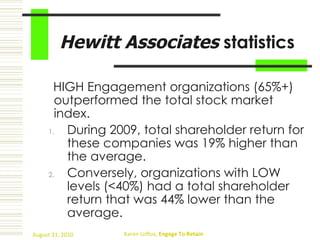
Hewitt Associates  statistics HIGH Engagement organizations (65%+) outperformed the total stock market index. During 2009, total shareholder return for these companies was 19% higher than the average. Conversely, organizations with LOW levels (<40%) had a total shareholder return that was 44% lower than the average.
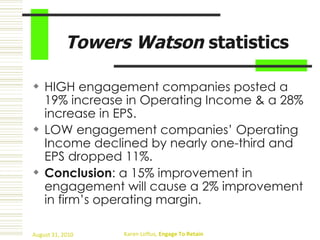
Towers Watson  statistics HIGH engagement companies posted a 19% increase in Operating Income & a 28% increase in EPS. LOW engagement companies’ Operating Income declined by nearly one-third and EPS dropped 11%. Conclusion : a 15% improvement in engagement will cause a 2% improvement in firm’s operating margin.
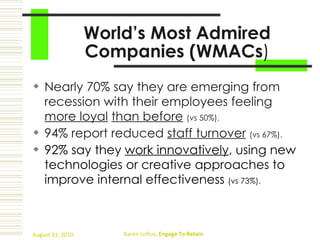
World’s Most Admired Companies (WMACs ) Nearly 70% say they are emerging from recession with their employees feeling  more loyal   than before   (vs 50%). 94% report reduced  staff turnover   (vs 67%). 92% say they  work innovatively , using new technologies or creative approaches to improve internal effectiveness  (vs 73%).
EE Engagement defined A high level of employee involvement, commitment to the organization, and job satisfaction.
Engaged employees… Value, enjoy & have pride in their work;  Are more willing to help each other and the organization succeed;  Take additional responsibility;  Invest more effort in their jobs;  Share information with other employees; & Remain with the organization longer than employees who are less engaged.
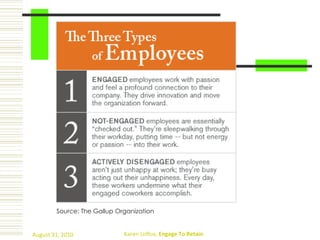
Source: The Gallup Organization
Bridge over troubled water? &quot; Everything we've seen suggests that trust, compassion, stability, and hope are what people need from leaders in times of trouble .&quot;    Jim Harter, Ph.D.   Gallup's chief scientist of workplace    management and wellbeing    Co-Author of    12: The Elements of Great Managing
Fulfillment of 12 human needs Such as… I know what is expected of me at work. I have the materials and equipment I need to do my work right. I have a best friend at work. This last year, I have had opportunities at work to learn and grow.
Driving Performance Engagement alone isn’t enough to drive individual & organizational performance. Employees also need to be ‘enabled’ to channel their efforts productively
Enabling  (in a good way!) Having the right tools to do their job Information Technology Equipment Finance Other support Freedom to focus on their responsibilities  without being distracted by procedural restrictions & non-essential tasks
Hay Group  statistics Companies in the top quartile on both engagement and enablement achieve  revenue growth   4.5 times  greater than those in the bottom quartile. Employee performance  is 10% higher in companies in the top quartile on engagement than those in the bottom quartile. Employee retention  is 40% higher. C ustomer satisfaction  is 71% higher.
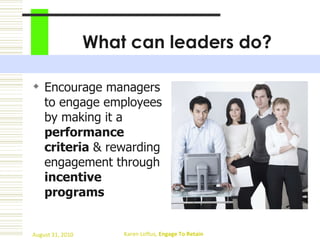
What can leaders do? Encourage managers to engage employees by making it a  performance criteria  & rewarding engagement through  incentive programs
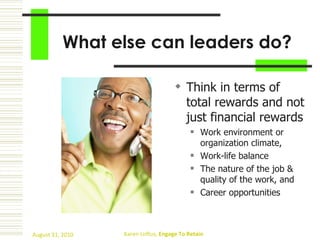
What else can leaders do? Think in terms of total rewards and not just financial rewards   Work environment or organization climate, Work-life balance  The nature of the job & quality of the work, and  Career opportunities
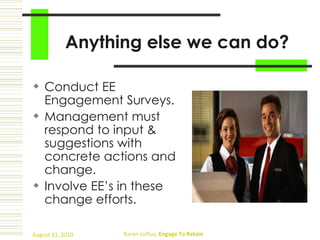
Anything else we can do? Conduct EE Engagement Surveys. Management must respond to input & suggestions with concrete actions and change. Involve EE’s in these change efforts.
Anything else? Demonstrate firm leadership and that you are capable of executing on strategic objectives.   Clear, transparent communication is key, especially in adverse conditions.
Questions?  Comments? Karen Loftus, MBA/SPHR Engage to Retain www.EngageToRetain.com   480-335-2367 [email_address]   Complimentary 30 min consultation

Engage To Retain Azshrm Presentation 2010

  • 1.
    Employee Engagement What’sthe business case? OR “ Why should I care?” Presented by Karen Loftus, MBA/SPHR Engage To Retain
  • 2.
    Hewitt Associates statistics HIGH Engagement organizations (65%+) outperformed the total stock market index. During 2009, total shareholder return for these companies was 19% higher than the average. Conversely, organizations with LOW levels (<40%) had a total shareholder return that was 44% lower than the average.
  • 3.
    Towers Watson statistics HIGH engagement companies posted a 19% increase in Operating Income & a 28% increase in EPS. LOW engagement companies’ Operating Income declined by nearly one-third and EPS dropped 11%. Conclusion : a 15% improvement in engagement will cause a 2% improvement in firm’s operating margin.
  • 4.
    World’s Most AdmiredCompanies (WMACs ) Nearly 70% say they are emerging from recession with their employees feeling more loyal than before (vs 50%). 94% report reduced staff turnover (vs 67%). 92% say they work innovatively , using new technologies or creative approaches to improve internal effectiveness (vs 73%).
  • 5.
    EE Engagement definedA high level of employee involvement, commitment to the organization, and job satisfaction.
  • 6.
    Engaged employees… Value,enjoy & have pride in their work; Are more willing to help each other and the organization succeed; Take additional responsibility; Invest more effort in their jobs; Share information with other employees; & Remain with the organization longer than employees who are less engaged.
  • 7.
    Source: The GallupOrganization
  • 8.
    Bridge over troubledwater? &quot; Everything we've seen suggests that trust, compassion, stability, and hope are what people need from leaders in times of trouble .&quot; Jim Harter, Ph.D. Gallup's chief scientist of workplace management and wellbeing Co-Author of 12: The Elements of Great Managing
  • 9.
    Fulfillment of 12human needs Such as… I know what is expected of me at work. I have the materials and equipment I need to do my work right. I have a best friend at work. This last year, I have had opportunities at work to learn and grow.
  • 10.
    Driving Performance Engagementalone isn’t enough to drive individual & organizational performance. Employees also need to be ‘enabled’ to channel their efforts productively
  • 11.
    Enabling (ina good way!) Having the right tools to do their job Information Technology Equipment Finance Other support Freedom to focus on their responsibilities without being distracted by procedural restrictions & non-essential tasks
  • 12.
    Hay Group statistics Companies in the top quartile on both engagement and enablement achieve revenue growth 4.5 times greater than those in the bottom quartile. Employee performance is 10% higher in companies in the top quartile on engagement than those in the bottom quartile. Employee retention is 40% higher. C ustomer satisfaction is 71% higher.
  • 13.
    What can leadersdo? Encourage managers to engage employees by making it a performance criteria & rewarding engagement through incentive programs
  • 14.
    What else canleaders do? Think in terms of total rewards and not just financial rewards Work environment or organization climate, Work-life balance The nature of the job & quality of the work, and Career opportunities
  • 15.
    Anything else wecan do? Conduct EE Engagement Surveys. Management must respond to input & suggestions with concrete actions and change. Involve EE’s in these change efforts.
  • 16.
    Anything else? Demonstratefirm leadership and that you are capable of executing on strategic objectives. Clear, transparent communication is key, especially in adverse conditions.
  • 17.
    Questions? Comments?Karen Loftus, MBA/SPHR Engage to Retain www.EngageToRetain.com 480-335-2367 [email_address] Complimentary 30 min consultation

Editor's Notes

  • #4 A global workforce study conducted by Towers Perrin (now Towers Watson ) surveyed 90,000 employees in 18 countries about a number of topics, including what drives engagement. The financial results of 50 multinational companies were compared.
  • #6 employee engagement is typically described as a high level of employee involvement, commitment to the organization and job satisfaction . Engaged employees value, enjoy and have pride in their work. They are more willing to help each other and the organization succeed; take additional responsibility; invest more effort in their jobs; share information with other employees; and remain with the organization than employees who are less engaged (Lazear 1989; LePine, Erez and Johnson 2002; Riketta 2002, 2008)
  • #10 Engagement results from the fulfillment of 12 universal human needs. And when those needs are met, workers are engaged
  • #13 Hay Group cross-industry analysis of over 400 companies found that    while organizations in the top quartile on engagement demonstrate revenue growth 2.5 times that of organizations in the bottom quartile,     companies in the top quartile on both engagement and enablement achieve revenue growth 4.5 times greater than those in the bottom quartile.   The corresponding figures for organizations that have both high engagement and high enablement are 50 percent, 54 percent and 89 percent.