June 3, 2014
Current Situation in the Steel Industry and
Development Trends
Igor I. Horoshiy
Vice-President, non-profit partnership “Russian Steel”
Chairman of Management Committee, NPP “Russian Steel” (representing Mechel OAO)
Non-Profit Partnership “Russian Steel”
Activities of Non-Profit Partnership “Russian Steel”
Federal executive
offices
Government of
the Russian
Federation
Russian Federation’s
trade representatives
abroad
National
industry
associations of
related
industries
OECD
(committee
on steel)
International
industry
associations
(World Steel
Association etc)
Other Russian
steelmakers
Customs
Union
Commission
(Eurasian
Economic
Commission)
98%
2%
Share of Russian Steel member
companies in Russian pig iron
production — 98%
90%
10%
Share of Russian Steel member
companies in Russian steel and rolls
production — 90%
60%
40%
Share of Russian Steel member
companies in Russian pipe production
— 60%
2Источник: НП «Русская Сталь»
3
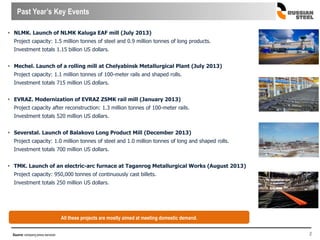
 NLMK. Launch of NLMK Kaluga EAF mill (July 2013)
Project capacity: 1.5 million tonnes of steel and 0.9 million tonnes of long products.
Investment totals 1.15 billion US dollars.
 Mechel. Launch of a rolling mill at Chelyabinsk Metallurgical Plant (July 2013)
Project capacity: 1.1 million tonnes of 100-meter rails and shaped rolls.
Investment totals 715 million US dollars.
 EVRAZ. Modernization of EVRAZ ZSMK rail mill (January 2013)
Project capacity after reconstruction: 1.3 million tonnes of 100-meter rails.
Investment totals 520 million US dollars.
 Severstal. Launch of Balakovo Long Product Mill (December 2013)
Project capacity: 1.0 million tonnes of steel and 1.0 million tonnes of long and shaped rolls.
Investment totals 700 million US dollars.
 ТМК. Launch of an electric-arc furnace at Taganrog Metallurgical Works (August 2013)
Project capacity: 950,000 tonnes of continuously cast billets.
Investment totals 250 million US dollars.
Source: company press services
All these projects are mostly aimed at meeting domestic demand.
Past Year’s Key Events
2. Challenges facing Russian steelmakers
4
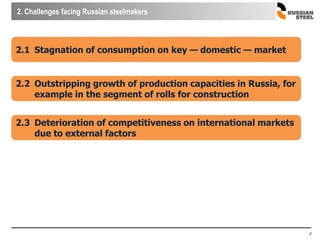
2.1 Stagnation of consumption on key — domestic — market
2.2 Outstripping growth of production capacities in Russia, for
example in the segment of rolls for construction
2.3 Deterioration of competitiveness on international markets
due to external factors
2.1 Stagnation of consumption on domestic market
5Source::Russia’s Economic Development Ministry, Industry and Trade Ministry, Metall-Courier, “Russian Steel”
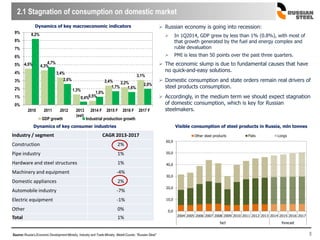
 Russian economy is going into recession:
 In 1Q2014, GDP grew by less than 1% (0.8%), with most of
that growth generated by the fuel and energy complex and
ruble devaluation
 PMI is less than 50 points over the past three quarters.
 The economic slump is due to fundamental causes that have
no quick-and-easy solutions.
 Domestic consumption and state orders remain real drivers of
steel products consumption.
 Accordingly, in the medium term we should expect stagnation
of domestic consumption, which is key for Russian
steelmakers.
Dynamics of key macroeconomic indicators
Dynamics of key consumer industries Visible consumption of steel products in Russia, mln tonnes
0,0
10,0
20,0
30,0
40,0
50,0
60,0
2004 2005 2006 2007 2008 2009 2010 2011 2012 2013 2014 2015 2016 2017
fact forecast
Other steel products Flats LongsIndustry / segment CAGR 2013-2017
Construction 2%
Pipe industry 1%
Hardware and steel structures 1%
Machinery and equipment -4%
Domestic appliances 2%
Automobile industry -7%
Electric equipment -1%
Other 0%
Total 1%
4,5% 4,3%
3,4%
1,3%
0,5%
2,4% 2,2%
3,1%
8,2%
4,7%
2,6%
0,4%
1,0%
1,7% 1,6%
2,0%
0%
1%
2%
3%
4%
5%
6%
7%
8%
9%
2010 2011 2012 2013
(est)
2014 F 2015 F 2016 F 2017 F
GDP growth Industrial production growth
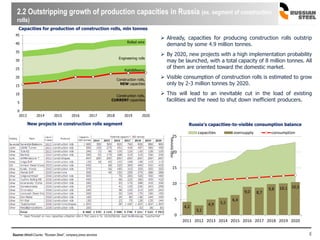
2.2 Outstripping growth of production capacities in Russia (ex. segment of construction
rolls)
6Source::Metall-Courier, “Russian Steel”, company press services
 Already, capacities for producing construction rolls outstrip
demand by some 4.9 million tonnes.
 By 2020, new projects with a high implementation probability
may be launched, with a total capacity of 8 million tonnes. All
of them are oriented toward the domestic market.
 Visible consumption of construction rolls is estimated to grow
only by 2-3 million tonnes by 2020.
 This will lead to an inevitable cut in the load of existing
facilities and the need to shut down inefficient producers.
Capacities for production of construction rolls, mln tonnes
New projects in construction rolls segment Russia’s capacities-to-visible consumption balance
4,2
3,1
4,9 5,5
6,4
9,0 8,7
9,8 10,1 10,5
0
5
10
15
20
25
2011 2012 2013 2014 2015 2016 2017 2018 2019 2020
mlntonnes
capacities oversupply consumption
0
5
10
15
20
25
30
35
40
45
2013 2014 2015 2016 2017 2018 2019 2020
Construction rolls,
CURRENT capacities
Construction rolls,
NEW capacities
Engineering rolls
Rails&Beams
Rolled wire
7Source: company data
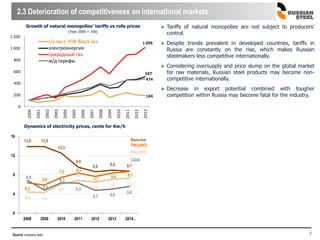
 Tariffs of natural monopolies are not subject to producers’
control.
 Despite trends prevalent in developed countries, tariffs in
Russia are constantly on the rise, which makes Russian
steelmakers less competitive internationally.
 Considering oversupply and price slump on the global market
for raw materials, Russian steel products may become non-
competitive internationally.
 Decrease in export potential combined with tougher
competition within Russia may become fatal for the industry.
2.3 Deterioration of competitiveness on international markets
Growth of natural monopolies’ tariffs vs rolls prices
(Year 2000 = 100)
184
507
1 009
474
0
200
400
600
800
1 000
1 200
2000
2001
2002
2003
2004
2005
2006
2007
2008
2009
2010
2011
2012
2013
г/к лист, FOB Black Sea
электроэнергия
природный газ
ж/д тарифы
Dynamics of electricity prices, cents for Kw/h
4,4 4,3
6,1
6,8
6,5
7,0 7,3
6,8
4,8
6,3
6,3
4,7 5,0
5,6
13,9 13,9
12,5
9,6
8,6 9,0 8,7
6,3
5,9
7,5 8,3
7,7
8,4 8,7
0
4
8
12
16
2008 2009 2010 2011 2012 2013 2014…
Бельгия
США
РФ(ЦФО)
РФ(УФО)
8
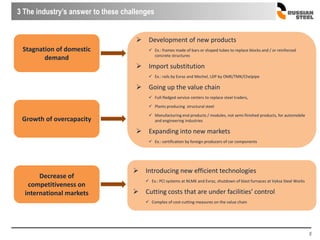
3 The industry’s answer to these challenges
Stagnation of domestic
demand
Growth of overcapacity
 Development of new products
 Ex.: frames made of bars or shaped tubes to replace blocks and / or reinforced
concrete structures
 Import substitution
 Ex.: rails by Evraz and Mechel, LDP by OMK/TMK/Chelpipe
 Going up the value chain
 Full-fledged service centers to replace steel traders,
 Plants producing structural steel
 Manufacturing end products / modules, not semi-finished products, for automobile
and engineering industries
 Expanding into new markets
 Ex.: certification by foreign producers of car components
Decrease of
competitiveness on
international markets
 Introducing new efficient technologies
 Ex.: PCI systems at NLMK and Evraz, shutdown of blast furnaces at Vyksa Steel Works
 Cutting costs that are under facilities’ control
 Complex of cost-cutting measures on the value chain
9
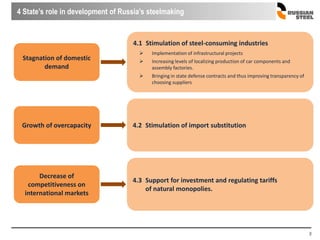
4 State’s role in development of Russia’s steelmaking
Stagnation of domestic
demand
Growth of overcapacity
4.1 Stimulation of steel-consuming industries
 Implementation of infrastructural projects
 Increasing levels of localizing production of car components and
assembly factories.
 Bringing in state defense contracts and thus improving transparency of
choosing suppliers
4.2 Stimulation of import substitution
Decrease of
competitiveness on
international markets
4.3 Support for investment and regulating tariffs
of natural monopolies.
10Source: Metal-Courier, «Russian Steel»
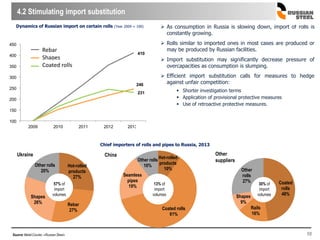
Chief importers of rolls and pipes to Russia, 2013
Ukraine
57% of
import
volumes
13% of
import
volumes
China Other
suppliers
30% of
import
volumes
 As consumption in Russia is slowing down, import of rolls is
constantly growing.
 Rolls similar to imported ones in most cases are produced or
may be produced by Russian facilities.
 Import substitution may significantly decrease pressure of
overcapacities as consumption is slumping.
 Efficient import substitution calls for measures to hedge
against unfair competition:
 Shorter investigation terms
 Application of provisional protective measures
 Use of retroactive protective measures.
4.2 Stimulating import substitution
Dynamics of Russian import on certain rolls (Year 2009 = 100)
410
246
231
100
150
200
250
300
350
400
450
2009 2010 2011 2012 2013е
Арматура
Фасонный прокат
Лист с покрытием
Hot-rolled
products
27%
Rebar
27%
Shapes
26%
Other rolls
20%
Hot-rolled
products
10%
Coated rolls
61%
Seamless
pipes
19%
Other rolls
10%
Coated
rolls
48%
Rails
16%
Shapes
9%
Other
rolls
27%
Rebar
Shapes
Coated rolls
11
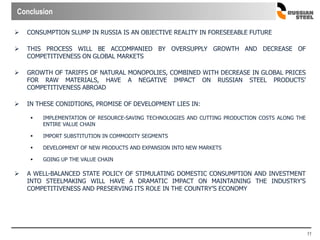
 CONSUMPTION SLUMP IN RUSSIA IS AN OBJECTIVE REALITY IN FORESEEABLE FUTURE
 THIS PROCESS WILL BE ACCOMPANIED BY OVERSUPPLY GROWTH AND DECREASE OF
COMPETITIVENESS ON GLOBAL MARKETS
 GROWTH OF TARIFFS OF NATURAL MONOPOLIES, COMBINED WITH DECREASE IN GLOBAL PRICES
FOR RAW MATERIALS, HAVE A NEGATIVE IMPACT ON RUSSIAN STEEL PRODUCTS’
COMPETITIVENESS ABROAD
 IN THESE CONIDTIONS, PROMISE OF DEVELOPMENT LIES IN:
 IMPLEMENTATION OF RESOURCE-SAVING TECHNOLOGIES AND CUTTING PRODUCTION COSTS ALONG THE
ENTIRE VALUE CHAIN
 IMPORT SUBSTITUTION IN COMMODITY SEGMENTS
 DEVELOPMENT OF NEW PRODUCTS AND EXPANSION INTO NEW MARKETS
 GOING UP THE VALUE CHAIN
 A WELL-BALANCED STATE POLICY OF STIMULATING DOMESTIC CONSUMPTION AND INVESTMENT
INTO STEELMAKING WILL HAVE A DRAMATIC IMPACT ON MAINTAINING THE INDUSTRY’S
COMPETITIVENESS AND PRESERVING ITS ROLE IN THE COUNTRY’S ECONOMY
Conclusion

Current Situation in the Steel Industry and Development Trends

  • 1.
    June 3, 2014 CurrentSituation in the Steel Industry and Development Trends Igor I. Horoshiy Vice-President, non-profit partnership “Russian Steel” Chairman of Management Committee, NPP “Russian Steel” (representing Mechel OAO)
  • 2.
    Non-Profit Partnership “RussianSteel” Activities of Non-Profit Partnership “Russian Steel” Federal executive offices Government of the Russian Federation Russian Federation’s trade representatives abroad National industry associations of related industries OECD (committee on steel) International industry associations (World Steel Association etc) Other Russian steelmakers Customs Union Commission (Eurasian Economic Commission) 98% 2% Share of Russian Steel member companies in Russian pig iron production — 98% 90% 10% Share of Russian Steel member companies in Russian steel and rolls production — 90% 60% 40% Share of Russian Steel member companies in Russian pipe production — 60% 2Источник: НП «Русская Сталь»
  • 3.
    3  NLMK. Launchof NLMK Kaluga EAF mill (July 2013) Project capacity: 1.5 million tonnes of steel and 0.9 million tonnes of long products. Investment totals 1.15 billion US dollars.  Mechel. Launch of a rolling mill at Chelyabinsk Metallurgical Plant (July 2013) Project capacity: 1.1 million tonnes of 100-meter rails and shaped rolls. Investment totals 715 million US dollars.  EVRAZ. Modernization of EVRAZ ZSMK rail mill (January 2013) Project capacity after reconstruction: 1.3 million tonnes of 100-meter rails. Investment totals 520 million US dollars.  Severstal. Launch of Balakovo Long Product Mill (December 2013) Project capacity: 1.0 million tonnes of steel and 1.0 million tonnes of long and shaped rolls. Investment totals 700 million US dollars.  ТМК. Launch of an electric-arc furnace at Taganrog Metallurgical Works (August 2013) Project capacity: 950,000 tonnes of continuously cast billets. Investment totals 250 million US dollars. Source: company press services All these projects are mostly aimed at meeting domestic demand. Past Year’s Key Events
  • 4.
    2. Challenges facingRussian steelmakers 4 2.1 Stagnation of consumption on key — domestic — market 2.2 Outstripping growth of production capacities in Russia, for example in the segment of rolls for construction 2.3 Deterioration of competitiveness on international markets due to external factors
  • 5.
    2.1 Stagnation ofconsumption on domestic market 5Source::Russia’s Economic Development Ministry, Industry and Trade Ministry, Metall-Courier, “Russian Steel”  Russian economy is going into recession:  In 1Q2014, GDP grew by less than 1% (0.8%), with most of that growth generated by the fuel and energy complex and ruble devaluation  PMI is less than 50 points over the past three quarters.  The economic slump is due to fundamental causes that have no quick-and-easy solutions.  Domestic consumption and state orders remain real drivers of steel products consumption.  Accordingly, in the medium term we should expect stagnation of domestic consumption, which is key for Russian steelmakers. Dynamics of key macroeconomic indicators Dynamics of key consumer industries Visible consumption of steel products in Russia, mln tonnes 0,0 10,0 20,0 30,0 40,0 50,0 60,0 2004 2005 2006 2007 2008 2009 2010 2011 2012 2013 2014 2015 2016 2017 fact forecast Other steel products Flats LongsIndustry / segment CAGR 2013-2017 Construction 2% Pipe industry 1% Hardware and steel structures 1% Machinery and equipment -4% Domestic appliances 2% Automobile industry -7% Electric equipment -1% Other 0% Total 1% 4,5% 4,3% 3,4% 1,3% 0,5% 2,4% 2,2% 3,1% 8,2% 4,7% 2,6% 0,4% 1,0% 1,7% 1,6% 2,0% 0% 1% 2% 3% 4% 5% 6% 7% 8% 9% 2010 2011 2012 2013 (est) 2014 F 2015 F 2016 F 2017 F GDP growth Industrial production growth
  • 6.
    2.2 Outstripping growthof production capacities in Russia (ex. segment of construction rolls) 6Source::Metall-Courier, “Russian Steel”, company press services  Already, capacities for producing construction rolls outstrip demand by some 4.9 million tonnes.  By 2020, new projects with a high implementation probability may be launched, with a total capacity of 8 million tonnes. All of them are oriented toward the domestic market.  Visible consumption of construction rolls is estimated to grow only by 2-3 million tonnes by 2020.  This will lead to an inevitable cut in the load of existing facilities and the need to shut down inefficient producers. Capacities for production of construction rolls, mln tonnes New projects in construction rolls segment Russia’s capacities-to-visible consumption balance 4,2 3,1 4,9 5,5 6,4 9,0 8,7 9,8 10,1 10,5 0 5 10 15 20 25 2011 2012 2013 2014 2015 2016 2017 2018 2019 2020 mlntonnes capacities oversupply consumption 0 5 10 15 20 25 30 35 40 45 2013 2014 2015 2016 2017 2018 2019 2020 Construction rolls, CURRENT capacities Construction rolls, NEW capacities Engineering rolls Rails&Beams Rolled wire
  • 7.
    7Source: company data Tariffs of natural monopolies are not subject to producers’ control.  Despite trends prevalent in developed countries, tariffs in Russia are constantly on the rise, which makes Russian steelmakers less competitive internationally.  Considering oversupply and price slump on the global market for raw materials, Russian steel products may become non- competitive internationally.  Decrease in export potential combined with tougher competition within Russia may become fatal for the industry. 2.3 Deterioration of competitiveness on international markets Growth of natural monopolies’ tariffs vs rolls prices (Year 2000 = 100) 184 507 1 009 474 0 200 400 600 800 1 000 1 200 2000 2001 2002 2003 2004 2005 2006 2007 2008 2009 2010 2011 2012 2013 г/к лист, FOB Black Sea электроэнергия природный газ ж/д тарифы Dynamics of electricity prices, cents for Kw/h 4,4 4,3 6,1 6,8 6,5 7,0 7,3 6,8 4,8 6,3 6,3 4,7 5,0 5,6 13,9 13,9 12,5 9,6 8,6 9,0 8,7 6,3 5,9 7,5 8,3 7,7 8,4 8,7 0 4 8 12 16 2008 2009 2010 2011 2012 2013 2014… Бельгия США РФ(ЦФО) РФ(УФО)
  • 8.
    8 3 The industry’sanswer to these challenges Stagnation of domestic demand Growth of overcapacity  Development of new products  Ex.: frames made of bars or shaped tubes to replace blocks and / or reinforced concrete structures  Import substitution  Ex.: rails by Evraz and Mechel, LDP by OMK/TMK/Chelpipe  Going up the value chain  Full-fledged service centers to replace steel traders,  Plants producing structural steel  Manufacturing end products / modules, not semi-finished products, for automobile and engineering industries  Expanding into new markets  Ex.: certification by foreign producers of car components Decrease of competitiveness on international markets  Introducing new efficient technologies  Ex.: PCI systems at NLMK and Evraz, shutdown of blast furnaces at Vyksa Steel Works  Cutting costs that are under facilities’ control  Complex of cost-cutting measures on the value chain
  • 9.
    9 4 State’s rolein development of Russia’s steelmaking Stagnation of domestic demand Growth of overcapacity 4.1 Stimulation of steel-consuming industries  Implementation of infrastructural projects  Increasing levels of localizing production of car components and assembly factories.  Bringing in state defense contracts and thus improving transparency of choosing suppliers 4.2 Stimulation of import substitution Decrease of competitiveness on international markets 4.3 Support for investment and regulating tariffs of natural monopolies.
  • 10.
    10Source: Metal-Courier, «RussianSteel» Chief importers of rolls and pipes to Russia, 2013 Ukraine 57% of import volumes 13% of import volumes China Other suppliers 30% of import volumes  As consumption in Russia is slowing down, import of rolls is constantly growing.  Rolls similar to imported ones in most cases are produced or may be produced by Russian facilities.  Import substitution may significantly decrease pressure of overcapacities as consumption is slumping.  Efficient import substitution calls for measures to hedge against unfair competition:  Shorter investigation terms  Application of provisional protective measures  Use of retroactive protective measures. 4.2 Stimulating import substitution Dynamics of Russian import on certain rolls (Year 2009 = 100) 410 246 231 100 150 200 250 300 350 400 450 2009 2010 2011 2012 2013е Арматура Фасонный прокат Лист с покрытием Hot-rolled products 27% Rebar 27% Shapes 26% Other rolls 20% Hot-rolled products 10% Coated rolls 61% Seamless pipes 19% Other rolls 10% Coated rolls 48% Rails 16% Shapes 9% Other rolls 27% Rebar Shapes Coated rolls
  • 11.
    11  CONSUMPTION SLUMPIN RUSSIA IS AN OBJECTIVE REALITY IN FORESEEABLE FUTURE  THIS PROCESS WILL BE ACCOMPANIED BY OVERSUPPLY GROWTH AND DECREASE OF COMPETITIVENESS ON GLOBAL MARKETS  GROWTH OF TARIFFS OF NATURAL MONOPOLIES, COMBINED WITH DECREASE IN GLOBAL PRICES FOR RAW MATERIALS, HAVE A NEGATIVE IMPACT ON RUSSIAN STEEL PRODUCTS’ COMPETITIVENESS ABROAD  IN THESE CONIDTIONS, PROMISE OF DEVELOPMENT LIES IN:  IMPLEMENTATION OF RESOURCE-SAVING TECHNOLOGIES AND CUTTING PRODUCTION COSTS ALONG THE ENTIRE VALUE CHAIN  IMPORT SUBSTITUTION IN COMMODITY SEGMENTS  DEVELOPMENT OF NEW PRODUCTS AND EXPANSION INTO NEW MARKETS  GOING UP THE VALUE CHAIN  A WELL-BALANCED STATE POLICY OF STIMULATING DOMESTIC CONSUMPTION AND INVESTMENT INTO STEELMAKING WILL HAVE A DRAMATIC IMPACT ON MAINTAINING THE INDUSTRY’S COMPETITIVENESS AND PRESERVING ITS ROLE IN THE COUNTRY’S ECONOMY Conclusion