Objectives
Objectives
• Learn aboutthe different sources energy
• Understand how one form of energy is
transformed into another form
• Describe the difference between
renewable energy, non-renewable energy
and inexhaustible energy
4.
Energy
Energy
CH-113.0
• Energy isthe ability to do work.
• We use energy for transportation, to heat and
cool our homes, to power our electronic
devices and many other things.
5.
Energy
Energy
CH-113.0
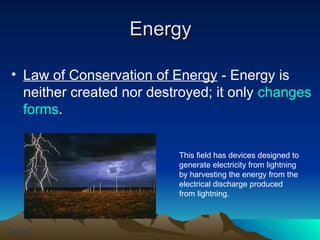
• Law ofConservation of Energy - Energy is
neither created nor destroyed; it only changes
forms.
This field has devices designed to
generate electricity from lightning
by harvesting the energy from the
electrical discharge produced
from lightning.
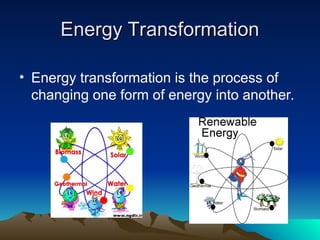
Energy Transformation
Energy Transformation
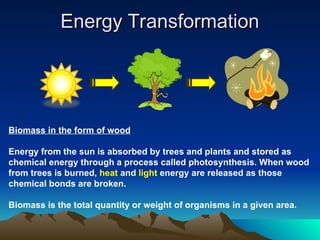
Biomassin the form of wood
Energy from the sun is absorbed by trees and plants and stored as
chemical energy through a process called photosynthesis. When wood
from trees is burned, heat and light energy are released as those
chemical bonds are broken.
Biomass is the total quantity or weight of organisms in a given area.
8.
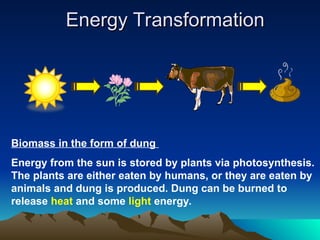
Biomass in theform of dung
Energy from the sun is stored by plants via photosynthesis.
The plants are either eaten by humans, or they are eaten by
animals and dung is produced. Dung can be burned to
release heat and some light energy.
Energy Transformation
Energy Transformation
9.
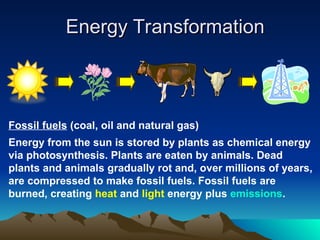
Fossil fuels (coal,oil and natural gas)
Energy from the sun is stored by plants as chemical energy
via photosynthesis. Plants are eaten by animals. Dead
plants and animals gradually rot and, over millions of years,
are compressed to make fossil fuels. Fossil fuels are
burned, creating heat and light energy plus emissions.
Energy Transformation
Energy Transformation
Energy Transformation
Energy Transformation
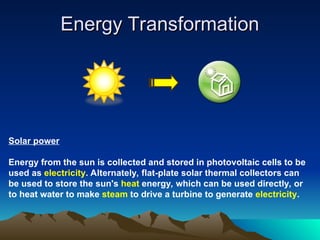
Solarpower
Energy from the sun is collected and stored in photovoltaic cells to be
used as electricity. Alternately, flat-plate solar thermal collectors can
be used to store the sun's heat energy, which can be used directly, or
to heat water to make steam to drive a turbine to generate electricity.
13.
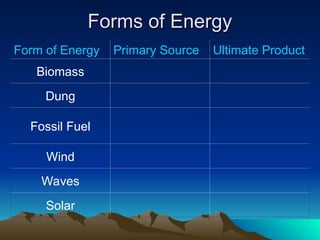
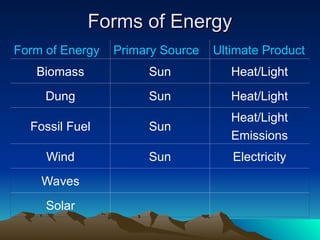
Forms of Energy
Formsof Energy
Form of Energy Primary Source Ultimate Product
Biomass
Dung
Fossil Fuel
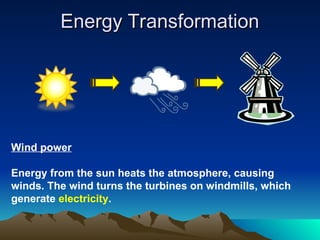
Wind
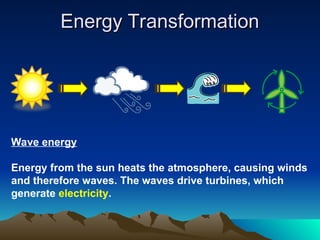
Waves
Solar
14.
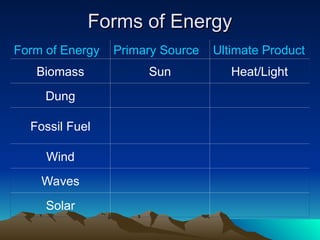
Forms of Energy
Formsof Energy
Form of Energy Primary Source Ultimate Product
Biomass Sun Heat/Light
Dung
Fossil Fuel
Wind
Waves
Solar
15.
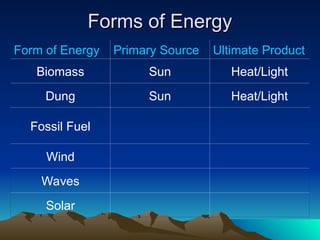
Forms of Energy
Formsof Energy
Form of Energy Primary Source Ultimate Product
Biomass Sun Heat/Light
Dung Sun Heat/Light
Fossil Fuel
Wind
Waves
Solar
16.
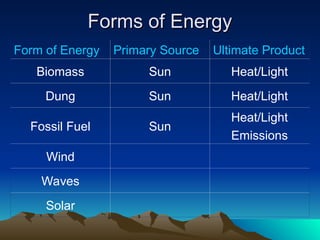
Forms of Energy
Formsof Energy
Form of Energy Primary Source Ultimate Product
Biomass Sun Heat/Light
Dung Sun Heat/Light
Fossil Fuel Sun
Heat/Light
Emissions
Wind
Waves
Solar
17.
Forms of Energy
Formsof Energy
Form of Energy Primary Source Ultimate Product
Biomass Sun Heat/Light
Dung Sun Heat/Light
Fossil Fuel Sun
Heat/Light
Emissions
Wind Sun Electricity
Waves
Solar
18.
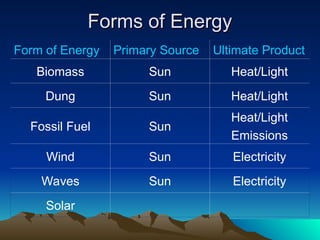
Forms of Energy
Formsof Energy
Form of Energy Primary Source Ultimate Product
Biomass Sun Heat/Light
Dung Sun Heat/Light
Fossil Fuel Sun
Heat/Light
Emissions
Wind Sun Electricity
Waves Sun Electricity
Solar
19.
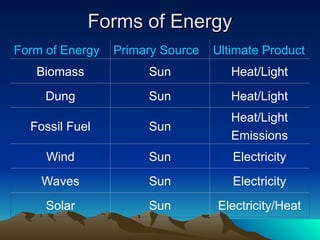
Forms of Energy
Formsof Energy
Form of Energy Primary Source Ultimate Product
Biomass Sun Heat/Light
Dung Sun Heat/Light
Fossil Fuel Sun
Heat/Light
Emissions
Wind Sun Electricity
Waves Sun Electricity
Solar Sun Electricity/Heat
20.
Forms of Energy
Formsof Energy
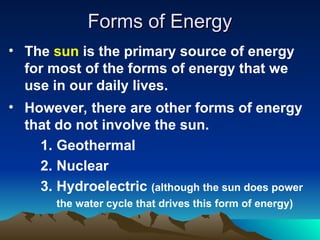
• The sun is the primary source of energy
for most of the forms of energy that we
use in our daily lives.
• However, there are other forms of energy
that do not involve the sun.
1. Geothermal
2. Nuclear
3. Hydroelectric (although the sun does power
the water cycle that drives this form of energy)
Geothermal Energy
Geothermal Energy
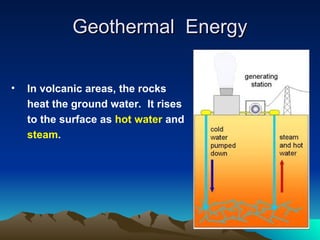
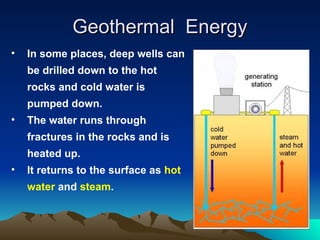
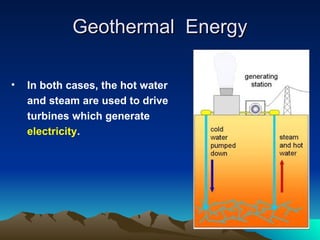
•In some places, deep wells can
be drilled down to the hot
rocks and cold water is
pumped down.
• The water runs through
fractures in the rocks and is
heated up.
• It returns to the surface as hot
water and steam.
Nuclear Energy
Nuclear Energy
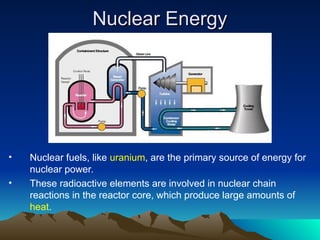
•Nuclear fuels, like uranium, are the primary source of energy for
nuclear power.
• These radioactive elements are involved in nuclear chain
reactions in the reactor core, which produce large amounts of
heat.
25.
Nuclear Energy
Nuclear Energy
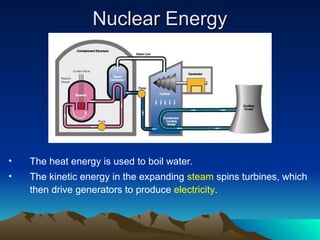
•The heat energy is used to boil water.
• The kinetic energy in the expanding steam spins turbines, which
then drive generators to produce electricity.
26.
Hydroelectric Energy
Hydroelectric Energy
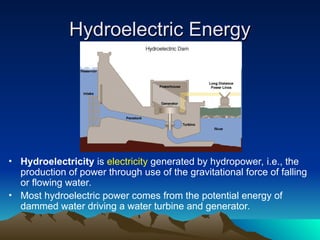
•Hydroelectricity is electricity generated by hydropower, i.e., the
production of power through use of the gravitational force of falling
or flowing water.
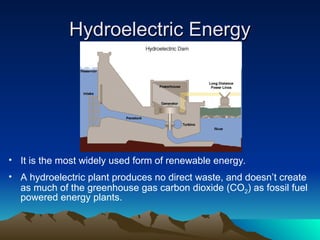
• Most hydroelectric power comes from the potential energy of
dammed water driving a water turbine and generator.
27.
Hydroelectric Energy
Hydroelectric Energy
•It is the most widely used form of renewable energy.
• A hydroelectric plant produces no direct waste, and doesn’t create
as much of the greenhouse gas carbon dioxide (CO2) as fossil fuel
powered energy plants.
Editor's Notes
#3 TEKS: Science
6-8.2 (A) Plan and implement investigative procedures
6-8.2 (B) Collect data by observing and measuring
6-8.2 (C) Analyze and interpret information to construct reasonable explanations
6.9 (A) identify energy transformations occurring during the production of energy for human use
6.9 (B) compare methods used for transforming energy in devices
6.9 (C) research and describe energy types from their source to their use and determine if the type is renewable, non-renewable, or inexhaustible.
7.11 (B) Identify responses in organisms to external stimuli
#5 This slide could be used to start a discussion among the students about where they use energy in their daily lives.
The following slides should clearly demonstrate that the sun is the primary source for the majority of our energy. Exceptions to this rule can be found on the slide entitled “Other Sources of Energy”.
http://www.climate-changer.com/category/energy-sources/page/2/
#12 Photovoltaic = relating to the production of the electric current at the junction of two substances exposed to light
Adapted from:
http://www.think-energy.com/ThinkEnergy/11-14/activities/EnergyTrans.aspx
#24 Information on slide is adapted from: http://www.bbc.co.uk/schools/gcsebitesize/science/aqa/energy/mainselectricityrev3.shtml
Image and the following information from:
http://www.freeinfosociety.com/site.php?postnum=3115
There are two types of nuclear reactions; a fusion reaction and a fission reaction. A fusion reaction is when an atom of tritium smashes into a deuterium atom, and combine to form a helium atom and a neutron. This is the most powerful nuclear reaction. There is more research being conducted to make this reaction possible in nuclear power plants.
The other type of reaction is a fission reaction. In a fission reaction, a neutron collides into an enriched uranium atom, splitting it, and releasing another uranium atom and two neutrons. When this process continues with the collisions it is called a nuclear chain reaction. This is the current nuclear reaction that takes place within the nuclear power plants around the world.
This reaction is only one of the factors that is responsible for the creation of electricity within a nuclear power plant. Once the reaction takes place, a large amount of heat is given off. This all happens within the reactor core, as can be seen in the figure. This heats the water around the core and then the water turns to steam. The steam then travels through pipes and causes the turbine to spin. This spinning of the turbine spins a large generator, creating electricity. However, the process that happens within a nuclear power plant does not stop here. The steam then is cooled by cold water coming from the cooling tower traveling into the condenser below the turbine. This drops the temperature causing it to turn back into water. This water is then pumped back to the reactor to be reheated and continue the process again.
#25 Information on slide is adapted from: http://www.bbc.co.uk/schools/gcsebitesize/science/aqa/energy/mainselectricityrev3.shtml
Image and the following information from:
http://www.freeinfosociety.com/site.php?postnum=3115
There are two types of nuclear reactions; a fusion reaction and a fission reaction. A fusion reaction is when an atom of tritium smashes into a deuterium atom, and combine to form a helium atom and a neutron. This is the most powerful nuclear reaction. There is more research being conducted to make this reaction possible in nuclear power plants.
The other type of reaction is a fission reaction. In a fission reaction, a neutron collides into an enriched uranium atom, splitting it, and releasing another uranium atom and two neutrons. When this process continues with the collisions it is called a nuclear chain reaction. This is the current nuclear reaction that takes place within the nuclear power plants around the world.
This reaction is only one of the factors that is responsible for the creation of electricity within a nuclear power plant. Once the reaction takes place, a large amount of heat is given off. This all happens within the reactor core, as can be seen in the figure. This heats the water around the core and then the water turns to steam. The steam then travels through pipes and causes the turbine to spin. This spinning of the turbine spins a large generator, creating electricity. However, the process that happens within a nuclear power plant does not stop here. The steam then is cooled by cold water coming from the cooling tower traveling into the condenser below the turbine. This drops the temperature causing it to turn back into water. This water is then pumped back to the reactor to be reheated and continue the process again.