Welcome to Net Energy
Metering Training
Angela Robinson
Billing Specialist, Ambit Energy
December 4th 2015
What You Should Know About Net Metering
 Net metering allows residential and commercial customers who generate their
own electricity from solar power to feed electricity they do not use back into
the grid resulting in a credit.
 Many states adopted net metering in the early 1980s as a way of
implementing the requirement known as PURPA 210 which states that utilities
must buy the output of qualifying small power production facilities.
Net Metering, Solar Energy and the Grid
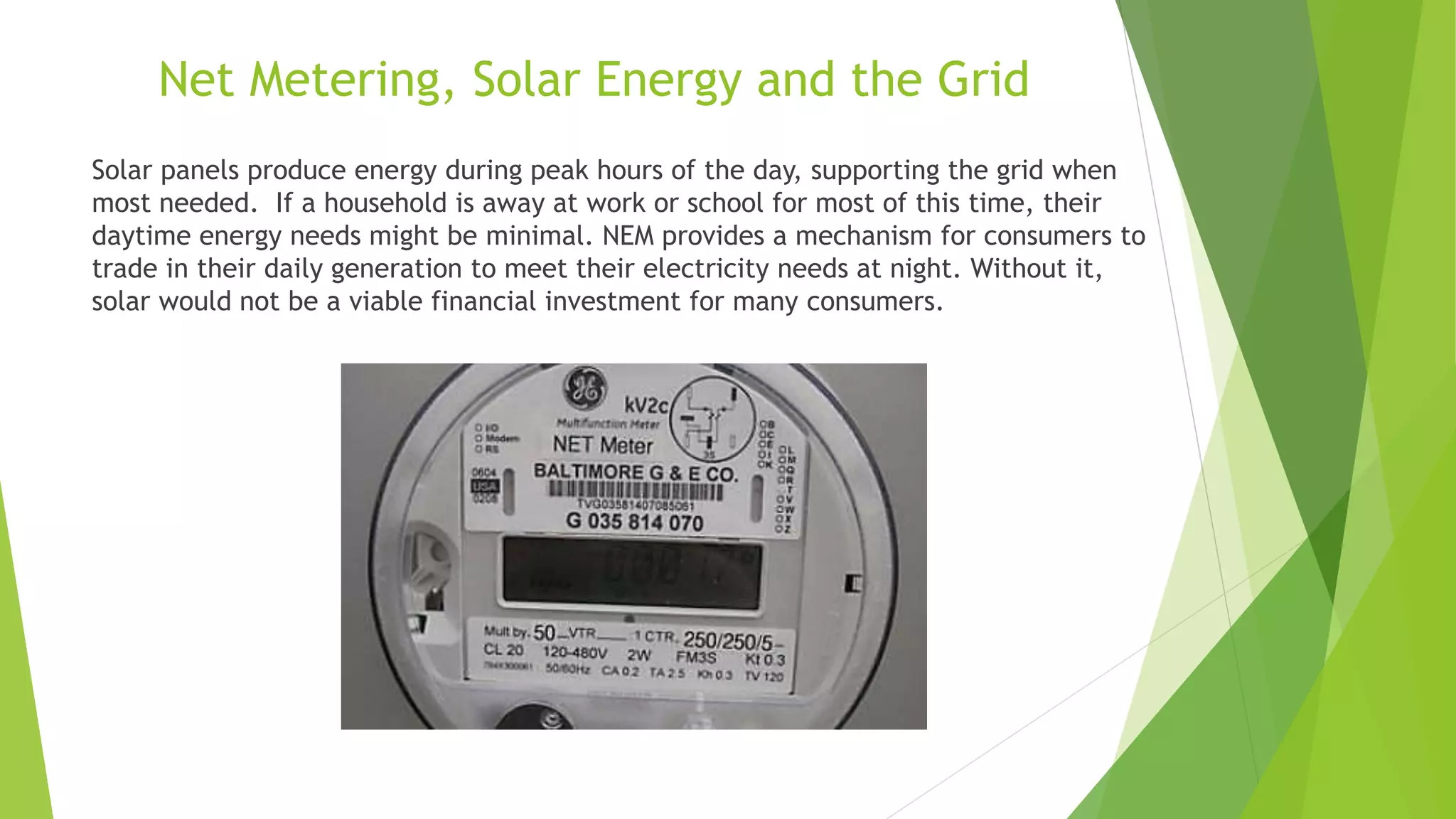
Solar panels produce energy during peak hours of the day, supporting the grid when
most needed. If a household is away at work or school for most of this time, their
daytime energy needs might be minimal. NEM provides a mechanism for consumers to
trade in their daily generation to meet their electricity needs at night. Without it,
solar would not be a viable financial investment for many consumers.
How is excess generation credited and at what rate
should a self generator be compensated?
Excess Energy Credits and Rates
 Excess Energy
 The customers excess kwh’s are banked and will roll forward to be applied as a
credit where there is consumption on subsequent bills until fully exhausted.
 Monthly credits result in customers receiving the full retail rate of the amount of
energy that is netted.
 Settlements for Excess Energy
 Excess energy left over at the end of a annual billing period or at the time a
customer drops service is bought from the customer by the utility.
 A settlement is performed at the avoided cost aka the wholesale, full retail or
average rate depending on the market rules.
Where is the net metering indicator on EDI
transactions?
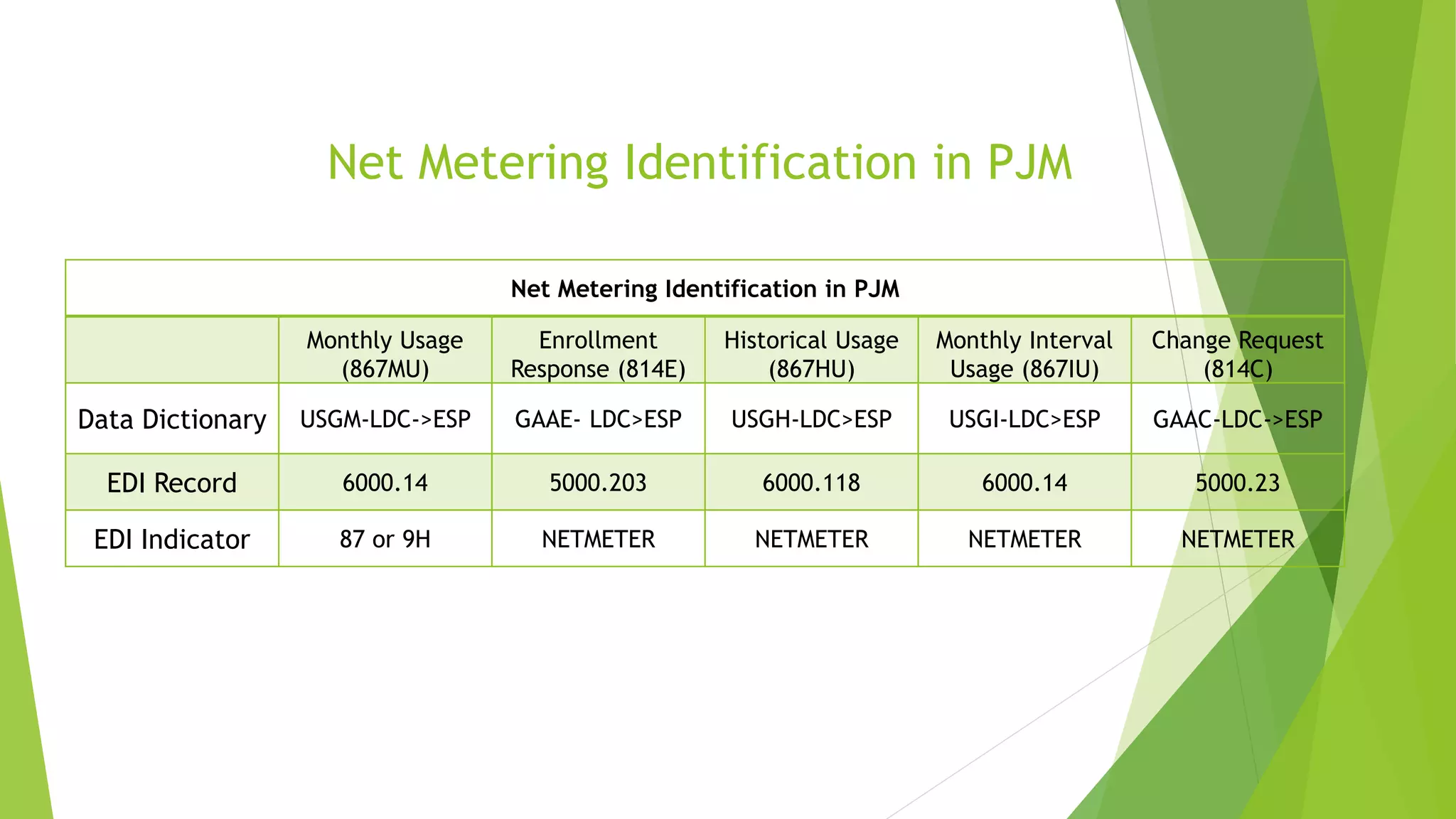
Net Metering Identification in PJM
Monthly Usage
(867MU)
Enrollment
Response (814E)
Historical Usage
(867HU)
Monthly Interval
Usage (867IU)
Change Request
(814C)
Data Dictionary USGM-LDC->ESP GAAE- LDC>ESP USGH-LDC>ESP USGI-LDC>ESP GAAC-LDC->ESP
EDI Record 6000.14 5000.203 6000.118 6000.14 5000.23
EDI Indicator 87 or 9H NETMETER NETMETER NETMETER NETMETER
How is customer generation and consumption
communicated to Ambit via EDI?
Generation and Consumption via EDI
The utility will send electric suppliers the monthly consumed kWh and
generated kWh along with the net consumed kWh (zero if generation is
greater than consumption).
ESG
Sender Transaction ID: 2014-05-16-19.44.22.817359
What is the appropriate size for a self generator’s
installation and should there be a limit to how much
a customer can generate?
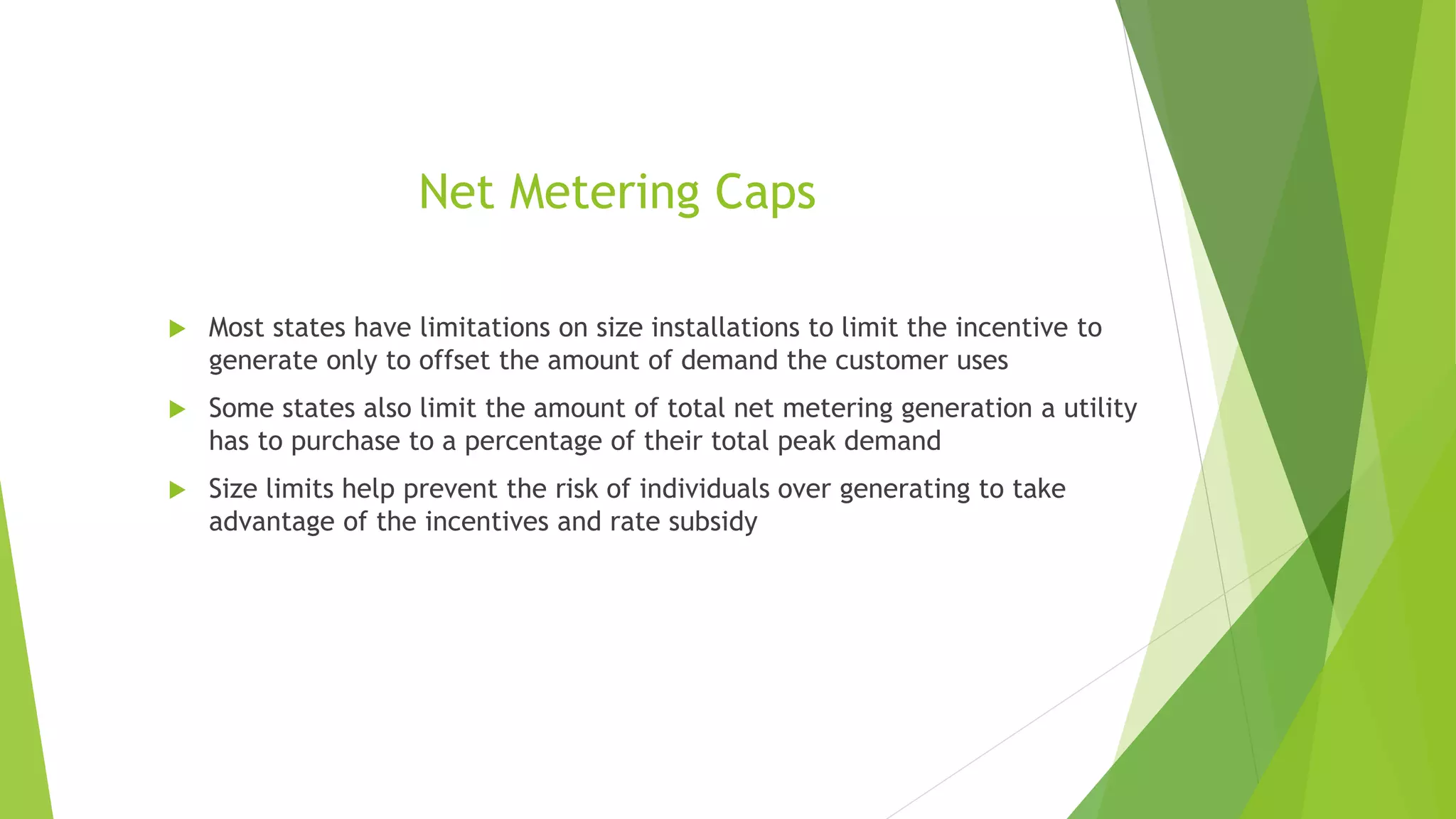
Net Metering Caps
 Most states have limitations on size installations to limit the incentive to
generate only to offset the amount of demand the customer uses
 Some states also limit the amount of total net metering generation a utility
has to purchase to a percentage of their total peak demand
 Size limits help prevent the risk of individuals over generating to take
advantage of the incentives and rate subsidy
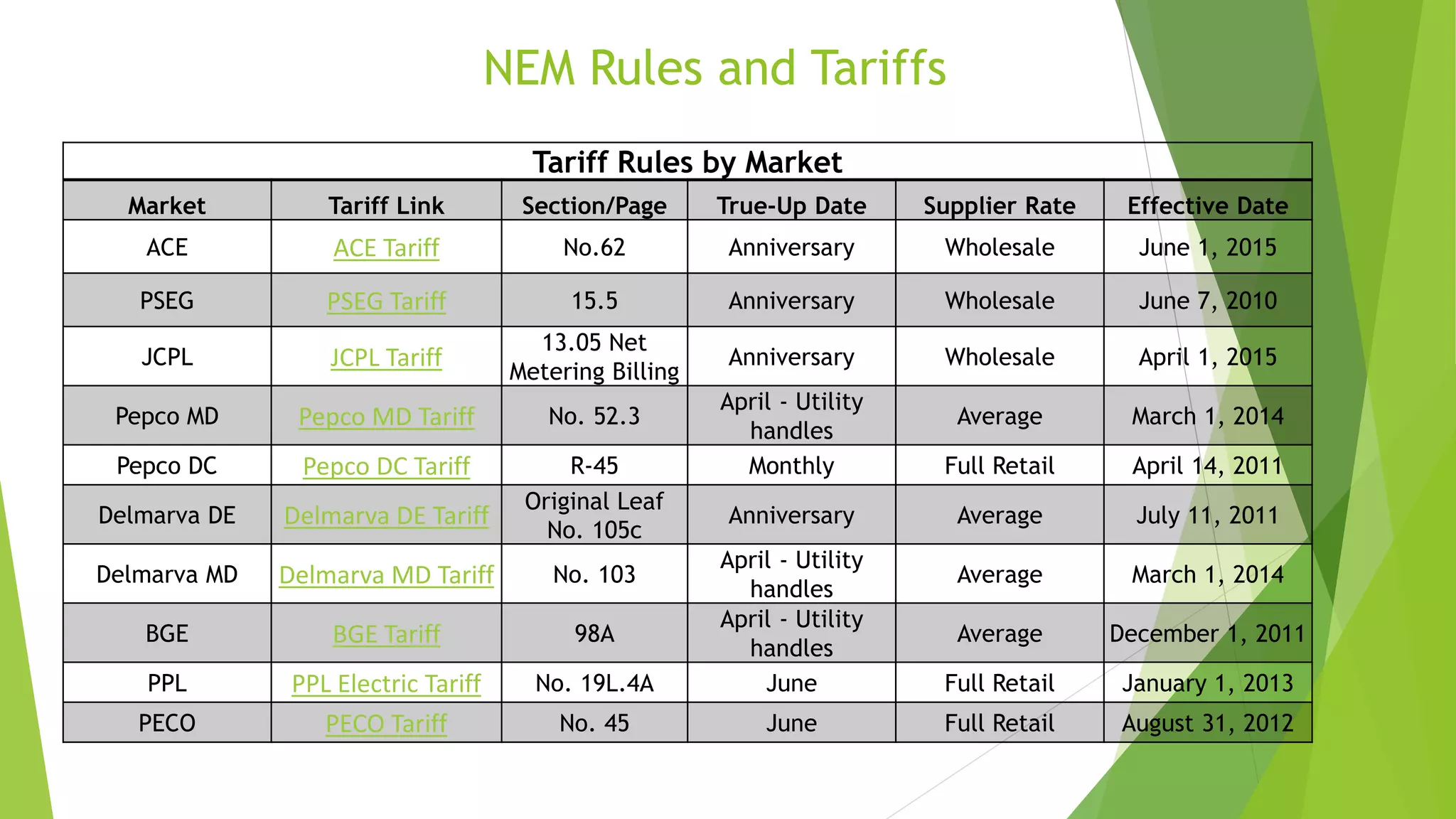
NEM Rules and Tariffs
Tariff Rules by Market
Market Tariff Link Section/Page True-Up Date Supplier Rate Effective Date
ACE ACE Tariff No.62 Anniversary Wholesale June 1, 2015
PSEG PSEG Tariff 15.5 Anniversary Wholesale June 7, 2010
JCPL JCPL Tariff
13.05 Net
Metering Billing
Anniversary Wholesale April 1, 2015
Pepco MD Pepco MD Tariff No. 52.3
April - Utility
handles
Average March 1, 2014
Pepco DC Pepco DC Tariff R-45 Monthly Full Retail April 14, 2011
Delmarva DE Delmarva DE Tariff
Original Leaf
No. 105c
Anniversary Average July 11, 2011
Delmarva MD Delmarva MD Tariff No. 103
April - Utility
handles
Average March 1, 2014
BGE BGE Tariff 98A
April - Utility
handles
Average December 1, 2011
PPL PPL Electric Tariff No. 19L.4A June Full Retail January 1, 2013
PECO PECO Tariff No. 45 June Full Retail August 31, 2012
Open Forum
Sources
http://www.seia.org/policy/distributed-solar/net-metering
http://www.irecusa.org/regulatory-reform/net-metering/
https://www.ferc.gov/whats-new/comm-meet/011906/E-3.pdf
www.kcc.ks.gov/energy

Welcome to Net Energy Metering Training

  • 1.
    Welcome to NetEnergy Metering Training Angela Robinson Billing Specialist, Ambit Energy December 4th 2015
  • 2.
    What You ShouldKnow About Net Metering  Net metering allows residential and commercial customers who generate their own electricity from solar power to feed electricity they do not use back into the grid resulting in a credit.  Many states adopted net metering in the early 1980s as a way of implementing the requirement known as PURPA 210 which states that utilities must buy the output of qualifying small power production facilities.
  • 3.
    Net Metering, SolarEnergy and the Grid
  • 4.
    Net Metering, SolarEnergy and the Grid Solar panels produce energy during peak hours of the day, supporting the grid when most needed. If a household is away at work or school for most of this time, their daytime energy needs might be minimal. NEM provides a mechanism for consumers to trade in their daily generation to meet their electricity needs at night. Without it, solar would not be a viable financial investment for many consumers.
  • 5.
    How is excessgeneration credited and at what rate should a self generator be compensated?
  • 6.
    Excess Energy Creditsand Rates  Excess Energy  The customers excess kwh’s are banked and will roll forward to be applied as a credit where there is consumption on subsequent bills until fully exhausted.  Monthly credits result in customers receiving the full retail rate of the amount of energy that is netted.  Settlements for Excess Energy  Excess energy left over at the end of a annual billing period or at the time a customer drops service is bought from the customer by the utility.  A settlement is performed at the avoided cost aka the wholesale, full retail or average rate depending on the market rules.
  • 7.
    Where is thenet metering indicator on EDI transactions?
  • 8.
    Net Metering Identificationin PJM Net Metering Identification in PJM Monthly Usage (867MU) Enrollment Response (814E) Historical Usage (867HU) Monthly Interval Usage (867IU) Change Request (814C) Data Dictionary USGM-LDC->ESP GAAE- LDC>ESP USGH-LDC>ESP USGI-LDC>ESP GAAC-LDC->ESP EDI Record 6000.14 5000.203 6000.118 6000.14 5000.23 EDI Indicator 87 or 9H NETMETER NETMETER NETMETER NETMETER
  • 9.
    How is customergeneration and consumption communicated to Ambit via EDI?
  • 10.
    Generation and Consumptionvia EDI The utility will send electric suppliers the monthly consumed kWh and generated kWh along with the net consumed kWh (zero if generation is greater than consumption). ESG Sender Transaction ID: 2014-05-16-19.44.22.817359
  • 11.
    What is theappropriate size for a self generator’s installation and should there be a limit to how much a customer can generate?
  • 12.
    Net Metering Caps Most states have limitations on size installations to limit the incentive to generate only to offset the amount of demand the customer uses  Some states also limit the amount of total net metering generation a utility has to purchase to a percentage of their total peak demand  Size limits help prevent the risk of individuals over generating to take advantage of the incentives and rate subsidy
  • 13.
    NEM Rules andTariffs Tariff Rules by Market Market Tariff Link Section/Page True-Up Date Supplier Rate Effective Date ACE ACE Tariff No.62 Anniversary Wholesale June 1, 2015 PSEG PSEG Tariff 15.5 Anniversary Wholesale June 7, 2010 JCPL JCPL Tariff 13.05 Net Metering Billing Anniversary Wholesale April 1, 2015 Pepco MD Pepco MD Tariff No. 52.3 April - Utility handles Average March 1, 2014 Pepco DC Pepco DC Tariff R-45 Monthly Full Retail April 14, 2011 Delmarva DE Delmarva DE Tariff Original Leaf No. 105c Anniversary Average July 11, 2011 Delmarva MD Delmarva MD Tariff No. 103 April - Utility handles Average March 1, 2014 BGE BGE Tariff 98A April - Utility handles Average December 1, 2011 PPL PPL Electric Tariff No. 19L.4A June Full Retail January 1, 2013 PECO PECO Tariff No. 45 June Full Retail August 31, 2012
  • 15.
  • 16.

Editor's Notes

  • #4 Here is a short 1 minute video from Sunrun that summarizes in a nutshell how net metering works. Sunrun is the largest residential solar company in the United States and recently partnered with Ambit in March of this year. An electrical grid is an interconnected network for delivering electricity from suppliers to consumers
  • #5 This BGE customer’s digital meter runs in both directions to accommodate electricity generated at this customer’s home. A 4 kilowatt solar/PV system on a home in this area would offset around 4911 kilowatt hours of electricity each calendar year, saving the homeowner over $380 on their utility bill.
  • #7 At this time rolling balances nor anniversary periods are tracked on the back-end. When a usage file is received and is identified as net metering, rating will calculate the net consumed for a single usage, but there is no systematic process to calculate and store accrued rolling credits. The only calculation applies to each individual monthly usage. Specialists are responsible for keeping track of excess credits and anniversary dates through individual reporting only in markets where Ambit is required to perform true-up. (PSEG, JCPL, PECO)* Currently in ACE, Pepco DC and Delmarva DE the utility is responsible for handing monthly credits and processing true-up. As of January 1st of this year suppliers will be responsible. Negative net metered consumption is will be communicated to Suppliers on the monthly usage. In addition, a credit kwh is reported on the bill each month for a customer who has net excess generation, which reduces that customer’s future consumption until the anniversary month
  • #9 6000.14 Record is the Quantity Qualifier field 5000.203 Special Meter Configuration field Net Meter Present on Account will be specified in all fields
  • #11 The consumption is communicated on the PM loop with a quality quantifier of “QD”. The generation is communicated on the PM loop with a quality quantifier of “87”. The Net usage amount is communicated on the BB loop also known as the “Billable Loop”. In Markets where the utility handles true up, only the net usage amount is communicated on the BB loop. Consumption Generation is not provided.
  • #14 This table outlines each market in which Ambit supports net energy metering along with tariff information. True Up is handled by the Utility in the state of Maryland. Ambit will receive a request to provide the customer’s AVERAGE rate Customers in PPL, PECO and Pepco DC receive settlements at the full retail rate as opposed to the wholesale rate the net metering tariff is a schedule of the rates, charges, terms and conditions that electric distribution companies must use when providing net metering or other distribution services to customers.
  • #16 Do any of you keep track of rollover credits on a month to month basis? How do you go about doing that?