Energy Expenditure
Energy Expenditure
during Walking, Running,
and Swimming
and Swimming
1
Energy expenditure at
rest & physical activity
2
Energy Expenditure at Rest
 Basal Metabolic Rate
Basal Metabolic Rate
 BMR is rate of energy expenditure during fasted,
BMR is rate of energy expenditure during fasted,
rested and supine conditions in thermoneutral
environment
environment
 Resting metabolic rate (RMR) is rate of energy
Resting metabolic rate (RMR) is rate of energy
expenditure when at rest but not basal
 BMR proportional to BSA, after age 20 , 2% & 3%
BMR proportional to BSA, after age 20 , 2% & 3%
per decade in women and men, respectively
 BMR represents largest fraction of TEE in sedentary
BMR represents largest fraction of TEE in sedentary
people
people
3
Energy Expenditure at Rest
 Influence of Body Size
Influence of Body Size
 Differences in body size usually expressed in terms
Differences in body size usually expressed in terms
of body surface area (BSA).
 From 20-40, average values BMR are 38 kcal/m
From 20-40, average values BMR are 38 kcal/m2
2
per
per
hour for men and 36 kcal/m
hour for men and 36 kcal/m2
2
for women.
for women.
 Lower BMR in women can be attributed to woman’s
Lower BMR in women can be attributed to woman’s
larger percent body fat & smaller muscle mass.
4
Energy Expenditure at Rest
 Estimate Resting Daily
Estimate Resting Daily
Energy Expenditure
Energy Expenditure
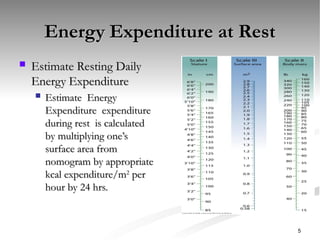
 Estimate Energy
Estimate Energy
Expenditure expenditure
during rest is calculated
by multiplying one’s
surface area from
surface area from
nomogram by appropriate
kcal expenditure/m
kcal expenditure/m2
2
per
per
hour by 24 hrs.
hour by 24 hrs.
5
Energy Expenditure at Rest
 Factors Affecting Total
Factors Affecting Total
Daily Energy Expenditure
 Physical Activity
Physical Activity: 15-30% of
: 15-30% of
TDEE
TDEE
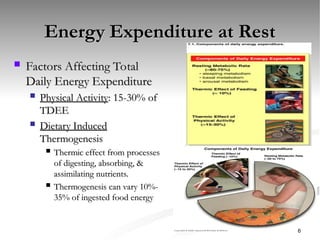
 Dietary Induced
Dietary Induced
Thermogenesis
Thermogenesis
 Thermic effect from processes
Thermic effect from processes
of digesting, absorbing, &
assimilating nutrients.
 Thermogenesis can vary 10%-
Thermogenesis can vary 10%-
35% of ingested food energy
6
Energy Expenditure at Rest
 Factors affecting Total Daily Energy Expenditure
Factors affecting Total Daily Energy Expenditure
 Climate.
Climate.
 RMR of people in tropic climate averages 5-10% higher.
RMR of people in tropic climate averages 5-10% higher.
 RMR in extreme cold can triple.
RMR in extreme cold can triple.
 Pregnancy.
Pregnancy.
7
Energy Expenditure in Physical
Activity
Activity
 Expression of Energy Expenditure
Expression of Energy Expenditure
 Total (gross) – Resting energy expenditure (REE) = Net
Total (gross) – Resting energy expenditure (REE) = Net
energy expenditure of the activity per se.
 Recovery energy included in Total = exercise energy +
Recovery energy included in Total = exercise energy +
recovery energy.
recovery energy.
 Utilization of 1 liter of O
Utilization of 1 liter of O2
2 generates about 5 kcal of
generates about 5 kcal of
energy.
energy.
Net O
Net O2
2 cost of exercise = exercise VO
cost of exercise = exercise VO2
2 + recovery
+ recovery
VO
VO2
2 – (resting VO
– (resting VO2
2 x time)
x time)
Gross energy expenditure= VO
Gross energy expenditure= VO2
2 during an activity
during an activity
and recovery × 5 kcal per liter
and recovery × 5 kcal per liter 8
Energy Expenditure in Physical
Activity
Activity
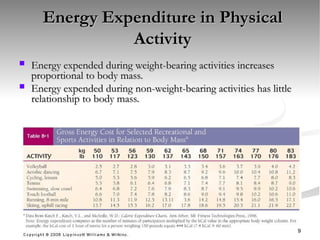
 Energy expended during weight-bearing activities increases
Energy expended during weight-bearing activities increases
proportional to body mass.
 Energy expended during non-weight-bearing activities has little
Energy expended during non-weight-bearing activities has little
relationship to body mass.
9
Energy Expenditure in Physical
Activity
Activity
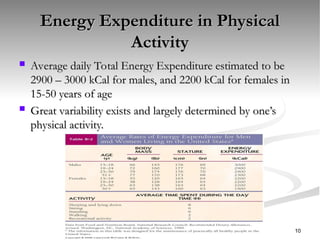
 Average daily Total Energy Expenditure estimated to be
Average daily Total Energy Expenditure estimated to be
2900 – 3000 kCal for males, and 2200 kCal for females in
15-50 years of age
15-50 years of age
 Great variability exists and largely determined by one’s
Great variability exists and largely determined by one’s
physical activity.
physical activity.
10
Energy Expenditure in Physical
Activity
Activity
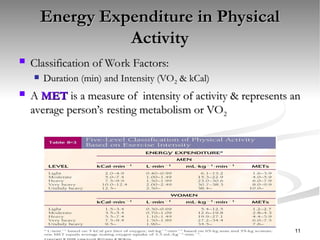
 Classification of Work Factors:
Classification of Work Factors:
 Duration (min) and Intensity (VO
Duration (min) and Intensity (VO2
2 & kCal)
& kCal)
 A
A MET
MET is a measure of intensity of activity & represents an
is a measure of intensity of activity & represents an
average person’s resting metabolism or VO
average person’s resting metabolism or VO2
2
11
Energy Expenditure in Physical
Activity
Activity
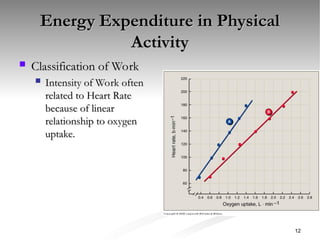
 Classification of Work
Classification of Work
 Intensity of Work often
Intensity of Work often
related to Heart Rate
because of linear
because of linear
relationship to oxygen
uptake.
uptake.
12
Economy & Efficiency of Energy
Expenditure
Expenditure
 Mechanical Efficiency
Mechanical Efficiency = Work Output÷
= Work Output÷
Energy Input (expenditure).
 Work Output = Force x Distance
Work Output = Force x Distance
 Three efficiency terms:
Three efficiency terms:
1.
1. Gross
Gross
2.
2. Net
Net
3.
3. Delta
Delta
13
Economy & Efficiency of Energy
Expenditure
Expenditure
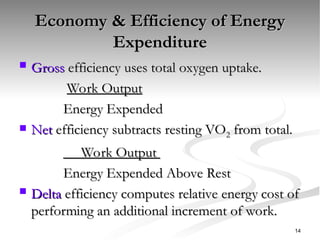
 Gross
Gross efficiency uses total oxygen uptake.
efficiency uses total oxygen uptake.
Work Output
Work Output
Energy Expended
Energy Expended
 Net
Net efficiency subtracts resting VO
efficiency subtracts resting VO2
2 from total.
from total.
Work Output
Work Output
Energy Expended Above Rest
 Delta
Delta efficiency computes relative energy cost of
efficiency computes relative energy cost of
performing an additional increment of work.
14
Energy Expenditure during Walking,
Running, and Swimming
 Economy is relationship between
Economy is relationship between
Energy output
Energy output
Energy input
Energy input
 Greater economy requires less oxygen uptake to
Greater economy requires less oxygen uptake to
perform a task.
perform a task.
 Training adjustment that improves economy
Training adjustment that improves economy
directly relates to improved exercise
performance.
performance.
15
Energy Expenditure during Walking
 Walking represents the major daily physical activity for most
Walking represents the major daily physical activity for most
persons.
persons.
 The relationship between walking speed and oxygen
The relationship between walking speed and oxygen
consumption remains approximately linear between speeds from
3.0 to 5.0 km/h; at faster speeds, walking ecomomy decreases
and the relationship curves upward,indicating a disproportionate
increase in energy expenditure with increasing speed.
 This explains the reason why per unit distance traveled faster,
This explains the reason why per unit distance traveled faster,
less efficient walking speeds expand more total calories.
16
Energy Expenditure during Walking
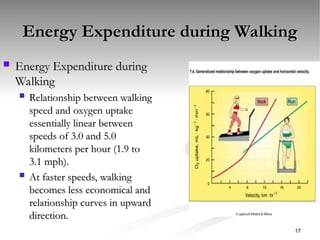
 Energy Expenditure during
Energy Expenditure during
Walking
Walking
 Relationship between walking
Relationship between walking
speed and oxygen uptake
essentially linear between
speeds of 3.0 and 5.0
kilometers per hour (1.9 to
3.1 mph).
3.1 mph).
 At faster speeds, walking
At faster speeds, walking
becomes less economical and
relationship curves in upward
direction.
direction.
17
Factor affecting walking
 1- Influence of body mass
1- Influence of body mass
 2-Terraing & walking surface
2-Terraing & walking surface
 3-Downhill walking
3-Downhill walking
 4- Footwear
4- Footwear
18
 Influence of body mass-
Influence of body mass-
 One can accurately predict energy expenditure of
One can accurately predict energy expenditure of
horizontal walking at speeds between 3.2 & 6.4 km/h
for men and women who differ in body mass
 On daily basis, error estimates of energy expended in
On daily basis, error estimates of energy expended in
walking generally range from 50 -100 kcal (assuming
the person walks 2 hrs daily)
 Extrapolation for light(<36 kg) and heavy individuals
Extrapolation for light(<36 kg) and heavy individuals
(>91 kg) is possible but with some loss in accuracy
Factor affecting walking
19
Factor affecting walking cont…
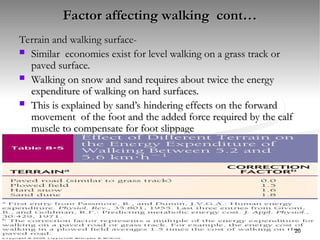
Terrain and walking surface-
 Similar economies exist for level walking on a grass track or
Similar economies exist for level walking on a grass track or
paved surface.
paved surface.
 Walking on snow and sand requires about twice the energy
Walking on snow and sand requires about twice the energy
expenditure of walking on hard surfaces.
 This is explained by sand’s hindering effects on the forward
This is explained by sand’s hindering effects on the forward
movement of the foot and the added force required by the calf
muscle to compensate for foot slippage
20
Factor affecting walking cont….
 Walking in a soft snow triples metabolic cost
Walking in a soft snow triples metabolic cost
compared with similar walking on a treadmill.
 A brisk walk (or a run) along a beach or in a freshly
A brisk walk (or a run) along a beach or in a freshly
fallen snow provides excellent exercise stress to
“burn” additional calories or improve physiologic
fitness
fitness
 Persons generate essentially the same physiologic
Persons generate essentially the same physiologic
stress by walking on a level surface or walking on a
treadmill at an equivalent speed & distance
21
Factor affecting walking cont…
Downhill walking
Downhill walking
 Walking the downhill portion of a mountain hike or golf course
Walking the downhill portion of a mountain hike or golf course
provides welcome relief compared with the uphill segment of
the exercise.
the exercise.
 Downhill walking represents a form of negative work because
Downhill walking represents a form of negative work because
the body’s centre of mass moves in downward vertical direction
with each step cycle
 This decreases the total potential energy of the system
This decreases the total potential energy of the system
 Consequently , at the same speed and elevation,it requires less
Consequently , at the same speed and elevation,it requires less
energy to perform eccentric muscle actions than the concentric
actions of positive work
22
Factor affecting walking cont…
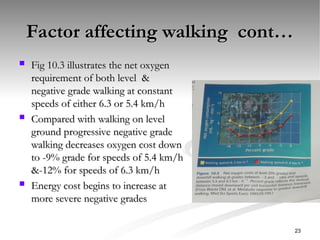
 Fig 10.3 illustrates the net oxygen
Fig 10.3 illustrates the net oxygen
requirement of both level &
negative grade walking at constant
speeds of either 6.3 or 5.4 km/h
 Compared with walking on level
Compared with walking on level
ground progressive negative grade
walking decreases oxygen cost down
to -9% grade for speeds of 5.4 km/h
&-12% for speeds of 6.3 km/h
 Energy cost begins to increase at
Energy cost begins to increase at
more severe negative grades
23
Factor affecting walking cont…
 The increase in oxygen cost for walking down
The increase in oxygen cost for walking down
the steeper grades probably results from
additional energy to ressist or “brake” the body
from gravity’s pull while trying to achieve a
proper and safe walking rhythm.
24
Factor affecting walking cont…
 Footwear
Footwear
 It requires considerably mpre energy to carry weight on the feet or ankles than to
It requires considerably mpre energy to carry weight on the feet or ankles than to
carry the same weight on the torso
 A weight equal to 1.4% of body mass placed on the ankles increases the energy
A weight equal to 1.4% of body mass placed on the ankles increases the energy
cost of walking an average of 8% or nearly 6 times more than with the same weight
on the torso.
on the torso.
 In a practical sense wearing boots increases the energy cost while wearing lighter
In a practical sense wearing boots increases the energy cost while wearing lighter
running shoes.
running shoes.
 Adding an additional 100g to each shoe increases oxygen consumption durig
Adding an additional 100g to each shoe increases oxygen consumption durig
moderate running by 1% .
 Clear implication exists for these findings in the design of running shoes,hiking and
Clear implication exists for these findings in the design of running shoes,hiking and
climbing boots,and workboots traditionally required in mining,forestry,fire fighting
and the milittary –small changes in movement economy
25
Factor affecting walking cont…

the cushioning properties of shoes also affect exercises economy
.
.
 A softer soled running shoe reduse the oxygen cost (incresd
A softer soled running shoe reduse the oxygen cost (incresd
economy).of running at moderet speed by 2.5% compared with
similar shoe with a firmer cushioning system .
 Even though the pair of softer –soled shoes weighed an
Even though the pair of softer –soled shoes weighed an
additional31g
additional31g
26
Factor affecting walking cont…
Hand held and ankle weights
The impect force on the legs during running averages about three
times body mass,wheras the level of leg shock walking equals
only 30% of this value
Individuals desiring to increase energy expenditure using only
walking as a low impact exercise mode often add extra
weight to the body.
weight to the body.
This modification also has been applied to running activities.
27
Influence of hand held weight
 Walking
Walking
 Ankle weights increase the energy expenditure of walking to values
Ankle weights increase the energy expenditure of walking to values
usually observed for running
 The effect benefits individual who use only walking as a low impact
The effect benefits individual who use only walking as a low impact
training modality , yet require greater energy expenditure than occur
during normal walking
 Hand held weights, walking poles (stimulate arm action in cross
Hand held weights, walking poles (stimulate arm action in cross
country skiing),power belts(worn around waist with ressistance cords
with handles for arm action) and upper body exercise(swinging the
arms) all increase the energy expenditure of walking
 However, handheld weights and walking poles may disproportionately
However, handheld weights and walking poles may disproportionately
increase exercise systolic blood pressure-elevating effects of
 (1)upper body exercise
(1)upper body exercise
 (2) increased intramuscular tension from gripping the object
(2) increased intramuscular tension from gripping the object
 An augmented blood pressure response contraindicates use of
An augmented blood pressure response contraindicates use of
handheld weights for individuals with existing hypertension or
coronary heart disease
28
Influence of hand held weight cont…
 Running
Running
 Considering the relatively small increase in energy
Considering the relatively small increase in energy
expenditure with hand or ankle weight in running,it seems
more practical to simply increase the unweighted running
speed or distance.
speed or distance.
 This reduces the injury potential from the added impact
This reduces the injury potential from the added impact
force imparted by the weights and eliminates discomfort from
carrying them.
carrying them.
 For individuals with orthopedic limitations that could
For individuals with orthopedic limitations that could
worsen wiyh leg impact shock from running, in-line skating
offers a less-stressful alternative for an equvivalent aerobic
demand.
demand.
29
Influence of hand held weight cont…
Competition walking
Competition walking
 Researchers studied the treadmill energy expenditure of 5 olympic-
Researchers studied the treadmill energy expenditure of 5 olympic-
caliber walkers at various walking and running speed.
 Walking speed during competition averaged 13.0 km/hr over distances
Walking speed during competition averaged 13.0 km/hr over distances
from 1.6 to 50 km.
from 1.6 to 50 km.
 This represents a relatively fast speed., the world record for 20 km walk
This represents a relatively fast speed., the world record for 20 km walk
of 1:17:21 equals a speed of 15.51 km/ hr in addition treadmill walking at
competition speed produce only slightly lower O
competition speed produce only slightly lower O2
2 consumption for race
consumption for race
walkers than their highest O
walkers than their highest O2
2 consumptions during treadmill running.
consumptions during treadmill running.
 A linear relationship existed between O2 consumption and walking at
A linear relationship existed between O2 consumption and walking at
speeds above 8 km/hr but the slope of the line was twice as steep as that
for running a t the same speeds.
 The athlete4s would walk at velocities of nearly 16 km/hr .
The athlete4s would walk at velocities of nearly 16 km/hr .
30
Influence of hand held weight cont…
The economy of walking Faster than 8km/hr equal only ½ the economy
for running at the same speed.
 Attainment of similar values for VO2max during the race walking
Attainment of similar values for VO2max during the race walking
and running by elite competitors further supports the model for
aerobic training specificity because VO2 max in untrained subjects
during walking generally remains 5-15% below running e.
 Competiiton walkers achieve high yet uneconomical rates of
Competiiton walkers achieve high yet uneconomical rates of
movement, unattainable with conventional walking, with a
distinctive modified walking technique that constrains the athelete
to certain movement patterns regardless of walking speed.
 The athelete must maintain this gait despite progressive decrease in
The athelete must maintain this gait despite progressive decrease in
walking economy as exercise duration progresses and fatigue
increases .
increases .
 among elite race walkers,variation in walking economy contribute
among elite race walkers,variation in walking economy contribute
more to successful performance than in competitive running
more to successful performance than in competitive running 31
Energy Expenditure during Running
Energy Expenditure during Running-
 Primary biomechanical factoor that determine the energy cost of running
Primary biomechanical factoor that determine the energy cost of running
related to velocity among mammals include the magnitude and rate of
muscular force generation to counteract gravity and to operate spring
like property of the muscle tendon system.
 Energy expenditure for running has been quantified in 2 ways
Energy expenditure for running has been quantified in 2 ways
 1-during performanceof the actual activity
1-during performanceof the actual activity
 2-on a treadmill with precise control of speed and grade
2-on a treadmill with precise control of speed and grade
 At identical submaximal speeds, an endurance athelete runs at a lower
At identical submaximal speeds, an endurance athelete runs at a lower
% of vo2max than an untrained person,even though both maintain
similar oxygen consumption while running.
32
Energy Expenditure during Running cont…
 Independent of fitness, it becomes more economical from an
Independent of fitness, it becomes more economical from an
energy standpoint to discontinue walking and begin running at
speeds above about 8km/h
33
Energy Expenditure during Running cont…
 Economy of running fast or slow-
Economy of running fast or slow-
 Because of linear relationship between oxygen consumption & running
Because of linear relationship between oxygen consumption & running
speed,the total energy requirement for running a given distance is about
the same regardless of speed
 Simply stated, running a mile at 10 mph requires about twice the energy
Simply stated, running a mile at 10 mph requires about twice the energy
per minute as running a mile at 5 mph; at the faster speed ,completing
the mile requires 6 minutes,but running at slower speed takes twice as
long or 12 minutes
long or 12 minutes
 As such the net energy cost to traverse the mile remains about the same
As such the net energy cost to traverse the mile remains about the same
 Equvivalent energy costs per mile occur not only for horizontal walking
Equvivalent energy costs per mile occur not only for horizontal walking
but also for walking at a specific grade that ranges from -45 to +15 %
34
Energy Expenditure during Running cont…
 During horizontal running, the net energy cost per kilogram of
During horizontal running, the net energy cost per kilogram of
body mass per kilometer traveled averages 1kcal or 1kcal/kg/km
 Thus the net energy cost of running 1 km for individuals
Thus the net energy cost of running 1 km for individuals
weighing 78 kg averages 78kcal,regardless of running speed
 Expressed in terms of oxygen consumption, this amounts to
Expressed in terms of oxygen consumption, this amounts to
15.6 L of oxygen consumption
 Comparisons of net energy cost of locomotion per unit
Comparisons of net energy cost of locomotion per unit
distance traveled for walking & running indicate greater energy
expenditure when running a given distance.
35
Energy Expenditure during Running cont…
 Stride length, stride frequency and speed
Stride length, stride frequency and speed
 Running
Running
 One can increase running speed in 3 ways-
One can increase running speed in 3 ways-
1.
1. Increase the number of steps each minute (stride frequency)
Increase the number of steps each minute (stride frequency)
2.
2. Increase the distance between steps(stride length)
Increase the distance between steps(stride length)
3.
3. Increase both the frequency and length of the stride
Increase both the frequency and length of the stride
The 3
The 3rd
rd
option may seem obvious for increasing running speed,but
several experiments have provided objective data concerning this
alternative
alternative
36
Energy Expenditure during Running cont…
Research in 1994 evaluated the stride pattern for the danish
champion in the 5- & 10-km running events
At a running speed of 9.3 km/h, this athelete’s stride frequency
equaled 160/minute, with a stride corresponding stride length of
97 cm
97 cm
When running speed increased 91% to 17.8km/h
Stride frequency increased only 10% to 176 per minute ,whereas
stride length increased 83% to 168 cm
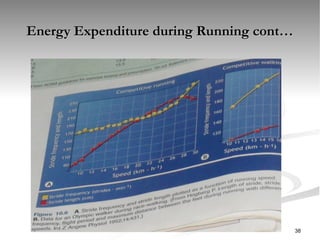
Figure 10.6 A displays the inteaction between stride frequency and
stride length as running speed increases
Doubling the speed from 10 to 20 km/h increases stride length by
85%,whereas stride frequency increases only about 9%
37
Energy Expenditure during Running cont…
38
Energy Expenditure during Running cont…
 Running at speed above 23km/h occurs mainly by increasing
Running at speed above 23km/h occurs mainly by increasing
stride frequency
stride frequency
 As a general rule, running speed increases mainly by
As a general rule, running speed increases mainly by
lengthening the stride
 only at faster speeds does stride frequency become important
only at faster speeds does stride frequency become important
 Relying on increasing the length of the “stroke” cycle, not the
Relying on increasing the length of the “stroke” cycle, not the
frequency
frequency
 To achieve more rapid speeds in endurance performance also
To achieve more rapid speeds in endurance performance also
occurs among top-flight kayakers,rowers,cross country skiers, &
speed skaters.
speed skaters.
39
 Competition walking-
Competition walking-
 The competitive walker does not increase speed the same way as a
The competitive walker does not increase speed the same way as a
runner does
runner does
 Fig 10.6 B illustrates the stride length-stride frequency relationship for
Fig 10.6 B illustrates the stride length-stride frequency relationship for
an olympic 10-km medal winner who walked at speeds from 10 to 14.4
km/h
km/h
 When walking speed increased within this range, stride frequency
When walking speed increased within this range, stride frequency
increased by 13%
increased by 13%
 Faster speeds produced an even greater increase in stride frequency
Faster speeds produced an even greater increase in stride frequency
 Unlike running, in which the body glides through the air, competitive
Unlike running, in which the body glides through the air, competitive
race-walking requires that the back foot remain on the ground until the
front foot makes contact
40
 Thus lengthening the stride
Thus lengthening the stride
becomes a difficult and
ineffective way to increase
the speed
the speed
 Consequently involving the
Consequently involving the
arm & trunk musculature to
move the leg forward rapidly
requires additional energy
expenditure; this explains the
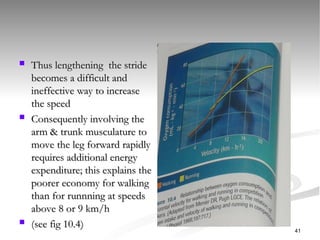
poorer economy for walking
than for runnning at speeds
above 8 or 9 km/h
above 8 or 9 km/h
 (see fig 10.4)
(see fig 10.4)
41
 Optimum stride length
Optimum stride length
 Each person runs at constant speed with an optimum
Each person runs at constant speed with an optimum
combination of stride length & frequency
 This optimum depends on the person’s mechanics or “style”
This optimum depends on the person’s mechanics or “style”
of running or cannot be determined from body
measurements
measurements
 Nevertheless energy expenditure increases more for
Nevertheless energy expenditure increases more for
overstriding than for understanding
42
Energy Expenditure during Running cont…
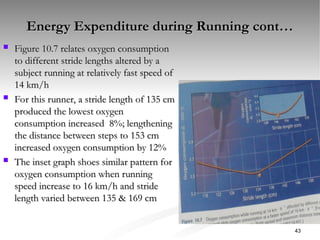
 Figure 10.7 relates oxygen consumption
Figure 10.7 relates oxygen consumption
to different stride lengths altered by a
subject running at relatively fast speed of
14 km/h
14 km/h
 For this runner, a stride length of 135 cm
For this runner, a stride length of 135 cm
produced the lowest oxygen
consumption increased 8%; lengthening
the distance between steps to 153 cm
increased oxygen consumption by 12%
 The inset graph shoes similar pattern for
The inset graph shoes similar pattern for
oxygen consumption when running
speed increase to 16 km/h and stride
length varied between 135 & 169 cm
43
Energy Expenditure during Running cont…
 Decreasing this runner’s stride length from the optimum of 149cm to
Decreasing this runner’s stride length from the optimum of 149cm to
135 cm increased oxygen consumption by 4.1%; lengthening the
stride to 169 cm increased aerobic energy expenditure nearly 13%
 As one might expect, the stride length selected by the subject
As one might expect, the stride length selected by the subject
(marked in figure by solid orange circle) produced the most
economical stride length (lowest vo2)
 Lengthening the stride above the optimum caused a larger increase in
Lengthening the stride above the optimum caused a larger increase in
oxygen consumption than a shorter-than-optimum length
 Urging a runner who shows signs of fatigue to “lengthen your stride!”
Urging a runner who shows signs of fatigue to “lengthen your stride!”
to maintain speed actually proves counterproductive in terms of
economy of effort
economy of effort

44
Energy Expenditure during Running cont…
 Well trained runners should run at stride length they have
Well trained runners should run at stride length they have
selected through years of running
 In keeping with the concept that the body attempts to achieve a
In keeping with the concept that the body attempts to achieve a
level of minimum effort, a self selected length & frequency
generally produce the most economical running performance
 This reflects an individual’s unique body size ,inertia of limb
This reflects an individual’s unique body size ,inertia of limb
segments, & anatomic development
 No “best” style characterizes elite runners
No “best” style characterizes elite runners
 Biomechanical analysis may help the athelete correctminor
Biomechanical analysis may help the athelete correctminor
irregularities in movement pattern while running
 For competitive runner, any minor improvement in movement
For competitive runner, any minor improvement in movement
economy generally improves performance
45
Energy Expenditure during Running
 More economical to discontinue walking and begin
More economical to discontinue walking and begin
to run or jog at speeds > 6.5 kmh (4 mph).
 Net energy cost of running a given distance is
Net energy cost of running a given distance is
independent of running speed.
 Lengthening stride above the optimum length (and
Lengthening stride above the optimum length (and
reducing stride frequency) increases VO
reducing stride frequency) increases VO2
2 more than
more than
shortening below optimum (and increasing stride
frequency).
frequency).
 Cost of running into headwind significantly greater
Cost of running into headwind significantly greater
than the reduction with tailwind.
than the reduction with tailwind. 46
Running economy; children,adult,trained
and untrained atheletes
 Boys & girls are less economical runners than adults because
Boys & girls are less economical runners than adults because
they require 20 to 30% more oxygen per unit body mass to run
at a particular speed
 consequently adult models to predict energy cost in weight
consequently adult models to predict energy cost in weight
bearing locomotion fails to account for the increased energy
costs in children & adolscents
47
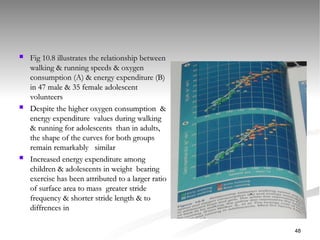
 Fig 10.8 illustrates the relationship between
Fig 10.8 illustrates the relationship between
walking & running speeds & oxygen
consumption (A) & energy expenditure (B)
in 47 male & 35 female adolescent
volunteers
volunteers
 Despite the higher oxygen consumption &
Despite the higher oxygen consumption &
energy expenditure values during walking
& running for adolescents than in adults,
the shape of the curves for both groups
remain remarkably similar
 Increased energy expenditure among
Increased energy expenditure among
children & adolescents in weight bearing
exercise has been attributed to a larger ratio
of surface area to mass greater stride
frequency & shorter stride length & to
diffrences in
diffrences in
48
 Anthropometric variables & body
Anthropometric variables & body
mechanics that reduces movement
economy
economy
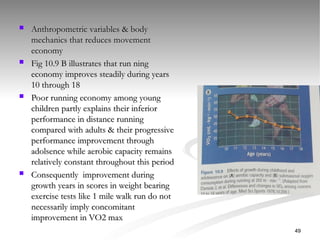
 Fig 10.9 B illustrates that run ning
Fig 10.9 B illustrates that run ning
economy improves steadily during years
10 through 18
10 through 18
 Poor running economy among young
Poor running economy among young
children partly explains their inferior
performance in distance running
compared with adults & their progressive
performance improvement through
adolsence while aerobic capacity remains
relatively constant throughout this period
 Consequently improvement during
Consequently improvement during
growth years in scores in weight bearing
exercise tests like 1 mile walk run do not
necessarily imply concomitant
improvement in VO2 max
49
 Treadmill versus track running
Treadmill versus track running
 The treadmill provides the primary exercise mode to evaluate the physiology
The treadmill provides the primary exercise mode to evaluate the physiology
of running
of running
 8 distance runners ran on a treadmill & track under a calm air conditions at 3
8 distance runners ran on a treadmill & track under a calm air conditions at 3
submaximal speeds of 180m/min, 210m/mi & 260m/min
 Graded exercise test determined possible diffrence between treadmill & track
Graded exercise test determined possible diffrence between treadmill & track
running on maximal oxygen consumption
50
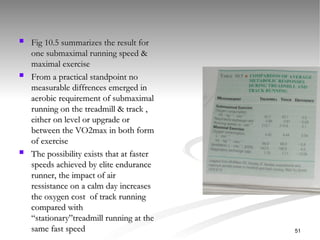
 Fig 10.5 summarizes the result for
Fig 10.5 summarizes the result for
one submaximal running speed &
maximal exercise
maximal exercise
 From a practical standpoint no
From a practical standpoint no
measurable diffrences emerged in
aerobic requirement of submaximal
running on the treadmill & track ,
either on level or upgrade or
between the VO2max in both form
of exercise
of exercise
 The possibility exists that at faster
The possibility exists that at faster
speeds achieved by elite endurance
runner, the impact of air
ressistance on a calm day increases
the oxygen cost of track running
compared with
compared with
“stationary”treadmill running at the
same fast speed
same fast speed 51
 Marathon running
Marathon running
 The current world marathon record(as october 2005) is 2h:04min:55s
The current world marathon record(as october 2005) is 2h:04min:55s
 Researchers measured 2 distance runners during a marathon to assess
Researchers measured 2 distance runners during a marathon to assess
energy expenditure each minute & total caloric cost of the run
 They determined oxygen consumption every 3 miles using open circuit
They determined oxygen consumption every 3 miles using open circuit
spirometry
spirometry
 Marathon times were 2h:36min:34s(vo2max=70.5ml/kg/min) &
Marathon times were 2h:36min:34s(vo2max=70.5ml/kg/min) &
2h:39min:28s(vo2max=73.9ml/kg/min)
 The first runner maintained an average speed of 16.2 km/h that requires
The first runner maintained an average speed of 16.2 km/h that requires
oxygen consumption equal to 80% of vo2max
 for 2
for 2nd
nd
runner who averaged a slower speed of 16km/h,the aerobic
component averaged 78.3% of maximum
 For both men total energy required to run the marathon ranged between
For both men total energy required to run the marathon ranged between
2300 & 2400kcal.
2300 & 2400kcal. 52
Swimming
Swimming
 Swimming differs in several important aspects from walking or
Swimming differs in several important aspects from walking or
running
running
 One obvious diffrence entails the expenditure of energy to
One obvious diffrence entails the expenditure of energy to
maintain buoyancy while simultaneously generating horizontal
movement by using arms & legs either in combination or
seperately
seperately
 Other diffrences include requirement of overcoming drag forces
Other diffrences include requirement of overcoming drag forces
that impedes a swimmer’s forward movement
 The amount of drag depends upon the fluid medium &
The amount of drag depends upon the fluid medium &
swimmer’s size, shape, & velocity
53
Energy Expenditure during
Swimming
Swimming
 Energy expenditure to swim a given distance is
Energy expenditure to swim a given distance is
about 4 times greater than to run same distance.
 Energy must be expended to maintain buoyancy
Energy must be expended to maintain buoyancy
while generating horizontal motion and to
overcome drag forces.
 Total drag consists of:
Total drag consists of:
 Wave drag
Wave drag
 Skin friction drag
Skin friction drag
 Viscous pressure drag
Viscous pressure drag
54
Energy Expenditure during
Swimming cont…
Swimming cont…
 Energy cost and drag
Energy cost and drag
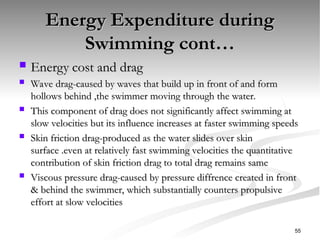
 Wave drag-caused by waves that build up in front of and form
Wave drag-caused by waves that build up in front of and form
hollows behind ,the swimmer moving through the water.
 This component of drag does not significantly affect swimming at
This component of drag does not significantly affect swimming at
slow velocities but its influence increases at faster swimming speeds
 Skin friction drag-produced as the water slides over skin
Skin friction drag-produced as the water slides over skin
surface .even at relatively fast swimming velocities the quantitative
contribution of skin friction drag to total drag remains same
 Viscous pressure drag-caused by pressure diffrence created in front
Viscous pressure drag-caused by pressure diffrence created in front
& behind the swimmer, which substantially counters propulsive
effort at slow velocities
55
Energy Expenditure during Swimming cont…
 Ways to reduce effect of drag force-
Ways to reduce effect of drag force-
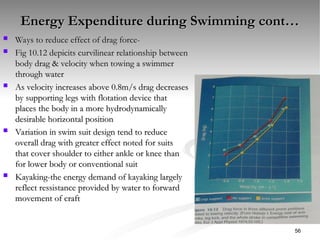
 Fig 10.12 depicits curvilinear relationship between
Fig 10.12 depicits curvilinear relationship between
body drag & velocity when towing a swimmer
through water
through water
 As velocity increases above 0.8m/s drag decreases
As velocity increases above 0.8m/s drag decreases
by supporting legs with flotation device that
places the body in a more hydrodynamically
desirable horizontal position
 Variation in swim suit design tend to reduce
Variation in swim suit design tend to reduce
overall drag with greater effect noted for suits
that cover shoulder to either ankle or knee than
for lower body or conventional suit
 Kayaking-the energy demand of kayaking largely
Kayaking-the energy demand of kayaking largely
reflect ressistance provided by water to forward
movement of craft
movement of craft
56
Energy Expenditure during
Swimming cont…
Swimming cont…
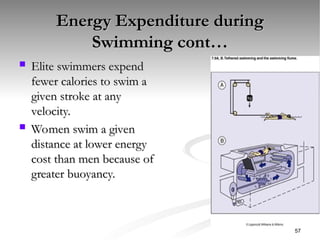
 Elite swimmers expend
Elite swimmers expend
fewer calories to swim a
given stroke at any
given stroke at any
velocity.
velocity.
 Women swim a given
Women swim a given
distance at lower energy
cost than men because of
greater buoyancy.
greater buoyancy.
57
Energy cost, swimming velocity,
and skill
and skill
 Elite swimmer swim a particular stroke at a given velocity with
Elite swimmer swim a particular stroke at a given velocity with
lower oxygen consumption than relatively untrained or
recreational swimmers
 Highly skilled swimmer use more of the energy they generate
Highly skilled swimmer use more of the energy they generate
per stroke to overcomevdrag forces
 Consequently they cover a greater distance per stroke than less
Consequently they cover a greater distance per stroke than less
skilled swimmers who waste considerable energy ineffectively
moving water
moving water
58
 Effect of water temperature-
Effect of water temperature-
 Cold water places swimmer under thermal stress
Cold water places swimmer under thermal stress
 This initiates cardiovascular & metabolic adjustments different
This initiates cardiovascular & metabolic adjustments different
from swimming in warmer water
 This adaptive response primarily maintain a stable core
This adaptive response primarily maintain a stable core
temperature by compensating for considerable heat loss from the
body particularly at water temperature below 25
body particularly at water temperature below 250
0
c
c
 Body heat loss occurs most readily in lean swimmers who lack
Body heat loss occurs most readily in lean swimmers who lack
benefits from insulatory effects of subcutaneous fat
accumulation
accumulation
59
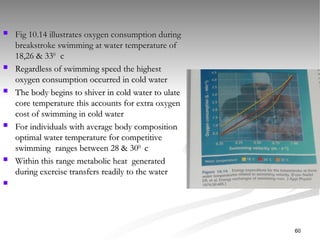
 Fig 10.14 illustrates oxygen consumption during
Fig 10.14 illustrates oxygen consumption during
breakstroke swimming at water temperature of
18,26 & 33
18,26 & 330
0
c
c
 Regardless of swimming speed the highest
Regardless of swimming speed the highest
oxygen consumption occurred in cold water
 The body begins to shiver in cold water to ulate
The body begins to shiver in cold water to ulate
core temperature this accounts for extra oxygen
cost of swimming in cold water
 For individuals with average body composition
For individuals with average body composition
optimal water temperature for competitive
swimming ranges between 28 & 30
swimming ranges between 28 & 300
0
c
c
 Within this range metabolic heat generated
Within this range metabolic heat generated
during exercise transfers readily to the water

60
 Effect of buoyancy: men versus women:
Effect of buoyancy: men versus women:
 Women of all ages possess on average a higher body fat
Women of all ages possess on average a higher body fat
percentage than men
percentage than men
 Because fat floats & muscle & bone sink in water the average
Because fat floats & muscle & bone sink in water the average
women gain a hydrodynamic lift and expends less energy to stay
afloat than her male counterpart
 More than likely, gender diffrences in percentage body fat & thus
More than likely, gender diffrences in percentage body fat & thus
body buoyancy partially explain the greater swimming economy
for women
for women
 For eg, women swim a given distance at about 30% lower total
For eg, women swim a given distance at about 30% lower total
energy cost than do men
61
 Endurance swimmers-
Endurance swimmers-
 Distance swimming in ocean water poses a severe metabolic
Distance swimming in ocean water poses a severe metabolic
& physiologic challenge
 A study of 9 english channel swimmers included
A study of 9 english channel swimmers included
measurements taken under race condition in salt water pool
at swimming speed that ranged from 2.6 to 4.9km/h
 During the race competitors maintained a constant stroke
During the race competitors maintained a constant stroke
rate & place until the last few hours when fatigue set in
62
References
References
 McArdle, William D., Frank I. Katch, and Victor
McArdle, William D., Frank I. Katch, and Victor
L. Katch. 2000. Essentials of Exercise
Physiology 2
Physiology 2nd
nd
ed. Image Collection. Lippincott
Williams & Wilkins.
Williams & Wilkins.
63
THANK YOU
THANK YOU
64

energy expenditure during rest & activity.ppt

  • 1.
    Energy Expenditure Energy Expenditure duringWalking, Running, during Walking, Running, and Swimming and Swimming 1
  • 2.
    Energy expenditure at Energyexpenditure at rest & physical activity rest & physical activity 2
  • 3.
    Energy Expenditure atRest Energy Expenditure at Rest  Basal Metabolic Rate Basal Metabolic Rate  BMR is rate of energy expenditure during fasted, BMR is rate of energy expenditure during fasted, rested and supine conditions in thermoneutral rested and supine conditions in thermoneutral environment environment  Resting metabolic rate (RMR) is rate of energy Resting metabolic rate (RMR) is rate of energy expenditure when at rest but not basal expenditure when at rest but not basal  BMR proportional to BSA, after age 20 , 2% & 3% BMR proportional to BSA, after age 20 , 2% & 3% per decade in women and men, respectively per decade in women and men, respectively  BMR represents largest fraction of TEE in sedentary BMR represents largest fraction of TEE in sedentary people people 3
  • 4.
    Energy Expenditure atRest Energy Expenditure at Rest  Influence of Body Size Influence of Body Size  Differences in body size usually expressed in terms Differences in body size usually expressed in terms of body surface area (BSA). of body surface area (BSA).  From 20-40, average values BMR are 38 kcal/m From 20-40, average values BMR are 38 kcal/m2 2 per per hour for men and 36 kcal/m hour for men and 36 kcal/m2 2 for women. for women.  Lower BMR in women can be attributed to woman’s Lower BMR in women can be attributed to woman’s larger percent body fat & smaller muscle mass. larger percent body fat & smaller muscle mass. 4
  • 5.
    Energy Expenditure atRest Energy Expenditure at Rest  Estimate Resting Daily Estimate Resting Daily Energy Expenditure Energy Expenditure  Estimate Energy Estimate Energy Expenditure expenditure Expenditure expenditure during rest is calculated during rest is calculated by multiplying one’s by multiplying one’s surface area from surface area from nomogram by appropriate nomogram by appropriate kcal expenditure/m kcal expenditure/m2 2 per per hour by 24 hrs. hour by 24 hrs. 5
  • 6.
    Energy Expenditure atRest Energy Expenditure at Rest  Factors Affecting Total Factors Affecting Total Daily Energy Expenditure Daily Energy Expenditure  Physical Activity Physical Activity: 15-30% of : 15-30% of TDEE TDEE  Dietary Induced Dietary Induced Thermogenesis Thermogenesis  Thermic effect from processes Thermic effect from processes of digesting, absorbing, & of digesting, absorbing, & assimilating nutrients. assimilating nutrients.  Thermogenesis can vary 10%- Thermogenesis can vary 10%- 35% of ingested food energy 35% of ingested food energy 6
  • 7.
    Energy Expenditure atRest Energy Expenditure at Rest  Factors affecting Total Daily Energy Expenditure Factors affecting Total Daily Energy Expenditure  Climate. Climate.  RMR of people in tropic climate averages 5-10% higher. RMR of people in tropic climate averages 5-10% higher.  RMR in extreme cold can triple. RMR in extreme cold can triple.  Pregnancy. Pregnancy. 7
  • 8.
    Energy Expenditure inPhysical Energy Expenditure in Physical Activity Activity  Expression of Energy Expenditure Expression of Energy Expenditure  Total (gross) – Resting energy expenditure (REE) = Net Total (gross) – Resting energy expenditure (REE) = Net energy expenditure of the activity per se. energy expenditure of the activity per se.  Recovery energy included in Total = exercise energy + Recovery energy included in Total = exercise energy + recovery energy. recovery energy.  Utilization of 1 liter of O Utilization of 1 liter of O2 2 generates about 5 kcal of generates about 5 kcal of energy. energy. Net O Net O2 2 cost of exercise = exercise VO cost of exercise = exercise VO2 2 + recovery + recovery VO VO2 2 – (resting VO – (resting VO2 2 x time) x time) Gross energy expenditure= VO Gross energy expenditure= VO2 2 during an activity during an activity and recovery × 5 kcal per liter and recovery × 5 kcal per liter 8
  • 9.
    Energy Expenditure inPhysical Energy Expenditure in Physical Activity Activity  Energy expended during weight-bearing activities increases Energy expended during weight-bearing activities increases proportional to body mass. proportional to body mass.  Energy expended during non-weight-bearing activities has little Energy expended during non-weight-bearing activities has little relationship to body mass. relationship to body mass. 9
  • 10.
    Energy Expenditure inPhysical Energy Expenditure in Physical Activity Activity  Average daily Total Energy Expenditure estimated to be Average daily Total Energy Expenditure estimated to be 2900 – 3000 kCal for males, and 2200 kCal for females in 2900 – 3000 kCal for males, and 2200 kCal for females in 15-50 years of age 15-50 years of age  Great variability exists and largely determined by one’s Great variability exists and largely determined by one’s physical activity. physical activity. 10
  • 11.
    Energy Expenditure inPhysical Energy Expenditure in Physical Activity Activity  Classification of Work Factors: Classification of Work Factors:  Duration (min) and Intensity (VO Duration (min) and Intensity (VO2 2 & kCal) & kCal)  A A MET MET is a measure of intensity of activity & represents an is a measure of intensity of activity & represents an average person’s resting metabolism or VO average person’s resting metabolism or VO2 2 11
  • 12.
    Energy Expenditure inPhysical Energy Expenditure in Physical Activity Activity  Classification of Work Classification of Work  Intensity of Work often Intensity of Work often related to Heart Rate related to Heart Rate because of linear because of linear relationship to oxygen relationship to oxygen uptake. uptake. 12
  • 13.
    Economy & Efficiencyof Energy Economy & Efficiency of Energy Expenditure Expenditure  Mechanical Efficiency Mechanical Efficiency = Work Output÷ = Work Output÷ Energy Input (expenditure). Energy Input (expenditure).  Work Output = Force x Distance Work Output = Force x Distance  Three efficiency terms: Three efficiency terms: 1. 1. Gross Gross 2. 2. Net Net 3. 3. Delta Delta 13
  • 14.
    Economy & Efficiencyof Energy Economy & Efficiency of Energy Expenditure Expenditure  Gross Gross efficiency uses total oxygen uptake. efficiency uses total oxygen uptake. Work Output Work Output Energy Expended Energy Expended  Net Net efficiency subtracts resting VO efficiency subtracts resting VO2 2 from total. from total. Work Output Work Output Energy Expended Above Rest Energy Expended Above Rest  Delta Delta efficiency computes relative energy cost of efficiency computes relative energy cost of performing an additional increment of work. performing an additional increment of work. 14
  • 15.
    Energy Expenditure duringWalking, Energy Expenditure during Walking, Running, and Swimming Running, and Swimming  Economy is relationship between Economy is relationship between Energy output Energy output Energy input Energy input  Greater economy requires less oxygen uptake to Greater economy requires less oxygen uptake to perform a task. perform a task.  Training adjustment that improves economy Training adjustment that improves economy directly relates to improved exercise directly relates to improved exercise performance. performance. 15
  • 16.
    Energy Expenditure duringWalking Energy Expenditure during Walking  Walking represents the major daily physical activity for most Walking represents the major daily physical activity for most persons. persons.  The relationship between walking speed and oxygen The relationship between walking speed and oxygen consumption remains approximately linear between speeds from consumption remains approximately linear between speeds from 3.0 to 5.0 km/h; at faster speeds, walking ecomomy decreases 3.0 to 5.0 km/h; at faster speeds, walking ecomomy decreases and the relationship curves upward,indicating a disproportionate and the relationship curves upward,indicating a disproportionate increase in energy expenditure with increasing speed. increase in energy expenditure with increasing speed.  This explains the reason why per unit distance traveled faster, This explains the reason why per unit distance traveled faster, less efficient walking speeds expand more total calories. less efficient walking speeds expand more total calories. 16
  • 17.
    Energy Expenditure duringWalking Energy Expenditure during Walking  Energy Expenditure during Energy Expenditure during Walking Walking  Relationship between walking Relationship between walking speed and oxygen uptake speed and oxygen uptake essentially linear between essentially linear between speeds of 3.0 and 5.0 speeds of 3.0 and 5.0 kilometers per hour (1.9 to kilometers per hour (1.9 to 3.1 mph). 3.1 mph).  At faster speeds, walking At faster speeds, walking becomes less economical and becomes less economical and relationship curves in upward relationship curves in upward direction. direction. 17
  • 18.
    Factor affecting walking Factoraffecting walking  1- Influence of body mass 1- Influence of body mass  2-Terraing & walking surface 2-Terraing & walking surface  3-Downhill walking 3-Downhill walking  4- Footwear 4- Footwear 18
  • 19.
     Influence ofbody mass- Influence of body mass-  One can accurately predict energy expenditure of One can accurately predict energy expenditure of horizontal walking at speeds between 3.2 & 6.4 km/h horizontal walking at speeds between 3.2 & 6.4 km/h for men and women who differ in body mass for men and women who differ in body mass  On daily basis, error estimates of energy expended in On daily basis, error estimates of energy expended in walking generally range from 50 -100 kcal (assuming walking generally range from 50 -100 kcal (assuming the person walks 2 hrs daily) the person walks 2 hrs daily)  Extrapolation for light(<36 kg) and heavy individuals Extrapolation for light(<36 kg) and heavy individuals (>91 kg) is possible but with some loss in accuracy (>91 kg) is possible but with some loss in accuracy Factor affecting walking 19
  • 20.
    Factor affecting walkingcont… Factor affecting walking cont… Terrain and walking surface- Terrain and walking surface-  Similar economies exist for level walking on a grass track or Similar economies exist for level walking on a grass track or paved surface. paved surface.  Walking on snow and sand requires about twice the energy Walking on snow and sand requires about twice the energy expenditure of walking on hard surfaces. expenditure of walking on hard surfaces.  This is explained by sand’s hindering effects on the forward This is explained by sand’s hindering effects on the forward movement of the foot and the added force required by the calf movement of the foot and the added force required by the calf muscle to compensate for foot slippage muscle to compensate for foot slippage 20
  • 21.
    Factor affecting walkingcont…. Factor affecting walking cont….  Walking in a soft snow triples metabolic cost Walking in a soft snow triples metabolic cost compared with similar walking on a treadmill. compared with similar walking on a treadmill.  A brisk walk (or a run) along a beach or in a freshly A brisk walk (or a run) along a beach or in a freshly fallen snow provides excellent exercise stress to fallen snow provides excellent exercise stress to “burn” additional calories or improve physiologic “burn” additional calories or improve physiologic fitness fitness  Persons generate essentially the same physiologic Persons generate essentially the same physiologic stress by walking on a level surface or walking on a stress by walking on a level surface or walking on a treadmill at an equivalent speed & distance treadmill at an equivalent speed & distance 21
  • 22.
    Factor affecting walkingcont… Factor affecting walking cont… Downhill walking Downhill walking  Walking the downhill portion of a mountain hike or golf course Walking the downhill portion of a mountain hike or golf course provides welcome relief compared with the uphill segment of provides welcome relief compared with the uphill segment of the exercise. the exercise.  Downhill walking represents a form of negative work because Downhill walking represents a form of negative work because the body’s centre of mass moves in downward vertical direction the body’s centre of mass moves in downward vertical direction with each step cycle with each step cycle  This decreases the total potential energy of the system This decreases the total potential energy of the system  Consequently , at the same speed and elevation,it requires less Consequently , at the same speed and elevation,it requires less energy to perform eccentric muscle actions than the concentric energy to perform eccentric muscle actions than the concentric actions of positive work actions of positive work 22
  • 23.
    Factor affecting walkingcont… Factor affecting walking cont…  Fig 10.3 illustrates the net oxygen Fig 10.3 illustrates the net oxygen requirement of both level & requirement of both level & negative grade walking at constant negative grade walking at constant speeds of either 6.3 or 5.4 km/h speeds of either 6.3 or 5.4 km/h  Compared with walking on level Compared with walking on level ground progressive negative grade ground progressive negative grade walking decreases oxygen cost down walking decreases oxygen cost down to -9% grade for speeds of 5.4 km/h to -9% grade for speeds of 5.4 km/h &-12% for speeds of 6.3 km/h &-12% for speeds of 6.3 km/h  Energy cost begins to increase at Energy cost begins to increase at more severe negative grades more severe negative grades 23
  • 24.
    Factor affecting walkingcont… Factor affecting walking cont…  The increase in oxygen cost for walking down The increase in oxygen cost for walking down the steeper grades probably results from the steeper grades probably results from additional energy to ressist or “brake” the body additional energy to ressist or “brake” the body from gravity’s pull while trying to achieve a from gravity’s pull while trying to achieve a proper and safe walking rhythm. proper and safe walking rhythm. 24
  • 25.
    Factor affecting walkingcont… Factor affecting walking cont…  Footwear Footwear  It requires considerably mpre energy to carry weight on the feet or ankles than to It requires considerably mpre energy to carry weight on the feet or ankles than to carry the same weight on the torso carry the same weight on the torso  A weight equal to 1.4% of body mass placed on the ankles increases the energy A weight equal to 1.4% of body mass placed on the ankles increases the energy cost of walking an average of 8% or nearly 6 times more than with the same weight cost of walking an average of 8% or nearly 6 times more than with the same weight on the torso. on the torso.  In a practical sense wearing boots increases the energy cost while wearing lighter In a practical sense wearing boots increases the energy cost while wearing lighter running shoes. running shoes.  Adding an additional 100g to each shoe increases oxygen consumption durig Adding an additional 100g to each shoe increases oxygen consumption durig moderate running by 1% . moderate running by 1% .  Clear implication exists for these findings in the design of running shoes,hiking and Clear implication exists for these findings in the design of running shoes,hiking and climbing boots,and workboots traditionally required in mining,forestry,fire fighting climbing boots,and workboots traditionally required in mining,forestry,fire fighting and the milittary –small changes in movement economy and the milittary –small changes in movement economy 25
  • 26.
    Factor affecting walkingcont… Factor affecting walking cont…  the cushioning properties of shoes also affect exercises economy the cushioning properties of shoes also affect exercises economy . .  A softer soled running shoe reduse the oxygen cost (incresd A softer soled running shoe reduse the oxygen cost (incresd economy).of running at moderet speed by 2.5% compared with economy).of running at moderet speed by 2.5% compared with similar shoe with a firmer cushioning system . similar shoe with a firmer cushioning system .  Even though the pair of softer –soled shoes weighed an Even though the pair of softer –soled shoes weighed an additional31g additional31g 26
  • 27.
    Factor affecting walkingcont… Factor affecting walking cont… Hand held and ankle weights Hand held and ankle weights The impect force on the legs during running averages about three The impect force on the legs during running averages about three times body mass,wheras the level of leg shock walking equals times body mass,wheras the level of leg shock walking equals only 30% of this value only 30% of this value Individuals desiring to increase energy expenditure using only Individuals desiring to increase energy expenditure using only walking as a low impact exercise mode often add extra walking as a low impact exercise mode often add extra weight to the body. weight to the body. This modification also has been applied to running activities. This modification also has been applied to running activities. 27
  • 28.
    Influence of handheld weight Influence of hand held weight  Walking Walking  Ankle weights increase the energy expenditure of walking to values Ankle weights increase the energy expenditure of walking to values usually observed for running usually observed for running  The effect benefits individual who use only walking as a low impact The effect benefits individual who use only walking as a low impact training modality , yet require greater energy expenditure than occur training modality , yet require greater energy expenditure than occur during normal walking during normal walking  Hand held weights, walking poles (stimulate arm action in cross Hand held weights, walking poles (stimulate arm action in cross country skiing),power belts(worn around waist with ressistance cords country skiing),power belts(worn around waist with ressistance cords with handles for arm action) and upper body exercise(swinging the with handles for arm action) and upper body exercise(swinging the arms) all increase the energy expenditure of walking arms) all increase the energy expenditure of walking  However, handheld weights and walking poles may disproportionately However, handheld weights and walking poles may disproportionately increase exercise systolic blood pressure-elevating effects of increase exercise systolic blood pressure-elevating effects of  (1)upper body exercise (1)upper body exercise  (2) increased intramuscular tension from gripping the object (2) increased intramuscular tension from gripping the object  An augmented blood pressure response contraindicates use of An augmented blood pressure response contraindicates use of handheld weights for individuals with existing hypertension or handheld weights for individuals with existing hypertension or coronary heart disease coronary heart disease 28
  • 29.
    Influence of handheld weight cont… Influence of hand held weight cont…  Running Running  Considering the relatively small increase in energy Considering the relatively small increase in energy expenditure with hand or ankle weight in running,it seems expenditure with hand or ankle weight in running,it seems more practical to simply increase the unweighted running more practical to simply increase the unweighted running speed or distance. speed or distance.  This reduces the injury potential from the added impact This reduces the injury potential from the added impact force imparted by the weights and eliminates discomfort from force imparted by the weights and eliminates discomfort from carrying them. carrying them.  For individuals with orthopedic limitations that could For individuals with orthopedic limitations that could worsen wiyh leg impact shock from running, in-line skating worsen wiyh leg impact shock from running, in-line skating offers a less-stressful alternative for an equvivalent aerobic offers a less-stressful alternative for an equvivalent aerobic demand. demand. 29
  • 30.
    Influence of handheld weight cont… Influence of hand held weight cont… Competition walking Competition walking  Researchers studied the treadmill energy expenditure of 5 olympic- Researchers studied the treadmill energy expenditure of 5 olympic- caliber walkers at various walking and running speed. caliber walkers at various walking and running speed.  Walking speed during competition averaged 13.0 km/hr over distances Walking speed during competition averaged 13.0 km/hr over distances from 1.6 to 50 km. from 1.6 to 50 km.  This represents a relatively fast speed., the world record for 20 km walk This represents a relatively fast speed., the world record for 20 km walk of 1:17:21 equals a speed of 15.51 km/ hr in addition treadmill walking at of 1:17:21 equals a speed of 15.51 km/ hr in addition treadmill walking at competition speed produce only slightly lower O competition speed produce only slightly lower O2 2 consumption for race consumption for race walkers than their highest O walkers than their highest O2 2 consumptions during treadmill running. consumptions during treadmill running.  A linear relationship existed between O2 consumption and walking at A linear relationship existed between O2 consumption and walking at speeds above 8 km/hr but the slope of the line was twice as steep as that speeds above 8 km/hr but the slope of the line was twice as steep as that for running a t the same speeds. for running a t the same speeds.  The athlete4s would walk at velocities of nearly 16 km/hr . The athlete4s would walk at velocities of nearly 16 km/hr . 30
  • 31.
    Influence of handheld weight cont… Influence of hand held weight cont… The economy of walking Faster than 8km/hr equal only ½ the economy The economy of walking Faster than 8km/hr equal only ½ the economy for running at the same speed. for running at the same speed.  Attainment of similar values for VO2max during the race walking Attainment of similar values for VO2max during the race walking and running by elite competitors further supports the model for and running by elite competitors further supports the model for aerobic training specificity because VO2 max in untrained subjects aerobic training specificity because VO2 max in untrained subjects during walking generally remains 5-15% below running e. during walking generally remains 5-15% below running e.  Competiiton walkers achieve high yet uneconomical rates of Competiiton walkers achieve high yet uneconomical rates of movement, unattainable with conventional walking, with a movement, unattainable with conventional walking, with a distinctive modified walking technique that constrains the athelete distinctive modified walking technique that constrains the athelete to certain movement patterns regardless of walking speed. to certain movement patterns regardless of walking speed.  The athelete must maintain this gait despite progressive decrease in The athelete must maintain this gait despite progressive decrease in walking economy as exercise duration progresses and fatigue walking economy as exercise duration progresses and fatigue increases . increases .  among elite race walkers,variation in walking economy contribute among elite race walkers,variation in walking economy contribute more to successful performance than in competitive running more to successful performance than in competitive running 31
  • 32.
    Energy Expenditure duringRunning Energy Expenditure during Running Energy Expenditure during Running- Energy Expenditure during Running-  Primary biomechanical factoor that determine the energy cost of running Primary biomechanical factoor that determine the energy cost of running related to velocity among mammals include the magnitude and rate of related to velocity among mammals include the magnitude and rate of muscular force generation to counteract gravity and to operate spring muscular force generation to counteract gravity and to operate spring like property of the muscle tendon system. like property of the muscle tendon system.  Energy expenditure for running has been quantified in 2 ways Energy expenditure for running has been quantified in 2 ways  1-during performanceof the actual activity 1-during performanceof the actual activity  2-on a treadmill with precise control of speed and grade 2-on a treadmill with precise control of speed and grade  At identical submaximal speeds, an endurance athelete runs at a lower At identical submaximal speeds, an endurance athelete runs at a lower % of vo2max than an untrained person,even though both maintain % of vo2max than an untrained person,even though both maintain similar oxygen consumption while running. similar oxygen consumption while running. 32
  • 33.
    Energy Expenditure duringRunning cont… Energy Expenditure during Running cont…  Independent of fitness, it becomes more economical from an Independent of fitness, it becomes more economical from an energy standpoint to discontinue walking and begin running at energy standpoint to discontinue walking and begin running at speeds above about 8km/h speeds above about 8km/h 33
  • 34.
    Energy Expenditure duringRunning cont… Energy Expenditure during Running cont…  Economy of running fast or slow- Economy of running fast or slow-  Because of linear relationship between oxygen consumption & running Because of linear relationship between oxygen consumption & running speed,the total energy requirement for running a given distance is about speed,the total energy requirement for running a given distance is about the same regardless of speed the same regardless of speed  Simply stated, running a mile at 10 mph requires about twice the energy Simply stated, running a mile at 10 mph requires about twice the energy per minute as running a mile at 5 mph; at the faster speed ,completing per minute as running a mile at 5 mph; at the faster speed ,completing the mile requires 6 minutes,but running at slower speed takes twice as the mile requires 6 minutes,but running at slower speed takes twice as long or 12 minutes long or 12 minutes  As such the net energy cost to traverse the mile remains about the same As such the net energy cost to traverse the mile remains about the same  Equvivalent energy costs per mile occur not only for horizontal walking Equvivalent energy costs per mile occur not only for horizontal walking but also for walking at a specific grade that ranges from -45 to +15 % but also for walking at a specific grade that ranges from -45 to +15 % 34
  • 35.
    Energy Expenditure duringRunning cont… Energy Expenditure during Running cont…  During horizontal running, the net energy cost per kilogram of During horizontal running, the net energy cost per kilogram of body mass per kilometer traveled averages 1kcal or 1kcal/kg/km body mass per kilometer traveled averages 1kcal or 1kcal/kg/km  Thus the net energy cost of running 1 km for individuals Thus the net energy cost of running 1 km for individuals weighing 78 kg averages 78kcal,regardless of running speed weighing 78 kg averages 78kcal,regardless of running speed  Expressed in terms of oxygen consumption, this amounts to Expressed in terms of oxygen consumption, this amounts to 15.6 L of oxygen consumption 15.6 L of oxygen consumption  Comparisons of net energy cost of locomotion per unit Comparisons of net energy cost of locomotion per unit distance traveled for walking & running indicate greater energy distance traveled for walking & running indicate greater energy expenditure when running a given distance. expenditure when running a given distance. 35
  • 36.
    Energy Expenditure duringRunning cont… Energy Expenditure during Running cont…  Stride length, stride frequency and speed Stride length, stride frequency and speed  Running Running  One can increase running speed in 3 ways- One can increase running speed in 3 ways- 1. 1. Increase the number of steps each minute (stride frequency) Increase the number of steps each minute (stride frequency) 2. 2. Increase the distance between steps(stride length) Increase the distance between steps(stride length) 3. 3. Increase both the frequency and length of the stride Increase both the frequency and length of the stride The 3 The 3rd rd option may seem obvious for increasing running speed,but option may seem obvious for increasing running speed,but several experiments have provided objective data concerning this several experiments have provided objective data concerning this alternative alternative 36
  • 37.
    Energy Expenditure duringRunning cont… Energy Expenditure during Running cont… Research in 1994 evaluated the stride pattern for the danish Research in 1994 evaluated the stride pattern for the danish champion in the 5- & 10-km running events champion in the 5- & 10-km running events At a running speed of 9.3 km/h, this athelete’s stride frequency At a running speed of 9.3 km/h, this athelete’s stride frequency equaled 160/minute, with a stride corresponding stride length of equaled 160/minute, with a stride corresponding stride length of 97 cm 97 cm When running speed increased 91% to 17.8km/h When running speed increased 91% to 17.8km/h Stride frequency increased only 10% to 176 per minute ,whereas Stride frequency increased only 10% to 176 per minute ,whereas stride length increased 83% to 168 cm stride length increased 83% to 168 cm Figure 10.6 A displays the inteaction between stride frequency and Figure 10.6 A displays the inteaction between stride frequency and stride length as running speed increases stride length as running speed increases Doubling the speed from 10 to 20 km/h increases stride length by Doubling the speed from 10 to 20 km/h increases stride length by 85%,whereas stride frequency increases only about 9% 85%,whereas stride frequency increases only about 9% 37
  • 38.
    Energy Expenditure duringRunning cont… Energy Expenditure during Running cont… 38
  • 39.
    Energy Expenditure duringRunning cont… Energy Expenditure during Running cont…  Running at speed above 23km/h occurs mainly by increasing Running at speed above 23km/h occurs mainly by increasing stride frequency stride frequency  As a general rule, running speed increases mainly by As a general rule, running speed increases mainly by lengthening the stride lengthening the stride  only at faster speeds does stride frequency become important only at faster speeds does stride frequency become important  Relying on increasing the length of the “stroke” cycle, not the Relying on increasing the length of the “stroke” cycle, not the frequency frequency  To achieve more rapid speeds in endurance performance also To achieve more rapid speeds in endurance performance also occurs among top-flight kayakers,rowers,cross country skiers, & occurs among top-flight kayakers,rowers,cross country skiers, & speed skaters. speed skaters. 39
  • 40.
     Competition walking- Competitionwalking-  The competitive walker does not increase speed the same way as a The competitive walker does not increase speed the same way as a runner does runner does  Fig 10.6 B illustrates the stride length-stride frequency relationship for Fig 10.6 B illustrates the stride length-stride frequency relationship for an olympic 10-km medal winner who walked at speeds from 10 to 14.4 an olympic 10-km medal winner who walked at speeds from 10 to 14.4 km/h km/h  When walking speed increased within this range, stride frequency When walking speed increased within this range, stride frequency increased by 13% increased by 13%  Faster speeds produced an even greater increase in stride frequency Faster speeds produced an even greater increase in stride frequency  Unlike running, in which the body glides through the air, competitive Unlike running, in which the body glides through the air, competitive race-walking requires that the back foot remain on the ground until the race-walking requires that the back foot remain on the ground until the front foot makes contact front foot makes contact 40
  • 41.
     Thus lengtheningthe stride Thus lengthening the stride becomes a difficult and becomes a difficult and ineffective way to increase ineffective way to increase the speed the speed  Consequently involving the Consequently involving the arm & trunk musculature to arm & trunk musculature to move the leg forward rapidly move the leg forward rapidly requires additional energy requires additional energy expenditure; this explains the expenditure; this explains the poorer economy for walking poorer economy for walking than for runnning at speeds than for runnning at speeds above 8 or 9 km/h above 8 or 9 km/h  (see fig 10.4) (see fig 10.4) 41
  • 42.
     Optimum stridelength Optimum stride length  Each person runs at constant speed with an optimum Each person runs at constant speed with an optimum combination of stride length & frequency combination of stride length & frequency  This optimum depends on the person’s mechanics or “style” This optimum depends on the person’s mechanics or “style” of running or cannot be determined from body of running or cannot be determined from body measurements measurements  Nevertheless energy expenditure increases more for Nevertheless energy expenditure increases more for overstriding than for understanding overstriding than for understanding 42
  • 43.
    Energy Expenditure duringRunning cont… Energy Expenditure during Running cont…  Figure 10.7 relates oxygen consumption Figure 10.7 relates oxygen consumption to different stride lengths altered by a to different stride lengths altered by a subject running at relatively fast speed of subject running at relatively fast speed of 14 km/h 14 km/h  For this runner, a stride length of 135 cm For this runner, a stride length of 135 cm produced the lowest oxygen produced the lowest oxygen consumption increased 8%; lengthening consumption increased 8%; lengthening the distance between steps to 153 cm the distance between steps to 153 cm increased oxygen consumption by 12% increased oxygen consumption by 12%  The inset graph shoes similar pattern for The inset graph shoes similar pattern for oxygen consumption when running oxygen consumption when running speed increase to 16 km/h and stride speed increase to 16 km/h and stride length varied between 135 & 169 cm length varied between 135 & 169 cm 43
  • 44.
    Energy Expenditure duringRunning cont… Energy Expenditure during Running cont…  Decreasing this runner’s stride length from the optimum of 149cm to Decreasing this runner’s stride length from the optimum of 149cm to 135 cm increased oxygen consumption by 4.1%; lengthening the 135 cm increased oxygen consumption by 4.1%; lengthening the stride to 169 cm increased aerobic energy expenditure nearly 13% stride to 169 cm increased aerobic energy expenditure nearly 13%  As one might expect, the stride length selected by the subject As one might expect, the stride length selected by the subject (marked in figure by solid orange circle) produced the most (marked in figure by solid orange circle) produced the most economical stride length (lowest vo2) economical stride length (lowest vo2)  Lengthening the stride above the optimum caused a larger increase in Lengthening the stride above the optimum caused a larger increase in oxygen consumption than a shorter-than-optimum length oxygen consumption than a shorter-than-optimum length  Urging a runner who shows signs of fatigue to “lengthen your stride!” Urging a runner who shows signs of fatigue to “lengthen your stride!” to maintain speed actually proves counterproductive in terms of to maintain speed actually proves counterproductive in terms of economy of effort economy of effort  44
  • 45.
    Energy Expenditure duringRunning cont… Energy Expenditure during Running cont…  Well trained runners should run at stride length they have Well trained runners should run at stride length they have selected through years of running selected through years of running  In keeping with the concept that the body attempts to achieve a In keeping with the concept that the body attempts to achieve a level of minimum effort, a self selected length & frequency level of minimum effort, a self selected length & frequency generally produce the most economical running performance generally produce the most economical running performance  This reflects an individual’s unique body size ,inertia of limb This reflects an individual’s unique body size ,inertia of limb segments, & anatomic development segments, & anatomic development  No “best” style characterizes elite runners No “best” style characterizes elite runners  Biomechanical analysis may help the athelete correctminor Biomechanical analysis may help the athelete correctminor irregularities in movement pattern while running irregularities in movement pattern while running  For competitive runner, any minor improvement in movement For competitive runner, any minor improvement in movement economy generally improves performance economy generally improves performance 45
  • 46.
    Energy Expenditure duringRunning Energy Expenditure during Running  More economical to discontinue walking and begin More economical to discontinue walking and begin to run or jog at speeds > 6.5 kmh (4 mph). to run or jog at speeds > 6.5 kmh (4 mph).  Net energy cost of running a given distance is Net energy cost of running a given distance is independent of running speed. independent of running speed.  Lengthening stride above the optimum length (and Lengthening stride above the optimum length (and reducing stride frequency) increases VO reducing stride frequency) increases VO2 2 more than more than shortening below optimum (and increasing stride shortening below optimum (and increasing stride frequency). frequency).  Cost of running into headwind significantly greater Cost of running into headwind significantly greater than the reduction with tailwind. than the reduction with tailwind. 46
  • 47.
    Running economy; children,adult,trained Runningeconomy; children,adult,trained and untrained atheletes and untrained atheletes  Boys & girls are less economical runners than adults because Boys & girls are less economical runners than adults because they require 20 to 30% more oxygen per unit body mass to run they require 20 to 30% more oxygen per unit body mass to run at a particular speed at a particular speed  consequently adult models to predict energy cost in weight consequently adult models to predict energy cost in weight bearing locomotion fails to account for the increased energy bearing locomotion fails to account for the increased energy costs in children & adolscents costs in children & adolscents 47
  • 48.
     Fig 10.8illustrates the relationship between Fig 10.8 illustrates the relationship between walking & running speeds & oxygen walking & running speeds & oxygen consumption (A) & energy expenditure (B) consumption (A) & energy expenditure (B) in 47 male & 35 female adolescent in 47 male & 35 female adolescent volunteers volunteers  Despite the higher oxygen consumption & Despite the higher oxygen consumption & energy expenditure values during walking energy expenditure values during walking & running for adolescents than in adults, & running for adolescents than in adults, the shape of the curves for both groups the shape of the curves for both groups remain remarkably similar remain remarkably similar  Increased energy expenditure among Increased energy expenditure among children & adolescents in weight bearing children & adolescents in weight bearing exercise has been attributed to a larger ratio exercise has been attributed to a larger ratio of surface area to mass greater stride of surface area to mass greater stride frequency & shorter stride length & to frequency & shorter stride length & to diffrences in diffrences in 48
  • 49.
     Anthropometric variables& body Anthropometric variables & body mechanics that reduces movement mechanics that reduces movement economy economy  Fig 10.9 B illustrates that run ning Fig 10.9 B illustrates that run ning economy improves steadily during years economy improves steadily during years 10 through 18 10 through 18  Poor running economy among young Poor running economy among young children partly explains their inferior children partly explains their inferior performance in distance running performance in distance running compared with adults & their progressive compared with adults & their progressive performance improvement through performance improvement through adolsence while aerobic capacity remains adolsence while aerobic capacity remains relatively constant throughout this period relatively constant throughout this period  Consequently improvement during Consequently improvement during growth years in scores in weight bearing growth years in scores in weight bearing exercise tests like 1 mile walk run do not exercise tests like 1 mile walk run do not necessarily imply concomitant necessarily imply concomitant improvement in VO2 max improvement in VO2 max 49
  • 50.
     Treadmill versustrack running Treadmill versus track running  The treadmill provides the primary exercise mode to evaluate the physiology The treadmill provides the primary exercise mode to evaluate the physiology of running of running  8 distance runners ran on a treadmill & track under a calm air conditions at 3 8 distance runners ran on a treadmill & track under a calm air conditions at 3 submaximal speeds of 180m/min, 210m/mi & 260m/min submaximal speeds of 180m/min, 210m/mi & 260m/min  Graded exercise test determined possible diffrence between treadmill & track Graded exercise test determined possible diffrence between treadmill & track running on maximal oxygen consumption running on maximal oxygen consumption 50
  • 51.
     Fig 10.5summarizes the result for Fig 10.5 summarizes the result for one submaximal running speed & one submaximal running speed & maximal exercise maximal exercise  From a practical standpoint no From a practical standpoint no measurable diffrences emerged in measurable diffrences emerged in aerobic requirement of submaximal aerobic requirement of submaximal running on the treadmill & track , running on the treadmill & track , either on level or upgrade or either on level or upgrade or between the VO2max in both form between the VO2max in both form of exercise of exercise  The possibility exists that at faster The possibility exists that at faster speeds achieved by elite endurance speeds achieved by elite endurance runner, the impact of air runner, the impact of air ressistance on a calm day increases ressistance on a calm day increases the oxygen cost of track running the oxygen cost of track running compared with compared with “stationary”treadmill running at the “stationary”treadmill running at the same fast speed same fast speed 51
  • 52.
     Marathon running Marathonrunning  The current world marathon record(as october 2005) is 2h:04min:55s The current world marathon record(as october 2005) is 2h:04min:55s  Researchers measured 2 distance runners during a marathon to assess Researchers measured 2 distance runners during a marathon to assess energy expenditure each minute & total caloric cost of the run energy expenditure each minute & total caloric cost of the run  They determined oxygen consumption every 3 miles using open circuit They determined oxygen consumption every 3 miles using open circuit spirometry spirometry  Marathon times were 2h:36min:34s(vo2max=70.5ml/kg/min) & Marathon times were 2h:36min:34s(vo2max=70.5ml/kg/min) & 2h:39min:28s(vo2max=73.9ml/kg/min) 2h:39min:28s(vo2max=73.9ml/kg/min)  The first runner maintained an average speed of 16.2 km/h that requires The first runner maintained an average speed of 16.2 km/h that requires oxygen consumption equal to 80% of vo2max oxygen consumption equal to 80% of vo2max  for 2 for 2nd nd runner who averaged a slower speed of 16km/h,the aerobic runner who averaged a slower speed of 16km/h,the aerobic component averaged 78.3% of maximum component averaged 78.3% of maximum  For both men total energy required to run the marathon ranged between For both men total energy required to run the marathon ranged between 2300 & 2400kcal. 2300 & 2400kcal. 52
  • 53.
    Swimming Swimming  Swimming differsin several important aspects from walking or Swimming differs in several important aspects from walking or running running  One obvious diffrence entails the expenditure of energy to One obvious diffrence entails the expenditure of energy to maintain buoyancy while simultaneously generating horizontal maintain buoyancy while simultaneously generating horizontal movement by using arms & legs either in combination or movement by using arms & legs either in combination or seperately seperately  Other diffrences include requirement of overcoming drag forces Other diffrences include requirement of overcoming drag forces that impedes a swimmer’s forward movement that impedes a swimmer’s forward movement  The amount of drag depends upon the fluid medium & The amount of drag depends upon the fluid medium & swimmer’s size, shape, & velocity swimmer’s size, shape, & velocity 53
  • 54.
    Energy Expenditure during EnergyExpenditure during Swimming Swimming  Energy expenditure to swim a given distance is Energy expenditure to swim a given distance is about 4 times greater than to run same distance. about 4 times greater than to run same distance.  Energy must be expended to maintain buoyancy Energy must be expended to maintain buoyancy while generating horizontal motion and to while generating horizontal motion and to overcome drag forces. overcome drag forces.  Total drag consists of: Total drag consists of:  Wave drag Wave drag  Skin friction drag Skin friction drag  Viscous pressure drag Viscous pressure drag 54
  • 55.
    Energy Expenditure during EnergyExpenditure during Swimming cont… Swimming cont…  Energy cost and drag Energy cost and drag  Wave drag-caused by waves that build up in front of and form Wave drag-caused by waves that build up in front of and form hollows behind ,the swimmer moving through the water. hollows behind ,the swimmer moving through the water.  This component of drag does not significantly affect swimming at This component of drag does not significantly affect swimming at slow velocities but its influence increases at faster swimming speeds slow velocities but its influence increases at faster swimming speeds  Skin friction drag-produced as the water slides over skin Skin friction drag-produced as the water slides over skin surface .even at relatively fast swimming velocities the quantitative surface .even at relatively fast swimming velocities the quantitative contribution of skin friction drag to total drag remains same contribution of skin friction drag to total drag remains same  Viscous pressure drag-caused by pressure diffrence created in front Viscous pressure drag-caused by pressure diffrence created in front & behind the swimmer, which substantially counters propulsive & behind the swimmer, which substantially counters propulsive effort at slow velocities effort at slow velocities 55
  • 56.
    Energy Expenditure duringSwimming cont… Energy Expenditure during Swimming cont…  Ways to reduce effect of drag force- Ways to reduce effect of drag force-  Fig 10.12 depicits curvilinear relationship between Fig 10.12 depicits curvilinear relationship between body drag & velocity when towing a swimmer body drag & velocity when towing a swimmer through water through water  As velocity increases above 0.8m/s drag decreases As velocity increases above 0.8m/s drag decreases by supporting legs with flotation device that by supporting legs with flotation device that places the body in a more hydrodynamically places the body in a more hydrodynamically desirable horizontal position desirable horizontal position  Variation in swim suit design tend to reduce Variation in swim suit design tend to reduce overall drag with greater effect noted for suits overall drag with greater effect noted for suits that cover shoulder to either ankle or knee than that cover shoulder to either ankle or knee than for lower body or conventional suit for lower body or conventional suit  Kayaking-the energy demand of kayaking largely Kayaking-the energy demand of kayaking largely reflect ressistance provided by water to forward reflect ressistance provided by water to forward movement of craft movement of craft 56
  • 57.
    Energy Expenditure during EnergyExpenditure during Swimming cont… Swimming cont…  Elite swimmers expend Elite swimmers expend fewer calories to swim a fewer calories to swim a given stroke at any given stroke at any velocity. velocity.  Women swim a given Women swim a given distance at lower energy distance at lower energy cost than men because of cost than men because of greater buoyancy. greater buoyancy. 57
  • 58.
    Energy cost, swimmingvelocity, Energy cost, swimming velocity, and skill and skill  Elite swimmer swim a particular stroke at a given velocity with Elite swimmer swim a particular stroke at a given velocity with lower oxygen consumption than relatively untrained or lower oxygen consumption than relatively untrained or recreational swimmers recreational swimmers  Highly skilled swimmer use more of the energy they generate Highly skilled swimmer use more of the energy they generate per stroke to overcomevdrag forces per stroke to overcomevdrag forces  Consequently they cover a greater distance per stroke than less Consequently they cover a greater distance per stroke than less skilled swimmers who waste considerable energy ineffectively skilled swimmers who waste considerable energy ineffectively moving water moving water 58
  • 59.
     Effect ofwater temperature- Effect of water temperature-  Cold water places swimmer under thermal stress Cold water places swimmer under thermal stress  This initiates cardiovascular & metabolic adjustments different This initiates cardiovascular & metabolic adjustments different from swimming in warmer water from swimming in warmer water  This adaptive response primarily maintain a stable core This adaptive response primarily maintain a stable core temperature by compensating for considerable heat loss from the temperature by compensating for considerable heat loss from the body particularly at water temperature below 25 body particularly at water temperature below 250 0 c c  Body heat loss occurs most readily in lean swimmers who lack Body heat loss occurs most readily in lean swimmers who lack benefits from insulatory effects of subcutaneous fat benefits from insulatory effects of subcutaneous fat accumulation accumulation 59
  • 60.
     Fig 10.14illustrates oxygen consumption during Fig 10.14 illustrates oxygen consumption during breakstroke swimming at water temperature of breakstroke swimming at water temperature of 18,26 & 33 18,26 & 330 0 c c  Regardless of swimming speed the highest Regardless of swimming speed the highest oxygen consumption occurred in cold water oxygen consumption occurred in cold water  The body begins to shiver in cold water to ulate The body begins to shiver in cold water to ulate core temperature this accounts for extra oxygen core temperature this accounts for extra oxygen cost of swimming in cold water cost of swimming in cold water  For individuals with average body composition For individuals with average body composition optimal water temperature for competitive optimal water temperature for competitive swimming ranges between 28 & 30 swimming ranges between 28 & 300 0 c c  Within this range metabolic heat generated Within this range metabolic heat generated during exercise transfers readily to the water during exercise transfers readily to the water  60
  • 61.
     Effect ofbuoyancy: men versus women: Effect of buoyancy: men versus women:  Women of all ages possess on average a higher body fat Women of all ages possess on average a higher body fat percentage than men percentage than men  Because fat floats & muscle & bone sink in water the average Because fat floats & muscle & bone sink in water the average women gain a hydrodynamic lift and expends less energy to stay women gain a hydrodynamic lift and expends less energy to stay afloat than her male counterpart afloat than her male counterpart  More than likely, gender diffrences in percentage body fat & thus More than likely, gender diffrences in percentage body fat & thus body buoyancy partially explain the greater swimming economy body buoyancy partially explain the greater swimming economy for women for women  For eg, women swim a given distance at about 30% lower total For eg, women swim a given distance at about 30% lower total energy cost than do men energy cost than do men 61
  • 62.
     Endurance swimmers- Enduranceswimmers-  Distance swimming in ocean water poses a severe metabolic Distance swimming in ocean water poses a severe metabolic & physiologic challenge & physiologic challenge  A study of 9 english channel swimmers included A study of 9 english channel swimmers included measurements taken under race condition in salt water pool measurements taken under race condition in salt water pool at swimming speed that ranged from 2.6 to 4.9km/h at swimming speed that ranged from 2.6 to 4.9km/h  During the race competitors maintained a constant stroke During the race competitors maintained a constant stroke rate & place until the last few hours when fatigue set in rate & place until the last few hours when fatigue set in 62
  • 63.
    References References  McArdle, WilliamD., Frank I. Katch, and Victor McArdle, William D., Frank I. Katch, and Victor L. Katch. 2000. Essentials of Exercise L. Katch. 2000. Essentials of Exercise Physiology 2 Physiology 2nd nd ed. Image Collection. Lippincott ed. Image Collection. Lippincott Williams & Wilkins. Williams & Wilkins. 63
  • 64.