RESPONSIVE AND RESPONSIBLE ENERGY
 DEVELOPMENT IN THE ARCTIC REGIONS


           Claudio Pellegatta

   Danish Minister for Foreign Affairs

         Copenhagen 18.01.11
Content


         I.   Focus and method

   II.   Energy trends in the Arctic

III. Critical energy needs and problems

IV. Green energy could be a solution?

   V. What could governments do?

 VI. Conclusion: Relational question
I. Focus and methods


Status of present consumption patterns

Characteristics of resource dependencies

Overview of ongoing changes

New energy trends in the Arctic regions
Focus and Methods

International literature and internet review of status and perspectives
by national authorities;

Analysis of micro and macro economic / energy data;

Consultation and interview with a wide range of stakeholders and
experts about characteristics and needs of Green energy business
development in Arctic countries;

Intensively looking at best practices around the world in Green energy
business;
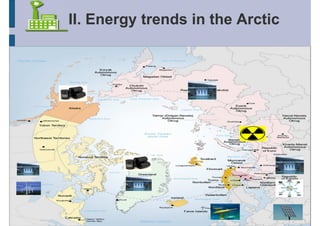
II. Energy trends in the Arctic
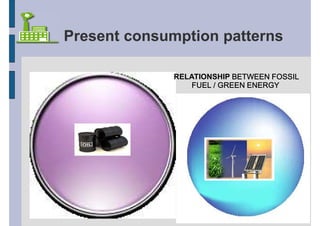
Present consumption patterns

              RELATIONSHIP
Present consumption patterns


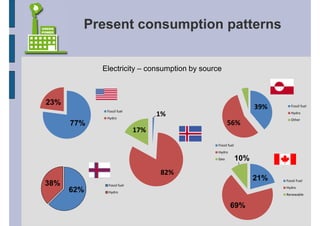
            Electricity – consumption by source


23%
             Fossil fuel
                                                                  39%      Fossil fuel


             Hydro
                                 1%                                        Hydro
                                                                           Other
      77%                                           56%
                           17%
                                              Fossil fuel
                                              Hydro
                                              Geo           10%
                                 82%
                                                                  21%   Fossil Fuel
38%          Fossil fuel
                                                                        Hydro
      62%    Hydro
                                                                        Renewable


                                                      69%
Present consumption patterns

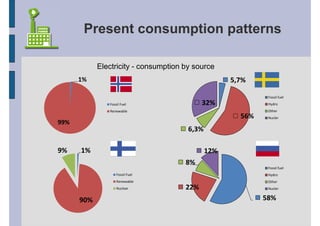
            Electricity - consumption by source
      1%                                            5,7%

                                                             Fossil fuel
               Fossil Fuel                  32%              Hydro
               Renewable                                     Other
                                                      56%    Nucler
99%
                                       6,3%

9%    1%                                      12%
                                      8%
                                                             Fossil fuel
                   Fossil Fuel                               Hydro
                   Renewable                                 Other
                   Nuclear            22%                    Nucler


      90%                                                   58%
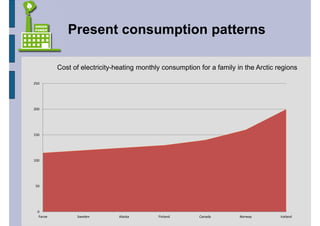
Present consumption patterns

           Cost of electricity-heating monthly consumption for a family in the Arctic regions

250


200


150


100


 50


  0
   Faroe         Sweden         Alaska       Finland       Canada        Norway        Iceland
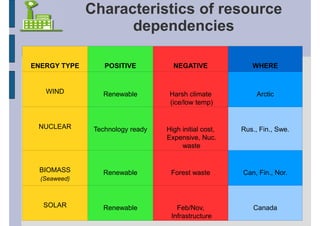
Characteristics of resource
                    dependencies

ENERGY TYPE       POSITIVE          NEGATIVE              WHERE


   WIND          Renewable         Harsh climate            Arctic
                                   (ice/low temp)


 NUCLEAR       Technology ready   High initial cost,   Rus., Fin., Swe.
                                  Expensive, Nuc.
                                       waste


 BIOMASS         Renewable         Forest waste        Can, Fin., Nor.
  (Seaweed)


  SOLAR          Renewable           Feb/Nov,              Canada
                                   Infrastructure
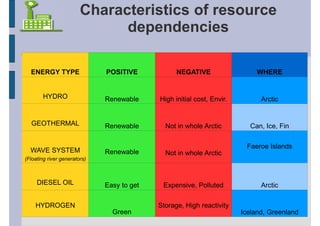
Characteristics of resource
                              dependencies

  ENERGY TYPE                 POSITIVE            NEGATIVE                   WHERE


        HYDRO                 Renewable     High initial cost, Envir.         Arctic


  GEOTHERMAL                  Renewable       Not in whole Arctic         Can, Ice, Fin

                                                                         Faeroe Islands
  WAVE SYSTEM                 Renewable       Not in whole Arctic
(Floating river generators)


     DIESEL OIL               Easy to get    Expensive, Polluted              Arctic

    HYDROGEN                                Storage, High reactivity
                                Green                                   Iceland, Greenland
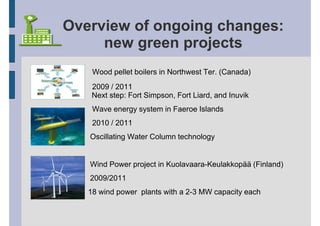
Overview of ongoing changes:
     new green projects
    Wood pellet boilers in Northwest Ter. (Canada)
    2009 / 2011
    Next step: Fort Simpson, Fort Liard, and Inuvik
    Wave energy system in Faeroe Islands
    2010 / 2011
   Oscillating Water Column technology


   Wind Power project in Kuolavaara-Keulakkopää (Finland)
   2009/2011
   18 wind power plants with a 2-3 MW capacity each
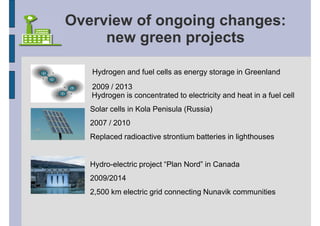
Overview of ongoing changes:
     new green projects

   Hydrogen and fuel cells as energy storage in Greenland
   2009 / 2013
   Hydrogen is concentrated to electricity and heat in a fuel cell
   Solar cells in Kola Penisula (Russia)
   2007 / 2010
   Replaced radioactive strontium batteries in lighthouses


   Hydro-electric project “Plan Nord” in Canada
   2009/2014
   2,500 km electric grid connecting Nunavik communities
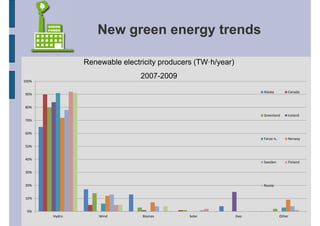
New green energy trends

               Renewable electricity producers (TW·h/year)
                               2007-2009
100%

                                                                   Alaska          Canada
90%


80%

                                                                   Greenland       Iceland
70%


60%
                                                                   Faroe Is.       Norway
50%


40%
                                                                   Sweden          Finland

30%


20%                                                                Russia


10%


 0%
       Hydro       Wind        Biomas        Solar           Geo               Other
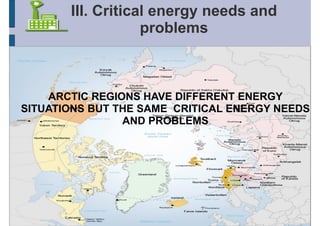
III. Critical energy needs and
                   problems


    ARCTIC REGIONS HAVE DIFFERENT ENERGY
SITUATIONS BUT THE SAME CRITICAL ENERGY NEEDS
                AND PROBLEMS
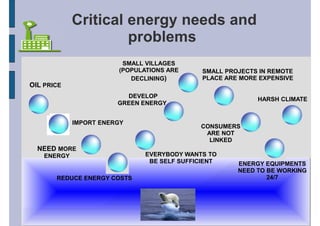
Critical energy needs and
                      problems
                         SMALL VILLAGES
                        (POPULATIONS ARE      SMALL PROJECTS IN REMOTE
                           DECLINING)         PLACE ARE MORE EXPENSIVE
OIL PRICE
                          DEVELOP
                                                            HARSH CLIMATE
                        GREEN ENERGY


             IMPORT ENERGY
                                             CONSUMERS
                                              ARE NOT
                                               LINKED
  NEED MORE
    ENERGY                     EVERYBODY WANTS TO
                                BE SELF SUFFICIENT     ENERGY EQUIPMENTS
                                                       NEED TO BE WORKING
       REDUCE ENERGY COSTS                                     24/7
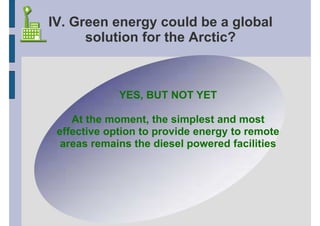
IV. Green energy could be a global
      solution for the Arctic?


             YES, BUT NOT YET

    At the moment, the simplest and most
 effective option to provide energy to remote
  areas remains the diesel powered facilities
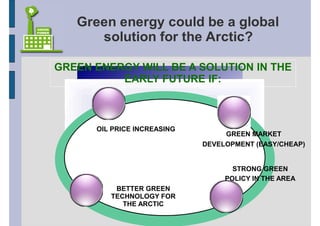
Green energy could be a global
      solution for the Arctic?

GREEN ENERGY WILL BE A SOLUTION IN THE
          EARLY FUTURE IF:


      OIL PRICE INCREASING
                                  GREEN MARKET
                             DEVELOPMENT (EASY/CHEAP)


                                    STRONG GREEN
                                  POLICY IN THE AREA
          BETTER GREEN
         TECHNOLOGY FOR
            THE ARCTIC
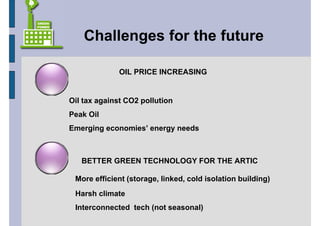
Challenges for the future

              OIL PRICE INCREASING


Oil tax against CO2 pollution
Peak Oil
Emerging economies’ energy needs


   BETTER GREEN TECHNOLOGY FOR THE ARTIC

 More efficient (storage, linked, cold isolation building)
 Harsh climate
 Interconnected tech (not seasonal)
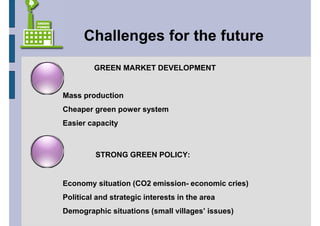
Challenges for the future
         GREEN MARKET DEVELOPMENT


Mass production
Cheaper green power system
Easier capacity


         STRONG GREEN POLICY:


Economy situation (CO2 emission- economic cries)
Political and strategic interests in the area
Demographic situations (small villages’ issues)
V. How could governments support
     green energy in the Arctic regions?


- Improving public investment,
- attracting private investment,
- free green energy investment zone,
- free trade area,
- Improve infrastructures,
- promote Arctic region as a focal point in a new green revolution,
- establish a highly specialized district and research centre for
   renewable energy in the Arctic region.
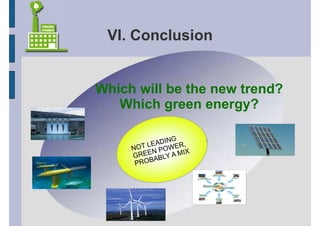
VI. Conclusion


Which will be the new trend?
   Which green energy?
Conclusion

Comments, suggestion, remarks, new idea,
       information, advices, are


         more than welcome to
            claudiop@ruc.dk
Conclusion


   Thank You!
         Grazie!

Contact: claudio.pellegatta@libero.it

         www.linkedin.com

Energy development in the Arctic regions

  • 1.
    RESPONSIVE AND RESPONSIBLEENERGY DEVELOPMENT IN THE ARCTIC REGIONS Claudio Pellegatta Danish Minister for Foreign Affairs Copenhagen 18.01.11
  • 2.
    Content I. Focus and method II. Energy trends in the Arctic III. Critical energy needs and problems IV. Green energy could be a solution? V. What could governments do? VI. Conclusion: Relational question
  • 3.
    I. Focus andmethods Status of present consumption patterns Characteristics of resource dependencies Overview of ongoing changes New energy trends in the Arctic regions
  • 4.
    Focus and Methods Internationalliterature and internet review of status and perspectives by national authorities; Analysis of micro and macro economic / energy data; Consultation and interview with a wide range of stakeholders and experts about characteristics and needs of Green energy business development in Arctic countries; Intensively looking at best practices around the world in Green energy business;
  • 5.
    II. Energy trendsin the Arctic
  • 6.
  • 7.
    Present consumption patterns Electricity – consumption by source 23% Fossil fuel 39% Fossil fuel Hydro 1% Hydro Other 77% 56% 17% Fossil fuel Hydro Geo 10% 82% 21% Fossil Fuel 38% Fossil fuel Hydro 62% Hydro Renewable 69%
  • 8.
    Present consumption patterns Electricity - consumption by source 1% 5,7% Fossil fuel Fossil Fuel 32% Hydro Renewable Other 56% Nucler 99% 6,3% 9% 1% 12% 8% Fossil fuel Fossil Fuel Hydro Renewable Other Nuclear 22% Nucler 90% 58%
  • 9.
    Present consumption patterns Cost of electricity-heating monthly consumption for a family in the Arctic regions 250 200 150 100 50 0 Faroe Sweden Alaska Finland Canada Norway Iceland
  • 10.
    Characteristics of resource dependencies ENERGY TYPE POSITIVE NEGATIVE WHERE WIND Renewable Harsh climate Arctic (ice/low temp) NUCLEAR Technology ready High initial cost, Rus., Fin., Swe. Expensive, Nuc. waste BIOMASS Renewable Forest waste Can, Fin., Nor. (Seaweed) SOLAR Renewable Feb/Nov, Canada Infrastructure
  • 11.
    Characteristics of resource dependencies ENERGY TYPE POSITIVE NEGATIVE WHERE HYDRO Renewable High initial cost, Envir. Arctic GEOTHERMAL Renewable Not in whole Arctic Can, Ice, Fin Faeroe Islands WAVE SYSTEM Renewable Not in whole Arctic (Floating river generators) DIESEL OIL Easy to get Expensive, Polluted Arctic HYDROGEN Storage, High reactivity Green Iceland, Greenland
  • 12.
    Overview of ongoingchanges: new green projects Wood pellet boilers in Northwest Ter. (Canada) 2009 / 2011 Next step: Fort Simpson, Fort Liard, and Inuvik Wave energy system in Faeroe Islands 2010 / 2011 Oscillating Water Column technology Wind Power project in Kuolavaara-Keulakkopää (Finland) 2009/2011 18 wind power plants with a 2-3 MW capacity each
  • 13.
    Overview of ongoingchanges: new green projects Hydrogen and fuel cells as energy storage in Greenland 2009 / 2013 Hydrogen is concentrated to electricity and heat in a fuel cell Solar cells in Kola Penisula (Russia) 2007 / 2010 Replaced radioactive strontium batteries in lighthouses Hydro-electric project “Plan Nord” in Canada 2009/2014 2,500 km electric grid connecting Nunavik communities
  • 14.
    New green energytrends Renewable electricity producers (TW·h/year) 2007-2009 100% Alaska Canada 90% 80% Greenland Iceland 70% 60% Faroe Is. Norway 50% 40% Sweden Finland 30% 20% Russia 10% 0% Hydro Wind Biomas Solar Geo Other
  • 15.
    III. Critical energyneeds and problems ARCTIC REGIONS HAVE DIFFERENT ENERGY SITUATIONS BUT THE SAME CRITICAL ENERGY NEEDS AND PROBLEMS
  • 16.
    Critical energy needsand problems SMALL VILLAGES (POPULATIONS ARE SMALL PROJECTS IN REMOTE DECLINING) PLACE ARE MORE EXPENSIVE OIL PRICE DEVELOP HARSH CLIMATE GREEN ENERGY IMPORT ENERGY CONSUMERS ARE NOT LINKED NEED MORE ENERGY EVERYBODY WANTS TO BE SELF SUFFICIENT ENERGY EQUIPMENTS NEED TO BE WORKING REDUCE ENERGY COSTS 24/7
  • 17.
    IV. Green energycould be a global solution for the Arctic? YES, BUT NOT YET At the moment, the simplest and most effective option to provide energy to remote areas remains the diesel powered facilities
  • 18.
    Green energy couldbe a global solution for the Arctic? GREEN ENERGY WILL BE A SOLUTION IN THE EARLY FUTURE IF: OIL PRICE INCREASING GREEN MARKET DEVELOPMENT (EASY/CHEAP) STRONG GREEN POLICY IN THE AREA BETTER GREEN TECHNOLOGY FOR THE ARCTIC
  • 19.
    Challenges for thefuture OIL PRICE INCREASING Oil tax against CO2 pollution Peak Oil Emerging economies’ energy needs BETTER GREEN TECHNOLOGY FOR THE ARTIC More efficient (storage, linked, cold isolation building) Harsh climate Interconnected tech (not seasonal)
  • 20.
    Challenges for thefuture GREEN MARKET DEVELOPMENT Mass production Cheaper green power system Easier capacity STRONG GREEN POLICY: Economy situation (CO2 emission- economic cries) Political and strategic interests in the area Demographic situations (small villages’ issues)
  • 21.
    V. How couldgovernments support green energy in the Arctic regions? - Improving public investment, - attracting private investment, - free green energy investment zone, - free trade area, - Improve infrastructures, - promote Arctic region as a focal point in a new green revolution, - establish a highly specialized district and research centre for renewable energy in the Arctic region.
  • 22.
    VI. Conclusion Which willbe the new trend? Which green energy?
  • 23.
    Conclusion Comments, suggestion, remarks,new idea, information, advices, are more than welcome to claudiop@ruc.dk
  • 24.
    Conclusion Thank You! Grazie! Contact: claudio.pellegatta@libero.it www.linkedin.com