Homework: Mark you past paper from the mark scheme on slide share.  Lesson Objective Understand fully the term ‘energy balance’ and how to approach a 6 mark question on this Start to consider how to answer more generic questions which bring together a wide range of the specification
Energy in the Diet The energy in the diet is provided by fat, carbohydrate and protein  To  maintain body functions  - to breathe, to keep the heart beating, to keep the body warm and all the other functions that keep the body alive.
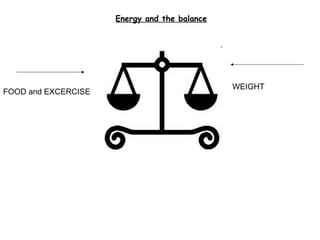
ENERGY BALANCE Energy IS MEASURED IN KCAL. Different people require different amounts of energy. If too much energy is consumed above and beyond what we need this will result in weight gain, below what we need and this will result in weight loss.
Energy and the balance FOOD and EXCERCISE WEIGHT
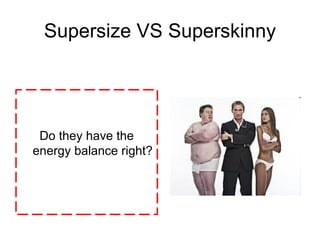
Supersize VS Superskinny Do they have the energy balance right?
Basal Metabolic Rate The basal metabolic rate is the amount of energy we need when the body is completely at rest. It is the energy we need to keep our bodies functioning, to breath, think, digest food and pump blood around our bodies. Our BMR accounts for about 75% of a persons daily energy needs, the average BMR for a man is 1600KCAL and 1300KCAL for a woman. It can be higher or lower for individuals
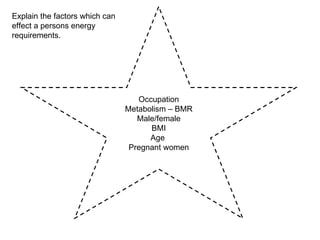
Occupation Metabolism – BMR Male/female BMI Age  Pregnant women Explain the factors which can effect a persons energy requirements.
Older Adults Energy requirements decrease as energy levels fall – so normally older people require less energy. They may also have a loss of appetite.
Teenagers As a teenagers you require the most amount of energy compared to any other time. You are going through a rapid time of growth and development and this requires energy
Occupations Someone who has a physically demanding job like a builder, brick layer, athlete will require more energy than a stay at home mum or an office worker
Body Mass Index (bmi) You can calculate your body mass index by diving your height and weight. A shorter, thinner person will have a lower BMI compared to a taller heavier person, these people will have very different energy needs.
6 mark exam question. You should be making three points and fully explaining them. You will gain 1 mark for a statement, you will gain a further mark for each statement which is fully explained.

Energy balance

  • 1.
    Homework: Mark youpast paper from the mark scheme on slide share. Lesson Objective Understand fully the term ‘energy balance’ and how to approach a 6 mark question on this Start to consider how to answer more generic questions which bring together a wide range of the specification
  • 2.
    Energy in theDiet The energy in the diet is provided by fat, carbohydrate and protein To maintain body functions - to breathe, to keep the heart beating, to keep the body warm and all the other functions that keep the body alive.
  • 3.
    ENERGY BALANCE EnergyIS MEASURED IN KCAL. Different people require different amounts of energy. If too much energy is consumed above and beyond what we need this will result in weight gain, below what we need and this will result in weight loss.
  • 4.
    Energy and thebalance FOOD and EXCERCISE WEIGHT
  • 5.
    Supersize VS SuperskinnyDo they have the energy balance right?
  • 6.
    Basal Metabolic RateThe basal metabolic rate is the amount of energy we need when the body is completely at rest. It is the energy we need to keep our bodies functioning, to breath, think, digest food and pump blood around our bodies. Our BMR accounts for about 75% of a persons daily energy needs, the average BMR for a man is 1600KCAL and 1300KCAL for a woman. It can be higher or lower for individuals
  • 7.
    Occupation Metabolism –BMR Male/female BMI Age Pregnant women Explain the factors which can effect a persons energy requirements.
  • 8.
    Older Adults Energyrequirements decrease as energy levels fall – so normally older people require less energy. They may also have a loss of appetite.
  • 9.
    Teenagers As ateenagers you require the most amount of energy compared to any other time. You are going through a rapid time of growth and development and this requires energy
  • 10.
    Occupations Someone whohas a physically demanding job like a builder, brick layer, athlete will require more energy than a stay at home mum or an office worker
  • 11.
    Body Mass Index(bmi) You can calculate your body mass index by diving your height and weight. A shorter, thinner person will have a lower BMI compared to a taller heavier person, these people will have very different energy needs.
  • 12.
    6 mark examquestion. You should be making three points and fully explaining them. You will gain 1 mark for a statement, you will gain a further mark for each statement which is fully explained.

Editor's Notes

  • #6 http://www.youtube.com/watch?v=CEtRGQWObmY