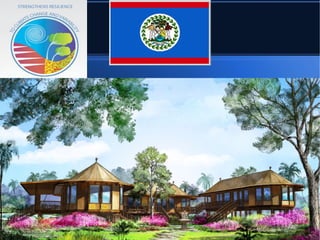
PROOF OF CONCEPT:

    COMMUNITIY SCALE
BIOMASS ENERGY PRODUCTION


 Clean Residential Energy Production
      Carbon Footprint Credits
    Managed Forest Conservation
Who's Responsibility is
               The Land Ethic?
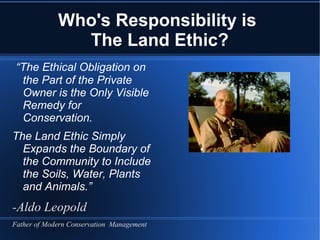
 “The Ethical Obligation on
  the Part of the Private
  Owner is the Only Visible
  Remedy for
  Conservation.
The Land Ethic Simply
  Expands the Boundary of
  the Community to Include
  the Soils, Water, Plants
  and Animals.”
-Aldo Leopold
Father of Modern Conservation Management
Overview: Why BioMass?
         Gateway to Energy Independence
         Through Biotic Interdependence

➲   Use and Nurture the Naturally Abundant &
    Rapidly Renewables and Waste BioMass
    on Sanctuary Belize
➲   Use Proven BioMass Gas Tech to Create
    Natural Gas for On-Site Generation of
    Power & Container Fuel (PGI: “DCDT”)
➲   Participate in the Natural Energy Cycle and
    Reduce Carbon Footprint with a Perpetual
    Fuel Source Supplying Is A Measurable
    Mode of Earning Carbon Credits
➲   Effectively Create Community Energy
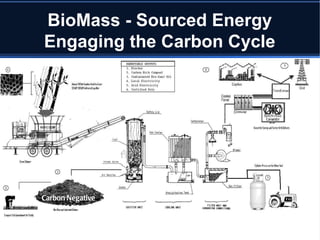
BioMass - Sourced Energy
Engaging the Carbon Cycle
GOAL OF CONCEPT
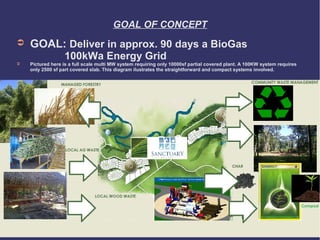
➲   GOAL: Deliver in approx. 90 days a BioGas
                  100kWa Energy Grid
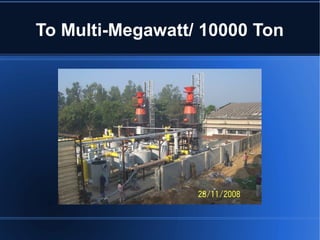
➲   Pictured here is a full scale multi MW system requiring only 10000sf partial covered plant. A 100KW system requires
    only 2500 sf part covered slab. This diagram ilustrates the straightforward and compact systems involved.
Plan of Action
Turnkey a 100kW* Grid Connected Power
 Able to deliver complete energy requirement
 for Office, Staff Lodging & Woodshop
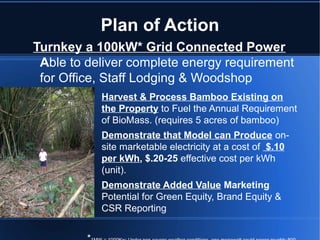
         •   Harvest & Process Bamboo Existing on
             the Property to Fuel the Annual Requirement
             of BioMass. (requires 5 acres of bamboo)
         •   Demonstrate that Model can Produce on-
             site marketable electricity at a cost of $.10
             per kWh, $.20-25 effective cost per kWh
             (unit).
         •   Demonstrate Added Value Marketing
             Potential for Green Equity, Brand Equity &
             CSR Reporting
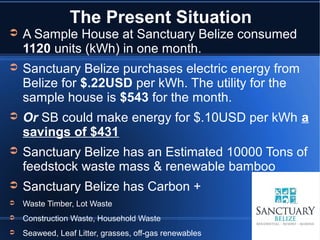
The Present Situation
➲   A Sample House at Sanctuary Belize consumed
    1120 units (kWh) in one month.
➲   Sanctuary Belize purchases electric energy from
    Belize for $.22USD per kWh. The utility for the
    sample house is $543 for the month.
➲   Or SB could make energy for $.10USD per kWh a
    savings of $431
➲   Sanctuary Belize has an Estimated 10000 Tons of
    feedstock waste mass & renewable bamboo
➲   Sanctuary Belize has Carbon +
➲   Waste Timber, Lot Waste
➲   Construction Waste, Household Waste
➲   Seaweed, Leaf Litter, grasses, off-gas renewables
➲   Development To Date:
     Field Study Found Abundant Bamboo and BioMass
     Onsite Biomass is a Natural Capital Carbon Sink
     PGI Developed BioMass & Alternate Energy Tech In
      US, India and Cambodia
     Work Order for Pilot Project Awarded to PGI


➲   Important background information:
     Thousands of BioMass Fuel Systems are Serving
      Homes, Business and Major Industry Worldwide.
     BioMass Fuel is Appropriate Tech when fuel is readily
      available such is the case at Sanctuary Belize.
     Sanctuary Belize could be leveraging CSR as a global
      marketing tool for brand equity, goodwill and ethical
      consumers. (ie SEC, Bloomberg and Reuters now scoring companies Enviro/Social/Governance
      (ESG) metrics) http://blogs.hbr.org/leadinggreen/2009/05/is-esg-data-going-mainstream.html)
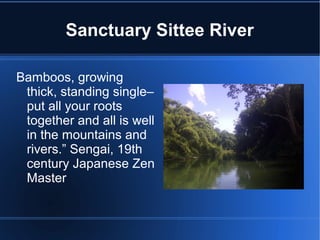
Sanctuary Sittee River

Bamboos, growing
 thick, standing single–
 put all your roots
 together and all is well
 in the mountains and
 rivers.” Sengai, 19th
 century Japanese Zen
 Master
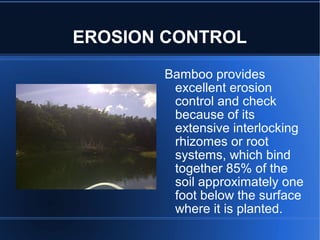
EROSION CONTROL
       Bamboo provides
        excellent erosion
        control and check
        because of its
        extensive interlocking
        rhizomes or root
        systems, which bind
        together 85% of the
        soil approximately one
        foot below the surface
        where it is planted.
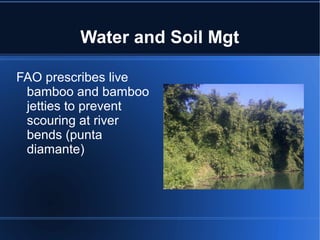
Water and Soil Mgt

FAO prescribes live
 bamboo and bamboo
 jetties to prevent
 scouring at river
 bends (punta
 diamante)
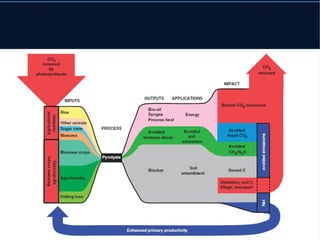
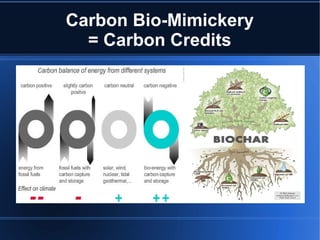
Carbon Bio-Mimickery
  = Carbon Credits
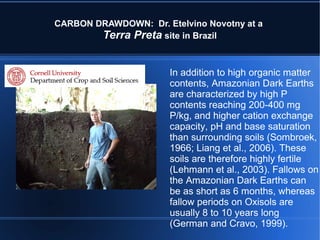
CARBON DRAWDOWN: Dr. Etelvino Novotny at a
        Terra Preta site in Brazil


                       In addition to high organic matter
                       contents, Amazonian Dark Earths
                       are characterized by high P
                       contents reaching 200-400 mg
                       P/kg, and higher cation exchange
                       capacity, pH and base saturation
                       than surrounding soils (Sombroek,
                       1966; Liang et al., 2006). These
                       soils are therefore highly fertile
                       (Lehmann et al., 2003). Fallows on
                       the Amazonian Dark Earths can
                       be as short as 6 months, whereas
                       fallow periods on Oxisols are
                       usually 8 to 10 years long
                       (German and Cravo, 1999).
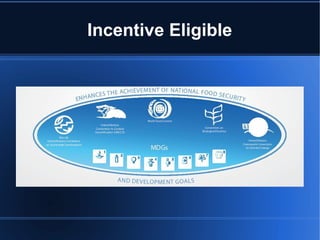
Incentive Eligible
The Renewable Story
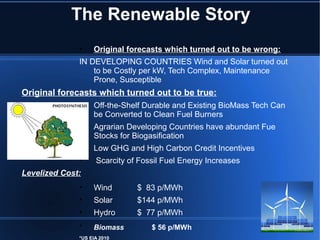
              •    Original forecasts which turned out to be wrong:
              IN DEVELOPING COUNTRIES Wind and Solar turned out
                  to be Costly per kW, Tech Complex, Maintenance
                  Prone, Susceptible
Original forecasts which turned out to be true:
              •    Off-the-Shelf Durable and Existing BioMass Tech Can
                   be Converted to Clean Fuel Burners
              •    Agrarian Developing Countries have abundant Fue
                   Stocks for Biogasification
              •    Low GHG and High Carbon Credit Incentives
              •     Scarcity of Fossil Fuel Energy Increases
Levelized Cost:
              •    Wind        $ 83 p/MWh
              •    Solar       $144 p/MWh
              •    Hydro       $ 77 p/MWh
              •    Biomass         $ 56 p/MWh
              *US EIA 2010
Potential Alternatives
➲     Alternative strategies
              Remain on Dependent Grid and Suffer Price Shocks
              Invest In Costly High Tech With Slow Break Even/ROI
              Allow Others to Manage Alternative Fuel Upstream
              Allow Sustainable Natural Capital to Remain Locked in Land
               Instead of Our Three Bottom Line Plan (Biotic Cycle)
              Lost Development Value Addition of Carbon Trading & Finance
➲     Pros and Cons of each strategy
              Solar Is “Free Fuel” only if CapEx, Land Space and Maintenance
               Not Weighed*
              Wind Can Be Geo-Fickle, Prone to Disaster Damage
              BioFuel Follows a Natural Energy Cycle, is a Renewable
               Resource, Promotes Soil Resilience and is a Carbon Capture
               PROFIT Center
➲     100kW produced is $60,000 overhead reduction
*The 1 MW photovoltaic solar installation by Gap Inc's Western Distribution Center in Fresno, CA

required five acres, cost $7 million, and took 6 months to build
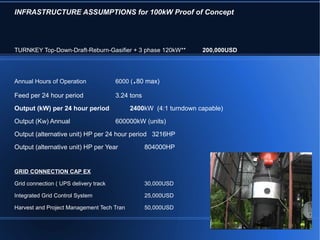
INFRASTRUCTURE ASSUMPTIONS for 100kW Proof of Concept


TURNKEY Top-Down-Draft-Reburn-Gasifier + 3 phase 120kW**         200,000USD


Annual Hours of Operation                   .
                                       6000 ( 80 max)

Feed per 24 hour period                3.24 tons

Output (kW) per 24 hour period             2400kW (4:1 turndown capable)

Output (Kw) Annual                     600000kW (units)

Output (alternative unit) HP per 24 hour period 3216HP

Output (alternative unit) HP per Year              804000HP


GRID CONNECTION CAP EX

Grid connection ( UPS delivery track               30,000USD

Integrated Grid Control System                     25,000USD

Harvest and Project Management Tech Tran           50,000USD
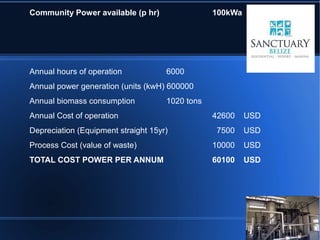
Community Power available (p hr)                 100kWa


Annual hours of operation            6000
Annual power generation (units (kwH) 600000
Annual biomass consumption           1020 tons
Annual Cost of operation                         42600    USD
Depreciation (Equipment straight 15yr)           7500     USD
Process Cost (value of waste)                    10000    USD
TOTAL COST POWER PER ANNUM                       60100    USD
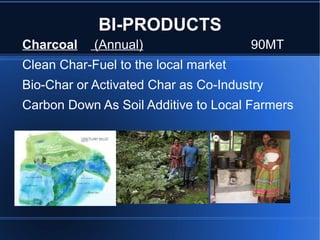
BI-PRODUCTS
Charcoal    (Annual)                  90MT
Clean Char-Fuel to the local market
Bio-Char or Activated Char as Co-Industry
Carbon Down As Soil Additive to Local Farmers
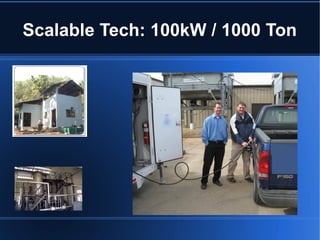
Scalable Tech: 100kW / 1000 Ton
To Multi-Megawatt/ 10000 Ton
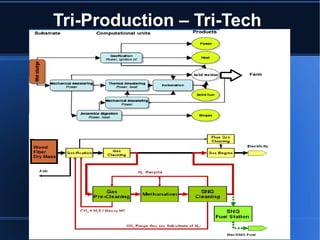
Tri-Production – Tri-Tech
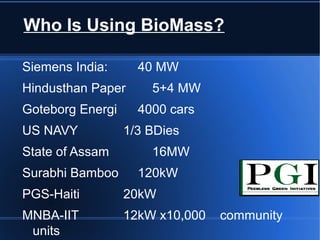
Who Is Using BioMass?

Siemens India:      40 MW
Hindusthan Paper      5+4 MW
Goteborg Energi     4000 cars
US NAVY           1/3 BDies
State of Assam        16MW
Surabhi Bamboo      120kW
PGS-Haiti         20kW
MNBA-IIT          12kW x10,000   community
 units
Independent Blue Sky Approach

Forms of Biomass & Corresponding Tech:
Animal Waste (Tri-Tech/Heat)
Solid Garbage (Plasma)
Algae (Bio-Diesel/ Ethanol)
Woody Waste/ Bio-Ag (NG/Heat)
Watery Waste/ Bio-Ag (NG)
Fuel Crops (Bio-Diesel)
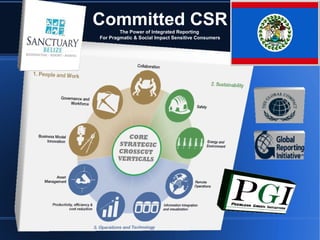
Committed CSR
        The Power of Integrated Reporting
For Pragmatic & Social Impact Sensitive Consumers
Tomorrow Begins Today
For More Information
Contact: Frank Costanzo- Connelly, PGI: Biomass Energy Project/CSR
frank@peerlessgreen.net
Contact: Robert Kathman, EBT: Santuary Belize
robert@ebtbelize.com

Energy 4 4_sanctuary_p_o_c

  • 1.
    PROOF OF CONCEPT: COMMUNITIY SCALE BIOMASS ENERGY PRODUCTION Clean Residential Energy Production Carbon Footprint Credits Managed Forest Conservation
  • 3.
    Who's Responsibility is The Land Ethic? “The Ethical Obligation on the Part of the Private Owner is the Only Visible Remedy for Conservation. The Land Ethic Simply Expands the Boundary of the Community to Include the Soils, Water, Plants and Animals.” -Aldo Leopold Father of Modern Conservation Management
  • 5.
    Overview: Why BioMass? Gateway to Energy Independence Through Biotic Interdependence ➲ Use and Nurture the Naturally Abundant & Rapidly Renewables and Waste BioMass on Sanctuary Belize ➲ Use Proven BioMass Gas Tech to Create Natural Gas for On-Site Generation of Power & Container Fuel (PGI: “DCDT”) ➲ Participate in the Natural Energy Cycle and Reduce Carbon Footprint with a Perpetual Fuel Source Supplying Is A Measurable Mode of Earning Carbon Credits ➲ Effectively Create Community Energy
  • 6.
    BioMass - SourcedEnergy Engaging the Carbon Cycle
  • 7.
    GOAL OF CONCEPT ➲ GOAL: Deliver in approx. 90 days a BioGas 100kWa Energy Grid ➲ Pictured here is a full scale multi MW system requiring only 10000sf partial covered plant. A 100KW system requires only 2500 sf part covered slab. This diagram ilustrates the straightforward and compact systems involved.
  • 8.
    Plan of Action Turnkeya 100kW* Grid Connected Power Able to deliver complete energy requirement for Office, Staff Lodging & Woodshop • Harvest & Process Bamboo Existing on the Property to Fuel the Annual Requirement of BioMass. (requires 5 acres of bamboo) • Demonstrate that Model can Produce on- site marketable electricity at a cost of $.10 per kWh, $.20-25 effective cost per kWh (unit). • Demonstrate Added Value Marketing Potential for Green Equity, Brand Equity & CSR Reporting
  • 9.
    The Present Situation ➲ A Sample House at Sanctuary Belize consumed 1120 units (kWh) in one month. ➲ Sanctuary Belize purchases electric energy from Belize for $.22USD per kWh. The utility for the sample house is $543 for the month. ➲ Or SB could make energy for $.10USD per kWh a savings of $431 ➲ Sanctuary Belize has an Estimated 10000 Tons of feedstock waste mass & renewable bamboo ➲ Sanctuary Belize has Carbon + ➲ Waste Timber, Lot Waste ➲ Construction Waste, Household Waste ➲ Seaweed, Leaf Litter, grasses, off-gas renewables
  • 10.
    Development To Date:  Field Study Found Abundant Bamboo and BioMass  Onsite Biomass is a Natural Capital Carbon Sink  PGI Developed BioMass & Alternate Energy Tech In US, India and Cambodia  Work Order for Pilot Project Awarded to PGI ➲ Important background information:  Thousands of BioMass Fuel Systems are Serving Homes, Business and Major Industry Worldwide.  BioMass Fuel is Appropriate Tech when fuel is readily available such is the case at Sanctuary Belize.  Sanctuary Belize could be leveraging CSR as a global marketing tool for brand equity, goodwill and ethical consumers. (ie SEC, Bloomberg and Reuters now scoring companies Enviro/Social/Governance (ESG) metrics) http://blogs.hbr.org/leadinggreen/2009/05/is-esg-data-going-mainstream.html)
  • 13.
    Sanctuary Sittee River Bamboos,growing thick, standing single– put all your roots together and all is well in the mountains and rivers.” Sengai, 19th century Japanese Zen Master
  • 14.
    EROSION CONTROL Bamboo provides excellent erosion control and check because of its extensive interlocking rhizomes or root systems, which bind together 85% of the soil approximately one foot below the surface where it is planted.
  • 15.
    Water and SoilMgt FAO prescribes live bamboo and bamboo jetties to prevent scouring at river bends (punta diamante)
  • 19.
    Carbon Bio-Mimickery = Carbon Credits
  • 20.
    CARBON DRAWDOWN: Dr.Etelvino Novotny at a Terra Preta site in Brazil In addition to high organic matter contents, Amazonian Dark Earths are characterized by high P contents reaching 200-400 mg P/kg, and higher cation exchange capacity, pH and base saturation than surrounding soils (Sombroek, 1966; Liang et al., 2006). These soils are therefore highly fertile (Lehmann et al., 2003). Fallows on the Amazonian Dark Earths can be as short as 6 months, whereas fallow periods on Oxisols are usually 8 to 10 years long (German and Cravo, 1999).
  • 22.
  • 24.
    The Renewable Story • Original forecasts which turned out to be wrong: IN DEVELOPING COUNTRIES Wind and Solar turned out to be Costly per kW, Tech Complex, Maintenance Prone, Susceptible Original forecasts which turned out to be true: • Off-the-Shelf Durable and Existing BioMass Tech Can be Converted to Clean Fuel Burners • Agrarian Developing Countries have abundant Fue Stocks for Biogasification • Low GHG and High Carbon Credit Incentives • Scarcity of Fossil Fuel Energy Increases Levelized Cost: • Wind $ 83 p/MWh • Solar $144 p/MWh • Hydro $ 77 p/MWh • Biomass $ 56 p/MWh *US EIA 2010
  • 25.
    Potential Alternatives ➲ Alternative strategies  Remain on Dependent Grid and Suffer Price Shocks  Invest In Costly High Tech With Slow Break Even/ROI  Allow Others to Manage Alternative Fuel Upstream  Allow Sustainable Natural Capital to Remain Locked in Land Instead of Our Three Bottom Line Plan (Biotic Cycle)  Lost Development Value Addition of Carbon Trading & Finance ➲ Pros and Cons of each strategy  Solar Is “Free Fuel” only if CapEx, Land Space and Maintenance Not Weighed*  Wind Can Be Geo-Fickle, Prone to Disaster Damage  BioFuel Follows a Natural Energy Cycle, is a Renewable Resource, Promotes Soil Resilience and is a Carbon Capture PROFIT Center ➲ 100kW produced is $60,000 overhead reduction *The 1 MW photovoltaic solar installation by Gap Inc's Western Distribution Center in Fresno, CA required five acres, cost $7 million, and took 6 months to build
  • 26.
    INFRASTRUCTURE ASSUMPTIONS for100kW Proof of Concept TURNKEY Top-Down-Draft-Reburn-Gasifier + 3 phase 120kW** 200,000USD Annual Hours of Operation . 6000 ( 80 max) Feed per 24 hour period 3.24 tons Output (kW) per 24 hour period 2400kW (4:1 turndown capable) Output (Kw) Annual 600000kW (units) Output (alternative unit) HP per 24 hour period 3216HP Output (alternative unit) HP per Year 804000HP GRID CONNECTION CAP EX Grid connection ( UPS delivery track 30,000USD Integrated Grid Control System 25,000USD Harvest and Project Management Tech Tran 50,000USD
  • 27.
    Community Power available(p hr) 100kWa Annual hours of operation 6000 Annual power generation (units (kwH) 600000 Annual biomass consumption 1020 tons Annual Cost of operation 42600 USD Depreciation (Equipment straight 15yr) 7500 USD Process Cost (value of waste) 10000 USD TOTAL COST POWER PER ANNUM 60100 USD
  • 28.
    BI-PRODUCTS Charcoal (Annual) 90MT Clean Char-Fuel to the local market Bio-Char or Activated Char as Co-Industry Carbon Down As Soil Additive to Local Farmers
  • 29.
  • 30.
  • 31.
  • 32.
    Who Is UsingBioMass? Siemens India: 40 MW Hindusthan Paper 5+4 MW Goteborg Energi 4000 cars US NAVY 1/3 BDies State of Assam 16MW Surabhi Bamboo 120kW PGS-Haiti 20kW MNBA-IIT 12kW x10,000 community units
  • 33.
    Independent Blue SkyApproach Forms of Biomass & Corresponding Tech: Animal Waste (Tri-Tech/Heat) Solid Garbage (Plasma) Algae (Bio-Diesel/ Ethanol) Woody Waste/ Bio-Ag (NG/Heat) Watery Waste/ Bio-Ag (NG) Fuel Crops (Bio-Diesel)
  • 34.
    Committed CSR The Power of Integrated Reporting For Pragmatic & Social Impact Sensitive Consumers
  • 35.
  • 36.
    For More Information Contact:Frank Costanzo- Connelly, PGI: Biomass Energy Project/CSR frank@peerlessgreen.net Contact: Robert Kathman, EBT: Santuary Belize robert@ebtbelize.com

Editor's Notes

  • #2 This is an overview of a public private partnership between Sanctuary Belize with its foreseeable 2+MW long term energy requirement, and the Government of Belize that is largely dependent on foreign sourced energy, and the joint desire of the parties to achieve energy independence for Belize and conserve the natural capital resources the country has been bestowed.
  • #3 Globally we are becoming aware that we must all be more conservation minded about our natural resources and ability to keep healthy and provide nutrition for a growing population. The millennium gave rise to the determination that all countries of the world must work together to achieve certain goals that are key to our ability to sustain ourselves, our economies and communities. These are known as the Millinnium Goals. It's also become evident that the global tax base will never be large enough for Governments to achieve these goals without the will of the private sector and its notions of 'development.' A new ethic is required and this is generally been labelled Corporate Social Responsibility or Corporate Sustainability. It used to be that a company's 'sustainability' relied solely on its ability to keep doing what it does for as low a cost and high a profit as possible. A great example are logging companies of the 1920's that leveled every privately available forest, then lobbied governments to open public lands to forestry. The thought of afforestation (the replacement of trees taken) and biodiverse forestry never was even considered an option. Today however we are becoming enlightened to the broader scope of “profit” as it relates to “natural capital services” (production of air), “biomass cycle of energy” (biotic circulation) and the true definition of conservation does not end at the State Forest protected boundary. Through our perceived independence from nature, we lost our understanding of our interdependence on nature.
  • #4 A recent survey by Conde Naste found that nearly 90% of tourists are attracted to Belize due to its natural beauty, beautiful forests and beaches. For this reason, among others, it is important that Belize's largest economic driver- tourism- is protected and maintained, as well as developed in a manner that is 'least violent' to the biotic cycle. Back in the 40's conservationist Aldo Leopold, was one of the first to articulate the growing disregard for the biotic cycle in the name of 'development.' He called for a development relationship that included moral social and environmental insight. He called this the land ethic. 50 years later and we are living his foresight that we are critically in need of living in a way that is in harmony with -not in competition and dominion over- nature. This responsibility falls on private citizen, landholder, business and government alike. The outsourcing of conservation and wildlife management is no longer tenable – and in fact never was. 'Velvet rope forest policies have led to artificial fragmented ecosystems and fail to include community and social economy in the natural order of the biotic cycle. The result has been forest fires, erosion, loss of biodiversity and socio-economic distress.
  • #5 In 2012, international sustainable business consultant Peerless Green Initiatives, was hired and invited to tour Sanctuary Belize, a 14000 acre reserve on which 4000 acres was to be developed for homes, hotels, restaurants and marina. This exquisite site extends east from Cockstand Forest Reserve to the Caribbean. After touring and meeting the developers including owner/farmer Belizian John Usher, PGI's Senior Analyst Frank C Connelly commented that never before had he seen a development being approached with such care to the fact that there are five distinct ecosystems at play on the site, and that each must be respected and left unmolested as much as possible during the development and beyond. It was on this trip that Frank notices two factors that he had seen in many other developing countries including India, Nepal, Cambodia and Guatemala...an abundance of renewable biomass that is otherwise wasted or burned – and exorbitant energy costs.
  • #6 Frank had from 2007 to 2012 lived and worked in India. It was a tough environment for a sustainable business firm to thrive, and the range of experiences and impact lead to PGI's recognition by the United Nations Development Program, UN Environment Program, Committee on Biodiversity, Waste Management Partnership, UNIDO and World Bank. Frank studied under India's former conservator of Forests, NS Adkoli and together they organized the 1000 member Agroforest Farmers Coop, the Bamboo Borderfarm Initiative and the commercialization of bamboo and biomass for energy in rural regions. From this Frank learned first hand the symphony of the bio-cycle that when tapped into creates a harmony of human and natural economy. Both can profit and both do profit in terms of 'true conservation, sustainable development and social community building including gender equality, education and appreciation of natural capital services, and the biotic energy cycle.. The recognition and interdependence on this cycle through use of simple and durable technology created local and regional energy independence, and thus the transformational change that the UNMDG demanded in 2011 which must vigorously pursue. Because of this mandate, groups like World Bank and REDD+ have created systems where the protection of ecology, and the reduction of carbon and GHG's (that threaten to upset the biotic cycle around the globe) providing strong incentives and finance for public-private partnerships that adopt sustainable economic energy models.
  • #7 To be clear, PGI does not represent any one technology. By its definition and corporate ethos, it could not serve its clients who include business, governments and NGO's if it did. Each situation is assessed on its own merits and situation, and the most suitable expert reviewed model is created with the most durable tech available. This is PGI's “DCD' tech criteria wherein PGI is not an R&D tech lab, it only employs tech that has proved itself over and over in a range of developing country conditions. Due to the lack of tech 'safety nets' in developing country and rural back country environments, PGI's chosen tech is always certified “Developing Country Durable” by PGI's core team of engineers, scientists and economists. The chosen system in this case is the 'Ford pickup' of energy creation, the woody fiber, downdraft gasifier, wet matter digester capture system and a easy maintenance filter and pressure step up system that provides hi-quality (synthetic NG and producer gas) for rugged brand generators such as Cummins producer gas engines, and Atom Systems cylinder filling rigs. The chosen systems are in use in 1000's of applications throughout the world, in increasing output and efficiency.
  • #8 The obvious economics of sustainability regarding biomass energy involved sourcing biomass that is readily available and inexhaustible based on the need/output criteria. The output and delivery must also be factored. PGI's core deliverable are 'profitable' models. Financial, social and environmental are all factored and balanced.