The Endocrine System
By: Kevin Koech
By: Kevin Koech
 Define hormone and endocrine system.
Name several organs of the endocrine system.
Contrast endocrine with exocrine glands.
Compare and contrast the nervous and endocrine
systems.
Learning objectives
Learning objectives
Introduction
 Two body systems are responsible for
sending and receiving sensory information and
coordinating body responses.
These are the nervous system and the
endocrine system.
Together, are sometimes referred to as the
neuro-endocrine system
Endocrine System
Endocrine System
 Endocrinology: The study of Endocrine
system and the diagnosis and treatment of its
disorders
 The endocrine system regulate body
activities by releasing hormones (chemical
messengers) into the blood stream, where
they are carried throughout the entire body.
 Hormonal responses may be almost
instantaneous (sudden) or may occur days
later. There is a wide variety of hormonal
effects.
• The body has four principal mechanisms of
communication between cells;
• Gap junctions - Pores in cell membrane allow signaling
molecules, nutrients, and electrolytes to move from cell to
cell
• Neurotransmitters - Released from neurons to travel
across synaptic cleft to second cell
• Paracrine (local) hormones - Secreted into tissue fluids to
affect nearby cells
• Hormones - Chemical messengers that travel in the
bloodstream to other tissues and organs
Endocrine System Cont…
Functions of the endocrine System
• Secrete hormones that coordinate and direct
activities of target cells/ organs
• Regulates mood, growth, development,
metabolism, sexual function, reproduction,
blood pressure, heart rate
• Most systems are under combined control of
endocrine and nervous systems
What is a gland?
• Gland is an organ or a group of cells that
produces secretion/substances and wastes
from the body.
Types of glands
• The body contains two kinds of glands:
a) Endocrine
b) Exocrine
Exocrine and endocrine glands
 Exocrine glands: Sweat, salivary, mammary,
lacrimal, mucous, sebaceous, and digestive) -
secrete their products into body ducts, which carry
the products into the body cavities, the lumen of
the organs or the outer surface of the body
 Endocrine glands:Secrete their products
(hormones) into the extracellular spaces around
the secretory cells, rather than into ducts. The
secretions diffuse into capillaries and are carried
throughout the body by the circulatory system
Figure 15.2b
Endocrine system –major organs
 The endocrine system is composed of the body's
endocrine glands. These include;
 The pituitary gland
 Thyroid
 Parathyroid
 Adrenal glands
 Pineal glands
 Pancreatic islets
Endocrine system Cont…
Slide 15.7
Copyright © 2003 Pearson Education, Inc. publishing as Benjamin Cummings
Figure 15.2c
There are also many organs that have cells which
secretes hormones but they are not exclusively
endocrine organs.
These include; The hypothalamus, thymus,pancrease,
ovaries, stomach, testes, kidneys, heart , liver ,small
intestine, skin and placenta
Hormones
Hormones
Slide 15.8
Copyright © 2003 Pearson Education, Inc. publishing as Benjamin Cummings
 Hormones are chemical substance that are carried
by a cell tissue and initiate a specific function
 Hormones can have very powerful effects, even
when present in very low concentration
 There are approximately 50 different hormones
produced in the human body
 The specific cells which are affected by a
hormones are called target cells
 Hormones influence their target cells by binding to
proteins or glycoproteins in the cell membrane
called receptors .
Hormones Cont…
Hormones Cont…
Slide 15.9a
Copyright © 2003 Pearson Education, Inc. publishing as Benjamin Cummings
Figure 15.3c
• When a hormone (or neurotransmitter) is present in
excess, the number of receptors may decrease (down
regulation) thereby decreasing the responsiveness of target
cells to the hormone.
• When a hormone (or neurotransmitter) is deficient, the
number of receptors may increase (up- regulation),
making the target tissue more sensitive to the stimulating
effect of the hormone.
• Hormones that pass into the blood to act on distant target
cells are called circulating hormones or endocrines.
• Hormones that act on target cells close to their site of
release are called local hormones or paracrines or
autocrines.
Function of hormones
•Regulate the chemical composition and volume of the
internal environment (extracellular fluid)
•Help in regulate metabolism and energy balance
•Help in regulate the contraction of cardiac and smooth
muscle fibers and secretion of glands
•Help maintain homeostasis, despite disruption such as
infection, trauma, emotional stress ,dehydration, starvation,
hemorrhage and temperature extremes
•Regulate certain activities of the immune system
Function of hormones cont..
 Play a role in smooth muscle sequential integration
of growth and development
 Contribute to the basic processes of reproduction
including gametes production, fertilization,
nourishment of the embryo and fetus ,delivery and
nourishment of the newborn
The pituitary gland and The hypothalamus
Slide 15.9b
Copyright © 2003 Pearson Education, Inc. publishing as Benjamin Cummings
 The pituitary gland is attached to the hypothalamus
at the base of the brain
 The hypothalamus is the major integrating link the
nervous and endocrine system
 Although the pituitary gland is sometimes called the
master endocrine gland
 Together ,the hypothalamus and pituitary regulate
virtually all aspects of
growth ,development ,metabolism and homeostasis
 The pituitary gland can be divided into two; The
posterior and anterior pituitary
Figure 15.3c
The hypothalamus and pituitary
gland Cont…
gland Cont…
Slide 15.10
Copyright © 2003 Pearson Education, Inc. publishing as Benjamin Cummings
 The anterior pituitary is the upgrowth of
glandular epithelium from the pharynx and
the posterior pituitary a downgrowth of the
nervous tissue from the brain
 There is a network of nerve fiber between
hypothalamus and the posterior pituitary
Figure 15.3b
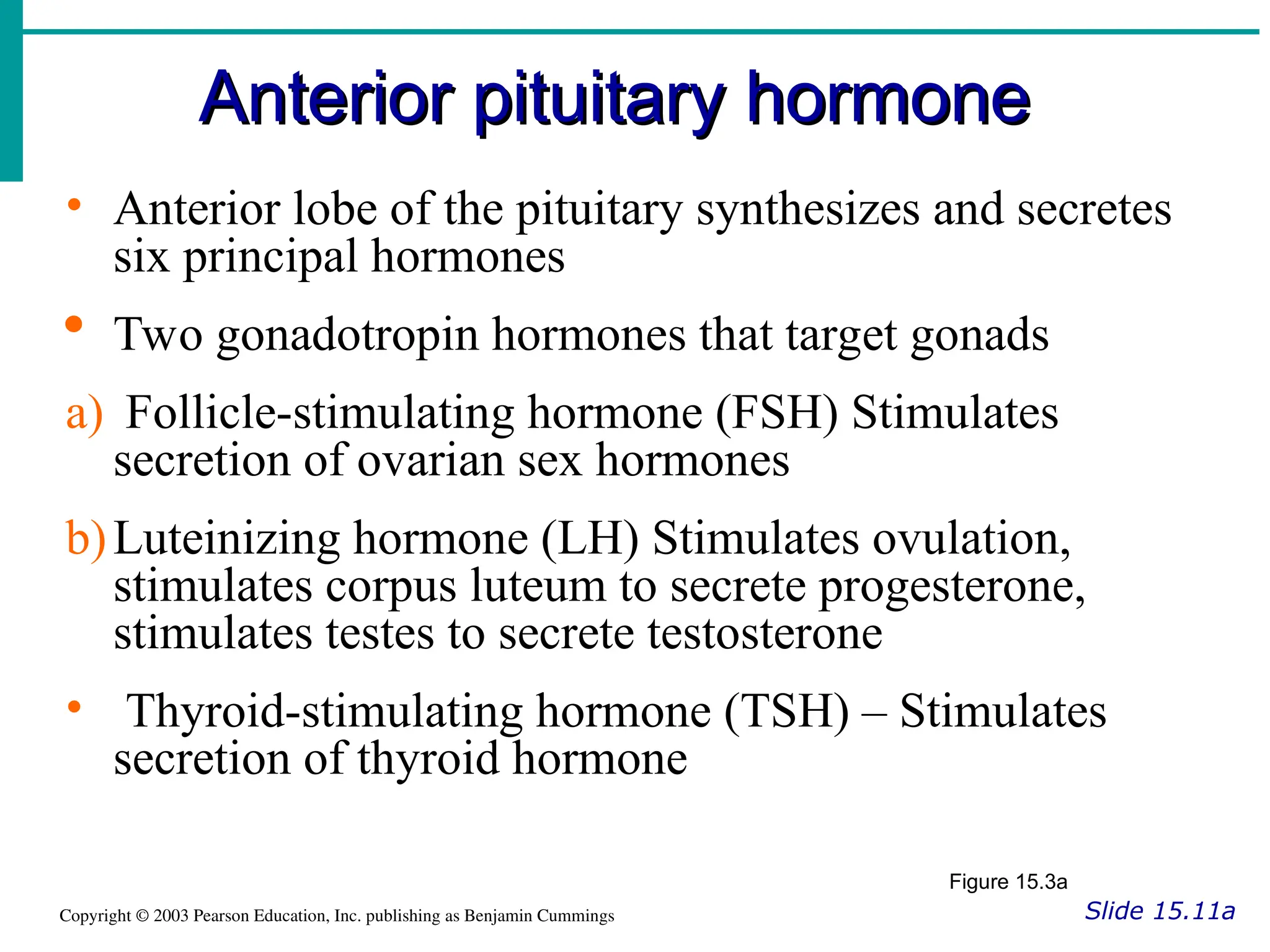
Anterior pituitary hormone
Slide 15.11a
Copyright © 2003 Pearson Education, Inc. publishing as Benjamin Cummings
• Anterior lobe of the pituitary synthesizes and secretes
six principal hormones
 Two gonadotropin hormones that target gonads
a) Follicle-stimulating hormone (FSH) Stimulates
secretion of ovarian sex hormones
b)Luteinizing hormone (LH) Stimulates ovulation,
stimulates corpus luteum to secrete progesterone,
stimulates testes to secrete testosterone
• Thyroid-stimulating hormone (TSH) – Stimulates
secretion of thyroid hormone
Figure 15.3a
Anterior pituitary hormones Cont…
Slide 15.11b
Copyright © 2003 Pearson Education, Inc. publishing as Benjamin Cummings
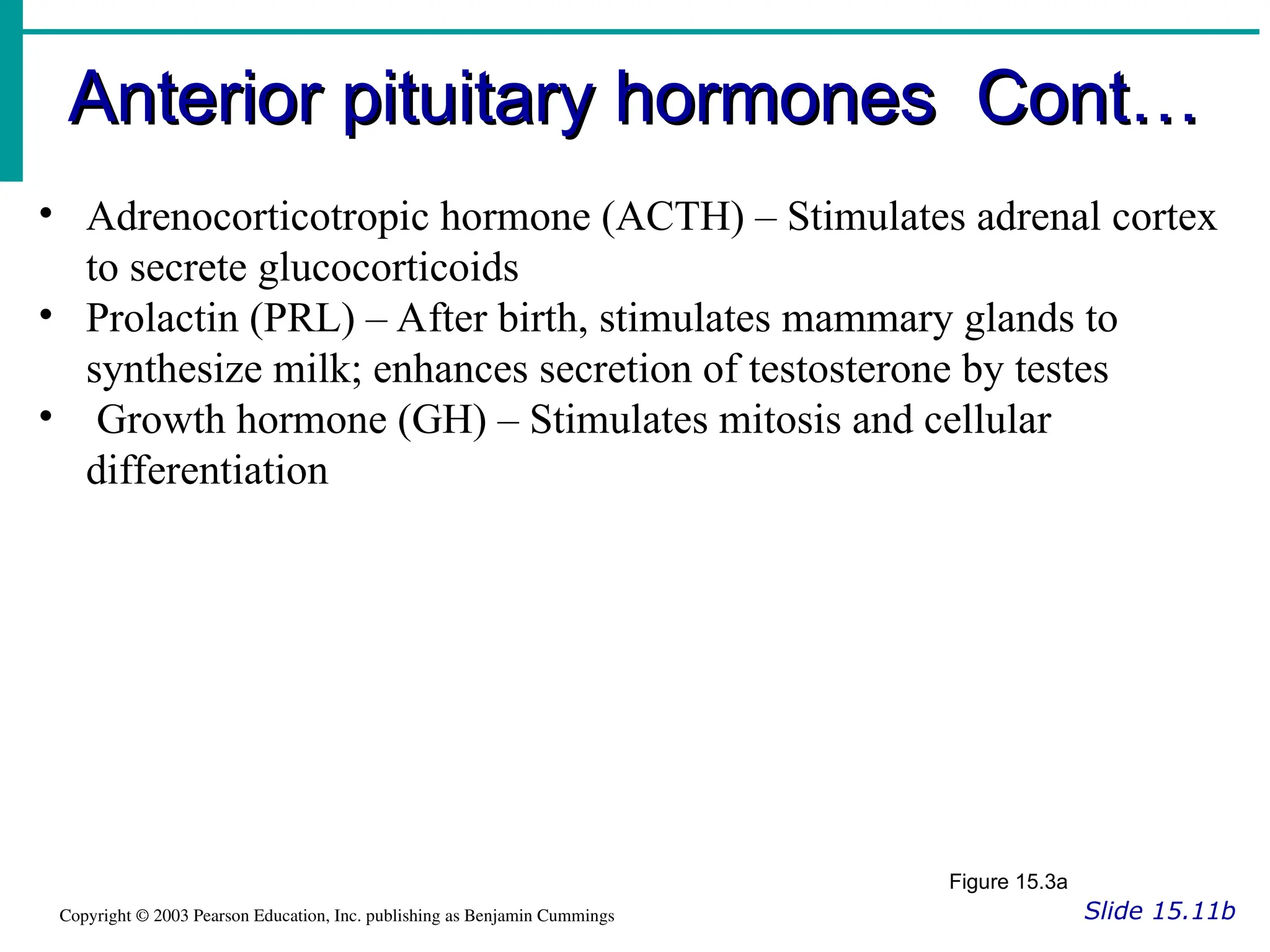
Figure 15.3a
• Adrenocorticotropic hormone (ACTH) – Stimulates adrenal cortex
to secrete glucocorticoids
• Prolactin (PRL) – After birth, stimulates mammary glands to
synthesize milk; enhances secretion of testosterone by testes
• Growth hormone (GH) – Stimulates mitosis and cellular
differentiation
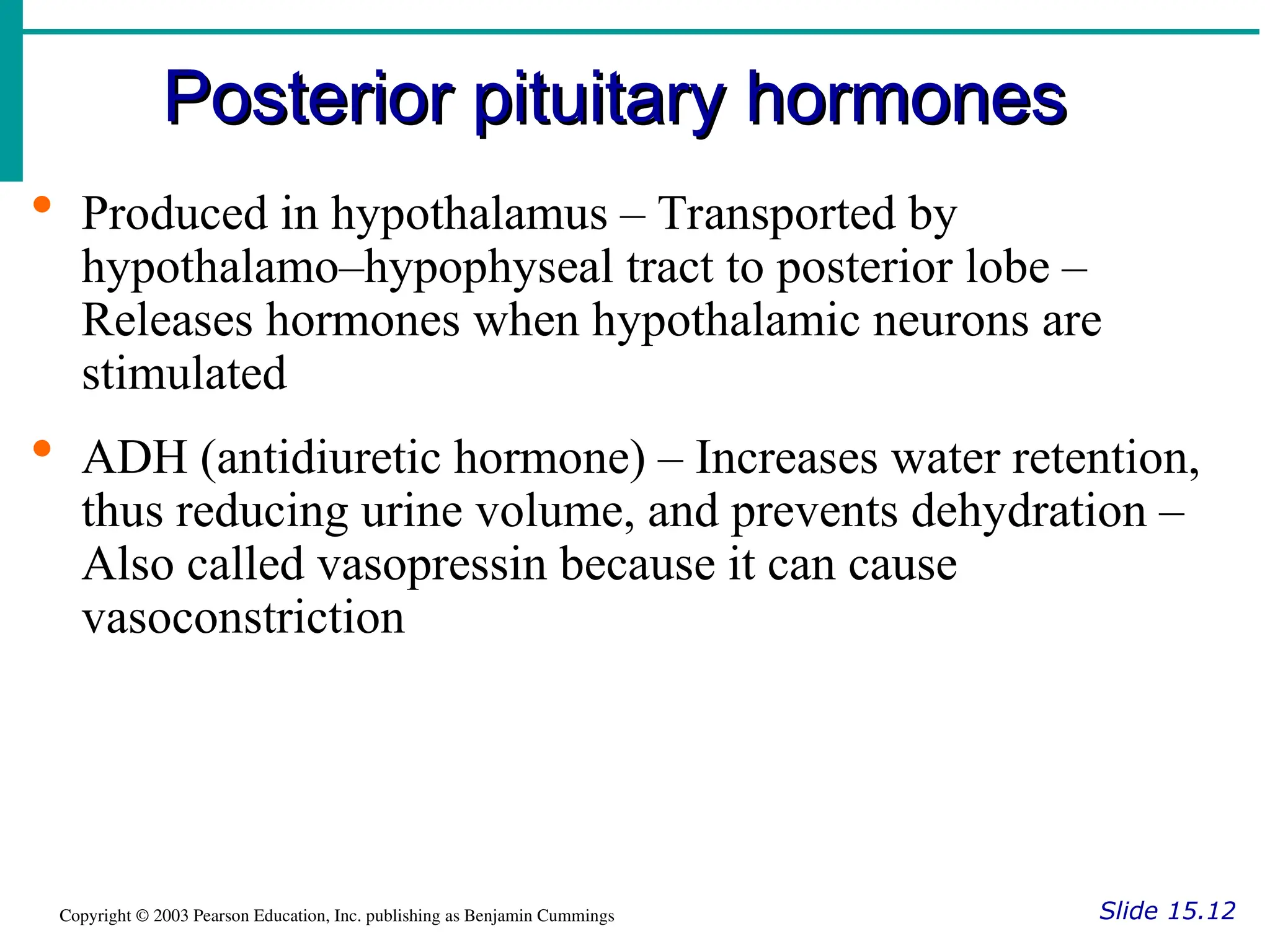
Posterior pituitary hormones
Slide 15.12
Copyright © 2003 Pearson Education, Inc. publishing as Benjamin Cummings
 Produced in hypothalamus – Transported by
hypothalamo–hypophyseal tract to posterior lobe –
Releases hormones when hypothalamic neurons are
stimulated
 ADH (antidiuretic hormone) – Increases water retention,
thus reducing urine volume, and prevents dehydration –
Also called vasopressin because it can cause
vasoconstriction
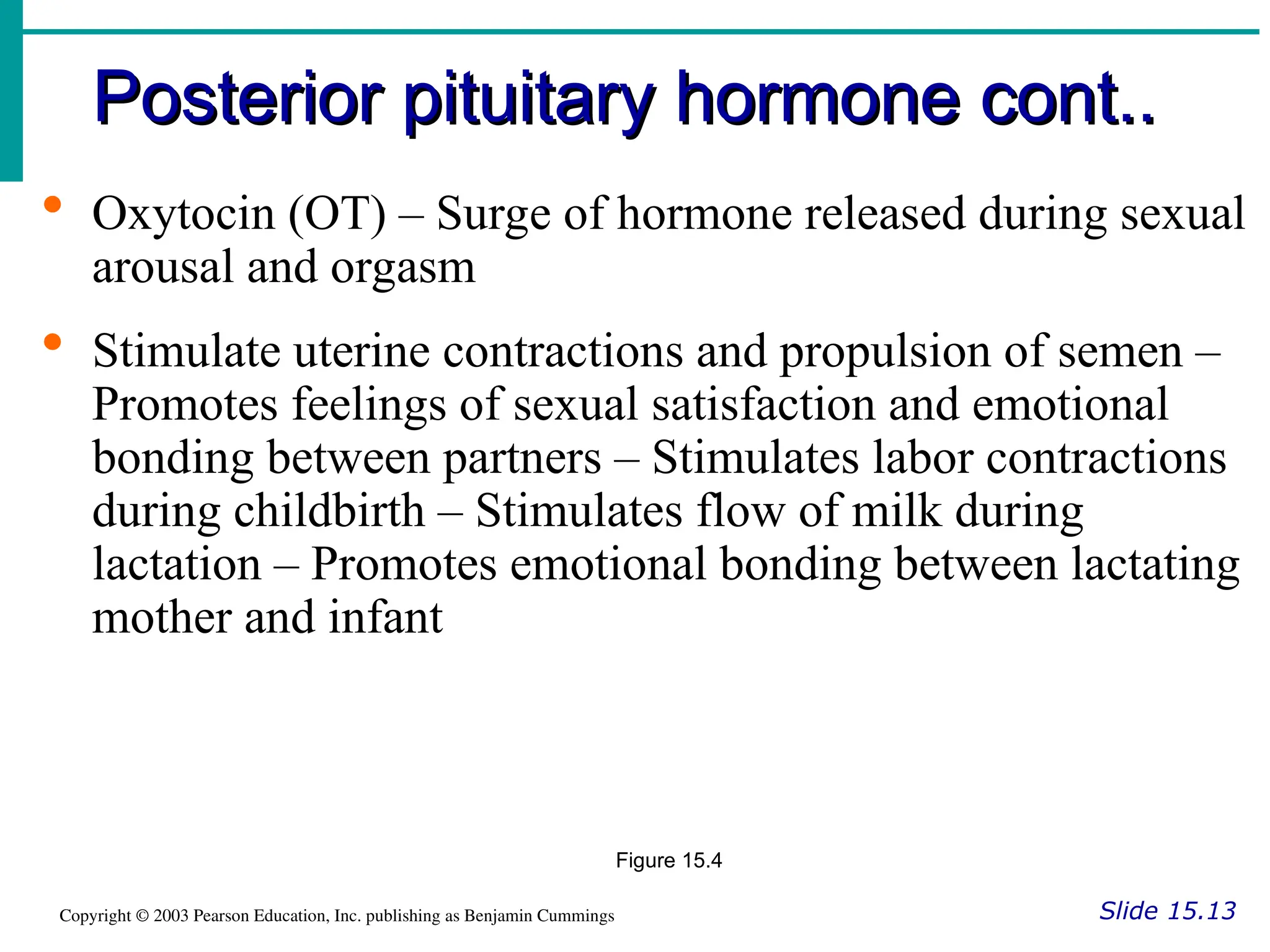
Posterior pituitary hormone cont..
Slide 15.13
Copyright © 2003 Pearson Education, Inc. publishing as Benjamin Cummings
 Oxytocin (OT) – Surge of hormone released during sexual
arousal and orgasm
 Stimulate uterine contractions and propulsion of semen –
Promotes feelings of sexual satisfaction and emotional
bonding between partners – Stimulates labor contractions
during childbirth – Stimulates flow of milk during
lactation – Promotes emotional bonding between lactating
mother and infant
Figure 15.4
Control of pituitary secretion
Slide 15.14
Copyright © 2003 Pearson Education, Inc. publishing as Benjamin Cummings
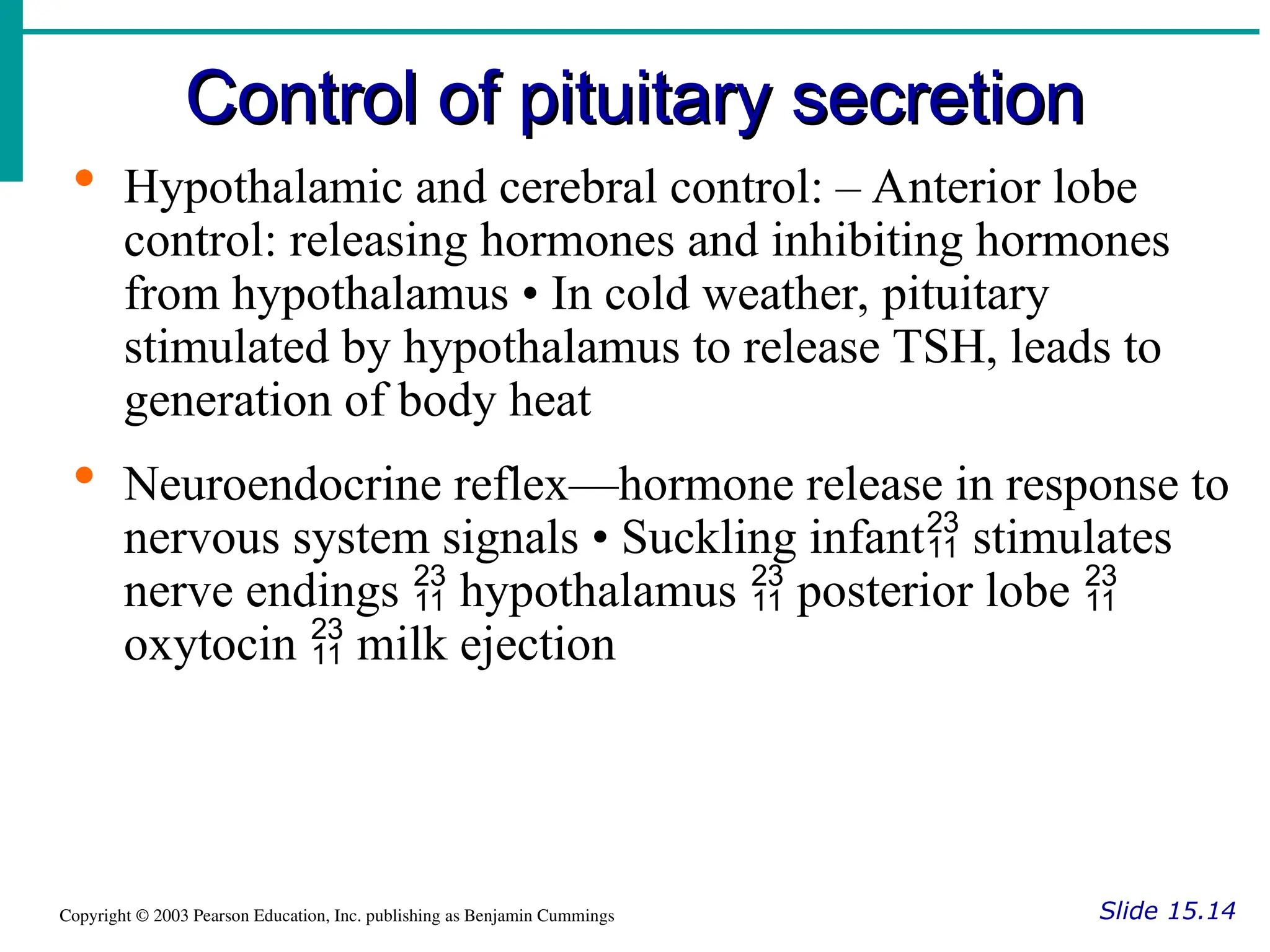
 Hypothalamic and cerebral control: – Anterior lobe
control: releasing hormones and inhibiting hormones
from hypothalamus • In cold weather, pituitary
stimulated by hypothalamus to release TSH, leads to
generation of body heat
 Neuroendocrine reflex—hormone release in response to
nervous system signals • Suckling infant stimulates

nerve endings hypothalamus posterior lobe
  
oxytocin milk ejection

Endocrine system control
Slide 15.15
Copyright © 2003 Pearson Education, Inc. publishing as Benjamin Cummings
• Regulated by feedback mechanisms
–2 types of feedback mechanisms
1. positive feedback
2. negative feedback
Feedback mechanism
Feedback mechanism
Slide 15.16
Copyright © 2003 Pearson Education, Inc. publishing as Benjamin Cummings
• Negative Feedback mechanisms:
–Act like a thermostat in a home
–As the temperature cools, the thermostat detects the
change and triggers the furnace to turn on and warm
the house
–Once the temperature reaches its thermostat setting,
the furnace turns off
• Example: Body sugar increases after a meal, so the
pancreas secretes insulin, which tells the body’s cells to
take in glucose. Once blood sugar levels reach normal,
the pancreas stops making insulin.
• Often used to maintain homeostasis
Negative mechanism
Negative mechanism
Slide 15.17
Copyright © 2003 Pearson Education, Inc. publishing as Benjamin Cummings
• Homeostasis is often maintained by two
hormones who have antagonistic effects
–Each hormone does the opposite of the other.
• For example, if the blood pressure drops too low, the
pituitary releases ADH, which causes the kidneys to
reabsorb more water. If it the blood pressure increases
too much, then the heart will release ANH, which will
cause the kidneys to reabsorb less water
Positive mechanism
Positive mechanism
Slide 15.18
Copyright © 2003 Pearson Education, Inc. publishing as Benjamin Cummings
Figure 15.5
Positive Feedback mechanisms control events that can be
out of control and do not require continuous adjustment
Rarely used to maintain homeostasis
Example of positive feedback found in childbirth
Oxytocin stimulates and enhances labor contractions
As labor continues, more oxytocin is produced
Intensifies contractions until the baby is outside birth canal
Oxytocin production stops and labor contractions stop
The end
The end

Endocrine system slides posterior and anterior

  • 1.
    The Endocrine System By:Kevin Koech By: Kevin Koech
  • 2.
     Define hormoneand endocrine system. Name several organs of the endocrine system. Contrast endocrine with exocrine glands. Compare and contrast the nervous and endocrine systems. Learning objectives Learning objectives
  • 3.
    Introduction  Two bodysystems are responsible for sending and receiving sensory information and coordinating body responses. These are the nervous system and the endocrine system. Together, are sometimes referred to as the neuro-endocrine system
  • 4.
    Endocrine System Endocrine System Endocrinology: The study of Endocrine system and the diagnosis and treatment of its disorders  The endocrine system regulate body activities by releasing hormones (chemical messengers) into the blood stream, where they are carried throughout the entire body.  Hormonal responses may be almost instantaneous (sudden) or may occur days later. There is a wide variety of hormonal effects.
  • 5.
    • The bodyhas four principal mechanisms of communication between cells; • Gap junctions - Pores in cell membrane allow signaling molecules, nutrients, and electrolytes to move from cell to cell • Neurotransmitters - Released from neurons to travel across synaptic cleft to second cell • Paracrine (local) hormones - Secreted into tissue fluids to affect nearby cells • Hormones - Chemical messengers that travel in the bloodstream to other tissues and organs Endocrine System Cont… Endocrine System Cont…
  • 6.
    Functions of theendocrine System Functions of the endocrine System • Secrete hormones that coordinate and direct activities of target cells/ organs • Regulates mood, growth, development, metabolism, sexual function, reproduction, blood pressure, heart rate • Most systems are under combined control of endocrine and nervous systems
  • 7.
    What is agland? • Gland is an organ or a group of cells that produces secretion/substances and wastes from the body. Types of glands • The body contains two kinds of glands: a) Endocrine b) Exocrine
  • 8.
    Exocrine and endocrineglands Exocrine and endocrine glands  Exocrine glands: Sweat, salivary, mammary, lacrimal, mucous, sebaceous, and digestive) - secrete their products into body ducts, which carry the products into the body cavities, the lumen of the organs or the outer surface of the body  Endocrine glands:Secrete their products (hormones) into the extracellular spaces around the secretory cells, rather than into ducts. The secretions diffuse into capillaries and are carried throughout the body by the circulatory system Figure 15.2b
  • 9.
    Endocrine system –majororgans Endocrine system –major organs  The endocrine system is composed of the body's endocrine glands. These include;  The pituitary gland  Thyroid  Parathyroid  Adrenal glands  Pineal glands  Pancreatic islets
  • 10.
    Endocrine system Cont… Endocrinesystem Cont… Slide 15.7 Copyright © 2003 Pearson Education, Inc. publishing as Benjamin Cummings Figure 15.2c There are also many organs that have cells which secretes hormones but they are not exclusively endocrine organs. These include; The hypothalamus, thymus,pancrease, ovaries, stomach, testes, kidneys, heart , liver ,small intestine, skin and placenta
  • 11.
    Hormones Hormones Slide 15.8 Copyright ©2003 Pearson Education, Inc. publishing as Benjamin Cummings  Hormones are chemical substance that are carried by a cell tissue and initiate a specific function  Hormones can have very powerful effects, even when present in very low concentration  There are approximately 50 different hormones produced in the human body  The specific cells which are affected by a hormones are called target cells  Hormones influence their target cells by binding to proteins or glycoproteins in the cell membrane called receptors .
  • 12.
    Hormones Cont… Hormones Cont… Slide15.9a Copyright © 2003 Pearson Education, Inc. publishing as Benjamin Cummings Figure 15.3c • When a hormone (or neurotransmitter) is present in excess, the number of receptors may decrease (down regulation) thereby decreasing the responsiveness of target cells to the hormone. • When a hormone (or neurotransmitter) is deficient, the number of receptors may increase (up- regulation), making the target tissue more sensitive to the stimulating effect of the hormone. • Hormones that pass into the blood to act on distant target cells are called circulating hormones or endocrines. • Hormones that act on target cells close to their site of release are called local hormones or paracrines or autocrines.
  • 13.
    Function of hormones Functionof hormones •Regulate the chemical composition and volume of the internal environment (extracellular fluid) •Help in regulate metabolism and energy balance •Help in regulate the contraction of cardiac and smooth muscle fibers and secretion of glands •Help maintain homeostasis, despite disruption such as infection, trauma, emotional stress ,dehydration, starvation, hemorrhage and temperature extremes •Regulate certain activities of the immune system
  • 14.
    Function of hormonescont.. Function of hormones cont..  Play a role in smooth muscle sequential integration of growth and development  Contribute to the basic processes of reproduction including gametes production, fertilization, nourishment of the embryo and fetus ,delivery and nourishment of the newborn
  • 15.
    The pituitary glandand The hypothalamus The pituitary gland and The hypothalamus Slide 15.9b Copyright © 2003 Pearson Education, Inc. publishing as Benjamin Cummings  The pituitary gland is attached to the hypothalamus at the base of the brain  The hypothalamus is the major integrating link the nervous and endocrine system  Although the pituitary gland is sometimes called the master endocrine gland  Together ,the hypothalamus and pituitary regulate virtually all aspects of growth ,development ,metabolism and homeostasis  The pituitary gland can be divided into two; The posterior and anterior pituitary Figure 15.3c
  • 16.
    The hypothalamus andpituitary The hypothalamus and pituitary gland Cont… gland Cont… Slide 15.10 Copyright © 2003 Pearson Education, Inc. publishing as Benjamin Cummings  The anterior pituitary is the upgrowth of glandular epithelium from the pharynx and the posterior pituitary a downgrowth of the nervous tissue from the brain  There is a network of nerve fiber between hypothalamus and the posterior pituitary Figure 15.3b
  • 17.
    Anterior pituitary hormone Anteriorpituitary hormone Slide 15.11a Copyright © 2003 Pearson Education, Inc. publishing as Benjamin Cummings • Anterior lobe of the pituitary synthesizes and secretes six principal hormones  Two gonadotropin hormones that target gonads a) Follicle-stimulating hormone (FSH) Stimulates secretion of ovarian sex hormones b)Luteinizing hormone (LH) Stimulates ovulation, stimulates corpus luteum to secrete progesterone, stimulates testes to secrete testosterone • Thyroid-stimulating hormone (TSH) – Stimulates secretion of thyroid hormone Figure 15.3a
  • 18.
    Anterior pituitary hormonesCont… Anterior pituitary hormones Cont… Slide 15.11b Copyright © 2003 Pearson Education, Inc. publishing as Benjamin Cummings Figure 15.3a • Adrenocorticotropic hormone (ACTH) – Stimulates adrenal cortex to secrete glucocorticoids • Prolactin (PRL) – After birth, stimulates mammary glands to synthesize milk; enhances secretion of testosterone by testes • Growth hormone (GH) – Stimulates mitosis and cellular differentiation
  • 19.
    Posterior pituitary hormones Posteriorpituitary hormones Slide 15.12 Copyright © 2003 Pearson Education, Inc. publishing as Benjamin Cummings  Produced in hypothalamus – Transported by hypothalamo–hypophyseal tract to posterior lobe – Releases hormones when hypothalamic neurons are stimulated  ADH (antidiuretic hormone) – Increases water retention, thus reducing urine volume, and prevents dehydration – Also called vasopressin because it can cause vasoconstriction
  • 20.
    Posterior pituitary hormonecont.. Posterior pituitary hormone cont.. Slide 15.13 Copyright © 2003 Pearson Education, Inc. publishing as Benjamin Cummings  Oxytocin (OT) – Surge of hormone released during sexual arousal and orgasm  Stimulate uterine contractions and propulsion of semen – Promotes feelings of sexual satisfaction and emotional bonding between partners – Stimulates labor contractions during childbirth – Stimulates flow of milk during lactation – Promotes emotional bonding between lactating mother and infant Figure 15.4
  • 21.
    Control of pituitarysecretion Control of pituitary secretion Slide 15.14 Copyright © 2003 Pearson Education, Inc. publishing as Benjamin Cummings  Hypothalamic and cerebral control: – Anterior lobe control: releasing hormones and inhibiting hormones from hypothalamus • In cold weather, pituitary stimulated by hypothalamus to release TSH, leads to generation of body heat  Neuroendocrine reflex—hormone release in response to nervous system signals • Suckling infant stimulates  nerve endings hypothalamus posterior lobe    oxytocin milk ejection 
  • 22.
    Endocrine system control Endocrinesystem control Slide 15.15 Copyright © 2003 Pearson Education, Inc. publishing as Benjamin Cummings • Regulated by feedback mechanisms –2 types of feedback mechanisms 1. positive feedback 2. negative feedback
  • 23.
    Feedback mechanism Feedback mechanism Slide15.16 Copyright © 2003 Pearson Education, Inc. publishing as Benjamin Cummings • Negative Feedback mechanisms: –Act like a thermostat in a home –As the temperature cools, the thermostat detects the change and triggers the furnace to turn on and warm the house –Once the temperature reaches its thermostat setting, the furnace turns off • Example: Body sugar increases after a meal, so the pancreas secretes insulin, which tells the body’s cells to take in glucose. Once blood sugar levels reach normal, the pancreas stops making insulin. • Often used to maintain homeostasis
  • 24.
    Negative mechanism Negative mechanism Slide15.17 Copyright © 2003 Pearson Education, Inc. publishing as Benjamin Cummings • Homeostasis is often maintained by two hormones who have antagonistic effects –Each hormone does the opposite of the other. • For example, if the blood pressure drops too low, the pituitary releases ADH, which causes the kidneys to reabsorb more water. If it the blood pressure increases too much, then the heart will release ANH, which will cause the kidneys to reabsorb less water
  • 25.
    Positive mechanism Positive mechanism Slide15.18 Copyright © 2003 Pearson Education, Inc. publishing as Benjamin Cummings Figure 15.5 Positive Feedback mechanisms control events that can be out of control and do not require continuous adjustment Rarely used to maintain homeostasis Example of positive feedback found in childbirth Oxytocin stimulates and enhances labor contractions As labor continues, more oxytocin is produced Intensifies contractions until the baby is outside birth canal Oxytocin production stops and labor contractions stop
  • 26.