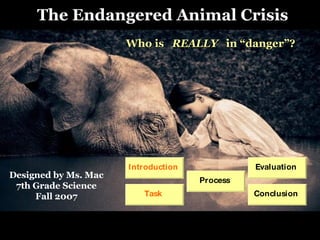
Process Who is  REALLY  in “danger”? The Endangered Animal Crisis Designed by Ms. Mac 7th Grade Science Fall 2007 Introduction Evaluation Task Conclusion
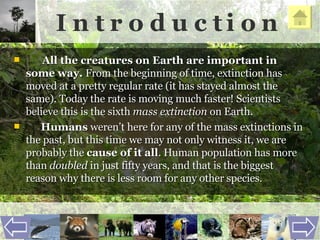
I n t r o d u c t i o n All the creatures on Earth are important in some way.  From the beginning of time, extinction has moved at a pretty regular rate (it has stayed almost the same). Today the rate is moving much faster! Scientists believe this is the sixth  mass extinction  on Earth.  Humans  weren’t here for any of the mass extinctions in the past, but this time we may not only witness it, we are probably the  cause of it all . Human population has more than  doubled  in just fifty years, and that is the biggest reason why there is less room for any other species.
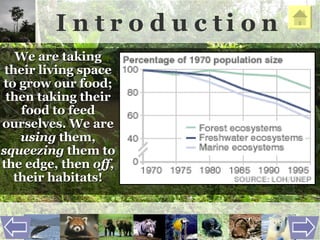
I n t r o d u c t i o n We are taking their living space to grow our food; then taking their food to feed ourselves. We are  using  them,  squeezing  them to the edge, then  off , their habitats!
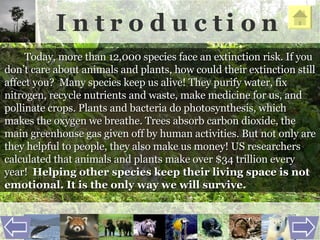
I n t r o d u c t i o n Today, more than 12,000 species face an extinction risk. If you don’t care about animals and plants, how could their extinction still affect you?  Many species keep us alive! They purify water, fix nitrogen, recycle nutrients and waste, make medicine for us, and pollinate crops. Plants and bacteria do photosynthesis, which makes the oxygen we breathe. Trees absorb carbon dioxide, the main greenhouse gas given off by human activities. But not only are they helpful to people, they also make us money! US researchers calculated that animals and plants make over $34 trillion every year!  Helping other species keep their living space is not emotional. It is the only way we will survive.
T a s k 7th grade California Health Framework Standards  addressed in  “Endangered Animal Crisis” 3a. Students know both genetic variation and  environmental factors are causes of evolution and diversity.   3d. Students know how to construct a simple branching diagram to classify living groups of organisms by shared derived characteristics and how to expand the diagram to include fossil organisms.   3e. Students know that extinction of a species occurs when  the environment changes and the adaptive characteristics  of a species are insufficient for its survival.
T a s k As a scientist, you are worried about the mass extinction going on. You decide that you need to do something about it! You develop a plan. First, you pick one endangered animal species that you will study in detail.  Next, you will fill out “Field Notes,” then research the evolution of your species, and create a “branching diagram”. You will write a 300-word essay about your species and create a “visual” displaying all of the information that you learned about your species (a poster, brochure, model, etc.).  To communicate your findings to your colleagues, you will make a presentation explaining everything you learned about your endangered animal species.
P r o c e s s After you have looked through the lists I’ve provided, books, and websites about endangered animals and picked one species to study, you are ready to begin! Get a “Field Notes” paper from your teacher or print it out so that you can organize the information that you find. Start researching!  Use ONLY these websites at school to find out the answers to your “Field Notes” questions and to gather pictures and interesting facts about your animal.
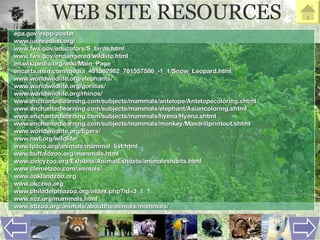
WEB SITE RESOURCES epa.gov/espp/poster www.iucnredlist.org/ www.fws.gov/educators/S_birds.html www.fws.gov/endangered/wildlife.html en.wikipedia.org/wiki/Main_Page  encarta.msn.com/media_461562982_761557586_-1_1/Snow_Leopard.html www.worldwildlife.org/elephants/ www.worldwildlife.org/gorillas/ www.worldwildlife.org/rhinos/ www.enchantedlearning.com/subjects/mammals/antelope/Antelopecoloring.shtml www.enchantedlearning.com/subjects/mammals/elephant/Asiancoloring.shtml www.enchantedlearning.com/subjects/mammals/hyena/Hyena.shtml www.enchantedlearning.com/subjects/mammals/monkey/Mandrillprintout.shtml www.worldwildlife.org/tigers/ www.nwf.org/wildlife/ www.lpzoo.org/animals/mammal_list.html  www.buffalozoo.org/mammals.html  www.cincyzoo.org/Exhibits/AnimalExhibits/animalexhibits.html  www.clemetzoo.com/animals/ www.oaklandzoo.org www.okczoo.org www.philadelphiazoo.org/index.php?id=3_1_1 www.scz.org/mammals.html  www.stlzoo.org/animals/abouttheanimals/mammals/
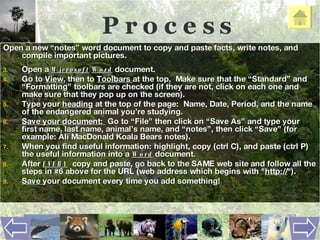
P r o c e s s Open a new “notes” word document to copy and paste facts, write notes, and compile important pictures. Open a  Microsoft   Word  document.  Go to  View , then to  Toolbars  at the top .   Make sure that the “Standard” and “Formatting” toolbars are checked (if they are not, click on each one and make sure that they pop up on the screen). Type your  heading  at the top of the page:  Name, Date, Period, and the name of the endangered animal you’re studying.  Save your document:  Go to “File” then click on “Save As” and type your first name, last name, animal’s name, and “notes”, then click “Save” (for example: Ali MacDonald Koala Bears notes). When you find useful information: highlight, copy (ctrl C), and paste (ctrl P)  the useful information into a  Word  document.  After  EVERY   copy and paste, go back to the SAME web site and follow all the steps in #6 above for the URL (web address which begins with " http:// ").  Save  your document every time you add something!
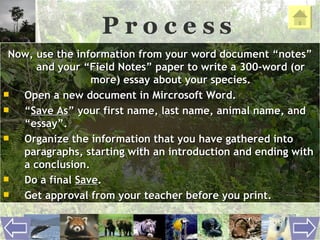
P r o c e s s Now, use the information from your word document “notes” and your “Field Notes” paper to write a 300-word (or more) essay about your species. Open a new document in Mircrosoft Word.  “ Save As ” your first name, last name, animal name, and “essay”.  Organize the information that you have gathered into paragraphs, starting with an introduction and ending with a conclusion.  Do a final  Save .  Get approval from your teacher before you print.
P r o c e s s After you have finished gathering information and writing your essay, it is time to communicate what you’ve learned with as many people as you can. To show the evolution of your species, you will create a “branching diagram”. This will help you describe your species and why it is important. Next, create a visual displaying all of the information that you learned about your species (a poster, brochure, or model).  You will use this in the next step. Finally, you will make a presentation explaining everything you learned about your endangered animal species using the branching diagram and the visual that you created.
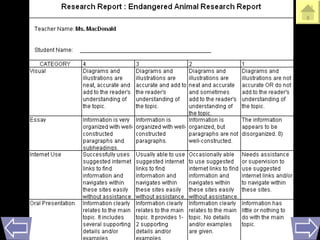
E v a l u a t i o n Checklist: Items to be Turned In Completed “Field Notes” Sheet 300-(or more)-word Essay  Branching Diagram Visual (poster, brochure, or model) Endangered Animal Project Rubric
 
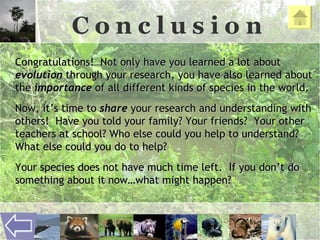
C o n c l u s i o n Congratulations!  Not only have you learned a lot about  evolution  through your research, you have also learned about the  importance  of all different kinds of species in the world.  Now, it’s time to  share  your research and understanding with others!  Have you told your family? Your friends?  Your other teachers at school? Who else could you help to understand?  What else could you do to help?  Your species does not have much time left.  If you don’t do something about it now…what might happen?

Endangered Animal Web Quest

  • 1.
    Process Who is REALLY in “danger”? The Endangered Animal Crisis Designed by Ms. Mac 7th Grade Science Fall 2007 Introduction Evaluation Task Conclusion
  • 2.
    I n tr o d u c t i o n All the creatures on Earth are important in some way. From the beginning of time, extinction has moved at a pretty regular rate (it has stayed almost the same). Today the rate is moving much faster! Scientists believe this is the sixth mass extinction on Earth. Humans weren’t here for any of the mass extinctions in the past, but this time we may not only witness it, we are probably the cause of it all . Human population has more than doubled in just fifty years, and that is the biggest reason why there is less room for any other species.
  • 3.
    I n tr o d u c t i o n We are taking their living space to grow our food; then taking their food to feed ourselves. We are using them, squeezing them to the edge, then off , their habitats!
  • 4.
    I n tr o d u c t i o n Today, more than 12,000 species face an extinction risk. If you don’t care about animals and plants, how could their extinction still affect you? Many species keep us alive! They purify water, fix nitrogen, recycle nutrients and waste, make medicine for us, and pollinate crops. Plants and bacteria do photosynthesis, which makes the oxygen we breathe. Trees absorb carbon dioxide, the main greenhouse gas given off by human activities. But not only are they helpful to people, they also make us money! US researchers calculated that animals and plants make over $34 trillion every year! Helping other species keep their living space is not emotional. It is the only way we will survive.
  • 5.
    T a sk 7th grade California Health Framework Standards addressed in “Endangered Animal Crisis” 3a. Students know both genetic variation and environmental factors are causes of evolution and diversity. 3d. Students know how to construct a simple branching diagram to classify living groups of organisms by shared derived characteristics and how to expand the diagram to include fossil organisms. 3e. Students know that extinction of a species occurs when the environment changes and the adaptive characteristics of a species are insufficient for its survival.
  • 6.
    T a sk As a scientist, you are worried about the mass extinction going on. You decide that you need to do something about it! You develop a plan. First, you pick one endangered animal species that you will study in detail. Next, you will fill out “Field Notes,” then research the evolution of your species, and create a “branching diagram”. You will write a 300-word essay about your species and create a “visual” displaying all of the information that you learned about your species (a poster, brochure, model, etc.). To communicate your findings to your colleagues, you will make a presentation explaining everything you learned about your endangered animal species.
  • 7.
    P r oc e s s After you have looked through the lists I’ve provided, books, and websites about endangered animals and picked one species to study, you are ready to begin! Get a “Field Notes” paper from your teacher or print it out so that you can organize the information that you find. Start researching! Use ONLY these websites at school to find out the answers to your “Field Notes” questions and to gather pictures and interesting facts about your animal.
  • 8.
    WEB SITE RESOURCESepa.gov/espp/poster www.iucnredlist.org/ www.fws.gov/educators/S_birds.html www.fws.gov/endangered/wildlife.html en.wikipedia.org/wiki/Main_Page encarta.msn.com/media_461562982_761557586_-1_1/Snow_Leopard.html www.worldwildlife.org/elephants/ www.worldwildlife.org/gorillas/ www.worldwildlife.org/rhinos/ www.enchantedlearning.com/subjects/mammals/antelope/Antelopecoloring.shtml www.enchantedlearning.com/subjects/mammals/elephant/Asiancoloring.shtml www.enchantedlearning.com/subjects/mammals/hyena/Hyena.shtml www.enchantedlearning.com/subjects/mammals/monkey/Mandrillprintout.shtml www.worldwildlife.org/tigers/ www.nwf.org/wildlife/ www.lpzoo.org/animals/mammal_list.html  www.buffalozoo.org/mammals.html  www.cincyzoo.org/Exhibits/AnimalExhibits/animalexhibits.html  www.clemetzoo.com/animals/ www.oaklandzoo.org www.okczoo.org www.philadelphiazoo.org/index.php?id=3_1_1 www.scz.org/mammals.html  www.stlzoo.org/animals/abouttheanimals/mammals/
  • 9.
    P r oc e s s Open a new “notes” word document to copy and paste facts, write notes, and compile important pictures. Open a Microsoft Word document. Go to View , then to Toolbars at the top . Make sure that the “Standard” and “Formatting” toolbars are checked (if they are not, click on each one and make sure that they pop up on the screen). Type your heading at the top of the page: Name, Date, Period, and the name of the endangered animal you’re studying. Save your document: Go to “File” then click on “Save As” and type your first name, last name, animal’s name, and “notes”, then click “Save” (for example: Ali MacDonald Koala Bears notes). When you find useful information: highlight, copy (ctrl C), and paste (ctrl P) the useful information into a Word document. After EVERY   copy and paste, go back to the SAME web site and follow all the steps in #6 above for the URL (web address which begins with " http:// "). Save your document every time you add something!
  • 10.
    P r oc e s s Now, use the information from your word document “notes” and your “Field Notes” paper to write a 300-word (or more) essay about your species. Open a new document in Mircrosoft Word. “ Save As ” your first name, last name, animal name, and “essay”. Organize the information that you have gathered into paragraphs, starting with an introduction and ending with a conclusion. Do a final Save . Get approval from your teacher before you print.
  • 11.
    P r oc e s s After you have finished gathering information and writing your essay, it is time to communicate what you’ve learned with as many people as you can. To show the evolution of your species, you will create a “branching diagram”. This will help you describe your species and why it is important. Next, create a visual displaying all of the information that you learned about your species (a poster, brochure, or model). You will use this in the next step. Finally, you will make a presentation explaining everything you learned about your endangered animal species using the branching diagram and the visual that you created.
  • 12.
    E v al u a t i o n Checklist: Items to be Turned In Completed “Field Notes” Sheet 300-(or more)-word Essay Branching Diagram Visual (poster, brochure, or model) Endangered Animal Project Rubric
  • 13.
  • 14.
    C o nc l u s i o n Congratulations! Not only have you learned a lot about evolution through your research, you have also learned about the importance of all different kinds of species in the world. Now, it’s time to share your research and understanding with others! Have you told your family? Your friends? Your other teachers at school? Who else could you help to understand? What else could you do to help? Your species does not have much time left. If you don’t do something about it now…what might happen?