Chapter 4:
Implementing Perfect Questionable Encryptions∗
Adam L. Young and Moti M. Yung
Abstract
The notion of a questionable encryption scheme was first put forth
in Malicious Cryptography [10]. In this chapter we present an imple-
mentation of the perfect questionable encryption scheme that appears
in [9] that is based on our MyCrypt ’05 paper [11]. A questionable en-
cryption (q.e.) scheme is a generalization of a PKCS that includes an
additional key generation algorithm that outputs a fake public key and
a corresponding witness of non-encryption. The perfect q.e. scheme is
based on the Paillier PKCS that produces a private key (that serves
as a witness of encryption) and corresponding public key. The scheme
includes a predicate F that takes as input a public key and correspond-
ing witness. The output of F is a single bit that proves whether the
public key is real or fake. A perfect q.e. scheme has the property that
it is information theoretically impossible for everyone including the key
pair owner to decrypt ciphertexts produced using the fake public key.
Also, fake public keys are computationally indistinguishable from real
public keys. It has been shown that a q.e. scheme is ideal for imple-
mentation in cryptoviruses, cryptoworms, and cryptotrojans. The use
of a q.e. scheme in malware to “encrypt” data prior to transmission
casts doubt on the occurrence of data theft, since prosecutors cannot
directly prove that such malware encrypts data even when all code, all
core dumps, and all packets that are transmitted by the malware are
entered into evidence. The attacker retains the witness and can re-
veal it at any time. Questionable encryptions also serve as a desirable
alternative to oblivious transfer in certain applications.
∗
If this file was obtained from a publicly accessible website other than the website
www.cryptovirology.com then (1) the entity or entities that made it available are in vio-
lation of our copyright and (2) the contents of this file should therefore not be trusted.
Please obtain the latest version directly from the official Cryptovirology Labs website at:
http://www.cryptovirology.com.
Copyright c 2005-2006 by Moti Yung and Adam Young. All rights reserved. Ver 3.5. 1
Introduction 2
1 Introduction
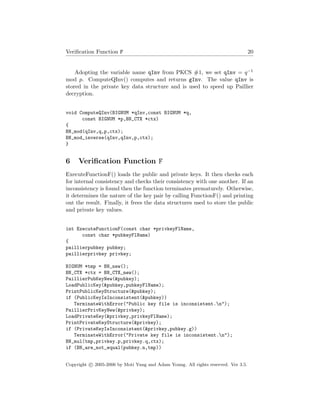
Consider a malware analyst that is given a malicious software program and
is asked what it does. Suppose that the program collects data from the
host system. Suppose further that it passes this data as plaintext to an
asymmetric encryption function along with what appears to be a public
key. The output ciphertext is transmitted over the public Internet (e.g.,
steganographically encoded into images that are posted to a public bulletin
board). Is the malware stealing data? Can the analyst conclude this to be
so? These questions are at the very heart of the notion of a questionable
encryption scheme.
The notion of a questionable encryption was first investigated in [10].
This informal work formed the basis for further work in more formal settings.
The notion of a perfect questionable encryption scheme was covered in [11]
and the notion of a computational questionable encryption scheme appears
in [12]. These papers point out the similarities and differences between
questionable encryptions and: oblivious transfer, deniable encryption, and
all-or-nothing disclosure of secrets.
The initial observation was that a public key can be constructed in such
a way that it appears to be a valid public key, i.e., algebraically correct,
but that has a fundamental flaw, a flaw that is so bad, in fact, that it is
intractable for everyone to decrypt data encrypted with it. This gave rise
to the idea that a fake key pair generator could be devised to output a
fake public key and a corresponding small value, called a witness of non-
encryption that proves that the public key is so flawed that the ciphertexts
that it yields are intractable to decrypt. The scheme, called a questionable
encryption scheme, not only hides plaintexts in a cryptographic sense, but
also hides whether or not data is being encrypted at all.
The definition of a questionable encryption scheme satisfies the follow-
ing properties. Informally, a fake public key must appear to all probabilistic
polynomial time algorithms like a real public key (computational indistin-
guishability). Also, it must be intractable to produce a “public” key and
both a witness of encryption and witness of non-encryption for it. In other
words, once a user generates a key pair he or she is committed to the public
key being either real or fake but not both.
The computational indistinguishability property is worth emphasizing
since it is easily misunderstood. It is entirely intractable to determine if the
plaintext is being encrypted vs. being destroyed even while watching the
asymmetric encryption function encrypt using the public key (that is real
or fake). There is no way to “trap” the encryption call and learn whether
Copyright c 2005-2006 by Moti Yung and Adam Young. All rights reserved. Ver 3.5.
Introduction 3
or not encryption is actually taking place.
But what use could a provably flawed yet normal-looking public key be?
Consider again the malware that appears to the analyst to be enciphering
data. Suppose that the public key is provably fake but that the witness is
not included in the malware. If the malware author mounts an attack and is
taken to court then the malware author can take the Fifth. If convicted of
data theft the attacker can appeal and reveal the witness of non-encryption.
This retroactively proves that the malware could not have possibly been
used to steal data. The result is practically significant because it implies
that when malware is properly designed (i.e., using cryptovirology) it is
fundamentally intractable to prove data theft directly.
This attack can be expanded into a larger attack scenario. Suppose that
hundreds of different malware strains are released that implement question-
able encryptions. Suppose that some contain real public keys and others
contain fake public keys. On occasion a malware author anonymously pub-
lishes his or her witness of non-encryption long after the malware is released.
This would set a strong real-world precedent that malware that appears to
asymmetrically encrypt and transmit data does not always do so.
No legal analyses will be attempted in this chapter. Our aim is to present
an implementation of a questionable encryption scheme and shed light on its
scientific aspects. Our implementation is based on the perfect q.e. scheme
that will appear in IEEE Transactions on Information Forensics and Secu-
rity [9]. This journal article is based on [11] that utilizes the Paillier public
key cryptosystem [5]. We remark that the journal version expands upon
[11]. However, the same basic idea remains unchanged. A perfect question-
able encryption scheme has the property that it is information theoretically
impossible to decipher data encrypted using a fake public key (in a computa-
tional q.e. scheme indecipherability is based on a computational argument).
This chapter goes beyond [9] by showing how to implement perfect ques-
tionable encryptions in a very computationally efficient manner. This chap-
ter and the associated appendix (that contains the corresponding source
code) therefore constitutes fundamental research in modern cryptovirology.
We chose to use the OpenSSL cryptographic library that is freely avail-
able as open source. At this time OpenSSL does not implement the Paillier
public key cryptosystem. So, it was necessary for us to implement it our-
selves. This chapter therefore serves as a tutorial on programming an effi-
cient implementation of Paillier as well as implementing perfect questionable
encryptions.
The example program is called pquesencr.exe. It implements a hybrid
cryptosystem based on Paillier and Blowfish [8] in cipher block chaining
Copyright c 2005-2006 by Moti Yung and Adam Young. All rights reserved. Ver 3.5.
Creating the Program 4
(CBC) mode. This hybrid cryptosystem is used to encrypt and decrypt
files. However, the ‘perfect’ property is lost when a symmetric cipher such
as Blowfish is used. This is because, whereas Paillier constitutes a perfect
questionable encryption scheme, Paillier combined with Blowfish in a hybrid
encryption scheme does not: a computationally unbounded adversary can
brute-force a symmetric cipher such as Blowfish.
It is straightforward to extract the pieces of this program that perform
Paillier encryption. The Paillier PKCS can be used in electronic code book
(ECB) mode. This chapter therefore justifiably covers the implementation
of a perfect questionable encryption scheme.
Our focus is on presenting a practical scheme. We combined Paillier with
Blowfish to achieve the benefits of hybrid encryption. It should be noted
that we by no means eliminate the properties of a questionable encryption
scheme by using Paillier with Blowfish. Our use of Blowfish makes the over-
all questionable encryption scheme secure under a computational argument
(that of breaking Blowfish). If the distinction here is not clear then we urge
the reader to consult the scientific literature on the subject.
2 Creating the Program
The program consists of the following ANSI C source files: pquesencr.c,
kleptoutil.c, pqext.c, and pqemisc.c. It also consists of the following
header files: pquesencr.h, kleptoutil.h, pqext.h, and pqemisc.h. Compi-
lation also requires OpenSSL. When installed, the needed OpenSSL library
is typically included by supplying −lcrypto as an argument to gcc.
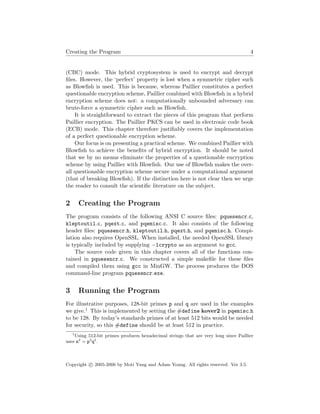
The source code given in this chapter covers all of the functions con-
tained in pquesencr.c. We constructed a simple makefile for these files
and compiled them using gcc in MinGW. The process produces the DOS
command-line program pquesencr.exe.
3 Running the Program
For illustrative purposes, 128-bit primes p and q are used in the examples
we give.1 This is implemented by setting the #define kover2 in pqemisc.h
to be 128. By today’s standards primes of at least 512 bits would be needed
for security, so this #define should be at least 512 in practice.
1
Using 512-bit primes produces hexadecimal strings that are very long since Paillier
uses n2
= p2
q2
.
Copyright c 2005-2006 by Moti Yung and Adam Young. All rights reserved. Ver 3.5.
Running the Program 5
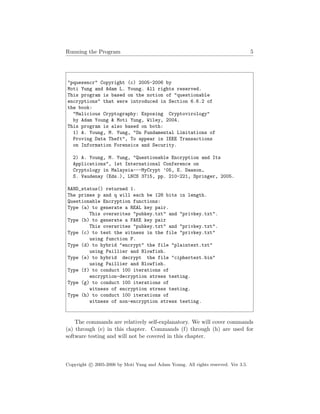
"pquesencr" Copyright (c) 2005-2006 by
Moti Yung and Adam L. Young. All rights reserved.
This program is based on the notion of "questionable
encryptions" that were introduced in Section 6.6.2 of
the book:
"Malicious Cryptography: Exposing Cryptovirology"
by Adam Young & Moti Yung, Wiley, 2004.
This program is also based on both:
1) A. Young, M. Yung, "On Fundamental Limitations of
Proving Data Theft", To appear in IEEE Transactions
on Information Forensics and Security.
2) A. Young, M. Yung, "Questionable Encryption and Its
Applications", 1st International Conference on
Cryptology in Malaysia---MyCrypt ’05, E. Dawson,
S. Vaudenay (Eds.), LNCS 3715, pp. 210-221, Springer, 2005.
RAND_status() returned 1.
The primes p and q will each be 128 bits in length.
Questionable Encryption functions:
Type (a) to generate a REAL key pair.
This overwrites "pubkey.txt" and "privkey.txt".
Type (b) to generate a FAKE key pair
This overwrites "pubkey.txt" and "privkey.txt".
Type (c) to test the witness in the file "privkey.txt"
using function F.
Type (d) to hybrid "encrypt" the file "plaintext.txt"
using Paillier and Blowfish.
Type (e) to hybrid decrypt the file "ciphertext.bin"
using Paillier and Blowfish.
Type (f) to conduct 100 iterations of
encryption-decryption stress testing.
Type (g) to conduct 100 iterations of
witness of encryption stress testing.
Type (h) to conduct 100 iterations of
witness of non-encryption stress testing.
The commands are relatively self-explanatory. We will cover commands
(a) through (e) in this chapter. Commands (f) through (h) are used for
software testing and will not be covered in this chapter.
Copyright c 2005-2006 by Moti Yung and Adam Young. All rights reserved. Ver 3.5.
3.1 Working with Real Key Pairs 6
3.1 Working with Real Key Pairs
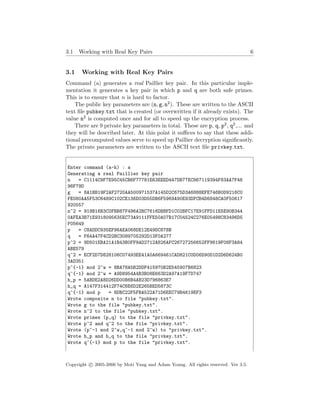
Command (a) generates a real Paillier key pair. In this particular imple-
mentation it generates a key pair in which p and q are both safe primes.
This is to ensure that n is hard to factor.
The public key parameters are (n, g, n2). These are written to the ASCII
text file pubkey.txt that is created (or overwritten if it already exists). The
value n2 is computed once and for all to speed up the encryption process.
There are 9 private key parameters in total. These are p, q, p2, q2,... and
they will be described later. At this point it suffices to say that these addi-
tional precomputed values serve to speed up Paillier decryption significantly.
The private parameters are written to the ASCII text file privkey.txt.
Enter command (a-h) : a
Generating a real Paillier key pair
n = C1114C9F7E95C45CB6F77781E63EEED447DB77EC867119394F83AA7F46
98F79D
g = 8A1BB19F2AF2720AA500971537A145D2C675D3A6888EFE746B0D9216C0
FE080AA5F53C6489C102CE136D03D55DB6F5969A90E93DFCB4D6848CA0F50617
920557
n^2 = 919B16B3C0FBB87F496A2BC7616DBBFD1C02BFC17E91FFD11E5E90B344
0AFEA3B71E9318095635EC73A9111FFE50A07B17C04524C276E05498C83496D5
F05649
p = C8ADDC935EF96AEA068DE12E49DC878B
q = F64A47F4CD2BC3089705292D13F0A277
p^2 = 9D501EBA21A1B43B0FF9AD2712A826AFC26727256652FF9819F08F3A84
ABE579
q^2 = ECF2D7D828106C07493EE41A0A669461CAD821C0D06D90D1D2D6D624B0
3AD351
p^{-1} mod 2^w = 8BA78A5B2DDF415970B2E545907B6823
q^{-1} mod 2^w = A9D8954A4B3B08E663D2A97A19F7D747
h_p = 5ABDE2A8D26DD00B6B4AB23D796863E7
h_q = A147F314412F74C6E6D2E265BED5873C
q^{-1} mod p = 8DBC22F5FBA522A71D6EEC79B4619EF3
Wrote composite n to file "pubkey.txt".
Wrote g to the file "pubkey.txt".
Wrote n^2 to the file "pubkey.txt".
Wrote primes (p,q) to the file "privkey.txt".
Wrote p^2 and q^2 to the file "privkey.txt".
Wrote (p^-1 mod 2^w,q^-1 mod 2^w) to "privkey.txt".
Wrote h_p and h_q to the file "privkey.txt".
Wrote q^{-1} mod p to the file "privkey.txt".
Copyright c 2005-2006 by Moti Yung and Adam Young. All rights reserved. Ver 3.5.
3.1 Working with Real Key Pairs 7
--------Memory Leaks displayed below--------
--------Memory Leaks displayed above--------
The last portion of the output indicates the presence or absence of mem-
ory leaks. The code for this utilizes OpenSSL’s memory leak checking func-
tionality. As long as there is no output between these two lines, there should
not be any memory leaks in the implementation.
To determine the nature of the public key, command (c) is used. This
command requires the public and private key files. Command (c) executes
function F as defined in [9].
Enter command (a-h) : c
About to read in public key values from file "pubkey.txt".
Public key values loaded successfully.
n = C1114C9F7E95C45CB6F77781E63EEED447DB77EC867119394F83AA7F46
98F79D
g = 8A1BB19F2AF2720AA500971537A145D2C675D3A6888EFE746B0D9216C0
FE080AA5F53C6489C102CE136D03D55DB6F5969A90E93DFCB4D6848CA0F50617
920557
n^2 = 919B16B3C0FBB87F496A2BC7616DBBFD1C02BFC17E91FFD11E5E90B344
0AFEA3B71E9318095635EC73A9111FFE50A07B17C04524C276E05498C83496D5
F05649
About to read in private key values from the file "privkey.txt".
Private key values loaded successfully.
p = C8ADDC935EF96AEA068DE12E49DC878B
q = F64A47F4CD2BC3089705292D13F0A277
p^2 = 9D501EBA21A1B43B0FF9AD2712A826AFC26727256652FF9819F08F3A84
ABE579
q^2 = ECF2D7D828106C07493EE41A0A669461CAD821C0D06D90D1D2D6D624B0
3AD351
p^{-1} mod 2^w = 8BA78A5B2DDF415970B2E545907B6823
q^{-1} mod 2^w = A9D8954A4B3B08E663D2A97A19F7D747
h_p = 5ABDE2A8D26DD00B6B4AB23D796863E7
h_q = A147F314412F74C6E6D2E265BED5873C
q^{-1} mod p = 8DBC22F5FBA522A71D6EEC79B4619EF3
This key pair is REAL.
--------Memory Leaks displayed below--------
--------Memory Leaks displayed above--------
Copyright c 2005-2006 by Moti Yung and Adam Young. All rights reserved. Ver 3.5.
3.1 Working with Real Key Pairs 8
The output shown above indicates that the key pair is a real Paillier key
pair. This is as it should be since the key pair was created using command
(a). The other possible responses are that the key pair is fake or that an
error occurred.
Now that the real key pair has been generated and tested, we are in a
position to encrypt data with the public key. The program pquesencr.exe
will encrypt the file plaintext.txt provided that it is available (the key
pair files, the plaintext, and the ciphertext files should be stored in the same
directory as pquesencr.exe). This is accomplished by selecting command
(d) after the key pair has been stored.
Enter command (a-h) : d
About to read in public key values from file "pubkey.txt".
Public key values loaded successfully.
Looking for file "plaintext.txt" so that it can be hybrid "encry
pted".
File "plaintext.txt" successfully opened for reading.
key[] = 0xAC7E0886CB581DE9647E81839B27953E
iv[] = 0x896128FE30F6DDDE
m = AB9A170C27A1274EFDD74D62429B4F23E95279B83817E64E91D58CB86087
EAC
r = 2728D60FEA2D4B8CA59B02D3047EA8DD10546042BA2C4B2ECF5A7C93FE27
1A6B
c = 294AA3D8838D4FE1FA97E4735626DFD2D14DE184C491C871F4BB51123D78
8934FB9B461F4B27FB947B0DE6BBDF6DC3AFD871F59B5F68C22BB8305C92A315
6555
Ciphertext written to file "ciphertext.bin".
--------Memory Leaks displayed below--------
--------Memory Leaks displayed above--------
The ciphertext is stored in the data file ciphertext.bin. This is a binary
file that can be examined using a disk utility or hex editor.
Since Paillier is a probabilistic cryptosystem, the asymmetric ciphertext
will differ with each encryption with overwhelming probability. Also, the
program chooses a random Blowfish key and initialization vector with each
encryption. So, the CBC ciphertext will differ with each encryption of the
same plaintext file with overwhelming probability.
Selecting command (e) causes the ciphertext file to be decrypted. The
resulting plaintext is written to plaintext2.txt.
Copyright c 2005-2006 by Moti Yung and Adam Young. All rights reserved. Ver 3.5.
3.2 Working with Fake Key Pairs 9
Enter command (a-h) : e
About to read in private key values from the file "privkey.txt".
Private key values loaded successfully.
About to read in public key values from file "pubkey.txt".
Public key values loaded successfully.
Looking for file "ciphertext.bin" so that it can be hybrid decry
pted.
File "ciphertext.bin" successfully opened for reading.
c = 294AA3D8838D4FE1FA97E4735626DFD2D14DE184C491C871F4BB51123D78
8934FB9B461F4B27FB947B0DE6BBDF6DC3AFD871F59B5F68C22BB8305C92A315
6555
m = AB9A170C27A1274EFDD74D62429B4F23E95279B83817E64E91D58CB86087
EAC
key[] = 0xAC7E0886CB581DE9647E81839B27953E
iv[] = 0x896128FE30F6DDDE
Plaintext written to file "plaintext2.txt".
--------Memory Leaks displayed below--------
--------Memory Leaks displayed above--------
As long as the public key file and private key file are preserved, the
file plaintext2.txt will be identical to the original plaintext file. This
completes the description of using real public keys.
3.2 Working with Fake Key Pairs
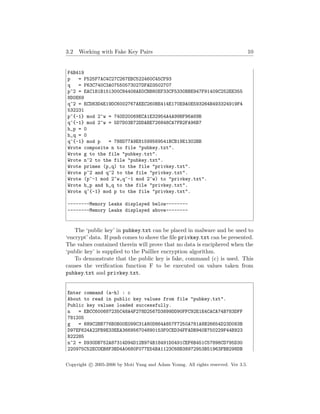
Selecting command (b) causes a fake Paillier key pair to be generated. When
the fake public key is used to asymmetrically encrypt data, the resulting
ciphertext cannot be decrypted at all, even when p is known.
Enter command (a-h) : b
Generating a fake Paillier key pair
n = EBCC600687235C48A4F278D2567D3899DD90FFC92E1E4CACA74B783DFF
781205
g = 689C2BB776B0B00E099C31A80D864A857F7250A781A8B26654D23D083B
D97EF624A22FB9E33EEA366956704890153F0CED34FFADB940B750229F44B923
B22285
n^2 = D930DB752A87314D94D12B974B18491D0491CEF6B451C57898CD795D30
220975C52EC0EB8F3BD4A0680F077E54BA1123C68B38972953B51963FBB298DB
Copyright c 2005-2006 by Moti Yung and Adam Young. All rights reserved. Ver 3.5.
3.2 Working with Fake Key Pairs 10
F4B419
p = F525F7AC4C27C267EBC522460C45CF93
q = F63C740C3A07550573027DFAD3502707
p^2 = EAC1B1B151300C84408AE0CBB80EF33CF5330BBE947F91409C252EE355
8D0E69
q^2 = ECD83D4E19DC6002767AEEC260BE414E170E9A0E593264B493324919F4
532231
p^{-1} mod 2^w = 740D20069ECA1E32954A4A99BF96A69B
q^{-1} mod 2^w = 5D7D03B72DDABE726848CA7FB2FA96B7
h_p = 0
h_q = 0
q^{-1} mod p = 788D77A9E81599569541BCB19E1302BB
Wrote composite n to file "pubkey.txt".
Wrote g to the file "pubkey.txt".
Wrote n^2 to the file "pubkey.txt".
Wrote primes (p,q) to the file "privkey.txt".
Wrote p^2 and q^2 to the file "privkey.txt".
Wrote (p^-1 mod 2^w,q^-1 mod 2^w) to "privkey.txt".
Wrote h_p and h_q to the file "privkey.txt".
Wrote q^{-1} mod p to the file "privkey.txt".
--------Memory Leaks displayed below--------
--------Memory Leaks displayed above--------
The ‘public key’ in pubkey.txt can be placed in malware and be used to
‘encrypt’ data. If push comes to shove the file privkey.txt can be presented.
The values contained therein will prove that no data is enciphered when the
‘public key’ is supplied to the Paillier encryption algorithm.
To demonstrate that the public key is fake, command (c) is used. This
causes the verification function F to be executed on values taken from
pubkey.txt and privkey.txt.
Enter command (a-h) : c
About to read in public key values from file "pubkey.txt".
Public key values loaded successfully.
n = EBCC600687235C48A4F278D2567D3899DD90FFC92E1E4CACA74B783DFF
781205
g = 689C2BB776B0B00E099C31A80D864A857F7250A781A8B26654D23D083B
D97EF624A22FB9E33EEA366956704890153F0CED34FFADB940B750229F44B923
B22285
n^2 = D930DB752A87314D94D12B974B18491D0491CEF6B451C57898CD795D30
220975C52EC0EB8F3BD4A0680F077E54BA1123C68B38972953B51963FBB298DB
Copyright c 2005-2006 by Moti Yung and Adam Young. All rights reserved. Ver 3.5.
3.2 Working with Fake Key Pairs 11
F4B419
About to read in private key values from the file "privkey.txt".
Private key values loaded successfully.
p = F525F7AC4C27C267EBC522460C45CF93
q = F63C740C3A07550573027DFAD3502707
p^2 = EAC1B1B151300C84408AE0CBB80EF33CF5330BBE947F91409C252EE355
8D0E69
q^2 = ECD83D4E19DC6002767AEEC260BE414E170E9A0E593264B493324919F4
532231
p^{-1} mod 2^w = 740D20069ECA1E32954A4A99BF96A69B
q^{-1} mod 2^w = 5D7D03B72DDABE726848CA7FB2FA96B7
h_p = 0
h_q = 0
q^{-1} mod p = 788D77A9E81599569541BCB19E1302BB
This key pair is FAKE.
--------Memory Leaks displayed below--------
--------Memory Leaks displayed above--------
Since a fake key was generated using command (b), as expected the out-
put indicates that the key pair is fake. The implementation checks various
values from the key files. However, the actual implementation of F only
takes (p, n, g) as input.
The fake public key nonetheless produces normal looking asymmetric
ciphertexts. Therefore, it leads to normal looking hybrid encryptions. Data
is encrypted with the fake public key by executing command (d).
Enter command (a-h) : d
About to read in public key values from file "pubkey.txt".
Public key values loaded successfully.
Looking for file "plaintext.txt" so that it can be hybrid "encry
pted".
File "plaintext.txt" successfully opened for reading.
key[] = 0x4119967DEDAF118A7EED0669259E8126
iv[] = 0x71461A0DC4A69B8F
m = 5EDE5AA7D01FCC7419883E5DCA57307826819E256906ED7E8A11AFED7D96
1941
r = 4CD222E2E6543FF203561F6C594059459810F82177BB795718EEBD9017F4
0568
c = 74E8672757CFB306EED92E30D2E9EA9E4B1DCDA47CBE0A0AB2785EB99EA4
13354D0D228A20B5CC12F85C4D8ACFC6F0097A4B05873158735FF593DE339DF6
Copyright c 2005-2006 by Moti Yung and Adam Young. All rights reserved. Ver 3.5.
The Function main() 12
76DA
Ciphertext written to file "ciphertext.bin".
--------Memory Leaks displayed below--------
--------Memory Leaks displayed above--------
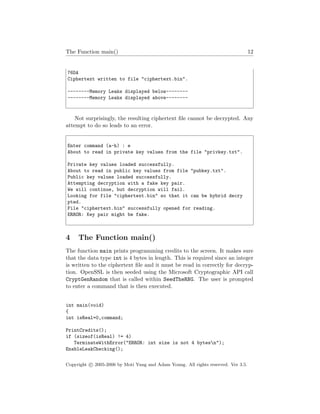
Not surprisingly, the resulting ciphertext file cannot be decrypted. Any
attempt to do so leads to an error.
Enter command (a-h) : e
About to read in private key values from the file "privkey.txt".
Private key values loaded successfully.
About to read in public key values from file "pubkey.txt".
Public key values loaded successfully.
Attempting decryption with a fake key pair.
We will continue, but decryption will fail.
Looking for file "ciphertext.bin" so that it can be hybrid decry
pted.
File "ciphertext.bin" successfully opened for reading.
ERROR: Key pair might be fake.
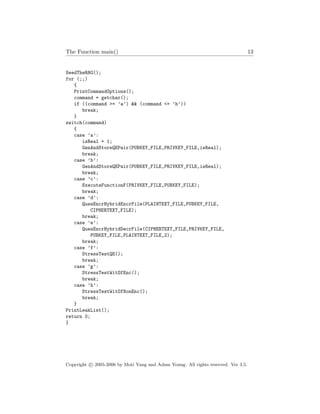
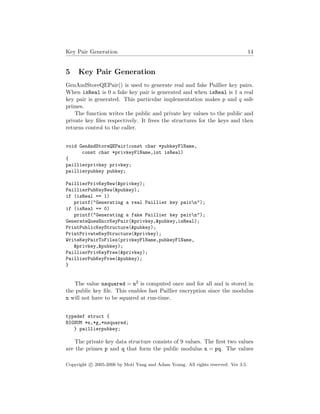
4 The Function main()
The function main prints programming credits to the screen. It makes sure
that the data type int is 4 bytes in length. This is required since an integer
is written to the ciphertext file and it must be read in correctly for decryp-
tion. OpenSSL is then seeded using the Microsoft Cryptographic API call
CryptGenRandom that is called within SeedTheRNG. The user is prompted
to enter a command that is then executed.
int main(void)
{
int isReal=0,command;
PrintCredits();
if (sizeof(isReal) != 4)
TerminateWithError("ERROR: int size is not 4 bytesn");
EnableLeakChecking();
Copyright c 2005-2006 by Moti Yung and Adam Young. All rights reserved. Ver 3.5.
The Function main() 13
SeedTheRNG();
for (;;)
{
PrintCommandOptions();
command = getchar();
if ((command >= ’a’) && (command <= ’h’))
break;
}
switch(command)
{
case ’a’:
isReal = 1;
GenAndStoreQEPair(PUBKEY_FILE,PRIVKEY_FILE,isReal);
break;
case ’b’:
GenAndStoreQEPair(PUBKEY_FILE,PRIVKEY_FILE,isReal);
break;
case ’c’:
ExecuteFunctionF(PRIVKEY_FILE,PUBKEY_FILE);
break;
case ’d’:
QuesEncrHybridEncrFile(PLAINTEXT_FILE,PUBKEY_FILE,
CIPHERTEXT_FILE);
break;
case ’e’:
QuesEncrHybridDecrFile(CIPHERTEXT_FILE,PRIVKEY_FILE,
PUBKEY_FILE,PLAINTEXT_FILE_2);
break;
case ’f’:
StressTestQE();
break;
case ’g’:
StressTestWitOfEnc();
break;
case ’h’:
StressTestWitOfNonEnc();
break;
}
PrintLeakList();
return 0;
}
Copyright c 2005-2006 by Moti Yung and Adam Young. All rights reserved. Ver 3.5.
Key Pair Generation 14
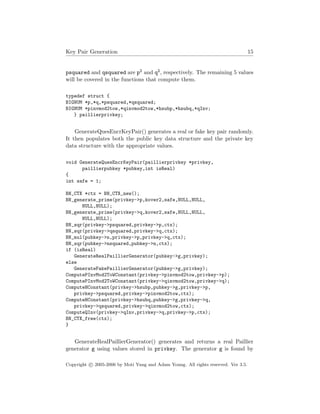
5 Key Pair Generation
GenAndStoreQEPair() is used to generate real and fake Paillier key pairs.
When isReal is 0 a fake key pair is generated and when isReal is 1 a real
key pair is generated. This particular implementation makes p and q safe
primes.
The function writes the public and private key values to the public and
private key files respectively. It frees the structures for the keys and then
returns control to the caller.
void GenAndStoreQEPair(const char *pubkeyFlName,
const char *privkeyFlName,int isReal)
{
paillierprivkey privkey;
paillierpubkey pubkey;
PaillierPrivKeyNew(&privkey);
PaillierPubKeyNew(&pubkey);
if (isReal == 1)
printf("Generating a real Paillier key pairn");
if (isReal == 0)
printf("Generating a fake Paillier key pairn");
GenerateQuesEncrKeyPair(&privkey,&pubkey,isReal);
PrintPublicKeyStructure(&pubkey);
PrintPrivateKeyStructure(&privkey);
WriteKeyPairToFiles(privkeyFlName,pubkeyFlName,
&privkey,&pubkey);
PaillierPrivKeyFree(&privkey);
PaillierPubKeyFree(&pubkey);
}
The value nsquared = n2 is computed once and for all and is stored in
the public key file. This enables fast Paillier encryption since the modulus
n will not have to be squared at run-time.
typedef struct {
BIGNUM *n,*g,*nsquared;
} paillierpubkey;
The private key data structure consists of 9 values. The first two values
are the primes p and q that form the public modulus n = pq. The values
Copyright c 2005-2006 by Moti Yung and Adam Young. All rights reserved. Ver 3.5.
Key Pair Generation 15
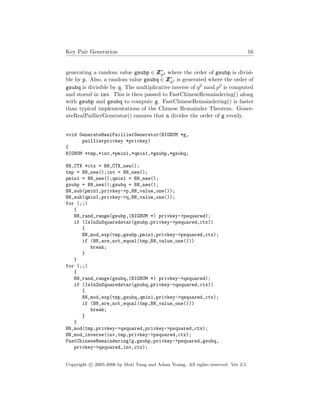
psquared and qsquared are p2 and q2, respectively. The remaining 5 values
will be covered in the functions that compute them.
typedef struct {
BIGNUM *p,*q,*psquared,*qsquared;
BIGNUM *pinvmod2tow,*qinvmod2tow,*hsubp,*hsubq,*qInv;
} paillierprivkey;
GenerateQuesEncrKeyPair() generates a real or fake key pair randomly.
It then populates both the public key data structure and the private key
data structure with the appropriate values.
void GenerateQuesEncrKeyPair(paillierprivkey *privkey,
paillierpubkey *pubkey,int isReal)
{
int safe = 1;
BN_CTX *ctx = BN_CTX_new();
BN_generate_prime(privkey->p,kover2,safe,NULL,NULL,
NULL,NULL);
BN_generate_prime(privkey->q,kover2,safe,NULL,NULL,
NULL,NULL);
BN_sqr(privkey->psquared,privkey->p,ctx);
BN_sqr(privkey->qsquared,privkey->q,ctx);
BN_mul(pubkey->n,privkey->p,privkey->q,ctx);
BN_sqr(pubkey->nsquared,pubkey->n,ctx);
if (isReal)
GenerateRealPaillierGenerator(pubkey->g,privkey);
else
GenerateFakePaillierGenerator(pubkey->g,privkey);
ComputePInvMod2ToWConstant(privkey->pinvmod2tow,privkey->p);
ComputePInvMod2ToWConstant(privkey->qinvmod2tow,privkey->q);
ComputeHConstant(privkey->hsubp,pubkey->g,privkey->p,
privkey->psquared,privkey->pinvmod2tow,ctx);
ComputeHConstant(privkey->hsubq,pubkey->g,privkey->q,
privkey->qsquared,privkey->qinvmod2tow,ctx);
ComputeQInv(privkey->qInv,privkey->q,privkey->p,ctx);
BN_CTX_free(ctx);
}
GenerateRealPaillierGenerator() generates and returns a real Paillier
generator g using values stored in privkey. The generator g is found by
Copyright c 2005-2006 by Moti Yung and Adam Young. All rights reserved. Ver 3.5.
Key Pair Generation 16
generating a random value gsubp ∈ ZZ∗
p2 where the order of gsubp is divisi-
ble by p. Also, a random value gsubq ∈ ZZ∗
q2 is generated where the order of
gsubq is divisible by q. The multiplicative inverse of q2 mod p2 is computed
and stored in inv. This is then passed to FastChineseRemaindering() along
with gsubp and gsubq to compute g. FastChineseRemaindering() is faster
than typical implementations of the Chinese Remainder Theorem. Gener-
ateRealPaillierGenerator() ensures that n divides the order of g evenly.
void GenerateRealPaillierGenerator(BIGNUM *g,
paillierprivkey *privkey)
{
BIGNUM *tmp,*inv,*pmin1,*qmin1,*gsubp,*gsubq;
BN_CTX *ctx = BN_CTX_new();
tmp = BN_new();inv = BN_new();
pmin1 = BN_new();qmin1 = BN_new();
gsubp = BN_new();gsubq = BN_new();
BN_sub(pmin1,privkey->p,BN_value_one());
BN_sub(qmin1,privkey->q,BN_value_one());
for (;;)
{
BN_rand_range(gsubp,(BIGNUM *) privkey->psquared);
if (IsInZnSquaredstar(gsubp,privkey->psquared,ctx))
{
BN_mod_exp(tmp,gsubp,pmin1,privkey->psquared,ctx);
if (BN_are_not_equal(tmp,BN_value_one()))
break;
}
}
for (;;)
{
BN_rand_range(gsubq,(BIGNUM *) privkey->qsquared);
if (IsInZnSquaredstar(gsubq,privkey->qsquared,ctx))
{
BN_mod_exp(tmp,gsubq,qmin1,privkey->qsquared,ctx);
if (BN_are_not_equal(tmp,BN_value_one()))
break;
}
}
BN_mod(tmp,privkey->qsquared,privkey->psquared,ctx);
BN_mod_inverse(inv,tmp,privkey->psquared,ctx);
FastChineseRemaindering(g,gsubp,privkey->psquared,gsubq,
privkey->qsquared,inv,ctx);
Copyright c 2005-2006 by Moti Yung and Adam Young. All rights reserved. Ver 3.5.
Key Pair Generation 17
BN_clear_free(tmp);BN_clear_free(inv);
BN_clear_free(pmin1);BN_clear_free(qmin1);
BN_clear_free(gsubp);BN_clear_free(gsubq);
BN_CTX_free(ctx);
}
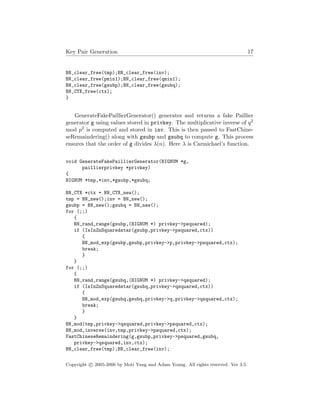
GenerateFakePaillierGenerator() generates and returns a fake Paillier
generator g using values stored in privkey. The multiplicative inverse of q2
mod p2 is computed and stored in inv. This is then passed to FastChine-
seRemaindering() along with gsubp and gsubq to compute g. This process
ensures that the order of g divides λ(n). Here λ is Carmichael’s function.
void GenerateFakePaillierGenerator(BIGNUM *g,
paillierprivkey *privkey)
{
BIGNUM *tmp,*inv,*gsubp,*gsubq;
BN_CTX *ctx = BN_CTX_new();
tmp = BN_new();inv = BN_new();
gsubp = BN_new();gsubq = BN_new();
for (;;)
{
BN_rand_range(gsubp,(BIGNUM *) privkey->psquared);
if (IsInZnSquaredstar(gsubp,privkey->psquared,ctx))
{
BN_mod_exp(gsubp,gsubp,privkey->p,privkey->psquared,ctx);
break;
}
}
for (;;)
{
BN_rand_range(gsubq,(BIGNUM *) privkey->qsquared);
if (IsInZnSquaredstar(gsubq,privkey->qsquared,ctx))
{
BN_mod_exp(gsubq,gsubq,privkey->q,privkey->qsquared,ctx);
break;
}
}
BN_mod(tmp,privkey->qsquared,privkey->psquared,ctx);
BN_mod_inverse(inv,tmp,privkey->psquared,ctx);
FastChineseRemaindering(g,gsubp,privkey->psquared,gsubq,
privkey->qsquared,inv,ctx);
BN_clear_free(tmp);BN_clear_free(inv);
Copyright c 2005-2006 by Moti Yung and Adam Young. All rights reserved. Ver 3.5.
Key Pair Generation 18
BN_clear_free(gsubp);BN_clear_free(gsubq);
BN_CTX_free(ctx);
}
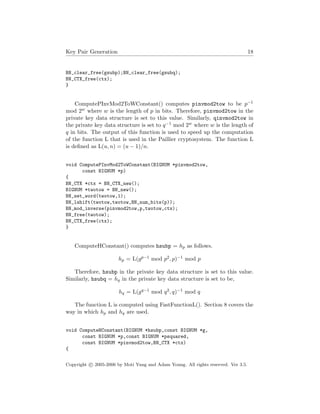
ComputePInvMod2ToWConstant() computes pinvmod2tow to be p−1
mod 2w where w is the length of p in bits. Therefore, pinvmod2tow in the
private key data structure is set to this value. Similarly, qinvmod2tow in
the private key data structure is set to q−1 mod 2w where w is the length of
q in bits. The output of this function is used to speed up the computation
of the function L that is used in the Paillier cryptosystem. The function L
is defined as L(u, n) = (u − 1)/n.
void ComputePInvMod2ToWConstant(BIGNUM *pinvmod2tow,
const BIGNUM *p)
{
BN_CTX *ctx = BN_CTX_new();
BIGNUM *twotow = BN_new();
BN_set_word(twotow,1);
BN_lshift(twotow,twotow,BN_num_bits(p));
BN_mod_inverse(pinvmod2tow,p,twotow,ctx);
BN_free(twotow);
BN_CTX_free(ctx);
}
ComputeHConstant() computes hsubp = hp as follows.
hp = L(gp−1 mod p2, p)−1 mod p
Therefore, hsubp in the private key data structure is set to this value.
Similarly, hsubq = hq in the private key data structure is set to be,
hq = L(gq−1 mod q2, q)−1 mod q
The function L is computed using FastFunctionL(). Section 8 covers the
way in which hp and hq are used.
void ComputeHConstant(BIGNUM *hsubp,const BIGNUM *g,
const BIGNUM *p,const BIGNUM *psquared,
const BIGNUM *pinvmod2tow,BN_CTX *ctx)
{
Copyright c 2005-2006 by Moti Yung and Adam Young. All rights reserved. Ver 3.5.
Key Pair Generation 19
BN_CTX_start(ctx);
BIGNUM *tmp = BN_CTX_get(ctx);
BIGNUM *pmin1 = BN_CTX_get(ctx);
BN_sub(pmin1,p,BN_value_one());
BN_mod(tmp,g,psquared,ctx);
BN_mod_exp(tmp,tmp,pmin1,psquared,ctx);
FastFunctionL(hsubp,tmp,p,pinvmod2tow,ctx);
BN_mod_inverse(hsubp,hsubp,p,ctx);
BN_clear(tmp);BN_clear(pmin1);
BN_CTX_end(ctx);
}
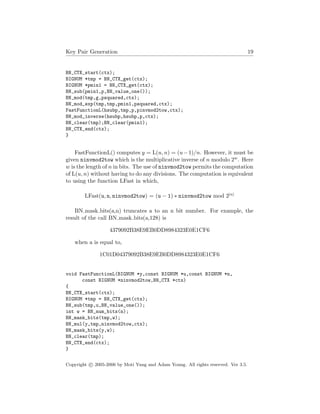
FastFunctionL() computes y = L(u, n) = (u−1)/n. However, it must be
given ninvmod2tow which is the multiplicative inverse of n modulo 2w. Here
w is the length of n in bits. The use of ninvmod2tow permits the computation
of L(u, n) without having to do any divisions. The computation is equivalent
to using the function LFast in which,
LFast(u, n, ninvmod2tow) = (u − 1) ∗ ninvmod2tow mod 2|n|
BN mask bits(a,n) truncates a to an n bit number. For example, the
result of the call BN mask bits(a,128) is
4379092B38E9EB0DD8984323E0E1CF6
when a is equal to,
1C01D04379092B38E9EB0DD8984323E0E1CF6
void FastFunctionL(BIGNUM *y,const BIGNUM *u,const BIGNUM *n,
const BIGNUM *ninvmod2tow,BN_CTX *ctx)
{
BN_CTX_start(ctx);
BIGNUM *tmp = BN_CTX_get(ctx);
BN_sub(tmp,u,BN_value_one());
int w = BN_num_bits(n);
BN_mask_bits(tmp,w);
BN_mul(y,tmp,ninvmod2tow,ctx);
BN_mask_bits(y,w);
BN_clear(tmp);
BN_CTX_end(ctx);
}
Copyright c 2005-2006 by Moti Yung and Adam Young. All rights reserved. Ver 3.5.
Verification Function F 20
Adopting the variable name qInv from PKCS #1, we set qInv = q−1
mod p. ComputeQInv() computes and returns gInv. The value qInv is
stored in the private key data structure and is used to speed up Paillier
decryption.
void ComputeQInv(BIGNUM *qInv,const BIGNUM *q,
const BIGNUM *p,BN_CTX *ctx)
{
BN_mod(qInv,q,p,ctx);
BN_mod_inverse(qInv,qInv,p,ctx);
}
6 Verification Function F
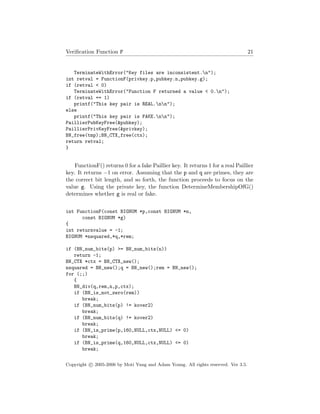
ExecuteFunctionF() loads the public and private keys. It then checks each
for internal consistency and checks their consistency with one another. If an
inconsistency is found then the function terminates prematurely. Otherwise,
it determines the nature of the key pair by calling FunctionF() and printing
out the result. Finally, it frees the data structures used to store the public
and private key values.
int ExecuteFunctionF(const char *privkeyFlName,
const char *pubkeyFlName)
{
paillierpubkey pubkey;
paillierprivkey privkey;
BIGNUM *tmp = BN_new();
BN_CTX *ctx = BN_CTX_new();
PaillierPubKeyNew(&pubkey);
LoadPublicKey(&pubkey,pubkeyFlName);
PrintPublicKeyStructure(&pubkey);
if (PublicKeyIsInconsistent(&pubkey))
TerminateWithError("Public key file is inconsistent.n");
PaillierPrivKeyNew(&privkey);
LoadPrivateKey(&privkey,privkeyFlName);
PrintPrivateKeyStructure(&privkey);
if (PrivateKeyIsInconsistent(&privkey,pubkey.g))
TerminateWithError("Private key file is inconsistent.n");
BN_mul(tmp,privkey.p,privkey.q,ctx);
if (BN_are_not_equal(pubkey.n,tmp))
Copyright c 2005-2006 by Moti Yung and Adam Young. All rights reserved. Ver 3.5.
Verification Function F 21
TerminateWithError("Key files are inconsistent.n");
int retval = FunctionF(privkey.p,pubkey.n,pubkey.g);
if (retval < 0)
TerminateWithError("Function F returned a value < 0.n");
if (retval == 1)
printf("This key pair is REAL.nn");
else
printf("This key pair is FAKE.nn");
PaillierPubKeyFree(&pubkey);
PaillierPrivKeyFree(&privkey);
BN_free(tmp);BN_CTX_free(ctx);
return retval;
}
FunctionF() returns 0 for a fake Paillier key. It returns 1 for a real Paillier
key. It returns −1 on error. Assuming that the p and q are primes, they are
the correct bit length, and so forth, the function proceeds to focus on the
value g. Using the private key, the function DetermineMembershipOfG()
determines whether g is real or fake.
int FunctionF(const BIGNUM *p,const BIGNUM *n,
const BIGNUM *g)
{
int returnvalue = -1;
BIGNUM *nsquared,*q,*rem;
if (BN_num_bits(p) >= BN_num_bits(n))
return -1;
BN_CTX *ctx = BN_CTX_new();
nsquared = BN_new();q = BN_new();rem = BN_new();
for (;;)
{
BN_div(q,rem,n,p,ctx);
if (BN_is_not_zero(rem))
break;
if (BN_num_bits(p) != kover2)
break;
if (BN_num_bits(q) != kover2)
break;
if (BN_is_prime(p,160,NULL,ctx,NULL) <= 0)
break;
if (BN_is_prime(q,160,NULL,ctx,NULL) <= 0)
break;
Copyright c 2005-2006 by Moti Yung and Adam Young. All rights reserved. Ver 3.5.
Verification Function F 22
BN_sqr(nsquared,n,ctx); /* now check g */
if (!(IsInZnSquaredstar(g,nsquared,ctx)))
break;
returnvalue = DetermineMembershipOfG(p,q,n,nsquared,g);
break;
}
BN_free(nsquared);
BN_clear_free(q);BN_clear_free(rem);
BN_CTX_free(ctx);
return returnvalue;
}
DetermineMembershipOfG() returns 1 if g is a real Paillier generator. It
returns 0 if g is a fake Paillier generator. It returns −1 on error.
If the order of g divides t = λ(n) evenly then DetermineMembershipOfG
returns 0 (fake g). If the order of g is a non-zero multiple of n then De-
termineMembershipOfG returns 1 (real g). As noted in [5], when gcd(L(gt
mod n2), n) = 1 it follows that the order of g is a non-zero multiple of n.
int DetermineMembershipOfG(const BIGNUM *p,
const BIGNUM *q,const BIGNUM *n,
const BIGNUM *nsquared,const BIGNUM *g)
{
int returnvalue = -1;
BIGNUM *t,*tmp,*pmin1,*qmin1,*quot,*rem,*gtot;
BN_CTX *ctx = BN_CTX_new();
t = BN_new();tmp = BN_new();pmin1 = BN_new();
qmin1 = BN_new();quot = BN_new();
rem = BN_new();gtot = BN_new();
BN_sub(pmin1,p,BN_value_one());
BN_sub(qmin1,q,BN_value_one());
BN_lcm(t,pmin1,qmin1,ctx);
BN_mod_exp(gtot,g,t,nsquared,ctx);
if (BN_is_one(gtot))
returnvalue = 0;
else
{
BN_sub(tmp,gtot,BN_value_one());
BN_div(quot,rem,tmp,n,ctx);
BN_gcd(tmp,quot,n,ctx);
if (BN_is_one(tmp))
Copyright c 2005-2006 by Moti Yung and Adam Young. All rights reserved. Ver 3.5.
The Encryption Source Code 23
returnvalue = 1;
}
BN_clear_free(t);BN_clear_free(tmp);
BN_clear_free(pmin1);BN_clear_free(qmin1);
BN_clear_free(quot);BN_clear_free(rem);
BN_clear_free(gtot);
BN_CTX_free(ctx);
return returnvalue;
}
7 The Encryption Source Code
The function QuesEncrHybridEncrFile() encrypts the plaintext file using
Paillier and Blowfish in CBC mode. The format of the output file is,
(n, c, iv, CBCciphertextlen, CBCciphertext)
The ciphertext file is a binary file.
The inclusion of n allows the decryption program to make sure it is
applying the correct Paillier private key to the ciphertext file. Because of the
possibility of leading zeros, the Paillier ciphertext c is written out as an array.
The value iv is the Blowfish CBC initialization vector. CBCciphertextlen
is the length in bytes of the CBC ciphertext denoted by CBCciphertext.
void QuesEncrHybridEncrFile(const char *ptextFl,
const char *pubkeyFlName,const char *ctextFl)
{
unsigned char *CBCptextinput,*CBCciphertext,iv[8];
unsigned char cArray[NSQUARED_SIZE_IN_BYTES];
int CBCinputplaintextlen,CBCctextlen,blocksize = 8;
size_t count = 0,fileLength;
FILE *inFl,*outFl;
paillierpubkey pubkey;
BIGNUM *c = BN_new();
PaillierPubKeyNew(&pubkey);
LoadPublicKey(&pubkey,pubkeyFlName);
LoadFilesForEncryption(ptextFl,ctextFl,&inFl,&outFl);
fileLength = GetFileLength(ptextFl);
Copyright c 2005-2006 by Moti Yung and Adam Young. All rights reserved. Ver 3.5.
The Encryption Source Code 24
if ((CBCptextinput = OPENSSL_malloc(fileLength)) == NULL)
TerminateWithError("ERROR: OPENSSL_malloc() failed.n");
do {
count += fread(&CBCptextinput[count],1,1,inFl);
if (ferror(inFl))
TerminateWithError("ERROR: fread() failed.n");
} while(!feof(inFl));
fclose(inFl);
CBCciphertext = OPENSSL_malloc(fileLength + blocksize);
if (CBCciphertext == NULL)
TerminateWithError("ERROR: OPENSSL_malloc() failed.n");
CBCinputplaintextlen = count;
HybridEncrypt(c,iv,CBCciphertext,&CBCctextlen,
CBCptextinput,CBCinputplaintextlen,&pubkey);
YY_BN_bn2binarray(c,NSQUARED_SIZE_IN_BYTES,cArray);
WriteBIGNUMtoFile(pubkey.n,outFl);
WriteArrayToFile(cArray,NSQUARED_SIZE_IN_BYTES,outFl);
WriteArrayToFile(iv,8,outFl);
WriteArrayToFile((unsigned char *) &CBCctextlen,4,outFl);
WriteArrayToFile(CBCciphertext,CBCctextlen,outFl);
printf("Ciphertext written to file "%s".nn",ctextFl);
OPENSSL_free(CBCptextinput);OPENSSL_free(CBCciphertext);
BN_free(c);fclose(outFl);
PaillierPubKeyFree(&pubkey);
}
The function HybridEncrypt() uses the Paillier public key to hybrid
encrypt the plaintext data that CBCplaintextinput points to. This function
generates a random 128-bit Blowfish key and an initialization vector on the
fly. This is used to encrypt the plaintext file. The Blowfish key is encrypted
using PaillierEncrypt(). HybridEncrypt() returns −1 on error. It returns 0
when no error is detected.
A full-sized random plaintext is used instead of padding the plaintext out
with constant bits. Paillier is semantically secure against known plaintext
attacks so this is not necessary to protect against known plaintext attacks.
int HybridEncrypt(BIGNUM *c,unsigned char *iv,
unsigned char *CBCciphertext,int *CBCciphertextlen,
const char *CBCplaintextinput,int CBCinputptextlen,
const paillierpubkey *pubkey)
{
unsigned char *ptr,key[16],ptextArray[MODULUS_SIZE_IN_BYTES];
Copyright c 2005-2006 by Moti Yung and Adam Young. All rights reserved. Ver 3.5.
The Encryption Source Code 25
int returnvalue = 0,tmplen,length;
EVP_CIPHER_CTX ctx;
BIGNUM *ptext = BN_new();
BN_rand_range(ptext,(BIGNUM *) pubkey->n);
YY_BN_bn2binarray(ptext,MODULUS_SIZE_IN_BYTES,ptextArray);
ptr = ptextArray + (MODULUS_SIZE_IN_BYTES - 16);
memcpy(key,ptr,16);
RAND_bytes(iv,8);
PrintSymmetricEncryptionValues(key,iv);
PaillierEncrypt(c,ptext,pubkey);
EVP_CIPHER_CTX_init(&ctx); /* Encrypt using blowfish */
length = EVP_CIPHER_key_length(EVP_bf_cbc());
if (length != 16) {printf("ERROR: bad length.n");exit(1);}
EVP_EncryptInit_ex(&ctx,EVP_bf_cbc(),NULL,key,iv);
if (!EVP_EncryptUpdate(&ctx,CBCciphertext,CBCciphertextlen,
CBCplaintextinput,CBCinputptextlen))
returnvalue = -1;
else
{
if (!EVP_EncryptFinal_ex(&ctx,
CBCciphertext + *CBCciphertextlen,&tmplen))
returnvalue = -1;
else
{
*CBCciphertextlen += tmplen;
EVP_CIPHER_CTX_cleanup(&ctx);
}
}
BN_clear_free(ptext);
return returnvalue;
}
We chose to adhere to the Paillier cryptosystem as originally defined [5]
and allow gcd(m, n) = 1. However, we depart from the original algorithm
slightly that says to choose r randomly subject to the constraint that r < n.
Instead we choose r uniformly at random from ZZ∗
n. Since Paillier encryp-
tion is the fundamental building block in computing perfect questionable
encryptions, it is worth taking a close look at it’s efficiency.
To speed up encryption we exploit the fact that n2 has already been
precomputed and stored in the public key file. So, there is no need to
square n during encryption.
Copyright c 2005-2006 by Moti Yung and Adam Young. All rights reserved. Ver 3.5.
The Encryption Source Code 26
The OpenSSL function BN mul() implements Karatsuba-Ofman multi-
plication [2]. This forms the basis for multiplying two integers together
efficiently in OpenSSL.
The three OpenSSL big number functions BN mod mul montgomery(),
BN from montgomery(), and BN to montgomery() implement Montgomery
multiplication [4]. They are invoked automatically when BN mod exp() is
called with suitable inputs, but they may also be useful when several oper-
ations need to be performed using the same modulus.
void PaillierEncrypt(BIGNUM *c,const BIGNUM *m,
const paillierpubkey *pubkey)
{
BIGNUM *tmp,*tmp2,*r;
BN_CTX *ctx = BN_CTX_new();
tmp = BN_new();tmp2 = BN_new();r = BN_new();
BN_mod_exp(tmp,pubkey->g,m,pubkey->nsquared,ctx);
for (;;)
{
BN_rand_range(r,(BIGNUM *) pubkey->n);
if (IsInZnstar(r,pubkey->n,ctx))
break;
}
BN_mod_exp(tmp2,r,pubkey->n,pubkey->nsquared,ctx);
BN_mod_mul(c,tmp,tmp2,pubkey->nsquared,ctx);
PrintEncryptionValues(m,r,c);
BN_clear_free(tmp);BN_clear_free(tmp2);BN_clear_free(r);
BN_CTX_free(ctx);
}
There are other optimizations that are possible for encryption that we
chose not to implement. A fixed-base exponentiation algorithm can be used
since the base g is fixed. It is possible to store the array (g, g2, g4,...) as
part of the public key (each value here is modulo n2). These values enable
gm mod n2 to be computed using multiplication only as opposed to square-
and-multiply. For variants of fixed-base exponentiation, see [1].
Also, rn mod n2 can be computed using a fixed-exponent exponentiation
algorithm since n is fixed. This can be done using a vector addition chain
that attempts to minimize the number of multiplications required for ex-
ponentiation. Knuth provides a comprehensive overview of vector addition
chains [3].
Copyright c 2005-2006 by Moti Yung and Adam Young. All rights reserved. Ver 3.5.
The Decryption Source Code 27
8 The Decryption Source Code
QuesEncrHybridDecrFile() reads in the public and private key values as well
as the ciphertext file. It compares the modulus n in the ciphertext file with
the modulus in the public key. If they do not match then the function halts
with an error. The function attempts to decrypt the ciphertext by calling
HybridDecrypt(). When it succeeds it writes the resulting plaintext out to
plaintext2.txt.
void QuesEncrHybridDecrFile(const char *ctextFl,
const char *privkeyFlName,const char *pubkeyFlName,
const char *ptextFl)
{
unsigned char *CBCciphertext,*CBCptextoutput,iv[8];
unsigned char cArray[NSQUARED_SIZE_IN_BYTES];
int isReal,CBCctextlen,CBCoutputptextlen;
BIGNUM *c,*n2;
FILE *inFl,*outFl;
paillierpubkey pubkey;
paillierprivkey privkey;
BN_CTX *ctx = BN_CTX_new();
c=BN_new();n2 = BN_new();
PaillierPubKeyNew(&pubkey);
PaillierPrivKeyNew(&privkey);
LoadPrivateKey(&privkey,privkeyFlName);
LoadPublicKey(&pubkey,pubkeyFlName); /* get g */
if ((isReal = FunctionF(privkey.p,pubkey.n,pubkey.g)) == 0)
{
printf("Attempting decryption with a fake key pair.n");
printf("We will continue, but decryption will fail.n");
}
if (isReal < 0)
printf("key pair is neither "real" nor "fake".n");
LoadFilesForDecryption(ctextFl,ptextFl,&inFl,&outFl);
ReadBIGNUMfromFile(inFl,MODULUS_SIZE_IN_BYTES,n2);
if (BN_are_not_equal(pubkey.n,n2))
TerminateWithError("moduli do not match.n");
ReadArrayFromFile(inFl,NSQUARED_SIZE_IN_BYTES,cArray);
BN_bin2bn(cArray,NSQUARED_SIZE_IN_BYTES,c);
ReadArrayFromFile(inFl,8,iv);
ReadArrayFromFile(inFl,4,(unsigned char *) &CBCctextlen);
if ((CBCciphertext = OPENSSL_malloc(CBCctextlen)) == NULL)
Copyright c 2005-2006 by Moti Yung and Adam Young. All rights reserved. Ver 3.5.
The Decryption Source Code 28
TerminateWithError("ERROR: OPENSSL_malloc() failed.n");
ReadArrayFromFile(inFl,CBCctextlen,CBCciphertext);
fclose(inFl);
if ((CBCptextoutput = OPENSSL_malloc(CBCctextlen)) == NULL)
TerminateWithError("ERROR: OPENSSL_malloc() failed.n");
HybridDecrypt(CBCptextoutput,&CBCoutputptextlen,c,
CBCciphertext,&CBCctextlen,iv,&privkey);
WriteArrayToFile(CBCptextoutput,CBCoutputptextlen,outFl);
fclose(outFl);
printf("Plaintext written to file "%s".nn",ptextFl);
OPENSSL_free(CBCciphertext);OPENSSL_free(CBCptextoutput);
PaillierPubKeyFree(&pubkey);
PaillierPrivKeyFree(&privkey);
BN_free(c);BN_free(n2);
BN_CTX_free(ctx);
}
The function HybridDecrypt() attempts to decrypt the Paillier cipher-
text c using PaillierDecrypt() to recover the Blowfish key. It then attempts
to decrypt the cipher block chaining ciphertext that CBCctext points to us-
ing the initialization vector that was recovered from the ciphertext file along
with the Blowfish key. This function returns −1 on error. It returns 0 when
no error is detected.
int HybridDecrypt(unsigned char *CBCptextoutput,
int *CBCoutputptextlen,const BIGNUM *c,
unsigned char *CBCctext,int *CBCctextlen,
unsigned char *iv,const paillierprivkey *privkey)
{
unsigned char key[16],ptextArray[MODULUS_SIZE_IN_BYTES];
int returnvalue = 0,declen,tmplen;
EVP_CIPHER_CTX ctx;
BIGNUM *ptext = BN_new();
PaillierDecrypt(ptext,c,privkey);
YY_BN_bn2binarray(ptext,MODULUS_SIZE_IN_BYTES,ptextArray);
unsigned char *ptr = ptextArray + (MODULUS_SIZE_IN_BYTES-16);
memcpy(key,ptr,16);
PrintSymmetricEncryptionValues(key,iv);
EVP_CIPHER_CTX_init(&ctx);
EVP_DecryptInit_ex(&ctx,EVP_bf_cbc(),NULL,key,iv);
if (!EVP_DecryptUpdate(&ctx,CBCptextoutput,&declen,CBCctext,
Copyright c 2005-2006 by Moti Yung and Adam Young. All rights reserved. Ver 3.5.
The Decryption Source Code 29
*CBCctextlen))
returnvalue = -1;
else
{
if (!EVP_DecryptFinal_ex(&ctx,CBCptextoutput + declen,
&tmplen))
returnvalue = -1;
else
*CBCoutputptextlen = declen + tmplen;
}
BN_clear_free(ptext);
EVP_CIPHER_CTX_cleanup(&ctx);
return returnvalue;
}
The Paillier decryption algorithm that follows is based on the efficiency
improvements presented in Section 7 of [5]. However, we digress from Section
7 by using the fast Chinese Remainder Theorem (CRT) implementation in
RSA’s PKCS #1 standard [7] (that uses gInv). Decryption utilizes 0 calls
to the Extended Euclidean Algorithm instead of 2 calls. Quisquater and
Couvreur pointed out the benefit using the CRT in RSA [6]. This idea
applies to Paillier as well.
1. compute mp = LFast(cp−1 mod p2, p, pinvmod2tow) hp mod p
2. compute mq = LFast(cq−1 mod q2, q, qinvmod2tow) hq mod q
3. compute h = (mp − mq)qInv mod p
4. output m = mq + qh and halt
LFast is defined in Section 5 in the discussion of FastFunctionL(). The
values mp and mq correspond to msubp and msubq, respectively. Similarly,
hp and hq correspond to hsubp and hsubq, respectively.
void PaillierDecrypt(BIGNUM *m,const BIGNUM *c,
const paillierprivkey *privkey)
{
BIGNUM *tmp,*pmin1,*qmin1,*msubp,*msubq;
BN_CTX *ctx = BN_CTX_new();
tmp = BN_new();pmin1 = BN_new();qmin1 = BN_new();
msubp = BN_new();msubq = BN_new();
BN_sub(pmin1,privkey->p,BN_value_one());
Copyright c 2005-2006 by Moti Yung and Adam Young. All rights reserved. Ver 3.5.
REFERENCES 30
BN_sub(qmin1,privkey->q,BN_value_one());
BN_mod(tmp,c,privkey->psquared,ctx);
BN_mod_exp(tmp,tmp,pmin1,privkey->psquared,ctx);
FastFunctionL(tmp,tmp,privkey->p,privkey->pinvmod2tow,ctx);
if (BN_is_zero(tmp))
TerminateWithError("ERROR: Key pair might be fake.n");
BN_mod_mul(msubp,tmp,privkey->hsubp,privkey->p,ctx);
BN_mod(tmp,c,privkey->qsquared,ctx);
BN_mod_exp(tmp,tmp,qmin1,privkey->qsquared,ctx);
FastFunctionL(tmp,tmp,privkey->q,privkey->qinvmod2tow,ctx);
BN_mod_mul(msubq,tmp,privkey->hsubq,privkey->q,ctx);
FastChineseRemaindering(m,msubp,privkey->p,msubq,privkey->q,
privkey->qInv,ctx);
PrintDecryptionValues(c,m);
BN_clear_free(tmp);BN_clear_free(pmin1);BN_clear_free(qmin1);
BN_clear_free(msubp);BN_clear_free(msubq);
BN_CTX_free(ctx);
}
References
[1] E. F. Brickell, D. M. Gordon, K. S. McCurley, and D. B. Wilson. Fast
exponentiation with precomputation. In R. A. Rueppel, editor, Ad-
vances in Cryptology—Eurocrypt ’92, pages 200–207, New York, 1992.
Springer-Verlag.
[2] A. A. Karatsuba and Yu. P. Ofman. Multiplication of multidigit num-
bers by automata. Physics Doklady, 7:595–596, 1963. Translated from
Doklady Akad. Nauk, vol. 145, no. 2, pages 293–294, 1962.
[3] Donald E. Knuth. Seminumerical Algorithms, volume 2 of The Art
of Computer Programming. Addison-Wesley Professional, 1969. Third
edition, Nov. 4, 1997.
[4] P. Montgomery. Modular multiplication without trial division. Mathe-
matics of Computation, 44:519–521, 1985.
[5] Pascal Paillier. Public-key cryptosystems based on composite degree
residue classes. In Jacques Stern, editor, Advances in Cryptology—
Eurocrypt ’99, pages 223–238. Springer-Verlag, 1999. Lecture Notes in
Computer Science No. 1592.
Copyright c 2005-2006 by Moti Yung and Adam Young. All rights reserved. Ver 3.5.
REFERENCES 31
[6] J.-J. Quisquater and C. Couvreur. Fast decipherment algorithm for
RSA public-key cryptosystem. Electronics Letters, 18(21):905–907,
1982.
[7] RSA Data Security, Inc. PKCS #1: RSA Cryptography Standard, Ver-
sion 2.1, June 2002.
[8] Bruce Schneier. Description of a new variable-length key, 64-bit block
cipher (Blowfish). In Ross Anderson, editor, Proceedings of the Fast
Software Encryption Workshop, pages 191–204. Springer-Verlag, De-
cember 1993. Lecture Notes in Computer Science No. 809.
[9] Adam L. Young and Moti M. Yung. On fundamental limitations of
proving data theft. To Appear in IEEE Transactions on Information
Forensics and Security.
[10] Adam L. Young and Moti M. Yung. Malicious Cryptography: Exposing
Cryptovirology. Wiley, February 2004.
[11] Adam L. Young and Moti M. Yung. Questionable encryption and
its applications. In First International Conference on Cryptology in
Malaysia—MyCrypt, pages 210–221. Springer, 2005. Lecture Notes in
Computer Science No. 3715.
[12] Adam L. Young and Moti M. Yung. Hiding information hiding. In 8th
Information Hiding—IH. Springer, 2006. to appear.
Copyright c 2005-2006 by Moti Yung and Adam Young. All rights reserved. Ver 3.5.

Encryption

  • 1.
    Chapter 4: Implementing PerfectQuestionable Encryptions∗ Adam L. Young and Moti M. Yung Abstract The notion of a questionable encryption scheme was first put forth in Malicious Cryptography [10]. In this chapter we present an imple- mentation of the perfect questionable encryption scheme that appears in [9] that is based on our MyCrypt ’05 paper [11]. A questionable en- cryption (q.e.) scheme is a generalization of a PKCS that includes an additional key generation algorithm that outputs a fake public key and a corresponding witness of non-encryption. The perfect q.e. scheme is based on the Paillier PKCS that produces a private key (that serves as a witness of encryption) and corresponding public key. The scheme includes a predicate F that takes as input a public key and correspond- ing witness. The output of F is a single bit that proves whether the public key is real or fake. A perfect q.e. scheme has the property that it is information theoretically impossible for everyone including the key pair owner to decrypt ciphertexts produced using the fake public key. Also, fake public keys are computationally indistinguishable from real public keys. It has been shown that a q.e. scheme is ideal for imple- mentation in cryptoviruses, cryptoworms, and cryptotrojans. The use of a q.e. scheme in malware to “encrypt” data prior to transmission casts doubt on the occurrence of data theft, since prosecutors cannot directly prove that such malware encrypts data even when all code, all core dumps, and all packets that are transmitted by the malware are entered into evidence. The attacker retains the witness and can re- veal it at any time. Questionable encryptions also serve as a desirable alternative to oblivious transfer in certain applications. ∗ If this file was obtained from a publicly accessible website other than the website www.cryptovirology.com then (1) the entity or entities that made it available are in vio- lation of our copyright and (2) the contents of this file should therefore not be trusted. Please obtain the latest version directly from the official Cryptovirology Labs website at: http://www.cryptovirology.com. Copyright c 2005-2006 by Moti Yung and Adam Young. All rights reserved. Ver 3.5. 1
  • 2.
    Introduction 2 1 Introduction Considera malware analyst that is given a malicious software program and is asked what it does. Suppose that the program collects data from the host system. Suppose further that it passes this data as plaintext to an asymmetric encryption function along with what appears to be a public key. The output ciphertext is transmitted over the public Internet (e.g., steganographically encoded into images that are posted to a public bulletin board). Is the malware stealing data? Can the analyst conclude this to be so? These questions are at the very heart of the notion of a questionable encryption scheme. The notion of a questionable encryption was first investigated in [10]. This informal work formed the basis for further work in more formal settings. The notion of a perfect questionable encryption scheme was covered in [11] and the notion of a computational questionable encryption scheme appears in [12]. These papers point out the similarities and differences between questionable encryptions and: oblivious transfer, deniable encryption, and all-or-nothing disclosure of secrets. The initial observation was that a public key can be constructed in such a way that it appears to be a valid public key, i.e., algebraically correct, but that has a fundamental flaw, a flaw that is so bad, in fact, that it is intractable for everyone to decrypt data encrypted with it. This gave rise to the idea that a fake key pair generator could be devised to output a fake public key and a corresponding small value, called a witness of non- encryption that proves that the public key is so flawed that the ciphertexts that it yields are intractable to decrypt. The scheme, called a questionable encryption scheme, not only hides plaintexts in a cryptographic sense, but also hides whether or not data is being encrypted at all. The definition of a questionable encryption scheme satisfies the follow- ing properties. Informally, a fake public key must appear to all probabilistic polynomial time algorithms like a real public key (computational indistin- guishability). Also, it must be intractable to produce a “public” key and both a witness of encryption and witness of non-encryption for it. In other words, once a user generates a key pair he or she is committed to the public key being either real or fake but not both. The computational indistinguishability property is worth emphasizing since it is easily misunderstood. It is entirely intractable to determine if the plaintext is being encrypted vs. being destroyed even while watching the asymmetric encryption function encrypt using the public key (that is real or fake). There is no way to “trap” the encryption call and learn whether Copyright c 2005-2006 by Moti Yung and Adam Young. All rights reserved. Ver 3.5.
  • 3.
    Introduction 3 or notencryption is actually taking place. But what use could a provably flawed yet normal-looking public key be? Consider again the malware that appears to the analyst to be enciphering data. Suppose that the public key is provably fake but that the witness is not included in the malware. If the malware author mounts an attack and is taken to court then the malware author can take the Fifth. If convicted of data theft the attacker can appeal and reveal the witness of non-encryption. This retroactively proves that the malware could not have possibly been used to steal data. The result is practically significant because it implies that when malware is properly designed (i.e., using cryptovirology) it is fundamentally intractable to prove data theft directly. This attack can be expanded into a larger attack scenario. Suppose that hundreds of different malware strains are released that implement question- able encryptions. Suppose that some contain real public keys and others contain fake public keys. On occasion a malware author anonymously pub- lishes his or her witness of non-encryption long after the malware is released. This would set a strong real-world precedent that malware that appears to asymmetrically encrypt and transmit data does not always do so. No legal analyses will be attempted in this chapter. Our aim is to present an implementation of a questionable encryption scheme and shed light on its scientific aspects. Our implementation is based on the perfect q.e. scheme that will appear in IEEE Transactions on Information Forensics and Secu- rity [9]. This journal article is based on [11] that utilizes the Paillier public key cryptosystem [5]. We remark that the journal version expands upon [11]. However, the same basic idea remains unchanged. A perfect question- able encryption scheme has the property that it is information theoretically impossible to decipher data encrypted using a fake public key (in a computa- tional q.e. scheme indecipherability is based on a computational argument). This chapter goes beyond [9] by showing how to implement perfect ques- tionable encryptions in a very computationally efficient manner. This chap- ter and the associated appendix (that contains the corresponding source code) therefore constitutes fundamental research in modern cryptovirology. We chose to use the OpenSSL cryptographic library that is freely avail- able as open source. At this time OpenSSL does not implement the Paillier public key cryptosystem. So, it was necessary for us to implement it our- selves. This chapter therefore serves as a tutorial on programming an effi- cient implementation of Paillier as well as implementing perfect questionable encryptions. The example program is called pquesencr.exe. It implements a hybrid cryptosystem based on Paillier and Blowfish [8] in cipher block chaining Copyright c 2005-2006 by Moti Yung and Adam Young. All rights reserved. Ver 3.5.
  • 4.
    Creating the Program4 (CBC) mode. This hybrid cryptosystem is used to encrypt and decrypt files. However, the ‘perfect’ property is lost when a symmetric cipher such as Blowfish is used. This is because, whereas Paillier constitutes a perfect questionable encryption scheme, Paillier combined with Blowfish in a hybrid encryption scheme does not: a computationally unbounded adversary can brute-force a symmetric cipher such as Blowfish. It is straightforward to extract the pieces of this program that perform Paillier encryption. The Paillier PKCS can be used in electronic code book (ECB) mode. This chapter therefore justifiably covers the implementation of a perfect questionable encryption scheme. Our focus is on presenting a practical scheme. We combined Paillier with Blowfish to achieve the benefits of hybrid encryption. It should be noted that we by no means eliminate the properties of a questionable encryption scheme by using Paillier with Blowfish. Our use of Blowfish makes the over- all questionable encryption scheme secure under a computational argument (that of breaking Blowfish). If the distinction here is not clear then we urge the reader to consult the scientific literature on the subject. 2 Creating the Program The program consists of the following ANSI C source files: pquesencr.c, kleptoutil.c, pqext.c, and pqemisc.c. It also consists of the following header files: pquesencr.h, kleptoutil.h, pqext.h, and pqemisc.h. Compi- lation also requires OpenSSL. When installed, the needed OpenSSL library is typically included by supplying −lcrypto as an argument to gcc. The source code given in this chapter covers all of the functions con- tained in pquesencr.c. We constructed a simple makefile for these files and compiled them using gcc in MinGW. The process produces the DOS command-line program pquesencr.exe. 3 Running the Program For illustrative purposes, 128-bit primes p and q are used in the examples we give.1 This is implemented by setting the #define kover2 in pqemisc.h to be 128. By today’s standards primes of at least 512 bits would be needed for security, so this #define should be at least 512 in practice. 1 Using 512-bit primes produces hexadecimal strings that are very long since Paillier uses n2 = p2 q2 . Copyright c 2005-2006 by Moti Yung and Adam Young. All rights reserved. Ver 3.5.
  • 5.
    Running the Program5 "pquesencr" Copyright (c) 2005-2006 by Moti Yung and Adam L. Young. All rights reserved. This program is based on the notion of "questionable encryptions" that were introduced in Section 6.6.2 of the book: "Malicious Cryptography: Exposing Cryptovirology" by Adam Young & Moti Yung, Wiley, 2004. This program is also based on both: 1) A. Young, M. Yung, "On Fundamental Limitations of Proving Data Theft", To appear in IEEE Transactions on Information Forensics and Security. 2) A. Young, M. Yung, "Questionable Encryption and Its Applications", 1st International Conference on Cryptology in Malaysia---MyCrypt ’05, E. Dawson, S. Vaudenay (Eds.), LNCS 3715, pp. 210-221, Springer, 2005. RAND_status() returned 1. The primes p and q will each be 128 bits in length. Questionable Encryption functions: Type (a) to generate a REAL key pair. This overwrites "pubkey.txt" and "privkey.txt". Type (b) to generate a FAKE key pair This overwrites "pubkey.txt" and "privkey.txt". Type (c) to test the witness in the file "privkey.txt" using function F. Type (d) to hybrid "encrypt" the file "plaintext.txt" using Paillier and Blowfish. Type (e) to hybrid decrypt the file "ciphertext.bin" using Paillier and Blowfish. Type (f) to conduct 100 iterations of encryption-decryption stress testing. Type (g) to conduct 100 iterations of witness of encryption stress testing. Type (h) to conduct 100 iterations of witness of non-encryption stress testing. The commands are relatively self-explanatory. We will cover commands (a) through (e) in this chapter. Commands (f) through (h) are used for software testing and will not be covered in this chapter. Copyright c 2005-2006 by Moti Yung and Adam Young. All rights reserved. Ver 3.5.
  • 6.
    3.1 Working withReal Key Pairs 6 3.1 Working with Real Key Pairs Command (a) generates a real Paillier key pair. In this particular imple- mentation it generates a key pair in which p and q are both safe primes. This is to ensure that n is hard to factor. The public key parameters are (n, g, n2). These are written to the ASCII text file pubkey.txt that is created (or overwritten if it already exists). The value n2 is computed once and for all to speed up the encryption process. There are 9 private key parameters in total. These are p, q, p2, q2,... and they will be described later. At this point it suffices to say that these addi- tional precomputed values serve to speed up Paillier decryption significantly. The private parameters are written to the ASCII text file privkey.txt. Enter command (a-h) : a Generating a real Paillier key pair n = C1114C9F7E95C45CB6F77781E63EEED447DB77EC867119394F83AA7F46 98F79D g = 8A1BB19F2AF2720AA500971537A145D2C675D3A6888EFE746B0D9216C0 FE080AA5F53C6489C102CE136D03D55DB6F5969A90E93DFCB4D6848CA0F50617 920557 n^2 = 919B16B3C0FBB87F496A2BC7616DBBFD1C02BFC17E91FFD11E5E90B344 0AFEA3B71E9318095635EC73A9111FFE50A07B17C04524C276E05498C83496D5 F05649 p = C8ADDC935EF96AEA068DE12E49DC878B q = F64A47F4CD2BC3089705292D13F0A277 p^2 = 9D501EBA21A1B43B0FF9AD2712A826AFC26727256652FF9819F08F3A84 ABE579 q^2 = ECF2D7D828106C07493EE41A0A669461CAD821C0D06D90D1D2D6D624B0 3AD351 p^{-1} mod 2^w = 8BA78A5B2DDF415970B2E545907B6823 q^{-1} mod 2^w = A9D8954A4B3B08E663D2A97A19F7D747 h_p = 5ABDE2A8D26DD00B6B4AB23D796863E7 h_q = A147F314412F74C6E6D2E265BED5873C q^{-1} mod p = 8DBC22F5FBA522A71D6EEC79B4619EF3 Wrote composite n to file "pubkey.txt". Wrote g to the file "pubkey.txt". Wrote n^2 to the file "pubkey.txt". Wrote primes (p,q) to the file "privkey.txt". Wrote p^2 and q^2 to the file "privkey.txt". Wrote (p^-1 mod 2^w,q^-1 mod 2^w) to "privkey.txt". Wrote h_p and h_q to the file "privkey.txt". Wrote q^{-1} mod p to the file "privkey.txt". Copyright c 2005-2006 by Moti Yung and Adam Young. All rights reserved. Ver 3.5.
  • 7.
    3.1 Working withReal Key Pairs 7 --------Memory Leaks displayed below-------- --------Memory Leaks displayed above-------- The last portion of the output indicates the presence or absence of mem- ory leaks. The code for this utilizes OpenSSL’s memory leak checking func- tionality. As long as there is no output between these two lines, there should not be any memory leaks in the implementation. To determine the nature of the public key, command (c) is used. This command requires the public and private key files. Command (c) executes function F as defined in [9]. Enter command (a-h) : c About to read in public key values from file "pubkey.txt". Public key values loaded successfully. n = C1114C9F7E95C45CB6F77781E63EEED447DB77EC867119394F83AA7F46 98F79D g = 8A1BB19F2AF2720AA500971537A145D2C675D3A6888EFE746B0D9216C0 FE080AA5F53C6489C102CE136D03D55DB6F5969A90E93DFCB4D6848CA0F50617 920557 n^2 = 919B16B3C0FBB87F496A2BC7616DBBFD1C02BFC17E91FFD11E5E90B344 0AFEA3B71E9318095635EC73A9111FFE50A07B17C04524C276E05498C83496D5 F05649 About to read in private key values from the file "privkey.txt". Private key values loaded successfully. p = C8ADDC935EF96AEA068DE12E49DC878B q = F64A47F4CD2BC3089705292D13F0A277 p^2 = 9D501EBA21A1B43B0FF9AD2712A826AFC26727256652FF9819F08F3A84 ABE579 q^2 = ECF2D7D828106C07493EE41A0A669461CAD821C0D06D90D1D2D6D624B0 3AD351 p^{-1} mod 2^w = 8BA78A5B2DDF415970B2E545907B6823 q^{-1} mod 2^w = A9D8954A4B3B08E663D2A97A19F7D747 h_p = 5ABDE2A8D26DD00B6B4AB23D796863E7 h_q = A147F314412F74C6E6D2E265BED5873C q^{-1} mod p = 8DBC22F5FBA522A71D6EEC79B4619EF3 This key pair is REAL. --------Memory Leaks displayed below-------- --------Memory Leaks displayed above-------- Copyright c 2005-2006 by Moti Yung and Adam Young. All rights reserved. Ver 3.5.
  • 8.
    3.1 Working withReal Key Pairs 8 The output shown above indicates that the key pair is a real Paillier key pair. This is as it should be since the key pair was created using command (a). The other possible responses are that the key pair is fake or that an error occurred. Now that the real key pair has been generated and tested, we are in a position to encrypt data with the public key. The program pquesencr.exe will encrypt the file plaintext.txt provided that it is available (the key pair files, the plaintext, and the ciphertext files should be stored in the same directory as pquesencr.exe). This is accomplished by selecting command (d) after the key pair has been stored. Enter command (a-h) : d About to read in public key values from file "pubkey.txt". Public key values loaded successfully. Looking for file "plaintext.txt" so that it can be hybrid "encry pted". File "plaintext.txt" successfully opened for reading. key[] = 0xAC7E0886CB581DE9647E81839B27953E iv[] = 0x896128FE30F6DDDE m = AB9A170C27A1274EFDD74D62429B4F23E95279B83817E64E91D58CB86087 EAC r = 2728D60FEA2D4B8CA59B02D3047EA8DD10546042BA2C4B2ECF5A7C93FE27 1A6B c = 294AA3D8838D4FE1FA97E4735626DFD2D14DE184C491C871F4BB51123D78 8934FB9B461F4B27FB947B0DE6BBDF6DC3AFD871F59B5F68C22BB8305C92A315 6555 Ciphertext written to file "ciphertext.bin". --------Memory Leaks displayed below-------- --------Memory Leaks displayed above-------- The ciphertext is stored in the data file ciphertext.bin. This is a binary file that can be examined using a disk utility or hex editor. Since Paillier is a probabilistic cryptosystem, the asymmetric ciphertext will differ with each encryption with overwhelming probability. Also, the program chooses a random Blowfish key and initialization vector with each encryption. So, the CBC ciphertext will differ with each encryption of the same plaintext file with overwhelming probability. Selecting command (e) causes the ciphertext file to be decrypted. The resulting plaintext is written to plaintext2.txt. Copyright c 2005-2006 by Moti Yung and Adam Young. All rights reserved. Ver 3.5.
  • 9.
    3.2 Working withFake Key Pairs 9 Enter command (a-h) : e About to read in private key values from the file "privkey.txt". Private key values loaded successfully. About to read in public key values from file "pubkey.txt". Public key values loaded successfully. Looking for file "ciphertext.bin" so that it can be hybrid decry pted. File "ciphertext.bin" successfully opened for reading. c = 294AA3D8838D4FE1FA97E4735626DFD2D14DE184C491C871F4BB51123D78 8934FB9B461F4B27FB947B0DE6BBDF6DC3AFD871F59B5F68C22BB8305C92A315 6555 m = AB9A170C27A1274EFDD74D62429B4F23E95279B83817E64E91D58CB86087 EAC key[] = 0xAC7E0886CB581DE9647E81839B27953E iv[] = 0x896128FE30F6DDDE Plaintext written to file "plaintext2.txt". --------Memory Leaks displayed below-------- --------Memory Leaks displayed above-------- As long as the public key file and private key file are preserved, the file plaintext2.txt will be identical to the original plaintext file. This completes the description of using real public keys. 3.2 Working with Fake Key Pairs Selecting command (b) causes a fake Paillier key pair to be generated. When the fake public key is used to asymmetrically encrypt data, the resulting ciphertext cannot be decrypted at all, even when p is known. Enter command (a-h) : b Generating a fake Paillier key pair n = EBCC600687235C48A4F278D2567D3899DD90FFC92E1E4CACA74B783DFF 781205 g = 689C2BB776B0B00E099C31A80D864A857F7250A781A8B26654D23D083B D97EF624A22FB9E33EEA366956704890153F0CED34FFADB940B750229F44B923 B22285 n^2 = D930DB752A87314D94D12B974B18491D0491CEF6B451C57898CD795D30 220975C52EC0EB8F3BD4A0680F077E54BA1123C68B38972953B51963FBB298DB Copyright c 2005-2006 by Moti Yung and Adam Young. All rights reserved. Ver 3.5.
  • 10.
    3.2 Working withFake Key Pairs 10 F4B419 p = F525F7AC4C27C267EBC522460C45CF93 q = F63C740C3A07550573027DFAD3502707 p^2 = EAC1B1B151300C84408AE0CBB80EF33CF5330BBE947F91409C252EE355 8D0E69 q^2 = ECD83D4E19DC6002767AEEC260BE414E170E9A0E593264B493324919F4 532231 p^{-1} mod 2^w = 740D20069ECA1E32954A4A99BF96A69B q^{-1} mod 2^w = 5D7D03B72DDABE726848CA7FB2FA96B7 h_p = 0 h_q = 0 q^{-1} mod p = 788D77A9E81599569541BCB19E1302BB Wrote composite n to file "pubkey.txt". Wrote g to the file "pubkey.txt". Wrote n^2 to the file "pubkey.txt". Wrote primes (p,q) to the file "privkey.txt". Wrote p^2 and q^2 to the file "privkey.txt". Wrote (p^-1 mod 2^w,q^-1 mod 2^w) to "privkey.txt". Wrote h_p and h_q to the file "privkey.txt". Wrote q^{-1} mod p to the file "privkey.txt". --------Memory Leaks displayed below-------- --------Memory Leaks displayed above-------- The ‘public key’ in pubkey.txt can be placed in malware and be used to ‘encrypt’ data. If push comes to shove the file privkey.txt can be presented. The values contained therein will prove that no data is enciphered when the ‘public key’ is supplied to the Paillier encryption algorithm. To demonstrate that the public key is fake, command (c) is used. This causes the verification function F to be executed on values taken from pubkey.txt and privkey.txt. Enter command (a-h) : c About to read in public key values from file "pubkey.txt". Public key values loaded successfully. n = EBCC600687235C48A4F278D2567D3899DD90FFC92E1E4CACA74B783DFF 781205 g = 689C2BB776B0B00E099C31A80D864A857F7250A781A8B26654D23D083B D97EF624A22FB9E33EEA366956704890153F0CED34FFADB940B750229F44B923 B22285 n^2 = D930DB752A87314D94D12B974B18491D0491CEF6B451C57898CD795D30 220975C52EC0EB8F3BD4A0680F077E54BA1123C68B38972953B51963FBB298DB Copyright c 2005-2006 by Moti Yung and Adam Young. All rights reserved. Ver 3.5.
  • 11.
    3.2 Working withFake Key Pairs 11 F4B419 About to read in private key values from the file "privkey.txt". Private key values loaded successfully. p = F525F7AC4C27C267EBC522460C45CF93 q = F63C740C3A07550573027DFAD3502707 p^2 = EAC1B1B151300C84408AE0CBB80EF33CF5330BBE947F91409C252EE355 8D0E69 q^2 = ECD83D4E19DC6002767AEEC260BE414E170E9A0E593264B493324919F4 532231 p^{-1} mod 2^w = 740D20069ECA1E32954A4A99BF96A69B q^{-1} mod 2^w = 5D7D03B72DDABE726848CA7FB2FA96B7 h_p = 0 h_q = 0 q^{-1} mod p = 788D77A9E81599569541BCB19E1302BB This key pair is FAKE. --------Memory Leaks displayed below-------- --------Memory Leaks displayed above-------- Since a fake key was generated using command (b), as expected the out- put indicates that the key pair is fake. The implementation checks various values from the key files. However, the actual implementation of F only takes (p, n, g) as input. The fake public key nonetheless produces normal looking asymmetric ciphertexts. Therefore, it leads to normal looking hybrid encryptions. Data is encrypted with the fake public key by executing command (d). Enter command (a-h) : d About to read in public key values from file "pubkey.txt". Public key values loaded successfully. Looking for file "plaintext.txt" so that it can be hybrid "encry pted". File "plaintext.txt" successfully opened for reading. key[] = 0x4119967DEDAF118A7EED0669259E8126 iv[] = 0x71461A0DC4A69B8F m = 5EDE5AA7D01FCC7419883E5DCA57307826819E256906ED7E8A11AFED7D96 1941 r = 4CD222E2E6543FF203561F6C594059459810F82177BB795718EEBD9017F4 0568 c = 74E8672757CFB306EED92E30D2E9EA9E4B1DCDA47CBE0A0AB2785EB99EA4 13354D0D228A20B5CC12F85C4D8ACFC6F0097A4B05873158735FF593DE339DF6 Copyright c 2005-2006 by Moti Yung and Adam Young. All rights reserved. Ver 3.5.
  • 12.
    The Function main()12 76DA Ciphertext written to file "ciphertext.bin". --------Memory Leaks displayed below-------- --------Memory Leaks displayed above-------- Not surprisingly, the resulting ciphertext file cannot be decrypted. Any attempt to do so leads to an error. Enter command (a-h) : e About to read in private key values from the file "privkey.txt". Private key values loaded successfully. About to read in public key values from file "pubkey.txt". Public key values loaded successfully. Attempting decryption with a fake key pair. We will continue, but decryption will fail. Looking for file "ciphertext.bin" so that it can be hybrid decry pted. File "ciphertext.bin" successfully opened for reading. ERROR: Key pair might be fake. 4 The Function main() The function main prints programming credits to the screen. It makes sure that the data type int is 4 bytes in length. This is required since an integer is written to the ciphertext file and it must be read in correctly for decryp- tion. OpenSSL is then seeded using the Microsoft Cryptographic API call CryptGenRandom that is called within SeedTheRNG. The user is prompted to enter a command that is then executed. int main(void) { int isReal=0,command; PrintCredits(); if (sizeof(isReal) != 4) TerminateWithError("ERROR: int size is not 4 bytesn"); EnableLeakChecking(); Copyright c 2005-2006 by Moti Yung and Adam Young. All rights reserved. Ver 3.5.
  • 13.
    The Function main()13 SeedTheRNG(); for (;;) { PrintCommandOptions(); command = getchar(); if ((command >= ’a’) && (command <= ’h’)) break; } switch(command) { case ’a’: isReal = 1; GenAndStoreQEPair(PUBKEY_FILE,PRIVKEY_FILE,isReal); break; case ’b’: GenAndStoreQEPair(PUBKEY_FILE,PRIVKEY_FILE,isReal); break; case ’c’: ExecuteFunctionF(PRIVKEY_FILE,PUBKEY_FILE); break; case ’d’: QuesEncrHybridEncrFile(PLAINTEXT_FILE,PUBKEY_FILE, CIPHERTEXT_FILE); break; case ’e’: QuesEncrHybridDecrFile(CIPHERTEXT_FILE,PRIVKEY_FILE, PUBKEY_FILE,PLAINTEXT_FILE_2); break; case ’f’: StressTestQE(); break; case ’g’: StressTestWitOfEnc(); break; case ’h’: StressTestWitOfNonEnc(); break; } PrintLeakList(); return 0; } Copyright c 2005-2006 by Moti Yung and Adam Young. All rights reserved. Ver 3.5.
  • 14.
    Key Pair Generation14 5 Key Pair Generation GenAndStoreQEPair() is used to generate real and fake Paillier key pairs. When isReal is 0 a fake key pair is generated and when isReal is 1 a real key pair is generated. This particular implementation makes p and q safe primes. The function writes the public and private key values to the public and private key files respectively. It frees the structures for the keys and then returns control to the caller. void GenAndStoreQEPair(const char *pubkeyFlName, const char *privkeyFlName,int isReal) { paillierprivkey privkey; paillierpubkey pubkey; PaillierPrivKeyNew(&privkey); PaillierPubKeyNew(&pubkey); if (isReal == 1) printf("Generating a real Paillier key pairn"); if (isReal == 0) printf("Generating a fake Paillier key pairn"); GenerateQuesEncrKeyPair(&privkey,&pubkey,isReal); PrintPublicKeyStructure(&pubkey); PrintPrivateKeyStructure(&privkey); WriteKeyPairToFiles(privkeyFlName,pubkeyFlName, &privkey,&pubkey); PaillierPrivKeyFree(&privkey); PaillierPubKeyFree(&pubkey); } The value nsquared = n2 is computed once and for all and is stored in the public key file. This enables fast Paillier encryption since the modulus n will not have to be squared at run-time. typedef struct { BIGNUM *n,*g,*nsquared; } paillierpubkey; The private key data structure consists of 9 values. The first two values are the primes p and q that form the public modulus n = pq. The values Copyright c 2005-2006 by Moti Yung and Adam Young. All rights reserved. Ver 3.5.
  • 15.
    Key Pair Generation15 psquared and qsquared are p2 and q2, respectively. The remaining 5 values will be covered in the functions that compute them. typedef struct { BIGNUM *p,*q,*psquared,*qsquared; BIGNUM *pinvmod2tow,*qinvmod2tow,*hsubp,*hsubq,*qInv; } paillierprivkey; GenerateQuesEncrKeyPair() generates a real or fake key pair randomly. It then populates both the public key data structure and the private key data structure with the appropriate values. void GenerateQuesEncrKeyPair(paillierprivkey *privkey, paillierpubkey *pubkey,int isReal) { int safe = 1; BN_CTX *ctx = BN_CTX_new(); BN_generate_prime(privkey->p,kover2,safe,NULL,NULL, NULL,NULL); BN_generate_prime(privkey->q,kover2,safe,NULL,NULL, NULL,NULL); BN_sqr(privkey->psquared,privkey->p,ctx); BN_sqr(privkey->qsquared,privkey->q,ctx); BN_mul(pubkey->n,privkey->p,privkey->q,ctx); BN_sqr(pubkey->nsquared,pubkey->n,ctx); if (isReal) GenerateRealPaillierGenerator(pubkey->g,privkey); else GenerateFakePaillierGenerator(pubkey->g,privkey); ComputePInvMod2ToWConstant(privkey->pinvmod2tow,privkey->p); ComputePInvMod2ToWConstant(privkey->qinvmod2tow,privkey->q); ComputeHConstant(privkey->hsubp,pubkey->g,privkey->p, privkey->psquared,privkey->pinvmod2tow,ctx); ComputeHConstant(privkey->hsubq,pubkey->g,privkey->q, privkey->qsquared,privkey->qinvmod2tow,ctx); ComputeQInv(privkey->qInv,privkey->q,privkey->p,ctx); BN_CTX_free(ctx); } GenerateRealPaillierGenerator() generates and returns a real Paillier generator g using values stored in privkey. The generator g is found by Copyright c 2005-2006 by Moti Yung and Adam Young. All rights reserved. Ver 3.5.
  • 16.
    Key Pair Generation16 generating a random value gsubp ∈ ZZ∗ p2 where the order of gsubp is divisi- ble by p. Also, a random value gsubq ∈ ZZ∗ q2 is generated where the order of gsubq is divisible by q. The multiplicative inverse of q2 mod p2 is computed and stored in inv. This is then passed to FastChineseRemaindering() along with gsubp and gsubq to compute g. FastChineseRemaindering() is faster than typical implementations of the Chinese Remainder Theorem. Gener- ateRealPaillierGenerator() ensures that n divides the order of g evenly. void GenerateRealPaillierGenerator(BIGNUM *g, paillierprivkey *privkey) { BIGNUM *tmp,*inv,*pmin1,*qmin1,*gsubp,*gsubq; BN_CTX *ctx = BN_CTX_new(); tmp = BN_new();inv = BN_new(); pmin1 = BN_new();qmin1 = BN_new(); gsubp = BN_new();gsubq = BN_new(); BN_sub(pmin1,privkey->p,BN_value_one()); BN_sub(qmin1,privkey->q,BN_value_one()); for (;;) { BN_rand_range(gsubp,(BIGNUM *) privkey->psquared); if (IsInZnSquaredstar(gsubp,privkey->psquared,ctx)) { BN_mod_exp(tmp,gsubp,pmin1,privkey->psquared,ctx); if (BN_are_not_equal(tmp,BN_value_one())) break; } } for (;;) { BN_rand_range(gsubq,(BIGNUM *) privkey->qsquared); if (IsInZnSquaredstar(gsubq,privkey->qsquared,ctx)) { BN_mod_exp(tmp,gsubq,qmin1,privkey->qsquared,ctx); if (BN_are_not_equal(tmp,BN_value_one())) break; } } BN_mod(tmp,privkey->qsquared,privkey->psquared,ctx); BN_mod_inverse(inv,tmp,privkey->psquared,ctx); FastChineseRemaindering(g,gsubp,privkey->psquared,gsubq, privkey->qsquared,inv,ctx); Copyright c 2005-2006 by Moti Yung and Adam Young. All rights reserved. Ver 3.5.
  • 17.
    Key Pair Generation17 BN_clear_free(tmp);BN_clear_free(inv); BN_clear_free(pmin1);BN_clear_free(qmin1); BN_clear_free(gsubp);BN_clear_free(gsubq); BN_CTX_free(ctx); } GenerateFakePaillierGenerator() generates and returns a fake Paillier generator g using values stored in privkey. The multiplicative inverse of q2 mod p2 is computed and stored in inv. This is then passed to FastChine- seRemaindering() along with gsubp and gsubq to compute g. This process ensures that the order of g divides λ(n). Here λ is Carmichael’s function. void GenerateFakePaillierGenerator(BIGNUM *g, paillierprivkey *privkey) { BIGNUM *tmp,*inv,*gsubp,*gsubq; BN_CTX *ctx = BN_CTX_new(); tmp = BN_new();inv = BN_new(); gsubp = BN_new();gsubq = BN_new(); for (;;) { BN_rand_range(gsubp,(BIGNUM *) privkey->psquared); if (IsInZnSquaredstar(gsubp,privkey->psquared,ctx)) { BN_mod_exp(gsubp,gsubp,privkey->p,privkey->psquared,ctx); break; } } for (;;) { BN_rand_range(gsubq,(BIGNUM *) privkey->qsquared); if (IsInZnSquaredstar(gsubq,privkey->qsquared,ctx)) { BN_mod_exp(gsubq,gsubq,privkey->q,privkey->qsquared,ctx); break; } } BN_mod(tmp,privkey->qsquared,privkey->psquared,ctx); BN_mod_inverse(inv,tmp,privkey->psquared,ctx); FastChineseRemaindering(g,gsubp,privkey->psquared,gsubq, privkey->qsquared,inv,ctx); BN_clear_free(tmp);BN_clear_free(inv); Copyright c 2005-2006 by Moti Yung and Adam Young. All rights reserved. Ver 3.5.
  • 18.
    Key Pair Generation18 BN_clear_free(gsubp);BN_clear_free(gsubq); BN_CTX_free(ctx); } ComputePInvMod2ToWConstant() computes pinvmod2tow to be p−1 mod 2w where w is the length of p in bits. Therefore, pinvmod2tow in the private key data structure is set to this value. Similarly, qinvmod2tow in the private key data structure is set to q−1 mod 2w where w is the length of q in bits. The output of this function is used to speed up the computation of the function L that is used in the Paillier cryptosystem. The function L is defined as L(u, n) = (u − 1)/n. void ComputePInvMod2ToWConstant(BIGNUM *pinvmod2tow, const BIGNUM *p) { BN_CTX *ctx = BN_CTX_new(); BIGNUM *twotow = BN_new(); BN_set_word(twotow,1); BN_lshift(twotow,twotow,BN_num_bits(p)); BN_mod_inverse(pinvmod2tow,p,twotow,ctx); BN_free(twotow); BN_CTX_free(ctx); } ComputeHConstant() computes hsubp = hp as follows. hp = L(gp−1 mod p2, p)−1 mod p Therefore, hsubp in the private key data structure is set to this value. Similarly, hsubq = hq in the private key data structure is set to be, hq = L(gq−1 mod q2, q)−1 mod q The function L is computed using FastFunctionL(). Section 8 covers the way in which hp and hq are used. void ComputeHConstant(BIGNUM *hsubp,const BIGNUM *g, const BIGNUM *p,const BIGNUM *psquared, const BIGNUM *pinvmod2tow,BN_CTX *ctx) { Copyright c 2005-2006 by Moti Yung and Adam Young. All rights reserved. Ver 3.5.
  • 19.
    Key Pair Generation19 BN_CTX_start(ctx); BIGNUM *tmp = BN_CTX_get(ctx); BIGNUM *pmin1 = BN_CTX_get(ctx); BN_sub(pmin1,p,BN_value_one()); BN_mod(tmp,g,psquared,ctx); BN_mod_exp(tmp,tmp,pmin1,psquared,ctx); FastFunctionL(hsubp,tmp,p,pinvmod2tow,ctx); BN_mod_inverse(hsubp,hsubp,p,ctx); BN_clear(tmp);BN_clear(pmin1); BN_CTX_end(ctx); } FastFunctionL() computes y = L(u, n) = (u−1)/n. However, it must be given ninvmod2tow which is the multiplicative inverse of n modulo 2w. Here w is the length of n in bits. The use of ninvmod2tow permits the computation of L(u, n) without having to do any divisions. The computation is equivalent to using the function LFast in which, LFast(u, n, ninvmod2tow) = (u − 1) ∗ ninvmod2tow mod 2|n| BN mask bits(a,n) truncates a to an n bit number. For example, the result of the call BN mask bits(a,128) is 4379092B38E9EB0DD8984323E0E1CF6 when a is equal to, 1C01D04379092B38E9EB0DD8984323E0E1CF6 void FastFunctionL(BIGNUM *y,const BIGNUM *u,const BIGNUM *n, const BIGNUM *ninvmod2tow,BN_CTX *ctx) { BN_CTX_start(ctx); BIGNUM *tmp = BN_CTX_get(ctx); BN_sub(tmp,u,BN_value_one()); int w = BN_num_bits(n); BN_mask_bits(tmp,w); BN_mul(y,tmp,ninvmod2tow,ctx); BN_mask_bits(y,w); BN_clear(tmp); BN_CTX_end(ctx); } Copyright c 2005-2006 by Moti Yung and Adam Young. All rights reserved. Ver 3.5.
  • 20.
    Verification Function F20 Adopting the variable name qInv from PKCS #1, we set qInv = q−1 mod p. ComputeQInv() computes and returns gInv. The value qInv is stored in the private key data structure and is used to speed up Paillier decryption. void ComputeQInv(BIGNUM *qInv,const BIGNUM *q, const BIGNUM *p,BN_CTX *ctx) { BN_mod(qInv,q,p,ctx); BN_mod_inverse(qInv,qInv,p,ctx); } 6 Verification Function F ExecuteFunctionF() loads the public and private keys. It then checks each for internal consistency and checks their consistency with one another. If an inconsistency is found then the function terminates prematurely. Otherwise, it determines the nature of the key pair by calling FunctionF() and printing out the result. Finally, it frees the data structures used to store the public and private key values. int ExecuteFunctionF(const char *privkeyFlName, const char *pubkeyFlName) { paillierpubkey pubkey; paillierprivkey privkey; BIGNUM *tmp = BN_new(); BN_CTX *ctx = BN_CTX_new(); PaillierPubKeyNew(&pubkey); LoadPublicKey(&pubkey,pubkeyFlName); PrintPublicKeyStructure(&pubkey); if (PublicKeyIsInconsistent(&pubkey)) TerminateWithError("Public key file is inconsistent.n"); PaillierPrivKeyNew(&privkey); LoadPrivateKey(&privkey,privkeyFlName); PrintPrivateKeyStructure(&privkey); if (PrivateKeyIsInconsistent(&privkey,pubkey.g)) TerminateWithError("Private key file is inconsistent.n"); BN_mul(tmp,privkey.p,privkey.q,ctx); if (BN_are_not_equal(pubkey.n,tmp)) Copyright c 2005-2006 by Moti Yung and Adam Young. All rights reserved. Ver 3.5.
  • 21.
    Verification Function F21 TerminateWithError("Key files are inconsistent.n"); int retval = FunctionF(privkey.p,pubkey.n,pubkey.g); if (retval < 0) TerminateWithError("Function F returned a value < 0.n"); if (retval == 1) printf("This key pair is REAL.nn"); else printf("This key pair is FAKE.nn"); PaillierPubKeyFree(&pubkey); PaillierPrivKeyFree(&privkey); BN_free(tmp);BN_CTX_free(ctx); return retval; } FunctionF() returns 0 for a fake Paillier key. It returns 1 for a real Paillier key. It returns −1 on error. Assuming that the p and q are primes, they are the correct bit length, and so forth, the function proceeds to focus on the value g. Using the private key, the function DetermineMembershipOfG() determines whether g is real or fake. int FunctionF(const BIGNUM *p,const BIGNUM *n, const BIGNUM *g) { int returnvalue = -1; BIGNUM *nsquared,*q,*rem; if (BN_num_bits(p) >= BN_num_bits(n)) return -1; BN_CTX *ctx = BN_CTX_new(); nsquared = BN_new();q = BN_new();rem = BN_new(); for (;;) { BN_div(q,rem,n,p,ctx); if (BN_is_not_zero(rem)) break; if (BN_num_bits(p) != kover2) break; if (BN_num_bits(q) != kover2) break; if (BN_is_prime(p,160,NULL,ctx,NULL) <= 0) break; if (BN_is_prime(q,160,NULL,ctx,NULL) <= 0) break; Copyright c 2005-2006 by Moti Yung and Adam Young. All rights reserved. Ver 3.5.
  • 22.
    Verification Function F22 BN_sqr(nsquared,n,ctx); /* now check g */ if (!(IsInZnSquaredstar(g,nsquared,ctx))) break; returnvalue = DetermineMembershipOfG(p,q,n,nsquared,g); break; } BN_free(nsquared); BN_clear_free(q);BN_clear_free(rem); BN_CTX_free(ctx); return returnvalue; } DetermineMembershipOfG() returns 1 if g is a real Paillier generator. It returns 0 if g is a fake Paillier generator. It returns −1 on error. If the order of g divides t = λ(n) evenly then DetermineMembershipOfG returns 0 (fake g). If the order of g is a non-zero multiple of n then De- termineMembershipOfG returns 1 (real g). As noted in [5], when gcd(L(gt mod n2), n) = 1 it follows that the order of g is a non-zero multiple of n. int DetermineMembershipOfG(const BIGNUM *p, const BIGNUM *q,const BIGNUM *n, const BIGNUM *nsquared,const BIGNUM *g) { int returnvalue = -1; BIGNUM *t,*tmp,*pmin1,*qmin1,*quot,*rem,*gtot; BN_CTX *ctx = BN_CTX_new(); t = BN_new();tmp = BN_new();pmin1 = BN_new(); qmin1 = BN_new();quot = BN_new(); rem = BN_new();gtot = BN_new(); BN_sub(pmin1,p,BN_value_one()); BN_sub(qmin1,q,BN_value_one()); BN_lcm(t,pmin1,qmin1,ctx); BN_mod_exp(gtot,g,t,nsquared,ctx); if (BN_is_one(gtot)) returnvalue = 0; else { BN_sub(tmp,gtot,BN_value_one()); BN_div(quot,rem,tmp,n,ctx); BN_gcd(tmp,quot,n,ctx); if (BN_is_one(tmp)) Copyright c 2005-2006 by Moti Yung and Adam Young. All rights reserved. Ver 3.5.
  • 23.
    The Encryption SourceCode 23 returnvalue = 1; } BN_clear_free(t);BN_clear_free(tmp); BN_clear_free(pmin1);BN_clear_free(qmin1); BN_clear_free(quot);BN_clear_free(rem); BN_clear_free(gtot); BN_CTX_free(ctx); return returnvalue; } 7 The Encryption Source Code The function QuesEncrHybridEncrFile() encrypts the plaintext file using Paillier and Blowfish in CBC mode. The format of the output file is, (n, c, iv, CBCciphertextlen, CBCciphertext) The ciphertext file is a binary file. The inclusion of n allows the decryption program to make sure it is applying the correct Paillier private key to the ciphertext file. Because of the possibility of leading zeros, the Paillier ciphertext c is written out as an array. The value iv is the Blowfish CBC initialization vector. CBCciphertextlen is the length in bytes of the CBC ciphertext denoted by CBCciphertext. void QuesEncrHybridEncrFile(const char *ptextFl, const char *pubkeyFlName,const char *ctextFl) { unsigned char *CBCptextinput,*CBCciphertext,iv[8]; unsigned char cArray[NSQUARED_SIZE_IN_BYTES]; int CBCinputplaintextlen,CBCctextlen,blocksize = 8; size_t count = 0,fileLength; FILE *inFl,*outFl; paillierpubkey pubkey; BIGNUM *c = BN_new(); PaillierPubKeyNew(&pubkey); LoadPublicKey(&pubkey,pubkeyFlName); LoadFilesForEncryption(ptextFl,ctextFl,&inFl,&outFl); fileLength = GetFileLength(ptextFl); Copyright c 2005-2006 by Moti Yung and Adam Young. All rights reserved. Ver 3.5.
  • 24.
    The Encryption SourceCode 24 if ((CBCptextinput = OPENSSL_malloc(fileLength)) == NULL) TerminateWithError("ERROR: OPENSSL_malloc() failed.n"); do { count += fread(&CBCptextinput[count],1,1,inFl); if (ferror(inFl)) TerminateWithError("ERROR: fread() failed.n"); } while(!feof(inFl)); fclose(inFl); CBCciphertext = OPENSSL_malloc(fileLength + blocksize); if (CBCciphertext == NULL) TerminateWithError("ERROR: OPENSSL_malloc() failed.n"); CBCinputplaintextlen = count; HybridEncrypt(c,iv,CBCciphertext,&CBCctextlen, CBCptextinput,CBCinputplaintextlen,&pubkey); YY_BN_bn2binarray(c,NSQUARED_SIZE_IN_BYTES,cArray); WriteBIGNUMtoFile(pubkey.n,outFl); WriteArrayToFile(cArray,NSQUARED_SIZE_IN_BYTES,outFl); WriteArrayToFile(iv,8,outFl); WriteArrayToFile((unsigned char *) &CBCctextlen,4,outFl); WriteArrayToFile(CBCciphertext,CBCctextlen,outFl); printf("Ciphertext written to file "%s".nn",ctextFl); OPENSSL_free(CBCptextinput);OPENSSL_free(CBCciphertext); BN_free(c);fclose(outFl); PaillierPubKeyFree(&pubkey); } The function HybridEncrypt() uses the Paillier public key to hybrid encrypt the plaintext data that CBCplaintextinput points to. This function generates a random 128-bit Blowfish key and an initialization vector on the fly. This is used to encrypt the plaintext file. The Blowfish key is encrypted using PaillierEncrypt(). HybridEncrypt() returns −1 on error. It returns 0 when no error is detected. A full-sized random plaintext is used instead of padding the plaintext out with constant bits. Paillier is semantically secure against known plaintext attacks so this is not necessary to protect against known plaintext attacks. int HybridEncrypt(BIGNUM *c,unsigned char *iv, unsigned char *CBCciphertext,int *CBCciphertextlen, const char *CBCplaintextinput,int CBCinputptextlen, const paillierpubkey *pubkey) { unsigned char *ptr,key[16],ptextArray[MODULUS_SIZE_IN_BYTES]; Copyright c 2005-2006 by Moti Yung and Adam Young. All rights reserved. Ver 3.5.
  • 25.
    The Encryption SourceCode 25 int returnvalue = 0,tmplen,length; EVP_CIPHER_CTX ctx; BIGNUM *ptext = BN_new(); BN_rand_range(ptext,(BIGNUM *) pubkey->n); YY_BN_bn2binarray(ptext,MODULUS_SIZE_IN_BYTES,ptextArray); ptr = ptextArray + (MODULUS_SIZE_IN_BYTES - 16); memcpy(key,ptr,16); RAND_bytes(iv,8); PrintSymmetricEncryptionValues(key,iv); PaillierEncrypt(c,ptext,pubkey); EVP_CIPHER_CTX_init(&ctx); /* Encrypt using blowfish */ length = EVP_CIPHER_key_length(EVP_bf_cbc()); if (length != 16) {printf("ERROR: bad length.n");exit(1);} EVP_EncryptInit_ex(&ctx,EVP_bf_cbc(),NULL,key,iv); if (!EVP_EncryptUpdate(&ctx,CBCciphertext,CBCciphertextlen, CBCplaintextinput,CBCinputptextlen)) returnvalue = -1; else { if (!EVP_EncryptFinal_ex(&ctx, CBCciphertext + *CBCciphertextlen,&tmplen)) returnvalue = -1; else { *CBCciphertextlen += tmplen; EVP_CIPHER_CTX_cleanup(&ctx); } } BN_clear_free(ptext); return returnvalue; } We chose to adhere to the Paillier cryptosystem as originally defined [5] and allow gcd(m, n) = 1. However, we depart from the original algorithm slightly that says to choose r randomly subject to the constraint that r < n. Instead we choose r uniformly at random from ZZ∗ n. Since Paillier encryp- tion is the fundamental building block in computing perfect questionable encryptions, it is worth taking a close look at it’s efficiency. To speed up encryption we exploit the fact that n2 has already been precomputed and stored in the public key file. So, there is no need to square n during encryption. Copyright c 2005-2006 by Moti Yung and Adam Young. All rights reserved. Ver 3.5.
  • 26.
    The Encryption SourceCode 26 The OpenSSL function BN mul() implements Karatsuba-Ofman multi- plication [2]. This forms the basis for multiplying two integers together efficiently in OpenSSL. The three OpenSSL big number functions BN mod mul montgomery(), BN from montgomery(), and BN to montgomery() implement Montgomery multiplication [4]. They are invoked automatically when BN mod exp() is called with suitable inputs, but they may also be useful when several oper- ations need to be performed using the same modulus. void PaillierEncrypt(BIGNUM *c,const BIGNUM *m, const paillierpubkey *pubkey) { BIGNUM *tmp,*tmp2,*r; BN_CTX *ctx = BN_CTX_new(); tmp = BN_new();tmp2 = BN_new();r = BN_new(); BN_mod_exp(tmp,pubkey->g,m,pubkey->nsquared,ctx); for (;;) { BN_rand_range(r,(BIGNUM *) pubkey->n); if (IsInZnstar(r,pubkey->n,ctx)) break; } BN_mod_exp(tmp2,r,pubkey->n,pubkey->nsquared,ctx); BN_mod_mul(c,tmp,tmp2,pubkey->nsquared,ctx); PrintEncryptionValues(m,r,c); BN_clear_free(tmp);BN_clear_free(tmp2);BN_clear_free(r); BN_CTX_free(ctx); } There are other optimizations that are possible for encryption that we chose not to implement. A fixed-base exponentiation algorithm can be used since the base g is fixed. It is possible to store the array (g, g2, g4,...) as part of the public key (each value here is modulo n2). These values enable gm mod n2 to be computed using multiplication only as opposed to square- and-multiply. For variants of fixed-base exponentiation, see [1]. Also, rn mod n2 can be computed using a fixed-exponent exponentiation algorithm since n is fixed. This can be done using a vector addition chain that attempts to minimize the number of multiplications required for ex- ponentiation. Knuth provides a comprehensive overview of vector addition chains [3]. Copyright c 2005-2006 by Moti Yung and Adam Young. All rights reserved. Ver 3.5.
  • 27.
    The Decryption SourceCode 27 8 The Decryption Source Code QuesEncrHybridDecrFile() reads in the public and private key values as well as the ciphertext file. It compares the modulus n in the ciphertext file with the modulus in the public key. If they do not match then the function halts with an error. The function attempts to decrypt the ciphertext by calling HybridDecrypt(). When it succeeds it writes the resulting plaintext out to plaintext2.txt. void QuesEncrHybridDecrFile(const char *ctextFl, const char *privkeyFlName,const char *pubkeyFlName, const char *ptextFl) { unsigned char *CBCciphertext,*CBCptextoutput,iv[8]; unsigned char cArray[NSQUARED_SIZE_IN_BYTES]; int isReal,CBCctextlen,CBCoutputptextlen; BIGNUM *c,*n2; FILE *inFl,*outFl; paillierpubkey pubkey; paillierprivkey privkey; BN_CTX *ctx = BN_CTX_new(); c=BN_new();n2 = BN_new(); PaillierPubKeyNew(&pubkey); PaillierPrivKeyNew(&privkey); LoadPrivateKey(&privkey,privkeyFlName); LoadPublicKey(&pubkey,pubkeyFlName); /* get g */ if ((isReal = FunctionF(privkey.p,pubkey.n,pubkey.g)) == 0) { printf("Attempting decryption with a fake key pair.n"); printf("We will continue, but decryption will fail.n"); } if (isReal < 0) printf("key pair is neither "real" nor "fake".n"); LoadFilesForDecryption(ctextFl,ptextFl,&inFl,&outFl); ReadBIGNUMfromFile(inFl,MODULUS_SIZE_IN_BYTES,n2); if (BN_are_not_equal(pubkey.n,n2)) TerminateWithError("moduli do not match.n"); ReadArrayFromFile(inFl,NSQUARED_SIZE_IN_BYTES,cArray); BN_bin2bn(cArray,NSQUARED_SIZE_IN_BYTES,c); ReadArrayFromFile(inFl,8,iv); ReadArrayFromFile(inFl,4,(unsigned char *) &CBCctextlen); if ((CBCciphertext = OPENSSL_malloc(CBCctextlen)) == NULL) Copyright c 2005-2006 by Moti Yung and Adam Young. All rights reserved. Ver 3.5.
  • 28.
    The Decryption SourceCode 28 TerminateWithError("ERROR: OPENSSL_malloc() failed.n"); ReadArrayFromFile(inFl,CBCctextlen,CBCciphertext); fclose(inFl); if ((CBCptextoutput = OPENSSL_malloc(CBCctextlen)) == NULL) TerminateWithError("ERROR: OPENSSL_malloc() failed.n"); HybridDecrypt(CBCptextoutput,&CBCoutputptextlen,c, CBCciphertext,&CBCctextlen,iv,&privkey); WriteArrayToFile(CBCptextoutput,CBCoutputptextlen,outFl); fclose(outFl); printf("Plaintext written to file "%s".nn",ptextFl); OPENSSL_free(CBCciphertext);OPENSSL_free(CBCptextoutput); PaillierPubKeyFree(&pubkey); PaillierPrivKeyFree(&privkey); BN_free(c);BN_free(n2); BN_CTX_free(ctx); } The function HybridDecrypt() attempts to decrypt the Paillier cipher- text c using PaillierDecrypt() to recover the Blowfish key. It then attempts to decrypt the cipher block chaining ciphertext that CBCctext points to us- ing the initialization vector that was recovered from the ciphertext file along with the Blowfish key. This function returns −1 on error. It returns 0 when no error is detected. int HybridDecrypt(unsigned char *CBCptextoutput, int *CBCoutputptextlen,const BIGNUM *c, unsigned char *CBCctext,int *CBCctextlen, unsigned char *iv,const paillierprivkey *privkey) { unsigned char key[16],ptextArray[MODULUS_SIZE_IN_BYTES]; int returnvalue = 0,declen,tmplen; EVP_CIPHER_CTX ctx; BIGNUM *ptext = BN_new(); PaillierDecrypt(ptext,c,privkey); YY_BN_bn2binarray(ptext,MODULUS_SIZE_IN_BYTES,ptextArray); unsigned char *ptr = ptextArray + (MODULUS_SIZE_IN_BYTES-16); memcpy(key,ptr,16); PrintSymmetricEncryptionValues(key,iv); EVP_CIPHER_CTX_init(&ctx); EVP_DecryptInit_ex(&ctx,EVP_bf_cbc(),NULL,key,iv); if (!EVP_DecryptUpdate(&ctx,CBCptextoutput,&declen,CBCctext, Copyright c 2005-2006 by Moti Yung and Adam Young. All rights reserved. Ver 3.5.
  • 29.
    The Decryption SourceCode 29 *CBCctextlen)) returnvalue = -1; else { if (!EVP_DecryptFinal_ex(&ctx,CBCptextoutput + declen, &tmplen)) returnvalue = -1; else *CBCoutputptextlen = declen + tmplen; } BN_clear_free(ptext); EVP_CIPHER_CTX_cleanup(&ctx); return returnvalue; } The Paillier decryption algorithm that follows is based on the efficiency improvements presented in Section 7 of [5]. However, we digress from Section 7 by using the fast Chinese Remainder Theorem (CRT) implementation in RSA’s PKCS #1 standard [7] (that uses gInv). Decryption utilizes 0 calls to the Extended Euclidean Algorithm instead of 2 calls. Quisquater and Couvreur pointed out the benefit using the CRT in RSA [6]. This idea applies to Paillier as well. 1. compute mp = LFast(cp−1 mod p2, p, pinvmod2tow) hp mod p 2. compute mq = LFast(cq−1 mod q2, q, qinvmod2tow) hq mod q 3. compute h = (mp − mq)qInv mod p 4. output m = mq + qh and halt LFast is defined in Section 5 in the discussion of FastFunctionL(). The values mp and mq correspond to msubp and msubq, respectively. Similarly, hp and hq correspond to hsubp and hsubq, respectively. void PaillierDecrypt(BIGNUM *m,const BIGNUM *c, const paillierprivkey *privkey) { BIGNUM *tmp,*pmin1,*qmin1,*msubp,*msubq; BN_CTX *ctx = BN_CTX_new(); tmp = BN_new();pmin1 = BN_new();qmin1 = BN_new(); msubp = BN_new();msubq = BN_new(); BN_sub(pmin1,privkey->p,BN_value_one()); Copyright c 2005-2006 by Moti Yung and Adam Young. All rights reserved. Ver 3.5.
  • 30.
    REFERENCES 30 BN_sub(qmin1,privkey->q,BN_value_one()); BN_mod(tmp,c,privkey->psquared,ctx); BN_mod_exp(tmp,tmp,pmin1,privkey->psquared,ctx); FastFunctionL(tmp,tmp,privkey->p,privkey->pinvmod2tow,ctx); if (BN_is_zero(tmp)) TerminateWithError("ERROR:Key pair might be fake.n"); BN_mod_mul(msubp,tmp,privkey->hsubp,privkey->p,ctx); BN_mod(tmp,c,privkey->qsquared,ctx); BN_mod_exp(tmp,tmp,qmin1,privkey->qsquared,ctx); FastFunctionL(tmp,tmp,privkey->q,privkey->qinvmod2tow,ctx); BN_mod_mul(msubq,tmp,privkey->hsubq,privkey->q,ctx); FastChineseRemaindering(m,msubp,privkey->p,msubq,privkey->q, privkey->qInv,ctx); PrintDecryptionValues(c,m); BN_clear_free(tmp);BN_clear_free(pmin1);BN_clear_free(qmin1); BN_clear_free(msubp);BN_clear_free(msubq); BN_CTX_free(ctx); } References [1] E. F. Brickell, D. M. Gordon, K. S. McCurley, and D. B. Wilson. Fast exponentiation with precomputation. In R. A. Rueppel, editor, Ad- vances in Cryptology—Eurocrypt ’92, pages 200–207, New York, 1992. Springer-Verlag. [2] A. A. Karatsuba and Yu. P. Ofman. Multiplication of multidigit num- bers by automata. Physics Doklady, 7:595–596, 1963. Translated from Doklady Akad. Nauk, vol. 145, no. 2, pages 293–294, 1962. [3] Donald E. Knuth. Seminumerical Algorithms, volume 2 of The Art of Computer Programming. Addison-Wesley Professional, 1969. Third edition, Nov. 4, 1997. [4] P. Montgomery. Modular multiplication without trial division. Mathe- matics of Computation, 44:519–521, 1985. [5] Pascal Paillier. Public-key cryptosystems based on composite degree residue classes. In Jacques Stern, editor, Advances in Cryptology— Eurocrypt ’99, pages 223–238. Springer-Verlag, 1999. Lecture Notes in Computer Science No. 1592. Copyright c 2005-2006 by Moti Yung and Adam Young. All rights reserved. Ver 3.5.
  • 31.
    REFERENCES 31 [6] J.-J.Quisquater and C. Couvreur. Fast decipherment algorithm for RSA public-key cryptosystem. Electronics Letters, 18(21):905–907, 1982. [7] RSA Data Security, Inc. PKCS #1: RSA Cryptography Standard, Ver- sion 2.1, June 2002. [8] Bruce Schneier. Description of a new variable-length key, 64-bit block cipher (Blowfish). In Ross Anderson, editor, Proceedings of the Fast Software Encryption Workshop, pages 191–204. Springer-Verlag, De- cember 1993. Lecture Notes in Computer Science No. 809. [9] Adam L. Young and Moti M. Yung. On fundamental limitations of proving data theft. To Appear in IEEE Transactions on Information Forensics and Security. [10] Adam L. Young and Moti M. Yung. Malicious Cryptography: Exposing Cryptovirology. Wiley, February 2004. [11] Adam L. Young and Moti M. Yung. Questionable encryption and its applications. In First International Conference on Cryptology in Malaysia—MyCrypt, pages 210–221. Springer, 2005. Lecture Notes in Computer Science No. 3715. [12] Adam L. Young and Moti M. Yung. Hiding information hiding. In 8th Information Hiding—IH. Springer, 2006. to appear. Copyright c 2005-2006 by Moti Yung and Adam Young. All rights reserved. Ver 3.5.