The document presents a novel deniable attribute-based encryption (ABE) scheme aimed at enhancing user privacy in cloud storage services against coercion and unauthorized access. The proposed method enables cloud service providers to generate fake user secrets, thus ensuring that even if external coercers attempt to extract information, they will only receive misleading data. This scheme employs fine-grained access control while maintaining audit-free functionality, thereby addressing critical security concerns related to user data in the cloud.
![Advances in Engineering: an International Journal (ADEIJ), Vol.3, No.2
11
SECURE CLOUD STORAGE USING DENIABLE
ATTRIBUTE BASED ENCRYPTION
S. Muthuselvi and P.Jeyadurga
Assistant Professor, Computer Science and Engineering,
Dr. SivanthiAditanar College of Engineering, Tiruchendur, India
ABSTRACT
Cloud storage services are a lot of well-liked today . To secure information from those that don't have
access, several encoding schemes are projected. Most of the projected schemes assume cloud storage
service suppliers or trustworthy third parties handling key management are trustworthy and can't be
hacked; but, in follow, some entities could intercept communications between users and cloud storage
suppliers and so compel storage suppliers to unleash user secrets by victimisation government power or
alternative means that. During this case, encrypted information are assumed to be identified and storage
suppliers are requested to unleash user secrets. Since it's tough to fight against outside coercion, we tend
to aimed to create Associate in Nursing encoding theme that might facilitate cloud storage suppliers avoid
this plight. We provide cloud storage suppliers means that to make pretend user secrets. Given such
pretend user secrets, outside coercers will solely obtained solid information from a user’s keep cipher text.
Once coercers suppose the received secrets are real, they'll be happy and a lot of significantly cloud
storage suppliers won't have discovered any real secrets. Therefore, user privacy continues to be
protected.
KEYWORDS
Deniable Encryption, Composite Order Bilinear Group, Attribute Based Encryption, Cloud Storage.
1. INTRODUCTION
Cloud storage services have chop-chop become progressively popular. Users will store their
information on the cloud and access their information anyplace at any time. Because of
user privacy, the information keep on the cloud is often encrypted and guarded from access by
alternative users. The cooperative property of the cloud information, attribute based cryptography
(ABE) is considered one of the most appropriate cryptography schemes for cloud storage. There
are various ABE schemes that are projected, including [1], [2], [3], [4], [5], [6], [7]. Most of the
projected schemes assume cloud storage service suppliers or trustworthy third parties handling
key management are trustworthy and can't be hacked; but, in follow, some entities might
intercept communications between users and cloud storages suppliers so compel storage suppliers
to unleash user secrets by mistreatment government power or alternative means during the case
encrypted information are assumed to be celebrated and storage providers are requested to
unleash user secrets. As an example, in 2010, while not notifying its users, Google free user
documents to the FBI when receiving a hunt warrant [8]. In 2013, Edward Snowden disclosed the
existence of global police work programs that collect such cloud information as emails, texts, and
voice messages from some technology firms [9], [10]. Once cloud storage providers are
compromised, all cryptography schemes lose their effectiveness. Those we have a tendency to
hope cloud storage providers will fight against such entities to take care of user privacy through
legal avenues, it's ostensibly a lot of and more troublesome.](https://image.slidesharecdn.com/3221adeij02-210416062721/85/SECURE-CLOUD-STORAGE-USING-DENIABLE-ATTRIBUTE-BASED-ENCRYPTION-1-320.jpg)
![Advances in Engineering: an International Journal (ADEIJ), Vol.3, No.2
11
SECURE CLOUD STORAGE USING DENIABLE
ATTRIBUTE BASED ENCRYPTION
S. Muthuselvi and P.Jeyadurga
Assistant Professor, Computer Science and Engineering,
Dr. SivanthiAditanar College of Engineering, Tiruchendur, India
ABSTRACT
Cloud storage services are a lot of well-liked today . To secure information from those that don't have
access, several encoding schemes are projected. Most of the projected schemes assume cloud storage
service suppliers or trustworthy third parties handling key management are trustworthy and can't be
hacked; but, in follow, some entities could intercept communications between users and cloud storage
suppliers and so compel storage suppliers to unleash user secrets by victimisation government power or
alternative means that. During this case, encrypted information are assumed to be identified and storage
suppliers are requested to unleash user secrets. Since it's tough to fight against outside coercion, we tend
to aimed to create Associate in Nursing encoding theme that might facilitate cloud storage suppliers avoid
this plight. We provide cloud storage suppliers means that to make pretend user secrets. Given such
pretend user secrets, outside coercers will solely obtained solid information from a user’s keep cipher text.
Once coercers suppose the received secrets are real, they'll be happy and a lot of significantly cloud
storage suppliers won't have discovered any real secrets. Therefore, user privacy continues to be
protected.
KEYWORDS
Deniable Encryption, Composite Order Bilinear Group, Attribute Based Encryption, Cloud Storage.
1. INTRODUCTION
Cloud storage services have chop-chop become progressively popular. Users will store their
information on the cloud and access their information anyplace at any time. Because of
user privacy, the information keep on the cloud is often encrypted and guarded from access by
alternative users. The cooperative property of the cloud information, attribute based cryptography
(ABE) is considered one of the most appropriate cryptography schemes for cloud storage. There
are various ABE schemes that are projected, including [1], [2], [3], [4], [5], [6], [7]. Most of the
projected schemes assume cloud storage service suppliers or trustworthy third parties handling
key management are trustworthy and can't be hacked; but, in follow, some entities might
intercept communications between users and cloud storages suppliers so compel storage suppliers
to unleash user secrets by mistreatment government power or alternative means during the case
encrypted information are assumed to be celebrated and storage providers are requested to
unleash user secrets. As an example, in 2010, while not notifying its users, Google free user
documents to the FBI when receiving a hunt warrant [8]. In 2013, Edward Snowden disclosed the
existence of global police work programs that collect such cloud information as emails, texts, and
voice messages from some technology firms [9], [10]. Once cloud storage providers are
compromised, all cryptography schemes lose their effectiveness. Those we have a tendency to
hope cloud storage providers will fight against such entities to take care of user privacy through
legal avenues, it's ostensibly a lot of and more troublesome.](https://image.slidesharecdn.com/3221adeij02-210416062721/75/SECURE-CLOUD-STORAGE-USING-DENIABLE-ATTRIBUTE-BASED-ENCRYPTION-1-2048.jpg)
![Advances in Engineering: an International Journal (ADEIJ), Vol.3, No.2
12
As one example, Lavabit was AN email service company that protected all user emails from
outside coercion; sadly, it failing and set to shut down its email service [11].Since it's
troublesome to fight against outside coercion, we aimed to create AN encoding theme that would
facilitate cloud storage suppliers avoid this difficulty. In our approach, we provide cloud storage
suppliers means that to create faux user secrets. Given such faux user secrets, outside coercers
will solely obtained solid knowledge from a user’s hold on cipher text. Once coercers suppose the
received secrets square measure real, they're going to be happy and additional significantly cloud
storage suppliers won't have unconcealed any real secrets. Therefore, user privacy remains
protected. This concept comes from a special reasonably encoding scheme known as
disavowable encoding, initial planned in [12]. disavowable encoding involves senders and
receivers creating convincing faux proof of solid knowledge in cipher texts such outside coercers
square measure happy. This method tries to altogether block coercion efforts since coercers
understand that their efforts are useless. We make use of this idea such cloud storage suppliers
will provide audit-free storage services. With in the cloud storage scenario, knowledge house
owners World Health Organization store their knowledge on the cloud are similar to senders
within the disavowable encoding theme. Those who will access the encrypted information play
the role of receiver within the confutative cryptography theme, as well as thecloud storage
suppliers themselves, United Nations agency have system wide secrets and should be able to
rewrite all encrypted data.
In this work, we have a tendency to describe a confutative ABE theme for cloud storage services.
we have a tendency to build use of ABE characteristics for securing keep information with a fine-
grained access control mechanism and confutative cryptography to stop outside auditing. Our
theme relies on Waters cipher text policy-attribute based mostly cryptography (CP-ABE) theme
[4]. We have a tendency to enhance the Waters theme from prime order bilinear teams to
Composite order additive teams. Waters cipher text policy-attribute based encryption (CP-
ABE) Strategies encoded information can be kept classified regardless of whether the capacity
worker is untrusted; in addition, in this techniques are secure against agreement assaults. Past
characteristic based encryption frameworks utilized ascribes to depict the scrambled information
and incorporated strategies into client's keys; while in this framework credits are utilized to
portray a client's certifications, and a gathering encoding information decides an arrangement for
who can decode. Subsequently, in this techniques are adroitly nearer to conventional access
control strategies, for example, job based admittance control (RBAC). Also, we give an execution
of this framework and give execution estimations. By the subgroup call downside assumption,
our scheme enables users to be able to give pretend secrets that appear legitimate to outside
coercers. In this attribute based encryption method the secrets information does not know the
outsider. Call downside assumption is used to predict the secrets information from outsiders if
suppose the outsiders hack the information means the call downside assumption will sent a wrong
information to the outsiders.
2. RELATED WORK
Markus Durmuth, David Mandell Freeman [2011] proposed the first sender-deniable public key
encryption system with a single encryption algorithm and negligible detection probability. It
describes a generic interactive construction based on a public key bit encryption scheme. Sender–
deniable public key encryption system use a public key bit encryption scheme that admits an
“oblivious cipher text generation” algorithm, which allows a public key holder to sample a cipher
text that is distributed as an encryption of a random bit. To encrypt a bit b ϵ (0, 1), we first obtain
4n + 1 public keys for the underlying encryption scheme. We construct n + 1 encryptions of b,
construct n encryptions of 1 - b, and sample 2n cipher texts obliviously, each under a different
public key, and then permute the output randomly. Decrypting all cipher texts individually and](https://image.slidesharecdn.com/3221adeij02-210416062721/85/SECURE-CLOUD-STORAGE-USING-DENIABLE-ATTRIBUTE-BASED-ENCRYPTION-2-320.jpg)
![Advances in Engineering: an International Journal (ADEIJ), Vol.3, No.2
13
taking the majority recovers the original message with noticeable probability. Repeating the
protocol multiple times in parallel reduces the decryption error. Adam O’Neill, Chris Peikert,
Brent Waters [2011] proposed bi-deniable public-key cryptosystems, in which both the sender
and receiver can simultaneously equivocate. They stress that the schemes are non-interactive and
involve no third parties. One of the systems is based generically on “simulatable encryption” as
while the other is lattice-based and with techniques that may be of independent interest. Both
schemes work in the “multi-distributional” model, in which the parties run alternative key-
generation and encryption algorithms for equivocable communication, but claim under coercion
to have run the prescribed algorithms. Although multi-distributional deniability has not attracted
much attention, they argue that it is meaningful and useful because it provides credible coercion
resistance in certain settings, and suffices for all of the related properties. Paolo Gasti, Giuseppe
Ateniese, Marina Blanton [2010] proposed sender-and-receiver deniable public-key encryption
scheme that is both practical and is built from standard tools. To construct a sender-deniable
plan-ahead public key encryption scheme using RSA-OAEP and the Damgard-Jurik
generalization of Paillier’s encryption scheme as building blocks. Then extend it to provide non-
interactive sender-and-receiver deniable plan-ahead public-key encryption. Finally, we show how
to efficiently construct a public key deniable encryption scheme using any IND-CPA encryption
scheme as a black box. It provide a high throughput (i.e., linear in the size of the ciphertext) for
messages that can be deniably communicated. Amit Sahai and Brent Waters [2005] proposes a
fuzzy IBE scheme allows for private key for an identity, to decrypt a ciphertext encrypted with an
identity. A Fuzzy IBE scheme can be applied to enable encryption using biometric inputs as
identities; the error-tolerance property of a Fuzzy IBE scheme is precisely what allows for the use
of biometric identities, which inherently will have some noise each time they are sampled. Our
constructions can be viewed as an Identity-Based Encryption of a message under several
attributes that compose a (fuzzy) identity.
3. ATTRIBUTE BASED ENCRYPTION
Attribute-based encryption is a type of public-key encryption in which the secret key of a user
and the cipher text are dependent upon attributes (e.g. the country in which they live, or the kind
of subscription they have). Attribute based encryption (ABE) more appropriate for access control
to information put away in the cloud. For this reason, we focus on providing for the encryptor full
power over the entrance rights, giving possible key administration even in the event of different
autonomous specialists, and empowering suitable client denial, which is fundamental practically
speaking.
Use of ABE characteristics for securing keep information with a fine-grained access control
mechanismFine-grained access control frameworks encourage giving differential access rights to
a bunch of clients and permit adaptability in determining the entrance rights of individual clients.
Usage of Attribute based encryption (ABE) can be utilized for log encryption. Rather than
encoding each piece of a log with the keys, everything being equal, it is conceivable to scramble
the log just with ascribes which coordinate beneficiaries' credits.
3.1. Proposed Method
My plan-ahead, bideniable, and multi-distributional CP-ABE scheme is composed of the
following algorithms:
• Setup (1) → (PP, MSK): This algorithm takes security parameter as input and returns
public parameter PP and system master key MSK.](https://image.slidesharecdn.com/3221adeij02-210416062721/85/SECURE-CLOUD-STORAGE-USING-DENIABLE-ATTRIBUTE-BASED-ENCRYPTION-3-320.jpg)

![Advances in Engineering: an International Journal (ADEIJ), Vol.3, No.2
15
normal and deniable open algorithms, respectively. That is, there is no PPT algorithm A for
which
Adv A := |P[A(PP, (M,C, PE, PD)) = 1] − P[A(PP, (M′,C′, P′E , P′D )) = 1] |is non-negligible.
3) Deniable Receiver Proof Consistency: The deniable CP-ABE is deniable receiver proof
consistent if a deniable receiver proof is convincing even when considering all cipher texts
in the system. That is, given set of cipher texts C, including normally encrypted cipher texts
and deniably encrypted cipher texts, normal proof PD and deniable proof P′D , there is no
PPT algorithm A for which
Adv A := |P[A(C, PD) = 1]− P[A(C, P′D ) = 1]|
is non-negligible.
We note that the last requirement is unusual for deniable encryption schemes. We build our
scheme with this requirement for practicality. In a cloud storage service.
4. RESULTS AND DISCUSSIONS
Fig:4.1 Registration
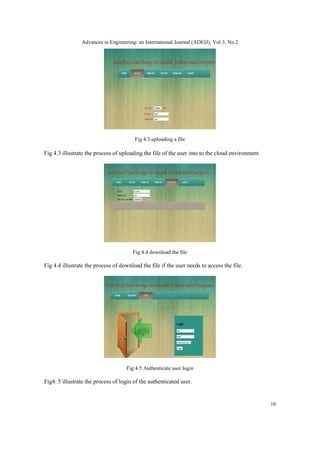
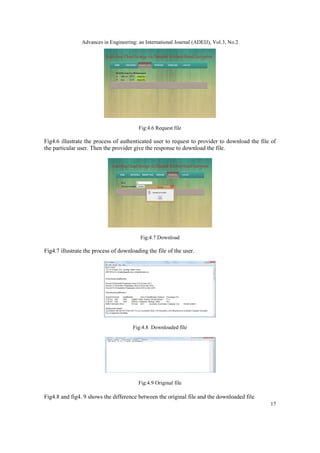
Fig4.1 illustrate the process of registration of users to access the cloud storage services. The
details of the users who are all registrated for stored in database sql.
Fig:4. 2login
The registrated user login into the cloud is illustrated in fig 4.2.](https://image.slidesharecdn.com/3221adeij02-210416062721/85/SECURE-CLOUD-STORAGE-USING-DENIABLE-ATTRIBUTE-BASED-ENCRYPTION-5-320.jpg)
![Advances in Engineering: an International Journal (ADEIJ), Vol.3, No.2
18
5. CONCLUSION
In this work we proposed a deniable CP-ABE with CCA and CPA to build audit free cloud
storage services. To protect the user secret from the coercers and the attackers deniable CP-ABE
is used. The deniability feature makes coercion invalid, and the ABE property ensures secure
cloud data sharing with a fine-grained access control mechanism. Our proposed scheme provides
a possible way to fight against immoral interference with the right of privacy. We hope more
schemes can be created to protect cloud user privacy.
REFERENCES
[1] A. Sahai and B. Waters, “Fuzzy identity-based encryption,” in Eurocrypt, 2005, pp. 457–473.
[2] V. Goyal, O. Pandey, A. Sahai, and B. Waters, “Attribute-based encryption for fine-grained access
control of encrypted data,” in ACM Conference on Computer and Communications Security, 2006,
pp. 89–98.
[3] J. Bethencourt, A. Sahai, and B. Waters, “Ciphertext-policy attribute-based encryption,” in IEEE
Symposium on Security andPrivacy, 2007, pp. 321–334.
[4] B. Waters, “Ciphertext-policy attribute-based encryption: An expressive, efficient, and provably
secure realization,” in Public Key Cryptography, 2011, pp. 53–70.
[5] A. Sahai, H. Seyalioglu, and B. Waters, “Dynamic credentials and ciphertext delegation for attribute-
based encryption,” in Crypto, 2012, pp. 199–217.
[6] S. Hohenberger and B. Waters, “Attribute-based encryption with fast decryption,” in Public Key
Cryptography, 2013, pp. 162–179.
[7] P. K. Tysowski and M. A. Hasan, “Hybrid attribute- and reencryption- based key management for
secure and scalable mobile applications in clouds.” IEEE T. Cloud Computing, pp. 172–186, 2013.
[8] Wired. (2014) Spam suspect uses google docs; fbi happy. [Online]. Available:
http://www.wired.com/2010/04/cloud-warrant/
[9] Wikipedia. (2014) Global surveillance disclosures (2013present). [Online]. Available:
http://en.wikipedia.org/wiki/Globalsurveillance disclosures (2013-present)
[10] (2014) Edward snowden. [Online]. Available:http://en.wikipedia.org/wiki/Edward Snowden
[11] (2014) Lavabit. [Online].Available: http://en.wikipedia.org/wiki/Lavabit
[12] R. Canetti, C. Dwork, M. Naor, and R. Ostrovsky, “Deniable encryption,” in Crypto, 1997, pp. 90–
104.
[13] A. B. Lewko, T. Okamoto, A. Sahai, K. Takashima, and B. Waters, “Fully secure functional
encryption: Attribute-based encryption and (hierarchical) inner product encryption,” in Eurocrypt,
2010, pp. 62–91.
[14] N. Attrapadung, J. Herranz, F. Laguillaumie, B. Libert, E. de Panafieu, and C. Rafols, “Attribute-
based encryption schemes with constant-size ciphertexts,” Theor.Comput. Sci., vol.422, pp. 15–38,
2012.
[15] M. Durmuth and D. M. Freeman, “Deniable encryption with negligible detection probability: An
interactive construction,” in Eurocrypt, 2011, pp. 610–626.
[16] A. O’Neill, C. Peikert, and B. Waters, “Bi-deniable public-key encryption,” in Crypto, 2011, pp.
525–542.
[17] P. Gasti, G. Ateniese, and M. Blanton, “Deniable cloud storage: sharing files via public-key
deniability,” in WPES, 2010, pp. 31–42.
[18] M. Klonowski, P. Kubiak, and M. Kutylowski, “Practical deniable encryption,” in SOFSEM, 2008,
pp. 599–609.](https://image.slidesharecdn.com/3221adeij02-210416062721/85/SECURE-CLOUD-STORAGE-USING-DENIABLE-ATTRIBUTE-BASED-ENCRYPTION-8-320.jpg)


