Mandee Liberty & Vikram Phadke
National Encoder Product Specialists
: Encoders – Basic Training
: SICK, Inc. : Confidential
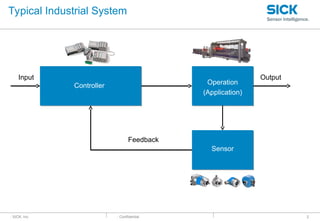
Typical Industrial System
Input Output
Feedback
Controller Operation
(Application)
Sensor
2
: SICK, Inc. : Confidential
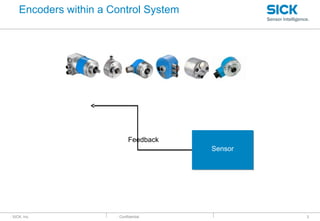
Encoders within a Control System
3
Feedback
Sensor
: SICK, Inc. : Confidential
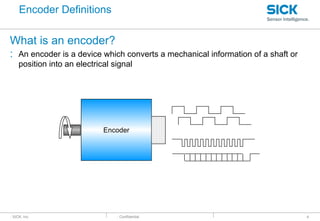
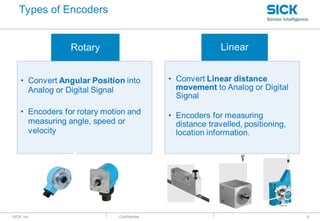
What is an encoder?
: An encoder is a device which converts a mechanical information of a shaft or
position into an electrical signal
Encoder
Encoder Definitions

4
: SICK, Inc. : Confidential
Encoder Definitions
5
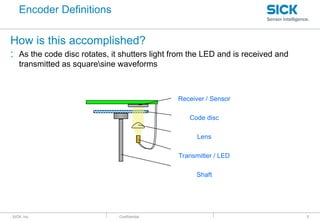
How is this accomplished?
: As the code disc rotates, it shutters light from the LED and is received and
transmitted as squaresine waveforms
Receiver / Sensor

Code disc
Lens
Transmitter / LED
Shaft
: SICK, Inc. : Confidential 6
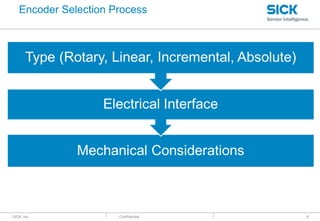
Encoder Selection Process
: SICK, Inc. : Confidential 7
Encoder Selection Process
: SICK, Inc. : Confidential
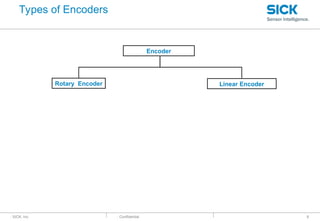
Encoder
Rotary Encoder Linear Encoder
Types of Encoders
8
: SICK, Inc. : Confidential 9
Types of Encoders
: SICK, Inc. : Confidential
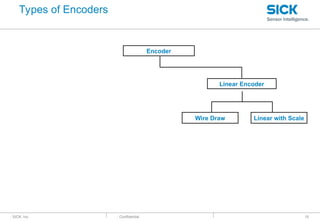
Encoder
Linear Encoder
Wire Draw Linear with Scale
Types of Encoders
10
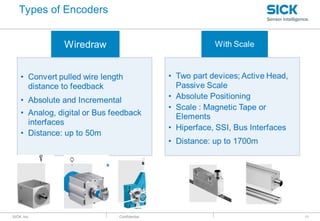
: SICK, Inc. : Confidential 11
Types of Encoders
: SICK, Inc. : Confidential
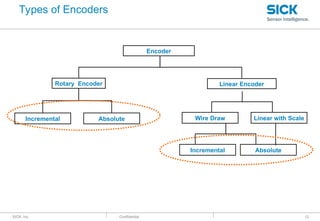
Encoder
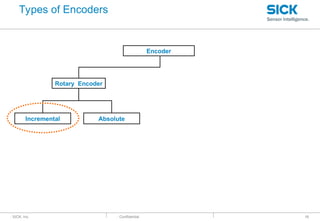
Rotary Encoder
Incremental Absolute
Linear Encoder
Wire Draw Linear with Scale
Absolute
Incremental
Types of Encoders
12
: SICK, Inc. : Confidential 13
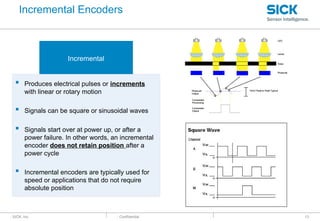
Incremental
 Produces electrical pulses or increments
with linear or rotary motion
 Signals can be square or sinusoidal waves
 Signals start over at power up, or after a
power failure. In other words, an incremental
encoder does not retain position after a
power cycle
 Incremental encoders are typically used for
speed or applications that do not require
absolute position
Incremental Encoders
: SICK, Inc. : Confidential
Absolute Encoders
14
Absolute
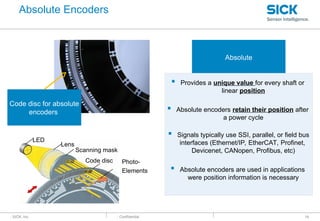
 Provides a unique value for every shaft or
linear position
 Absolute encoders retain their position after
a power cycle
 Signals typically use SSI, parallel, or field bus
interfaces (Ethernet/IP, EtherCAT, Profinet,
Devicenet, CANopen, Profibus, etc)
 Absolute encoders are used in applications
were position information is necessary
Code disc for absolute
encoders
LED
Lens
Scanning mask
Code disc Photo-
Elements
: SICK, Inc. : Confidential
Encoder Selection Process
15
Electrical Interface
: SICK, Inc. : Confidential
Encoder
Rotary Encoder
Incremental Absolute
Types of Encoders
16
: SICK, Inc. : Confidential
Incremental Encoders
Output Channels
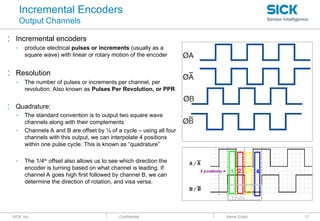
: Incremental encoders
- produce electrical pulses or increments (usually as a
square wave) with linear or rotary motion of the encoder
: Resolution
- The number of pulses or increments per channel, per
revolution. Also known as Pulses Per Revolution, or PPR
: Quadrature:
- The standard convention is to output two square wave
channels along with their complements
- Channels A and B are offset by ¼ of a cycle – using all four
channels with this output, we can interpolate 4 positions
within one pulse cycle. This is known as “quadrature”
- The 1/4th
offset also allows us to see which direction the
encoder is turning based on what channel is leading. If
channel A goes high first followed by channel B, we can
determine the direction of rotation, and visa versa.
: Name (Date) 17
: SICK, Inc. : Confidential
Incremental Encoders
Electrical Signals
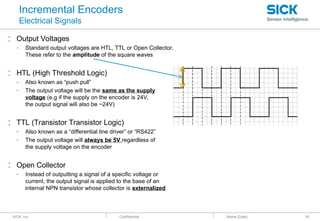
: Output Voltages
- Standard output voltages are HTL, TTL or Open Collector.
These refer to the amplitude of the square waves
: HTL (High Threshold Logic)
- Also known as “push pull”
- The output voltage will be the same as the supply
voltage (e.g if the supply on the encoder is 24V,
the output signal will also be ~24V)
: TTL (Transistor Transistor Logic)
- Also known as a “differential line driver” or “RS422”
- The output voltage will always be 5V regardless of
the supply voltage on the encoder
: Open Collector
- Instead of outputting a signal of a specific voltage or
current, the output signal is applied to the base of an
internal NPN transistor whose collector is externalized
: Name (Date) 18
: SICK, Inc. : Confidential 19
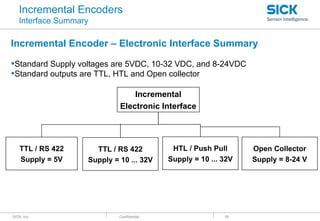
Incremental Encoder – Electronic Interface Summary
•Standard Supply voltages are 5VDC, 10-32 VDC, and 8-24VDC
•Standard outputs are TTL, HTL and Open collector
Incremental
Electronic Interface
TTL / RS 422
Supply = 5V
TTL / RS 422
Supply = 10 ... 32V
HTL / Push Pull
Supply = 10 ... 32V
Open Collector
Supply = 8-24 V
Incremental Encoders
Interface Summary
: SICK, Inc. : Confidential
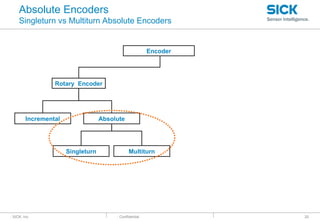
Encoder
Rotary Encoder
Incremental Absolute
Multiturn
Singleturn
Absolute Encoders
Singleturn vs Multiturn Absolute Encoders
20
: SICK, Inc. : Confidential 21
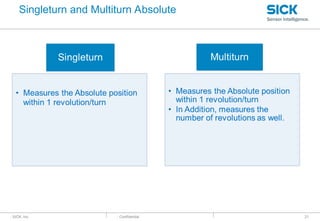
Singleturn and Multiturn Absolute
: SICK, Inc. : Confidential
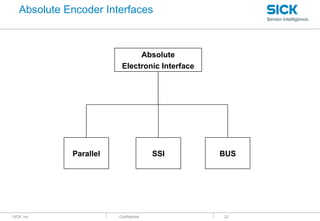
Absolute
Electronic Interface
SSI
Parallel BUS
22
Absolute Encoder Interfaces
: SICK, Inc. : Confidential
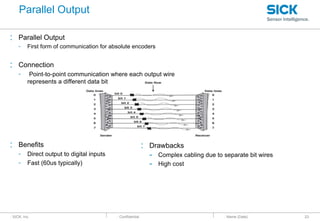
: Parallel Output
- First form of communication for absolute encoders
: Connection
- Point-to-point communication where each output wire
represents a different data bit
: Benefits
- Direct output to digital inputs
- Fast (60us typically)
: Name (Date) 23
: Drawbacks
- Complex cabling due to separate bit wires
- High cost
Parallel Output
: SICK, Inc. : Confidential
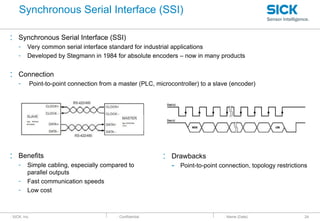
: Synchronous Serial Interface (SSI)
- Very common serial interface standard for industrial applications
- Developed by Stegmann in 1984 for absolute encoders – now in many products
: Connection
- Point-to-point connection from a master (PLC, microcontroller) to a slave (encoder)
: Benefits
- Simple cabling, especially compared to
parallel outputs
- Fast communication speeds
- Low cost
: Name (Date) 24
: Drawbacks
- Point-to-point connection, topology restrictions
Synchronous Serial Interface (SSI)
: SICK, Inc. : Confidential
Network Encoders
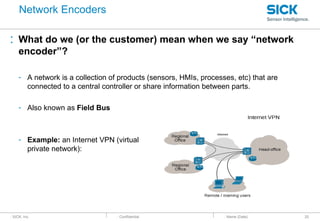
: What do we (or the customer) mean when we say “network
encoder”?
- A network is a collection of products (sensors, HMIs, processes, etc) that are
connected to a central controller or share information between parts.
- Also known as Field Bus
- Example: an Internet VPN (virtual
private network):
: Name (Date) 25
: SICK, Inc. : Confidential
: Field Bus
- Industrial network system that connects multiple products in a manufacturing plant or on a
machine
: Benefits
- Products are no longer point-to-point which allow multiple products to be connected to one
controller
- Generally does not require as many cables as a point to point configuration, and cables do not
need to be as long. This saves on system costs.
- Typically the controller has more flexibility for configuration and information gathering
: Disadvantages
- The network topologies are generally more complex
- Individual components cost more than standalone products (potential system savings, however)
: Name (Date) 26
Field Bus Interfaces
: SICK, Inc. : Confidential
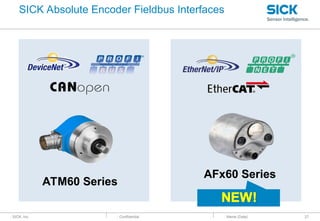
SICK Absolute Encoder Fieldbus Interfaces
: Name (Date) 27
ATM60 Series
AFx60 Series
: SICK, Inc. : Confidential
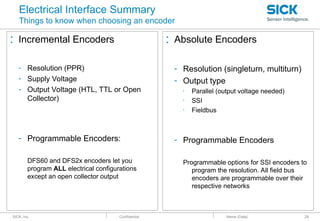
Electrical Interface Summary
Things to know when choosing an encoder
: Incremental Encoders
- Resolution (PPR)
- Supply Voltage
- Output Voltage (HTL, TTL or Open
Collector)
- Programmable Encoders:
DFS60 and DFS2x encoders let you
program ALL electrical configurations
except an open collector output
: Absolute Encoders
- Resolution (singleturn, multiturn)
- Output type
▪ Parallel (output voltage needed)
▪ SSI
▪ Fieldbus
- Programmable Encoders
Programmable options for SSI encoders to
program the resolution. All field bus
encoders are programmable over their
respective networks
: Name (Date) 28
: SICK, Inc. : Confidential
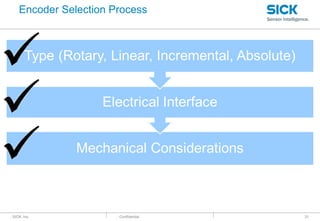
Encoder Selection Process
29
Mechanical Considerations
: SICK, Inc. : Confidential 30
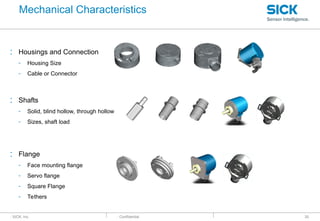
: Housings and Connection
- Housing Size
- Cable or Connector
: Shafts
- Solid, blind hollow, through hollow
- Sizes, shaft load
: Flange
- Face mounting flange
- Servo flange
- Square Flange
- Tethers
Mechanical Characteristics
: SICK, Inc. : Confidential
Encoder Selection Process
31
: SICK, Inc. : Confidential
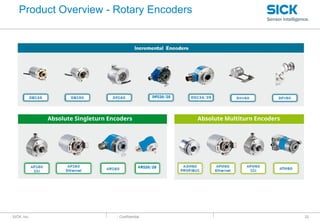
Product Overview - Rotary Encoders
Absolute Singleturn Encoders Absolute Multiturn Encoders
32
: SICK, Inc. : Confidential
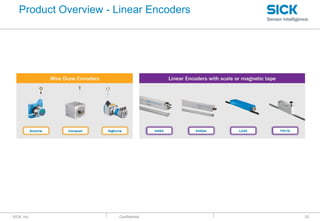
Product Overview - Linear Encoders
33
: SICK, Inc. : Confidential
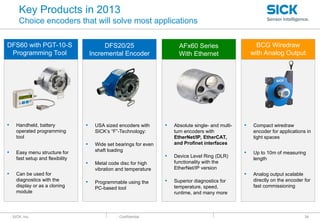
Key Products in 2013
Choice encoders that will solve most applications
34
AFx60 Series
With Ethernet
DFS60 with PGT-10-S
Programming Tool
BCG Wiredraw
with Analog Output
DFS20/25
Incremental Encoder
• Handheld, battery
operated programming
tool
• Easy menu structure for
fast setup and flexibility
• Can be used for
diagnostics with the
display or as a cloning
module
• USA sized encoders with
SICK’s “F”-Technology:
• Wide set bearings for even
shaft loading
• Metal code disc for high
vibration and temperature
• Programmable using the
PC-based tool
• Absolute single- and multi-
turn encoders with
EtherNet/IP, EtherCAT,
and Profinet interfaces
• Device Level Ring (DLR)
functionality with the
EtherNet/IP version
• Superior diagnostics for
temperature, speed,
runtime, and many more
• Compact wiredraw
encoder for applications in
tight spaces
• Up to 10m of measuring
length
• Analog output scalable
directly on the encoder for
fast commissioning
: SICK, Inc. : Confidential
Handling
Wood industry
Automotive Ports & Cranes
Packaging
Machine Tooling
Print & Paper
… And many more
Fields of applications
35
: SICK, Inc. : Confidential
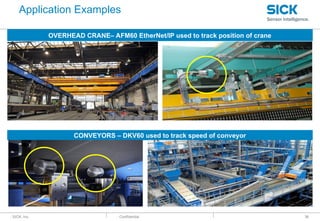
Application Examples
36
OVERHEAD CRANE– AFM60 EtherNet/IP used to track position of crane
CONVEYORS – DKV60 used to track speed of conveyor
: SICK, Inc. : Confidential
Application Examples
37
WIND TURBINE – Absolute encoder AFM60 for gandala and blade angle tracking
BOTTLING – Absolute encoder AFS60 to track position of fillers
: SICK, Inc. : Confidential
Application Examples
38
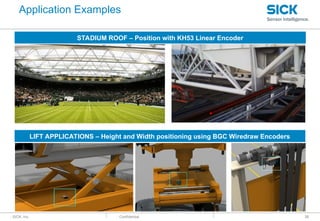
STADIUM ROOF – Position with KH53 Linear Encoder
LIFT APPLICATIONS – Height and Width positioning using BGC Wiredraw Encoders
: SICK, Inc. : Confidential
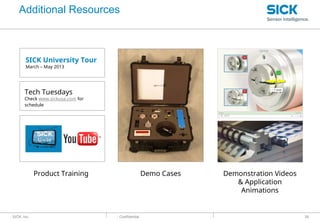
Additional Resources
39
Demonstration Videos
& Application
Animations
SICK University Tour
March – May 2013
Product Training Demo Cases
Tech Tuesdays
Check www.sickusa.com for
schedule
: SICK, Inc. : Confidential
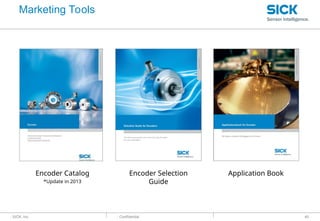
Marketing Tools
40
Encoder Selection
Guide
Application Book
Encoder Catalog
*Update in 2013
: Thank you for your attention.

Encoders_Basic_Training_SICK_SICKSICK.ppt

  • 1.
    Mandee Liberty &Vikram Phadke National Encoder Product Specialists : Encoders – Basic Training
  • 2.
    : SICK, Inc.: Confidential Typical Industrial System Input Output Feedback Controller Operation (Application) Sensor 2
  • 3.
    : SICK, Inc.: Confidential Encoders within a Control System 3 Feedback Sensor
  • 4.
    : SICK, Inc.: Confidential What is an encoder? : An encoder is a device which converts a mechanical information of a shaft or position into an electrical signal Encoder Encoder Definitions 4
  • 5.
    : SICK, Inc.: Confidential Encoder Definitions 5 How is this accomplished? : As the code disc rotates, it shutters light from the LED and is received and transmitted as squaresine waveforms Receiver / Sensor Code disc Lens Transmitter / LED Shaft
  • 6.
    : SICK, Inc.: Confidential 6 Encoder Selection Process
  • 7.
    : SICK, Inc.: Confidential 7 Encoder Selection Process
  • 8.
    : SICK, Inc.: Confidential Encoder Rotary Encoder Linear Encoder Types of Encoders 8
  • 9.
    : SICK, Inc.: Confidential 9 Types of Encoders
  • 10.
    : SICK, Inc.: Confidential Encoder Linear Encoder Wire Draw Linear with Scale Types of Encoders 10
  • 11.
    : SICK, Inc.: Confidential 11 Types of Encoders
  • 12.
    : SICK, Inc.: Confidential Encoder Rotary Encoder Incremental Absolute Linear Encoder Wire Draw Linear with Scale Absolute Incremental Types of Encoders 12
  • 13.
    : SICK, Inc.: Confidential 13 Incremental  Produces electrical pulses or increments with linear or rotary motion  Signals can be square or sinusoidal waves  Signals start over at power up, or after a power failure. In other words, an incremental encoder does not retain position after a power cycle  Incremental encoders are typically used for speed or applications that do not require absolute position Incremental Encoders
  • 14.
    : SICK, Inc.: Confidential Absolute Encoders 14 Absolute  Provides a unique value for every shaft or linear position  Absolute encoders retain their position after a power cycle  Signals typically use SSI, parallel, or field bus interfaces (Ethernet/IP, EtherCAT, Profinet, Devicenet, CANopen, Profibus, etc)  Absolute encoders are used in applications were position information is necessary Code disc for absolute encoders LED Lens Scanning mask Code disc Photo- Elements
  • 15.
    : SICK, Inc.: Confidential Encoder Selection Process 15 Electrical Interface
  • 16.
    : SICK, Inc.: Confidential Encoder Rotary Encoder Incremental Absolute Types of Encoders 16
  • 17.
    : SICK, Inc.: Confidential Incremental Encoders Output Channels : Incremental encoders - produce electrical pulses or increments (usually as a square wave) with linear or rotary motion of the encoder : Resolution - The number of pulses or increments per channel, per revolution. Also known as Pulses Per Revolution, or PPR : Quadrature: - The standard convention is to output two square wave channels along with their complements - Channels A and B are offset by ¼ of a cycle – using all four channels with this output, we can interpolate 4 positions within one pulse cycle. This is known as “quadrature” - The 1/4th offset also allows us to see which direction the encoder is turning based on what channel is leading. If channel A goes high first followed by channel B, we can determine the direction of rotation, and visa versa. : Name (Date) 17
  • 18.
    : SICK, Inc.: Confidential Incremental Encoders Electrical Signals : Output Voltages - Standard output voltages are HTL, TTL or Open Collector. These refer to the amplitude of the square waves : HTL (High Threshold Logic) - Also known as “push pull” - The output voltage will be the same as the supply voltage (e.g if the supply on the encoder is 24V, the output signal will also be ~24V) : TTL (Transistor Transistor Logic) - Also known as a “differential line driver” or “RS422” - The output voltage will always be 5V regardless of the supply voltage on the encoder : Open Collector - Instead of outputting a signal of a specific voltage or current, the output signal is applied to the base of an internal NPN transistor whose collector is externalized : Name (Date) 18
  • 19.
    : SICK, Inc.: Confidential 19 Incremental Encoder – Electronic Interface Summary •Standard Supply voltages are 5VDC, 10-32 VDC, and 8-24VDC •Standard outputs are TTL, HTL and Open collector Incremental Electronic Interface TTL / RS 422 Supply = 5V TTL / RS 422 Supply = 10 ... 32V HTL / Push Pull Supply = 10 ... 32V Open Collector Supply = 8-24 V Incremental Encoders Interface Summary
  • 20.
    : SICK, Inc.: Confidential Encoder Rotary Encoder Incremental Absolute Multiturn Singleturn Absolute Encoders Singleturn vs Multiturn Absolute Encoders 20
  • 21.
    : SICK, Inc.: Confidential 21 Singleturn and Multiturn Absolute
  • 22.
    : SICK, Inc.: Confidential Absolute Electronic Interface SSI Parallel BUS 22 Absolute Encoder Interfaces
  • 23.
    : SICK, Inc.: Confidential : Parallel Output - First form of communication for absolute encoders : Connection - Point-to-point communication where each output wire represents a different data bit : Benefits - Direct output to digital inputs - Fast (60us typically) : Name (Date) 23 : Drawbacks - Complex cabling due to separate bit wires - High cost Parallel Output
  • 24.
    : SICK, Inc.: Confidential : Synchronous Serial Interface (SSI) - Very common serial interface standard for industrial applications - Developed by Stegmann in 1984 for absolute encoders – now in many products : Connection - Point-to-point connection from a master (PLC, microcontroller) to a slave (encoder) : Benefits - Simple cabling, especially compared to parallel outputs - Fast communication speeds - Low cost : Name (Date) 24 : Drawbacks - Point-to-point connection, topology restrictions Synchronous Serial Interface (SSI)
  • 25.
    : SICK, Inc.: Confidential Network Encoders : What do we (or the customer) mean when we say “network encoder”? - A network is a collection of products (sensors, HMIs, processes, etc) that are connected to a central controller or share information between parts. - Also known as Field Bus - Example: an Internet VPN (virtual private network): : Name (Date) 25
  • 26.
    : SICK, Inc.: Confidential : Field Bus - Industrial network system that connects multiple products in a manufacturing plant or on a machine : Benefits - Products are no longer point-to-point which allow multiple products to be connected to one controller - Generally does not require as many cables as a point to point configuration, and cables do not need to be as long. This saves on system costs. - Typically the controller has more flexibility for configuration and information gathering : Disadvantages - The network topologies are generally more complex - Individual components cost more than standalone products (potential system savings, however) : Name (Date) 26 Field Bus Interfaces
  • 27.
    : SICK, Inc.: Confidential SICK Absolute Encoder Fieldbus Interfaces : Name (Date) 27 ATM60 Series AFx60 Series
  • 28.
    : SICK, Inc.: Confidential Electrical Interface Summary Things to know when choosing an encoder : Incremental Encoders - Resolution (PPR) - Supply Voltage - Output Voltage (HTL, TTL or Open Collector) - Programmable Encoders: DFS60 and DFS2x encoders let you program ALL electrical configurations except an open collector output : Absolute Encoders - Resolution (singleturn, multiturn) - Output type ▪ Parallel (output voltage needed) ▪ SSI ▪ Fieldbus - Programmable Encoders Programmable options for SSI encoders to program the resolution. All field bus encoders are programmable over their respective networks : Name (Date) 28
  • 29.
    : SICK, Inc.: Confidential Encoder Selection Process 29 Mechanical Considerations
  • 30.
    : SICK, Inc.: Confidential 30 : Housings and Connection - Housing Size - Cable or Connector : Shafts - Solid, blind hollow, through hollow - Sizes, shaft load : Flange - Face mounting flange - Servo flange - Square Flange - Tethers Mechanical Characteristics
  • 31.
    : SICK, Inc.: Confidential Encoder Selection Process 31
  • 32.
    : SICK, Inc.: Confidential Product Overview - Rotary Encoders Absolute Singleturn Encoders Absolute Multiturn Encoders 32
  • 33.
    : SICK, Inc.: Confidential Product Overview - Linear Encoders 33
  • 34.
    : SICK, Inc.: Confidential Key Products in 2013 Choice encoders that will solve most applications 34 AFx60 Series With Ethernet DFS60 with PGT-10-S Programming Tool BCG Wiredraw with Analog Output DFS20/25 Incremental Encoder • Handheld, battery operated programming tool • Easy menu structure for fast setup and flexibility • Can be used for diagnostics with the display or as a cloning module • USA sized encoders with SICK’s “F”-Technology: • Wide set bearings for even shaft loading • Metal code disc for high vibration and temperature • Programmable using the PC-based tool • Absolute single- and multi- turn encoders with EtherNet/IP, EtherCAT, and Profinet interfaces • Device Level Ring (DLR) functionality with the EtherNet/IP version • Superior diagnostics for temperature, speed, runtime, and many more • Compact wiredraw encoder for applications in tight spaces • Up to 10m of measuring length • Analog output scalable directly on the encoder for fast commissioning
  • 35.
    : SICK, Inc.: Confidential Handling Wood industry Automotive Ports & Cranes Packaging Machine Tooling Print & Paper … And many more Fields of applications 35
  • 36.
    : SICK, Inc.: Confidential Application Examples 36 OVERHEAD CRANE– AFM60 EtherNet/IP used to track position of crane CONVEYORS – DKV60 used to track speed of conveyor
  • 37.
    : SICK, Inc.: Confidential Application Examples 37 WIND TURBINE – Absolute encoder AFM60 for gandala and blade angle tracking BOTTLING – Absolute encoder AFS60 to track position of fillers
  • 38.
    : SICK, Inc.: Confidential Application Examples 38 STADIUM ROOF – Position with KH53 Linear Encoder LIFT APPLICATIONS – Height and Width positioning using BGC Wiredraw Encoders
  • 39.
    : SICK, Inc.: Confidential Additional Resources 39 Demonstration Videos & Application Animations SICK University Tour March – May 2013 Product Training Demo Cases Tech Tuesdays Check www.sickusa.com for schedule
  • 40.
    : SICK, Inc.: Confidential Marketing Tools 40 Encoder Selection Guide Application Book Encoder Catalog *Update in 2013
  • 41.
    : Thank youfor your attention.

Editor's Notes

  • #2 Other components – HMI, Mechanical, etc Input I/O Types Discrete Analog Communication Encoders Discrete Analog Communication
  • #6 Give everyone a selection guide: Explain the Selection Guide
  • #7 Give everyone a selection guide: Explain the Selection Guide
  • #22 Absolute encoders transmit position information via serial, parallel bits or via bus communication. Parallel wires can provide position information as one bit per wire. Parallel bit communication has distance restrictions – usually 10 M. Electric noise interference and power supply capabilities are limiting factors. BUS communication is very efficient, but also has distance limitations – usually 100 M per drop. Serial communication can run the longest distances – sometimes in excess of 1000 M. SSI (Synchronous Serial Interface) is a popular format for serial communication.