Enterprise Management Suite
User Guide for VCXTM V7000
Components


VCX™ V7000 IP Telephony Solution
System Release 7.1


Part Number 900-0385-01
Published August 2006
http://www.3com.com/
3Com Corporation   Copyright © 2001–2006, 3Com Corporation. All rights reserved. No part of this
350 Campus Drive   documentation may be reproduced in any form or by any means or used to make any
                   derivative work (such as translation, transformation, or adaptation) without written
Marlborough, MA    permission from 3Com Corporation.
01752-3064
                   3Com Corporation reserves the right to revise this documentation and to make
                   changes in content from time to time without obligation on the part of 3Com
                   Corporation to provide notification of such revision or change.
                   3Com Corporation provides this documentation without warranty, term, or condition
                   of any kind, either implied or expressed, including, but not limited to, the implied
                   warranties, terms, or conditions of merchantability, satisfactory quality, and fitness
                   for a particular purpose. 3Com may make improvements or changes in the product(s)
                   and/or the program(s) described in this documentation at any time.
                   If there is any software on removable media described in this documentation, it is
                   furnished under a license agreement included with the product as a separate
                   document, in the hardcopy documentation, or on the removable media in a directory
                   file named LICENSE.TXT or !LICENSE.TXT. If you are unable to locate a copy, please
                   contact 3Com and a copy will be provided to you.
                   UNITED STATES GOVERNMENT LEGENDS:
                   If you are a United States government agency, then this documentation and the
                   software described herein are provided to you subject to the following:
                   United States Government Legend: All technical data and computer software is
                   commercial in nature and developed solely at private expense. Software is delivered
                   as Commercial Computer Software as defined in DFARS 252.227-7014 (June 1995)
                   or as a commercial item as defined in FAR 2.101(a) and as such is provided with only
                   such rights as are provided in 3Com’s standard commercial license for the Software.
                   Technical data is provided with limited rights only as provided in DFAR 252.227-7015
                   (Nov 1995) or FAR 52.227-14 (June 1987), whichever is applicable. You agree not to
                   remove or deface any portion of any legend provided on any licensed program or
                   documentation contained in, or delivered to you in conjunction with guide.
                   Unless otherwise indicated, 3Com registered trademarks are registered in the United
                   States and may or may not be registered in other countries.
                   3Com and the 3Com logo are registered trademarks of 3Com Corporation. VCX is a
                   trademark of 3Com Corporation.
                   Other brand and product names may be registered trademarks or trademarks of their
                   respective holders.
CONTENTS

    ABOUT THIS GUIDE
    Related Documentation   13
    Your Comments 14


1   3COM VCX IP TELEPHONY SERVER
    Installing a License on a VCX Server 17
        Obtaining a License 17
        Copying the License File to the EMS Server 18
        Uploading a License to a VCX Server 18
        Activating a License on a VCX Server 18
    Managing License Files 19
        Viewing License Details 19
        Viewing License Components 20
    Viewing System Information 20
    Creating Backup Configuration Files 21
        Creating a Backup File 21
        Setting the Current Configuration as Baseline 21
        Restoring Backup Configuration Files 22
        Recovering a Failed Restore 23
    Starting and Stopping VCX Services 23
    Golden Template Configuration 24
    Verifying State of the VCX IP Telephony Server 24
    Verifying VCX IP Telephony Server Software Version 24
    VCX IP Telephony Server Identification Tab 25
        Identification Tab Location 25
        Verifying the Type of Office Configured 26
        Verifying the Type of Components Installed on a Server 27
    Verifying the Amount of Disk Spaced Used on an IP Telephony Server 27
    Configuring Date and Time Variables for the IP Telephony Server 27
        Configuring the Date of an IP Telephony Server 28
        Configuring the Time of an IP Telephony Server 28
4


           Configuring the Timezone of an IP Telephony Server 28
        Configuring Authorization Station Agents 29
           Adding Authorized Station Agents 29
           Deleting Authorized Station Agents 29
        Enabling and Disabling the Web Provisioning Server (Tomcat) 30
        Rediscovering the IP Telephony Server in EMS 30
        Back-end Server Maintenance 31
           Monitoring XML Accounting Server Activity on the XML Accounting
           Server 31
           Restarting Systems and Services 31
           Reserving and Unreserving the Back-end Server 32
           Updating the Server State 32
        Configuring Replication for the VCX Data Server 33
           Setting Up Replication for a VCX Data Server 33
           Dropping Replication for a VCX Data Server 33
           Checking Replication Status on a VCX Data Server 34
           Deleting Replication Errors on the VCX Data Server 34
        Managing SSH Scripts 34
        RAID Monitoring 35
        UPS Monitoring 35
           Setting Up UPS Master/Slaves 35
           Enabling UPS Monitoring 35
           Viewing UPS Monitoring Information 36
           Viewing UPS Slaves 36


    2   CONFIGURING THE VCX DATA SERVER
        VCX Data Server Database Configuration 37
           Changing the VCX Data Server Database Name 37
           Changing the VCX Data Server Database Server Name 37
           Changing the VCX Data Server Database User Name 38
           Changing the VCX Data Server Database User Password 38
        Configuring the VCX Data Server Database Keep Alive Timeout 38
        Configuring the VCX Data Server Client Activity Interval 39
        Configuring VCX Data Server Client Request Threads 39
        Configuring the VCX Data Server Logging Level 39
        Enabling VCX Data Server Packet Tracing 40
        VCX Data Server Configuration Tab Descriptions 40
5


      Tab Location 40
      3 Q Protocol Configuration 40
      BES Common Configuration 41
      BES Common Statistics 41
      Flow Control Configuration 42
      Identification 42
      State 42
    VCX Data Server Maintenance 43
      Restarting the VCX Data Server 43
      Shutting Down the VCX Data Server 43
      Verifying the VCX Data Server State 44


3   CONFIGURING THE XML ACCOUNTING SERVER
    Configuring the Client Activity Interval 45
    Configuring Client Request Threads 45
    Configuring the Logging Level 46
    XML CDR Configuration 46
       XML CDR Control 46
    Enabling Packet Tracing 47
    XML Accounting Server Configuration Tab Descriptions   48
       Tab Location 48
       3 Q Protocol Configuration 48
       BES Common Configuration 49
       BES Common Statistics 49
       Flow Control Configuration 50
       Identification 50
       State 51
    Accounting Server Maintenance 51
       Restarting the Accounting Server 51
       Stopping the Accounting Server 51
       Verifying the Accounting Server State 52
    QoS Monitoring 52


4   CONFIGURING THE CALL PROCESSOR
    Configuring SIP Call Processor 53
    Configuring Trusted Endpoints 54
      Adding Trusted Endpoints 54
6


           Editing Trusted Endpoints 55
           Deleting Trusted Endpoints 55
        Verifying Call Processor Version 56
        Call Processor Identification Tab 56
        Configuring the Back-end Servers 57
           Adding Accounting Servers 57
           Editing Accounting Server IP Addresses 57
           Removing Accounting Servers 58
           Adding Authentication Servers 58
           Editing Authentication Server IP Addresses 59
           Removing Authentication Servers 59
           Adding Directory Servers 60
           Editing Directory Server IP Addresses 60
           Removing Directory Servers 61
           Adding VCX Data Servers 61
           Editing VCX Data Server IP Addresses 62
           Removing VCX Data Servers 62
           Enabling or Disabling Accounting Server 62
           Enabling or Disabling Authentication Server 63
           Enabling or Disabling Directory Server 63
           Enabling or Disabling VCX Data Server 63
        Monitoring Call Statistics 64
        Verifying State of a Call Processor 64
        Call Processor Maintenance 65
           Restarting the Call Processor 65
           Stopping the Call Processor 65
           Verifying the Call Processor State 66
        QoS Monitoring 66


    5   CONFIGURING THE IP MESSAGING SYSTEM
        Verifying State of an IP Messaging Server 67
        IP Messaging Server Identification Tab 68
           Verifying IP Messaging Software Version 68
        Verifying Connection to Call Builder Interface 69
        Configuring Call Builder Variables 69
           Configuring DTMF Payload 69
           Configuring RTP 69
7


       Configuring Dialing Domain of IP Messaging Server     70
       Configuring Call Processors for IP Messaging Server   70
       Configuring SIP Registration 70
       Configuring the Signaling Server 71
    IP Messaging Server Maintenance 71
       Verifying the IP Messaging Server State 71
       Gracefully Stopping the IP Messaging Server 71
       Stopping the IP Messaging Server Hard 72
       Gracefully Restarting the IP Messaging Server 72
       Restarting the IP Messaging Server Hard 72


6   CONFIGURING THE SIP PHONE DOWNLOADER
    Configuring the SIP Phone Downloader 73
    Device Mapping 75
    SIP Phone Downloader Maintenance 76
        Restarting the Application Downloader 76
        Stopping the Application Downloader 76
        Verifying the Application Downloader State 76


7   CONFIGURING THE COMMON AGENT
    Verifying State of the Common Agent 77
    Verifying Common Agent Software Version 78
    Common Agent Identification Tab 78
    Enabling Back-end Server Traps 79
       Configuring Trap Destinations 79
       Enabling Back-end Server Traps 79
       Receiving Traps 80
    Common Agent Maintenance 81
       Restarting the Common Agent 81
       Verifying the Common Agent State 81


8   CONFIGURING THE OS ENTITY
    Verifying State of the O/S 83
    Verifying O/S Software Version   84
    O/S Identification Tab 84
    O/S Entity Maintenance 85
8


            Gracefully Restarting the O/S Entity   85
            Verifying the O/S Entity State 85


    9    UPGRADING AND MAINTAINING VCX SYSTEMS AND
         COMPONENTS
         Maintaining VCX Versions 88
           Viewing Installed Versions of VCX 88
           Removing an Unused Version of VCX 88
         Upgrading VCX Server Software from 7.0 to 7.1 89
           Upgrading a Multiple Site Configuration from 7.0 to 7.1 90
           Upgrading the VCX IP Telephony Software from 7.0 to 7.1 103
           Installing IP Messaging Software Patch Releases 104
           Installing SIP Phone Downloader and Boot File Software Patch
           Releases 105
         Upgrading VCX Server Software from 6.0x to 7.0 108
           Upgrading a Multiple Site Configuration from 6.0.x to 7.0 108
           Upgrading the VCX IP Telephony Software from 6.0x to 7.0 120
           Uploading Music on Hold Files 121
           Upgrading the IP Messaging Software from 6.0x to 7.0 122
           Upgrading the SIP Phone Downloader and Boot File Software from 6.0x
           to 7.0 123


    10   USING QOS MONITORING
         Overview 125
         VCX Call Processor 126
            Setting QoS Monitoring Parameters 126
            Specifying Phones for QoS Monitoring 126
         3Com IP Phones 127
            Configuring
            3Com IP Phones 127
         XML Accounting Server 128
            Settings QoS Collection Parameters 128
            Viewing Call History 130
            Viewing Phone Statistics 130
            Viewing Quality Detail Records (QDRs) 130
9


11   MANAGING MEDIA GATEWAYS
     Supported Media Gateways 131
     Backing Up and Restoring Media Gateways   131
        Creating a Backup File 131
        Performing a Restore 132
     Upgrading Software 133


     INDEX
10
ABOUT THIS GUIDE


This chapter contains an overview of this guide, lists guide conventions,
related documentation, and product compatibility, and describes how to
contact Customer Service.

This guide describes how to configure and maintain the following:
■   3Com Accounting Server
■   3Com Application Downloader
■   3Com Authentication Server
■   3Com Directory Server
■   3Com SIP Call Processor
■   3Com SNMP Agent
■   3Com VCX Data Server
■   IP Messaging System
■   UNIX OS Entity

This guide is intended for operators and administrators of the system
and assumes you have a thorough understanding of
telecommunications, VoIP technology, Linux operating system, Oracle
databases, network knowledge, and system administrator privileges.

Release notes are issued with some products. If the information in the
release notes differs from the information in this guide, follow the
instructions in the release notes.
12   ABOUT THIS GUIDE


                        Table 1 and Table 2 list conventions that are used throughout this guide.
                        Table 1 Notice Icons

                        Icon      Notice Type          Description
                                  Information note     Information that describes important features or
                                                       instructions
                                  Caution              Information that alerts you to potential loss of data or
                                                       potential damage to an application, system, or device
                                  Warning              Information that alerts you to potential personal injury


                        Table 2 Text Conventions

                        Convention              Description
                        Screen displays This typeface represents information as it appears on the
                                        screen.
                        Syntax                  The word “syntax” means that you must evaluate the syntax
                                                provided and then supply the appropriate values for the
                                                placeholders that appear in angle brackets. Example:
                                                    To enable RIPIP, use the following syntax:
                                                    SETDefault !<port> -RIPIP CONTrol =
                                                    Listen
                                                In this example, you must supply a port number for <port>.
                        Commands                The word “command” means that you must enter the
                                                command exactly as shown and then press Return or Enter.
                                                Commands appear in bold. Example:
                                                    To remove the IP address, enter the following command:
                                                    SETDefault !0 -IP NETaddr = 0.0.0.0
                        The words “enter”       When you see the word “enter” in this guide, you must type
                        and “type”              something, and then press Return or Enter. Do not press
                                                Return or Enter when an instruction simply says “type.”
                        Words in italics        Italics are used to:
                                                ■   Emphasize a point.
                                                ■   Denote a new term at the place where it is defined in the
                                                    text.
                                                ■   Identify menu names, menu commands, and software
                                                    button names. Examples:
                                                    From the Help menu, select Contents.
                                                    Click OK.
Related Documentation      13


Related         These 3Com documents contain additional information about the
Documentation   products in this release that are a part of or support the 3Com
                Convergence Applications Suite.

                The following documents are a part of the VCX IP Telephony Module:
                ■   VCX Installation Guide
                ■   VCX Maintenance Guide
                ■   VCX Administration Guide
                ■   VCX Basic Telephone Quick Reference Guide
                ■   VCX Business Telephone Quick Reference Guide
                ■   VCX Telephone Display Quick Reference Guide
                ■   VCX Manager’s Telephone Quick Reference Guide
                ■   VCX Basic Telephone Guide
                ■   VCX Business Telephone Guide
                ■   VCX Manager’s Telephone Guide
                ■   VCX Feature Codes for Analog Telephones Quick Reference Guide
                ■   VCX Security Guide

                The following documents are a part of the IP Messaging Module:
                ■   IP Messaging Module Quick Reference Guide - 3Com Native Interface
                ■   IP Messaging Module User Guide - 3Com Native Interface
                ■   IP Messaging Module Quick Reference Guide - Traditional Interface
                ■   IP Messaging Module User Guide - Traditional Interface
                ■   IP Messaging Module Operations and System Administration Guide
                ■   E-Mail Reader Application Quick Start Guide

                The following documents are a part of the IP Conferencing Module:
                ■   IP Conferencing Module Installation Guide
                ■   IP Conferencing Module Administration Guide
                ■   IP Conferencing Module User Guide
                ■   Convergence Center Client User and Administration Guide
14   ABOUT THIS GUIDE


                        The following documents provide information on products that support
                        this release:
                        ■   Enterprise Management Suite
                            ■   Enterprise Management Suite Getting Started Guide, Version 2.3
                            ■   Enterprise Management Suite User Guide, Version 2.3
                            ■   Enterprise Management Suite 2.3 for VCX 7.1 User Guide
                        ■   Digital Gateways
                            ■   V7122 and V6100 Digital Media Gateway User Guide, Version 4.8
                            ■   V6100 Digital Media Gateway Fast Track Installation Guide,
                                Version 4.8
                            ■   V7122 Digital Media Gateway Fast Track Installation Guide,
                                Version 4.8
                        ■   Analog Gateways
                            ■   V7111 Analog Media Gateway Fast Track Installation Guide,
                                Version 4.8
                            ■   V7111 Analog Media Gateway User Guide, Version 4.8
                            ■   V6000 Analog Media Gateway Fast Track Installation Guide,
                                Version 4.8
                            ■   V6000 Analog Media Gateway User Guide, Version 4.8


Your Comments           Your suggestions are important to us because we want to make our
                        documentation more useful to you.

                        Please send e-mail comments about this guide or any of the 3Com Voice
                        Products documentation and Help systems to:
                        VOICE_Techpubs_comments@3com.com

                        Please include the following information with your comments:
                        ■   Document title
                        ■   Document part number (found on the front page)
                        ■   Page number
                        ■   Your name and organization (optional)
Your Comments    15


Example:
Enterprise Management Suite User Guide for VCXTM V7000 Components
Part Number 900-0180-01 Rev AA
Page 25

Please address all questions regarding the 3Com software to your
authorized 3Com representative.
16   ABOUT THIS GUIDE
3COM VCX IP TELEPHONY
    1                      SERVER


                           This chapter describes how to install a license on a VCX IP Telephony
                           Server, and view and configure the features that are associated with the
                           VCX IP Telephony Server.


Installing a License       In VCX 7.0 and later, you must install a license to use the VCX IP
on a VCX Server            Telephony Server.

                           The license file must be installed after you complete the network
                           configuration and service configuration (that is, after you have run the
                           vcx-config-network and setup scripts).

                           Installing a license involves the following steps:
                        1 Obtain the license file.
                        2 Copy the license file to the EMS server.
                        3 Upload the license file.
                        4 Activate the license file.

  Obtaining a License      To obtain a license file, contact your authorized 3Com representative.

                           When you request a license file, submit the machine ID for your VCX IP
                           Telephony Server. This machine ID is available from the command line
                           vcx-showmachineid or from the License Info tab in EMS.
18       CHAPTER 1: 3COM VCX IP TELEPHONY SERVER


  Copying the License          To copy the license file to the EMS server:
File to the EMS Server
                            1 Place the license file you received from 3Com in the following directory
                              on the EMS server:
                               <EMS_INSTALL_DIR>/software_upgrades/voice/ActivationKey
                            2 From the EMS client Explorer tree, navigate to 3Com VCX IP Telephony
                              Server.
                            3 From the Properties tab, click License Info.
                            4 In the Planned License File field, click the license file from the drop-down
                              list. The license file you placed in step 1 is listed in the drop-down menu.
                            5 Click Save all.
                               The license file is copied to the EMS server. Next, upload the file to the
                               VCX server.

 Uploading a License           To upload the license file to the VCX server:
     to a VCX Server
                            1 From the Explorer tab, right-click 3Com VCX IP Telephony Server.
                            2 From the pop-up menu, select Licensing and then select
                              Upload License File.
                               The license file is uploaded. Next, activate the license file.

     Activating a License      To activate a license on a VCX server:
         on a VCX Server

                            1 From the Explorer tab, right-click 3Com VCX IP Telephony Server.
                            2 From the pop-up menu, select Licensing and then select
                              Activate License Key.
                               The license is activated.
Managing License Files         19


Managing License        Enterprise Management Suite allows you to view the details and
Files                   components of your VCX 7.x license.

                        This information is useful for monitoring the status of your license.

    Viewing License     To view details of an installed license:
            Details

                      1 Log into EMS.
                      2 From the Explorer tab, navigate to the 3Com VCX IP Telephony Server.
                      3 From the Properties tab, click License Info.
                        For a description of each field, see Table 3.
                        Table 3 License Info Tab

                         Attribute                 Description
                         Customer/AcctNumber       The customer account number associated with the
                                                   activation key.
                         CustomerAddress           The customer address.
                         CustomerName              The customer name this activation key was issued to.
                         ExpiryDate                The VCX license expiry date present in the activation
                                                   key.
                         IssuerName                The VCX license issuer name for the activation key.
                         LicenseStatus             The status of the license. This contains the reason code
                                                   for identifying licensing-related failures.
                         LicenseSystemVersion      The system version the activation key is associated
                         Number                    with.
                         MachineIdentifier         The VCX license machine identifier present in the
                                                   activation key.
                         Planned License File      The file containing the planned license file. This file
                                                   must be located in the following directory on the EMS
                                                   server: software_upgrades/voice/ActivationKey
                         Remaining Grace Period    The remaining time, in hours, the license will be
                                                   available for during the grace period after a license
                                                   expires.
                         SerialNumber              The VCX license serial number present in the activation
                                                   key.
                         UpgradeExpiryDate         The VCX license expiry date for software upgrades
                                                   present in the activation key.
20    CHAPTER 1: 3COM VCX IP TELEPHONY SERVER


     Viewing License       To view a list of license components:
        Components

                        1 Log into EMS.
                        2 From the Explorer tab, navigate to the 3Com VCX IP Telephony Server.
                        3 From the Properties tab, click Licensed Components.
                           A list of components appears. These components vary depending on your
                           license.


Viewing System             EMS allows you to view summary information for the VCX IP Telephony
Information                Server.

                           To view summary information:
                        1 Log into EMS.
                        2 From the Explorer tab, navigate to the 3Com VCX IP Telephony Server.
                        3 From the Properties tab, click System Info.
                           A list of attributes appears. For a description of each attribute, see
                           Table 4.

                           For complete details of each attribute, view the context-sensitive help for
                           each attribute in EMS.
                           Table 4 System Info Tab

                            Attribute                   Description
                            RAID Status                 The status of RAID.
                            Site type                   The VCX server site type.
                            System Machine Identifier   The machine identifier reported by the system. This is
                                                        reported independent of the activation key.
                            System Type                 The type of VCX IP telephony server. The Server Type is
                                                        determined by the combination of running software
                                                        components, which affect the features made available
                                                        by the server.
                            UPS Monitoring Status       The UPS configuration information showing if the VCX
                                                        machine is configured as a master or slave.
Creating Backup Configuration Files      21


Creating Backup           EMS allows you to save the configurations for the IP Telephony Server
Configuration Files       and IP Messaging server and create backup configuration files. Use these
                          files to restore the IP Telephony Server and IP Messaging Server to a
                          previous set of configurations.
                          Backup files contain configuration and backup information for all of the
                          installed applications, as well as server and operating system configuration
                          information. User profiles, voice mails, and database schemas are not
                          backed up.
                          In addition to creating backup configuration files and performing restores,
                          EMS allows you to recover from a situation where an attempted restore fails.

   Creating a Backup      You can save the IP Telephony Server configuration to a backup file. After
                 File     you have saved the configuration, you can set the backup file as a
                          baseline so that you can restore it later.

                          To save the IP Telephony Server configuration:
                        1 From the Explorer tab, right-click the 3Com VCX IP Telephony Server.
                        2 From the pop-up menu, select Configuration and then select Backup.
                          The progress is shown in the Job Progress section of the EMS GUI. When
                          the command is finished, the Working icon changes to a Finished icon.
                        3 Click Close.
                          This file becomes the current, or most recently saved or restored, version.
                          You can set the current version as the baseline version.

  Setting the Current     To set the current, or most recently saved or restored, configuration as
    Configuration as      the baseline version:
             Baseline
                        1 From the Explorer tab, right-click the 3Com VCX IP Telephony Server.
                        2 From the pop-up menu, select Configuration and then select Set baseline
                          to current.
                          The progress is shown in the Job Progress section of the EMS GUI. When
                          the command is finished, the Working icon changes to a Finished icon.
                        3 Click Close.
                          This file becomes the baseline version.
                          To restore the IP Telephony Server configuration, refer to Restoring
                          Backup Configuration Files.
22      CHAPTER 1: 3COM VCX IP TELEPHONY SERVER


      Restoring Backup       You can restore the 3Com VCX IP Telephony Server configuration from
     Configuration Files     the last backup (current), the baseline, or the planned backup file.

                             All VCX services are shut down during a restore. The services are not
                             restarted automatically when the restore is complete. Use EMS to restart
                             VCX services when the restore is finished. See Starting and Stopping VCX
                             Services for instructions.

                             To restore the 3Com VCX IP Telephony Server configuration:
                           1 From the Explorer tab, right-click the 3Com VCX IP Telephony Server.
                           2 Select the configuration file you want to restore (baseline, current, or
                             planned).
                           3 From the pop-up menu, select Configuration and then select one of the
                             following:
                             a To restore the configuration to the last saved configuration, select
                               Restore current.
                             b To restore the configuration to the saved baseline configuration (refer
                               to Setting the Current Configuration as Baseline), select Restore
                               baseline.
                             c To restore the configuration to the planned configuration, first select
                               the file, and then select Restore planned.
                             The progress is shown in the Job Progress section of the EMS GUI. When
                             the restore operation is finished, the Working icon changes to a Finished
                             icon.
                           4 Click Close.
                           5 Restart VCX services. See Starting and Stopping VCX Services for
                             instructions.
Starting and Stopping VCX Services   23


 Recovering a Failed      If a configuration restore operation fails for any reason, EMS allows you
            Restore       to perform a Restore Failure Recovery.

                          This recovery operation uses a backup file stored on the VCX system to
                          restore the configuration state to exactly where it was before the failed
                          restore operation was launched.

                          To perform a failure recovery:
                       1 From the Explorer tab, right-click the 3Com VCX IP Telephony Server.
                       2 From the pop-up menu, select Configuration and then select
                         Restore Failure Recovery.
                          The progress is shown in the Job Progress section of the EMS GUI. When
                          the recovery is finished, the Working icon changes to a Finished icon.
                       3 Click Close.


Starting and              When you perform a restore, all VCX services are shut down
Stopping VCX              automatically. The services are not restarted automatically when the
Services                  restore is complete. This section describes how to restart VCX services
                          when a restore is finished, and how to manually stop VCX services.

                          CAUTION: The Stop All Services option causes all VCX services (except
                          the SNMP agent) to shutdown. Your system will not take any calls when
                          you select this option.

                          To start or stop all VCX services:
                       1 Log into EMS.
                       2 From the Explorer tab, right-click 3Com VCX IP Telephony Server.
                       3 From the pop-up menu, select VCX Services and then select Start All Services.
                          To stop all VCX services, select Stop All Services.
24    CHAPTER 1: 3COM VCX IP TELEPHONY SERVER


Golden Template            Configuring Golden Templates is a feature that is not specific to just VCX
Configuration              components. For more information on Golden Template configuration,
                           see the Enterprise Management Suite User Guide.


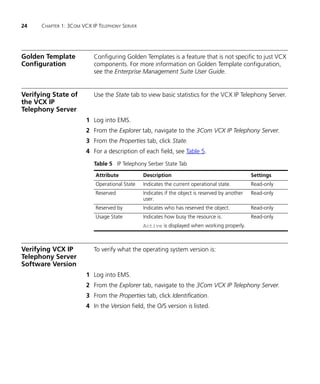
Verifying State of         Use the State tab to view basic statistics for the VCX IP Telephony Server.
the VCX IP
Telephony Server
                        1 Log into EMS.
                        2 From the Explorer tab, navigate to the 3Com VCX IP Telephony Server.
                        3 From the Properties tab, click State.
                        4 For a description of each field, see Table 5.
                           Table 5 IP Telephony Serber State Tab

                            Attribute           Description                                      Settings
                            Operational State   Indicates the current operational state.         Read-only
                            Reserved            Indicates if the object is reserved by another   Read-only
                                                user.
                            Reserved by         Indicates who has reserved the object.           Read-only
                            Usage State         Indicates how busy the resource is.              Read-only
                                                Active is displayed when working properly.


Verifying VCX IP           To verify what the operating system version is:
Telephony Server
Software Version
                        1 Log into EMS.
                        2 From the Explorer tab, navigate to the 3Com VCX IP Telephony Server.
                        3 From the Properties tab, click Identification.
                        4 In the Version field, the O/S version is listed.
VCX IP Telephony Server Identification Tab     25


VCX IP Telephony            Use the Identification tab to view basic statistics for the operating system
Server                      such as the software version.
Identification Tab

    Identification Tab      To view the Identification tab:
              Location
                         1 Log into EMS.
                         2 From the Explorer tab, navigate to the 3Com VCX IP Telephony Server.
                         3 From the Properties tab, click Identification.
                         4 For a description of each field, see Table 6.
                            Table 6 IP Messaging Identification Tab

                            Attribute          Description                                       Settings
                            Class              The internal schema className for this            Read-only
                                               object.
                            FQN                The fully qualified name of this object. This is Read-only
                                               the complete path from the root of all
                                               objects.
                            Location           Identified the physical location of the server.   String
                            Serial Number      Serial Number of the server.                      Read-only
                                               This field is reserved for future use.
                            Site Type          Identifies what type of office this server is.    Read-only
                                               1 – unknown
                                               2 – regional
                                               3 – branch
                                               4 – standalone
                            (continued)
26   CHAPTER 1: 3COM VCX IP TELEPHONY SERVER


                           Table 6 IP Messaging Identification Tab

                           Attribute           Description                                  Settings
                           System Type         Identifies the server type based on the      Read-only
                                               components that are installed and running
                                               on this server, which affect the features
                                               made available by the server.
                                               ■   allComponents – both the IP
                                                   Telephony and IP Messaging servers are
                                                   installed
                                               ■   callServer – only the VCX Call
                                                   Processor is installed
                                               ■   dataServer – only the VCX Data Server
                                                   is installed
                                               ■   ipMessagingServer – only the IP
                                                   Messaging server is installed
                                               ■   Softswitch – only the IP Telephony
                                                   server is installed
                                               ■   billingSupportServer – only the
                                                   billing support server is installed
                                               ■   undetermined – cannot determine
                                                   server tye
                           User Label          A label assign by the user.                  String
                           Vendor              The vendor name of this software.            Read-only
                           Version             The current version of this software.        Read-only

                           To view the latest values, click Refresh.

Verifying the Type of      To determine if the server is a regional or branch office:
   Office Configured
                        1 Log into EMS.
                        2 From the Explorer tab, navigate to the 3Com VCX IP Telephony Server.
                        3 From the Properties tab, click Identification.
                        4 From the Site Type field, the office type is listed such as regional or
                          branch.
Verifying the Amount of Disk Spaced Used on an IP Telephony Server   27


 Verifying the Type of      To determine the type of components installed on a server:
Components Installed
           on a Server
                         1 Log into EMS.
                         2 From the Explorer tab, navigate to the 3Com VCX IP Telephony Server.
                         3 From the Properties tab, click Identification.
                         4 From the System Type field, the type of server is listed, which is used to
                           determine what components are installed. See the Installation and
                           Maintenance Guide for an overview of what components are available
                           with each configuration listed.


Verifying the               This option is useful for monitoring how much space is left on a server for
Amount of Disk              log files, back-ups, and any processes that require disk space. You can
Spaced Used on an           even configure traps to warn you of when disk space is becoming limited
IP Telephony Server         so you know to purge old files and increase space availability.
                         1 Log into EMS.
                         2 From the Explorer tab, navigate to the 3Com VCX IP Telephony Server.
                         3 From the Properties tab, click Memory.
                         4 From the Memory Utilization (%) field, the percentage the total amount
                           of space used is listed. If the server has reached 100, there is no more
                           space left on this server.


Configuring Date            This section provides information on how to configure the timezone,
and Time Variables          time, and date for an IP Telephony Server. This option can sometimes be
for the IP                  used in place of the vcx-config-network --wizard script.
Telephony Server            In a VCX system the daylight savings and timezone configuration should
                            only be modified using the vcx-config-network -- wizard tool that is
                            located on the VCX server. Even though it appears the timezone and
                            daylight savings time can be modified using Enterprise Management
                            Suite (EMS), all configurations are not currently supported since you
                            cannot change the daylight savings status (enabled to disabled or vice
                            versa) from the original configuration. Also, not as many timezone
                            options are available in EMS as there are through the
                            vcx-config-network -- wizard tool.

                            When using the vcx-config-network -- wizard tool, both the Daylight
                            Savings and Timezone preference are configured at the same time.
28     CHAPTER 1: 3COM VCX IP TELEPHONY SERVER


Configuring the Date        To modify the configured date of an IP Telephony Server:
  of an IP Telephony
               Server
                         1 Log into EMS.
                         2 From the Explorer tab, navigate to the 3Com VCX IP Telephony Server.
                         3 From the Properties tab, click Time.
                         4 From the Date field, enter the new date in the DD:MM:YYYY format.
                         5 Click Save All.

Configuring the Time        To modify the configured time of an IP Telephony Server:
  of an IP Telephony
               Server
                         1 Log into EMS.
                         2 From the Explorer tab, navigate to the 3Com VCX IP Telephony Server.
                         3 From the Properties tab, click Time.
                         4 From the Time field, enter the new time in the HH:MM:SS format. You
                           must use military time (24 hour format).
                         5 Click Save All.

       Configuring the      To modify the configured timezome of an IP Telephony Server:
     Timezone of an IP
     Telephony Server

                            Using the vcx-config-network -- wizard tool is actually preferred if
                            possible since both the Daylight Savings and Timezone preference are
                            configured at the same time.
                         1 Log into EMS.
                         2 From the Explorer tab, navigate to the 3Com VCX IP Telephony Server.
                         3 From the Properties tab, click Time.
                         4 From the Timezone field, double-click the field and choose a new
                           timezone from the drop-down menu.
                         5 Click Save All.
Configuring Authorization Station Agents   29


Configuring              For this feature to become available (activated), you must enter the
Authorization            IP addresses of the Authorized Management Stations when prompted during
Station Agents           the installation and initial configuration of the VCX IP Telephony System.

                         If at least one IP address is entered, this feature becomes active, and only
                         that machine can manage the server. If no IP addresses are configured at
                         initial installation, the feature is not enabled (not activated).

                         The Authorized Stations table lists which IP addresses the common agent
                         accepts SNMP request from. Requests originating from other sources are
                         dropped. This is a security feature on the common agent.

  Adding Authorized      Authorized station agents can only be added if an authorized station
     Station Agents      station agent was added when the IP Telephony Server was initially
                         configured. Up to four authorized station agents can be configured.

                         To add authorized station agents:
                       1 From the explorer tree in EMS, click on the IP Telephony Server you want
                         to add authorized station agents to.
                       2 From the right-hand pane, click the Authorized Stations tab.
                       3 Click Add.
                         The Add row to table window appears.
                       4 From the IP field, enter the IP address of the server you want to be
                         allowed as an authorized station agent.
                       5 From the NetMask field, enter the subnet mask IP address of the server.
                       6 Click OK.
                         The authorized agent is added to the table.

 Deleting Authorized     To delete an authorized station agents:
      Station Agents
                       1 From the explorer tree in EMS, click on the IP Telephony Server you want
                         to delete an authorized station agents from.
                       2 From the right-hand pane, click the Authorized Stations tab.
                       3 Click the row containing the IP address you want to delete.
                       4 Click Delete.
                         The authorized agent is deleted from the table.
30    CHAPTER 1: 3COM VCX IP TELEPHONY SERVER


Enabling and               Through EMS you can enable and disable the web provisioning server
Disabling the Web          (Tomcat). When disabled, the administrator cannot access the VCX data
Provisioning Server        server configurables through the web provisioning server.
(Tomcat)
                           To enable or disable the web provisioning server GUI:
                        1 From the EMS explorer tree, navigate to the 3Com VCX IP Telephony
                          Server.
                        2 Right-click and select Web Provisioning and then click one of the
                          following depending on whether you need to enable or disable the web
                          provisioning server:
                           ■   Enable – click Enable Web Provisioning.
                           ■   Disable – click Disable Web Provisioning.


Rediscovering the          After making configuration changes on any of the VCX components,
IP Telephony Server        rediscover the 3Com VCX IP Telephony Server to refresh the
in EMS                     configuration MIB values.

                           To rediscover to 3Com VCX IP Telephony Server in EMS:
                        1 In the explorer tree, right-click the 3Com VCX IP Telephony Server.
                        2 From the pop-up menu, click Rediscover.

                           The progress is shown in the Job Progress section of the EMS GUI. When
                           the command has completed, the Working icon (it is yellow) changes to a
                           Finished icon (it becomes green).
Back-end Server Maintenance   31


Back-end Server          This section provides maintenance tasks that are specific to the XML
Maintenance              accounting and VCX data servers.

    Monitoring XML       The Monitor State command opens the Monitor State window. Use this
  Accounting Server      window to monitor the operational state, usage state, or administration
 Activity on the XML     state of the accounting server.
  Accounting Server
                         To monitor the activity of the XML accounting server:
                       1 In the explorer tree, right-click the 3COM XML accounting server.
                       2 From the pop-up menu, click Monitor State.

                         Refer to the Enterprise Management Suite User Guide for more
                         information.

                         Rediscovering the XML Accounting Server
                         After making configuration changes on the accounting server, rediscover
                         the 3Com VCX IP Telephony Server to refresh the configuration MIB
                         values.

                         To rediscover to 3Com VCX IP Telephony Server:
                       1 In the explorer tree, right-click the 3Com VCX IP Telephony Server.
                       2 From the pop-up menu, click Rediscover.
                         The progress is shown in the Job Progress section of the EMS GUI.
                         When the command has completed, the Working icon (it is yellow)
                         changes to a Finished icon (it becomes green).

  Restarting Systems     After performing routine maintenance on either the XML accounting and
        and Services     the VCX data servers must be restarted.

                         To restart the back-end server systems and services:
                       1 From the explorer tree, click the individual component.
                       2 Right-click and select Maintenance, and then click Hard Restart.
32    CHAPTER 1: 3COM VCX IP TELEPHONY SERVER


       Reserving and       The Operator Reserve command reserves either the XML accounting or
     Unreserving the       the VCX data servers so that no one else can perform operations on the
     Back-end Server       server except the administrator. The Operator Unreserve command
                           cancels the reservation.

                           Reserving Back-end Servers
                           To reserve the back-end server using EMS:
                        1 In the explorer tree, right-click the individual back-end server.
                        2 From the pop-up menu, click Operator Reserve to reserve the back-end
                          server.

                           If the back-end server is reserved, check the State tab to see who has
                           reserved the card.

                           Unreserving Back-end Servers
                           To unreserve either the XML accounting or the VCX data servers:
                        1 In the explorer tree, right-click the back-end server.
                        2 From the pop-up menu, click Operator Un-reserve to unreserve the
                          back-end server.

 Updating the Server       Use the State command to update EMS with the current operational
               State       state, usage state, or administration state of the back-end server.

                           To update the state of either the XML accounting or the VCX data
                           servers:
                        1 In the explorer tree, right-click the back-end server.
                        2 From the pop-up menu, select State and then click Update.
Configuring Replication for the VCX Data Server   33


Configuring               This section provides instructions on how to setup replication, check
Replication for the       replication, delete replication errors, and drop replication for the VCX IP
VCX Data Server           Telephony Server data server.

           Setting Up     This section provides instructions on how to setup replication for a VCX
Replication for a VCX     data server. This will only setup replication in one direction. You need to
          Data Server     repeat these steps for each set of VCX data servers you want to
                          replication between.
                        1 From the EMS client explorer tree, for the VCX data server you want to
                          connect to another VCX data server from, click 3Com VCX IP Telephony
                          Server.
                        2 In the right-hand pane, click the Replication Settings tab.
                        3 From the Master Def Site IP Address field, enter the IP Address of the
                          master definition site (usually the region 1 primary VCX data server).
                        4 From the Master Site IP Address field, enter the IP Address of the master
                          site (usually the region 2 primary VCX data server).
                        5 From the Site ID field, enter the site ID of the Region 1 VCX data server.
                        6 Click Save All.
                        7 Right-click 3Com VCX IP Telephony Server, select Database Replication,
                          and then click Setup Database Replication.
                        8 Repeat step 1 through step 7 to setup replication from the other
                          direction.

 Dropping Replication     This section provides instructions on how to drop replication for a VCX
for a VCX Data Server     data server. This will only drop replication in one direction. You need to
                          repeat these steps for each set of VCX data servers you want to drop
                          replication between.
                        1 From the EMS client explorer tree, for the VCX data server you want to
                          drop replication from, click 3Com VCX IP Telephony Server.
                        2 Right-click 3Com VCX IP Telephony Server, select Database Replication,
                          and then click Drop Database Replication.
                          Repeat step 1 through step 2 for any other direction you need to drop
                          replication for.
34    CHAPTER 1: 3COM VCX IP TELEPHONY SERVER


Checking Replication       This feature is useful if you want to verify that replication is set-up
Status on a VCX Data       correctly or if you want to determine if replication has finished setup
              Server       when the setupReplication command is issued.
                        1 From the EMS client explorer tree, for the VCX data server you want to
                          drop replication from, click 3Com VCX IP Telephony Server.
                        2 Right-click 3Com VCX IP Telephony Server, select Database Replication,
                          and then click Check Database Replication.
                           .The Job Progress section of the EMS client indicates the Replication state.

 Deleting Replication      This section provides details on how to use the VCX replication error
   Errors on the VCX       deletion script. Replication errors occasionally need to be deleted, for
         Data Server       instance, before you perform an upgrade.
                        1 From the EMS client explorer tree, for the VCX data server you want to
                          drop replication from, click 3Com VCX IP Telephony Server.
                        2 Right-click 3Com VCX IP Telephony Server, select Database Replication,
                          and then click Clear Replication Errors.


Managing SSH               EMS provides a graphical method for creating and editing SSH scripts.
Scripts                    This provides an easy way to configure scripts to execute commands such
                           as performing a backup, modifying users, setting trap destinations, or
                           rebooting a device. You can preserve per device settings such as IP
                           addresses by inserting tokens into a script to be substituted at apply-time.
                           See the “Telnet Scripting Configuration” chapter in the
                           Enterprise Management Suite User Guide for more information and
                           instructions.
RAID Monitoring    35


RAID Monitoring         EMS provides a method for viewing RAID partitions and Active Drives.

                        To view RAID partitions:
                      1 Log into EMS.
                      2 From the Explorer tab, navigate to the 3Com VCX IP Telephony Server.
                      3 From the Properties tab, click RAID Partitions.

                        To view RAID active drives:
                      1 Log into EMS.
                      2 From the Explorer tab, navigate to the 3Com VCX IP Telephony Server.
                      3 From the Properties tab, click RAID Active Drives.


UPS Monitoring          EMS allows you to remotely set up UPS master/slaves. Additionally, if UPS
                        monitoring is enabled, EMS displays monitoring data and data on UPS
                        slaves.

     Setting Up UPS     To set up UPS master/slaves:
      Master/Slaves
                      1 Log into EMS.
                      2 From the Explorer tab, right-click 3Com VCX IP Telephony Server.
                      3 From the pop-up menu, select UPS Monitoring and then select Setup as
                        Master or Setup as Slave.

       Enabling UPS     To enable or disable UPS monitoring:
         Monitoring
                      1 Log into EMS.
                      2 From the Explorer tab, right-click 3Com VCX IP Telephony Server.
                      3 Configure the information for the slave.
                        ■   For Master Slave configuration, complete the information as described
                            Table 7.
                        ■   For Slave configuration, complete the information as described in
                            Table 8.
                        For complete details of each attribute, view the context-sensitive help for
                        each attribute in EMS.
36       CHAPTER 1: 3COM VCX IP TELEPHONY SERVER


                              Table 7 UPS Master Setup Parameters Tab

                               Attribute              Description
                               BatteryCharge          The percentage battery charge threshold in UPS before
                                                      starting a shutdown.
                               IPAddress1             IP address of the first UPS.
                               IPAddress1Community    The community string of the first UPS.
                               IPAddress2             IP address of the second UPS.
                               IPAddress2Community    The community string of the second UPS.


                              Table 8 UPS Slave Setup Parameters Tab

                               Attribute              Description
                               IsMultipleUPSEnabled   Determines if multiple UPSes are enabled.
                               UPSServerIPAddr        The VCX server acting as a UPS monitor.

                           4 From the pop-up menu, select UPS Monitoring and then select
                             Enable UPS Monitoring.
                              To disable UPS monitoring, select Disable UPS Monitoring.

           Viewing UPS        To view UPS monitoring information:
             Monitoring
            Information

                           1 Log into EMS.
                           2 From the Explorer tab, navigate to the 3Com VCX IP Telephony Server.
                           3 From the Properties tab, click UPS Monitoring.

     Viewing UPS Slaves       To view UPS slaves:
                           1 Log into EMS.
                           2 From the Explorer tab, navigate to the 3Com VCX IP Telephony Server.
                           3 From the Properties tab, click UPS Slaves.
CONFIGURING THE VCX DATA
   2                      SERVER


VCX Data Server           Use EMS to edit basic information for database identification.
Database
Configuration

   Changing the VCX       Change the database name for the VCX data server using EMS:
Data Server Database
               Name
                       1 From the Explorer tab, select the VCX data server.
                       2 From the Properties tab, select the Database Configuration tab.
                       3 In the Name column, double-click the associated field and enter the new
                         database name.
                       4 Click Save all.

   Changing the VCX       Change the database server name for the VCX data server using EMS:
Data Server Database
        Server Name
                       1 From the Explorer tab, select the accounting server.
                       2 From the Properties tab, select the Database Configuration tab.
                       3 In the ServerName column, double-click the associated field and enter the
                         new database server name.
                          For example, cwbes.
                       4 Click Save all.
38    CHAPTER 2: CONFIGURING THE VCX DATA SERVER


   Changing the VCX        Change the database user name for the VCX data server using EMS:
Data Server Database
          User Name
                        1 From the Explorer tab, select the VCX data server.
                        2 From the Properties tab, select the Database Configuration tab.
                        3 In the UserName column, double-click the associated field and enter the
                          new database user name.
                           For example, sys.
                        4 Click Save all.

   Changing the VCX        Change the database user password for the VCX data server using EMS:
Data Server Database
      User Password
                        1 From the Explorer tab, select the VCX data server.
                        2 From the Properties tab, select the Database Configuration tab.
                        3 In the UserPasswd column, double-click the associated field and enter the
                          new database user password.
                           For example, besgroup.
                        4 Click Save all.


Configuring the            Configure the database keep alive timeout setting for the VCX data
VCX Data Server            server using EMS:
Database Keep
Alive Timeout
                        1 From the Explorer tab, select the VCX data server.
                        2 From the Properties tab, select the Database Configuration tab.
                        3 In the KeepAlive column, double-click the associated field and enter the
                          new keep alive timeout.
                           The default setting is 20000. The range is 20000 through 1000000.
                        4 Click Save all.
Configuring the VCX Data Server Client Activity Interval   39


Configuring the         Configure the client activity interval for the VCX data server using EMS:
VCX Data Server
Client Activity
Interval
                     1 From the Explorer tab, select the VCX data server.
                     2 From the Properties tab, select the BES Common Configuration tab.
                     3 Double-click the ClientActivityInterval field and enter the client activity
                       interval in milliseconds.
                        The default setting is 200000. The range is 2000 through 200000.
                     4 Click Save all.


Configuring VCX         Configure client request threads for the for the VCX data server using
Data Server Client      EMS:
Request Threads
                     1 From the Explorer tab, select the VCX data server.
                     2 From the Properties tab, select the BES Common Configuration tab.
                     3 Double-click the ClientReqThreads field and enter the client request
                       threads.
                        The range is 4 through 20.
                     4 Click Save all.


Configuring the         Configure the logging level for the VCX data server using EMS:
VCX Data Server
Logging Level
                     1 From the Explorer tab, select the VCX data server.
                     2 From the Properties tab, select the BES Common Configuration tab.
                     3 Double-click the LogLevel field and enter the logging level.
                        The default setting is 0. The range is 1 through 255.
                     4 Click Save all.
40   CHAPTER 2: CONFIGURING THE VCX DATA SERVER


Enabling VCX Data         Server packet tracing is enabled by default.
Server Packet
Tracing                   Enable packet tracing for VCX data server using EMS:
                       1 From the Explorer tab, select the VCX data server.
                       2 From the Properties tab, select the BES Common Configuration tab.
                       3 Double-click the PacketTracing field and select enable from the
                         drop-down list.
                       4 Click Save all.


VCX Data Server           Enterprise Management Suite (EMS) contains several common
Configuration Tab         configuration tabs. Most of these configurables must be set to their
Descriptions              initial, default configuration.

        Tab Location      These tabs are available for the VCX data server.

                          To access these tabs:
                       1 From the EMS GUI, navigate to the 3Com VCX IP Telephony Server within
                         the Equipment folder.
                       2 Click 3COM VCX Data Server.
                       3 From the left-hand of the GUI, select the Properties tab (default).

       3 Q Protocol       Use the 3 Q Protocol Configuration tab to enable the proprietary 3Q
      Configuration       protocol for the VCX data server.
                          Table 9 3 Q Protocol Configuration Tab

                           Attribute          Description                              Settings
                           3QenablesStatus    Whether or not 3Q Protocol is enabled.   Read-only
                           ClientThread       Number of threads to receive data        Integer
                                                                                       Range: 1- 4
                           ControlIPAddress   IP address of the Linux workstation      Read-only
                                              receiving Control Messages.
                           ControlPort        Control port number. Default = 1784.     Read-only
                           DataIPaddress      IP address of the Linux workstation      Read-only
                                              receiving data.
                           DataPort           Data port number. Default = 1789         Read-only
VCX Data Server Configuration Tab Descriptions         41


 BES Common      Use the BES Common Configuration tab to enable packet tracing for the
Configuration    VCX data server.
                 Table 10 BES Common Configuration Tab

                 Attribute                Description                                Settings
                 ClientActivityInterval   Keep alive interval in milliseconds.       Integer
                                          Default = 200000
                                                                                     Range: 2000 -
                                                                                     200000
                 ClientReqThreads         Number of Application thread to process Integer
                                          data
                                                                                  Range: 4 - 20
                 InstallationType         Indicates if this back-end server is part of Read-only
                                          a regional office (rocsa) or branch office
                                          (losca).
                 LogLevel                 The logging level that is supported by     Integer
                                          the Back End Server. Default = 0
                                                                                     Range: 0 - 255
                 PacketTracing            Enable or disable packet tracing           default = enable
                                                                                     disable
                 UseTrustedClientList     Whether the use of trusted endpoint list   default = enable
                                          is enabled or disabled.
                                                                                     disable


BES Common       Use the BES Common Statistics tab to view common statistics for the VCX
    Statistics   data server.
                 Table 11 BES Common Statistics Tab

                 Attribute                     Description                              Settings
                 ServerUpTime                  Server Up Time                           Read-only
                 TotalDuplicateRequests        Total Duplicate Request                  Read-only
                 TotalIncommingrequests        Total Incoming Request                   Read-only
                 TotalInvalidRequests          Total Invalid Request                    Read-only
                 TotalMalformedRequests        Total Malformed Requests                 Read-only
                 TotalNumOfResponses           Total Number of Responses                Read-only
                 TotalPacketeDropped           Total Packets Dropped                    Read-only
                 TotalPendingRequests          Total Pending Requests                   Read-only
                 TotalUnknownTypes             Total Unknown Types                      Read-only
42   CHAPTER 2: CONFIGURING THE VCX DATA SERVER


       Flow Control       Use the Flow Control Configuration tab to view basic statistics for the
      Configuration       VCX data server.
                          Table 12 State Tab

                           Attribute           Description                                        Settings
                           Active Status       Indicates the current operational state.           enable
                                                                                                  disable
                           MaxCount            Max number of messages that can be queued Integer
                                               or processed at any instant. A value of zero
                                                                                            Range: 0 - 150
                                               will disable Flow Control.
                           MaxQueueFullTime Max time in seconds that the queue will               Integer
                                            remain full. A value of zero will disable Flow
                                                                                                  Range: 0 - 60
                                            Control.


      Identification      Use the Identification tab to view basic statistics for the VCX data server.
                          Table 13 Identification Tab

                           Attribute              Description                                    Settings
                           Alias                  A management defined alias for the entity      String
                                                  saved across reboots.
                           Class                  The internal schema className for this         Read-only
                                                  object.
                           FQN                    The fully qualified name of this object. This is Read-only
                                                  the complete path from the root of all
                                                  objects.
                           Last State Change      The value of sysUpTime at the time the entity Read-only
                                                  entered its current operational state.
                           User Label             A label assign by the user.                    String
                           Vendor                 The vendor name of this software.              Read-only
                           Version                The current version of this software.          Read-only


                State     Use the State tab to view basic statistics for the VCX data server.
                          Table 14 State Tab

                           Attribute           Description                                        Settings
                           Operational State   Indicates the current operational state.           Read-only
                           Reserved            Indicates if the object is reserved by another     Read-only
                                               user.
                           (continued)
VCX Data Server Maintenance           43


                         Table 14 State Tab (continued)

                          Attribute         Description                                    Settings
                          Reserved by       Indicates who has reserved the object.         Read-only
                          Software status   The current operational state of the entity. If Read-only
                                            AdminStatus is down, then OperStatus should
                                                                                            Default = up
                                            be down. If AdminStatus is changed to up,
                                            through the entity command interface, then
                                            OperStatus should change to up if the entity
                                            is operational; it should remain in the down
                                            state if and only if there is a fault that
                                            prevents it from going to the up state; it
                                            should remain in the notPresent state if the
                                            entity has missing components. If the entity is
                                            operational, but not responding to queries,
                                            the state is notResponding.
                          Usage State       Indicates how busy the resource is.            Read-only


VCX Data Server          This section provides maintenance tasks that are specific to just the VCX
Maintenance              data server.

  Restarting the VCX     To restart the VCX data server:
         Data Server
                       1 From the EMS explorer tree, navigate to the 3Com VCX Data Server.
                       2 Right-click the VCX data server and select Maintenance and then click
                         Hard Restart.

  Shutting Down the      To shut down the VCX data server:
    VCX Data Server
                       1 From the EMS explorer tree, navigate to the 3Com VCX Data Server.
                       2 Right-click the VCX data server and select Maintenance and then click
                         Hard Shutdown.
44     CHAPTER 2: CONFIGURING THE VCX DATA SERVER


     Verifying the VCX      To verify the state of the VCX data server using EMS:
     Data Server State
                         1 Login to EMS.
                         2 Navigate to the VCX data server.
                         3 The state icon light that appears next to the 3COM VCX Data Server
                           identifies these states:
                            ■   green — it is running
                            ■   yellow – transitioning to another state
                            ■   red — it is down
CONFIGURING THE XML
    3                   ACCOUNTING SERVER


Configuring the         Configure the client activity interval for the accounting server using either
Client Activity         the server configuration file (acctconfig.xml) or Enterprise Management
Interval                Suite.

                        To configure the client activity interval for the accounting server using
                        EMS:
                     1 From the Explorer tab, select the accounting server.
                     2 From the Properties tab, select the BES Common Configuration tab.
                     3 Double-click the ClientActivityInterval field and enter the client activity
                       interval in milliseconds.
                        The default setting is 20000. The range is 2000 through 200000.
                     4 Click Save all.


Configuring Client      To configure client request threads for the accounting server using EMS:
Request Threads
                     1 From the Explorer tab, select the accounting server.
                     2 From the Properties tab, select the BES Common Configuration tab.
                     3 Double-click the ClientReqThreads field and enter the client request
                       threads.
                        The range is 4 through 20.
                     4 Click Save all.
46    CHAPTER 3: CONFIGURING THE XML ACCOUNTING SERVER


Configuring the            To configure the logging level for the accounting server using EMS:
Logging Level
                        1 From the Explorer tab, select the accounting server.
                        2 From the Properties tab, select the BES Common Configuration tab.
                        3 Double-click the LogLevel field and enter the logging level.
                           The default setting is 0. The range is 1 through 255.
                        4 Click Save all.


XML CDR                    This section provides details on how you can set-up the accounting server
Configuration              for CDR collection.

     XML CDR Control       Use the XML CDR Configuration tab to set CDR collection variables for
                           the accounting server.
                           Table 15 XML CDR Configuration Tab

                            Attribute                     Description                           Settings
                            CdrAutoCleanLatestBad         Whether or not the CDR files          enable
                                                          are removed automatically,
                                                                                                default =
                                                          periodically if the file is corrupt
                                                                                                disable
                                                          or missing.
                            CdrAutoCleanLatestBadPeriod   Number of 30 minute periods           1 through
                                                          to wait before automatically          65535
                                                          removing finished CDR files if
                                                                                                default = 96
                                                          the latest file is missing or
                                                          invalid.
                                                          NOTE: Requires
                                                          cdrAutoCleanIfLatestBad to be
                                                          enabled.
                            CdrAutoCleanLatestStale       Whether or not the CDR files          enable
                                                          are removed automatically,
                                                                                                default =
                                                          periodically if the latest file is
                                                                                                disable
                                                          unchanged in a specified
                                                          period.
                            (continued)
Enabling Packet Tracing         47


                     Table 15 XML CDR Configuration Tab

                     Attribute                       Description                        Settings
                     CdrAutoCleanLatestStalePeriod   Number of 30 minute periods        1 through
                                                     to wait before automatically       65535
                                                     removing finished CDR files if
                                                                                        default = 96
                                                     the latest file is not changed
                                                     within a specified period.
                                                     NOTE: Requires
                                                     cdrAutoCleanIfLatestStale to be
                                                     enabled.
                     CdrBaseName                     Name of CDR files assigned.        String
                     CdrDelimiter                    Not Used                           N/A
                     CdrFilePath                     Path to where the XML based       String
                                                     CDR files are put relative to the
                                                     server install directory root.
                     CdrFileType                     Not Used                           N/A
                     CdrNameTimeStamp                Not Used                           N/A
                     CdrRecordsPerFile               The maximum number of CDRs 1 through
                                                     per file.                  65535
                                                                                        default = 500
                     CdrTimeToClose                  The maximum time a CDR file        1 through
                                                     stays open after it has at least   65535
                                                     one CDR record in it.
                                                                                        default = 120


Enabling Packet      To enable packet tracing for the accounting server using EMS:
Tracing
                  1 From the Explorer tab, select the accounting server.
                  2 From the Properties tab, select the BES Common Configuration tab.
                  3 Double-click the PacketTracing field and select enable from the
                    drop-down list.
                  4 Click Save all.
48   CHAPTER 3: CONFIGURING THE XML ACCOUNTING SERVER


XML Accounting            Enterprise Management Suite (EMS) contains several common
Server                    configuration tabs. Most of these configurables must be set to their
Configuration Tab         initial, default configuration.
Descriptions

        Tab Location      These tabs are available for the accounting server.

                          To access these tabs:
                       1 From the EMS GUI, navigate to the 3Com VCX IP Telephony Server within
                         the Equipment folder.
                       2 Click on either the XML Accounting Server tab.
                       3 From the left-hand of the GUI, select the Properties tab (default).

       3 Q Protocol       Use the 3 Q Protocol Configuration tab to enable the proprietary 3Q
      Configuration       protocol for the accounting server.
                          Table 16 3 Q Protocol Configuration Tab

                           Attribute          Description                              Settings
                           3QenablesStatus    Whether or not 3Q Protocol is enabled.   Read-only
                                                                                       default = enabled
                           ClientThread       Number of threads to receive data        Integer
                                                                                       Range: 1- 4
                                                                                       default = 2
                           ControlIPAddress   IP address of the Linux workstation      Read-only
                                              receiving Control Messages.
                           ControlPort        Control port number.                     Read-only
                                                                                       default = 1781
                           DataIPaddress      IP address of the Linux workstation      Read-only
                                              receiving data.
                           DataPort           Data port number. DEFAULT = 1788         Read-only
                                                                                       default = 1786
XML Accounting Server Configuration Tab Descriptions         49


 BES Common      Use the BES Common Configuration tab to enable packet tracing for the
Configuration    accounting server.
                 Table 17 BES Common Configuration Tab

                 Attribute                  Description                                Settings
                 ClientActivityInterval     Keep alive interval in milliseconds.       Integer
                                            Default = 200000
                                                                                       Range: 2000 -
                                                                                       200000
                 ClientReqThreads           Number of Application thread to process Integer
                                            data
                                                                                    Range: 4 - 20
                                                                                       default = 4
                 InstallationType           Indicates if this back-end server is part of Read-only
                                            a regional office (rocsa) or branch office
                                            (losca).
                 LogLevel                   The logging level that is supported by     Integer
                                            the Back End Server. Default = 0
                                                                                       Range: 0 - 255
                 PacketTracing              Enable or disable packet tracing           enable
                                                                                       default = disable
                 UseTrustedClientList       Whether the use of trusted endpoint list   enable
                                            is enabled or disabled.
                                                                                       default = disable


BES Common       Use the BES Common Statistics tab to view common statistics for the
    Statistics   accounting server.
                 Table 18 BES Common Statistics Tab

                 Attribute                       Description                              Settings
                 ServerUpTime                    Server Up Time                           Read-only
                 TotalDuplicateRequests          Total Duplicate Request                  Read-only
                 TotalIncommingrequests          Total Incoming Request                   Read-only
                 TotalInvalidRequests            Total Invalid Request                    Read-only
                 TotalMalformedRequests          Total Malformed Requests                 Read-only
                 TotalNumOfResponses             Total Number of Responses                Read-only
                 TotalPacketeDropped             Total Packets Dropped                    Read-only
                 TotalPendingRequests            Total Pending Requests                   Read-only
                 TotalUnknownTypes               Total Unknown Types                      Read-only
50   CHAPTER 3: CONFIGURING THE XML ACCOUNTING SERVER


       Flow Control       Use the Flow Control Configuration tab to view basic statistics for the
      Configuration       accounting server.
                          Table 19 State Tab

                           Attribute           Description                                     Settings
                           Active Status       Indicates the current operational state.        enable
                                                                                               disable
                           MaxCount            Max number of messages that can be queued Integer
                                               or processed at any instant. A value of zero
                                                                                            Range: 0 - 150
                                               will disable Flow Control.
                           MaxQueueFullTime Max time in seconds that the queue will            Integer
                                            remain full. A value of zero will disable Flow
                                                                                               Range: 0 - 60
                                            Control.


      Identification      Use the Identification tab to view basic statistics for the accounting
                          server.
                          Table 20 Identification Tab

                           Attribute           Description                                    Settings
                           Alias               A management defined alias for the entity      String
                                               saved across reboots.
                           Class               The internal schema className for this         Read-only
                                               object.
                           FQN                 The fully qualified name of this object. This is Read-only
                                               the complete path from the root of all
                                               objects.
                           Last State Change   The value of sysUpTime at the time the entity Read-only
                                               entered its current operational state.
                           User Label          A label assign by the user.                    String
                           Vendor              The vendor name of this software.              Read-only
                           Version             The current version of this software.          Read-only
Accounting Server Maintenance        51


               State      Use the State tab to view basic statistics for the accounting server.
                          Table 21 State Tab

                           Attribute           Description                                      Settings
                           Operational State   Indicates the current operational state.         Read-only
                           Reserved            Indicates if the object is reserved by another   Read-only
                                               user.
                           Reserved by         Indicates who has reserved the object.           Read-only
                           Software status     The current operational state of the entity. If Read-only
                                               AdminStatus is down, then OperStatus should
                                               be down. If AdminStatus is changed to up,
                                               through the entity command interface, then
                                               OperStatus should change to up if the entity
                                               is operational; it should remain in the down
                                               state if and only if there is a fault that
                                               prevents it from going to the up state; it
                                               should remain in the notPresent state if the
                                               entity has missing components. If the entity is
                                               operational, but not responding to queries,
                                               the state is notResponding.
                           Usage State         Indicates how busy the resource is.              Read-only


Accounting Server         This section provides maintenance tasks that are specific to just the
Maintenance               accounting server.

       Restarting the     To restart the accounting server:
   Accounting Server
                        1 From the EMS explorer tree, navigate to the 3Com XML Accounting
                          Server.
                        2 Right-click the accounting server and select Maintenance and then click
                          Hard Restart.

       Stopping the       To stop the accounting server:
   Accounting Server
                        1 From the EMS explorer tree, navigate to the 3Com XML Accounting
                          Server.
                        2 Right-click the accounting server and select Maintenance and then click
                          Hard Shutdown.
52      CHAPTER 3: CONFIGURING THE XML ACCOUNTING SERVER


         Verifying the       To verify the state of the accounting server using EMS:
     Accounting Server
                 State
                          1 Login to EMS.
                          2 Navigate to the accounting server.
                          3 The status indicator light that appears next to the 3COM XML Accounting
                            Server identifies these states:
                             ■   green — it is running
                             ■   red — it is down


QoS Monitoring               The XML Accounting Server collects QoS Monitoring reports generated
                             by the VCX Call Processor.

                             On the XML Accounting Server you can:
                             ■   Set QoS collection parameters, which determine when the system
                                 issues Warning or Critical severity traps based on QoS measurements
                             ■   View call history
                             ■   View phone statistics
                             ■   View Quality Detail Reports (QDRs)

                             See Chapter 10, Using QoS Monitoring, for more information and
                             instructions.
CONFIGURING THE CALL
     4                       PROCESSOR


Configuring SIP Call         This section provides information on how to configure the SIP Call
Processor                    Processor.

                             To configure the SIP Call Processor using EMS:
                         1 Log into EMS.
                         2 From the Explorer tab, navigate to the 3Com Sip Call Processor.
                         3 From the Properties tab, click Configuration.
                         4 Double-click any of the fields under the 3COM Sip Call Processor column
                           and configure according to the descriptions within Table 22.
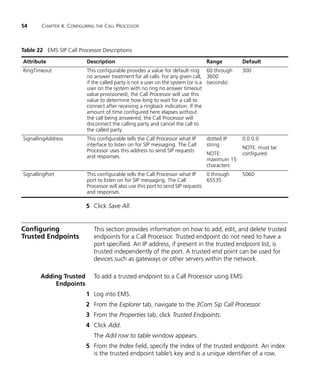
Table 22 EMS SIP Call Processor Descriptions

Attribute                 Description                                            Range         Default
AnonymousCallerString     This configurable determines what value the Call        any string   anonymous
                          Processor will expect in the from field of an
                          incoming SIP INVITE to indicate that the caller is
                          suppressing their caller Id. This is one of the ways in
                          which the Call Processor determines that an
                          incoming caller id is suppressed.
AuthDomainString          This configurable determines what value the Call       any string    3Com
                          Processor will send in the "domain" parameter of
                          the authentication challenge to SIP Endpoints.
AuthRealmString           This configurable determines what value the Call    any string       3Com
                          Processor will send in the "realm" parameter of the
                          authentication challenge to SIP Endpoints.
ChallengeAllCalls         This configurable tells the Call Processor to        true            false
                          challenge all incoming new call INVITE requests for false
                          authentication. In installations where security is a
                          high priority, this configurable should be set to
                          "true".
(continued)
54      CHAPTER 4: CONFIGURING THE CALL PROCESSOR


Table 22 EMS SIP Call Processor Descriptions

Attribute                  Description                                           Range          Default
RingTimeout                This configurable provides a value for default ring 60 through       300
                           no answer treatment for all calls. For any given call, 3600
                           if the called party is not a user on the system (or is a (seconds)
                           user on the system with no ring no answer timeout
                           value provisioned), the Call Processor will use this
                           value to determine how long to wait for a call to
                           connect after receiving a ringback indication. If the
                           amount of time configured here elapses without
                           the call being answered, the Call Processor will
                           disconnect the calling party and cancel the call to
                           the called party.
SignallingAddress          This configurable tells the Call Processor what IP    dotted IP      0.0.0.0
                           interface to listen on for SIP messaging. The Call    string
                                                                                                NOTE: must be
                           Processor uses this address to send SIP requests
                                                                                 NOTE:          configured
                           and responses.
                                                                                 maximum 15
                                                                                 characters
SignallingPort             This configurable tells the Call Processor what IP     0 through     5060
                           port to listen on for SIP messaging. The Call          65535
                           Processor will also use this port to send SIP requests
                           and responses.

                          5 Click Save All.


Configuring                   This section provides information on how to add, edit, and delete trusted
Trusted Endpoints             endpoints for a Call Processor. Trusted endpoint do not need to have a
                              port specified. An IP address, if present in the trusted endpoint list, is
                              trusted independently of the port. A trusted end point can be used for
                              devices such as gateways or other servers within the network.

       Adding Trusted         To add a trusted endpoint to a Call Processor using EMS:
           Endpoints
                          1 Log into EMS.
                          2 From the Explorer tab, navigate to the 3Com Sip Call Processor.
                          3 From the Properties tab, click Trusted Endpoints.
                          4 Click Add.
                              The Add row to table window appears.
                          5 From the Index field, specify the index of the trusted endpoint. An index
                            is the trusted endpoint table’s key and is a unique identifier of a row.
Configuring Trusted Endpoints   55


                   6 From the IpAddress field, enter an IP address that you want to make a
                     trusted endpoint.
                   7 To specify a range of trusted endpoints use the Netmask field, otherwise,
                     leave it blank. From the Netmask field, enter an IP address for a range of
                     trusted endpoints.
                   8 Click OK.
                   9 The IP Address is added and is listed in the IpAddress column of EMS.

 Editing Trusted      To edit a trusted endpoint to a Call Processor using EMS:
      Endpoints
                   1 Log into EMS.
                   2 From the Explorer tab, navigate to the 3Com Sip Call Processor.
                   3 From the Properties tab, click Trusted Endpoints.
                   4 Double-click the field (s) you want to edit under the IpAddress column.
                   5 Highlight what you want to edit.
                   6 Type in the new information.
                   7 Click in a different field to activate the Save all button.
                   8 Click Save all.
                      The new information is added and is listed in the IpAddress column of
                      EMS.

Deleting Trusted      To delete a trusted endpoint to the Call Processor using EMS:
      Endpoints
                   1 Log into EMS.
                   2 From the Explorer tab, navigate to the 3Com Sip Call Processor.
                   3 From the Properties tab, click Trusted Endpoints.
                   4 From the IpAddress column, click the IP Address field you want to delete.
                   5 Click Delete.
                      The trusted endpoint is removed from the call processor.
56    CHAPTER 4: CONFIGURING THE CALL PROCESSOR


Verifying Call              To verify what the Call Processor version is using EMS:
Processor Version
                        1 Log into EMS.
                        2 From the Explorer tab, navigate to the 3Com Sip Call Processor.
                        3 From the Properties tab, click Identification.
                        4 From the Version field, the Call Processor version is listed.


Call Processor              Use the Identification tab to view basic statistics for the Call Processor
Identification Tab          server.
                            Table 23 Identification Tab

                            Attribute             Description                                    Settings
                            Alias                 A management defined alias for the entity      String
                                                  saved across reboots.
                            Class                 The internal schema className for this         Read-only
                                                  object.
                            FQN                   The fully qualified name of this object. This is Read-only
                                                  the complete path from the root of all
                                                  objects.
                            Last State Change     The value of sysUpTime at the time the entity Read-only
                                                  entered its current operational state.
                            User Label            A label assign by the user.                    String
                            Vendor                The vendor name of this software.              Read-only
                            Version               The current version of this software.          Read-only
Configuring the Back-end Servers        57


Configuring the            This section provides information on how to add and delete accounting
Back-end Servers           servers, authentication servers, directory servers, and VCX data servers.

                           In VCX 6.0, the authentication and directory servers were combined to
                           become the VCX data server.

  Adding Accounting        To add an accounting server through EMS:
            Servers
                        1 Log into EMS.
                        2 From the Explorer tab, navigate to the 3Com Sip Call Processor.
                        3 From the Properties tab, click Accounting Servers.
                        4 Click Add.
                           The Add row to table window appears.
                        5 Fill in the fields according to the descriptions in Table 24.
                           Table 24 Accounting Server Tab Descriptions in EMS

                           Attribute             Description                      Values
                           Priority              Specifies the priority of the    Integer: 1 - 5
                                                 accounting server.               1 = primary)
                                                                                  2 = secondary
                           AcctServerIpAddress   Specifies the IP Address of the IP Address String
                                                 accounting server.              xxx.xxx.xxx.xxx (0 - 255)
                           LocalIpAddress        Specifies the Local IP Address   IP Address String
                                                 for the accounting server        xxx.xxx.xxx.xxx (0 - 255)
                                                 client.

                        6 Click OK.
                        7 The accounting server is added to the Accounting Server tab.

  Editing Accounting       To edit an accounting server IP address for the Call Processor using EMS:
  Server IP Addresses
                        1 Log into EMS.
                        2 From the Explorer tab, navigate to the 3Com Sip Call Processor.
                        3 From the Properties tab, click Accounting Servers.
                        4 Double-click the IP Address under the AcctServerIpAddress column you
                          want to edit.
58       CHAPTER 4: CONFIGURING THE CALL PROCESSOR


                           5 Highlight what you want to edit.
                           6 Type in the new IP address.
                           7 Click in a different field to activate the Save all button.
                           8 Click Save all.
                               The new IP Address is added and is listed in the AcctServerIpAddress
                               column of EMS.

             Removing          To remove an accounting server through EMS:
     Accounting Servers
                           1 Log into EMS.
                           2 From the Explorer tab, navigate to the 3Com Sip Call Processor.
                           3 From the Properties tab, click Accounting Servers.
                           4 Put cursor in the row of the accounting server you want to delete.
                           5 Click Delete.
                               The accounting server is removed from the VCX IP Telephony Server.

              Adding           To add an authentication server through EMS:
        Authentication
              Servers
                           1 Log into EMS.
                           2 From the Explorer tab, navigate to the 3Com Sip Call Processor.
                           3 From the Properties tab, click Authentication Servers.
                           4 Click Add.
                               The Add row to table window appears.
                           5 Fill in the fields according to the descriptions in Table 24.
                               Table 25 Authentication Server Tab Descriptions in EMS

                               Attribute             Description                     Values
                               Priority              Specifies the priority of the   Integer: 1 - 5
                                                     authentication server.          1 = primary)
                                                                                     2 = secondary
                               AuthServerIpAddress Specifies the IP Address of the IP Address String
                                                   authentication server.          xxx.xxx.xxx.xxx (0 - 255)
                               (continued)
Configuring the Back-end Servers         59


                         Table 25 Authentication Server Tab Descriptions in EMS

                         Attribute            Description                      Values
                         LocalIpAddress       Specifies the Local IP Address   IP Address String
                                              for the authentication server    xxx.xxx.xxx.xxx (0 - 255)
                                              client.

                      6 Click OK.
                         The authentication server is added to the Authentication Server tab.

            Editing      To edit an authentication server IP address for the Call Processor using
    Authentication       EMS:
Server IP Addresses
                      1 Log into EMS.
                      2 From the Explorer tab, navigate to the 3Com Sip Call Processor.
                      3 From the Properties tab, click Authentication Servers.
                      4 Double-click the IP Address under the AuthServerIpAddress column you
                        want to edit.
                      5 Highlight what you want to edit.
                      6 Type in the new IP address.
                      7 Click in a different field to activate the Save all button.
                      8 Click Save all.
                         The new IP Address is added to the nmdb.xml file and is listed in the
                         AuthServerIpAddress column of EMS.

        Removing         To remove an authentication server through EMS:
    Authentication
          Servers
                      1 Log into EMS.
                      2 From the Explorer tab, navigate to the 3Com Sip Call Processor.
                      3 From the Properties tab, click Authentication Servers.
                      4 Put cursor in the row of the authentication server you want to delete.
                      5 Click Delete.
                         The authentication server is removed from the VCX IP Telephony Server.
60       CHAPTER 4: CONFIGURING THE CALL PROCESSOR


       Adding Directory        To add an directory server through EMS:
                Servers
                           1 Log into EMS.
                           2 From the Explorer tab, navigate to the 3Com Sip Call Processor.
                           3 From the Properties tab, click Directory Servers.
                           4 Click Add.
                               The Add row to table window appears.
                           5 Fill in the fields according to the descriptions in Table 26.
                               Table 26 Directory Server Tab Descriptions in EMS

                               Attribute             Description                        Values
                               Priority              Specifies the priority of the      Integer: 1 - 5
                                                     directory server.                  1 = primary)
                                                                                        2 = secondary
                               DirServerIpAddress    Specifies the IP Address of the IP Address String
                                                     directory server.               xxx.xxx.xxx.xxx (0 - 255)
                               LocalIpAddress        Specifies the Local IP Address     IP Address String
                                                     for the directory server client.   xxx.xxx.xxx.xxx (0 - 255)

                           6 Click OK.
                           7 The directory server is added to the Directory Server tab.

       Editing Directory       To edit a directory server IP address for the Call Processor using EMS:
     Server IP Addresses
                           1 Log into EMS.
                           2 From the Explorer tab, navigate to the 3Com Sip Call Processor.
                           3 From the Properties tab, click Directory Servers.
                           4 Double-click the IP Address under the DirServerIpAddress column you
                             want to edit.
                           5 Highlight what you want to edit.
                           6 Type in the new IP address.
                           7 Click in a different field to activate the Save all button.
                           8 Click Save all.
                               The new IP Address is added to the nmdb.xml file and is listed in the
                               DirServerIpAddress column of EMS.
Configuring the Back-end Servers       61


Removing Directory      To remove an directory server through EMS:
           Servers
                     1 Log into EMS.
                     2 From the Explorer tab, navigate to the 3Com Sip Call Processor.
                     3 From the Properties tab, click Directory Servers.
                     4 Put cursor in the row of the directory server you want to delete.
                     5 Click Delete.
                        The directory server is removed from the VCX IP Telephony Server.

  Adding VCX Data       To add a VCX data server through EMS:
           Servers
                     1 Log into EMS.
                     2 From the Explorer tab, navigate to the 3Com Sip Call Processor.
                     3 From the Properties tab, click Data Servers.
                     4 Click Add.
                        The Add row to table window appears.
                     5 Fill in the fields according to the descriptions in Table 24.
                        Table 27 VCX Data Server Tab Descriptions in EMS

                        Attribute             Description                      Values
                        Priority              Specifies the priority of the    Integer: 1 - 5
                                              VCX data server.                 1 = primary)
                                                                               2 = secondary
                        DataServerIpAddress   Specifies the IP Address of the IP Address String
                                              VCX data server.                xxx.xxx.xxx.xxx (0 - 255)
                        LocalIpAddress        Specifies the Local IP Address IP Address String
                                              for the VCX data server client. xxx.xxx.xxx.xxx (0 - 255)

                     6 Click OK.
                     7 The VCX data server is added to the Data Servers tab.
62       CHAPTER 4: CONFIGURING THE CALL PROCESSOR


       Editing VCX Data        To edit a VCX data server IP address for the Call Processor using EMS:
     Server IP Addresses
                           1 Log into EMS.
                           2 From the Explorer tab, navigate to the 3Com Sip Call Processor.
                           3 From the Properties tab, click Data Servers.
                           4 Double-click the IP Address under the DataServerIpAddress column you
                             want to edit.
                           5 Highlight what you want to edit.
                           6 Type in the new IP address.
                           7 Click in a different field to activate the Save all button.
                           8 Click Save all.
                               The new IP Address is added and is listed in the DataServerIpAddress
                               column of EMS.

 Removing VCX Data             To remove a VCX data server through EMS:
            Servers
                           1 Log into EMS.
                           2 From the Explorer tab, navigate to the 3Com Sip Call Processor.
                           3 From the Properties tab, click Data Servers.
                           4 Put cursor in the row of the VCX data server you want to delete.
                           5 Click Delete.
                               The VCX data server is removed from the VCX IP Telephony Server.

Enabling or Disabling          To enable or disable an accounting server:
   Accounting Server
                           1 Log into EMS.
                           2 From the Explorer tab, navigate to the 3Com Sip Call Processor.
                           3 From the Properties tab, click Accounting Server Configuration
                           4 From the UseAccountingServerAdmin row, double-click the field in the
                             same row under the 3COM Sip Call Processor column.
                               ■   To enable, change to true.
                               ■   To disable, change to false.
                           5 Click Save All.
Configuring the Back-end Servers   63


Enabling or Disabling     To enable or disable an authentication server:
      Authentication
               Server
                        1 Log into EMS.
                        2 From the Explorer tab, navigate to the 3Com Sip Call Processor.
                        3 From the Properties tab, click Authentication Server Configuration.
                        4 From the UseAutheticationServerAdmin row, double-click the field in the
                          same row under the 3COM Sip Call Processor column.
                          ■   To enable, change to true.
                          ■   To disable, change to false.
                        5 Click Save All.

Enabling or Disabling     To enable or disable a directory server:
    Directory Server
                        1 Log into EMS.
                        2 From the Explorer tab, navigate to the 3Com Sip Call Processor.
                        3 From the Properties tab, click Directory Server Configuration.
                        4 From the UseDirectoryServerAdmin row, double-click the field in the
                          same row under the 3COM Sip Call Processor column.
                          ■   To enable, change to true.
                          ■   To disable, change to false.
                        5 Click Save All.

Enabling or Disabling     To enable or disable a VCX data server:
    VCX Data Server
                        1 Log into EMS.
                        2 From the Explorer tab, navigate to the 3Com Sip Call Processor.
                        3 From the Properties tab, click Data Server Configuration.
                        4 From the UseDataServerAdmin row, double-click the field in the same
                          row under the 3COM Sip Call Processor column.
                          ■   To enable, change to true.
                          ■   To disable, change to false.
                        5 Click Save All.
64    CHAPTER 4: CONFIGURING THE CALL PROCESSOR


Monitoring Call             You can verify the number of active calls, attempted calls, successfully
Statistics                  connected calls, and unsuccessful calls using EMS. To monitor call
                            statistics for the call processor:
                        1 Log into EMS.
                        2 From the Explorer tab, navigate to the 3Com Sip Call Processor.
                        3 From the Properties tab, click Call Statistics.
                        4 For description of each field, see Table 28.
                            Table 28 Call Statistics Field Attribute Descriptions

                            Attribute                  Description
                            CurrentActiveCalls         This number defines the total number of calls that are in
                                                       process of being connected, are already connected, or are
                                                       in process of being disconnected.
                            TotalAttemptCalls          This number defines the total number of origination call
                                                       attempts that were handled by the call processor.
                            TotalSuccessfulCalls       This number defines the total number of calls that were
                                                       successfully connected through this call processor.
                            TotalUnsuccessfulCalls     This number defines the total number of calls that were
                                                       dropped by this call processor or rejected by this call
                                                       processor or calls that could not be connected.


Verifying State of a        Use the State tab to view basic statistics for the VCX data server.
Call Processor
                        1 Log into EMS.
                        2 From the Explorer tab, navigate to the 3Com Sip Call Processor.
                        3 From the Properties tab, click State.
                        4 For a description of each field, see Table 29.
                            Table 29 Call Processor State Tab

                            Attribute              Description                                      Settings
                            Operational State      Indicates the current operational state.         Read-only
                            Reserved               Indicates if the object is reserved by another   Read-only
                                                   user.
                            Reserved by            Indicates who has reserved the object.           Read-only
                            (continued)
Call Processor Maintenance     65


                           Table 29 Call Processor State Tab (continued)

                            Attribute         Description                                    Settings
                            Software status   The current operational state of the entity. If Read-only
                                              AdminStatus is down, then OperStatus should
                                              be down. If AdminStatus is changed to up,
                                              through the entity command interface, then
                                              OperStatus should change to up if the entity
                                              is operational; it should remain in the down
                                              state if and only if there is a fault that
                                              prevents it from going to the up state; it
                                              should remain in the notPresent state if the
                                              entity has missing components. If the entity is
                                              operational, but not responding to queries,
                                              the state is notResponding.
                            Usage State       Indicates how busy the resource is.            Read-only


Call Processor             This section provides maintenance tasks that are specific to just the call
Maintenance                processor.

   Restarting the Call     To restart the Call Processor:
            Processor
                         1 From the EMS explorer tree, navigate to the 3Com Sip Call Processor.
                         2 Right-click the Call Processor and select Maintenance and then click Hard
                           Restart.

    Stopping the Call      To stop the Call Processor:
           Processor
                         1 From the EMS explorer tree, navigate to the 3Com Sip Call Processor.
                         2 Right-click the Call Processor and select Maintenance and then click Hard
                           Shutdown.
66     CHAPTER 4: CONFIGURING THE CALL PROCESSOR


     Verifying the Call      To verify the state of the Call Processor using EMS:
       Processor State
                          1 Login to EMS.
                          2 Navigate to the Call Processor.
                          3 The status indicator light that appears next to the 3COM Sip Call
                            Processor identifies these states:
                             ■   green — it is running
                             ■   red — it is down


QoS Monitoring               In QoS Monitoring, the Call Processor is where you specify the 3Com
                             phones (endpoints) that you want to monitor, and where you set the
                             default threshold values for the statistics you want to gather.

                             See Chapter 10, Using QoS Monitoring, for more information and
                             instructions.
CONFIGURING THE IP MESSAGING
    5                  SYSTEM


Verifying State of     Use the State tab to view basic statistics for the IP Messaging server.
an IP Messaging
Server
                     1 Log into EMS.
                     2 From the Explorer tab, navigate to the 3COM IP Messaging System.
                     3 From the Properties tab, click State.
                     4 For a description of each field, see Table 30.
                       Table 30 IP Messaging State Tab

                        Attribute           Description                                      Settings
                        Operational State   Indicates the current operational state.         Read-only
                        Reserved            Indicates if the object is reserved by another   Read-only
                                            user.
                        Reserved by         Indicates who has reserved the object.           Read-only
                        Software status     The current operational state of the entity. If Read-only
                                            AdminStatus is down, then OperStatus should
                                            be down. If AdminStatus is changed to up,
                                            through the entity command interface, then
                                            OperStatus should change to up if the entity
                                            is operational; it should remain in the down
                                            state if and only if there is a fault that
                                            prevents it from going to the up state; it
                                            should remain in the notPresent state if the
                                            entity has missing components. If the entity is
                                            operational, but not responding to queries,
                                            the state is notResponding.
                        Usage State         Indicates how busy the resource is.              Read-only
68    CHAPTER 5: CONFIGURING THE IP MESSAGING SYSTEM


IP Messaging Server         Use the Identification tab to view basic statistics for the IP Messaging
Identification Tab          server such as the software version.
                        1 Log into EMS.
                        2 From the Explorer tab, navigate to the IP Messaging System.
                        3 From the Properties tab, click Identification.
                        4 For a description of each field, see Table 31.
                            Table 31 IP Messaging Identification Tab

                            Attribute            Description                                    Settings
                            Alias                A management defined alias for the entity      String
                                                 saved across reboots.
                            Class                The internal schema className for this         Read-only
                                                 object.
                            FQN                  The fully qualified name of this object. This is Read-only
                                                 the complete path from the root of all
                                                 objects.
                            Last State Change    The value of sysUpTime at the time the entity Read-only
                                                 entered its current operational state.
                            User Label           A label assign by the user.                    String
                            Vendor               The vendor name of this software.              Read-only
                            Version              The current version of this software.          Read-only


         Verifying IP       To verify what the IP Messaging software version is using EMS:
 Messaging Software
             Version
                        1 Log into EMS.
                        2 From the Explorer tab, navigate to the IP Messaging System.
                        3 From the Properties tab, click Identification.
                        4 The IP Messaging software version is listed, in the Version field.
Verifying Connection to Call Builder Interface   69


Verifying                To verify if the IP Messaging Server is connected to the call builder
Connection to Call       interface (CBI):
Builder Interface
                       1 Log into EMS.
                       2 From the Explorer tab, navigate to the IP Messaging System.
                       3 From the Properties tab, click Status.
                       4 The Application Status field, should show connected. If the CBI is not
                         connected, the Application Status field shows not connected.


Configuring Call         This section outlines the various Call Builder components that are a part
Builder Variables        of the IP Messaging Server.

   Configuring DTMF      To configure the DTMF payload:
             Payload
                       1 Log into EMS.
                       2 From the Explorer tab, navigate to the IP Messaging System.
                       3 From the Properties tab, click Call Builder Config.
                       4 In the DefaultDTMFPayloadType field, type in a number between 1 and
                         256.
                       5 Click Save All.

     Configuring RTP     RTP packets are generally sent from the Call Builder to the server that the
                         VCX data server is located on.

                         To configure where RTP packets are sent:
                       1 Log into EMS.
                       2 From the Explorer tab, navigate to the IP Messaging System.
                       3 From the Properties tab, click Call Builder Config.
                       4 In the RTPAddress field, type the IP Address of the server you want to sent
                         RTP packets to.
                       5 In the RTPStartPort field, type the port number of the server you want to
                         send RTP packets to.
                       6 Click Save All.
70       CHAPTER 5: CONFIGURING THE IP MESSAGING SYSTEM


     Configuring Dialing       The dialing domain is used as part of a SIP phone number and helps
           Domain of IP        determines how to route the call.
      Messaging Server
                               To configure the dialing domain:
                           1 Log into EMS.
                           2 From the Explorer tab, navigate to the IP Messaging System.
                           3 From the Properties tab, click Call Builder Config.
                           4 In the SIPDefaultDialingDomain field, type the dialing domain that you
                             want to apply to the IP Messaging server.
                           5 Click Save All.

       Configuring Call        This section provides instructions on how to define the primary and
       Processors for IP       secondary call processor, which is necessary for call processing.
      Messaging Server
                               To configure the call processors associated with this IP Messaging server:
                           1 Log into EMS.
                           2 From the Explorer tab, navigate to the IP Messaging System.
                           3 From the Properties tab, click Call Builder Config.
                           4 In the SIPProxy1 field, type the IP address of the primary call processor.
                           5 In the SIPProxy2 field, type the IP address of the secondary call processor.
                           6 Click Save All.

        Configuring SIP        This section provides instructions on how to enable or disable SIP registration
           Registration        (default is enabled) and how to configure the SIP Registration interval.
                               Registration is used to ensure that end points are able to receive messages.

                               To configure the SIP Registration variables:
                           1 Log into EMS.
                           2 From the Explorer tab, navigate to the IP Messaging System.
                           3 From the Properties tab, click Call Builder Config.
                           4 In the SIPRegistrationEnabled field, choose true to enable SIP registration
                             or false to disable it.
                           5 In the SIPRegistrationInterval field, specify (in minutes) how often you
                             want SIP registration to occur. The default is five minutes.
                           6 Click Save All.
IP Messaging Server Maintenance      71


    Configuring the        This section provides instructions on how to configure the VCX data
    Signaling Server       server IP address and port number.

                           To configure VCX data server IP address and port number associated with
                           the call builder:
                        1 Log into EMS.
                        2 From the Explorer tab, navigate to the IP Messaging System.
                        3 From the Properties tab, click Call Builder Config.
                        4 In the SIPSignallingAddress field, type the IP address of the server that the
                          VCX data server is located on.
                        5 In the SIPSignallingPort field, type the port of the VCX data server where
                          that receives the SIP messages.
                        6 Click Save All.


IP Messaging Server        This section describes maintenance tasks that are specific to just the
Maintenance                IP Messaging server.

    Verifying the IP       To verify the state of the IP Messaging Server:
   Messaging Server
               State
                        1 Log in to EMS.
                        2 Navigate to the IP Messaging Server.
                        3 The status indicator light that appears next to the 3Com IP Messaging
                          System identifies these system states:
                           ■   Green — The IP Messaging server is running
                           ■   Red — The IP Messaging server is not running

 Gracefully Stopping       When an IP Messaging server is stopped gracefully, all calls that are in
   the IP Messaging        progress continue their connections, but no new calls can take place.
               Server
                           To stop the IP Messaging server:
                        1 From the EMS explorer tree, navigate to the 3Com IP Messaging System.
                        2 Right-click the IP Messaging server, select Maintenance, and then click
                          Graceful Shutdown.
72     CHAPTER 5: CONFIGURING THE IP MESSAGING SYSTEM


      Stopping the IP        When an IP Messaging server is stopped hard, all calls that are in progress
     Messaging Server        are disconnected.
                Hard
                             To stop the IP Messaging server hard:
                          1 From the EMS explorer tree, navigate to the 3Com IP Messaging System.
                          2 Right-click the IP Messaging server, select Maintenance, and then click
                            Hard Shutdown.

Gracefully Restarting        When an IP Messaging server is restarted gracefully, all calls that are in
    the IP Messaging         progress continue their connections, but no new calls can take place.
               Server
                             To gracefully restart the IP Messaging server:
                          1 From the EMS explorer tree, navigate to the 3Com IP Messaging System.
                          2 Right-click the IP Messaging Server and select Maintenance and then click
                            Graceful Restart.

      Restarting the IP      When an IP Messaging server is restarted hard, all calls that are in
     Messaging Server        progress are disconnected.
                  Hard
                             To perform a hard restart of the IP Messaging server:
                          1 From the EMS explorer tree, navigate to the 3Com IP Messaging System.
                          2 Right-click the IP Messaging Server and select Maintenance and then click
                            Hard Restart.
CONFIGURING THE SIP PHONE
   6                  DOWNLOADER


                      This chapter describes how to configure the SIP phone downloader.
                      The SIP downloader is initially configured through the installation
                      scripts. Use this chapter to edit any SIP downloader information.


Configuring the SIP   Use this section to configure the SIP phone downloader. The Local Device
Phone Downloader      Name needs to be changed to what ever your host is configured as.

                      CAUTION: If using a dual download environment, two issues can arise:
                      1) The WAN link utilization can be stressed during a large download
                      (especially if the primary server is down). For example, if you have a large
                      number of phones pointing to a primary download server on the LAN
                      and a secondary download server that sits across a WAN. If the primary
                      building takes a power hit, the download server might take 15 minutes or
                      more to recover, but the phones will all reboot in a few seconds and
                      begin looking for their download. This will begin to flood the WAN link.
                      2) If there is a version mismatch, you could get into a situation where
                      phones go into a continuous cycle of rebooting and downloading.

                      Choose one of the 2 Ethernet interfaces (recommend eth1) you want
                      this SIP phone downloader to use.

                      In super user mode, type the following to print a list of the various
                      downloaders:
                      ifconfig -a
74   CHAPTER 6: CONFIGURING THE SIP PHONE DOWNLOADER


                       1 Launch EMS and discover the server that the SIP Phone Downloader is
                         installed on. The navigation tree looks similar to Figure 1.

                          Figure 1 SIP Phone Downloader Configuration Tab


                       2 Click 3COM Application Downloader.
                       3 From the Properties tabs, click Configuration.
                       4 Set the following attributes by double-clicking each field:
                          a LocalDeviceNameAdmin — Use //dev//eth1, which is your NIC
                            device.
                             Make sure the NIC device has read and write permissions for the
                             cworks user; otherwise, change the permission on this device or run
                             this application as the super user.
                          b LocalIPAddressAdmin — the IP Address of the server the SIP Phone
                            Downloader is installed on. It picks a default.
                          c LocalIPPortAdmin — Do not change this since it cannot be
                            configured on the 3Com phone.
                       5 Click Save all.
Device Mapping   75


Device Mapping      The SIP Phone Downloader application comes with two images:
                    ndset_boot_19 and nbset_19, and the boot version is a508. All images
                    need to be stored in the $HOME/sipdl/images.

                    To configure the device mapping:
                 1 Launch EMS and discover the server that the SIP Phone Downloader is
                   installed on. The navigation tree looks similar to Figure 2.

                    Figure 2 SIP Phone Downloader Device Mapping Tab


                 2 Click 3Com Application Downloader.
                 3 From the Properties tabs, click Device Mapping.
                 4 Set the following attributes by double-clicking each field:
                    ■   BootFilename — SIP phone downloader code and firmware code
                        provided by the NBX phone. This value should be set to
                        nbset_boot_19.
                    ■   BootVersion — Version of the firmware code. This value should be
                        set to a508.
                    ■   ImageFilename — Application code and SIP Phone application. This
                        value should be set to nbset_19.
                 5 Click Save all.
76     CHAPTER 6: CONFIGURING THE SIP PHONE DOWNLOADER


SIP Phone                   This section provides maintenance tasks that are specific to just the
Downloader                  application downloader.
Maintenance

        Restarting the      To restart the application downloader:
          Application
         Downloader
                         1 From the EMS explorer tree, navigate to the 3Com Application
                           Downloader.
                         2 Right-click the application downloader and select Maintenance and then
                           click Hard Restart.

         Stopping the       To stop the application downloader:
           Application
          Downloader
                         1 From the EMS explorer tree, navigate to the 3Com Application
                           Downloader.
                         2 Right-click the application downloader and select Maintenance and then
                           click Hard Shutdown.

        Verifying the       To verify the state of the application downloader:
          Application
     Downloader State
                         1 Login to EMS.
                         2 Navigate to the application downloader.
                         3 The status indicator light that appears next to the 3COM Application
                           Downloader identifies these states:
                            ■   green — it is running
                            ■   red — it is down
CONFIGURING THE COMMON
   7                   AGENT


                       The Common Agent is referred to as the SNMP Agent in EMS.


Verifying State of     Use the State tab to view basic statistics for the common agent.
the Common Agent
                     1 Log into EMS.
                     2 From the Explorer tab, navigate to the 3COM SNMP Agent.
                     3 From the Properties tab, click State.
                     4 For a description of each field, see Table 32.
                       Table 32 Common Agent State Tab

                        Attribute           Description                                      Settings
                        Operational State   Indicates the current operational state.         Read-only
                        Reserved            Indicates if the object is reserved by another   Read-only
                                            user.
                        Reserved by         Indicates who has reserved the object.           Read-only
                        Software status     The current operational state of the entity. If Read-only
                                            AdminStatus is down, then OperStatus should
                                            be down. If AdminStatus is changed to up,
                                            through the entity command interface, then
                                            OperStatus should change to up if the entity
                                            is operational; it should remain in the down
                                            state if and only if there is a fault that
                                            prevents it from going to the up state; it
                                            should remain in the notPresent state if the
                                            entity has missing components. If the entity is
                                            operational, but not responding to queries,
                                            the state is notResponding.
                        Usage State         Indicates how busy the resource is.              Read-only
78    CHAPTER 7: CONFIGURING THE COMMON AGENT


Verifying Common          To verify what the common agent version is:
Agent Software
Version
                       1 Log into EMS.
                       2 From the Explorer tab, navigate to the 3COM SNMP Agent.
                       3 From the Properties tab, click Identification.
                       4 From the Version field, the SNMP agent version is listed.


Common Agent              Use the Identification tab to view basic statistics for the common agent
Identification Tab        such as the software version.
                       1 Log into EMS.
                       2 From the Explorer tab, navigate to the 3COM SNMP Agent.
                       3 From the Properties tab, click State.
                       4 For a description of each field, see Table 33.
                          Table 33 IP Messaging Identification Tab

                           Attribute            Description                                    Settings
                           Alias                A management defined alias for the entity      String
                                                saved across reboots.
                           Class                The internal schema className for this         Read-only
                                                object.
                           FQN                  The fully qualified name of this object. This is Read-only
                                                the complete path from the root of all
                                                objects.
                           Last State Change    The value of sysUpTime at the time the entity Read-only
                                                entered its current operational state.
                           User Label           A label assign by the user.                    String
                           Vendor               The vendor name of this software.              Read-only
                           Version              The current version of this software.          Read-only
Enabling Back-end Server Traps   79


Enabling Back-end        Back-end server traps can be enabled and disabled at the 3COM SNMP
Server Traps             Agent level.

                         Alarm notification requires two components: a device (the 3Com VCX IP
                         Telephony Server) to send traps and a device (an alarm server) to receive
                         them and alert the network manager. Traps are sent over the Simple
                         Network Management Protocol (SNMP), which runs on the User
                         Datagram Protocol / Internet Protocol (UDP/IP).

                         First, use Enterprise Management Suite to tell the 3Com VCX IP
                         Telephony Server where to send traps. Then use Enterprise Management
                         Suite to enable the traps. Finally, start the trap generation.

    Configuring Trap     To configure a trap destination:
       Destinations
                       1 From the Explorer tab, select 3Com VCX IP Telephony Server to configure.
                       2 From the Properties tab, select Trap Destinations.
                       3 At the bottom of the right-hand pane, click Add.
                         The Add Row to Table dialog box opens.
                       4 Type the IP address and Community string for the trap destination.
                       5 Click OK.
                         The Trap Destinations tab changes to show the new trap destination.

  Enabling Back-end      The 3Com VCX IP Telephony Server can generate traps when the
        Server Traps     authentication server changes state.

                         To enable back-end server traps:
                       1 From the Explorer tab, click 3Com VCX IP Telephony Server to configure.
                       2 Select the 3COM SNMP Agent element.
                       3 From the Properties tab, select Trap Configurations.
                         Figure 3 shows the location for all back-end server traps.
80   CHAPTER 7: CONFIGURING THE COMMON AGENT


                          Figure 3 Enabling Back-end Server Traps


                       4 Enable and disable SNMP traps according to your customized needs.
                       5 Click Save all.
                       6 Back up the server configuration.

     Receiving Traps      To start and stop receiving SNMP traps:
                       1 From the Explorer tab, right-click 3Com VCX IP Telephony Server.
                       2 From the pop-up menu, select Traps.
                          From the pop-up menu, select Start receiving to begin receiving SNMP
                          traps or Stop receiving to stop receiving SNMP traps.
Common Agent Maintenance       81


Common Agent             This section provides maintenance tasks that are specific to just the
Maintenance              Common Agent.

      Restarting the     To restart the Common Agent:
     Common Agent
                       1 From the EMS explorer tree, navigate to the 3Com SNMP Agent.
                       2 Right-click the SNMP Agent and select Maintenance and then click Hard
                         Restart.

      Verifying the      To verify the state of the Common Agent:
Common Agent State
                       1 Login to EMS.
                       2 Navigate to the SNMP Agent.
                       3 The status indicator light that appears next to the 3Com SNMP Agent
                         identifies these states:
                         ■   green — it is running
                         ■   red — it is down
82   CHAPTER 7: CONFIGURING THE COMMON AGENT
CONFIGURING THE OS ENTITY
    8
                       The 3Com Convergence Applications Suite is built on 3Com Linux. This
                       chapter provides details on how to verify the O/S version a server is built
                       on and whether or not it is operational.


Verifying State of     Use the State tab to view basic statistics for the operating system.
the O/S
                     1 Log into EMS.
                     2 From the Explorer tab, navigate to the UNIX OS Entity.
                     3 From the Properties tab, click State.
                     4 For a description of each field, see Table 34.
                       Table 34 O/S Entity State Tab

                        Attribute           Description                                      Settings
                        Operational State   Indicates the current operational state.         Read-only
                        Reserved            Indicates if the object is reserved by another   Read-only
                                            user.
                        Reserved by         Indicates who has reserved the object.           Read-only
                        Software status     The current operational state of the entity. If Read-only
                                            AdminStatus is down, then OperStatus should
                                            be down. If AdminStatus is changed to up,
                                            through the entity command interface, then
                                            OperStatus should change to up if the entity
                                            is operational; it should remain in the down
                                            state if and only if there is a fault that
                                            prevents it from going to the up state; it
                                            should remain in the notPresent state if the
                                            entity has missing components. If the entity is
                                            operational, but not responding to queries,
                                            the state is notResponding.
                        Usage State         Indicates how busy the resource is.              Read-only
84    CHAPTER 8: CONFIGURING THE OS ENTITY


Verifying O/S               To verify what the operating system version is:
Software Version
                         1 Log into EMS.
                         2 From the Explorer tab, navigate to the UNIX OS Entity.
                         3 From the Properties tab, click Identification.
                         4 From the Version field, the O/S version is listed.


O/S Identification          Use the Identification tab to view basic statistics for the operating system
Tab                         such as the software version.
                         1 Log into EMS.
                         2 From the Explorer tab, navigate to the UNIX OS Entity.
                         3 From the Properties tab, click State.
                         4 For a description of each field, see Table 35.
                            Table 35 IP Messaging Identification Tab

                             Attribute           Description                                    Settings
                             Alias               A management defined alias for the entity      String
                                                 saved across reboots.
                             Class               The internal schema className for this         Read-only
                                                 object.
                             FQN                 The fully qualified name of this object. This is Read-only
                                                 the complete path from the root of all
                                                 objects.
                             Last State Change   The value of sysUpTime at the time the entity Read-only
                                                 entered its current operational state.
                             User Label          A label assign by the user.                    String
                             Vendor              The vendor name of this software.              Read-only
                             Version             The current version of this software.          Read-only
O/S Entity Maintenance    85


O/S Entity                This section provides maintenance tasks that are specific to just the O/S
Maintenance               Entity.

Gracefully Restarting     To gracefully restart the O/S Entity:
      the O/S Entity
                        1 From the EMS explorer tree, navigate to the UNIX OS Entity.
                        2 Right-click the O/S Entity and select Maintenance and then click Hard
                          Restart.

   Verifying the O/S      To verify the state of the O/S Entity:
         Entity State
                        1 Login to EMS.
                        2 Navigate to the O/S Entity.
                        3 The status indicator light that appears next to the UNIX OS Entity
                          identifies these states:
                          ■   green — it is running
                          ■   red — it is down
86   CHAPTER 8: CONFIGURING THE OS ENTITY
UPGRADING AND MAINTAINING
9   VCX SYSTEMS AND COMPONENTS


    This chapter provides details on how to remotely upgrade your VCX
    systems and/or components using EMS. It also explains how to maintain
    versions of VCX on your system, including viewing installed versions and
    removing unused versions of VCX.

    Sections in this chapter include:
    ■   Maintaining VCX Versions
    ■   Upgrading VCX Server Software from 7.0 to 7.1
    ■   Upgrading VCX Server Software from 6.0x to 7.0

    To upgrade VCX Server Software from 7.1x to 7.1y, follow the
    instructions in Upgrading VCX Server Software from 7.0 to 7.1.

    CAUTION: 3Com Corporation strongly recommends that you backup
    your VCX system before you perform an upgrade. See Creating Backup
    Configuration Files for instructions. If the upgrade fails and you must
    downgrade, you can restore data from these backups as part of the
    downgrade procedure.
88     CHAPTER 9: UPGRADING AND MAINTAINING VCX SYSTEMS AND COMPONENTS


Maintaining VCX            EMS allows you to view all of the installed versions of VCX on your
Versions                   system, and lets you remove old, unused versions of VCX.

     Viewing Installed     You will need to view and verify the versions of VCX installed on your
      Versions of VCX      system before you perform an upgrade.

                           To view all of the installed versions of VCX on your system:
                         1 From the EMS client Explorer tree, navigate to 3Com VCX IP Telephony
                           Server.
                         2 From the right-hand pane, click the Installed Software Versions tab.
                           All of the versions installed on your system appear, with the date of
                           installation, version number, and version state.

Removing an Unused
     Version of VCX

                           You cannot remove a currently active version of VCX from your system.

                           To remove an unused version of VCX from your system:
                         1 From the EMS client Explorer tree, navigate to 3Com VCX IP Telephony
                           Server.
                         2 In the right-hand pane, click the Planned Upgrades tab.
                         3 In the Software Version To Be Removed field, select the VCX version to be
                           removed from the drop-down list. The drop-down list displays all of the
                           installed VCX versions on the server.
                           You can remove unused versions of VCX only. You cannot remove a
                           currently active VCX version.
                         4 Click Save all to save the version to be removed.
                         5 From the Explorer tab, right-click 3Com VCX IP Telephony Server.
                         6 From the pop-up menu, select Install Upgrade Images and then select
                           Remove Installed Version.
                           The version of VCX is removed from your system.
Upgrading VCX Server Software from 7.0 to 7.1   89


Upgrading VCX     This section describes the procedures required to upgrade a system
Server Software   running VCX server software version 7.0 to VCX server software
from 7.0 to 7.1   version 7.1.These procedures upgrade the VCX system to an operational
                  state and assumes the VCX system was operational prior to the upgrade
                  occurring.

                  These instructions can also be used for upgrading from version 7.1x to
                  7.1y.

                  This section assumes the VCX system is successfully operating at version
                  7.0.7c before you perform the upgrade. If your system is running an
                  earlier version of VCX 7.0 software (or VCX 6.0 software), you must
                  upgrade to 7.0.7c before upgrading to version 7.1. See Viewing Installed
                  Versions of VCX for instructions on verifying the version of VCX installed
                  on your system. See Upgrading a Multiple Site Configuration from 6.0.x
                  to 7.0 for instructions on upgrading from 6.0 to 7.0.

                  This section covers the following configurations and/or components that
                  can be upgraded using EMS:
                  ■   Upgrading a Multiple Site Configuration from 7.0 to 7.1
                  ■   Upgrading the VCX IP Telephony Software from 7.0 to 7.1
                  ■   Installing IP Messaging Software Patch Release
                  ■   Installing SIP Phone Downloader and Boot File Software Patch
                      Releases

                  The components in a multi-site VCX system can be set up in many
                  possible configurations. The procedures in this section describe
                  upgrading a multi-site VCX system that includes two regions (Region 1
                  and Region 2) with multiple branch offices in each region. For instructions
                  on upgrading a VCX system with other configurations (such as single-site
                  systems with two or four servers, or multi-site systems with no branch
                  offices), see the VCX Maintenance Guide.
90    CHAPTER 9: UPGRADING AND MAINTAINING VCX SYSTEMS AND COMPONENTS


Upgrading a Multiple      This section describes how to upgrade a VCX configuration from version
  Site Configuration      7.0 to 7.1 where there is more than one regional office and branch
      from 7.0 to 7.1     offices present.

                          These instructions assume a two-region office configuration where the
                          regional offices use global messaging and the branch offices use local
                          messaging configurations. When upgrading a region-to-region office
                          configuration, replication needs to be dropped.

                          Multiple Site Upgrade Order
                          When upgrading a multiple site configuration keep this order in mind,
                          which is outlined in more detail in the actual procedure:
                          ■   First, upgrade the replicated regional office VCX data servers.
                          ■   Second, upgrade the regional office IP Messaging servers.
                          ■   Third, upgrade the regional office Call Processing server.
                          ■   Fourth, upgrade the branch offices, starting with any that are hosted
                              by the primary regional office.

                          Upgrade Instructions
                          The software upgrade package is provided by 3Com or your authorized
                          3Com reseller and must be installed using the following sequence of
                          steps.
                        1 Copy the upgrade tar file(s) to the EMS server in the
                          <EMS_INSTALL_DIR>/software_upgrades/voice/SystemUpgrades
                          directory. This includes any software for the VCX data server, IP
                          Messaging server, and/or the VCX call processing server.
                        2 If you have a replicated system, clear any replication errors before
                          performing an upgrade, otherwise, go to step 3.
                          a From the EMS client explorer tree, for each VCX data server you want
                            to drop replication from, click 3Com VCX IP Telephony Server.
                          b Right-click 3Com VCX IP Telephony Server, select Database
                            Replication, and then click Clear Replication Errors.
                          If the Clear Replication Errors option is greyed out, make sure the
                          Replication Settings tab is populated.
                          You can only delete replication errors on regional offices, not on branch
                          offices.
Upgrading VCX Server Software from 7.0 to 7.1   91


3 Stop Tomcat on the region 1 and 2 VCX call processing server.
  a From the EMS client explorer tree, for the region 1 VCX call processing
    server, click 3Com VCX IP Telephony Server.
  b Right-click 3Com VCX IP Telephony Server, select Web Provisioning,
    and then click Disable Web Provisioning.
  c From the EMS client explorer tree, for the region 2 VCX call processing
    server, click 3Com VCX IP Telephony Server.
  d Right-click 3Com VCX IP Telephony Server, select Web Provisioning,
    and then click Disable Web Provisioning.
4 Stop replication between the region 1 and 2 VCX data servers.
  a From the EMS client explorer tree, for the region 1 VCX data server,
    click 3Com VCX IP Telephony Server.
  b Right-click 3Com VCX IP Telephony Server, select Database
    Replication, and then click Drop Replication.
5 Upgrade the region 1 VCX data server.
  a From the EMS client explorer tree, for the region 1 VCX data server,
    click 3Com VCX IP Telephony Server.
  b From the right-hand of the pane, click the Planned Upgrades tab.
     For each of these fields, the default setting is None Planned.
  c Double-click the Planned System Upgrade field and click the
    vcx-dataserver-<version>.tar file from the drop-down menu.
  d Click Save all to commit the filename to the database.
     Once an upgrade file has been selected, the file must be transferred to
     the server.
  e To transfer the file to the server, from the VCX data server 3Com VCX
    IP Telephony Server right-click menu, click Transfer Upgrade Images
    and then click Transfer System Upgrade File.
     These options are only available is a file has been selected for upgrade.
     The file is SFTP'd to the server, using the SFTP credentials in the
     SSH/SFTP Settings tab.
     Now the upgrade file needs to be installed.
     With IP Telephony upgrades, this only unpacks the tar file and creates
     the relevant directories on the server, it does not switch the running
     version to the new version.
92   CHAPTER 9: UPGRADING AND MAINTAINING VCX SYSTEMS AND COMPONENTS


                         f To install the upgrade file to the server, from the VCX data server
                           3Com VCX IP Telephony Server right-click menu, click Install Upgrade
                           Images and then click Install System Upgrade.
                         g Verify that the upgrade succeeded. To verify that the upgrade
                           succeeded, the VCX data server 3Com VCX IP Telephony Server
                           right-click menu, click Install Upgrade Images and then click Verify
                           Upgrade.
                         h Switch the software version for the VCX data server. A switchover
                           needs to be performed before the new version takes effect.
                         i   To switchover the VCX data server software, right-click the 3Com VCX
                             IP Telephony Server in the left pane of the EMS window, click Install
                             Upgrade Images and then click Switchover Version.
                         You may have to wait a few seconds for the Install Upgrade Images menu
                         to appear.
                             The server reboots and EMS provides status of the switchover
                             progress.
                             ■   If the switchover is successful, you must change the Operational
                                 State from degraded to enabled. To do this, right-click the 3Com
                                 VCX IP Telephony Server, click State, and then Update. The
                                 Operational State is changed to enabled. Go to step g to continue.
                             ■   If the switchover is not successful and you receive the error
                                 message Error: failed, vcxUpgradeNewConfigFileNeeded, you must
                                 create a new configuration file. To create the new configuration
                                 file:
                                 a Log in as root on the VCX server on which the switch failed and
                                   enter these commands:
                                    cd /opt/3com/VCX.<NewReleaseInstalled>/conf
                                    vcx-updatecfg
                                 b Enter the number that corresponds to the VCX version to which
                                   you are upgrading.
                                 c Press the Return key to specify the configuration file from the
                                   currently active VCX version.
                                 d When prompted for a configuration file name, enter
                                   VCXConfiguration.xml.
                                 e Answer the questions appropriately for the server being
                                   upgraded.
Upgrading VCX Server Software from 7.0 to 7.1   93


          f Perform the Install Upgrade Images > Switchover Version
            command again, as described previously in step i.
   g To verify the version numbers of the newly installed software, click
     each component from the explorer tree and click the Identification
     tab.
   h Click Refresh all to confirm that the latest software has been installed.
   The software versions displayed for a single server may differ from each
   other. To correct this and make sure you are viewing the latest values,
   click Refresh all.
 6 Stop the region 1 VCX data server before upgrading the region 2 VCX
   data server.
   a From the EMS client explorer tree, for the region 1 VCX data server,
     click 3Com VCX IP Telephony Server.
   b Expand 3Com VCX IP Telephony Server, and click 3Com VCX Data
     Server.
   c Right-click 3Com VCX Data Server, select Maintenance, and then click
     Hard Shutdown.
 7 Stop replication between the region 2 and 1 VCX data servers.
   a From the EMS client explorer tree, for the region 2 VCX data server,
     click 3Com VCX IP Telephony Server.
   b Right-click 3Com VCX IP Telephony Server, select Database
     Replication, and then click Drop Replication.
 8 Upgrade the region 2 VCX data server. Repeat step a through step j in
   step 5 except perform the steps on the region 2 VCX data server.
 9 Stop the region 2 VCX data server.
   a From the EMS client explorer tree, for the region 2 VCX data server,
     click 3Com VCX IP Telephony Server.
   b Expand 3Com VCX IP Telephony Server, and click 3Com VCX Data
     Server.
   c Right-click 3Com VCX Data Server, select Maintenance, and then click
     Hard Shutdown.
10 Upgrade the region 2 VCX data server database on region 1.
   a From the EMS client explorer tree, for the region 1 VCX data server,
     click 3Com VCX IP Telephony Server.
   b From the right-hand pane, click the DB Schema Upgrade tab.
94   CHAPTER 9: UPGRADING AND MAINTAINING VCX SYSTEMS AND COMPONENTS


                         c From the Database Schema Site ID field, enter the Region 2 site ID.
                         d Click Save All.
                         e Click the 3Com VCX IP Telephony Server for the region 2 VCX data
                           server.
                         f Right-click 3Com VCX IP Telephony Server, and select Database
                           Upgrade, and then click Upgrade Database Schema.
                     11 Upgrade the region 1 VCX data server database on region 2.
                         a From the EMS client explorer tree, for the region 2 VCX data server,
                           click 3Com VCX IP Telephony Server.
                         b From the right-hand pane, click the DB Schema Upgrade tab.
                         c From the Database Schema Site ID field, enter the Region 1 site ID.
                         d Click Save All.
                         e Click the 3Com VCX IP Telephony Server for the region 1 VCX data
                           server.
                         f Right-click 3Com VCX IP Telephony Server, and select Database
                           Upgrade, and then click Upgrade Database Schema.
                     12 Setup replication for the region 1 VCX data server.
                         a From the EMS client explorer tree, for the region 1 VCX data server,
                           click 3Com VCX IP Telephony Server.
                         b In the right-hand pane, click the Replication Settings tab.
                         c From the Master Def Site IP Address field, enter the IP Address of the
                           master definition site (usually the region 1 primary VCX data server).
                         d From the Master Site IP Address field, enter the IP Address of the
                           master site (usually the region 2 primary VCX data server).
                         e From the Site ID field, enter the site ID of the Region 1 VCX data
                           server.
                         f Click Save All.
                         g Right-click 3Com VCX IP Telephony Server, select Database
                           Replication, and then click Setup Database Replication.
                     13 Setup replication for the region 2 VCX data server.
                         a From the EMS client explorer tree, for the region 2 VCX data server,
                           click 3Com VCX IP Telephony Server.
                         b In the right-hand pane, click the Replication Settings tab.
Upgrading VCX Server Software from 7.0 to 7.1   95


    c From the Master Def Site IP Address field, enter the IP Address of the
      master definition site (usually the region 2 primary VCX data server).
    d From the Master Site IP Address field, enter the IP Address of the
      master site (usually the region 1 primary VCX data server).
    e From the Site ID field, enter the site ID of the Region 1 VCX data
      server.
    f Click Save All.
    g Right-click 3Com VCX IP Telephony Server, select Database
      Replication, and then click Setup Database Replication.
14 Start the Region 1 VCX data server. This cannot be done until the
   replication setup is finished, which takes a minimum of 20 minutes.
    To verify if the replication is finished, right-click 3Com VCX IP Telephony
    Server of the VCX data server, select Database Replication, and then click
    Check Database Replication. Once complete the Job Status pane of the
    EMS client lists Check Database Replication complete.
    a From the EMS client explorer tree, for the region 1 VCX data server,
      click 3Com VCX IP Telephony Server.
    b Expand 3Com VCX IP Telephony Server, and click 3Com VCX Data
      Server.
    c Right-click 3Com VCX Data Server, select Maintenance, and then click
      Hard Restart.
15 Start the Region 2 VCX data server. This cannot be done until the
   replication setup is finish, which takes a minimum of 20 minutes.
    To verify if the replication is finished, right-click 3Com VCX IP Telephony
    Server of the VCX data server, select Database Replication, and then click
    Check Database Replication. Once complete the Job Status pane of the
    EMS client lists Check Database Replication complete.
    a From the EMS client explorer tree, for the region 2 VCX data server,
      click 3Com VCX IP Telephony Server.
    b Expand 3Com VCX IP Telephony Server, and click 3Com VCX Data
      Server.
    c Right-click 3Com VCX Data Server, select Maintenance, and then click
      Hard Restart.
16 Shut down the primary IP Messaging server.
    a From the EMS client explorer tree, for the primary IP Messaging server,
      click 3Com VCX IP Telephony Server.
96   CHAPTER 9: UPGRADING AND MAINTAINING VCX SYSTEMS AND COMPONENTS


                         b Expand 3Com VCX IP Telephony Server, and click 3Com IP Messaging
                           System.
                         c Right-click 3Com IP Messaging System, select Maintenance, and then
                           click Graceful Shutdown.
                     17 Shut down the secondary IP Messaging server.
                         a From the EMS client explorer tree, for the secondary IP Messaging
                           server, click 3Com VCX IP Telephony Server.
                         b Expand 3Com VCX IP Telephony Server, and click 3Com IP Messaging
                           System.
                         c Right-click 3Com IP Messaging System, select Maintenance, and then
                           click Graceful Shutdown.
                     18 Upgrade the primary IP Messaging server.
                         a From the EMS client explorer tree, for the primary IP Messaging server,
                           click 3Com VCX IP Telephony Server.
                         b In the right-hand pane, click the Planned Upgrades tab.
                         c Double-click the Planned System Upgrade field and click the
                           vcx-ipmsg-<version>.tar file from the drop-down menu.
                         d Click Save all to commit the tar file to the database.
                             Once an upgrade tar file has been selected, the tar file must be
                             transferred to the IP Messaging server.
                         e To transfer the tar file to the server, from the 3Com VCX IP Telephony
                           Server right-click menu, select Transfer Upgrade Images, and then
                           click Transfer System Upgrade File.
                         f These options are only available if a file has been selected for upgrade.
                           The file is transferred to the server using the SFTP credentials in the
                           SSH/SFTP Settings tab.
                             Next the upgrade tar file needs to be installed, which is the last step
                             before the new version becomes active.
                         g To install the upgrade file on the IP Messaging server, for the primary
                           IP Messaging server, click 3Com VCX IP Telephony Server.
                         h Right-click the 3Com VCX IP Telephony Server, select Install Upgrade
                           Images, and then click Install System Upgrade.
                         i   To verify the version number of the newly installed software, click the
                             IP Messaging server from the explorer tree and then click the
                             Identification tab.
Upgrading VCX Server Software from 7.0 to 7.1   97


    j   Click Refresh all to confirm that the latest software has been installed.
19 Stop the primary IP Messaging server.
    a From the EMS client explorer tree, for the primary IP Messaging server,
      click 3Com VCX IP Telephony Server.
    b Expand 3Com VCX IP Telephony Server, and click 3Com IP Messaging
      System.
    c Right-click 3Com IP Messaging System, select Maintenance, and then
      click Graceful Shutdown.
20 Upgrade the secondary IP Messaging server.
    a From the EMS client explorer tree, for the secondary IP Messaging
      server, click 3Com VCX IP Telephony Server.
    b In the right-hand pane, click the Planned Upgrades tab.
    c Double-click the Planned System Upgrade field and click the
      vcx-ipmsg-<version>.tar file from the drop-down menu.
    d Click Save all to commit the tar file to the database.
        Once an upgrade tar file has been selected, the tar file must be
        transferred to the IP Messaging server.
    e To transfer the tar file to the server, from the 3Com VCX IP Telephony
      Server right-click menu, select Transfer Upgrade Images, and then
      click Transfer System Upgrade File.
    f These options are only available if a file has been selected for upgrade.
      The file is transferred to the server using the SFTP credentials in the
      SSH/SFTP Settings tab.
        Next the upgrade tar file needs to be installed, which is the last step
        before the new version becomes active.
    g To install the upgrade file on the IP Messaging server, for the
      secondary IP Messaging server, click 3Com VCX IP Telephony Server.
    h Right-click the 3Com VCX IP Telephony Server, select Install Upgrade
      Images, and then click Install System Upgrade.
    i   To verify the version number of the newly installed software, click the
        IP Messaging server from the explorer tree and then click the
        Identification tab.
    j   Click Refresh all to confirm that the latest software has been installed.
98   CHAPTER 9: UPGRADING AND MAINTAINING VCX SYSTEMS AND COMPONENTS


                     21 Restart the primary IP Messaging server.
                         a From the EMS client explorer tree, for the primary IP Messaging server,
                           click 3Com VCX IP Telephony Server.
                         b Expand 3Com VCX IP Telephony Server, and click 3Com IP Messaging
                           System.
                         c Right-click 3Com IP Messaging System, select Maintenance, and then
                           click Graceful Restart.
                     22 Upgrade the primary VCX call processing server.
                         a From the EMS client explorer tree, for the primary VCX call processing
                           server, click 3Com VCX IP Telephony Server.
                         b In the right-hand pane, click the Planned Upgrades tab.
                         c Double-click the Planned System Upgrade field and click the
                           vcx-callserver-<version>.tar file from the drop-down menu.
                         d Click Save all to commit the tar file to the database.
                             Once an upgrade tar file has been selected, the tar file must be
                             transferred to the VCX calling processing server.
                         e To transfer the tar file to the server, from the 3Com VCX IP Telephony
                           Server right-click menu, select Transfer Upgrade Images, and then
                           click Transfer System Upgrade File.
                         f These options are only available if a file has been selected for upgrade.
                           The file is transferred to the server using the SFTP credentials in the
                           SSH/SFTP Settings tab.
                             Next the upgrade tar file needs to be installed, which is the last step
                             before the new version becomes active.
                         g To install the upgrade file on the VCX calling processing server, for the
                           primary VCX calling processing server, click 3Com VCX IP Telephony
                           Server.
                         h Right-click the 3Com VCX IP Telephony Server, select Install Upgrade
                           Images, and then click Install System Upgrade.
                         i   To verify the version number of the newly installed software, from the
                             explorer tree, for the primary VCX call processing server, click 3Com
                             VCX IP Telephony Server.
                         j   In the left hand pane, click the Identification tab.
                         k Click Refresh all to confirm that the latest software has been installed.
Upgrading VCX Server Software from 7.0 to 7.1   99


23 Upgrade the secondary VCX call processing server.
    a From the EMS client explorer tree, for the secondary VCX call
      processing server, click 3Com VCX IP Telephony Server.
    b In the right-hand pane, click the Planned Upgrades tab.
    c Double-click the Planned System Upgrade field and click the
      vcx-callserver-<version>.tar file from the drop-down menu.
    d Click Save all to commit the tar file to the database.
        Once an upgrade tar file has been selected, the tar file must be
        transferred to the VCX calling processing server.
    e To transfer the tar file to the server, from the 3Com VCX IP Telephony
      Server right-click menu, select Transfer Upgrade Images, and then
      click Transfer System Upgrade File.
    f These options are only available if a file has been selected for upgrade.
      The file is transferred to the server using the SFTP credentials in the
      SSH/SFTP Settings tab.
        Next the upgrade tar file needs to be installed, which is the last step
        before the new version becomes active.
    g To install the upgrade file on the VCX calling processing server, for the
      secondary VCX calling processing server, click 3Com VCX IP Telephony
      Server.
    h Right-click the 3Com VCX IP Telephony Server, select Install Upgrade
      Images, and then click Install System Upgrade.
    i   To verify the version number of the newly installed software, from the
        explorer tree, for the secondary VCX call processing server, click 3Com
        VCX IP Telephony Server.
    j   In the left hand pane, click the Identification tab.
    k Click Refresh all to confirm that the latest software has been installed.
24 Upgrade the Billing Support server.
    a From the EMS client explorer tree, for the server where the billing
      support server is installed, click 3Com VCX IP Telephony Server.
    b In the right-hand pane, click the Planned Upgrades tab.
    c Double-click the Planned System Upgrade field and click the
      vcx-bss-<version>.tar file from the drop-down menu.
    d Click Save all to commit the tar file to the database.
100   CHAPTER 9: UPGRADING AND MAINTAINING VCX SYSTEMS AND COMPONENTS


                              Once an upgrade tar file has been selected, the tar file must be
                              transferred to the billing support server.
                          e To transfer the tar file to the server, from the 3Com VCX IP Telephony
                            Server right-click menu, select Transfer Upgrade Images, and then
                            click Transfer System Upgrade File.
                          f These options are only available if a file has been selected for upgrade.
                            The file is transferred to the server using the SFTP credentials in the
                            SSH/SFTP Settings tab.
                              Next the upgrade tar file needs to be installed, which is the last step
                              before the new version becomes active.
                          g To install the upgrade file on the billing support server, click 3Com
                            VCX IP Telephony Server.
                          h Right-click the 3Com VCX IP Telephony Server, select Install Upgrade
                            Images, and then click Install System Upgrade.
                      25 Upgrade the branch office(s), starting with any that are a part of
                         Region 1.
                          a Stop Tomcat on the host VCX call processing server.
                          b From the EMS client explorer tree, for the host VCX call processing
                            server, click 3Com VCX IP Telephony Server.
                          c Right-click 3Com VCX IP Telephony Server, select Web Provisioning,
                            and then click Disable Web Provisioning.
                              ■   To upgrade an IP Telephony Server branch office go to step 26 on
                                  page 118.
                              ■   To upgrade an IP Telephony Server and IP Messaging Server branch
                                  office go to step 27 on page 119.
                      26 Upgrade an IP Telephony Server branch office (Soft Switch).
                          a From the EMS client explorer tree, for the branch office, click 3Com
                            VCX IP Telephony Server.
                          b In the right-hand pane, click the Planned Upgrades tab.
                          c Double-click the Planned System Upgrade field and click the
                            vcx-softswitch<version>.tar file from the drop-down menu.
                          d Click Save all to commit the tar file to the database.
                              Once an upgrade tar file has been selected, the tar file must be
                              transferred to the branch office server.
Upgrading VCX Server Software from 7.0 to 7.1   101


    e To transfer the tar file to the server, from the 3Com VCX IP Telephony
      Server right-click menu, select Transfer Upgrade Images, and then
      click Transfer System Upgrade File.
    f These options are only available if a file has been selected for upgrade.
      The file is transferred to the server using the SFTP credentials in the
      SSH/SFTP Settings tab.
        Next the upgrade tar file needs to be installed, which is the last step
        before the new version becomes active.
    g To install the upgrade file on the branch office server, for the branch
      office server, click 3Com VCX IP Telephony Server.
    h Right-click the 3Com VCX IP Telephony Server, select Install Upgrade
      Images, and then click Install System Upgrade.
    i   To verify the version number of the newly installed software, from the
        explorer tree, for the branch office server, click 3Com VCX IP
        Telephony Server.
    j   In the left hand pane, click the Identification tab.
    k Click Refresh all to confirm that the latest software has been installed.
        If you have another branch office to upgrade in this region, go to
        step 25 on page 118.
        If this is the last branch office to upgrade for this region, go to step 28
        on page 120.
27 Upgrade an IP Telephony Server and IP Messaging branch office (All in
   One Server).
    a From the EMS client explorer tree, for the branch office, click 3Com
      VCX IP Telephony Server.
    b In the right-hand pane, click the Planned Upgrades tab.
    c Double-click the Planned System Upgrade field and click the
      vcx-all-<version>.tar file from the drop-down menu.
    d Click Save all to commit the tar file to the database.
        Once an upgrade tar file has been selected, the tar file must be
        transferred to the branch office server.
    e To transfer the tar file to the server, from the 3Com VCX IP Telephony
      Server right-click menu, select Transfer Upgrade Images, and then
      click Transfer System Upgrade File.
102   CHAPTER 9: UPGRADING AND MAINTAINING VCX SYSTEMS AND COMPONENTS


                          f These options are only available if a file has been selected for upgrade.
                            The file is transferred to the server using the SFTP credentials in the
                            SSH/SFTP Settings tab.
                              Next the upgrade tar file needs to be installed, which is the last step
                              before the new version becomes active.
                          g To install the upgrade file on the branch office server, for the branch
                            office server, click 3Com VCX IP Telephony Server.
                          h Right-click the 3Com VCX IP Telephony Server, select Install Upgrade
                            Images, and then click Install System Upgrade.
                          i   To verify the version number of the newly installed software, from the
                              explorer tree, for the branch office server, click 3Com VCX IP
                              Telephony Server.
                          j   In the left hand pane, click the Identification tab.
                          k Click Refresh all to confirm that the latest software has been installed.
                              If you have another branch office to upgrade in this region, go to
                              step 25 on page 118.
                              If this is the last branch office to upgrade for this region, go to step 28
                              on page 120.
                      28 Restart Tomcat on the host regional office VCX call processing server.
                          a From the EMS client explorer tree, for the host VCX call processing
                            server, click 3Com VCX IP Telephony Server.
                          b Right-click 3Com VCX IP Telephony Server, select Web Provisioning,
                            and then click Enable Web Provisioning.
                              If you have another branch office to upgrade in a different region, go
                              to step 25 on page 118.
                              If you have no more branch offices to upgrade, the upgrade is complete.
Upgrading VCX Server Software from 7.0 to 7.1   103


Upgrading the VCX IP       EMS provides support for remote software upgrades of VCX IP Telephony
 Telephony Software        software, from version 7.0 to 7.1.
      from 7.0 to 7.1
                           The software upgrade package is provided by 3Com or your authorized
                           3Com reseller and must be installed using the following sequence of
                           steps.

                        1 The software (relevant tar files) to be upgraded MUST be located in the
                          <EMS_INSTALL_DIR>/software_upgrades/voice/SystemUpgrades directory
                          on the EMS server.
                        2 Once the tar file is in the correct directory, from the EMS client explorer
                          tree, click 3Com VCX IP Telephony Server.
                        3 From the right-hand of the pane, click the Planned Upgrades tab.
                           For each of these fields, the default setting is None Planned.
                        4 Double-click the Planned System Upgrade field to choose the upgrade
                          file.
                        5 Click Save all to commit the filename to the database.
                           Once an upgrade file has been selected, the file must be transferred to
                           the server.
                        6 To transfer the file to the server, from the 3Com VCX IP Telephony Server
                          right-click menu, click Transfer Upgrade Images and then click Transfer
                          System Upgrade File.
                           These options are only available is a file has been selected for upgrade.
                           The file is SFTP'd to the server, using the SFTP credentials in the SSH/SFTP
                           Settings tab.
                           Now the upgrade file needs to be installed.
                           With IP Telephony upgrades, this only unpacks the tar file and creates the
                           relevant directories on the server, it does not switch the running version
                           to the new version.
                        7 To install the upgrade file to the server, from the 3Com VCX IP Telephony
                          Server right-click menu, click Install Upgrade Images and then click Install
                          System Upgrade.
                        8 Verify that the upgrade succeeded. To verify that the upgrade succeeded,
                          the 3Com VCX IP Telephony Server right-click menu, click Install Upgrade
                          Images and then click Verify Upgrade.
                        9 Switch the software version for the VCX system software. A switchover
                          needs to be performed before the new version will take effect.
104   CHAPTER 9: UPGRADING AND MAINTAINING VCX SYSTEMS AND COMPONENTS


                      10 To switchover the VCX system software, from the 3Com VCX IP
                         Telephony Server right-click menu, click Install Upgrade Images and then
                         click Switchover Version.
                            The server reboots and EMS provides status of the switchover progress.
                      11 To verify the version numbers of the newly installed software, click the
                         each component from the explorer tree and click the Identification tab.
                      12 Click Refresh all to confirm that the latest software has been installed.

            Installing      This section describes how to install an IP Messaging Software patch
        IP Messaging        release. These instructions are specifically for a patch release, not a
      Software Patch        system upgrade.
              Release

                         1 The software patch release upgrade file MUST be located in the
                           <EMS_INSTALL_DIR>/software_upgrades/voice/IPMessagingUpgrades
                           directory on the EMS server.
                         2 Once the file is in the correct directory, from the EMS client explorer tree,
                           click 3Com VCX IP Telephony Server.
                         3 Click the Planned Upgrades tab in the right pane.
                         4 Double-click the text box to the right of Planned IP Messaging Upgrade.
                         5 From the list of items that appears, select the file that you downloaded to
                           the EMS server IPMessagingUpgrades directory.
                         6 Click the Save all button.
                         7 Transfer the file to the VCX server.
                            a Right-click the server name (3Com VCX IP Telephony
                              Server<hostname>) in the left pane of the EMS client window.
                            You must wait for a few seconds for the menu to appear.
                            b In the menu that appears, click Transfer Upgrade Images, and then
                              Transfer IPMS Upgrade File.
                               In the Job Progress area of the window, progress messages appear in
                               the Task Name and Task Status columns. The icon on the left initially
                               appears yellow. After a few seconds, the icon turns green and the Task
                               Status column shows that the file transfer was successful.
                         8 Install the upgrade software on the VCX server.
                            a Right-click the server name (3Com VCX IP Telephony
                              Server<hostname>) in the left pane of the EMS client window.
Upgrading VCX Server Software from 7.0 to 7.1   105


                          You must wait for a few seconds for the menu to appear.
                          b In the menu that appears, click Install Upgrade Images, and then
                            Install IPMS Upgrade.
                              In the Job Progress area of the window, progress messages appear in
                              the Task Name and Task Status columns. The icon on the left initially
                              appears yellow. After a few seconds, the icon turns green and the Task
                              Status column shows that the upgrade was successful.

Installing SIP Phone      This section describes how to install SIP Phone Downloader and Boot File
   Downloader and         software patch release files. These instructions are specifically for a patch
 Boot File Software       release, not a system upgrade.
     Patch Releases
                          There are two possible phone-only software upgrades: Application
                          Downloader software (PhoneApp) and Boot software (PhoneBoot).
                          Depending on the VCX system configuration, the procedures are
                          performed on one of these servers:
                          ■   IP Telephony and Messaging server (All in One server)
                          ■   IP Telephony server (Soft Switch server)
                          ■   Call Processing server (Call server)

                          PhoneApp Upgrade
                          Follow the procedures in this section to upgrade the PhoneApp software.
                       1 The software patch release upgrade file MUST be located in the
                         <EMS_INSTALL_DIR>/software_upgrades/voice/PhoneAppUpgrades
                         directory on the EMS server.
                       2 Once the file is in the correct directory, from the EMS client explorer tree,
                         click 3Com IP Telephony Server <hostname>.
                       3 Click the Planned Upgrades tab in the right pane.
                       4 Double-click the text box to the right of Planned Phone App Upgrade.
                       5 From the list of items that appears, select the file that you downloaded to
                         the EMS server PhoneAppUpgrades directory.
                       6 Click the Save all button.
                       7 Transfer the file to the VCX server.
                          a Right-click the server name (3Com VCX IP Telephony
                            Server<hostname>) in the left pane of the EMS client window.
                          You must wait for a few seconds for the menu to appear.
106   CHAPTER 9: UPGRADING AND MAINTAINING VCX SYSTEMS AND COMPONENTS


                          b In the menu that appears, click Transfer Upgrade Images, and then
                            Transfer PhoneApp Upgrade File.
                              In the Job Progress area of the window, progress messages appear in
                              the Task Name and Task Status columns. The icon on the left initially
                              appears yellow. After a few seconds, the icon turns green and the Task
                              Status column shows that the file transfer was successful.
                       8 Install the upgrade software on the VCX server.
                          a Right-click the server name (3Com VCX IP Telephony
                            Server<hostname>) in the left pane of the EMS client window.
                          You must wait for a few seconds for the menu to appear.
                          b In the menu that appears, click Install Upgrade Images, and then
                            Install PhoneApp Upgrade.
                              In the Job Progress area of the window, progress messages appear in
                              the Task Name and Task Status columns. The icon on the left initially
                              appears yellow. After a few seconds, the icon turns green and the Task
                              Status column shows that the upgrade was successful.
                          The installation process unpacks the .tar file. The phones will pick up the
                          new software the next time that they register or are rebooted.

                          PhoneBoot Upgrade
                          Follow the procedures in this section to upgrade the PhoneBoot software.
                       1 The software patch release upgrade file MUST be located in the
                         <EMS_INSTALL_DIR>/software_upgrades/voice/PhoneBootUpgrades
                         directory on the EMS server.
                       2 Once the file is in the correct directory, from the EMS client explorer tree,
                         click 3Com IP Telephony Server <hostname>.
                       3 Click the Planned Upgrades tab in the right pane.
                       4 Double-click the text box to the right of Planned Phone Boot Upgrade.
                       5 From the list of items that appears, select the file that you downloaded to
                         the EMS server PhoneBootUpgrades directory.
                       6 Click the Save all button.
                       7 Transfer the file to the VCX server.
                          a Right-click the server name (3Com VCX IP Telephony
                            Server<hostname>) in the left pane of the EMS client window.
                          You must wait for a few seconds for the menu to appear.
Upgrading VCX Server Software from 7.0 to 7.1   107


  b In the menu that appears, click Transfer Upgrade Images, and then
    Transfer Phone Boot Upgrade File.
     In the Job Progress area of the window, progress messages appear in
     the Task Name and Task Status columns. The icon on the left initially
     appears yellow. After a few seconds, the icon turns green and the Task
     Status column shows that the file transfer was successful.
8 Install the upgrade software on the VCX server.
  a Right-click the server name (3Com VCX IP Telephony
    Server<hostname>) in the left pane of the EMS client window.
  You must wait for a few seconds for the menu to appear.
  b In the menu that appears, click Install Upgrade Images, and then
    Install System Upgrade.
     In the Job Progress area of the window, progress messages appear in
     the Task Name and Task Status columns. The icon on the left initially
     appears yellow. After a few seconds, the icon turns green and the Task
     Status column shows that the upgrade was successful.
  The installation process unpacks the .tar file. The phones will pick up the
  new software the next time that they register or are rebooted.
108   CHAPTER 9: UPGRADING AND MAINTAINING VCX SYSTEMS AND COMPONENTS


Upgrading VCX             This section describes the procedures required to upgrade a system
Server Software           running VCX server software version 6.0x to VCX server software
from 6.0x to 7.0          version 7.0.
                          Sections cover the following configurations and/or components that can
                          be upgraded using EMS:
                          ■   Upgrading a Multiple Site Configuration from 6.0.x to 7.0
                          ■   Upgrading the VCX IP Telephony Software from 6.0x to 7.0
                          ■   Upgrading the IP Messaging Software from 6.0x to 7.0
                          ■   Upgrading the SIP Phone Downloader and Boot File Software from
                              6.0x to 7.0

Upgrading a Multiple      This section describes how to upgrade a VCX configuration from version
  Site Configuration      6.0x to 7.0 where there is more than one regional office and branch
    from 6.0.x to 7.0     offices present.

                          These instructions assume a two-region office configuration where the
                          regional offices use global messaging and the branch offices use local
                          messaging configurations. When upgrading a region-to-region office
                          configuration, replication needs to be dropped.

                          Following this procedure upgrades the VCX system to an operational
                          state and assumes the VCX system was operational prior to the upgrade
                          occurring.

                          Multiple Site Upgrade Order
                          When upgrading a multiple site configuration keep this order in mind,
                          which is outlined in more detail in the actual procedure:
                          ■   First, upgrade the replicated regional office VCX data servers.
                          ■   Second, upgrade the regional office IP Messaging servers.
                          ■   Third, upgrade the regional office Call Processing server.
                          ■   Fourth, upgrade the branch offices, starting with any that are hosted
                              by the primary regional office.
Upgrading VCX Server Software from 6.0x to 7.0   109


  The software upgrade package is provided by 3Com or your authorized
  3Com reseller and must be installed using the following sequence of
  steps.
1 Untar the upgrade tar file(s) and copy them to the EMS server in the
  <EMS_INSTALL_DIR>/software_upgrades/voice/SystemUpgrades
  directory. This includes any software for the VCX data server, IP
  Messaging server, and/or the VCX call processing server.
2 If you have a replicated system, clear any replication errors before
  performing an upgrade, otherwise, go to step 3.
  a From the EMS client explorer tree, for each VCX data server you want
    to drop replication from, click 3Com VCX IP Telephony Server.
  b Right-click 3Com VCX IP Telephony Server, select Database
    Replication, and then click Clear Replication Errors.
  You can only delete replication errors on regional offices, not on branch
  offices.
3 Stop Tomcat on the region 1 and 2 VCX call processing server.
  a From the EMS client explorer tree, for the region 1 VCX call processing
    server, click 3Com VCX IP Telephony Server.
  b Right-click 3Com VCX IP Telephony Server, select Web Provisioning,
    and then click Disable Web Provisioning.
  c From the EMS client explorer tree, for the region 2 VCX call processing
    server, click 3Com VCX IP Telephony Server.
  d Right-click 3Com VCX IP Telephony Server, select Web Provisioning,
    and then click Disable Web Provisioning.
4 Stop replication between the region 1 and 2 VCX data servers.
  a From the EMS client explorer tree, for the region 1 VCX data server,
    click 3Com VCX IP Telephony Server.
  b Right-click 3Com VCX IP Telephony Server, select Database
    Replication, and then click Drop Replication.
5 Upgrade the region 1 VCX data server.
  a From the EMS client explorer tree, for the region 1 VCX data server,
    click 3Com VCX IP Telephony Server.
  b From the right-hand of the pane, click the Planned Upgrades tab.
      For each of these fields, the default setting is None Planned.
110   CHAPTER 9: UPGRADING AND MAINTAINING VCX SYSTEMS AND COMPONENTS


                          c Double-click the Planned System Upgrade field and click the
                            vcx-dataserver-<version>.tar file from the drop-down menu.
                          d Click Save all to commit the filename to the database.
                              Once an upgrade file has been selected, the file must be transferred to
                              the server.
                          e To transfer the file to the server, from the VCX data server 3Com VCX
                            IP Telephony Server right-click menu, click Transfer Upgrade Images
                            and then click Transfer System Upgrade File.
                              These options are only available is a file has been selected for upgrade.
                              The file is SFTP'd to the server, using the SFTP credentials in the
                              SSH/SFTP Settings tab.
                              Now the upgrade file needs to be installed.
                              With IP Telephony upgrades, this only unpacks the tar file and creates
                              the relevant directories on the server, it does not switch the running
                              version to the new version.
                          f To install the upgrade file to the server, from the VCX data server
                            3Com VCX IP Telephony Server right-click menu, click Install Upgrade
                            Images and then click Install System Upgrade.
                          g Verify that the upgrade succeeded. To verify that the upgrade
                            succeeded, the VCX data server 3Com VCX IP Telephony Server
                            right-click menu, click Install Upgrade Images and then click Verify
                            Upgrade.
                          h Switch the software version for the VCX data server. A switchover
                            needs to be performed before the new version takes effect.
                          i   To switchover the VCX data server software, from the data server
                              3Com VCX IP Telephony Server right-click menu, click Install Upgrade
                              Images and then click Switchover Version.
                              The server reboots and EMS provides status of the switchover
                              progress.
                              To verify the version numbers of the newly installed software, click the
                              each component from the explorer tree and click the Identification
                              tab.
                          j   Click Refresh all to confirm that the latest software has been installed.
                       6 Stop the region 1 VCX data server before upgrading the region 2 VCX
                         data server.
Upgrading VCX Server Software from 6.0x to 7.0   111


   a From the EMS client explorer tree, for the region 1 VCX data server,
     click 3Com VCX IP Telephony Server.
   b Expand 3Com VCX IP Telephony Server, and click 3Com VCX Data
     Server.
   c Right-click 3Com VCX Data Server, select Maintenance, and then click
     Hard Shutdown.
 7 Stop replication between the region 2 and 1 VCX data servers.
   a From the EMS client explorer tree, for the region 2 VCX data server,
     click 3Com VCX IP Telephony Server.
   b Right-click 3Com VCX IP Telephony Server, select Database
     Replication, and then click Drop Replication.
 8 Upgrade the region 2 VCX data server. Repeat step a through step j in
   step 5 except perform the steps on the region 2 VCX data server.
 9 Stop the region 2 VCX data server.
   a From the EMS client explorer tree, for the region 2 VCX data server,
     click 3Com VCX IP Telephony Server.
   b Expand 3Com VCX IP Telephony Server, and click 3Com VCX Data
     Server.
   c Right-click 3Com VCX Data Server, select Maintenance, and then click
     Hard Shutdown.
10 Upgrade the region 2 VCX data server database on region 1.
   a From the EMS client explorer tree, for the region 1 VCX data server,
     click 3Com VCX IP Telephony Server.
   b From the right-hand pane, click the DB Schema Upgrade tab.
   c From the Database Schema Site ID field, enter the Region 2 site ID.
   d Click Save All.
   e Click the 3Com VCX IP Telephony Server for the region 2 VCX data
     server.
   f Right-click 3Com VCX IP Telephony Server, and select Database
     Upgrade, and then click Upgrade Database Schema.
11 Upgrade the region 1 VCX data server database on region 2.
   a From the EMS client explorer tree, for the region 2 VCX data server,
     click 3Com VCX IP Telephony Server.
   b From the right-hand pane, click the DB Schema Upgrade tab.
112   CHAPTER 9: UPGRADING AND MAINTAINING VCX SYSTEMS AND COMPONENTS


                          c From the Database Schema Site ID field, enter the Region 1 site ID.
                          d Click Save All.
                          e Click the 3Com VCX IP Telephony Server for the region 1 VCX data
                            server.
                          f Right-click 3Com VCX IP Telephony Server, and select Database
                            Upgrade, and then click Upgrade Database Schema.
                      12 Setup replication for the region 1 VCX data server.
                          a From the EMS client explorer tree, for the region 1 VCX data server,
                            click 3Com VCX IP Telephony Server.
                          b In the right-hand pane, click the Replication Settings tab.
                          c From the Master Def Site IP Address field, enter the IP Address of the
                            master definition site (usually the region 1 primary VCX data server).
                          d From the Master Site IP Address field, enter the IP Address of the
                            master site (usually the region 2 primary VCX data server).
                          e From the Site ID field, enter the site ID of the Region 1 VCX data
                            server.
                          f Click Save All.
                          g Right-click 3Com VCX IP Telephony Server, select Database
                            Replication, and then click Setup Database Replication.
                      13 Setup replication for the region 2 VCX data server.
                          a From the EMS client explorer tree, for the region 2 VCX data server,
                            click 3Com VCX IP Telephony Server.
                          b In the right-hand pane, click the Replication Settings tab.
                          c From the Master Def Site IP Address field, enter the IP Address of the
                            master definition site (usually the region 2 primary VCX data server).
                          d From the Master Site IP Address field, enter the IP Address of the
                            master site (usually the region 1 primary VCX data server).
                          e From the Site ID field, enter the site ID of the Region 1 VCX data
                            server.
                          f Click Save All.
                          g Right-click 3Com VCX IP Telephony Server, select Database
                            Replication, and then click Setup Database Replication.
                      14 Start the Region 1 VCX data server. This cannot be done until the
                         replication setup is finished, which takes a minimum of 20 minutes.
Upgrading VCX Server Software from 6.0x to 7.0   113


    To verify if the replication is finished, right-click 3Com VCX IP Telephony
    Server of the VCX data server, select Database Replication, and then click
    Check Database Replication. Once complete the Job Status pane of the
    EMS client lists Check Database Replication complete.
    a From the EMS client explorer tree, for the region 1 VCX data server,
      click 3Com VCX IP Telephony Server.
    b Expand 3Com VCX IP Telephony Server, and click 3Com VCX Data
      Server.
    c Right-click 3Com VCX Data Server, select Maintenance, and then click
      Hard Restart.
15 Start the Region 2 VCX data server. This cannot be done until the
   replication setup is finish, which takes a minimum of 20 minutes.
    To verify if the replication is finished, right-click 3Com VCX IP Telephony
    Server of the VCX data server, select Database Replication, and then click
    Check Database Replication. Once complete the Job Status pane of the
    EMS client lists Check Database Replication complete.
    a From the EMS client explorer tree, for the region 2 VCX data server,
      click 3Com VCX IP Telephony Server.
    b Expand 3Com VCX IP Telephony Server, and click 3Com VCX Data
      Server.
    c Right-click 3Com VCX Data Server, select Maintenance, and then click
      Hard Restart.
16 Shut down the primary IP Messaging server.
    a From the EMS client explorer tree, for the primary IP Messaging server,
      click 3Com VCX IP Telephony Server.
    b Expand 3Com VCX IP Telephony Server, and click 3Com IP Messaging
      System.
    c Right-click 3Com IP Messaging System, select Maintenance, and then
      click Graceful Shutdown.
17 Shut down the secondary IP Messaging server.
    a From the EMS client explorer tree, for the secondary IP Messaging
      server, click 3Com VCX IP Telephony Server.
    b Expand 3Com VCX IP Telephony Server, and click 3Com IP Messaging
      System.
    c Right-click 3Com IP Messaging System, select Maintenance, and then
      click Graceful Shutdown.
114   CHAPTER 9: UPGRADING AND MAINTAINING VCX SYSTEMS AND COMPONENTS


                      18 Upgrade the primary IP Messaging server.
                          a From the EMS client explorer tree, for the primary IP Messaging server,
                            click 3Com VCX IP Telephony Server.
                          b In the right-hand pane, click the Planned Upgrades tab.
                          c Double-click the Planned IP Messaging Upgrade field and click the
                            vcx-ipmsg-<version>.tar file from the drop-down menu.
                          d Click Save all to commit the tar file to the database.
                              Once an upgrade tar file has been selected, the tar file must be
                              transferred to the IP Messaging server.
                          e To transfer the tar file to the server, from the 3Com VCX IP Telephony
                            Server right-click menu, select Transfer Upgrade Images, and then
                            click Transfer IPMSG Upgrade File.
                          f These options are only available if a file has been selected for upgrade.
                            The file is transferred to the server using the SFTP credentials in the
                            SSH/SFTP Settings tab.
                              Next the upgrade tar file needs to be installed, which is the last step
                              before the new version becomes active.
                          g To install the upgrade file on the IP Messaging server, for the primary
                            IP Messaging server, click 3Com VCX IP Telephony Server.
                          h Right-click the 3Com VCX IP Telephony Server, select Install Upgrade
                            Images, and then click Install IPMSG Upgrade.
                          i   To verify the version number of the newly installed software, click the
                              IP Messaging server from the explorer tree and then click the
                              Identification tab.
                          j   Click Refresh all to confirm that the latest software has been installed.
                      19 Stop the primary IP Messaging server.
                          a From the EMS client explorer tree, for the primary IP Messaging server,
                            click 3Com VCX IP Telephony Server.
                          b Expand 3Com VCX IP Telephony Server, and click 3Com IP Messaging
                            System.
                          c Right-click 3Com IP Messaging System, select Maintenance, and then
                            click Graceful Shutdown.
                      20 Upgrade the secondary IP Messaging server.
                          a From the EMS client explorer tree, for the secondary IP Messaging
                            server, click 3Com VCX IP Telephony Server.
Upgrading VCX Server Software from 6.0x to 7.0   115


    b In the right-hand pane, click the Planned Upgrades tab.
    c Double-click the Planned IP Messaging Upgrade field and click the
      vcx-ipmsg-<version>.tar file from the drop-down menu.
    d Click Save all to commit the tar file to the database.
        Once an upgrade tar file has been selected, the tar file must be
        transferred to the IP Messaging server.
    e To transfer the tar file to the server, from the 3Com VCX IP Telephony
      Server right-click menu, select Transfer Upgrade Images, and then
      click Transfer IPMSG Upgrade File.
    f These options are only available if a file has been selected for upgrade.
      The file is transferred to the server using the SFTP credentials in the
      SSH/SFTP Settings tab.
        Next the upgrade tar file needs to be installed, which is the last step
        before the new version becomes active.
    g To install the upgrade file on the IP Messaging server, for the
      secondary IP Messaging server, click 3Com VCX IP Telephony Server.
    h Right-click the 3Com VCX IP Telephony Server, select Install Upgrade
      Images, and then click Install IPMSG Upgrade.
    i   To verify the version number of the newly installed software, click the
        IP Messaging server from the explorer tree and then click the
        Identification tab.
    j   Click Refresh all to confirm that the latest software has been installed.
21 Restart the primary IP Messaging server.
    a From the EMS client explorer tree, for the primary IP Messaging server,
      click 3Com VCX IP Telephony Server.
    b Expand 3Com VCX IP Telephony Server, and click 3Com IP Messaging
      System.
    c Right-click 3Com IP Messaging System, select Maintenance, and then
      click Graceful Restart.
22 Upgrade the primary VCX call processing server.
    a From the EMS client explorer tree, for the primary VCX call processing
      server, click 3Com VCX IP Telephony Server.
    b In the right-hand pane, click the Planned Upgrades tab.
    c Double-click the Planned System Upgrade field and click the
      vcx-callserver-<version>.tar file from the drop-down menu.
116   CHAPTER 9: UPGRADING AND MAINTAINING VCX SYSTEMS AND COMPONENTS


                          d Click Save all to commit the tar file to the database.
                              Once an upgrade tar file has been selected, the tar file must be
                              transferred to the VCX calling processing server.
                          e To transfer the tar file to the server, from the 3Com VCX IP Telephony
                            Server right-click menu, select Transfer Upgrade Images, and then
                            click Transfer System Upgrade File.
                          f These options are only available if a file has been selected for upgrade.
                            The file is transferred to the server using the SFTP credentials in the
                            SSH/SFTP Settings tab.
                              Next the upgrade tar file needs to be installed, which is the last step
                              before the new version becomes active.
                          g To install the upgrade file on the VCX calling processing server, for the
                            primary VCX calling processing server, click 3Com VCX IP Telephony
                            Server.
                          h Right-click the 3Com VCX IP Telephony Server, select Install Upgrade
                            Images, and then click Install System Upgrade.
                          i   To verify the version number of the newly installed software, from the
                              explorer tree, for the primary VCX call processing server, click 3Com
                              VCX IP Telephony Server.
                          j   In the left hand pane, click the Identification tab.
                          k Click Refresh all to confirm that the latest software has been installed.
                      23 Upgrade the secondary VCX call processing server.
                          a From the EMS client explorer tree, for the secondary VCX call
                            processing server, click 3Com VCX IP Telephony Server.
                          b In the right-hand pane, click the Planned Upgrades tab.
                          c Double-click the Planned System Upgrade field and click the
                            vcx-callserver-<version>.tar file from the drop-down menu.
                          d Click Save all to commit the tar file to the database.
                              Once an upgrade tar file has been selected, the tar file must be
                              transferred to the VCX calling processing server.
                          e To transfer the tar file to the server, from the 3Com VCX IP Telephony
                            Server right-click menu, select Transfer Upgrade Images, and then
                            click Transfer System Upgrade File.
Upgrading VCX Server Software from 6.0x to 7.0   117


    f These options are only available if a file has been selected for upgrade.
      The file is transferred to the server using the SFTP credentials in the
      SSH/SFTP Settings tab.
        Next the upgrade tar file needs to be installed, which is the last step
        before the new version becomes active.
    g To install the upgrade file on the VCX calling processing server, for the
      secondary VCX calling processing server, click 3Com VCX IP Telephony
      Server.
    h Right-click the 3Com VCX IP Telephony Server, select Install Upgrade
      Images, and then click Install System Upgrade.
    i   To verify the version number of the newly installed software, from the
        explorer tree, for the secondary VCX call processing server, click 3Com
        VCX IP Telephony Server.
    j   In the left hand pane, click the Identification tab.
    k Click Refresh all to confirm that the latest software has been installed.
24 Upgrade the Billing Support server.
    a From the EMS client explorer tree, for the server where the billing
      support server is installed, click 3Com VCX IP Telephony Server.
    b In the right-hand pane, click the Planned Upgrades tab.
    c Double-click the Planned System Upgrade field and click the
      vcx-bss-<version>.tar file from the drop-down menu.
    d Click Save all to commit the tar file to the database.
        Once an upgrade tar file has been selected, the tar file must be
        transferred to the billing support server.
    e To transfer the tar file to the server, from the 3Com VCX IP Telephony
      Server right-click menu, select Transfer Upgrade Images, and then
      click Transfer System Upgrade File.
    f These options are only available if a file has been selected for upgrade.
      The file is transferred to the server using the SFTP credentials in the
      SSH/SFTP Settings tab.
        Next the upgrade tar file needs to be installed, which is the last step
        before the new version becomes active.
    g To install the upgrade file on the billing support server, click 3Com
      VCX IP Telephony Server.
118   CHAPTER 9: UPGRADING AND MAINTAINING VCX SYSTEMS AND COMPONENTS


                          h Right-click the 3Com VCX IP Telephony Server, select Install Upgrade
                            Images, and then click Install System Upgrade.
                      25 Upgrade the branch office(s), starting with any that are a part of
                         Region 1.
                          a Stop Tomcat on the host VCX call processing server.
                          b From the EMS client explorer tree, for the host VCX call processing
                            server, click 3Com VCX IP Telephony Server.
                          c Right-click 3Com VCX IP Telephony Server, select Web Provisioning,
                            and then click Disable Web Provisioning.
                              ■   To upgrade an IP Telephony Server branch office go to step 26 on
                                  page 118.
                              ■   To upgrade an IP Telephony Server and IP Messaging Server branch
                                  office go to step 27 on page 119.
                      26 Upgrade an IP Telephony Server branch office.
                          a From the EMS client explorer tree, for the branch office, click 3Com
                            VCX IP Telephony Server.
                          b In the right-hand pane, click the Planned Upgrades tab.
                          c Double-click the Planned System Upgrade field and click the
                            vcx-softswitch<version>.tar file from the drop-down menu.
                          d Click Save all to commit the tar file to the database.
                              Once an upgrade tar file has been selected, the tar file must be
                              transferred to the branch office server.
                          e To transfer the tar file to the server, from the 3Com VCX IP Telephony
                            Server right-click menu, select Transfer Upgrade Images, and then
                            click Transfer System Upgrade File.
                          f These options are only available if a file has been selected for upgrade.
                            The file is transferred to the server using the SFTP credentials in the
                            SSH/SFTP Settings tab.
                              Next the upgrade tar file needs to be installed, which is the last step
                              before the new version becomes active.
                          g To install the upgrade file on the branch office server, for the branch
                            office server, click 3Com VCX IP Telephony Server.
                          h Right-click the 3Com VCX IP Telephony Server, select Install Upgrade
                            Images, and then click Install System Upgrade.
Upgrading VCX Server Software from 6.0x to 7.0   119


    i   To verify the version number of the newly installed software, from the
        explorer tree, for the branch office server, click 3Com VCX IP
        Telephony Server.
    j   In the left hand pane, click the Identification tab.
    k Click Refresh all to confirm that the latest software has been installed.
        If you have another branch office to upgrade in this region, go to
        step 25 on page 118.
        If this is the last branch office to upgrade for this region, go to step 28
        on page 120.
27 Upgrade an IP Telephony Server and IP Messaging branch office.
    a From the EMS client explorer tree, for the branch office, click 3Com
      VCX IP Telephony Server.
    b In the right-hand pane, click the Planned Upgrades tab.
    c Double-click the Planned System Upgrade field and click the
      vcx-all-<version>.tar file from the drop-down menu.
    d Click Save all to commit the tar file to the database.
        Once an upgrade tar file has been selected, the tar file must be
        transferred to the branch office server.
    e To transfer the tar file to the server, from the 3Com VCX IP Telephony
      Server right-click menu, select Transfer Upgrade Images, and then
      click Transfer System Upgrade File.
    f These options are only available if a file has been selected for upgrade.
      The file is transferred to the server using the SFTP credentials in the
      SSH/SFTP Settings tab.
        Next the upgrade tar file needs to be installed, which is the last step
        before the new version becomes active.
    g To install the upgrade file on the branch office server, for the branch
      office server, click 3Com VCX IP Telephony Server.
    h Right-click the 3Com VCX IP Telephony Server, select Install Upgrade
      Images, and then click Install System Upgrade.
    i   To verify the version number of the newly installed software, from the
        explorer tree, for the branch office server, click 3Com VCX IP
        Telephony Server.
    j   In the left hand pane, click the Identification tab.
120   CHAPTER 9: UPGRADING AND MAINTAINING VCX SYSTEMS AND COMPONENTS


                           k Click Refresh all to confirm that the latest software has been installed.
                              If you have another branch office to upgrade in this region, go to
                              step 25 on page 118.
                              If this is the last branch office to upgrade for this region, go to step 28
                              on page 120.
                      28 Restart Tomcat on the host regional office VCX call processing server.
                           a From the EMS client explorer tree, for the host VCX call processing
                             server, click 3Com VCX IP Telephony Server.
                           b Right-click 3Com VCX IP Telephony Server, select Web Provisioning,
                             and then click Enable Web Provisioning.
                              If you have another branch office to upgrade in a different region, go
                              to step 25 on page 118.
                              If you have no more branch offices to upgrade, the upgrade is
                              complete.

Upgrading the VCX IP       EMS provides support for remote software upgrades of VCX IP Telephony
 Telephony Software        software, from version 6.0x to 7.0.
     from 6.0x to 7.0
                           The software upgrade package is provided by 3Com or your authorized
                           3Com reseller and must be installed using the following sequence of
                           steps.

                        1 The software (relevant tar files) to be upgraded MUST be located in the
                          <EMS_INSTALL_DIR>/software_upgrades/voice/SystemUpgrades directory
                          on the EMS server.
                        2 Once the tar file is in the correct directory, from the EMS client explorer
                          tree, click 3Com VCX IP Telephony Server.
                        3 From the right-hand of the pane, click the Planned Upgrades tab.
                           For each of these fields, the default setting is None Planned.
                        4 Double-click the Planned System Upgrade field to choose the upgrade
                          file.
                        5 Click Save all to commit the filename to the database.
                           Once an upgrade file has been selected, the file must be transferred to
                           the server.
                        6 To transfer the file to the server, from the 3Com VCX IP Telephony Server
                          right-click menu, click Transfer Upgrade Images and then click Transfer
                          System Upgrade File.
Upgrading VCX Server Software from 6.0x to 7.0   121


                         These options are only available is a file has been selected for upgrade.
                         The file is SFTP'd to the server, using the SFTP credentials in the SSH/SFTP
                         Settings tab.
                         Now the upgrade file needs to be installed.
                         With IP Telephony upgrades, this only unpacks the tar file and creates the
                         relevant directories on the server, it does not switch the running version
                         to the new version.
                      7 To install the upgrade file to the server, from the 3Com VCX IP Telephony
                        Server right-click menu, click Install Upgrade Images and then click Install
                        System Upgrade.
                      8 Verify that the upgrade succeeded. To verify that the upgrade succeeded,
                        the 3Com VCX IP Telephony Server right-click menu, click Install Upgrade
                        Images and then click Verify Upgrade.
                      9 Switch the software version for the VCX system software. A switchover
                        needs to be performed before the new version will take effect.
                  10 To switchover the VCX system software, from the 3Com VCX IP
                     Telephony Server right-click menu, click Install Upgrade Images and then
                     click Switchover Version.
                         The server reboots and EMS provides status of the switchover progress.
                  11 To verify the version numbers of the newly installed software, click the
                     each component from the explorer tree and click the Identification tab.
                  12 Click Refresh all to confirm that the latest software has been installed.

Uploading Music on       This section provides information on how to remotely upload Music on
         Hold Files      Hold files using EMS.

                         The following sequence of steps must be followed in order to upload and
                         activate a Music on Hold file for a IP Telephony server with IP Messaging
                         present:
                      1 Copy the Music on Hold files that you want to upload to in the
                        <EMS_INSTALL_DIR>/software_upgrades/voice/MusicOnHoldFiles
                        directory.
                      2 From the EMS client, go to the 3Com VCX IP Telephony Server level
                        within the Equipment folder.
                      3 In the right-hand pane, click the Planned Upgrades tab.
122   CHAPTER 9: UPGRADING AND MAINTAINING VCX SYSTEMS AND COMPONENTS


                        4 In the Planned Music on Hold Upgrades field, click the correct file from
                          the drop-down list. The file you copied in step 1 is listed in the drop-down
                          menu.
                           Once the file has been selected, you must upload it to the system.
                           Selecting a file enables the Transfer Music on Hold File option in the
                           Transfer Upgrade Images right-click menu.
                        5 Click Save all.
                        6 From the 3Com VCX IP Telephony Server right-click menu, click Transfer
                          Upgrade Images and then Transfer Music on Hold.
                           The Music on Hold file is transferred, using SFTP, to the server, using the
                           SFTP credentials in the SSH/SFTP Settings tab.
                           The file that is uploaded needs to be associated with a Music on Hold
                           number.
                        7 Go to the 3Com IP Messaging System level from the explorer tree.
                        8 From the right-hand pane, click the Music on Hold tab.
                        9 From the Music on Hold Number field, set the Music on Hold number.
                           The filename is set automatically when a file is uploaded. However, a user
                           may change the filename if needed (the new filename must be that of a
                           file that has been uploaded to the system).
                      10 Activate the Music on Hold file, by right-clicking on the 3Com IP
                         Messaging System level.
                      11 Click Music on Hold and then Activate Music on Hold File.

   Upgrading the IP        EMS provides support for remote software upgrades of the IP Messaging
 Messaging Software        software, from version 6.0x to 7.0.
     from 6.0x to 7.0
                           The software upgrade package is provided by 3Com or your authorized
                           3Com reseller and must be installed using the following sequence of
                           steps.

                        1 The upgrade software (relevant tar file) MUST be located in the
                          <EMS_INSTALL_DIR>/software_upgrades/voice/IPMessagingUpgrades
                          directory on the EMS server.
                        2 Once the tar file is in the correct directory, from the EMS client explorer
                          tree, click 3Com VCX IP Telephony Server.
                        3 In the right-hand pane, click the Planned Upgrades tab.
                        4 Double-click the Planned IP Messaging Upgrade field.
Upgrading VCX Server Software from 6.0x to 7.0    123


                        5 Click Save all to commit the tar file to the database.
                           Once an upgrade tar file has been selected, the tar file must be
                           transferred to the IP Messaging server.
                        6 To transfer the tar file to the server, from the 3Com VCX IP Telephony
                          Server right-click menu, select Transfer Upgrade Images and then click
                          Transfer IPMSG Upgrade File.
                           These options are only available if a file has been selected for upgrade.
                           The file is transferred to the server using the SFTP credentials in the
                           SSH/SFTP Settings tab.
                           Next the upgrade tar file needs to be installed, which is the last step
                           before the new version becomes active.
                        7 To install the upgrade file on the IP Messaging server, from the 3Com VCX
                          IP Telephony Server right-click menu, click Install Upgrade Images and
                          then click Install IPMSG Upgrade.
                        8 To verify the version number of the newly installed software, click the IP
                          Messaging server from the explorer tree and then click the Identification
                          tab.
                        9 Click Refresh all to confirm that the latest software has been installed.

    Upgrading the SIP      EMS provides support for remote software upgrades of the 3Com phone
  Phone Downloader         software, from version 6.0x to 7.0.
        and Boot File
Software from 6.0x to      The software upgrade packages are provided by 3Com or your
                  7.0      authorized 3Com reseller and must be installed using the following
                           sequence of steps.

                        1 The software to be upgraded MUST be located in the following places on
                          the EMS server. The relevant tar files from the release must be placed into
                          the following EMS directories:
                           ■   Application Downloader software – place the tar file in the
                               <EMS_INSTALL_DIR>/software_upgrades/voice/PhoneAppUpgrades
                               directory.
                           ■   Boot software – place the tar file in the
                               <EMS_INSTALL_DIR>/software_upgrades/voice/PhoneBootUpgrades
                               directory.
                        2 Once the tar file is in the correct directory, from the EMS client explorer
                          tree, click 3Com VCX IP Telephony Server.
                        3 From the right-hand of the pane, click the Planned Upgrades tab.
124   CHAPTER 9: UPGRADING AND MAINTAINING VCX SYSTEMS AND COMPONENTS


                          For each of these fields, the default setting is None Planned.
                       4 Double-click the correct field to choose the upgrade file.
                          ■   Application Downloader software – double-click the Planned
                              Phone App Upgrade field.
                          ■   Boot software – double-click the Planned Phone Boot Upgrade field.
                       5 Click Save all to commit the filename to the database.
                          Once an upgrade file has been selected, the file must be transferred to
                          the server.
                       6 To transfer the file to the server, from the 3Com VCX IP Telephony Server
                         right-click menu, click Transfer Upgrade Images and then click one of the
                         following depending on the type of upgrade being performed:
                          ■   Application Downloader software – click Transfer PhoneApp
                              Upgrade File.
                          ■   Boot software – click Transfer PhoneBoot Upgrade File.
                              These options are only available is a file has been selected for upgrade.
                              The file is SFTP'd to the server, using the SFTP credentials in the
                              SSH/SFTP Settings tab.
                          Now the upgrade file needs to be installed, which is the last step before
                          the new version become active.
                       7 To install the upgrade file to the server, from the 3Com VCX IP Telephony
                         Server right-click menu, click Install Upgrade Images and then click one of
                         the following depending on the type of upgrade being performed:
                          ■   Application Downloader software – click Install Phone App
                              Upgrade.
                          ■   Boot software – click Install Phone Boot Upgrade.
                              All of the upgrade is complete
                       8 To verify the version numbers of the newly installed software, click the
                         each component from the explorer tree and click the Identification tab.
                       9 Click Refresh all to confirm that the latest software has been installed.
USING QOS MONITORING
 10
           This chapter describes how to use the QoS Monitoring feature to gather
           and view statistics on 3Com IP phones.

           QoS Monitoring is implemented across three components in a VCX
           system:
           ■   VCX Call Processor
           ■   3Com IP Phones
           ■   XML Accounting Server


Overview   The QoS Monitoring feature covers 3Com IP phones as endpoints (310x).
           With QoS Monitoring you can:
           ■   Obtain measurements of layer-2 configuration changes
           ■   Identify faulty phones or routes
           ■   Recognize periods or network episodes with sub-standard voice
               quality
           ■   View generated statistics using SNMP

           Additionally, you can configure:
           ■   One or more monitored phones/subnets
           ■   Thresholds for QoS statistics generation by the phones on those
               monitored subnets
           ■   Alarm thresholds for notifications to be issued based on QoS
               parameters

           Third party phones, soft phones, and convergence clients are not
           supported.
126   CHAPTER 10: USING QOS MONITORING


VCX Call Processor         The VCX Call Processor is where you set the default threshold values for
                           the statistics you want to gather and where you specify the 3Com IP
                           phones (endpoints) that you want to monitor.

                           The monitoring parameters and phones specified for monitoring are
                           persistent across system reboots and upgrades.

         Setting QoS       Use the QoS Monitoring Configuration tab to set the default threshold
          Monitoring       values for the following statistics:
          Parameters       ■   Computed Mean Opinion Score (MOS) average
                           ■   Jitter average
                           ■   Packet Loss average
                           ■   Round Trip Delay average

                           The thresholds configured here automatically become the defaults for
                           any endpoints or subnets you add for monitoring. These settings can be
                           overridden on a phone or subnet basis by editing the appropriate column
                           in the QoS Monitored Endpoints table.

                           To set QoS Monitoring parameters:
                        1 From the EMS client Explorer tree, select the 3Com VCX Call Processor.
                        2 From the Properties tab, click the QOS Monitor Configuration tab.
                        3 Enter threshold values for each statistic.
                           Monitored phones send QoS reports to the Call Processor when any
                           threshold is breached.

Specifying Phones for      Use the QoS Monitored Endpoints tab to specify which phones or set of
      QoS Monitoring       phones report QoS statistics to the Call Processor.

                           The Call Processor only processes statistics from phones that are specified
                           for monitoring. If monitored phones are setup on the primary and
                           secondary Call Processor, only the Call Processor that the phone is
                           currently specified to will receive the QoS reports from the phones.

                           To specify phones for QoS Monitoring:
                        1 From the EMS client Explorer tree, select the 3Com VCX Call Processor.
                        2 From the Properties tab, click the QOS Monitored Endpoints tab.
3Com IP Phones    127


                     3 Click the Add button.
                     4 Enter the IP address for the phone you want to monitor.
                       To specify multiple phones at once, enter the IP address and netmask for
                       the set of phones you want to monitor.
                     5 Click OK.
                       The phone or set of phones is added to the QOS Monitored Endpoints
                       page.
                       The default settings are set automatically when a new entry is created.
                       Click on an individual setting to change it.
                     6 Repeat steps 3 - 5 to specify additional phones.


3Com IP Phones         The statistics being recorded at the end of every call for each monitored
                       3Com IP phone are:
                       ■   SIP Call ID
                       ■   Codec Sample Size
                       ■   Codec Type
                       ■   Device Type
                       ■   Computed Mean Opinion Score
                       ■   Jitter
                       ■   Packet Loss
                       ■   Round Trip Delay
                       ■   Call Start Time
                       ■   Call End Time
                       ■   Caller Extension and IP address
                       ■   Called Party Extension and IP address

       Configuring     No configuration is necessary on individual 3Com IP phones. The settings
    3Com IP Phones     configured in the previous sections, Setting QoS Monitoring Parameters
                       and Specifying Phones for QoS Monitoring, are relayed to the phones
                       automatically and generate statistics based on the thresholds configured.
128   CHAPTER 10: USING QOS MONITORING


XML Accounting             The XML Accounting Server collects, and is where you view, the QoS
Server                     reports generated by the VCX Call Processor.

                           On the XML Accounting Server you can:
                           ■   Set QoS collection parameters, which determine when the system
                               issues Warning or Critical severity traps based on QoS measurements
                           ■   View call history
                           ■   View phone statistics
                           ■   View Quality Detail Reports (QDRs)

         Settings QoS      Use the QoS Collection Parameters tab to specify when the Accounting
Collection Parameters      Server issues Warning or Critical severity traps based on QoS measurements.

                           To set QoS Collection parameters:
                        1 From the EMS client Explorer tree, select the accounting server.
                        2 From the Properties tab, click the QOS Collection Parameters tab.
                        3 Specify a threshold value for each attribute.
                           For a description of each attribute, see Table 36. For complete details of
                           each attribute, view the context-sensitive help in EMS.
                           Table 36 QOS Collection Parameters Tab

                           Attribute               Description
                           BucketSizeMultiplier    Determines the size of the rate-limit bucket. The rate-limit
                                                   bucket is multiplied by either of the
                                                   vcxQoSRateLimitMaxWarnings or vcxQoSRateLimitMaxAlarms
                                                   to produce a rate-limit bucket value.
                           Computed            Specifies a threshold for QoS alarms based on computed
                           MOSValueSevereAlarm mean option scores (MOS). A value of zero disables this
                           Threshold           threshold.
                           ComputedMOSValue        Specifies a threshold for QoS warnings based on computed
                           WarningThreshold        mean opinion scores (MOS). A value of zero disables this
                                                   threshold.
                           EndpointCallHistory     Specifies the number of most recent calls to use to
                           Depth                   compute the running-average for QoS performance
                                                   metrics. The running-averages are made available in the
                                                   augmenting table vcxMonitoredEndpointStatisticsTable.
                                                   A value of zero disables running average statistics for the
                                                   given row.
                           (continued)
XML Accounting Server        129


  Table 36 QOS Collection Parameters Tab (continued)

   Attribute               Description
   JitterValueSevereAlarm Specifies a threshold for QoS alarms based on measured
   Threshold              jitter.
   JitterValueWarning      Specifies a threshold for QoS warnings based on measured
   Threshold               jitter.
   LogAlarms               Enable or disable the logging of QoS alarm conditions to
                           the system’s logging device.
   LogWarnings             Enable or disable the logging of QoS warning conditions to
                           the system’s logging device.
   PacketLossValueSevere   Specifies a threshold for QoS alarms based on measured packet
   AlarmThreshold          loss. A value of zero disables this threshold.
   PacketLossValueWarning Specifies a threshold for QoS warnings based on measured
   Threshold              packet loss. A value of zero disables this threshold.
   RateLimitMaxAlarms      Specifies the maximum number of QoS alarms that can be
                           issued on average in the rate-limit period.
   RateLimitMaxWarnings Specifies the maximum number of QoS warnings that can
                        be issued on average in the rate-limit period.
   RateLimitPeriod         Specifies a rate-limit period in minutes. This object is
                           closely coupled with vcxQoSRateLimitMaxWarnings and
                           vcxQoSRateLimitMaxAlarms. Together, they are used to
                           implement a leaky-bucket algorithm.
   RoundTripDelayValue     Specifies a threshold value for QoS alarms based on
   SevereAlarmThreshold    measured round-trip delay. A value of zero disables this
                           threshold.
   RoundTripDelayValue     Specifies a threshold for QoS warnings based on measured
   WarningThreshold        round-trip delay. A value of zero disables this threshold.

4 Click OK.
130   CHAPTER 10: USING QOS MONITORING


 Viewing Call History      Use the Endpoint Call History tab to view the history of phone calls
                           associated with each monitored 3Com IP phone.

                           The call history information that is sent to the XML Accounting Server
                           does not persist across reboots of the system, upgrades, or restarts of the
                           Accounting Server. However, the QoS data is not lost. The data is
                           available in the Quality Detail Records (QDR) stored on the Accounting
                           Server. See Viewing Quality Detail Records (QDRs).

                           To view call history:
                        1 From the EMS client Explorer tree, select the accounting server.
                        2 From the Properties tab, click the Endpoint Call History tab.
                           The Endpoint Call History table appears. For a description of each
                           attribute, view the context-sensitive help available for each attribute in
                           EMS.

      Viewing Phone        Use the Endpoint QoS Statistics tab to view the aggregate statistics you
           Statistics      selected on the VCX Call Processor.

                           The phone statistics that are sent to the XML Accounting Server do not
                           persist across reboots of the system, upgrades, or restarts of the
                           Accounting Server. However, the QoS data is not lost. The data is
                           available in the Quality Detail Records (QDR) stored on the Accounting
                           Server. See Viewing Quality Detail Records (QDRs).

                           To view phone statistics:
                        1 From the EMS client Explorer tree, select the accounting server.
                        2 From the Properties tab, click the Endpoint QoS Statistics tab.
                           The Endpoint QoS Statistics table appears. For a description of each
                           attribute, view the context-sensitive help available for each attribute in
                           EMS.

     Viewing Quality       QoS statistics generate Quality Detail Records (QDRs), in XML format, that
Detail Records (QDRs)      are stored on the Accounting Server. These QDRs can be downloaded
                           and used to create reports.
MANAGING MEDIA GATEWAYS
 11
                          This chapter describes the media gateways supported by VCX 7.0 and
                          later, and explains how to back up, restore, and upgrade a gateway.


Supported Media           The following media gateways are supported by VCX 7.0 and later:
Gateways                  ■   V6100 Digital Media Gateway
                          ■   VCX V7111 Analog Media Gateway
                          ■   VCX V7122 Digital Media Gateway
                          ■   VCX V6000 Integrated Branch Office Solution


Backing Up and            EMS allows you to save the configurations for a media gateway and
Restoring Media           create a backup configuration file. Use the backup file to restore the
Gateways                  gateway to a previous set of configurations.

   Creating a Backup      To create a backup file:
                 File
                        1 From the EMS client Explorer tab, right-click the media gateway.
                        2 From the right-hand pane, click the Backup/Restore tab.
                        3 Enter a name for the backup file in the Backup File Name field.
                          This will become the filename on the EMS server that will contain the
                          backup contents. For example, create a file titled backup1.ini.
                          The following figure shows the Backup/Restore tab and
                          Backup File Name field.
132   CHAPTER 11: MANAGING MEDIA GATEWAYS


                          Figure 4 Backup/Restore Tab


                       4 Click Save All.
                       5 From the Explorer tab, right-click the media gateway.
                       6 From the pop-up menu, select Backup.
                          A backup file with the name selected in step 3 is created on the EMS
                          server.

Performing a Restore

                          CAUTION: Performing a restore reboots the gateway, and therefore
                          disrupts service on the gateway. Perform a restore in a service window
                          only.

                          To perform a restore:
                       1 From the EMS client Explorer tree, right-click the media gateway.
                       2 From the right-hand pane, click the Backup/Restore tab.
                       3 Select the backup file you want to use when performing the restore.
                       4 Right-click the backup file and select Restore.
Upgrading Software   133


Upgrading     This section describes how to upgrade software files on a media gateway.
Software
              The software upgrade files are provided by 3Com or your authorized 3Com
              reseller and must be installed using the following sequence of steps.

              CAUTION: Upgrading software files on a gateway may cause the
              gateway to reboot. Perform an upgrade in a service window only.

            1 The software to be upgraded MUST be located in the
              <EMS_INSTALL_DIR>/software_upgrades/voice/GatewayUpgrades
              directory on the EMS server.
              There are several types of software upgrade files. Each upgrade file must
              be placed in the above directory on the EMS server.
            2 Once the upgrade file is in the correct directory, from the Explorer tab,
              right-click on the media gateway.
            3 From the right-hand pane, click the Planned Upgrades tab.
              A field appears for each software upgrade file you have copied to the
              GatewayUpgrades directory. The following figure shows the Planned
              Upgrades tab with a field for upgrading a CMP file.

              Figure 5 Planned Upgrades Tab
134   CHAPTER 11: MANAGING MEDIA GATEWAYS


                       4 Double-click a field to choose the upgrade file.
                          The drop-down list in each field displays all of the installed software
                          upgrade files on the server. There are several types of upgrade files:
                          ■   CMP files—actual system upgrades of software versions for the
                              gateway.
                          ■   CPT files—call progress tones.
                          ■   FXO and FXS files—Foreign Exchange Office; Foreign Exchange
                              Station.
                          ■   VP files—voice profiles.
                       5 Click Save all.
                       6 From the Explorer tab, right-click on the media gateway and select the
                         appropriate type of upgrade from the pop-up menu.
                          Only those upgrade types that have been chosen in step 4 will be enabled
                          for selection.
Numerics   135


INDEX                                             contact
                                                     3Com with documentation comments 14
                                                  conventions
                                                     notice icons, About This Guide 12
                                                     text, About This Guide 12


                                                  D
                                                  documentation
Numerics                                             related 13
3Q
   refer to 3Queue                                E
3Queue
                                                  EMS
   protocol configuration 40, 48
                                                     configuring trap destinations 79
                                                     reserving authentication server 32
A                                                    unreserving authentication server 32
                                                     updating the server state 32
Accounting Server
                                                  enabling
    Activity, Monitoring 31
                                                     back-end server traps 79
    Rediscovering 31
Activity, Monitoring Accounting Server 31
authentication server                             G
    reserving in EMS 32
                                                  gateways, media
    unreserving in EMS 32
                                                     creating backup file 131
                                                     performing a restore 132
B                                                    supported 131
                                                     upgrading software 133
back-end server
    common configuration 41, 49
    common statistics 41, 49                      I
    enabling traps 79
                                                  identification 42, 50
baseline, setting the saved configuration as 21
                                                  ImageFilename 75
BES
    common configuration 37
BootFilename 75                                   L
BootVersion 75                                    license components
                                                      viewing 19, 20, 128
                                                  license file
C                                                     activating 18
common configuration, BES 37
                                                      installing 17, 18
common statistics
                                                      viewing details 19
   back-end server 41, 49
                                                  LocalDeviceNameAdmin 74
configuration
                                                  LocalIPAddressAdmin 74
   3Queue protocol 40, 48
                                                  LocalIPPortAdmin 74
   back-end server 41, 49
   back-end server common 41, 49
   BES common 37                                  M
   common back-end server 41, 49                  media gateways
   EMS tabs 40, 48                                  creating backup file 131
   Solaris server, restoring 22, 23                 performing a restore 132
   Solaris server, saving 21                        supported 131
   trap destinations in EMS 79                      upgrading software 133
136     INDEX


Monitoring Accounting Server Activity 31             receiving 80


P                                                U
protocol                                         unreserving
    3Queue configuration 40, 48                     authentication server in EMS 32
protocol configuration                              using EMS 32
    3Queue 40, 48                                updating
                                                    server state in EMS 32
                                                 upgrading
Q                                                   6.0.x to 7.0 90, 108
QoS monitoring                                          IP Messaging software 122
   configuring 3Com IP phones 127                       IP Telephony software 120
   configuring Accounting server 128                    multiple site order 108
   configuring Call Processor 126                       SIP phone downloader 123
   overview 125                                     7.0 to 7.1 89
                                                        IP Messaging software 104
                                                        IP Telephony software 103
R                                                       multiple site order 90
receiving                                               phone-only software 105
    traps 80                                        7.1x to 7.1y 89
Rediscovering, Accounting Server 31              users
removing unused versions of VCX 88                  intended 11
reserving
    authentication server in EMS 32
restoring, Solaris server configuration 22, 23   V
                                                 versions of VCX
                                                     removing 88
S                                                    viewing 88
saving, Solaris server configuration 21
scrips, SSH
    managing 34
setting
    saved configuration as baseline 21
Solaris server
    configuration
         restoring 22, 23
         saving 21
SSH scripts
    managing 34
state 42, 51
statistics, back-end server common 41, 49
Supported 131
system information, viewing 20


T
tabs
    EMS configuration 40, 48
traps
    configuring destinations in EMS 79
    enabling in EMS 79
    enabling in EMS for back-end server 79

EMS VCX 7.1

  • 1.
    Enterprise Management Suite UserGuide for VCXTM V7000 Components VCX™ V7000 IP Telephony Solution System Release 7.1 Part Number 900-0385-01 Published August 2006 http://www.3com.com/
  • 2.
    3Com Corporation Copyright © 2001–2006, 3Com Corporation. All rights reserved. No part of this 350 Campus Drive documentation may be reproduced in any form or by any means or used to make any derivative work (such as translation, transformation, or adaptation) without written Marlborough, MA permission from 3Com Corporation. 01752-3064 3Com Corporation reserves the right to revise this documentation and to make changes in content from time to time without obligation on the part of 3Com Corporation to provide notification of such revision or change. 3Com Corporation provides this documentation without warranty, term, or condition of any kind, either implied or expressed, including, but not limited to, the implied warranties, terms, or conditions of merchantability, satisfactory quality, and fitness for a particular purpose. 3Com may make improvements or changes in the product(s) and/or the program(s) described in this documentation at any time. If there is any software on removable media described in this documentation, it is furnished under a license agreement included with the product as a separate document, in the hardcopy documentation, or on the removable media in a directory file named LICENSE.TXT or !LICENSE.TXT. If you are unable to locate a copy, please contact 3Com and a copy will be provided to you. UNITED STATES GOVERNMENT LEGENDS: If you are a United States government agency, then this documentation and the software described herein are provided to you subject to the following: United States Government Legend: All technical data and computer software is commercial in nature and developed solely at private expense. Software is delivered as Commercial Computer Software as defined in DFARS 252.227-7014 (June 1995) or as a commercial item as defined in FAR 2.101(a) and as such is provided with only such rights as are provided in 3Com’s standard commercial license for the Software. Technical data is provided with limited rights only as provided in DFAR 252.227-7015 (Nov 1995) or FAR 52.227-14 (June 1987), whichever is applicable. You agree not to remove or deface any portion of any legend provided on any licensed program or documentation contained in, or delivered to you in conjunction with guide. Unless otherwise indicated, 3Com registered trademarks are registered in the United States and may or may not be registered in other countries. 3Com and the 3Com logo are registered trademarks of 3Com Corporation. VCX is a trademark of 3Com Corporation. Other brand and product names may be registered trademarks or trademarks of their respective holders.
  • 3.
    CONTENTS ABOUT THIS GUIDE Related Documentation 13 Your Comments 14 1 3COM VCX IP TELEPHONY SERVER Installing a License on a VCX Server 17 Obtaining a License 17 Copying the License File to the EMS Server 18 Uploading a License to a VCX Server 18 Activating a License on a VCX Server 18 Managing License Files 19 Viewing License Details 19 Viewing License Components 20 Viewing System Information 20 Creating Backup Configuration Files 21 Creating a Backup File 21 Setting the Current Configuration as Baseline 21 Restoring Backup Configuration Files 22 Recovering a Failed Restore 23 Starting and Stopping VCX Services 23 Golden Template Configuration 24 Verifying State of the VCX IP Telephony Server 24 Verifying VCX IP Telephony Server Software Version 24 VCX IP Telephony Server Identification Tab 25 Identification Tab Location 25 Verifying the Type of Office Configured 26 Verifying the Type of Components Installed on a Server 27 Verifying the Amount of Disk Spaced Used on an IP Telephony Server 27 Configuring Date and Time Variables for the IP Telephony Server 27 Configuring the Date of an IP Telephony Server 28 Configuring the Time of an IP Telephony Server 28
  • 4.
    4 Configuring the Timezone of an IP Telephony Server 28 Configuring Authorization Station Agents 29 Adding Authorized Station Agents 29 Deleting Authorized Station Agents 29 Enabling and Disabling the Web Provisioning Server (Tomcat) 30 Rediscovering the IP Telephony Server in EMS 30 Back-end Server Maintenance 31 Monitoring XML Accounting Server Activity on the XML Accounting Server 31 Restarting Systems and Services 31 Reserving and Unreserving the Back-end Server 32 Updating the Server State 32 Configuring Replication for the VCX Data Server 33 Setting Up Replication for a VCX Data Server 33 Dropping Replication for a VCX Data Server 33 Checking Replication Status on a VCX Data Server 34 Deleting Replication Errors on the VCX Data Server 34 Managing SSH Scripts 34 RAID Monitoring 35 UPS Monitoring 35 Setting Up UPS Master/Slaves 35 Enabling UPS Monitoring 35 Viewing UPS Monitoring Information 36 Viewing UPS Slaves 36 2 CONFIGURING THE VCX DATA SERVER VCX Data Server Database Configuration 37 Changing the VCX Data Server Database Name 37 Changing the VCX Data Server Database Server Name 37 Changing the VCX Data Server Database User Name 38 Changing the VCX Data Server Database User Password 38 Configuring the VCX Data Server Database Keep Alive Timeout 38 Configuring the VCX Data Server Client Activity Interval 39 Configuring VCX Data Server Client Request Threads 39 Configuring the VCX Data Server Logging Level 39 Enabling VCX Data Server Packet Tracing 40 VCX Data Server Configuration Tab Descriptions 40
  • 5.
    5 Tab Location 40 3 Q Protocol Configuration 40 BES Common Configuration 41 BES Common Statistics 41 Flow Control Configuration 42 Identification 42 State 42 VCX Data Server Maintenance 43 Restarting the VCX Data Server 43 Shutting Down the VCX Data Server 43 Verifying the VCX Data Server State 44 3 CONFIGURING THE XML ACCOUNTING SERVER Configuring the Client Activity Interval 45 Configuring Client Request Threads 45 Configuring the Logging Level 46 XML CDR Configuration 46 XML CDR Control 46 Enabling Packet Tracing 47 XML Accounting Server Configuration Tab Descriptions 48 Tab Location 48 3 Q Protocol Configuration 48 BES Common Configuration 49 BES Common Statistics 49 Flow Control Configuration 50 Identification 50 State 51 Accounting Server Maintenance 51 Restarting the Accounting Server 51 Stopping the Accounting Server 51 Verifying the Accounting Server State 52 QoS Monitoring 52 4 CONFIGURING THE CALL PROCESSOR Configuring SIP Call Processor 53 Configuring Trusted Endpoints 54 Adding Trusted Endpoints 54
  • 6.
    6 Editing Trusted Endpoints 55 Deleting Trusted Endpoints 55 Verifying Call Processor Version 56 Call Processor Identification Tab 56 Configuring the Back-end Servers 57 Adding Accounting Servers 57 Editing Accounting Server IP Addresses 57 Removing Accounting Servers 58 Adding Authentication Servers 58 Editing Authentication Server IP Addresses 59 Removing Authentication Servers 59 Adding Directory Servers 60 Editing Directory Server IP Addresses 60 Removing Directory Servers 61 Adding VCX Data Servers 61 Editing VCX Data Server IP Addresses 62 Removing VCX Data Servers 62 Enabling or Disabling Accounting Server 62 Enabling or Disabling Authentication Server 63 Enabling or Disabling Directory Server 63 Enabling or Disabling VCX Data Server 63 Monitoring Call Statistics 64 Verifying State of a Call Processor 64 Call Processor Maintenance 65 Restarting the Call Processor 65 Stopping the Call Processor 65 Verifying the Call Processor State 66 QoS Monitoring 66 5 CONFIGURING THE IP MESSAGING SYSTEM Verifying State of an IP Messaging Server 67 IP Messaging Server Identification Tab 68 Verifying IP Messaging Software Version 68 Verifying Connection to Call Builder Interface 69 Configuring Call Builder Variables 69 Configuring DTMF Payload 69 Configuring RTP 69
  • 7.
    7 Configuring Dialing Domain of IP Messaging Server 70 Configuring Call Processors for IP Messaging Server 70 Configuring SIP Registration 70 Configuring the Signaling Server 71 IP Messaging Server Maintenance 71 Verifying the IP Messaging Server State 71 Gracefully Stopping the IP Messaging Server 71 Stopping the IP Messaging Server Hard 72 Gracefully Restarting the IP Messaging Server 72 Restarting the IP Messaging Server Hard 72 6 CONFIGURING THE SIP PHONE DOWNLOADER Configuring the SIP Phone Downloader 73 Device Mapping 75 SIP Phone Downloader Maintenance 76 Restarting the Application Downloader 76 Stopping the Application Downloader 76 Verifying the Application Downloader State 76 7 CONFIGURING THE COMMON AGENT Verifying State of the Common Agent 77 Verifying Common Agent Software Version 78 Common Agent Identification Tab 78 Enabling Back-end Server Traps 79 Configuring Trap Destinations 79 Enabling Back-end Server Traps 79 Receiving Traps 80 Common Agent Maintenance 81 Restarting the Common Agent 81 Verifying the Common Agent State 81 8 CONFIGURING THE OS ENTITY Verifying State of the O/S 83 Verifying O/S Software Version 84 O/S Identification Tab 84 O/S Entity Maintenance 85
  • 8.
    8 Gracefully Restarting the O/S Entity 85 Verifying the O/S Entity State 85 9 UPGRADING AND MAINTAINING VCX SYSTEMS AND COMPONENTS Maintaining VCX Versions 88 Viewing Installed Versions of VCX 88 Removing an Unused Version of VCX 88 Upgrading VCX Server Software from 7.0 to 7.1 89 Upgrading a Multiple Site Configuration from 7.0 to 7.1 90 Upgrading the VCX IP Telephony Software from 7.0 to 7.1 103 Installing IP Messaging Software Patch Releases 104 Installing SIP Phone Downloader and Boot File Software Patch Releases 105 Upgrading VCX Server Software from 6.0x to 7.0 108 Upgrading a Multiple Site Configuration from 6.0.x to 7.0 108 Upgrading the VCX IP Telephony Software from 6.0x to 7.0 120 Uploading Music on Hold Files 121 Upgrading the IP Messaging Software from 6.0x to 7.0 122 Upgrading the SIP Phone Downloader and Boot File Software from 6.0x to 7.0 123 10 USING QOS MONITORING Overview 125 VCX Call Processor 126 Setting QoS Monitoring Parameters 126 Specifying Phones for QoS Monitoring 126 3Com IP Phones 127 Configuring 3Com IP Phones 127 XML Accounting Server 128 Settings QoS Collection Parameters 128 Viewing Call History 130 Viewing Phone Statistics 130 Viewing Quality Detail Records (QDRs) 130
  • 9.
    9 11 MANAGING MEDIA GATEWAYS Supported Media Gateways 131 Backing Up and Restoring Media Gateways 131 Creating a Backup File 131 Performing a Restore 132 Upgrading Software 133 INDEX
  • 10.
  • 11.
    ABOUT THIS GUIDE Thischapter contains an overview of this guide, lists guide conventions, related documentation, and product compatibility, and describes how to contact Customer Service. This guide describes how to configure and maintain the following: ■ 3Com Accounting Server ■ 3Com Application Downloader ■ 3Com Authentication Server ■ 3Com Directory Server ■ 3Com SIP Call Processor ■ 3Com SNMP Agent ■ 3Com VCX Data Server ■ IP Messaging System ■ UNIX OS Entity This guide is intended for operators and administrators of the system and assumes you have a thorough understanding of telecommunications, VoIP technology, Linux operating system, Oracle databases, network knowledge, and system administrator privileges. Release notes are issued with some products. If the information in the release notes differs from the information in this guide, follow the instructions in the release notes.
  • 12.
    12 ABOUT THIS GUIDE Table 1 and Table 2 list conventions that are used throughout this guide. Table 1 Notice Icons Icon Notice Type Description Information note Information that describes important features or instructions Caution Information that alerts you to potential loss of data or potential damage to an application, system, or device Warning Information that alerts you to potential personal injury Table 2 Text Conventions Convention Description Screen displays This typeface represents information as it appears on the screen. Syntax The word “syntax” means that you must evaluate the syntax provided and then supply the appropriate values for the placeholders that appear in angle brackets. Example: To enable RIPIP, use the following syntax: SETDefault !<port> -RIPIP CONTrol = Listen In this example, you must supply a port number for <port>. Commands The word “command” means that you must enter the command exactly as shown and then press Return or Enter. Commands appear in bold. Example: To remove the IP address, enter the following command: SETDefault !0 -IP NETaddr = 0.0.0.0 The words “enter” When you see the word “enter” in this guide, you must type and “type” something, and then press Return or Enter. Do not press Return or Enter when an instruction simply says “type.” Words in italics Italics are used to: ■ Emphasize a point. ■ Denote a new term at the place where it is defined in the text. ■ Identify menu names, menu commands, and software button names. Examples: From the Help menu, select Contents. Click OK.
  • 13.
    Related Documentation 13 Related These 3Com documents contain additional information about the Documentation products in this release that are a part of or support the 3Com Convergence Applications Suite. The following documents are a part of the VCX IP Telephony Module: ■ VCX Installation Guide ■ VCX Maintenance Guide ■ VCX Administration Guide ■ VCX Basic Telephone Quick Reference Guide ■ VCX Business Telephone Quick Reference Guide ■ VCX Telephone Display Quick Reference Guide ■ VCX Manager’s Telephone Quick Reference Guide ■ VCX Basic Telephone Guide ■ VCX Business Telephone Guide ■ VCX Manager’s Telephone Guide ■ VCX Feature Codes for Analog Telephones Quick Reference Guide ■ VCX Security Guide The following documents are a part of the IP Messaging Module: ■ IP Messaging Module Quick Reference Guide - 3Com Native Interface ■ IP Messaging Module User Guide - 3Com Native Interface ■ IP Messaging Module Quick Reference Guide - Traditional Interface ■ IP Messaging Module User Guide - Traditional Interface ■ IP Messaging Module Operations and System Administration Guide ■ E-Mail Reader Application Quick Start Guide The following documents are a part of the IP Conferencing Module: ■ IP Conferencing Module Installation Guide ■ IP Conferencing Module Administration Guide ■ IP Conferencing Module User Guide ■ Convergence Center Client User and Administration Guide
  • 14.
    14 ABOUT THIS GUIDE The following documents provide information on products that support this release: ■ Enterprise Management Suite ■ Enterprise Management Suite Getting Started Guide, Version 2.3 ■ Enterprise Management Suite User Guide, Version 2.3 ■ Enterprise Management Suite 2.3 for VCX 7.1 User Guide ■ Digital Gateways ■ V7122 and V6100 Digital Media Gateway User Guide, Version 4.8 ■ V6100 Digital Media Gateway Fast Track Installation Guide, Version 4.8 ■ V7122 Digital Media Gateway Fast Track Installation Guide, Version 4.8 ■ Analog Gateways ■ V7111 Analog Media Gateway Fast Track Installation Guide, Version 4.8 ■ V7111 Analog Media Gateway User Guide, Version 4.8 ■ V6000 Analog Media Gateway Fast Track Installation Guide, Version 4.8 ■ V6000 Analog Media Gateway User Guide, Version 4.8 Your Comments Your suggestions are important to us because we want to make our documentation more useful to you. Please send e-mail comments about this guide or any of the 3Com Voice Products documentation and Help systems to: VOICE_Techpubs_comments@3com.com Please include the following information with your comments: ■ Document title ■ Document part number (found on the front page) ■ Page number ■ Your name and organization (optional)
  • 15.
    Your Comments 15 Example: Enterprise Management Suite User Guide for VCXTM V7000 Components Part Number 900-0180-01 Rev AA Page 25 Please address all questions regarding the 3Com software to your authorized 3Com representative.
  • 16.
    16 ABOUT THIS GUIDE
  • 17.
    3COM VCX IPTELEPHONY 1 SERVER This chapter describes how to install a license on a VCX IP Telephony Server, and view and configure the features that are associated with the VCX IP Telephony Server. Installing a License In VCX 7.0 and later, you must install a license to use the VCX IP on a VCX Server Telephony Server. The license file must be installed after you complete the network configuration and service configuration (that is, after you have run the vcx-config-network and setup scripts). Installing a license involves the following steps: 1 Obtain the license file. 2 Copy the license file to the EMS server. 3 Upload the license file. 4 Activate the license file. Obtaining a License To obtain a license file, contact your authorized 3Com representative. When you request a license file, submit the machine ID for your VCX IP Telephony Server. This machine ID is available from the command line vcx-showmachineid or from the License Info tab in EMS.
  • 18.
    18 CHAPTER 1: 3COM VCX IP TELEPHONY SERVER Copying the License To copy the license file to the EMS server: File to the EMS Server 1 Place the license file you received from 3Com in the following directory on the EMS server: <EMS_INSTALL_DIR>/software_upgrades/voice/ActivationKey 2 From the EMS client Explorer tree, navigate to 3Com VCX IP Telephony Server. 3 From the Properties tab, click License Info. 4 In the Planned License File field, click the license file from the drop-down list. The license file you placed in step 1 is listed in the drop-down menu. 5 Click Save all. The license file is copied to the EMS server. Next, upload the file to the VCX server. Uploading a License To upload the license file to the VCX server: to a VCX Server 1 From the Explorer tab, right-click 3Com VCX IP Telephony Server. 2 From the pop-up menu, select Licensing and then select Upload License File. The license file is uploaded. Next, activate the license file. Activating a License To activate a license on a VCX server: on a VCX Server 1 From the Explorer tab, right-click 3Com VCX IP Telephony Server. 2 From the pop-up menu, select Licensing and then select Activate License Key. The license is activated.
  • 19.
    Managing License Files 19 Managing License Enterprise Management Suite allows you to view the details and Files components of your VCX 7.x license. This information is useful for monitoring the status of your license. Viewing License To view details of an installed license: Details 1 Log into EMS. 2 From the Explorer tab, navigate to the 3Com VCX IP Telephony Server. 3 From the Properties tab, click License Info. For a description of each field, see Table 3. Table 3 License Info Tab Attribute Description Customer/AcctNumber The customer account number associated with the activation key. CustomerAddress The customer address. CustomerName The customer name this activation key was issued to. ExpiryDate The VCX license expiry date present in the activation key. IssuerName The VCX license issuer name for the activation key. LicenseStatus The status of the license. This contains the reason code for identifying licensing-related failures. LicenseSystemVersion The system version the activation key is associated Number with. MachineIdentifier The VCX license machine identifier present in the activation key. Planned License File The file containing the planned license file. This file must be located in the following directory on the EMS server: software_upgrades/voice/ActivationKey Remaining Grace Period The remaining time, in hours, the license will be available for during the grace period after a license expires. SerialNumber The VCX license serial number present in the activation key. UpgradeExpiryDate The VCX license expiry date for software upgrades present in the activation key.
  • 20.
    20 CHAPTER 1: 3COM VCX IP TELEPHONY SERVER Viewing License To view a list of license components: Components 1 Log into EMS. 2 From the Explorer tab, navigate to the 3Com VCX IP Telephony Server. 3 From the Properties tab, click Licensed Components. A list of components appears. These components vary depending on your license. Viewing System EMS allows you to view summary information for the VCX IP Telephony Information Server. To view summary information: 1 Log into EMS. 2 From the Explorer tab, navigate to the 3Com VCX IP Telephony Server. 3 From the Properties tab, click System Info. A list of attributes appears. For a description of each attribute, see Table 4. For complete details of each attribute, view the context-sensitive help for each attribute in EMS. Table 4 System Info Tab Attribute Description RAID Status The status of RAID. Site type The VCX server site type. System Machine Identifier The machine identifier reported by the system. This is reported independent of the activation key. System Type The type of VCX IP telephony server. The Server Type is determined by the combination of running software components, which affect the features made available by the server. UPS Monitoring Status The UPS configuration information showing if the VCX machine is configured as a master or slave.
  • 21.
    Creating Backup ConfigurationFiles 21 Creating Backup EMS allows you to save the configurations for the IP Telephony Server Configuration Files and IP Messaging server and create backup configuration files. Use these files to restore the IP Telephony Server and IP Messaging Server to a previous set of configurations. Backup files contain configuration and backup information for all of the installed applications, as well as server and operating system configuration information. User profiles, voice mails, and database schemas are not backed up. In addition to creating backup configuration files and performing restores, EMS allows you to recover from a situation where an attempted restore fails. Creating a Backup You can save the IP Telephony Server configuration to a backup file. After File you have saved the configuration, you can set the backup file as a baseline so that you can restore it later. To save the IP Telephony Server configuration: 1 From the Explorer tab, right-click the 3Com VCX IP Telephony Server. 2 From the pop-up menu, select Configuration and then select Backup. The progress is shown in the Job Progress section of the EMS GUI. When the command is finished, the Working icon changes to a Finished icon. 3 Click Close. This file becomes the current, or most recently saved or restored, version. You can set the current version as the baseline version. Setting the Current To set the current, or most recently saved or restored, configuration as Configuration as the baseline version: Baseline 1 From the Explorer tab, right-click the 3Com VCX IP Telephony Server. 2 From the pop-up menu, select Configuration and then select Set baseline to current. The progress is shown in the Job Progress section of the EMS GUI. When the command is finished, the Working icon changes to a Finished icon. 3 Click Close. This file becomes the baseline version. To restore the IP Telephony Server configuration, refer to Restoring Backup Configuration Files.
  • 22.
    22 CHAPTER 1: 3COM VCX IP TELEPHONY SERVER Restoring Backup You can restore the 3Com VCX IP Telephony Server configuration from Configuration Files the last backup (current), the baseline, or the planned backup file. All VCX services are shut down during a restore. The services are not restarted automatically when the restore is complete. Use EMS to restart VCX services when the restore is finished. See Starting and Stopping VCX Services for instructions. To restore the 3Com VCX IP Telephony Server configuration: 1 From the Explorer tab, right-click the 3Com VCX IP Telephony Server. 2 Select the configuration file you want to restore (baseline, current, or planned). 3 From the pop-up menu, select Configuration and then select one of the following: a To restore the configuration to the last saved configuration, select Restore current. b To restore the configuration to the saved baseline configuration (refer to Setting the Current Configuration as Baseline), select Restore baseline. c To restore the configuration to the planned configuration, first select the file, and then select Restore planned. The progress is shown in the Job Progress section of the EMS GUI. When the restore operation is finished, the Working icon changes to a Finished icon. 4 Click Close. 5 Restart VCX services. See Starting and Stopping VCX Services for instructions.
  • 23.
    Starting and StoppingVCX Services 23 Recovering a Failed If a configuration restore operation fails for any reason, EMS allows you Restore to perform a Restore Failure Recovery. This recovery operation uses a backup file stored on the VCX system to restore the configuration state to exactly where it was before the failed restore operation was launched. To perform a failure recovery: 1 From the Explorer tab, right-click the 3Com VCX IP Telephony Server. 2 From the pop-up menu, select Configuration and then select Restore Failure Recovery. The progress is shown in the Job Progress section of the EMS GUI. When the recovery is finished, the Working icon changes to a Finished icon. 3 Click Close. Starting and When you perform a restore, all VCX services are shut down Stopping VCX automatically. The services are not restarted automatically when the Services restore is complete. This section describes how to restart VCX services when a restore is finished, and how to manually stop VCX services. CAUTION: The Stop All Services option causes all VCX services (except the SNMP agent) to shutdown. Your system will not take any calls when you select this option. To start or stop all VCX services: 1 Log into EMS. 2 From the Explorer tab, right-click 3Com VCX IP Telephony Server. 3 From the pop-up menu, select VCX Services and then select Start All Services. To stop all VCX services, select Stop All Services.
  • 24.
    24 CHAPTER 1: 3COM VCX IP TELEPHONY SERVER Golden Template Configuring Golden Templates is a feature that is not specific to just VCX Configuration components. For more information on Golden Template configuration, see the Enterprise Management Suite User Guide. Verifying State of Use the State tab to view basic statistics for the VCX IP Telephony Server. the VCX IP Telephony Server 1 Log into EMS. 2 From the Explorer tab, navigate to the 3Com VCX IP Telephony Server. 3 From the Properties tab, click State. 4 For a description of each field, see Table 5. Table 5 IP Telephony Serber State Tab Attribute Description Settings Operational State Indicates the current operational state. Read-only Reserved Indicates if the object is reserved by another Read-only user. Reserved by Indicates who has reserved the object. Read-only Usage State Indicates how busy the resource is. Read-only Active is displayed when working properly. Verifying VCX IP To verify what the operating system version is: Telephony Server Software Version 1 Log into EMS. 2 From the Explorer tab, navigate to the 3Com VCX IP Telephony Server. 3 From the Properties tab, click Identification. 4 In the Version field, the O/S version is listed.
  • 25.
    VCX IP TelephonyServer Identification Tab 25 VCX IP Telephony Use the Identification tab to view basic statistics for the operating system Server such as the software version. Identification Tab Identification Tab To view the Identification tab: Location 1 Log into EMS. 2 From the Explorer tab, navigate to the 3Com VCX IP Telephony Server. 3 From the Properties tab, click Identification. 4 For a description of each field, see Table 6. Table 6 IP Messaging Identification Tab Attribute Description Settings Class The internal schema className for this Read-only object. FQN The fully qualified name of this object. This is Read-only the complete path from the root of all objects. Location Identified the physical location of the server. String Serial Number Serial Number of the server. Read-only This field is reserved for future use. Site Type Identifies what type of office this server is. Read-only 1 – unknown 2 – regional 3 – branch 4 – standalone (continued)
  • 26.
    26 CHAPTER 1: 3COM VCX IP TELEPHONY SERVER Table 6 IP Messaging Identification Tab Attribute Description Settings System Type Identifies the server type based on the Read-only components that are installed and running on this server, which affect the features made available by the server. ■ allComponents – both the IP Telephony and IP Messaging servers are installed ■ callServer – only the VCX Call Processor is installed ■ dataServer – only the VCX Data Server is installed ■ ipMessagingServer – only the IP Messaging server is installed ■ Softswitch – only the IP Telephony server is installed ■ billingSupportServer – only the billing support server is installed ■ undetermined – cannot determine server tye User Label A label assign by the user. String Vendor The vendor name of this software. Read-only Version The current version of this software. Read-only To view the latest values, click Refresh. Verifying the Type of To determine if the server is a regional or branch office: Office Configured 1 Log into EMS. 2 From the Explorer tab, navigate to the 3Com VCX IP Telephony Server. 3 From the Properties tab, click Identification. 4 From the Site Type field, the office type is listed such as regional or branch.
  • 27.
    Verifying the Amountof Disk Spaced Used on an IP Telephony Server 27 Verifying the Type of To determine the type of components installed on a server: Components Installed on a Server 1 Log into EMS. 2 From the Explorer tab, navigate to the 3Com VCX IP Telephony Server. 3 From the Properties tab, click Identification. 4 From the System Type field, the type of server is listed, which is used to determine what components are installed. See the Installation and Maintenance Guide for an overview of what components are available with each configuration listed. Verifying the This option is useful for monitoring how much space is left on a server for Amount of Disk log files, back-ups, and any processes that require disk space. You can Spaced Used on an even configure traps to warn you of when disk space is becoming limited IP Telephony Server so you know to purge old files and increase space availability. 1 Log into EMS. 2 From the Explorer tab, navigate to the 3Com VCX IP Telephony Server. 3 From the Properties tab, click Memory. 4 From the Memory Utilization (%) field, the percentage the total amount of space used is listed. If the server has reached 100, there is no more space left on this server. Configuring Date This section provides information on how to configure the timezone, and Time Variables time, and date for an IP Telephony Server. This option can sometimes be for the IP used in place of the vcx-config-network --wizard script. Telephony Server In a VCX system the daylight savings and timezone configuration should only be modified using the vcx-config-network -- wizard tool that is located on the VCX server. Even though it appears the timezone and daylight savings time can be modified using Enterprise Management Suite (EMS), all configurations are not currently supported since you cannot change the daylight savings status (enabled to disabled or vice versa) from the original configuration. Also, not as many timezone options are available in EMS as there are through the vcx-config-network -- wizard tool. When using the vcx-config-network -- wizard tool, both the Daylight Savings and Timezone preference are configured at the same time.
  • 28.
    28 CHAPTER 1: 3COM VCX IP TELEPHONY SERVER Configuring the Date To modify the configured date of an IP Telephony Server: of an IP Telephony Server 1 Log into EMS. 2 From the Explorer tab, navigate to the 3Com VCX IP Telephony Server. 3 From the Properties tab, click Time. 4 From the Date field, enter the new date in the DD:MM:YYYY format. 5 Click Save All. Configuring the Time To modify the configured time of an IP Telephony Server: of an IP Telephony Server 1 Log into EMS. 2 From the Explorer tab, navigate to the 3Com VCX IP Telephony Server. 3 From the Properties tab, click Time. 4 From the Time field, enter the new time in the HH:MM:SS format. You must use military time (24 hour format). 5 Click Save All. Configuring the To modify the configured timezome of an IP Telephony Server: Timezone of an IP Telephony Server Using the vcx-config-network -- wizard tool is actually preferred if possible since both the Daylight Savings and Timezone preference are configured at the same time. 1 Log into EMS. 2 From the Explorer tab, navigate to the 3Com VCX IP Telephony Server. 3 From the Properties tab, click Time. 4 From the Timezone field, double-click the field and choose a new timezone from the drop-down menu. 5 Click Save All.
  • 29.
    Configuring Authorization StationAgents 29 Configuring For this feature to become available (activated), you must enter the Authorization IP addresses of the Authorized Management Stations when prompted during Station Agents the installation and initial configuration of the VCX IP Telephony System. If at least one IP address is entered, this feature becomes active, and only that machine can manage the server. If no IP addresses are configured at initial installation, the feature is not enabled (not activated). The Authorized Stations table lists which IP addresses the common agent accepts SNMP request from. Requests originating from other sources are dropped. This is a security feature on the common agent. Adding Authorized Authorized station agents can only be added if an authorized station Station Agents station agent was added when the IP Telephony Server was initially configured. Up to four authorized station agents can be configured. To add authorized station agents: 1 From the explorer tree in EMS, click on the IP Telephony Server you want to add authorized station agents to. 2 From the right-hand pane, click the Authorized Stations tab. 3 Click Add. The Add row to table window appears. 4 From the IP field, enter the IP address of the server you want to be allowed as an authorized station agent. 5 From the NetMask field, enter the subnet mask IP address of the server. 6 Click OK. The authorized agent is added to the table. Deleting Authorized To delete an authorized station agents: Station Agents 1 From the explorer tree in EMS, click on the IP Telephony Server you want to delete an authorized station agents from. 2 From the right-hand pane, click the Authorized Stations tab. 3 Click the row containing the IP address you want to delete. 4 Click Delete. The authorized agent is deleted from the table.
  • 30.
    30 CHAPTER 1: 3COM VCX IP TELEPHONY SERVER Enabling and Through EMS you can enable and disable the web provisioning server Disabling the Web (Tomcat). When disabled, the administrator cannot access the VCX data Provisioning Server server configurables through the web provisioning server. (Tomcat) To enable or disable the web provisioning server GUI: 1 From the EMS explorer tree, navigate to the 3Com VCX IP Telephony Server. 2 Right-click and select Web Provisioning and then click one of the following depending on whether you need to enable or disable the web provisioning server: ■ Enable – click Enable Web Provisioning. ■ Disable – click Disable Web Provisioning. Rediscovering the After making configuration changes on any of the VCX components, IP Telephony Server rediscover the 3Com VCX IP Telephony Server to refresh the in EMS configuration MIB values. To rediscover to 3Com VCX IP Telephony Server in EMS: 1 In the explorer tree, right-click the 3Com VCX IP Telephony Server. 2 From the pop-up menu, click Rediscover. The progress is shown in the Job Progress section of the EMS GUI. When the command has completed, the Working icon (it is yellow) changes to a Finished icon (it becomes green).
  • 31.
    Back-end Server Maintenance 31 Back-end Server This section provides maintenance tasks that are specific to the XML Maintenance accounting and VCX data servers. Monitoring XML The Monitor State command opens the Monitor State window. Use this Accounting Server window to monitor the operational state, usage state, or administration Activity on the XML state of the accounting server. Accounting Server To monitor the activity of the XML accounting server: 1 In the explorer tree, right-click the 3COM XML accounting server. 2 From the pop-up menu, click Monitor State. Refer to the Enterprise Management Suite User Guide for more information. Rediscovering the XML Accounting Server After making configuration changes on the accounting server, rediscover the 3Com VCX IP Telephony Server to refresh the configuration MIB values. To rediscover to 3Com VCX IP Telephony Server: 1 In the explorer tree, right-click the 3Com VCX IP Telephony Server. 2 From the pop-up menu, click Rediscover. The progress is shown in the Job Progress section of the EMS GUI. When the command has completed, the Working icon (it is yellow) changes to a Finished icon (it becomes green). Restarting Systems After performing routine maintenance on either the XML accounting and and Services the VCX data servers must be restarted. To restart the back-end server systems and services: 1 From the explorer tree, click the individual component. 2 Right-click and select Maintenance, and then click Hard Restart.
  • 32.
    32 CHAPTER 1: 3COM VCX IP TELEPHONY SERVER Reserving and The Operator Reserve command reserves either the XML accounting or Unreserving the the VCX data servers so that no one else can perform operations on the Back-end Server server except the administrator. The Operator Unreserve command cancels the reservation. Reserving Back-end Servers To reserve the back-end server using EMS: 1 In the explorer tree, right-click the individual back-end server. 2 From the pop-up menu, click Operator Reserve to reserve the back-end server. If the back-end server is reserved, check the State tab to see who has reserved the card. Unreserving Back-end Servers To unreserve either the XML accounting or the VCX data servers: 1 In the explorer tree, right-click the back-end server. 2 From the pop-up menu, click Operator Un-reserve to unreserve the back-end server. Updating the Server Use the State command to update EMS with the current operational State state, usage state, or administration state of the back-end server. To update the state of either the XML accounting or the VCX data servers: 1 In the explorer tree, right-click the back-end server. 2 From the pop-up menu, select State and then click Update.
  • 33.
    Configuring Replication forthe VCX Data Server 33 Configuring This section provides instructions on how to setup replication, check Replication for the replication, delete replication errors, and drop replication for the VCX IP VCX Data Server Telephony Server data server. Setting Up This section provides instructions on how to setup replication for a VCX Replication for a VCX data server. This will only setup replication in one direction. You need to Data Server repeat these steps for each set of VCX data servers you want to replication between. 1 From the EMS client explorer tree, for the VCX data server you want to connect to another VCX data server from, click 3Com VCX IP Telephony Server. 2 In the right-hand pane, click the Replication Settings tab. 3 From the Master Def Site IP Address field, enter the IP Address of the master definition site (usually the region 1 primary VCX data server). 4 From the Master Site IP Address field, enter the IP Address of the master site (usually the region 2 primary VCX data server). 5 From the Site ID field, enter the site ID of the Region 1 VCX data server. 6 Click Save All. 7 Right-click 3Com VCX IP Telephony Server, select Database Replication, and then click Setup Database Replication. 8 Repeat step 1 through step 7 to setup replication from the other direction. Dropping Replication This section provides instructions on how to drop replication for a VCX for a VCX Data Server data server. This will only drop replication in one direction. You need to repeat these steps for each set of VCX data servers you want to drop replication between. 1 From the EMS client explorer tree, for the VCX data server you want to drop replication from, click 3Com VCX IP Telephony Server. 2 Right-click 3Com VCX IP Telephony Server, select Database Replication, and then click Drop Database Replication. Repeat step 1 through step 2 for any other direction you need to drop replication for.
  • 34.
    34 CHAPTER 1: 3COM VCX IP TELEPHONY SERVER Checking Replication This feature is useful if you want to verify that replication is set-up Status on a VCX Data correctly or if you want to determine if replication has finished setup Server when the setupReplication command is issued. 1 From the EMS client explorer tree, for the VCX data server you want to drop replication from, click 3Com VCX IP Telephony Server. 2 Right-click 3Com VCX IP Telephony Server, select Database Replication, and then click Check Database Replication. .The Job Progress section of the EMS client indicates the Replication state. Deleting Replication This section provides details on how to use the VCX replication error Errors on the VCX deletion script. Replication errors occasionally need to be deleted, for Data Server instance, before you perform an upgrade. 1 From the EMS client explorer tree, for the VCX data server you want to drop replication from, click 3Com VCX IP Telephony Server. 2 Right-click 3Com VCX IP Telephony Server, select Database Replication, and then click Clear Replication Errors. Managing SSH EMS provides a graphical method for creating and editing SSH scripts. Scripts This provides an easy way to configure scripts to execute commands such as performing a backup, modifying users, setting trap destinations, or rebooting a device. You can preserve per device settings such as IP addresses by inserting tokens into a script to be substituted at apply-time. See the “Telnet Scripting Configuration” chapter in the Enterprise Management Suite User Guide for more information and instructions.
  • 35.
    RAID Monitoring 35 RAID Monitoring EMS provides a method for viewing RAID partitions and Active Drives. To view RAID partitions: 1 Log into EMS. 2 From the Explorer tab, navigate to the 3Com VCX IP Telephony Server. 3 From the Properties tab, click RAID Partitions. To view RAID active drives: 1 Log into EMS. 2 From the Explorer tab, navigate to the 3Com VCX IP Telephony Server. 3 From the Properties tab, click RAID Active Drives. UPS Monitoring EMS allows you to remotely set up UPS master/slaves. Additionally, if UPS monitoring is enabled, EMS displays monitoring data and data on UPS slaves. Setting Up UPS To set up UPS master/slaves: Master/Slaves 1 Log into EMS. 2 From the Explorer tab, right-click 3Com VCX IP Telephony Server. 3 From the pop-up menu, select UPS Monitoring and then select Setup as Master or Setup as Slave. Enabling UPS To enable or disable UPS monitoring: Monitoring 1 Log into EMS. 2 From the Explorer tab, right-click 3Com VCX IP Telephony Server. 3 Configure the information for the slave. ■ For Master Slave configuration, complete the information as described Table 7. ■ For Slave configuration, complete the information as described in Table 8. For complete details of each attribute, view the context-sensitive help for each attribute in EMS.
  • 36.
    36 CHAPTER 1: 3COM VCX IP TELEPHONY SERVER Table 7 UPS Master Setup Parameters Tab Attribute Description BatteryCharge The percentage battery charge threshold in UPS before starting a shutdown. IPAddress1 IP address of the first UPS. IPAddress1Community The community string of the first UPS. IPAddress2 IP address of the second UPS. IPAddress2Community The community string of the second UPS. Table 8 UPS Slave Setup Parameters Tab Attribute Description IsMultipleUPSEnabled Determines if multiple UPSes are enabled. UPSServerIPAddr The VCX server acting as a UPS monitor. 4 From the pop-up menu, select UPS Monitoring and then select Enable UPS Monitoring. To disable UPS monitoring, select Disable UPS Monitoring. Viewing UPS To view UPS monitoring information: Monitoring Information 1 Log into EMS. 2 From the Explorer tab, navigate to the 3Com VCX IP Telephony Server. 3 From the Properties tab, click UPS Monitoring. Viewing UPS Slaves To view UPS slaves: 1 Log into EMS. 2 From the Explorer tab, navigate to the 3Com VCX IP Telephony Server. 3 From the Properties tab, click UPS Slaves.
  • 37.
    CONFIGURING THE VCXDATA 2 SERVER VCX Data Server Use EMS to edit basic information for database identification. Database Configuration Changing the VCX Change the database name for the VCX data server using EMS: Data Server Database Name 1 From the Explorer tab, select the VCX data server. 2 From the Properties tab, select the Database Configuration tab. 3 In the Name column, double-click the associated field and enter the new database name. 4 Click Save all. Changing the VCX Change the database server name for the VCX data server using EMS: Data Server Database Server Name 1 From the Explorer tab, select the accounting server. 2 From the Properties tab, select the Database Configuration tab. 3 In the ServerName column, double-click the associated field and enter the new database server name. For example, cwbes. 4 Click Save all.
  • 38.
    38 CHAPTER 2: CONFIGURING THE VCX DATA SERVER Changing the VCX Change the database user name for the VCX data server using EMS: Data Server Database User Name 1 From the Explorer tab, select the VCX data server. 2 From the Properties tab, select the Database Configuration tab. 3 In the UserName column, double-click the associated field and enter the new database user name. For example, sys. 4 Click Save all. Changing the VCX Change the database user password for the VCX data server using EMS: Data Server Database User Password 1 From the Explorer tab, select the VCX data server. 2 From the Properties tab, select the Database Configuration tab. 3 In the UserPasswd column, double-click the associated field and enter the new database user password. For example, besgroup. 4 Click Save all. Configuring the Configure the database keep alive timeout setting for the VCX data VCX Data Server server using EMS: Database Keep Alive Timeout 1 From the Explorer tab, select the VCX data server. 2 From the Properties tab, select the Database Configuration tab. 3 In the KeepAlive column, double-click the associated field and enter the new keep alive timeout. The default setting is 20000. The range is 20000 through 1000000. 4 Click Save all.
  • 39.
    Configuring the VCXData Server Client Activity Interval 39 Configuring the Configure the client activity interval for the VCX data server using EMS: VCX Data Server Client Activity Interval 1 From the Explorer tab, select the VCX data server. 2 From the Properties tab, select the BES Common Configuration tab. 3 Double-click the ClientActivityInterval field and enter the client activity interval in milliseconds. The default setting is 200000. The range is 2000 through 200000. 4 Click Save all. Configuring VCX Configure client request threads for the for the VCX data server using Data Server Client EMS: Request Threads 1 From the Explorer tab, select the VCX data server. 2 From the Properties tab, select the BES Common Configuration tab. 3 Double-click the ClientReqThreads field and enter the client request threads. The range is 4 through 20. 4 Click Save all. Configuring the Configure the logging level for the VCX data server using EMS: VCX Data Server Logging Level 1 From the Explorer tab, select the VCX data server. 2 From the Properties tab, select the BES Common Configuration tab. 3 Double-click the LogLevel field and enter the logging level. The default setting is 0. The range is 1 through 255. 4 Click Save all.
  • 40.
    40 CHAPTER 2: CONFIGURING THE VCX DATA SERVER Enabling VCX Data Server packet tracing is enabled by default. Server Packet Tracing Enable packet tracing for VCX data server using EMS: 1 From the Explorer tab, select the VCX data server. 2 From the Properties tab, select the BES Common Configuration tab. 3 Double-click the PacketTracing field and select enable from the drop-down list. 4 Click Save all. VCX Data Server Enterprise Management Suite (EMS) contains several common Configuration Tab configuration tabs. Most of these configurables must be set to their Descriptions initial, default configuration. Tab Location These tabs are available for the VCX data server. To access these tabs: 1 From the EMS GUI, navigate to the 3Com VCX IP Telephony Server within the Equipment folder. 2 Click 3COM VCX Data Server. 3 From the left-hand of the GUI, select the Properties tab (default). 3 Q Protocol Use the 3 Q Protocol Configuration tab to enable the proprietary 3Q Configuration protocol for the VCX data server. Table 9 3 Q Protocol Configuration Tab Attribute Description Settings 3QenablesStatus Whether or not 3Q Protocol is enabled. Read-only ClientThread Number of threads to receive data Integer Range: 1- 4 ControlIPAddress IP address of the Linux workstation Read-only receiving Control Messages. ControlPort Control port number. Default = 1784. Read-only DataIPaddress IP address of the Linux workstation Read-only receiving data. DataPort Data port number. Default = 1789 Read-only
  • 41.
    VCX Data ServerConfiguration Tab Descriptions 41 BES Common Use the BES Common Configuration tab to enable packet tracing for the Configuration VCX data server. Table 10 BES Common Configuration Tab Attribute Description Settings ClientActivityInterval Keep alive interval in milliseconds. Integer Default = 200000 Range: 2000 - 200000 ClientReqThreads Number of Application thread to process Integer data Range: 4 - 20 InstallationType Indicates if this back-end server is part of Read-only a regional office (rocsa) or branch office (losca). LogLevel The logging level that is supported by Integer the Back End Server. Default = 0 Range: 0 - 255 PacketTracing Enable or disable packet tracing default = enable disable UseTrustedClientList Whether the use of trusted endpoint list default = enable is enabled or disabled. disable BES Common Use the BES Common Statistics tab to view common statistics for the VCX Statistics data server. Table 11 BES Common Statistics Tab Attribute Description Settings ServerUpTime Server Up Time Read-only TotalDuplicateRequests Total Duplicate Request Read-only TotalIncommingrequests Total Incoming Request Read-only TotalInvalidRequests Total Invalid Request Read-only TotalMalformedRequests Total Malformed Requests Read-only TotalNumOfResponses Total Number of Responses Read-only TotalPacketeDropped Total Packets Dropped Read-only TotalPendingRequests Total Pending Requests Read-only TotalUnknownTypes Total Unknown Types Read-only
  • 42.
    42 CHAPTER 2: CONFIGURING THE VCX DATA SERVER Flow Control Use the Flow Control Configuration tab to view basic statistics for the Configuration VCX data server. Table 12 State Tab Attribute Description Settings Active Status Indicates the current operational state. enable disable MaxCount Max number of messages that can be queued Integer or processed at any instant. A value of zero Range: 0 - 150 will disable Flow Control. MaxQueueFullTime Max time in seconds that the queue will Integer remain full. A value of zero will disable Flow Range: 0 - 60 Control. Identification Use the Identification tab to view basic statistics for the VCX data server. Table 13 Identification Tab Attribute Description Settings Alias A management defined alias for the entity String saved across reboots. Class The internal schema className for this Read-only object. FQN The fully qualified name of this object. This is Read-only the complete path from the root of all objects. Last State Change The value of sysUpTime at the time the entity Read-only entered its current operational state. User Label A label assign by the user. String Vendor The vendor name of this software. Read-only Version The current version of this software. Read-only State Use the State tab to view basic statistics for the VCX data server. Table 14 State Tab Attribute Description Settings Operational State Indicates the current operational state. Read-only Reserved Indicates if the object is reserved by another Read-only user. (continued)
  • 43.
    VCX Data ServerMaintenance 43 Table 14 State Tab (continued) Attribute Description Settings Reserved by Indicates who has reserved the object. Read-only Software status The current operational state of the entity. If Read-only AdminStatus is down, then OperStatus should Default = up be down. If AdminStatus is changed to up, through the entity command interface, then OperStatus should change to up if the entity is operational; it should remain in the down state if and only if there is a fault that prevents it from going to the up state; it should remain in the notPresent state if the entity has missing components. If the entity is operational, but not responding to queries, the state is notResponding. Usage State Indicates how busy the resource is. Read-only VCX Data Server This section provides maintenance tasks that are specific to just the VCX Maintenance data server. Restarting the VCX To restart the VCX data server: Data Server 1 From the EMS explorer tree, navigate to the 3Com VCX Data Server. 2 Right-click the VCX data server and select Maintenance and then click Hard Restart. Shutting Down the To shut down the VCX data server: VCX Data Server 1 From the EMS explorer tree, navigate to the 3Com VCX Data Server. 2 Right-click the VCX data server and select Maintenance and then click Hard Shutdown.
  • 44.
    44 CHAPTER 2: CONFIGURING THE VCX DATA SERVER Verifying the VCX To verify the state of the VCX data server using EMS: Data Server State 1 Login to EMS. 2 Navigate to the VCX data server. 3 The state icon light that appears next to the 3COM VCX Data Server identifies these states: ■ green — it is running ■ yellow – transitioning to another state ■ red — it is down
  • 45.
    CONFIGURING THE XML 3 ACCOUNTING SERVER Configuring the Configure the client activity interval for the accounting server using either Client Activity the server configuration file (acctconfig.xml) or Enterprise Management Interval Suite. To configure the client activity interval for the accounting server using EMS: 1 From the Explorer tab, select the accounting server. 2 From the Properties tab, select the BES Common Configuration tab. 3 Double-click the ClientActivityInterval field and enter the client activity interval in milliseconds. The default setting is 20000. The range is 2000 through 200000. 4 Click Save all. Configuring Client To configure client request threads for the accounting server using EMS: Request Threads 1 From the Explorer tab, select the accounting server. 2 From the Properties tab, select the BES Common Configuration tab. 3 Double-click the ClientReqThreads field and enter the client request threads. The range is 4 through 20. 4 Click Save all.
  • 46.
    46 CHAPTER 3: CONFIGURING THE XML ACCOUNTING SERVER Configuring the To configure the logging level for the accounting server using EMS: Logging Level 1 From the Explorer tab, select the accounting server. 2 From the Properties tab, select the BES Common Configuration tab. 3 Double-click the LogLevel field and enter the logging level. The default setting is 0. The range is 1 through 255. 4 Click Save all. XML CDR This section provides details on how you can set-up the accounting server Configuration for CDR collection. XML CDR Control Use the XML CDR Configuration tab to set CDR collection variables for the accounting server. Table 15 XML CDR Configuration Tab Attribute Description Settings CdrAutoCleanLatestBad Whether or not the CDR files enable are removed automatically, default = periodically if the file is corrupt disable or missing. CdrAutoCleanLatestBadPeriod Number of 30 minute periods 1 through to wait before automatically 65535 removing finished CDR files if default = 96 the latest file is missing or invalid. NOTE: Requires cdrAutoCleanIfLatestBad to be enabled. CdrAutoCleanLatestStale Whether or not the CDR files enable are removed automatically, default = periodically if the latest file is disable unchanged in a specified period. (continued)
  • 47.
    Enabling Packet Tracing 47 Table 15 XML CDR Configuration Tab Attribute Description Settings CdrAutoCleanLatestStalePeriod Number of 30 minute periods 1 through to wait before automatically 65535 removing finished CDR files if default = 96 the latest file is not changed within a specified period. NOTE: Requires cdrAutoCleanIfLatestStale to be enabled. CdrBaseName Name of CDR files assigned. String CdrDelimiter Not Used N/A CdrFilePath Path to where the XML based String CDR files are put relative to the server install directory root. CdrFileType Not Used N/A CdrNameTimeStamp Not Used N/A CdrRecordsPerFile The maximum number of CDRs 1 through per file. 65535 default = 500 CdrTimeToClose The maximum time a CDR file 1 through stays open after it has at least 65535 one CDR record in it. default = 120 Enabling Packet To enable packet tracing for the accounting server using EMS: Tracing 1 From the Explorer tab, select the accounting server. 2 From the Properties tab, select the BES Common Configuration tab. 3 Double-click the PacketTracing field and select enable from the drop-down list. 4 Click Save all.
  • 48.
    48 CHAPTER 3: CONFIGURING THE XML ACCOUNTING SERVER XML Accounting Enterprise Management Suite (EMS) contains several common Server configuration tabs. Most of these configurables must be set to their Configuration Tab initial, default configuration. Descriptions Tab Location These tabs are available for the accounting server. To access these tabs: 1 From the EMS GUI, navigate to the 3Com VCX IP Telephony Server within the Equipment folder. 2 Click on either the XML Accounting Server tab. 3 From the left-hand of the GUI, select the Properties tab (default). 3 Q Protocol Use the 3 Q Protocol Configuration tab to enable the proprietary 3Q Configuration protocol for the accounting server. Table 16 3 Q Protocol Configuration Tab Attribute Description Settings 3QenablesStatus Whether or not 3Q Protocol is enabled. Read-only default = enabled ClientThread Number of threads to receive data Integer Range: 1- 4 default = 2 ControlIPAddress IP address of the Linux workstation Read-only receiving Control Messages. ControlPort Control port number. Read-only default = 1781 DataIPaddress IP address of the Linux workstation Read-only receiving data. DataPort Data port number. DEFAULT = 1788 Read-only default = 1786
  • 49.
    XML Accounting ServerConfiguration Tab Descriptions 49 BES Common Use the BES Common Configuration tab to enable packet tracing for the Configuration accounting server. Table 17 BES Common Configuration Tab Attribute Description Settings ClientActivityInterval Keep alive interval in milliseconds. Integer Default = 200000 Range: 2000 - 200000 ClientReqThreads Number of Application thread to process Integer data Range: 4 - 20 default = 4 InstallationType Indicates if this back-end server is part of Read-only a regional office (rocsa) or branch office (losca). LogLevel The logging level that is supported by Integer the Back End Server. Default = 0 Range: 0 - 255 PacketTracing Enable or disable packet tracing enable default = disable UseTrustedClientList Whether the use of trusted endpoint list enable is enabled or disabled. default = disable BES Common Use the BES Common Statistics tab to view common statistics for the Statistics accounting server. Table 18 BES Common Statistics Tab Attribute Description Settings ServerUpTime Server Up Time Read-only TotalDuplicateRequests Total Duplicate Request Read-only TotalIncommingrequests Total Incoming Request Read-only TotalInvalidRequests Total Invalid Request Read-only TotalMalformedRequests Total Malformed Requests Read-only TotalNumOfResponses Total Number of Responses Read-only TotalPacketeDropped Total Packets Dropped Read-only TotalPendingRequests Total Pending Requests Read-only TotalUnknownTypes Total Unknown Types Read-only
  • 50.
    50 CHAPTER 3: CONFIGURING THE XML ACCOUNTING SERVER Flow Control Use the Flow Control Configuration tab to view basic statistics for the Configuration accounting server. Table 19 State Tab Attribute Description Settings Active Status Indicates the current operational state. enable disable MaxCount Max number of messages that can be queued Integer or processed at any instant. A value of zero Range: 0 - 150 will disable Flow Control. MaxQueueFullTime Max time in seconds that the queue will Integer remain full. A value of zero will disable Flow Range: 0 - 60 Control. Identification Use the Identification tab to view basic statistics for the accounting server. Table 20 Identification Tab Attribute Description Settings Alias A management defined alias for the entity String saved across reboots. Class The internal schema className for this Read-only object. FQN The fully qualified name of this object. This is Read-only the complete path from the root of all objects. Last State Change The value of sysUpTime at the time the entity Read-only entered its current operational state. User Label A label assign by the user. String Vendor The vendor name of this software. Read-only Version The current version of this software. Read-only
  • 51.
    Accounting Server Maintenance 51 State Use the State tab to view basic statistics for the accounting server. Table 21 State Tab Attribute Description Settings Operational State Indicates the current operational state. Read-only Reserved Indicates if the object is reserved by another Read-only user. Reserved by Indicates who has reserved the object. Read-only Software status The current operational state of the entity. If Read-only AdminStatus is down, then OperStatus should be down. If AdminStatus is changed to up, through the entity command interface, then OperStatus should change to up if the entity is operational; it should remain in the down state if and only if there is a fault that prevents it from going to the up state; it should remain in the notPresent state if the entity has missing components. If the entity is operational, but not responding to queries, the state is notResponding. Usage State Indicates how busy the resource is. Read-only Accounting Server This section provides maintenance tasks that are specific to just the Maintenance accounting server. Restarting the To restart the accounting server: Accounting Server 1 From the EMS explorer tree, navigate to the 3Com XML Accounting Server. 2 Right-click the accounting server and select Maintenance and then click Hard Restart. Stopping the To stop the accounting server: Accounting Server 1 From the EMS explorer tree, navigate to the 3Com XML Accounting Server. 2 Right-click the accounting server and select Maintenance and then click Hard Shutdown.
  • 52.
    52 CHAPTER 3: CONFIGURING THE XML ACCOUNTING SERVER Verifying the To verify the state of the accounting server using EMS: Accounting Server State 1 Login to EMS. 2 Navigate to the accounting server. 3 The status indicator light that appears next to the 3COM XML Accounting Server identifies these states: ■ green — it is running ■ red — it is down QoS Monitoring The XML Accounting Server collects QoS Monitoring reports generated by the VCX Call Processor. On the XML Accounting Server you can: ■ Set QoS collection parameters, which determine when the system issues Warning or Critical severity traps based on QoS measurements ■ View call history ■ View phone statistics ■ View Quality Detail Reports (QDRs) See Chapter 10, Using QoS Monitoring, for more information and instructions.
  • 53.
    CONFIGURING THE CALL 4 PROCESSOR Configuring SIP Call This section provides information on how to configure the SIP Call Processor Processor. To configure the SIP Call Processor using EMS: 1 Log into EMS. 2 From the Explorer tab, navigate to the 3Com Sip Call Processor. 3 From the Properties tab, click Configuration. 4 Double-click any of the fields under the 3COM Sip Call Processor column and configure according to the descriptions within Table 22. Table 22 EMS SIP Call Processor Descriptions Attribute Description Range Default AnonymousCallerString This configurable determines what value the Call any string anonymous Processor will expect in the from field of an incoming SIP INVITE to indicate that the caller is suppressing their caller Id. This is one of the ways in which the Call Processor determines that an incoming caller id is suppressed. AuthDomainString This configurable determines what value the Call any string 3Com Processor will send in the "domain" parameter of the authentication challenge to SIP Endpoints. AuthRealmString This configurable determines what value the Call any string 3Com Processor will send in the "realm" parameter of the authentication challenge to SIP Endpoints. ChallengeAllCalls This configurable tells the Call Processor to true false challenge all incoming new call INVITE requests for false authentication. In installations where security is a high priority, this configurable should be set to "true". (continued)
  • 54.
    54 CHAPTER 4: CONFIGURING THE CALL PROCESSOR Table 22 EMS SIP Call Processor Descriptions Attribute Description Range Default RingTimeout This configurable provides a value for default ring 60 through 300 no answer treatment for all calls. For any given call, 3600 if the called party is not a user on the system (or is a (seconds) user on the system with no ring no answer timeout value provisioned), the Call Processor will use this value to determine how long to wait for a call to connect after receiving a ringback indication. If the amount of time configured here elapses without the call being answered, the Call Processor will disconnect the calling party and cancel the call to the called party. SignallingAddress This configurable tells the Call Processor what IP dotted IP 0.0.0.0 interface to listen on for SIP messaging. The Call string NOTE: must be Processor uses this address to send SIP requests NOTE: configured and responses. maximum 15 characters SignallingPort This configurable tells the Call Processor what IP 0 through 5060 port to listen on for SIP messaging. The Call 65535 Processor will also use this port to send SIP requests and responses. 5 Click Save All. Configuring This section provides information on how to add, edit, and delete trusted Trusted Endpoints endpoints for a Call Processor. Trusted endpoint do not need to have a port specified. An IP address, if present in the trusted endpoint list, is trusted independently of the port. A trusted end point can be used for devices such as gateways or other servers within the network. Adding Trusted To add a trusted endpoint to a Call Processor using EMS: Endpoints 1 Log into EMS. 2 From the Explorer tab, navigate to the 3Com Sip Call Processor. 3 From the Properties tab, click Trusted Endpoints. 4 Click Add. The Add row to table window appears. 5 From the Index field, specify the index of the trusted endpoint. An index is the trusted endpoint table’s key and is a unique identifier of a row.
  • 55.
    Configuring Trusted Endpoints 55 6 From the IpAddress field, enter an IP address that you want to make a trusted endpoint. 7 To specify a range of trusted endpoints use the Netmask field, otherwise, leave it blank. From the Netmask field, enter an IP address for a range of trusted endpoints. 8 Click OK. 9 The IP Address is added and is listed in the IpAddress column of EMS. Editing Trusted To edit a trusted endpoint to a Call Processor using EMS: Endpoints 1 Log into EMS. 2 From the Explorer tab, navigate to the 3Com Sip Call Processor. 3 From the Properties tab, click Trusted Endpoints. 4 Double-click the field (s) you want to edit under the IpAddress column. 5 Highlight what you want to edit. 6 Type in the new information. 7 Click in a different field to activate the Save all button. 8 Click Save all. The new information is added and is listed in the IpAddress column of EMS. Deleting Trusted To delete a trusted endpoint to the Call Processor using EMS: Endpoints 1 Log into EMS. 2 From the Explorer tab, navigate to the 3Com Sip Call Processor. 3 From the Properties tab, click Trusted Endpoints. 4 From the IpAddress column, click the IP Address field you want to delete. 5 Click Delete. The trusted endpoint is removed from the call processor.
  • 56.
    56 CHAPTER 4: CONFIGURING THE CALL PROCESSOR Verifying Call To verify what the Call Processor version is using EMS: Processor Version 1 Log into EMS. 2 From the Explorer tab, navigate to the 3Com Sip Call Processor. 3 From the Properties tab, click Identification. 4 From the Version field, the Call Processor version is listed. Call Processor Use the Identification tab to view basic statistics for the Call Processor Identification Tab server. Table 23 Identification Tab Attribute Description Settings Alias A management defined alias for the entity String saved across reboots. Class The internal schema className for this Read-only object. FQN The fully qualified name of this object. This is Read-only the complete path from the root of all objects. Last State Change The value of sysUpTime at the time the entity Read-only entered its current operational state. User Label A label assign by the user. String Vendor The vendor name of this software. Read-only Version The current version of this software. Read-only
  • 57.
    Configuring the Back-endServers 57 Configuring the This section provides information on how to add and delete accounting Back-end Servers servers, authentication servers, directory servers, and VCX data servers. In VCX 6.0, the authentication and directory servers were combined to become the VCX data server. Adding Accounting To add an accounting server through EMS: Servers 1 Log into EMS. 2 From the Explorer tab, navigate to the 3Com Sip Call Processor. 3 From the Properties tab, click Accounting Servers. 4 Click Add. The Add row to table window appears. 5 Fill in the fields according to the descriptions in Table 24. Table 24 Accounting Server Tab Descriptions in EMS Attribute Description Values Priority Specifies the priority of the Integer: 1 - 5 accounting server. 1 = primary) 2 = secondary AcctServerIpAddress Specifies the IP Address of the IP Address String accounting server. xxx.xxx.xxx.xxx (0 - 255) LocalIpAddress Specifies the Local IP Address IP Address String for the accounting server xxx.xxx.xxx.xxx (0 - 255) client. 6 Click OK. 7 The accounting server is added to the Accounting Server tab. Editing Accounting To edit an accounting server IP address for the Call Processor using EMS: Server IP Addresses 1 Log into EMS. 2 From the Explorer tab, navigate to the 3Com Sip Call Processor. 3 From the Properties tab, click Accounting Servers. 4 Double-click the IP Address under the AcctServerIpAddress column you want to edit.
  • 58.
    58 CHAPTER 4: CONFIGURING THE CALL PROCESSOR 5 Highlight what you want to edit. 6 Type in the new IP address. 7 Click in a different field to activate the Save all button. 8 Click Save all. The new IP Address is added and is listed in the AcctServerIpAddress column of EMS. Removing To remove an accounting server through EMS: Accounting Servers 1 Log into EMS. 2 From the Explorer tab, navigate to the 3Com Sip Call Processor. 3 From the Properties tab, click Accounting Servers. 4 Put cursor in the row of the accounting server you want to delete. 5 Click Delete. The accounting server is removed from the VCX IP Telephony Server. Adding To add an authentication server through EMS: Authentication Servers 1 Log into EMS. 2 From the Explorer tab, navigate to the 3Com Sip Call Processor. 3 From the Properties tab, click Authentication Servers. 4 Click Add. The Add row to table window appears. 5 Fill in the fields according to the descriptions in Table 24. Table 25 Authentication Server Tab Descriptions in EMS Attribute Description Values Priority Specifies the priority of the Integer: 1 - 5 authentication server. 1 = primary) 2 = secondary AuthServerIpAddress Specifies the IP Address of the IP Address String authentication server. xxx.xxx.xxx.xxx (0 - 255) (continued)
  • 59.
    Configuring the Back-endServers 59 Table 25 Authentication Server Tab Descriptions in EMS Attribute Description Values LocalIpAddress Specifies the Local IP Address IP Address String for the authentication server xxx.xxx.xxx.xxx (0 - 255) client. 6 Click OK. The authentication server is added to the Authentication Server tab. Editing To edit an authentication server IP address for the Call Processor using Authentication EMS: Server IP Addresses 1 Log into EMS. 2 From the Explorer tab, navigate to the 3Com Sip Call Processor. 3 From the Properties tab, click Authentication Servers. 4 Double-click the IP Address under the AuthServerIpAddress column you want to edit. 5 Highlight what you want to edit. 6 Type in the new IP address. 7 Click in a different field to activate the Save all button. 8 Click Save all. The new IP Address is added to the nmdb.xml file and is listed in the AuthServerIpAddress column of EMS. Removing To remove an authentication server through EMS: Authentication Servers 1 Log into EMS. 2 From the Explorer tab, navigate to the 3Com Sip Call Processor. 3 From the Properties tab, click Authentication Servers. 4 Put cursor in the row of the authentication server you want to delete. 5 Click Delete. The authentication server is removed from the VCX IP Telephony Server.
  • 60.
    60 CHAPTER 4: CONFIGURING THE CALL PROCESSOR Adding Directory To add an directory server through EMS: Servers 1 Log into EMS. 2 From the Explorer tab, navigate to the 3Com Sip Call Processor. 3 From the Properties tab, click Directory Servers. 4 Click Add. The Add row to table window appears. 5 Fill in the fields according to the descriptions in Table 26. Table 26 Directory Server Tab Descriptions in EMS Attribute Description Values Priority Specifies the priority of the Integer: 1 - 5 directory server. 1 = primary) 2 = secondary DirServerIpAddress Specifies the IP Address of the IP Address String directory server. xxx.xxx.xxx.xxx (0 - 255) LocalIpAddress Specifies the Local IP Address IP Address String for the directory server client. xxx.xxx.xxx.xxx (0 - 255) 6 Click OK. 7 The directory server is added to the Directory Server tab. Editing Directory To edit a directory server IP address for the Call Processor using EMS: Server IP Addresses 1 Log into EMS. 2 From the Explorer tab, navigate to the 3Com Sip Call Processor. 3 From the Properties tab, click Directory Servers. 4 Double-click the IP Address under the DirServerIpAddress column you want to edit. 5 Highlight what you want to edit. 6 Type in the new IP address. 7 Click in a different field to activate the Save all button. 8 Click Save all. The new IP Address is added to the nmdb.xml file and is listed in the DirServerIpAddress column of EMS.
  • 61.
    Configuring the Back-endServers 61 Removing Directory To remove an directory server through EMS: Servers 1 Log into EMS. 2 From the Explorer tab, navigate to the 3Com Sip Call Processor. 3 From the Properties tab, click Directory Servers. 4 Put cursor in the row of the directory server you want to delete. 5 Click Delete. The directory server is removed from the VCX IP Telephony Server. Adding VCX Data To add a VCX data server through EMS: Servers 1 Log into EMS. 2 From the Explorer tab, navigate to the 3Com Sip Call Processor. 3 From the Properties tab, click Data Servers. 4 Click Add. The Add row to table window appears. 5 Fill in the fields according to the descriptions in Table 24. Table 27 VCX Data Server Tab Descriptions in EMS Attribute Description Values Priority Specifies the priority of the Integer: 1 - 5 VCX data server. 1 = primary) 2 = secondary DataServerIpAddress Specifies the IP Address of the IP Address String VCX data server. xxx.xxx.xxx.xxx (0 - 255) LocalIpAddress Specifies the Local IP Address IP Address String for the VCX data server client. xxx.xxx.xxx.xxx (0 - 255) 6 Click OK. 7 The VCX data server is added to the Data Servers tab.
  • 62.
    62 CHAPTER 4: CONFIGURING THE CALL PROCESSOR Editing VCX Data To edit a VCX data server IP address for the Call Processor using EMS: Server IP Addresses 1 Log into EMS. 2 From the Explorer tab, navigate to the 3Com Sip Call Processor. 3 From the Properties tab, click Data Servers. 4 Double-click the IP Address under the DataServerIpAddress column you want to edit. 5 Highlight what you want to edit. 6 Type in the new IP address. 7 Click in a different field to activate the Save all button. 8 Click Save all. The new IP Address is added and is listed in the DataServerIpAddress column of EMS. Removing VCX Data To remove a VCX data server through EMS: Servers 1 Log into EMS. 2 From the Explorer tab, navigate to the 3Com Sip Call Processor. 3 From the Properties tab, click Data Servers. 4 Put cursor in the row of the VCX data server you want to delete. 5 Click Delete. The VCX data server is removed from the VCX IP Telephony Server. Enabling or Disabling To enable or disable an accounting server: Accounting Server 1 Log into EMS. 2 From the Explorer tab, navigate to the 3Com Sip Call Processor. 3 From the Properties tab, click Accounting Server Configuration 4 From the UseAccountingServerAdmin row, double-click the field in the same row under the 3COM Sip Call Processor column. ■ To enable, change to true. ■ To disable, change to false. 5 Click Save All.
  • 63.
    Configuring the Back-endServers 63 Enabling or Disabling To enable or disable an authentication server: Authentication Server 1 Log into EMS. 2 From the Explorer tab, navigate to the 3Com Sip Call Processor. 3 From the Properties tab, click Authentication Server Configuration. 4 From the UseAutheticationServerAdmin row, double-click the field in the same row under the 3COM Sip Call Processor column. ■ To enable, change to true. ■ To disable, change to false. 5 Click Save All. Enabling or Disabling To enable or disable a directory server: Directory Server 1 Log into EMS. 2 From the Explorer tab, navigate to the 3Com Sip Call Processor. 3 From the Properties tab, click Directory Server Configuration. 4 From the UseDirectoryServerAdmin row, double-click the field in the same row under the 3COM Sip Call Processor column. ■ To enable, change to true. ■ To disable, change to false. 5 Click Save All. Enabling or Disabling To enable or disable a VCX data server: VCX Data Server 1 Log into EMS. 2 From the Explorer tab, navigate to the 3Com Sip Call Processor. 3 From the Properties tab, click Data Server Configuration. 4 From the UseDataServerAdmin row, double-click the field in the same row under the 3COM Sip Call Processor column. ■ To enable, change to true. ■ To disable, change to false. 5 Click Save All.
  • 64.
    64 CHAPTER 4: CONFIGURING THE CALL PROCESSOR Monitoring Call You can verify the number of active calls, attempted calls, successfully Statistics connected calls, and unsuccessful calls using EMS. To monitor call statistics for the call processor: 1 Log into EMS. 2 From the Explorer tab, navigate to the 3Com Sip Call Processor. 3 From the Properties tab, click Call Statistics. 4 For description of each field, see Table 28. Table 28 Call Statistics Field Attribute Descriptions Attribute Description CurrentActiveCalls This number defines the total number of calls that are in process of being connected, are already connected, or are in process of being disconnected. TotalAttemptCalls This number defines the total number of origination call attempts that were handled by the call processor. TotalSuccessfulCalls This number defines the total number of calls that were successfully connected through this call processor. TotalUnsuccessfulCalls This number defines the total number of calls that were dropped by this call processor or rejected by this call processor or calls that could not be connected. Verifying State of a Use the State tab to view basic statistics for the VCX data server. Call Processor 1 Log into EMS. 2 From the Explorer tab, navigate to the 3Com Sip Call Processor. 3 From the Properties tab, click State. 4 For a description of each field, see Table 29. Table 29 Call Processor State Tab Attribute Description Settings Operational State Indicates the current operational state. Read-only Reserved Indicates if the object is reserved by another Read-only user. Reserved by Indicates who has reserved the object. Read-only (continued)
  • 65.
    Call Processor Maintenance 65 Table 29 Call Processor State Tab (continued) Attribute Description Settings Software status The current operational state of the entity. If Read-only AdminStatus is down, then OperStatus should be down. If AdminStatus is changed to up, through the entity command interface, then OperStatus should change to up if the entity is operational; it should remain in the down state if and only if there is a fault that prevents it from going to the up state; it should remain in the notPresent state if the entity has missing components. If the entity is operational, but not responding to queries, the state is notResponding. Usage State Indicates how busy the resource is. Read-only Call Processor This section provides maintenance tasks that are specific to just the call Maintenance processor. Restarting the Call To restart the Call Processor: Processor 1 From the EMS explorer tree, navigate to the 3Com Sip Call Processor. 2 Right-click the Call Processor and select Maintenance and then click Hard Restart. Stopping the Call To stop the Call Processor: Processor 1 From the EMS explorer tree, navigate to the 3Com Sip Call Processor. 2 Right-click the Call Processor and select Maintenance and then click Hard Shutdown.
  • 66.
    66 CHAPTER 4: CONFIGURING THE CALL PROCESSOR Verifying the Call To verify the state of the Call Processor using EMS: Processor State 1 Login to EMS. 2 Navigate to the Call Processor. 3 The status indicator light that appears next to the 3COM Sip Call Processor identifies these states: ■ green — it is running ■ red — it is down QoS Monitoring In QoS Monitoring, the Call Processor is where you specify the 3Com phones (endpoints) that you want to monitor, and where you set the default threshold values for the statistics you want to gather. See Chapter 10, Using QoS Monitoring, for more information and instructions.
  • 67.
    CONFIGURING THE IPMESSAGING 5 SYSTEM Verifying State of Use the State tab to view basic statistics for the IP Messaging server. an IP Messaging Server 1 Log into EMS. 2 From the Explorer tab, navigate to the 3COM IP Messaging System. 3 From the Properties tab, click State. 4 For a description of each field, see Table 30. Table 30 IP Messaging State Tab Attribute Description Settings Operational State Indicates the current operational state. Read-only Reserved Indicates if the object is reserved by another Read-only user. Reserved by Indicates who has reserved the object. Read-only Software status The current operational state of the entity. If Read-only AdminStatus is down, then OperStatus should be down. If AdminStatus is changed to up, through the entity command interface, then OperStatus should change to up if the entity is operational; it should remain in the down state if and only if there is a fault that prevents it from going to the up state; it should remain in the notPresent state if the entity has missing components. If the entity is operational, but not responding to queries, the state is notResponding. Usage State Indicates how busy the resource is. Read-only
  • 68.
    68 CHAPTER 5: CONFIGURING THE IP MESSAGING SYSTEM IP Messaging Server Use the Identification tab to view basic statistics for the IP Messaging Identification Tab server such as the software version. 1 Log into EMS. 2 From the Explorer tab, navigate to the IP Messaging System. 3 From the Properties tab, click Identification. 4 For a description of each field, see Table 31. Table 31 IP Messaging Identification Tab Attribute Description Settings Alias A management defined alias for the entity String saved across reboots. Class The internal schema className for this Read-only object. FQN The fully qualified name of this object. This is Read-only the complete path from the root of all objects. Last State Change The value of sysUpTime at the time the entity Read-only entered its current operational state. User Label A label assign by the user. String Vendor The vendor name of this software. Read-only Version The current version of this software. Read-only Verifying IP To verify what the IP Messaging software version is using EMS: Messaging Software Version 1 Log into EMS. 2 From the Explorer tab, navigate to the IP Messaging System. 3 From the Properties tab, click Identification. 4 The IP Messaging software version is listed, in the Version field.
  • 69.
    Verifying Connection toCall Builder Interface 69 Verifying To verify if the IP Messaging Server is connected to the call builder Connection to Call interface (CBI): Builder Interface 1 Log into EMS. 2 From the Explorer tab, navigate to the IP Messaging System. 3 From the Properties tab, click Status. 4 The Application Status field, should show connected. If the CBI is not connected, the Application Status field shows not connected. Configuring Call This section outlines the various Call Builder components that are a part Builder Variables of the IP Messaging Server. Configuring DTMF To configure the DTMF payload: Payload 1 Log into EMS. 2 From the Explorer tab, navigate to the IP Messaging System. 3 From the Properties tab, click Call Builder Config. 4 In the DefaultDTMFPayloadType field, type in a number between 1 and 256. 5 Click Save All. Configuring RTP RTP packets are generally sent from the Call Builder to the server that the VCX data server is located on. To configure where RTP packets are sent: 1 Log into EMS. 2 From the Explorer tab, navigate to the IP Messaging System. 3 From the Properties tab, click Call Builder Config. 4 In the RTPAddress field, type the IP Address of the server you want to sent RTP packets to. 5 In the RTPStartPort field, type the port number of the server you want to send RTP packets to. 6 Click Save All.
  • 70.
    70 CHAPTER 5: CONFIGURING THE IP MESSAGING SYSTEM Configuring Dialing The dialing domain is used as part of a SIP phone number and helps Domain of IP determines how to route the call. Messaging Server To configure the dialing domain: 1 Log into EMS. 2 From the Explorer tab, navigate to the IP Messaging System. 3 From the Properties tab, click Call Builder Config. 4 In the SIPDefaultDialingDomain field, type the dialing domain that you want to apply to the IP Messaging server. 5 Click Save All. Configuring Call This section provides instructions on how to define the primary and Processors for IP secondary call processor, which is necessary for call processing. Messaging Server To configure the call processors associated with this IP Messaging server: 1 Log into EMS. 2 From the Explorer tab, navigate to the IP Messaging System. 3 From the Properties tab, click Call Builder Config. 4 In the SIPProxy1 field, type the IP address of the primary call processor. 5 In the SIPProxy2 field, type the IP address of the secondary call processor. 6 Click Save All. Configuring SIP This section provides instructions on how to enable or disable SIP registration Registration (default is enabled) and how to configure the SIP Registration interval. Registration is used to ensure that end points are able to receive messages. To configure the SIP Registration variables: 1 Log into EMS. 2 From the Explorer tab, navigate to the IP Messaging System. 3 From the Properties tab, click Call Builder Config. 4 In the SIPRegistrationEnabled field, choose true to enable SIP registration or false to disable it. 5 In the SIPRegistrationInterval field, specify (in minutes) how often you want SIP registration to occur. The default is five minutes. 6 Click Save All.
  • 71.
    IP Messaging ServerMaintenance 71 Configuring the This section provides instructions on how to configure the VCX data Signaling Server server IP address and port number. To configure VCX data server IP address and port number associated with the call builder: 1 Log into EMS. 2 From the Explorer tab, navigate to the IP Messaging System. 3 From the Properties tab, click Call Builder Config. 4 In the SIPSignallingAddress field, type the IP address of the server that the VCX data server is located on. 5 In the SIPSignallingPort field, type the port of the VCX data server where that receives the SIP messages. 6 Click Save All. IP Messaging Server This section describes maintenance tasks that are specific to just the Maintenance IP Messaging server. Verifying the IP To verify the state of the IP Messaging Server: Messaging Server State 1 Log in to EMS. 2 Navigate to the IP Messaging Server. 3 The status indicator light that appears next to the 3Com IP Messaging System identifies these system states: ■ Green — The IP Messaging server is running ■ Red — The IP Messaging server is not running Gracefully Stopping When an IP Messaging server is stopped gracefully, all calls that are in the IP Messaging progress continue their connections, but no new calls can take place. Server To stop the IP Messaging server: 1 From the EMS explorer tree, navigate to the 3Com IP Messaging System. 2 Right-click the IP Messaging server, select Maintenance, and then click Graceful Shutdown.
  • 72.
    72 CHAPTER 5: CONFIGURING THE IP MESSAGING SYSTEM Stopping the IP When an IP Messaging server is stopped hard, all calls that are in progress Messaging Server are disconnected. Hard To stop the IP Messaging server hard: 1 From the EMS explorer tree, navigate to the 3Com IP Messaging System. 2 Right-click the IP Messaging server, select Maintenance, and then click Hard Shutdown. Gracefully Restarting When an IP Messaging server is restarted gracefully, all calls that are in the IP Messaging progress continue their connections, but no new calls can take place. Server To gracefully restart the IP Messaging server: 1 From the EMS explorer tree, navigate to the 3Com IP Messaging System. 2 Right-click the IP Messaging Server and select Maintenance and then click Graceful Restart. Restarting the IP When an IP Messaging server is restarted hard, all calls that are in Messaging Server progress are disconnected. Hard To perform a hard restart of the IP Messaging server: 1 From the EMS explorer tree, navigate to the 3Com IP Messaging System. 2 Right-click the IP Messaging Server and select Maintenance and then click Hard Restart.
  • 73.
    CONFIGURING THE SIPPHONE 6 DOWNLOADER This chapter describes how to configure the SIP phone downloader. The SIP downloader is initially configured through the installation scripts. Use this chapter to edit any SIP downloader information. Configuring the SIP Use this section to configure the SIP phone downloader. The Local Device Phone Downloader Name needs to be changed to what ever your host is configured as. CAUTION: If using a dual download environment, two issues can arise: 1) The WAN link utilization can be stressed during a large download (especially if the primary server is down). For example, if you have a large number of phones pointing to a primary download server on the LAN and a secondary download server that sits across a WAN. If the primary building takes a power hit, the download server might take 15 minutes or more to recover, but the phones will all reboot in a few seconds and begin looking for their download. This will begin to flood the WAN link. 2) If there is a version mismatch, you could get into a situation where phones go into a continuous cycle of rebooting and downloading. Choose one of the 2 Ethernet interfaces (recommend eth1) you want this SIP phone downloader to use. In super user mode, type the following to print a list of the various downloaders: ifconfig -a
  • 74.
    74 CHAPTER 6: CONFIGURING THE SIP PHONE DOWNLOADER 1 Launch EMS and discover the server that the SIP Phone Downloader is installed on. The navigation tree looks similar to Figure 1. Figure 1 SIP Phone Downloader Configuration Tab 2 Click 3COM Application Downloader. 3 From the Properties tabs, click Configuration. 4 Set the following attributes by double-clicking each field: a LocalDeviceNameAdmin — Use //dev//eth1, which is your NIC device. Make sure the NIC device has read and write permissions for the cworks user; otherwise, change the permission on this device or run this application as the super user. b LocalIPAddressAdmin — the IP Address of the server the SIP Phone Downloader is installed on. It picks a default. c LocalIPPortAdmin — Do not change this since it cannot be configured on the 3Com phone. 5 Click Save all.
  • 75.
    Device Mapping 75 Device Mapping The SIP Phone Downloader application comes with two images: ndset_boot_19 and nbset_19, and the boot version is a508. All images need to be stored in the $HOME/sipdl/images. To configure the device mapping: 1 Launch EMS and discover the server that the SIP Phone Downloader is installed on. The navigation tree looks similar to Figure 2. Figure 2 SIP Phone Downloader Device Mapping Tab 2 Click 3Com Application Downloader. 3 From the Properties tabs, click Device Mapping. 4 Set the following attributes by double-clicking each field: ■ BootFilename — SIP phone downloader code and firmware code provided by the NBX phone. This value should be set to nbset_boot_19. ■ BootVersion — Version of the firmware code. This value should be set to a508. ■ ImageFilename — Application code and SIP Phone application. This value should be set to nbset_19. 5 Click Save all.
  • 76.
    76 CHAPTER 6: CONFIGURING THE SIP PHONE DOWNLOADER SIP Phone This section provides maintenance tasks that are specific to just the Downloader application downloader. Maintenance Restarting the To restart the application downloader: Application Downloader 1 From the EMS explorer tree, navigate to the 3Com Application Downloader. 2 Right-click the application downloader and select Maintenance and then click Hard Restart. Stopping the To stop the application downloader: Application Downloader 1 From the EMS explorer tree, navigate to the 3Com Application Downloader. 2 Right-click the application downloader and select Maintenance and then click Hard Shutdown. Verifying the To verify the state of the application downloader: Application Downloader State 1 Login to EMS. 2 Navigate to the application downloader. 3 The status indicator light that appears next to the 3COM Application Downloader identifies these states: ■ green — it is running ■ red — it is down
  • 77.
    CONFIGURING THE COMMON 7 AGENT The Common Agent is referred to as the SNMP Agent in EMS. Verifying State of Use the State tab to view basic statistics for the common agent. the Common Agent 1 Log into EMS. 2 From the Explorer tab, navigate to the 3COM SNMP Agent. 3 From the Properties tab, click State. 4 For a description of each field, see Table 32. Table 32 Common Agent State Tab Attribute Description Settings Operational State Indicates the current operational state. Read-only Reserved Indicates if the object is reserved by another Read-only user. Reserved by Indicates who has reserved the object. Read-only Software status The current operational state of the entity. If Read-only AdminStatus is down, then OperStatus should be down. If AdminStatus is changed to up, through the entity command interface, then OperStatus should change to up if the entity is operational; it should remain in the down state if and only if there is a fault that prevents it from going to the up state; it should remain in the notPresent state if the entity has missing components. If the entity is operational, but not responding to queries, the state is notResponding. Usage State Indicates how busy the resource is. Read-only
  • 78.
    78 CHAPTER 7: CONFIGURING THE COMMON AGENT Verifying Common To verify what the common agent version is: Agent Software Version 1 Log into EMS. 2 From the Explorer tab, navigate to the 3COM SNMP Agent. 3 From the Properties tab, click Identification. 4 From the Version field, the SNMP agent version is listed. Common Agent Use the Identification tab to view basic statistics for the common agent Identification Tab such as the software version. 1 Log into EMS. 2 From the Explorer tab, navigate to the 3COM SNMP Agent. 3 From the Properties tab, click State. 4 For a description of each field, see Table 33. Table 33 IP Messaging Identification Tab Attribute Description Settings Alias A management defined alias for the entity String saved across reboots. Class The internal schema className for this Read-only object. FQN The fully qualified name of this object. This is Read-only the complete path from the root of all objects. Last State Change The value of sysUpTime at the time the entity Read-only entered its current operational state. User Label A label assign by the user. String Vendor The vendor name of this software. Read-only Version The current version of this software. Read-only
  • 79.
    Enabling Back-end ServerTraps 79 Enabling Back-end Back-end server traps can be enabled and disabled at the 3COM SNMP Server Traps Agent level. Alarm notification requires two components: a device (the 3Com VCX IP Telephony Server) to send traps and a device (an alarm server) to receive them and alert the network manager. Traps are sent over the Simple Network Management Protocol (SNMP), which runs on the User Datagram Protocol / Internet Protocol (UDP/IP). First, use Enterprise Management Suite to tell the 3Com VCX IP Telephony Server where to send traps. Then use Enterprise Management Suite to enable the traps. Finally, start the trap generation. Configuring Trap To configure a trap destination: Destinations 1 From the Explorer tab, select 3Com VCX IP Telephony Server to configure. 2 From the Properties tab, select Trap Destinations. 3 At the bottom of the right-hand pane, click Add. The Add Row to Table dialog box opens. 4 Type the IP address and Community string for the trap destination. 5 Click OK. The Trap Destinations tab changes to show the new trap destination. Enabling Back-end The 3Com VCX IP Telephony Server can generate traps when the Server Traps authentication server changes state. To enable back-end server traps: 1 From the Explorer tab, click 3Com VCX IP Telephony Server to configure. 2 Select the 3COM SNMP Agent element. 3 From the Properties tab, select Trap Configurations. Figure 3 shows the location for all back-end server traps.
  • 80.
    80 CHAPTER 7: CONFIGURING THE COMMON AGENT Figure 3 Enabling Back-end Server Traps 4 Enable and disable SNMP traps according to your customized needs. 5 Click Save all. 6 Back up the server configuration. Receiving Traps To start and stop receiving SNMP traps: 1 From the Explorer tab, right-click 3Com VCX IP Telephony Server. 2 From the pop-up menu, select Traps. From the pop-up menu, select Start receiving to begin receiving SNMP traps or Stop receiving to stop receiving SNMP traps.
  • 81.
    Common Agent Maintenance 81 Common Agent This section provides maintenance tasks that are specific to just the Maintenance Common Agent. Restarting the To restart the Common Agent: Common Agent 1 From the EMS explorer tree, navigate to the 3Com SNMP Agent. 2 Right-click the SNMP Agent and select Maintenance and then click Hard Restart. Verifying the To verify the state of the Common Agent: Common Agent State 1 Login to EMS. 2 Navigate to the SNMP Agent. 3 The status indicator light that appears next to the 3Com SNMP Agent identifies these states: ■ green — it is running ■ red — it is down
  • 82.
    82 CHAPTER 7: CONFIGURING THE COMMON AGENT
  • 83.
    CONFIGURING THE OSENTITY 8 The 3Com Convergence Applications Suite is built on 3Com Linux. This chapter provides details on how to verify the O/S version a server is built on and whether or not it is operational. Verifying State of Use the State tab to view basic statistics for the operating system. the O/S 1 Log into EMS. 2 From the Explorer tab, navigate to the UNIX OS Entity. 3 From the Properties tab, click State. 4 For a description of each field, see Table 34. Table 34 O/S Entity State Tab Attribute Description Settings Operational State Indicates the current operational state. Read-only Reserved Indicates if the object is reserved by another Read-only user. Reserved by Indicates who has reserved the object. Read-only Software status The current operational state of the entity. If Read-only AdminStatus is down, then OperStatus should be down. If AdminStatus is changed to up, through the entity command interface, then OperStatus should change to up if the entity is operational; it should remain in the down state if and only if there is a fault that prevents it from going to the up state; it should remain in the notPresent state if the entity has missing components. If the entity is operational, but not responding to queries, the state is notResponding. Usage State Indicates how busy the resource is. Read-only
  • 84.
    84 CHAPTER 8: CONFIGURING THE OS ENTITY Verifying O/S To verify what the operating system version is: Software Version 1 Log into EMS. 2 From the Explorer tab, navigate to the UNIX OS Entity. 3 From the Properties tab, click Identification. 4 From the Version field, the O/S version is listed. O/S Identification Use the Identification tab to view basic statistics for the operating system Tab such as the software version. 1 Log into EMS. 2 From the Explorer tab, navigate to the UNIX OS Entity. 3 From the Properties tab, click State. 4 For a description of each field, see Table 35. Table 35 IP Messaging Identification Tab Attribute Description Settings Alias A management defined alias for the entity String saved across reboots. Class The internal schema className for this Read-only object. FQN The fully qualified name of this object. This is Read-only the complete path from the root of all objects. Last State Change The value of sysUpTime at the time the entity Read-only entered its current operational state. User Label A label assign by the user. String Vendor The vendor name of this software. Read-only Version The current version of this software. Read-only
  • 85.
    O/S Entity Maintenance 85 O/S Entity This section provides maintenance tasks that are specific to just the O/S Maintenance Entity. Gracefully Restarting To gracefully restart the O/S Entity: the O/S Entity 1 From the EMS explorer tree, navigate to the UNIX OS Entity. 2 Right-click the O/S Entity and select Maintenance and then click Hard Restart. Verifying the O/S To verify the state of the O/S Entity: Entity State 1 Login to EMS. 2 Navigate to the O/S Entity. 3 The status indicator light that appears next to the UNIX OS Entity identifies these states: ■ green — it is running ■ red — it is down
  • 86.
    86 CHAPTER 8: CONFIGURING THE OS ENTITY
  • 87.
    UPGRADING AND MAINTAINING 9 VCX SYSTEMS AND COMPONENTS This chapter provides details on how to remotely upgrade your VCX systems and/or components using EMS. It also explains how to maintain versions of VCX on your system, including viewing installed versions and removing unused versions of VCX. Sections in this chapter include: ■ Maintaining VCX Versions ■ Upgrading VCX Server Software from 7.0 to 7.1 ■ Upgrading VCX Server Software from 6.0x to 7.0 To upgrade VCX Server Software from 7.1x to 7.1y, follow the instructions in Upgrading VCX Server Software from 7.0 to 7.1. CAUTION: 3Com Corporation strongly recommends that you backup your VCX system before you perform an upgrade. See Creating Backup Configuration Files for instructions. If the upgrade fails and you must downgrade, you can restore data from these backups as part of the downgrade procedure.
  • 88.
    88 CHAPTER 9: UPGRADING AND MAINTAINING VCX SYSTEMS AND COMPONENTS Maintaining VCX EMS allows you to view all of the installed versions of VCX on your Versions system, and lets you remove old, unused versions of VCX. Viewing Installed You will need to view and verify the versions of VCX installed on your Versions of VCX system before you perform an upgrade. To view all of the installed versions of VCX on your system: 1 From the EMS client Explorer tree, navigate to 3Com VCX IP Telephony Server. 2 From the right-hand pane, click the Installed Software Versions tab. All of the versions installed on your system appear, with the date of installation, version number, and version state. Removing an Unused Version of VCX You cannot remove a currently active version of VCX from your system. To remove an unused version of VCX from your system: 1 From the EMS client Explorer tree, navigate to 3Com VCX IP Telephony Server. 2 In the right-hand pane, click the Planned Upgrades tab. 3 In the Software Version To Be Removed field, select the VCX version to be removed from the drop-down list. The drop-down list displays all of the installed VCX versions on the server. You can remove unused versions of VCX only. You cannot remove a currently active VCX version. 4 Click Save all to save the version to be removed. 5 From the Explorer tab, right-click 3Com VCX IP Telephony Server. 6 From the pop-up menu, select Install Upgrade Images and then select Remove Installed Version. The version of VCX is removed from your system.
  • 89.
    Upgrading VCX ServerSoftware from 7.0 to 7.1 89 Upgrading VCX This section describes the procedures required to upgrade a system Server Software running VCX server software version 7.0 to VCX server software from 7.0 to 7.1 version 7.1.These procedures upgrade the VCX system to an operational state and assumes the VCX system was operational prior to the upgrade occurring. These instructions can also be used for upgrading from version 7.1x to 7.1y. This section assumes the VCX system is successfully operating at version 7.0.7c before you perform the upgrade. If your system is running an earlier version of VCX 7.0 software (or VCX 6.0 software), you must upgrade to 7.0.7c before upgrading to version 7.1. See Viewing Installed Versions of VCX for instructions on verifying the version of VCX installed on your system. See Upgrading a Multiple Site Configuration from 6.0.x to 7.0 for instructions on upgrading from 6.0 to 7.0. This section covers the following configurations and/or components that can be upgraded using EMS: ■ Upgrading a Multiple Site Configuration from 7.0 to 7.1 ■ Upgrading the VCX IP Telephony Software from 7.0 to 7.1 ■ Installing IP Messaging Software Patch Release ■ Installing SIP Phone Downloader and Boot File Software Patch Releases The components in a multi-site VCX system can be set up in many possible configurations. The procedures in this section describe upgrading a multi-site VCX system that includes two regions (Region 1 and Region 2) with multiple branch offices in each region. For instructions on upgrading a VCX system with other configurations (such as single-site systems with two or four servers, or multi-site systems with no branch offices), see the VCX Maintenance Guide.
  • 90.
    90 CHAPTER 9: UPGRADING AND MAINTAINING VCX SYSTEMS AND COMPONENTS Upgrading a Multiple This section describes how to upgrade a VCX configuration from version Site Configuration 7.0 to 7.1 where there is more than one regional office and branch from 7.0 to 7.1 offices present. These instructions assume a two-region office configuration where the regional offices use global messaging and the branch offices use local messaging configurations. When upgrading a region-to-region office configuration, replication needs to be dropped. Multiple Site Upgrade Order When upgrading a multiple site configuration keep this order in mind, which is outlined in more detail in the actual procedure: ■ First, upgrade the replicated regional office VCX data servers. ■ Second, upgrade the regional office IP Messaging servers. ■ Third, upgrade the regional office Call Processing server. ■ Fourth, upgrade the branch offices, starting with any that are hosted by the primary regional office. Upgrade Instructions The software upgrade package is provided by 3Com or your authorized 3Com reseller and must be installed using the following sequence of steps. 1 Copy the upgrade tar file(s) to the EMS server in the <EMS_INSTALL_DIR>/software_upgrades/voice/SystemUpgrades directory. This includes any software for the VCX data server, IP Messaging server, and/or the VCX call processing server. 2 If you have a replicated system, clear any replication errors before performing an upgrade, otherwise, go to step 3. a From the EMS client explorer tree, for each VCX data server you want to drop replication from, click 3Com VCX IP Telephony Server. b Right-click 3Com VCX IP Telephony Server, select Database Replication, and then click Clear Replication Errors. If the Clear Replication Errors option is greyed out, make sure the Replication Settings tab is populated. You can only delete replication errors on regional offices, not on branch offices.
  • 91.
    Upgrading VCX ServerSoftware from 7.0 to 7.1 91 3 Stop Tomcat on the region 1 and 2 VCX call processing server. a From the EMS client explorer tree, for the region 1 VCX call processing server, click 3Com VCX IP Telephony Server. b Right-click 3Com VCX IP Telephony Server, select Web Provisioning, and then click Disable Web Provisioning. c From the EMS client explorer tree, for the region 2 VCX call processing server, click 3Com VCX IP Telephony Server. d Right-click 3Com VCX IP Telephony Server, select Web Provisioning, and then click Disable Web Provisioning. 4 Stop replication between the region 1 and 2 VCX data servers. a From the EMS client explorer tree, for the region 1 VCX data server, click 3Com VCX IP Telephony Server. b Right-click 3Com VCX IP Telephony Server, select Database Replication, and then click Drop Replication. 5 Upgrade the region 1 VCX data server. a From the EMS client explorer tree, for the region 1 VCX data server, click 3Com VCX IP Telephony Server. b From the right-hand of the pane, click the Planned Upgrades tab. For each of these fields, the default setting is None Planned. c Double-click the Planned System Upgrade field and click the vcx-dataserver-<version>.tar file from the drop-down menu. d Click Save all to commit the filename to the database. Once an upgrade file has been selected, the file must be transferred to the server. e To transfer the file to the server, from the VCX data server 3Com VCX IP Telephony Server right-click menu, click Transfer Upgrade Images and then click Transfer System Upgrade File. These options are only available is a file has been selected for upgrade. The file is SFTP'd to the server, using the SFTP credentials in the SSH/SFTP Settings tab. Now the upgrade file needs to be installed. With IP Telephony upgrades, this only unpacks the tar file and creates the relevant directories on the server, it does not switch the running version to the new version.
  • 92.
    92 CHAPTER 9: UPGRADING AND MAINTAINING VCX SYSTEMS AND COMPONENTS f To install the upgrade file to the server, from the VCX data server 3Com VCX IP Telephony Server right-click menu, click Install Upgrade Images and then click Install System Upgrade. g Verify that the upgrade succeeded. To verify that the upgrade succeeded, the VCX data server 3Com VCX IP Telephony Server right-click menu, click Install Upgrade Images and then click Verify Upgrade. h Switch the software version for the VCX data server. A switchover needs to be performed before the new version takes effect. i To switchover the VCX data server software, right-click the 3Com VCX IP Telephony Server in the left pane of the EMS window, click Install Upgrade Images and then click Switchover Version. You may have to wait a few seconds for the Install Upgrade Images menu to appear. The server reboots and EMS provides status of the switchover progress. ■ If the switchover is successful, you must change the Operational State from degraded to enabled. To do this, right-click the 3Com VCX IP Telephony Server, click State, and then Update. The Operational State is changed to enabled. Go to step g to continue. ■ If the switchover is not successful and you receive the error message Error: failed, vcxUpgradeNewConfigFileNeeded, you must create a new configuration file. To create the new configuration file: a Log in as root on the VCX server on which the switch failed and enter these commands: cd /opt/3com/VCX.<NewReleaseInstalled>/conf vcx-updatecfg b Enter the number that corresponds to the VCX version to which you are upgrading. c Press the Return key to specify the configuration file from the currently active VCX version. d When prompted for a configuration file name, enter VCXConfiguration.xml. e Answer the questions appropriately for the server being upgraded.
  • 93.
    Upgrading VCX ServerSoftware from 7.0 to 7.1 93 f Perform the Install Upgrade Images > Switchover Version command again, as described previously in step i. g To verify the version numbers of the newly installed software, click each component from the explorer tree and click the Identification tab. h Click Refresh all to confirm that the latest software has been installed. The software versions displayed for a single server may differ from each other. To correct this and make sure you are viewing the latest values, click Refresh all. 6 Stop the region 1 VCX data server before upgrading the region 2 VCX data server. a From the EMS client explorer tree, for the region 1 VCX data server, click 3Com VCX IP Telephony Server. b Expand 3Com VCX IP Telephony Server, and click 3Com VCX Data Server. c Right-click 3Com VCX Data Server, select Maintenance, and then click Hard Shutdown. 7 Stop replication between the region 2 and 1 VCX data servers. a From the EMS client explorer tree, for the region 2 VCX data server, click 3Com VCX IP Telephony Server. b Right-click 3Com VCX IP Telephony Server, select Database Replication, and then click Drop Replication. 8 Upgrade the region 2 VCX data server. Repeat step a through step j in step 5 except perform the steps on the region 2 VCX data server. 9 Stop the region 2 VCX data server. a From the EMS client explorer tree, for the region 2 VCX data server, click 3Com VCX IP Telephony Server. b Expand 3Com VCX IP Telephony Server, and click 3Com VCX Data Server. c Right-click 3Com VCX Data Server, select Maintenance, and then click Hard Shutdown. 10 Upgrade the region 2 VCX data server database on region 1. a From the EMS client explorer tree, for the region 1 VCX data server, click 3Com VCX IP Telephony Server. b From the right-hand pane, click the DB Schema Upgrade tab.
  • 94.
    94 CHAPTER 9: UPGRADING AND MAINTAINING VCX SYSTEMS AND COMPONENTS c From the Database Schema Site ID field, enter the Region 2 site ID. d Click Save All. e Click the 3Com VCX IP Telephony Server for the region 2 VCX data server. f Right-click 3Com VCX IP Telephony Server, and select Database Upgrade, and then click Upgrade Database Schema. 11 Upgrade the region 1 VCX data server database on region 2. a From the EMS client explorer tree, for the region 2 VCX data server, click 3Com VCX IP Telephony Server. b From the right-hand pane, click the DB Schema Upgrade tab. c From the Database Schema Site ID field, enter the Region 1 site ID. d Click Save All. e Click the 3Com VCX IP Telephony Server for the region 1 VCX data server. f Right-click 3Com VCX IP Telephony Server, and select Database Upgrade, and then click Upgrade Database Schema. 12 Setup replication for the region 1 VCX data server. a From the EMS client explorer tree, for the region 1 VCX data server, click 3Com VCX IP Telephony Server. b In the right-hand pane, click the Replication Settings tab. c From the Master Def Site IP Address field, enter the IP Address of the master definition site (usually the region 1 primary VCX data server). d From the Master Site IP Address field, enter the IP Address of the master site (usually the region 2 primary VCX data server). e From the Site ID field, enter the site ID of the Region 1 VCX data server. f Click Save All. g Right-click 3Com VCX IP Telephony Server, select Database Replication, and then click Setup Database Replication. 13 Setup replication for the region 2 VCX data server. a From the EMS client explorer tree, for the region 2 VCX data server, click 3Com VCX IP Telephony Server. b In the right-hand pane, click the Replication Settings tab.
  • 95.
    Upgrading VCX ServerSoftware from 7.0 to 7.1 95 c From the Master Def Site IP Address field, enter the IP Address of the master definition site (usually the region 2 primary VCX data server). d From the Master Site IP Address field, enter the IP Address of the master site (usually the region 1 primary VCX data server). e From the Site ID field, enter the site ID of the Region 1 VCX data server. f Click Save All. g Right-click 3Com VCX IP Telephony Server, select Database Replication, and then click Setup Database Replication. 14 Start the Region 1 VCX data server. This cannot be done until the replication setup is finished, which takes a minimum of 20 minutes. To verify if the replication is finished, right-click 3Com VCX IP Telephony Server of the VCX data server, select Database Replication, and then click Check Database Replication. Once complete the Job Status pane of the EMS client lists Check Database Replication complete. a From the EMS client explorer tree, for the region 1 VCX data server, click 3Com VCX IP Telephony Server. b Expand 3Com VCX IP Telephony Server, and click 3Com VCX Data Server. c Right-click 3Com VCX Data Server, select Maintenance, and then click Hard Restart. 15 Start the Region 2 VCX data server. This cannot be done until the replication setup is finish, which takes a minimum of 20 minutes. To verify if the replication is finished, right-click 3Com VCX IP Telephony Server of the VCX data server, select Database Replication, and then click Check Database Replication. Once complete the Job Status pane of the EMS client lists Check Database Replication complete. a From the EMS client explorer tree, for the region 2 VCX data server, click 3Com VCX IP Telephony Server. b Expand 3Com VCX IP Telephony Server, and click 3Com VCX Data Server. c Right-click 3Com VCX Data Server, select Maintenance, and then click Hard Restart. 16 Shut down the primary IP Messaging server. a From the EMS client explorer tree, for the primary IP Messaging server, click 3Com VCX IP Telephony Server.
  • 96.
    96 CHAPTER 9: UPGRADING AND MAINTAINING VCX SYSTEMS AND COMPONENTS b Expand 3Com VCX IP Telephony Server, and click 3Com IP Messaging System. c Right-click 3Com IP Messaging System, select Maintenance, and then click Graceful Shutdown. 17 Shut down the secondary IP Messaging server. a From the EMS client explorer tree, for the secondary IP Messaging server, click 3Com VCX IP Telephony Server. b Expand 3Com VCX IP Telephony Server, and click 3Com IP Messaging System. c Right-click 3Com IP Messaging System, select Maintenance, and then click Graceful Shutdown. 18 Upgrade the primary IP Messaging server. a From the EMS client explorer tree, for the primary IP Messaging server, click 3Com VCX IP Telephony Server. b In the right-hand pane, click the Planned Upgrades tab. c Double-click the Planned System Upgrade field and click the vcx-ipmsg-<version>.tar file from the drop-down menu. d Click Save all to commit the tar file to the database. Once an upgrade tar file has been selected, the tar file must be transferred to the IP Messaging server. e To transfer the tar file to the server, from the 3Com VCX IP Telephony Server right-click menu, select Transfer Upgrade Images, and then click Transfer System Upgrade File. f These options are only available if a file has been selected for upgrade. The file is transferred to the server using the SFTP credentials in the SSH/SFTP Settings tab. Next the upgrade tar file needs to be installed, which is the last step before the new version becomes active. g To install the upgrade file on the IP Messaging server, for the primary IP Messaging server, click 3Com VCX IP Telephony Server. h Right-click the 3Com VCX IP Telephony Server, select Install Upgrade Images, and then click Install System Upgrade. i To verify the version number of the newly installed software, click the IP Messaging server from the explorer tree and then click the Identification tab.
  • 97.
    Upgrading VCX ServerSoftware from 7.0 to 7.1 97 j Click Refresh all to confirm that the latest software has been installed. 19 Stop the primary IP Messaging server. a From the EMS client explorer tree, for the primary IP Messaging server, click 3Com VCX IP Telephony Server. b Expand 3Com VCX IP Telephony Server, and click 3Com IP Messaging System. c Right-click 3Com IP Messaging System, select Maintenance, and then click Graceful Shutdown. 20 Upgrade the secondary IP Messaging server. a From the EMS client explorer tree, for the secondary IP Messaging server, click 3Com VCX IP Telephony Server. b In the right-hand pane, click the Planned Upgrades tab. c Double-click the Planned System Upgrade field and click the vcx-ipmsg-<version>.tar file from the drop-down menu. d Click Save all to commit the tar file to the database. Once an upgrade tar file has been selected, the tar file must be transferred to the IP Messaging server. e To transfer the tar file to the server, from the 3Com VCX IP Telephony Server right-click menu, select Transfer Upgrade Images, and then click Transfer System Upgrade File. f These options are only available if a file has been selected for upgrade. The file is transferred to the server using the SFTP credentials in the SSH/SFTP Settings tab. Next the upgrade tar file needs to be installed, which is the last step before the new version becomes active. g To install the upgrade file on the IP Messaging server, for the secondary IP Messaging server, click 3Com VCX IP Telephony Server. h Right-click the 3Com VCX IP Telephony Server, select Install Upgrade Images, and then click Install System Upgrade. i To verify the version number of the newly installed software, click the IP Messaging server from the explorer tree and then click the Identification tab. j Click Refresh all to confirm that the latest software has been installed.
  • 98.
    98 CHAPTER 9: UPGRADING AND MAINTAINING VCX SYSTEMS AND COMPONENTS 21 Restart the primary IP Messaging server. a From the EMS client explorer tree, for the primary IP Messaging server, click 3Com VCX IP Telephony Server. b Expand 3Com VCX IP Telephony Server, and click 3Com IP Messaging System. c Right-click 3Com IP Messaging System, select Maintenance, and then click Graceful Restart. 22 Upgrade the primary VCX call processing server. a From the EMS client explorer tree, for the primary VCX call processing server, click 3Com VCX IP Telephony Server. b In the right-hand pane, click the Planned Upgrades tab. c Double-click the Planned System Upgrade field and click the vcx-callserver-<version>.tar file from the drop-down menu. d Click Save all to commit the tar file to the database. Once an upgrade tar file has been selected, the tar file must be transferred to the VCX calling processing server. e To transfer the tar file to the server, from the 3Com VCX IP Telephony Server right-click menu, select Transfer Upgrade Images, and then click Transfer System Upgrade File. f These options are only available if a file has been selected for upgrade. The file is transferred to the server using the SFTP credentials in the SSH/SFTP Settings tab. Next the upgrade tar file needs to be installed, which is the last step before the new version becomes active. g To install the upgrade file on the VCX calling processing server, for the primary VCX calling processing server, click 3Com VCX IP Telephony Server. h Right-click the 3Com VCX IP Telephony Server, select Install Upgrade Images, and then click Install System Upgrade. i To verify the version number of the newly installed software, from the explorer tree, for the primary VCX call processing server, click 3Com VCX IP Telephony Server. j In the left hand pane, click the Identification tab. k Click Refresh all to confirm that the latest software has been installed.
  • 99.
    Upgrading VCX ServerSoftware from 7.0 to 7.1 99 23 Upgrade the secondary VCX call processing server. a From the EMS client explorer tree, for the secondary VCX call processing server, click 3Com VCX IP Telephony Server. b In the right-hand pane, click the Planned Upgrades tab. c Double-click the Planned System Upgrade field and click the vcx-callserver-<version>.tar file from the drop-down menu. d Click Save all to commit the tar file to the database. Once an upgrade tar file has been selected, the tar file must be transferred to the VCX calling processing server. e To transfer the tar file to the server, from the 3Com VCX IP Telephony Server right-click menu, select Transfer Upgrade Images, and then click Transfer System Upgrade File. f These options are only available if a file has been selected for upgrade. The file is transferred to the server using the SFTP credentials in the SSH/SFTP Settings tab. Next the upgrade tar file needs to be installed, which is the last step before the new version becomes active. g To install the upgrade file on the VCX calling processing server, for the secondary VCX calling processing server, click 3Com VCX IP Telephony Server. h Right-click the 3Com VCX IP Telephony Server, select Install Upgrade Images, and then click Install System Upgrade. i To verify the version number of the newly installed software, from the explorer tree, for the secondary VCX call processing server, click 3Com VCX IP Telephony Server. j In the left hand pane, click the Identification tab. k Click Refresh all to confirm that the latest software has been installed. 24 Upgrade the Billing Support server. a From the EMS client explorer tree, for the server where the billing support server is installed, click 3Com VCX IP Telephony Server. b In the right-hand pane, click the Planned Upgrades tab. c Double-click the Planned System Upgrade field and click the vcx-bss-<version>.tar file from the drop-down menu. d Click Save all to commit the tar file to the database.
  • 100.
    100 CHAPTER 9: UPGRADING AND MAINTAINING VCX SYSTEMS AND COMPONENTS Once an upgrade tar file has been selected, the tar file must be transferred to the billing support server. e To transfer the tar file to the server, from the 3Com VCX IP Telephony Server right-click menu, select Transfer Upgrade Images, and then click Transfer System Upgrade File. f These options are only available if a file has been selected for upgrade. The file is transferred to the server using the SFTP credentials in the SSH/SFTP Settings tab. Next the upgrade tar file needs to be installed, which is the last step before the new version becomes active. g To install the upgrade file on the billing support server, click 3Com VCX IP Telephony Server. h Right-click the 3Com VCX IP Telephony Server, select Install Upgrade Images, and then click Install System Upgrade. 25 Upgrade the branch office(s), starting with any that are a part of Region 1. a Stop Tomcat on the host VCX call processing server. b From the EMS client explorer tree, for the host VCX call processing server, click 3Com VCX IP Telephony Server. c Right-click 3Com VCX IP Telephony Server, select Web Provisioning, and then click Disable Web Provisioning. ■ To upgrade an IP Telephony Server branch office go to step 26 on page 118. ■ To upgrade an IP Telephony Server and IP Messaging Server branch office go to step 27 on page 119. 26 Upgrade an IP Telephony Server branch office (Soft Switch). a From the EMS client explorer tree, for the branch office, click 3Com VCX IP Telephony Server. b In the right-hand pane, click the Planned Upgrades tab. c Double-click the Planned System Upgrade field and click the vcx-softswitch<version>.tar file from the drop-down menu. d Click Save all to commit the tar file to the database. Once an upgrade tar file has been selected, the tar file must be transferred to the branch office server.
  • 101.
    Upgrading VCX ServerSoftware from 7.0 to 7.1 101 e To transfer the tar file to the server, from the 3Com VCX IP Telephony Server right-click menu, select Transfer Upgrade Images, and then click Transfer System Upgrade File. f These options are only available if a file has been selected for upgrade. The file is transferred to the server using the SFTP credentials in the SSH/SFTP Settings tab. Next the upgrade tar file needs to be installed, which is the last step before the new version becomes active. g To install the upgrade file on the branch office server, for the branch office server, click 3Com VCX IP Telephony Server. h Right-click the 3Com VCX IP Telephony Server, select Install Upgrade Images, and then click Install System Upgrade. i To verify the version number of the newly installed software, from the explorer tree, for the branch office server, click 3Com VCX IP Telephony Server. j In the left hand pane, click the Identification tab. k Click Refresh all to confirm that the latest software has been installed. If you have another branch office to upgrade in this region, go to step 25 on page 118. If this is the last branch office to upgrade for this region, go to step 28 on page 120. 27 Upgrade an IP Telephony Server and IP Messaging branch office (All in One Server). a From the EMS client explorer tree, for the branch office, click 3Com VCX IP Telephony Server. b In the right-hand pane, click the Planned Upgrades tab. c Double-click the Planned System Upgrade field and click the vcx-all-<version>.tar file from the drop-down menu. d Click Save all to commit the tar file to the database. Once an upgrade tar file has been selected, the tar file must be transferred to the branch office server. e To transfer the tar file to the server, from the 3Com VCX IP Telephony Server right-click menu, select Transfer Upgrade Images, and then click Transfer System Upgrade File.
  • 102.
    102 CHAPTER 9: UPGRADING AND MAINTAINING VCX SYSTEMS AND COMPONENTS f These options are only available if a file has been selected for upgrade. The file is transferred to the server using the SFTP credentials in the SSH/SFTP Settings tab. Next the upgrade tar file needs to be installed, which is the last step before the new version becomes active. g To install the upgrade file on the branch office server, for the branch office server, click 3Com VCX IP Telephony Server. h Right-click the 3Com VCX IP Telephony Server, select Install Upgrade Images, and then click Install System Upgrade. i To verify the version number of the newly installed software, from the explorer tree, for the branch office server, click 3Com VCX IP Telephony Server. j In the left hand pane, click the Identification tab. k Click Refresh all to confirm that the latest software has been installed. If you have another branch office to upgrade in this region, go to step 25 on page 118. If this is the last branch office to upgrade for this region, go to step 28 on page 120. 28 Restart Tomcat on the host regional office VCX call processing server. a From the EMS client explorer tree, for the host VCX call processing server, click 3Com VCX IP Telephony Server. b Right-click 3Com VCX IP Telephony Server, select Web Provisioning, and then click Enable Web Provisioning. If you have another branch office to upgrade in a different region, go to step 25 on page 118. If you have no more branch offices to upgrade, the upgrade is complete.
  • 103.
    Upgrading VCX ServerSoftware from 7.0 to 7.1 103 Upgrading the VCX IP EMS provides support for remote software upgrades of VCX IP Telephony Telephony Software software, from version 7.0 to 7.1. from 7.0 to 7.1 The software upgrade package is provided by 3Com or your authorized 3Com reseller and must be installed using the following sequence of steps. 1 The software (relevant tar files) to be upgraded MUST be located in the <EMS_INSTALL_DIR>/software_upgrades/voice/SystemUpgrades directory on the EMS server. 2 Once the tar file is in the correct directory, from the EMS client explorer tree, click 3Com VCX IP Telephony Server. 3 From the right-hand of the pane, click the Planned Upgrades tab. For each of these fields, the default setting is None Planned. 4 Double-click the Planned System Upgrade field to choose the upgrade file. 5 Click Save all to commit the filename to the database. Once an upgrade file has been selected, the file must be transferred to the server. 6 To transfer the file to the server, from the 3Com VCX IP Telephony Server right-click menu, click Transfer Upgrade Images and then click Transfer System Upgrade File. These options are only available is a file has been selected for upgrade. The file is SFTP'd to the server, using the SFTP credentials in the SSH/SFTP Settings tab. Now the upgrade file needs to be installed. With IP Telephony upgrades, this only unpacks the tar file and creates the relevant directories on the server, it does not switch the running version to the new version. 7 To install the upgrade file to the server, from the 3Com VCX IP Telephony Server right-click menu, click Install Upgrade Images and then click Install System Upgrade. 8 Verify that the upgrade succeeded. To verify that the upgrade succeeded, the 3Com VCX IP Telephony Server right-click menu, click Install Upgrade Images and then click Verify Upgrade. 9 Switch the software version for the VCX system software. A switchover needs to be performed before the new version will take effect.
  • 104.
    104 CHAPTER 9: UPGRADING AND MAINTAINING VCX SYSTEMS AND COMPONENTS 10 To switchover the VCX system software, from the 3Com VCX IP Telephony Server right-click menu, click Install Upgrade Images and then click Switchover Version. The server reboots and EMS provides status of the switchover progress. 11 To verify the version numbers of the newly installed software, click the each component from the explorer tree and click the Identification tab. 12 Click Refresh all to confirm that the latest software has been installed. Installing This section describes how to install an IP Messaging Software patch IP Messaging release. These instructions are specifically for a patch release, not a Software Patch system upgrade. Release 1 The software patch release upgrade file MUST be located in the <EMS_INSTALL_DIR>/software_upgrades/voice/IPMessagingUpgrades directory on the EMS server. 2 Once the file is in the correct directory, from the EMS client explorer tree, click 3Com VCX IP Telephony Server. 3 Click the Planned Upgrades tab in the right pane. 4 Double-click the text box to the right of Planned IP Messaging Upgrade. 5 From the list of items that appears, select the file that you downloaded to the EMS server IPMessagingUpgrades directory. 6 Click the Save all button. 7 Transfer the file to the VCX server. a Right-click the server name (3Com VCX IP Telephony Server<hostname>) in the left pane of the EMS client window. You must wait for a few seconds for the menu to appear. b In the menu that appears, click Transfer Upgrade Images, and then Transfer IPMS Upgrade File. In the Job Progress area of the window, progress messages appear in the Task Name and Task Status columns. The icon on the left initially appears yellow. After a few seconds, the icon turns green and the Task Status column shows that the file transfer was successful. 8 Install the upgrade software on the VCX server. a Right-click the server name (3Com VCX IP Telephony Server<hostname>) in the left pane of the EMS client window.
  • 105.
    Upgrading VCX ServerSoftware from 7.0 to 7.1 105 You must wait for a few seconds for the menu to appear. b In the menu that appears, click Install Upgrade Images, and then Install IPMS Upgrade. In the Job Progress area of the window, progress messages appear in the Task Name and Task Status columns. The icon on the left initially appears yellow. After a few seconds, the icon turns green and the Task Status column shows that the upgrade was successful. Installing SIP Phone This section describes how to install SIP Phone Downloader and Boot File Downloader and software patch release files. These instructions are specifically for a patch Boot File Software release, not a system upgrade. Patch Releases There are two possible phone-only software upgrades: Application Downloader software (PhoneApp) and Boot software (PhoneBoot). Depending on the VCX system configuration, the procedures are performed on one of these servers: ■ IP Telephony and Messaging server (All in One server) ■ IP Telephony server (Soft Switch server) ■ Call Processing server (Call server) PhoneApp Upgrade Follow the procedures in this section to upgrade the PhoneApp software. 1 The software patch release upgrade file MUST be located in the <EMS_INSTALL_DIR>/software_upgrades/voice/PhoneAppUpgrades directory on the EMS server. 2 Once the file is in the correct directory, from the EMS client explorer tree, click 3Com IP Telephony Server <hostname>. 3 Click the Planned Upgrades tab in the right pane. 4 Double-click the text box to the right of Planned Phone App Upgrade. 5 From the list of items that appears, select the file that you downloaded to the EMS server PhoneAppUpgrades directory. 6 Click the Save all button. 7 Transfer the file to the VCX server. a Right-click the server name (3Com VCX IP Telephony Server<hostname>) in the left pane of the EMS client window. You must wait for a few seconds for the menu to appear.
  • 106.
    106 CHAPTER 9: UPGRADING AND MAINTAINING VCX SYSTEMS AND COMPONENTS b In the menu that appears, click Transfer Upgrade Images, and then Transfer PhoneApp Upgrade File. In the Job Progress area of the window, progress messages appear in the Task Name and Task Status columns. The icon on the left initially appears yellow. After a few seconds, the icon turns green and the Task Status column shows that the file transfer was successful. 8 Install the upgrade software on the VCX server. a Right-click the server name (3Com VCX IP Telephony Server<hostname>) in the left pane of the EMS client window. You must wait for a few seconds for the menu to appear. b In the menu that appears, click Install Upgrade Images, and then Install PhoneApp Upgrade. In the Job Progress area of the window, progress messages appear in the Task Name and Task Status columns. The icon on the left initially appears yellow. After a few seconds, the icon turns green and the Task Status column shows that the upgrade was successful. The installation process unpacks the .tar file. The phones will pick up the new software the next time that they register or are rebooted. PhoneBoot Upgrade Follow the procedures in this section to upgrade the PhoneBoot software. 1 The software patch release upgrade file MUST be located in the <EMS_INSTALL_DIR>/software_upgrades/voice/PhoneBootUpgrades directory on the EMS server. 2 Once the file is in the correct directory, from the EMS client explorer tree, click 3Com IP Telephony Server <hostname>. 3 Click the Planned Upgrades tab in the right pane. 4 Double-click the text box to the right of Planned Phone Boot Upgrade. 5 From the list of items that appears, select the file that you downloaded to the EMS server PhoneBootUpgrades directory. 6 Click the Save all button. 7 Transfer the file to the VCX server. a Right-click the server name (3Com VCX IP Telephony Server<hostname>) in the left pane of the EMS client window. You must wait for a few seconds for the menu to appear.
  • 107.
    Upgrading VCX ServerSoftware from 7.0 to 7.1 107 b In the menu that appears, click Transfer Upgrade Images, and then Transfer Phone Boot Upgrade File. In the Job Progress area of the window, progress messages appear in the Task Name and Task Status columns. The icon on the left initially appears yellow. After a few seconds, the icon turns green and the Task Status column shows that the file transfer was successful. 8 Install the upgrade software on the VCX server. a Right-click the server name (3Com VCX IP Telephony Server<hostname>) in the left pane of the EMS client window. You must wait for a few seconds for the menu to appear. b In the menu that appears, click Install Upgrade Images, and then Install System Upgrade. In the Job Progress area of the window, progress messages appear in the Task Name and Task Status columns. The icon on the left initially appears yellow. After a few seconds, the icon turns green and the Task Status column shows that the upgrade was successful. The installation process unpacks the .tar file. The phones will pick up the new software the next time that they register or are rebooted.
  • 108.
    108 CHAPTER 9: UPGRADING AND MAINTAINING VCX SYSTEMS AND COMPONENTS Upgrading VCX This section describes the procedures required to upgrade a system Server Software running VCX server software version 6.0x to VCX server software from 6.0x to 7.0 version 7.0. Sections cover the following configurations and/or components that can be upgraded using EMS: ■ Upgrading a Multiple Site Configuration from 6.0.x to 7.0 ■ Upgrading the VCX IP Telephony Software from 6.0x to 7.0 ■ Upgrading the IP Messaging Software from 6.0x to 7.0 ■ Upgrading the SIP Phone Downloader and Boot File Software from 6.0x to 7.0 Upgrading a Multiple This section describes how to upgrade a VCX configuration from version Site Configuration 6.0x to 7.0 where there is more than one regional office and branch from 6.0.x to 7.0 offices present. These instructions assume a two-region office configuration where the regional offices use global messaging and the branch offices use local messaging configurations. When upgrading a region-to-region office configuration, replication needs to be dropped. Following this procedure upgrades the VCX system to an operational state and assumes the VCX system was operational prior to the upgrade occurring. Multiple Site Upgrade Order When upgrading a multiple site configuration keep this order in mind, which is outlined in more detail in the actual procedure: ■ First, upgrade the replicated regional office VCX data servers. ■ Second, upgrade the regional office IP Messaging servers. ■ Third, upgrade the regional office Call Processing server. ■ Fourth, upgrade the branch offices, starting with any that are hosted by the primary regional office.
  • 109.
    Upgrading VCX ServerSoftware from 6.0x to 7.0 109 The software upgrade package is provided by 3Com or your authorized 3Com reseller and must be installed using the following sequence of steps. 1 Untar the upgrade tar file(s) and copy them to the EMS server in the <EMS_INSTALL_DIR>/software_upgrades/voice/SystemUpgrades directory. This includes any software for the VCX data server, IP Messaging server, and/or the VCX call processing server. 2 If you have a replicated system, clear any replication errors before performing an upgrade, otherwise, go to step 3. a From the EMS client explorer tree, for each VCX data server you want to drop replication from, click 3Com VCX IP Telephony Server. b Right-click 3Com VCX IP Telephony Server, select Database Replication, and then click Clear Replication Errors. You can only delete replication errors on regional offices, not on branch offices. 3 Stop Tomcat on the region 1 and 2 VCX call processing server. a From the EMS client explorer tree, for the region 1 VCX call processing server, click 3Com VCX IP Telephony Server. b Right-click 3Com VCX IP Telephony Server, select Web Provisioning, and then click Disable Web Provisioning. c From the EMS client explorer tree, for the region 2 VCX call processing server, click 3Com VCX IP Telephony Server. d Right-click 3Com VCX IP Telephony Server, select Web Provisioning, and then click Disable Web Provisioning. 4 Stop replication between the region 1 and 2 VCX data servers. a From the EMS client explorer tree, for the region 1 VCX data server, click 3Com VCX IP Telephony Server. b Right-click 3Com VCX IP Telephony Server, select Database Replication, and then click Drop Replication. 5 Upgrade the region 1 VCX data server. a From the EMS client explorer tree, for the region 1 VCX data server, click 3Com VCX IP Telephony Server. b From the right-hand of the pane, click the Planned Upgrades tab. For each of these fields, the default setting is None Planned.
  • 110.
    110 CHAPTER 9: UPGRADING AND MAINTAINING VCX SYSTEMS AND COMPONENTS c Double-click the Planned System Upgrade field and click the vcx-dataserver-<version>.tar file from the drop-down menu. d Click Save all to commit the filename to the database. Once an upgrade file has been selected, the file must be transferred to the server. e To transfer the file to the server, from the VCX data server 3Com VCX IP Telephony Server right-click menu, click Transfer Upgrade Images and then click Transfer System Upgrade File. These options are only available is a file has been selected for upgrade. The file is SFTP'd to the server, using the SFTP credentials in the SSH/SFTP Settings tab. Now the upgrade file needs to be installed. With IP Telephony upgrades, this only unpacks the tar file and creates the relevant directories on the server, it does not switch the running version to the new version. f To install the upgrade file to the server, from the VCX data server 3Com VCX IP Telephony Server right-click menu, click Install Upgrade Images and then click Install System Upgrade. g Verify that the upgrade succeeded. To verify that the upgrade succeeded, the VCX data server 3Com VCX IP Telephony Server right-click menu, click Install Upgrade Images and then click Verify Upgrade. h Switch the software version for the VCX data server. A switchover needs to be performed before the new version takes effect. i To switchover the VCX data server software, from the data server 3Com VCX IP Telephony Server right-click menu, click Install Upgrade Images and then click Switchover Version. The server reboots and EMS provides status of the switchover progress. To verify the version numbers of the newly installed software, click the each component from the explorer tree and click the Identification tab. j Click Refresh all to confirm that the latest software has been installed. 6 Stop the region 1 VCX data server before upgrading the region 2 VCX data server.
  • 111.
    Upgrading VCX ServerSoftware from 6.0x to 7.0 111 a From the EMS client explorer tree, for the region 1 VCX data server, click 3Com VCX IP Telephony Server. b Expand 3Com VCX IP Telephony Server, and click 3Com VCX Data Server. c Right-click 3Com VCX Data Server, select Maintenance, and then click Hard Shutdown. 7 Stop replication between the region 2 and 1 VCX data servers. a From the EMS client explorer tree, for the region 2 VCX data server, click 3Com VCX IP Telephony Server. b Right-click 3Com VCX IP Telephony Server, select Database Replication, and then click Drop Replication. 8 Upgrade the region 2 VCX data server. Repeat step a through step j in step 5 except perform the steps on the region 2 VCX data server. 9 Stop the region 2 VCX data server. a From the EMS client explorer tree, for the region 2 VCX data server, click 3Com VCX IP Telephony Server. b Expand 3Com VCX IP Telephony Server, and click 3Com VCX Data Server. c Right-click 3Com VCX Data Server, select Maintenance, and then click Hard Shutdown. 10 Upgrade the region 2 VCX data server database on region 1. a From the EMS client explorer tree, for the region 1 VCX data server, click 3Com VCX IP Telephony Server. b From the right-hand pane, click the DB Schema Upgrade tab. c From the Database Schema Site ID field, enter the Region 2 site ID. d Click Save All. e Click the 3Com VCX IP Telephony Server for the region 2 VCX data server. f Right-click 3Com VCX IP Telephony Server, and select Database Upgrade, and then click Upgrade Database Schema. 11 Upgrade the region 1 VCX data server database on region 2. a From the EMS client explorer tree, for the region 2 VCX data server, click 3Com VCX IP Telephony Server. b From the right-hand pane, click the DB Schema Upgrade tab.
  • 112.
    112 CHAPTER 9: UPGRADING AND MAINTAINING VCX SYSTEMS AND COMPONENTS c From the Database Schema Site ID field, enter the Region 1 site ID. d Click Save All. e Click the 3Com VCX IP Telephony Server for the region 1 VCX data server. f Right-click 3Com VCX IP Telephony Server, and select Database Upgrade, and then click Upgrade Database Schema. 12 Setup replication for the region 1 VCX data server. a From the EMS client explorer tree, for the region 1 VCX data server, click 3Com VCX IP Telephony Server. b In the right-hand pane, click the Replication Settings tab. c From the Master Def Site IP Address field, enter the IP Address of the master definition site (usually the region 1 primary VCX data server). d From the Master Site IP Address field, enter the IP Address of the master site (usually the region 2 primary VCX data server). e From the Site ID field, enter the site ID of the Region 1 VCX data server. f Click Save All. g Right-click 3Com VCX IP Telephony Server, select Database Replication, and then click Setup Database Replication. 13 Setup replication for the region 2 VCX data server. a From the EMS client explorer tree, for the region 2 VCX data server, click 3Com VCX IP Telephony Server. b In the right-hand pane, click the Replication Settings tab. c From the Master Def Site IP Address field, enter the IP Address of the master definition site (usually the region 2 primary VCX data server). d From the Master Site IP Address field, enter the IP Address of the master site (usually the region 1 primary VCX data server). e From the Site ID field, enter the site ID of the Region 1 VCX data server. f Click Save All. g Right-click 3Com VCX IP Telephony Server, select Database Replication, and then click Setup Database Replication. 14 Start the Region 1 VCX data server. This cannot be done until the replication setup is finished, which takes a minimum of 20 minutes.
  • 113.
    Upgrading VCX ServerSoftware from 6.0x to 7.0 113 To verify if the replication is finished, right-click 3Com VCX IP Telephony Server of the VCX data server, select Database Replication, and then click Check Database Replication. Once complete the Job Status pane of the EMS client lists Check Database Replication complete. a From the EMS client explorer tree, for the region 1 VCX data server, click 3Com VCX IP Telephony Server. b Expand 3Com VCX IP Telephony Server, and click 3Com VCX Data Server. c Right-click 3Com VCX Data Server, select Maintenance, and then click Hard Restart. 15 Start the Region 2 VCX data server. This cannot be done until the replication setup is finish, which takes a minimum of 20 minutes. To verify if the replication is finished, right-click 3Com VCX IP Telephony Server of the VCX data server, select Database Replication, and then click Check Database Replication. Once complete the Job Status pane of the EMS client lists Check Database Replication complete. a From the EMS client explorer tree, for the region 2 VCX data server, click 3Com VCX IP Telephony Server. b Expand 3Com VCX IP Telephony Server, and click 3Com VCX Data Server. c Right-click 3Com VCX Data Server, select Maintenance, and then click Hard Restart. 16 Shut down the primary IP Messaging server. a From the EMS client explorer tree, for the primary IP Messaging server, click 3Com VCX IP Telephony Server. b Expand 3Com VCX IP Telephony Server, and click 3Com IP Messaging System. c Right-click 3Com IP Messaging System, select Maintenance, and then click Graceful Shutdown. 17 Shut down the secondary IP Messaging server. a From the EMS client explorer tree, for the secondary IP Messaging server, click 3Com VCX IP Telephony Server. b Expand 3Com VCX IP Telephony Server, and click 3Com IP Messaging System. c Right-click 3Com IP Messaging System, select Maintenance, and then click Graceful Shutdown.
  • 114.
    114 CHAPTER 9: UPGRADING AND MAINTAINING VCX SYSTEMS AND COMPONENTS 18 Upgrade the primary IP Messaging server. a From the EMS client explorer tree, for the primary IP Messaging server, click 3Com VCX IP Telephony Server. b In the right-hand pane, click the Planned Upgrades tab. c Double-click the Planned IP Messaging Upgrade field and click the vcx-ipmsg-<version>.tar file from the drop-down menu. d Click Save all to commit the tar file to the database. Once an upgrade tar file has been selected, the tar file must be transferred to the IP Messaging server. e To transfer the tar file to the server, from the 3Com VCX IP Telephony Server right-click menu, select Transfer Upgrade Images, and then click Transfer IPMSG Upgrade File. f These options are only available if a file has been selected for upgrade. The file is transferred to the server using the SFTP credentials in the SSH/SFTP Settings tab. Next the upgrade tar file needs to be installed, which is the last step before the new version becomes active. g To install the upgrade file on the IP Messaging server, for the primary IP Messaging server, click 3Com VCX IP Telephony Server. h Right-click the 3Com VCX IP Telephony Server, select Install Upgrade Images, and then click Install IPMSG Upgrade. i To verify the version number of the newly installed software, click the IP Messaging server from the explorer tree and then click the Identification tab. j Click Refresh all to confirm that the latest software has been installed. 19 Stop the primary IP Messaging server. a From the EMS client explorer tree, for the primary IP Messaging server, click 3Com VCX IP Telephony Server. b Expand 3Com VCX IP Telephony Server, and click 3Com IP Messaging System. c Right-click 3Com IP Messaging System, select Maintenance, and then click Graceful Shutdown. 20 Upgrade the secondary IP Messaging server. a From the EMS client explorer tree, for the secondary IP Messaging server, click 3Com VCX IP Telephony Server.
  • 115.
    Upgrading VCX ServerSoftware from 6.0x to 7.0 115 b In the right-hand pane, click the Planned Upgrades tab. c Double-click the Planned IP Messaging Upgrade field and click the vcx-ipmsg-<version>.tar file from the drop-down menu. d Click Save all to commit the tar file to the database. Once an upgrade tar file has been selected, the tar file must be transferred to the IP Messaging server. e To transfer the tar file to the server, from the 3Com VCX IP Telephony Server right-click menu, select Transfer Upgrade Images, and then click Transfer IPMSG Upgrade File. f These options are only available if a file has been selected for upgrade. The file is transferred to the server using the SFTP credentials in the SSH/SFTP Settings tab. Next the upgrade tar file needs to be installed, which is the last step before the new version becomes active. g To install the upgrade file on the IP Messaging server, for the secondary IP Messaging server, click 3Com VCX IP Telephony Server. h Right-click the 3Com VCX IP Telephony Server, select Install Upgrade Images, and then click Install IPMSG Upgrade. i To verify the version number of the newly installed software, click the IP Messaging server from the explorer tree and then click the Identification tab. j Click Refresh all to confirm that the latest software has been installed. 21 Restart the primary IP Messaging server. a From the EMS client explorer tree, for the primary IP Messaging server, click 3Com VCX IP Telephony Server. b Expand 3Com VCX IP Telephony Server, and click 3Com IP Messaging System. c Right-click 3Com IP Messaging System, select Maintenance, and then click Graceful Restart. 22 Upgrade the primary VCX call processing server. a From the EMS client explorer tree, for the primary VCX call processing server, click 3Com VCX IP Telephony Server. b In the right-hand pane, click the Planned Upgrades tab. c Double-click the Planned System Upgrade field and click the vcx-callserver-<version>.tar file from the drop-down menu.
  • 116.
    116 CHAPTER 9: UPGRADING AND MAINTAINING VCX SYSTEMS AND COMPONENTS d Click Save all to commit the tar file to the database. Once an upgrade tar file has been selected, the tar file must be transferred to the VCX calling processing server. e To transfer the tar file to the server, from the 3Com VCX IP Telephony Server right-click menu, select Transfer Upgrade Images, and then click Transfer System Upgrade File. f These options are only available if a file has been selected for upgrade. The file is transferred to the server using the SFTP credentials in the SSH/SFTP Settings tab. Next the upgrade tar file needs to be installed, which is the last step before the new version becomes active. g To install the upgrade file on the VCX calling processing server, for the primary VCX calling processing server, click 3Com VCX IP Telephony Server. h Right-click the 3Com VCX IP Telephony Server, select Install Upgrade Images, and then click Install System Upgrade. i To verify the version number of the newly installed software, from the explorer tree, for the primary VCX call processing server, click 3Com VCX IP Telephony Server. j In the left hand pane, click the Identification tab. k Click Refresh all to confirm that the latest software has been installed. 23 Upgrade the secondary VCX call processing server. a From the EMS client explorer tree, for the secondary VCX call processing server, click 3Com VCX IP Telephony Server. b In the right-hand pane, click the Planned Upgrades tab. c Double-click the Planned System Upgrade field and click the vcx-callserver-<version>.tar file from the drop-down menu. d Click Save all to commit the tar file to the database. Once an upgrade tar file has been selected, the tar file must be transferred to the VCX calling processing server. e To transfer the tar file to the server, from the 3Com VCX IP Telephony Server right-click menu, select Transfer Upgrade Images, and then click Transfer System Upgrade File.
  • 117.
    Upgrading VCX ServerSoftware from 6.0x to 7.0 117 f These options are only available if a file has been selected for upgrade. The file is transferred to the server using the SFTP credentials in the SSH/SFTP Settings tab. Next the upgrade tar file needs to be installed, which is the last step before the new version becomes active. g To install the upgrade file on the VCX calling processing server, for the secondary VCX calling processing server, click 3Com VCX IP Telephony Server. h Right-click the 3Com VCX IP Telephony Server, select Install Upgrade Images, and then click Install System Upgrade. i To verify the version number of the newly installed software, from the explorer tree, for the secondary VCX call processing server, click 3Com VCX IP Telephony Server. j In the left hand pane, click the Identification tab. k Click Refresh all to confirm that the latest software has been installed. 24 Upgrade the Billing Support server. a From the EMS client explorer tree, for the server where the billing support server is installed, click 3Com VCX IP Telephony Server. b In the right-hand pane, click the Planned Upgrades tab. c Double-click the Planned System Upgrade field and click the vcx-bss-<version>.tar file from the drop-down menu. d Click Save all to commit the tar file to the database. Once an upgrade tar file has been selected, the tar file must be transferred to the billing support server. e To transfer the tar file to the server, from the 3Com VCX IP Telephony Server right-click menu, select Transfer Upgrade Images, and then click Transfer System Upgrade File. f These options are only available if a file has been selected for upgrade. The file is transferred to the server using the SFTP credentials in the SSH/SFTP Settings tab. Next the upgrade tar file needs to be installed, which is the last step before the new version becomes active. g To install the upgrade file on the billing support server, click 3Com VCX IP Telephony Server.
  • 118.
    118 CHAPTER 9: UPGRADING AND MAINTAINING VCX SYSTEMS AND COMPONENTS h Right-click the 3Com VCX IP Telephony Server, select Install Upgrade Images, and then click Install System Upgrade. 25 Upgrade the branch office(s), starting with any that are a part of Region 1. a Stop Tomcat on the host VCX call processing server. b From the EMS client explorer tree, for the host VCX call processing server, click 3Com VCX IP Telephony Server. c Right-click 3Com VCX IP Telephony Server, select Web Provisioning, and then click Disable Web Provisioning. ■ To upgrade an IP Telephony Server branch office go to step 26 on page 118. ■ To upgrade an IP Telephony Server and IP Messaging Server branch office go to step 27 on page 119. 26 Upgrade an IP Telephony Server branch office. a From the EMS client explorer tree, for the branch office, click 3Com VCX IP Telephony Server. b In the right-hand pane, click the Planned Upgrades tab. c Double-click the Planned System Upgrade field and click the vcx-softswitch<version>.tar file from the drop-down menu. d Click Save all to commit the tar file to the database. Once an upgrade tar file has been selected, the tar file must be transferred to the branch office server. e To transfer the tar file to the server, from the 3Com VCX IP Telephony Server right-click menu, select Transfer Upgrade Images, and then click Transfer System Upgrade File. f These options are only available if a file has been selected for upgrade. The file is transferred to the server using the SFTP credentials in the SSH/SFTP Settings tab. Next the upgrade tar file needs to be installed, which is the last step before the new version becomes active. g To install the upgrade file on the branch office server, for the branch office server, click 3Com VCX IP Telephony Server. h Right-click the 3Com VCX IP Telephony Server, select Install Upgrade Images, and then click Install System Upgrade.
  • 119.
    Upgrading VCX ServerSoftware from 6.0x to 7.0 119 i To verify the version number of the newly installed software, from the explorer tree, for the branch office server, click 3Com VCX IP Telephony Server. j In the left hand pane, click the Identification tab. k Click Refresh all to confirm that the latest software has been installed. If you have another branch office to upgrade in this region, go to step 25 on page 118. If this is the last branch office to upgrade for this region, go to step 28 on page 120. 27 Upgrade an IP Telephony Server and IP Messaging branch office. a From the EMS client explorer tree, for the branch office, click 3Com VCX IP Telephony Server. b In the right-hand pane, click the Planned Upgrades tab. c Double-click the Planned System Upgrade field and click the vcx-all-<version>.tar file from the drop-down menu. d Click Save all to commit the tar file to the database. Once an upgrade tar file has been selected, the tar file must be transferred to the branch office server. e To transfer the tar file to the server, from the 3Com VCX IP Telephony Server right-click menu, select Transfer Upgrade Images, and then click Transfer System Upgrade File. f These options are only available if a file has been selected for upgrade. The file is transferred to the server using the SFTP credentials in the SSH/SFTP Settings tab. Next the upgrade tar file needs to be installed, which is the last step before the new version becomes active. g To install the upgrade file on the branch office server, for the branch office server, click 3Com VCX IP Telephony Server. h Right-click the 3Com VCX IP Telephony Server, select Install Upgrade Images, and then click Install System Upgrade. i To verify the version number of the newly installed software, from the explorer tree, for the branch office server, click 3Com VCX IP Telephony Server. j In the left hand pane, click the Identification tab.
  • 120.
    120 CHAPTER 9: UPGRADING AND MAINTAINING VCX SYSTEMS AND COMPONENTS k Click Refresh all to confirm that the latest software has been installed. If you have another branch office to upgrade in this region, go to step 25 on page 118. If this is the last branch office to upgrade for this region, go to step 28 on page 120. 28 Restart Tomcat on the host regional office VCX call processing server. a From the EMS client explorer tree, for the host VCX call processing server, click 3Com VCX IP Telephony Server. b Right-click 3Com VCX IP Telephony Server, select Web Provisioning, and then click Enable Web Provisioning. If you have another branch office to upgrade in a different region, go to step 25 on page 118. If you have no more branch offices to upgrade, the upgrade is complete. Upgrading the VCX IP EMS provides support for remote software upgrades of VCX IP Telephony Telephony Software software, from version 6.0x to 7.0. from 6.0x to 7.0 The software upgrade package is provided by 3Com or your authorized 3Com reseller and must be installed using the following sequence of steps. 1 The software (relevant tar files) to be upgraded MUST be located in the <EMS_INSTALL_DIR>/software_upgrades/voice/SystemUpgrades directory on the EMS server. 2 Once the tar file is in the correct directory, from the EMS client explorer tree, click 3Com VCX IP Telephony Server. 3 From the right-hand of the pane, click the Planned Upgrades tab. For each of these fields, the default setting is None Planned. 4 Double-click the Planned System Upgrade field to choose the upgrade file. 5 Click Save all to commit the filename to the database. Once an upgrade file has been selected, the file must be transferred to the server. 6 To transfer the file to the server, from the 3Com VCX IP Telephony Server right-click menu, click Transfer Upgrade Images and then click Transfer System Upgrade File.
  • 121.
    Upgrading VCX ServerSoftware from 6.0x to 7.0 121 These options are only available is a file has been selected for upgrade. The file is SFTP'd to the server, using the SFTP credentials in the SSH/SFTP Settings tab. Now the upgrade file needs to be installed. With IP Telephony upgrades, this only unpacks the tar file and creates the relevant directories on the server, it does not switch the running version to the new version. 7 To install the upgrade file to the server, from the 3Com VCX IP Telephony Server right-click menu, click Install Upgrade Images and then click Install System Upgrade. 8 Verify that the upgrade succeeded. To verify that the upgrade succeeded, the 3Com VCX IP Telephony Server right-click menu, click Install Upgrade Images and then click Verify Upgrade. 9 Switch the software version for the VCX system software. A switchover needs to be performed before the new version will take effect. 10 To switchover the VCX system software, from the 3Com VCX IP Telephony Server right-click menu, click Install Upgrade Images and then click Switchover Version. The server reboots and EMS provides status of the switchover progress. 11 To verify the version numbers of the newly installed software, click the each component from the explorer tree and click the Identification tab. 12 Click Refresh all to confirm that the latest software has been installed. Uploading Music on This section provides information on how to remotely upload Music on Hold Files Hold files using EMS. The following sequence of steps must be followed in order to upload and activate a Music on Hold file for a IP Telephony server with IP Messaging present: 1 Copy the Music on Hold files that you want to upload to in the <EMS_INSTALL_DIR>/software_upgrades/voice/MusicOnHoldFiles directory. 2 From the EMS client, go to the 3Com VCX IP Telephony Server level within the Equipment folder. 3 In the right-hand pane, click the Planned Upgrades tab.
  • 122.
    122 CHAPTER 9: UPGRADING AND MAINTAINING VCX SYSTEMS AND COMPONENTS 4 In the Planned Music on Hold Upgrades field, click the correct file from the drop-down list. The file you copied in step 1 is listed in the drop-down menu. Once the file has been selected, you must upload it to the system. Selecting a file enables the Transfer Music on Hold File option in the Transfer Upgrade Images right-click menu. 5 Click Save all. 6 From the 3Com VCX IP Telephony Server right-click menu, click Transfer Upgrade Images and then Transfer Music on Hold. The Music on Hold file is transferred, using SFTP, to the server, using the SFTP credentials in the SSH/SFTP Settings tab. The file that is uploaded needs to be associated with a Music on Hold number. 7 Go to the 3Com IP Messaging System level from the explorer tree. 8 From the right-hand pane, click the Music on Hold tab. 9 From the Music on Hold Number field, set the Music on Hold number. The filename is set automatically when a file is uploaded. However, a user may change the filename if needed (the new filename must be that of a file that has been uploaded to the system). 10 Activate the Music on Hold file, by right-clicking on the 3Com IP Messaging System level. 11 Click Music on Hold and then Activate Music on Hold File. Upgrading the IP EMS provides support for remote software upgrades of the IP Messaging Messaging Software software, from version 6.0x to 7.0. from 6.0x to 7.0 The software upgrade package is provided by 3Com or your authorized 3Com reseller and must be installed using the following sequence of steps. 1 The upgrade software (relevant tar file) MUST be located in the <EMS_INSTALL_DIR>/software_upgrades/voice/IPMessagingUpgrades directory on the EMS server. 2 Once the tar file is in the correct directory, from the EMS client explorer tree, click 3Com VCX IP Telephony Server. 3 In the right-hand pane, click the Planned Upgrades tab. 4 Double-click the Planned IP Messaging Upgrade field.
  • 123.
    Upgrading VCX ServerSoftware from 6.0x to 7.0 123 5 Click Save all to commit the tar file to the database. Once an upgrade tar file has been selected, the tar file must be transferred to the IP Messaging server. 6 To transfer the tar file to the server, from the 3Com VCX IP Telephony Server right-click menu, select Transfer Upgrade Images and then click Transfer IPMSG Upgrade File. These options are only available if a file has been selected for upgrade. The file is transferred to the server using the SFTP credentials in the SSH/SFTP Settings tab. Next the upgrade tar file needs to be installed, which is the last step before the new version becomes active. 7 To install the upgrade file on the IP Messaging server, from the 3Com VCX IP Telephony Server right-click menu, click Install Upgrade Images and then click Install IPMSG Upgrade. 8 To verify the version number of the newly installed software, click the IP Messaging server from the explorer tree and then click the Identification tab. 9 Click Refresh all to confirm that the latest software has been installed. Upgrading the SIP EMS provides support for remote software upgrades of the 3Com phone Phone Downloader software, from version 6.0x to 7.0. and Boot File Software from 6.0x to The software upgrade packages are provided by 3Com or your 7.0 authorized 3Com reseller and must be installed using the following sequence of steps. 1 The software to be upgraded MUST be located in the following places on the EMS server. The relevant tar files from the release must be placed into the following EMS directories: ■ Application Downloader software – place the tar file in the <EMS_INSTALL_DIR>/software_upgrades/voice/PhoneAppUpgrades directory. ■ Boot software – place the tar file in the <EMS_INSTALL_DIR>/software_upgrades/voice/PhoneBootUpgrades directory. 2 Once the tar file is in the correct directory, from the EMS client explorer tree, click 3Com VCX IP Telephony Server. 3 From the right-hand of the pane, click the Planned Upgrades tab.
  • 124.
    124 CHAPTER 9: UPGRADING AND MAINTAINING VCX SYSTEMS AND COMPONENTS For each of these fields, the default setting is None Planned. 4 Double-click the correct field to choose the upgrade file. ■ Application Downloader software – double-click the Planned Phone App Upgrade field. ■ Boot software – double-click the Planned Phone Boot Upgrade field. 5 Click Save all to commit the filename to the database. Once an upgrade file has been selected, the file must be transferred to the server. 6 To transfer the file to the server, from the 3Com VCX IP Telephony Server right-click menu, click Transfer Upgrade Images and then click one of the following depending on the type of upgrade being performed: ■ Application Downloader software – click Transfer PhoneApp Upgrade File. ■ Boot software – click Transfer PhoneBoot Upgrade File. These options are only available is a file has been selected for upgrade. The file is SFTP'd to the server, using the SFTP credentials in the SSH/SFTP Settings tab. Now the upgrade file needs to be installed, which is the last step before the new version become active. 7 To install the upgrade file to the server, from the 3Com VCX IP Telephony Server right-click menu, click Install Upgrade Images and then click one of the following depending on the type of upgrade being performed: ■ Application Downloader software – click Install Phone App Upgrade. ■ Boot software – click Install Phone Boot Upgrade. All of the upgrade is complete 8 To verify the version numbers of the newly installed software, click the each component from the explorer tree and click the Identification tab. 9 Click Refresh all to confirm that the latest software has been installed.
  • 125.
    USING QOS MONITORING 10 This chapter describes how to use the QoS Monitoring feature to gather and view statistics on 3Com IP phones. QoS Monitoring is implemented across three components in a VCX system: ■ VCX Call Processor ■ 3Com IP Phones ■ XML Accounting Server Overview The QoS Monitoring feature covers 3Com IP phones as endpoints (310x). With QoS Monitoring you can: ■ Obtain measurements of layer-2 configuration changes ■ Identify faulty phones or routes ■ Recognize periods or network episodes with sub-standard voice quality ■ View generated statistics using SNMP Additionally, you can configure: ■ One or more monitored phones/subnets ■ Thresholds for QoS statistics generation by the phones on those monitored subnets ■ Alarm thresholds for notifications to be issued based on QoS parameters Third party phones, soft phones, and convergence clients are not supported.
  • 126.
    126 CHAPTER 10: USING QOS MONITORING VCX Call Processor The VCX Call Processor is where you set the default threshold values for the statistics you want to gather and where you specify the 3Com IP phones (endpoints) that you want to monitor. The monitoring parameters and phones specified for monitoring are persistent across system reboots and upgrades. Setting QoS Use the QoS Monitoring Configuration tab to set the default threshold Monitoring values for the following statistics: Parameters ■ Computed Mean Opinion Score (MOS) average ■ Jitter average ■ Packet Loss average ■ Round Trip Delay average The thresholds configured here automatically become the defaults for any endpoints or subnets you add for monitoring. These settings can be overridden on a phone or subnet basis by editing the appropriate column in the QoS Monitored Endpoints table. To set QoS Monitoring parameters: 1 From the EMS client Explorer tree, select the 3Com VCX Call Processor. 2 From the Properties tab, click the QOS Monitor Configuration tab. 3 Enter threshold values for each statistic. Monitored phones send QoS reports to the Call Processor when any threshold is breached. Specifying Phones for Use the QoS Monitored Endpoints tab to specify which phones or set of QoS Monitoring phones report QoS statistics to the Call Processor. The Call Processor only processes statistics from phones that are specified for monitoring. If monitored phones are setup on the primary and secondary Call Processor, only the Call Processor that the phone is currently specified to will receive the QoS reports from the phones. To specify phones for QoS Monitoring: 1 From the EMS client Explorer tree, select the 3Com VCX Call Processor. 2 From the Properties tab, click the QOS Monitored Endpoints tab.
  • 127.
    3Com IP Phones 127 3 Click the Add button. 4 Enter the IP address for the phone you want to monitor. To specify multiple phones at once, enter the IP address and netmask for the set of phones you want to monitor. 5 Click OK. The phone or set of phones is added to the QOS Monitored Endpoints page. The default settings are set automatically when a new entry is created. Click on an individual setting to change it. 6 Repeat steps 3 - 5 to specify additional phones. 3Com IP Phones The statistics being recorded at the end of every call for each monitored 3Com IP phone are: ■ SIP Call ID ■ Codec Sample Size ■ Codec Type ■ Device Type ■ Computed Mean Opinion Score ■ Jitter ■ Packet Loss ■ Round Trip Delay ■ Call Start Time ■ Call End Time ■ Caller Extension and IP address ■ Called Party Extension and IP address Configuring No configuration is necessary on individual 3Com IP phones. The settings 3Com IP Phones configured in the previous sections, Setting QoS Monitoring Parameters and Specifying Phones for QoS Monitoring, are relayed to the phones automatically and generate statistics based on the thresholds configured.
  • 128.
    128 CHAPTER 10: USING QOS MONITORING XML Accounting The XML Accounting Server collects, and is where you view, the QoS Server reports generated by the VCX Call Processor. On the XML Accounting Server you can: ■ Set QoS collection parameters, which determine when the system issues Warning or Critical severity traps based on QoS measurements ■ View call history ■ View phone statistics ■ View Quality Detail Reports (QDRs) Settings QoS Use the QoS Collection Parameters tab to specify when the Accounting Collection Parameters Server issues Warning or Critical severity traps based on QoS measurements. To set QoS Collection parameters: 1 From the EMS client Explorer tree, select the accounting server. 2 From the Properties tab, click the QOS Collection Parameters tab. 3 Specify a threshold value for each attribute. For a description of each attribute, see Table 36. For complete details of each attribute, view the context-sensitive help in EMS. Table 36 QOS Collection Parameters Tab Attribute Description BucketSizeMultiplier Determines the size of the rate-limit bucket. The rate-limit bucket is multiplied by either of the vcxQoSRateLimitMaxWarnings or vcxQoSRateLimitMaxAlarms to produce a rate-limit bucket value. Computed Specifies a threshold for QoS alarms based on computed MOSValueSevereAlarm mean option scores (MOS). A value of zero disables this Threshold threshold. ComputedMOSValue Specifies a threshold for QoS warnings based on computed WarningThreshold mean opinion scores (MOS). A value of zero disables this threshold. EndpointCallHistory Specifies the number of most recent calls to use to Depth compute the running-average for QoS performance metrics. The running-averages are made available in the augmenting table vcxMonitoredEndpointStatisticsTable. A value of zero disables running average statistics for the given row. (continued)
  • 129.
    XML Accounting Server 129 Table 36 QOS Collection Parameters Tab (continued) Attribute Description JitterValueSevereAlarm Specifies a threshold for QoS alarms based on measured Threshold jitter. JitterValueWarning Specifies a threshold for QoS warnings based on measured Threshold jitter. LogAlarms Enable or disable the logging of QoS alarm conditions to the system’s logging device. LogWarnings Enable or disable the logging of QoS warning conditions to the system’s logging device. PacketLossValueSevere Specifies a threshold for QoS alarms based on measured packet AlarmThreshold loss. A value of zero disables this threshold. PacketLossValueWarning Specifies a threshold for QoS warnings based on measured Threshold packet loss. A value of zero disables this threshold. RateLimitMaxAlarms Specifies the maximum number of QoS alarms that can be issued on average in the rate-limit period. RateLimitMaxWarnings Specifies the maximum number of QoS warnings that can be issued on average in the rate-limit period. RateLimitPeriod Specifies a rate-limit period in minutes. This object is closely coupled with vcxQoSRateLimitMaxWarnings and vcxQoSRateLimitMaxAlarms. Together, they are used to implement a leaky-bucket algorithm. RoundTripDelayValue Specifies a threshold value for QoS alarms based on SevereAlarmThreshold measured round-trip delay. A value of zero disables this threshold. RoundTripDelayValue Specifies a threshold for QoS warnings based on measured WarningThreshold round-trip delay. A value of zero disables this threshold. 4 Click OK.
  • 130.
    130 CHAPTER 10: USING QOS MONITORING Viewing Call History Use the Endpoint Call History tab to view the history of phone calls associated with each monitored 3Com IP phone. The call history information that is sent to the XML Accounting Server does not persist across reboots of the system, upgrades, or restarts of the Accounting Server. However, the QoS data is not lost. The data is available in the Quality Detail Records (QDR) stored on the Accounting Server. See Viewing Quality Detail Records (QDRs). To view call history: 1 From the EMS client Explorer tree, select the accounting server. 2 From the Properties tab, click the Endpoint Call History tab. The Endpoint Call History table appears. For a description of each attribute, view the context-sensitive help available for each attribute in EMS. Viewing Phone Use the Endpoint QoS Statistics tab to view the aggregate statistics you Statistics selected on the VCX Call Processor. The phone statistics that are sent to the XML Accounting Server do not persist across reboots of the system, upgrades, or restarts of the Accounting Server. However, the QoS data is not lost. The data is available in the Quality Detail Records (QDR) stored on the Accounting Server. See Viewing Quality Detail Records (QDRs). To view phone statistics: 1 From the EMS client Explorer tree, select the accounting server. 2 From the Properties tab, click the Endpoint QoS Statistics tab. The Endpoint QoS Statistics table appears. For a description of each attribute, view the context-sensitive help available for each attribute in EMS. Viewing Quality QoS statistics generate Quality Detail Records (QDRs), in XML format, that Detail Records (QDRs) are stored on the Accounting Server. These QDRs can be downloaded and used to create reports.
  • 131.
    MANAGING MEDIA GATEWAYS 11 This chapter describes the media gateways supported by VCX 7.0 and later, and explains how to back up, restore, and upgrade a gateway. Supported Media The following media gateways are supported by VCX 7.0 and later: Gateways ■ V6100 Digital Media Gateway ■ VCX V7111 Analog Media Gateway ■ VCX V7122 Digital Media Gateway ■ VCX V6000 Integrated Branch Office Solution Backing Up and EMS allows you to save the configurations for a media gateway and Restoring Media create a backup configuration file. Use the backup file to restore the Gateways gateway to a previous set of configurations. Creating a Backup To create a backup file: File 1 From the EMS client Explorer tab, right-click the media gateway. 2 From the right-hand pane, click the Backup/Restore tab. 3 Enter a name for the backup file in the Backup File Name field. This will become the filename on the EMS server that will contain the backup contents. For example, create a file titled backup1.ini. The following figure shows the Backup/Restore tab and Backup File Name field.
  • 132.
    132 CHAPTER 11: MANAGING MEDIA GATEWAYS Figure 4 Backup/Restore Tab 4 Click Save All. 5 From the Explorer tab, right-click the media gateway. 6 From the pop-up menu, select Backup. A backup file with the name selected in step 3 is created on the EMS server. Performing a Restore CAUTION: Performing a restore reboots the gateway, and therefore disrupts service on the gateway. Perform a restore in a service window only. To perform a restore: 1 From the EMS client Explorer tree, right-click the media gateway. 2 From the right-hand pane, click the Backup/Restore tab. 3 Select the backup file you want to use when performing the restore. 4 Right-click the backup file and select Restore.
  • 133.
    Upgrading Software 133 Upgrading This section describes how to upgrade software files on a media gateway. Software The software upgrade files are provided by 3Com or your authorized 3Com reseller and must be installed using the following sequence of steps. CAUTION: Upgrading software files on a gateway may cause the gateway to reboot. Perform an upgrade in a service window only. 1 The software to be upgraded MUST be located in the <EMS_INSTALL_DIR>/software_upgrades/voice/GatewayUpgrades directory on the EMS server. There are several types of software upgrade files. Each upgrade file must be placed in the above directory on the EMS server. 2 Once the upgrade file is in the correct directory, from the Explorer tab, right-click on the media gateway. 3 From the right-hand pane, click the Planned Upgrades tab. A field appears for each software upgrade file you have copied to the GatewayUpgrades directory. The following figure shows the Planned Upgrades tab with a field for upgrading a CMP file. Figure 5 Planned Upgrades Tab
  • 134.
    134 CHAPTER 11: MANAGING MEDIA GATEWAYS 4 Double-click a field to choose the upgrade file. The drop-down list in each field displays all of the installed software upgrade files on the server. There are several types of upgrade files: ■ CMP files—actual system upgrades of software versions for the gateway. ■ CPT files—call progress tones. ■ FXO and FXS files—Foreign Exchange Office; Foreign Exchange Station. ■ VP files—voice profiles. 5 Click Save all. 6 From the Explorer tab, right-click on the media gateway and select the appropriate type of upgrade from the pop-up menu. Only those upgrade types that have been chosen in step 4 will be enabled for selection.
  • 135.
    Numerics 135 INDEX contact 3Com with documentation comments 14 conventions notice icons, About This Guide 12 text, About This Guide 12 D documentation Numerics related 13 3Q refer to 3Queue E 3Queue EMS protocol configuration 40, 48 configuring trap destinations 79 reserving authentication server 32 A unreserving authentication server 32 updating the server state 32 Accounting Server enabling Activity, Monitoring 31 back-end server traps 79 Rediscovering 31 Activity, Monitoring Accounting Server 31 authentication server G reserving in EMS 32 gateways, media unreserving in EMS 32 creating backup file 131 performing a restore 132 B supported 131 upgrading software 133 back-end server common configuration 41, 49 common statistics 41, 49 I enabling traps 79 identification 42, 50 baseline, setting the saved configuration as 21 ImageFilename 75 BES common configuration 37 BootFilename 75 L BootVersion 75 license components viewing 19, 20, 128 license file C activating 18 common configuration, BES 37 installing 17, 18 common statistics viewing details 19 back-end server 41, 49 LocalDeviceNameAdmin 74 configuration LocalIPAddressAdmin 74 3Queue protocol 40, 48 LocalIPPortAdmin 74 back-end server 41, 49 back-end server common 41, 49 BES common 37 M common back-end server 41, 49 media gateways EMS tabs 40, 48 creating backup file 131 Solaris server, restoring 22, 23 performing a restore 132 Solaris server, saving 21 supported 131 trap destinations in EMS 79 upgrading software 133
  • 136.
    136 INDEX Monitoring Accounting Server Activity 31 receiving 80 P U protocol unreserving 3Queue configuration 40, 48 authentication server in EMS 32 protocol configuration using EMS 32 3Queue 40, 48 updating server state in EMS 32 upgrading Q 6.0.x to 7.0 90, 108 QoS monitoring IP Messaging software 122 configuring 3Com IP phones 127 IP Telephony software 120 configuring Accounting server 128 multiple site order 108 configuring Call Processor 126 SIP phone downloader 123 overview 125 7.0 to 7.1 89 IP Messaging software 104 IP Telephony software 103 R multiple site order 90 receiving phone-only software 105 traps 80 7.1x to 7.1y 89 Rediscovering, Accounting Server 31 users removing unused versions of VCX 88 intended 11 reserving authentication server in EMS 32 restoring, Solaris server configuration 22, 23 V versions of VCX removing 88 S viewing 88 saving, Solaris server configuration 21 scrips, SSH managing 34 setting saved configuration as baseline 21 Solaris server configuration restoring 22, 23 saving 21 SSH scripts managing 34 state 42, 51 statistics, back-end server common 41, 49 Supported 131 system information, viewing 20 T tabs EMS configuration 40, 48 traps configuring destinations in EMS 79 enabling in EMS 79 enabling in EMS for back-end server 79