Empowering Steps
in The Problem Solving
Training “Mastering PROBLEM”
“He who asks a question may be a fool for five minutes, but he who never asks a
question remains a fool forever.”
- Tom Connelly
“Yangbertanyabisajadi dianggapbodohselama lima menit,tapiyangtidakpernahbertanyatetapbodoh
selamanya.”
Barriers to EffectiveProblem Solving
• Failure to recognize the problem
• Conceiving the problem too narrowly
• Making a hasty choice
• Failure to consider all consequences
• Failure to consider the feasibility of the solution
XX• Gagal mengenali masalahnya
• Memahami masalahterlalu sempit
• Membuat pilihanyang terburu-buru
• Kegagalanuntuk mempertimbangkan semua konsekuensi
• Kegagalanuntuk mempertimbangkan kelayakansolusi.
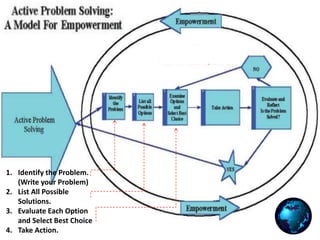
1. Identify the Problem.
(Write your Problem)
2. List All Possible
Solutions.
3. Evaluate Each Option
and Select Best Choice
4. Take Action.
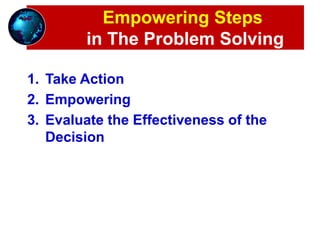
1. Take Action
2. Empowering
3. Evaluate the Effectiveness of the
Decision
Empowering Steps
in The Problem Solving
Take Action
• (Write the action you plan to take. What will
you do?)
a. When will you start or try this plan?
(date/time)
b. Who will you talk to about your plan? (list
names)
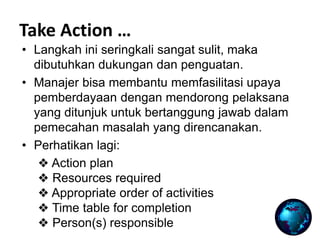
Take Action …
• Langkah ini seringkali sangat sulit, maka
dibutuhkan dukungan dan penguatan.
• Manajer bisa membantu memfasilitasi upaya
pemberdayaan dengan mendorong pelaksana
yang ditunjuk untuk bertanggung jawab dalam
pemecahan masalah yang direncanakan.
• Perhatikan lagi:
❖ Action plan
❖ Resources required
❖ Appropriate order of activities
❖ Time table for completion
❖ Person(s) responsible
Empowerment
• It is defined as giving employees the authority &
information they need to make wise decisions and
solve the problems.
“The paradox of empowerment is that in order to
gain power, you must give some of it away. Good
managers are those who recognize that
empowerment is not a substitute for leadership or a
decrease in their own authority.
The more people are empowered, the more they
need leaders who can set goals and define a vision
of where the org. should be going.”
“Paradoks dari empowerment adalah untuk
mendapatkan kekuasaan, ini yang harus Anda berikan
(sebagian). Manajer yang baik adalah mereka yang
menyadari bahwa pemberdayaan bukanlah pengganti
kepemimpinan atau penurunan otoritas seorang
manajer.
Semakin banyak orang diberdayakan, semakin
mereka membutuhkan pemimpin yang dapat
menetapkan tujuan dan menentukan visi ke mana
organisasi seharusnya pergi."
Evaluate the Effectiveness of
the Decision
• Dengan memperhatikan:
❖ Outcome objectives met?
❖ Problem solved?
❖ Process improved?
❖ Strategic goal achieved?
❖ If the plan is not being followed as
expected, then consider:
 Was the plan realistic?
 Are there sufficient resources to
accomplish the plan on schedule?
 Should the plan be changed?
Evaluate …
• Pada fase ini, petugas yang bertanggung jawab
diminta untuk mengevaluasi setiap opsi yang
ada dalam daftar (dari sesi brainstorming
terdahulu).
• Petugas yang bertanggung jawab memiliki
kesempatan untuk memproyeksikan
konsekuensi dari setiap opsi yang ada,
mengidentifikasi dan menghilangkan pilihan
yang tidak aman atau dianggap bertentangan,
sehingga mempersempit daftar solusi yang
potensial.
The Decision-Making
Process
What is
Decision Making?
What are the
things you
consider before
making a
decision?
What is
Decision Making?
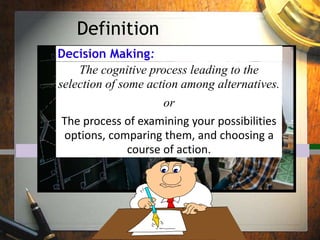
Definition
Decision Making:
The cognitive process leading to the
selection of some action among alternatives.
or
The process of examining your possibilities
options, comparing them, and choosing a
course of action.
Six C's of Decision Making (1 of 2)
 Construct a clear picture of
precisely what must be decided.
 Compile a list of requirements that
must be met.
 Collect information on alternatives
that meet the requirements.
Six C's of Decision Making (2 of 2)
 Compare alternatives that meet
the requirements.
 Consider the "what might go wrong"
factor with each alternative.
 Commit to a decision and follow
through with it.
Inherent Personal Traps
 Trying too hard to play it safe.
 Letting fears and biases tilt your
thinking and analysis.
 Getting lost in the minutia can cause
trouble.
 Craving for unanimous approval.
 Trying to make decisions which are
outside your realm of authority.
• Berusaha terlalu keras untukbermain aman.
• Membiarkan ketakutandan bias dalam pemikiran dan
analisis.
• Tersesat dalam hal-halkecilyang dapat menyebabkan
masalah.
• Mendambakan persetujuan dengan suara bulat.
• Mencoba membuat keputusanyang berada di luar
kewenangan.
Inherent System Traps
 Willing to begin with too little,
inaccurate, or wrong information.
 Overlook viable alternatives or waste
time considering alternatives which
have no realistic prospects.
 Not following the six C's.
 Failure to clearly define the results you
expect to achieve.
 Worst of all, failure to reach a decision.
• Bersediamemulaidenganinformasiyangterlalusedikit,dangkal,
tidakakurat,atausalah.
• Mengabaikanalternatifyanglayakataubuangwaktudengan
mempertimbangkanalternatifyangtidakmemilikiprospek
realistis.
• TidakmengikutiSix’C.
• KegagalanuntuksecarajelasmendefinisikanhasilyanginginAnda
capai.
• Yangterburuk,kegagalan untukmengambilkeputusan.
Barriers to GoodDecision Making
"Pemimpin yang sukses memiliki keberanian untuk mengambil tindakan
sementara yang lain ragu."
Barriers to Good Decision Making
 Hasty - Making quick decisions without having much
thought.
 Narrow - Decision making is based on very limited
information.
 Scattered - Our thoughts in making decisions are
disconnected or disorganized.
 Fuzzy - Sometimes, the lack of clarity on important
aspects of a decision causes us to overlook certain
important considerations.
The Decision-Making Process
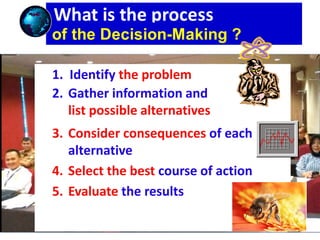
What is the process
of the Decision-Making ?
1. Identify the problem
3. Consider consequences of each
alternative
4. Select the best course of action
5. Evaluate the results
2. Gather information and
list possible alternatives
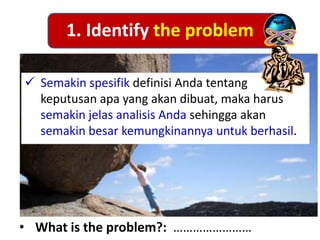
1. Identify the problem
• What is the problem?: ……………………
 Semakin spesifik definisi Anda tentang
keputusan apa yang akan dibuat, maka harus
semakin jelas analisis Anda sehingga akan
semakin besar kemungkinannya untuk berhasil.
• What : Data & Informasi?
• Why?
 Pengambil keputusan yang sukses adalah
yang mampu mengeksplorasi semua
kemungkinan pilihan dan situasi.
2. Gather information and
list possible alternatives
• What : Data & Informasi?
• Why?
 Pengambil keputusan yang sukses adalah
yang mampu mengeksplorasi semua
kemungkinan pilihan dan situasi.
3. Consider consequences
of each alternative
1. Why? + –
2. Why? + –
3. Why? + –
Analisis keuntungan dan kerugian dari setiap
alternatif.
Dalam banyak kasus, ada kemungkinan terdapat
kekurangan informasi yang memadai untuk
membuat keputusan yang tepat.
1. Why? + –
2. Why? + –
3. Why? + –
Analisis keuntungan dan kerugian dari setiap
alternatif.
Dalam banyak kasus, ada kemungkinan terdapat
kekurangan informasi yang memadai untuk
membuat keputusan yang tepat.
4. Select the best
course of action
• Why ?
• Dari kesemua yang ada di langkah sebelumnya:
 pilih salah satu alternatif,
 yang merupakan kesimpulan yang dapat
meyakinkan bahwa itu adalah pilihan
"terbaik" Anda.
• Dari kesemua yang ada di langkah sebelumnya:
 pilih salah satu alternatif,
 yang merupakan kesimpulan yang dapat
meyakinkan bahwa itu adalah pilihan "terbaik"
Anda.
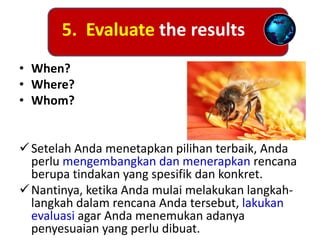
5. Evaluate the results
• When?
• Where?
• Whom?
Setelah Anda menetapkan pilihan terbaik, Anda
perlu mengembangkan dan menerapkan rencana
berupa tindakan yang spesifik dan konkret.
Nantinya, ketika Anda mulai melakukan langkah-
langkah dalam rencana Anda tersebut, lakukan
evaluasi agar Anda menemukan adanya
penyesuaian yang perlu dibuat.
www.slideshare.net/kenkanaidi
(Narasumber)
www.ken-spektakuler.blogspot.com
e-mail: kanaidi63@gmail.com atau
kanaidi@yahoo.com
Fax. 022-4267749 HP. 0812 2353 284
WA. 0877 5871 1905
www.antawijaya.com

Empowering Steps in Problem Solving _ Materi Training "Mastering Problem & Analysis"

  • 1.
    Empowering Steps in TheProblem Solving Training “Mastering PROBLEM”
  • 2.
    “He who asksa question may be a fool for five minutes, but he who never asks a question remains a fool forever.” - Tom Connelly “Yangbertanyabisajadi dianggapbodohselama lima menit,tapiyangtidakpernahbertanyatetapbodoh selamanya.”
  • 3.
    Barriers to EffectiveProblemSolving • Failure to recognize the problem • Conceiving the problem too narrowly • Making a hasty choice • Failure to consider all consequences • Failure to consider the feasibility of the solution XX• Gagal mengenali masalahnya • Memahami masalahterlalu sempit • Membuat pilihanyang terburu-buru • Kegagalanuntuk mempertimbangkan semua konsekuensi • Kegagalanuntuk mempertimbangkan kelayakansolusi.
  • 4.
    1. Identify theProblem. (Write your Problem) 2. List All Possible Solutions. 3. Evaluate Each Option and Select Best Choice 4. Take Action.
  • 5.
    1. Take Action 2.Empowering 3. Evaluate the Effectiveness of the Decision Empowering Steps in The Problem Solving
  • 6.
    Take Action • (Writethe action you plan to take. What will you do?) a. When will you start or try this plan? (date/time) b. Who will you talk to about your plan? (list names)
  • 7.
    Take Action … •Langkah ini seringkali sangat sulit, maka dibutuhkan dukungan dan penguatan. • Manajer bisa membantu memfasilitasi upaya pemberdayaan dengan mendorong pelaksana yang ditunjuk untuk bertanggung jawab dalam pemecahan masalah yang direncanakan. • Perhatikan lagi: ❖ Action plan ❖ Resources required ❖ Appropriate order of activities ❖ Time table for completion ❖ Person(s) responsible
  • 8.
    Empowerment • It isdefined as giving employees the authority & information they need to make wise decisions and solve the problems. “The paradox of empowerment is that in order to gain power, you must give some of it away. Good managers are those who recognize that empowerment is not a substitute for leadership or a decrease in their own authority. The more people are empowered, the more they need leaders who can set goals and define a vision of where the org. should be going.” “Paradoks dari empowerment adalah untuk mendapatkan kekuasaan, ini yang harus Anda berikan (sebagian). Manajer yang baik adalah mereka yang menyadari bahwa pemberdayaan bukanlah pengganti kepemimpinan atau penurunan otoritas seorang manajer. Semakin banyak orang diberdayakan, semakin mereka membutuhkan pemimpin yang dapat menetapkan tujuan dan menentukan visi ke mana organisasi seharusnya pergi."
  • 9.
    Evaluate the Effectivenessof the Decision • Dengan memperhatikan: ❖ Outcome objectives met? ❖ Problem solved? ❖ Process improved? ❖ Strategic goal achieved? ❖ If the plan is not being followed as expected, then consider:  Was the plan realistic?  Are there sufficient resources to accomplish the plan on schedule?  Should the plan be changed?
  • 10.
    Evaluate … • Padafase ini, petugas yang bertanggung jawab diminta untuk mengevaluasi setiap opsi yang ada dalam daftar (dari sesi brainstorming terdahulu). • Petugas yang bertanggung jawab memiliki kesempatan untuk memproyeksikan konsekuensi dari setiap opsi yang ada, mengidentifikasi dan menghilangkan pilihan yang tidak aman atau dianggap bertentangan, sehingga mempersempit daftar solusi yang potensial.
  • 11.
  • 12.
  • 13.
    What are the thingsyou consider before making a decision? What is Decision Making?
  • 14.
    Definition Decision Making: The cognitiveprocess leading to the selection of some action among alternatives. or The process of examining your possibilities options, comparing them, and choosing a course of action.
  • 15.
    Six C's ofDecision Making (1 of 2)  Construct a clear picture of precisely what must be decided.  Compile a list of requirements that must be met.  Collect information on alternatives that meet the requirements.
  • 16.
    Six C's ofDecision Making (2 of 2)  Compare alternatives that meet the requirements.  Consider the "what might go wrong" factor with each alternative.  Commit to a decision and follow through with it.
  • 17.
    Inherent Personal Traps Trying too hard to play it safe.  Letting fears and biases tilt your thinking and analysis.  Getting lost in the minutia can cause trouble.  Craving for unanimous approval.  Trying to make decisions which are outside your realm of authority. • Berusaha terlalu keras untukbermain aman. • Membiarkan ketakutandan bias dalam pemikiran dan analisis. • Tersesat dalam hal-halkecilyang dapat menyebabkan masalah. • Mendambakan persetujuan dengan suara bulat. • Mencoba membuat keputusanyang berada di luar kewenangan.
  • 18.
    Inherent System Traps Willing to begin with too little, inaccurate, or wrong information.  Overlook viable alternatives or waste time considering alternatives which have no realistic prospects.  Not following the six C's.  Failure to clearly define the results you expect to achieve.  Worst of all, failure to reach a decision. • Bersediamemulaidenganinformasiyangterlalusedikit,dangkal, tidakakurat,atausalah. • Mengabaikanalternatifyanglayakataubuangwaktudengan mempertimbangkanalternatifyangtidakmemilikiprospek realistis. • TidakmengikutiSix’C. • KegagalanuntuksecarajelasmendefinisikanhasilyanginginAnda capai. • Yangterburuk,kegagalan untukmengambilkeputusan.
  • 19.
    Barriers to GoodDecisionMaking "Pemimpin yang sukses memiliki keberanian untuk mengambil tindakan sementara yang lain ragu."
  • 20.
    Barriers to GoodDecision Making  Hasty - Making quick decisions without having much thought.  Narrow - Decision making is based on very limited information.  Scattered - Our thoughts in making decisions are disconnected or disorganized.  Fuzzy - Sometimes, the lack of clarity on important aspects of a decision causes us to overlook certain important considerations.
  • 21.
  • 22.
    What is theprocess of the Decision-Making ? 1. Identify the problem 3. Consider consequences of each alternative 4. Select the best course of action 5. Evaluate the results 2. Gather information and list possible alternatives
  • 23.
    1. Identify theproblem • What is the problem?: ……………………  Semakin spesifik definisi Anda tentang keputusan apa yang akan dibuat, maka harus semakin jelas analisis Anda sehingga akan semakin besar kemungkinannya untuk berhasil.
  • 24.
    • What :Data & Informasi? • Why?  Pengambil keputusan yang sukses adalah yang mampu mengeksplorasi semua kemungkinan pilihan dan situasi. 2. Gather information and list possible alternatives • What : Data & Informasi? • Why?  Pengambil keputusan yang sukses adalah yang mampu mengeksplorasi semua kemungkinan pilihan dan situasi.
  • 25.
    3. Consider consequences ofeach alternative 1. Why? + – 2. Why? + – 3. Why? + – Analisis keuntungan dan kerugian dari setiap alternatif. Dalam banyak kasus, ada kemungkinan terdapat kekurangan informasi yang memadai untuk membuat keputusan yang tepat. 1. Why? + – 2. Why? + – 3. Why? + – Analisis keuntungan dan kerugian dari setiap alternatif. Dalam banyak kasus, ada kemungkinan terdapat kekurangan informasi yang memadai untuk membuat keputusan yang tepat.
  • 26.
    4. Select thebest course of action • Why ? • Dari kesemua yang ada di langkah sebelumnya:  pilih salah satu alternatif,  yang merupakan kesimpulan yang dapat meyakinkan bahwa itu adalah pilihan "terbaik" Anda. • Dari kesemua yang ada di langkah sebelumnya:  pilih salah satu alternatif,  yang merupakan kesimpulan yang dapat meyakinkan bahwa itu adalah pilihan "terbaik" Anda.
  • 27.
    5. Evaluate theresults • When? • Where? • Whom? Setelah Anda menetapkan pilihan terbaik, Anda perlu mengembangkan dan menerapkan rencana berupa tindakan yang spesifik dan konkret. Nantinya, ketika Anda mulai melakukan langkah- langkah dalam rencana Anda tersebut, lakukan evaluasi agar Anda menemukan adanya penyesuaian yang perlu dibuat.
  • 28.