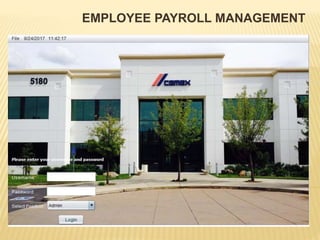
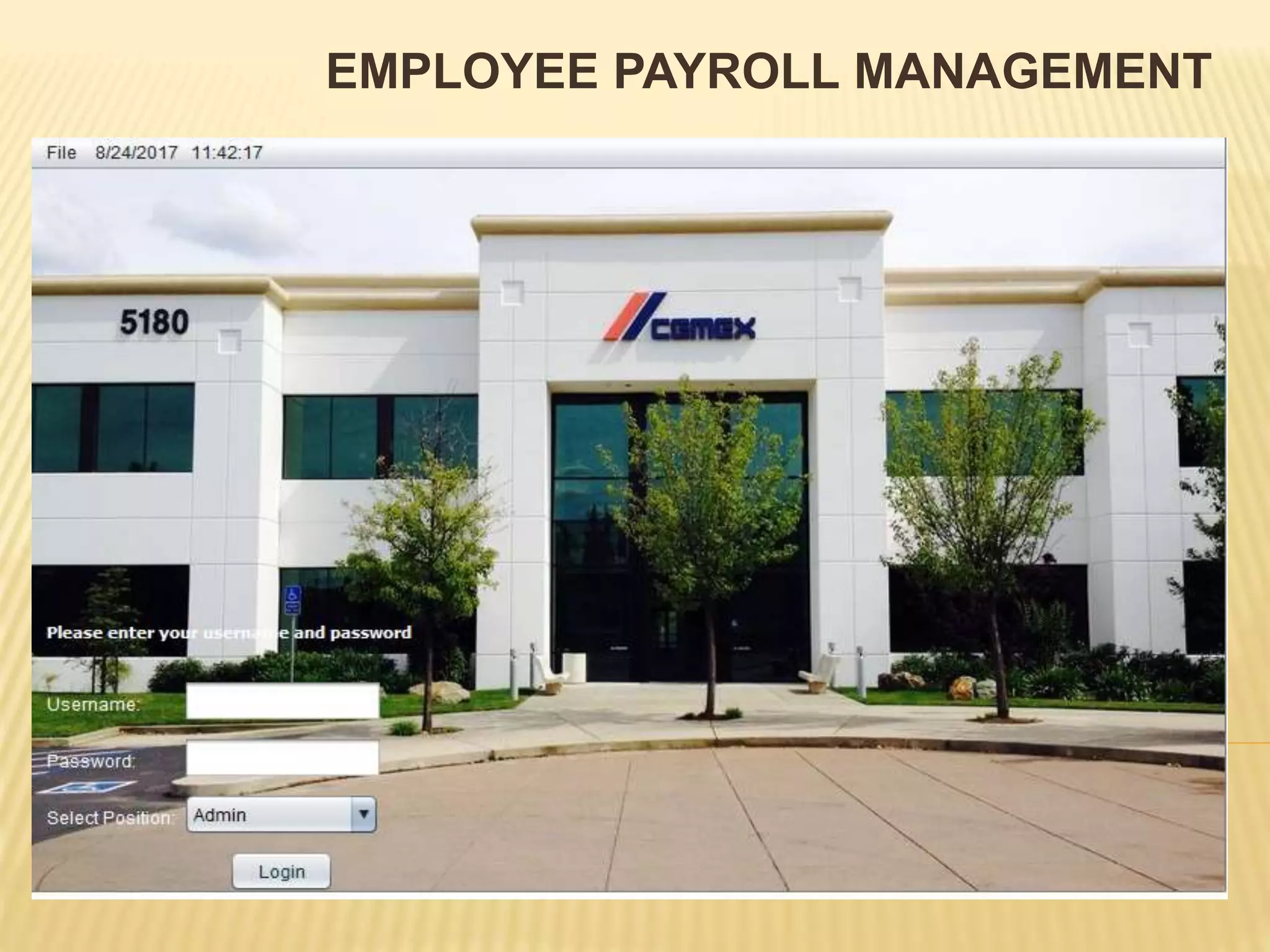
EMPLOYEE PAYROLL MANAGEMENT
CONTENTS
 Project overview
 Introduction
 Feasibility study
 Types of feasibility study
 Proposed modules
 Software engineering paradigm
 Technology used
 Advantages
PROJECT OVERVIEW
 GOAL OF THE PROJECT
To develop Employee Payroll Management.
 SCOPE OF THE PROJECT
 It is user - friendly and easy to use..
 Automate all the functionalities of the employees of
company or organization
 Less time consuming
 Minimizes paper work and human effort.
INTRODUCTION
 A payroll system is software designed to organize all the
tasks of employee payment
 These tasks can include keeping track of hours, calculating
wages, withholding taxes and deductions, printing and
delivering checks and paying employment
 It greatly helps to reduce the paper-work and human efforts.
 Automate all the functionalities of the employees of
company or organization
FEASIBILITY STUDY
Feasibility study is a cross life cycle activity and should be
continuously performed throughout a system project.
Employee Payroll Management is feasible due to
following reasons :
• EPM is feasible because it will meet the user
requirements.
• This Application can be implemented using the current
technology and with in specified budget and schedule.
• This application is compatible with other existing
hardware and software.
TYPES OF FEASIBILITY
• Technical Feasibility
 A technical feasibility study is an excellent tool for
troubleshooting and long-term planning.
EPM is Technical feasible due to following reason :
 It will developed with Java Programming Language is
relevant technology which is relevant technology and is
stable and also established.
CONTD…
• Operational Feasibility
 Operational feasibility is the measure of how well a
proposed system solves the problems.
EPM is Operationally feasible due to following reason :
 Because this application will operate after it is developed
and be operative once it is installed.
 User can adopt it easily because it is will increase the
security of employer’s data.
CONTD...
• Economic Feasibility
 Detail the costs that will be incurred by the organisation
adopting the new system; consider development costs
and running costs.
EPM is Economically feasible due to following reason :
 Because it can be developed with in the expected
budget.
 There is no involvement of any extra hardware or
software.
PROPOSED MODULES
 Admin login
 Employee registration
 Search
 Payment
 Update salary
 Allowance
 Deduction
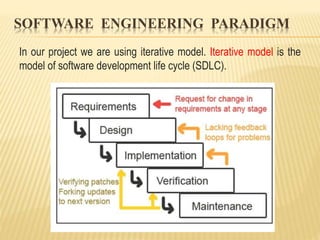
SOFTWARE ENGINEERING PARADIGM
In our project we are using iterative model. Iterative model is the
model of software development life cycle (SDLC).
HARDWARE AND SOFTWARE REQUIREMENTS
Hardware specifications(minimum)
PROCESSOR : Dual Core
RAM : 4 GB
STORAGE : 10 GB
Software specifications
Operating system : Windows 7+
Back End : JAVA
IDE : Netbeans
TECHNOLOGY USED
• JAVA WHY JAVA?
 Java is a multi-paradigm programming
language encompassing strong typing.
 Java is declarative, functional, generic,
object-oriented (class-based), and
component-oriented.
ADVANTAGES
 Minimized paper-work
 Minimizes human error
 Avoid data manipulation
 Huge data storage with less computer memory
 Saves resources
 Platform independent
Employee  Payroll Management system

Employee Payroll Management system

  • 1.
  • 2.
    CONTENTS  Project overview Introduction  Feasibility study  Types of feasibility study  Proposed modules  Software engineering paradigm  Technology used  Advantages
  • 3.
    PROJECT OVERVIEW  GOALOF THE PROJECT To develop Employee Payroll Management.  SCOPE OF THE PROJECT  It is user - friendly and easy to use..  Automate all the functionalities of the employees of company or organization  Less time consuming  Minimizes paper work and human effort.
  • 4.
    INTRODUCTION  A payrollsystem is software designed to organize all the tasks of employee payment  These tasks can include keeping track of hours, calculating wages, withholding taxes and deductions, printing and delivering checks and paying employment  It greatly helps to reduce the paper-work and human efforts.  Automate all the functionalities of the employees of company or organization
  • 5.
    FEASIBILITY STUDY Feasibility studyis a cross life cycle activity and should be continuously performed throughout a system project. Employee Payroll Management is feasible due to following reasons : • EPM is feasible because it will meet the user requirements. • This Application can be implemented using the current technology and with in specified budget and schedule. • This application is compatible with other existing hardware and software.
  • 6.
    TYPES OF FEASIBILITY •Technical Feasibility  A technical feasibility study is an excellent tool for troubleshooting and long-term planning. EPM is Technical feasible due to following reason :  It will developed with Java Programming Language is relevant technology which is relevant technology and is stable and also established.
  • 7.
    CONTD… • Operational Feasibility Operational feasibility is the measure of how well a proposed system solves the problems. EPM is Operationally feasible due to following reason :  Because this application will operate after it is developed and be operative once it is installed.  User can adopt it easily because it is will increase the security of employer’s data.
  • 8.
    CONTD... • Economic Feasibility Detail the costs that will be incurred by the organisation adopting the new system; consider development costs and running costs. EPM is Economically feasible due to following reason :  Because it can be developed with in the expected budget.  There is no involvement of any extra hardware or software.
  • 9.
    PROPOSED MODULES  Adminlogin  Employee registration  Search  Payment  Update salary  Allowance  Deduction
  • 10.
    SOFTWARE ENGINEERING PARADIGM Inour project we are using iterative model. Iterative model is the model of software development life cycle (SDLC).
  • 11.
    HARDWARE AND SOFTWAREREQUIREMENTS Hardware specifications(minimum) PROCESSOR : Dual Core RAM : 4 GB STORAGE : 10 GB Software specifications Operating system : Windows 7+ Back End : JAVA IDE : Netbeans
  • 12.
    TECHNOLOGY USED • JAVAWHY JAVA?  Java is a multi-paradigm programming language encompassing strong typing.  Java is declarative, functional, generic, object-oriented (class-based), and component-oriented.
  • 13.
    ADVANTAGES  Minimized paper-work Minimizes human error  Avoid data manipulation  Huge data storage with less computer memory  Saves resources  Platform independent