Discrimination and Harassment Free Workplace

   Protected class status under federal law includes:
   race, color and national origin;
   sex (includes pregnancy-related conditions);
   religion;
   age (40 and older);
   disability;
   a person who uses leave covered by the Federal Family and
    Medical Leave Act;
   a person who uses Military Leave;
   a person who associates with a protected class;
   a person who opposes unlawful employment practices, files a
    complaint or testifies about violations or possible violations; and
   any other protected class as defined by federal law.
Discrimination and Harassment Free Workplace

   Protected class status under Oregon law
    includes:
   All federally protected classes, plus:
   age (18 and older);
   physical or mental disability;
   injured worker;
   a person who uses leave covered by the Oregon Family
    Leave Act;
   marital status and family relationships;
   sexual orientation;
   whistleblower;
   expunged juvenile record; and
   any other protected class as defined by state law.
Discrimination and Harassment Free Workplace


                       Discrimination is
   A supervisor or person in authority making employment
    decisions related to hiring, firing, transferring, promoting,
    demoting, benefits, compensation, and other terms and
    conditions of employment, because of an employee’s protected
    class status.
Discrimination and Harassment Free Workplace


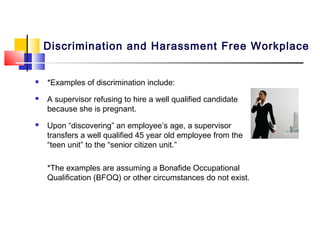
   *Examples of discrimination include:
   A supervisor refusing to hire a well qualified candidate
    because she is pregnant.
   Upon “discovering” an employee’s age, a supervisor
    transfers a well qualified 45 year old employee from the
    “teen unit” to the “senior citizen unit.”

    *The examples are assuming a Bonafide Occupational
    Qualification (BFOQ) or other circumstances do not exist.
Discrimination and Harassment Free Workplace


               Workplace Harassment is

    Unwelcome, unwanted or offensive conduct based on
     or because of an employee’s protected class status.
Discrimination and Harassment Free Workplace


   Examples of workplace harassment include:
   An employee repeatedly addresses coworkers with
    derogatory comments or stereotypes related to their race or
    religion. The employee calls a coworker wearing a turban,
    “Towel Head,” calls a Hispanic coworker, “Beaner,” and
    calls a Jewish coworker “Cheap Skate.”
   An employee tries to get a coworker to resign by spreading
    untrue, malicious gossip about the coworker, because of the
    coworker’s disability.
Discrimination and Harassment Free Workplace

                        Sexual Harassment is
   Unwelcome, unwanted, or offensive sexual advances, requests for
    sexual favors, and other verbal or physical conduct of a sexual
    nature when:
   1. Submission to the conduct is made either explicitly or implicitly a
    term or condition of the individual’s employment; or is used as a
    basis for any employment decision (granting leave requests,
    promotion, favorable performance appraisal, etc.); or
   2. The conduct is unwelcome, unwanted, or offensive and has the
    purpose or effect of unreasonably interfering with an individual’s
    work performance, or creating an intimidating, hostile or offensive
    working environment.
Discrimination and Harassment Free Workplace

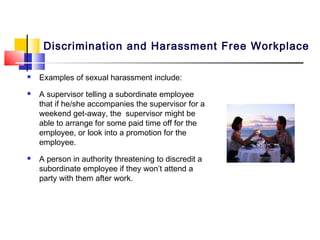
   Examples of sexual harassment include:
   A supervisor telling a subordinate employee
    that if he/she accompanies the supervisor for a
    weekend get-away, the supervisor might be
    able to arrange for some paid time off for the
    employee, or look into a promotion for the
    employee.
   A person in authority threatening to discredit a
    subordinate employee if they won’t attend a
    party with them after work.
Discrimination and Harassment Free Workplace

   Any employee believing they have been subjected
    to discrimination, workplace harassment or sexual
    harassment should report that behavior to their
    immediate supervisor, another member of
    management or the agency Human Resource
    section.
   A complaint may be made verbally or in writing.
Discrimination and Harassment Free Workplace

   Why is it important for employees to report discrimination,
    workplace harassment and sexual harassment?
   Answer
   Discrimination ,workplace harassment and sexual harassment can cause:
        Employees to be hurt emotionally
        Productivity to go down
        Absenteeism to go up
        The work of the agency to be jeopardized
        Employees to be fearful of others
        Workplace morale to be reduced
   When management knows about the problem it can be corrected
   Discrimination, workplace harassment and sexual harassment must be
    stopped!
Discrimination and Harassment Free Workplace

   Why do employee’s hesitate to report discrimination,
    workplace harassment and sexual harassment?
   Answer
   Fear of losing their job
   Fear of retaliation
   Fear of getting someone into trouble
   Fear of disrupting the workplace
   Fear of being accused of having no sense of humor
   Fear of being embarrassed
   Fear of feeling like “less of a man/woman”
   Fear of not being believed. Discrimination and harassment are
    generally subtle and inconspicuous.
Discrimination and Harassment Free Workplace
   What can a supervisor do to help employees feel safe reporting
    discrimination, workplace harassment and sexual harassment?
   Answer
   Set an example of respectful workplace behavior.
   Have clear expectations that discrimination, workplace harassment and
    sexual harassment are not tolerated.
   Have a clear mechanism for reporting; including the ability to report to
    another member of management should the supervisor be the accused.
   Take immediate steps to stop inappropriate behavior or conduct as it occurs
    or is reported.
   Guard against retaliation.
   Handle investigations as discretely and confidentially as possible.
   Be sensitive to the feelings of all involved. It is not easy for the complainant,
    the accused or anyone participating in an investigation.
Discrimination and Harassment Free Workplace


   Once a complaint of discrimination,
    workplace harassment or sexual
    harassment is made, the agency must
    promptly investigate the complaint.
   Complaints are taken seriously and are
    confidential to the extent possible.
   Employees are expected to cooperate with
    an investigation and keep information
    regarding the investigation confidential.
Discrimination and Harassment Free Workplace

    Scenario: An employee reports harassment to his/her supervisor
    and says, “I don’t want you to do anything about this. I just want
    you to listen and be aware of what is going on.”
   How should the supervisor respond?
   Answer
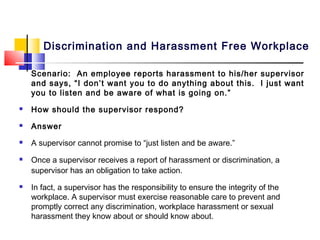
   A supervisor cannot promise to “just listen and be aware.”
   Once a supervisor receives a report of harassment or discrimination, a
    supervisor has an obligation to take action.
   In fact, a supervisor has the responsibility to ensure the integrity of the
    workplace. A supervisor must exercise reasonable care to prevent and
    promptly correct any discrimination, workplace harassment or sexual
    harassment they know about or should know about.
Discrimination and Harassment Free Workplace

    Scenario: A supervisor receives a report of sexual harassment.
    The supervisor has seen such reports divide a workforce.
   What advice would you give the supervisor to help minimize
    disruption to the workplace?
   Answer
   Conduct an investigation discretely and quickly.
   Caution all parties not to discuss the investigation.
   Direct employees back to work who are talking about the accused or the
    complainant in regards to the report.
   Work to keep up morale in the office and ensure work is being accomplished.
   Be proactive. Having established expectations in place that do not allow
    gossiping and other non-productive or destructive activities is a preventative
    measure a supervisor should take.
Discrimination and Harassment Free Workplace

   How should an agency treat an employee accused of
    discrimination, workplace harassment or sexual harassment?
   Answer
   An employee accused of discrimination, workplace harassment or sexual
    harassment should be treated with professionalism and respect, as you
    would any employee.
   Just because an employee has been accused, does not mean the employee
    is guilty.
   The accused employee has a chance to defend him/herself and present
    information and witnesses.
   An agency must conduct a neutral investigation. Conclusions should not be
    reached until the investigation is complete.
Discrimination and Harassment Free Workplace

    Scenario: An employee filed a report of harassment with
    her supervisor. After an investigation the agency did not
    agree that harassment occurred. Because harassment was
    not found, the employee worries that she will be disciplined.

   Are the employee’s worries founded?
   Answer
   No. An employee will not be disciplined for making a report of what the
    employee believes is harassment.
   Harassment is a term often used for lack of a better way to describe
    what an employee feels he/she is experiencing.
   Sometimes an investigation will conclude that a particular behavior was
    not harassment or discrimination but was inappropriate workplace
    behavior.
Discrimination and Harassment Free Workplace

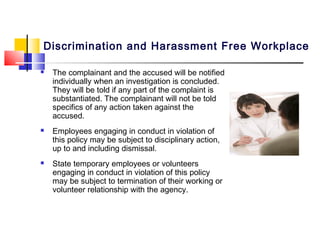
   The complainant and the accused will be notified
    individually when an investigation is concluded.
    They will be told if any part of the complaint is
    substantiated. The complainant will not be told
    specifics of any action taken against the
    accused.
   Employees engaging in conduct in violation of
    this policy may be subject to disciplinary action,
    up to and including dismissal.
   State temporary employees or volunteers
    engaging in conduct in violation of this policy
    may be subject to termination of their working or
    volunteer relationship with the agency.
Discrimination and Harassment Free Workplace
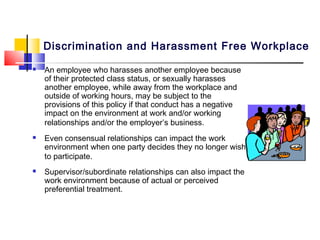
   An employee who harasses another employee because
    of their protected class status, or sexually harasses
    another employee, while away from the workplace and
    outside of working hours, may be subject to the
    provisions of this policy if that conduct has a negative
    impact on the environment at work and/or working
    relationships and/or the employer’s business.
   Even consensual relationships can impact the work
    environment when one party decides they no longer wish
    to participate.
   Supervisor/subordinate relationships can also impact the
    work environment because of actual or perceived
    preferential treatment.
Discrimination and Harassment Free Workplace

   If a complaint involves the conduct of a
    contracted employee or a contractor,
    management will address the problem
    behavior with the contractor and require
    prompt, appropriate action.
   If a complaint involves the conduct of a
    client, customer, or visitor, the agency
    should follow its own internal procedures
    and take prompt, appropriate action.
Discrimination and Harassment Free Workplace

    Scenario: A technician is contracted to maintain the office copy
    machine. Each time the technician makes a service call the
    technician tells a dirty joke. Some employees can’t wait for the
    machine to break down, just so they can hear the latest joke.
   Even though no employees have complained, what is the
    supervisor’s responsibility?
   Answer
   The supervisor has an obligation to maintain the integrity of the office
    environment.
   The supervisor should direct the employees back to work.
   Even though the technician is not an employee, the supervisor should tell the
    technician to stop telling dirty jokes.
   The supervisor should contact the company holding the contract and report
    the behavior and request prompt corrective action.
Discrimination and Harassment Free Workplace

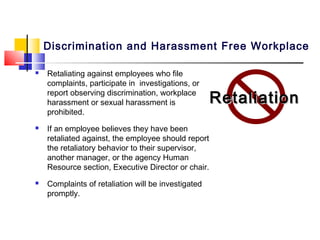
   Retaliating against employees who file
    complaints, participate in investigations, or
    report observing discrimination, workplace
    harassment or sexual harassment is               Retaliation
    prohibited.
   If an employee believes they have been
    retaliated against, the employee should report
    the retaliatory behavior to their supervisor,
    another manager, or the agency Human
    Resource section, Executive Director or chair.
   Complaints of retaliation will be investigated
    promptly.
Discrimination and Harassment Free Workplace

    Scenario: An investigation resulted in an employee being
    disciplined for sexual harassment. The disciplined employee
    was mad and encouraged others to shun those who participated
    in the investigation. You have been asked to refuse to speak to
    your coworkers who reported the employee’s behavior to the
    supervisor.
   What can you do?
   Answer
   Just as discrimination and harassment are prohibited, so is retaliation.
   Refuse to participate in retaliation against your coworkers. The morale of the
    staff has already been harmed. You do not want to contribute to further
    problems.
   Report this behavior to management.
Discrimination and Harassment Free Workplace

                 A Quiz (True or False)
   Discrimination, workplace harassment and
    sexual harassment can be illegal behavior.
   True
   Employment actions taken against employees that are
    based on or because of an employee’s protected class
    status are illegal, violating federal and state law.
   Unwelcome, unwanted or offensive sexual advances or
    requests for sexual favors which require submission in
    exchange for employment action or inaction are illegal,
    violating federal and state law.
Discrimination and Harassment Free Workplace

   Harassment is limited to exchanges between men and
    women.
   False
   Harassment can occur between men and women, women and
    women, and men and men.
Discrimination and Harassment Free Workplace

   Only a member of management has the power to eliminate
    discrimination, workplace harassment and sexual
    harassment in the workplace.
   False
   Only a supervisor/manager has the authority to discipline an employee
    for engaging in discrimination, workplace harassment or sexual
    harassment.
   Employees at every level of the agency have the power to prevent and
    eliminate discrimination, workplace harassment and sexual harassment
    by:
        Being a role model for appropriate workplace behavior;
        Not engaging in it; and
        Being comfortable enough to tell each other respectfully when they have
         been offended.
Discrimination and Harassment Free Workplace

   If I tell my manager I am being harassed my manager can
    guarantee my name will be kept out of it.
   False.
   A manager receiving a report of harassment has an obligation to keep the
    information as confidential as possible.
   Human Resources and specific members of management may need to
    have some or all of the information from your report.
   In order for the accused to answer questions and defend him/herself,
    he/she will need specifics.
   Witnesses will be given limited information.
Discrimination and Harassment Free Workplace

       Prevention is the most effective way to eliminate
        discrimination, workplace harassment and sexual harassment
        in the workplace .
       True
       Taking a proactive stance to create and maintain a respectful work
        environment is the most effective way to prevent discrimination, workplace
        harassment and sexual harassment.
       This can be accomplished by:
          Educating the workforce about discrimination, workplace harassment and
           sexual harassment;
          Having clear guidelines for reporting discrimination, workplace harassment
           and sexual harassment; and
          Making it clear that that discrimination, workplace harassment and sexual
           harassment are prohibited and retaliating against someone for reporting is
           prohibited.
Discrimination and Harassment Free Workplace


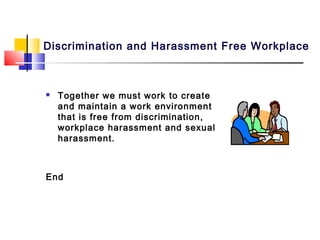
   Together we must work to create
    and maintain a work environment
    that is free from discrimination,
    workplace harassment and sexual
    harassment.


End

Employee Job Description 2

  • 1.
    Discrimination and HarassmentFree Workplace  Protected class status under federal law includes:  race, color and national origin;  sex (includes pregnancy-related conditions);  religion;  age (40 and older);  disability;  a person who uses leave covered by the Federal Family and Medical Leave Act;  a person who uses Military Leave;  a person who associates with a protected class;  a person who opposes unlawful employment practices, files a complaint or testifies about violations or possible violations; and  any other protected class as defined by federal law.
  • 2.
    Discrimination and HarassmentFree Workplace  Protected class status under Oregon law includes:  All federally protected classes, plus:  age (18 and older);  physical or mental disability;  injured worker;  a person who uses leave covered by the Oregon Family Leave Act;  marital status and family relationships;  sexual orientation;  whistleblower;  expunged juvenile record; and  any other protected class as defined by state law.
  • 3.
    Discrimination and HarassmentFree Workplace Discrimination is  A supervisor or person in authority making employment decisions related to hiring, firing, transferring, promoting, demoting, benefits, compensation, and other terms and conditions of employment, because of an employee’s protected class status.
  • 4.
    Discrimination and HarassmentFree Workplace  *Examples of discrimination include:  A supervisor refusing to hire a well qualified candidate because she is pregnant.  Upon “discovering” an employee’s age, a supervisor transfers a well qualified 45 year old employee from the “teen unit” to the “senior citizen unit.” *The examples are assuming a Bonafide Occupational Qualification (BFOQ) or other circumstances do not exist.
  • 5.
    Discrimination and HarassmentFree Workplace Workplace Harassment is  Unwelcome, unwanted or offensive conduct based on or because of an employee’s protected class status.
  • 6.
    Discrimination and HarassmentFree Workplace  Examples of workplace harassment include:  An employee repeatedly addresses coworkers with derogatory comments or stereotypes related to their race or religion. The employee calls a coworker wearing a turban, “Towel Head,” calls a Hispanic coworker, “Beaner,” and calls a Jewish coworker “Cheap Skate.”  An employee tries to get a coworker to resign by spreading untrue, malicious gossip about the coworker, because of the coworker’s disability.
  • 7.
    Discrimination and HarassmentFree Workplace Sexual Harassment is  Unwelcome, unwanted, or offensive sexual advances, requests for sexual favors, and other verbal or physical conduct of a sexual nature when:  1. Submission to the conduct is made either explicitly or implicitly a term or condition of the individual’s employment; or is used as a basis for any employment decision (granting leave requests, promotion, favorable performance appraisal, etc.); or  2. The conduct is unwelcome, unwanted, or offensive and has the purpose or effect of unreasonably interfering with an individual’s work performance, or creating an intimidating, hostile or offensive working environment.
  • 8.
    Discrimination and HarassmentFree Workplace  Examples of sexual harassment include:  A supervisor telling a subordinate employee that if he/she accompanies the supervisor for a weekend get-away, the supervisor might be able to arrange for some paid time off for the employee, or look into a promotion for the employee.  A person in authority threatening to discredit a subordinate employee if they won’t attend a party with them after work.
  • 9.
    Discrimination and HarassmentFree Workplace  Any employee believing they have been subjected to discrimination, workplace harassment or sexual harassment should report that behavior to their immediate supervisor, another member of management or the agency Human Resource section.  A complaint may be made verbally or in writing.
  • 10.
    Discrimination and HarassmentFree Workplace  Why is it important for employees to report discrimination, workplace harassment and sexual harassment?  Answer  Discrimination ,workplace harassment and sexual harassment can cause:  Employees to be hurt emotionally  Productivity to go down  Absenteeism to go up  The work of the agency to be jeopardized  Employees to be fearful of others  Workplace morale to be reduced  When management knows about the problem it can be corrected  Discrimination, workplace harassment and sexual harassment must be stopped!
  • 11.
    Discrimination and HarassmentFree Workplace  Why do employee’s hesitate to report discrimination, workplace harassment and sexual harassment?  Answer  Fear of losing their job  Fear of retaliation  Fear of getting someone into trouble  Fear of disrupting the workplace  Fear of being accused of having no sense of humor  Fear of being embarrassed  Fear of feeling like “less of a man/woman”  Fear of not being believed. Discrimination and harassment are generally subtle and inconspicuous.
  • 12.
    Discrimination and HarassmentFree Workplace  What can a supervisor do to help employees feel safe reporting discrimination, workplace harassment and sexual harassment?  Answer  Set an example of respectful workplace behavior.  Have clear expectations that discrimination, workplace harassment and sexual harassment are not tolerated.  Have a clear mechanism for reporting; including the ability to report to another member of management should the supervisor be the accused.  Take immediate steps to stop inappropriate behavior or conduct as it occurs or is reported.  Guard against retaliation.  Handle investigations as discretely and confidentially as possible.  Be sensitive to the feelings of all involved. It is not easy for the complainant, the accused or anyone participating in an investigation.
  • 13.
    Discrimination and HarassmentFree Workplace  Once a complaint of discrimination, workplace harassment or sexual harassment is made, the agency must promptly investigate the complaint.  Complaints are taken seriously and are confidential to the extent possible.  Employees are expected to cooperate with an investigation and keep information regarding the investigation confidential.
  • 14.
    Discrimination and HarassmentFree Workplace Scenario: An employee reports harassment to his/her supervisor and says, “I don’t want you to do anything about this. I just want you to listen and be aware of what is going on.”  How should the supervisor respond?  Answer  A supervisor cannot promise to “just listen and be aware.”  Once a supervisor receives a report of harassment or discrimination, a supervisor has an obligation to take action.  In fact, a supervisor has the responsibility to ensure the integrity of the workplace. A supervisor must exercise reasonable care to prevent and promptly correct any discrimination, workplace harassment or sexual harassment they know about or should know about.
  • 15.
    Discrimination and HarassmentFree Workplace Scenario: A supervisor receives a report of sexual harassment. The supervisor has seen such reports divide a workforce.  What advice would you give the supervisor to help minimize disruption to the workplace?  Answer  Conduct an investigation discretely and quickly.  Caution all parties not to discuss the investigation.  Direct employees back to work who are talking about the accused or the complainant in regards to the report.  Work to keep up morale in the office and ensure work is being accomplished.  Be proactive. Having established expectations in place that do not allow gossiping and other non-productive or destructive activities is a preventative measure a supervisor should take.
  • 16.
    Discrimination and HarassmentFree Workplace  How should an agency treat an employee accused of discrimination, workplace harassment or sexual harassment?  Answer  An employee accused of discrimination, workplace harassment or sexual harassment should be treated with professionalism and respect, as you would any employee.  Just because an employee has been accused, does not mean the employee is guilty.  The accused employee has a chance to defend him/herself and present information and witnesses.  An agency must conduct a neutral investigation. Conclusions should not be reached until the investigation is complete.
  • 17.
    Discrimination and HarassmentFree Workplace Scenario: An employee filed a report of harassment with her supervisor. After an investigation the agency did not agree that harassment occurred. Because harassment was not found, the employee worries that she will be disciplined.  Are the employee’s worries founded?  Answer  No. An employee will not be disciplined for making a report of what the employee believes is harassment.  Harassment is a term often used for lack of a better way to describe what an employee feels he/she is experiencing.  Sometimes an investigation will conclude that a particular behavior was not harassment or discrimination but was inappropriate workplace behavior.
  • 18.
    Discrimination and HarassmentFree Workplace  The complainant and the accused will be notified individually when an investigation is concluded. They will be told if any part of the complaint is substantiated. The complainant will not be told specifics of any action taken against the accused.  Employees engaging in conduct in violation of this policy may be subject to disciplinary action, up to and including dismissal.  State temporary employees or volunteers engaging in conduct in violation of this policy may be subject to termination of their working or volunteer relationship with the agency.
  • 19.
    Discrimination and HarassmentFree Workplace  An employee who harasses another employee because of their protected class status, or sexually harasses another employee, while away from the workplace and outside of working hours, may be subject to the provisions of this policy if that conduct has a negative impact on the environment at work and/or working relationships and/or the employer’s business.  Even consensual relationships can impact the work environment when one party decides they no longer wish to participate.  Supervisor/subordinate relationships can also impact the work environment because of actual or perceived preferential treatment.
  • 20.
    Discrimination and HarassmentFree Workplace  If a complaint involves the conduct of a contracted employee or a contractor, management will address the problem behavior with the contractor and require prompt, appropriate action.  If a complaint involves the conduct of a client, customer, or visitor, the agency should follow its own internal procedures and take prompt, appropriate action.
  • 21.
    Discrimination and HarassmentFree Workplace Scenario: A technician is contracted to maintain the office copy machine. Each time the technician makes a service call the technician tells a dirty joke. Some employees can’t wait for the machine to break down, just so they can hear the latest joke.  Even though no employees have complained, what is the supervisor’s responsibility?  Answer  The supervisor has an obligation to maintain the integrity of the office environment.  The supervisor should direct the employees back to work.  Even though the technician is not an employee, the supervisor should tell the technician to stop telling dirty jokes.  The supervisor should contact the company holding the contract and report the behavior and request prompt corrective action.
  • 22.
    Discrimination and HarassmentFree Workplace  Retaliating against employees who file complaints, participate in investigations, or report observing discrimination, workplace harassment or sexual harassment is Retaliation prohibited.  If an employee believes they have been retaliated against, the employee should report the retaliatory behavior to their supervisor, another manager, or the agency Human Resource section, Executive Director or chair.  Complaints of retaliation will be investigated promptly.
  • 23.
    Discrimination and HarassmentFree Workplace Scenario: An investigation resulted in an employee being disciplined for sexual harassment. The disciplined employee was mad and encouraged others to shun those who participated in the investigation. You have been asked to refuse to speak to your coworkers who reported the employee’s behavior to the supervisor.  What can you do?  Answer  Just as discrimination and harassment are prohibited, so is retaliation.  Refuse to participate in retaliation against your coworkers. The morale of the staff has already been harmed. You do not want to contribute to further problems.  Report this behavior to management.
  • 24.
    Discrimination and HarassmentFree Workplace A Quiz (True or False)  Discrimination, workplace harassment and sexual harassment can be illegal behavior.  True  Employment actions taken against employees that are based on or because of an employee’s protected class status are illegal, violating federal and state law.  Unwelcome, unwanted or offensive sexual advances or requests for sexual favors which require submission in exchange for employment action or inaction are illegal, violating federal and state law.
  • 25.
    Discrimination and HarassmentFree Workplace  Harassment is limited to exchanges between men and women.  False  Harassment can occur between men and women, women and women, and men and men.
  • 26.
    Discrimination and HarassmentFree Workplace  Only a member of management has the power to eliminate discrimination, workplace harassment and sexual harassment in the workplace.  False  Only a supervisor/manager has the authority to discipline an employee for engaging in discrimination, workplace harassment or sexual harassment.  Employees at every level of the agency have the power to prevent and eliminate discrimination, workplace harassment and sexual harassment by:  Being a role model for appropriate workplace behavior;  Not engaging in it; and  Being comfortable enough to tell each other respectfully when they have been offended.
  • 27.
    Discrimination and HarassmentFree Workplace  If I tell my manager I am being harassed my manager can guarantee my name will be kept out of it.  False.  A manager receiving a report of harassment has an obligation to keep the information as confidential as possible.  Human Resources and specific members of management may need to have some or all of the information from your report.  In order for the accused to answer questions and defend him/herself, he/she will need specifics.  Witnesses will be given limited information.
  • 28.
    Discrimination and HarassmentFree Workplace  Prevention is the most effective way to eliminate discrimination, workplace harassment and sexual harassment in the workplace .  True  Taking a proactive stance to create and maintain a respectful work environment is the most effective way to prevent discrimination, workplace harassment and sexual harassment.  This can be accomplished by:  Educating the workforce about discrimination, workplace harassment and sexual harassment;  Having clear guidelines for reporting discrimination, workplace harassment and sexual harassment; and  Making it clear that that discrimination, workplace harassment and sexual harassment are prohibited and retaliating against someone for reporting is prohibited.
  • 29.
    Discrimination and HarassmentFree Workplace  Together we must work to create and maintain a work environment that is free from discrimination, workplace harassment and sexual harassment. End