Unlawful Discrimination & Sexual
Harassment
Unlawful
Discrimination
& Sexual
Harassment
PURPOSE:
• To help you understand
what is meant by
“unlawful discrimination”
& “sexual harassment.”
• Provide guidance on what
to do if you witness or
experience potential
unlawful discrimination
or sexual harassment.
• Provide supervisors with
information about their
responsibilities.
Title VII
This training is to help you understand
what is meant by “Title VII.”
We will provide guidance on what to do
if you witness, experience, or learn
about potential Title VII concerns.
Workplace Violence
• We will review how to recognize issues of
workplace violence.
• And give you guidance as to how to react to
issues of workplace violence and;
• Ensure that all employees have a safe place
to work!
What is Unlawful Discrimination?
Unlawful discrimination occurs when an
employee is treated differently because of
or related to his or her protected class(es).
The next slide has the many protected
classes under federal law.
Each of us may have several protected
classes.
Unlawful Discrimination –
Protected Classes
• Race.
• Color.
• National origin.
• Sex (includes pregnancy-
related conditions, gender,
sexual harassment).
• Religion.
• Age.
• Veteran status
• Physical or mental disability.
• Sexual orientation.
• Gender identity.
• Marital status.
• Family relationship.
• Injured workers.
• Genetic screening & brain-
wave testing.
• Use of protected medical or
family leave.
• Association with member of a
protected class.
• Opposition of an unlawful
employment practice.
• Use of rights under other
employment laws.
Unlawful Discrimination: Potential
Examples
• A Muslim applicant not hired for housekeeping position because she stated that she needs to wear a head
covering while working.
• Employees with veteran status not promoted as much as other employees.
• Women employees paid less than male employees.
• Employee fired after employer learns employee is in a romantic relationship with someone of the same gender.
• Promoting one employee and not another based on marital status.
• Racial or ethnic slurs.
• Offensive or uncomfortable jokes, innuendos, stories, or graphics related to a protected class such as race, sex,
age, sexual orientation, etc.
• Engaging in unwelcome physical touching (hugging, touching or patting body parts, kissing) towards men or
women.
• Engaging in unwelcome or harassing conduct (placing garbage in a coworker’s locker, putting dog bowl before a
coworker’s locker, hanging a noose on a coworker’s cart, etc.).
What is
Sexual
Harassment?
Sexual harassment is a form of
unlawful discrimination. The
protected class involved in sexual
harassment is sex/gender.
Sexual harassment is when an
employee is treated differently and
negatively by the employer
(managers or supervisors) or other
employees related to the
employee’s sex or gender.
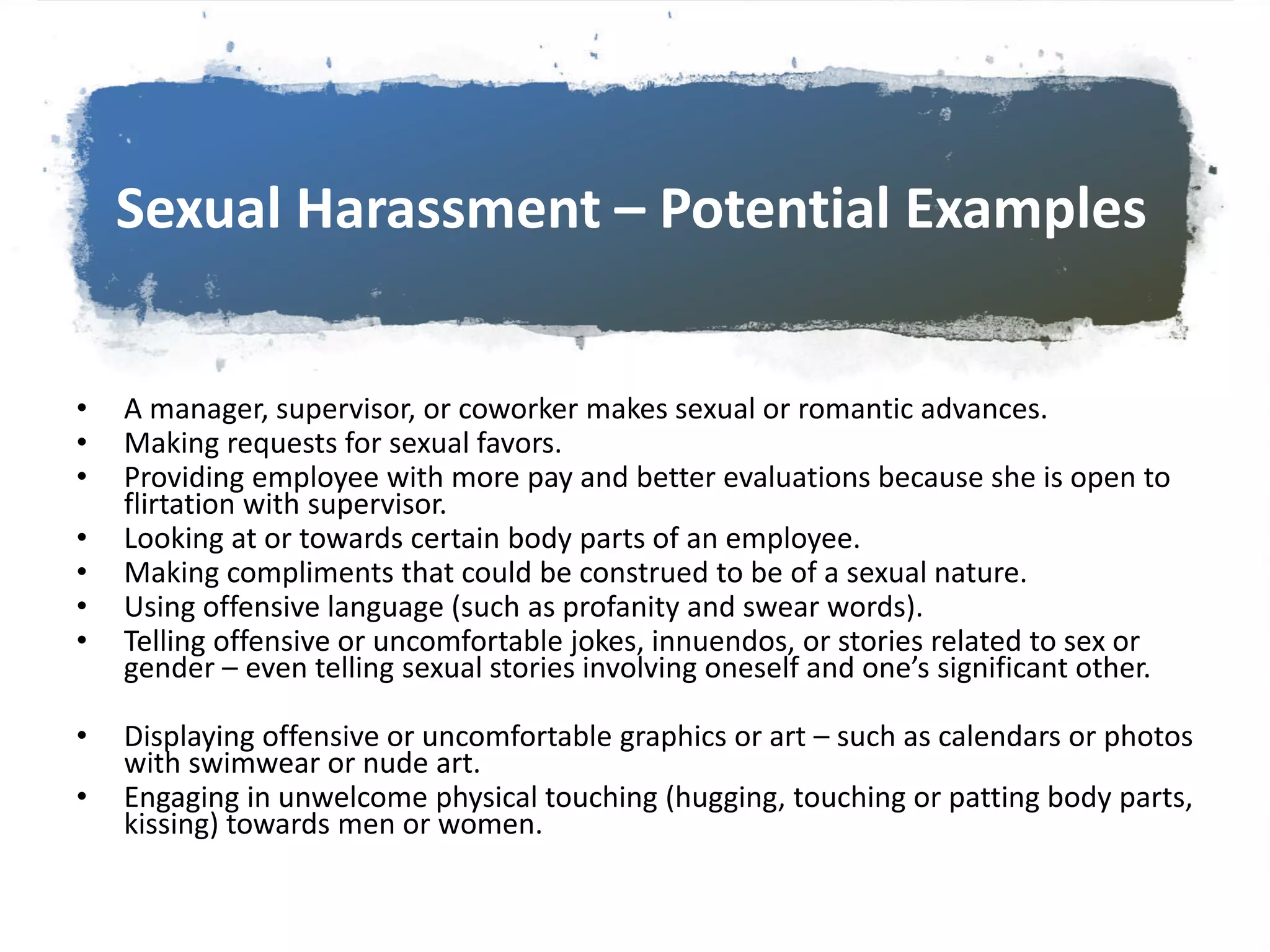
Sexual Harassment – Potential Examples
• A manager, supervisor, or coworker makes sexual or romantic advances.
• Making requests for sexual favors.
• Providing employee with more pay and better evaluations because she is open to
flirtation with supervisor.
• Looking at or towards certain body parts of an employee.
• Making compliments that could be construed to be of a sexual nature.
• Using offensive language (such as profanity and swear words).
• Telling offensive or uncomfortable jokes, innuendos, or stories related to sex or
gender – even telling sexual stories involving oneself and one’s significant other.
• Displaying offensive or uncomfortable graphics or art – such as calendars or photos
with swimwear or nude art.
• Engaging in unwelcome physical touching (hugging, touching or patting body parts,
kissing) towards men or women.
Unlawful Discrimination
& Sexual Harassment
Is it okay if the employee subjected to the discriminatory or sexually
harassing conduct is open to, agreeable to, or participates in such conduct?
No.
Submission to unlawful conduct cannot explicitly or implicitly be made a
term or condition of employment no matter what. Such conduct can still
have the effect of unreasonably interfering with an employee’s work
performance or of creating an intimidating, hostile, or offensive work
environment.
This is unlawful.
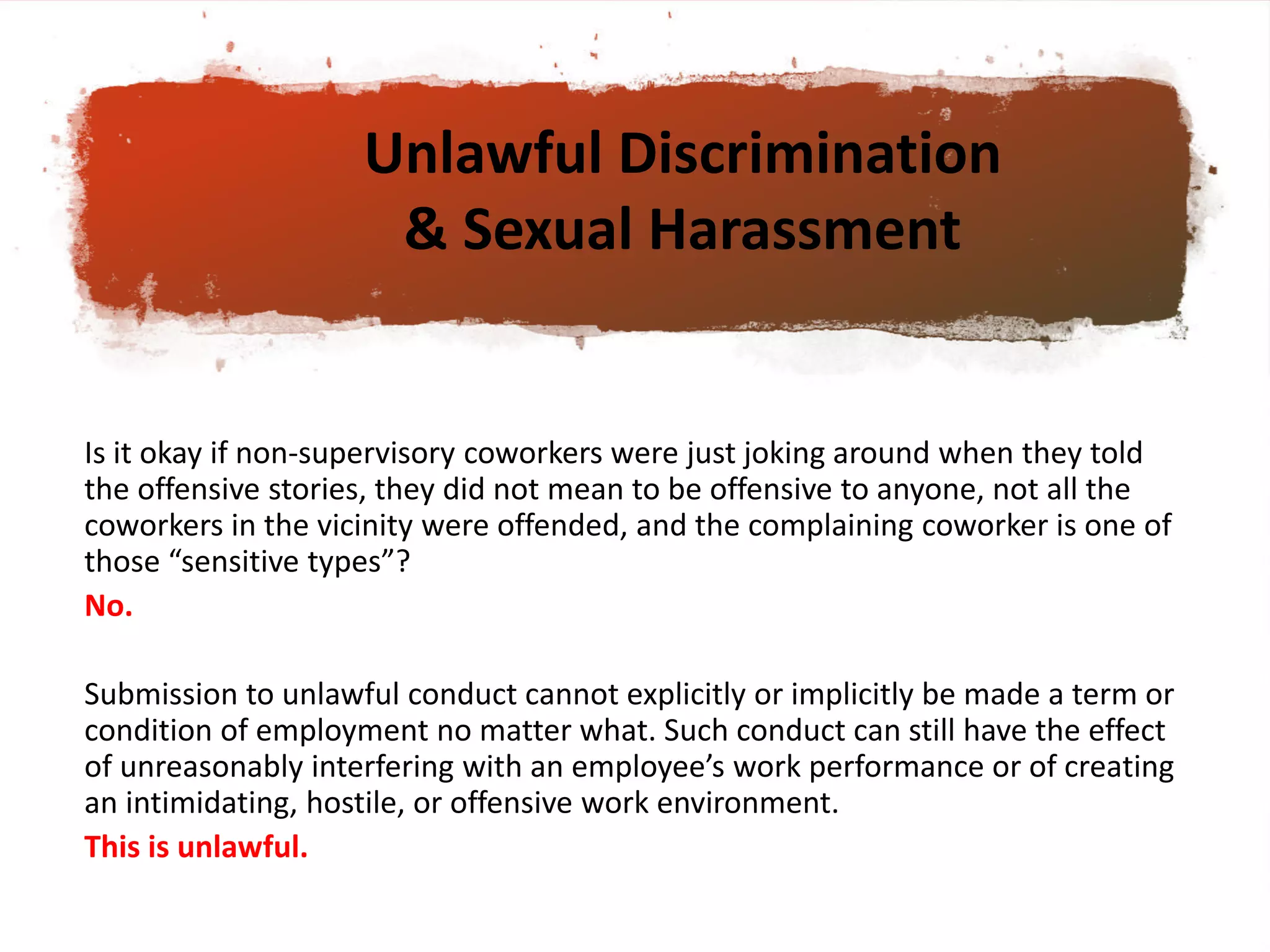
Unlawful Discrimination
& Sexual Harassment
Is it okay if non-supervisory coworkers were just joking around when they told
the offensive stories, they did not mean to be offensive to anyone, not all the
coworkers in the vicinity were offended, and the complaining coworker is one of
those “sensitive types”?
No.
Submission to unlawful conduct cannot explicitly or implicitly be made a term or
condition of employment no matter what. Such conduct can still have the effect
of unreasonably interfering with an employee’s work performance or of creating
an intimidating, hostile, or offensive work environment.
This is unlawful.
Unlawful
Discrimination
& Sexual
Harassment
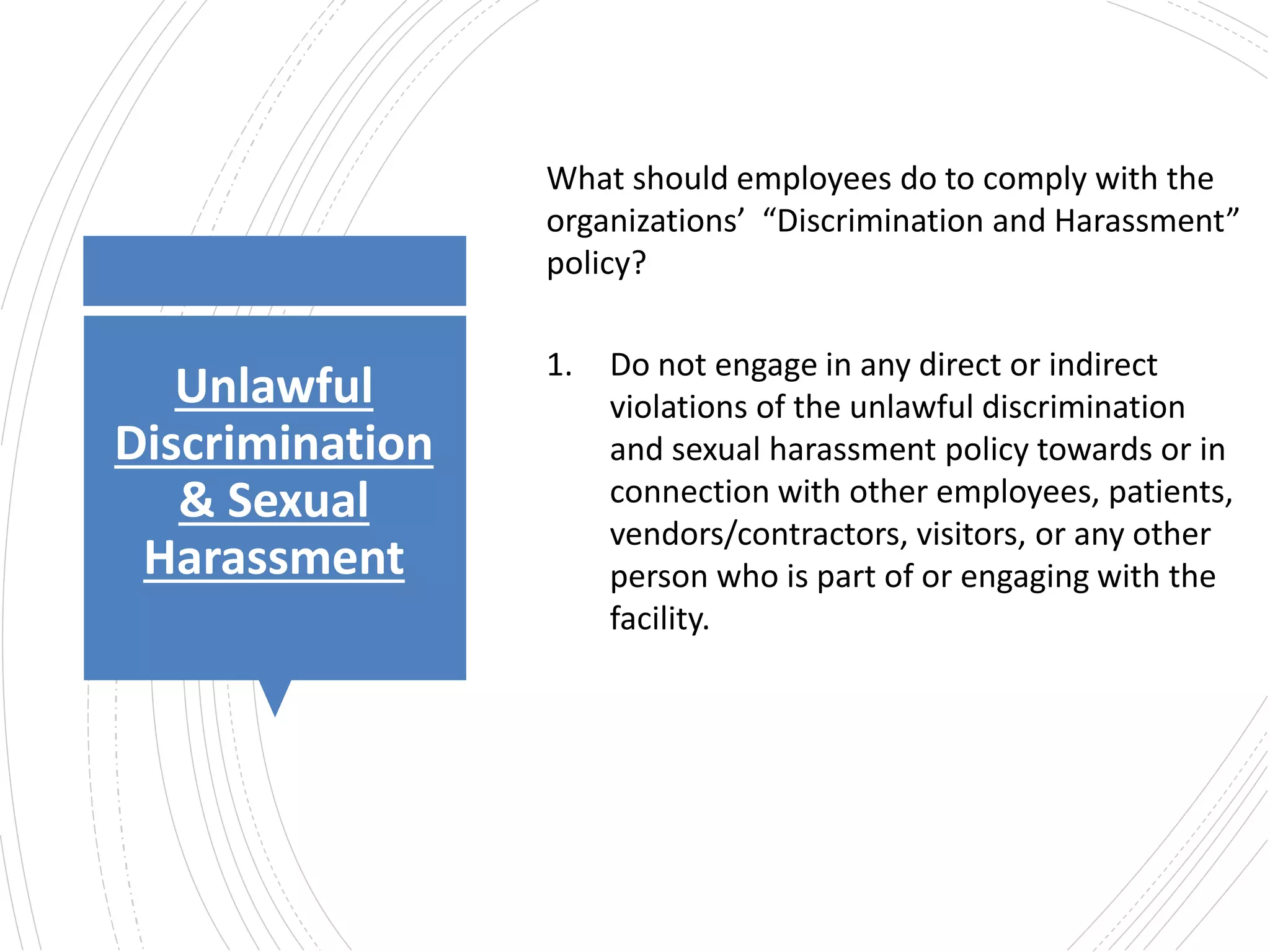
What should employees do to comply with the
organizations’ “Discrimination and Harassment”
policy?
1. Do not engage in any direct or indirect
violations of the unlawful discrimination
and sexual harassment policy towards or in
connection with other employees, patients,
vendors/contractors, visitors, or any other
person who is part of or engaging with the
facility.
Unlawful
Discrimination
& Sexual
Harassment
What should you do if you have any concerns about
unlawful discrimination or sexual harassment of
any person who is part of or engaging in the
community?
Contact HR immediately
Unlawful Discrimination & Sexual Harassment
– Duties of Managers & Supervisors
Managers and supervisors have a legal duty to report
potential unlawful discrimination or sexual harassment to
HR.
• Reports should be made to HR even if
manager/supervisor did not personally observe or hear
the incident or concern.
• Reports should be made to HR even if
manager/supervisor is not sure if anything unlawful or
prohibited occurred.
• Reports to HR should be made ASAP.
Unlawful Discrimination & Sexual Harassment –
Duties of Managers & Supervisors
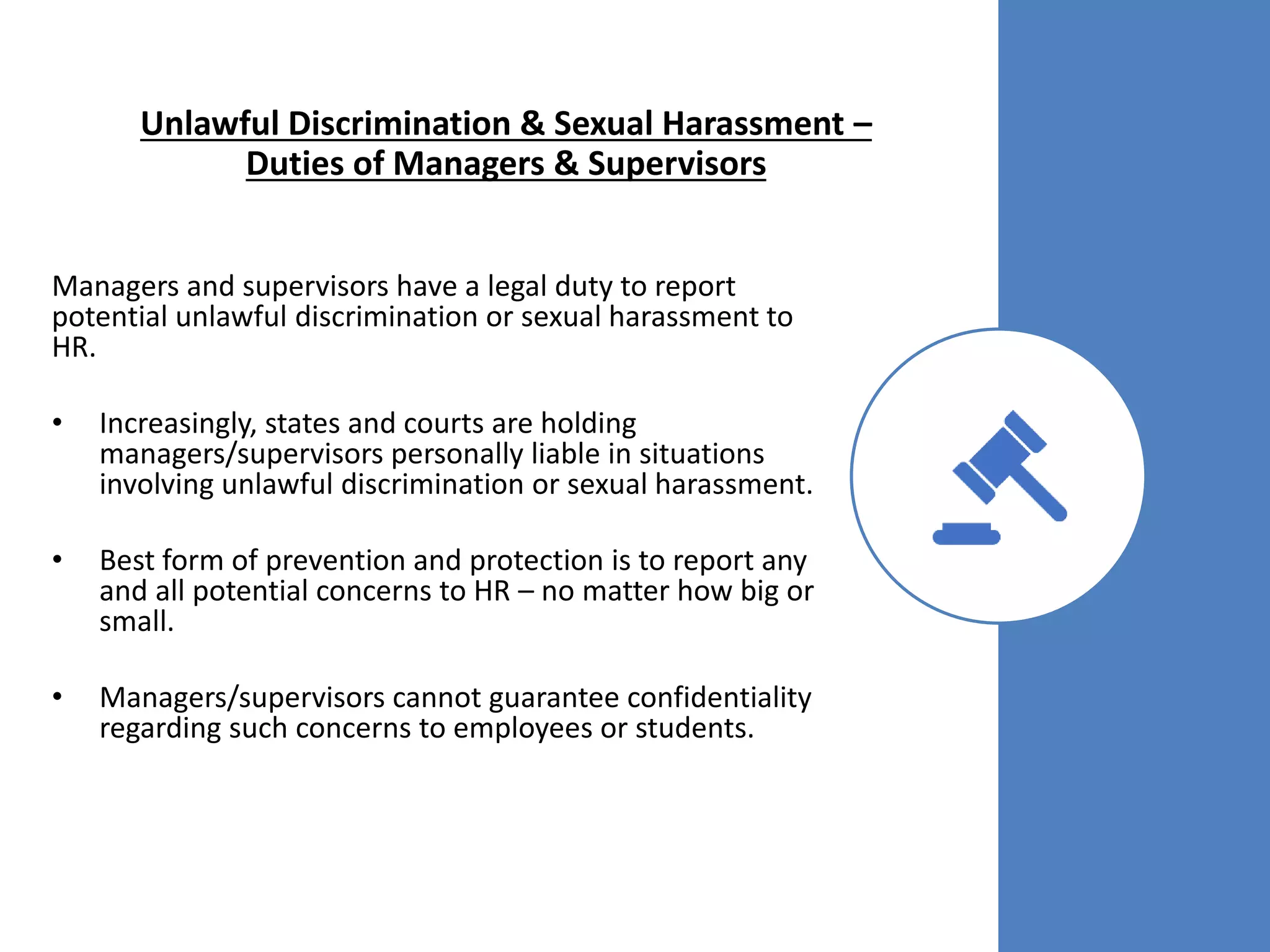
Managers and supervisors have a legal duty to report
potential unlawful discrimination or sexual harassment to
HR.
• Increasingly, states and courts are holding
managers/supervisors personally liable in situations
involving unlawful discrimination or sexual harassment.
• Best form of prevention and protection is to report any
and all potential concerns to HR – no matter how big or
small.
• Managers/supervisors cannot guarantee confidentiality
regarding such concerns to employees or students.
Unlawful
Discrimination &
Sexual Harassment –
Duties of Human
Resources
When HR receives concerns or complaints about potential
unlawful discrimination or sexual harassment, HR has a
duty to investigate.
• That an investigation is being conducted says nothing
about the legitimacy or accuracy of the concern or
complaint.
• Persons who may be a witness or can provide relevant
information will be interviewed.
• It is prohibited to try to affect the information provided
by a witness.
• It is prohibited to retaliate – act in a negative way –
towards a person for making a complaint or
participating in an investigation.
• Managers/supervisors and HR cannot guarantee 100%
confidentiality; rather, UP’s representatives can only
try to keep shared information as confidential as
possible
Workplace
Violence
Hostile acts such as physical violence, verbal
assaults, threats, coercion, intimidation, and
other forms of harassment may constitute
workplace violence.
Warning signs:
• Numerous or repeated conflicts with
others.
• Statements indicating desperation over
finances, family, school, or other problems.
• Statements indicating desire or intent to
hurt oneself or others.
• Reference to weapons.
• Statements about substance abuse.
• Threats or belligerent, intimidating, bullying
type conduct.
Workplace Violence
What should employees do with potential concerns about workplace
violence.
If concern is imminent or urgent, contact:
For concerns not imminent or urgent, be proactive and do not
underestimate possibility of violence. Contact supervisor and HR
asap.
Workplace
Violence
If an incident of potential workplace
violence occurs:
• If you can safely run away or hide,
do so.
• Otherwise, try to signal to a
coworker to call for Security, or
potentially 911.
• Don’t assume that you can diffuse
a violent situation. Weigh out the
potential risks.

Harassment & Discrimination Training

  • 1.
    Unlawful Discrimination &Sexual Harassment
  • 2.
    Unlawful Discrimination & Sexual Harassment PURPOSE: • Tohelp you understand what is meant by “unlawful discrimination” & “sexual harassment.” • Provide guidance on what to do if you witness or experience potential unlawful discrimination or sexual harassment. • Provide supervisors with information about their responsibilities.
  • 3.
    Title VII This trainingis to help you understand what is meant by “Title VII.” We will provide guidance on what to do if you witness, experience, or learn about potential Title VII concerns.
  • 4.
    Workplace Violence • Wewill review how to recognize issues of workplace violence. • And give you guidance as to how to react to issues of workplace violence and; • Ensure that all employees have a safe place to work!
  • 5.
    What is UnlawfulDiscrimination? Unlawful discrimination occurs when an employee is treated differently because of or related to his or her protected class(es). The next slide has the many protected classes under federal law. Each of us may have several protected classes.
  • 6.
    Unlawful Discrimination – ProtectedClasses • Race. • Color. • National origin. • Sex (includes pregnancy- related conditions, gender, sexual harassment). • Religion. • Age. • Veteran status • Physical or mental disability. • Sexual orientation. • Gender identity. • Marital status. • Family relationship. • Injured workers. • Genetic screening & brain- wave testing. • Use of protected medical or family leave. • Association with member of a protected class. • Opposition of an unlawful employment practice. • Use of rights under other employment laws.
  • 7.
    Unlawful Discrimination: Potential Examples •A Muslim applicant not hired for housekeeping position because she stated that she needs to wear a head covering while working. • Employees with veteran status not promoted as much as other employees. • Women employees paid less than male employees. • Employee fired after employer learns employee is in a romantic relationship with someone of the same gender. • Promoting one employee and not another based on marital status. • Racial or ethnic slurs. • Offensive or uncomfortable jokes, innuendos, stories, or graphics related to a protected class such as race, sex, age, sexual orientation, etc. • Engaging in unwelcome physical touching (hugging, touching or patting body parts, kissing) towards men or women. • Engaging in unwelcome or harassing conduct (placing garbage in a coworker’s locker, putting dog bowl before a coworker’s locker, hanging a noose on a coworker’s cart, etc.).
  • 8.
    What is Sexual Harassment? Sexual harassmentis a form of unlawful discrimination. The protected class involved in sexual harassment is sex/gender. Sexual harassment is when an employee is treated differently and negatively by the employer (managers or supervisors) or other employees related to the employee’s sex or gender.
  • 9.
    Sexual Harassment –Potential Examples • A manager, supervisor, or coworker makes sexual or romantic advances. • Making requests for sexual favors. • Providing employee with more pay and better evaluations because she is open to flirtation with supervisor. • Looking at or towards certain body parts of an employee. • Making compliments that could be construed to be of a sexual nature. • Using offensive language (such as profanity and swear words). • Telling offensive or uncomfortable jokes, innuendos, or stories related to sex or gender – even telling sexual stories involving oneself and one’s significant other. • Displaying offensive or uncomfortable graphics or art – such as calendars or photos with swimwear or nude art. • Engaging in unwelcome physical touching (hugging, touching or patting body parts, kissing) towards men or women.
  • 10.
    Unlawful Discrimination & SexualHarassment Is it okay if the employee subjected to the discriminatory or sexually harassing conduct is open to, agreeable to, or participates in such conduct? No. Submission to unlawful conduct cannot explicitly or implicitly be made a term or condition of employment no matter what. Such conduct can still have the effect of unreasonably interfering with an employee’s work performance or of creating an intimidating, hostile, or offensive work environment. This is unlawful.
  • 11.
    Unlawful Discrimination & SexualHarassment Is it okay if non-supervisory coworkers were just joking around when they told the offensive stories, they did not mean to be offensive to anyone, not all the coworkers in the vicinity were offended, and the complaining coworker is one of those “sensitive types”? No. Submission to unlawful conduct cannot explicitly or implicitly be made a term or condition of employment no matter what. Such conduct can still have the effect of unreasonably interfering with an employee’s work performance or of creating an intimidating, hostile, or offensive work environment. This is unlawful.
  • 12.
    Unlawful Discrimination & Sexual Harassment What shouldemployees do to comply with the organizations’ “Discrimination and Harassment” policy? 1. Do not engage in any direct or indirect violations of the unlawful discrimination and sexual harassment policy towards or in connection with other employees, patients, vendors/contractors, visitors, or any other person who is part of or engaging with the facility.
  • 13.
    Unlawful Discrimination & Sexual Harassment What shouldyou do if you have any concerns about unlawful discrimination or sexual harassment of any person who is part of or engaging in the community? Contact HR immediately
  • 14.
    Unlawful Discrimination &Sexual Harassment – Duties of Managers & Supervisors Managers and supervisors have a legal duty to report potential unlawful discrimination or sexual harassment to HR. • Reports should be made to HR even if manager/supervisor did not personally observe or hear the incident or concern. • Reports should be made to HR even if manager/supervisor is not sure if anything unlawful or prohibited occurred. • Reports to HR should be made ASAP.
  • 15.
    Unlawful Discrimination &Sexual Harassment – Duties of Managers & Supervisors Managers and supervisors have a legal duty to report potential unlawful discrimination or sexual harassment to HR. • Increasingly, states and courts are holding managers/supervisors personally liable in situations involving unlawful discrimination or sexual harassment. • Best form of prevention and protection is to report any and all potential concerns to HR – no matter how big or small. • Managers/supervisors cannot guarantee confidentiality regarding such concerns to employees or students.
  • 16.
    Unlawful Discrimination & Sexual Harassment– Duties of Human Resources When HR receives concerns or complaints about potential unlawful discrimination or sexual harassment, HR has a duty to investigate. • That an investigation is being conducted says nothing about the legitimacy or accuracy of the concern or complaint. • Persons who may be a witness or can provide relevant information will be interviewed. • It is prohibited to try to affect the information provided by a witness. • It is prohibited to retaliate – act in a negative way – towards a person for making a complaint or participating in an investigation. • Managers/supervisors and HR cannot guarantee 100% confidentiality; rather, UP’s representatives can only try to keep shared information as confidential as possible
  • 17.
    Workplace Violence Hostile acts suchas physical violence, verbal assaults, threats, coercion, intimidation, and other forms of harassment may constitute workplace violence. Warning signs: • Numerous or repeated conflicts with others. • Statements indicating desperation over finances, family, school, or other problems. • Statements indicating desire or intent to hurt oneself or others. • Reference to weapons. • Statements about substance abuse. • Threats or belligerent, intimidating, bullying type conduct.
  • 18.
    Workplace Violence What shouldemployees do with potential concerns about workplace violence. If concern is imminent or urgent, contact: For concerns not imminent or urgent, be proactive and do not underestimate possibility of violence. Contact supervisor and HR asap.
  • 19.
    Workplace Violence If an incidentof potential workplace violence occurs: • If you can safely run away or hide, do so. • Otherwise, try to signal to a coworker to call for Security, or potentially 911. • Don’t assume that you can diffuse a violent situation. Weigh out the potential risks.