Sexual Harassment
in the
Workplace
Management Training & Awareness
Objectives:
International perspective on definition, scope, attitudes and effects -
(ILO standards)
Definition sexual harassment.
Describe the action and steps Managers must take in order to resolve
sexual harassment grievances at the workplace.
Identify the process of reporting sexual harassment.
Understand the impact of sexual harassment in the workplace on
morale and values, performance and productivity.
Describe strategies and action Managers can take to prevent sexual
harassment at the workplace.
Define Sexual Harassment
Identify what actions constitute Sexual Harassment.
Where can it occur
Who may be involved
Colleagues responsibility
How to Report Sexual Harassment
The Company’s Policies on Sexual Harassment
Role of Supervisors/Managers
Effects of Sexual Harassment
Summary
Topics to be covered
Discussion Time
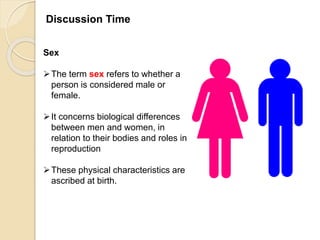
Sex
The term sex refers to whether a
person is considered male or
female.
It concerns biological differences
between men and women, in
relation to their bodies and roles in
reproduction
These physical characteristics are
ascribed at birth.
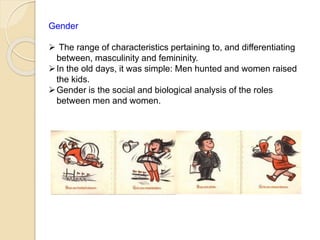
Gender
 The range of characteristics pertaining to, and differentiating
between, masculinity and femininity.
In the old days, it was simple: Men hunted and women raised
the kids.
Gender is the social and biological analysis of the roles
between men and women.
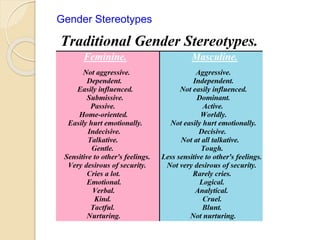
Gender Stereotypes
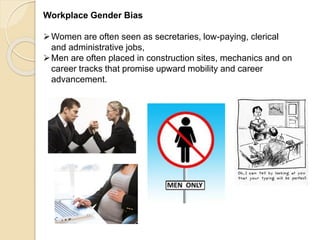
Workplace Gender Bias
Women are often seen as secretaries, low-paying, clerical
and administrative jobs,
Men are often placed in construction sites, mechanics and on
career tracks that promise upward mobility and career
advancement.
8
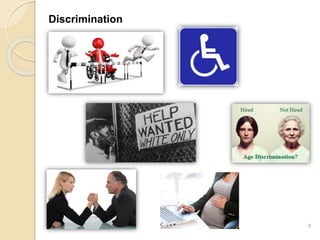
Discrimination
•Ethnicity
•Colour
•Religion
•Political Opinion
•Trade Union Membership
•Disability
•Sexual Orientation
•Gender
•Marital Status
•Pregnancy
•State of Health
No Person is to discriminate against another
worker on any of the above grounds in employment
matters
Workplace Discrimination
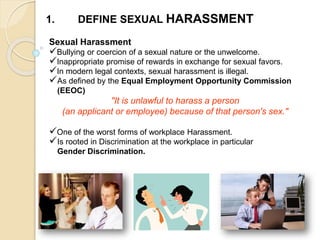
1. DEFINE SEXUAL HARASSMENT
Sexual Harassment
Bullying or coercion of a sexual nature or the unwelcome.
Inappropriate promise of rewards in exchange for sexual favors.
In modern legal contexts, sexual harassment is illegal.
As defined by the Equal Employment Opportunity Commission
(EEOC)
"It is unlawful to harass a person
(an applicant or employee) because of that person's sex."
One of the worst forms of workplace Harassment.
Is rooted in Discrimination at the workplace in particular
Gender Discrimination.
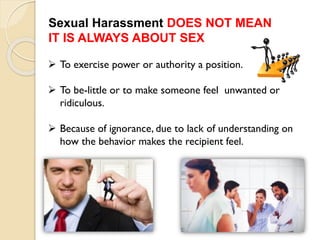
 To exercise power or authority a position.
 To be-little or to make someone feel unwanted or
ridiculous.
 Because of ignorance, due to lack of understanding on
how the behavior makes the recipient feel.
Sexual Harassment DOES NOT MEAN
IT IS ALWAYS ABOUT SEX
Nature of Sexual Harassment:
2 situations can give rise to sexual harassment at the workplace:
Quid Pro Quo- (I will give you this if you give me that)
 Sexual harassment occurs when it is stated or implied that an
employment decision about an employee depends upon whether
the employee submits to conduct which is sexual in nature.
 Submission to or rejection of such conduct by an individual is
used as the basis for employment decisions affecting such
individual.
Hostile Work Environment - unwelcome sexual advances,
bullying, non-verbal or physical conduct of a sexual nature
constitute hostile environment sexual harassment when a
reasonable person would find:
 Such conduct has the effect of unreasonably interfering with an
individual work performance or
 Such conduct creates an intimidating hostile or offensive
working environment, which is perceived by the victim to be
abusive or hostile.
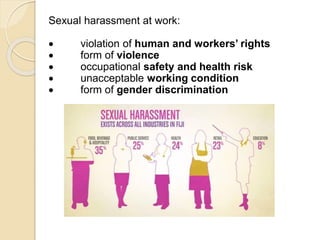
Sexual harassment at work:
 violation of human and workers’ rights
 form of violence
 occupational safety and health risk
 unacceptable working condition
 form of gender discrimination
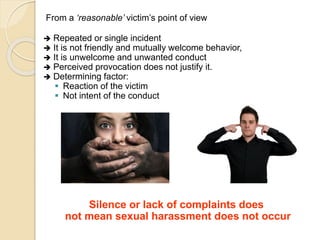
From a ‘reasonable’ victim’s point of view
 Repeated or single incident
 It is not friendly and mutually welcome behavior,
 It is unwelcome and unwanted conduct
 Perceived provocation does not justify it.
 Determining factor:
 Reaction of the victim
 Not intent of the conduct
Silence or lack of complaints does
not mean sexual harassment does not occur
15
2. WHAT ACTIONS CONSTITUTE SEXUAL
HARASSMENT
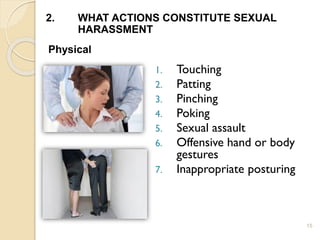
Physical
1. Touching
2. Patting
3. Pinching
4. Poking
5. Sexual assault
6. Offensive hand or body
gestures
7. Inappropriate posturing
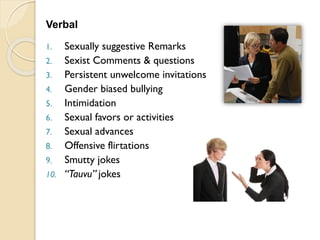
Verbal
1. Sexually suggestive Remarks
2. Sexist Comments & questions
3. Persistent unwelcome invitations
4. Gender biased bullying
5. Intimidation
6. Sexual favors or activities
7. Sexual advances
8. Offensive flirtations
9. Smutty jokes
10. “Tauvu” jokes
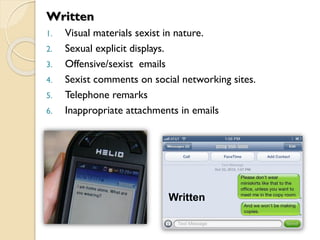
Written
Written
1. Visual materials sexist in nature.
2. Sexual explicit displays.
3. Offensive/sexist emails
4. Sexist comments on social networking sites.
5. Telephone remarks
6. Inappropriate attachments in emails
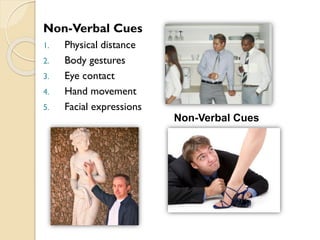
Non-Verbal Cues
Non-Verbal Cues
1. Physical distance
2. Body gestures
3. Eye contact
4. Hand movement
5. Facial expressions
It can occur at the workplace:
• colleague facilities,
• washroom,
• recreational areas,
• social events,
• company transport,
3. WHERE IT CAN OCCUR?
One single act
can constitute
Sexual
Harassment.
Sexual harassment may occur between:
Supervisor-subordinate (unequal power)
Worker - worker (co-workers)
Customer -worker
Contractor - Customer
Worker - contractor
Visitor - Customer
Visitor - worker
4. WHO MAY BE INVOLVED
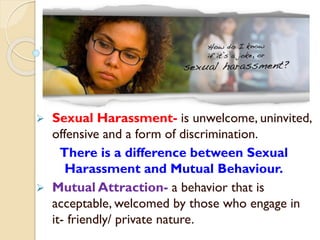
 Sexual Harassment- is unwelcome, uninvited,
offensive and a form of discrimination.
There is a difference between Sexual
Harassment and Mutual Behaviour.
 Mutual Attraction- a behavior that is
acceptable, welcomed by those who engage in
it- friendly/ private nature.
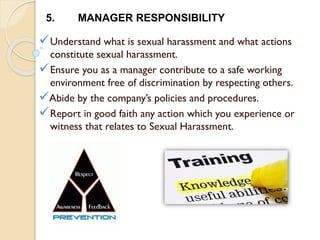
Understand what is sexual harassment and what actions
constitute sexual harassment.
Ensure you as a manager contribute to a safe working
environment free of discrimination by respecting others.
Abide by the company’s policies and procedures.
Report in good faith any action which you experience or
witness that relates to Sexual Harassment.
5. MANAGER RESPONSIBILITY
Communicate to staff on the harmful effects of sexual
harassment at the workplace.
Responsible in maintaining a safe and Productive
workplace.
Plays a leading role in ensuring the complaint is
resolved in a timely and confidential manner. Takes
into account Natural Justice- should gather fact- based
data to support claims and ensure accurate process of
investigations are undertaken.
Communicates closely with HRM in resolving the
matter and activating the Disciplinary Procedures.
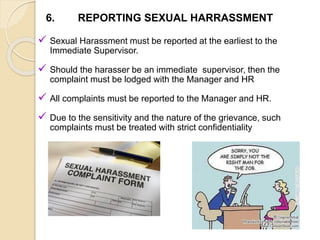
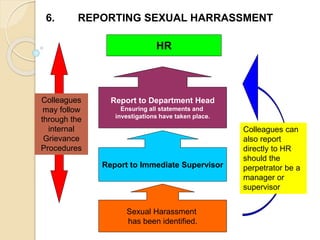
 Sexual Harassment must be reported at the earliest to the
Immediate Supervisor.
 Should the harasser be an immediate supervisor, then the
complaint must be lodged with the Manager and HR
 All complaints must be reported to the Manager and HR.
 Due to the sensitivity and the nature of the grievance, such
complaints must be treated with strict confidentiality
6. REPORTING SEXUAL HARRASSMENT
Sexual Harassment
has been identified.
Report to Immediate Supervisor
Report to Department Head
Ensuring all statements and
investigations have taken place.
HR
Colleagues can
also report
directly to HR
should the
perpetrator be a
manager or
supervisor
Colleagues
may follow
through the
internal
Grievance
Procedures
6. REPORTING SEXUAL HARRASSMENT
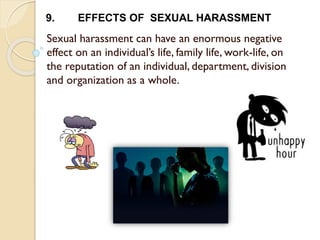
Sexual harassment can have an enormous negative
effect on an individual’s life, family life, work-life, on
the reputation of an individual, department, division
and organization as a whole.
9. EFFECTS OF SEXUAL HARASSMENT
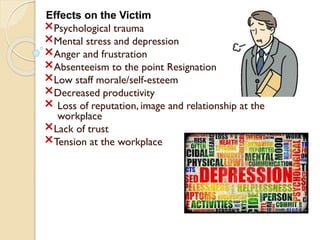
×Psychological trauma
×Mental stress and depression
×Anger and frustration
×Absenteeism to the point Resignation
×Low staff morale/self-esteem
×Decreased productivity
× Loss of reputation, image and relationship at the
workplace
×Lack of trust
×Tension at the workplace
Effects on the Victim
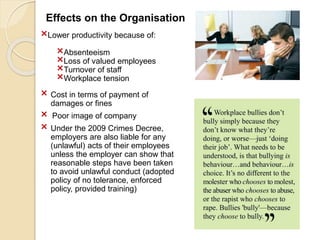
Effects on the Organisation
×Lower productivity because of:
×Absenteeism
×Loss of valued employees
×Turnover of staff
×Workplace tension
× Cost in terms of payment of
damages or fines
× Poor image of company
× Under the 2009 Crimes Decree,
employers are also liable for any
(unlawful) acts of their employees
unless the employer can show that
reasonable steps have been taken
to avoid unlawful conduct (adopted
policy of no tolerance, enforced
policy, provided training)
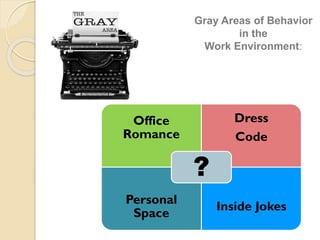
Gray Areas of Behavior
in the
Work Environment:
Office
Romance
Dress
Code
Personal
Space
Inside Jokes
?
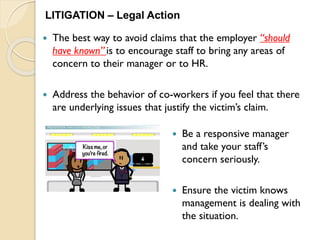
 The best way to avoid claims that the employer “should
have known” is to encourage staff to bring any areas of
concern to their manager or to HR.
 Address the behavior of co-workers if you feel that there
are underlying issues that justify the victim’s claim.
LITIGATION – Legal Action
 Be a responsive manager
and take your staff’s
concern seriously.
 Ensure the victim knows
management is dealing with
the situation.
If any harassment claim is proven to be inaccurate or
false, that person can be subject to individual liability
for:
 Defamation, if he/she falsely publicizes information
about employees in a harassment claim.
 Inflicting emotional distress
 Engaging in harassment
 Visual Aids- posters and pamphlets
 RefresherTraining or ContinuousTraining
 Avoid negative jokes or comments about protected categories
 Reinforcement through Department Briefings.
 Improve safety of work environment (e.g. well-lit work areas, balance
of men and women in all levels during all work hours at all
workstations)
 Remove inappropriate materials from the workplace
 Use monitoring and evaluation mechanisms to review and modify
policies
 Beware of how physical touching could be misinterpreted or later
misrepresented.
 Do not rely or endorse stereotypes
 Scrutinize your own actions.Ask yourself, would you feel comfortable
with your behavior knowing it was being observed by other co-
workers.
Preventive and Remedial
 The workplace should be one free of discrimination and
sexual harassment.
 It is important that Management and colleagues fully
understand their responsibilities and act accordingly to
ensure a safe and productive workplace for all.
 Knowing and understanding the Sexual Harassment Policy
and HR Grievance and Disciplinary procedures must be
mandatory for all and at all times must be complied with.
Strong statement on organization’s attitude toward sexual
harassment
10. SUMMARY
Sexual Harassment

Sexual Harassment

  • 1.
  • 2.
    Objectives: International perspective ondefinition, scope, attitudes and effects - (ILO standards) Definition sexual harassment. Describe the action and steps Managers must take in order to resolve sexual harassment grievances at the workplace. Identify the process of reporting sexual harassment. Understand the impact of sexual harassment in the workplace on morale and values, performance and productivity. Describe strategies and action Managers can take to prevent sexual harassment at the workplace.
  • 3.
    Define Sexual Harassment Identifywhat actions constitute Sexual Harassment. Where can it occur Who may be involved Colleagues responsibility How to Report Sexual Harassment The Company’s Policies on Sexual Harassment Role of Supervisors/Managers Effects of Sexual Harassment Summary Topics to be covered
  • 4.
    Discussion Time Sex The termsex refers to whether a person is considered male or female. It concerns biological differences between men and women, in relation to their bodies and roles in reproduction These physical characteristics are ascribed at birth.
  • 5.
    Gender  The rangeof characteristics pertaining to, and differentiating between, masculinity and femininity. In the old days, it was simple: Men hunted and women raised the kids. Gender is the social and biological analysis of the roles between men and women.
  • 6.
  • 7.
    Workplace Gender Bias Womenare often seen as secretaries, low-paying, clerical and administrative jobs, Men are often placed in construction sites, mechanics and on career tracks that promise upward mobility and career advancement.
  • 8.
  • 9.
    •Ethnicity •Colour •Religion •Political Opinion •Trade UnionMembership •Disability •Sexual Orientation •Gender •Marital Status •Pregnancy •State of Health No Person is to discriminate against another worker on any of the above grounds in employment matters Workplace Discrimination
  • 10.
    1. DEFINE SEXUALHARASSMENT Sexual Harassment Bullying or coercion of a sexual nature or the unwelcome. Inappropriate promise of rewards in exchange for sexual favors. In modern legal contexts, sexual harassment is illegal. As defined by the Equal Employment Opportunity Commission (EEOC) "It is unlawful to harass a person (an applicant or employee) because of that person's sex." One of the worst forms of workplace Harassment. Is rooted in Discrimination at the workplace in particular Gender Discrimination.
  • 11.
     To exercisepower or authority a position.  To be-little or to make someone feel unwanted or ridiculous.  Because of ignorance, due to lack of understanding on how the behavior makes the recipient feel. Sexual Harassment DOES NOT MEAN IT IS ALWAYS ABOUT SEX
  • 12.
    Nature of SexualHarassment: 2 situations can give rise to sexual harassment at the workplace: Quid Pro Quo- (I will give you this if you give me that)  Sexual harassment occurs when it is stated or implied that an employment decision about an employee depends upon whether the employee submits to conduct which is sexual in nature.  Submission to or rejection of such conduct by an individual is used as the basis for employment decisions affecting such individual. Hostile Work Environment - unwelcome sexual advances, bullying, non-verbal or physical conduct of a sexual nature constitute hostile environment sexual harassment when a reasonable person would find:  Such conduct has the effect of unreasonably interfering with an individual work performance or  Such conduct creates an intimidating hostile or offensive working environment, which is perceived by the victim to be abusive or hostile.
  • 13.
    Sexual harassment atwork:  violation of human and workers’ rights  form of violence  occupational safety and health risk  unacceptable working condition  form of gender discrimination
  • 14.
    From a ‘reasonable’victim’s point of view  Repeated or single incident  It is not friendly and mutually welcome behavior,  It is unwelcome and unwanted conduct  Perceived provocation does not justify it.  Determining factor:  Reaction of the victim  Not intent of the conduct Silence or lack of complaints does not mean sexual harassment does not occur
  • 15.
    15 2. WHAT ACTIONSCONSTITUTE SEXUAL HARASSMENT Physical 1. Touching 2. Patting 3. Pinching 4. Poking 5. Sexual assault 6. Offensive hand or body gestures 7. Inappropriate posturing
  • 16.
    Verbal 1. Sexually suggestiveRemarks 2. Sexist Comments & questions 3. Persistent unwelcome invitations 4. Gender biased bullying 5. Intimidation 6. Sexual favors or activities 7. Sexual advances 8. Offensive flirtations 9. Smutty jokes 10. “Tauvu” jokes
  • 17.
    Written Written 1. Visual materialssexist in nature. 2. Sexual explicit displays. 3. Offensive/sexist emails 4. Sexist comments on social networking sites. 5. Telephone remarks 6. Inappropriate attachments in emails
  • 18.
    Non-Verbal Cues Non-Verbal Cues 1.Physical distance 2. Body gestures 3. Eye contact 4. Hand movement 5. Facial expressions
  • 19.
    It can occurat the workplace: • colleague facilities, • washroom, • recreational areas, • social events, • company transport, 3. WHERE IT CAN OCCUR? One single act can constitute Sexual Harassment.
  • 20.
    Sexual harassment mayoccur between: Supervisor-subordinate (unequal power) Worker - worker (co-workers) Customer -worker Contractor - Customer Worker - contractor Visitor - Customer Visitor - worker 4. WHO MAY BE INVOLVED
  • 21.
     Sexual Harassment-is unwelcome, uninvited, offensive and a form of discrimination. There is a difference between Sexual Harassment and Mutual Behaviour.  Mutual Attraction- a behavior that is acceptable, welcomed by those who engage in it- friendly/ private nature.
  • 22.
    Understand what issexual harassment and what actions constitute sexual harassment. Ensure you as a manager contribute to a safe working environment free of discrimination by respecting others. Abide by the company’s policies and procedures. Report in good faith any action which you experience or witness that relates to Sexual Harassment. 5. MANAGER RESPONSIBILITY
  • 23.
    Communicate to staffon the harmful effects of sexual harassment at the workplace. Responsible in maintaining a safe and Productive workplace. Plays a leading role in ensuring the complaint is resolved in a timely and confidential manner. Takes into account Natural Justice- should gather fact- based data to support claims and ensure accurate process of investigations are undertaken. Communicates closely with HRM in resolving the matter and activating the Disciplinary Procedures.
  • 24.
     Sexual Harassmentmust be reported at the earliest to the Immediate Supervisor.  Should the harasser be an immediate supervisor, then the complaint must be lodged with the Manager and HR  All complaints must be reported to the Manager and HR.  Due to the sensitivity and the nature of the grievance, such complaints must be treated with strict confidentiality 6. REPORTING SEXUAL HARRASSMENT
  • 25.
    Sexual Harassment has beenidentified. Report to Immediate Supervisor Report to Department Head Ensuring all statements and investigations have taken place. HR Colleagues can also report directly to HR should the perpetrator be a manager or supervisor Colleagues may follow through the internal Grievance Procedures 6. REPORTING SEXUAL HARRASSMENT
  • 26.
    Sexual harassment canhave an enormous negative effect on an individual’s life, family life, work-life, on the reputation of an individual, department, division and organization as a whole. 9. EFFECTS OF SEXUAL HARASSMENT
  • 27.
    ×Psychological trauma ×Mental stressand depression ×Anger and frustration ×Absenteeism to the point Resignation ×Low staff morale/self-esteem ×Decreased productivity × Loss of reputation, image and relationship at the workplace ×Lack of trust ×Tension at the workplace Effects on the Victim
  • 28.
    Effects on theOrganisation ×Lower productivity because of: ×Absenteeism ×Loss of valued employees ×Turnover of staff ×Workplace tension × Cost in terms of payment of damages or fines × Poor image of company × Under the 2009 Crimes Decree, employers are also liable for any (unlawful) acts of their employees unless the employer can show that reasonable steps have been taken to avoid unlawful conduct (adopted policy of no tolerance, enforced policy, provided training)
  • 29.
    Gray Areas ofBehavior in the Work Environment: Office Romance Dress Code Personal Space Inside Jokes ?
  • 30.
     The bestway to avoid claims that the employer “should have known” is to encourage staff to bring any areas of concern to their manager or to HR.  Address the behavior of co-workers if you feel that there are underlying issues that justify the victim’s claim. LITIGATION – Legal Action  Be a responsive manager and take your staff’s concern seriously.  Ensure the victim knows management is dealing with the situation.
  • 31.
    If any harassmentclaim is proven to be inaccurate or false, that person can be subject to individual liability for:  Defamation, if he/she falsely publicizes information about employees in a harassment claim.  Inflicting emotional distress  Engaging in harassment
  • 32.
     Visual Aids-posters and pamphlets  RefresherTraining or ContinuousTraining  Avoid negative jokes or comments about protected categories  Reinforcement through Department Briefings.  Improve safety of work environment (e.g. well-lit work areas, balance of men and women in all levels during all work hours at all workstations)  Remove inappropriate materials from the workplace  Use monitoring and evaluation mechanisms to review and modify policies  Beware of how physical touching could be misinterpreted or later misrepresented.  Do not rely or endorse stereotypes  Scrutinize your own actions.Ask yourself, would you feel comfortable with your behavior knowing it was being observed by other co- workers. Preventive and Remedial
  • 33.
     The workplaceshould be one free of discrimination and sexual harassment.  It is important that Management and colleagues fully understand their responsibilities and act accordingly to ensure a safe and productive workplace for all.  Knowing and understanding the Sexual Harassment Policy and HR Grievance and Disciplinary procedures must be mandatory for all and at all times must be complied with. Strong statement on organization’s attitude toward sexual harassment 10. SUMMARY