

Empathy and its Elements
A Lecture
By
Mr. Allah Dad Khan
Visiting Professor
The University of Agriculture
Peshawar
WHAT IS EMPATHY?
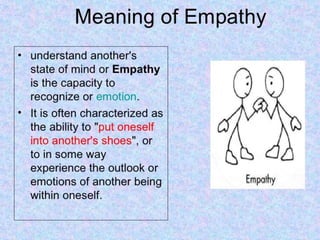
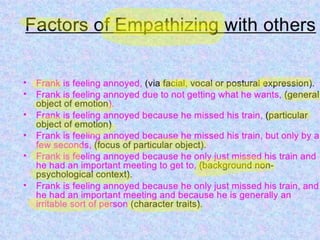
Empathy is, at its simplest, awareness of the feelings
and emotions of other people. It is a key element
of Emotional Intelligence, the link between self and
others, because it is how we as individuals understand
what others are experiencing as if we were feeling it
ourselves.
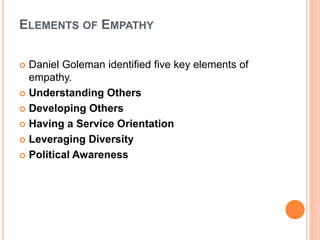
ELEMENTS OF EMPATHY
 Daniel Goleman identified five key elements of
empathy.
 Understanding Others
 Developing Others
 Having a Service Orientation
 Leveraging Diversity
 Political Awareness
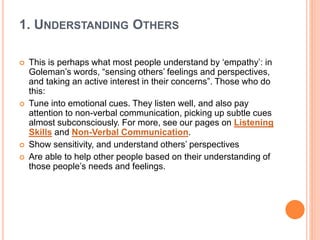
1. UNDERSTANDING OTHERS
 This is perhaps what most people understand by ‘empathy’: in
Goleman’s words, “sensing others’ feelings and perspectives,
and taking an active interest in their concerns”. Those who do
this:
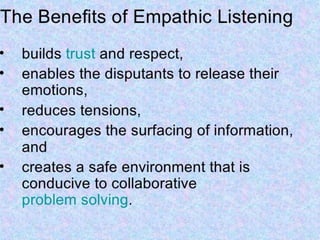
 Tune into emotional cues. They listen well, and also pay
attention to non-verbal communication, picking up subtle cues
almost subconsciously. For more, see our pages on Listening
Skills and Non-Verbal Communication.
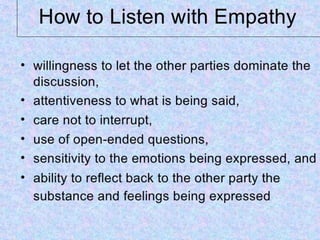
 Show sensitivity, and understand others’ perspectives
 Are able to help other people based on their understanding of
those people’s needs and feelings.
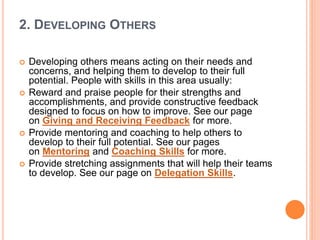
2. DEVELOPING OTHERS
 Developing others means acting on their needs and
concerns, and helping them to develop to their full
potential. People with skills in this area usually:
 Reward and praise people for their strengths and
accomplishments, and provide constructive feedback
designed to focus on how to improve. See our page
on Giving and Receiving Feedback for more.
 Provide mentoring and coaching to help others to
develop to their full potential. See our pages
on Mentoring and Coaching Skills for more.
 Provide stretching assignments that will help their teams
to develop. See our page on Delegation Skills.
3. HAVING A SERVICE ORIENTATION
 Primarily aimed at work situations, having a service
orientation means putting the needs of customers first
and looking for ways to improve their satisfaction and
loyalty.
 People who have this approach will ‘go the extra mile’
for customers. They will genuinely understand
customers’ needs, and go out of their way to help meet
them.
 In this way, they can become a ‘trusted advisor’ to
customers, developing a long-term relationship
between customer and organisation. This can
happen in any industry, and any situation
4. LEVERAGING DIVERSITY
 Leveraging diversity means being able to create
and develop opportunities through different kinds of
people, recognising and celebrating that we all
bring something different to the table.
 Leveraging diversity does not mean that you
treat everyone in exactly the same way, but that
you tailor the way you interact with others to fit
with their needs and feelings.
5. POLITICAL AWARENESS
 Many people view ‘political’ skills as manipulative,
but in its best sense, ‘political’ means sensing and
responding to a group’s emotional undercurrents
and power relationships.
 Political awareness can help individuals to navigate
organizational relationships effectively, allowing
them to achieve where others may previously have
failed.
THREE TYPES OF EMPATHY
 Psychologists have identified three types of empathy: cognitive
empathy, emotional empathy and compassionate empathy.
1. Cognitive empathy is understanding someone’s thoughts and
emotions, in a very rational, rather than emotional sense.
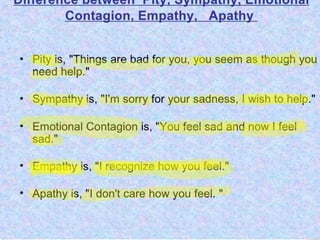
2. Emotional empathy is also known as emotional contagion, and is
‘catching’ someone else’s feelings, so that you literally feel them too.
3. Compassionate empathy is understanding someone’s feelings, and
taking appropriate action to help.
Empathy and its elements  A Lecture By Mr Allah Dad Khan

Empathy and its elements A Lecture By Mr Allah Dad Khan

  • 2.
    Empathy and itsElements A Lecture By Mr. Allah Dad Khan Visiting Professor The University of Agriculture Peshawar
  • 3.
    WHAT IS EMPATHY? Empathyis, at its simplest, awareness of the feelings and emotions of other people. It is a key element of Emotional Intelligence, the link between self and others, because it is how we as individuals understand what others are experiencing as if we were feeling it ourselves.
  • 11.
    ELEMENTS OF EMPATHY Daniel Goleman identified five key elements of empathy.  Understanding Others  Developing Others  Having a Service Orientation  Leveraging Diversity  Political Awareness
  • 12.
    1. UNDERSTANDING OTHERS This is perhaps what most people understand by ‘empathy’: in Goleman’s words, “sensing others’ feelings and perspectives, and taking an active interest in their concerns”. Those who do this:  Tune into emotional cues. They listen well, and also pay attention to non-verbal communication, picking up subtle cues almost subconsciously. For more, see our pages on Listening Skills and Non-Verbal Communication.  Show sensitivity, and understand others’ perspectives  Are able to help other people based on their understanding of those people’s needs and feelings.
  • 13.
    2. DEVELOPING OTHERS Developing others means acting on their needs and concerns, and helping them to develop to their full potential. People with skills in this area usually:  Reward and praise people for their strengths and accomplishments, and provide constructive feedback designed to focus on how to improve. See our page on Giving and Receiving Feedback for more.  Provide mentoring and coaching to help others to develop to their full potential. See our pages on Mentoring and Coaching Skills for more.  Provide stretching assignments that will help their teams to develop. See our page on Delegation Skills.
  • 14.
    3. HAVING ASERVICE ORIENTATION  Primarily aimed at work situations, having a service orientation means putting the needs of customers first and looking for ways to improve their satisfaction and loyalty.  People who have this approach will ‘go the extra mile’ for customers. They will genuinely understand customers’ needs, and go out of their way to help meet them.  In this way, they can become a ‘trusted advisor’ to customers, developing a long-term relationship between customer and organisation. This can happen in any industry, and any situation
  • 15.
    4. LEVERAGING DIVERSITY Leveraging diversity means being able to create and develop opportunities through different kinds of people, recognising and celebrating that we all bring something different to the table.  Leveraging diversity does not mean that you treat everyone in exactly the same way, but that you tailor the way you interact with others to fit with their needs and feelings.
  • 16.
    5. POLITICAL AWARENESS Many people view ‘political’ skills as manipulative, but in its best sense, ‘political’ means sensing and responding to a group’s emotional undercurrents and power relationships.  Political awareness can help individuals to navigate organizational relationships effectively, allowing them to achieve where others may previously have failed.
  • 17.
    THREE TYPES OFEMPATHY  Psychologists have identified three types of empathy: cognitive empathy, emotional empathy and compassionate empathy. 1. Cognitive empathy is understanding someone’s thoughts and emotions, in a very rational, rather than emotional sense. 2. Emotional empathy is also known as emotional contagion, and is ‘catching’ someone else’s feelings, so that you literally feel them too. 3. Compassionate empathy is understanding someone’s feelings, and taking appropriate action to help.