Technology Offer
TT.-Ref.2007-160
Novel Iron Based Shape Memory
Alloys with low activation (phase
transformation) temperature
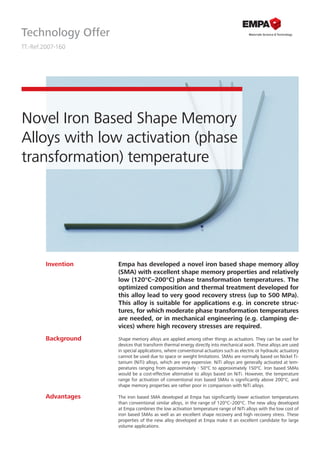
Empa has developed a novel iron based shape memory alloy
(SMA) with excellent shape memory properties and relatively
low (120°C–200°C) phase transformation temperatures. The
optimized composition and thermal treatment developed for
this alloy lead to very good recovery stress (up to 500 MPa).
This alloy is suitable for applications e.g. in concrete struc-
tures, for which moderate phase transformation temperatures
are needed, or in mechanical engineering (e.g. clamping de-
vices) where high recovery stresses are required.
Shape memory alloys are applied among other things as actuators. They can be used for
devices that transform thermal energy directly into mechanical work. These alloys are used
in special applications, where conventional actuators such as electric or hydraulic actuatory
cannot be used due to space or weight limitations. SMAs are normally based on Nickel Ti-
tanium (NiTi) alloys, which are very expensive. NiTi alloys are generally activated at tem-
peratures ranging from approximately - 50°C to approximately 150°C. Iron based SMAs
would be a cost-effective alternative to alloys based on NiTi. However, the temperature
range for activation of conventional iron based SMAs is significantly above 200°C, and
shape memory properties are rather poor in comparison with NiTi alloys.
The iron based SMA developed at Empa has significantly lower activation temperatures
than conventional similar alloys, in the range of 120°C–200°C. The new alloy developed
at Empa combines the low activation temperature range of NiTi alloys with the low cost of
iron based SMAs as well as an excellent shape recovery and high recovery stress. These
properties of the new alloy developed at Empa make it an excellent candidate for large
volume applications.
Invention
Advantages
Background
Empa, Technology Transfer
Überlandstrasse 129, CH-8600 Dübendorf, Switzerland
Alexander Sutter, alexander.sutter@empa.ch
Phone +41 44 823 45 55, Fax +41 44 823 40 31
Andrea Bergamini
Civil and Mechanical Engineering/Mechanics for Modeling and Simulation
andrea.bergamini @empa.ch
Phone +41 44 823 44 24, Fax +41 44 823 42 52
Dr. Christian Leinenbach, Group Leader
Advanced Materials and Surfaces/Joining and Interface Technology
christian.leinenbach@empa.ch
Phone +41 44 823 45 18, Fax +41 44 823 40 39
Empa is a transdisciplinary research and service institution within the ETH Domain covering selected fields
of materials science and technology development including important environmental aspects. Empa’s
R&D activities focus on the requirements of industry and the needs of society, therefore bridging the gap
from science to engineering and from research to industry and society. As a result, Empa is capable of
providing its partners with help to improve the quality of life for the public at large. Safety, reliability and
sustainability of materials and systems are cross-sectional topics permeating all Empa activities. As such,
Empa plays a key role in Switzerland's research and innovation landscape.
Empa
CH-8600 Dübendorf
Überlandstrasse 129
Telefon +41 44 823 55 11
Fax +41 44 821 62 44
CH-9014 St.Gallen
Lerchenfeldstrasse 5
Telefon +41 71 274 74 74
Fax +41 71 274 74 99
CH-3602 Thun
Feuerwerkerstrasse 39
Telefon +41 33 228 46 26
Fax +41 33 228 44 90
www.empa.ch© Empa 2009
Ownership
References
Contact
These new alloys were developed with the needs of civil engineering applications in mind. The cost of the alloy is
a parameter of paramount importance, given the large volumes and low value density of most civil engineering ap-
plications. The reduced activation temperature makes the alloy suitable for applicatons in various industrial sectors,
such as civil and mechanical engineering, automotive applications or transportation. Possible applications are an-
chors for tensile members, prestressing of concrete structures, dowels, pipe couplings, safety valves. The alloy is
expected to exhibit good corrosion resistance due to the relatively high level of Nickel and Chromium used as
alloying elements.
Empa, Swiss Federal Laboratories for Materials Testing and Research, Überlandstrasse 129, CH-8600 Dübendorf
1) Z.Z. Dong, U.E. Klotz, C. Leinenbach, A. Bergamini, C. Czaderski, M. Motavalli
A novel Fe-Mn-Si shape memory alloy with improved shape recovery properties by VC precipitation
Advanced Engineering Materials, 11(1-2), 2009, 40-44
2) C. Leinenbach, Z.Z. Dong, A. Bergamini
Novel Fe-based shape memory alloys with excellent shape recovery properties
Empa Activity-Report 2008, p. 5
3) A. Sato, T. Mori
Development of a shape memory alloy Fe-Mn-Si
Materials Science and Engineering A, 146, 1991, 197-204
4) S. Kajiwara, D. Liu, T. Kikuchi, N. Shinya
Remarkable improvement of shape memory effect in Fe-Mn-Si based shape memory alloys by producing
NbC precipitates Scripta Materialia 44(12), 2001, 2809-2814
5) Z. Dong , S. Kajiwara , T. Kikuchi , T. Sawaguchi,
Effect of pre-deformation at room temperature on shape memory properties of stainless type
Fe–15Mn–5Si–9Cr–5Ni–(0.5–1.5)NbC alloys, Acta Materialia 53(15) , 2005, 4009-4018
Smart Material, Iron based Shape Memory Alloy (SMA), low phase transformation temperature, low cost SMA, civil
engineering, automotive application, pre-stressing, joining
Applications
Keywords
Technical Information
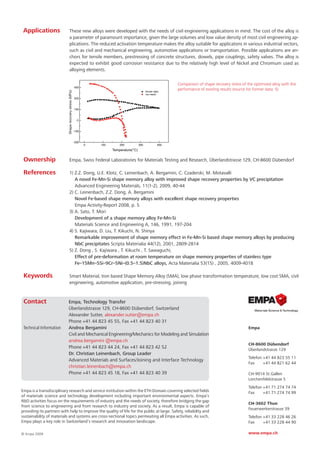
Comparison of shape recovery stress of the optimized alloy with the
performance of existing results (source for former data: 5)
0 100 200 300 400
-300
-150
0
150
300
450
former data
our result
Temperature(°C)
Shaperecoverystress(MPa)

Empa technology offer iron based shape memory alloys

  • 1.
    Technology Offer TT.-Ref.2007-160 Novel IronBased Shape Memory Alloys with low activation (phase transformation) temperature Empa has developed a novel iron based shape memory alloy (SMA) with excellent shape memory properties and relatively low (120°C–200°C) phase transformation temperatures. The optimized composition and thermal treatment developed for this alloy lead to very good recovery stress (up to 500 MPa). This alloy is suitable for applications e.g. in concrete struc- tures, for which moderate phase transformation temperatures are needed, or in mechanical engineering (e.g. clamping de- vices) where high recovery stresses are required. Shape memory alloys are applied among other things as actuators. They can be used for devices that transform thermal energy directly into mechanical work. These alloys are used in special applications, where conventional actuators such as electric or hydraulic actuatory cannot be used due to space or weight limitations. SMAs are normally based on Nickel Ti- tanium (NiTi) alloys, which are very expensive. NiTi alloys are generally activated at tem- peratures ranging from approximately - 50°C to approximately 150°C. Iron based SMAs would be a cost-effective alternative to alloys based on NiTi. However, the temperature range for activation of conventional iron based SMAs is significantly above 200°C, and shape memory properties are rather poor in comparison with NiTi alloys. The iron based SMA developed at Empa has significantly lower activation temperatures than conventional similar alloys, in the range of 120°C–200°C. The new alloy developed at Empa combines the low activation temperature range of NiTi alloys with the low cost of iron based SMAs as well as an excellent shape recovery and high recovery stress. These properties of the new alloy developed at Empa make it an excellent candidate for large volume applications. Invention Advantages Background
  • 2.
    Empa, Technology Transfer Überlandstrasse129, CH-8600 Dübendorf, Switzerland Alexander Sutter, alexander.sutter@empa.ch Phone +41 44 823 45 55, Fax +41 44 823 40 31 Andrea Bergamini Civil and Mechanical Engineering/Mechanics for Modeling and Simulation andrea.bergamini @empa.ch Phone +41 44 823 44 24, Fax +41 44 823 42 52 Dr. Christian Leinenbach, Group Leader Advanced Materials and Surfaces/Joining and Interface Technology christian.leinenbach@empa.ch Phone +41 44 823 45 18, Fax +41 44 823 40 39 Empa is a transdisciplinary research and service institution within the ETH Domain covering selected fields of materials science and technology development including important environmental aspects. Empa’s R&D activities focus on the requirements of industry and the needs of society, therefore bridging the gap from science to engineering and from research to industry and society. As a result, Empa is capable of providing its partners with help to improve the quality of life for the public at large. Safety, reliability and sustainability of materials and systems are cross-sectional topics permeating all Empa activities. As such, Empa plays a key role in Switzerland's research and innovation landscape. Empa CH-8600 Dübendorf Überlandstrasse 129 Telefon +41 44 823 55 11 Fax +41 44 821 62 44 CH-9014 St.Gallen Lerchenfeldstrasse 5 Telefon +41 71 274 74 74 Fax +41 71 274 74 99 CH-3602 Thun Feuerwerkerstrasse 39 Telefon +41 33 228 46 26 Fax +41 33 228 44 90 www.empa.ch© Empa 2009 Ownership References Contact These new alloys were developed with the needs of civil engineering applications in mind. The cost of the alloy is a parameter of paramount importance, given the large volumes and low value density of most civil engineering ap- plications. The reduced activation temperature makes the alloy suitable for applicatons in various industrial sectors, such as civil and mechanical engineering, automotive applications or transportation. Possible applications are an- chors for tensile members, prestressing of concrete structures, dowels, pipe couplings, safety valves. The alloy is expected to exhibit good corrosion resistance due to the relatively high level of Nickel and Chromium used as alloying elements. Empa, Swiss Federal Laboratories for Materials Testing and Research, Überlandstrasse 129, CH-8600 Dübendorf 1) Z.Z. Dong, U.E. Klotz, C. Leinenbach, A. Bergamini, C. Czaderski, M. Motavalli A novel Fe-Mn-Si shape memory alloy with improved shape recovery properties by VC precipitation Advanced Engineering Materials, 11(1-2), 2009, 40-44 2) C. Leinenbach, Z.Z. Dong, A. Bergamini Novel Fe-based shape memory alloys with excellent shape recovery properties Empa Activity-Report 2008, p. 5 3) A. Sato, T. Mori Development of a shape memory alloy Fe-Mn-Si Materials Science and Engineering A, 146, 1991, 197-204 4) S. Kajiwara, D. Liu, T. Kikuchi, N. Shinya Remarkable improvement of shape memory effect in Fe-Mn-Si based shape memory alloys by producing NbC precipitates Scripta Materialia 44(12), 2001, 2809-2814 5) Z. Dong , S. Kajiwara , T. Kikuchi , T. Sawaguchi, Effect of pre-deformation at room temperature on shape memory properties of stainless type Fe–15Mn–5Si–9Cr–5Ni–(0.5–1.5)NbC alloys, Acta Materialia 53(15) , 2005, 4009-4018 Smart Material, Iron based Shape Memory Alloy (SMA), low phase transformation temperature, low cost SMA, civil engineering, automotive application, pre-stressing, joining Applications Keywords Technical Information Comparison of shape recovery stress of the optimized alloy with the performance of existing results (source for former data: 5) 0 100 200 300 400 -300 -150 0 150 300 450 former data our result Temperature(°C) Shaperecoverystress(MPa)