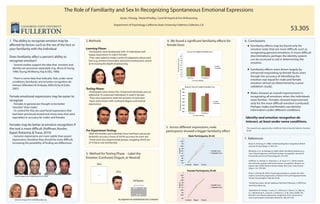
Posed images from Tottenham et al.(2009)
Genuine images from Tarrlabface-place.org keyassignmentwascounterbalancedacross3computers
The Role of Familiarity and Sex In Recognizing Spontaneous Emotional Expressions
Jessie J Peissig, Shiela M Kelley, Carol M Huynh & Erin M Browning
Department of Psychology,California State University Fullerton,Fullerton,CA
53.305
1. The ability to recognize emotion may be
affected by factors such as the sex of the face or
your familiarity with the individual
Does familiarity affect a person’s ability to
recognize emotion?
- Several studies support the idea that emotion and
identity are processes separately (e.g.,Bruce & Young,
1986;Young,McWeeny,Hay & Ellis,1986)
- There is some data that indicates that,under some
conditions,familiarity and emotion recognition do
interact (Elfenbein & Ambady,2003; Kirita & Endo,
2001)
Female emotional expressions may be easier to
recognize
- Females in general are thought to be better
“emoters”than males
- To control for this,we used facial expressions that
had been previously tested and chose ones that were
equivalent in accuracy for males and females
Females may be better at emotion recognition if
the task is more difficult (Hoffman,Kessler,
Eppel,Rukavina,& Traue,2010)
- Genuine expressions are more subtle than posed
expressions,therefore they should be more difficult,
increasing the possibility of finding sex differences
5. Across different expressions,male
participants showed a bigger familiarity effect
2.Methods
Learning Phase:
-Participants were familiarized with 10 individuals with
happy expressions (5 male/5 female)
-They were asked to make a series of judgments about each
face (e.g.,smoker/nonsmoker,attractive/unattractive),aimed
at increasing the depth of processing.
Testing Phase:
-Participants were shown the 10 learned individuals,plus an
additional 10 unlearned individuals (5 male/5 female)
-They were required to label the emotion of each face
-Faces were shown with confused,disgust,and neutral
expressions
Pre-Experiment Testing:
-Both the familiar and unfamiliar faces had been previously
tested for accuracy (mean of 50.9% accuracy for each set)
-There were two experimental groups,swapping which set
of 10 faces was familiarized
This research was supported by a California State University Fullerton Incentive
Grant.
Familiarity effects may be found only for
emotion tasks that are more difficult, such as
recognizing genuine emotions. In more difficult
discriminations, perhaps the identity system
can be accessed to aid in determining the
emotion.
3. Method for Testing Phase - Label the
Emotion (Confused,Disgust,or Neutral)
7. References
6. Conclusions
Bruce,V.,& Young,A.(1986).Understanding face recognition.British
Journal of Psychology,77,305-327.
Elfenbein,H.A.,& Ambady,N.(2003).When familiarity breeds accu-
racy:Cultural exposure and facial emotion recognition.Journal of
Personality and Social Psychology,85,276-290.
Hoffman, H., Kessler, H., Rukavina, S., & Traue, H. C. (2010). Expres-
sion intensity, gender and facial emotion recognition: Women rec-
ognize only subtle facial emotions better than men. Acta Psycho-
logica, 135, 278-283.
Kirita,T.,& Endo,M.(2001).Facial representations contain the infor-
mation concerning expressions:Evidence from primingexperiments.
Tohoku Psychologica Folia,60,45-60.
Tarrlab face-place stimuli database.Retrieved February 2,2009 from
www.face-place.org
Tottenham,N.,Tanaka,J.,Leon,A.C.,McCarry,T.,Nurse,T.A.,Marcus,
D.J.,Westerlund,A.,Casey,B.J.,& Nelson,C.A.M.,Hare,(2009).The
NimStim set of facial expressions:Judgments from untrained re-
search participants.Psychiatry Research,168,242-249
4. We found a significant familiarity effects for
female faces
Familiarity effects were driven largely by
enhanced responding to female faces, even
though the accuracy of identifying the
emotion was equal for male and female
emotion stimuli (as determined by a prior
validation study).
Males showed an overall improvement in
recognizing all emotions when the individuals
were familiar. Females showed improvement
only for the most difficult emotion (confused).
Perhaps males and females use identity
information under different conditions.
250ms
500ms
UntilResponse
0.5
0.55
0.6
0.65
0.7
0.75
0.8
0.85
0.9
0.95
1
Male Faces Female Faces
MeanProportionCorrect
Sex of Face Stimulus
Accuracy for Familiar/Unfamiliar Faces
Familiar
Unfamiliar
1500
1550
1600
1650
1700
1750
1800
1850
Male Faces Female Faces
MeanResponseTimeforCorrectTrials
Sex of Face Stimulus
Response Times for Familiar/Unfamiliar Faces
Familiar
Unfamiliar
0.5
0.55
0.6
0.65
0.7
0.75
0.8
0.85
0.9
0.95
1
Confused Disgust Neutral
Accuracy
Familiar Faces
Unfamiliar Faces
0.5
0.55
0.6
0.65
0.7
0.75
0.8
0.85
0.9
0.95
1
Confused Disgust Neutral
Accuracy
Familiar Faces
Unfamiliar Faces
Male Participants,N=65
Female Participants,N=65
Identity and emotion recogniton do
interact, at least under some conditions.

Emotion_Sex_VSS_2012

  • 1.
    Posed images fromTottenham et al.(2009) Genuine images from Tarrlabface-place.org keyassignmentwascounterbalancedacross3computers The Role of Familiarity and Sex In Recognizing Spontaneous Emotional Expressions Jessie J Peissig, Shiela M Kelley, Carol M Huynh & Erin M Browning Department of Psychology,California State University Fullerton,Fullerton,CA 53.305 1. The ability to recognize emotion may be affected by factors such as the sex of the face or your familiarity with the individual Does familiarity affect a person’s ability to recognize emotion? - Several studies support the idea that emotion and identity are processes separately (e.g.,Bruce & Young, 1986;Young,McWeeny,Hay & Ellis,1986) - There is some data that indicates that,under some conditions,familiarity and emotion recognition do interact (Elfenbein & Ambady,2003; Kirita & Endo, 2001) Female emotional expressions may be easier to recognize - Females in general are thought to be better “emoters”than males - To control for this,we used facial expressions that had been previously tested and chose ones that were equivalent in accuracy for males and females Females may be better at emotion recognition if the task is more difficult (Hoffman,Kessler, Eppel,Rukavina,& Traue,2010) - Genuine expressions are more subtle than posed expressions,therefore they should be more difficult, increasing the possibility of finding sex differences 5. Across different expressions,male participants showed a bigger familiarity effect 2.Methods Learning Phase: -Participants were familiarized with 10 individuals with happy expressions (5 male/5 female) -They were asked to make a series of judgments about each face (e.g.,smoker/nonsmoker,attractive/unattractive),aimed at increasing the depth of processing. Testing Phase: -Participants were shown the 10 learned individuals,plus an additional 10 unlearned individuals (5 male/5 female) -They were required to label the emotion of each face -Faces were shown with confused,disgust,and neutral expressions Pre-Experiment Testing: -Both the familiar and unfamiliar faces had been previously tested for accuracy (mean of 50.9% accuracy for each set) -There were two experimental groups,swapping which set of 10 faces was familiarized This research was supported by a California State University Fullerton Incentive Grant. Familiarity effects may be found only for emotion tasks that are more difficult, such as recognizing genuine emotions. In more difficult discriminations, perhaps the identity system can be accessed to aid in determining the emotion. 3. Method for Testing Phase - Label the Emotion (Confused,Disgust,or Neutral) 7. References 6. Conclusions Bruce,V.,& Young,A.(1986).Understanding face recognition.British Journal of Psychology,77,305-327. Elfenbein,H.A.,& Ambady,N.(2003).When familiarity breeds accu- racy:Cultural exposure and facial emotion recognition.Journal of Personality and Social Psychology,85,276-290. Hoffman, H., Kessler, H., Rukavina, S., & Traue, H. C. (2010). Expres- sion intensity, gender and facial emotion recognition: Women rec- ognize only subtle facial emotions better than men. Acta Psycho- logica, 135, 278-283. Kirita,T.,& Endo,M.(2001).Facial representations contain the infor- mation concerning expressions:Evidence from primingexperiments. Tohoku Psychologica Folia,60,45-60. Tarrlab face-place stimuli database.Retrieved February 2,2009 from www.face-place.org Tottenham,N.,Tanaka,J.,Leon,A.C.,McCarry,T.,Nurse,T.A.,Marcus, D.J.,Westerlund,A.,Casey,B.J.,& Nelson,C.A.M.,Hare,(2009).The NimStim set of facial expressions:Judgments from untrained re- search participants.Psychiatry Research,168,242-249 4. We found a significant familiarity effects for female faces Familiarity effects were driven largely by enhanced responding to female faces, even though the accuracy of identifying the emotion was equal for male and female emotion stimuli (as determined by a prior validation study). Males showed an overall improvement in recognizing all emotions when the individuals were familiar. Females showed improvement only for the most difficult emotion (confused). Perhaps males and females use identity information under different conditions. 250ms 500ms UntilResponse 0.5 0.55 0.6 0.65 0.7 0.75 0.8 0.85 0.9 0.95 1 Male Faces Female Faces MeanProportionCorrect Sex of Face Stimulus Accuracy for Familiar/Unfamiliar Faces Familiar Unfamiliar 1500 1550 1600 1650 1700 1750 1800 1850 Male Faces Female Faces MeanResponseTimeforCorrectTrials Sex of Face Stimulus Response Times for Familiar/Unfamiliar Faces Familiar Unfamiliar 0.5 0.55 0.6 0.65 0.7 0.75 0.8 0.85 0.9 0.95 1 Confused Disgust Neutral Accuracy Familiar Faces Unfamiliar Faces 0.5 0.55 0.6 0.65 0.7 0.75 0.8 0.85 0.9 0.95 1 Confused Disgust Neutral Accuracy Familiar Faces Unfamiliar Faces Male Participants,N=65 Female Participants,N=65 Identity and emotion recogniton do interact, at least under some conditions.