Instructor : Ms. Maryam Shahzadi
Department of Applied Psychology GCWUF
 We’ll learn:
1) Variety of emotions
2) Patterns of overt behavior in emotion
3) Strategies to manage emotions
4) Therapies for Emotional dysregulation
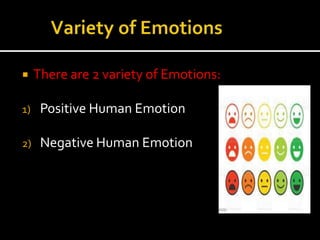
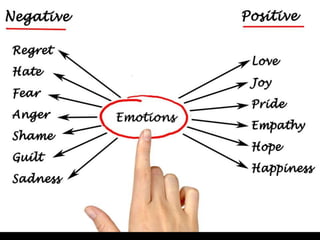
 There are 2 variety of Emotions:
1) Positive Human Emotion
2) Negative Human Emotion
 Positive emotions that lead one to feel good
about one’s self will lead to an emotionally
happy and satisfied result.
 Some positive emotions are
Hopeful
Confident
Peaceful
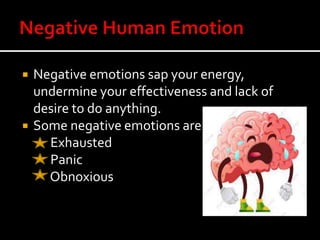
 Negative emotions sap your energy,
undermine your effectiveness and lack of
desire to do anything.
 Some negative emotions are
Exhausted
Panic
Obnoxious
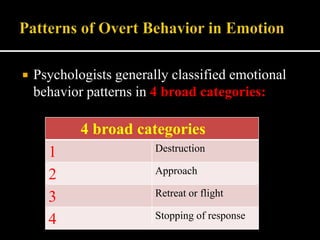
 Psychologists generally classified emotional
behavior patterns in 4 broad categories:
4 broad categories
1 Destruction
2 Approach
3 Retreat or flight
4 Stopping of response
 Uncivilized man makes
a physically destructive
attack like
biting,
scratching,
choking,
hitting,
spitting, or
snarling.
 Civilized man makes attack more symbolic.
Words take the place of blows and the end
result is anger.
 In pleasant emotions the
essential response is approach.
 Any stimulus that create a
pleasant response in human
serves as a motivator for future
responses.
 E.g: Biryani is a stimulus that
creates a pleasant response.
 Flight from a dangerous situation may be physical or
symbolic and is often used as a mode of adjustment.
 Some people try to escape from frustration or
irritation by moving from place to place, job to job,
or even spouse to spouse.
 In civilized life, we more often retreat symbolically
through words, apologies, compromises, discussion
or through psychological mechanisms of withdrawal.
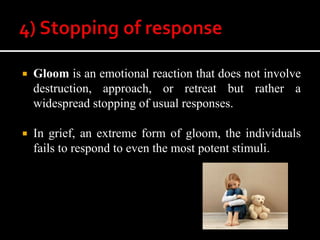
 Gloom is an emotional reaction that does not involve
destruction, approach, or retreat but rather a
widespread stopping of usual responses.
 In grief, an extreme form of gloom, the individuals
fails to respond to even the most potent stimuli.
1) Identify and reduce triggers
 You should try to avoid negative emotions or be
afraid of them.
 You don’t have to put yourself in a situation that
bring unpleasant emotions.
 Start to look for factors that are present when you
start to feel strong emotions.
2) Tune into physical symptoms
 Pay attention to how you are feeling, including
whether you are feeling hungry or tired.
 These factors exacerbate your emotions and cause
you to interpret your emotions more strongly.
3) Engage in positive self-talk
 Try to encouraging yourself by saying
“I always try so hard” or
“People are doing the best they can”
4) Make a choice about how to respond
 Make a choice about how to respond because if you
show anger towards people, it creates negative
impact on your relationship.
 You might also notice that it doesn’t feel good.
5) Look for positive emotions
 Human beings naturally attribute more weight to
negative emotions than positive ones. This is known
as negative bias.
 So, make a habit of noticing positive experiences
because it boost resilience and well-being.
6) Seek out a therapist
 Managing our own emotions can be difficult. It
requires a high degree of self-awareness.
 Sometimes we need a therapist who help us learn
better self-regulation skills.
 Dialectical behavior therapy (DBT)
 Cognitive Behavioral therapy (CBT)
 Emotional regulation therapy (ERT)
 Positive emotions that lead one to feel good
and negative emotions sap energy and lack of
desire to do something.
 Always follow strategies for healthy
emotional regulation.
 Seek help from therapist if you find any
negative trigger emotion.
Quize / Question
 Zimbardo P.G.(1988).Psychology and life (12th ed). Harper
Collins Publishers
 Kelly, G.A.(1955).The psychology of personal constructs. New
York : norton.
 Plotnik , R.(1989). Introduction to Psychology (2nd ed).Newbery
Award Records, Inc.
Emotions part 4.pptx

Emotions part 4.pptx

  • 1.
    Instructor : Ms.Maryam Shahzadi Department of Applied Psychology GCWUF
  • 2.
     We’ll learn: 1)Variety of emotions 2) Patterns of overt behavior in emotion 3) Strategies to manage emotions 4) Therapies for Emotional dysregulation
  • 3.
     There are2 variety of Emotions: 1) Positive Human Emotion 2) Negative Human Emotion
  • 5.
     Positive emotionsthat lead one to feel good about one’s self will lead to an emotionally happy and satisfied result.  Some positive emotions are Hopeful Confident Peaceful
  • 6.
     Negative emotionssap your energy, undermine your effectiveness and lack of desire to do anything.  Some negative emotions are Exhausted Panic Obnoxious
  • 7.
     Psychologists generallyclassified emotional behavior patterns in 4 broad categories: 4 broad categories 1 Destruction 2 Approach 3 Retreat or flight 4 Stopping of response
  • 8.
     Uncivilized manmakes a physically destructive attack like biting, scratching, choking, hitting, spitting, or snarling.
  • 9.
     Civilized manmakes attack more symbolic. Words take the place of blows and the end result is anger.
  • 10.
     In pleasantemotions the essential response is approach.  Any stimulus that create a pleasant response in human serves as a motivator for future responses.  E.g: Biryani is a stimulus that creates a pleasant response.
  • 11.
     Flight froma dangerous situation may be physical or symbolic and is often used as a mode of adjustment.  Some people try to escape from frustration or irritation by moving from place to place, job to job, or even spouse to spouse.  In civilized life, we more often retreat symbolically through words, apologies, compromises, discussion or through psychological mechanisms of withdrawal.
  • 13.
     Gloom isan emotional reaction that does not involve destruction, approach, or retreat but rather a widespread stopping of usual responses.  In grief, an extreme form of gloom, the individuals fails to respond to even the most potent stimuli.
  • 14.
    1) Identify andreduce triggers  You should try to avoid negative emotions or be afraid of them.  You don’t have to put yourself in a situation that bring unpleasant emotions.  Start to look for factors that are present when you start to feel strong emotions.
  • 15.
    2) Tune intophysical symptoms  Pay attention to how you are feeling, including whether you are feeling hungry or tired.  These factors exacerbate your emotions and cause you to interpret your emotions more strongly.
  • 16.
    3) Engage inpositive self-talk  Try to encouraging yourself by saying “I always try so hard” or “People are doing the best they can”
  • 17.
    4) Make achoice about how to respond  Make a choice about how to respond because if you show anger towards people, it creates negative impact on your relationship.  You might also notice that it doesn’t feel good.
  • 18.
    5) Look forpositive emotions  Human beings naturally attribute more weight to negative emotions than positive ones. This is known as negative bias.  So, make a habit of noticing positive experiences because it boost resilience and well-being.
  • 19.
    6) Seek outa therapist  Managing our own emotions can be difficult. It requires a high degree of self-awareness.  Sometimes we need a therapist who help us learn better self-regulation skills.
  • 20.
     Dialectical behaviortherapy (DBT)  Cognitive Behavioral therapy (CBT)  Emotional regulation therapy (ERT)
  • 21.
     Positive emotionsthat lead one to feel good and negative emotions sap energy and lack of desire to do something.  Always follow strategies for healthy emotional regulation.  Seek help from therapist if you find any negative trigger emotion.
  • 22.
  • 23.
     Zimbardo P.G.(1988).Psychologyand life (12th ed). Harper Collins Publishers  Kelly, G.A.(1955).The psychology of personal constructs. New York : norton.  Plotnik , R.(1989). Introduction to Psychology (2nd ed).Newbery Award Records, Inc.