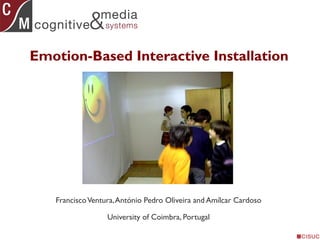
Emotion-Based Interactive Installation
FranciscoVentura,António Pedro Oliveira and Amílcar Cardoso
University of Coimbra, Portugal
2
Outline
 Introduction
 EDME
 Interactive Installation
 Experiments
 Demonstration
 Conclusion
3
Outline
 Introduction
 EDME
 Interactive Installation
 Experiments
 Demonstration
 Conclusion
Introduction
4
 We prepared an installation to explore the interactive
capabilities of an Emotion-Driven Music Engine (EDME)
 This installation allows participants to experience and
influence the emotional state of a computational system
 The system perceives emotions from the environment by
using a camera and expresses emotions to the environment
with music and images by using, respectively, loudspeakers
and a projector
5
Outline
 Introduction
 EDME
 Interactive Installation
 Experiments
 Demonstration
 Conclusion
EDME
6
 EDME is a computer program that intends to produce
music expressing a desired emotion
 It is composed by an offline stage and a real-time stage
 At the offline stage, pre-composed music is segmented,
emotionally classified and stored in a music base
 At the real-time stage, EDME selects from a music base the
segments that are closer to a desired emotion
EDME
7
 Transformation and sequencing algorithms are applied on
selected segments to form song-like structures
 These song-like structures are then synthesized and given
to the listener
Real-Time
Stage
Offline Stage
8
Outline
 Introduction
 EDME
 Interactive Installation
 Experiments
 Demonstration
 Conclusion
Interactive Installation
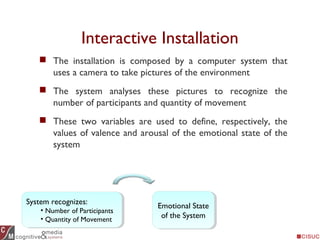
 The installation is composed by a computer system that
uses a camera to take pictures of the environment
Interactive Installation
 The installation is composed by a computer system that
uses a camera to take pictures of the environment
 The system analyses these pictures to recognize the
number of participants and quantity of movement
System recognizes:
• Number of Participants
• Quantity of Movement
System recognizes:
• Number of Participants
• Quantity of Movement
Interactive Installation
 The installation is composed by a computer system that
uses a camera to take pictures of the environment
 The system analyses these pictures to recognize the
number of participants and quantity of movement
 These two variables are used to define, respectively, the
values of valence and arousal of the emotional state of the
system
System recognizes:
• Number of Participants
• Quantity of Movement
System recognizes:
• Number of Participants
• Quantity of Movement
Emotional State
of the System
Emotional State
of the System
Interactive Installation
12
 The installation is composed by a computer system that
uses a camera to take pictures of the environment
 The system analyses these pictures to recognize the
number of participants and quantity of movement
 These two variables are used to define, respectively, the
values of valence and arousal of the emotional state of the
system
 The emotional state influences the expression of music and
images to the environment
System recognizes:
• Number of Participants
• Quantity of Movement
System recognizes:
• Number of Participants
• Quantity of Movement
Emotional State
of the System
Emotional State
of the System
Emotional
expression
(Music & Images)
Emotional
expression
(Music & Images)
Interactive Installation
13
 The number of participants is determined by the
percentage of change between scenario (image taken when
the system starts) and current image
 Quantity of movement is determined by the change
between current and last image
Interactive Installation
14
 EDME generates music according to the values of valence
and arousal of the system
 As images are emotionally classified with valence, the
selection of images is only based on this emotional
dimension
Interactive Installation
15
 The emotional behaviour of the system is controlled by a
multi-agent system
16
Outline
 Introduction
 EDME
 Interactive Installation
 Experiments
 Demonstration
 Conclusion
Experiments
17
 We made a preliminary experiment with students with the
objective of observing the interaction between the system
and participants
Experiments
18
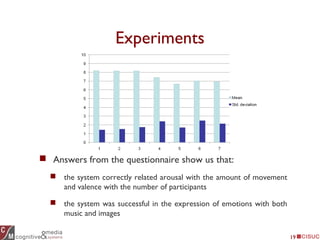
 The second experiment was focused in obtaining
participants feedback via a questionnaire of 7 questions
 Example of questions:
 Music expressed expected emotion?
 Importance of images in the emotional expression?
 System expressed expected emotion?
Experiments
19
 Answers from the questionnaire show us that:
 the system correctly related arousal with the amount of movement
and valence with the number of participants
 the system was successful in the expression of emotions with both
music and images
20
Outline
 Introduction
 EDME
 Interactive Installation
 Experiments
 Demonstration
 Conclusion
21
Outline
 Introduction
 EDME
 Interactive Installation
 Experiments
 Demonstration
 Conclusion
Conclusion
22
 EDME is prepared to be used in interactive contexts
 People experienced and influenced the emotional state of
the system
 Both music and images are relevant in the emotional
expression of the system
 Installation assumes no variation of environmental
conditions; however, it can be adapted to deal with this
situation by changing the scenario

Emotion-Based Interactive Installation

  • 1.
    Emotion-Based Interactive Installation FranciscoVentura,AntónioPedro Oliveira and Amílcar Cardoso University of Coimbra, Portugal
  • 2.
    2 Outline  Introduction  EDME Interactive Installation  Experiments  Demonstration  Conclusion
  • 3.
    3 Outline  Introduction  EDME Interactive Installation  Experiments  Demonstration  Conclusion
  • 4.
    Introduction 4  We preparedan installation to explore the interactive capabilities of an Emotion-Driven Music Engine (EDME)  This installation allows participants to experience and influence the emotional state of a computational system  The system perceives emotions from the environment by using a camera and expresses emotions to the environment with music and images by using, respectively, loudspeakers and a projector
  • 5.
    5 Outline  Introduction  EDME Interactive Installation  Experiments  Demonstration  Conclusion
  • 6.
    EDME 6  EDME isa computer program that intends to produce music expressing a desired emotion  It is composed by an offline stage and a real-time stage  At the offline stage, pre-composed music is segmented, emotionally classified and stored in a music base  At the real-time stage, EDME selects from a music base the segments that are closer to a desired emotion
  • 7.
    EDME 7  Transformation andsequencing algorithms are applied on selected segments to form song-like structures  These song-like structures are then synthesized and given to the listener Real-Time Stage Offline Stage
  • 8.
    8 Outline  Introduction  EDME Interactive Installation  Experiments  Demonstration  Conclusion
  • 9.
    Interactive Installation  Theinstallation is composed by a computer system that uses a camera to take pictures of the environment
  • 10.
    Interactive Installation  Theinstallation is composed by a computer system that uses a camera to take pictures of the environment  The system analyses these pictures to recognize the number of participants and quantity of movement System recognizes: • Number of Participants • Quantity of Movement System recognizes: • Number of Participants • Quantity of Movement
  • 11.
    Interactive Installation  Theinstallation is composed by a computer system that uses a camera to take pictures of the environment  The system analyses these pictures to recognize the number of participants and quantity of movement  These two variables are used to define, respectively, the values of valence and arousal of the emotional state of the system System recognizes: • Number of Participants • Quantity of Movement System recognizes: • Number of Participants • Quantity of Movement Emotional State of the System Emotional State of the System
  • 12.
    Interactive Installation 12  Theinstallation is composed by a computer system that uses a camera to take pictures of the environment  The system analyses these pictures to recognize the number of participants and quantity of movement  These two variables are used to define, respectively, the values of valence and arousal of the emotional state of the system  The emotional state influences the expression of music and images to the environment System recognizes: • Number of Participants • Quantity of Movement System recognizes: • Number of Participants • Quantity of Movement Emotional State of the System Emotional State of the System Emotional expression (Music & Images) Emotional expression (Music & Images)
  • 13.
    Interactive Installation 13  Thenumber of participants is determined by the percentage of change between scenario (image taken when the system starts) and current image  Quantity of movement is determined by the change between current and last image
  • 14.
    Interactive Installation 14  EDMEgenerates music according to the values of valence and arousal of the system  As images are emotionally classified with valence, the selection of images is only based on this emotional dimension
  • 15.
    Interactive Installation 15  Theemotional behaviour of the system is controlled by a multi-agent system
  • 16.
    16 Outline  Introduction  EDME Interactive Installation  Experiments  Demonstration  Conclusion
  • 17.
    Experiments 17  We madea preliminary experiment with students with the objective of observing the interaction between the system and participants
  • 18.
    Experiments 18  The secondexperiment was focused in obtaining participants feedback via a questionnaire of 7 questions  Example of questions:  Music expressed expected emotion?  Importance of images in the emotional expression?  System expressed expected emotion?
  • 19.
    Experiments 19  Answers fromthe questionnaire show us that:  the system correctly related arousal with the amount of movement and valence with the number of participants  the system was successful in the expression of emotions with both music and images
  • 20.
    20 Outline  Introduction  EDME Interactive Installation  Experiments  Demonstration  Conclusion
  • 21.
    21 Outline  Introduction  EDME Interactive Installation  Experiments  Demonstration  Conclusion
  • 22.
    Conclusion 22  EDME isprepared to be used in interactive contexts  People experienced and influenced the emotional state of the system  Both music and images are relevant in the emotional expression of the system  Installation assumes no variation of environmental conditions; however, it can be adapted to deal with this situation by changing the scenario