António Pedro OliveiraAntónio Pedro Oliveira
and Amílcar Cardosoand Amílcar Cardoso
06/12/200706/12/2007
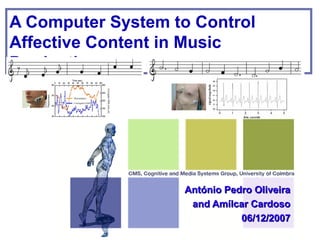
A Computer System to Control
Affective Content in Music
Production
António Pedro Oliveira
and Amílcar Cardoso
2
OutlineOutline
 IntroductionIntroduction
 Proposed SystemProposed System
 Emotional output validationEmotional output validation
 Prototype (demo)Prototype (demo)
 ConclusionConclusion
António Pedro Oliveira
and Amílcar Cardoso
3
OutlineOutline
 IntroductionIntroduction
 Proposed SystemProposed System
 Emotional output validationEmotional output validation
 Prototype (demo)Prototype (demo)
 ConclusionConclusion
António Pedro Oliveira
and Amílcar Cardoso
4
IntroductionIntroduction
 Problem
 No automatic method to express and induce an
intended emotional description with music
 Objective
 Design, implement and assess a computer
system that can control the affective content of
pre-composed music represented at a symbolic
level
António Pedro Oliveira
and Amílcar Cardoso
5
Introduction – Topics of ResearchIntroduction – Topics of Research
 Music and emotions psychology
 Relations between emotions and musical
features
 Affective computingAffective computing
 Techniques to recognize emotions
 Music computingMusic computing
 Approaches to generate affective music
António Pedro Oliveira
and Amílcar Cardoso
6
OutlineOutline
 IntroductionIntroduction
 Proposed SystemProposed System
 Emotional output validationEmotional output validation
 Prototype (demo)Prototype (demo)
 ConclusionConclusion
António Pedro Oliveira
and Amílcar Cardoso
7
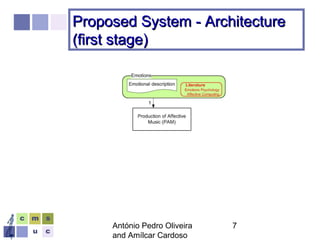
Proposed System - ArchitectureProposed System - Architecture
(first stage)(first stage)
António Pedro Oliveira
and Amílcar Cardoso
8
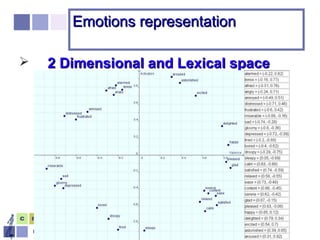
Emotions representationEmotions representation
 2 Dimensional and Lexical space2 Dimensional and Lexical space
António Pedro Oliveira
and Amílcar Cardoso
9
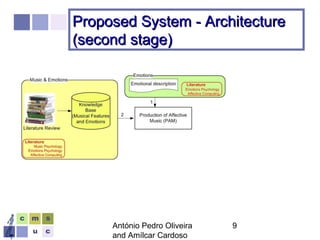
Proposed System - ArchitectureProposed System - Architecture
(second stage)(second stage)
António Pedro Oliveira
and Amílcar Cardoso
10
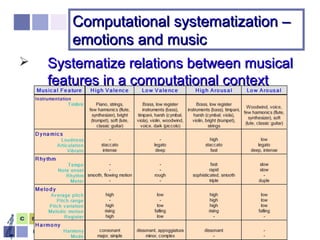
Computational systematization –Computational systematization –
emotions and musicemotions and music
 Systematize relations between musicalSystematize relations between musical
features in a computational contextfeatures in a computational context
António Pedro Oliveira
and Amílcar Cardoso
11
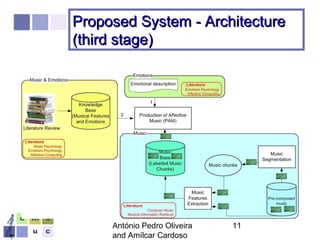
Proposed System - ArchitectureProposed System - Architecture
(third stage)(third stage)
António Pedro Oliveira
and Amílcar Cardoso
12
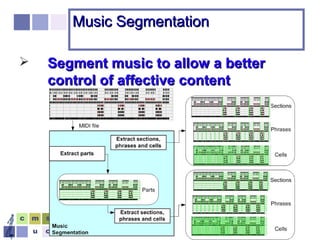
Music SegmentationMusic Segmentation
 Segment music to allow a betterSegment music to allow a better
control of affective contentcontrol of affective content
António Pedro Oliveira
and Amílcar Cardoso
13
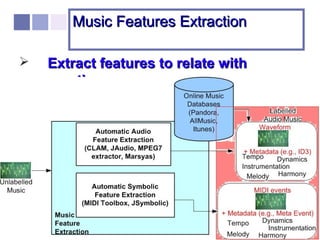
Music Features ExtractionMusic Features Extraction
 Extract features to relate withExtract features to relate with
emotionsemotions
António Pedro Oliveira
and Amílcar Cardoso
14
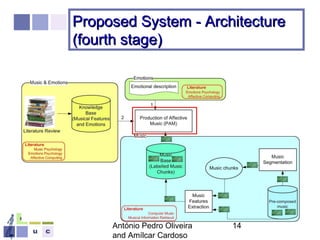
Proposed System - ArchitectureProposed System - Architecture
(fourth stage)(fourth stage)
António Pedro Oliveira
and Amílcar Cardoso
15
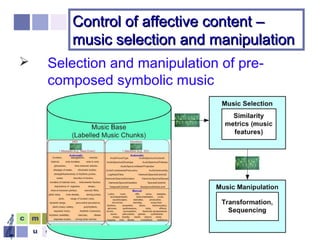
Control of affective content –Control of affective content –
music selection and manipulationmusic selection and manipulation
 Selection and manipulation of pre-
composed symbolic music
António Pedro Oliveira
and Amílcar Cardoso
16
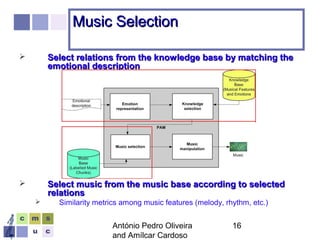
Music SelectionMusic Selection
 Select relations from the knowledge base by matching theSelect relations from the knowledge base by matching the
emotional descriptionemotional description
 Select music from the music base according to selectedSelect music from the music base according to selected
relationsrelations
 Similarity metrics among music features (melody, rhythm, etc.)
António Pedro Oliveira
and Amílcar Cardoso
17
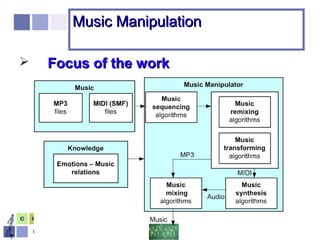
Music ManipulationMusic Manipulation
 Focus of the workFocus of the work
António Pedro Oliveira
and Amílcar Cardoso
18
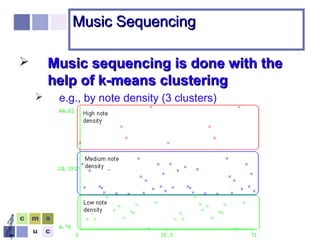
Music SequencingMusic Sequencing
 Music sequencing is done with theMusic sequencing is done with the
help of k-means clusteringhelp of k-means clustering
 e.g., by note density (3 clusters)
António Pedro Oliveira
and Amílcar Cardoso
19
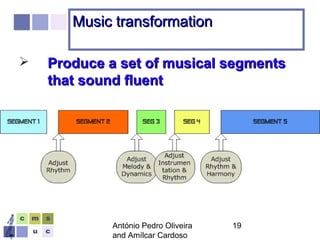
Music transformationMusic transformation
 Produce a set of musical segmentsProduce a set of musical segments
that sound fluentthat sound fluent
António Pedro Oliveira
and Amílcar Cardoso
20
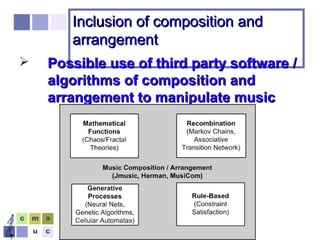
Inclusion of composition andInclusion of composition and
arrangementarrangement
 Possible use of third party software /Possible use of third party software /
algorithms of composition andalgorithms of composition and
arrangement to manipulate musicarrangement to manipulate music
António Pedro Oliveira
and Amílcar Cardoso
21
OutlineOutline
 IntroductionIntroduction
 Proposed SystemProposed System
 Emotional output validationEmotional output validation
 Prototype (demo)Prototype (demo)
 ConclusionConclusion
António Pedro Oliveira
and Amílcar Cardoso
22
Emotional output validationEmotional output validation
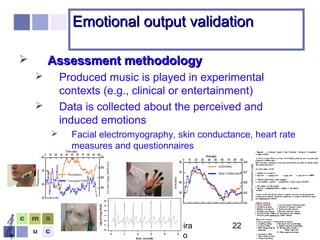
 Assessment methodologyAssessment methodology
 Produced music is played in experimental
contexts (e.g., clinical or entertainment)
 Data is collected about the perceived and
induced emotions
 Facial electromyography, skin conductance, heart rate
measures and questionnaires
António Pedro Oliveira
and Amílcar Cardoso
23
Emotional output validationEmotional output validation
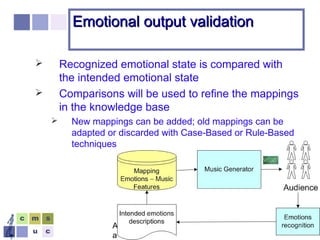
 Recognized emotional state is compared with
the intended emotional state
 Comparisons will be used to refine the mappings
in the knowledge base
 New mappings can be added; old mappings can be
adapted or discarded with Case-Based or Rule-Based
techniques
António Pedro Oliveira
and Amílcar Cardoso
24
OutlineOutline
 IntroductionIntroduction
 Proposed SystemProposed System
 Emotional output validationEmotional output validation
 Prototype (demo)Prototype (demo)
 ConclusionConclusion
António Pedro Oliveira
and Amílcar Cardoso
25
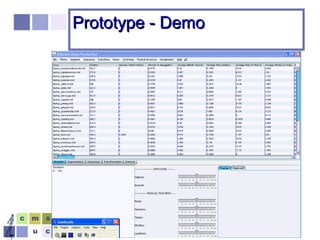
Prototype - DemoPrototype - Demo
António Pedro Oliveira
and Amílcar Cardoso
26
ExamplesExamples
 Manipulated music samplesManipulated music samples
 Different affective content (e.g., timbre,
loudness, tempo and register)
 http://student.dei.uc.pt/~apsimoes/PhD/Music/epia200
 High arousal
 High valence
 Low arousal
 Low valence
António Pedro Oliveira
and Amílcar Cardoso
27
OutlineOutline
 IntroductionIntroduction
 Proposed SystemProposed System
 Emotional output validationEmotional output validation
 Prototype (demo)Prototype (demo)
 ConclusionConclusion
António Pedro Oliveira
and Amílcar Cardoso
28
ConclusionConclusion
 Design a computational model to control
music affective content grounded on
psychological research
 Validate the model with users to promote a
reliable expression and induction of emotions
by using music
 System can be applied in areas that intend to
produce music given an emotional input
 Music Therapy, soundtracks for arts, movies, dance,
theater, virtual environments, computer games, etc.

Epia 2007

  • 1.
    António Pedro OliveiraAntónioPedro Oliveira and Amílcar Cardosoand Amílcar Cardoso 06/12/200706/12/2007 A Computer System to Control Affective Content in Music Production
  • 2.
    António Pedro Oliveira andAmílcar Cardoso 2 OutlineOutline  IntroductionIntroduction  Proposed SystemProposed System  Emotional output validationEmotional output validation  Prototype (demo)Prototype (demo)  ConclusionConclusion
  • 3.
    António Pedro Oliveira andAmílcar Cardoso 3 OutlineOutline  IntroductionIntroduction  Proposed SystemProposed System  Emotional output validationEmotional output validation  Prototype (demo)Prototype (demo)  ConclusionConclusion
  • 4.
    António Pedro Oliveira andAmílcar Cardoso 4 IntroductionIntroduction  Problem  No automatic method to express and induce an intended emotional description with music  Objective  Design, implement and assess a computer system that can control the affective content of pre-composed music represented at a symbolic level
  • 5.
    António Pedro Oliveira andAmílcar Cardoso 5 Introduction – Topics of ResearchIntroduction – Topics of Research  Music and emotions psychology  Relations between emotions and musical features  Affective computingAffective computing  Techniques to recognize emotions  Music computingMusic computing  Approaches to generate affective music
  • 6.
    António Pedro Oliveira andAmílcar Cardoso 6 OutlineOutline  IntroductionIntroduction  Proposed SystemProposed System  Emotional output validationEmotional output validation  Prototype (demo)Prototype (demo)  ConclusionConclusion
  • 7.
    António Pedro Oliveira andAmílcar Cardoso 7 Proposed System - ArchitectureProposed System - Architecture (first stage)(first stage)
  • 8.
    António Pedro Oliveira andAmílcar Cardoso 8 Emotions representationEmotions representation  2 Dimensional and Lexical space2 Dimensional and Lexical space
  • 9.
    António Pedro Oliveira andAmílcar Cardoso 9 Proposed System - ArchitectureProposed System - Architecture (second stage)(second stage)
  • 10.
    António Pedro Oliveira andAmílcar Cardoso 10 Computational systematization –Computational systematization – emotions and musicemotions and music  Systematize relations between musicalSystematize relations between musical features in a computational contextfeatures in a computational context
  • 11.
    António Pedro Oliveira andAmílcar Cardoso 11 Proposed System - ArchitectureProposed System - Architecture (third stage)(third stage)
  • 12.
    António Pedro Oliveira andAmílcar Cardoso 12 Music SegmentationMusic Segmentation  Segment music to allow a betterSegment music to allow a better control of affective contentcontrol of affective content
  • 13.
    António Pedro Oliveira andAmílcar Cardoso 13 Music Features ExtractionMusic Features Extraction  Extract features to relate withExtract features to relate with emotionsemotions
  • 14.
    António Pedro Oliveira andAmílcar Cardoso 14 Proposed System - ArchitectureProposed System - Architecture (fourth stage)(fourth stage)
  • 15.
    António Pedro Oliveira andAmílcar Cardoso 15 Control of affective content –Control of affective content – music selection and manipulationmusic selection and manipulation  Selection and manipulation of pre- composed symbolic music
  • 16.
    António Pedro Oliveira andAmílcar Cardoso 16 Music SelectionMusic Selection  Select relations from the knowledge base by matching theSelect relations from the knowledge base by matching the emotional descriptionemotional description  Select music from the music base according to selectedSelect music from the music base according to selected relationsrelations  Similarity metrics among music features (melody, rhythm, etc.)
  • 17.
    António Pedro Oliveira andAmílcar Cardoso 17 Music ManipulationMusic Manipulation  Focus of the workFocus of the work
  • 18.
    António Pedro Oliveira andAmílcar Cardoso 18 Music SequencingMusic Sequencing  Music sequencing is done with theMusic sequencing is done with the help of k-means clusteringhelp of k-means clustering  e.g., by note density (3 clusters)
  • 19.
    António Pedro Oliveira andAmílcar Cardoso 19 Music transformationMusic transformation  Produce a set of musical segmentsProduce a set of musical segments that sound fluentthat sound fluent
  • 20.
    António Pedro Oliveira andAmílcar Cardoso 20 Inclusion of composition andInclusion of composition and arrangementarrangement  Possible use of third party software /Possible use of third party software / algorithms of composition andalgorithms of composition and arrangement to manipulate musicarrangement to manipulate music
  • 21.
    António Pedro Oliveira andAmílcar Cardoso 21 OutlineOutline  IntroductionIntroduction  Proposed SystemProposed System  Emotional output validationEmotional output validation  Prototype (demo)Prototype (demo)  ConclusionConclusion
  • 22.
    António Pedro Oliveira andAmílcar Cardoso 22 Emotional output validationEmotional output validation  Assessment methodologyAssessment methodology  Produced music is played in experimental contexts (e.g., clinical or entertainment)  Data is collected about the perceived and induced emotions  Facial electromyography, skin conductance, heart rate measures and questionnaires
  • 23.
    António Pedro Oliveira andAmílcar Cardoso 23 Emotional output validationEmotional output validation  Recognized emotional state is compared with the intended emotional state  Comparisons will be used to refine the mappings in the knowledge base  New mappings can be added; old mappings can be adapted or discarded with Case-Based or Rule-Based techniques
  • 24.
    António Pedro Oliveira andAmílcar Cardoso 24 OutlineOutline  IntroductionIntroduction  Proposed SystemProposed System  Emotional output validationEmotional output validation  Prototype (demo)Prototype (demo)  ConclusionConclusion
  • 25.
    António Pedro Oliveira andAmílcar Cardoso 25 Prototype - DemoPrototype - Demo
  • 26.
    António Pedro Oliveira andAmílcar Cardoso 26 ExamplesExamples  Manipulated music samplesManipulated music samples  Different affective content (e.g., timbre, loudness, tempo and register)  http://student.dei.uc.pt/~apsimoes/PhD/Music/epia200  High arousal  High valence  Low arousal  Low valence
  • 27.
    António Pedro Oliveira andAmílcar Cardoso 27 OutlineOutline  IntroductionIntroduction  Proposed SystemProposed System  Emotional output validationEmotional output validation  Prototype (demo)Prototype (demo)  ConclusionConclusion
  • 28.
    António Pedro Oliveira andAmílcar Cardoso 28 ConclusionConclusion  Design a computational model to control music affective content grounded on psychological research  Validate the model with users to promote a reliable expression and induction of emotions by using music  System can be applied in areas that intend to produce music given an emotional input  Music Therapy, soundtracks for arts, movies, dance, theater, virtual environments, computer games, etc.

Editor's Notes

  • #2 Music samples (website)
  • #13 MIDI file representation and how it is segmented into different segments (parts, phrases, cells, sections)
  • #16 Put more emphasis in the automatic symbolic extraction