2014-­‐09-­‐12	
  
1	
  
Sentiment Analysis of Social Media Texts
Saif M. Mohammad and Xiaodan Zhu
National Research Council Canada
Acknowledgment: Thanks to Svetlana Kiritchenko for helpful suggestions.
A tutorial presented at the 2014 Conference on Empirical Methods on Natural Language Processing, October
2014, Doha, Qatar.
INTRODUCTION
2
2014-­‐09-­‐12	
  
2	
  
Sentiment Analysis
—  Is a given piece of text positive, negative, or neutral?"
◦  The text may be a sentence, a tweet, an SMS message, a
customer review, a document, and so on."
"
3
Sentiment Analysis
—  Is a given piece of text positive, negative, or neutral?"
◦  The text may be a sentence, a tweet, an SMS message, a
customer review, a document, and so on."
"
—  What emotion is being expressed in a given piece of text?"
◦  Basic emotions: joy, sadness, fear, anger,…"
◦  Other emotions: guilt, pride, optimism, frustration,…"
"
Emotion Analysis
4
2014-­‐09-­‐12	
  
3	
  
Sentiment Analysis
—  Is a given piece of text positive, negative, or neutral?"
◦  The text may be a sentence, a tweet, an SMS message, a
customer review, a document, and so on."
"
—  What emotion is being expressed in a given piece of text?"
◦  Basic emotions: joy, sadness, fear, anger,…"
◦  Other emotions: guilt, pride, optimism, frustration,…"
"
Emotion Analysis
5
Not in the scope of this tutorial.
Sentiment Analysis: Tasks
—  Is a given piece of text positive, negative, or neutral?"
◦  The text may be a sentence, a tweet, an SMS message, a
customer review, a document, and so on."
—  Is a word within a sentence positive, negative, or neutral? "
◦  unpredictable movie plot vs. unpredictable steering "
—  What is the sentiment towards specific aspects of a product?"
◦  sentiment towards the food and sentiment towards the
service in a customer review of a restaurant"
—  What is the sentiment towards an entity such as a politician,
government policy, company, or product?"
◦  Stance detection: favorable or unfavorable "
◦  Framing: focusing on specific dimensions"
"
6
2014-­‐09-­‐12	
  
4	
  
Sentiment Analysis: Tasks (continued)
—  What is the sentiment of the speaker/writer?"
◦  Is the speaker explicitly expressing sentiment?"
—  What sentiment is evoked in the listener/reader?"
—  What is the sentiment of an entity mentioned in the text?"
"
Consider the above questions with the examples below:"
General Tapioca was ruthlessly executed today.
Mass-murdered General Tapioca finally killed in battle. 
General Tapioca was killed in an explosion.
May God help the people being persecuted by General Tapioca. 

"
7
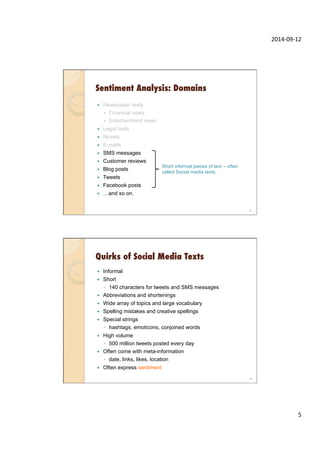
Sentiment Analysis: Domains
—  Newspaper texts
◦  Financial news
◦  Entertainment news
—  Legal texts
—  Novels
—  E-mails
—  SMS messages
—  Customer reviews
—  Blog posts
—  Tweets
—  Facebook posts
—  …and so on.
8
2014-­‐09-­‐12	
  
5	
  
Sentiment Analysis: Domains
—  Newspaper texts
◦  Financial news
◦  Entertainment news
—  Legal texts
—  Novels
—  E-mails
—  SMS messages
—  Customer reviews
—  Blog posts
—  Tweets
—  Facebook posts
—  …and so on.
9
Short informal pieces of text – often
called Social media texts.
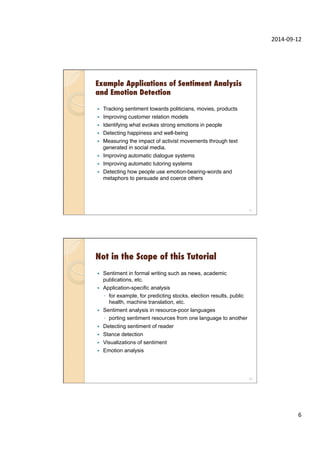
Quirks of Social Media Texts
—  Informal
—  Short
◦  140 characters for tweets and SMS messages
—  Abbreviations and shortenings
—  Wide array of topics and large vocabulary
—  Spelling mistakes and creative spellings
—  Special strings
◦  hashtags, emoticons, conjoined words
—  High volume
◦  500 million tweets posted every day
—  Often come with meta-information
◦  date, links, likes, location
—  Often express sentiment
10
2014-­‐09-­‐12	
  
6	
  
Example Applications of Sentiment Analysis
and Emotion Detection
—  Tracking sentiment towards politicians, movies, products"
—  Improving customer relation models"
—  Identifying what evokes strong emotions in people"
—  Detecting happiness and well-being"
—  Measuring the impact of activist movements through text
generated in social media."
—  Improving automatic dialogue systems"
—  Improving automatic tutoring systems"
—  Detecting how people use emotion-bearing-words and
metaphors to persuade and coerce others"
11
Not in the Scope of this Tutorial
—  Sentiment in formal writing such as news, academic
publications, etc.
—  Application-specific analysis
◦  for example, for predicting stocks, election results, public
health, machine translation, etc.
—  Sentiment analysis in resource-poor languages
◦  porting sentiment resources from one language to another
—  Detecting sentiment of reader
—  Stance detection
—  Visualizations of sentiment
—  Emotion analysis
12
2014-­‐09-­‐12	
  
7	
  
SemEval Sentiment Tasks
13
•  SemEval-2013 Task 2
•  SemEval-2014 Task 9
•  SemEval-2014 Task 4
SemEval-2013, Task 2: Sentiment Analysis in Twitter
—  Tasks
◦  Is a given message positive, negative, or neutral?
◦  Is a given term within a message positive, negative, or
neutral?
—  Data
◦  test set
–  tweets
–  SMS messages
◦  training set
–  tweets
◦  sources of data
–  tweets taken from Twitter API
–  search was for certain named entities
–  tweets had to have some words from SentiWordNet
14
2014-­‐09-­‐12	
  
8	
  
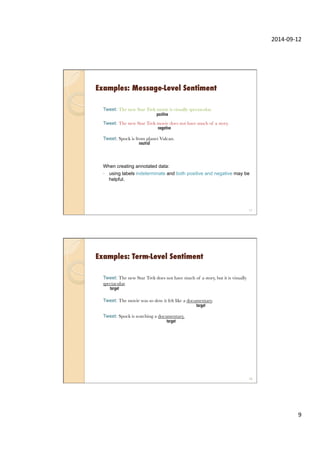
Examples: Message-Level Sentiment
Tweet: The new Star Trek movie is visually spectacular.
Tweet: The new Star Trek movie does not have much of a story.
Tweet: Spock is from planet Vulcan.
15
Examples: Message-Level Sentiment
Tweet: The new Star Trek movie is visually spectacular.
Tweet: The new Star Trek movie does not have much of a story.
Tweet: Spock is from planet Vulcan.
16
negative
neutral
positive
2014-­‐09-­‐12	
  
9	
  
Examples: Message-Level Sentiment
Tweet: The new Star Trek movie is visually spectacular.
Tweet: The new Star Trek movie does not have much of a story.
Tweet: Spock is from planet Vulcan.
When creating annotated data:
◦  using labels indeterminate and both positive and negative may be
helpful.
17
negative
neutral
positive
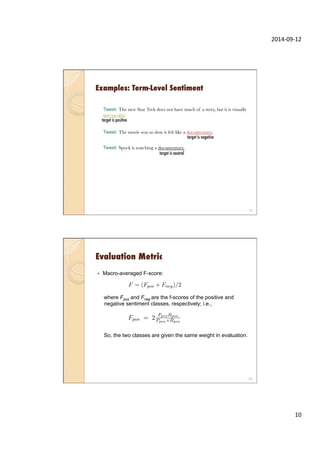
Examples: Term-Level Sentiment
Tweet: The new Star Trek does not have much of a story, but it is visually
spectacular.
Tweet: The movie was so slow it felt like a documentary.
Tweet: Spock is watching a documentary.
18
target
target
target
2014-­‐09-­‐12	
  
10	
  
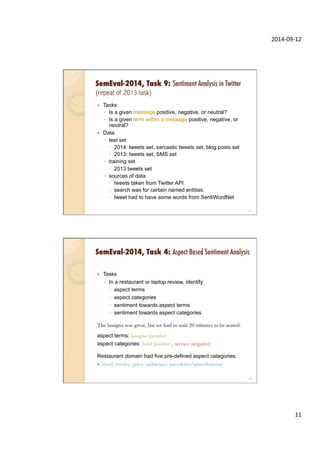
Examples: Term-Level Sentiment
Tweet: The new Star Trek does not have much of a story, but it is visually
spectacular.
Tweet: The movie was so slow it felt like a documentary.
Tweet: Spock is watching a documentary.
19
target is negative
target is neutral
target is positive
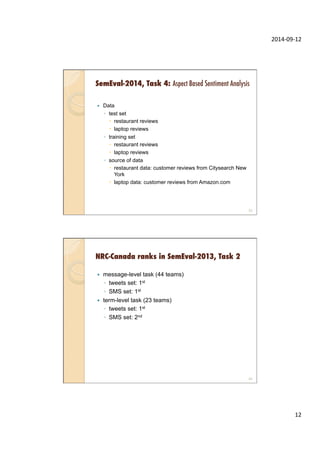
Evaluation Metric
—  Macro-averaged F-score:
where Fpos and Fneg are the f-scores of the positive and
negative sentiment classes, respectively; i.e.,
So, the two classes are given the same weight in evaluation.
20
2014-­‐09-­‐12	
  
11	
  
SemEval-2014, Task 9: Sentiment Analysis in Twitter
(repeat of 2013 task)
—  Tasks
◦  Is a given message positive, negative, or neutral?
◦  Is a given term within a message positive, negative, or
neutral?
—  Data
◦  test set
–  2014: tweets set, sarcastic tweets set, blog posts set
–  2013: tweets set, SMS set
◦  training set
–  2013 tweets set
◦  sources of data
–  tweets taken from Twitter API
–  search was for certain named entities
–  tweet had to have some words from SentiWordNet
21
SemEval-2014, Task 4: Aspect Based Sentiment Analysis
—  Tasks
◦  In a restaurant or laptop review, identify:
–  aspect terms
–  aspect categories
–  sentiment towards aspect terms
–  sentiment towards aspect categories
The lasagna was great, but we had to wait 20 minutes to be seated.
aspect terms: lasagna (positive)
aspect categories: food (positive), service (negative)
Restaurant domain had five pre-defined aspect categories:
—  food, service, price, ambience, anecdotes/miscellaneous
"
22
2014-­‐09-­‐12	
  
12	
  
SemEval-2014, Task 4: Aspect Based Sentiment Analysis
—  Data
◦  test set
–  restaurant reviews
–  laptop reviews
◦  training set
–  restaurant reviews
–  laptop reviews
◦  source of data
–  restaurant data: customer reviews from Citysearch New
York
–  laptop data: customer reviews from Amazon.com
23
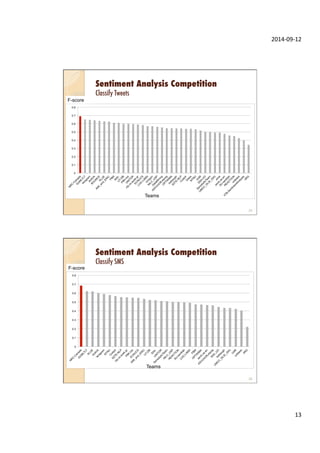
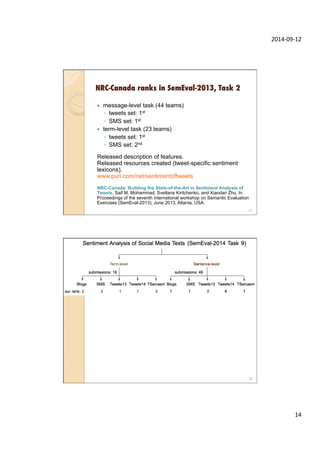
NRC-Canada ranks in SemEval-2013, Task 2
—  message-level task (44 teams)
◦  tweets set: 1st
◦  SMS set: 1st
—  term-level task (23 teams)
◦  tweets set: 1st
◦  SMS set: 2nd
24
2014-­‐09-­‐12	
  
13	
  
Sentiment Analysis Competition
Classify Tweets
0
0.1
0.2
0.3
0.4
0.5
0.6
0.7
0.8
F-score
Teams
25
Sentiment Analysis Competition
Classify SMS
0
0.1
0.2
0.3
0.4
0.5
0.6
0.7
0.8
Teams
F-score
26
2014-­‐09-­‐12	
  
14	
  
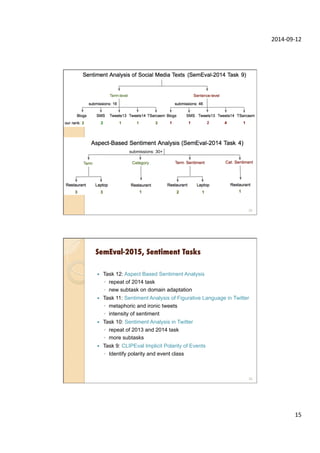
NRC-Canada ranks in SemEval-2013, Task 2
—  message-level task (44 teams)
◦  tweets set: 1st
◦  SMS set: 1st
—  term-level task (23 teams)
◦  tweets set: 1st
◦  SMS set: 2nd
Released description of features.
Released resources created (tweet-specific sentiment
lexicons).
www.purl.com/net/sentimentoftweets
NRC-Canada: Building the State-of-the-Art in Sentiment Analysis of
Tweets, Saif M. Mohammad, Svetlana Kiritchenko, and Xiaodan Zhu, In
Proceedings of the seventh international workshop on Semantic Evaluation
Exercises (SemEval-2013), June 2013, Atlanta, USA."
27
28
22
2014-­‐09-­‐12	
  
15	
  
29
22
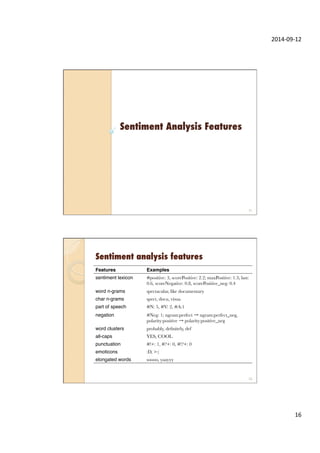
submissions: 30+
SemEval-2015, Sentiment Tasks
—  Task 12: Aspect Based Sentiment Analysis
◦  repeat of 2014 task
◦  new subtask on domain adaptation
—  Task 11: Sentiment Analysis of Figurative Language in Twitter
◦  metaphoric and ironic tweets
◦  intensity of sentiment
—  Task 10: Sentiment Analysis in Twitter
◦  repeat of 2013 and 2014 task
◦  more subtasks
—  Task 9: CLIPEval Implicit Polarity of Events
◦  Identify polarity and event class
30
2014-­‐09-­‐12	
  
16	
  
Sentiment Analysis Features
31
Sentiment analysis features
32
Features! Examples!
sentiment lexicon! #positive: 3, scorePositive: 2.2; maxPositive: 1.3; last:
0.6, scoreNegative: 0.8, scorePositive_neg: 0.4
word n-grams! spectacular, like documentary
char n-grams! spect, docu, visua
part of speech! #N: 5, #V: 2, #A:1
negation! #Neg: 1; ngram:perfect → ngram:perfect_neg,
polarity:positive → polarity:positive_neg
word clusters! probably, definitely, def
all-caps! YES, COOL
punctuation! #!+: 1, #?+: 0, #!?+: 0
emoticons! :D, >:(
elongated words! soooo, yaayyy
2014-­‐09-­‐12	
  
17	
  
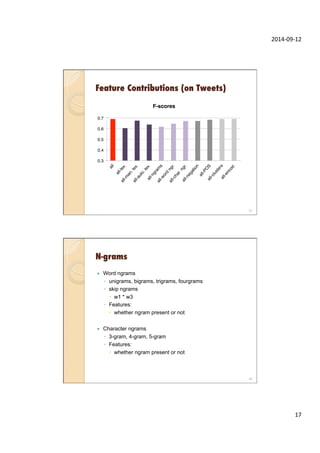
Feature Contributions (on Tweets)
0.3"
0.4"
0.5"
0.6"
0.7"
F-scores!
33
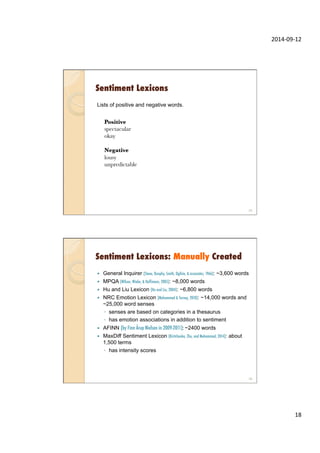
N-grams
—  Word ngrams
◦  unigrams, bigrams, trigrams, fourgrams
◦  skip ngrams
–  w1 * w3
◦  Features:
–  whether ngram present or not
—  Character ngrams
◦  3-gram, 4-gram, 5-gram
◦  Features:
–  whether ngram present or not
34
2014-­‐09-­‐12	
  
18	
  
Sentiment Lexicons
Lists of positive and negative words.
spectacular positive 0.91
okay positive 0.3
lousy negative 0.84
unpredictable negative 0.17
Positive
spectacular
okay

Negative
lousy
unpredictable
35
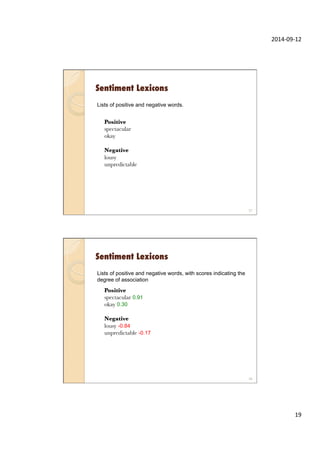
Sentiment Lexicons: Manually Created
—  General Inquirer (Stone, Dunphy, Smith, Ogilvie, & associates, 1966): ~3,600 words
—  MPQA (Wilson, Wiebe, & Hoffmann, 2005): ~8,000 words
—  Hu and Liu Lexicon (Hu and Liu, 2004): ~6,800 words
—  NRC Emotion Lexicon (Mohammad & Turney, 2010): ~14,000 words and
~25,000 word senses
◦  senses are based on categories in a thesaurus
◦  has emotion associations in addition to sentiment
—  AFINN (by Finn Årup Nielsen in 2009-2011): ~2400 words
—  MaxDiff Sentiment Lexicon (Kiritchenko, Zhu, and Mohammad, 2014): about
1,500 terms
◦  has intensity scores
36
2014-­‐09-­‐12	
  
19	
  
Sentiment Lexicons
Lists of positive and negative words.
spectacular positive 0.91
okay positive 0.3
lousy negative 0.84
unpredictable negative 0.17
Positive
spectacular
okay

Negative
lousy
unpredictable
37
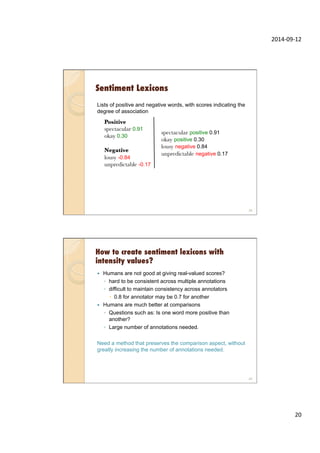
Sentiment Lexicons
Lists of positive and negative words, with scores indicating the
degree of association
spectacular positive 0.91
okay positive 0.3
lousy negative 0.84
unpredictable negative 0.17
Positive
spectacular 0.91
okay 0.30

Negative
lousy -0.84
unpredictable -0.17
38
2014-­‐09-­‐12	
  
20	
  
Sentiment Lexicons
Lists of positive and negative words, with scores indicating the
degree of association
spectacular positive 0.91
okay positive 0.3
lousy negative 0.84
unpredictable negative 0.17
Positive
spectacular 0.91
okay 0.30

Negative
lousy -0.84
unpredictable -0.17
39
spectacular positive 0.91
okay positive 0.30
lousy negative 0.84
unpredictable negative 0.17
How to create sentiment lexicons with
intensity values?
—  Humans are not good at giving real-valued scores?
◦  hard to be consistent across multiple annotations
◦  difficult to maintain consistency across annotators
–  0.8 for annotator may be 0.7 for another
—  Humans are much better at comparisons
◦  Questions such as: Is one word more positive than
another?
◦  Large number of annotations needed.
Need a method that preserves the comparison aspect, without
greatly increasing the number of annotations needed.
40
2014-­‐09-­‐12	
  
21	
  
MaxDiff
—  The annotator is presented with four words (say, A, B, C, and
D) and asked:
◦  which word is the most positive
◦  which is the least positive
—  By answering just these two questions, five out of the six
inequalities are known
◦  For e.g.:
–  If A is most positive
–  and D is least positive, then we know:
A > B, A > C, A > D, B > D, C > D
41
MaxDiff
—  Each of these MaxDiff questions can be presented to multiple
annotators.
—  The responses to the MaxDiff questions can then be easily
translated into:
◦  a ranking of all the terms
◦  a real-valued score for all the terms (Orme, 2009)
—  If two words have very different degrees of association (for
example, A >> D), then:
◦  A will be chosen as most positive much more often than D
◦  D will be chosen as least positive much more often than A.
This will eventually lead to a ranked list such that A and D are
significantly farther apart, and their real-valued association
scores will also be significantly different.
42
2014-­‐09-­‐12	
  
22	
  
Dataset of Sentiment Scores
(Kiritchenko, Zhu, and Mohammad, 2014)
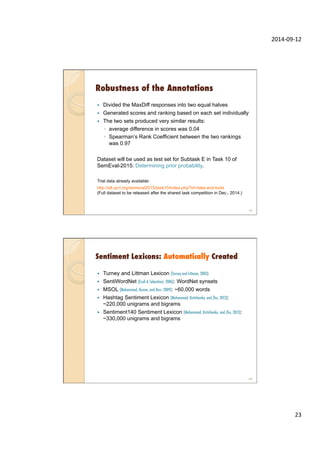
—  Selected ~1,500 terms from tweets
◦  regular English words: peace, jumpy
◦  tweet-specific terms
–  hashtags and conjoined words: #inspiring, #happytweet,
#needsleep
–  creative spellings: amazzing, goooood
◦  negated terms: not nice, nothing better, not sad
—  Generated 3,000 MaxDiff questions
—  Each question annotated by 10 annotators on CrowdFlower
—  Answers converted to real-valued scores (0 to 1) and to a full
ranking of terms using the counting procedure (Orme, 2009)
43
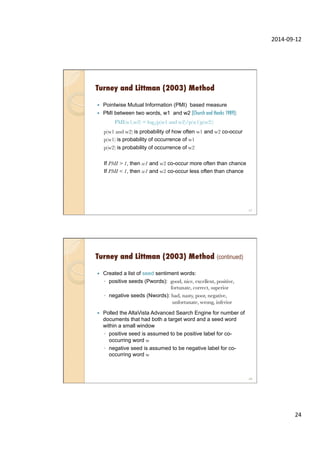
Examples of sentiment scores from the
MaxDiff annotations
Term Sentiment Score
0 (most negative) to 1 (most positive)
awesomeness
 0.9133
#happygirl
 0.8125
cant waitttt
 0.8000
don't worry
 0.5750
not true
 0.3871
cold
 0.2750
#getagrip
 0.2063
#sickening
 0.1389
44
2014-­‐09-­‐12	
  
23	
  
Robustness of the Annotations
—  Divided the MaxDiff responses into two equal halves
—  Generated scores and ranking based on each set individually
—  The two sets produced very similar results:
◦  average difference in scores was 0.04
◦  Spearman’s Rank Coefficient between the two rankings
was 0.97
Dataset will be used as test set for Subtask E in Task 10 of
SemEval-2015: Determining prior probability.
Trial data already available:
http://alt.qcri.org/semeval2015/task10/index.php?id=data-and-tools
(Full dataset to be released after the shared task competition in Dec., 2014.)
45
Sentiment Lexicons: Automatically Created
—  Turney and Littman Lexicon (Turney and Littman, 2003)
—  SentiWordNet (Esuli & Sebastiani, 2006): WordNet synsets
—  MSOL (Mohammad, Dunne, and Dorr, 2009): ~60,000 words
—  Hashtag Sentiment Lexicon (Mohammad, Kiritchenko, and Zhu, 2013):
~220,000 unigrams and bigrams
—  Sentiment140 Sentiment Lexicon (Mohammad, Kiritchenko, and Zhu, 2013):
~330,000 unigrams and bigrams
46
2014-­‐09-­‐12	
  
24	
  
Turney and Littman (2003) Method
—  Pointwise Mutual Information (PMI) based measure
—  PMI between two words, w1 and w2 (Church and Hanks 1989):

PMI(w1,w2) = log2(p(w1 and w2)/p(w1)p(w2))

p(w1 and w2) is probability of how often w1 and w2 co-occur
p(w1) is probability of occurrence of w1
p(w2) is probability of occurrence of w2
If PMI > 1, then w1 and w2 co-occur more often than chance
If PMI < 1, then w1 and w2 co-occur less often than chance
47
Turney and Littman (2003) Method (continued)
—  Created a list of seed sentiment words:
◦  positive seeds (Pwords): good, nice, excellent, positive,
fortunate, correct, superior
◦  negative seeds (Nwords): bad, nasty, poor, negative,
unfortunate, wrong, inferior
—  Polled the AltaVista Advanced Search Engine for number of
documents that had both a target word and a seed word
within a small window
◦  positive seed is assumed to be positive label for co-
occurring word w
◦  negative seed is assumed to be negative label for co-
occurring word w
48
2014-­‐09-­‐12	
  
25	
  
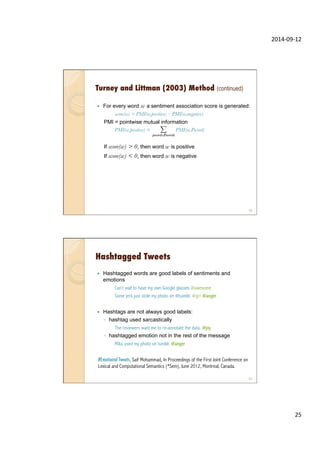
—  For every word w a sentiment association score is generated:
score(w) = PMI(w,positive) – PMI(w,negative)
PMI = pointwise mutual information
PMI(w,positive) = PMI(w,Pword)

If score(w) > 0, then word w is positive
If score(w) < 0, then word w is negative
Turney and Littman (2003) Method (continued)
49
Hashtagged Tweets
—  Hashtagged words are good labels of sentiments and
emotions
Can’t wait to have my own Google glasses #awesome
Some jerk just stole my photo on #tumblr. #grr #anger
—  Hashtags are not always good labels:
◦  hashtag used sarcastically
The reviewers want me to re-annotate the data. #joy
◦  hashtagged emotion not in the rest of the message
Mika used my photo on tumblr. #anger
#Emotional Tweets, Saif Mohammad, In Proceedings of the First Joint Conference on
Lexical and Computational Semantics (*Sem), June 2012, Montreal, Canada.
50
2014-­‐09-­‐12	
  
26	
  
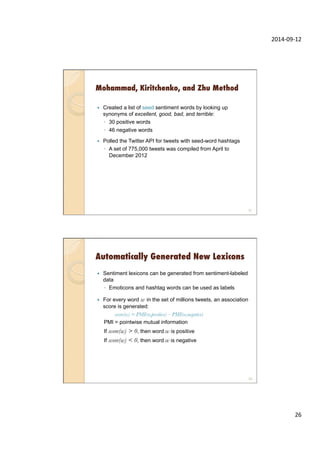
Mohammad, Kiritchenko, and Zhu Method
—  Created a list of seed sentiment words by looking up
synonyms of excellent, good, bad, and terrible:
◦  30 positive words
◦  46 negative words
—  Polled the Twitter API for tweets with seed-word hashtags
◦  A set of 775,000 tweets was compiled from April to
December 2012
51
Automatically Generated New Lexicons
—  Sentiment lexicons can be generated from sentiment-labeled
data
◦  Emoticons and hashtag words can be used as labels
—  For every word w in the set of millions tweets, an association
score is generated:
score(w) = PMI(w,positive) – PMI(w,negative)
PMI = pointwise mutual information
If score(w) > 0, then word w is positive
If score(w) < 0, then word w is negative
52
2014-­‐09-­‐12	
  
27	
  
PMI Method based Lexicons
—  Hashtag Sentiment Lexicon
◦  created from a large collection of hashtagged tweets
◦  has entries for ~215,000 unigrams and bigrams
—  Sentiment140 Lexicon
◦  created from a large collection of tweets with emoticons
–  Sentiment140 corpus (Alec Go, Richa Bhayani, and Lei Huang, 2009)
http://help.sentiment140.com/for-students/
◦  has entries for ~330,000 unigrams and bigrams
53
Features of the Twitter Lexicon
—  connotation and not necessarily denotation
◦  tears, party, vacation
—  large vocabulary
◦  cover wide variety of topics
◦  lots of informal words
◦  twitter-specific words
–  creative spellings, hashtags, conjoined words
—  seed hashtags have varying effectiveness
◦  study on sentiment predictability of different hashtags
(Kunneman, F.A., Liebrecht, C.C., van den Bosch, A.P.J., 2014)
54
2014-­‐09-­‐12	
  
28	
  
Negation
—  A grammatical category that allows the changing of the truth
value of a proposition (Morante and Sporleder, 2012)
—  Often expressed through the use of negative signals or
negators
◦  words like isn’t and never
—  Can significantly affect the sentiment of its scope
—  Examples:
People do not like change.
Jack never hated the plan, he just has other priorities.
The negator is shown in blue.
The scope is shown by underline.
55
Conventional methods to handle negation
Reversing hypothesis:
s(n,w) = -s(w)
where, s(w) is the sentiment of word (or phrase) w,
s(n,w) is the sentiment of the expression formed by the
concatenation of the negator n and word w.
—  For example, if s(honest) = 0.9, then s(not, honest) = -0.9
But how good is this hypothesis?
What about:
The movie is not terrible.
If s(terrible) = -0.9. what is the appropriate value for s(not,
terrible) in this context?
56
2014-­‐09-­‐12	
  
29	
  
Negation
57
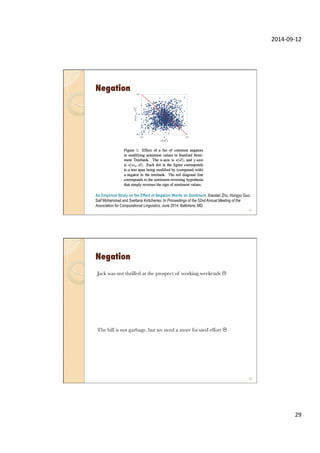
An Empirical Study on the Effect of Negation Words on Sentiment. Xiaodan Zhu, Hongyu Guo,
Saif Mohammad and Svetlana Kiritchenko. In Proceedings of the 52nd Annual Meeting of the
Association for Computational Linguistics, June 2014, Baltimore, MD.
Negation
58
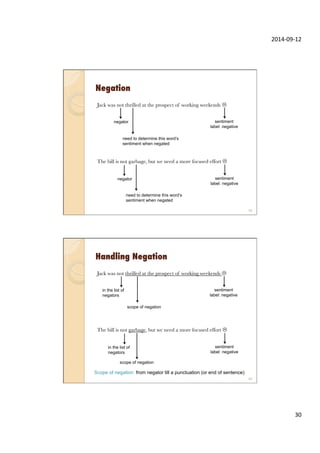
Jack was not thrilled at the prospect of working weekends L
The bill is not garbage, but we need a more focused effort L
2014-­‐09-­‐12	
  
30	
  
Negation
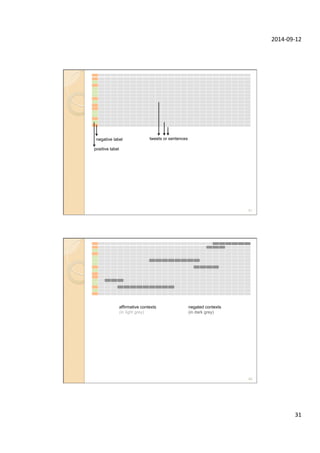
Jack was not thrilled at the prospect of working weekends L
The bill is not garbage, but we need a more focused effort L
59
negator sentiment
label: negative
need to determine this word’s
sentiment when negated
negator sentiment
label: negative
need to determine this word’s
sentiment when negated
Handling Negation
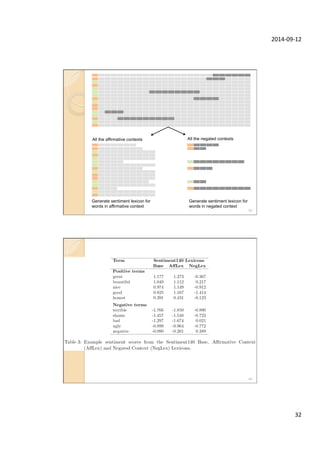
Jack was not thrilled at the prospect of working weekends L
The bill is not garbage, but we need a more focused effort L
60
in the list of
negators
sentiment
label: negative
scope of negation
in the list of
negators
sentiment
label: negative
scope of negation
Scope of negation: from negator till a punctuation (or end of sentence)
2014-­‐09-­‐12	
  
31	
  
61
tweets or sentencesnegative label
positive label
62
negated contexts
(in dark grey)
affirmative contexts
(in light grey)
2014-­‐09-­‐12	
  
32	
  
63
All the affirmative contexts All the negated contexts
Generate sentiment lexicon for
words in affirmative context
Generate sentiment lexicon for
words in negated context
64
2014-­‐09-­‐12	
  
33	
  
65
Sentiment Analysis of Short Informal Texts
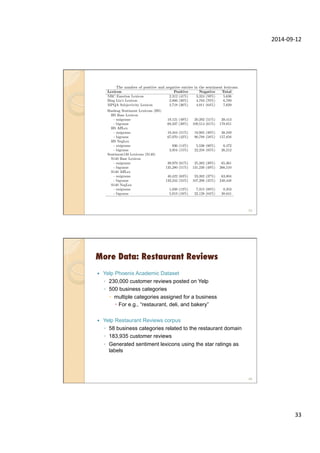
Table 4: The number of positive and negative entries in the sentiment lexicons.
Lexicon Positive Negative Total
NRC Emotion Lexicon 2,312 (41%) 3,324 (59%) 5,636
Bing Liu’s Lexicon 2,006 (30%) 4,783 (70%) 6,789
MPQA Subjectivity Lexicon 2,718 (36%) 4,911 (64%) 7,629
Hashtag Sentiment Lexicons (HS)
HS Base Lexicon
- unigrams 19,121 (49%) 20,292 (51%) 39,413
- bigrams 69,337 (39%) 109,514 (61%) 178,851
HS A↵Lex
- unigrams 19,344 (51%) 18,905 (49%) 38,249
- bigrams 67,070 (42%) 90,788 (58%) 157,858
HS NegLex
- unigrams 936 (14%) 5,536 (86%) 6,472
- bigrams 3,954 (15%) 22,258 (85%) 26,212
Sentiment140 Lexicons (S140)
S140 Base Lexicon
- unigrams 39,979 (61%) 25,382 (39%) 65,361
- bigrams 135,280 (51%) 131,230 (49%) 266,510
S140 A↵Lex
- unigrams 40,422 (63%) 23,382 (37%) 63,804
- bigrams 133,242 (55%) 107,206 (45%) 240,448
S140 NegLex
- unigrams 1,038 (12%) 7,315 (88%) 8,353
- bigrams 5,913 (16%) 32,128 (84%) 38,041
language and supports the Polyanna Hypothesis (Boucher & Osgood, 1969), which states
that people tend to use positive terms more frequently and diversely than negative. Note,
however, that negative terms are dominant in the Negated Context Lexicons since most
terms, both positive and negative, tend to convey negative sentiment in the presence of
negation. The overall sizes of the Negated Context Lexicons are rather small since negation
occurs only in 24% of the tweets in the Hashtag and Sentiment140 corpora and only part
of a message with negation is actually negated.
Table 5 shows the di↵erences in coverage between the lexicons. Specifically, it gives the
number of additional terms a lexicon in row X has in comparison to a lexicon in column
Y and the percentage of tokens in the SemEval-2013 tweet test set covered by these extra
entries of lexicon X (numbers in brackets). For instance, almost half of Bing Liu’s Lexicon
(3,457 terms) is not found in the Sentiment140 Base Lexicon. However, these additional
terms represent only 0.05% of all the tokens from the tweet test set. These are terms that
are rarely used in short informal writing (e.g., acrimoniously, bestial, nepotism). Each of
the manually created lexicons covers extra 2–3% of the test data compared to other manual
lexicons. On the other hand, the automatically generated lexicons cover 60% more tokens
in the test data. Both automatic lexicons provide a number of terms not found in the other.
15
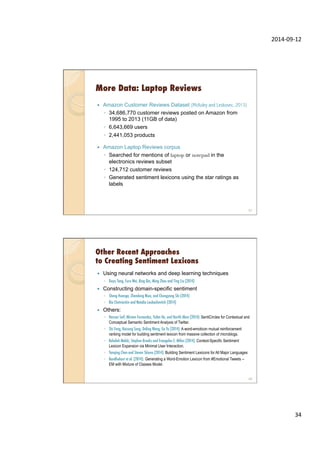
More Data: Restaurant Reviews
—  Yelp Phoenix Academic Dataset
◦  230,000 customer reviews posted on Yelp
◦  500 business categories
–  multiple categories assigned for a business
–  For e.g., “restaurant, deli, and bakery”
—  Yelp Restaurant Reviews corpus
◦  58 business categories related to the restaurant domain
◦  183,935 customer reviews
◦  Generated sentiment lexicons using the star ratings as
labels
66
2014-­‐09-­‐12	
  
34	
  
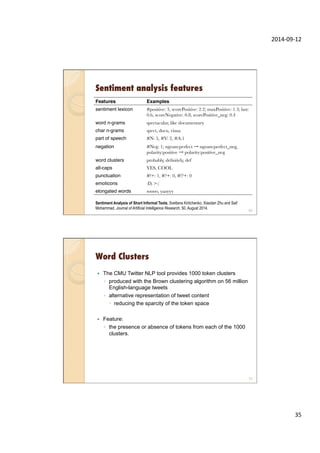
More Data: Laptop Reviews
—  Amazon Customer Reviews Dataset (McAuley and Leskovec, 2013)
◦  34,686,770 customer reviews posted on Amazon from
1995 to 2013 (11GB of data)
◦  6,643,669 users
◦  2,441,053 products
—  Amazon Laptop Reviews corpus
◦  Searched for mentions of laptop or notepad in the
electronics reviews subset
◦  124,712 customer reviews
◦  Generated sentiment lexicons using the star ratings as
labels
67
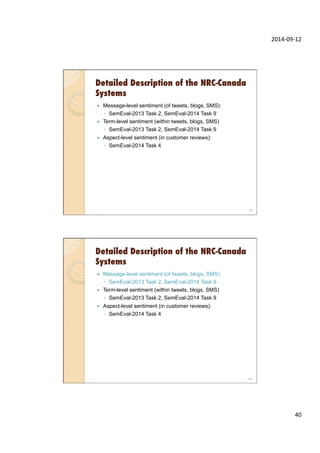
Other Recent Approaches
to Creating Sentiment Lexicons
—  Using neural networks and deep learning techniques
◦  Duyu Tang, Furu Wei, Bing Qin, Ming Zhou and Ting Liu (2014)
—  Constructing domain-specific sentiment
◦  Sheng Huanga, Zhendong Niua, and Chongyang Shi (2014)
◦  Ilia Chetviorkin and Natalia Loukachevitch (2014)
—  Others:
◦  Hassan Saif, Miriam Fernandez, Yulan He, and Harith Alani (2014): SentiCircles for Contextual and
Conceptual Semantic Sentiment Analysis of Twitter.
◦  Shi Feng, Kaisong Song, Daling Wang, Ge Yu (2014): A word-emoticon mutual reinforcement
ranking model for building sentiment lexicon from massive collection of microblogs.
◦  Raheleh Makki, Stephen Brooks and Evangelos E. Milios (2014): Context-Specific Sentiment
Lexicon Expansion via Minimal User Interaction.
◦  Yanqing Chen and Steven Skiena (2014): Building Sentiment Lexicons for All Major Languages
◦  Bandhakavi et al. (2014): Generating a Word-Emotion Lexicon from #Emotional Tweets --
EM with Mixture of Classes Model.
68
2014-­‐09-­‐12	
  
35	
  
Sentiment analysis features
69
Features! Examples!
sentiment lexicon! #positive: 3, scorePositive: 2.2; maxPositive: 1.3; last:
0.6, scoreNegative: 0.8, scorePositive_neg: 0.4
word n-grams! spectacular, like documentary
char n-grams! spect, docu, visua
part of speech! #N: 5, #V: 2, #A:1
negation! #Neg: 1; ngram:perfect → ngram:perfect_neg,
polarity:positive → polarity:positive_neg
word clusters! probably, definitely, def
all-caps! YES, COOL
punctuation! #!+: 1, #?+: 0, #!?+: 0
emoticons! :D, >:(
elongated words! soooo, yaayyy
Sentiment Analysis of Short Informal Texts. Svetlana Kiritchenko, Xiaodan Zhu and Saif
Mohammad. Journal of Artificial Intelligence Research, 50, August 2014.
Word Clusters
—  The CMU Twitter NLP tool provides 1000 token clusters
◦  produced with the Brown clustering algorithm on 56 million
English-language tweets
◦  alternative representation of tweet content
–  reducing the sparcity of the token space
—  Feature:
◦  the presence or absence of tokens from each of the 1000
clusters.
70
2014-­‐09-­‐12	
  
36	
  
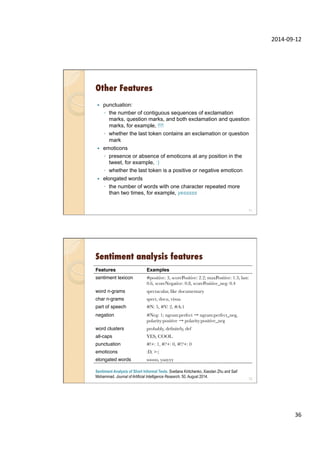
Other Features
—  punctuation:
◦  the number of contiguous sequences of exclamation
marks, question marks, and both exclamation and question
marks, for example, !!!!
◦  whether the last token contains an exclamation or question
mark
—  emoticons
◦  presence or absence of emoticons at any position in the
tweet, for example, :)
◦  whether the last token is a positive or negative emoticon
—  elongated words
◦  the number of words with one character repeated more
than two times, for example, yesssss
71
Sentiment analysis features
72
Features! Examples!
sentiment lexicon! #positive: 3, scorePositive: 2.2; maxPositive: 1.3; last:
0.6, scoreNegative: 0.8, scorePositive_neg: 0.4
word n-grams! spectacular, like documentary
char n-grams! spect, docu, visua
part of speech! #N: 5, #V: 2, #A:1
negation! #Neg: 1; ngram:perfect → ngram:perfect_neg,
polarity:positive → polarity:positive_neg
word clusters! probably, definitely, def
all-caps! YES, COOL
punctuation! #!+: 1, #?+: 0, #!?+: 0
emoticons! :D, >:(
elongated words! soooo, yaayyy
Sentiment Analysis of Short Informal Texts. Svetlana Kiritchenko, Xiaodan Zhu and Saif
Mohammad. Journal of Artificial Intelligence Research, 50, August 2014.
2014-­‐09-­‐12	
  
37	
  
Overview of Sentiment
Analysis Systems
73
•  Rule-based systems
•  Conventional statistical systems
•  Deep-learning-based models
Overview of Sentiment
Analysis Systems
74
•  Rule-based systems
•  Conventional statistical systems
•  Deep-learning-based models
2014-­‐09-­‐12	
  
38	
  
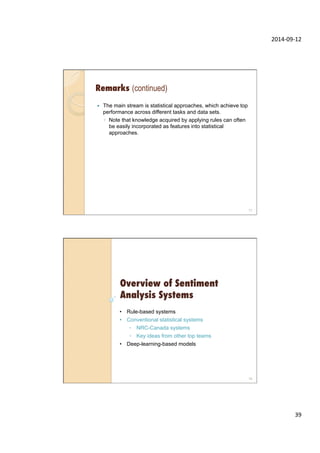
Teragram: A Rule-Based System
(Reckman et al., 2013)
—  Develop lexicalized hand-written rules: each rule is a pattern
that matches words or sequences of words.
◦  Examples:
—  Background data: use blogs, forums, news, and tweets to
develop the rules.
—  Performance:
◦  Ranked 3rd on the tweet test data in message-level task
(SemEval-2013 Task 2), but ranked 15th on the term-level
task.
75
Negative:
Positive:
Remarks
—  Carefully developed rule-based systems can sometimes
achieve completive performance on the data/domains they
are created for.
—  Advantages: explicit knowledge representation, so intuitive to
develop and maintain.
—  Problems
◦  Coverage: hand-written rules often have limited coverage,
so recall is often low. This can impact the overall
performance (as observed in Teragram).
◦  Extensibility: not easy to be extended to new data/domains;
rule-based models have inherent difficulty in automatically
acquiring knowledge.
◦  Modeling capability.
76
2014-­‐09-­‐12	
  
39	
  
—  The main stream is statistical approaches, which achieve top
performance across different tasks and data sets.
◦  Note that knowledge acquired by applying rules can often
be easily incorporated as features into statistical
approaches.
77
Remarks (continued)
Overview of Sentiment
Analysis Systems
78
•  Rule-based systems
•  Conventional statistical systems
◦  NRC-Canada systems
◦  Key ideas from other top teams
•  Deep-learning-based models
2014-­‐09-­‐12	
  
40	
  
Detailed Description of the NRC-Canada
Systems
—  Message-level sentiment (of tweets, blogs, SMS):
◦  SemEval-2013 Task 2, SemEval-2014 Task 9
—  Term-level sentiment (within tweets, blogs, SMS)
◦  SemEval-2013 Task 2, SemEval-2014 Task 9
—  Aspect-level sentiment (in customer reviews):
◦  SemEval-2014 Task 4
79
Detailed Description of the NRC-Canada
Systems
—  Message-level sentiment (of tweets, blogs, SMS):
◦  SemEval-2013 Task 2, SemEval-2014 Task 9
—  Term-level sentiment (within tweets, blogs, SMS)
◦  SemEval-2013 Task 2, SemEval-2014 Task 9
—  Aspect-level sentiment (in customer reviews):
◦  SemEval-2014 Task 4
80
2014-­‐09-­‐12	
  
41	
  
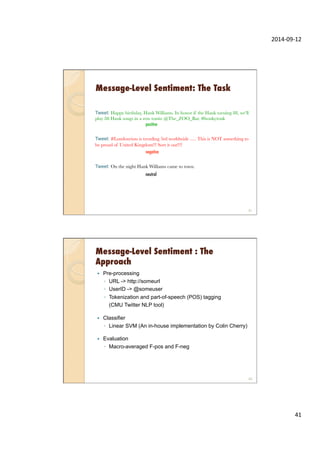
Message-Level Sentiment: The Task
Tweet: Happy birthday, Hank Williams. In honor if the Hank turning 88, we'll
play 88 Hank songs in a row tonite @The_ZOO_Bar. #honkytonk


positive

Tweet: #Londonriots is trending 3rd worldwide ..... This is NOT something to
be proud of United Kingdom!!! Sort it out!!!!


negative

Tweet: On the night Hank Williams came to town.
neutral
81
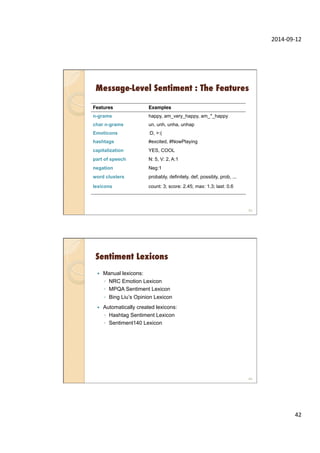
Message-Level Sentiment : The
Approach
—  Pre-processing
◦  URL -> http://someurl
◦  UserID -> @someuser
◦  Tokenization and part-of-speech (POS) tagging
(CMU Twitter NLP tool)
—  Classifier
◦  Linear SVM (An in-house implementation by Colin Cherry)
—  Evaluation
◦  Macro-averaged F-pos and F-neg
82
2014-­‐09-­‐12	
  
42	
  
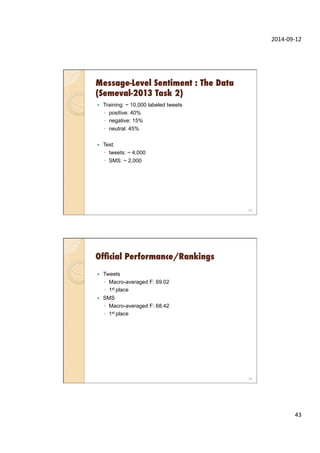
Message-Level Sentiment : The Features
83
Features! Examples!
n-grams happy, am_very_happy, am_*_happy
char n-grams un, unh, unha, unhap
Emoticons :D, >:(
hashtags #excited, #NowPlaying
capitalization YES, COOL
part of speech N: 5, V: 2, A:1
negation Neg:1
word clusters probably, definitely, def, possibly, prob, ...
lexicons count: 3; score: 2.45; max: 1.3; last: 0.6
Sentiment Lexicons
—  Manual lexicons:
◦  NRC Emotion Lexicon
◦  MPQA Sentiment Lexicon
◦  Bing Liu’s Opinion Lexicon
—  Automatically created lexicons:
◦  Hashtag Sentiment Lexicon
◦  Sentiment140 Lexicon
84
2014-­‐09-­‐12	
  
43	
  
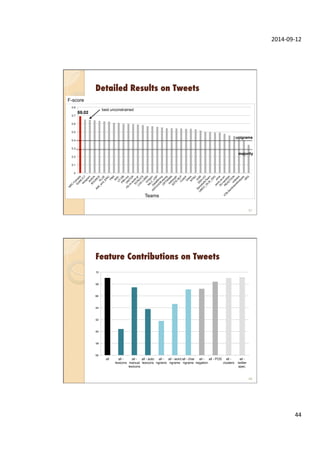
Message-Level Sentiment : The Data
(Semeval-2013 Task 2)
—  Training: ~ 10,000 labeled tweets
◦  positive: 40%
◦  negative: 15%
◦  neutral: 45%
—  Test:
◦  tweets: ~ 4,000
◦  SMS: ~ 2,000
85
Official Performance/Rankings
—  Tweets
◦  Macro-averaged F: 69.02
◦  1st place
—  SMS
◦  Macro-averaged F: 68.42
◦  1st place
86
2014-­‐09-­‐12	
  
44	
  
Detailed Results on Tweets
87
0
0.1
0.2
0.3
0.4
0.5
0.6
0.7
0.8
F-score
Teams
majority!
unigrams!
best unconstrained"
69.02!
Feature Contributions on Tweets
88
56"
58"
60"
62"
64"
66"
68"
70"
all" all -
lexicons"
all -
manual
lexicons"
all - auto
lexicons"
all -
ngrams"
all - word
ngrams"
all - char
ngrams"
all -
negation"
all - POS" all -
clusters"
all -
twitter
spec."
2014-­‐09-­‐12	
  
45	
  
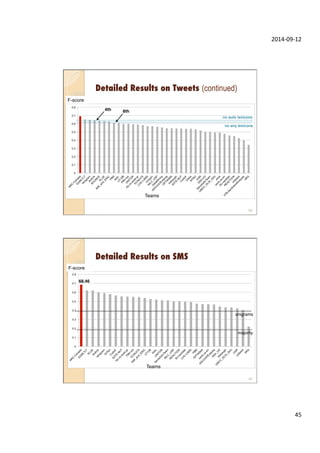
Detailed Results on Tweets (continued)
89
0
0.1
0.2
0.3
0.4
0.5
0.6
0.7
0.8
F-score
Teams
no auto lexicons!
no any lexicons!
4th! 8th!
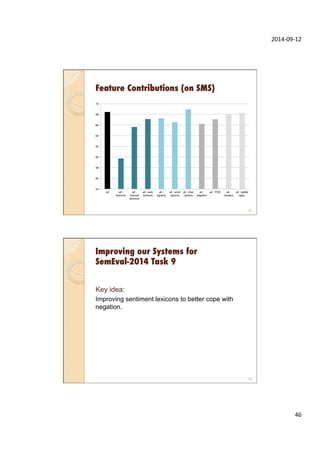
Detailed Results on SMS
90
0
0.1
0.2
0.3
0.4
0.5
0.6
0.7
0.8
68.46!
Teams
F-score
majority"
unigrams"
2014-­‐09-­‐12	
  
46	
  
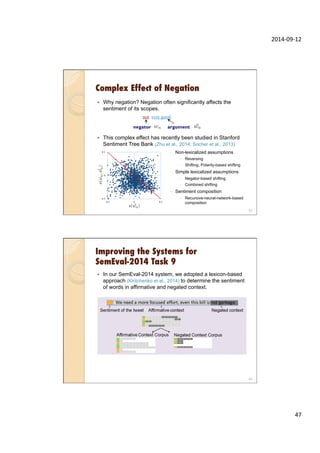
Feature Contributions (on SMS)
91
54"
56"
58"
60"
62"
64"
66"
68"
70"
all" all -
lexicons"
all -
manual
lexicons"
all - auto
lexicons"
all -
ngrams"
all - word
ngrams"
all - char
ngrams"
all -
negation"
all - POS" all -
clusters"
all - twitter
spec."
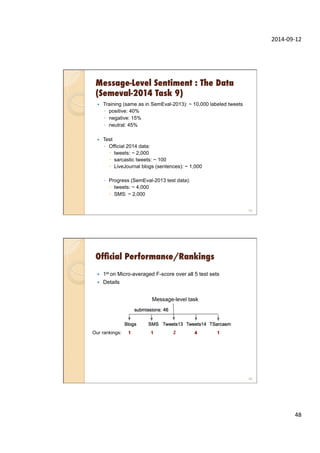
Improving our Systems for
SemEval-2014 Task 9
Key idea:
Improving sentiment lexicons to better cope with
negation.
92
2014-­‐09-­‐12	
  
47	
  
Complex Effect of Negation
—  Why negation? Negation often significantly affects the
sentiment of its scopes.
—  This complex effect has recently been studied in Stanford
Sentiment Tree Bank (Zhu et al., 2014; Socher et al., 2013)
93
negator argument
not very good
◦  Non-lexicalized assumptions
◦  Reversing
◦  Shifting, Polarity-based shifting
◦  Simple lexicalized assumptions
◦  Negator-based shifting
◦  Combined shifting
◦  Sentiment composition
◦  Recursive-neural-network-based
composition
Improving the Systems for
SemEval-2014 Task 9
—  In our SemEval-2014 system, we adopted a lexicon-based
approach (Kiritchenko et al., 2014) to determine the sentiment
of words in affirmative and negated context.
94
2014-­‐09-­‐12	
  
48	
  
Message-Level Sentiment : The Data
(Semeval-2014 Task 9)
—  Training (same as in SemEval-2013): ~ 10,000 labeled tweets
◦  positive: 40%
◦  negative: 15%
◦  neutral: 45%
—  Test
◦  Official 2014 data:
–  tweets: ~ 2,000
–  sarcastic tweets: ~ 100
–  LiveJournal blogs (sentences): ~ 1,000
◦  Progress (SemEval-2013 test data):
–  tweets: ~ 4,000
–  SMS: ~ 2,000
95
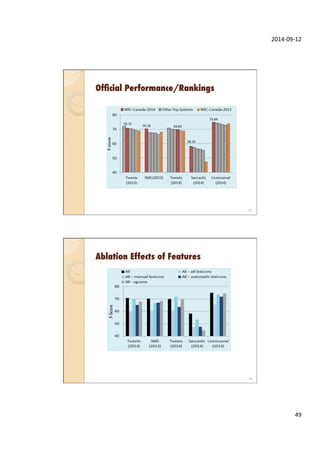
Official Performance/Rankings
—  1st on Micro-averaged F-score over all 5 test sets
—  Details
96
Our rankings:
2014-­‐09-­‐12	
  
49	
  
Official Performance/Rankings
97
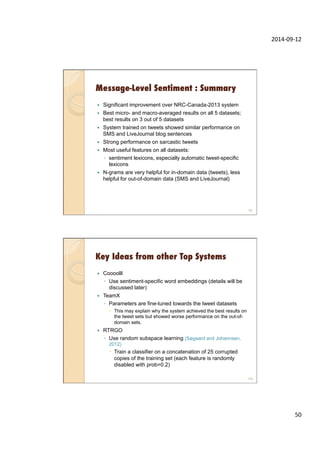
Ablation Effects of Features
98
2014-­‐09-­‐12	
  
50	
  
Message-Level Sentiment : Summary
—  Significant improvement over NRC-Canada-2013 system
—  Best micro- and macro-averaged results on all 5 datasets;
best results on 3 out of 5 datasets
—  System trained on tweets showed similar performance on
SMS and LiveJournal blog sentences
—  Strong performance on sarcastic tweets
—  Most useful features on all datasets:
◦  sentiment lexicons, especially automatic tweet-specific
lexicons
—  N-grams are very helpful for in-domain data (tweets), less
helpful for out-of-domain data (SMS and LiveJournal)
99
Key Ideas from other Top Systems
—  Coooolll
◦  Use sentiment-specific word embeddings (details will be
discussed later)
—  TeamX
◦  Parameters are fine-tuned towards the tweet datasets
–  This may explain why the system achieved the best results on
the tweet sets but showed worse performance on the out-of-
domain sets.
—  RTRGO
◦  Use random subspace learning (Søgaard and Johannsen,
2012)
–  Train a classifier on a concatenation of 25 corrupted
copies of the training set (each feature is randomly
disabled with prob=0.2)
100
2014-­‐09-­‐12	
  
51	
  
Key Ideas from other Top Systems
—  Other ideas
◦  Spelling correction
◦  Careful normalization (e.g., for the elongated words)
◦  Term/cluster weighting (e.g., TF-IDF)
101
Detailed Description of the NRC-Canada
Systems
—  Message-level sentiment (of tweets, blogs, SMS):
◦  SemEval-2013 Task 2, SemEval-2014 Task 9
—  Term-level sentiment (within tweets, blogs, SMS)
◦  SemEval-2013 Task 2, SemEval-2014 Task 9
—  Aspect-level sentiment (in customer reviews):
◦  SemEval-2014 Task 4
102
2014-­‐09-­‐12	
  
52	
  
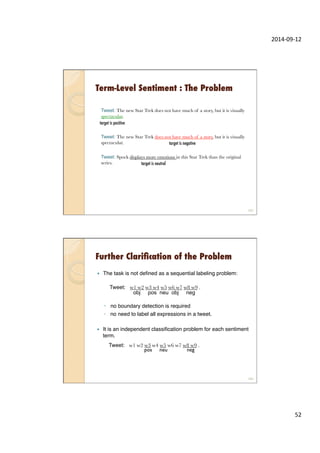
Term-Level Sentiment : The Problem
Tweet: The new Star Trek does not have much of a story, but it is visually
spectacular.
Tweet: The new Star Trek does not have much of a story, but it is visually
spectacular.
Tweet: Spock displays more emotions in this Star Trek than the original
series.
103
target is negative
target is neutral
target is positive
—  The task is not defined as a sequential labeling problem:"


"
◦  no boundary detection is required"
◦  no need to label all expressions in a tweet."
Further Clarification of the Problem
104
Tweet: w1 w2 w3 w4 w5 w6 w7 w8 w9 .
obj pos neu obj neg
—  It is an independent classification problem for each sentiment
term."
Tweet: w1 w2 w3 w4 w5 w6 w7 w8 w9 .
pos neu neg
2014-­‐09-­‐12	
  
53	
  
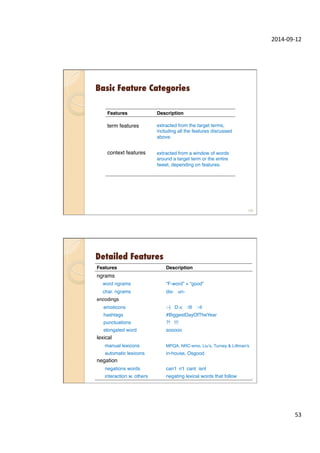
Basic Feature Categories
105
Features! Description!
term features" extracted from the target terms,
including all the features discussed
above."
context features" extracted from a window of words
around a target term or the entire
tweet, depending on features."
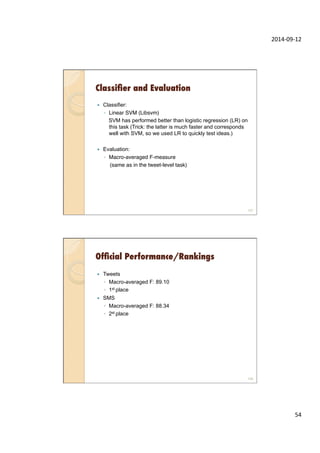
Detailed Features
106
Features! Description!
ngrams"
word ngrams" “F-word” + “good”"
char. ngrams" dis- un-"
encodings"
emoticons" :-) D:< :@ :-||"
hashtags" #BiggestDayOfTheYear"
punctuations" ?! !!!"
elongated word" sooooo"
lexical"
manual lexicons" MPQA, NRC-emo, Liu’s, Turney & Littman's "
automatic lexicons" in-house, Osgood"
negation"
negations words" can’t n’t cant isnt"
interaction w. others" negating lexical words that follow"
2014-­‐09-­‐12	
  
54	
  
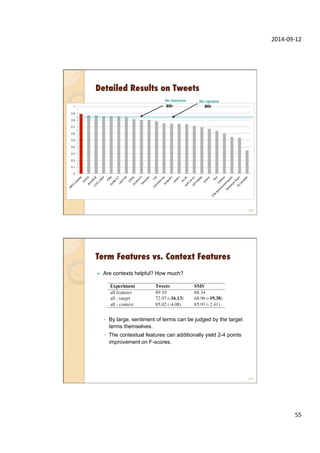
Classifier and Evaluation
—  Classifier:
◦  Linear SVM (Libsvm)"
SVM has performed better than logistic regression (LR) on
this task (Trick: the latter is much faster and corresponds
well with SVM, so we used LR to quickly test ideas.)"
—  Evaluation:
◦  Macro-averaged F-measure"
(same as in the tweet-level task)"
107
Official Performance/Rankings
—  Tweets
◦  Macro-averaged F: 89.10
◦  1st place
—  SMS
◦  Macro-averaged F: 88.34
◦  2st place
108
2014-­‐09-­‐12	
  
55	
  
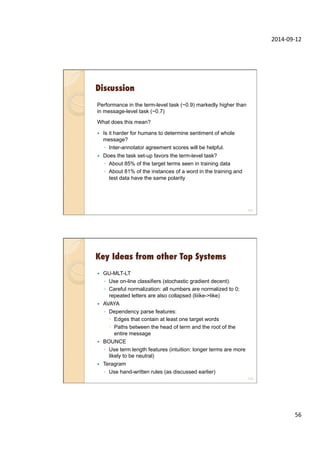
Detailed Results on Tweets
109
0
0.1
0.2
0.3
0.4
0.5
0.6
0.7
0.8
0.9
1
No lexicons!
6th! 8th!
No ngrams!
Term Features vs. Context Features
—  Are contexts helpful? How much?"
110
◦  By large, sentiment of terms can be judged by the target
terms themselves.
◦  The contextual features can additionally yield 2-4 points
improvement on F-scores.
2014-­‐09-­‐12	
  
56	
  
Discussion
Performance in the term-level task (~0.9) markedly higher than
in message-level task (~0.7)
What does this mean?
—  Is it harder for humans to determine sentiment of whole
message?
◦  Inter-annotator agreement scores will be helpful.
—  Does the task set-up favors the term-level task?
◦  About 85% of the target terms seen in training data
◦  About 81% of the instances of a word in the training and
test data have the same polarity
111
Key Ideas from other Top Systems
—  GU-MLT-LT
◦  Use on-line classifiers (stochastic gradient decent).
◦  Careful normalization: all numbers are normalized to 0;
repeated letters are also collapsed (liiike->like)
—  AVAYA
◦  Dependency parse features:
–  Edges that contain at least one target words
–  Paths between the head of term and the root of the
entire message
—  BOUNCE
◦  Use term length features (intuition: longer terms are more
likely to be neutral)
—  Teragram
◦  Use hand-written rules (as discussed earlier)
112
2014-­‐09-­‐12	
  
57	
  
Improving the Systems for
SemEval-2014 Task 9
113
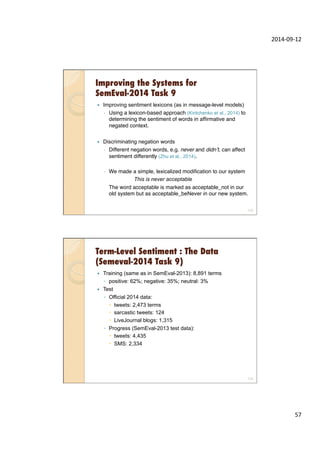
—  Improving sentiment lexicons (as in message-level models)
◦  Using a lexicon-based approach (Kiritchenko et al., 2014) to
determining the sentiment of words in affirmative and
negated context."
—  Discriminating negation words
◦  Different negation words, e.g. never and didn’t, can affect
sentiment differently (Zhu et al., 2014)."
◦  We made a simple, lexicalized modification to our system"
This is never acceptable
"The word acceptable is marked as acceptable_not in our
old system but as acceptable_beNever in our new system."
Term-Level Sentiment : The Data
(Semeval-2014 Task 9)
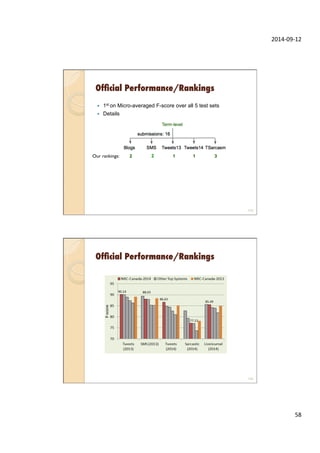
—  Training (same as in SemEval-2013): 8,891 terms
◦  positive: 62%; negative: 35%; neutral: 3%
—  Test
◦  Official 2014 data:
–  tweets: 2,473 terms
–  sarcastic tweets: 124
–  LiveJournal blogs: 1,315
◦  Progress (SemEval-2013 test data):
–  tweets: 4,435
–  SMS: 2,334
114
2014-­‐09-­‐12	
  
58	
  
Official Performance/Rankings
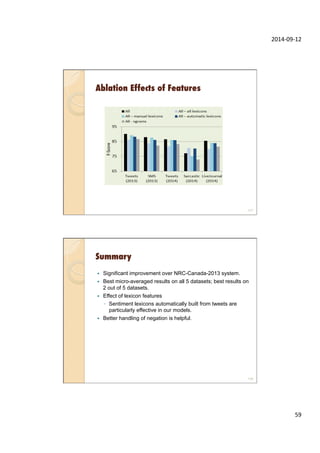
—  1st on Micro-averaged F-score over all 5 test sets
—  Details
115
Our rankings:
Official Performance/Rankings
116
2014-­‐09-­‐12	
  
59	
  
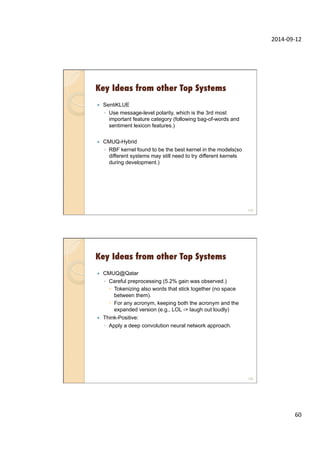
Ablation Effects of Features
117
Summary
—  Significant improvement over NRC-Canada-2013 system.
—  Best micro-averaged results on all 5 datasets; best results on
2 out of 5 datasets.
—  Effect of lexicon features
◦  Sentiment lexicons automatically built from tweets are
particularly effective in our models.!
—  Better handling of negation is helpful.
118
2014-­‐09-­‐12	
  
60	
  
Key Ideas from other Top Systems
—  SentiKLUE
◦  Use message-level polarity, which is the 3rd most
important feature category (following bag-of-words and
sentiment lexicon features.)
—  CMUQ-Hybrid
◦  RBF kernel found to be the best kernel in the models(so
different systems may still need to try different kernels
during development.)
119
Key Ideas from other Top Systems
—  CMUQ@Qatar
◦  Careful preprocessing (5.2% gain was observed.)
–  Tokenizing also words that stick together (no space
between them).
–  For any acronym, keeping both the acronym and the
expanded version (e.g., LOL -> laugh out loudly)
—  Think-Positive:
◦  Apply a deep convolution neural network approach.
120
2014-­‐09-­‐12	
  
61	
  
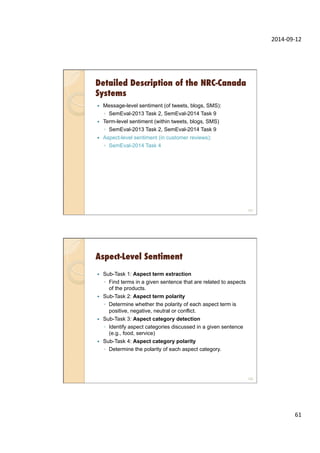
Detailed Description of the NRC-Canada
Systems
—  Message-level sentiment (of tweets, blogs, SMS):
◦  SemEval-2013 Task 2, SemEval-2014 Task 9
—  Term-level sentiment (within tweets, blogs, SMS)
◦  SemEval-2013 Task 2, SemEval-2014 Task 9
—  Aspect-level sentiment (in customer reviews):
◦  SemEval-2014 Task 4
121
Aspect-Level Sentiment
—  Sub-Task 1: Aspect term extraction
◦  Find terms in a given sentence that are related to aspects
of the products.
—  Sub-Task 2: Aspect term polarity
◦  Determine whether the polarity of each aspect term is
positive, negative, neutral or conflict.
—  Sub-Task 3: Aspect category detection
◦  Identify aspect categories discussed in a given sentence
(e.g., food, service)
—  Sub-Task 4: Aspect category polarity
◦  Determine the polarity of each aspect category.
122
2014-­‐09-­‐12	
  
62	
  
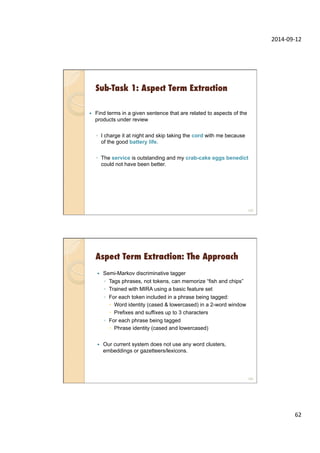
Sub-Task 1: Aspect Term Extraction
—  Find terms in a given sentence that are related to aspects of the
products under review
◦  I charge it at night and skip taking the cord with me because
of the good battery life.
◦  The service is outstanding and my crab-cake eggs benedict
could not have been better.
123
Aspect Term Extraction: The Approach
—  Semi-Markov discriminative tagger
◦  Tags phrases, not tokens, can memorize “fish and chips”
◦  Trained with MIRA using a basic feature set
◦  For each token included in a phrase being tagged:
–  Word identity (cased & lowercased) in a 2-word window
–  Prefixes and suffixes up to 3 characters
◦  For each phrase being tagged
–  Phrase identity (cased and lowercased)
—  Our current system does not use any word clusters,
embeddings or gazetteers/lexicons.
124
2014-­‐09-­‐12	
  
63	
  
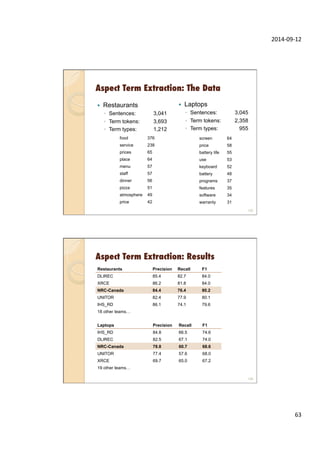
Aspect Term Extraction: The Data
—  Restaurants
◦  Sentences: 3,041
◦  Term tokens: 3,693
◦  Term types: 1,212
—  Laptops
◦  Sentences: 3,045
◦  Term tokens: 2,358
◦  Term types: 0,955
125
food 376
service 238
prices 65
place 64
menu 57
staff 57
dinner 56
pizza 51
atmosphere 49
price 42
screen 64
price 58
battery life 55
use 53
keyboard 52
battery 48
programs 37
features 35
software 34
warranty 31
Aspect Term Extraction: Results
126
Restaurants Precision Recall F1
DLIREC 85.4 82.7 84.0
XRCE 86.2 81.8 84.0
NRC-Canada 84.4 76.4 80.2
UNITOR 82.4 77.9 80.1
IHS_RD 86.1 74.1 79.6
18 other teams…
Laptops Precision Recall F1
IHS_RD 84.8 66.5 74.6
DLIREC 82.5 67.1 74.0
NRC-Canada 78.8 60.7 68.6
UNITOR 77.4 57.6 68.0
XRCE 69.7 65.0 67.2
19 other teams…
2014-­‐09-­‐12	
  
64	
  
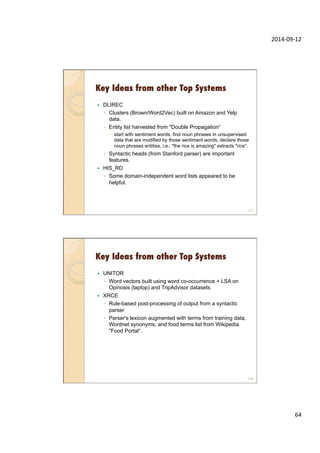
Key Ideas from other Top Systems
127
—  DLIREC
◦  Clusters (Brown/Word2Vec) built on Amazon and Yelp
data.
◦  Entity list harvested from "Double Propagation“
–  start with sentiment words, find noun phrases in unsupervised
data that are modified by those sentiment words, declare those
noun phrases entities, i.e.: "the rice is amazing" extracts "rice“.
◦  Syntactic heads (from Stanford parser) are important
features.
—  HIS_RD
◦  Some domain-independent word lists appeared to be
helpful.
Key Ideas from other Top Systems
128
—  UNITOR
◦  Word vectors built using word co-occurrence + LSA on
Opinosis (laptop) and TripAdvisor datasets
—  XRCE
◦  Rule-based post-processing of output from a syntactic
parser
◦  Parser's lexicon augmented with terms from training data,
Wordnet synonyms, and food terms list from Wikipedia
"Food Portal“.
2014-­‐09-­‐12	
  
65	
  
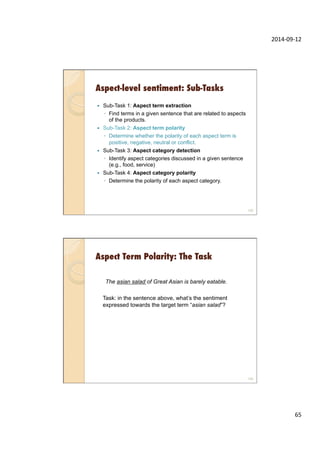
Aspect-level sentiment: Sub-Tasks
—  Sub-Task 1: Aspect term extraction
◦  Find terms in a given sentence that are related to aspects
of the products.
—  Sub-Task 2: Aspect term polarity
◦  Determine whether the polarity of each aspect term is
positive, negative, neutral or conflict.
—  Sub-Task 3: Aspect category detection
◦  Identify aspect categories discussed in a given sentence
(e.g., food, service)
—  Sub-Task 4: Aspect category polarity
◦  Determine the polarity of each aspect category.
129
Aspect Term Polarity: The Task
130
The asian salad of Great Asian is barely eatable.
Task: in the sentence above, what’s the sentiment
expressed towards the target term “asian salad”?
2014-­‐09-­‐12	
  
66	
  
Aspect Term Polarity: The Task
131
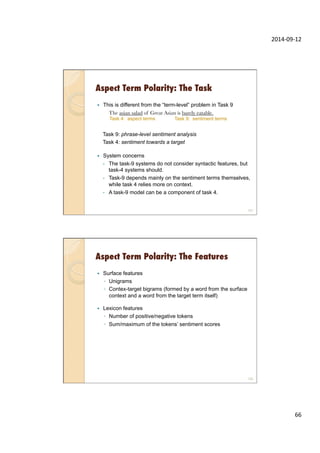
—  This is different from the “term-level” problem in Task 9
The asian salad of Great Asian is barely eatable.

Task 9: phrase-level sentiment analysis
Task 4: sentiment towards a target
—  System concerns
-  The task-9 systems do not consider syntactic features, but
task-4 systems should.
-  Task-9 depends mainly on the sentiment terms themselves,
while task 4 relies more on context.
-  A task-9 model can be a component of task 4.
Task 9: sentiment termsTask 4: aspect terms
Aspect Term Polarity: The Features
132
—  Surface features
◦  Unigrams
◦  Contex-target bigrams (formed by a word from the surface
context and a word from the target term itself)
—  Lexicon features
◦  Number of positive/negative tokens
◦  Sum/maximum of the tokens’ sentiment scores
2014-­‐09-­‐12	
  
67	
  
Aspect Term Polarity: The Features
133
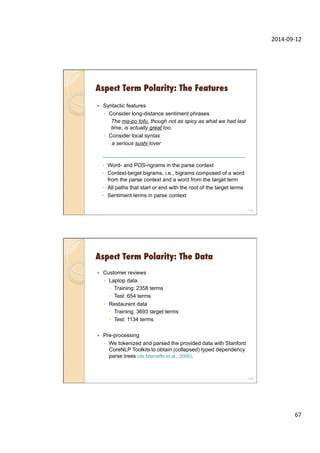
—  Syntactic features
◦  Consider long-distance sentiment phrases
The ma-po tofu, though not as spicy as what we had last
time, is actually great too.
◦  Consider local syntax
a serious sushi lover
◦  Word- and POS-ngrams in the parse context
◦  Context-target bigrams, i.e., bigrams composed of a word
from the parse context and a word from the target term
◦  All paths that start or end with the root of the target terms
◦  Sentiment terms in parse context
Aspect Term Polarity: The Data
—  Customer reviews
◦  Laptop data
–  Training: 2358 terms
–  Test: 654 terms
◦  Restaurant data
–  Training: 3693 target terms
–  Test: 1134 terms
—  Pre-processing
◦  We tokenized and parsed the provided data with Stanford
CoreNLP Toolkits to obtain (collapsed) typed dependency
parse trees (de Marneffe et al., 2006).
134
2014-­‐09-­‐12	
  
68	
  
Aspect Term Polarity: Set-Up
—  Classifier
◦  Libsvm with the linear kernel
—  Evaluation metric
◦  Accuracy
135
Aspect Term Polarity: Results
136
—  Laptop reviews
◦  Accuracy: 70.49
◦  1st among 32 submissions from 29 teams
—  Restaurant reviews
◦  Accuracy: 80.16
◦  2nd among 36 submissions from 29 teams
2014-­‐09-­‐12	
  
69	
  
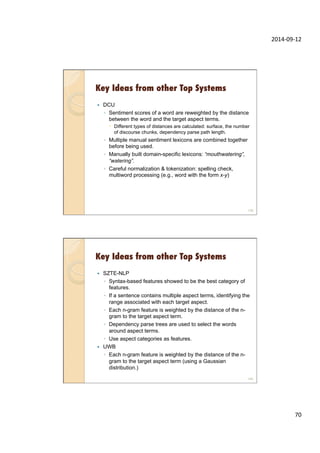
Aspect Term Polarity: Contributions of
Features
137
Aspect Term Polarity: Summary
—  Our systems achieve an accuracy of 70.49 on the laptop
reviews and 80.16 on the restaurant data, ranking 1st and 2nd,
respectively.
—  The sentiment lexicon and parse features are critical to help
us achieve the performance.
—  Carefully designed features are also important: distance-
weighted features, normalization & tokenization, etc.
138
2014-­‐09-­‐12	
  
70	
  
Key Ideas from other Top Systems
—  DCU
◦  Sentiment scores of a word are reweighted by the distance
between the word and the target aspect terms.
–  Different types of distances are calculated: surface, the number
of discourse chunks, dependency parse path length.
◦  Multiple manual sentiment lexicons are combined together
before being used.
◦  Manually built domain-specific lexicons: “mouthwatering”,
“watering”.
◦  Careful normalization & tokenization: spelling check,
multiword processing (e.g., word with the form x-y)
139
Key Ideas from other Top Systems
—  SZTE-NLP
◦  Syntax-based features showed to be the best category of
features.
◦  If a sentence contains multiple aspect terms, identifying the
range associated with each target aspect.
◦  Each n-gram feature is weighted by the distance of the n-
gram to the target aspect term.
◦  Dependency parse trees are used to select the words
around aspect terms.
◦  Use aspect categories as features.
—  UWB
◦  Each n-gram feature is weighted by the distance of the n-
gram to the target aspect term (using a Gaussian
distribution.)
140
2014-­‐09-­‐12	
  
71	
  
Key Ideas from other Top Systems
—  XRCE
◦  The entire system is built around sentiment-oriented
dependency parser
–  Parse trees were annotated with sentiment information.
◦  Rules are used to link sentiment on terms based on the
parse.
◦  Hybridizing rule based parse with machine learning.
—  Ubham
◦  Detect sentiment of text using lexicon-based methods, then
assign that to different clauses using dependency parse
trees.
141
Aspect-level sentiment: Sub-Tasks
—  Sub-Task 1: Aspect term extraction
◦  Find terms in a given sentence that are related to aspects
of the products.
—  Sub-Task 2: Aspect term polarity
◦  Determine whether the polarity of each aspect term is
positive, negative, neutral or conflict.
—  Sub-Task 3: Aspect category detection
◦  Identify aspect categories discussed in a given sentence
(e.g., food, service)
—  Sub-Task 4: Aspect category polarity
◦  Determine the polarity of each aspect category.
142
2014-­‐09-­‐12	
  
72	
  
Aspect Category Detection: The Task
—  Identify aspect categories discussed in a given sentence
extracted from a restaurant review
To be completely fair, the only redeeming factor was the food, which was above
average, but couldn't make up for all the other deficiencies of Teodora.
Aspect categories: food, miscellaneous
—  A second stage will assign sentiment to each of these categories
143
Aspect Category Detection: The Approach
—  Pre-processing
◦  Tokenization (CMU Twitter NLP tool)
◦  Stemming (Porter stemmer)
—  Classifier
◦  SVM with linear kernel (Colin’s implementation)
◦  Five binary classifiers (one-vs-all), one for each aspect
category
—  Evaluation
◦  Micro-averaged F1-score
144
2014-­‐09-­‐12	
  
73	
  
Aspect Category Detection: The Approach
145
—  Features
◦  Ngrams
◦  Stemmed ngrams
◦  Character ngrams
◦  Word cluster ngrams
◦  Yelp Restaurant Word – Aspect Association Lexicon features
—  Post-processing
◦  If no category is assigned,
–  cmax = argmaxc P(c|d)
–  assign cmax if P(cmax|d) ≥ 0.4
Aspect Category Detection: The Data
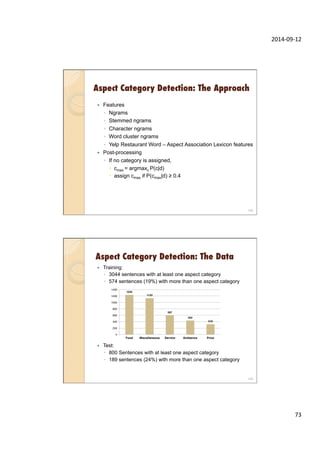
—  Training:
◦  3044 sentences with at least one aspect category
◦  574 sentences (19%) with more than one aspect category
—  Test:
◦  800 Sentences with at least one aspect category
◦  189 sentences (24%) with more than one aspect category
146
1233!
1133!
597!
432!
319!
0"
200"
400"
600"
800"
1000"
1200"
1400"
Food! Miscellaneous! Service! Ambience! Price!
2014-­‐09-­‐12	
  
74	
  
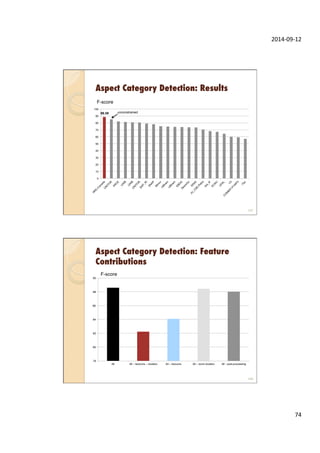
Aspect Category Detection: Results
147
F-score
0
10
20
30
40
50
60
70
80
90
100
88.58! unconstrained"
Aspect Category Detection: Feature
Contributions
148
F-score
78"
80"
82"
84"
86"
88"
90"
All" All – lexicons – clusters" All – lexicons" All – word clusters" All - post-processing"
2014-­‐09-­‐12	
  
75	
  
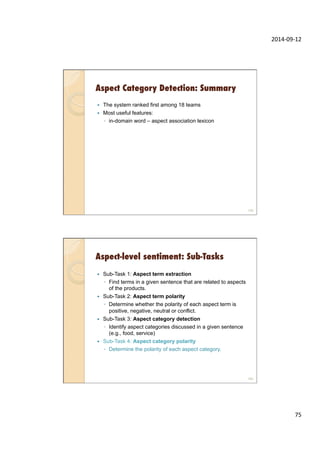
Aspect Category Detection: Summary
—  The system ranked first among 18 teams
—  Most useful features:
◦  in-domain word – aspect association lexicon
149
Aspect-level sentiment: Sub-Tasks
—  Sub-Task 1: Aspect term extraction
◦  Find terms in a given sentence that are related to aspects
of the products.
—  Sub-Task 2: Aspect term polarity
◦  Determine whether the polarity of each aspect term is
positive, negative, neutral or conflict.
—  Sub-Task 3: Aspect category detection
◦  Identify aspect categories discussed in a given sentence
(e.g., food, service)
—  Sub-Task 4: Aspect category polarity
◦  Determine the polarity of each aspect category.
150
2014-­‐09-­‐12	
  
76	
  
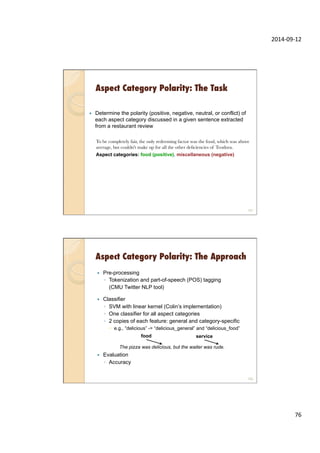
Aspect Category Polarity: The Task
—  Determine the polarity (positive, negative, neutral, or conflict) of
each aspect category discussed in a given sentence extracted
from a restaurant review
To be completely fair, the only redeeming factor was the food, which was above
average, but couldn't make up for all the other deficiencies of Teodora.
Aspect categories: food (positive), miscellaneous (negative)
151
Aspect Category Polarity: The Approach
—  Pre-processing
◦  Tokenization and part-of-speech (POS) tagging
(CMU Twitter NLP tool)
—  Classifier
◦  SVM with linear kernel (Colin’s implementation)
◦  One classifier for all aspect categories
◦  2 copies of each feature: general and category-specific
–  e.g., “delicious” -> “delicious_general” and “delicious_food”
—  Evaluation
◦  Accuracy
152
The pizza was delicious, but the waiter was rude.
food service
2014-­‐09-­‐12	
  
77	
  
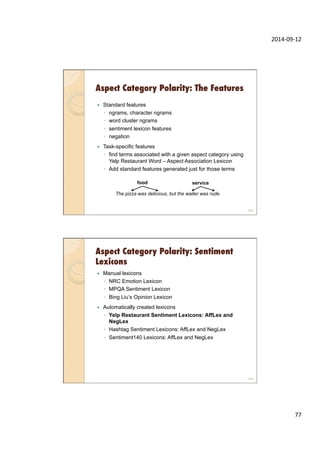
Aspect Category Polarity: The Features
153
—  Standard features
◦  ngrams, character ngrams
◦  word cluster ngrams
◦  sentiment lexicon features
◦  negation
—  Task-specific features
◦  find terms associated with a given aspect category using
Yelp Restaurant Word – Aspect Association Lexicon
◦  Add standard features generated just for those terms
The pizza was delicious, but the waiter was rude.
food service
Aspect Category Polarity: Sentiment
Lexicons
—  Manual lexicons
◦  NRC Emotion Lexicon
◦  MPQA Sentiment Lexicon
◦  Bing Liu’s Opinion Lexicon
—  Automatically created lexicons
◦  Yelp Restaurant Sentiment Lexicons: AffLex and
NegLex
◦  Hashtag Sentiment Lexicons: AffLex and NegLex
◦  Sentiment140 Lexicons: AffLex and NegLex
154
2014-­‐09-­‐12	
  
78	
  
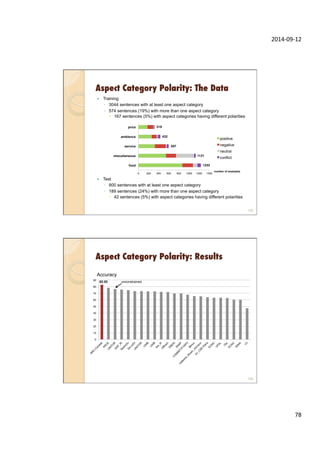
Aspect Category Polarity: The Data
—  Training
◦  3044 sentences with at least one aspect category
◦  574 sentences (19%) with more than one aspect category
–  167 sentences (5%) with aspect categories having different polarities
—  Test
◦  800 sentences with at least one aspect category
◦  189 sentences (24%) with more than one aspect category
–  42 sentences (5%) with aspect categories having different polarities
155
0 200 400 600 800 1000 1200 1400
food
miscellaneous
service
ambience
price
positive
negative
neutral
conflict
319!
432!
597!
1131!
1233!
number of examples!
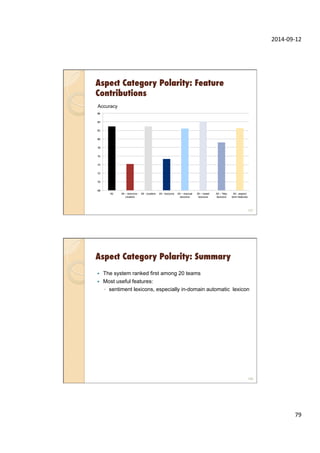
Aspect Category Polarity: Results
156
Accuracy
0
10
20
30
40
50
60
70
80
90
82.93! unconstrained"
2014-­‐09-­‐12	
  
79	
  
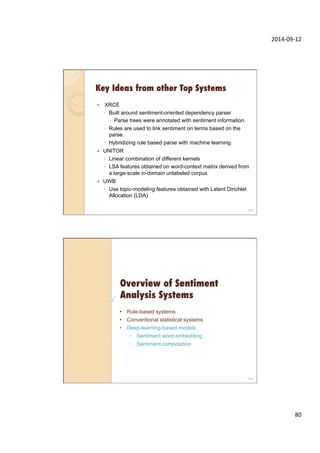
Aspect Category Polarity: Feature
Contributions
157
Accuracy
68
70
72
74
76
78
80
82
84
86
All All – lexicons -
clusters
All - clusters All - lexicons All – manual
lexicons
All – tweet
lexicons
All – Yelp
lexicons
All - aspect
term features
Aspect Category Polarity: Summary
—  The system ranked first among 20 teams
—  Most useful features:
◦  sentiment lexicons, especially in-domain automatic lexicon
158
2014-­‐09-­‐12	
  
80	
  
Key Ideas from other Top Systems
—  XRCE
◦  Built around sentiment-oriented dependency parser
–  Parse trees were annotated with sentiment information.
◦  Rules are used to link sentiment on terms based on the
parse.
◦  Hybridizing rule based parse with machine learning.
—  UNITOR
◦  Linear combination of different kernels
◦  LSA features obtained on word-context matrix derived from
a large-scale in-domain unlabeled corpus
—  UWB
◦  Use topic-modeling features obtained with Latent Dirichlet
Allocation (LDA)
159
Overview of Sentiment
Analysis Systems
160
•  Rule-based systems
•  Conventional statistical systems
•  Deep-learning-based models
◦  Sentiment word embedding
◦  Sentiment composition
2014-­‐09-­‐12	
  
81	
  
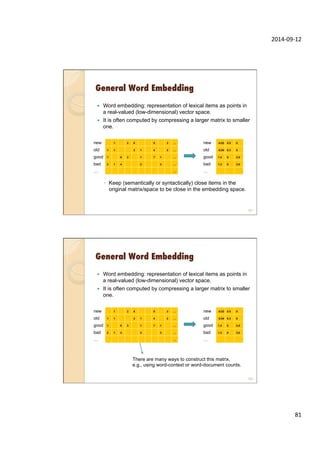
General Word Embedding
—  Word embedding: representation of lexical items as points in
a real-valued (low-dimensional) vector space.
—  It is often computed by compressing a larger matrix to smaller
one.
◦  Keep (semantically or syntactically) close items in the
original matrix/space to be close in the embedding space.
161
new 1 2 6 9 3 …
old 1 1 2 1 4 2 …
good 1 6 3 1 7 1 …
bad 2 1 4 2 3 …
… …
new -0.03 0.5 0
old -0.04 0.3 0
good 1.4 0 2.5
bad 1.3 0 3.6
…
General Word Embedding
—  Word embedding: representation of lexical items as points in
a real-valued (low-dimensional) vector space.
—  It is often computed by compressing a larger matrix to smaller
one.
162
new 1 2 6 9 3 …
old 1 1 2 1 4 2 …
good 1 6 3 1 7 1 …
bad 2 1 4 2 3 …
… …
new -0.03 0.5 0
old -0.04 0.3 0
good 1.4 0 2.5
bad 1.3 0 3.6
…
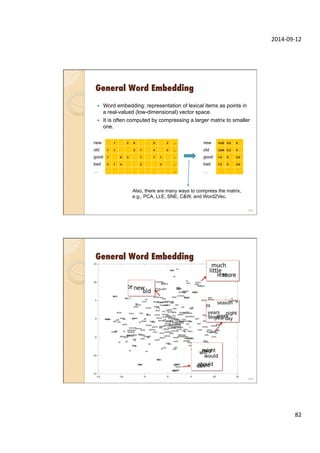
There are many ways to construct this matrix,
e.g., using word-context or word-document counts.
2014-­‐09-­‐12	
  
82	
  
General Word Embedding
—  Word embedding: representation of lexical items as points in
a real-valued (low-dimensional) vector space.
—  It is often computed by compressing a larger matrix to smaller
one.
163
new 1 2 6 9 3 …
old 1 1 2 1 4 2 …
good 1 6 3 1 7 1 …
bad 2 1 4 2 3 …
… …
new -0.03 0.5 0
old -0.04 0.3 0
good 1.4 0 2.5
bad 1.3 0 3.6
…
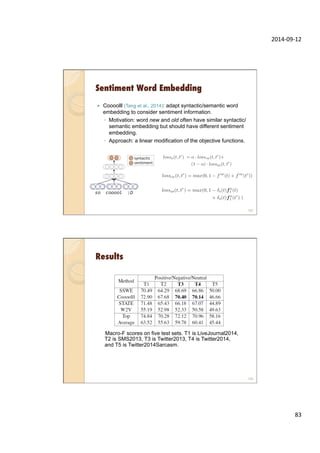
Also, there are many ways to compress the matrix,
e.g., PCA, LLE, SNE, C&W, and Word2Vec.
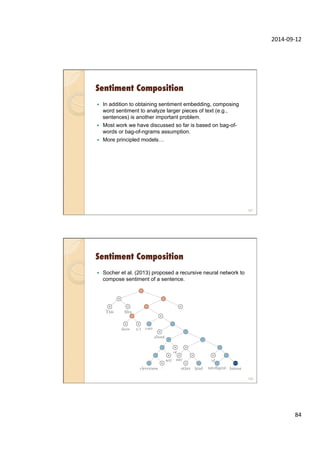
General Word Embedding
164
2014-­‐09-­‐12	
  
83	
  
Sentiment Word Embedding
—  Coooolll (Tang et al., 2014): adapt syntactic/semantic word
embedding to consider sentiment information.
◦  Motivation: word new and old often have similar syntactic/
semantic embedding but should have different sentiment
embedding.
◦  Approach: a linear modification of the objective functions.
165
Results
166
Macro-F scores on five test sets. T1 is LiveJournal2014,
T2 is SMS2013, T3 is Twitter2013, T4 is Twitter2014,
and T5 is Twitter2014Sarcasm.
2014-­‐09-­‐12	
  
84	
  
Sentiment Composition
—  In addition to obtaining sentiment embedding, composing
word sentiment to analyze larger pieces of text (e.g.,
sentences) is another important problem.
—  Most work we have discussed so far is based on bag-of-
words or bag-of-ngrams assumption.
—  More principled models…
167
Sentiment Composition
—  Socher et al. (2013) proposed a recursive neural network to
compose sentiment of a sentence.
168
2014-­‐09-­‐12	
  
85	
  
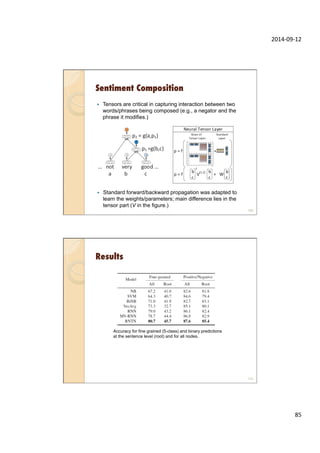
Sentiment Composition
—  Tensors are critical in capturing interaction between two
words/phrases being composed (e.g., a negator and the
phrase it modifies.)
169
—  Standard forward/backward propagation was adapted to
learn the weights/parameters; main difference lies in the
tensor part (V in the figure.)
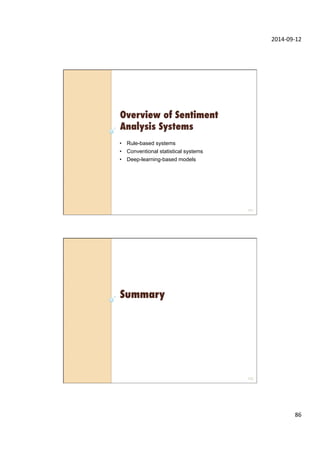
Results
170
Accuracy for fine grained (5-class) and binary predictions
at the sentence level (root) and for all nodes.
2014-­‐09-­‐12	
  
86	
  
Overview of Sentiment
Analysis Systems
171
•  Rule-based systems
•  Conventional statistical systems
•  Deep-learning-based models
Summary
172
2014-­‐09-­‐12	
  
87	
  
Summary
—  Sentiment analysis subsumes several different problems
◦  Important to be aware of the problem pertinent to your task,
and the annotation instructions used to create the data
—  Sentiment analysis relevant to many domains
◦  Not just customer reviews
—  Several shared tasks exist
◦  Source of data and benchmarks
—  Statistical machine learning methods quite popular
—  Term-sentiment associations are a key source of information
◦  Can obtain this from training data (ngrams)
◦  More can be obtained from quasi-annotations, such as
from emoticons and hashtags
173
Summary (continued)
—  Other significant features include those from:
◦  handling negation
◦  handling semantic composition
—  Building a competition system involves:
◦  careful evaluation of usefulness of features
◦  trying various parameters pertaining to both the learning
algorithm and the features
◦  keep features that obtain improvements consistently on
many datasets
◦  more labeled data trumps smarter algorithms
174
2014-­‐09-­‐12	
  
88	
  
Future Directions
—  Semantic roles of sentiment
—  Sentiment embedding and composition
—  Sarcasm, irony, and metaphor
—  Sentiment analysis in non-English languages
—  Detecting stance, framing, and spin
—  Detecting trends and significant changes in sentiment
distributions
175
Future Directions (continued)
—  Detecting intensity of sentiment
—  Developing better sentiment models for negation, intensifiers,
and modality
—  Developing better emotion models
—  Developing applications for public health, business, social
welfare, and for literary and social scientists
176
2014-­‐09-­‐12	
  
89	
  
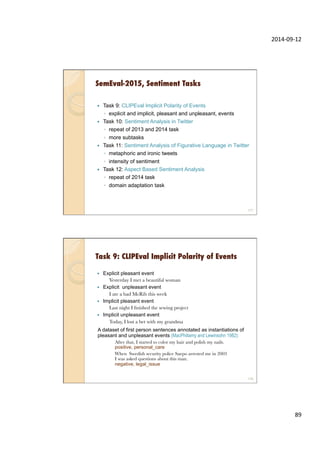
SemEval-2015, Sentiment Tasks
—  Task 9: CLIPEval Implicit Polarity of Events
◦  explicit and implicit, pleasant and unpleasant, events
—  Task 10: Sentiment Analysis in Twitter
◦  repeat of 2013 and 2014 task
◦  more subtasks
—  Task 11: Sentiment Analysis of Figurative Language in Twitter
◦  metaphoric and ironic tweets
◦  intensity of sentiment
—  Task 12: Aspect Based Sentiment Analysis
◦  repeat of 2014 task
◦  domain adaptation task
177
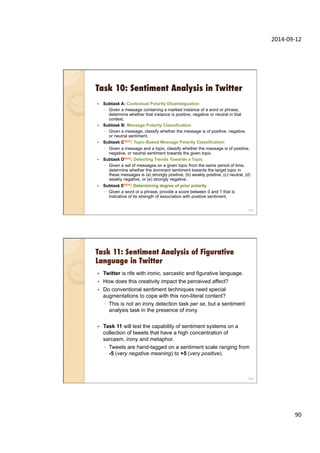
Task 9: CLIPEval Implicit Polarity of Events
—  Explicit pleasant event
Yesterday I met a beautiful woman
—  Explicit unpleasant event
I ate a bad McRib this week
—  Implicit pleasant event
Last night I finished the sewing project
—  Implicit unpleasant event
Today, I lost a bet with my grandma

A dataset of first person sentences annotated as instantiations of
pleasant and unpleasant events (MacPhillamy and Lewinsohn 1982):

After that, I started to color my hair and polish my nails.
positive, personal_care

When Swedish security police Saepo arrested me in 2003

I was asked questions about this man.
negative, legal_issue
178
2014-­‐09-­‐12	
  
90	
  
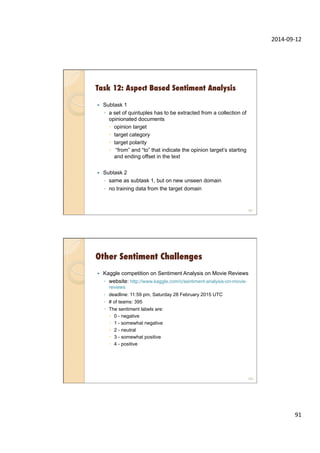
Task 10: Sentiment Analysis in Twitter
—  Subtask A: Contextual Polarity Disambiguation
◦  Given a message containing a marked instance of a word or phrase,
determine whether that instance is positive, negative or neutral in that
context.
—  Subtask B: Message Polarity Classification
◦  Given a message, classify whether the message is of positive, negative,
or neutral sentiment.
—  Subtask CNEW: Topic-Based Message Polarity Classification
◦  Given a message and a topic, classify whether the message is of positive,
negative, or neutral sentiment towards the given topic.
—  Subtask DNEW: Detecting Trends Towards a Topic
◦  Given a set of messages on a given topic from the same period of time,
determine whether the dominant sentiment towards the target topic in
these messages is (a) strongly positive, (b) weakly positive, (c) neutral, (d)
weakly negative, or (e) strongly negative.
—  Subtask ENEW: Determining degree of prior polarity
◦  Given a word or a phrase, provide a score between 0 and 1 that is
indicative of its strength of association with positive sentiment.
179
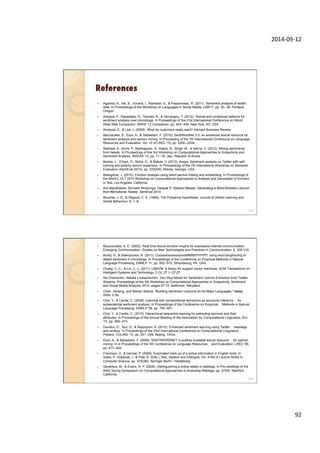
Task 11: Sentiment Analysis of Figurative
Language in Twitter
—  Twitter is rife with ironic, sarcastic and figurative language.
—  How does this creativity impact the perceived affect?
—  Do conventional sentiment techniques need special
augmentations to cope with this non-literal content?
◦  This is not an irony detection task per se, but a sentiment
analysis task in the presence of irony.
—  Task 11 will test the capability of sentiment systems on a
collection of tweets that have a high concentration of
sarcasm, irony and metaphor.
◦  Tweets are hand-tagged on a sentiment scale ranging from
-5 (very negative meaning) to +5 (very positive).
180
2014-­‐09-­‐12	
  
91	
  
Task 12: Aspect Based Sentiment Analysis
—  Subtask 1
◦  a set of quintuples has to be extracted from a collection of
opinionated documents
–  opinion target
–  target category
–  target polarity
–  “from” and “to” that indicate the opinion target’s starting
and ending offset in the text
—  Subtask 2
◦  same as subtask 1, but on new unseen domain
◦  no training data from the target domain
181
Other Sentiment Challenges
—  Kaggle competition on Sentiment Analysis on Movie Reviews
◦  website: http://www.kaggle.com/c/sentiment-analysis-on-movie-
reviews
◦  deadline: 11:59 pm, Saturday 28 February 2015 UTC
◦  # of teams: 395
◦  The sentiment labels are:
–  0 - negative
–  1 - somewhat negative
–  2 - neutral
–  3 - somewhat positive
–  4 - positive
182
2014-­‐09-­‐12	
  
92	
  
References
—  Agarwal, A., Xie, B., Vovsha, I., Rambow, O., & Passonneau, R. (2011). Sentiment analysis of twitter
data. In Proceedings of the Workshop on Languages in Social Media, LSM'11, pp. 30--38, Portland,
Oregon.
—  Aisopos, F., Papadakis, G., Tserpes, K., & Varvarigou, T. (2012). Textual and contextual patterns for
sentiment analysis over microblogs. In Proceedings of the 21st International Conference on World
Wide Web Companion, WWW '12 Companion, pp. 453--454, New York, NY, USA.
—  Almquist, E., & Lee, J. (2009). What do customers really want? Harvard Business Review.
—  Baccianella, S., Esuli, A., & Sebastiani, F. (2010). SentiWordNet 3.0: an enhanced lexical resource for
sentiment analysis and opinion mining. In Proceeding of the 7th International Conference on Language
Resources and Evaluation, Vol. 10 of LREC '10, pp. 2200--2204.
—  Bakliwal, A., Arora, P., Madhappan, S., Kapre, N., Singh, M., & Varma, V. (2012). Mining sentiments
from tweets. In Proceedings of the 3rd Workshop on Computational Approaches to Subjectivity and
Sentiment Analysis, WASSA '12, pp. 11--18, Jeju, Republic of Korea.
—  Becker, L., Erhart, G., Skiba, D., & Matula, V. (2013). Avaya: Sentiment analysis on Twitter with self-
training and polarity lexicon expansion. In Proceedings of the 7th International Workshop on Semantic
Evaluation (SemEval 2013), pp. 333{340, Atlanta, Georgia, USA.
—  Bellegarda, J. (2010). Emotion analysis using latent aective folding and embedding. In Proceedings of
the NAACL-HLT 2010 Workshop on Computational Approaches to Analysis and Generation of Emotion
in Text, Los Angeles, California.
—  Anil Bandhakavi; Nirmalie Wiratunga; Deepak P; Stewart Massie. Generating a Word-Emotion Lexicon
from #Emotional Tweets. SemEval-2014.
—  Boucher, J. D., & Osgood, C. E. (1969). The Pollyanna Hypothesis. Journal of Verbal Learning and
Verbal Behaviour, 8, 1--8.
183
—  Boucouvalas, A. C. (2002). Real time text-to-emotion engine for expressive internet communication.
Emerging Communication: Studies on New Technologies and Practices in Communication, 5, 305-318.
—  Brody, S., & Diakopoulos, N. (2011). Cooooooooooooooollllllllllllll!!!!!!!!!!!!!!: using word lengthening to
detect sentiment in microblogs. In Proceedings of the Conference on Empirical Methods in Natural
Language Processing, EMNLP '11, pp. 562--570, Stroudsburg, PA, USA.
—  Chang, C.-C., & Lin, C.-J. (2011). LIBSVM: A library for support vector machines. ACM Transactions on
Intelligent Systems and Technology, 2 (3), 27:1--27:27.
—  Ilia Chetviorkin, Natalia Loukachevitch. Two-Step Model for Sentiment Lexicon Extraction from Twitter
Streams. Proceedings of the 5th Workshop on Computational Approaches to Subjectivity, Sentiment
and Social Media Analysis, 2014, pages 67-72, Baltimore, Maryland.
—  Chen, Yanqing, and Steven Skiena. "Building Sentiment Lexicons for All Major Languages." Malay
2934: 0-39.
—  Choi, Y., & Cardie, C. (2008). Learning with compositional semantics as structural inference —for
subsentential sentiment analysis. In Proceedings of the Conference on Empirical —Methods in Natural
Language Processing, EMNLP '08, pp. 793--801.
—  Choi, Y., & Cardie, C. (2010). Hierarchical sequential learning for extracting opinions and their
attributes. In Proceedings of the Annual Meeting of the Association for Computational Linguistics, ACL
'10, pp. 269--274.
—  Davidov, D., Tsur, O., & Rappoport, A. (2010). Enhanced sentiment learning using Twitter —hashtags
and smileys. In Proceedings of the 23rd International Conference on Computational Linguistics:
Posters, COLING '10, pp. 241--249, Beijing, China.
—  Esuli, A., & Sebastiani, F. (2006). SENTIWORDNET: A publicly available lexical resource —for opinion
mining. In In Proceedings of the 5th Conference on Language Resources —and Evaluation, LREC '06,
pp. 417--422.
—  Francisco, V., & Gervas, P. (2006). Automated mark up of a ective information in English texts. In
Sojka, P., Kopecek, I., & Pala, K. (Eds.), Text, Speech and Dialogue, Vol. 4188 of Lecture Notes in
Computer Science, pp. 375{382. Springer Berlin / Heidelberg.
—  Genereux, M., & Evans, R. P. (2006). Distinguishing a ective states in weblogs. In Pro-ceedings of the
AAAI Spring Symposium on Computational Approaches to Analysing Weblogs, pp. 27{29, Stanford,
California.
184
2014-­‐09-­‐12	
  
93	
  
—  Gimpel, K., Schneider, N., O'Connor, B., Das, D., Mills, D., Eisenstein, J., Heilman, M., Yogatama, D.,
Flanigan, J., & Smith, N. A. (2011). Part-of-speech tagging for Twitter: Annotation, features, and
experiments. In Proceedings of the Annual Meeting of the Association for Computational Linguistics,
ACL '11.
—  Go, A., Bhayani, R., & Huang, L. (2009). Twitter sentiment classi cation using distant supervision. Tech.
rep., Stanford University.
—  Hanley, J., & McNeil, B. (1982). The meaning and use of the area under a Receiver Oper-ating
Characteristic (ROC) curve. Radiology, 143, 29-36.
—  Hatzivassiloglou, V., & McKeown, K. R. (1997). Predicting the semantic orientation of adjectives. In
Proceedings of the 8th Conference of European Chapter of the Association for Computational
Linguistics, EACL '97, pp. 174{181, Madrid, Spain.
—  Hu, M., & Liu, B. (2004). Mining and summarizing customer reviews. In Proceedings of the 10th ACM
SIGKDD International Conference on Knowledge Discovery and Data Mining, KDD '04, pp. 168-177,
New York, NY, USA. ACM.
—  Jia, L., Yu, C., & Meng, W. (2009). The e ect of negation on sentiment analysis and retrieval e
ectiveness. In Proceedings of the 18th ACM Conference on Information and Knowledge Management,
CIKM '09, pp. 1827-1830, New York, NY, USA. ACM.
—  Jiang, L., Yu, M., Zhou, M., Liu, X., & Zhao, T. (2011). Target-dependent Twitter senti-ment classi
cation. In Proceedings of the 49th Annual Meeting of the Association for Computational Linguistics,
ACL '11, pp. 151-160.
—  Johansson, R., & Moschitti, A. (2013). Relational features in ne-grained opinion analysis.
Computational Linguistics, 39 (3), 473-509.
—  John, D., Boucouvalas, A. C., & Xu, Z. (2006). Representing emotional momentum within expressive
internet communication. In Proceedings of the 24th International Conference on Internet and
Multimedia Systems and Applications, pp. 183-188, Anaheim, CA. ACTA Press.
—  Jurgens, D., Mohammad, S. M., Turney, P., & Holyoak, K. (2012). Semeval-2012 task 2: Measuring
degrees of relational similarity. In Proceedings of the 6th International Workshop on Semantic
Evaluation, SemEval '12, pp. 356{364, Montreal, Canada. Association for Computational Linguistics.
185
—  Kennedy, A., & Inkpen, D. (2005). Sentiment classi cation of movie and product reviews using
contextual valence shifters. In Proceedings of the Workshop on the Analysis of Informal and Formal
Information Exchange during Negotiations, Ottawa, Ontario, Canada.
—  Kennedy, A., & Inkpen, D. (2006). Sentiment classi cation of movie reviews using contextual valence
shifters. Computational Intelligence, 22 (2), 110-125.
—  Kiritchenko, S., Zhu, X., Cherry, C., & Mohammad, S. (2014). NRC-Canada-2014: Detecting aspects
and sentiment in customer reviews. In Proceedings of the International Workshop on Semantic
Evaluation, SemEval '14, Dublin, Ireland.
—  Kunneman, F. A., C. C. Liebrecht, and A. P. J. van den Bosch. The (Un) Predictability of Emotional
Hashtags in Twitter. 2014.
—  Svetlana Kiritchenko, Xiaodan Zhu and Saif Mohammad. Sentiment Analysis of Short Informal Texts.
Journal of Artificial Intelligence Research, volume 50, pages 723-762.
—  Kouloumpis, E., Wilson, T., & Moore, J. (2011). Twitter sentiment analysis: The Good the Bad and the
OMG!. In Proceedings of the 5th International AAAI Conference on Weblogs and Social Media.
—  Lapponi, E., Read, J., & Ovrelid, L. (2012). Representing and resolving negation for senti-ment
analysis. In Vreeken, J., Ling, C., Zaki, M. J., Siebes, A., Yu, J. X., Goethals, B., Webb, G. I., & Wu, X.
(Eds.), ICDM Workshops, pp. 687-692. IEEE Computer Society.
—  Li, J., Zhou, G., Wang, H., & Zhu, Q. (2010). Learning the scope of negation via shallow se-mantic
parsing. In Proceedings of the 23rd International Conference on Computational Linguistics, COLING
'10, pp. 671-679, Beijing, China.
—  Liu, B., & Zhang, L. (2012). A survey of opinion mining and sentiment analysis. In Aggarwal, C. C., &
Zhai, C. (Eds.), Mining Text Data, pp. 415-463. Springer US.
—  Liu, H., Lieberman, H., & Selker, T. (2003). A model of textual a ect sensing using real-world
knowledge. In Proceedings of the 8th International Conference on Intelligent User Interfaces, IUI '03,
pp. 125-132, New York, NY. ACM.
—  Louviere, J. J. (1991). Best-worst scaling: A model for the largest di erence judgments. Working Paper.
—  Raheleh Makki, Stephen Brooks and Evangelos E. Milios, Context-Specific Sentiment Lexicon
Expansion via Minimal User Interaction. 2014.
186
2014-­‐09-­‐12	
  
94	
  
—  Mart nez-Camara, E., Mart n-Valdivia, M. T., Ure~nalopez, L. A., & Montejoraez, A. R. (2012).
Sentiment analysis in Twitter. Natural Language Engineering, 1-28.
—  Mihalcea, R., & Liu, H. (2006). A corpus-based approach to nding happiness. In Pro-ceedings of the
AAAI Spring Symposium on Computational Approaches to Analysing Weblogs, pp. 139-144. AAAI
Press.
—  Mohammad, S. (2012). #emotional tweets. In Proceedings of the First Joint Conference on Lexical and
Computational Semantics, *SEM '12, pp. 246-255, Montreal, Canada. Association for Computational
Linguistics.
—  Mohammad, S., Dunne, C., & Dorr, B. (2009). Generating high-coverage semantic ori-entation lexicons
from overtly marked words and a thesaurus. In Proceedings of the Conference on Empirical Methods in
Natural Language Processing: Volume 2, EMNLP '09, pp. 599-608.
—  Mohammad, S. M., & Kiritchenko, S. (2014). Using hashtags to capture ne emotion categories from
tweets. To appear in Computational Intelligence.
—  Mohammad, S. M., Kiritchenko, S., & Martin, J. (2013). Identifying purpose behind elec-toral tweets. In
Proceedings of the 2nd International Workshop on Issues of Sentiment Discovery and Opinion Mining,
WISDOM '13, pp. 1-9.
—  Mohammad, S. M., & Turney, P. D. (2010). Emotions evoked by common words and phrases: Using
Mechanical Turk to create an emotion lexicon. In Proceedings of the NAACL-HLT Workshop on
Computational Approaches to Analysis and Generation of Emotion in Text, LA, California.
—  Mohammad, S. M., & Yang, T. W. (2011). Tracking sentiment in mail: How genders di er on emotional
axes. In Proceedings of the ACL Workshop on Computational Approaches to Subjectivity and
Sentiment Analysis, WASSA '11, Portland, OR, USA.
—  Neviarouskaya, A., Prendinger, H., & Ishizuka, M. (2011). A ect analysis model: novel rule-based
approach to a ect sensing from text. Natural Language Engineering, 17, 95-135.
—  Orme, B. (2009). Maxdi analysis: Simple counting, individual-level logit, and HB. Saw-tooth Software,
Inc.
—  Pak, A., & Paroubek, P. (2010). Twitter as a corpus for sentiment analysis and opinion mining. In
Proceedings of the 7th Conference on International Language Resources and Evaluation, LREC '10,
Valletta, Malta. European Language Resources Association (ELRA).
187
—  Pang, B., & Lee, L. (2005). Seeing stars: Exploiting class relationships for sentiment cate-gorization
with respect to rating scales. In Proceedings of the Annual Meeting of the Association for
Computational Linguistics, ACL '05, pp. 115-124.
—  Pang, B., & Lee, L. (2008). Opinion mining and sentiment analysis. Foundations and Trends in
Information Retrieval, 2 (1-2), 1-135.
—  Pang, B., Lee, L., & Vaithyanathan, S. (2002). Thumbs up?: Sentiment classi cation using machine
learning techniques. In Proceedings of the Conference on Empirical Methods in Natural Language
Processing, EMNLP '02, pp. 79-86, Philadelphia, PA.
—  Polanyi, L., & Zaenen, A. (2004). Contextual valence shifters. In Exploring Attitude and A ect in Text:
Theories and Applications (AAAI Spring Symposium Series).
—  Porter, M. (1980). An algorithm for su x stripping. Program, 3, 130-137.
—  Proisl, T., Greiner, P., Evert, S., & Kabashi, B. (2013). Klue: Simple and robust methods for polarity
classi cation. In Proceedings of the 7th International Workshop on Se-mantic Evaluation (SemEval
2013), pp. 395-401, Atlanta, Georgia, USA. Association for Computational Linguistics.
—  Reckman, H., Baird, C., Crawford, J., Crowell, R., Micciulla, L., Sethi, S., & Veress, F. (2013). teragram:
Rule-based detection of sentiment phrases using sas sentiment analysis. In Proceedings of the 7th
International Workshop on Semantic Evaluation (SemEval 2013), pp. 513-519, Atlanta, Georgia, USA.
Association for Computational Linguistics.
—  Hassan Saif, Miriam Fernandez, Yulan He, and Harith Alani (2014). SentiCircles for Contextual and
Conceptual Semantic Sentiment Analysis of Twitter. In Proceeding of the 11th Extended Semantic Web
Conference (ESWC), Crete, Greece.
—  Sauper, C., & Barzilay, R. (2013). Automatic aggregation by joint modeling of aspects and values.
Journal of Arti cial Intelligence Research, 46, 89-127.
—  Sheng Huang and Zhendong Niu and Chongyang Shi. Automatic construction of domain-specific
sentiment lexicon based on constrained label propagation. Knowledge-Based Systems, 2014, pp.
191-200.
—  Shi Feng, Kaisong Song, Daling Wang, Ge Yu. A word-emoticon mutual reinforcement ranking model
for building sentiment lexicon from massive collection of microblogs. World Wide Web. Pg 1-19. 2014.
188
2014-­‐09-­‐12	
  
95	
  
—  Socher, R., Huval, B., Manning, C. D., & Ng, A. Y. (2012). Semantic compositionality through recursive
matrix-vector spaces. In Proceedings of the Conference on Empirical Methods in Natural Language
Processing, EMNLP '12. Association for Computational Linguistics.
—  Socher, R., Perelygin, A., Wu, J. Y., Chuang, J., Manning, C. D., Ng, A. Y., & Potts, C. (2013).
Recursive deep models for semantic compositionality over a sentiment treebank. In Proceedings of the
Conference on Empirical Methods in Natural Language Processing, EMNLP '13. Association for
Computational Linguistics.
—  Stone, P., Dunphy, D. C., Smith, M. S., Ogilvie, D. M., & associates (1966). The General Inquirer: A
Computer Approach to Content Analysis. The MIT Press.
—  Taboada, M., Brooke, J., To loski, M., Voll, K., & Stede, M. (2011). Lexicon-based methods for
sentiment analysis. Computational Linguistics, 37 (2), 267-307.
—  Duyu Tang, Furu Wei, Bing Qin, Ming Zhou, Ting Liu. Building Large-Scale Twitter-Specific Sentiment
Lexicon : A Representation Learning Approach, COLING 2014.
—  Duyu Tang, Furu Wei, Nan Yang, Bing Qin, Ting Liu, Ming Zhou: Proceedings of the 8th International
Workshop on Semantic Evaluation (SemEval 2014), pages 208–212,
—  Dublin, Ireland, August 23-24, 2014.
—  Thelwall, M., Buckley, K., & Paltoglou, G. (2011). Sentiment in Twitter events. Journal of the American
Society for Information Science and Technology, 62 (2), 406-418.
—  Turney, P. (2001). Mining the web for synonyms: PMI-IR versus LSA on TOEFL. In Proceedings of the
Twelfth European Conference on Machine Learning, pp. 491-502, Freiburg, Germany.
—  Turney, P., & Littman, M. L. (2003). Measuring praise and criticism: Inference of semantic orientation
from association. ACM Transactions on Information Systems, 21 (4).
—  Wiegand, M., Balahur, A., Roth, B., Klakow, D., & Montoyo, A. (2010). A survey on the role of negation
in sentiment analysis. In Proceedings of the Workshop on Negation and Speculation in Natural
Language Processing, NeSp-NLP '10, pp. 60-68, Stroudsburg, PA, USA. Association for Computational
Linguistics.
—  Wilson, T., Kozareva, Z., Nakov, P., Rosenthal, S., Stoyanov, V., & Ritter, A. (2013). SemEval-2013
Task 2: Sentiment analysis in Twitter. In Proceedings of the Interna-tional Workshop on Semantic
Evaluation, SemEval '13, Atlanta, Georgia, USA.
189
—  Wilson, T., Wiebe, J., & Ho mann, P. (2005). Recognizing contextual polarity in phrase-level sentiment
analysis. In Proceedings of the Conference on Human Language Tech-nology and Empirical Methods
in Natural Language Processing, HLT '05, pp. 347-354, Stroudsburg, PA, USA. Association for
Computational Linguistics.
—  Yang, B., & Cardie, C. (2013). Joint inference for ne-grained opinion extraction. In Proceedings of the
Annual Meeting of the Association for Computational Linguistics, ACL '13.
—  Yeh, A. (2000). More accurate tests for the statistical signi cance of result di erences. In Proceedings of
the 18th conference on Computational linguistics - Volume 2, COLING '00, pp. 947-953, Stroudsburg,
PA, USA. Association for Computational Linguistics.
—  Xiaodan Zhu, Hongyu Guo, Saif Mohammad and Svetlana Kiritchenko. An Empirical Study on the
Effect of Negation Words on Sentiment. In Proceedings of the 52nd Annual Meeting of the Association
for Computational Linguistics, June 2014, Baltimore, MD.
SemEval Proceedings
—  SemEval-2013 proceedings are available here:
http://www.aclweb.org/anthology/siglex.html#2013_1
—  SemEval-2014 proceedings are available here:
http://alt.qcri.org/semeval2014/cdrom/
190

7 notes

  • 1.
    2014-­‐09-­‐12   1   SentimentAnalysis of Social Media Texts Saif M. Mohammad and Xiaodan Zhu National Research Council Canada Acknowledgment: Thanks to Svetlana Kiritchenko for helpful suggestions. A tutorial presented at the 2014 Conference on Empirical Methods on Natural Language Processing, October 2014, Doha, Qatar. INTRODUCTION 2
  • 2.
    2014-­‐09-­‐12   2   SentimentAnalysis —  Is a given piece of text positive, negative, or neutral?" ◦  The text may be a sentence, a tweet, an SMS message, a customer review, a document, and so on." " 3 Sentiment Analysis —  Is a given piece of text positive, negative, or neutral?" ◦  The text may be a sentence, a tweet, an SMS message, a customer review, a document, and so on." " —  What emotion is being expressed in a given piece of text?" ◦  Basic emotions: joy, sadness, fear, anger,…" ◦  Other emotions: guilt, pride, optimism, frustration,…" " Emotion Analysis 4
  • 3.
    2014-­‐09-­‐12   3   SentimentAnalysis —  Is a given piece of text positive, negative, or neutral?" ◦  The text may be a sentence, a tweet, an SMS message, a customer review, a document, and so on." " —  What emotion is being expressed in a given piece of text?" ◦  Basic emotions: joy, sadness, fear, anger,…" ◦  Other emotions: guilt, pride, optimism, frustration,…" " Emotion Analysis 5 Not in the scope of this tutorial. Sentiment Analysis: Tasks —  Is a given piece of text positive, negative, or neutral?" ◦  The text may be a sentence, a tweet, an SMS message, a customer review, a document, and so on." —  Is a word within a sentence positive, negative, or neutral? " ◦  unpredictable movie plot vs. unpredictable steering " —  What is the sentiment towards specific aspects of a product?" ◦  sentiment towards the food and sentiment towards the service in a customer review of a restaurant" —  What is the sentiment towards an entity such as a politician, government policy, company, or product?" ◦  Stance detection: favorable or unfavorable " ◦  Framing: focusing on specific dimensions" " 6
  • 4.
    2014-­‐09-­‐12   4   SentimentAnalysis: Tasks (continued) —  What is the sentiment of the speaker/writer?" ◦  Is the speaker explicitly expressing sentiment?" —  What sentiment is evoked in the listener/reader?" —  What is the sentiment of an entity mentioned in the text?" " Consider the above questions with the examples below:" General Tapioca was ruthlessly executed today. Mass-murdered General Tapioca finally killed in battle. General Tapioca was killed in an explosion. May God help the people being persecuted by General Tapioca. " 7 Sentiment Analysis: Domains —  Newspaper texts ◦  Financial news ◦  Entertainment news —  Legal texts —  Novels —  E-mails —  SMS messages —  Customer reviews —  Blog posts —  Tweets —  Facebook posts —  …and so on. 8
  • 5.
    2014-­‐09-­‐12   5   SentimentAnalysis: Domains —  Newspaper texts ◦  Financial news ◦  Entertainment news —  Legal texts —  Novels —  E-mails —  SMS messages —  Customer reviews —  Blog posts —  Tweets —  Facebook posts —  …and so on. 9 Short informal pieces of text – often called Social media texts. Quirks of Social Media Texts —  Informal —  Short ◦  140 characters for tweets and SMS messages —  Abbreviations and shortenings —  Wide array of topics and large vocabulary —  Spelling mistakes and creative spellings —  Special strings ◦  hashtags, emoticons, conjoined words —  High volume ◦  500 million tweets posted every day —  Often come with meta-information ◦  date, links, likes, location —  Often express sentiment 10
  • 6.
    2014-­‐09-­‐12   6   ExampleApplications of Sentiment Analysis and Emotion Detection —  Tracking sentiment towards politicians, movies, products" —  Improving customer relation models" —  Identifying what evokes strong emotions in people" —  Detecting happiness and well-being" —  Measuring the impact of activist movements through text generated in social media." —  Improving automatic dialogue systems" —  Improving automatic tutoring systems" —  Detecting how people use emotion-bearing-words and metaphors to persuade and coerce others" 11 Not in the Scope of this Tutorial —  Sentiment in formal writing such as news, academic publications, etc. —  Application-specific analysis ◦  for example, for predicting stocks, election results, public health, machine translation, etc. —  Sentiment analysis in resource-poor languages ◦  porting sentiment resources from one language to another —  Detecting sentiment of reader —  Stance detection —  Visualizations of sentiment —  Emotion analysis 12
  • 7.
    2014-­‐09-­‐12   7   SemEvalSentiment Tasks 13 •  SemEval-2013 Task 2 •  SemEval-2014 Task 9 •  SemEval-2014 Task 4 SemEval-2013, Task 2: Sentiment Analysis in Twitter —  Tasks ◦  Is a given message positive, negative, or neutral? ◦  Is a given term within a message positive, negative, or neutral? —  Data ◦  test set –  tweets –  SMS messages ◦  training set –  tweets ◦  sources of data –  tweets taken from Twitter API –  search was for certain named entities –  tweets had to have some words from SentiWordNet 14
  • 8.
    2014-­‐09-­‐12   8   Examples:Message-Level Sentiment Tweet: The new Star Trek movie is visually spectacular. Tweet: The new Star Trek movie does not have much of a story. Tweet: Spock is from planet Vulcan. 15 Examples: Message-Level Sentiment Tweet: The new Star Trek movie is visually spectacular. Tweet: The new Star Trek movie does not have much of a story. Tweet: Spock is from planet Vulcan. 16 negative neutral positive
  • 9.
    2014-­‐09-­‐12   9   Examples:Message-Level Sentiment Tweet: The new Star Trek movie is visually spectacular. Tweet: The new Star Trek movie does not have much of a story. Tweet: Spock is from planet Vulcan. When creating annotated data: ◦  using labels indeterminate and both positive and negative may be helpful. 17 negative neutral positive Examples: Term-Level Sentiment Tweet: The new Star Trek does not have much of a story, but it is visually spectacular. Tweet: The movie was so slow it felt like a documentary. Tweet: Spock is watching a documentary. 18 target target target
  • 10.
    2014-­‐09-­‐12   10   Examples:Term-Level Sentiment Tweet: The new Star Trek does not have much of a story, but it is visually spectacular. Tweet: The movie was so slow it felt like a documentary. Tweet: Spock is watching a documentary. 19 target is negative target is neutral target is positive Evaluation Metric —  Macro-averaged F-score: where Fpos and Fneg are the f-scores of the positive and negative sentiment classes, respectively; i.e., So, the two classes are given the same weight in evaluation. 20
  • 11.
    2014-­‐09-­‐12   11   SemEval-2014,Task 9: Sentiment Analysis in Twitter (repeat of 2013 task) —  Tasks ◦  Is a given message positive, negative, or neutral? ◦  Is a given term within a message positive, negative, or neutral? —  Data ◦  test set –  2014: tweets set, sarcastic tweets set, blog posts set –  2013: tweets set, SMS set ◦  training set –  2013 tweets set ◦  sources of data –  tweets taken from Twitter API –  search was for certain named entities –  tweet had to have some words from SentiWordNet 21 SemEval-2014, Task 4: Aspect Based Sentiment Analysis —  Tasks ◦  In a restaurant or laptop review, identify: –  aspect terms –  aspect categories –  sentiment towards aspect terms –  sentiment towards aspect categories The lasagna was great, but we had to wait 20 minutes to be seated. aspect terms: lasagna (positive) aspect categories: food (positive), service (negative) Restaurant domain had five pre-defined aspect categories: —  food, service, price, ambience, anecdotes/miscellaneous " 22
  • 12.
    2014-­‐09-­‐12   12   SemEval-2014,Task 4: Aspect Based Sentiment Analysis —  Data ◦  test set –  restaurant reviews –  laptop reviews ◦  training set –  restaurant reviews –  laptop reviews ◦  source of data –  restaurant data: customer reviews from Citysearch New York –  laptop data: customer reviews from Amazon.com 23 NRC-Canada ranks in SemEval-2013, Task 2 —  message-level task (44 teams) ◦  tweets set: 1st ◦  SMS set: 1st —  term-level task (23 teams) ◦  tweets set: 1st ◦  SMS set: 2nd 24
  • 13.
    2014-­‐09-­‐12   13   SentimentAnalysis Competition Classify Tweets 0 0.1 0.2 0.3 0.4 0.5 0.6 0.7 0.8 F-score Teams 25 Sentiment Analysis Competition Classify SMS 0 0.1 0.2 0.3 0.4 0.5 0.6 0.7 0.8 Teams F-score 26
  • 14.
    2014-­‐09-­‐12   14   NRC-Canadaranks in SemEval-2013, Task 2 —  message-level task (44 teams) ◦  tweets set: 1st ◦  SMS set: 1st —  term-level task (23 teams) ◦  tweets set: 1st ◦  SMS set: 2nd Released description of features. Released resources created (tweet-specific sentiment lexicons). www.purl.com/net/sentimentoftweets NRC-Canada: Building the State-of-the-Art in Sentiment Analysis of Tweets, Saif M. Mohammad, Svetlana Kiritchenko, and Xiaodan Zhu, In Proceedings of the seventh international workshop on Semantic Evaluation Exercises (SemEval-2013), June 2013, Atlanta, USA." 27 28 22
  • 15.
    2014-­‐09-­‐12   15   29 22 submissions:30+ SemEval-2015, Sentiment Tasks —  Task 12: Aspect Based Sentiment Analysis ◦  repeat of 2014 task ◦  new subtask on domain adaptation —  Task 11: Sentiment Analysis of Figurative Language in Twitter ◦  metaphoric and ironic tweets ◦  intensity of sentiment —  Task 10: Sentiment Analysis in Twitter ◦  repeat of 2013 and 2014 task ◦  more subtasks —  Task 9: CLIPEval Implicit Polarity of Events ◦  Identify polarity and event class 30
  • 16.
    2014-­‐09-­‐12   16   SentimentAnalysis Features 31 Sentiment analysis features 32 Features! Examples! sentiment lexicon! #positive: 3, scorePositive: 2.2; maxPositive: 1.3; last: 0.6, scoreNegative: 0.8, scorePositive_neg: 0.4 word n-grams! spectacular, like documentary char n-grams! spect, docu, visua part of speech! #N: 5, #V: 2, #A:1 negation! #Neg: 1; ngram:perfect → ngram:perfect_neg, polarity:positive → polarity:positive_neg word clusters! probably, definitely, def all-caps! YES, COOL punctuation! #!+: 1, #?+: 0, #!?+: 0 emoticons! :D, >:( elongated words! soooo, yaayyy
  • 17.
    2014-­‐09-­‐12   17   FeatureContributions (on Tweets) 0.3" 0.4" 0.5" 0.6" 0.7" F-scores! 33 N-grams —  Word ngrams ◦  unigrams, bigrams, trigrams, fourgrams ◦  skip ngrams –  w1 * w3 ◦  Features: –  whether ngram present or not —  Character ngrams ◦  3-gram, 4-gram, 5-gram ◦  Features: –  whether ngram present or not 34
  • 18.
    2014-­‐09-­‐12   18   SentimentLexicons Lists of positive and negative words. spectacular positive 0.91 okay positive 0.3 lousy negative 0.84 unpredictable negative 0.17 Positive spectacular okay Negative lousy unpredictable 35 Sentiment Lexicons: Manually Created —  General Inquirer (Stone, Dunphy, Smith, Ogilvie, & associates, 1966): ~3,600 words —  MPQA (Wilson, Wiebe, & Hoffmann, 2005): ~8,000 words —  Hu and Liu Lexicon (Hu and Liu, 2004): ~6,800 words —  NRC Emotion Lexicon (Mohammad & Turney, 2010): ~14,000 words and ~25,000 word senses ◦  senses are based on categories in a thesaurus ◦  has emotion associations in addition to sentiment —  AFINN (by Finn Årup Nielsen in 2009-2011): ~2400 words —  MaxDiff Sentiment Lexicon (Kiritchenko, Zhu, and Mohammad, 2014): about 1,500 terms ◦  has intensity scores 36
  • 19.
    2014-­‐09-­‐12   19   SentimentLexicons Lists of positive and negative words. spectacular positive 0.91 okay positive 0.3 lousy negative 0.84 unpredictable negative 0.17 Positive spectacular okay Negative lousy unpredictable 37 Sentiment Lexicons Lists of positive and negative words, with scores indicating the degree of association spectacular positive 0.91 okay positive 0.3 lousy negative 0.84 unpredictable negative 0.17 Positive spectacular 0.91 okay 0.30 Negative lousy -0.84 unpredictable -0.17 38
  • 20.
    2014-­‐09-­‐12   20   SentimentLexicons Lists of positive and negative words, with scores indicating the degree of association spectacular positive 0.91 okay positive 0.3 lousy negative 0.84 unpredictable negative 0.17 Positive spectacular 0.91 okay 0.30 Negative lousy -0.84 unpredictable -0.17 39 spectacular positive 0.91 okay positive 0.30 lousy negative 0.84 unpredictable negative 0.17 How to create sentiment lexicons with intensity values? —  Humans are not good at giving real-valued scores? ◦  hard to be consistent across multiple annotations ◦  difficult to maintain consistency across annotators –  0.8 for annotator may be 0.7 for another —  Humans are much better at comparisons ◦  Questions such as: Is one word more positive than another? ◦  Large number of annotations needed. Need a method that preserves the comparison aspect, without greatly increasing the number of annotations needed. 40
  • 21.
    2014-­‐09-­‐12   21   MaxDiff — The annotator is presented with four words (say, A, B, C, and D) and asked: ◦  which word is the most positive ◦  which is the least positive —  By answering just these two questions, five out of the six inequalities are known ◦  For e.g.: –  If A is most positive –  and D is least positive, then we know: A > B, A > C, A > D, B > D, C > D 41 MaxDiff —  Each of these MaxDiff questions can be presented to multiple annotators. —  The responses to the MaxDiff questions can then be easily translated into: ◦  a ranking of all the terms ◦  a real-valued score for all the terms (Orme, 2009) —  If two words have very different degrees of association (for example, A >> D), then: ◦  A will be chosen as most positive much more often than D ◦  D will be chosen as least positive much more often than A. This will eventually lead to a ranked list such that A and D are significantly farther apart, and their real-valued association scores will also be significantly different. 42
  • 22.
    2014-­‐09-­‐12   22   Datasetof Sentiment Scores (Kiritchenko, Zhu, and Mohammad, 2014) —  Selected ~1,500 terms from tweets ◦  regular English words: peace, jumpy ◦  tweet-specific terms –  hashtags and conjoined words: #inspiring, #happytweet, #needsleep –  creative spellings: amazzing, goooood ◦  negated terms: not nice, nothing better, not sad —  Generated 3,000 MaxDiff questions —  Each question annotated by 10 annotators on CrowdFlower —  Answers converted to real-valued scores (0 to 1) and to a full ranking of terms using the counting procedure (Orme, 2009) 43 Examples of sentiment scores from the MaxDiff annotations Term Sentiment Score 0 (most negative) to 1 (most positive) awesomeness 0.9133 #happygirl 0.8125 cant waitttt 0.8000 don't worry 0.5750 not true 0.3871 cold 0.2750 #getagrip 0.2063 #sickening 0.1389 44
  • 23.
    2014-­‐09-­‐12   23   Robustnessof the Annotations —  Divided the MaxDiff responses into two equal halves —  Generated scores and ranking based on each set individually —  The two sets produced very similar results: ◦  average difference in scores was 0.04 ◦  Spearman’s Rank Coefficient between the two rankings was 0.97 Dataset will be used as test set for Subtask E in Task 10 of SemEval-2015: Determining prior probability. Trial data already available: http://alt.qcri.org/semeval2015/task10/index.php?id=data-and-tools (Full dataset to be released after the shared task competition in Dec., 2014.) 45 Sentiment Lexicons: Automatically Created —  Turney and Littman Lexicon (Turney and Littman, 2003) —  SentiWordNet (Esuli & Sebastiani, 2006): WordNet synsets —  MSOL (Mohammad, Dunne, and Dorr, 2009): ~60,000 words —  Hashtag Sentiment Lexicon (Mohammad, Kiritchenko, and Zhu, 2013): ~220,000 unigrams and bigrams —  Sentiment140 Sentiment Lexicon (Mohammad, Kiritchenko, and Zhu, 2013): ~330,000 unigrams and bigrams 46
  • 24.
    2014-­‐09-­‐12   24   Turneyand Littman (2003) Method —  Pointwise Mutual Information (PMI) based measure —  PMI between two words, w1 and w2 (Church and Hanks 1989): PMI(w1,w2) = log2(p(w1 and w2)/p(w1)p(w2)) p(w1 and w2) is probability of how often w1 and w2 co-occur p(w1) is probability of occurrence of w1 p(w2) is probability of occurrence of w2 If PMI > 1, then w1 and w2 co-occur more often than chance If PMI < 1, then w1 and w2 co-occur less often than chance 47 Turney and Littman (2003) Method (continued) —  Created a list of seed sentiment words: ◦  positive seeds (Pwords): good, nice, excellent, positive, fortunate, correct, superior ◦  negative seeds (Nwords): bad, nasty, poor, negative, unfortunate, wrong, inferior —  Polled the AltaVista Advanced Search Engine for number of documents that had both a target word and a seed word within a small window ◦  positive seed is assumed to be positive label for co- occurring word w ◦  negative seed is assumed to be negative label for co- occurring word w 48
  • 25.
    2014-­‐09-­‐12   25   — For every word w a sentiment association score is generated: score(w) = PMI(w,positive) – PMI(w,negative) PMI = pointwise mutual information PMI(w,positive) = PMI(w,Pword) If score(w) > 0, then word w is positive If score(w) < 0, then word w is negative Turney and Littman (2003) Method (continued) 49 Hashtagged Tweets —  Hashtagged words are good labels of sentiments and emotions Can’t wait to have my own Google glasses #awesome Some jerk just stole my photo on #tumblr. #grr #anger —  Hashtags are not always good labels: ◦  hashtag used sarcastically The reviewers want me to re-annotate the data. #joy ◦  hashtagged emotion not in the rest of the message Mika used my photo on tumblr. #anger #Emotional Tweets, Saif Mohammad, In Proceedings of the First Joint Conference on Lexical and Computational Semantics (*Sem), June 2012, Montreal, Canada. 50
  • 26.
    2014-­‐09-­‐12   26   Mohammad,Kiritchenko, and Zhu Method —  Created a list of seed sentiment words by looking up synonyms of excellent, good, bad, and terrible: ◦  30 positive words ◦  46 negative words —  Polled the Twitter API for tweets with seed-word hashtags ◦  A set of 775,000 tweets was compiled from April to December 2012 51 Automatically Generated New Lexicons —  Sentiment lexicons can be generated from sentiment-labeled data ◦  Emoticons and hashtag words can be used as labels —  For every word w in the set of millions tweets, an association score is generated: score(w) = PMI(w,positive) – PMI(w,negative) PMI = pointwise mutual information If score(w) > 0, then word w is positive If score(w) < 0, then word w is negative 52
  • 27.
    2014-­‐09-­‐12   27   PMIMethod based Lexicons —  Hashtag Sentiment Lexicon ◦  created from a large collection of hashtagged tweets ◦  has entries for ~215,000 unigrams and bigrams —  Sentiment140 Lexicon ◦  created from a large collection of tweets with emoticons –  Sentiment140 corpus (Alec Go, Richa Bhayani, and Lei Huang, 2009) http://help.sentiment140.com/for-students/ ◦  has entries for ~330,000 unigrams and bigrams 53 Features of the Twitter Lexicon —  connotation and not necessarily denotation ◦  tears, party, vacation —  large vocabulary ◦  cover wide variety of topics ◦  lots of informal words ◦  twitter-specific words –  creative spellings, hashtags, conjoined words —  seed hashtags have varying effectiveness ◦  study on sentiment predictability of different hashtags (Kunneman, F.A., Liebrecht, C.C., van den Bosch, A.P.J., 2014) 54
  • 28.
    2014-­‐09-­‐12   28   Negation — A grammatical category that allows the changing of the truth value of a proposition (Morante and Sporleder, 2012) —  Often expressed through the use of negative signals or negators ◦  words like isn’t and never —  Can significantly affect the sentiment of its scope —  Examples: People do not like change. Jack never hated the plan, he just has other priorities. The negator is shown in blue. The scope is shown by underline. 55 Conventional methods to handle negation Reversing hypothesis: s(n,w) = -s(w) where, s(w) is the sentiment of word (or phrase) w, s(n,w) is the sentiment of the expression formed by the concatenation of the negator n and word w. —  For example, if s(honest) = 0.9, then s(not, honest) = -0.9 But how good is this hypothesis? What about: The movie is not terrible. If s(terrible) = -0.9. what is the appropriate value for s(not, terrible) in this context? 56
  • 29.
    2014-­‐09-­‐12   29   Negation 57 AnEmpirical Study on the Effect of Negation Words on Sentiment. Xiaodan Zhu, Hongyu Guo, Saif Mohammad and Svetlana Kiritchenko. In Proceedings of the 52nd Annual Meeting of the Association for Computational Linguistics, June 2014, Baltimore, MD. Negation 58 Jack was not thrilled at the prospect of working weekends L The bill is not garbage, but we need a more focused effort L
  • 30.
    2014-­‐09-­‐12   30   Negation Jackwas not thrilled at the prospect of working weekends L The bill is not garbage, but we need a more focused effort L 59 negator sentiment label: negative need to determine this word’s sentiment when negated negator sentiment label: negative need to determine this word’s sentiment when negated Handling Negation Jack was not thrilled at the prospect of working weekends L The bill is not garbage, but we need a more focused effort L 60 in the list of negators sentiment label: negative scope of negation in the list of negators sentiment label: negative scope of negation Scope of negation: from negator till a punctuation (or end of sentence)
  • 31.
    2014-­‐09-­‐12   31   61 tweetsor sentencesnegative label positive label 62 negated contexts (in dark grey) affirmative contexts (in light grey)
  • 32.
    2014-­‐09-­‐12   32   63 Allthe affirmative contexts All the negated contexts Generate sentiment lexicon for words in affirmative context Generate sentiment lexicon for words in negated context 64
  • 33.
    2014-­‐09-­‐12   33   65 SentimentAnalysis of Short Informal Texts Table 4: The number of positive and negative entries in the sentiment lexicons. Lexicon Positive Negative Total NRC Emotion Lexicon 2,312 (41%) 3,324 (59%) 5,636 Bing Liu’s Lexicon 2,006 (30%) 4,783 (70%) 6,789 MPQA Subjectivity Lexicon 2,718 (36%) 4,911 (64%) 7,629 Hashtag Sentiment Lexicons (HS) HS Base Lexicon - unigrams 19,121 (49%) 20,292 (51%) 39,413 - bigrams 69,337 (39%) 109,514 (61%) 178,851 HS A↵Lex - unigrams 19,344 (51%) 18,905 (49%) 38,249 - bigrams 67,070 (42%) 90,788 (58%) 157,858 HS NegLex - unigrams 936 (14%) 5,536 (86%) 6,472 - bigrams 3,954 (15%) 22,258 (85%) 26,212 Sentiment140 Lexicons (S140) S140 Base Lexicon - unigrams 39,979 (61%) 25,382 (39%) 65,361 - bigrams 135,280 (51%) 131,230 (49%) 266,510 S140 A↵Lex - unigrams 40,422 (63%) 23,382 (37%) 63,804 - bigrams 133,242 (55%) 107,206 (45%) 240,448 S140 NegLex - unigrams 1,038 (12%) 7,315 (88%) 8,353 - bigrams 5,913 (16%) 32,128 (84%) 38,041 language and supports the Polyanna Hypothesis (Boucher & Osgood, 1969), which states that people tend to use positive terms more frequently and diversely than negative. Note, however, that negative terms are dominant in the Negated Context Lexicons since most terms, both positive and negative, tend to convey negative sentiment in the presence of negation. The overall sizes of the Negated Context Lexicons are rather small since negation occurs only in 24% of the tweets in the Hashtag and Sentiment140 corpora and only part of a message with negation is actually negated. Table 5 shows the di↵erences in coverage between the lexicons. Specifically, it gives the number of additional terms a lexicon in row X has in comparison to a lexicon in column Y and the percentage of tokens in the SemEval-2013 tweet test set covered by these extra entries of lexicon X (numbers in brackets). For instance, almost half of Bing Liu’s Lexicon (3,457 terms) is not found in the Sentiment140 Base Lexicon. However, these additional terms represent only 0.05% of all the tokens from the tweet test set. These are terms that are rarely used in short informal writing (e.g., acrimoniously, bestial, nepotism). Each of the manually created lexicons covers extra 2–3% of the test data compared to other manual lexicons. On the other hand, the automatically generated lexicons cover 60% more tokens in the test data. Both automatic lexicons provide a number of terms not found in the other. 15 More Data: Restaurant Reviews —  Yelp Phoenix Academic Dataset ◦  230,000 customer reviews posted on Yelp ◦  500 business categories –  multiple categories assigned for a business –  For e.g., “restaurant, deli, and bakery” —  Yelp Restaurant Reviews corpus ◦  58 business categories related to the restaurant domain ◦  183,935 customer reviews ◦  Generated sentiment lexicons using the star ratings as labels 66
  • 34.
    2014-­‐09-­‐12   34   MoreData: Laptop Reviews —  Amazon Customer Reviews Dataset (McAuley and Leskovec, 2013) ◦  34,686,770 customer reviews posted on Amazon from 1995 to 2013 (11GB of data) ◦  6,643,669 users ◦  2,441,053 products —  Amazon Laptop Reviews corpus ◦  Searched for mentions of laptop or notepad in the electronics reviews subset ◦  124,712 customer reviews ◦  Generated sentiment lexicons using the star ratings as labels 67 Other Recent Approaches to Creating Sentiment Lexicons —  Using neural networks and deep learning techniques ◦  Duyu Tang, Furu Wei, Bing Qin, Ming Zhou and Ting Liu (2014) —  Constructing domain-specific sentiment ◦  Sheng Huanga, Zhendong Niua, and Chongyang Shi (2014) ◦  Ilia Chetviorkin and Natalia Loukachevitch (2014) —  Others: ◦  Hassan Saif, Miriam Fernandez, Yulan He, and Harith Alani (2014): SentiCircles for Contextual and Conceptual Semantic Sentiment Analysis of Twitter. ◦  Shi Feng, Kaisong Song, Daling Wang, Ge Yu (2014): A word-emoticon mutual reinforcement ranking model for building sentiment lexicon from massive collection of microblogs. ◦  Raheleh Makki, Stephen Brooks and Evangelos E. Milios (2014): Context-Specific Sentiment Lexicon Expansion via Minimal User Interaction. ◦  Yanqing Chen and Steven Skiena (2014): Building Sentiment Lexicons for All Major Languages ◦  Bandhakavi et al. (2014): Generating a Word-Emotion Lexicon from #Emotional Tweets -- EM with Mixture of Classes Model. 68
  • 35.
    2014-­‐09-­‐12   35   Sentimentanalysis features 69 Features! Examples! sentiment lexicon! #positive: 3, scorePositive: 2.2; maxPositive: 1.3; last: 0.6, scoreNegative: 0.8, scorePositive_neg: 0.4 word n-grams! spectacular, like documentary char n-grams! spect, docu, visua part of speech! #N: 5, #V: 2, #A:1 negation! #Neg: 1; ngram:perfect → ngram:perfect_neg, polarity:positive → polarity:positive_neg word clusters! probably, definitely, def all-caps! YES, COOL punctuation! #!+: 1, #?+: 0, #!?+: 0 emoticons! :D, >:( elongated words! soooo, yaayyy Sentiment Analysis of Short Informal Texts. Svetlana Kiritchenko, Xiaodan Zhu and Saif Mohammad. Journal of Artificial Intelligence Research, 50, August 2014. Word Clusters —  The CMU Twitter NLP tool provides 1000 token clusters ◦  produced with the Brown clustering algorithm on 56 million English-language tweets ◦  alternative representation of tweet content –  reducing the sparcity of the token space —  Feature: ◦  the presence or absence of tokens from each of the 1000 clusters. 70
  • 36.
    2014-­‐09-­‐12   36   OtherFeatures —  punctuation: ◦  the number of contiguous sequences of exclamation marks, question marks, and both exclamation and question marks, for example, !!!! ◦  whether the last token contains an exclamation or question mark —  emoticons ◦  presence or absence of emoticons at any position in the tweet, for example, :) ◦  whether the last token is a positive or negative emoticon —  elongated words ◦  the number of words with one character repeated more than two times, for example, yesssss 71 Sentiment analysis features 72 Features! Examples! sentiment lexicon! #positive: 3, scorePositive: 2.2; maxPositive: 1.3; last: 0.6, scoreNegative: 0.8, scorePositive_neg: 0.4 word n-grams! spectacular, like documentary char n-grams! spect, docu, visua part of speech! #N: 5, #V: 2, #A:1 negation! #Neg: 1; ngram:perfect → ngram:perfect_neg, polarity:positive → polarity:positive_neg word clusters! probably, definitely, def all-caps! YES, COOL punctuation! #!+: 1, #?+: 0, #!?+: 0 emoticons! :D, >:( elongated words! soooo, yaayyy Sentiment Analysis of Short Informal Texts. Svetlana Kiritchenko, Xiaodan Zhu and Saif Mohammad. Journal of Artificial Intelligence Research, 50, August 2014.
  • 37.
    2014-­‐09-­‐12   37   Overviewof Sentiment Analysis Systems 73 •  Rule-based systems •  Conventional statistical systems •  Deep-learning-based models Overview of Sentiment Analysis Systems 74 •  Rule-based systems •  Conventional statistical systems •  Deep-learning-based models
  • 38.
    2014-­‐09-­‐12   38   Teragram:A Rule-Based System (Reckman et al., 2013) —  Develop lexicalized hand-written rules: each rule is a pattern that matches words or sequences of words. ◦  Examples: —  Background data: use blogs, forums, news, and tweets to develop the rules. —  Performance: ◦  Ranked 3rd on the tweet test data in message-level task (SemEval-2013 Task 2), but ranked 15th on the term-level task. 75 Negative: Positive: Remarks —  Carefully developed rule-based systems can sometimes achieve completive performance on the data/domains they are created for. —  Advantages: explicit knowledge representation, so intuitive to develop and maintain. —  Problems ◦  Coverage: hand-written rules often have limited coverage, so recall is often low. This can impact the overall performance (as observed in Teragram). ◦  Extensibility: not easy to be extended to new data/domains; rule-based models have inherent difficulty in automatically acquiring knowledge. ◦  Modeling capability. 76
  • 39.
    2014-­‐09-­‐12   39   — The main stream is statistical approaches, which achieve top performance across different tasks and data sets. ◦  Note that knowledge acquired by applying rules can often be easily incorporated as features into statistical approaches. 77 Remarks (continued) Overview of Sentiment Analysis Systems 78 •  Rule-based systems •  Conventional statistical systems ◦  NRC-Canada systems ◦  Key ideas from other top teams •  Deep-learning-based models
  • 40.
    2014-­‐09-­‐12   40   DetailedDescription of the NRC-Canada Systems —  Message-level sentiment (of tweets, blogs, SMS): ◦  SemEval-2013 Task 2, SemEval-2014 Task 9 —  Term-level sentiment (within tweets, blogs, SMS) ◦  SemEval-2013 Task 2, SemEval-2014 Task 9 —  Aspect-level sentiment (in customer reviews): ◦  SemEval-2014 Task 4 79 Detailed Description of the NRC-Canada Systems —  Message-level sentiment (of tweets, blogs, SMS): ◦  SemEval-2013 Task 2, SemEval-2014 Task 9 —  Term-level sentiment (within tweets, blogs, SMS) ◦  SemEval-2013 Task 2, SemEval-2014 Task 9 —  Aspect-level sentiment (in customer reviews): ◦  SemEval-2014 Task 4 80
  • 41.
    2014-­‐09-­‐12   41   Message-LevelSentiment: The Task Tweet: Happy birthday, Hank Williams. In honor if the Hank turning 88, we'll play 88 Hank songs in a row tonite @The_ZOO_Bar. #honkytonk positive Tweet: #Londonriots is trending 3rd worldwide ..... This is NOT something to be proud of United Kingdom!!! Sort it out!!!! negative Tweet: On the night Hank Williams came to town. neutral 81 Message-Level Sentiment : The Approach —  Pre-processing ◦  URL -> http://someurl ◦  UserID -> @someuser ◦  Tokenization and part-of-speech (POS) tagging (CMU Twitter NLP tool) —  Classifier ◦  Linear SVM (An in-house implementation by Colin Cherry) —  Evaluation ◦  Macro-averaged F-pos and F-neg 82
  • 42.
    2014-­‐09-­‐12   42   Message-LevelSentiment : The Features 83 Features! Examples! n-grams happy, am_very_happy, am_*_happy char n-grams un, unh, unha, unhap Emoticons :D, >:( hashtags #excited, #NowPlaying capitalization YES, COOL part of speech N: 5, V: 2, A:1 negation Neg:1 word clusters probably, definitely, def, possibly, prob, ... lexicons count: 3; score: 2.45; max: 1.3; last: 0.6 Sentiment Lexicons —  Manual lexicons: ◦  NRC Emotion Lexicon ◦  MPQA Sentiment Lexicon ◦  Bing Liu’s Opinion Lexicon —  Automatically created lexicons: ◦  Hashtag Sentiment Lexicon ◦  Sentiment140 Lexicon 84
  • 43.
    2014-­‐09-­‐12   43   Message-LevelSentiment : The Data (Semeval-2013 Task 2) —  Training: ~ 10,000 labeled tweets ◦  positive: 40% ◦  negative: 15% ◦  neutral: 45% —  Test: ◦  tweets: ~ 4,000 ◦  SMS: ~ 2,000 85 Official Performance/Rankings —  Tweets ◦  Macro-averaged F: 69.02 ◦  1st place —  SMS ◦  Macro-averaged F: 68.42 ◦  1st place 86
  • 44.
    2014-­‐09-­‐12   44   DetailedResults on Tweets 87 0 0.1 0.2 0.3 0.4 0.5 0.6 0.7 0.8 F-score Teams majority! unigrams! best unconstrained" 69.02! Feature Contributions on Tweets 88 56" 58" 60" 62" 64" 66" 68" 70" all" all - lexicons" all - manual lexicons" all - auto lexicons" all - ngrams" all - word ngrams" all - char ngrams" all - negation" all - POS" all - clusters" all - twitter spec."
  • 45.
    2014-­‐09-­‐12   45   DetailedResults on Tweets (continued) 89 0 0.1 0.2 0.3 0.4 0.5 0.6 0.7 0.8 F-score Teams no auto lexicons! no any lexicons! 4th! 8th! Detailed Results on SMS 90 0 0.1 0.2 0.3 0.4 0.5 0.6 0.7 0.8 68.46! Teams F-score majority" unigrams"
  • 46.
    2014-­‐09-­‐12   46   FeatureContributions (on SMS) 91 54" 56" 58" 60" 62" 64" 66" 68" 70" all" all - lexicons" all - manual lexicons" all - auto lexicons" all - ngrams" all - word ngrams" all - char ngrams" all - negation" all - POS" all - clusters" all - twitter spec." Improving our Systems for SemEval-2014 Task 9 Key idea: Improving sentiment lexicons to better cope with negation. 92
  • 47.
    2014-­‐09-­‐12   47   ComplexEffect of Negation —  Why negation? Negation often significantly affects the sentiment of its scopes. —  This complex effect has recently been studied in Stanford Sentiment Tree Bank (Zhu et al., 2014; Socher et al., 2013) 93 negator argument not very good ◦  Non-lexicalized assumptions ◦  Reversing ◦  Shifting, Polarity-based shifting ◦  Simple lexicalized assumptions ◦  Negator-based shifting ◦  Combined shifting ◦  Sentiment composition ◦  Recursive-neural-network-based composition Improving the Systems for SemEval-2014 Task 9 —  In our SemEval-2014 system, we adopted a lexicon-based approach (Kiritchenko et al., 2014) to determine the sentiment of words in affirmative and negated context. 94
  • 48.
    2014-­‐09-­‐12   48   Message-LevelSentiment : The Data (Semeval-2014 Task 9) —  Training (same as in SemEval-2013): ~ 10,000 labeled tweets ◦  positive: 40% ◦  negative: 15% ◦  neutral: 45% —  Test ◦  Official 2014 data: –  tweets: ~ 2,000 –  sarcastic tweets: ~ 100 –  LiveJournal blogs (sentences): ~ 1,000 ◦  Progress (SemEval-2013 test data): –  tweets: ~ 4,000 –  SMS: ~ 2,000 95 Official Performance/Rankings —  1st on Micro-averaged F-score over all 5 test sets —  Details 96 Our rankings:
  • 49.
    2014-­‐09-­‐12   49   OfficialPerformance/Rankings 97 Ablation Effects of Features 98
  • 50.
    2014-­‐09-­‐12   50   Message-LevelSentiment : Summary —  Significant improvement over NRC-Canada-2013 system —  Best micro- and macro-averaged results on all 5 datasets; best results on 3 out of 5 datasets —  System trained on tweets showed similar performance on SMS and LiveJournal blog sentences —  Strong performance on sarcastic tweets —  Most useful features on all datasets: ◦  sentiment lexicons, especially automatic tweet-specific lexicons —  N-grams are very helpful for in-domain data (tweets), less helpful for out-of-domain data (SMS and LiveJournal) 99 Key Ideas from other Top Systems —  Coooolll ◦  Use sentiment-specific word embeddings (details will be discussed later) —  TeamX ◦  Parameters are fine-tuned towards the tweet datasets –  This may explain why the system achieved the best results on the tweet sets but showed worse performance on the out-of- domain sets. —  RTRGO ◦  Use random subspace learning (Søgaard and Johannsen, 2012) –  Train a classifier on a concatenation of 25 corrupted copies of the training set (each feature is randomly disabled with prob=0.2) 100
  • 51.
    2014-­‐09-­‐12   51   KeyIdeas from other Top Systems —  Other ideas ◦  Spelling correction ◦  Careful normalization (e.g., for the elongated words) ◦  Term/cluster weighting (e.g., TF-IDF) 101 Detailed Description of the NRC-Canada Systems —  Message-level sentiment (of tweets, blogs, SMS): ◦  SemEval-2013 Task 2, SemEval-2014 Task 9 —  Term-level sentiment (within tweets, blogs, SMS) ◦  SemEval-2013 Task 2, SemEval-2014 Task 9 —  Aspect-level sentiment (in customer reviews): ◦  SemEval-2014 Task 4 102
  • 52.
    2014-­‐09-­‐12   52   Term-LevelSentiment : The Problem Tweet: The new Star Trek does not have much of a story, but it is visually spectacular. Tweet: The new Star Trek does not have much of a story, but it is visually spectacular. Tweet: Spock displays more emotions in this Star Trek than the original series. 103 target is negative target is neutral target is positive —  The task is not defined as a sequential labeling problem:" 
 " ◦  no boundary detection is required" ◦  no need to label all expressions in a tweet." Further Clarification of the Problem 104 Tweet: w1 w2 w3 w4 w5 w6 w7 w8 w9 . obj pos neu obj neg —  It is an independent classification problem for each sentiment term." Tweet: w1 w2 w3 w4 w5 w6 w7 w8 w9 . pos neu neg
  • 53.
    2014-­‐09-­‐12   53   BasicFeature Categories 105 Features! Description! term features" extracted from the target terms, including all the features discussed above." context features" extracted from a window of words around a target term or the entire tweet, depending on features." Detailed Features 106 Features! Description! ngrams" word ngrams" “F-word” + “good”" char. ngrams" dis- un-" encodings" emoticons" :-) D:< :@ :-||" hashtags" #BiggestDayOfTheYear" punctuations" ?! !!!" elongated word" sooooo" lexical" manual lexicons" MPQA, NRC-emo, Liu’s, Turney & Littman's " automatic lexicons" in-house, Osgood" negation" negations words" can’t n’t cant isnt" interaction w. others" negating lexical words that follow"
  • 54.
    2014-­‐09-­‐12   54   Classifierand Evaluation —  Classifier: ◦  Linear SVM (Libsvm)" SVM has performed better than logistic regression (LR) on this task (Trick: the latter is much faster and corresponds well with SVM, so we used LR to quickly test ideas.)" —  Evaluation: ◦  Macro-averaged F-measure" (same as in the tweet-level task)" 107 Official Performance/Rankings —  Tweets ◦  Macro-averaged F: 89.10 ◦  1st place —  SMS ◦  Macro-averaged F: 88.34 ◦  2st place 108
  • 55.
    2014-­‐09-­‐12   55   DetailedResults on Tweets 109 0 0.1 0.2 0.3 0.4 0.5 0.6 0.7 0.8 0.9 1 No lexicons! 6th! 8th! No ngrams! Term Features vs. Context Features —  Are contexts helpful? How much?" 110 ◦  By large, sentiment of terms can be judged by the target terms themselves. ◦  The contextual features can additionally yield 2-4 points improvement on F-scores.
  • 56.
    2014-­‐09-­‐12   56   Discussion Performancein the term-level task (~0.9) markedly higher than in message-level task (~0.7) What does this mean? —  Is it harder for humans to determine sentiment of whole message? ◦  Inter-annotator agreement scores will be helpful. —  Does the task set-up favors the term-level task? ◦  About 85% of the target terms seen in training data ◦  About 81% of the instances of a word in the training and test data have the same polarity 111 Key Ideas from other Top Systems —  GU-MLT-LT ◦  Use on-line classifiers (stochastic gradient decent). ◦  Careful normalization: all numbers are normalized to 0; repeated letters are also collapsed (liiike->like) —  AVAYA ◦  Dependency parse features: –  Edges that contain at least one target words –  Paths between the head of term and the root of the entire message —  BOUNCE ◦  Use term length features (intuition: longer terms are more likely to be neutral) —  Teragram ◦  Use hand-written rules (as discussed earlier) 112
  • 57.
    2014-­‐09-­‐12   57   Improvingthe Systems for SemEval-2014 Task 9 113 —  Improving sentiment lexicons (as in message-level models) ◦  Using a lexicon-based approach (Kiritchenko et al., 2014) to determining the sentiment of words in affirmative and negated context." —  Discriminating negation words ◦  Different negation words, e.g. never and didn’t, can affect sentiment differently (Zhu et al., 2014)." ◦  We made a simple, lexicalized modification to our system" This is never acceptable "The word acceptable is marked as acceptable_not in our old system but as acceptable_beNever in our new system." Term-Level Sentiment : The Data (Semeval-2014 Task 9) —  Training (same as in SemEval-2013): 8,891 terms ◦  positive: 62%; negative: 35%; neutral: 3% —  Test ◦  Official 2014 data: –  tweets: 2,473 terms –  sarcastic tweets: 124 –  LiveJournal blogs: 1,315 ◦  Progress (SemEval-2013 test data): –  tweets: 4,435 –  SMS: 2,334 114
  • 58.
    2014-­‐09-­‐12   58   OfficialPerformance/Rankings —  1st on Micro-averaged F-score over all 5 test sets —  Details 115 Our rankings: Official Performance/Rankings 116
  • 59.
    2014-­‐09-­‐12   59   AblationEffects of Features 117 Summary —  Significant improvement over NRC-Canada-2013 system. —  Best micro-averaged results on all 5 datasets; best results on 2 out of 5 datasets. —  Effect of lexicon features ◦  Sentiment lexicons automatically built from tweets are particularly effective in our models.! —  Better handling of negation is helpful. 118
  • 60.
    2014-­‐09-­‐12   60   KeyIdeas from other Top Systems —  SentiKLUE ◦  Use message-level polarity, which is the 3rd most important feature category (following bag-of-words and sentiment lexicon features.) —  CMUQ-Hybrid ◦  RBF kernel found to be the best kernel in the models(so different systems may still need to try different kernels during development.) 119 Key Ideas from other Top Systems —  CMUQ@Qatar ◦  Careful preprocessing (5.2% gain was observed.) –  Tokenizing also words that stick together (no space between them). –  For any acronym, keeping both the acronym and the expanded version (e.g., LOL -> laugh out loudly) —  Think-Positive: ◦  Apply a deep convolution neural network approach. 120
  • 61.
    2014-­‐09-­‐12   61   DetailedDescription of the NRC-Canada Systems —  Message-level sentiment (of tweets, blogs, SMS): ◦  SemEval-2013 Task 2, SemEval-2014 Task 9 —  Term-level sentiment (within tweets, blogs, SMS) ◦  SemEval-2013 Task 2, SemEval-2014 Task 9 —  Aspect-level sentiment (in customer reviews): ◦  SemEval-2014 Task 4 121 Aspect-Level Sentiment —  Sub-Task 1: Aspect term extraction ◦  Find terms in a given sentence that are related to aspects of the products. —  Sub-Task 2: Aspect term polarity ◦  Determine whether the polarity of each aspect term is positive, negative, neutral or conflict. —  Sub-Task 3: Aspect category detection ◦  Identify aspect categories discussed in a given sentence (e.g., food, service) —  Sub-Task 4: Aspect category polarity ◦  Determine the polarity of each aspect category. 122
  • 62.
    2014-­‐09-­‐12   62   Sub-Task1: Aspect Term Extraction —  Find terms in a given sentence that are related to aspects of the products under review ◦  I charge it at night and skip taking the cord with me because of the good battery life. ◦  The service is outstanding and my crab-cake eggs benedict could not have been better. 123 Aspect Term Extraction: The Approach —  Semi-Markov discriminative tagger ◦  Tags phrases, not tokens, can memorize “fish and chips” ◦  Trained with MIRA using a basic feature set ◦  For each token included in a phrase being tagged: –  Word identity (cased & lowercased) in a 2-word window –  Prefixes and suffixes up to 3 characters ◦  For each phrase being tagged –  Phrase identity (cased and lowercased) —  Our current system does not use any word clusters, embeddings or gazetteers/lexicons. 124
  • 63.
    2014-­‐09-­‐12   63   AspectTerm Extraction: The Data —  Restaurants ◦  Sentences: 3,041 ◦  Term tokens: 3,693 ◦  Term types: 1,212 —  Laptops ◦  Sentences: 3,045 ◦  Term tokens: 2,358 ◦  Term types: 0,955 125 food 376 service 238 prices 65 place 64 menu 57 staff 57 dinner 56 pizza 51 atmosphere 49 price 42 screen 64 price 58 battery life 55 use 53 keyboard 52 battery 48 programs 37 features 35 software 34 warranty 31 Aspect Term Extraction: Results 126 Restaurants Precision Recall F1 DLIREC 85.4 82.7 84.0 XRCE 86.2 81.8 84.0 NRC-Canada 84.4 76.4 80.2 UNITOR 82.4 77.9 80.1 IHS_RD 86.1 74.1 79.6 18 other teams… Laptops Precision Recall F1 IHS_RD 84.8 66.5 74.6 DLIREC 82.5 67.1 74.0 NRC-Canada 78.8 60.7 68.6 UNITOR 77.4 57.6 68.0 XRCE 69.7 65.0 67.2 19 other teams…
  • 64.
    2014-­‐09-­‐12   64   KeyIdeas from other Top Systems 127 —  DLIREC ◦  Clusters (Brown/Word2Vec) built on Amazon and Yelp data. ◦  Entity list harvested from "Double Propagation“ –  start with sentiment words, find noun phrases in unsupervised data that are modified by those sentiment words, declare those noun phrases entities, i.e.: "the rice is amazing" extracts "rice“. ◦  Syntactic heads (from Stanford parser) are important features. —  HIS_RD ◦  Some domain-independent word lists appeared to be helpful. Key Ideas from other Top Systems 128 —  UNITOR ◦  Word vectors built using word co-occurrence + LSA on Opinosis (laptop) and TripAdvisor datasets —  XRCE ◦  Rule-based post-processing of output from a syntactic parser ◦  Parser's lexicon augmented with terms from training data, Wordnet synonyms, and food terms list from Wikipedia "Food Portal“.
  • 65.
    2014-­‐09-­‐12   65   Aspect-levelsentiment: Sub-Tasks —  Sub-Task 1: Aspect term extraction ◦  Find terms in a given sentence that are related to aspects of the products. —  Sub-Task 2: Aspect term polarity ◦  Determine whether the polarity of each aspect term is positive, negative, neutral or conflict. —  Sub-Task 3: Aspect category detection ◦  Identify aspect categories discussed in a given sentence (e.g., food, service) —  Sub-Task 4: Aspect category polarity ◦  Determine the polarity of each aspect category. 129 Aspect Term Polarity: The Task 130 The asian salad of Great Asian is barely eatable. Task: in the sentence above, what’s the sentiment expressed towards the target term “asian salad”?
  • 66.
    2014-­‐09-­‐12   66   AspectTerm Polarity: The Task 131 —  This is different from the “term-level” problem in Task 9 The asian salad of Great Asian is barely eatable. Task 9: phrase-level sentiment analysis Task 4: sentiment towards a target —  System concerns -  The task-9 systems do not consider syntactic features, but task-4 systems should. -  Task-9 depends mainly on the sentiment terms themselves, while task 4 relies more on context. -  A task-9 model can be a component of task 4. Task 9: sentiment termsTask 4: aspect terms Aspect Term Polarity: The Features 132 —  Surface features ◦  Unigrams ◦  Contex-target bigrams (formed by a word from the surface context and a word from the target term itself) —  Lexicon features ◦  Number of positive/negative tokens ◦  Sum/maximum of the tokens’ sentiment scores
  • 67.
    2014-­‐09-­‐12   67   AspectTerm Polarity: The Features 133 —  Syntactic features ◦  Consider long-distance sentiment phrases The ma-po tofu, though not as spicy as what we had last time, is actually great too. ◦  Consider local syntax a serious sushi lover ◦  Word- and POS-ngrams in the parse context ◦  Context-target bigrams, i.e., bigrams composed of a word from the parse context and a word from the target term ◦  All paths that start or end with the root of the target terms ◦  Sentiment terms in parse context Aspect Term Polarity: The Data —  Customer reviews ◦  Laptop data –  Training: 2358 terms –  Test: 654 terms ◦  Restaurant data –  Training: 3693 target terms –  Test: 1134 terms —  Pre-processing ◦  We tokenized and parsed the provided data with Stanford CoreNLP Toolkits to obtain (collapsed) typed dependency parse trees (de Marneffe et al., 2006). 134
  • 68.
    2014-­‐09-­‐12   68   AspectTerm Polarity: Set-Up —  Classifier ◦  Libsvm with the linear kernel —  Evaluation metric ◦  Accuracy 135 Aspect Term Polarity: Results 136 —  Laptop reviews ◦  Accuracy: 70.49 ◦  1st among 32 submissions from 29 teams —  Restaurant reviews ◦  Accuracy: 80.16 ◦  2nd among 36 submissions from 29 teams
  • 69.
    2014-­‐09-­‐12   69   AspectTerm Polarity: Contributions of Features 137 Aspect Term Polarity: Summary —  Our systems achieve an accuracy of 70.49 on the laptop reviews and 80.16 on the restaurant data, ranking 1st and 2nd, respectively. —  The sentiment lexicon and parse features are critical to help us achieve the performance. —  Carefully designed features are also important: distance- weighted features, normalization & tokenization, etc. 138
  • 70.
    2014-­‐09-­‐12   70   KeyIdeas from other Top Systems —  DCU ◦  Sentiment scores of a word are reweighted by the distance between the word and the target aspect terms. –  Different types of distances are calculated: surface, the number of discourse chunks, dependency parse path length. ◦  Multiple manual sentiment lexicons are combined together before being used. ◦  Manually built domain-specific lexicons: “mouthwatering”, “watering”. ◦  Careful normalization & tokenization: spelling check, multiword processing (e.g., word with the form x-y) 139 Key Ideas from other Top Systems —  SZTE-NLP ◦  Syntax-based features showed to be the best category of features. ◦  If a sentence contains multiple aspect terms, identifying the range associated with each target aspect. ◦  Each n-gram feature is weighted by the distance of the n- gram to the target aspect term. ◦  Dependency parse trees are used to select the words around aspect terms. ◦  Use aspect categories as features. —  UWB ◦  Each n-gram feature is weighted by the distance of the n- gram to the target aspect term (using a Gaussian distribution.) 140
  • 71.
    2014-­‐09-­‐12   71   KeyIdeas from other Top Systems —  XRCE ◦  The entire system is built around sentiment-oriented dependency parser –  Parse trees were annotated with sentiment information. ◦  Rules are used to link sentiment on terms based on the parse. ◦  Hybridizing rule based parse with machine learning. —  Ubham ◦  Detect sentiment of text using lexicon-based methods, then assign that to different clauses using dependency parse trees. 141 Aspect-level sentiment: Sub-Tasks —  Sub-Task 1: Aspect term extraction ◦  Find terms in a given sentence that are related to aspects of the products. —  Sub-Task 2: Aspect term polarity ◦  Determine whether the polarity of each aspect term is positive, negative, neutral or conflict. —  Sub-Task 3: Aspect category detection ◦  Identify aspect categories discussed in a given sentence (e.g., food, service) —  Sub-Task 4: Aspect category polarity ◦  Determine the polarity of each aspect category. 142
  • 72.
    2014-­‐09-­‐12   72   AspectCategory Detection: The Task —  Identify aspect categories discussed in a given sentence extracted from a restaurant review To be completely fair, the only redeeming factor was the food, which was above average, but couldn't make up for all the other deficiencies of Teodora. Aspect categories: food, miscellaneous —  A second stage will assign sentiment to each of these categories 143 Aspect Category Detection: The Approach —  Pre-processing ◦  Tokenization (CMU Twitter NLP tool) ◦  Stemming (Porter stemmer) —  Classifier ◦  SVM with linear kernel (Colin’s implementation) ◦  Five binary classifiers (one-vs-all), one for each aspect category —  Evaluation ◦  Micro-averaged F1-score 144
  • 73.
    2014-­‐09-­‐12   73   AspectCategory Detection: The Approach 145 —  Features ◦  Ngrams ◦  Stemmed ngrams ◦  Character ngrams ◦  Word cluster ngrams ◦  Yelp Restaurant Word – Aspect Association Lexicon features —  Post-processing ◦  If no category is assigned, –  cmax = argmaxc P(c|d) –  assign cmax if P(cmax|d) ≥ 0.4 Aspect Category Detection: The Data —  Training: ◦  3044 sentences with at least one aspect category ◦  574 sentences (19%) with more than one aspect category —  Test: ◦  800 Sentences with at least one aspect category ◦  189 sentences (24%) with more than one aspect category 146 1233! 1133! 597! 432! 319! 0" 200" 400" 600" 800" 1000" 1200" 1400" Food! Miscellaneous! Service! Ambience! Price!
  • 74.
    2014-­‐09-­‐12   74   AspectCategory Detection: Results 147 F-score 0 10 20 30 40 50 60 70 80 90 100 88.58! unconstrained" Aspect Category Detection: Feature Contributions 148 F-score 78" 80" 82" 84" 86" 88" 90" All" All – lexicons – clusters" All – lexicons" All – word clusters" All - post-processing"
  • 75.
    2014-­‐09-­‐12   75   AspectCategory Detection: Summary —  The system ranked first among 18 teams —  Most useful features: ◦  in-domain word – aspect association lexicon 149 Aspect-level sentiment: Sub-Tasks —  Sub-Task 1: Aspect term extraction ◦  Find terms in a given sentence that are related to aspects of the products. —  Sub-Task 2: Aspect term polarity ◦  Determine whether the polarity of each aspect term is positive, negative, neutral or conflict. —  Sub-Task 3: Aspect category detection ◦  Identify aspect categories discussed in a given sentence (e.g., food, service) —  Sub-Task 4: Aspect category polarity ◦  Determine the polarity of each aspect category. 150
  • 76.
    2014-­‐09-­‐12   76   AspectCategory Polarity: The Task —  Determine the polarity (positive, negative, neutral, or conflict) of each aspect category discussed in a given sentence extracted from a restaurant review To be completely fair, the only redeeming factor was the food, which was above average, but couldn't make up for all the other deficiencies of Teodora. Aspect categories: food (positive), miscellaneous (negative) 151 Aspect Category Polarity: The Approach —  Pre-processing ◦  Tokenization and part-of-speech (POS) tagging (CMU Twitter NLP tool) —  Classifier ◦  SVM with linear kernel (Colin’s implementation) ◦  One classifier for all aspect categories ◦  2 copies of each feature: general and category-specific –  e.g., “delicious” -> “delicious_general” and “delicious_food” —  Evaluation ◦  Accuracy 152 The pizza was delicious, but the waiter was rude. food service
  • 77.
    2014-­‐09-­‐12   77   AspectCategory Polarity: The Features 153 —  Standard features ◦  ngrams, character ngrams ◦  word cluster ngrams ◦  sentiment lexicon features ◦  negation —  Task-specific features ◦  find terms associated with a given aspect category using Yelp Restaurant Word – Aspect Association Lexicon ◦  Add standard features generated just for those terms The pizza was delicious, but the waiter was rude. food service Aspect Category Polarity: Sentiment Lexicons —  Manual lexicons ◦  NRC Emotion Lexicon ◦  MPQA Sentiment Lexicon ◦  Bing Liu’s Opinion Lexicon —  Automatically created lexicons ◦  Yelp Restaurant Sentiment Lexicons: AffLex and NegLex ◦  Hashtag Sentiment Lexicons: AffLex and NegLex ◦  Sentiment140 Lexicons: AffLex and NegLex 154
  • 78.
    2014-­‐09-­‐12   78   AspectCategory Polarity: The Data —  Training ◦  3044 sentences with at least one aspect category ◦  574 sentences (19%) with more than one aspect category –  167 sentences (5%) with aspect categories having different polarities —  Test ◦  800 sentences with at least one aspect category ◦  189 sentences (24%) with more than one aspect category –  42 sentences (5%) with aspect categories having different polarities 155 0 200 400 600 800 1000 1200 1400 food miscellaneous service ambience price positive negative neutral conflict 319! 432! 597! 1131! 1233! number of examples! Aspect Category Polarity: Results 156 Accuracy 0 10 20 30 40 50 60 70 80 90 82.93! unconstrained"
  • 79.
    2014-­‐09-­‐12   79   AspectCategory Polarity: Feature Contributions 157 Accuracy 68 70 72 74 76 78 80 82 84 86 All All – lexicons - clusters All - clusters All - lexicons All – manual lexicons All – tweet lexicons All – Yelp lexicons All - aspect term features Aspect Category Polarity: Summary —  The system ranked first among 20 teams —  Most useful features: ◦  sentiment lexicons, especially in-domain automatic lexicon 158
  • 80.
    2014-­‐09-­‐12   80   KeyIdeas from other Top Systems —  XRCE ◦  Built around sentiment-oriented dependency parser –  Parse trees were annotated with sentiment information. ◦  Rules are used to link sentiment on terms based on the parse. ◦  Hybridizing rule based parse with machine learning. —  UNITOR ◦  Linear combination of different kernels ◦  LSA features obtained on word-context matrix derived from a large-scale in-domain unlabeled corpus —  UWB ◦  Use topic-modeling features obtained with Latent Dirichlet Allocation (LDA) 159 Overview of Sentiment Analysis Systems 160 •  Rule-based systems •  Conventional statistical systems •  Deep-learning-based models ◦  Sentiment word embedding ◦  Sentiment composition
  • 81.
    2014-­‐09-­‐12   81   GeneralWord Embedding —  Word embedding: representation of lexical items as points in a real-valued (low-dimensional) vector space. —  It is often computed by compressing a larger matrix to smaller one. ◦  Keep (semantically or syntactically) close items in the original matrix/space to be close in the embedding space. 161 new 1 2 6 9 3 … old 1 1 2 1 4 2 … good 1 6 3 1 7 1 … bad 2 1 4 2 3 … … … new -0.03 0.5 0 old -0.04 0.3 0 good 1.4 0 2.5 bad 1.3 0 3.6 … General Word Embedding —  Word embedding: representation of lexical items as points in a real-valued (low-dimensional) vector space. —  It is often computed by compressing a larger matrix to smaller one. 162 new 1 2 6 9 3 … old 1 1 2 1 4 2 … good 1 6 3 1 7 1 … bad 2 1 4 2 3 … … … new -0.03 0.5 0 old -0.04 0.3 0 good 1.4 0 2.5 bad 1.3 0 3.6 … There are many ways to construct this matrix, e.g., using word-context or word-document counts.
  • 82.
    2014-­‐09-­‐12   82   GeneralWord Embedding —  Word embedding: representation of lexical items as points in a real-valued (low-dimensional) vector space. —  It is often computed by compressing a larger matrix to smaller one. 163 new 1 2 6 9 3 … old 1 1 2 1 4 2 … good 1 6 3 1 7 1 … bad 2 1 4 2 3 … … … new -0.03 0.5 0 old -0.04 0.3 0 good 1.4 0 2.5 bad 1.3 0 3.6 … Also, there are many ways to compress the matrix, e.g., PCA, LLE, SNE, C&W, and Word2Vec. General Word Embedding 164
  • 83.
    2014-­‐09-­‐12   83   SentimentWord Embedding —  Coooolll (Tang et al., 2014): adapt syntactic/semantic word embedding to consider sentiment information. ◦  Motivation: word new and old often have similar syntactic/ semantic embedding but should have different sentiment embedding. ◦  Approach: a linear modification of the objective functions. 165 Results 166 Macro-F scores on five test sets. T1 is LiveJournal2014, T2 is SMS2013, T3 is Twitter2013, T4 is Twitter2014, and T5 is Twitter2014Sarcasm.
  • 84.
    2014-­‐09-­‐12   84   SentimentComposition —  In addition to obtaining sentiment embedding, composing word sentiment to analyze larger pieces of text (e.g., sentences) is another important problem. —  Most work we have discussed so far is based on bag-of- words or bag-of-ngrams assumption. —  More principled models… 167 Sentiment Composition —  Socher et al. (2013) proposed a recursive neural network to compose sentiment of a sentence. 168
  • 85.
    2014-­‐09-­‐12   85   SentimentComposition —  Tensors are critical in capturing interaction between two words/phrases being composed (e.g., a negator and the phrase it modifies.) 169 —  Standard forward/backward propagation was adapted to learn the weights/parameters; main difference lies in the tensor part (V in the figure.) Results 170 Accuracy for fine grained (5-class) and binary predictions at the sentence level (root) and for all nodes.
  • 86.
    2014-­‐09-­‐12   86   Overviewof Sentiment Analysis Systems 171 •  Rule-based systems •  Conventional statistical systems •  Deep-learning-based models Summary 172
  • 87.
    2014-­‐09-­‐12   87   Summary — Sentiment analysis subsumes several different problems ◦  Important to be aware of the problem pertinent to your task, and the annotation instructions used to create the data —  Sentiment analysis relevant to many domains ◦  Not just customer reviews —  Several shared tasks exist ◦  Source of data and benchmarks —  Statistical machine learning methods quite popular —  Term-sentiment associations are a key source of information ◦  Can obtain this from training data (ngrams) ◦  More can be obtained from quasi-annotations, such as from emoticons and hashtags 173 Summary (continued) —  Other significant features include those from: ◦  handling negation ◦  handling semantic composition —  Building a competition system involves: ◦  careful evaluation of usefulness of features ◦  trying various parameters pertaining to both the learning algorithm and the features ◦  keep features that obtain improvements consistently on many datasets ◦  more labeled data trumps smarter algorithms 174
  • 88.
    2014-­‐09-­‐12   88   FutureDirections —  Semantic roles of sentiment —  Sentiment embedding and composition —  Sarcasm, irony, and metaphor —  Sentiment analysis in non-English languages —  Detecting stance, framing, and spin —  Detecting trends and significant changes in sentiment distributions 175 Future Directions (continued) —  Detecting intensity of sentiment —  Developing better sentiment models for negation, intensifiers, and modality —  Developing better emotion models —  Developing applications for public health, business, social welfare, and for literary and social scientists 176
  • 89.
    2014-­‐09-­‐12   89   SemEval-2015,Sentiment Tasks —  Task 9: CLIPEval Implicit Polarity of Events ◦  explicit and implicit, pleasant and unpleasant, events —  Task 10: Sentiment Analysis in Twitter ◦  repeat of 2013 and 2014 task ◦  more subtasks —  Task 11: Sentiment Analysis of Figurative Language in Twitter ◦  metaphoric and ironic tweets ◦  intensity of sentiment —  Task 12: Aspect Based Sentiment Analysis ◦  repeat of 2014 task ◦  domain adaptation task 177 Task 9: CLIPEval Implicit Polarity of Events —  Explicit pleasant event Yesterday I met a beautiful woman —  Explicit unpleasant event I ate a bad McRib this week —  Implicit pleasant event Last night I finished the sewing project —  Implicit unpleasant event Today, I lost a bet with my grandma A dataset of first person sentences annotated as instantiations of pleasant and unpleasant events (MacPhillamy and Lewinsohn 1982): After that, I started to color my hair and polish my nails. positive, personal_care When Swedish security police Saepo arrested me in 2003 I was asked questions about this man. negative, legal_issue 178
  • 90.
    2014-­‐09-­‐12   90   Task10: Sentiment Analysis in Twitter —  Subtask A: Contextual Polarity Disambiguation ◦  Given a message containing a marked instance of a word or phrase, determine whether that instance is positive, negative or neutral in that context. —  Subtask B: Message Polarity Classification ◦  Given a message, classify whether the message is of positive, negative, or neutral sentiment. —  Subtask CNEW: Topic-Based Message Polarity Classification ◦  Given a message and a topic, classify whether the message is of positive, negative, or neutral sentiment towards the given topic. —  Subtask DNEW: Detecting Trends Towards a Topic ◦  Given a set of messages on a given topic from the same period of time, determine whether the dominant sentiment towards the target topic in these messages is (a) strongly positive, (b) weakly positive, (c) neutral, (d) weakly negative, or (e) strongly negative. —  Subtask ENEW: Determining degree of prior polarity ◦  Given a word or a phrase, provide a score between 0 and 1 that is indicative of its strength of association with positive sentiment. 179 Task 11: Sentiment Analysis of Figurative Language in Twitter —  Twitter is rife with ironic, sarcastic and figurative language. —  How does this creativity impact the perceived affect? —  Do conventional sentiment techniques need special augmentations to cope with this non-literal content? ◦  This is not an irony detection task per se, but a sentiment analysis task in the presence of irony. —  Task 11 will test the capability of sentiment systems on a collection of tweets that have a high concentration of sarcasm, irony and metaphor. ◦  Tweets are hand-tagged on a sentiment scale ranging from -5 (very negative meaning) to +5 (very positive). 180
  • 91.
    2014-­‐09-­‐12   91   Task12: Aspect Based Sentiment Analysis —  Subtask 1 ◦  a set of quintuples has to be extracted from a collection of opinionated documents –  opinion target –  target category –  target polarity –  “from” and “to” that indicate the opinion target’s starting and ending offset in the text —  Subtask 2 ◦  same as subtask 1, but on new unseen domain ◦  no training data from the target domain 181 Other Sentiment Challenges —  Kaggle competition on Sentiment Analysis on Movie Reviews ◦  website: http://www.kaggle.com/c/sentiment-analysis-on-movie- reviews ◦  deadline: 11:59 pm, Saturday 28 February 2015 UTC ◦  # of teams: 395 ◦  The sentiment labels are: –  0 - negative –  1 - somewhat negative –  2 - neutral –  3 - somewhat positive –  4 - positive 182
  • 92.
    2014-­‐09-­‐12   92   References — Agarwal, A., Xie, B., Vovsha, I., Rambow, O., & Passonneau, R. (2011). Sentiment analysis of twitter data. In Proceedings of the Workshop on Languages in Social Media, LSM'11, pp. 30--38, Portland, Oregon. —  Aisopos, F., Papadakis, G., Tserpes, K., & Varvarigou, T. (2012). Textual and contextual patterns for sentiment analysis over microblogs. In Proceedings of the 21st International Conference on World Wide Web Companion, WWW '12 Companion, pp. 453--454, New York, NY, USA. —  Almquist, E., & Lee, J. (2009). What do customers really want? Harvard Business Review. —  Baccianella, S., Esuli, A., & Sebastiani, F. (2010). SentiWordNet 3.0: an enhanced lexical resource for sentiment analysis and opinion mining. In Proceeding of the 7th International Conference on Language Resources and Evaluation, Vol. 10 of LREC '10, pp. 2200--2204. —  Bakliwal, A., Arora, P., Madhappan, S., Kapre, N., Singh, M., & Varma, V. (2012). Mining sentiments from tweets. In Proceedings of the 3rd Workshop on Computational Approaches to Subjectivity and Sentiment Analysis, WASSA '12, pp. 11--18, Jeju, Republic of Korea. —  Becker, L., Erhart, G., Skiba, D., & Matula, V. (2013). Avaya: Sentiment analysis on Twitter with self- training and polarity lexicon expansion. In Proceedings of the 7th International Workshop on Semantic Evaluation (SemEval 2013), pp. 333{340, Atlanta, Georgia, USA. —  Bellegarda, J. (2010). Emotion analysis using latent aective folding and embedding. In Proceedings of the NAACL-HLT 2010 Workshop on Computational Approaches to Analysis and Generation of Emotion in Text, Los Angeles, California. —  Anil Bandhakavi; Nirmalie Wiratunga; Deepak P; Stewart Massie. Generating a Word-Emotion Lexicon from #Emotional Tweets. SemEval-2014. —  Boucher, J. D., & Osgood, C. E. (1969). The Pollyanna Hypothesis. Journal of Verbal Learning and Verbal Behaviour, 8, 1--8. 183 —  Boucouvalas, A. C. (2002). Real time text-to-emotion engine for expressive internet communication. Emerging Communication: Studies on New Technologies and Practices in Communication, 5, 305-318. —  Brody, S., & Diakopoulos, N. (2011). Cooooooooooooooollllllllllllll!!!!!!!!!!!!!!: using word lengthening to detect sentiment in microblogs. In Proceedings of the Conference on Empirical Methods in Natural Language Processing, EMNLP '11, pp. 562--570, Stroudsburg, PA, USA. —  Chang, C.-C., & Lin, C.-J. (2011). LIBSVM: A library for support vector machines. ACM Transactions on Intelligent Systems and Technology, 2 (3), 27:1--27:27. —  Ilia Chetviorkin, Natalia Loukachevitch. Two-Step Model for Sentiment Lexicon Extraction from Twitter Streams. Proceedings of the 5th Workshop on Computational Approaches to Subjectivity, Sentiment and Social Media Analysis, 2014, pages 67-72, Baltimore, Maryland. —  Chen, Yanqing, and Steven Skiena. "Building Sentiment Lexicons for All Major Languages." Malay 2934: 0-39. —  Choi, Y., & Cardie, C. (2008). Learning with compositional semantics as structural inference —for subsentential sentiment analysis. In Proceedings of the Conference on Empirical —Methods in Natural Language Processing, EMNLP '08, pp. 793--801. —  Choi, Y., & Cardie, C. (2010). Hierarchical sequential learning for extracting opinions and their attributes. In Proceedings of the Annual Meeting of the Association for Computational Linguistics, ACL '10, pp. 269--274. —  Davidov, D., Tsur, O., & Rappoport, A. (2010). Enhanced sentiment learning using Twitter —hashtags and smileys. In Proceedings of the 23rd International Conference on Computational Linguistics: Posters, COLING '10, pp. 241--249, Beijing, China. —  Esuli, A., & Sebastiani, F. (2006). SENTIWORDNET: A publicly available lexical resource —for opinion mining. In In Proceedings of the 5th Conference on Language Resources —and Evaluation, LREC '06, pp. 417--422. —  Francisco, V., & Gervas, P. (2006). Automated mark up of a ective information in English texts. In Sojka, P., Kopecek, I., & Pala, K. (Eds.), Text, Speech and Dialogue, Vol. 4188 of Lecture Notes in Computer Science, pp. 375{382. Springer Berlin / Heidelberg. —  Genereux, M., & Evans, R. P. (2006). Distinguishing a ective states in weblogs. In Pro-ceedings of the AAAI Spring Symposium on Computational Approaches to Analysing Weblogs, pp. 27{29, Stanford, California. 184
  • 93.
    2014-­‐09-­‐12   93   — Gimpel, K., Schneider, N., O'Connor, B., Das, D., Mills, D., Eisenstein, J., Heilman, M., Yogatama, D., Flanigan, J., & Smith, N. A. (2011). Part-of-speech tagging for Twitter: Annotation, features, and experiments. In Proceedings of the Annual Meeting of the Association for Computational Linguistics, ACL '11. —  Go, A., Bhayani, R., & Huang, L. (2009). Twitter sentiment classi cation using distant supervision. Tech. rep., Stanford University. —  Hanley, J., & McNeil, B. (1982). The meaning and use of the area under a Receiver Oper-ating Characteristic (ROC) curve. Radiology, 143, 29-36. —  Hatzivassiloglou, V., & McKeown, K. R. (1997). Predicting the semantic orientation of adjectives. In Proceedings of the 8th Conference of European Chapter of the Association for Computational Linguistics, EACL '97, pp. 174{181, Madrid, Spain. —  Hu, M., & Liu, B. (2004). Mining and summarizing customer reviews. In Proceedings of the 10th ACM SIGKDD International Conference on Knowledge Discovery and Data Mining, KDD '04, pp. 168-177, New York, NY, USA. ACM. —  Jia, L., Yu, C., & Meng, W. (2009). The e ect of negation on sentiment analysis and retrieval e ectiveness. In Proceedings of the 18th ACM Conference on Information and Knowledge Management, CIKM '09, pp. 1827-1830, New York, NY, USA. ACM. —  Jiang, L., Yu, M., Zhou, M., Liu, X., & Zhao, T. (2011). Target-dependent Twitter senti-ment classi cation. In Proceedings of the 49th Annual Meeting of the Association for Computational Linguistics, ACL '11, pp. 151-160. —  Johansson, R., & Moschitti, A. (2013). Relational features in ne-grained opinion analysis. Computational Linguistics, 39 (3), 473-509. —  John, D., Boucouvalas, A. C., & Xu, Z. (2006). Representing emotional momentum within expressive internet communication. In Proceedings of the 24th International Conference on Internet and Multimedia Systems and Applications, pp. 183-188, Anaheim, CA. ACTA Press. —  Jurgens, D., Mohammad, S. M., Turney, P., & Holyoak, K. (2012). Semeval-2012 task 2: Measuring degrees of relational similarity. In Proceedings of the 6th International Workshop on Semantic Evaluation, SemEval '12, pp. 356{364, Montreal, Canada. Association for Computational Linguistics. 185 —  Kennedy, A., & Inkpen, D. (2005). Sentiment classi cation of movie and product reviews using contextual valence shifters. In Proceedings of the Workshop on the Analysis of Informal and Formal Information Exchange during Negotiations, Ottawa, Ontario, Canada. —  Kennedy, A., & Inkpen, D. (2006). Sentiment classi cation of movie reviews using contextual valence shifters. Computational Intelligence, 22 (2), 110-125. —  Kiritchenko, S., Zhu, X., Cherry, C., & Mohammad, S. (2014). NRC-Canada-2014: Detecting aspects and sentiment in customer reviews. In Proceedings of the International Workshop on Semantic Evaluation, SemEval '14, Dublin, Ireland. —  Kunneman, F. A., C. C. Liebrecht, and A. P. J. van den Bosch. The (Un) Predictability of Emotional Hashtags in Twitter. 2014. —  Svetlana Kiritchenko, Xiaodan Zhu and Saif Mohammad. Sentiment Analysis of Short Informal Texts. Journal of Artificial Intelligence Research, volume 50, pages 723-762. —  Kouloumpis, E., Wilson, T., & Moore, J. (2011). Twitter sentiment analysis: The Good the Bad and the OMG!. In Proceedings of the 5th International AAAI Conference on Weblogs and Social Media. —  Lapponi, E., Read, J., & Ovrelid, L. (2012). Representing and resolving negation for senti-ment analysis. In Vreeken, J., Ling, C., Zaki, M. J., Siebes, A., Yu, J. X., Goethals, B., Webb, G. I., & Wu, X. (Eds.), ICDM Workshops, pp. 687-692. IEEE Computer Society. —  Li, J., Zhou, G., Wang, H., & Zhu, Q. (2010). Learning the scope of negation via shallow se-mantic parsing. In Proceedings of the 23rd International Conference on Computational Linguistics, COLING '10, pp. 671-679, Beijing, China. —  Liu, B., & Zhang, L. (2012). A survey of opinion mining and sentiment analysis. In Aggarwal, C. C., & Zhai, C. (Eds.), Mining Text Data, pp. 415-463. Springer US. —  Liu, H., Lieberman, H., & Selker, T. (2003). A model of textual a ect sensing using real-world knowledge. In Proceedings of the 8th International Conference on Intelligent User Interfaces, IUI '03, pp. 125-132, New York, NY. ACM. —  Louviere, J. J. (1991). Best-worst scaling: A model for the largest di erence judgments. Working Paper. —  Raheleh Makki, Stephen Brooks and Evangelos E. Milios, Context-Specific Sentiment Lexicon Expansion via Minimal User Interaction. 2014. 186
  • 94.
    2014-­‐09-­‐12   94   — Mart nez-Camara, E., Mart n-Valdivia, M. T., Ure~nalopez, L. A., & Montejoraez, A. R. (2012). Sentiment analysis in Twitter. Natural Language Engineering, 1-28. —  Mihalcea, R., & Liu, H. (2006). A corpus-based approach to nding happiness. In Pro-ceedings of the AAAI Spring Symposium on Computational Approaches to Analysing Weblogs, pp. 139-144. AAAI Press. —  Mohammad, S. (2012). #emotional tweets. In Proceedings of the First Joint Conference on Lexical and Computational Semantics, *SEM '12, pp. 246-255, Montreal, Canada. Association for Computational Linguistics. —  Mohammad, S., Dunne, C., & Dorr, B. (2009). Generating high-coverage semantic ori-entation lexicons from overtly marked words and a thesaurus. In Proceedings of the Conference on Empirical Methods in Natural Language Processing: Volume 2, EMNLP '09, pp. 599-608. —  Mohammad, S. M., & Kiritchenko, S. (2014). Using hashtags to capture ne emotion categories from tweets. To appear in Computational Intelligence. —  Mohammad, S. M., Kiritchenko, S., & Martin, J. (2013). Identifying purpose behind elec-toral tweets. In Proceedings of the 2nd International Workshop on Issues of Sentiment Discovery and Opinion Mining, WISDOM '13, pp. 1-9. —  Mohammad, S. M., & Turney, P. D. (2010). Emotions evoked by common words and phrases: Using Mechanical Turk to create an emotion lexicon. In Proceedings of the NAACL-HLT Workshop on Computational Approaches to Analysis and Generation of Emotion in Text, LA, California. —  Mohammad, S. M., & Yang, T. W. (2011). Tracking sentiment in mail: How genders di er on emotional axes. In Proceedings of the ACL Workshop on Computational Approaches to Subjectivity and Sentiment Analysis, WASSA '11, Portland, OR, USA. —  Neviarouskaya, A., Prendinger, H., & Ishizuka, M. (2011). A ect analysis model: novel rule-based approach to a ect sensing from text. Natural Language Engineering, 17, 95-135. —  Orme, B. (2009). Maxdi analysis: Simple counting, individual-level logit, and HB. Saw-tooth Software, Inc. —  Pak, A., & Paroubek, P. (2010). Twitter as a corpus for sentiment analysis and opinion mining. In Proceedings of the 7th Conference on International Language Resources and Evaluation, LREC '10, Valletta, Malta. European Language Resources Association (ELRA). 187 —  Pang, B., & Lee, L. (2005). Seeing stars: Exploiting class relationships for sentiment cate-gorization with respect to rating scales. In Proceedings of the Annual Meeting of the Association for Computational Linguistics, ACL '05, pp. 115-124. —  Pang, B., & Lee, L. (2008). Opinion mining and sentiment analysis. Foundations and Trends in Information Retrieval, 2 (1-2), 1-135. —  Pang, B., Lee, L., & Vaithyanathan, S. (2002). Thumbs up?: Sentiment classi cation using machine learning techniques. In Proceedings of the Conference on Empirical Methods in Natural Language Processing, EMNLP '02, pp. 79-86, Philadelphia, PA. —  Polanyi, L., & Zaenen, A. (2004). Contextual valence shifters. In Exploring Attitude and A ect in Text: Theories and Applications (AAAI Spring Symposium Series). —  Porter, M. (1980). An algorithm for su x stripping. Program, 3, 130-137. —  Proisl, T., Greiner, P., Evert, S., & Kabashi, B. (2013). Klue: Simple and robust methods for polarity classi cation. In Proceedings of the 7th International Workshop on Se-mantic Evaluation (SemEval 2013), pp. 395-401, Atlanta, Georgia, USA. Association for Computational Linguistics. —  Reckman, H., Baird, C., Crawford, J., Crowell, R., Micciulla, L., Sethi, S., & Veress, F. (2013). teragram: Rule-based detection of sentiment phrases using sas sentiment analysis. In Proceedings of the 7th International Workshop on Semantic Evaluation (SemEval 2013), pp. 513-519, Atlanta, Georgia, USA. Association for Computational Linguistics. —  Hassan Saif, Miriam Fernandez, Yulan He, and Harith Alani (2014). SentiCircles for Contextual and Conceptual Semantic Sentiment Analysis of Twitter. In Proceeding of the 11th Extended Semantic Web Conference (ESWC), Crete, Greece. —  Sauper, C., & Barzilay, R. (2013). Automatic aggregation by joint modeling of aspects and values. Journal of Arti cial Intelligence Research, 46, 89-127. —  Sheng Huang and Zhendong Niu and Chongyang Shi. Automatic construction of domain-specific sentiment lexicon based on constrained label propagation. Knowledge-Based Systems, 2014, pp. 191-200. —  Shi Feng, Kaisong Song, Daling Wang, Ge Yu. A word-emoticon mutual reinforcement ranking model for building sentiment lexicon from massive collection of microblogs. World Wide Web. Pg 1-19. 2014. 188
  • 95.
    2014-­‐09-­‐12   95   — Socher, R., Huval, B., Manning, C. D., & Ng, A. Y. (2012). Semantic compositionality through recursive matrix-vector spaces. In Proceedings of the Conference on Empirical Methods in Natural Language Processing, EMNLP '12. Association for Computational Linguistics. —  Socher, R., Perelygin, A., Wu, J. Y., Chuang, J., Manning, C. D., Ng, A. Y., & Potts, C. (2013). Recursive deep models for semantic compositionality over a sentiment treebank. In Proceedings of the Conference on Empirical Methods in Natural Language Processing, EMNLP '13. Association for Computational Linguistics. —  Stone, P., Dunphy, D. C., Smith, M. S., Ogilvie, D. M., & associates (1966). The General Inquirer: A Computer Approach to Content Analysis. The MIT Press. —  Taboada, M., Brooke, J., To loski, M., Voll, K., & Stede, M. (2011). Lexicon-based methods for sentiment analysis. Computational Linguistics, 37 (2), 267-307. —  Duyu Tang, Furu Wei, Bing Qin, Ming Zhou, Ting Liu. Building Large-Scale Twitter-Specific Sentiment Lexicon : A Representation Learning Approach, COLING 2014. —  Duyu Tang, Furu Wei, Nan Yang, Bing Qin, Ting Liu, Ming Zhou: Proceedings of the 8th International Workshop on Semantic Evaluation (SemEval 2014), pages 208–212, —  Dublin, Ireland, August 23-24, 2014. —  Thelwall, M., Buckley, K., & Paltoglou, G. (2011). Sentiment in Twitter events. Journal of the American Society for Information Science and Technology, 62 (2), 406-418. —  Turney, P. (2001). Mining the web for synonyms: PMI-IR versus LSA on TOEFL. In Proceedings of the Twelfth European Conference on Machine Learning, pp. 491-502, Freiburg, Germany. —  Turney, P., & Littman, M. L. (2003). Measuring praise and criticism: Inference of semantic orientation from association. ACM Transactions on Information Systems, 21 (4). —  Wiegand, M., Balahur, A., Roth, B., Klakow, D., & Montoyo, A. (2010). A survey on the role of negation in sentiment analysis. In Proceedings of the Workshop on Negation and Speculation in Natural Language Processing, NeSp-NLP '10, pp. 60-68, Stroudsburg, PA, USA. Association for Computational Linguistics. —  Wilson, T., Kozareva, Z., Nakov, P., Rosenthal, S., Stoyanov, V., & Ritter, A. (2013). SemEval-2013 Task 2: Sentiment analysis in Twitter. In Proceedings of the Interna-tional Workshop on Semantic Evaluation, SemEval '13, Atlanta, Georgia, USA. 189 —  Wilson, T., Wiebe, J., & Ho mann, P. (2005). Recognizing contextual polarity in phrase-level sentiment analysis. In Proceedings of the Conference on Human Language Tech-nology and Empirical Methods in Natural Language Processing, HLT '05, pp. 347-354, Stroudsburg, PA, USA. Association for Computational Linguistics. —  Yang, B., & Cardie, C. (2013). Joint inference for ne-grained opinion extraction. In Proceedings of the Annual Meeting of the Association for Computational Linguistics, ACL '13. —  Yeh, A. (2000). More accurate tests for the statistical signi cance of result di erences. In Proceedings of the 18th conference on Computational linguistics - Volume 2, COLING '00, pp. 947-953, Stroudsburg, PA, USA. Association for Computational Linguistics. —  Xiaodan Zhu, Hongyu Guo, Saif Mohammad and Svetlana Kiritchenko. An Empirical Study on the Effect of Negation Words on Sentiment. In Proceedings of the 52nd Annual Meeting of the Association for Computational Linguistics, June 2014, Baltimore, MD. SemEval Proceedings —  SemEval-2013 proceedings are available here: http://www.aclweb.org/anthology/siglex.html#2013_1 —  SemEval-2014 proceedings are available here: http://alt.qcri.org/semeval2014/cdrom/ 190