EMG-Based Prosthetic
Arm Control Using
Arduino
Done by :
Adrian Motha
Antony Sebastian
AR Devanandhan
Guided By :
Mr Abhishek Viswakumar
Interim
Presentation(50%)
Contents
•Introduction
•Objective
•Methodology
•Work Done
•Work Plan
•Work Division
Introduction
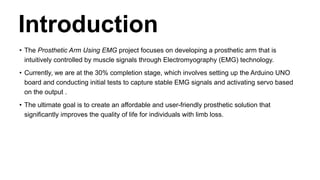
• The Prosthetic Arm Using EMG project focuses on developing a prosthetic arm that is
intuitively controlled by muscle signals through Electromyography (EMG) technology.
• Currently, we are at the 30% completion stage, which involves setting up the Arduino UNO
board and conducting initial tests to capture stable EMG signals and activating servo based
on the output .
• The ultimate goal is to create an affordable and user-friendly prosthetic solution that
significantly improves the quality of life for individuals with limb loss.
Objectives
•Functional Control
•User Comfort and Adaptability
•Integration of Technology
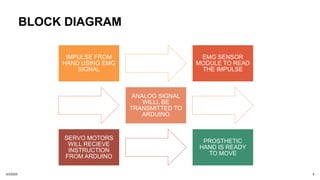
BLOCK DIAGRAM
IMPULSE FROM
HAND USING EMG
SIGNAL
EMG SENSOR
MODULE TO READ
THE IMPULSE
ANALOG SIGNAL
WILLL BE
TRANSMITTED TO
ARDUINO
SERVO MOTORS
WILL RECIEVE
INSTRUCTION
FROM ARDUINO
PROSTHETIC
HAND IS READY
TO MOVE
3/3/2025 5
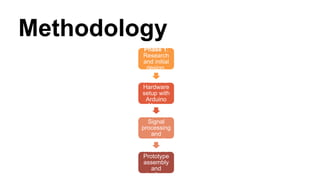
Methodology
Phase 1:
Research
and initial
design.
Phase 2:
Hardware
setup with
Arduino
Nano.
Phase 3:
Signal
processing
and
control.
Phase 4:
Prototype
assembly
and
testing.
Work Done (15%)
•Completed initial project research.
•Set up the Arduino and plotted EMG siginal
values obtained.
•Conducted basic EMG signal detection trials.
WORK DONE( 30%)
• Setup: the physical setup where the EMG sensor was attached to the
target muscle .
• Connection: the sensor was connected to Arduino UNO to record the
electrical signals generated by muscle contractions.
• Configuration Trials: attempted different settings on the sensor and
microcontroller to get usable data. This could involve adjusting the
sensitivity, electrode positioning, or testing on different muscles.
• Servo Activation:The servo motors where activated according to
emg output
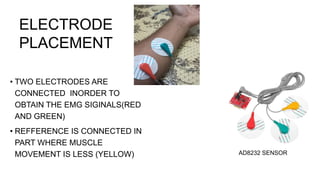
• TWO ELECTRODES ARE
CONNECTED INORDER TO
OBTAIN THE EMG SIGINALS(RED
AND GREEN)
• REFFERENCE IS CONNECTED IN
PART WHERE MUSCLE
MOVEMENT IS LESS (YELLOW)
ELECTRODE
PLACEMENT
AD8232 SENSOR
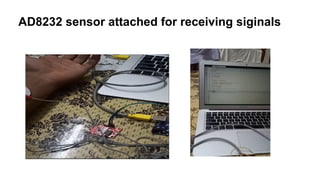
AD8232 sensor attached for receiving siginals
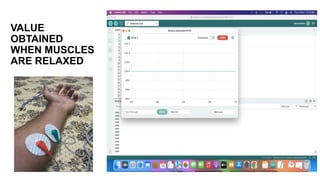
VALUE
OBTAINED
WHEN MUSCLES
ARE RELAXED
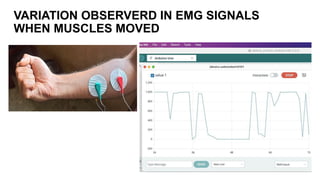
VARIATION OBSERVERD IN EMG SIGNALS
WHEN MUSCLES MOVED
Implementation Outline: EMG-Controlled Servo
Motor
• Threshold Logic: The code continuously reads the EMG sensor value. If
the value exceeds a set threshold (indicating muscle contraction), the servo
motor is activated to move to the ACTIVE ANGLE. If it falls below the
threshold, the servo returns to the REST ANGLE.
• Adjustable Threshold: The threshold value might need fine-tuning
depending on the EMG sensor’s sensitivity and the strength of the muscle
signals.
• Debugging: The monitor EMG values in real-time, which is useful for
setting the threshold correctly.
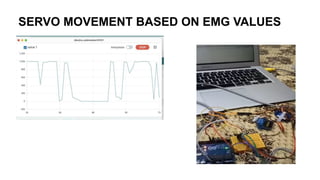
SERVO MOVEMENT BASED ON EMG VALUES
WORK DONE( 50%)
1. EMG Signal Acquisition and Processing
2. Calibration System
3. Servo Motor Control (SG90)
4. Basic Hand Grasping Simulation
3/3/2025 15
Methodology 50%
1. EMG Sensor:Muscle Signal Input: Bioelectrical Acquisition
• The initial stage involves the acquisition of bioelectrical signals through an EMG
sensor.
• This sensor detects the electrical activity generated by muscle contractions,
providing the fundamental input for the prosthetic arm's control.
• Higher muscle contractions produce higher voltage readings, allowing you to
control the arm movements.
• Placement and sensor quality are critical for accurate data collection.
16
Methodology 50%
2. Signal Processing
• Raw EMG signals are subject to noise and variability, necessitating signal
processing.
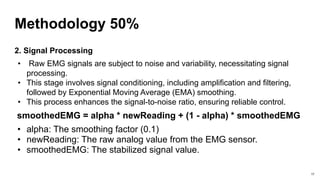
• This stage involves signal conditioning, including amplification and filtering,
followed by Exponential Moving Average (EMA) smoothing.
• This process enhances the signal-to-noise ratio, ensuring reliable control.
smoothedEMG = alpha * newReading + (1 - alpha) * smoothedEMG
• alpha: The smoothing factor (0.1)
• newReading: The raw analog value from the EMG sensor.
• smoothedEMG: The stabilized signal value.
17
Methodology 50%
3. Calibration:- Personalized Setup: Adaptive Threshold Determination
• To accommodate individual variations in muscle signal strength, a
calibration process is implemented.
• This involves establishing baseline and peak EMG values through
user-guided muscle contractions.
• Based on these values, personalized activation and release thresholds
are calculated.
• This helps in setting a reference point for detecting muscle
contractions.
18
Methodology 50%
4. Control Triggers:- Action Points: Activation and Release Thresholds
• Activation and release thresholds serve as critical decision points for the
control system.
• The activation threshold triggers the hold action when the processed
EMG signal exceeds this value.
• Conversely, the release threshold triggers the release action when the
signal falls below this value.
19
Methodology 50%
5.Control Logic:- Decision Making: Threshold-Driven Actuation
• The control logic continuously monitors the processed EMG signal and
compares it to the predefined thresholds.
• Based on these comparisons, the system determines the appropriate
actuation command.
• This process is the core of the systems ability to respond to user
muscle signals.
20
Methodology 50%
5.Control Logic:- Decision Making: Threshold-Driven Actuation
• Uses a state-based approach:-
• State 1: Holding (Grip Closed)
• State 2: Released (Grip Open)
Logic Flow:
• If the smoothed EMG signal crosses the activation threshold → Grip
closes.
• If the smoothed EMG signal falls below the baseline → Grip opens.
• Prevents repetitive movements by maintaining the current state.
21
Methodology 50%
6.Action Control:-State Management: Sequential Control
Execution
• A state machine is used to manage the hold and release states, ensuring
sequential control execution.
• The is Holding flag tracks the current state, preventing conflicting or
concurrent actions.
• This mechanism enhances system stability and prevents erratic behavior.
22
Methodology 50%
7.Servo Motors:-Hand Movement Servo-Driven Actuation
• Servo motors provide the actuation mechanism for the prosthetic hand.
• The control system translates actuation commands into precise servo
motor movements.
• This enables the prosthetic hand to perform controlled grasping and
releasing actions.
• Convert electrical signals into mechanical movement.
23
Methodology
24
Lorem 1
Lorem ipsum dolor sit
amet, consectetur
adipiscing elit. Duis sit
amet odio vel purus
bibendum luctus.
Morbi iaculis dapibus
tristique. In hac nec
habitasse platea
ipsum
dictumst. Mauris nec
convallis quam dolor
at. Morbi iaculis nec
dolor lorem dapibus.
Lorem 2
Lorem ipsum dolor sit
amet, consectetur
adipiscing elit. Duis sit
amet odio vel purus
bibendum luctus.
Morbi iaculis dapibus
tristique. In hac nec
habitasse platea
ipsum
dictumst. Mauris nec
convallis quam dolor
at. Morbi iaculis nec
dolor lorem dapibus.
Lorem 3
Lorem ipsum dolor sit
amet, consectetur
adipiscing elit. Duis sit
amet odio vel purus
bibendum luctus.
Morbi iaculis dapibus
tristique. In hac nec
habitasse platea
ipsum
dictumst. Mauris nec
convallis quam dolor
at. Morbi iaculis nec
dolor lorem dapibus.
Lorem 5
Lorem ipsum dolor sit
amet, consectetur
adipiscing elit. Duis sit
amet odio vel purus
bibendum luctus.
Morbi iaculis dapibus
tristique. In hac nec
habitasse platea
ipsum
dictumst. Mauris nec
convallis quam dolor
at. Morbi iaculis nec
dolor lorem dapibus.
Lorem 4
Lorem ipsum dolor sit
amet, consectetur
adipiscing elit. Duis sit
amet odio vel purus
bibendum luctus.
Morbi iaculis dapibus
tristique. In hac nec
habitasse platea
ipsum
dictumst. Mauris nec
convallis quam dolor
at. Morbi iaculis nec
dolor lorem dapibus.
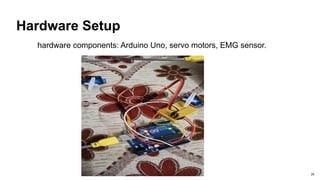
Hardware Setup
hardware components: Arduino Uno, servo motors, EMG sensor.
25
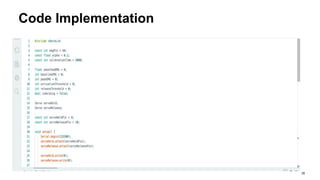
Code Implementation
26
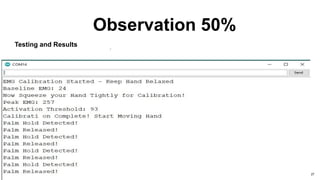
Observation 50%
Testing and Results
27
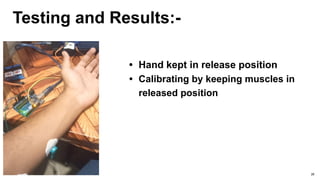
Testing and Results:-
• Hand kept in release position
• Calibrating by keeping muscles in
released position
28
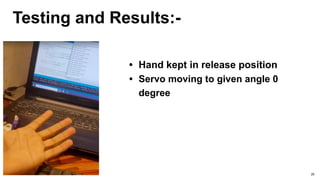
Testing and Results:-
• Hand kept in release position
• Servo moving to given angle 0
degree
29
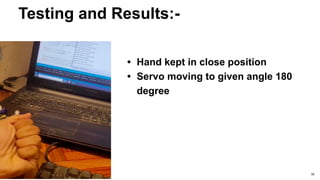
Testing and Results:-
• Hand kept in close position
• Servo moving to given angle 180
degree
30
CHALLENGES FACED
• Signal Noise: EMG signals are often weak and easily overwhelmed by
background electrical noise from the environment. Even slight movements or
nearby electrical devices can introduce interference.
• Electrode Placement and Skin Contact: EMG data quality can vary significantly
depending on electrode placement, skin preparation, and how well the electrodes
stick to the skin. Poor contact can lead to inconsistent signals.
• Difficulty in Filtering Background Noise: In some cases, the EMG signal might
contain more noise than useful information. Filtering noise from the signal is
essential but can be challenging, especially if there is a lot of environmental or
muscle crosstalk noise (from other nearby muscles).
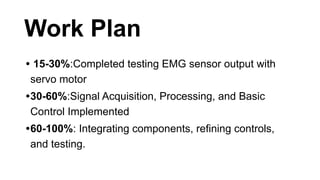
Work Plan
• 15-30%:Completed testing EMG sensor output with
servo motor
•30-60%:Signal Acquisition, Processing, and Basic
Control Implemented
•60-100%: Integrating components, refining controls,
and testing.
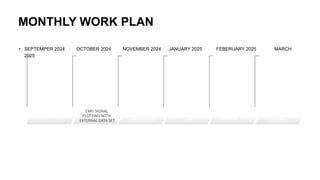
MONTHLY WORK PLAN
• SEPTEMPER 2024 OCTOBER 2024 NOVEMBER 2024 JANUARY 2025 FEBERUARY 2025 MARCH
2025
DESIGN OVERVIEW
EMG SIGNAL
PLOTTING WITH
EXTERNAL DATA SET
TESTING EMG
SIGINALS WITH
SERVO MOTOR
BUILDING
MECHANICAL
ARM
INTERGRATING
COMPONENTS
TESTING AND
REFINENING
CONTROLS
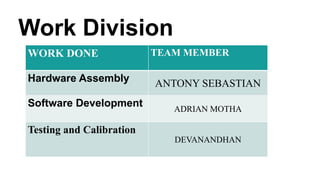
Work Division
WORK DONE TEAM MEMBER
Hardware Assembly ANTONY SEBASTIAN
Software Development ADRIAN MOTHA
Testing and Calibration
DEVANANDHAN
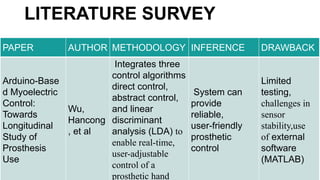
LITERATURE SURVEY
PAPER AUTHOR METHODOLOGY INFERENCE DRAWBACK
Arduino-Base
d Myoelectric
Control:
Towards
Longitudinal
Study of
Prosthesis
Use
Wu,
Hancong
, et al
Integrates three
control algorithms
direct control,
abstract control,
and linear
discriminant
analysis (LDA) to
enable real-time,
user-adjustable
control of a
prosthetic hand
System can
provide
reliable,
user-friendly
prosthetic
control
Limited
testing,
challenges in
sensor
stability,use
of external
software
(MATLAB)
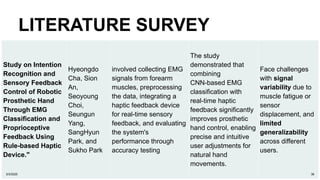
LITERATURE SURVEY
Study on Intention
Recognition and
Sensory Feedback
Control of Robotic
Prosthetic Hand
Through EMG
Classification and
Proprioceptive
Feedback Using
Rule-based Haptic
Device."
Hyeongdo
Cha, Sion
An,
Seoyoung
Choi,
Seungun
Yang,
SangHyun
Park, and
Sukho Park
involved collecting EMG
signals from forearm
muscles, preprocessing
the data, integrating a
haptic feedback device
for real-time sensory
feedback, and evaluating
the system's
performance through
accuracy testing
The study
demonstrated that
combining
CNN-based EMG
classification with
real-time haptic
feedback significantly
improves prosthetic
hand control, enabling
precise and intuitive
user adjustments for
natural hand
movements.
Face challenges
with signal
variability due to
muscle fatigue or
sensor
displacement, and
limited
generalizability
across different
users.
3/3/2025 36
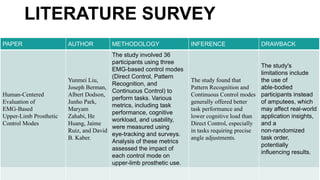
LITERATURE SURVEY
PAPER AUTHOR METHODOLOGY INFERENCE DRAWBACK
Human-Centered
Evaluation of
EMG-Based
Upper-Limb Prosthetic
Control Modes
Yunmei Liu,
Joseph Berman,
Albert Dodson,
Junho Park,
Maryam
Zahabi, He
Huang, Jaime
Ruiz, and David
B. Kaber.
The study involved 36
participants using three
EMG-based control modes
(Direct Control, Pattern
Recognition, and
Continuous Control) to
perform tasks. Various
metrics, including task
performance, cognitive
workload, and usability,
were measured using
eye-tracking and surveys.
Analysis of these metrics
assessed the impact of
each control mode on
upper-limb prosthetic use.
The study found that
Pattern Recognition and
Continuous Control modes
generally offered better
task performance and
lower cognitive load than
Direct Control, especially
in tasks requiring precise
angle adjustments.
The study's
limitations include
the use of
able-bodied
participants instead
of amputees, which
may affect real-world
application insights,
and a
non-randomized
task order,
potentially
influencing results.
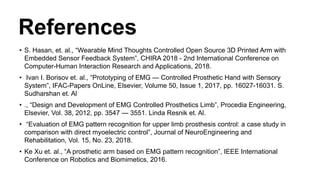
References
• S. Hasan, et. al., “Wearable Mind Thoughts Controlled Open Source 3D Printed Arm with
Embedded Sensor Feedback System”, CHIRA 2018 - 2nd International Conference on
Computer-Human Interaction Research and Applications, 2018.
• Ivan I. Borisov et. al., “Prototyping of EMG — Controlled Prosthetic Hand with Sensory
System”, IFAC-Papers OnLine, Elsevier, Volume 50, Issue 1, 2017, pp. 16027-16031. S.
Sudharshan et. Al
• ., “Design and Development of EMG Controlled Prosthetics Limb”, Procedia Engineering,
Elsevier, Vol. 38, 2012, pp. 3547 — 3551. Linda Resnik et. Al.
• “Evaluation of EMG pattern recognition for upper limb prosthesis control: a case study in
comparison with direct myoelectric control”, Journal of NeuroEngineering and
Rehabilitation, Vol. 15, No. 23, 2018.
• Ke Xu et. al., “A prosthetic arm based on EMG pattern recognition”, IEEE International
Conference on Robotics and Biomimetics, 2016.
Thank You

emg prostetic armmmmmmmmmmmmmmmmmmmm.pdf

  • 1.
    EMG-Based Prosthetic Arm ControlUsing Arduino Done by : Adrian Motha Antony Sebastian AR Devanandhan Guided By : Mr Abhishek Viswakumar Interim Presentation(50%)
  • 2.
  • 3.
    Introduction • The ProstheticArm Using EMG project focuses on developing a prosthetic arm that is intuitively controlled by muscle signals through Electromyography (EMG) technology. • Currently, we are at the 30% completion stage, which involves setting up the Arduino UNO board and conducting initial tests to capture stable EMG signals and activating servo based on the output . • The ultimate goal is to create an affordable and user-friendly prosthetic solution that significantly improves the quality of life for individuals with limb loss.
  • 4.
    Objectives •Functional Control •User Comfortand Adaptability •Integration of Technology
  • 5.
    BLOCK DIAGRAM IMPULSE FROM HANDUSING EMG SIGNAL EMG SENSOR MODULE TO READ THE IMPULSE ANALOG SIGNAL WILLL BE TRANSMITTED TO ARDUINO SERVO MOTORS WILL RECIEVE INSTRUCTION FROM ARDUINO PROSTHETIC HAND IS READY TO MOVE 3/3/2025 5
  • 6.
    Methodology Phase 1: Research and initial design. Phase2: Hardware setup with Arduino Nano. Phase 3: Signal processing and control. Phase 4: Prototype assembly and testing.
  • 7.
    Work Done (15%) •Completedinitial project research. •Set up the Arduino and plotted EMG siginal values obtained. •Conducted basic EMG signal detection trials.
  • 8.
    WORK DONE( 30%) •Setup: the physical setup where the EMG sensor was attached to the target muscle . • Connection: the sensor was connected to Arduino UNO to record the electrical signals generated by muscle contractions. • Configuration Trials: attempted different settings on the sensor and microcontroller to get usable data. This could involve adjusting the sensitivity, electrode positioning, or testing on different muscles. • Servo Activation:The servo motors where activated according to emg output
  • 9.
    • TWO ELECTRODESARE CONNECTED INORDER TO OBTAIN THE EMG SIGINALS(RED AND GREEN) • REFFERENCE IS CONNECTED IN PART WHERE MUSCLE MOVEMENT IS LESS (YELLOW) ELECTRODE PLACEMENT AD8232 SENSOR
  • 10.
    AD8232 sensor attachedfor receiving siginals
  • 11.
  • 12.
    VARIATION OBSERVERD INEMG SIGNALS WHEN MUSCLES MOVED
  • 13.
    Implementation Outline: EMG-ControlledServo Motor • Threshold Logic: The code continuously reads the EMG sensor value. If the value exceeds a set threshold (indicating muscle contraction), the servo motor is activated to move to the ACTIVE ANGLE. If it falls below the threshold, the servo returns to the REST ANGLE. • Adjustable Threshold: The threshold value might need fine-tuning depending on the EMG sensor’s sensitivity and the strength of the muscle signals. • Debugging: The monitor EMG values in real-time, which is useful for setting the threshold correctly.
  • 14.
    SERVO MOVEMENT BASEDON EMG VALUES
  • 15.
    WORK DONE( 50%) 1.EMG Signal Acquisition and Processing 2. Calibration System 3. Servo Motor Control (SG90) 4. Basic Hand Grasping Simulation 3/3/2025 15
  • 16.
    Methodology 50% 1. EMGSensor:Muscle Signal Input: Bioelectrical Acquisition • The initial stage involves the acquisition of bioelectrical signals through an EMG sensor. • This sensor detects the electrical activity generated by muscle contractions, providing the fundamental input for the prosthetic arm's control. • Higher muscle contractions produce higher voltage readings, allowing you to control the arm movements. • Placement and sensor quality are critical for accurate data collection. 16
  • 17.
    Methodology 50% 2. SignalProcessing • Raw EMG signals are subject to noise and variability, necessitating signal processing. • This stage involves signal conditioning, including amplification and filtering, followed by Exponential Moving Average (EMA) smoothing. • This process enhances the signal-to-noise ratio, ensuring reliable control. smoothedEMG = alpha * newReading + (1 - alpha) * smoothedEMG • alpha: The smoothing factor (0.1) • newReading: The raw analog value from the EMG sensor. • smoothedEMG: The stabilized signal value. 17
  • 18.
    Methodology 50% 3. Calibration:-Personalized Setup: Adaptive Threshold Determination • To accommodate individual variations in muscle signal strength, a calibration process is implemented. • This involves establishing baseline and peak EMG values through user-guided muscle contractions. • Based on these values, personalized activation and release thresholds are calculated. • This helps in setting a reference point for detecting muscle contractions. 18
  • 19.
    Methodology 50% 4. ControlTriggers:- Action Points: Activation and Release Thresholds • Activation and release thresholds serve as critical decision points for the control system. • The activation threshold triggers the hold action when the processed EMG signal exceeds this value. • Conversely, the release threshold triggers the release action when the signal falls below this value. 19
  • 20.
    Methodology 50% 5.Control Logic:-Decision Making: Threshold-Driven Actuation • The control logic continuously monitors the processed EMG signal and compares it to the predefined thresholds. • Based on these comparisons, the system determines the appropriate actuation command. • This process is the core of the systems ability to respond to user muscle signals. 20
  • 21.
    Methodology 50% 5.Control Logic:-Decision Making: Threshold-Driven Actuation • Uses a state-based approach:- • State 1: Holding (Grip Closed) • State 2: Released (Grip Open) Logic Flow: • If the smoothed EMG signal crosses the activation threshold → Grip closes. • If the smoothed EMG signal falls below the baseline → Grip opens. • Prevents repetitive movements by maintaining the current state. 21
  • 22.
    Methodology 50% 6.Action Control:-StateManagement: Sequential Control Execution • A state machine is used to manage the hold and release states, ensuring sequential control execution. • The is Holding flag tracks the current state, preventing conflicting or concurrent actions. • This mechanism enhances system stability and prevents erratic behavior. 22
  • 23.
    Methodology 50% 7.Servo Motors:-HandMovement Servo-Driven Actuation • Servo motors provide the actuation mechanism for the prosthetic hand. • The control system translates actuation commands into precise servo motor movements. • This enables the prosthetic hand to perform controlled grasping and releasing actions. • Convert electrical signals into mechanical movement. 23
  • 24.
    Methodology 24 Lorem 1 Lorem ipsumdolor sit amet, consectetur adipiscing elit. Duis sit amet odio vel purus bibendum luctus. Morbi iaculis dapibus tristique. In hac nec habitasse platea ipsum dictumst. Mauris nec convallis quam dolor at. Morbi iaculis nec dolor lorem dapibus. Lorem 2 Lorem ipsum dolor sit amet, consectetur adipiscing elit. Duis sit amet odio vel purus bibendum luctus. Morbi iaculis dapibus tristique. In hac nec habitasse platea ipsum dictumst. Mauris nec convallis quam dolor at. Morbi iaculis nec dolor lorem dapibus. Lorem 3 Lorem ipsum dolor sit amet, consectetur adipiscing elit. Duis sit amet odio vel purus bibendum luctus. Morbi iaculis dapibus tristique. In hac nec habitasse platea ipsum dictumst. Mauris nec convallis quam dolor at. Morbi iaculis nec dolor lorem dapibus. Lorem 5 Lorem ipsum dolor sit amet, consectetur adipiscing elit. Duis sit amet odio vel purus bibendum luctus. Morbi iaculis dapibus tristique. In hac nec habitasse platea ipsum dictumst. Mauris nec convallis quam dolor at. Morbi iaculis nec dolor lorem dapibus. Lorem 4 Lorem ipsum dolor sit amet, consectetur adipiscing elit. Duis sit amet odio vel purus bibendum luctus. Morbi iaculis dapibus tristique. In hac nec habitasse platea ipsum dictumst. Mauris nec convallis quam dolor at. Morbi iaculis nec dolor lorem dapibus.
  • 25.
    Hardware Setup hardware components:Arduino Uno, servo motors, EMG sensor. 25
  • 26.
  • 27.
  • 28.
    Testing and Results:- •Hand kept in release position • Calibrating by keeping muscles in released position 28
  • 29.
    Testing and Results:- •Hand kept in release position • Servo moving to given angle 0 degree 29
  • 30.
    Testing and Results:- •Hand kept in close position • Servo moving to given angle 180 degree 30
  • 31.
    CHALLENGES FACED • SignalNoise: EMG signals are often weak and easily overwhelmed by background electrical noise from the environment. Even slight movements or nearby electrical devices can introduce interference. • Electrode Placement and Skin Contact: EMG data quality can vary significantly depending on electrode placement, skin preparation, and how well the electrodes stick to the skin. Poor contact can lead to inconsistent signals. • Difficulty in Filtering Background Noise: In some cases, the EMG signal might contain more noise than useful information. Filtering noise from the signal is essential but can be challenging, especially if there is a lot of environmental or muscle crosstalk noise (from other nearby muscles).
  • 32.
    Work Plan • 15-30%:Completedtesting EMG sensor output with servo motor •30-60%:Signal Acquisition, Processing, and Basic Control Implemented •60-100%: Integrating components, refining controls, and testing.
  • 33.
    MONTHLY WORK PLAN •SEPTEMPER 2024 OCTOBER 2024 NOVEMBER 2024 JANUARY 2025 FEBERUARY 2025 MARCH 2025 DESIGN OVERVIEW EMG SIGNAL PLOTTING WITH EXTERNAL DATA SET TESTING EMG SIGINALS WITH SERVO MOTOR BUILDING MECHANICAL ARM INTERGRATING COMPONENTS TESTING AND REFINENING CONTROLS
  • 34.
    Work Division WORK DONETEAM MEMBER Hardware Assembly ANTONY SEBASTIAN Software Development ADRIAN MOTHA Testing and Calibration DEVANANDHAN
  • 35.
    LITERATURE SURVEY PAPER AUTHORMETHODOLOGY INFERENCE DRAWBACK Arduino-Base d Myoelectric Control: Towards Longitudinal Study of Prosthesis Use Wu, Hancong , et al Integrates three control algorithms direct control, abstract control, and linear discriminant analysis (LDA) to enable real-time, user-adjustable control of a prosthetic hand System can provide reliable, user-friendly prosthetic control Limited testing, challenges in sensor stability,use of external software (MATLAB)
  • 36.
    LITERATURE SURVEY Study onIntention Recognition and Sensory Feedback Control of Robotic Prosthetic Hand Through EMG Classification and Proprioceptive Feedback Using Rule-based Haptic Device." Hyeongdo Cha, Sion An, Seoyoung Choi, Seungun Yang, SangHyun Park, and Sukho Park involved collecting EMG signals from forearm muscles, preprocessing the data, integrating a haptic feedback device for real-time sensory feedback, and evaluating the system's performance through accuracy testing The study demonstrated that combining CNN-based EMG classification with real-time haptic feedback significantly improves prosthetic hand control, enabling precise and intuitive user adjustments for natural hand movements. Face challenges with signal variability due to muscle fatigue or sensor displacement, and limited generalizability across different users. 3/3/2025 36
  • 37.
    LITERATURE SURVEY PAPER AUTHORMETHODOLOGY INFERENCE DRAWBACK Human-Centered Evaluation of EMG-Based Upper-Limb Prosthetic Control Modes Yunmei Liu, Joseph Berman, Albert Dodson, Junho Park, Maryam Zahabi, He Huang, Jaime Ruiz, and David B. Kaber. The study involved 36 participants using three EMG-based control modes (Direct Control, Pattern Recognition, and Continuous Control) to perform tasks. Various metrics, including task performance, cognitive workload, and usability, were measured using eye-tracking and surveys. Analysis of these metrics assessed the impact of each control mode on upper-limb prosthetic use. The study found that Pattern Recognition and Continuous Control modes generally offered better task performance and lower cognitive load than Direct Control, especially in tasks requiring precise angle adjustments. The study's limitations include the use of able-bodied participants instead of amputees, which may affect real-world application insights, and a non-randomized task order, potentially influencing results.
  • 38.
    References • S. Hasan,et. al., “Wearable Mind Thoughts Controlled Open Source 3D Printed Arm with Embedded Sensor Feedback System”, CHIRA 2018 - 2nd International Conference on Computer-Human Interaction Research and Applications, 2018. • Ivan I. Borisov et. al., “Prototyping of EMG — Controlled Prosthetic Hand with Sensory System”, IFAC-Papers OnLine, Elsevier, Volume 50, Issue 1, 2017, pp. 16027-16031. S. Sudharshan et. Al • ., “Design and Development of EMG Controlled Prosthetics Limb”, Procedia Engineering, Elsevier, Vol. 38, 2012, pp. 3547 — 3551. Linda Resnik et. Al. • “Evaluation of EMG pattern recognition for upper limb prosthesis control: a case study in comparison with direct myoelectric control”, Journal of NeuroEngineering and Rehabilitation, Vol. 15, No. 23, 2018. • Ke Xu et. al., “A prosthetic arm based on EMG pattern recognition”, IEEE International Conference on Robotics and Biomimetics, 2016.
  • 39.