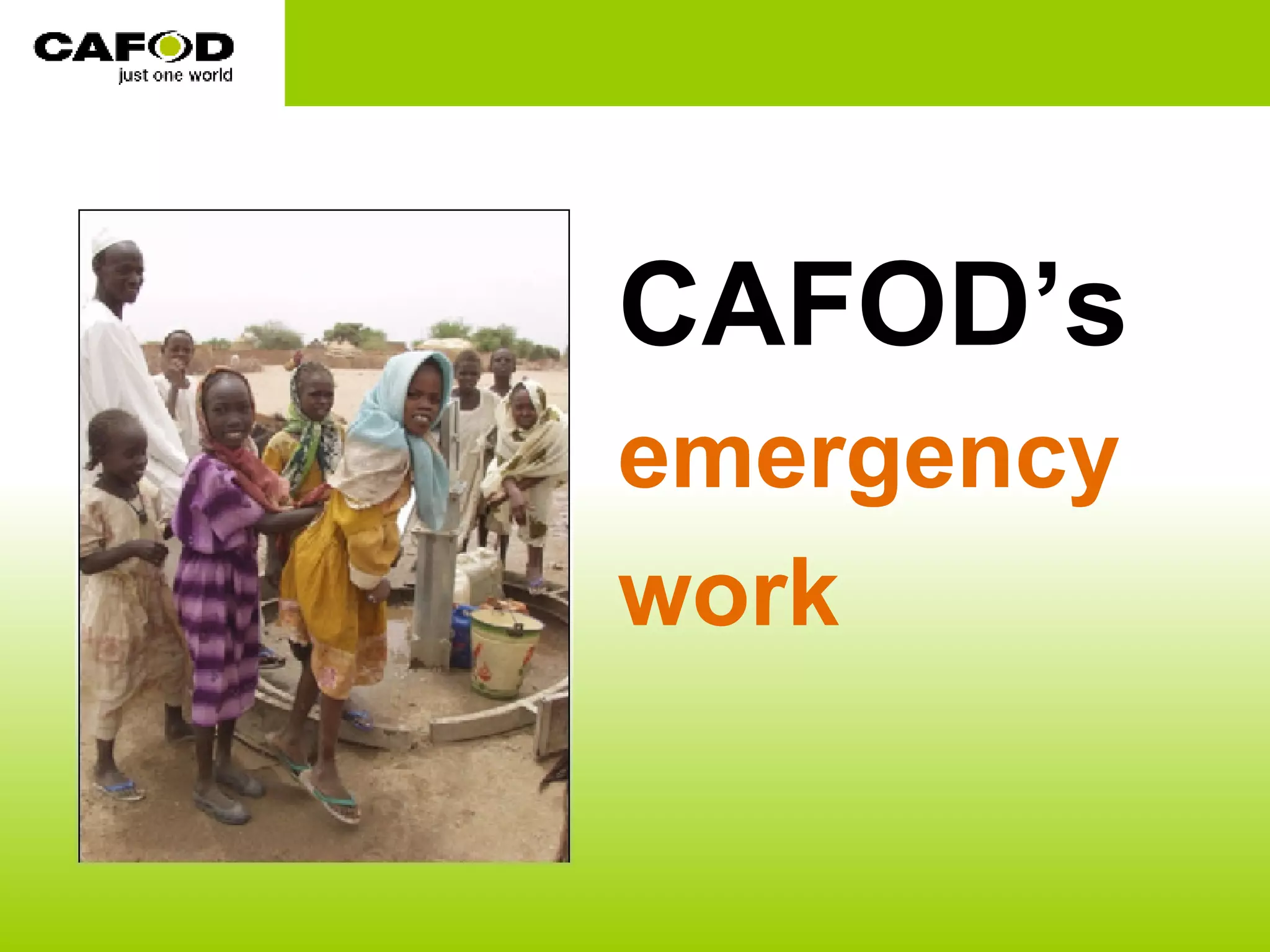
CAFOD’s emergency  work
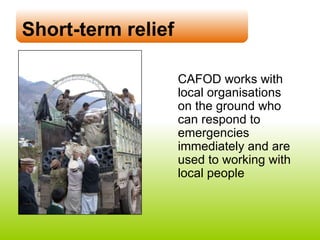
Short-term relief CAFOD works with  local organisations  on the ground who can respond to emergencies immediately and are  used to working with  local people
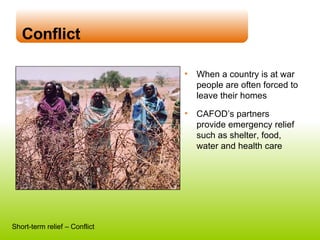
Conflict When a country is at war people are often forced to leave their homes CAFOD’s partners provide emergency relief such as shelter, food, water and health care Short-term relief – Conflict
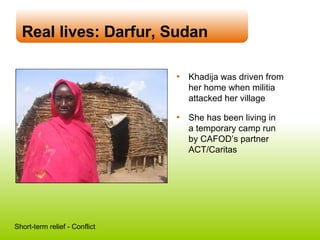
Real lives: Darfur, Sudan Khadija was driven from her home when militia attacked her village She has been living in  a temporary camp run  by CAFOD’s partner ACT/Caritas Short-term relief - Conflict
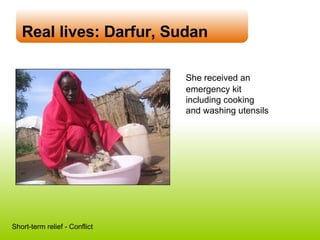
Real lives: Darfur, Sudan She received an emergency kit  including cooking  and washing utensils Short-term relief - Conflict
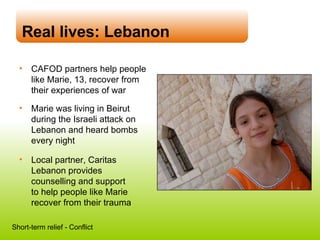
Real lives: Lebanon CAFOD partners help people like Marie, 13, recover from their experiences of war Marie was living in Beirut during the Israeli attack on Lebanon and heard bombs every night Local partner, Caritas Lebanon provides counselling and support  to help people like Marie recover from their trauma Short-term relief - Conflict
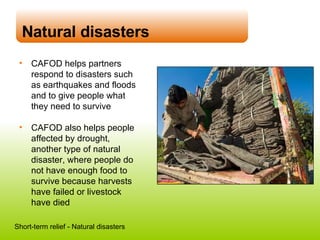
Natural disasters CAFOD helps partners respond to disasters such as earthquakes and floods and to give people what they need to survive CAFOD also helps people affected by drought, another type of natural disaster, where people do not have enough food to survive because harvests have failed or livestock have died Short-term relief - Natural disasters
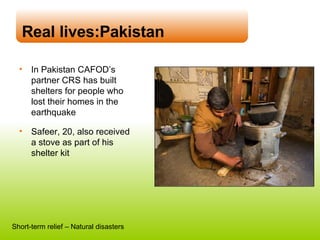
In Pakistan CAFOD’s  partner CRS has built  shelters for people who  lost their homes in the earthquake Safeer, 20, also received  a stove as part of his  shelter kit Real lives:Pakistan Short-term relief – Natural disasters
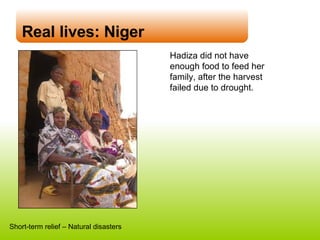
Real lives: Niger Hadiza did not have enough food to feed her family, after the harvest failed due to drought. Short-term relief – Natural disasters
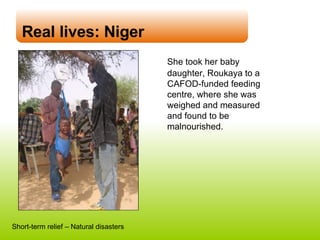
Real lives: Niger She took her baby daughter,  Roukaya  to a CAFOD-funded feeding centre, where she was weighed and measured and found to be malnourished. Short-term relief – Natural disasters
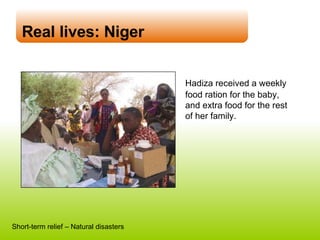
Real lives: Niger Hadiza received a weekly food ration for the baby, and extra food for the rest of her family. Short-term relief – Natural disasters
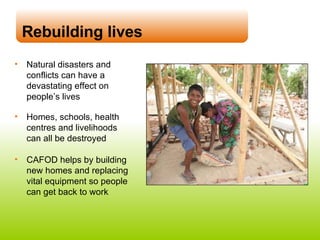
Rebuilding lives Natural disasters and conflicts can have a devastating effect on people’s lives Homes, schools, health centres and livelihoods can all be destroyed CAFOD helps by building new homes and replacing vital equipment so people can get back to work
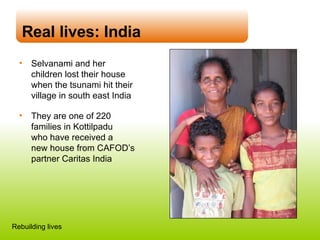
Selvanami and her children lost their house when the tsunami hit their village in south east India They are one of 220 families in Kottilpadu  who have received a  new house from CAFOD’s partner Caritas India Real lives: India Rebuilding lives
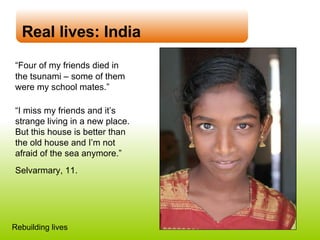
“ Four of my friends died in the tsunami – some of them were my school mates.”  “ I miss my friends and it’s strange living in a new place. But this house is better than the old house and I’m not afraid of the sea anymore.” Selvarmary, 11. Real lives: India Rebuilding lives
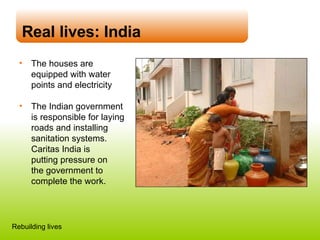
The houses are equipped with water points and electricity The Indian government is responsible for laying roads and installing sanitation systems. Caritas India is  putting pressure on  the government to complete the work. Real lives: India Rebuilding lives
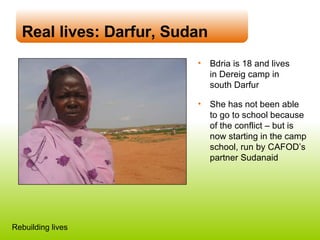
Real lives: Darfur, Sudan Bdria is 18 and lives  in Dereig camp in  south Darfur  She has not been able  to go to school because of the conflict – but is  now starting in the camp school, run by CAFOD’s partner Sudanaid Rebuilding lives
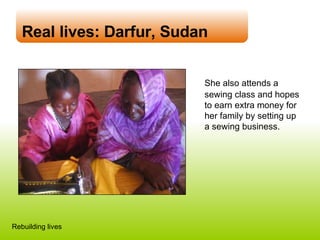
Real lives: Darfur, Sudan She also attends a sewing class and hopes to earn extra money for her family by setting up  a sewing business. Rebuilding lives
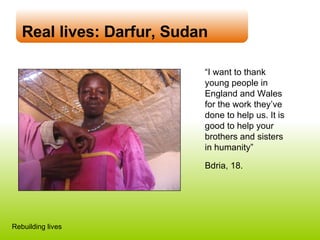
Real lives: Darfur, Sudan “ I want to thank young people in England and Wales for the work they’ve done to help us. It is good to help your brothers and sisters in humanity” Bdria, 18. Rebuilding lives
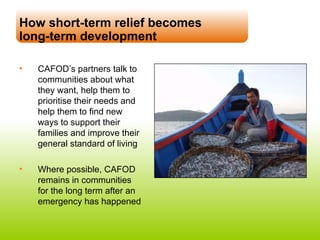
How short-term relief becomes  long-term development CAFOD’s partners talk to communities about what they want, help them to prioritise their needs and help them to find new ways to support their families and improve their general standard of living Where possible, CAFOD remains in communities for the long term after an emergency has happened
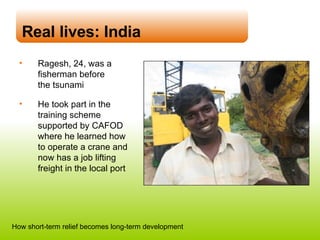
Real lives: India Ragesh, 24, was a fisherman before  the tsunami He took part in the training scheme supported by CAFOD where he learned how  to operate a crane and now has a job lifting freight in the local port How short-term relief becomes long-term development
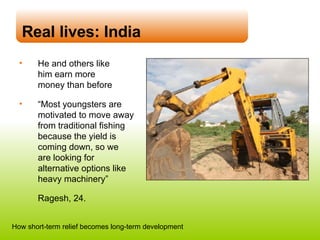
Real lives: India He and others like  him earn more  money than before “ Most youngsters are motivated to move away from traditional fishing because the yield is coming down, so we  are looking for  alternative options like heavy machinery” Ragesh, 24. How short-term relief becomes long-term development
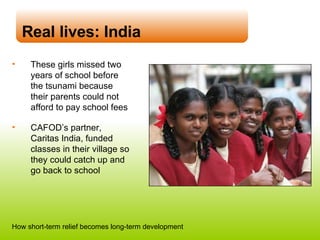
Real lives: India These girls missed two years of school before the tsunami because their parents could not afford to pay school fees CAFOD’s partner, Caritas India, funded classes in their village so they could catch up and go back to school How short-term relief becomes long-term development
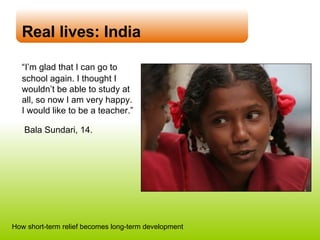
Real lives: India “ I’m glad that I can go to school again. I thought I wouldn’t be able to study at all, so now I am very happy.  I would like to be a teacher.”    Bala Sundari, 14. How short-term relief becomes long-term development
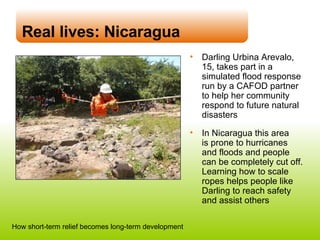
Real lives: Nicaragua Darling Urbina Arevalo,  15, takes part in a simulated flood response run by a CAFOD partner  to help her community respond to future natural disasters In Nicaragua this area  is prone to hurricanes  and floods and people  can be completely cut off. Learning how to scale ropes helps people like Darling to reach safety  and assist others How short-term relief becomes long-term development
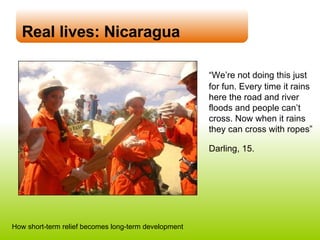
Real lives: Nicaragua “ We’re not doing this just for fun. Every time it rains here the road and river floods and people can’t cross. Now when it rains they can cross with ropes” Darling, 15.  How short-term relief becomes long-term development
Picture credits Amelia Bookstein, Fiona Callister, Laura Donkin, Noel Gavin,  Marcella Haddad, Patrick Nicholson,  CRS/David Snyder, Jim Stipe,  Laura Storr, Stefan Teplan.

Emergency Work

  • 1.
  • 2.
    Short-term relief CAFODworks with local organisations on the ground who can respond to emergencies immediately and are used to working with local people
  • 3.
    Conflict When acountry is at war people are often forced to leave their homes CAFOD’s partners provide emergency relief such as shelter, food, water and health care Short-term relief – Conflict
  • 4.
    Real lives: Darfur,Sudan Khadija was driven from her home when militia attacked her village She has been living in a temporary camp run by CAFOD’s partner ACT/Caritas Short-term relief - Conflict
  • 5.
    Real lives: Darfur,Sudan She received an emergency kit including cooking and washing utensils Short-term relief - Conflict
  • 6.
    Real lives: LebanonCAFOD partners help people like Marie, 13, recover from their experiences of war Marie was living in Beirut during the Israeli attack on Lebanon and heard bombs every night Local partner, Caritas Lebanon provides counselling and support to help people like Marie recover from their trauma Short-term relief - Conflict
  • 7.
    Natural disasters CAFODhelps partners respond to disasters such as earthquakes and floods and to give people what they need to survive CAFOD also helps people affected by drought, another type of natural disaster, where people do not have enough food to survive because harvests have failed or livestock have died Short-term relief - Natural disasters
  • 8.
    In Pakistan CAFOD’s partner CRS has built shelters for people who lost their homes in the earthquake Safeer, 20, also received a stove as part of his shelter kit Real lives:Pakistan Short-term relief – Natural disasters
  • 9.
    Real lives: NigerHadiza did not have enough food to feed her family, after the harvest failed due to drought. Short-term relief – Natural disasters
  • 10.
    Real lives: NigerShe took her baby daughter, Roukaya to a CAFOD-funded feeding centre, where she was weighed and measured and found to be malnourished. Short-term relief – Natural disasters
  • 11.
    Real lives: NigerHadiza received a weekly food ration for the baby, and extra food for the rest of her family. Short-term relief – Natural disasters
  • 12.
    Rebuilding lives Naturaldisasters and conflicts can have a devastating effect on people’s lives Homes, schools, health centres and livelihoods can all be destroyed CAFOD helps by building new homes and replacing vital equipment so people can get back to work
  • 13.
    Selvanami and herchildren lost their house when the tsunami hit their village in south east India They are one of 220 families in Kottilpadu who have received a new house from CAFOD’s partner Caritas India Real lives: India Rebuilding lives
  • 14.
    “ Four ofmy friends died in the tsunami – some of them were my school mates.” “ I miss my friends and it’s strange living in a new place. But this house is better than the old house and I’m not afraid of the sea anymore.” Selvarmary, 11. Real lives: India Rebuilding lives
  • 15.
    The houses areequipped with water points and electricity The Indian government is responsible for laying roads and installing sanitation systems. Caritas India is putting pressure on the government to complete the work. Real lives: India Rebuilding lives
  • 16.
    Real lives: Darfur,Sudan Bdria is 18 and lives in Dereig camp in south Darfur She has not been able to go to school because of the conflict – but is now starting in the camp school, run by CAFOD’s partner Sudanaid Rebuilding lives
  • 17.
    Real lives: Darfur,Sudan She also attends a sewing class and hopes to earn extra money for her family by setting up a sewing business. Rebuilding lives
  • 18.
    Real lives: Darfur,Sudan “ I want to thank young people in England and Wales for the work they’ve done to help us. It is good to help your brothers and sisters in humanity” Bdria, 18. Rebuilding lives
  • 19.
    How short-term reliefbecomes long-term development CAFOD’s partners talk to communities about what they want, help them to prioritise their needs and help them to find new ways to support their families and improve their general standard of living Where possible, CAFOD remains in communities for the long term after an emergency has happened
  • 20.
    Real lives: IndiaRagesh, 24, was a fisherman before the tsunami He took part in the training scheme supported by CAFOD where he learned how to operate a crane and now has a job lifting freight in the local port How short-term relief becomes long-term development
  • 21.
    Real lives: IndiaHe and others like him earn more money than before “ Most youngsters are motivated to move away from traditional fishing because the yield is coming down, so we are looking for alternative options like heavy machinery” Ragesh, 24. How short-term relief becomes long-term development
  • 22.
    Real lives: IndiaThese girls missed two years of school before the tsunami because their parents could not afford to pay school fees CAFOD’s partner, Caritas India, funded classes in their village so they could catch up and go back to school How short-term relief becomes long-term development
  • 23.
    Real lives: India“ I’m glad that I can go to school again. I thought I wouldn’t be able to study at all, so now I am very happy. I would like to be a teacher.” Bala Sundari, 14. How short-term relief becomes long-term development
  • 24.
    Real lives: NicaraguaDarling Urbina Arevalo, 15, takes part in a simulated flood response run by a CAFOD partner to help her community respond to future natural disasters In Nicaragua this area is prone to hurricanes and floods and people can be completely cut off. Learning how to scale ropes helps people like Darling to reach safety and assist others How short-term relief becomes long-term development
  • 25.
    Real lives: Nicaragua“ We’re not doing this just for fun. Every time it rains here the road and river floods and people can’t cross. Now when it rains they can cross with ropes” Darling, 15. How short-term relief becomes long-term development
  • 26.
    Picture credits AmeliaBookstein, Fiona Callister, Laura Donkin, Noel Gavin, Marcella Haddad, Patrick Nicholson, CRS/David Snyder, Jim Stipe, Laura Storr, Stefan Teplan.