ABCDE APPROACH
IN
EMERGENCIES
Lydia Kabiri
Department of Nursing
Why the ABCDE approach?
What is a SAMPLE history?
• Categories of questions to obtain a patient’s history
• Signs and Symptoms
• Allergies
• Medications
• Past medical history
• Last oral intake
• Events
• Immediately follows the ABCDE approach
• Allows providers to easily communicate
Goal:
• Rapidly gather history critical to the management of the acutely ill patient
ABCDE: Initial Approach
■ The most important step is to stay safe!
■ Scene safety
– Fire
– Motor vehicle crash
– Building collapse
– Chemical spill
– Violence
– Infections disease
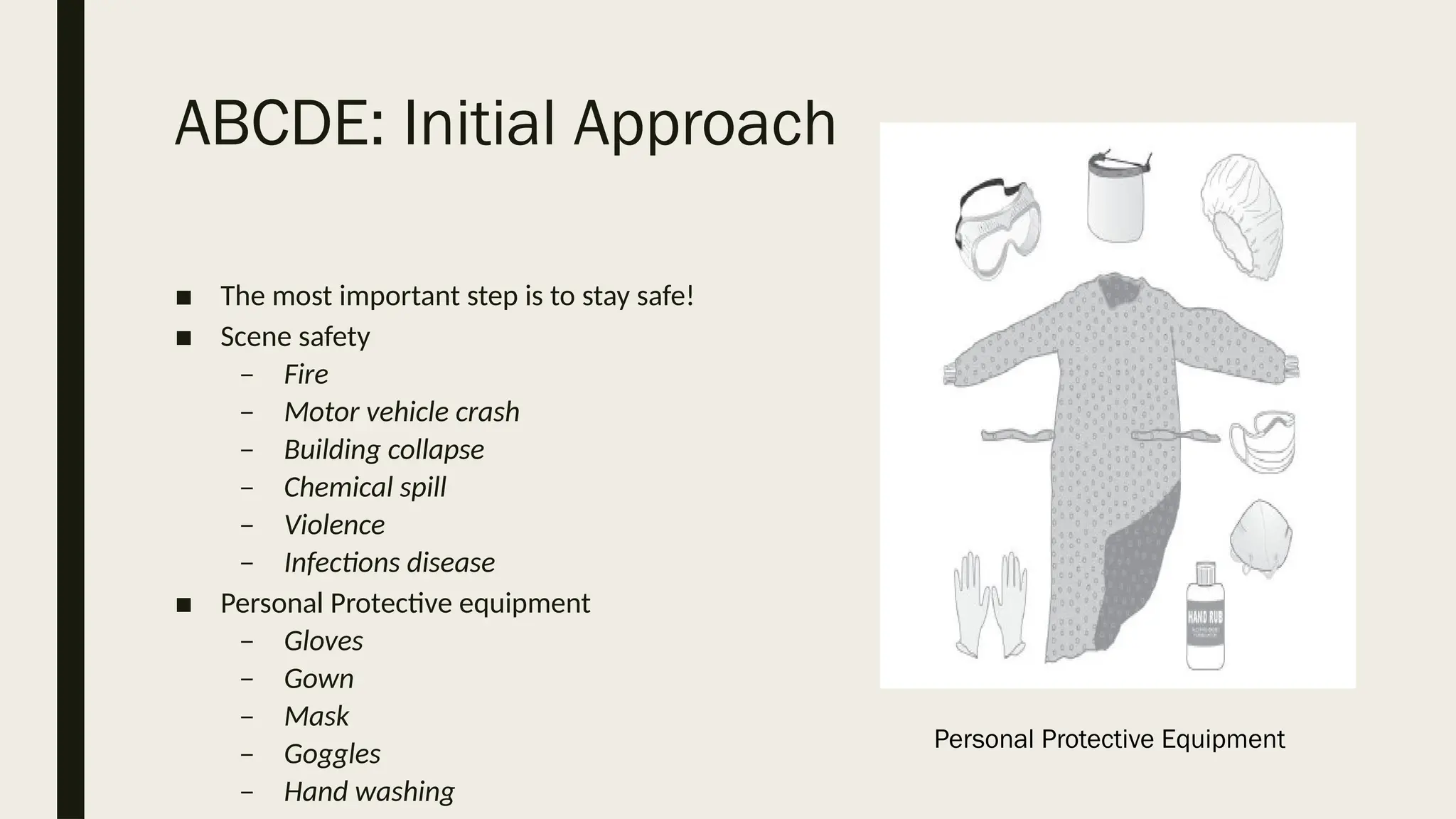
■ Personal Protective equipment
– Gloves
– Gown
– Mask
– Goggles
– Hand washing
Personal Protective Equipment
Safety considerations
Scene safety
Scene hazards
Violence
Infectious disease risk
Use personal protective equipment
Consider appropriate PPE for situation
Gloves, eye protection, gown and mask
Cleaning and decontamination
Use PPE and wash your hands before and after every patient contact (or alcohol gel cleanser)
Clean/disinfect surfaces
Refer to local decontamination protocols for chemical exposures
Ask for help early
Multiple patients
Make arrangements if transfer is needed
Know who to call for infectious outbreaks or hazardous exposures
ABCDE Approach: Elements
• Breathing plus oxygen if needed:
• Ensure adequate movement of air into the lungs
• Airway with cervical spine immobilization:
• Check for obstruction
• If trauma-immobilize cervical spine
• Circulation with bleeding control and IV fluids
• Determine if there is adequate perfusion
• Check for life-threatening bleeding
ABCDE Approach: Elements
• Disability: AVPU/GCS, pupils and glucose
• Assess and protect brain and spinal functions
• Exposure and keep warm
• Identify all injuries and environmental threats
• Avoid hypothermia
This stepwise approach is designed to ensure that life-threatening conditions are
identified and treated early, in order of priority.
A problem discovered (A-B-C-D-E) must be addressed immediately
before moving on to the next step.
!
REMEMBER…
Always check for signs of trauma in each of
the ABCDE sections, and reference the trauma
module as needed.
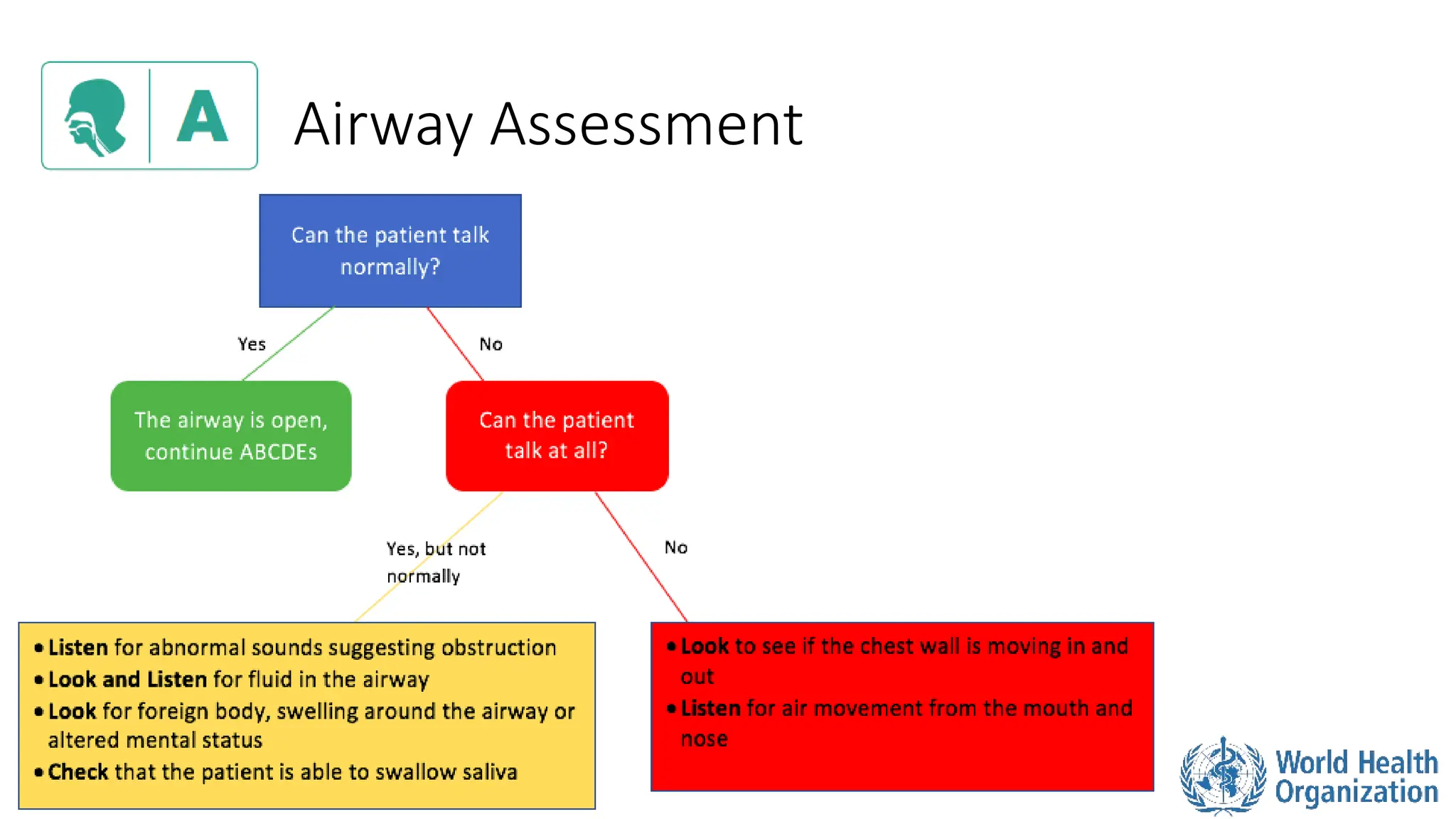
Airway Assessment
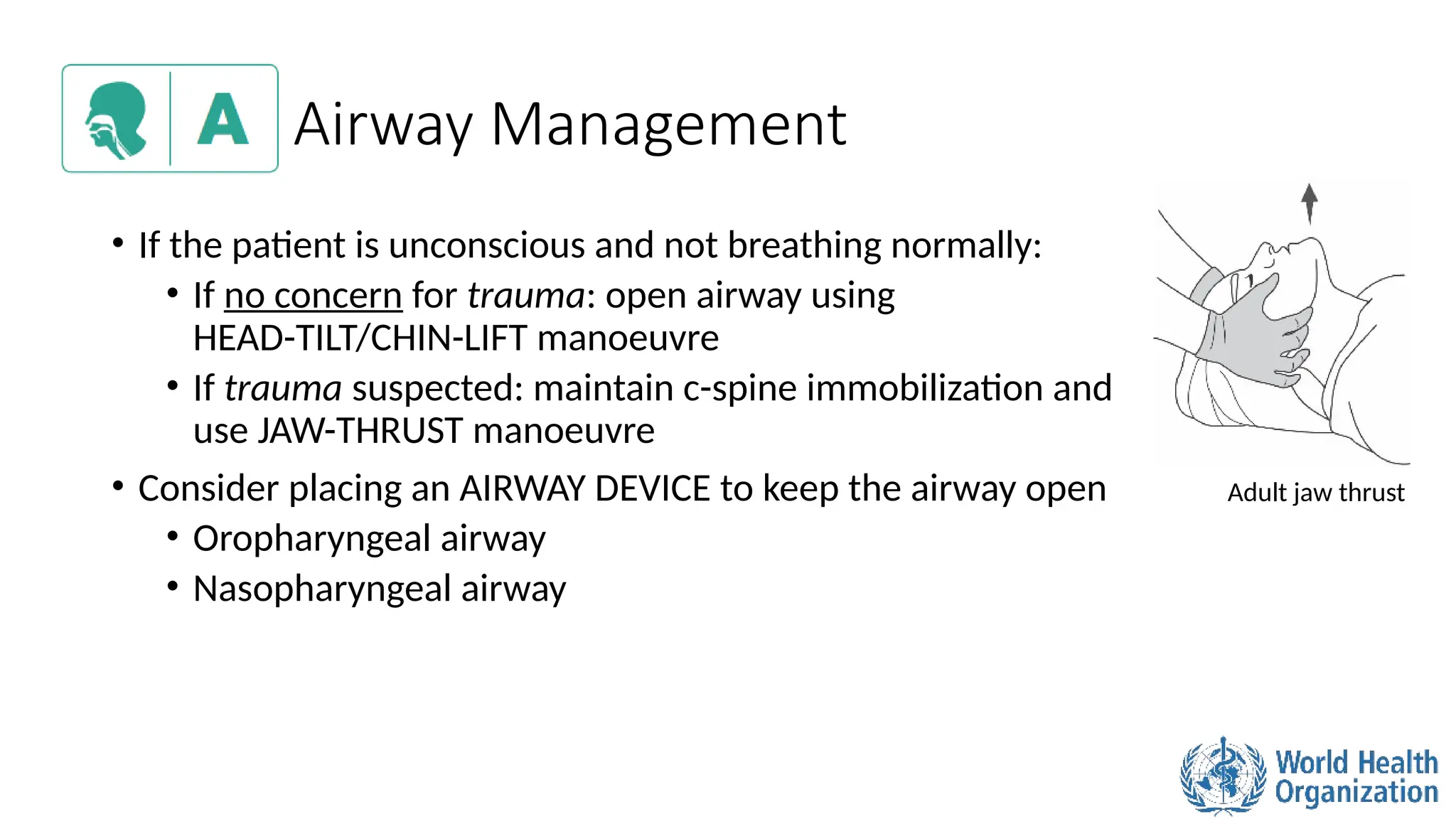
Airway Management
• If the patient is unconscious and not breathing normally:
• If no concern for trauma: open airway using
HEAD-TILT/CHIN-LIFT manoeuvre
• If trauma suspected: maintain c-spine immobilization and
use JAW-THRUST manoeuvre
• Consider placing an AIRWAY DEVICE to keep the airway open
• Oropharyngeal airway
• Nasopharyngeal airway
Adult jaw thrust
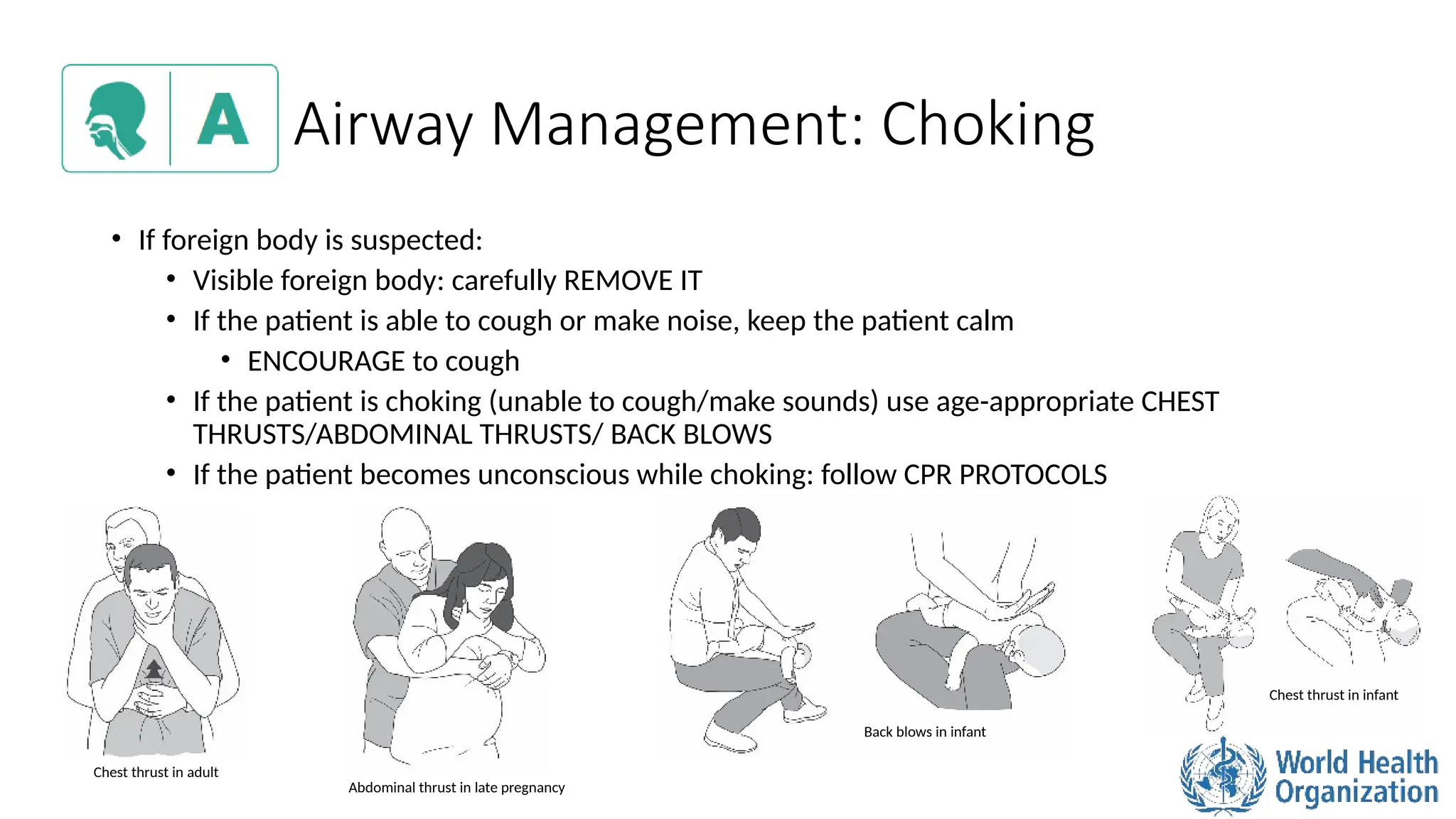
Airway Management: Choking
• If foreign body is suspected:
• Visible foreign body: carefully REMOVE IT
• If the patient is able to cough or make noise, keep the patient calm
• ENCOURAGE to cough
• If the patient is choking (unable to cough/make sounds) use age-appropriate CHEST
THRUSTS/ABDOMINAL THRUSTS/ BACK BLOWS
• If the patient becomes unconscious while choking: follow CPR PROTOCOLS
Chest thrust in adult
Abdominal thrust in late pregnancy
Back blows in infant
Chest thrust in infant
Airway Management:
• If secretions are present:
• SUCTION airway or wipe clean
• Consider RECOVERY POSITION if the rest of the ABCDE is normal and no trauma
• If the patient has swelling, hives, or stridor, consider a severe allergic
reaction (anaphylaxis)
• Give intramuscular ADRENALINE
• Allow patient to stay in position of comfort
• Prepare for HANDOVER/TRANSFER to a center capable of advanced airway
management
QUESTIONS?
Airway
?
Breathing: Assessment
• Look, listen and feel to see if the patient is breathing
• Assess if the breathing is very fast, very slow or very shallow
• Look for increased work of breathing
• Accessory muscle work
• Chest indrawing
• Nasal flaring
• Abnormal chest wall movement
• Listen for abnormal breath sounds
• REMEMBER with severe wheezes there may be no audible breath
sounds because of severe airway narrowing
!
Breathing: Assessment
• Listen to see if breath sounds are equal
• Check for the absence of breath sounds on one side
• If dull sound with percussion to the same side
• THINK large pleural effusion or haemothroax
• If also hypotension, distended neck veins or tracheal shift
• THINK tension pneumothorax
• Check oxygen saturation
Breathing: Management
• If unconscious with abnormal breathing, perform BAG-VALVE-MASK-VENTILATION with OXYGEN and
follow CPR PROTOCOLS
• If not breathing adequately (too slow or too shallow) begin BAG-VALVE-MASK-VENTILATION with OXYGEN
• If oxygen is not immediately available, do not delay ventilation
• Plan for immediate TRANSFER for airway management
• If breathing fast or hypoxia, give OXYGEN
• If wheezing, give SALBUTAMOL
• If concern for anaphylaxis, give intramuscular ADRENALINE
• If concern for tension pneumothorax, perform NEEDLE DECOMPRESSION, give OXYGEN, give IV FLUIDS
• Plan for immediate transfer for chest tube
• If concern for pleural effusion, haemothorax, give OXYGEN
• Plan for immediate transfer for chest tube
• If cause unknown, consider trauma
!
QUESTIONS?
Breathing
?
Circulation: Assessment
• Look, listen and feel for signs of poor perfusion
• Cool, moist extremities
• Delayed capillary refill
• Diaphoresis
• Low blood pressure
• Tachypnoea
• Tachycardia
• Absent pulses
Circulation: Assessment
• Look for internal and external signs of bleeding
• Chest
• Abdomen
• From stomach or intestines
• Pelvic fracture
• Femur Fracture
• From wounds
• Check for pericardial tamponade
• Hypotension
• Distended neck veins
• Muffled heart sounds
• Check blood pressure
Circulation: Management
• For cardiopulmonary arrest follow relevant CPR PROTOCOLS
• If poor perfusion: GIVE IV FLUIDS
• If external bleeding: APPLY DIRECT PRESSURE
• If internal bleeding or pericardial tamponade, REFER to centre with
surgical capabilities
• If unknown cause, remember trauma
• Apply BINDER for pelvic fracture or SPLINT for femur fracture with
compromised blood flow
QUESTIONS?
Circulation
?
Disability: Assessment
• Assess level of consciousness
• AVPU or GCS in trauma
• Check for low blood glucose (hypoglycaemia)
• Check pupils (size, reactivity to light and if equal)
• Check movement and sensation in all four limbs
• Look for abnormal repetitive movements or shaking
• Seizures/convulsions
Disability: Management
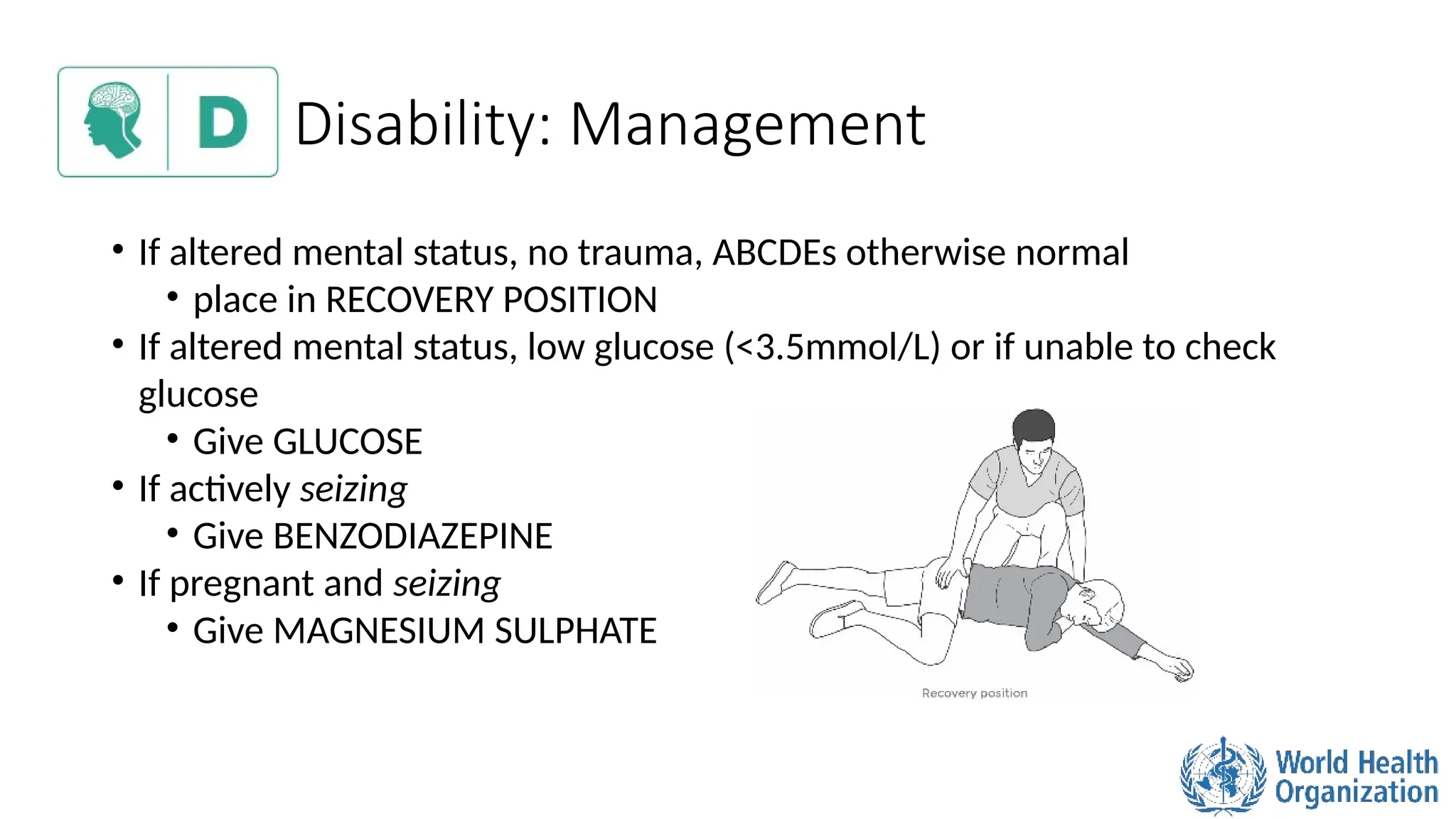
• If altered mental status, no trauma, ABCDEs otherwise normal
• place in RECOVERY POSITION
• If altered mental status, low glucose (<3.5mmol/L) or if unable to check
glucose
• Give GLUCOSE
• If actively seizing
• Give BENZODIAZEPINE
• If pregnant and seizing
• Give MAGNESIUM SULPHATE
Disability: Management
• If small pupils and slow breathing, consider opioid overdose
• Give NALOXONE
• If unequal pupils, consider increased pressure in the brain
• RAISE HEAD OF BED 30 DEGREES if no concern for spinal injury
• Plan for early TRANSFER/REFERRAL
• If unknown cause of altered mental status, consider trauma
• IMMOBILIZE the cervical spine
QUESTIONS?
Disability
?
Exposure: Assessment
• Examine the entire body for hidden injuries, rashes, bites or
other lesions
• Rashes, such as hives, can indicate an allergic reaction
• Other rashes can indicate infection
Exposure: Management
• If snake bite is suspected
• IMMOBILIZE the extremity
• Take a picture of the snake (if possible) to send to referral hospital
• General exposure considerations
• REMOVE constricting clothing and jewelry
• COVER the patient to prevent hypothermia
• Acutely ill patients may be unable to regulate body temperature
• PREVENT hypothermia
• Remove wet clothing and dry patient thoroughly
• Respect the patient’s modesty
• If cause unknown, remember trauma
• LOG ROLL for suspected spinal cord injury
QUESTIONS?
Exposure
?
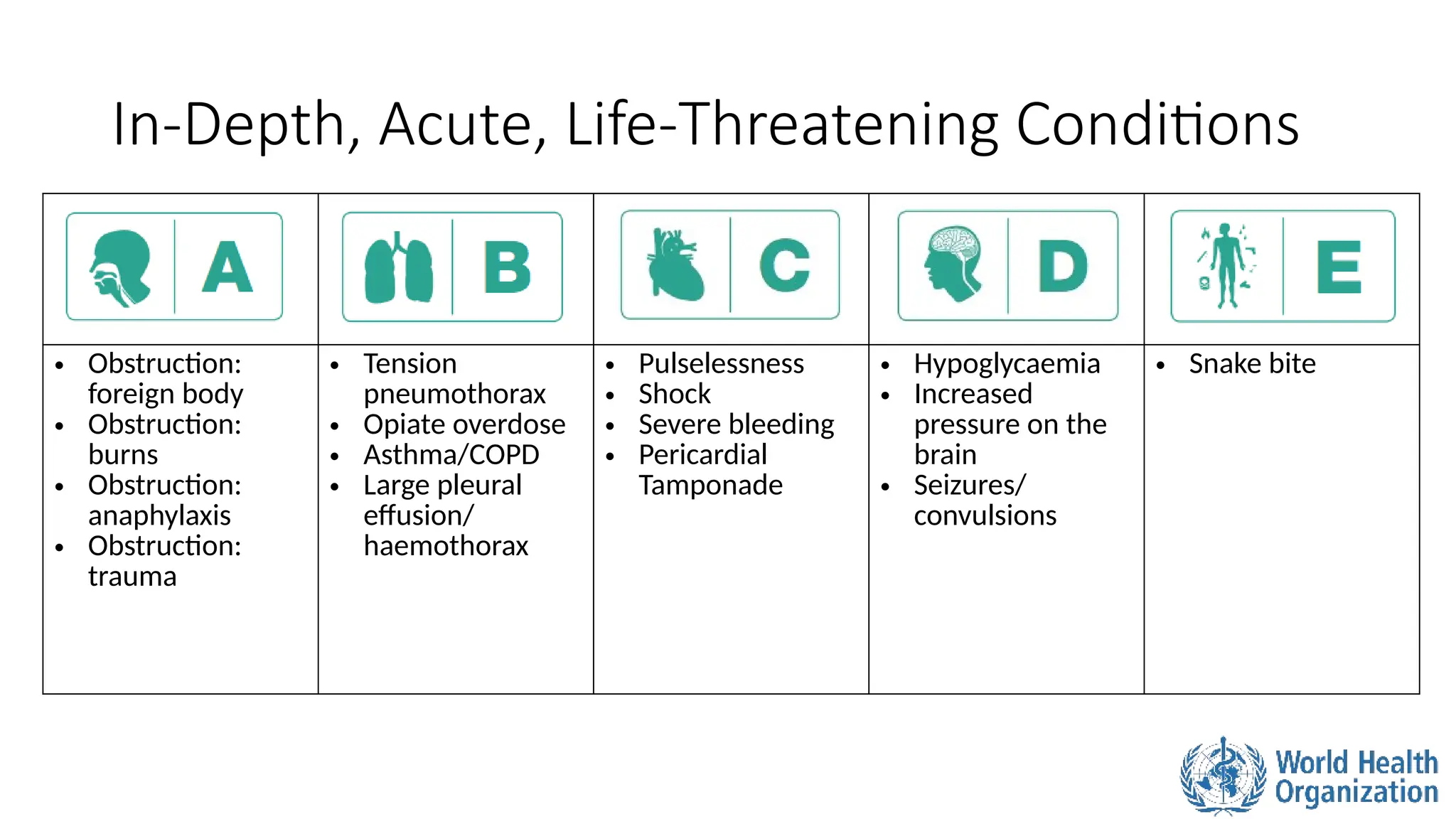
• Obstruction:
foreign body
• Obstruction:
burns
• Obstruction:
anaphylaxis
• Obstruction:
trauma
• Tension
pneumothorax
• Opiate overdose
• Asthma/COPD
• Large pleural
effusion/
haemothorax
• Pulselessness
• Shock
• Severe bleeding
• Pericardial
Tamponade
• Hypoglycaemia
• Increased
pressure on the
brain
• Seizures/
convulsions
• Snake bite
In-Depth, Acute, Life-Threatening Conditions
If you find a problem with any of the ABCDEs:
STOP
CORRECT the problem
then
GO BACK to the beginning and REASSESS the ABCDEs again
!
Remember
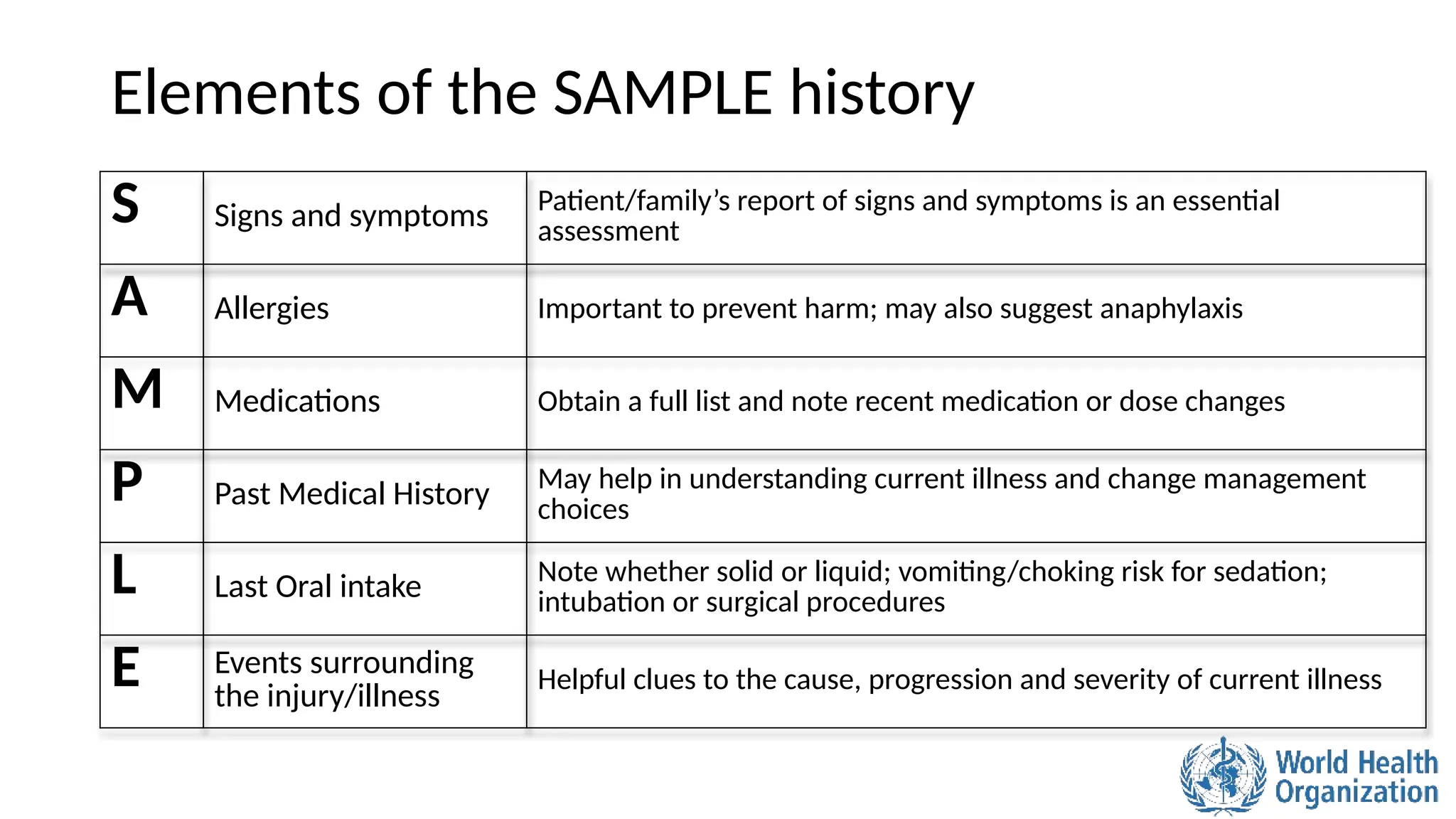
Elements of the SAMPLE history
S Signs and symptoms Patient/family’s report of signs and symptoms is an essential
assessment
A Allergies Important to prevent harm; may also suggest anaphylaxis
M Medications Obtain a full list and note recent medication or dose changes
P Past Medical History May help in understanding current illness and change management
choices
L Last Oral intake Note whether solid or liquid; vomiting/choking risk for sedation;
intubation or surgical procedures
E Events surrounding
the injury/illness
Helpful clues to the cause, progression and severity of current illness

Emergency Assessment ABCDE and its importance.pptx

  • 1.
  • 2.
    Why the ABCDEapproach?
  • 3.
    What is aSAMPLE history? • Categories of questions to obtain a patient’s history • Signs and Symptoms • Allergies • Medications • Past medical history • Last oral intake • Events • Immediately follows the ABCDE approach • Allows providers to easily communicate Goal: • Rapidly gather history critical to the management of the acutely ill patient
  • 4.
    ABCDE: Initial Approach ■The most important step is to stay safe! ■ Scene safety – Fire – Motor vehicle crash – Building collapse – Chemical spill – Violence – Infections disease ■ Personal Protective equipment – Gloves – Gown – Mask – Goggles – Hand washing Personal Protective Equipment
  • 5.
    Safety considerations Scene safety Scenehazards Violence Infectious disease risk Use personal protective equipment Consider appropriate PPE for situation Gloves, eye protection, gown and mask Cleaning and decontamination Use PPE and wash your hands before and after every patient contact (or alcohol gel cleanser) Clean/disinfect surfaces Refer to local decontamination protocols for chemical exposures Ask for help early Multiple patients Make arrangements if transfer is needed Know who to call for infectious outbreaks or hazardous exposures
  • 6.
    ABCDE Approach: Elements •Breathing plus oxygen if needed: • Ensure adequate movement of air into the lungs • Airway with cervical spine immobilization: • Check for obstruction • If trauma-immobilize cervical spine • Circulation with bleeding control and IV fluids • Determine if there is adequate perfusion • Check for life-threatening bleeding
  • 7.
    ABCDE Approach: Elements •Disability: AVPU/GCS, pupils and glucose • Assess and protect brain and spinal functions • Exposure and keep warm • Identify all injuries and environmental threats • Avoid hypothermia This stepwise approach is designed to ensure that life-threatening conditions are identified and treated early, in order of priority. A problem discovered (A-B-C-D-E) must be addressed immediately before moving on to the next step. !
  • 8.
    REMEMBER… Always check forsigns of trauma in each of the ABCDE sections, and reference the trauma module as needed.
  • 9.
  • 10.
    Airway Management • Ifthe patient is unconscious and not breathing normally: • If no concern for trauma: open airway using HEAD-TILT/CHIN-LIFT manoeuvre • If trauma suspected: maintain c-spine immobilization and use JAW-THRUST manoeuvre • Consider placing an AIRWAY DEVICE to keep the airway open • Oropharyngeal airway • Nasopharyngeal airway Adult jaw thrust
  • 11.
    Airway Management: Choking •If foreign body is suspected: • Visible foreign body: carefully REMOVE IT • If the patient is able to cough or make noise, keep the patient calm • ENCOURAGE to cough • If the patient is choking (unable to cough/make sounds) use age-appropriate CHEST THRUSTS/ABDOMINAL THRUSTS/ BACK BLOWS • If the patient becomes unconscious while choking: follow CPR PROTOCOLS Chest thrust in adult Abdominal thrust in late pregnancy Back blows in infant Chest thrust in infant
  • 12.
    Airway Management: • Ifsecretions are present: • SUCTION airway or wipe clean • Consider RECOVERY POSITION if the rest of the ABCDE is normal and no trauma • If the patient has swelling, hives, or stridor, consider a severe allergic reaction (anaphylaxis) • Give intramuscular ADRENALINE • Allow patient to stay in position of comfort • Prepare for HANDOVER/TRANSFER to a center capable of advanced airway management
  • 13.
  • 14.
    Breathing: Assessment • Look,listen and feel to see if the patient is breathing • Assess if the breathing is very fast, very slow or very shallow • Look for increased work of breathing • Accessory muscle work • Chest indrawing • Nasal flaring • Abnormal chest wall movement • Listen for abnormal breath sounds • REMEMBER with severe wheezes there may be no audible breath sounds because of severe airway narrowing !
  • 15.
    Breathing: Assessment • Listento see if breath sounds are equal • Check for the absence of breath sounds on one side • If dull sound with percussion to the same side • THINK large pleural effusion or haemothroax • If also hypotension, distended neck veins or tracheal shift • THINK tension pneumothorax • Check oxygen saturation
  • 16.
    Breathing: Management • Ifunconscious with abnormal breathing, perform BAG-VALVE-MASK-VENTILATION with OXYGEN and follow CPR PROTOCOLS • If not breathing adequately (too slow or too shallow) begin BAG-VALVE-MASK-VENTILATION with OXYGEN • If oxygen is not immediately available, do not delay ventilation • Plan for immediate TRANSFER for airway management • If breathing fast or hypoxia, give OXYGEN • If wheezing, give SALBUTAMOL • If concern for anaphylaxis, give intramuscular ADRENALINE • If concern for tension pneumothorax, perform NEEDLE DECOMPRESSION, give OXYGEN, give IV FLUIDS • Plan for immediate transfer for chest tube • If concern for pleural effusion, haemothorax, give OXYGEN • Plan for immediate transfer for chest tube • If cause unknown, consider trauma !
  • 17.
  • 18.
    Circulation: Assessment • Look,listen and feel for signs of poor perfusion • Cool, moist extremities • Delayed capillary refill • Diaphoresis • Low blood pressure • Tachypnoea • Tachycardia • Absent pulses
  • 19.
    Circulation: Assessment • Lookfor internal and external signs of bleeding • Chest • Abdomen • From stomach or intestines • Pelvic fracture • Femur Fracture • From wounds • Check for pericardial tamponade • Hypotension • Distended neck veins • Muffled heart sounds • Check blood pressure
  • 20.
    Circulation: Management • Forcardiopulmonary arrest follow relevant CPR PROTOCOLS • If poor perfusion: GIVE IV FLUIDS • If external bleeding: APPLY DIRECT PRESSURE • If internal bleeding or pericardial tamponade, REFER to centre with surgical capabilities • If unknown cause, remember trauma • Apply BINDER for pelvic fracture or SPLINT for femur fracture with compromised blood flow
  • 21.
  • 22.
    Disability: Assessment • Assesslevel of consciousness • AVPU or GCS in trauma • Check for low blood glucose (hypoglycaemia) • Check pupils (size, reactivity to light and if equal) • Check movement and sensation in all four limbs • Look for abnormal repetitive movements or shaking • Seizures/convulsions
  • 23.
    Disability: Management • Ifaltered mental status, no trauma, ABCDEs otherwise normal • place in RECOVERY POSITION • If altered mental status, low glucose (<3.5mmol/L) or if unable to check glucose • Give GLUCOSE • If actively seizing • Give BENZODIAZEPINE • If pregnant and seizing • Give MAGNESIUM SULPHATE
  • 24.
    Disability: Management • Ifsmall pupils and slow breathing, consider opioid overdose • Give NALOXONE • If unequal pupils, consider increased pressure in the brain • RAISE HEAD OF BED 30 DEGREES if no concern for spinal injury • Plan for early TRANSFER/REFERRAL • If unknown cause of altered mental status, consider trauma • IMMOBILIZE the cervical spine
  • 25.
  • 26.
    Exposure: Assessment • Examinethe entire body for hidden injuries, rashes, bites or other lesions • Rashes, such as hives, can indicate an allergic reaction • Other rashes can indicate infection
  • 27.
    Exposure: Management • Ifsnake bite is suspected • IMMOBILIZE the extremity • Take a picture of the snake (if possible) to send to referral hospital • General exposure considerations • REMOVE constricting clothing and jewelry • COVER the patient to prevent hypothermia • Acutely ill patients may be unable to regulate body temperature • PREVENT hypothermia • Remove wet clothing and dry patient thoroughly • Respect the patient’s modesty • If cause unknown, remember trauma • LOG ROLL for suspected spinal cord injury
  • 28.
  • 29.
    • Obstruction: foreign body •Obstruction: burns • Obstruction: anaphylaxis • Obstruction: trauma • Tension pneumothorax • Opiate overdose • Asthma/COPD • Large pleural effusion/ haemothorax • Pulselessness • Shock • Severe bleeding • Pericardial Tamponade • Hypoglycaemia • Increased pressure on the brain • Seizures/ convulsions • Snake bite In-Depth, Acute, Life-Threatening Conditions
  • 30.
    If you finda problem with any of the ABCDEs: STOP CORRECT the problem then GO BACK to the beginning and REASSESS the ABCDEs again ! Remember
  • 31.
    Elements of theSAMPLE history S Signs and symptoms Patient/family’s report of signs and symptoms is an essential assessment A Allergies Important to prevent harm; may also suggest anaphylaxis M Medications Obtain a full list and note recent medication or dose changes P Past Medical History May help in understanding current illness and change management choices L Last Oral intake Note whether solid or liquid; vomiting/choking risk for sedation; intubation or surgical procedures E Events surrounding the injury/illness Helpful clues to the cause, progression and severity of current illness

Editor's Notes

  • #6 A - Airway: check for any obstruction to movement of air to the lungs; if trauma--immobilize cervical spine B - Breathing: ensure adequate movement of air into the lungs C - Circulation: evaluate whether there is adequate perfusion to deliver oxygen to the organs; check for signs of life-threatening bleeding
  • #7 D - Disability: assess and protect brain and spine functions E - Exposure: identify all injuries and any environmental threats and avoid hypothermia This stepwise approach is designed to ensure that life-threatening conditions can be identified and treated early, in order of priority. If a problem is discovered in any of these steps (A-B-C-D-E), it must be addressed immediately before moving on to the next step.
  • #9 Ask if the patient if he/she can talk normally?- if YES, the airway is open If the patient cannot talk at all – Look to see if the chest wall is moving and Listen to see if there is air movement from mouth or nose If the patient cannot talk normally – Listen for abnormal sounds suggesting obstruction (stridor/grunting/snoring) Look and Listen for fluid (such as blood, vomit) in the airway Look for foreign body, abnormal swelling around the airway and altered mental status Look to see if patient is unable to swallow saliva or drooling
  • #10 If the patient is unconscious and not breathing normally: If no concern for trauma: open airway using HEAD-TILT/CHIN-LIFT manoeuvre If trauma suspected: maintain cervical spine immobilization and open the airway using JAW-THRUST manoeuvre Consider placing an AIRWAY DEVICE to keep the airway open: Oropharyngeal airway Nasopharyngeal airway Image: Original Tein Jung Illustration 2017.
  • #11 If a foreign body is suspected: if the object is visible: REMOVE IT carefully if the patient is able to cough or make noise: keep the patient calm and ENCOURAGE to cough If the patient is choking (unable to cough, not making sounds): use age-appropriate CHEST THRUSTS/ABDOMINAL THRUSTS/BACK BLOWS If the patient becomes unconscious while choking: follow relevant CPR PROTOCOLS Images: Original Tein Jung Illustration 2017.
  • #12 If secretions are present: SUCTION airway or wipe clean Consider placing patient in the RECOVERY POSITION if the rest of the ABCDE is normal and no trauma If the patient has swelling, hives, or stridor consider a severe allergic reaction (anaphylaxis), Give intramuscular ADRENALINE Allow the patient to stay in position of comfort and prepare for rapid HANDOVER/TRANSFER to a center capable of advanced airway management.
  • #14 Look, listen, and feel to see if the patient is breathing Assess if the breathing is very fast, very slow or very shallow Look for signs of increased work of breathing (accessory muscle use, chest indrawing, nasal flaring) or abnormal chest wall movement Listen for abnormal breath sounds (wheezing or crackles)
  • #15 Listen to see if breath sounds are equal on both sides. • Check for the absence of breath sounds and dull sounds with percussion on one side (large pleural effusion or haemothorax). If there are no breath sounds on one side, and hypotension, check for distended neck veins or a shifted trachea (tension pneumothorax). • Check oxygen saturation with a pulse oximeter when available.
  • #16 • If unconscious with abnormal breathing, start bag-valve-mask ventilation and follow relevant CPR protocols. • If not breathing adequately (too slow for age or too shallow), begin bag-valve-mask ventilation with oxygen If oxygen not immediately available, DO NOT DELAY ventilation. Start ventilation while oxygen is being prepared. Plan for rapid handover/transfer. • If breathing fast or hypoxic, give oxygen • If wheezing, give salbutamol. Repeat salbutamol as needed. • If concern for severe allergic reaction (anaphylaxis), give intramuscular adrenaline. • If concern for tension pneumothorax, perform needle decompression immediately and give IV fluids and oxygen. Plan for rapid handover/ transfer. • If concern for large pleural effusion or haemothorax, give oxygen and plan for rapid handover/transfer. • If cause unknown, remember the possibility of trauma [See TRAUMA]
  • #18 Look and feel for signs of poor perfusion Cool, moist extremities Delayed capillary refill greater than 3 seconds Low blood pressure Tachypnoea, Tachycardia Absent pulses
  • #19 • Look for both external AND internal bleeding, including bleeding: – into chest; – into abdomen; – from stomach or intestine; – from pelvic or femur fracture; – from wounds. • Look for hypotension, distended neck veins and muffed heart sounds that might indicate pericardial tamponade.
  • #20 For cardiopulmonary arrest, follow relevant CPR protocols. • If signs of poor perfusion, give IV fuids and oxygen and: – For external bleeding, apply direct pressure or use other technique to control. – If internal bleeding or pericardial tamponade are suspected, refer rapidly to a centre with surgical capabilities. -If cause unknown, remember the possibility of trauma: Bind pelvic fractures and splint femur fractures, or any fracture with compromised blood flow.
  • #22 • Assess level of consciousness with the AVPU scale (Alert, Voice, Pain, Unresponsive) or in trauma cases, the Glasgow Coma Scale (GCS). • Always check glucose level in the confused or unconscious patient. • Check for pupil size, whether the pupils are equal, and if pupils are reactive to light. • Check movement and sensation in all four limbs. • Look for abnormal repetitive movements or shaking on one or both sides of the body (seizure/convulsion).
  • #23 If altered mental status and o evidence of trauma, place in recovery position If glucose low (<3.5 mmol/L) or glucose test not available and patient has altered mental status, give glucose For active seizures, give a benzodiazepine If pregnant and having seizures, give magnesium sulfate Images: Original Tein Jung Illustration 2017.
  • #24  If pupils are small and breathing is slow, consider opioid overdose Give NALOXONE If pupils are not equal, consider increased pressure on the brain Raise head of bead 30 degrees Plan for rapid transfer If cause unknown, consider trauma
  • #27 If snake bite is suspected, immobilize the limb. Take a picture of the snake if possible from a distance and send with patient. Do not risk additional bites to catch/kill snake. Remove constricting clothing and all jewelry. Cover the patient as soon as possible to prevent hypothermia. Acutely ill patients have difficulty regulating body temperature. Remove any wet clothes and dry patient thoroughly. • Respect the patient and protect modesty during exposure. If cause unknown, remember the possibility of trauma: Log roll if suspected spinal injury
  • #29  A: Obstruction due to a Foreign Body Obstruction due to Burns Obstruction due to Trauma Obstruction due to Severe Allergic Reaction (Anaphylaxis) B: Tension Pneumothorax Suspected opiate overdose Asthma/COPD Large Pleural Effusion C: Pulselessness Shock Severe Bleeding (Haemorrhage) Pericardial Tamponade D Hypoglycaemia Increased Pressure on the Brain Seizure/convulsion E Snake bite
  • #30 If you find a problem with any of the ABCDE STOP CORRECT the problem, then GO BACK to the beginning and RE-ASSESS the ABCDE again
  • #31 The SAMPLE approach is a standard way of gathering the key history related to an illness or injury. Sources of information include: the ill/injured person, family members, friends, bystanders, or prior providers. SAMPLE stands for: S: Signs and symptoms The patient/family’s report of signs and symptoms is essential to assessment and management. A: Allergies It is important to be aware of medication allergies so that treatments do not cause harm. Allergies may also suggest anaphylaxis as the cause of acute symptoms. M: Medications Obtain a full list of medications that the person currently takes and ask about recent medication or dose changes. These may affect treatment decisions and are important to understanding the person’s chronic conditions. P: Past medical history: Knowing prior medical conditions may help in understanding the current illness and may change management choices. L: Last oral intake Record the time of last oral intake and whether solid or liquid. A full stomach increases the risk of vomiting and subsequent choking, especially with sedation or intubation that might be required for surgical procedures. E: Events surrounding the injury or illness: Knowing the circumstances around the injury or illness may be helpful in understanding the cause, progression and severity