KEY FINDINGS
EMBODIED CARBON
IN TRADE:
CARBON LOOPHOLE
BY CATRINA RORKE AND GREG BERTELSEN
November 2022
Embodied Carbon in Trade
2
A B O U T T H E A U T H O R S
Greg Bertelsen is CEO of the Climate Leadership Council.
Previously, Mr. Bertelsen served as an analyst and advisor
to manufacturers, utilities, and other industries on energy and
environmental policy at Siemens AG and as Senior Director
of Energy and Resources Policy at the National Association
of Manufacturers (NAM).
Catrina Rorke is executive director of the Center for
Climate and Trade and senior vice president for policy and
research at the Climate Leadership Council. Previously,
Ms. Rorke served as Director of Energy Policy at the R
Street Institute where she founded the institute’s energy and
environment program.
The Climate Leadership Council supported and advised the production of Embodied Carbon in Trade: Carbon Loophole,
a November 2022 report from Global Efficiency Intelligence by authors Ali Hasanbeigi and Aldy Darwili. The following is
a summary of the study’s key findings.
Embodied Carbon in Trade
3
K E Y F I N D I N G S :
C A R B O N LO O P H O L E
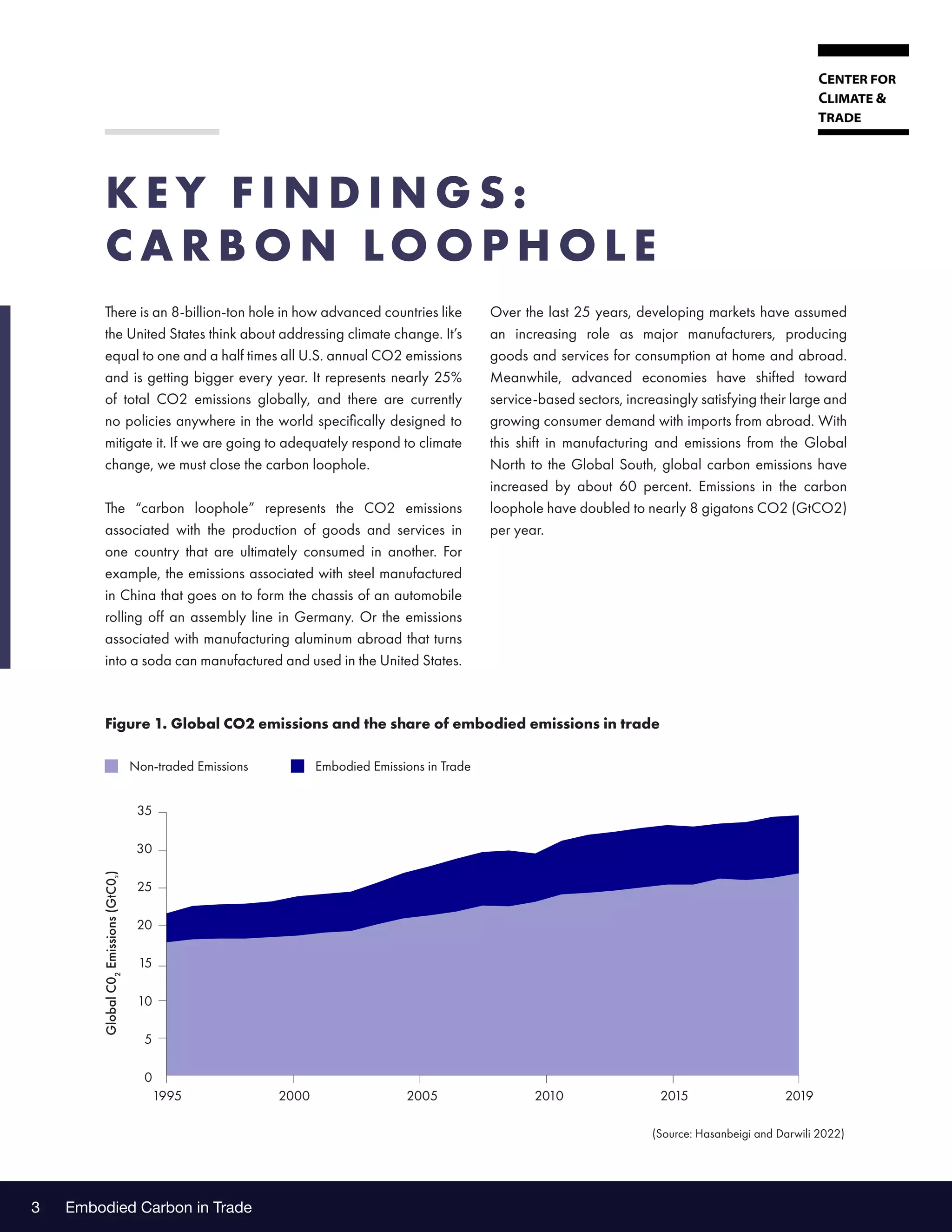
Over the last 25 years, developing markets have assumed
an increasing role as major manufacturers, producing
goods and services for consumption at home and abroad.
Meanwhile, advanced economies have shifted toward
service-based sectors, increasingly satisfying their large and
growing consumer demand with imports from abroad. With
this shift in manufacturing and emissions from the Global
North to the Global South, global carbon emissions have
increased by about 60 percent. Emissions in the carbon
loophole have doubled to nearly 8 gigatons CO2 (GtCO2)
per year.
There is an 8-billion-ton hole in how advanced countries like
the United States think about addressing climate change. It’s
equal to one and a half times all U.S. annual CO2 emissions
and is getting bigger every year. It represents nearly 25%
of total CO2 emissions globally, and there are currently
no policies anywhere in the world specifically designed to
mitigate it. If we are going to adequately respond to climate
change, we must close the carbon loophole.
The “carbon loophole” represents the CO2 emissions
associated with the production of goods and services in
one country that are ultimately consumed in another. For
example, the emissions associated with steel manufactured
in China that goes on to form the chassis of an automobile
rolling off an assembly line in Germany. Or the emissions
associated with manufacturing aluminum abroad that turns
into a soda can manufactured and used in the United States.
Figure 1. Global CO2 emissions and the share of embodied emissions in trade
35
30
25
20
15
10
5
0
1995 2000 2005 2010 2015 2019
Global
C0
2
Emissions
(GtC0
²
)
Non-traded Emissions Embodied Emissions in Trade
(Source: Hasanbeigi and Darwili 2022)
Embodied Carbon in Trade
4
In the context of meaningfully lowering global greenhouse
gas emissions, the carbon loophole highlights a major
shortcoming in traditional international climate accounting
and raises questions about how emissions associated with
international trade should be accounted for. A convention
of international climate diplomacy is for each country to
account for emissions on a production basis; all countries
track and report the emissions released within their borders.
But as the most climate-ambitious countries tend to be those
that import the most embodied emissions from abroad, and
the least ambitious national reduction commitments tend
to be from countries whose net emissions exports are the
greatest, the loophole shows us that our carbon accounting
conventions may be undermining global emissions
mitigation efforts.
T RAC K I N G CA R B O N F LO WS
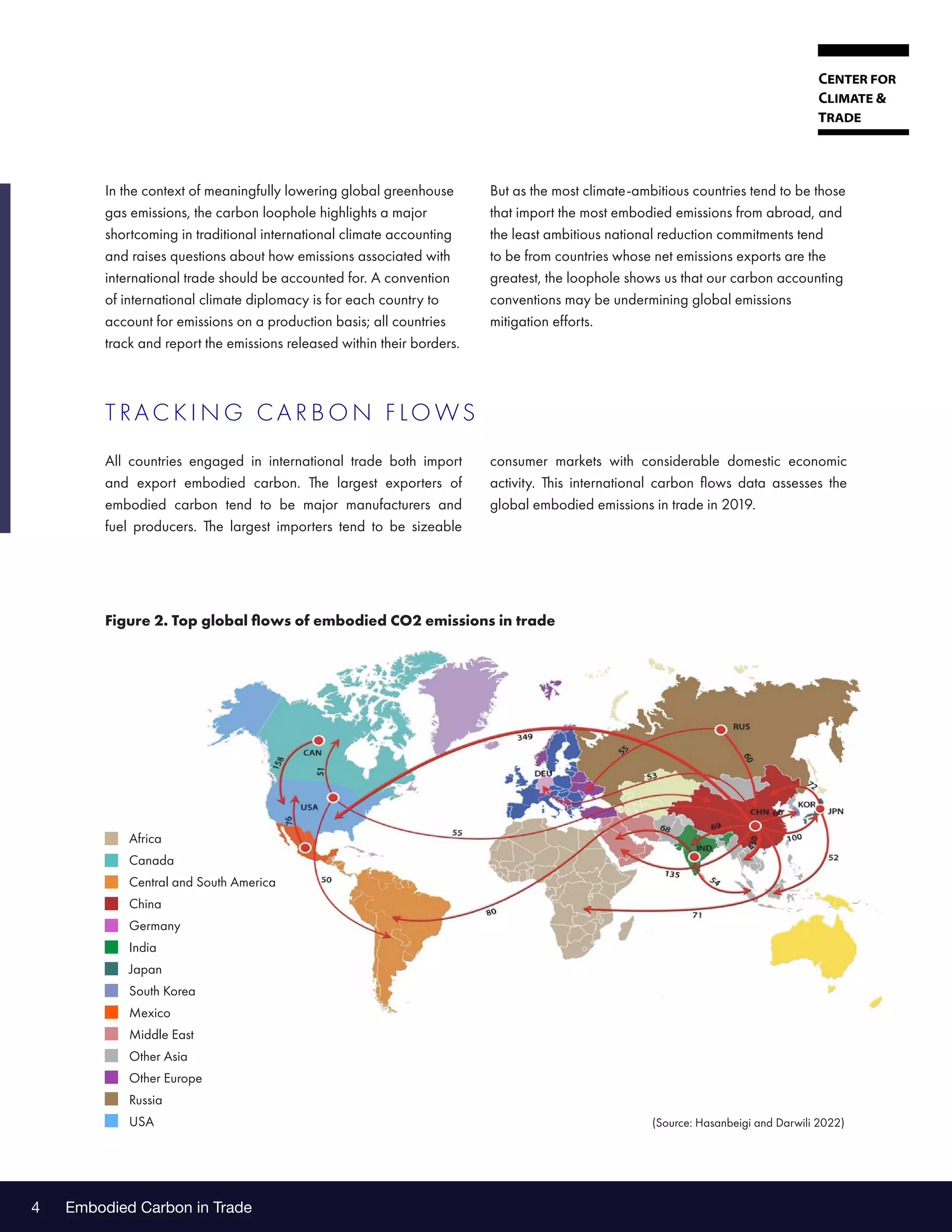
All countries engaged in international trade both import
and export embodied carbon. The largest exporters of
embodied carbon tend to be major manufacturers and
fuel producers. The largest importers tend to be sizeable
Figure 2. Top global flows of embodied CO2 emissions in trade
consumer markets with considerable domestic economic
activity. This international carbon flows data assesses the
global embodied emissions in trade in 2019.
(Source: Hasanbeigi and Darwili 2022)
Africa
Canada
Central and South America
China
Germany
India
Japan
South Korea
Mexico
Middle East
Other Asia
Other Europe
Russia
USA
Embodied Carbon in Trade
5
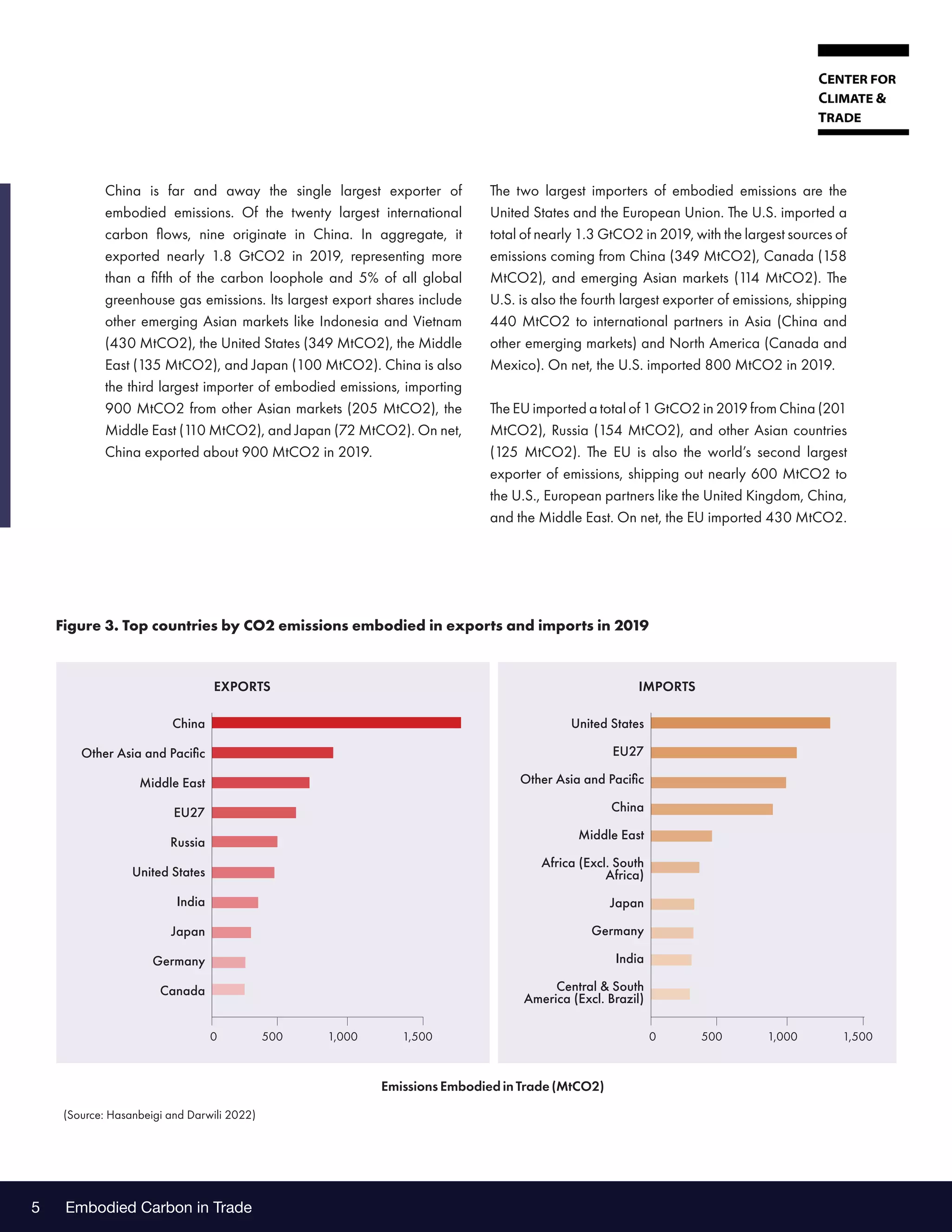
China is far and away the single largest exporter of
embodied emissions. Of the twenty largest international
carbon flows, nine originate in China. In aggregate, it
exported nearly 1.8 GtCO2 in 2019, representing more
than a fifth of the carbon loophole and 5% of all global
greenhouse gas emissions. Its largest export shares include
other emerging Asian markets like Indonesia and Vietnam
(430 MtCO2), the United States (349 MtCO2), the Middle
East (135 MtCO2), and Japan (100 MtCO2). China is also
the third largest importer of embodied emissions, importing
900 MtCO2 from other Asian markets (205 MtCO2), the
Middle East (1
10 MtCO2), and Japan (72 MtCO2). On net,
China exported about 900 MtCO2 in 2019.
The two largest importers of embodied emissions are the
United States and the European Union. The U.S. imported a
total of nearly 1.3 GtCO2 in 2019, with the largest sources of
emissions coming from China (349 MtCO2), Canada (158
MtCO2), and emerging Asian markets (1
14 MtCO2). The
U.S. is also the fourth largest exporter of emissions, shipping
440 MtCO2 to international partners in Asia (China and
other emerging markets) and North America (Canada and
Mexico). On net, the U.S. imported 800 MtCO2 in 2019.
The EU imported a total of 1 GtCO2 in 2019 from China (201
MtCO2), Russia (154 MtCO2), and other Asian countries
(125 MtCO2). The EU is also the world’s second largest
exporter of emissions, shipping out nearly 600 MtCO2 to
the U.S., European partners like the United Kingdom, China,
and the Middle East. On net, the EU imported 430 MtCO2.
Figure 3. Top countries by CO2 emissions embodied in exports and imports in 2019
(Source: Hasanbeigi and Darwili 2022)
China
Other Asia and Pacific
Middle East
EU27
Russia
United States
India
Japan
Germany
Canada
0 500 1,000 1,500
Emissions Embodied in Trade (MtCO2)
United States
EU27
Other Asia and Pacific
China
Middle East
Africa (Excl. South
Africa)
Japan
Germany
India
Central & South
America (Excl. Brazil)
0 500 1,000 1,500
EXPORTS IMPORTS
Embodied Carbon in Trade
6
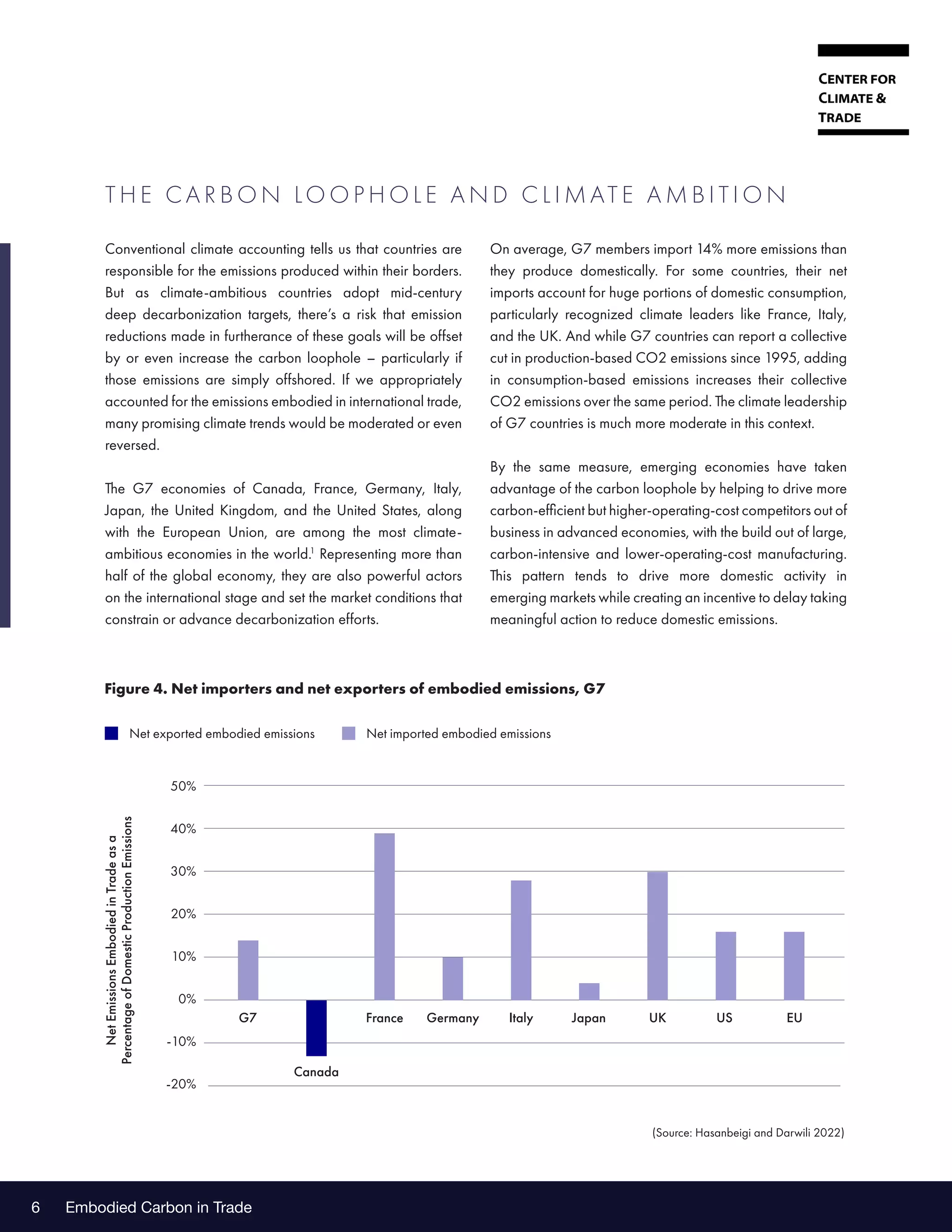
T H E CA R B O N LO O P H O L E A N D C L I MAT E A M B I T I O N
On average, G7 members import 14% more emissions than
they produce domestically. For some countries, their net
imports account for huge portions of domestic consumption,
particularly recognized climate leaders like France, Italy,
and the UK. And while G7 countries can report a collective
cut in production-based CO2 emissions since 1995, adding
in consumption-based emissions increases their collective
CO2 emissions over the same period. The climate leadership
of G7 countries is much more moderate in this context.
By the same measure, emerging economies have taken
advantage of the carbon loophole by helping to drive more
carbon-efficient but higher-operating-cost competitors out of
business in advanced economies, with the build out of large,
carbon-intensive and lower-operating-cost manufacturing.
This pattern tends to drive more domestic activity in
emerging markets while creating an incentive to delay taking
meaningful action to reduce domestic emissions.
Conventional climate accounting tells us that countries are
responsible for the emissions produced within their borders.
But as climate-ambitious countries adopt mid-century
deep decarbonization targets, there’s a risk that emission
reductions made in furtherance of these goals will be offset
by or even increase the carbon loophole – particularly if
those emissions are simply offshored. If we appropriately
accounted for the emissions embodied in international trade,
many promising climate trends would be moderated or even
reversed.
The G7 economies of Canada, France, Germany, Italy,
Japan, the United Kingdom, and the United States, along
with the European Union, are among the most climate-
ambitious economies in the world.1
Representing more than
half of the global economy, they are also powerful actors
on the international stage and set the market conditions that
constrain or advance decarbonization efforts.
50%
40%
30%
20%
10%
0%
-10%
-20%
Net
Emissions
Embodied
in
Trade
as
a
Percentage
of
Domestic
Production
Emissions
(Source: Hasanbeigi and Darwili 2022)
Figure 4. Net importers and net exporters of embodied emissions, G7
Net exported embodied emissions
G7
Canada
France Germany US
UK
Japan
Italy EU
Net imported embodied emissions
Embodied Carbon in Trade
7
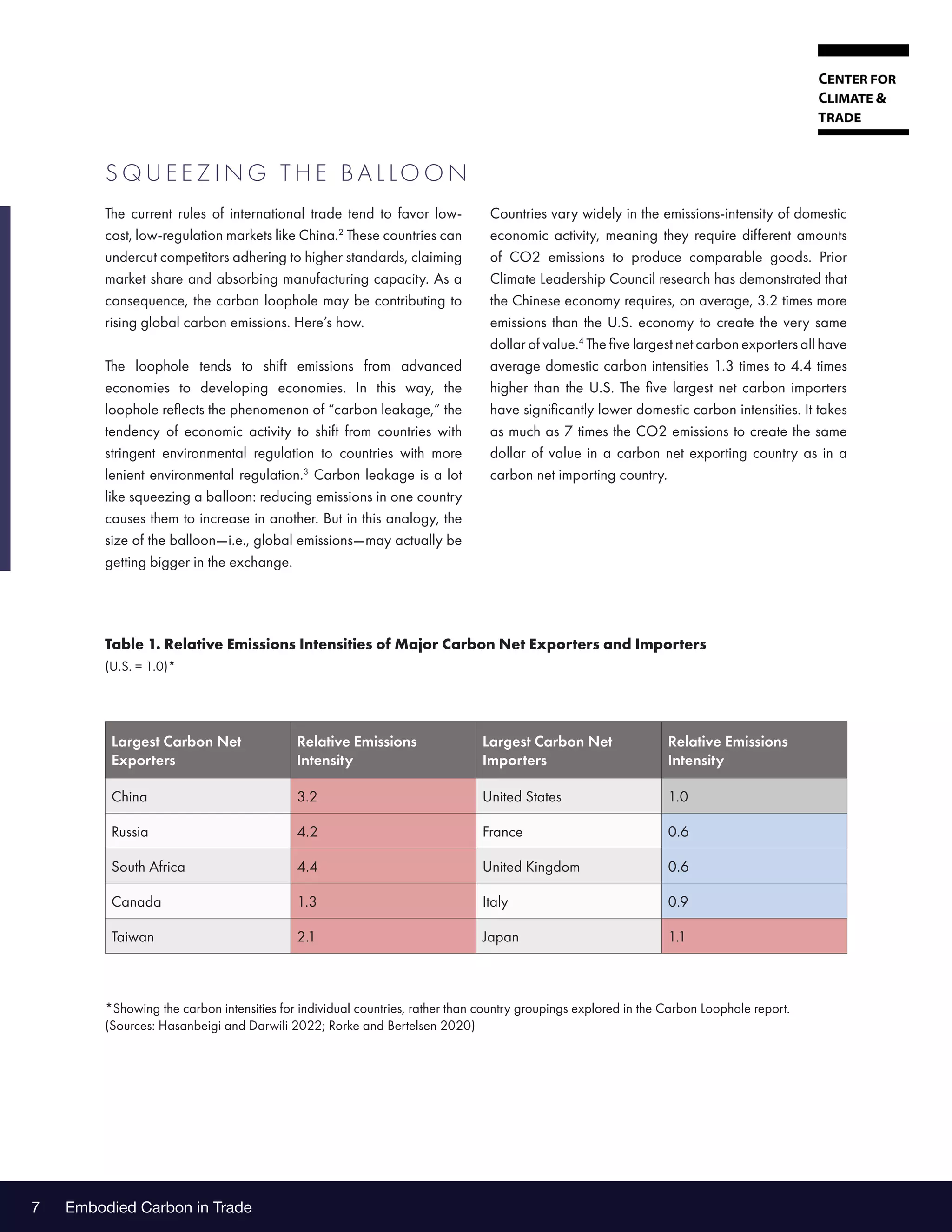
S Q U E E Z I N G T H E B A L LO O N
The current rules of international trade tend to favor low-
cost, low-regulation markets like China.2
These countries can
undercut competitors adhering to higher standards, claiming
market share and absorbing manufacturing capacity. As a
consequence, the carbon loophole may be contributing to
rising global carbon emissions. Here’s how.
The loophole tends to shift emissions from advanced
economies to developing economies. In this way, the
loophole reflects the phenomenon of “carbon leakage,” the
tendency of economic activity to shift from countries with
stringent environmental regulation to countries with more
lenient environmental regulation.3
Carbon leakage is a lot
like squeezing a balloon: reducing emissions in one country
causes them to increase in another. But in this analogy, the
size of the balloon—i.e., global emissions—may actually be
getting bigger in the exchange.
Countries vary widely in the emissions-intensity of domestic
economic activity, meaning they require different amounts
of CO2 emissions to produce comparable goods. Prior
Climate Leadership Council research has demonstrated that
the Chinese economy requires, on average, 3.2 times more
emissions than the U.S. economy to create the very same
dollar of value.4
The five largest net carbon exporters all have
average domestic carbon intensities 1.3 times to 4.4 times
higher than the U.S. The five largest net carbon importers
have significantly lower domestic carbon intensities. It takes
as much as 7 times the CO2 emissions to create the same
dollar of value in a carbon net exporting country as in a
carbon net importing country.
Table 1. Relative Emissions Intensities of Major Carbon Net Exporters and Importers
(U.S. = 1.0)*
Largest Carbon Net
Exporters
Relative Emissions
Intensity
Largest Carbon Net
Importers
Relative Emissions
Intensity
China 3.2 United States 1.0
Russia 4.2 France 0.6
South Africa 4.4 United Kingdom 0.6
Canada 1.3 Italy 0.9
Taiwan 2.1 Japan 1.1
*Showing the carbon intensities for individual countries, rather than country groupings explored in the Carbon Loophole report.
(Sources: Hasanbeigi and Darwili 2022; Rorke and Bertelsen 2020)
Embodied Carbon in Trade
8
If manufacturing production in the United States is displaced
by more carbon intensive manufacturing production abroad,
U.S. emissions will fall but global emissions will increase.
This phenomenon of carbon leakage driving up global
emissions is a consequence of a globalized economy, the
large differences in the carbon efficiencies of advanced and
emerging markets, and the imperfections inherent in focusing
exclusively on reducing emissions within a country’s own
borders. For climate ambitious countries to bend the curve
on global emissions, they need a new policy approach that
squarely addresses the carbon loophole.
G LO B A L CO O P E RAT I O N
The carbon loophole is hampering global decarbonization
efforts. Achieving net-zero emissions on domestic production
can be more than offset by importing goods and services
from higher-emitting countries for domestic consumption.
Economies like China and Russia exploit the carbon
loophole by allowing low domestic environmental standards
to give their firms a competitive edge over rivals in cleaner
markets, while taking a pass on setting and following
through on meaningful domestic emission reduction targets.5
The U.S. and EU have been enablers in this practice by
pursuing climate policies that myopically focus on reducing
their domestic emissions without ensuring those emissions
aren’t simply being sent abroad. And for the poorest of
countries, little thought in the current paradigm is given to
how they will be able to improve the living standards of their
citizens, inevitably requiring higher domestic emissions while
ensuring that global emissions continue to fall.
A new paradigm can improve global emissions mitigation
efforts; benefit countries and firms leading the way in
innovation and decarbonization investments; deleverage
China and Russia; and give emerging markets better
access to advanced economies, accelerated economic
development, and rapid decarbonization.
The most advanced economies in the G7 represent about
40% of total emissions imports and over 50% of the global
economy, giving them enormous leverage to shrink the
carbon loophole.6,7
Working together, these and other
climate-ambitious countries can mobilize new policies
and their trade relationships to appropriately value lower-
carbon goods and services, shift economic activity to the
most carbon efficient markets and producers, support least
developed countries, and cut global emissions.
The U.S. economy is 40% more carbon efficient than
the world average. If the U.S. were able to ensure that
imports matched domestic carbon intensity—by onshoring
productionorselectingforcleanerimports—globalemissions
could fall by 600 MtCO2.8
If all members of the G7 were
able to do the same, implementing policies that favor lower-
carbon goods on a par with domestic carbon intensity,
we could cut global annual CO2 emissions by more than
1.8 GtCO2, a 5.5% cut in total global CO2 emissions.9
Improving the competitive position of the cleanest firms in
the U.S. and in other G7 economies can increase investment
and manufacturing jobs and drive down emissions.
Embodied Carbon in Trade
9
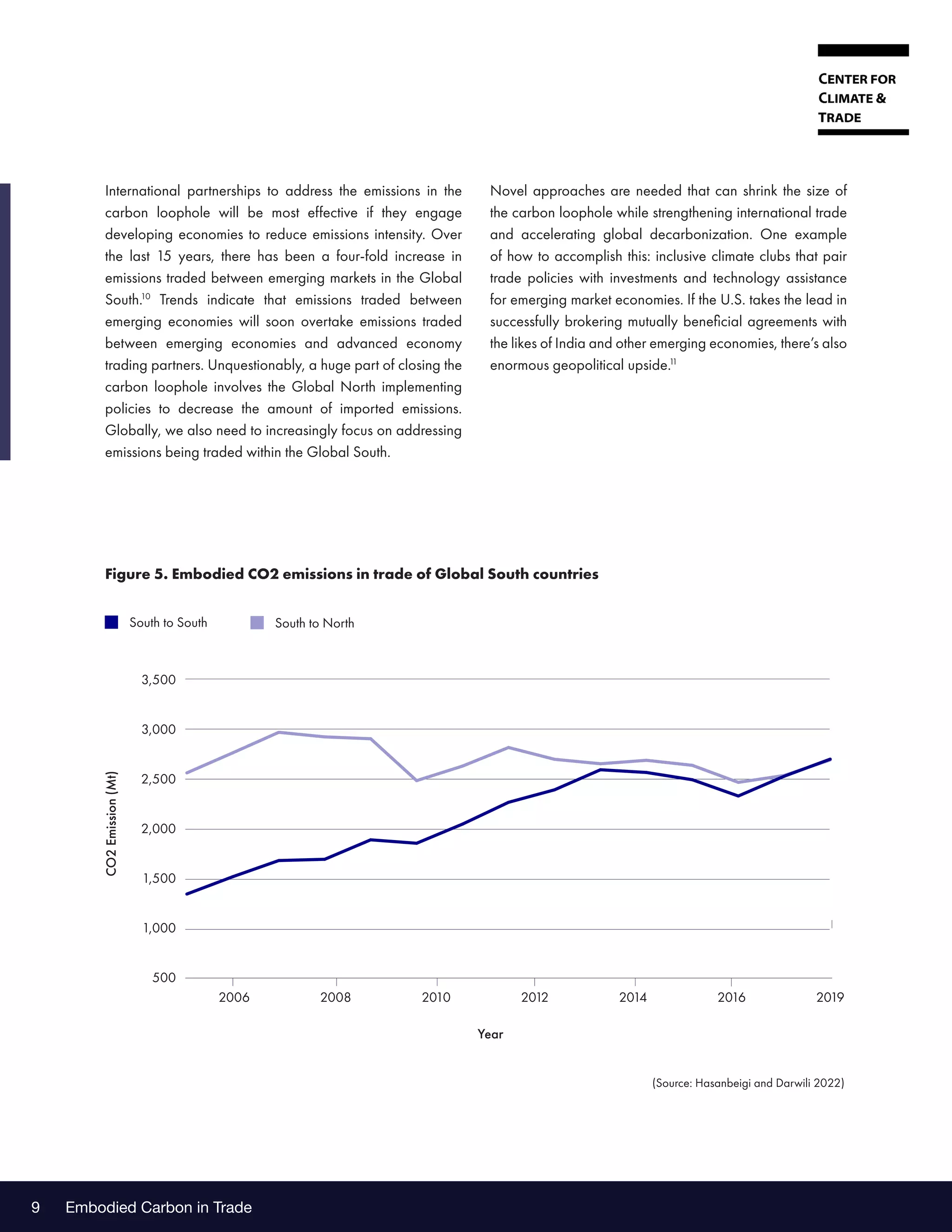
International partnerships to address the emissions in the
carbon loophole will be most effective if they engage
developing economies to reduce emissions intensity. Over
the last 15 years, there has been a four-fold increase in
emissions traded between emerging markets in the Global
South.10
Trends indicate that emissions traded between
emerging economies will soon overtake emissions traded
between emerging economies and advanced economy
trading partners. Unquestionably, a huge part of closing the
carbon loophole involves the Global North implementing
policies to decrease the amount of imported emissions.
Globally, we also need to increasingly focus on addressing
emissions being traded within the Global South.
Figure 5. Embodied CO2 emissions in trade of Global South countries
3,500
3,000
2,500
2,000
1,500
1,000
500
CO2
Emission
(Mt)
South to South
(Source: Hasanbeigi and Darwili 2022)
South to North
Year
2006 2008 2010 2012 2014 2016 2019
Novel approaches are needed that can shrink the size of
the carbon loophole while strengthening international trade
and accelerating global decarbonization. One example
of how to accomplish this: inclusive climate clubs that pair
trade policies with investments and technology assistance
for emerging market economies. If the U.S. takes the lead in
successfully brokering mutually beneficial agreements with
the likes of India and other emerging economies, there’s also
enormous geopolitical upside.1
1
Embodied Carbon in Trade
10
C O N C LU S I O N
At 8 GtCO2, nearly a fourth of global emissions, the carbon
loophole represents a significant obstacle to meeting global
carbon emissions targets. Flows in the carbon loophole tend
to relocate emissions from the balance sheets of advanced
economies to developing economies whose carbon
emissions continue to increase year-over-year. This is directly
undermining net-zero and deep decarbonization targets in
climate-ambitious advanced economies and exacerbating
emissions trends in the Global South.
The carbon loophole reflects unintended “carbon leakage,”
the tendency of economic activity to shift from areas
of stringent environmental regulation to markets where
environmental standards and other costs are lower. As a
consequence, China and other countries with relatively
high carbon intensities are also the largest net exporters of
carbon; the U.S., EU, and other lower-carbon markets are
the largest net importers.
New policy approaches are necessary to address the
loophole and support global decarbonization. Through
climate and trade policies that value lower-carbon
production across the global supply chain, climate-ambitious
countries can leverage their strong consumer economies
to create market incentives that drive domestic and global
decarbonization. And by partnering with emerging
economies through new trade deals, economic partnerships,
technology and investment access, or multilateral climate
clubs to lower emissions intensities, the carbon loophole can
be further closed.
The carbon loophole sheds light on a major shortcoming
of the conventional approach to determining national
contributions to global emissions. More importantly,
the loophole highlights an enormous opportunity for
policymakers in the U.S. and elsewhere to maximize
current emission reduction policies, create new economic
opportunities for cleaner manufacturers at home, and
strengthen relationships in emerging markets—all in service
of a lower-carbon future.
Embodied Carbon in Trade
11
N O T E S
1 “Climate Action Tracker,” Climate Action Tracker, last updated November 7, 2022, https://climateactiontracker.org/.
2 “China,” Climate Action Tracker, last updated November 3, 2022, https://climateactiontracker.org/countries/china/.
3 “Carbon Leakage,” Climate Action, European Commission Directorate-General for Climate Action, accessed November 1,
2022, https://climate.ec.europa.eu/eu-action/eu-emissions-trading-system-eu-ets/free-allocation/carbon-leakage_en.
4 Catrina Rorke and Greg Bertelsen, America’s Carbon Advantage (Climate Leadership Council, September 2020), https://
clcouncil.org/report/americas-carbon-advantage/.
5 Ibid.
6 Ali Hasanbeigi and Aldy Darwili, Embodied Carbon in Trade (Global Efficiency Intelligence, November 2022).
7 Catrina Rorke, The Case for Climate and Trade (Climate Leadership Council, May 2022), https://clcouncil.org/report/
case-for-climate-and-trade/.
8 Ibid.
9 Ibid.
10 Ali Hasanbeigi and Aldy Darwili, Embodied Carbon in Trade (Global Efficiency Intelligence, November 2022).
1
1 Christopher S. Chivvis and Ethan Kapstein, U.S. Strategy and Economic Statecraft: Understanding the Tradeoffs (Carnegie
Endowment for International Peace, April 28, 2022), https://carnegieendowment.org/2022/04/28/u.s.-strategy-and-
economic-statecraft-understanding-tradeoffs-pub-86995.
1900 M Street NW, Suite 800
Washington, DC 20036
clcouncil.org

Embodied-Carbon-in-Trade_Findings_v5.pdf

  • 1.
    KEY FINDINGS EMBODIED CARBON INTRADE: CARBON LOOPHOLE BY CATRINA RORKE AND GREG BERTELSEN November 2022
  • 2.
    Embodied Carbon inTrade 2 A B O U T T H E A U T H O R S Greg Bertelsen is CEO of the Climate Leadership Council. Previously, Mr. Bertelsen served as an analyst and advisor to manufacturers, utilities, and other industries on energy and environmental policy at Siemens AG and as Senior Director of Energy and Resources Policy at the National Association of Manufacturers (NAM). Catrina Rorke is executive director of the Center for Climate and Trade and senior vice president for policy and research at the Climate Leadership Council. Previously, Ms. Rorke served as Director of Energy Policy at the R Street Institute where she founded the institute’s energy and environment program. The Climate Leadership Council supported and advised the production of Embodied Carbon in Trade: Carbon Loophole, a November 2022 report from Global Efficiency Intelligence by authors Ali Hasanbeigi and Aldy Darwili. The following is a summary of the study’s key findings.
  • 3.
    Embodied Carbon inTrade 3 K E Y F I N D I N G S : C A R B O N LO O P H O L E Over the last 25 years, developing markets have assumed an increasing role as major manufacturers, producing goods and services for consumption at home and abroad. Meanwhile, advanced economies have shifted toward service-based sectors, increasingly satisfying their large and growing consumer demand with imports from abroad. With this shift in manufacturing and emissions from the Global North to the Global South, global carbon emissions have increased by about 60 percent. Emissions in the carbon loophole have doubled to nearly 8 gigatons CO2 (GtCO2) per year. There is an 8-billion-ton hole in how advanced countries like the United States think about addressing climate change. It’s equal to one and a half times all U.S. annual CO2 emissions and is getting bigger every year. It represents nearly 25% of total CO2 emissions globally, and there are currently no policies anywhere in the world specifically designed to mitigate it. If we are going to adequately respond to climate change, we must close the carbon loophole. The “carbon loophole” represents the CO2 emissions associated with the production of goods and services in one country that are ultimately consumed in another. For example, the emissions associated with steel manufactured in China that goes on to form the chassis of an automobile rolling off an assembly line in Germany. Or the emissions associated with manufacturing aluminum abroad that turns into a soda can manufactured and used in the United States. Figure 1. Global CO2 emissions and the share of embodied emissions in trade 35 30 25 20 15 10 5 0 1995 2000 2005 2010 2015 2019 Global C0 2 Emissions (GtC0 ² ) Non-traded Emissions Embodied Emissions in Trade (Source: Hasanbeigi and Darwili 2022)
  • 4.
    Embodied Carbon inTrade 4 In the context of meaningfully lowering global greenhouse gas emissions, the carbon loophole highlights a major shortcoming in traditional international climate accounting and raises questions about how emissions associated with international trade should be accounted for. A convention of international climate diplomacy is for each country to account for emissions on a production basis; all countries track and report the emissions released within their borders. But as the most climate-ambitious countries tend to be those that import the most embodied emissions from abroad, and the least ambitious national reduction commitments tend to be from countries whose net emissions exports are the greatest, the loophole shows us that our carbon accounting conventions may be undermining global emissions mitigation efforts. T RAC K I N G CA R B O N F LO WS All countries engaged in international trade both import and export embodied carbon. The largest exporters of embodied carbon tend to be major manufacturers and fuel producers. The largest importers tend to be sizeable Figure 2. Top global flows of embodied CO2 emissions in trade consumer markets with considerable domestic economic activity. This international carbon flows data assesses the global embodied emissions in trade in 2019. (Source: Hasanbeigi and Darwili 2022) Africa Canada Central and South America China Germany India Japan South Korea Mexico Middle East Other Asia Other Europe Russia USA
  • 5.
    Embodied Carbon inTrade 5 China is far and away the single largest exporter of embodied emissions. Of the twenty largest international carbon flows, nine originate in China. In aggregate, it exported nearly 1.8 GtCO2 in 2019, representing more than a fifth of the carbon loophole and 5% of all global greenhouse gas emissions. Its largest export shares include other emerging Asian markets like Indonesia and Vietnam (430 MtCO2), the United States (349 MtCO2), the Middle East (135 MtCO2), and Japan (100 MtCO2). China is also the third largest importer of embodied emissions, importing 900 MtCO2 from other Asian markets (205 MtCO2), the Middle East (1 10 MtCO2), and Japan (72 MtCO2). On net, China exported about 900 MtCO2 in 2019. The two largest importers of embodied emissions are the United States and the European Union. The U.S. imported a total of nearly 1.3 GtCO2 in 2019, with the largest sources of emissions coming from China (349 MtCO2), Canada (158 MtCO2), and emerging Asian markets (1 14 MtCO2). The U.S. is also the fourth largest exporter of emissions, shipping 440 MtCO2 to international partners in Asia (China and other emerging markets) and North America (Canada and Mexico). On net, the U.S. imported 800 MtCO2 in 2019. The EU imported a total of 1 GtCO2 in 2019 from China (201 MtCO2), Russia (154 MtCO2), and other Asian countries (125 MtCO2). The EU is also the world’s second largest exporter of emissions, shipping out nearly 600 MtCO2 to the U.S., European partners like the United Kingdom, China, and the Middle East. On net, the EU imported 430 MtCO2. Figure 3. Top countries by CO2 emissions embodied in exports and imports in 2019 (Source: Hasanbeigi and Darwili 2022) China Other Asia and Pacific Middle East EU27 Russia United States India Japan Germany Canada 0 500 1,000 1,500 Emissions Embodied in Trade (MtCO2) United States EU27 Other Asia and Pacific China Middle East Africa (Excl. South Africa) Japan Germany India Central & South America (Excl. Brazil) 0 500 1,000 1,500 EXPORTS IMPORTS
  • 6.
    Embodied Carbon inTrade 6 T H E CA R B O N LO O P H O L E A N D C L I MAT E A M B I T I O N On average, G7 members import 14% more emissions than they produce domestically. For some countries, their net imports account for huge portions of domestic consumption, particularly recognized climate leaders like France, Italy, and the UK. And while G7 countries can report a collective cut in production-based CO2 emissions since 1995, adding in consumption-based emissions increases their collective CO2 emissions over the same period. The climate leadership of G7 countries is much more moderate in this context. By the same measure, emerging economies have taken advantage of the carbon loophole by helping to drive more carbon-efficient but higher-operating-cost competitors out of business in advanced economies, with the build out of large, carbon-intensive and lower-operating-cost manufacturing. This pattern tends to drive more domestic activity in emerging markets while creating an incentive to delay taking meaningful action to reduce domestic emissions. Conventional climate accounting tells us that countries are responsible for the emissions produced within their borders. But as climate-ambitious countries adopt mid-century deep decarbonization targets, there’s a risk that emission reductions made in furtherance of these goals will be offset by or even increase the carbon loophole – particularly if those emissions are simply offshored. If we appropriately accounted for the emissions embodied in international trade, many promising climate trends would be moderated or even reversed. The G7 economies of Canada, France, Germany, Italy, Japan, the United Kingdom, and the United States, along with the European Union, are among the most climate- ambitious economies in the world.1 Representing more than half of the global economy, they are also powerful actors on the international stage and set the market conditions that constrain or advance decarbonization efforts. 50% 40% 30% 20% 10% 0% -10% -20% Net Emissions Embodied in Trade as a Percentage of Domestic Production Emissions (Source: Hasanbeigi and Darwili 2022) Figure 4. Net importers and net exporters of embodied emissions, G7 Net exported embodied emissions G7 Canada France Germany US UK Japan Italy EU Net imported embodied emissions
  • 7.
    Embodied Carbon inTrade 7 S Q U E E Z I N G T H E B A L LO O N The current rules of international trade tend to favor low- cost, low-regulation markets like China.2 These countries can undercut competitors adhering to higher standards, claiming market share and absorbing manufacturing capacity. As a consequence, the carbon loophole may be contributing to rising global carbon emissions. Here’s how. The loophole tends to shift emissions from advanced economies to developing economies. In this way, the loophole reflects the phenomenon of “carbon leakage,” the tendency of economic activity to shift from countries with stringent environmental regulation to countries with more lenient environmental regulation.3 Carbon leakage is a lot like squeezing a balloon: reducing emissions in one country causes them to increase in another. But in this analogy, the size of the balloon—i.e., global emissions—may actually be getting bigger in the exchange. Countries vary widely in the emissions-intensity of domestic economic activity, meaning they require different amounts of CO2 emissions to produce comparable goods. Prior Climate Leadership Council research has demonstrated that the Chinese economy requires, on average, 3.2 times more emissions than the U.S. economy to create the very same dollar of value.4 The five largest net carbon exporters all have average domestic carbon intensities 1.3 times to 4.4 times higher than the U.S. The five largest net carbon importers have significantly lower domestic carbon intensities. It takes as much as 7 times the CO2 emissions to create the same dollar of value in a carbon net exporting country as in a carbon net importing country. Table 1. Relative Emissions Intensities of Major Carbon Net Exporters and Importers (U.S. = 1.0)* Largest Carbon Net Exporters Relative Emissions Intensity Largest Carbon Net Importers Relative Emissions Intensity China 3.2 United States 1.0 Russia 4.2 France 0.6 South Africa 4.4 United Kingdom 0.6 Canada 1.3 Italy 0.9 Taiwan 2.1 Japan 1.1 *Showing the carbon intensities for individual countries, rather than country groupings explored in the Carbon Loophole report. (Sources: Hasanbeigi and Darwili 2022; Rorke and Bertelsen 2020)
  • 8.
    Embodied Carbon inTrade 8 If manufacturing production in the United States is displaced by more carbon intensive manufacturing production abroad, U.S. emissions will fall but global emissions will increase. This phenomenon of carbon leakage driving up global emissions is a consequence of a globalized economy, the large differences in the carbon efficiencies of advanced and emerging markets, and the imperfections inherent in focusing exclusively on reducing emissions within a country’s own borders. For climate ambitious countries to bend the curve on global emissions, they need a new policy approach that squarely addresses the carbon loophole. G LO B A L CO O P E RAT I O N The carbon loophole is hampering global decarbonization efforts. Achieving net-zero emissions on domestic production can be more than offset by importing goods and services from higher-emitting countries for domestic consumption. Economies like China and Russia exploit the carbon loophole by allowing low domestic environmental standards to give their firms a competitive edge over rivals in cleaner markets, while taking a pass on setting and following through on meaningful domestic emission reduction targets.5 The U.S. and EU have been enablers in this practice by pursuing climate policies that myopically focus on reducing their domestic emissions without ensuring those emissions aren’t simply being sent abroad. And for the poorest of countries, little thought in the current paradigm is given to how they will be able to improve the living standards of their citizens, inevitably requiring higher domestic emissions while ensuring that global emissions continue to fall. A new paradigm can improve global emissions mitigation efforts; benefit countries and firms leading the way in innovation and decarbonization investments; deleverage China and Russia; and give emerging markets better access to advanced economies, accelerated economic development, and rapid decarbonization. The most advanced economies in the G7 represent about 40% of total emissions imports and over 50% of the global economy, giving them enormous leverage to shrink the carbon loophole.6,7 Working together, these and other climate-ambitious countries can mobilize new policies and their trade relationships to appropriately value lower- carbon goods and services, shift economic activity to the most carbon efficient markets and producers, support least developed countries, and cut global emissions. The U.S. economy is 40% more carbon efficient than the world average. If the U.S. were able to ensure that imports matched domestic carbon intensity—by onshoring productionorselectingforcleanerimports—globalemissions could fall by 600 MtCO2.8 If all members of the G7 were able to do the same, implementing policies that favor lower- carbon goods on a par with domestic carbon intensity, we could cut global annual CO2 emissions by more than 1.8 GtCO2, a 5.5% cut in total global CO2 emissions.9 Improving the competitive position of the cleanest firms in the U.S. and in other G7 economies can increase investment and manufacturing jobs and drive down emissions.
  • 9.
    Embodied Carbon inTrade 9 International partnerships to address the emissions in the carbon loophole will be most effective if they engage developing economies to reduce emissions intensity. Over the last 15 years, there has been a four-fold increase in emissions traded between emerging markets in the Global South.10 Trends indicate that emissions traded between emerging economies will soon overtake emissions traded between emerging economies and advanced economy trading partners. Unquestionably, a huge part of closing the carbon loophole involves the Global North implementing policies to decrease the amount of imported emissions. Globally, we also need to increasingly focus on addressing emissions being traded within the Global South. Figure 5. Embodied CO2 emissions in trade of Global South countries 3,500 3,000 2,500 2,000 1,500 1,000 500 CO2 Emission (Mt) South to South (Source: Hasanbeigi and Darwili 2022) South to North Year 2006 2008 2010 2012 2014 2016 2019 Novel approaches are needed that can shrink the size of the carbon loophole while strengthening international trade and accelerating global decarbonization. One example of how to accomplish this: inclusive climate clubs that pair trade policies with investments and technology assistance for emerging market economies. If the U.S. takes the lead in successfully brokering mutually beneficial agreements with the likes of India and other emerging economies, there’s also enormous geopolitical upside.1 1
  • 10.
    Embodied Carbon inTrade 10 C O N C LU S I O N At 8 GtCO2, nearly a fourth of global emissions, the carbon loophole represents a significant obstacle to meeting global carbon emissions targets. Flows in the carbon loophole tend to relocate emissions from the balance sheets of advanced economies to developing economies whose carbon emissions continue to increase year-over-year. This is directly undermining net-zero and deep decarbonization targets in climate-ambitious advanced economies and exacerbating emissions trends in the Global South. The carbon loophole reflects unintended “carbon leakage,” the tendency of economic activity to shift from areas of stringent environmental regulation to markets where environmental standards and other costs are lower. As a consequence, China and other countries with relatively high carbon intensities are also the largest net exporters of carbon; the U.S., EU, and other lower-carbon markets are the largest net importers. New policy approaches are necessary to address the loophole and support global decarbonization. Through climate and trade policies that value lower-carbon production across the global supply chain, climate-ambitious countries can leverage their strong consumer economies to create market incentives that drive domestic and global decarbonization. And by partnering with emerging economies through new trade deals, economic partnerships, technology and investment access, or multilateral climate clubs to lower emissions intensities, the carbon loophole can be further closed. The carbon loophole sheds light on a major shortcoming of the conventional approach to determining national contributions to global emissions. More importantly, the loophole highlights an enormous opportunity for policymakers in the U.S. and elsewhere to maximize current emission reduction policies, create new economic opportunities for cleaner manufacturers at home, and strengthen relationships in emerging markets—all in service of a lower-carbon future.
  • 11.
    Embodied Carbon inTrade 11 N O T E S 1 “Climate Action Tracker,” Climate Action Tracker, last updated November 7, 2022, https://climateactiontracker.org/. 2 “China,” Climate Action Tracker, last updated November 3, 2022, https://climateactiontracker.org/countries/china/. 3 “Carbon Leakage,” Climate Action, European Commission Directorate-General for Climate Action, accessed November 1, 2022, https://climate.ec.europa.eu/eu-action/eu-emissions-trading-system-eu-ets/free-allocation/carbon-leakage_en. 4 Catrina Rorke and Greg Bertelsen, America’s Carbon Advantage (Climate Leadership Council, September 2020), https:// clcouncil.org/report/americas-carbon-advantage/. 5 Ibid. 6 Ali Hasanbeigi and Aldy Darwili, Embodied Carbon in Trade (Global Efficiency Intelligence, November 2022). 7 Catrina Rorke, The Case for Climate and Trade (Climate Leadership Council, May 2022), https://clcouncil.org/report/ case-for-climate-and-trade/. 8 Ibid. 9 Ibid. 10 Ali Hasanbeigi and Aldy Darwili, Embodied Carbon in Trade (Global Efficiency Intelligence, November 2022). 1 1 Christopher S. Chivvis and Ethan Kapstein, U.S. Strategy and Economic Statecraft: Understanding the Tradeoffs (Carnegie Endowment for International Peace, April 28, 2022), https://carnegieendowment.org/2022/04/28/u.s.-strategy-and- economic-statecraft-understanding-tradeoffs-pub-86995.
  • 12.
    1900 M StreetNW, Suite 800 Washington, DC 20036 clcouncil.org