Creating an Embedding Schedule
Steps:
1.Create a matrix (use a single piece of paper and/or poster size paper)
with a column for the daily activities and columns for children in your
classroom.
2.Identify and list daily daily activities in the 1st
column. List teacher
led, routine, and child-directed activities.
3.List children’s names/initials (whole class, small group, or individual
child) and associated outcome in subsequent columns.
4.Consider each activity as it “intersects” with each child/outcome and
if it is a “good” time to deliver instruction, put an “X” at the
intersection to signify “WHEN” to teach. See example on next slide.
© 2013 B2K Solutions, Ltd.
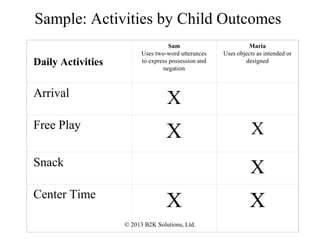
Sample: Activities by Child Outcomes
Daily Activities
Sam
Uses two-word utterances
to express possession and
negation
Maria
Uses objects as intended or
designed
Arrival
X
Free Play
X X
Snack
X
Center Time
X X
© 2013 B2K Solutions, Ltd.
Considerations and Variations
• While a creative teacher can align each child outcome with each
activity, the “match” between resources and readiness should be
considered. Note there are some intersections that are
purposefully left blank on the preceding slide.
• Embedding schedules can be placed at individual activity
locations as reminder of “When” to deliver instruction or made
visible from multiple locations across the classroom.
• Embedding schedules can be shared with family members as
part of the home-school connection and/or home embedding
schedules can be jointly created.
• A variation of using “X”s to indicate a match for “When” to
teach, is to state the actual teacher or peer action that will be
demonstrated to deliver the instruction. See next slide.
© 2013 B2K Solutions, Ltd.
Sample: Activities by Child Outcomes
Daily Activities
Sam
Uses two-word utterances
to express possession and
negation
Maria
Uses objects as intended or
designed
Arrival
Adult models two-words to
express possession (e.g.,
"Sam's coat.")
Free Play
Adult directs Sam to use
two-words to express
possession (e.g., Say, "My
baby.")
Adult or peer gives Maria
a cookie cutter to cut play
dough
Snack
Adult or peer models how
to use a spoon to eat
yogurt
Center Time
Peer asks Sam to play with
a toy. Provides an
opportunity for Sam to
express possession or
negation (e.g., “No, mine).
Maria stacks blocks, turns
pages of a book, cobs a
baby doll’s hair etc.
© 2013 B2K Solutions, Ltd.

Embedding schedules

  • 1.
    Creating an EmbeddingSchedule Steps: 1.Create a matrix (use a single piece of paper and/or poster size paper) with a column for the daily activities and columns for children in your classroom. 2.Identify and list daily daily activities in the 1st column. List teacher led, routine, and child-directed activities. 3.List children’s names/initials (whole class, small group, or individual child) and associated outcome in subsequent columns. 4.Consider each activity as it “intersects” with each child/outcome and if it is a “good” time to deliver instruction, put an “X” at the intersection to signify “WHEN” to teach. See example on next slide. © 2013 B2K Solutions, Ltd.
  • 2.
    Sample: Activities byChild Outcomes Daily Activities Sam Uses two-word utterances to express possession and negation Maria Uses objects as intended or designed Arrival X Free Play X X Snack X Center Time X X © 2013 B2K Solutions, Ltd.
  • 3.
    Considerations and Variations •While a creative teacher can align each child outcome with each activity, the “match” between resources and readiness should be considered. Note there are some intersections that are purposefully left blank on the preceding slide. • Embedding schedules can be placed at individual activity locations as reminder of “When” to deliver instruction or made visible from multiple locations across the classroom. • Embedding schedules can be shared with family members as part of the home-school connection and/or home embedding schedules can be jointly created. • A variation of using “X”s to indicate a match for “When” to teach, is to state the actual teacher or peer action that will be demonstrated to deliver the instruction. See next slide. © 2013 B2K Solutions, Ltd.
  • 4.
    Sample: Activities byChild Outcomes Daily Activities Sam Uses two-word utterances to express possession and negation Maria Uses objects as intended or designed Arrival Adult models two-words to express possession (e.g., "Sam's coat.") Free Play Adult directs Sam to use two-words to express possession (e.g., Say, "My baby.") Adult or peer gives Maria a cookie cutter to cut play dough Snack Adult or peer models how to use a spoon to eat yogurt Center Time Peer asks Sam to play with a toy. Provides an opportunity for Sam to express possession or negation (e.g., “No, mine). Maria stacks blocks, turns pages of a book, cobs a baby doll’s hair etc. © 2013 B2K Solutions, Ltd.