Scoping Post 2012 Climate Instruments: Nationally Appropriate Mitigation Actions –NAMAsCase Study on Opportunities in Brazilian Cities – Belo HorizonteEMBARQ, The WRI Center on Sustainable TransportSupported by: Inter-American Development Bank
Proposed Framework forthe NAMAPublicpolicyobjective NAMA Components GHG Mitigation Co-BenefitsFinancingInstitutionalSettingsMonitoring, Reporting and Verification MRVRiskAnalysis
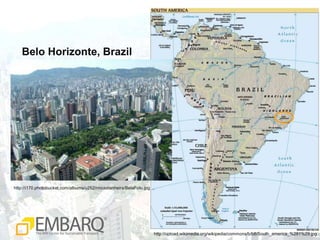
Belo Horizonte, Brazilhttp://i170.photobucket.com/albums/u252/rmcastanheira/BelaFoto.jpghttp://upload.wikimedia.org/wikipedia/commons/b/b8/South_america_%281%29.jpg
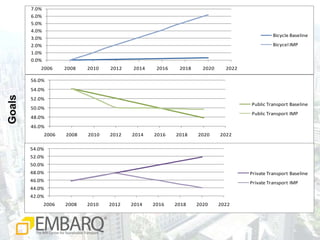
Goals
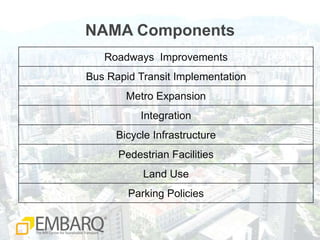
NAMA Components
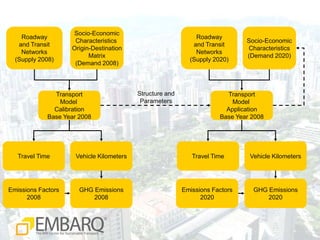
Roadwayand TransitNetworks(Supply 2008)Socio-EconomicCharacteristics Origin-DestinationMatrix(Demand 2008)Roadwayand TransitNetworks(Supply 2020)Socio-EconomicCharacteristics(Demand 2020)Structure and ParametersTransportModel CalibrationBase Year 2008TransportModel ApplicationBase Year 2008Travel TimeVehicle KilometersTravel TimeVehicle KilometersEmissions Factors2008GHG Emissions2008GHG Emissions2020Emissions Factors2020
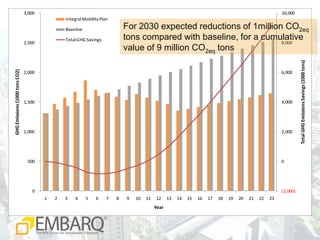
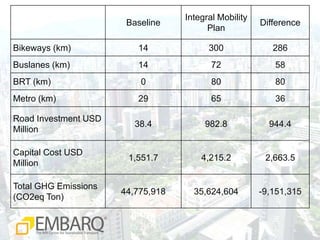
For 2030 expected reductions of 1millionCO2eq tons compared with baseline, for a cumulative value of 9 million CO2eqtons
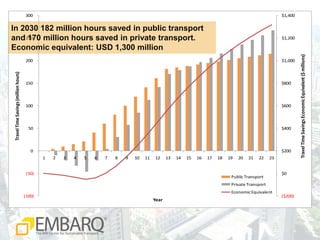
In 2030 182 million hours saved in public transport and 170 million hours saved in private transport. Economic equivalent: USD 1,300 million
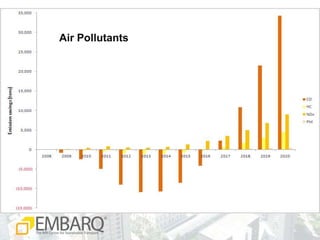
Air Pollutants
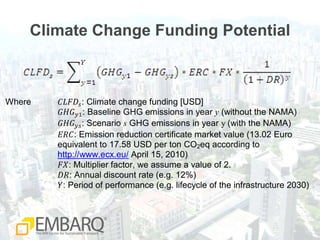
ClimateChangeFundingPotential
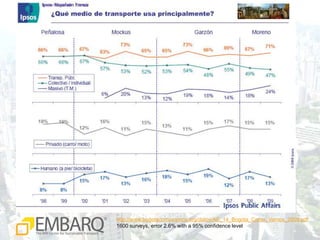
http://www.bogotacomovamos.org/datos/AE_14_Bogota_Como_Vamos_2009.pdf1600 surveys, error 2.6% with a 95% confidence level
ConclusionsFor 2030 the plan is expected to save 36% in GHG, 25% in travel time, 19% in transport costs and 39% in particulate matter as compared with a projected linebase (BAU)The potential funding from climate change sources is small as compared with the funding needs, but a supported NAMA will help in removing implementation barriers. Base GHG and co-benefits estimation in good transport planning: Detailed modeling with good information on demand and supply Integration of multiple elements under the plan: active and public transport, land use and transport demand managementBase climate change funding on the reduction potential, not the size of the investmentsBase MRV on activity surveys (mobility objectives)

Embarq presentation july2010eng

Editor's Notes

  • #2 Study Objective: To understand methodological and practical issues for the application of NAMAs in the transport sectorMain questions: ¿Which aspects does an avoid-shift-improve NAMA include?¿How to organize it?¿How to fund it?¿How to do MRV?¿Which are the GHG and co-benefits potential in an intermediate brazilian city?¿How to expand it to a national program?
  • #4 Minas Gerais State Capital 2.4 millioninhabitants, 5.4 million in themetropolitanarea (3rd in Brazil)Has alreadydeveloped a comprehensivemobility plan “planmobBH”Largescale data collectionAdequatetransportplanningmodelingtechniquesEvaluationIndicatorsonlycovertransportissues (congestion, modal splits, speeds)
  • #5 Increase the share of active and public transport in the total trips, reduce GHG emissions and improve transport and local environment conditions For 2030 the NAMA is expected to generate 36% reductions in GHG, 25% reduction in travel time, 19% reduction in transport costs, and 39% reduction in particulate matter.
  • #12 Estimated climate change funding: USD 36 Million (1.4% of the program cost) Small amount, but very attractive: grant or concessional loan Funding “up front” to help plan preparation and implementationTotal funds from diverse sources: local, state, national, commercial credit, multilateral funds, etc.
  • #13 Monitoring activity (trip frequency, transport mode, modo, trip length)Categorized random sampling , error 5%, 95% confidence levelRecommended categories: trip purpose, gender, income level5,400 surveys, ~USD 21,600 to 27,000, a fraction of a large scale transport study