Enterprise Modelling Sean Luke Presented to The Open Group Conference in Budapest 2007
Outline Introduction to EM at BT Methods, Frameworks and Models Static  and  Dynamic  Impact Analysis Metrics-based  decision making Completeness, Availability, Performance, Cost … Case Study:  IP Telephony Future Work
BTGS BT Global Services consists of  30,000  employees located in  50  countries delivering services to  170  different countries Global Revenue of over  £20bn Major Accounts include UK Government, Fiat, NHS Recognised Leader in our industry by Gartner, Dow Jones, Frost and Sullivan
Enterprise Architecture at BT BT is committed to Best Practice using Industry Standards BT Process Framework based on methods such as Prince2, RUP, DSDM, ADM etc Enterprise Architecture framework based on  TOGAF  and Zachman Professional Communities and Disciplines ensure consistency and adoption across BT Global Services
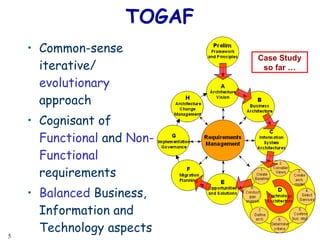
TOGAF Common-sense iterative/  evolutionary  approach Cognisant of  Functional  and  Non-Functional  requirements Balanced  Business, Information and Technology aspects Case Study so far …
Impact Analysis All the TOGAF phases need it Both  Static ; Traceability, Completeness, Validity etc and  Dynamic  techniques; Discrete Event and Monte-Carlo Simulation to produce  metrics Multiple evolutions / solutions in the one model    TRUE scenario analysis “ Without metrics, you’re just another guy with an opinion”,  Michael Mah, Cutter
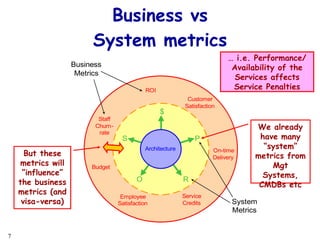
Business vs System metrics We already have many “system” metrics from Mgt Systems, CMDBs etc But these metrics will “influence” the business metrics (and visa-versa) …  i.e. Performance/ Availability of the Services affects Service Penalties
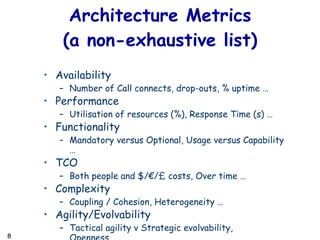
Availability Number of Call connects, drop-outs, % uptime … Performance Utilisation of resources (%), Response Time (s) … Functionality Mandatory versus Optional, Usage versus Capability … TCO Both people and $/ €/£ costs, Over time … Complexity Coupling / Cohesion, Heterogeneity … Agility/Evolvability Tactical agility v Strategic evolvability, Openness … Architecture Metrics (a non-exhaustive list)
A fool with a tool is still a fool … We’re using  ABACUS  from Avolution TOGAF  certified Completely  flexible  meta-model and views Libraries of  products ,  patterns , frameworks  Metrics : in-built and custom evaluators Not JUST a drawing tool; Static / dynamic impact analysis Scenario / what-if analysis Trade-off analysis Comparative / “gap” analysis TOGAF® Certified www. avolution .eu
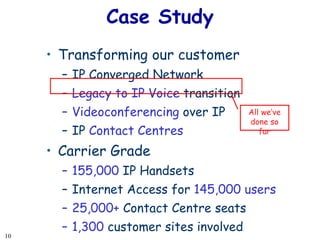
Case Study Transforming our customer  IP Converged Network Legacy to IP Voice  transition Videoconferencing  over IP IP  Contact Centres Carrier Grade 155,000  IP Handsets  Internet Access for  145,000 users 25,000+  Contact Centre seats  1,300  customer sites involved All we’ve done so far
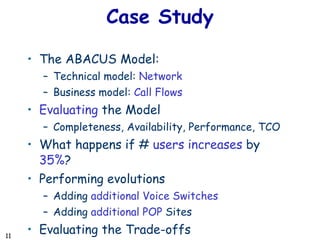
Case Study The ABACUS Model: Technical model:  Network Business model:  Call Flows Evaluating  the Model Completeness, Availability, Performance, TCO What happens if #  users   increases  by  35% ? Performing evolutions Adding  additional Voice Switches Adding  additional POP  Sites Evaluating the Trade-offs
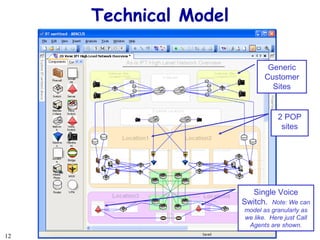
Technical Model 2 POP sites Single Voice Switch.  Note: We can model as granularly as we like.  Here just Call Agents are shown. Generic Customer Sites
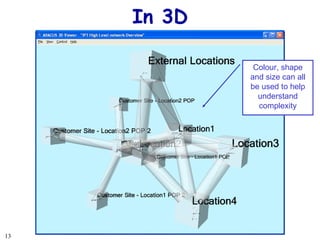
In 3D Colour, shape and size can all be used to help understand complexity
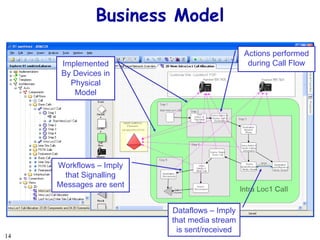
Business Model Workflows – Imply that Signalling Messages are sent Actions performed during Call Flow Dataflows – Imply that media stream is sent/received Implemented By Devices in Physical Model
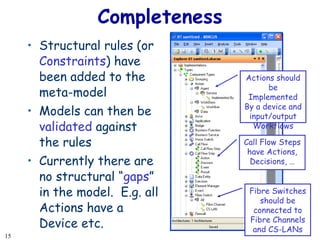
Completeness Structural rules (or  Constraints ) have been added to the meta-model Models can then be  validated  against the rules Currently there are no structural “ gaps ” in the model.  E.g. all Actions have a Device etc. Actions should be Implemented By a device and input/output Workflows Fibre Switches should be connected to Fibre Channels and CS-LANs Call Flow Steps have Actions, Decisions, …
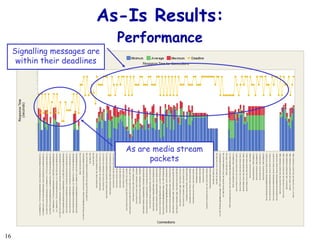
As-Is Results: Performance Signalling messages are within their deadlines As are media stream packets
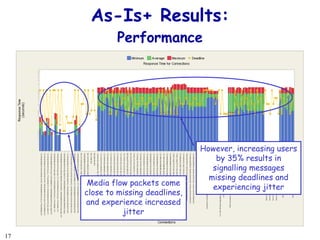
As-Is+ Results: Performance However, increasing users by 35% results in signalling messages missing deadlines and experiencing jitter Media flow packets come close to missing deadlines, and experience increased jitter
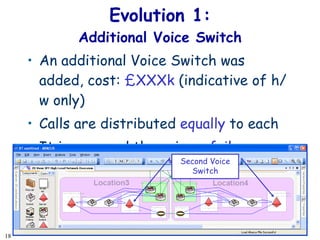
Evolution 1: Additional Voice Switch An additional Voice Switch was added, cost:  £XXX k  (indicative of h/w only) Calls are distributed  equally  to each It is assumed there is  no fail-over  from one Voice Switch to another Second Voice Switch
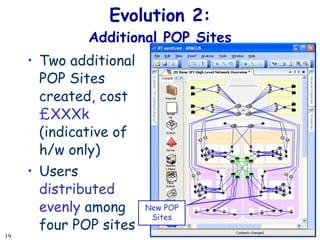
Evolution 2: Additional POP Sites Two additional POP Sites created, cost  £XXX k  (indicative of h/w only) Users  distributed evenly  among four POP sites New POP Sites
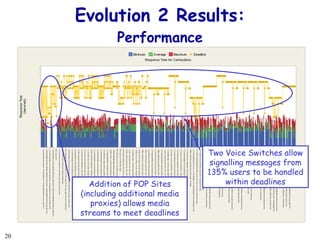
Evolution 2 Results: Performance Addition of POP Sites (including additional media proxies) allows media streams to meet deadlines Two Voice Switches allow signalling messages from 135% users to be handled within deadlines
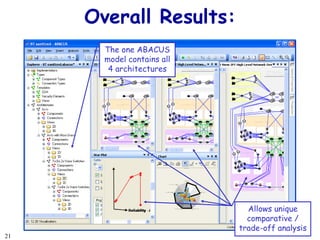
Overall Results: The one ABACUS model contains all 4 architectures Allows unique comparative / trade-off analysis
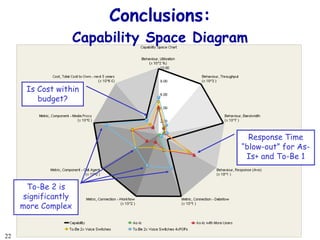
Conclusions: Capability Space Diagram Response Time “blow-out” for As-Is+ and To-Be 1 To-Be 2 is significantly more Complex Is Cost within budget?
Summary Documented the  end-2-end  Business and Technology model – even in 3D Analysed the  impact  of 35% more users Explored several  solution opportunities  and formulated a migration plan According to justifiable  metrics …  In just  2 months , start to finish!
Future Work Model other  critical business services Contact Centres Service Lines Gateway Services More  metrics  (business and technical) and higher  precision Standardise  and  re-use  the meta-model, solution patterns, libraries, metrics Capacity planning, Availability management, Operational diagnostics, Testing …

Enterprise Modelling Case Study

  • 1.
    Enterprise Modelling SeanLuke Presented to The Open Group Conference in Budapest 2007
  • 2.
    Outline Introduction toEM at BT Methods, Frameworks and Models Static and Dynamic Impact Analysis Metrics-based decision making Completeness, Availability, Performance, Cost … Case Study: IP Telephony Future Work
  • 3.
    BTGS BT GlobalServices consists of 30,000 employees located in 50 countries delivering services to 170 different countries Global Revenue of over £20bn Major Accounts include UK Government, Fiat, NHS Recognised Leader in our industry by Gartner, Dow Jones, Frost and Sullivan
  • 4.
    Enterprise Architecture atBT BT is committed to Best Practice using Industry Standards BT Process Framework based on methods such as Prince2, RUP, DSDM, ADM etc Enterprise Architecture framework based on TOGAF and Zachman Professional Communities and Disciplines ensure consistency and adoption across BT Global Services
  • 5.
    TOGAF Common-sense iterative/ evolutionary approach Cognisant of Functional and Non-Functional requirements Balanced Business, Information and Technology aspects Case Study so far …
  • 6.
    Impact Analysis Allthe TOGAF phases need it Both Static ; Traceability, Completeness, Validity etc and Dynamic techniques; Discrete Event and Monte-Carlo Simulation to produce metrics Multiple evolutions / solutions in the one model  TRUE scenario analysis “ Without metrics, you’re just another guy with an opinion”, Michael Mah, Cutter
  • 7.
    Business vs Systemmetrics We already have many “system” metrics from Mgt Systems, CMDBs etc But these metrics will “influence” the business metrics (and visa-versa) … i.e. Performance/ Availability of the Services affects Service Penalties
  • 8.
    Availability Number ofCall connects, drop-outs, % uptime … Performance Utilisation of resources (%), Response Time (s) … Functionality Mandatory versus Optional, Usage versus Capability … TCO Both people and $/ €/£ costs, Over time … Complexity Coupling / Cohesion, Heterogeneity … Agility/Evolvability Tactical agility v Strategic evolvability, Openness … Architecture Metrics (a non-exhaustive list)
  • 9.
    A fool witha tool is still a fool … We’re using ABACUS from Avolution TOGAF certified Completely flexible meta-model and views Libraries of products , patterns , frameworks Metrics : in-built and custom evaluators Not JUST a drawing tool; Static / dynamic impact analysis Scenario / what-if analysis Trade-off analysis Comparative / “gap” analysis TOGAF® Certified www. avolution .eu
  • 10.
    Case Study Transformingour customer IP Converged Network Legacy to IP Voice transition Videoconferencing over IP IP Contact Centres Carrier Grade 155,000 IP Handsets Internet Access for 145,000 users 25,000+ Contact Centre seats 1,300 customer sites involved All we’ve done so far
  • 11.
    Case Study TheABACUS Model: Technical model: Network Business model: Call Flows Evaluating the Model Completeness, Availability, Performance, TCO What happens if # users increases by 35% ? Performing evolutions Adding additional Voice Switches Adding additional POP Sites Evaluating the Trade-offs
  • 12.
    Technical Model 2POP sites Single Voice Switch. Note: We can model as granularly as we like. Here just Call Agents are shown. Generic Customer Sites
  • 13.
    In 3D Colour,shape and size can all be used to help understand complexity
  • 14.
    Business Model Workflows– Imply that Signalling Messages are sent Actions performed during Call Flow Dataflows – Imply that media stream is sent/received Implemented By Devices in Physical Model
  • 15.
    Completeness Structural rules(or Constraints ) have been added to the meta-model Models can then be validated against the rules Currently there are no structural “ gaps ” in the model. E.g. all Actions have a Device etc. Actions should be Implemented By a device and input/output Workflows Fibre Switches should be connected to Fibre Channels and CS-LANs Call Flow Steps have Actions, Decisions, …
  • 16.
    As-Is Results: PerformanceSignalling messages are within their deadlines As are media stream packets
  • 17.
    As-Is+ Results: PerformanceHowever, increasing users by 35% results in signalling messages missing deadlines and experiencing jitter Media flow packets come close to missing deadlines, and experience increased jitter
  • 18.
    Evolution 1: AdditionalVoice Switch An additional Voice Switch was added, cost: £XXX k (indicative of h/w only) Calls are distributed equally to each It is assumed there is no fail-over from one Voice Switch to another Second Voice Switch
  • 19.
    Evolution 2: AdditionalPOP Sites Two additional POP Sites created, cost £XXX k (indicative of h/w only) Users distributed evenly among four POP sites New POP Sites
  • 20.
    Evolution 2 Results:Performance Addition of POP Sites (including additional media proxies) allows media streams to meet deadlines Two Voice Switches allow signalling messages from 135% users to be handled within deadlines
  • 21.
    Overall Results: Theone ABACUS model contains all 4 architectures Allows unique comparative / trade-off analysis
  • 22.
    Conclusions: Capability SpaceDiagram Response Time “blow-out” for As-Is+ and To-Be 1 To-Be 2 is significantly more Complex Is Cost within budget?
  • 23.
    Summary Documented the end-2-end Business and Technology model – even in 3D Analysed the impact of 35% more users Explored several solution opportunities and formulated a migration plan According to justifiable metrics … In just 2 months , start to finish!
  • 24.
    Future Work Modelother critical business services Contact Centres Service Lines Gateway Services More metrics (business and technical) and higher precision Standardise and re-use the meta-model, solution patterns, libraries, metrics Capacity planning, Availability management, Operational diagnostics, Testing …