Elliot Rawls
Senior Director, Strategy and Corporate Development
U.S. Cellular Corporation, Chicago
Architecture School
Drawings by Michael Graves
250% Over Budget
(Project is never built)
The design process overshadowed
the design problem
Beautiful designs…… ……but no architecture.
1. Strategic planning and strategy development are
concerned with different sets of issues
2. The wrong metaphors are often used to describe a
strategic plan – often misrepresenting its capabilities.
3. Strategy development is thought to be a more deliberate
process than it often is.
4. Strategy is often portrayed as a linear process:
“complete the design….then switch to execution”.
Strategic planning processes
often overshadow strategy
1. Strategic planning and strategy
development are concerned with different
sets of issues.
Planning is about imposing order
Execution
Organizational alignment and coordination
Growth and financial outcomes
Strategy is about a rationale for decision-making
Assessing the environment
Designing (or discovering) advantages
Developing a value proposition
Establishing a competitive position
Planning Issues Strategy Issues
Absolute values
Benchmarks for success Reasons for success
vs
vs
Relative values
Management
accountability is
established through these.
Organizational bandwidth
is consumed by these.
Strategy
Formulation
Strategy
Planning
Process
“getting the plan done”
vs
Q: “Does this strategy deserve a plan?”
Planning issues often steal focus from
strategy issues.
This man may be
laboring under
the guidance of a
strategic plan.
Focusing on
execution while
losing sight of
strategy
2. The wrong metaphors are often used to
describe a strategic plan – misrepresenting
its nature.
A strategic plan is often
portrayed as a “roadmap” (…
but it’s not).
A map is a “proven” pathway.
It’s after the fact.
A strategic plan is before the
fact (ex ante).
(Ex post facto) Nile
A strategic plan is often
thought of as a “blueprint”
(…but it’s not)
….blueprint is ex ante.
…but not subject to great
uncertainty.
A collection of uncertainties
IncomeStatement(Fictitous)
2014 2015 2016 2017 2018
RetailRevenue 60,000,000$ 61,800,000$ 63,654,000$ 65,563,620$ 67,530,529$
RoamingRevenue 6,000,000$ 6,120,000$ 6,242,400$ 6,367,248$ 6,494,593$
TollRevenue 4,000,000$ 4,160,000$ 4,326,400$ 4,499,456$ 4,679,434$
DataRevenue 11,000,000$ 11,660,000$ 12,359,600$ 13,101,176$ 13,887,247$
OtherRevenue 2,000,000$ 2,060,000$ 2,121,800$ 2,185,454$ 2,251,018$
TotalRevenue 83,002,014$ 85,802,015$ 88,706,216$ 91,718,971$ 94,844,838$
SystemsOperationsExpense 15,000,000$ 15,600,000$ 16,224,000$ 16,872,960$ 17,547,878$
NetRoamerExpense 5,000,000$ 5,100,000$ 5,202,000$ 5,306,040$ 5,412,161$
MarketingExpense 22,000,000$ 22,660,000$ 23,339,800$ 24,039,994$ 24,761,194$
General&Administrative 10,000,000$ 10,300,000$ 10,609,000$ 10,927,270$ 11,255,088$
DataApplicationExpense 5,000,000$ 5,300,000$ 5,618,000$ 5,955,080$ 6,312,385$
OperatingExpense 57,000,000$ 58,960,000$ 60,992,800$ 63,101,344$ 65,288,706$
OperatingCashFlow 26,002,014$ 26,842,015$ 27,713,416$ 28,617,627$ 29,556,132$
5-Yr Financial Forecast
IncomeStatement(Fictitous)
2014 2015 2016 2017 2018
RetailRevenue 60,000,000$ 61,800,000$ 63,654,000$ 65,563,620$ 67,530,529$
RoamingRevenue 6,000,000$ 6,120,000$ 6,242,400$ 6,367,248$ 6,494,593$
TollRevenue 4,000,000$ 4,160,000$ 4,326,400$ 4,499,456$ 4,679,434$
DataRevenue 11,000,000$ 11,660,000$ 12,359,600$ 13,101,176$ 13,887,247$
OtherRevenue 2,000,000$ 2,060,000$ 2,121,800$ 2,185,454$ 2,251,018$
TotalRevenue 83,002,014$ 85,802,015$ 88,706,216$ 91,718,971$ 94,844,838$
SystemsOperationsExpense 15,000,000$ 15,600,000$ 16,224,000$ 16,872,960$ 17,547,878$
NetRoamerExpense 5,000,000$ 5,100,000$ 5,202,000$ 5,306,040$ 5,412,161$
MarketingExpense 22,000,000$ 22,660,000$ 23,339,800$ 24,039,994$ 24,761,194$
General&Administrative 10,000,000$ 10,300,000$ 10,609,000$ 10,927,270$ 11,255,088$
DataApplicationExpense 5,000,000$ 5,300,000$ 5,618,000$ 5,955,080$ 6,312,385$
OperatingExpense 57,000,000$ 58,960,000$ 60,992,800$ 63,101,344$ 65,288,706$
OperatingCashFlow 26,002,014$ 26,842,015$ 27,713,416$ 28,617,627$ 29,556,132$
5-Yr “Fading” Financial Forecast
5-Yr Financial Forecast w/ “Risk Coding”
A forecast can represent very different things:
•A true belief of the future
•A company’s aspirations for the future
•A necessary set of goals (“minimum viable future”)
•A single scenario of future (among many)
A strategic plan is inherently uncertain….
….but in many ways it portrays control
3. Strategy-development is thought to be
more deliberate than it often is.
….or
discover
them?
Do we
create
strategies?
Strategy looks deliberate through frameworks
(A view championed by Henry Mintzberg)
Deliberate Strategy
(Intended Strategy)
Realized Strategy
Realized Strategy
(“Emergent Strategy”)
Deliberate
Strategy
Em
ergent
Forces
Deliberate
Strategy
Southwest
Airlines
Groupon
Emergent
Strategy
Expand service – buy
a fourth plane. (1971)
Sell plane – maintain
service level with three
planes.
10-min turn around
time is born (1972)
Organizing group
action around saving
money (2008)
Organizing group
action around social
causes (2007)
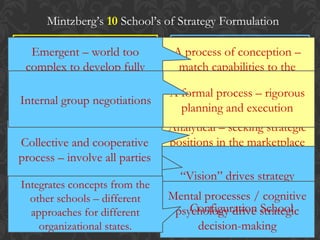
Design School
Planning School
Cognitive School
Positioning School
Entrepreneurial School
Cultural School
Mintzberg’s 10 School’s of Strategy Formulation
Environmental School
Power School
Learning School
PRESCRIPTIVE DESCRIPTIVE
A process of conception –
match capabilities to the
environment
Analytical – seeking strategic
positions in the marketplace
A formal process – rigorous
planning and execution
“Vision” drives strategy
Mental processes / cognitive
psychology drive strategic
decision-making
Emergent – world too
complex to develop fully
formed strategies all at once
Reactive – initiative begins
with the external environment
Collective and cooperative
process – involve all parties
Internal group negotiations
Configuration School
Integrates concepts from the
other schools – different
approaches for different
organizational states.
Strategy Development…..
Intentional planning & control
(“deliberate”)
plus
Learning & responding
(“emergent”)
Strategic
Planning
focuses here
4. Strategy is often portrayed as a linear
process:
“complete the design….then switch to
execution”
Strategy development fits “awkwardly” within a
linear planning process:
Environmental
Assessment
Formulate
Strategy
Design the
Overall
Process
Outline
Financial
Forecasts
Formulate
Operational
Plans
Formulate
Strategy
This thing is not
like the others
A creative act in search of
unique opportunities
Hard to fit into a schedule
A B C D
Strategic Planning Strategy Formulation
A process-oriented,
step by step activity
Almost always driven
by a time schedule
Strategy Formulation
over time
Strategy Execution
over time
Strategic Plan
1. Strategic planning and strategy development are
concerned with different sets of issues
2. The wrong metaphors are often used to describe a
strategic plan – misrepresenting its promise.
3. Strategy development is thought to be more deliberate
than it often is.
4. Strategy isn’t a simple linear process:
“complete the design…….then switch to execution”.
The four things again….
So What ?
How can we better position the relationship
between strategy development and strategic
planning……..and to the benefit of both?
The strategic planning process may not facilitate
strategy creation but …….
…….the strategic plan itself can play a key role
in strategy assessment.
1. Consider formally disconnecting strategy making
from the “annual strategic planning process”
Henry Mintzberg: “strategy cannot be systematized”.
Jan Feb Mar Apr
May Jun July Aug
Sep Oct Nov Dec
2. Highlight uncertainty/risk in the strategic plan.
• Gather probabilistic data not just deterministic data
• Quantify the uncertainty and its impact on the plan
• Focus on implications of differing outcomes
Keep the focus on both forecast and strategy
Strategic Plan:
Forecasting Tool vs Decision Tool
Degree of Future Uncertainty
HighLow
DecisionTool
ForecastTool
3. Where is your company on this axis?
Planning Issues:
Revenue growth
Capital expense planning
Expand distribution
Product line expansion
Training programs
Cost reduction efforts
Strategy Issues:
Future competitive
environment scenarios
Clarity of value proposition
Clarity of competitive
advantage
How functional decisions
inter-relate
Explicit about trade-offs
Focus on the Relationships Between Planning and Strategy
1. Strategic planning and
strategy making address
different sets of issues.
Plans & Forecasts
vs
Relative Advantages &
Positions
2. Strategic planning framed as a linear
process: design 1st….execution 2nd.
 Create an independent organizational focus around
strategy development -- don’t bury it within the
strategic planning process.
3. We use the wrong
metaphors to describe a
strategic plan.
4. Strategy-development is
thought to be more
deliberate than it often is.
Strategic
Plan
(Lengthy
and highly
detailed)
These misrepresents the capabilities of a strategic plan
Position the strategic plan as an uncertain opportunity
not as a blueprint of the future.
Use that uncertainty to focus the organization on the
quality and versatility of the underlying strategy.
Strategic planning is capable of either enabling
or masking
strategic insights.

Elliot Rawl US Cellular

  • 1.
    Elliot Rawls Senior Director,Strategy and Corporate Development U.S. Cellular Corporation, Chicago
  • 2.
  • 3.
  • 4.
    The design processovershadowed the design problem Beautiful designs…… ……but no architecture.
  • 5.
    1. Strategic planningand strategy development are concerned with different sets of issues 2. The wrong metaphors are often used to describe a strategic plan – often misrepresenting its capabilities. 3. Strategy development is thought to be a more deliberate process than it often is. 4. Strategy is often portrayed as a linear process: “complete the design….then switch to execution”. Strategic planning processes often overshadow strategy
  • 6.
    1. Strategic planningand strategy development are concerned with different sets of issues.
  • 7.
    Planning is aboutimposing order Execution Organizational alignment and coordination Growth and financial outcomes Strategy is about a rationale for decision-making Assessing the environment Designing (or discovering) advantages Developing a value proposition Establishing a competitive position
  • 8.
    Planning Issues StrategyIssues Absolute values Benchmarks for success Reasons for success vs vs Relative values Management accountability is established through these. Organizational bandwidth is consumed by these.
  • 9.
    Strategy Formulation Strategy Planning Process “getting the plandone” vs Q: “Does this strategy deserve a plan?” Planning issues often steal focus from strategy issues.
  • 10.
    This man maybe laboring under the guidance of a strategic plan. Focusing on execution while losing sight of strategy
  • 11.
    2. The wrongmetaphors are often used to describe a strategic plan – misrepresenting its nature.
  • 12.
    A strategic planis often portrayed as a “roadmap” (… but it’s not). A map is a “proven” pathway. It’s after the fact. A strategic plan is before the fact (ex ante). (Ex post facto) Nile A strategic plan is often thought of as a “blueprint” (…but it’s not) ….blueprint is ex ante. …but not subject to great uncertainty.
  • 13.
    A collection ofuncertainties IncomeStatement(Fictitous) 2014 2015 2016 2017 2018 RetailRevenue 60,000,000$ 61,800,000$ 63,654,000$ 65,563,620$ 67,530,529$ RoamingRevenue 6,000,000$ 6,120,000$ 6,242,400$ 6,367,248$ 6,494,593$ TollRevenue 4,000,000$ 4,160,000$ 4,326,400$ 4,499,456$ 4,679,434$ DataRevenue 11,000,000$ 11,660,000$ 12,359,600$ 13,101,176$ 13,887,247$ OtherRevenue 2,000,000$ 2,060,000$ 2,121,800$ 2,185,454$ 2,251,018$ TotalRevenue 83,002,014$ 85,802,015$ 88,706,216$ 91,718,971$ 94,844,838$ SystemsOperationsExpense 15,000,000$ 15,600,000$ 16,224,000$ 16,872,960$ 17,547,878$ NetRoamerExpense 5,000,000$ 5,100,000$ 5,202,000$ 5,306,040$ 5,412,161$ MarketingExpense 22,000,000$ 22,660,000$ 23,339,800$ 24,039,994$ 24,761,194$ General&Administrative 10,000,000$ 10,300,000$ 10,609,000$ 10,927,270$ 11,255,088$ DataApplicationExpense 5,000,000$ 5,300,000$ 5,618,000$ 5,955,080$ 6,312,385$ OperatingExpense 57,000,000$ 58,960,000$ 60,992,800$ 63,101,344$ 65,288,706$ OperatingCashFlow 26,002,014$ 26,842,015$ 27,713,416$ 28,617,627$ 29,556,132$
  • 14.
    5-Yr Financial Forecast IncomeStatement(Fictitous) 20142015 2016 2017 2018 RetailRevenue 60,000,000$ 61,800,000$ 63,654,000$ 65,563,620$ 67,530,529$ RoamingRevenue 6,000,000$ 6,120,000$ 6,242,400$ 6,367,248$ 6,494,593$ TollRevenue 4,000,000$ 4,160,000$ 4,326,400$ 4,499,456$ 4,679,434$ DataRevenue 11,000,000$ 11,660,000$ 12,359,600$ 13,101,176$ 13,887,247$ OtherRevenue 2,000,000$ 2,060,000$ 2,121,800$ 2,185,454$ 2,251,018$ TotalRevenue 83,002,014$ 85,802,015$ 88,706,216$ 91,718,971$ 94,844,838$ SystemsOperationsExpense 15,000,000$ 15,600,000$ 16,224,000$ 16,872,960$ 17,547,878$ NetRoamerExpense 5,000,000$ 5,100,000$ 5,202,000$ 5,306,040$ 5,412,161$ MarketingExpense 22,000,000$ 22,660,000$ 23,339,800$ 24,039,994$ 24,761,194$ General&Administrative 10,000,000$ 10,300,000$ 10,609,000$ 10,927,270$ 11,255,088$ DataApplicationExpense 5,000,000$ 5,300,000$ 5,618,000$ 5,955,080$ 6,312,385$ OperatingExpense 57,000,000$ 58,960,000$ 60,992,800$ 63,101,344$ 65,288,706$ OperatingCashFlow 26,002,014$ 26,842,015$ 27,713,416$ 28,617,627$ 29,556,132$
  • 15.
  • 16.
    5-Yr Financial Forecastw/ “Risk Coding”
  • 17.
    A forecast canrepresent very different things: •A true belief of the future •A company’s aspirations for the future •A necessary set of goals (“minimum viable future”) •A single scenario of future (among many) A strategic plan is inherently uncertain…. ….but in many ways it portrays control
  • 18.
    3. Strategy-development isthought to be more deliberate than it often is. ….or discover them? Do we create strategies? Strategy looks deliberate through frameworks
  • 19.
    (A view championedby Henry Mintzberg) Deliberate Strategy (Intended Strategy) Realized Strategy Realized Strategy (“Emergent Strategy”) Deliberate Strategy Em ergent Forces
  • 20.
    Deliberate Strategy Southwest Airlines Groupon Emergent Strategy Expand service –buy a fourth plane. (1971) Sell plane – maintain service level with three planes. 10-min turn around time is born (1972) Organizing group action around saving money (2008) Organizing group action around social causes (2007)
  • 21.
    Design School Planning School CognitiveSchool Positioning School Entrepreneurial School Cultural School Mintzberg’s 10 School’s of Strategy Formulation Environmental School Power School Learning School PRESCRIPTIVE DESCRIPTIVE A process of conception – match capabilities to the environment Analytical – seeking strategic positions in the marketplace A formal process – rigorous planning and execution “Vision” drives strategy Mental processes / cognitive psychology drive strategic decision-making Emergent – world too complex to develop fully formed strategies all at once Reactive – initiative begins with the external environment Collective and cooperative process – involve all parties Internal group negotiations Configuration School Integrates concepts from the other schools – different approaches for different organizational states.
  • 22.
    Strategy Development….. Intentional planning& control (“deliberate”) plus Learning & responding (“emergent”) Strategic Planning focuses here
  • 23.
    4. Strategy isoften portrayed as a linear process: “complete the design….then switch to execution”
  • 24.
    Strategy development fits“awkwardly” within a linear planning process: Environmental Assessment Formulate Strategy Design the Overall Process Outline Financial Forecasts Formulate Operational Plans Formulate Strategy This thing is not like the others
  • 25.
    A creative actin search of unique opportunities Hard to fit into a schedule A B C D Strategic Planning Strategy Formulation A process-oriented, step by step activity Almost always driven by a time schedule
  • 26.
    Strategy Formulation over time StrategyExecution over time Strategic Plan
  • 27.
    1. Strategic planningand strategy development are concerned with different sets of issues 2. The wrong metaphors are often used to describe a strategic plan – misrepresenting its promise. 3. Strategy development is thought to be more deliberate than it often is. 4. Strategy isn’t a simple linear process: “complete the design…….then switch to execution”. The four things again….
  • 28.
    So What ? Howcan we better position the relationship between strategy development and strategic planning……..and to the benefit of both? The strategic planning process may not facilitate strategy creation but ……. …….the strategic plan itself can play a key role in strategy assessment.
  • 29.
    1. Consider formallydisconnecting strategy making from the “annual strategic planning process” Henry Mintzberg: “strategy cannot be systematized”. Jan Feb Mar Apr May Jun July Aug Sep Oct Nov Dec
  • 30.
    2. Highlight uncertainty/riskin the strategic plan. • Gather probabilistic data not just deterministic data • Quantify the uncertainty and its impact on the plan • Focus on implications of differing outcomes Keep the focus on both forecast and strategy
  • 31.
    Strategic Plan: Forecasting Toolvs Decision Tool Degree of Future Uncertainty HighLow DecisionTool ForecastTool 3. Where is your company on this axis?
  • 32.
    Planning Issues: Revenue growth Capitalexpense planning Expand distribution Product line expansion Training programs Cost reduction efforts Strategy Issues: Future competitive environment scenarios Clarity of value proposition Clarity of competitive advantage How functional decisions inter-relate Explicit about trade-offs Focus on the Relationships Between Planning and Strategy
  • 33.
    1. Strategic planningand strategy making address different sets of issues. Plans & Forecasts vs Relative Advantages & Positions 2. Strategic planning framed as a linear process: design 1st….execution 2nd.  Create an independent organizational focus around strategy development -- don’t bury it within the strategic planning process.
  • 34.
    3. We usethe wrong metaphors to describe a strategic plan. 4. Strategy-development is thought to be more deliberate than it often is. Strategic Plan (Lengthy and highly detailed) These misrepresents the capabilities of a strategic plan Position the strategic plan as an uncertain opportunity not as a blueprint of the future. Use that uncertainty to focus the organization on the quality and versatility of the underlying strategy.
  • 35.
    Strategic planning iscapable of either enabling or masking strategic insights.

Editor's Notes

  • #3 Many years ago, before attending business school I studied architecture in college. Architects of great notoriety would come through and share with us some of their recent work. One much heralded architect of the time arrived and gave a dazzling presentation of gorgeous drawings, one in particular of a house….
  • #4 drawings. Most interesting is that he was still willing to present the drawings to our architecture class….presumably as an example of good work……as though they still had relevance in spite of the fact that they didn’t solve the problem. The drawings were beautiful, no doubt, but on a fundamental level, it was a failed design…..a beautiful looking, failed design.
  • #5 What happened? How does something get to be that far over budget in the design phase? Most interesting is that he was still willing to present the drawings to our architecture class….presumably as an example of good work……as though they still had relevance in spite of the fact that they didn’t solve the problem. The drawings were beautiful, no doubt, but on a fundamental level, it was a failed design…..a beautiful looking, failed design. One explanation might be that the process took over. The design process took over. Processes are designed to facilitate end goals, but sometimes those processes are subject to other influences that may overshadow their primary goals. In the case of architectural design, there’s a strong desire to produce something that is logical and elegant visually because that’s how the solution is communicated. The budget doesn’t show up anywhere on the drawings. And if the architect fails to meet a budget, resulting in an unbuilt design – doesn’t impugn their design legacy. Both built and unbuilt designs get included in the monograph that highlight’s the architect’s work. The highlight reel in book form if you will. [Beautiful designs….] [….but no architecture] So there are other influences on the design process than just getting the building built.
  • #6 So what has that got to do with strategy and strategic planning? Like architectural design, strategic planning is a process that is also subject to influences that can distract it from the goal of strategy development. I’d like to tee up 4 issues that inhibit us from creating a better relationship between strategy making and strategic planning. [Go through the four] (I’m not implying that there are only 4.) In fact, an obvious 5th is long-term strategic planning colliding with near-term budgeting. Near –term budgeting often drives a lot of management financial incentives. Nearer-term financial incentives and longer-term investment objectives may or may not align in any given year. Let’s talk more about them one by one…. [Slide]
  • #8 Planning around strategy is concerned with a different set of questions than is formulating and assessing strategy Plans and timelines Across functions, project sequencing Market share, cash generation, ROI Formulation is about creating a competitive position What future circumstances would support or undermine our position in the marketplace Modes of competition, establishing competitive advantage How functional strategies inter-relate; making deliberate trade-offs
  • #9 Within a formal planning process, the sheer detail and weight of the planning issues, can outweigh some of the right-side concerns around planning. Heightened by the fact that they drive accountability which means there’s a lot on the line personally for management,
  • #11 This, of course, is Sisyphus rolling the boulder up the hill only to have it get away from him and roll back down before he makes it too the top. He’ll then begin the process over with the same result, etc., etc. Now I know he didn’t choose to do this, he was condemned by Zeus (or someone) but that’s the mythological underpinning of this story but that has nothing to do with the point I want to make. The point I wish to make is that this behavior is the type of behavior that could be driven by a strategic plan. Think about it. The major components could all be there: defined objective; defined resources; may have a defined time schedule; specified activity and method, etc. etc. All the elements of a plan could be in place. Of course, he never gets to the top….but he keeps on executing…….and he likely thinks it’s a flaw in the execution. It may be time to re-think the strategy (but it’s hard to because everyone’s already aligned behind the plan – perhaps some board has already accepted it – it’s got momentum that’s hard to stop. And that can overshadow strategy?? [Slide….]
  • #13 A real map is not a “theoretical” pathway or a potential pathway – it’s the actual pathway. It’s going to get you there. It is a simple matter of execution. Not much uncertainty. There’s plenty of uncertainty in a strategic plan. Following a strategic plan is not a simple matter of execution. Execution….adaptation……reassessment……organizations shouldn’t portray that as a problem……and force an unreasonable number of reconciliations to old views of the world.
  • #14 In fact, a strategic plan is usually loaded with uncertainties The materials used to represent the plan often don’t reflect that reality. Some planners will attempt to assess and highlight uncertainty and risk within the plan but usually the punchline looks something like this…. [Slide]
  • #15 ………The financial outcome of all the assumptions. By this stage in the document (usually the end), the emphasis is around this single scenario – which implies certainty. The inherent uncertainty in the forecast may perhaps have been spoken to – but the “single scenario” is what people tend to remember and reference later. This isn’t always concerning -- it depends: how uncertain is the future believed to be for this company? Some industries and companies face a lot more future uncertainty than do others. If uncertainty is thought to be high and a typical deterministic financial forecast is the only thing they manage to,
  • #16 I’ve wondered what would happen if you presented something like this…. Numbers fade in future years…..to suggest that they’re more “elusive” the further out they are. This would probably just irritate people – but the point would be to inhibit the viewer from thinking about each section of the forecast in the same way. [Slide]
  • #17 ….or here’s another idea: “risk code” selected numbers. A different color would mean that the degree of uncertainty (or perceived risk) is materially higher than the average across the forecast. Both suggestions could be problematic for any number of reasons -- but the point is to highlight the circumstances you’re managing to rather than ignore them out of convenience.
  • #18 Furthermore, degree of certainty aside, these numbers can mean many different things. Org belief about the future that planning conforms to. The org seeks to accommodate its relationship to the environment. Rallying cry for the organization – something to aspire to that’s designed to drive new thinking. The org may seek to change its relationship to the environment. Outline a “minimum viable future” – anything less “wouldn’t be worth managing to”. May be seen as a single outcome within a range of potential outcomes with differing likelihoods but are all reasonable. Often means different things to different people even within the same organization.
  • #19 Long debated question around the extent to which a company’s strategy is the result of its deliberate efforts or the collection of its responses to the competitive environment over many years. I think there’s a consensus around it being some of both. Many popular frameworks reflect the deliberate dimension of strategy development (which is not to say that the people that developed these frameworks don’t also acknowledge the reality of “discovered” strategy).
  • #20 How often do deliberate attempts at strategy development translate directly into the strategies that are realized – over time? I doubt that it’s even possible to trace the origin of every dimension of a company’s strategy – even the most critical elements – to deliberate decision-making versus a response of some kind to unanticipated challenges or opportunities. ….but there are many interesting examples of this: [Slide]
  • #22 Returning to Mintzberg for a moment, he wrote an interesting, if not somewhat tedious book called “Strategy Safari” in which he laid out his so-called “10 Schools of Strategy Formulation”. Only 3 represent deliberate strategy making as we usually envision it.: Design (process of conception – informal design); Planning (formal process); Positioning (analytical – seeking strategic positions in the economic marketplace); The other 7 represent influences that aren’t easily “structurable” to enable deliberate strategy making: Entrepreneurial (visionary); Cognitive (mental – cognitive psychology describes strategic decision-making); Learning (emergent – world too complex to allow strategies to be developed all at once as clear plans or visions); Power (negotiation – by internal groups or by orgs as they confront their external environments); Cultural (collective and cooperative); Environmental (reactive – initiative begins with the external environment); Configuration (transformation – integrating concepts from the other schools; distinguishing the different stages or states of an organization, diff approaches are required or naturally take hold). Contrast between the various structured approaches to the planning process and the seemingly unstructurable strategy formulation processes which underpin that planning.
  • #26 You may head in an initial direction…….
  • #27 If strategy formulation tends to take a circuitous route over time, there should be little surprise that strategy execution will also take a somewhat similar path, albeit perhaps not as wild …….but that path may be only somewhat represented by the strategic plan in any given year.
  • #28 So we’ve outlined 4 beliefs about strategic planning and strategy development that risk undermining strategy development for the sake of strategic planning. [Slide]
  • #29 So what do we do with that?
  • #30 Mintzberg argues that strategic planning can help coordinate planning efforts and measure progress on strategic goals, but that it occurs "around" the strategy formation process rather than within it.
  • #31 Don’t allow the deterministic sections of the plan completely overshadow the fact of great risk and uncertainty. Give it equal weight by highlighting it. In other words, don’t let the organization forget that it must contemplate potential strategic decisions that arise from uncertainties – they should be top of mind. The company shouldn’t perceive itself to have left “strategy mode” and is living in “execution mode”.
  • #32 If you’ve got multiple views of the future , you’re force to think about how well your underlying strategy may perform under these different conditions. How “robust”, how resilient, how agile can you be, etc. – keeps a focus on strategy, not just executing to a single scenario.
  • #33 If there’s a lot of risk in the plan and therefore, you’re using it primarily as a decision tool, which issues do you focus on – just strategy? Where do the planning metrics come in? I’d argue that you focus disproportionately on the relationship between the two.