ESIW KCOLC 
ELIT 10 Class 15 
C C 
H H 
E 
C C 
K K 
S T 
I U 
T H 
S
AGENDA 
• Make-up Exam 
• Change Teams 
• Presentation: The 70s 
• Discussion 
– The Front Runner 
• Author Introductions: 
– Barbara Cameron 
– Allen Barnett
Announcement 
• Make up exam #1: Class 17 Wednesday, 11/19 
• If you are not taking this exam, you may have the day off. 
• Remember, if you take this exam, you are ineligible to 
submit an essay revision
Change Teams: Make New Friends!
Presentation: The 70s! 
1970 Unitarian Universalist Association becomes first U.S. 
mainstream religious group to recognize LGB clergy and 
laity within its ranks and to demand an end to anti-gay 
discrimination. 
1970 The Vatican issues a statement reiterating that 
homosexuality is a moral aberration. 
1971 Idaho repeals the sodomy law, then re-instates the 
repealed sodomy law because of outrage among Mormons 
and Catholics. 
1972 East Lansing, Michigan, becomes first city to ban anti-gay 
bias in city hiring. 
1972 The Rev. William R. Johnson became the first openly 
gay minister to be ordained in the United Church of Christ.
1973 American Psychiatric Association removes homosexuality from its list 
of mental illnesses. 
1974 First state-level openly gay person elected: Elaine Noble of 
Massachusetts. 
1974 Robert Grant founds American Christian Cause to oppose the “gay 
agenda,” beginning modern Christian politics in America. 
1974 Ohio Supreme Court rules that even though homosexuality is legal, 
the state can refuse to incorporate a gay organization because “the 
promotion of homosexuality as a valid life style is contrary to the public 
policy of the state.” 
1975 U.S. Civil Service Commission stops banning gay men and lesbians 
from federal jobs. 
1976 Tales of the City published by the “San Francisco Chronicle,“ 
includes LGB and T characters. 
1976 Lynn Ransom of California is one of the first openly lesbian mothers 
to win custody of her children in court.
1976 San Francisco Bisexual Center opens. 
1977 Anita Bryant and Save Our Children succeed in repealing Miami law 
against discrimination based on sexual orientation. 
1977 80% of surveyed Oregon doctors say they would refuse to treat a 
known homosexual. 
1977 Arkansas recriminalizes gay sex after two years without such a law. 
1978 The rainbow flag is first used as a symbol of homosexual pride. 
1978 Harvey Milk 
Harvey Milk was the first openly gay man to be elected to public office in 
California, as a member of the San Francisco Board of Supervisors. Milk 
served 11 months in office and was responsible for passing a stringent gay 
rights ordinance for the city. On November 27, 1978, Milk and Mayor 
George Moscone were assassinated by Dan White, another city supervisor 
who had recently resigned and wanted his job back. 
1979 The first homosexual rights march on Washington, D.C. is held
QHQ: Front Runner 
First Half 
1. Q: What role does Christopher play in Harlan’s life? 
2. Q: Even though there is no evidence that Harlan has homosexual 
activity with Denny, why he is forced to resign? 
3. Q: Does Harlan Brown accept the boys into the school/ track program 
for his own benefit since he finds Billy sexually attractive? 
4. Q: Why does Billy act weird when Mr. Brown corrects the boys about 
his name from Harlan to Mr. Brown? 
5. Q: Why was Harlan being cruel towards Billy? 
6. Q: Does Mr. Brown suppress his attraction toward Billy because of 
internalized homophobia? 
7. Q: Before they initiate a romantic relationship, how Billy and Mr. 
Brown’s silent feelings for each other affect them both in harmful ways?
1. Q: Why does it take Harlan and Billy so long to realize they 
could date and just keep it secret? Why put one another 
through the pain for that long? 
2. Q: Does Billy possess that “ghost of [him]self” that Harlan 
claimed to be looking for in other lovers? 
3. Q: Before they initiate a romantic relationship, how Billy and 
Mr. Brown’s silent feelings for each other affect them both in 
harmful ways? 
4. Q: Why does it take Harlan and Billy so long to realize they 
could date and just keep it secret? Why put one another 
through the pain for that long? 
5. Q: Why would Harlan decide to tell a tabloid magazine of his 
relationship with Billy? 
6. Q: What were the social repercussions of being gay at that time 
period that kept homosexuals like Harlan closeted?
QHQ: Front Runner 
Second Half 
1. Q: Why does Harlan think that their relationship would 
last forever even if Harlan is way older than Billy? 
2. Q: Before everything went so horribly wrong so fast, 
why was Harlan so seemingly obsessed with marrying 
Billy, despite Billy’s desire not to? 
3. Q: What are Richard Mech’s motives for killing Billy? 
Are they justified? 
4. Q: Do you think Harlan’s reaction to Billy’s murder was 
appropriate or at least uncharacteristic?
1. Q: If Billy had not been killed, would the marriage have 
really lasted? Especially with plans to have an actual 
child together? 
2. Q: Why does it take Vince to finally get Harlan to cry? 
3. Q: What is difference between queer literature before 
the stonewall riot and after the stonewall riot? 
4. What are the politics (ideological agendas) of 
specific gay, lesbian, or queer works, and how are 
those politics revealed in...the work's thematic 
content or portrayals of its characters? 
5. What does the work reveal about the operations 
(socially, politically, psychologically) of 
heterosexism?
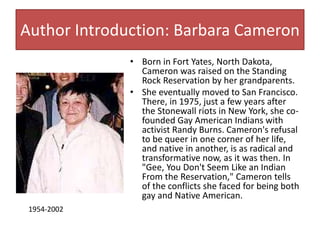
Author Introduction: Barbara Cameron 
• Born in Fort Yates, North Dakota, 
Cameron was raised on the Standing 
Rock Reservation by her grandparents. 
• She eventually moved to San Francisco. 
There, in 1975, just a few years after 
the Stonewall riots in New York, she co-founded 
Gay American Indians with 
activist Randy Burns. Cameron's refusal 
to be queer in one corner of her life, 
and native in another, is as radical and 
transformative now, as it was then. In 
"Gee, You Don't Seem Like an Indian 
From the Reservation," Cameron tells 
of the conflicts she faced for being both 
gay and Native American. 
1954-2002
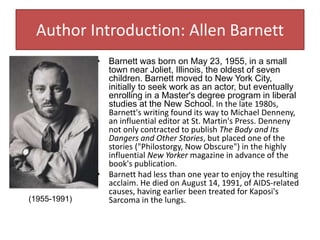
Author Introduction: Allen Barnett 
• Barnett was born on May 23, 1955, in a small 
town near Joliet, Illinois, the oldest of seven 
children. Barnett moved to New York City, 
initially to seek work as an actor, but eventually 
enrolling in a Master's degree program in liberal 
studies at the New School. In the late 1980s, 
Barnett's writing found its way to Michael Denneny, 
an influential editor at St. Martin's Press. Denneny 
not only contracted to publish The Body and Its 
Dangers and Other Stories, but placed one of the 
stories ("Philostorgy, Now Obscure") in the highly 
influential New Yorker magazine in advance of the 
book's publication. 
• Barnett had less than one year to enjoy the resulting 
acclaim. He died on August 14, 1991, of AIDS-related 
causes, having earlier been treated for Kaposi's 
(1955-1991) Sarcoma in the lungs.
Homework 
• Read “Gee, You Don’t Seem Like 
an Indian From the Reservation” 
by Barbara Cameron 1982 from 
This Bridge Called my Back 
• “Philostorgy, Now Obscure” by 
Allen Barnett 
• Post #15 QHQ from either short 
story

Elit 10 class 15

  • 1.
    ESIW KCOLC ELIT10 Class 15 C C H H E C C K K S T I U T H S
  • 2.
    AGENDA • Make-upExam • Change Teams • Presentation: The 70s • Discussion – The Front Runner • Author Introductions: – Barbara Cameron – Allen Barnett
  • 3.
    Announcement • Makeup exam #1: Class 17 Wednesday, 11/19 • If you are not taking this exam, you may have the day off. • Remember, if you take this exam, you are ineligible to submit an essay revision
  • 4.
    Change Teams: MakeNew Friends!
  • 5.
    Presentation: The 70s! 1970 Unitarian Universalist Association becomes first U.S. mainstream religious group to recognize LGB clergy and laity within its ranks and to demand an end to anti-gay discrimination. 1970 The Vatican issues a statement reiterating that homosexuality is a moral aberration. 1971 Idaho repeals the sodomy law, then re-instates the repealed sodomy law because of outrage among Mormons and Catholics. 1972 East Lansing, Michigan, becomes first city to ban anti-gay bias in city hiring. 1972 The Rev. William R. Johnson became the first openly gay minister to be ordained in the United Church of Christ.
  • 6.
    1973 American PsychiatricAssociation removes homosexuality from its list of mental illnesses. 1974 First state-level openly gay person elected: Elaine Noble of Massachusetts. 1974 Robert Grant founds American Christian Cause to oppose the “gay agenda,” beginning modern Christian politics in America. 1974 Ohio Supreme Court rules that even though homosexuality is legal, the state can refuse to incorporate a gay organization because “the promotion of homosexuality as a valid life style is contrary to the public policy of the state.” 1975 U.S. Civil Service Commission stops banning gay men and lesbians from federal jobs. 1976 Tales of the City published by the “San Francisco Chronicle,“ includes LGB and T characters. 1976 Lynn Ransom of California is one of the first openly lesbian mothers to win custody of her children in court.
  • 7.
    1976 San FranciscoBisexual Center opens. 1977 Anita Bryant and Save Our Children succeed in repealing Miami law against discrimination based on sexual orientation. 1977 80% of surveyed Oregon doctors say they would refuse to treat a known homosexual. 1977 Arkansas recriminalizes gay sex after two years without such a law. 1978 The rainbow flag is first used as a symbol of homosexual pride. 1978 Harvey Milk Harvey Milk was the first openly gay man to be elected to public office in California, as a member of the San Francisco Board of Supervisors. Milk served 11 months in office and was responsible for passing a stringent gay rights ordinance for the city. On November 27, 1978, Milk and Mayor George Moscone were assassinated by Dan White, another city supervisor who had recently resigned and wanted his job back. 1979 The first homosexual rights march on Washington, D.C. is held
  • 8.
    QHQ: Front Runner First Half 1. Q: What role does Christopher play in Harlan’s life? 2. Q: Even though there is no evidence that Harlan has homosexual activity with Denny, why he is forced to resign? 3. Q: Does Harlan Brown accept the boys into the school/ track program for his own benefit since he finds Billy sexually attractive? 4. Q: Why does Billy act weird when Mr. Brown corrects the boys about his name from Harlan to Mr. Brown? 5. Q: Why was Harlan being cruel towards Billy? 6. Q: Does Mr. Brown suppress his attraction toward Billy because of internalized homophobia? 7. Q: Before they initiate a romantic relationship, how Billy and Mr. Brown’s silent feelings for each other affect them both in harmful ways?
  • 9.
    1. Q: Whydoes it take Harlan and Billy so long to realize they could date and just keep it secret? Why put one another through the pain for that long? 2. Q: Does Billy possess that “ghost of [him]self” that Harlan claimed to be looking for in other lovers? 3. Q: Before they initiate a romantic relationship, how Billy and Mr. Brown’s silent feelings for each other affect them both in harmful ways? 4. Q: Why does it take Harlan and Billy so long to realize they could date and just keep it secret? Why put one another through the pain for that long? 5. Q: Why would Harlan decide to tell a tabloid magazine of his relationship with Billy? 6. Q: What were the social repercussions of being gay at that time period that kept homosexuals like Harlan closeted?
  • 10.
    QHQ: Front Runner Second Half 1. Q: Why does Harlan think that their relationship would last forever even if Harlan is way older than Billy? 2. Q: Before everything went so horribly wrong so fast, why was Harlan so seemingly obsessed with marrying Billy, despite Billy’s desire not to? 3. Q: What are Richard Mech’s motives for killing Billy? Are they justified? 4. Q: Do you think Harlan’s reaction to Billy’s murder was appropriate or at least uncharacteristic?
  • 11.
    1. Q: IfBilly had not been killed, would the marriage have really lasted? Especially with plans to have an actual child together? 2. Q: Why does it take Vince to finally get Harlan to cry? 3. Q: What is difference between queer literature before the stonewall riot and after the stonewall riot? 4. What are the politics (ideological agendas) of specific gay, lesbian, or queer works, and how are those politics revealed in...the work's thematic content or portrayals of its characters? 5. What does the work reveal about the operations (socially, politically, psychologically) of heterosexism?
  • 12.
    Author Introduction: BarbaraCameron • Born in Fort Yates, North Dakota, Cameron was raised on the Standing Rock Reservation by her grandparents. • She eventually moved to San Francisco. There, in 1975, just a few years after the Stonewall riots in New York, she co-founded Gay American Indians with activist Randy Burns. Cameron's refusal to be queer in one corner of her life, and native in another, is as radical and transformative now, as it was then. In "Gee, You Don't Seem Like an Indian From the Reservation," Cameron tells of the conflicts she faced for being both gay and Native American. 1954-2002
  • 13.
    Author Introduction: AllenBarnett • Barnett was born on May 23, 1955, in a small town near Joliet, Illinois, the oldest of seven children. Barnett moved to New York City, initially to seek work as an actor, but eventually enrolling in a Master's degree program in liberal studies at the New School. In the late 1980s, Barnett's writing found its way to Michael Denneny, an influential editor at St. Martin's Press. Denneny not only contracted to publish The Body and Its Dangers and Other Stories, but placed one of the stories ("Philostorgy, Now Obscure") in the highly influential New Yorker magazine in advance of the book's publication. • Barnett had less than one year to enjoy the resulting acclaim. He died on August 14, 1991, of AIDS-related causes, having earlier been treated for Kaposi's (1955-1991) Sarcoma in the lungs.
  • 14.
    Homework • Read“Gee, You Don’t Seem Like an Indian From the Reservation” by Barbara Cameron 1982 from This Bridge Called my Back • “Philostorgy, Now Obscure” by Allen Barnett • Post #15 QHQ from either short story