Looking at Today’s Landscape
Ann McLean
Arts Manager, Creative Producer
Agenda
• Information and perspectives
• Bigger trends and ideas
• Building your capacity
• Key questions
• Communications etiquette
Sue Healy Film still from “Virtuosi”
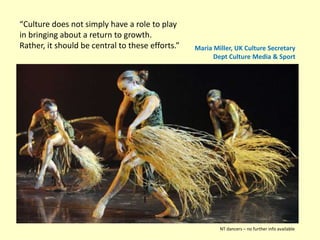
“Culture does not simply have a role to play
in bringing about a return to growth.
Rather, it should be central to these efforts.” Maria Miller, UK Culture Secretary
Dept Culture Media & Sport
NT dancers – no further info available
Australian population = 22,680,000
Contribution: approx. $3800 per person
The landscape has changed.
Sustainable cultural activity
benefits the whole of society.
All those working within arts
and culture should consider
their contribution.
Provocation
Big Ideas in the Landscape
• Technical innovation
• Values shift*
• Economic reality
• Environmental issues
• Dynamic employment pathways
Values*
Collaboration
empowerment
openness and
humanness
Building your capacity…
What do you know now? Where can you start?
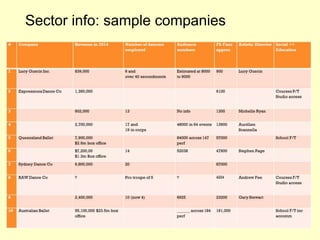
Sector info: sample companies
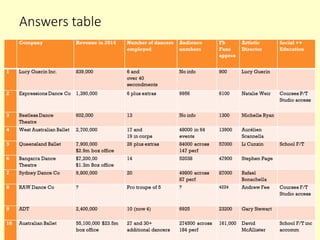
Answers table
Places to find information
Touring shows info on ArTour
Dance Massive program
RealTime Arts online Dance portal… example:
http://realtimearts.net/feature/search/12154
Australian Dance Awards nominees
Australia Council data and peers search “dance grant recipients”
Websites and Annual Reports (publically funded companies)
Follow follow follow – twitter and Instagram for dancers and
directors.
Example: Super Cell Dance Festival news on the Facebook page
Participate and gather info
How do you see
yourself in this
landscape?
Sean Choolburra, Decendence, Torres Strait, Australia
Jeremy Poi Dancenorth, Townsville, AustraliaMichelle Ryan and Vincent Crowley in Tankard’s “Michelle’s Story”
Resilience
What will
the future
look like?
How will
you
adapt?
Who will
you share
it with?
Practising Livelihoods
Artists coming together with creative practitioners to
discuss how they create and maintain livelihoods.
How do/will you look for opportunities which
will benefit your practice/region/community?
Artists and creative practitioners share the risks of new financial,
operational and creative endeavours, and models of working.
To build resilience, self-confidence and self-reliance…
How will you pool risk? What will you share?
Artists and creative practitioners need to
access, animate and use unused space.
What spaces / other resources could be better used?
Seek out new artistic and commercial opportunities.
Email Notes
• Consider your reader. What reaction do you
expect?
• Provide a clear, specific subject line
• Acknowledge prompt replies; clarify what you’re
replying to
• Remove long lists of recipients’ names and
addresses; BCC groups
• Strike a balance between formal and casual
language
• Read and then reread your message before you
send it (for meaning, spelling & punctuation)
• Type your name at the end of your message
• Signature (with your phone number) is a must:
To (really) avoid
• Substituting email for necessary face-
to-face meetings
• Assuming the reader knows who you
are (introduce yourself)
• Assuming that email is private
• Thinking that everyone reads email
immediately (3 work days is ok)
• Sending an email message written in
capital letters, LIKE THIS
• Replying to everyone who received
an email unless it’s relevant to them
• Including your whole address book in
the address line. (use BCC please)
• Forwarding jokes, spam, chain letters,
or advertisements
• Sending an angry message via email
• Facebook messenger & Texting
merci
Ann McLean
annmcleanmanager@gmail.com
annmcleanblog.com
Twitter @thelmascooter

Elevate Landscape May 2016

  • 1.
    Looking at Today’sLandscape Ann McLean Arts Manager, Creative Producer
  • 2.
    Agenda • Information andperspectives • Bigger trends and ideas • Building your capacity • Key questions • Communications etiquette Sue Healy Film still from “Virtuosi”
  • 3.
    “Culture does notsimply have a role to play in bringing about a return to growth. Rather, it should be central to these efforts.” Maria Miller, UK Culture Secretary Dept Culture Media & Sport NT dancers – no further info available
  • 4.
    Australian population =22,680,000 Contribution: approx. $3800 per person The landscape has changed. Sustainable cultural activity benefits the whole of society. All those working within arts and culture should consider their contribution. Provocation
  • 5.
    Big Ideas inthe Landscape • Technical innovation • Values shift* • Economic reality • Environmental issues • Dynamic employment pathways Values* Collaboration empowerment openness and humanness
  • 6.
    Building your capacity… Whatdo you know now? Where can you start?
  • 7.
  • 8.
  • 9.
    Places to findinformation Touring shows info on ArTour Dance Massive program RealTime Arts online Dance portal… example: http://realtimearts.net/feature/search/12154 Australian Dance Awards nominees Australia Council data and peers search “dance grant recipients” Websites and Annual Reports (publically funded companies) Follow follow follow – twitter and Instagram for dancers and directors. Example: Super Cell Dance Festival news on the Facebook page
  • 11.
  • 12.
    How do yousee yourself in this landscape? Sean Choolburra, Decendence, Torres Strait, Australia Jeremy Poi Dancenorth, Townsville, AustraliaMichelle Ryan and Vincent Crowley in Tankard’s “Michelle’s Story”
  • 13.
    Resilience What will the future looklike? How will you adapt? Who will you share it with?
  • 14.
    Practising Livelihoods Artists comingtogether with creative practitioners to discuss how they create and maintain livelihoods. How do/will you look for opportunities which will benefit your practice/region/community? Artists and creative practitioners share the risks of new financial, operational and creative endeavours, and models of working. To build resilience, self-confidence and self-reliance… How will you pool risk? What will you share? Artists and creative practitioners need to access, animate and use unused space. What spaces / other resources could be better used? Seek out new artistic and commercial opportunities.
  • 15.
    Email Notes • Consideryour reader. What reaction do you expect? • Provide a clear, specific subject line • Acknowledge prompt replies; clarify what you’re replying to • Remove long lists of recipients’ names and addresses; BCC groups • Strike a balance between formal and casual language • Read and then reread your message before you send it (for meaning, spelling & punctuation) • Type your name at the end of your message • Signature (with your phone number) is a must:
  • 16.
    To (really) avoid •Substituting email for necessary face- to-face meetings • Assuming the reader knows who you are (introduce yourself) • Assuming that email is private • Thinking that everyone reads email immediately (3 work days is ok) • Sending an email message written in capital letters, LIKE THIS • Replying to everyone who received an email unless it’s relevant to them • Including your whole address book in the address line. (use BCC please) • Forwarding jokes, spam, chain letters, or advertisements • Sending an angry message via email • Facebook messenger & Texting
  • 17.

Editor's Notes

  • #14 renew mission; reconfigure business model; revise approach to money; leadership, culture and values – a crucially important cross cutting theme.