ELEMENTS
OF POETRY
Poetry is one of the oldest, if not the
oldest, forms of literature that is still
existing and popular today. It is a writing
that formulates a concentrated
imaginative awareness of experience in
language chosen and arranged to
create a specific emotional response
through meaning, sound, and rhythm.
Table of Contents
1. PERSONA
2. DRAMATIC
SITUATION
3. IMAGES
4. SYMBOLISM
5. FIGURE OF
SPEECH
6. DICTION
7. SYNTAX
8. TONE
9. SOUND AND
SENSE
10. SUMMARY OF
THE LESSON
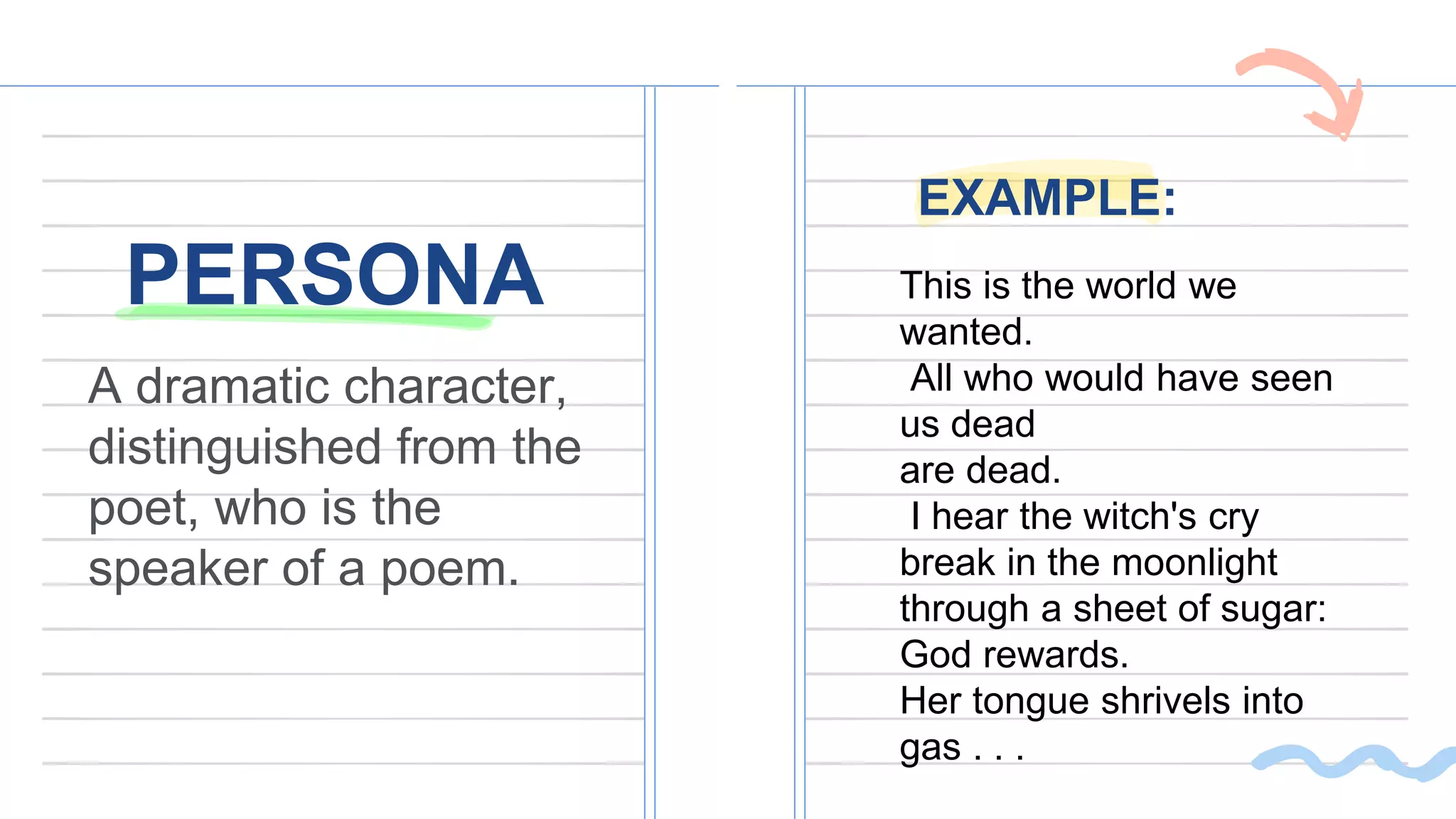
PERSONA
EXAMPLE:
A dramatic character,
distinguished from the
poet, who is the
speaker of a poem.
This is the world we
wanted.
All who would have seen
us dead
are dead.
I hear the witch's cry
break in the moonlight
through a sheet of sugar:
God rewards.
Her tongue shrivels into
gas . . .
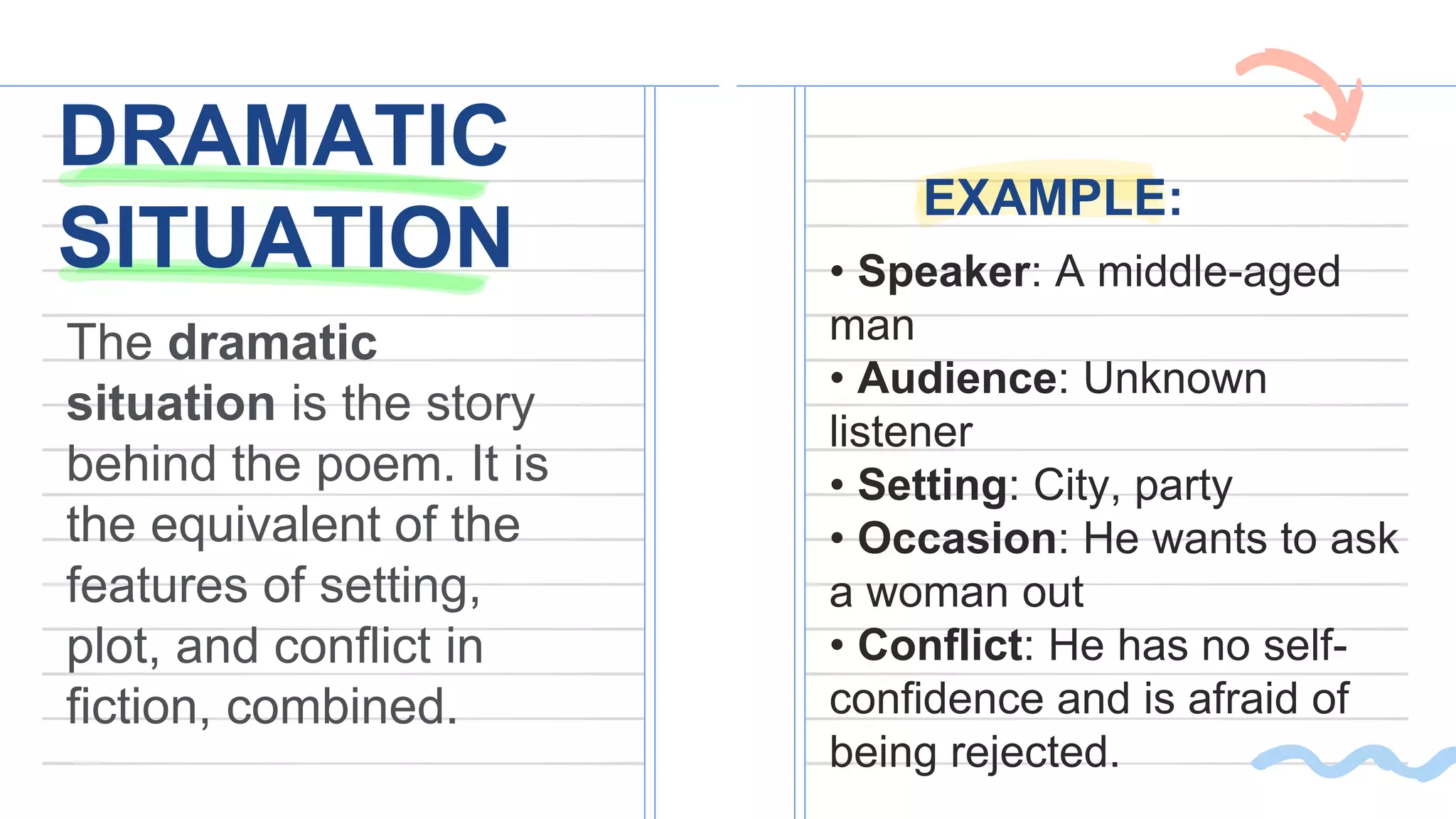
DRAMATIC
SITUATION
EXAMPLE:
The dramatic
situation is the story
behind the poem. It is
the equivalent of the
features of setting,
plot, and conflict in
fiction, combined.
• Speaker: A middle-aged
man
• Audience: Unknown
listener
• Setting: City, party
• Occasion: He wants to ask
a woman out
• Conflict: He has no self-
confidence and is afraid of
being rejected.
IMAGES SENSES:
Images refers to the
elements of a poem
that engage a reader’s
senses. Images are
the mental pictures in
a poem that make the
poet’s ideas concrete
for the readers.
1. Visual - what we see
2. Olfactory - referring to the
smell of things
3. Auditory - what we hear
4. Gustatory - the taste of
certain things
5. Tactile - what we can touch
or feel
6. Organic - what we can
touch or feel
7. Kinesthetic - related to
temperature or movement
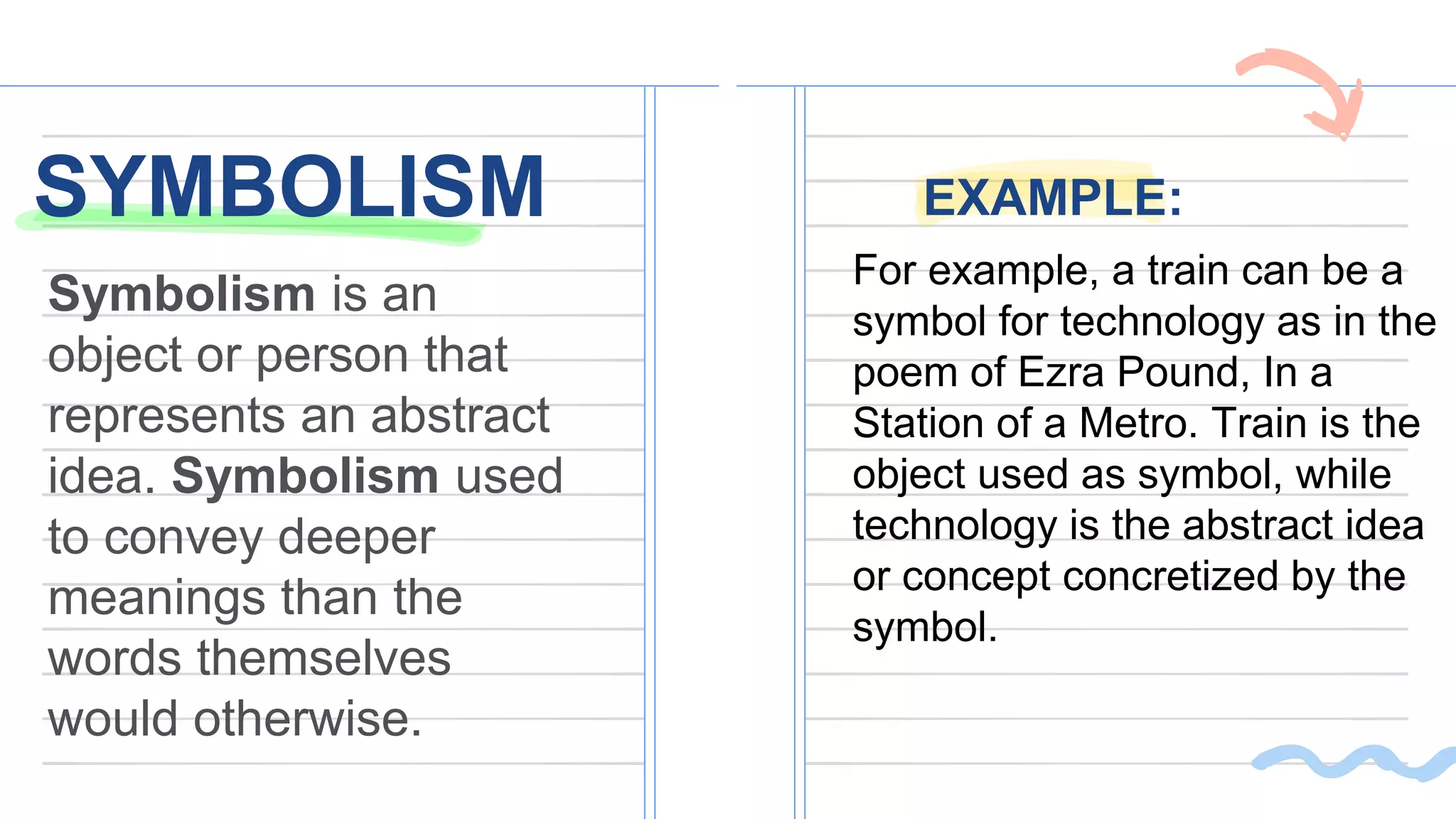
SYMBOLISM EXAMPLE:
Symbolism is an
object or person that
represents an abstract
idea. Symbolism used
to convey deeper
meanings than the
words themselves
would otherwise.
For example, a train can be a
symbol for technology as in the
poem of Ezra Pound, In a
Station of a Metro. Train is the
object used as symbol, while
technology is the abstract idea
or concept concretized by the
symbol.
FIGURE OF
SPEECH
EXAMPL
E:
Figure of speech are
words with meaning
beyond the literal that
help concretize an
abstract idea and add
color and meaning to
the poem.
Metaphor
- Your eyes are stars
Synecdoche
- He is living from hand
to mouth
Irony
- The smell of trash is
really delicious.
Paradox
- The more I see the
less I know.
DICTION EXAMPLE:
Diction is the careful
choice of words.
Diction the intentional
selection of vocabulary
that is most effective,
appropriate, or clear.
The Soul selects her own
Society —
Emily Dickinson deliberately
chose the words soul and
society to show how serious
and sincere the persona is in
choosing his/her friends out of
the many that s/he could
possibly choose from.
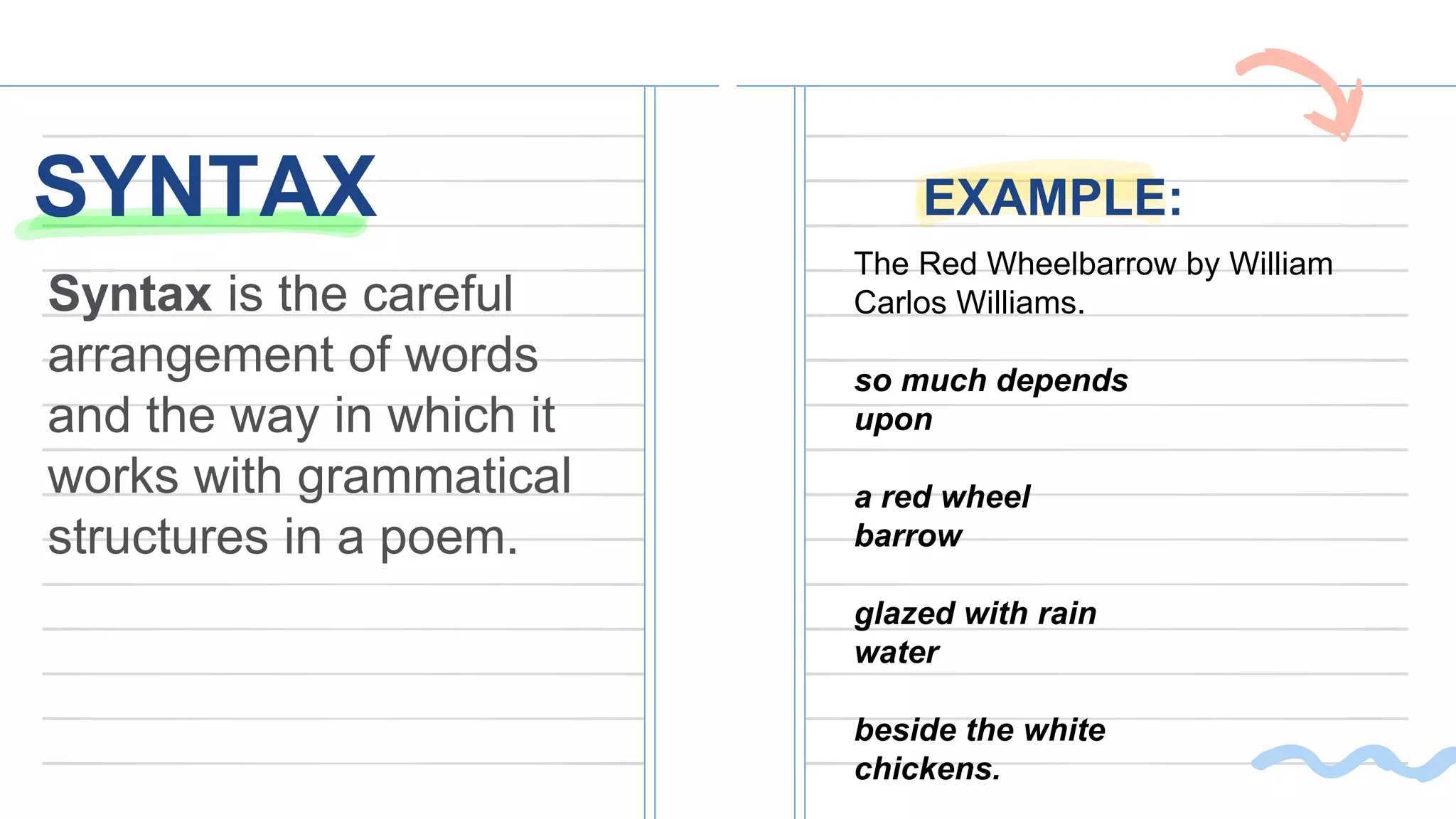
SYNTAX EXAMPLE:
Syntax is the careful
arrangement of words
and the way in which it
works with grammatical
structures in a poem.
The Red Wheelbarrow by William
Carlos Williams.
so much depends
upon
a red wheel
barrow
glazed with rain
water
beside the white
chickens.
TONE EXAMPLE:
Tone is the attitude of
the persona (or the
writer) towards the
subject or the dramatic
situation.
For example, the
persona is angry, or to
be more specific,
sarcastic about a
political or social
situation portrayed in
the poem.
SOUND AND
SENSE
EXAMPLE:
Sound and sense is
the use of sound
devices to match the
meaning of the poem.
For example, in the poem
“Eight O’Clock” by A.E.
Housman, the underlined
sounds are considered harsh
sounds which are just fitting
to the subject of the poem
which is the impending death
of the “He” due to a cruel
public execution which then
in England happens every
8:00 a.m.
SUMMARY
A dramatic character engage the reader’s
senses.
convey deeper meanings the careful choice of
words.
the story behind the
poem
add color and meaning to
the poem.
SYMBOLISM DICTION
PERSONA IMAGES
FIGURE OF
SPEECH
DRAMATIC
SITUATION
the careful arrangement
of words
SYNTAX
the attitude of the
persona
TONE
the use of sound devices
to match the meaning
SOUND AND
SENSE
THANK YOU!

Elements of Poetry.pptx

  • 1.
  • 2.
    Poetry is oneof the oldest, if not the oldest, forms of literature that is still existing and popular today. It is a writing that formulates a concentrated imaginative awareness of experience in language chosen and arranged to create a specific emotional response through meaning, sound, and rhythm.
  • 3.
    Table of Contents 1.PERSONA 2. DRAMATIC SITUATION 3. IMAGES 4. SYMBOLISM 5. FIGURE OF SPEECH 6. DICTION 7. SYNTAX 8. TONE 9. SOUND AND SENSE 10. SUMMARY OF THE LESSON
  • 4.
    PERSONA EXAMPLE: A dramatic character, distinguishedfrom the poet, who is the speaker of a poem. This is the world we wanted. All who would have seen us dead are dead. I hear the witch's cry break in the moonlight through a sheet of sugar: God rewards. Her tongue shrivels into gas . . .
  • 5.
    DRAMATIC SITUATION EXAMPLE: The dramatic situation isthe story behind the poem. It is the equivalent of the features of setting, plot, and conflict in fiction, combined. • Speaker: A middle-aged man • Audience: Unknown listener • Setting: City, party • Occasion: He wants to ask a woman out • Conflict: He has no self- confidence and is afraid of being rejected.
  • 6.
    IMAGES SENSES: Images refersto the elements of a poem that engage a reader’s senses. Images are the mental pictures in a poem that make the poet’s ideas concrete for the readers. 1. Visual - what we see 2. Olfactory - referring to the smell of things 3. Auditory - what we hear 4. Gustatory - the taste of certain things 5. Tactile - what we can touch or feel 6. Organic - what we can touch or feel 7. Kinesthetic - related to temperature or movement
  • 7.
    SYMBOLISM EXAMPLE: Symbolism isan object or person that represents an abstract idea. Symbolism used to convey deeper meanings than the words themselves would otherwise. For example, a train can be a symbol for technology as in the poem of Ezra Pound, In a Station of a Metro. Train is the object used as symbol, while technology is the abstract idea or concept concretized by the symbol.
  • 8.
    FIGURE OF SPEECH EXAMPL E: Figure ofspeech are words with meaning beyond the literal that help concretize an abstract idea and add color and meaning to the poem. Metaphor - Your eyes are stars Synecdoche - He is living from hand to mouth Irony - The smell of trash is really delicious. Paradox - The more I see the less I know.
  • 9.
    DICTION EXAMPLE: Diction isthe careful choice of words. Diction the intentional selection of vocabulary that is most effective, appropriate, or clear. The Soul selects her own Society — Emily Dickinson deliberately chose the words soul and society to show how serious and sincere the persona is in choosing his/her friends out of the many that s/he could possibly choose from.
  • 10.
    SYNTAX EXAMPLE: Syntax isthe careful arrangement of words and the way in which it works with grammatical structures in a poem. The Red Wheelbarrow by William Carlos Williams. so much depends upon a red wheel barrow glazed with rain water beside the white chickens.
  • 11.
    TONE EXAMPLE: Tone isthe attitude of the persona (or the writer) towards the subject or the dramatic situation. For example, the persona is angry, or to be more specific, sarcastic about a political or social situation portrayed in the poem.
  • 12.
    SOUND AND SENSE EXAMPLE: Sound andsense is the use of sound devices to match the meaning of the poem. For example, in the poem “Eight O’Clock” by A.E. Housman, the underlined sounds are considered harsh sounds which are just fitting to the subject of the poem which is the impending death of the “He” due to a cruel public execution which then in England happens every 8:00 a.m.
  • 13.
    SUMMARY A dramatic characterengage the reader’s senses. convey deeper meanings the careful choice of words. the story behind the poem add color and meaning to the poem. SYMBOLISM DICTION PERSONA IMAGES FIGURE OF SPEECH DRAMATIC SITUATION the careful arrangement of words SYNTAX the attitude of the persona TONE the use of sound devices to match the meaning SOUND AND SENSE
  • 14.