Elements of a Good Information System
Kyle Duarte
Antalya, Turkey
December 2013
Overview
• Key feature of information system
• Maximizing information systems
• Most common challenges
• Critical factors to successful implementation and
use
Understand the Context
Define the problem/problem statement:
• What is the problem that needs resolution?
• What are the expectations from the software & how
will the software solve the problem?
• How much resources need to be allocated for the
software?
• What and who benefits from this software?
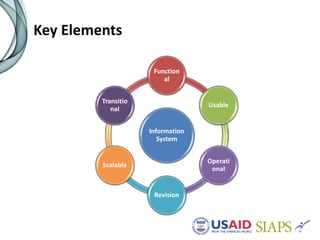
Key Elements
Information
System
Function
al
Usable
Operati
onal
Revision
Scalable
Transitio
nal
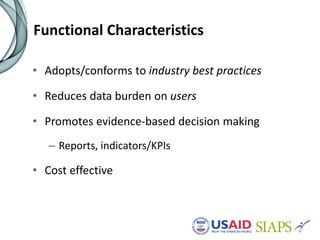
Functional Characteristics
• Adopts/conforms to industry best practices
• Reduces data burden on users
• Promotes evidence-based decision making
– Reports, indicators/KPIs
• Cost effective
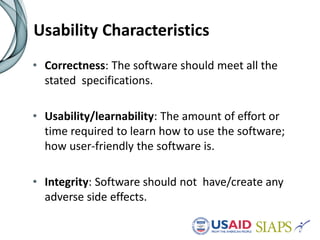
Usability Characteristics
• Correctness: The software should meet all the
stated specifications.
• Usability/learnability: The amount of effort or
time required to learn how to use the software;
how user-friendly the software is.
• Integrity: Software should not have/create any
adverse side effects.
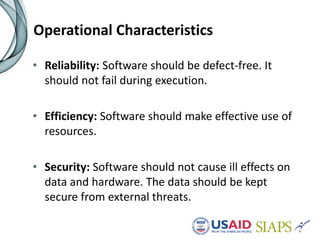
Operational Characteristics
• Reliability: Software should be defect-free. It
should not fail during execution.
• Efficiency: Software should make effective use of
resources.
• Security: Software should not cause ill effects on
data and hardware. The data should be kept
secure from external threats.
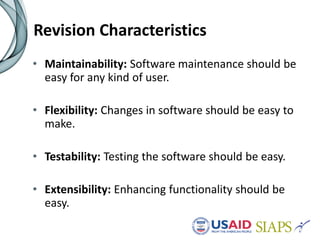
Revision Characteristics
• Maintainability: Software maintenance should be
easy for any kind of user.
• Flexibility: Changes in software should be easy to
make.
• Testability: Testing the software should be easy.
• Extensibility: Enhancing functionality should be
easy.
Scalable Characteristics
• Scalability: Easily upgradeable for more work or
for larger number of users
• Extensibility : Accessible across multiple
platforms/devices
• Modularity: Separate independent units/modules
that can be modified and tested independently
Overview
• Key feature of information system
• Maximizing information systems
• Most common challenges
• Critical factors to successful implementation and
use
Maximizing Information Systems
• Interoperability: Ability of the software to
exchange information with other applications and
make use of information transparently
• Portability: Ability to perform the same functions
across all environments and platforms
• Reusability: Ability to modify code for a different
purpose and reuse it
Maximizing Information Systems…(2)
• Integration: Bringing together various
disparate systems to act as one system
• Interface: Ability to transform or map data
to the receiving application’s requirements
while the message is in transit so that the
data can be accepted by the receiving
application
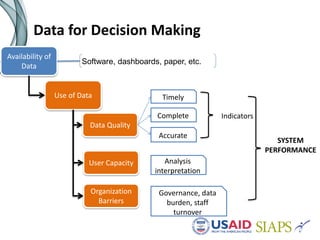
Data for Decision Making
Use of Data
Data Quality
Timely
Complete
Accurate
Indicators
SYSTEM
PERFORMANCE
Availability of
Data
Software, dashboards, paper, etc.
User Capacity
Organization
Barriers
Analysis
interpretation
Governance, data
burden, staff
turnover
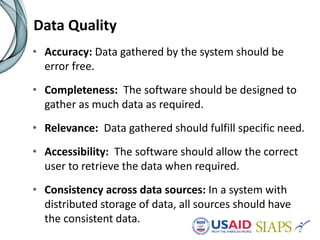
Data Quality
• Accuracy: Data gathered by the system should be
error free.
• Completeness: The software should be designed to
gather as much data as required.
• Relevance: Data gathered should fulfill specific need.
• Accessibility: The software should allow the correct
user to retrieve the data when required.
• Consistency across data sources: In a system with
distributed storage of data, all sources should have
the consistent data.
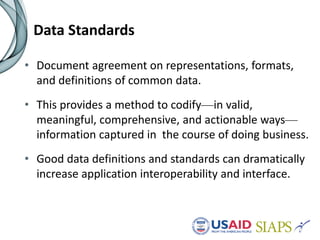
Data Standards
• Document agreement on representations, formats,
and definitions of common data.
• This provides a method to codify—in valid,
meaningful, comprehensive, and actionable ways—
information captured in the course of doing business.
• Good data definitions and standards can dramatically
increase application interoperability and interface.
Overview
• Key feature of information system
• Maximizing information systems
• Most common challenges
• Critical factors to successful implementation and
use
Most Common Challenges
• Length of time: 12-18 months
• Business as usual during implementation, training, and
migration
• Inadequate training and continuous process changes
• Time-consuming data entry
• Lack of support post go-live
Suboptimal Software Implementation
• Designed for data entry only
• Tries to resolve too many varied problems
• Duplication of efforts and parallel system
• Lack of standard reports/indicators, leading
users to create their own
• User resistance to adoption
Critical Factors to Success
• Good, robust software solution
• Implementation expertise and experience
• Stakeholder buy-in and commitment
• Sustainability and local ownership
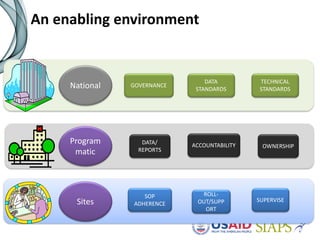
An enabling environment
ROLL-
OUT/SUPP
ORT
SUPERVISE
ACCOUNTABILITYDATA/
REPORTS
OWNERSHIP
GOVERNANCE
DATA
STANDARDS
TECHNICAL
STANDARDSNational
Program
matic
Sites
SOP
ADHERENCE
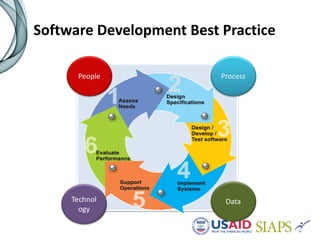
Software Development Best Practice
Technol
ogy
People
Data
Process

Elements of a Good Information System

  • 1.
    Elements of aGood Information System Kyle Duarte Antalya, Turkey December 2013
  • 2.
    Overview • Key featureof information system • Maximizing information systems • Most common challenges • Critical factors to successful implementation and use
  • 3.
    Understand the Context Definethe problem/problem statement: • What is the problem that needs resolution? • What are the expectations from the software & how will the software solve the problem? • How much resources need to be allocated for the software? • What and who benefits from this software?
  • 4.
  • 5.
    Functional Characteristics • Adopts/conformsto industry best practices • Reduces data burden on users • Promotes evidence-based decision making – Reports, indicators/KPIs • Cost effective
  • 6.
    Usability Characteristics • Correctness:The software should meet all the stated specifications. • Usability/learnability: The amount of effort or time required to learn how to use the software; how user-friendly the software is. • Integrity: Software should not have/create any adverse side effects.
  • 7.
    Operational Characteristics • Reliability:Software should be defect-free. It should not fail during execution. • Efficiency: Software should make effective use of resources. • Security: Software should not cause ill effects on data and hardware. The data should be kept secure from external threats.
  • 8.
    Revision Characteristics • Maintainability:Software maintenance should be easy for any kind of user. • Flexibility: Changes in software should be easy to make. • Testability: Testing the software should be easy. • Extensibility: Enhancing functionality should be easy.
  • 9.
    Scalable Characteristics • Scalability:Easily upgradeable for more work or for larger number of users • Extensibility : Accessible across multiple platforms/devices • Modularity: Separate independent units/modules that can be modified and tested independently
  • 10.
    Overview • Key featureof information system • Maximizing information systems • Most common challenges • Critical factors to successful implementation and use
  • 11.
    Maximizing Information Systems •Interoperability: Ability of the software to exchange information with other applications and make use of information transparently • Portability: Ability to perform the same functions across all environments and platforms • Reusability: Ability to modify code for a different purpose and reuse it
  • 12.
    Maximizing Information Systems…(2) •Integration: Bringing together various disparate systems to act as one system • Interface: Ability to transform or map data to the receiving application’s requirements while the message is in transit so that the data can be accepted by the receiving application
  • 13.
    Data for DecisionMaking Use of Data Data Quality Timely Complete Accurate Indicators SYSTEM PERFORMANCE Availability of Data Software, dashboards, paper, etc. User Capacity Organization Barriers Analysis interpretation Governance, data burden, staff turnover
  • 14.
    Data Quality • Accuracy:Data gathered by the system should be error free. • Completeness: The software should be designed to gather as much data as required. • Relevance: Data gathered should fulfill specific need. • Accessibility: The software should allow the correct user to retrieve the data when required. • Consistency across data sources: In a system with distributed storage of data, all sources should have the consistent data.
  • 15.
    Data Standards • Documentagreement on representations, formats, and definitions of common data. • This provides a method to codify—in valid, meaningful, comprehensive, and actionable ways— information captured in the course of doing business. • Good data definitions and standards can dramatically increase application interoperability and interface.
  • 16.
    Overview • Key featureof information system • Maximizing information systems • Most common challenges • Critical factors to successful implementation and use
  • 17.
    Most Common Challenges •Length of time: 12-18 months • Business as usual during implementation, training, and migration • Inadequate training and continuous process changes • Time-consuming data entry • Lack of support post go-live
  • 18.
    Suboptimal Software Implementation •Designed for data entry only • Tries to resolve too many varied problems • Duplication of efforts and parallel system • Lack of standard reports/indicators, leading users to create their own • User resistance to adoption
  • 19.
    Critical Factors toSuccess • Good, robust software solution • Implementation expertise and experience • Stakeholder buy-in and commitment • Sustainability and local ownership
  • 20.
  • 21.
    Software Development BestPractice Technol ogy People Data Process