Electrostatics
By
Samiul Islam
ID: 20104027
1
Topics at a glance
 Introduction
 Types of Electricity
 Conducting medium
 Coulomb’s Law
 Electric field and electric field intensity
 Potential and potential difference
 Electric capacitance
 Potential energy of Capacitors
 Combination of Capacitors
2
“Electricity can be converted to other form of energy and other form of energy
can be converted into electricity and work can be done by electricity”
Conservation of Electrical Energy
3
Dr. William Gilbert
In 1600 Dr. Gilbert showed by experiments that, not only in amber, similar effect is produced
when glass. rubber, ebonite, Sulphur etc. are rubbed. In winter, it is often seen that a plastic
comb attracts small pieces of paper after combing hair. He called this event as electrification.
The object in which charges are produced is called charged object. The object in which charges
are not present are uncharged object.
Definition of charge: Electric charge is an intrinsic characteristic of the fundamental particles
whose presence generate static electricity, electric field, static electric energy in an object which
can attract very tiny objects like paper and due to their motion electric current. electric and
magnetic field are generated.
Introduction
4
Types of electricity
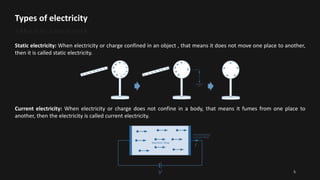
Static electricity: When electricity or charge confined in an object , that means it does not move one place to another,
then it is called static electricity.
Current electricity: When electricity or charge does not confine in a body, that means it fumes from one place to
another, then the electricity is called current electricity.
5
Conducting medium
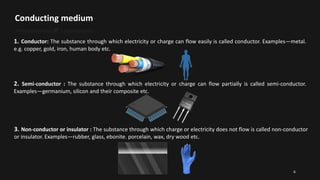
1. Conductor: The substance through which electricity or charge can flow easily is called conductor. Examples—metal.
e.g. copper, gold, iron, human body etc.
2. Semi-conductor : The substance through which electricity or charge can flow partially is called semi-conductor.
Examples—germanium, silicon and their composite etc.
3. Non-conductor or insulator : The substance through which charge or electricity does not flow is called non-conductor
or insulator. Examples—rubber, glass, ebonite. porcelain, wax, dry wood etc.
6
Coulomb’s law
“At a particular medium, the magnitude of attractive or repulsive force between two point charges is directly
proportional to the product of the charges and inversely proportional to the square of distance between the
charges. The force acts along the straight line joining the two charges.”
𝐹 = 𝑘
𝑄1 𝑄2
𝑟2
Where,
 𝐹 is the force
 𝑘 is the Coulomb Constant 9 × 10⁹ 𝑁. 𝑚2. 𝐶−2
 𝑄1 and 𝑄2 are the signed magnitude of charges
 𝑟 is the distance between charges.
7
Electric field and electric field intensity
8
Electric field: Space around a charged body where its influence is experienced is called the electric field of that charged
body.
Electric field intensity: The electric force acting on a unit charge at a point in the electric field is called electric field
intensity or simply field intensity.
Potential and potential difference
9
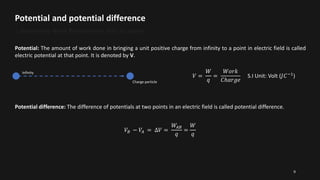
Potential: The amount of work done in bringing a unit positive charge from infinity to a point in electric field is called
electric potential at that point. It is denoted by V.
Infinity
Charge particle
𝑉 =
𝑊
𝑞
=
𝑊𝑜𝑟𝑘
𝐶ℎ𝑎𝑟𝑔𝑒
S.I Unit: Volt (𝐽𝐶−1)
Potential difference: The difference of potentials at two points in an electric field is called potential difference.
𝑉𝐵 − 𝑉𝐴 = ∆𝑉 =
𝑊𝐴𝐵
𝑞
=
𝑊
𝑞
10
Electron volt
In atomic and nuclear physics work or energy is often measured instead of joule. by another quantity called electron
volt. If the potential difference between two points in an electric field is 1V, then the kinetic energy acquired by a free
electron in moving from one of to other point is called I electron volt or simply I eV.
Definition: The amount of work done in taking a free electron from a point to another point having potential difference
of 1V is called I electron volt 1 eV.
1𝑒𝑉 = 𝑐ℎ𝑎𝑟𝑔𝑒 𝑜𝑓 𝑎𝑛 𝑒𝑙𝑒𝑐𝑡𝑒𝑜𝑛 × 1𝑉
= 1.6 × 10−19
𝐶 × 1𝑉
= 1.6 × 10−19
𝐶 ×
1𝐽
1𝐶
= 1.6 × 10⁻¹⁹
𝐽
11
Electric capacitance
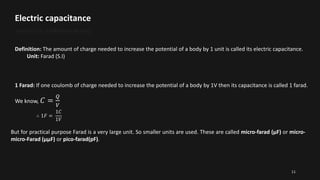
Definition: The amount of charge needed to increase the potential of a body by 1 unit is called its electric capacitance.
Unit: Farad (S.I)
1 Farad: If one coulomb of charge needed to increase the potential of a body by 1V then its capacitance is called 1 farad.
We know, 𝐶 =
𝑄
𝑉
∴ 1𝐹 =
1𝐶
1𝑉
But for practical purpose Farad is a very large unit. So smaller units are used. These are called micro-farad (µF) or micro-
micro-Farad (µµF) or pico-farad(pF).
12
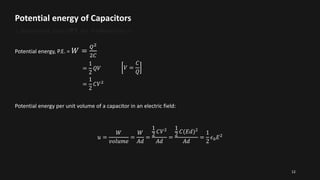
Potential energy of Capacitors
Potential energy, P.E. = 𝑊 =
𝑄2
2𝐶
=
1
2
𝑄𝑉
=
1
2
𝐶𝑉2
𝑉 =
𝐶
𝑄
Potential energy per unit volume of a capacitor in an electric field:
𝑢 =
𝑊
𝑣𝑜𝑙𝑢𝑚𝑒
=
𝑊
𝐴𝑑
=
1
2
𝐶𝑉2
𝐴𝑑
=
1
2
𝐶(𝐸𝑑)2
𝐴𝑑
=
1
2
𝜖0 𝐸2
13
Combination of Capacitors
1. Series combination: When some capacitors are connected in such a way that the second of the first capacitor is
connected to the first plate of the second capacitor and the second plate of the second capacitor is connected to the first
plate of the third capacitor and so on and the end plate of the last capacitor' connected to the ground, then the
combination or grouping is called series combination.
2. Parallel combination : When some capacitors are connected in such a way that first plate of each capacitor is
connected to one point and the second plate of each capacitor is connected to another point then the combination or
grouping is called parallel combination.
𝐶1 𝐶2
1
𝐶𝑠
=
1
𝐶1
+
1
𝐶2
+
1
𝐶3
+ ⋯ ⋯ +
1
𝐶 𝑛
=
1
𝐶 𝑛
𝐶 𝑝 = 𝐶1 + 𝐶2 + 𝐶3 + ⋯ ⋯ + 𝐶 𝑛 = 𝐶 𝑛
𝐶2
𝐶1
14
Thanks for your attention

Electrostatics

  • 1.
  • 2.
    Topics at aglance  Introduction  Types of Electricity  Conducting medium  Coulomb’s Law  Electric field and electric field intensity  Potential and potential difference  Electric capacitance  Potential energy of Capacitors  Combination of Capacitors 2
  • 3.
    “Electricity can beconverted to other form of energy and other form of energy can be converted into electricity and work can be done by electricity” Conservation of Electrical Energy 3
  • 4.
    Dr. William Gilbert In1600 Dr. Gilbert showed by experiments that, not only in amber, similar effect is produced when glass. rubber, ebonite, Sulphur etc. are rubbed. In winter, it is often seen that a plastic comb attracts small pieces of paper after combing hair. He called this event as electrification. The object in which charges are produced is called charged object. The object in which charges are not present are uncharged object. Definition of charge: Electric charge is an intrinsic characteristic of the fundamental particles whose presence generate static electricity, electric field, static electric energy in an object which can attract very tiny objects like paper and due to their motion electric current. electric and magnetic field are generated. Introduction 4
  • 5.
    Types of electricity Staticelectricity: When electricity or charge confined in an object , that means it does not move one place to another, then it is called static electricity. Current electricity: When electricity or charge does not confine in a body, that means it fumes from one place to another, then the electricity is called current electricity. 5
  • 6.
    Conducting medium 1. Conductor:The substance through which electricity or charge can flow easily is called conductor. Examples—metal. e.g. copper, gold, iron, human body etc. 2. Semi-conductor : The substance through which electricity or charge can flow partially is called semi-conductor. Examples—germanium, silicon and their composite etc. 3. Non-conductor or insulator : The substance through which charge or electricity does not flow is called non-conductor or insulator. Examples—rubber, glass, ebonite. porcelain, wax, dry wood etc. 6
  • 7.
    Coulomb’s law “At aparticular medium, the magnitude of attractive or repulsive force between two point charges is directly proportional to the product of the charges and inversely proportional to the square of distance between the charges. The force acts along the straight line joining the two charges.” 𝐹 = 𝑘 𝑄1 𝑄2 𝑟2 Where,  𝐹 is the force  𝑘 is the Coulomb Constant 9 × 10⁹ 𝑁. 𝑚2. 𝐶−2  𝑄1 and 𝑄2 are the signed magnitude of charges  𝑟 is the distance between charges. 7
  • 8.
    Electric field andelectric field intensity 8 Electric field: Space around a charged body where its influence is experienced is called the electric field of that charged body. Electric field intensity: The electric force acting on a unit charge at a point in the electric field is called electric field intensity or simply field intensity.
  • 9.
    Potential and potentialdifference 9 Potential: The amount of work done in bringing a unit positive charge from infinity to a point in electric field is called electric potential at that point. It is denoted by V. Infinity Charge particle 𝑉 = 𝑊 𝑞 = 𝑊𝑜𝑟𝑘 𝐶ℎ𝑎𝑟𝑔𝑒 S.I Unit: Volt (𝐽𝐶−1) Potential difference: The difference of potentials at two points in an electric field is called potential difference. 𝑉𝐵 − 𝑉𝐴 = ∆𝑉 = 𝑊𝐴𝐵 𝑞 = 𝑊 𝑞
  • 10.
    10 Electron volt In atomicand nuclear physics work or energy is often measured instead of joule. by another quantity called electron volt. If the potential difference between two points in an electric field is 1V, then the kinetic energy acquired by a free electron in moving from one of to other point is called I electron volt or simply I eV. Definition: The amount of work done in taking a free electron from a point to another point having potential difference of 1V is called I electron volt 1 eV. 1𝑒𝑉 = 𝑐ℎ𝑎𝑟𝑔𝑒 𝑜𝑓 𝑎𝑛 𝑒𝑙𝑒𝑐𝑡𝑒𝑜𝑛 × 1𝑉 = 1.6 × 10−19 𝐶 × 1𝑉 = 1.6 × 10−19 𝐶 × 1𝐽 1𝐶 = 1.6 × 10⁻¹⁹ 𝐽
  • 11.
    11 Electric capacitance Definition: Theamount of charge needed to increase the potential of a body by 1 unit is called its electric capacitance. Unit: Farad (S.I) 1 Farad: If one coulomb of charge needed to increase the potential of a body by 1V then its capacitance is called 1 farad. We know, 𝐶 = 𝑄 𝑉 ∴ 1𝐹 = 1𝐶 1𝑉 But for practical purpose Farad is a very large unit. So smaller units are used. These are called micro-farad (µF) or micro- micro-Farad (µµF) or pico-farad(pF).
  • 12.
    12 Potential energy ofCapacitors Potential energy, P.E. = 𝑊 = 𝑄2 2𝐶 = 1 2 𝑄𝑉 = 1 2 𝐶𝑉2 𝑉 = 𝐶 𝑄 Potential energy per unit volume of a capacitor in an electric field: 𝑢 = 𝑊 𝑣𝑜𝑙𝑢𝑚𝑒 = 𝑊 𝐴𝑑 = 1 2 𝐶𝑉2 𝐴𝑑 = 1 2 𝐶(𝐸𝑑)2 𝐴𝑑 = 1 2 𝜖0 𝐸2
  • 13.
    13 Combination of Capacitors 1.Series combination: When some capacitors are connected in such a way that the second of the first capacitor is connected to the first plate of the second capacitor and the second plate of the second capacitor is connected to the first plate of the third capacitor and so on and the end plate of the last capacitor' connected to the ground, then the combination or grouping is called series combination. 2. Parallel combination : When some capacitors are connected in such a way that first plate of each capacitor is connected to one point and the second plate of each capacitor is connected to another point then the combination or grouping is called parallel combination. 𝐶1 𝐶2 1 𝐶𝑠 = 1 𝐶1 + 1 𝐶2 + 1 𝐶3 + ⋯ ⋯ + 1 𝐶 𝑛 = 1 𝐶 𝑛 𝐶 𝑝 = 𝐶1 + 𝐶2 + 𝐶3 + ⋯ ⋯ + 𝐶 𝑛 = 𝐶 𝑛 𝐶2 𝐶1
  • 14.