E Contracts (E Transactions)
Dr. Shruti Ganpule
Introduction
• Meaning of E Commerce
• E Commerce pertains to the ability of conducting business
electronically or over the internet. It refers to the technology enabled
communication with customers and suppliers for a business
organization.
• E commerce is paperless exchange of business information using
electronic data interchange. (EDI), electronic mail, electronic bulletin
board, electronic fund transfers and other network technologies.
• E commerce includes EDI, fund transfers, debit and credit card
transactions and retail sales activities.
Characteristics of E Commerce
• It is available everywhere
• It has global reach
• It has to operate according to universal protocols / standards.
• It provides information with all complex details (including mail,
graphs, video, music files, images etc)
• It facilitates two way communication.
• It improves quality standards
• It reduces operational costs
• It enables to send personalized messages to individuals and groups.
Kinds of E Commerce
1. Business to consumer (B2C)
2. Business to Business (B2B)
3. Consumers to consumers (C2C)
4. Peer to peer (P2P)
5. M Commerce (Mobile commerce) using wireless digital
services.
Significance and Advantages of E Commerce
• All time operations
• Global Market
• Cost effective
• Expansion of Business
• Elimination of intermediaries
• Increased satisfaction of customers.
• Growth in sales volume
• Control of customer on the interaction
• Understanding customer behaviour.
E Contracts
• The parliament of India passed its first cyber law on 17th October,
2000 which is known as Information Technology Act (IT Act) 2000.
• As per this Act, electronic contracts are considered to be legally valid.
• EDI was given legal recognition.
• E mail is now considered to be valid and can be produced in the court
of law in the matter of litigation.
• As a result of which corporates are required to be more careful while
writing e mail or answering an email.
Creating E Contracts
• In order to create a valid contract, all the essential elements of a valid
contract listed u/s 10 of the Indian Contract Act, 1872 are required to
be fulfilled.
• Offer
• Acceptance
• Communication of Acceptance:
• As against the Proposer: When it is put in the course of transmission.
• As against the acceptor: When it comes to the knowledge of the proposer
• The courts have held that the acceptance communicated by telephone,
telex or fax are formed when the offeror receives the acceptance
because they are functionally equivalent to face to face
communication.
Legality of E contracts & E transactions
• Information Technology Act 2000
• Indian contract Act 1872
• UNCITRAL Model of E Commerce
• (The United Nations Commission on International Trade Law): adopted
in 1996.
• It is intended to give states a legislative framework to remove legal
barriers to electronic commerce.
Legality of E Signatures
• Electronic Signature includes Digital signature.
• Sometimes law provides that any information is to be authenticated by
affixing the signature. Sometimes it is required that a document should
bear signature of a specific person. In such cases, it will be sufficient if
the documents are signed electronically with the help of digital
signature as prescribed by the Central Government.
• The IT act allows the use and preservation of electronic records and
electronic signature in Government and its agencies.
Parties to the electronic transmission process
• Originator: A person who sends, generates, stores or transmits any
electronic message.
• Intermediary: Any person who on behalf of any other person receives,
stores or transmits any electronic message or provides any service with
respect to that message. It includes telecom service providers, network
service providers, internet service providers, web hosting service
providers, search engine, online payment intermediary etc..
• Addressee: A person who is intended to receive electronic record.
Attribution, Acknowledgement & Dispatch of E Records
• Attribution of Electronic Record:
An electronic record shall be attributed to the originator if:
1. It was sent by the originator himself
2. By the person authorized by the originator.
3. By an information system programmed by the originator to operate automatically.
This provision is made to discuss consensus ad idem. It is the system of computer program
which receives assent of the addressee. Still it is considered to be consensus ad idem.
Attribution, Acknowledgement & Dispatch of E Records
• Acknowledgement of Receipt:
If the originator of the contract has not stipulated a specific method of
acknowledgement (acceptance) then, it can be given by:
1. Any mode of communication, automated or electronic or physical.
2. Any conduct by addressee to show that he electronic record has been
received.
3. The originator may specify that the contract will be considered only
after receiving receipt of acknowledgement by him. If such condition
is not fulfilled, the originator shall consider that the electronic record
was never sent.
4. The originator may specify a specific time for acknowledgement of
record.
Attribution, Acknowledgement & Dispatch of E Records
• The dispatch of an electronic record occurs when it enters a computer
resource out of the control of the originator.
• If the addressee has specified a computer resource,
1. Receipt occurs only when it enters the specified computer system.
2. If the record is sent to other system, it will be considered as accepted
only when it is retrieved by the originator.
3. If a specified system is not mentioned, record will be treated as
received when it enters the computer resource of the addressee.
4. An electronic record is deemed to be dispatched at the place of the
originator and is deemed to be received at the place where the
addressee has its place of business.
Attribution, Acknowledgement & Dispatch of E Records
5. If there are more than one place of business of the originator, the
principal place will be considered.
6. If there is no place of business, the residence of the originator will be
considered as the place of business.
7. For a body corporate, the registered address is considered to be place
of business.
Digital Signature
Electronic Data:
Electronic data means data, record, image or sound stored, received or
sent in an electronic form or microfilm or computer generated
microfiche.
Subscriber:
Subscriber means a person in whose name the electronic signature
certificate is issued.
Digital Signature:
Digital signature means authentication of any electronic record by a
subscriber by means of an electronic method or procedure
Working of Digital Signature
• While conducting business or transmitting legal documents electronically, one
must confirm that such documents are authentic and have not been tampered with
by any person during transmission.
• It is possible with the use of asymmetric crypto system.
• Under this system, each person will have two corresponding and matching keys:
• A public key
• A private key
Process of creating and Verifying Digital Signature
• Signer Authentication
A digital signature with private key effectively identifies the signer with the
message.
• Authentication of message
It identifies the matter to be signed with greater certainty and precision.
• Affirmative Act
The signer must use his private key by appropriate software function.
• Efficiency
The process ensures a significant level of genuineness of the signer and almost
complete automation whereby the signatures are transmitted for verification
automatically.
Functions of Digital Signature
1. Confidentiality;
• Protect from hackers.
• Send message to the recipient safely.
• Use of public and private key.
2. Integrity:
• To see that the information or data sent is not tampered or altered.
• To check whether there is any alteration or modification in the original
message with the help of software.
• To make sure that the data or message should reach the recipient in the
original form.
Functions of Digital Signature
3. Authenticity:
• Reliable identification of the sender and receiver.
• Preventing others from utilizing the public or private key or interrupting the message.
4. Availability:
• To ensure that the message or information is available whenever required in the stipulated
time.
• To take care that there is no difficulty due to hardware problems / network problems /
software errors / virus attacks / hackers etc.
Functions of Digital Signature
5. Non Repudiation:
• The system should be able to bind the originator and the recipient.
• Once message is sent, the originator should not deny that the message is not sent by him.
• Once the message is received, the receiver should not say that the message is not received by
him.
6. Auditability:
While recording audit data, the system must ensure that all specified
confidentiality and integrity requirements are complied with.
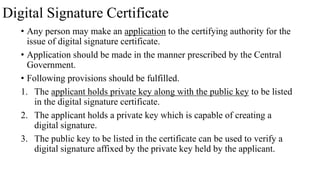
Digital Signature Certificate
• Any person may make an application to the certifying authority for the
issue of digital signature certificate.
• Application should be made in the manner prescribed by the Central
Government.
• Following provisions should be fulfilled.
1. The applicant holds private key along with the public key to be listed
in the digital signature certificate.
2. The applicant holds a private key which is capable of creating a
digital signature.
3. The public key to be listed in the certificate can be used to verify a
digital signature affixed by the private key held by the applicant.
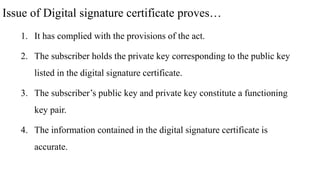
Issue of Digital signature certificate proves…
1. It has complied with the provisions of the act.
2. The subscriber holds the private key corresponding to the public key
listed in the digital signature certificate.
3. The subscriber’s public key and private key constitute a functioning
key pair.
4. The information contained in the digital signature certificate is
accurate.
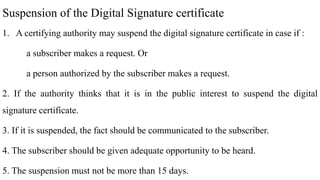
Suspension of the Digital Signature certificate
1. A certifying authority may suspend the digital signature certificate in case if :
a subscriber makes a request. Or
a person authorized by the subscriber makes a request.
2. If the authority thinks that it is in the public interest to suspend the digital
signature certificate.
3. If it is suspended, the fact should be communicated to the subscriber.
4. The subscriber should be given adequate opportunity to be heard.
5. The suspension must not be more than 15 days.
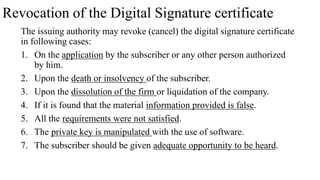
Revocation of the Digital Signature certificate
The issuing authority may revoke (cancel) the digital signature certificate
in following cases:
1. On the application by the subscriber or any other person authorized
by him.
2. Upon the death or insolvency of the subscriber.
3. Upon the dissolution of the firm or liquidation of the company.
4. If it is found that the material information provided is false.
5. All the requirements were not satisfied.
6. The private key is manipulated with the use of software.
7. The subscriber should be given adequate opportunity to be heard.
Legal Issues Involved in E Contracts
There is no special law of E contracts. Moreover, the IT Act 2000 has not suggested
any kind of amendment in the contract act, 1872. The law of contract is quite
competent to afford ample legal protection to E contracts. However, some issues
have become legally sensitive in the absence of specific provisions in the law.
1. Subscriber’s Liability
1. User / authorized person / any other person
2. Communication of acceptance through email
1. Whether mail reaches the offeror or not
Legal Issues Involved in E Contracts
3. Evidence of Contracts
• Susceptible to alteration
4. Issue relating to acknowledgement of receipt of notice through
internet
• The originator may ask for acknowledgement of receipt. If not received by
mail, he may insist on speed post or register AD.
Legal Issues Involved in E Contracts
4. Protection of E-commerce consumers
• Protection of consumers under Consumer protection Act.
5. Problem of Jurisdiction
• Where to register complaint?
6. Indian law of jurisdiction in Internet disputes
• The CPC (civil procedure code) of assumes jurisdiction where the case of action is occurred
in its sphere.(sec 20, 13 and 44) Even transnational cases can be registered in local court.
Indian decrees can be implemented abroad. But if the matter is not covered by these
provisions, the jurisdiction issue becomes more complicated.
Legal Issues Involved in E Contracts
8. Contract of Sale of Software:
• In the case of TCS Vs. State of Andhra Pradesh, it was held that software are considered as
tangible goods as these are capable of abstraction, consumption and use. These can be
transferred, delivered, stored and possessed easily.
• Thus, there is no specific law to tackle the international online contracts. It is
necessary to frame an international convention to sort out the problems related to
E-contracts.
• In case, a body corporate makes use of any personal sensational data, it is liable
to pay compensation.

E Contracts E Transactions.pptx

  • 1.
    E Contracts (ETransactions) Dr. Shruti Ganpule
  • 2.
    Introduction • Meaning ofE Commerce • E Commerce pertains to the ability of conducting business electronically or over the internet. It refers to the technology enabled communication with customers and suppliers for a business organization. • E commerce is paperless exchange of business information using electronic data interchange. (EDI), electronic mail, electronic bulletin board, electronic fund transfers and other network technologies. • E commerce includes EDI, fund transfers, debit and credit card transactions and retail sales activities.
  • 3.
    Characteristics of ECommerce • It is available everywhere • It has global reach • It has to operate according to universal protocols / standards. • It provides information with all complex details (including mail, graphs, video, music files, images etc) • It facilitates two way communication. • It improves quality standards • It reduces operational costs • It enables to send personalized messages to individuals and groups.
  • 4.
    Kinds of ECommerce 1. Business to consumer (B2C) 2. Business to Business (B2B) 3. Consumers to consumers (C2C) 4. Peer to peer (P2P) 5. M Commerce (Mobile commerce) using wireless digital services.
  • 5.
    Significance and Advantagesof E Commerce • All time operations • Global Market • Cost effective • Expansion of Business • Elimination of intermediaries • Increased satisfaction of customers. • Growth in sales volume • Control of customer on the interaction • Understanding customer behaviour.
  • 6.
    E Contracts • Theparliament of India passed its first cyber law on 17th October, 2000 which is known as Information Technology Act (IT Act) 2000. • As per this Act, electronic contracts are considered to be legally valid. • EDI was given legal recognition. • E mail is now considered to be valid and can be produced in the court of law in the matter of litigation. • As a result of which corporates are required to be more careful while writing e mail or answering an email.
  • 7.
    Creating E Contracts •In order to create a valid contract, all the essential elements of a valid contract listed u/s 10 of the Indian Contract Act, 1872 are required to be fulfilled. • Offer • Acceptance • Communication of Acceptance: • As against the Proposer: When it is put in the course of transmission. • As against the acceptor: When it comes to the knowledge of the proposer • The courts have held that the acceptance communicated by telephone, telex or fax are formed when the offeror receives the acceptance because they are functionally equivalent to face to face communication.
  • 8.
    Legality of Econtracts & E transactions • Information Technology Act 2000 • Indian contract Act 1872 • UNCITRAL Model of E Commerce • (The United Nations Commission on International Trade Law): adopted in 1996. • It is intended to give states a legislative framework to remove legal barriers to electronic commerce.
  • 9.
    Legality of ESignatures • Electronic Signature includes Digital signature. • Sometimes law provides that any information is to be authenticated by affixing the signature. Sometimes it is required that a document should bear signature of a specific person. In such cases, it will be sufficient if the documents are signed electronically with the help of digital signature as prescribed by the Central Government. • The IT act allows the use and preservation of electronic records and electronic signature in Government and its agencies.
  • 10.
    Parties to theelectronic transmission process • Originator: A person who sends, generates, stores or transmits any electronic message. • Intermediary: Any person who on behalf of any other person receives, stores or transmits any electronic message or provides any service with respect to that message. It includes telecom service providers, network service providers, internet service providers, web hosting service providers, search engine, online payment intermediary etc.. • Addressee: A person who is intended to receive electronic record.
  • 11.
    Attribution, Acknowledgement &Dispatch of E Records • Attribution of Electronic Record: An electronic record shall be attributed to the originator if: 1. It was sent by the originator himself 2. By the person authorized by the originator. 3. By an information system programmed by the originator to operate automatically. This provision is made to discuss consensus ad idem. It is the system of computer program which receives assent of the addressee. Still it is considered to be consensus ad idem.
  • 12.
    Attribution, Acknowledgement &Dispatch of E Records • Acknowledgement of Receipt: If the originator of the contract has not stipulated a specific method of acknowledgement (acceptance) then, it can be given by: 1. Any mode of communication, automated or electronic or physical. 2. Any conduct by addressee to show that he electronic record has been received. 3. The originator may specify that the contract will be considered only after receiving receipt of acknowledgement by him. If such condition is not fulfilled, the originator shall consider that the electronic record was never sent. 4. The originator may specify a specific time for acknowledgement of record.
  • 13.
    Attribution, Acknowledgement &Dispatch of E Records • The dispatch of an electronic record occurs when it enters a computer resource out of the control of the originator. • If the addressee has specified a computer resource, 1. Receipt occurs only when it enters the specified computer system. 2. If the record is sent to other system, it will be considered as accepted only when it is retrieved by the originator. 3. If a specified system is not mentioned, record will be treated as received when it enters the computer resource of the addressee. 4. An electronic record is deemed to be dispatched at the place of the originator and is deemed to be received at the place where the addressee has its place of business.
  • 14.
    Attribution, Acknowledgement &Dispatch of E Records 5. If there are more than one place of business of the originator, the principal place will be considered. 6. If there is no place of business, the residence of the originator will be considered as the place of business. 7. For a body corporate, the registered address is considered to be place of business.
  • 15.
    Digital Signature Electronic Data: Electronicdata means data, record, image or sound stored, received or sent in an electronic form or microfilm or computer generated microfiche. Subscriber: Subscriber means a person in whose name the electronic signature certificate is issued. Digital Signature: Digital signature means authentication of any electronic record by a subscriber by means of an electronic method or procedure
  • 16.
    Working of DigitalSignature • While conducting business or transmitting legal documents electronically, one must confirm that such documents are authentic and have not been tampered with by any person during transmission. • It is possible with the use of asymmetric crypto system. • Under this system, each person will have two corresponding and matching keys: • A public key • A private key
  • 17.
    Process of creatingand Verifying Digital Signature • Signer Authentication A digital signature with private key effectively identifies the signer with the message. • Authentication of message It identifies the matter to be signed with greater certainty and precision. • Affirmative Act The signer must use his private key by appropriate software function. • Efficiency The process ensures a significant level of genuineness of the signer and almost complete automation whereby the signatures are transmitted for verification automatically.
  • 18.
    Functions of DigitalSignature 1. Confidentiality; • Protect from hackers. • Send message to the recipient safely. • Use of public and private key. 2. Integrity: • To see that the information or data sent is not tampered or altered. • To check whether there is any alteration or modification in the original message with the help of software. • To make sure that the data or message should reach the recipient in the original form.
  • 19.
    Functions of DigitalSignature 3. Authenticity: • Reliable identification of the sender and receiver. • Preventing others from utilizing the public or private key or interrupting the message. 4. Availability: • To ensure that the message or information is available whenever required in the stipulated time. • To take care that there is no difficulty due to hardware problems / network problems / software errors / virus attacks / hackers etc.
  • 20.
    Functions of DigitalSignature 5. Non Repudiation: • The system should be able to bind the originator and the recipient. • Once message is sent, the originator should not deny that the message is not sent by him. • Once the message is received, the receiver should not say that the message is not received by him. 6. Auditability: While recording audit data, the system must ensure that all specified confidentiality and integrity requirements are complied with.
  • 21.
    Digital Signature Certificate •Any person may make an application to the certifying authority for the issue of digital signature certificate. • Application should be made in the manner prescribed by the Central Government. • Following provisions should be fulfilled. 1. The applicant holds private key along with the public key to be listed in the digital signature certificate. 2. The applicant holds a private key which is capable of creating a digital signature. 3. The public key to be listed in the certificate can be used to verify a digital signature affixed by the private key held by the applicant.
  • 22.
    Issue of Digitalsignature certificate proves… 1. It has complied with the provisions of the act. 2. The subscriber holds the private key corresponding to the public key listed in the digital signature certificate. 3. The subscriber’s public key and private key constitute a functioning key pair. 4. The information contained in the digital signature certificate is accurate.
  • 23.
    Suspension of theDigital Signature certificate 1. A certifying authority may suspend the digital signature certificate in case if : a subscriber makes a request. Or a person authorized by the subscriber makes a request. 2. If the authority thinks that it is in the public interest to suspend the digital signature certificate. 3. If it is suspended, the fact should be communicated to the subscriber. 4. The subscriber should be given adequate opportunity to be heard. 5. The suspension must not be more than 15 days.
  • 24.
    Revocation of theDigital Signature certificate The issuing authority may revoke (cancel) the digital signature certificate in following cases: 1. On the application by the subscriber or any other person authorized by him. 2. Upon the death or insolvency of the subscriber. 3. Upon the dissolution of the firm or liquidation of the company. 4. If it is found that the material information provided is false. 5. All the requirements were not satisfied. 6. The private key is manipulated with the use of software. 7. The subscriber should be given adequate opportunity to be heard.
  • 25.
    Legal Issues Involvedin E Contracts There is no special law of E contracts. Moreover, the IT Act 2000 has not suggested any kind of amendment in the contract act, 1872. The law of contract is quite competent to afford ample legal protection to E contracts. However, some issues have become legally sensitive in the absence of specific provisions in the law. 1. Subscriber’s Liability 1. User / authorized person / any other person 2. Communication of acceptance through email 1. Whether mail reaches the offeror or not
  • 26.
    Legal Issues Involvedin E Contracts 3. Evidence of Contracts • Susceptible to alteration 4. Issue relating to acknowledgement of receipt of notice through internet • The originator may ask for acknowledgement of receipt. If not received by mail, he may insist on speed post or register AD.
  • 27.
    Legal Issues Involvedin E Contracts 4. Protection of E-commerce consumers • Protection of consumers under Consumer protection Act. 5. Problem of Jurisdiction • Where to register complaint? 6. Indian law of jurisdiction in Internet disputes • The CPC (civil procedure code) of assumes jurisdiction where the case of action is occurred in its sphere.(sec 20, 13 and 44) Even transnational cases can be registered in local court. Indian decrees can be implemented abroad. But if the matter is not covered by these provisions, the jurisdiction issue becomes more complicated.
  • 28.
    Legal Issues Involvedin E Contracts 8. Contract of Sale of Software: • In the case of TCS Vs. State of Andhra Pradesh, it was held that software are considered as tangible goods as these are capable of abstraction, consumption and use. These can be transferred, delivered, stored and possessed easily. • Thus, there is no specific law to tackle the international online contracts. It is necessary to frame an international convention to sort out the problems related to E-contracts. • In case, a body corporate makes use of any personal sensational data, it is liable to pay compensation.