March 2008
Electrical Instrument/ sul 1
To Be A World Class Maritime Academy
March 2008
Electrical Instrument/ sul 2
To Be A World Class Maritime Academy
March 2008
Electrical Instrument/ sul 3
To Be A World Class Maritime Academy
March 2008
Electrical Instrument/ sul 4
To Be A World Class Maritime Academy
Construction
• A deflecting or operating device. A is produced by the
current or voltage mechanical force which causes the pointer
to deflect from its zero position.
• A controlling device. The controlling force acts in
opposition to the deflecting force and ensures that the
deflection shown on the meter is always the same for a given
measured quantity. There are two main types of controlling
device – spring control and gravity control.
• A damping device. The damping force ensures that the
pointer comes to rest in its final position quickly and without
undue oscillation. There are three main types of damping
used eddy-current damping, air-friction damping and fluid-
friction damping.
March 2008
Electrical Instrument/ sul 5
To Be A World Class Maritime Academy
Scale
• There are basically two types of
scale – linear and non-linear.
• A linear scale is shown in Figure
6.1(a), where the divisions or
graduations are evenly spaced.
The voltmeter shown has a range
0–100 V, i.e. a full-scale
deflection (f.s.d.) of 100 V.
• A non-linear scale is shown in
Figure 6.1(b). The scale is
cramped at the beginning and the
graduations are uneven
throughout the range. The
ammeter shown has a f.s.d. of 10
A.
March 2008
Electrical Instrument/ sul 6
To Be A World Class Maritime Academy
Moving-iron instrument
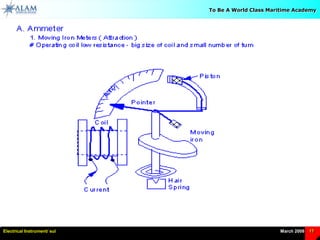
• An attraction type of moving-iron instrument is
shown diagrammatically in Figure 6.2(a). When
current flows in the solenoid, a pivoted soft-iron
disc is attracted towards the solenoid and the
movement causes a pointer to move across a
scale.
• In the repulsion type moving-iron instrument
shown diagrammatically in Figure 6.2(b), two
pieces of iron are placed inside the solenoid, one
being fixed, and the other attached to the spindle
carrying the pointer.
March 2008
Electrical Instrument/ sul 7
To Be A World Class Maritime Academy
Moving-iron instrument
March 2008
Electrical Instrument/ sul 8
To Be A World Class Maritime Academy
Ammeter and voltmeter
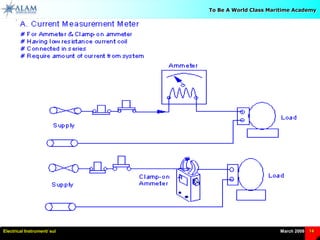
• An ammeter, which measures current, has a
low resistance (ideally zero) and must be
connected in series with the circuit.
• A voltmeter which measure p.d., has a high
resistance (ideally infinite) and must be
connected in parallel with the part of the
circuit whose p.d. is required.
March 2008
Electrical Instrument/ sul 9
To Be A World Class Maritime Academy
Ammeter and voltmeter
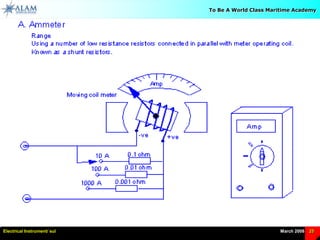
• When an ammeter is required to
measure currents of larger magnitude,
a proportion of the current is diverted
through a low-value resistance
connected in parallel with the meter.
Such a diverting resistor is called a
shunt. From Figure 6.3(a), VPQ =
VRS. Hence
• Iara = IsRs
• The milliammeter is converted into a
voltmeter by connecting a high value
resistance (called a multiplier) in
series with it as shown in Figure
6.3(b).
• From Figure 10.4(b), V = Va + VM
= Ira + IRM
March 2008
Electrical Instrument/ sul 10
To Be A World Class Maritime Academy
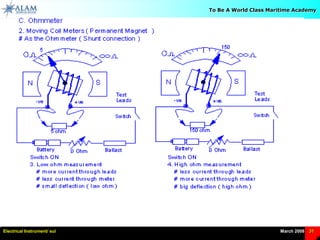
Ohmmeter
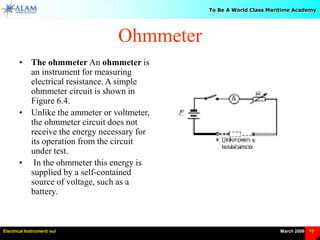
• The ohmmeter An ohmmeter is
an instrument for measuring
electrical resistance. A simple
ohmmeter circuit is shown in
Figure 6.4.
• Unlike the ammeter or voltmeter,
the ohmmeter circuit does not
receive the energy necessary for
its operation from the circuit
under test.
• In the ohmmeter this energy is
supplied by a self-contained
source of voltage, such as a
battery.
March 2008
Electrical Instrument/ sul 11
To Be A World Class Maritime Academy
Ohmmeter
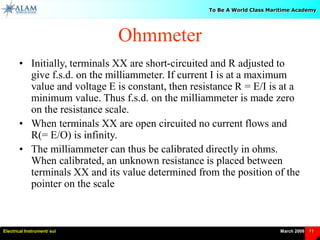
• Initially, terminals XX are short-circuited and R adjusted to
give f.s.d. on the milliammeter. If current I is at a maximum
value and voltage E is constant, then resistance R = E/I is at a
minimum value. Thus f.s.d. on the milliammeter is made zero
on the resistance scale.
• When terminals XX are open circuited no current flows and
R(= E/O) is infinity.
• The milliammeter can thus be calibrated directly in ohms.
When calibrated, an unknown resistance is placed between
terminals XX and its value determined from the position of the
pointer on the scale
March 2008
Electrical Instrument/ sul 12
To Be A World Class Maritime Academy
Multimeters also called universal instruments
or multirange instruments.
• Instruments are manufactured that combine a
moving-coil meter with a number of shunts and series
multipliers, to provide a range of readings on a single
scale graduated to read current and voltage.
• If a battery is incorporated then resistance can also be
measured.
• Often such instruments can be used in a.c. as well as
d.c. circuits when a rectifier is incorporated in the
instrument.
March 2008
Electrical Instrument/ sul 13
To Be A World Class Maritime Academy
Instrument ‘loading’ effect
• Some measuring instruments depend for their operation on
power taken from the circuit in which measurements are being
made. Depending on the ‘loading’ effect of the instrument (i.e.
the current taken to enable it to operate), the prevailing circuit
conditions may change. The resistance of voltmeters may be
calculated since each have a stated
• sensitivity (or ‘figure of merit’), often stated in ‘k_ per volt’ of
f.s.d. A voltmeter should have as high a resistance as possible
(_ ideally infinite). In a.c. circuits the impedance of the
instrument varies with frequency and thus the loading effect of
the instrument can change.
March 2008
Electrical Instrument/ sul 14
To Be A World Class Maritime Academy
March 2008
Electrical Instrument/ sul 15
To Be A World Class Maritime Academy
March 2008
Electrical Instrument/ sul 16
To Be A World Class Maritime Academy
March 2008
Electrical Instrument/ sul 17
To Be A World Class Maritime Academy
March 2008
Electrical Instrument/ sul 18
To Be A World Class Maritime Academy
March 2008
Electrical Instrument/ sul 19
To Be A World Class Maritime Academy
March 2008
Electrical Instrument/ sul 20
To Be A World Class Maritime Academy
March 2008
Electrical Instrument/ sul 21
To Be A World Class Maritime Academy
March 2008
Electrical Instrument/ sul 22
To Be A World Class Maritime Academy
March 2008
Electrical Instrument/ sul 23
To Be A World Class Maritime Academy
March 2008
Electrical Instrument/ sul 24
To Be A World Class Maritime Academy
March 2008
Electrical Instrument/ sul 25
To Be A World Class Maritime Academy
March 2008
Electrical Instrument/ sul 26
To Be A World Class Maritime Academy
March 2008
Electrical Instrument/ sul 27
To Be A World Class Maritime Academy
March 2008
Electrical Instrument/ sul 28
To Be A World Class Maritime Academy
March 2008
Electrical Instrument/ sul 29
To Be A World Class Maritime Academy
March 2008
Electrical Instrument/ sul 30
To Be A World Class Maritime Academy
March 2008
Electrical Instrument/ sul 31
To Be A World Class Maritime Academy
March 2008
Electrical Instrument/ sul 32
To Be A World Class Maritime Academy
March 2008
Electrical Instrument/ sul 33
To Be A World Class Maritime Academy
March 2008
Electrical Instrument/ sul 34
To Be A World Class Maritime Academy
March 2008
Electrical Instrument/ sul 35
To Be A World Class Maritime Academy
March 2008
Electrical Instrument/ sul 36
To Be A World Class Maritime Academy
March 2008
Electrical Instrument/ sul 37
To Be A World Class Maritime Academy
March 2008
Electrical Instrument/ sul 38
To Be A World Class Maritime Academy
March 2008
Electrical Instrument/ sul 39
To Be A World Class Maritime Academy
March 2008
Electrical Instrument/ sul 40
To Be A World Class Maritime Academy
March 2008
Electrical Instrument/ sul 41
To Be A World Class Maritime Academy
March 2008
Electrical Instrument/ sul 42
To Be A World Class Maritime Academy
March 2008
Electrical Instrument/ sul 43
To Be A World Class Maritime Academy
March 2008
Electrical Instrument/ sul 44
To Be A World Class Maritime Academy
March 2008
Electrical Instrument/ sul 45
To Be A World Class Maritime Academy
March 2008
Electrical Instrument/ sul 46
To Be A World Class Maritime Academy
March 2008
Electrical Instrument/ sul 47
To Be A World Class Maritime Academy
March 2008
Electrical Instrument/ sul 48
To Be A World Class Maritime Academy
March 2008
Electrical Instrument/ sul 49
To Be A World Class Maritime Academy
March 2008
Electrical Instrument/ sul 50
To Be A World Class Maritime Academy
March 2008
Electrical Instrument/ sul 51
To Be A World Class Maritime Academy
March 2008
Electrical Instrument/ sul 52
To Be A World Class Maritime Academy

Electrical Instrument.ppt

  • 1.
    March 2008 Electrical Instrument/sul 1 To Be A World Class Maritime Academy
  • 2.
    March 2008 Electrical Instrument/sul 2 To Be A World Class Maritime Academy
  • 3.
    March 2008 Electrical Instrument/sul 3 To Be A World Class Maritime Academy
  • 4.
    March 2008 Electrical Instrument/sul 4 To Be A World Class Maritime Academy Construction • A deflecting or operating device. A is produced by the current or voltage mechanical force which causes the pointer to deflect from its zero position. • A controlling device. The controlling force acts in opposition to the deflecting force and ensures that the deflection shown on the meter is always the same for a given measured quantity. There are two main types of controlling device – spring control and gravity control. • A damping device. The damping force ensures that the pointer comes to rest in its final position quickly and without undue oscillation. There are three main types of damping used eddy-current damping, air-friction damping and fluid- friction damping.
  • 5.
    March 2008 Electrical Instrument/sul 5 To Be A World Class Maritime Academy Scale • There are basically two types of scale – linear and non-linear. • A linear scale is shown in Figure 6.1(a), where the divisions or graduations are evenly spaced. The voltmeter shown has a range 0–100 V, i.e. a full-scale deflection (f.s.d.) of 100 V. • A non-linear scale is shown in Figure 6.1(b). The scale is cramped at the beginning and the graduations are uneven throughout the range. The ammeter shown has a f.s.d. of 10 A.
  • 6.
    March 2008 Electrical Instrument/sul 6 To Be A World Class Maritime Academy Moving-iron instrument • An attraction type of moving-iron instrument is shown diagrammatically in Figure 6.2(a). When current flows in the solenoid, a pivoted soft-iron disc is attracted towards the solenoid and the movement causes a pointer to move across a scale. • In the repulsion type moving-iron instrument shown diagrammatically in Figure 6.2(b), two pieces of iron are placed inside the solenoid, one being fixed, and the other attached to the spindle carrying the pointer.
  • 7.
    March 2008 Electrical Instrument/sul 7 To Be A World Class Maritime Academy Moving-iron instrument
  • 8.
    March 2008 Electrical Instrument/sul 8 To Be A World Class Maritime Academy Ammeter and voltmeter • An ammeter, which measures current, has a low resistance (ideally zero) and must be connected in series with the circuit. • A voltmeter which measure p.d., has a high resistance (ideally infinite) and must be connected in parallel with the part of the circuit whose p.d. is required.
  • 9.
    March 2008 Electrical Instrument/sul 9 To Be A World Class Maritime Academy Ammeter and voltmeter • When an ammeter is required to measure currents of larger magnitude, a proportion of the current is diverted through a low-value resistance connected in parallel with the meter. Such a diverting resistor is called a shunt. From Figure 6.3(a), VPQ = VRS. Hence • Iara = IsRs • The milliammeter is converted into a voltmeter by connecting a high value resistance (called a multiplier) in series with it as shown in Figure 6.3(b). • From Figure 10.4(b), V = Va + VM = Ira + IRM
  • 10.
    March 2008 Electrical Instrument/sul 10 To Be A World Class Maritime Academy Ohmmeter • The ohmmeter An ohmmeter is an instrument for measuring electrical resistance. A simple ohmmeter circuit is shown in Figure 6.4. • Unlike the ammeter or voltmeter, the ohmmeter circuit does not receive the energy necessary for its operation from the circuit under test. • In the ohmmeter this energy is supplied by a self-contained source of voltage, such as a battery.
  • 11.
    March 2008 Electrical Instrument/sul 11 To Be A World Class Maritime Academy Ohmmeter • Initially, terminals XX are short-circuited and R adjusted to give f.s.d. on the milliammeter. If current I is at a maximum value and voltage E is constant, then resistance R = E/I is at a minimum value. Thus f.s.d. on the milliammeter is made zero on the resistance scale. • When terminals XX are open circuited no current flows and R(= E/O) is infinity. • The milliammeter can thus be calibrated directly in ohms. When calibrated, an unknown resistance is placed between terminals XX and its value determined from the position of the pointer on the scale
  • 12.
    March 2008 Electrical Instrument/sul 12 To Be A World Class Maritime Academy Multimeters also called universal instruments or multirange instruments. • Instruments are manufactured that combine a moving-coil meter with a number of shunts and series multipliers, to provide a range of readings on a single scale graduated to read current and voltage. • If a battery is incorporated then resistance can also be measured. • Often such instruments can be used in a.c. as well as d.c. circuits when a rectifier is incorporated in the instrument.
  • 13.
    March 2008 Electrical Instrument/sul 13 To Be A World Class Maritime Academy Instrument ‘loading’ effect • Some measuring instruments depend for their operation on power taken from the circuit in which measurements are being made. Depending on the ‘loading’ effect of the instrument (i.e. the current taken to enable it to operate), the prevailing circuit conditions may change. The resistance of voltmeters may be calculated since each have a stated • sensitivity (or ‘figure of merit’), often stated in ‘k_ per volt’ of f.s.d. A voltmeter should have as high a resistance as possible (_ ideally infinite). In a.c. circuits the impedance of the instrument varies with frequency and thus the loading effect of the instrument can change.
  • 14.
    March 2008 Electrical Instrument/sul 14 To Be A World Class Maritime Academy
  • 15.
    March 2008 Electrical Instrument/sul 15 To Be A World Class Maritime Academy
  • 16.
    March 2008 Electrical Instrument/sul 16 To Be A World Class Maritime Academy
  • 17.
    March 2008 Electrical Instrument/sul 17 To Be A World Class Maritime Academy
  • 18.
    March 2008 Electrical Instrument/sul 18 To Be A World Class Maritime Academy
  • 19.
    March 2008 Electrical Instrument/sul 19 To Be A World Class Maritime Academy
  • 20.
    March 2008 Electrical Instrument/sul 20 To Be A World Class Maritime Academy
  • 21.
    March 2008 Electrical Instrument/sul 21 To Be A World Class Maritime Academy
  • 22.
    March 2008 Electrical Instrument/sul 22 To Be A World Class Maritime Academy
  • 23.
    March 2008 Electrical Instrument/sul 23 To Be A World Class Maritime Academy
  • 24.
    March 2008 Electrical Instrument/sul 24 To Be A World Class Maritime Academy
  • 25.
    March 2008 Electrical Instrument/sul 25 To Be A World Class Maritime Academy
  • 26.
    March 2008 Electrical Instrument/sul 26 To Be A World Class Maritime Academy
  • 27.
    March 2008 Electrical Instrument/sul 27 To Be A World Class Maritime Academy
  • 28.
    March 2008 Electrical Instrument/sul 28 To Be A World Class Maritime Academy
  • 29.
    March 2008 Electrical Instrument/sul 29 To Be A World Class Maritime Academy
  • 30.
    March 2008 Electrical Instrument/sul 30 To Be A World Class Maritime Academy
  • 31.
    March 2008 Electrical Instrument/sul 31 To Be A World Class Maritime Academy
  • 32.
    March 2008 Electrical Instrument/sul 32 To Be A World Class Maritime Academy
  • 33.
    March 2008 Electrical Instrument/sul 33 To Be A World Class Maritime Academy
  • 34.
    March 2008 Electrical Instrument/sul 34 To Be A World Class Maritime Academy
  • 35.
    March 2008 Electrical Instrument/sul 35 To Be A World Class Maritime Academy
  • 36.
    March 2008 Electrical Instrument/sul 36 To Be A World Class Maritime Academy
  • 37.
    March 2008 Electrical Instrument/sul 37 To Be A World Class Maritime Academy
  • 38.
    March 2008 Electrical Instrument/sul 38 To Be A World Class Maritime Academy
  • 39.
    March 2008 Electrical Instrument/sul 39 To Be A World Class Maritime Academy
  • 40.
    March 2008 Electrical Instrument/sul 40 To Be A World Class Maritime Academy
  • 41.
    March 2008 Electrical Instrument/sul 41 To Be A World Class Maritime Academy
  • 42.
    March 2008 Electrical Instrument/sul 42 To Be A World Class Maritime Academy
  • 43.
    March 2008 Electrical Instrument/sul 43 To Be A World Class Maritime Academy
  • 44.
    March 2008 Electrical Instrument/sul 44 To Be A World Class Maritime Academy
  • 45.
    March 2008 Electrical Instrument/sul 45 To Be A World Class Maritime Academy
  • 46.
    March 2008 Electrical Instrument/sul 46 To Be A World Class Maritime Academy
  • 47.
    March 2008 Electrical Instrument/sul 47 To Be A World Class Maritime Academy
  • 48.
    March 2008 Electrical Instrument/sul 48 To Be A World Class Maritime Academy
  • 49.
    March 2008 Electrical Instrument/sul 49 To Be A World Class Maritime Academy
  • 50.
    March 2008 Electrical Instrument/sul 50 To Be A World Class Maritime Academy
  • 51.
    March 2008 Electrical Instrument/sul 51 To Be A World Class Maritime Academy
  • 52.
    March 2008 Electrical Instrument/sul 52 To Be A World Class Maritime Academy