eLearning Design
INTRODUCTION
Presenter: Melisa Achoko Allela
eLearning
The use of information and communication technologies (ICTs) to
expand access to education and to enhance and transform teaching and
learning.
Issues in E-Learning & Distance Education Video Series www.col.org/videos What is
eLearning?
eLearning continuum
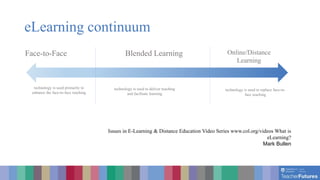
Face-to-Face
technology is used primarily to
enhance the face-to-face teaching
Blended Learning
technology is used to deliver teaching
and facilitate learning
Online/Distance
Learning
technology is used to replace face-to-
face teaching
Issues in E-Learning & Distance Education Video Series www.col.org/videos What is
eLearning?
Mark Bullen
eLearning and Open Education
Open education is based on the
idea that:
“knowledge should be free and open to use and
reuse; that collaboration should be easier, not
harder; that people should receive credit and
kudos for contributing to education and
research; and that concepts and ideas are linked
in unusual and surprising ways and not in the
simple linear forms that today’s textbooks
present”.
Richard Baraniuk
Co-Founder Open Education Movement
eLearning and Open Education
• freely accessible
• openly licensed documents
and media that are useful for
teaching, learning, and
assessing as well as for
research purposes.
http://www.goopen.no/timeline/
Open Resource for English
Language Teaching
1. need to know the benefits of learning (why they have to learn
something)
2. like to learn experientially
3. approach learning as problem-solving
4. learn better where they can see the immediate value and application
of content
5. prefer to study at a time, place and pace convenient for them
eLearning and Adult Learners
Scenario
Idris is a principal at a local Teacher Training College. The college
provides training to Junior Secondary School teachers from several
parts of the country.
Because of the increasing demand to change the teacher trainers’
methods of lesson delivery to the more effective student-centred,
activity-based and technology-supported teaching/learning
experiences, Idris is considering the option of including e-learning
in the College’s training plan.
He now would like to know if e-learning is a convenient option for
the Teacher Training College, and if it can ensure the same
effectiveness as traditional training.
1. Just as effective as traditional training at a lower
cost
2. Can reach a wider target audience who have
challenges attending conventional classroom
training (location, limited time, busy with
family/work commitments, restricted in mobility)
3. Offers effective instructional methods (associated
feedback, collaboration activities, self-paced study,
personalizing learning paths based on learners’)
Why eLearning?
Why eLearning?: Learning Domains
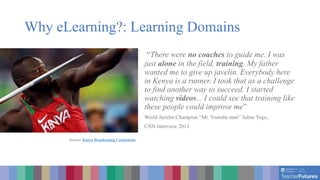
“There were no coaches to guide me. I was
just alone in the field, training. My father
wanted me to give up javelin. Everybody here
in Kenya is a runner. I took that as a challenge
to find another way to succeed. I started
watching videos... I could see that training like
these people could improve me”
World Javelin Champion “Mr. Youtube man” Julius Yego,
CNN interview 2013
Source: Kenya Broadcasting Corporation
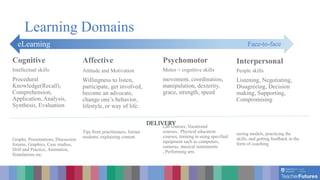
Learning Domains
Cognitive
Intellectual skills
Procedural
Knowledge(Recall),
Comprehension,
Application, Analysis,
Synthesis, Evaluation
Graphs, Presentations, Discussion
forums, Graphics, Case studies,
Drill and Practice, Animation,
Simulations etc.
Psychomotor
Motor + cognitive skills
movement, coordination,
manipulation, dexterity,
grace, strength, speed
Lab courses, Vocational
courses, Physical education
courses, training in using specified
equipment such as computers,
cameras, musical instruments
, Performing arts
Interpersonal
People skills
Listening, Negotiating,
Disagreeing, Decision
making, Supporting,
Compromising
seeing models, practicing the
skills, and getting feedback in the
form of coaching
Affective
Attitude and Motivation
Willingness to listen,
participate, get involved,
become an advocate,
change one’s behavior,
lifestyle, or way of life.
Tips from practitioners, former
students, explaining content
eLearning Face-to-face
DELIVERY
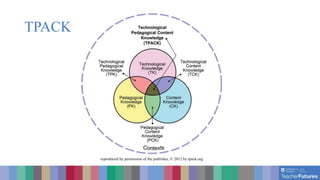
TPACK
reproduced by permission of the publisher, © 2012 by tpack.org
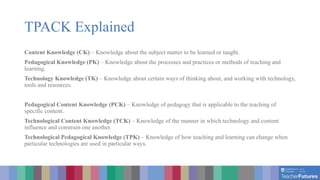
TPACK Explained
Content Knowledge (CK) – Knowledge about the subject matter to be learned or taught.
Pedagogical Knowledge (PK) – Knowledge about the processes and practices or methods of teaching and
learning.
Technology Knowledge (TK) – Knowledge about certain ways of thinking about, and working with technology,
tools and resources.
Pedagogical Content Knowledge (PCK) – Knowledge of pedagogy that is applicable to the teaching of
specific content.
Technological Content Knowledge (TCK) – Knowledge of the manner in which technology and content
influence and constrain one another.
Technological Pedagogical Knowledge (TPK) – Knowledge of how teaching and learning can change when
particular technologies are used in particular ways.
TPACK Definition
Basis of effective teaching with technology
• Requires an understanding of the representation of concepts using technologies;
• pedagogical techniques that use technologies in constructive ways to teach
content;
• knowledge of what makes concepts difficult or easy to learn and how
technology can help redress some of the problems that students face;
• knowledge of students’ prior knowledge and theories of epistemology;
• knowledge of how technologies can be used to build on existing knowledge to
develop new epistemologies or strengthen old ones.
(Koehler & Mishra, 2009)
Intermezzo
Identify a specific course you want to develop
THE T-PACK GAME
Consider how Technology (T), Pedagogy (P), and
Content (C) work together by randomly choosing two
of the three (C,P, and T), and thinking deeply to find
the third that makes them all work together in a
pedagogically sound way to teach the content. Discuss
in groups.
Link: http://www.matt-koehler.com/the-tpack-game/
When to use eLearning
Learning Domain: training aims to build cognitive skills rather than psychomotor skills;
Large Class sizes: Large amount of content to be delivered to a large number of learners;
Location: learners from geographically dispersed locations;
Time constraints: learners have limited mobility, limited daily time to devote to learning;
Technical skills: learners do not have effective listening and reading skills; learners have at least
basic computer and Internet skills;
Learner Motivation: learners are highly motivated to learn and appreciate proceeding at their own
pace; content must be reused for different learners’ groups in the future;
Analytics: there is a need to collect and track data.
Questions?
Suggestions?

eLearning Design_PT1.ppt

  • 1.
  • 2.
    eLearning The use ofinformation and communication technologies (ICTs) to expand access to education and to enhance and transform teaching and learning. Issues in E-Learning & Distance Education Video Series www.col.org/videos What is eLearning?
  • 3.
    eLearning continuum Face-to-Face technology isused primarily to enhance the face-to-face teaching Blended Learning technology is used to deliver teaching and facilitate learning Online/Distance Learning technology is used to replace face-to- face teaching Issues in E-Learning & Distance Education Video Series www.col.org/videos What is eLearning? Mark Bullen
  • 4.
    eLearning and OpenEducation Open education is based on the idea that: “knowledge should be free and open to use and reuse; that collaboration should be easier, not harder; that people should receive credit and kudos for contributing to education and research; and that concepts and ideas are linked in unusual and surprising ways and not in the simple linear forms that today’s textbooks present”. Richard Baraniuk Co-Founder Open Education Movement
  • 5.
    eLearning and OpenEducation • freely accessible • openly licensed documents and media that are useful for teaching, learning, and assessing as well as for research purposes. http://www.goopen.no/timeline/ Open Resource for English Language Teaching
  • 6.
    1. need toknow the benefits of learning (why they have to learn something) 2. like to learn experientially 3. approach learning as problem-solving 4. learn better where they can see the immediate value and application of content 5. prefer to study at a time, place and pace convenient for them eLearning and Adult Learners
  • 7.
    Scenario Idris is aprincipal at a local Teacher Training College. The college provides training to Junior Secondary School teachers from several parts of the country. Because of the increasing demand to change the teacher trainers’ methods of lesson delivery to the more effective student-centred, activity-based and technology-supported teaching/learning experiences, Idris is considering the option of including e-learning in the College’s training plan. He now would like to know if e-learning is a convenient option for the Teacher Training College, and if it can ensure the same effectiveness as traditional training.
  • 8.
    1. Just aseffective as traditional training at a lower cost 2. Can reach a wider target audience who have challenges attending conventional classroom training (location, limited time, busy with family/work commitments, restricted in mobility) 3. Offers effective instructional methods (associated feedback, collaboration activities, self-paced study, personalizing learning paths based on learners’) Why eLearning?
  • 9.
    Why eLearning?: LearningDomains “There were no coaches to guide me. I was just alone in the field, training. My father wanted me to give up javelin. Everybody here in Kenya is a runner. I took that as a challenge to find another way to succeed. I started watching videos... I could see that training like these people could improve me” World Javelin Champion “Mr. Youtube man” Julius Yego, CNN interview 2013 Source: Kenya Broadcasting Corporation
  • 10.
    Learning Domains Cognitive Intellectual skills Procedural Knowledge(Recall), Comprehension, Application,Analysis, Synthesis, Evaluation Graphs, Presentations, Discussion forums, Graphics, Case studies, Drill and Practice, Animation, Simulations etc. Psychomotor Motor + cognitive skills movement, coordination, manipulation, dexterity, grace, strength, speed Lab courses, Vocational courses, Physical education courses, training in using specified equipment such as computers, cameras, musical instruments , Performing arts Interpersonal People skills Listening, Negotiating, Disagreeing, Decision making, Supporting, Compromising seeing models, practicing the skills, and getting feedback in the form of coaching Affective Attitude and Motivation Willingness to listen, participate, get involved, become an advocate, change one’s behavior, lifestyle, or way of life. Tips from practitioners, former students, explaining content eLearning Face-to-face DELIVERY
  • 11.
    TPACK reproduced by permissionof the publisher, © 2012 by tpack.org
  • 12.
    TPACK Explained Content Knowledge(CK) – Knowledge about the subject matter to be learned or taught. Pedagogical Knowledge (PK) – Knowledge about the processes and practices or methods of teaching and learning. Technology Knowledge (TK) – Knowledge about certain ways of thinking about, and working with technology, tools and resources. Pedagogical Content Knowledge (PCK) – Knowledge of pedagogy that is applicable to the teaching of specific content. Technological Content Knowledge (TCK) – Knowledge of the manner in which technology and content influence and constrain one another. Technological Pedagogical Knowledge (TPK) – Knowledge of how teaching and learning can change when particular technologies are used in particular ways.
  • 13.
    TPACK Definition Basis ofeffective teaching with technology • Requires an understanding of the representation of concepts using technologies; • pedagogical techniques that use technologies in constructive ways to teach content; • knowledge of what makes concepts difficult or easy to learn and how technology can help redress some of the problems that students face; • knowledge of students’ prior knowledge and theories of epistemology; • knowledge of how technologies can be used to build on existing knowledge to develop new epistemologies or strengthen old ones. (Koehler & Mishra, 2009)
  • 14.
    Intermezzo Identify a specificcourse you want to develop THE T-PACK GAME Consider how Technology (T), Pedagogy (P), and Content (C) work together by randomly choosing two of the three (C,P, and T), and thinking deeply to find the third that makes them all work together in a pedagogically sound way to teach the content. Discuss in groups. Link: http://www.matt-koehler.com/the-tpack-game/
  • 15.
    When to useeLearning Learning Domain: training aims to build cognitive skills rather than psychomotor skills; Large Class sizes: Large amount of content to be delivered to a large number of learners; Location: learners from geographically dispersed locations; Time constraints: learners have limited mobility, limited daily time to devote to learning; Technical skills: learners do not have effective listening and reading skills; learners have at least basic computer and Internet skills; Learner Motivation: learners are highly motivated to learn and appreciate proceeding at their own pace; content must be reused for different learners’ groups in the future; Analytics: there is a need to collect and track data.
  • 16.

Editor's Notes

  • #3 the use of computer and Internet technologies to deliver
  • #4 the use of computer and Internet technologies to deliver
  • #5 Baraniuk is one of the founders of the Open Education movement Open education has the potential to radically change education by promoting and facilitating the sharing and reuse of educational resources and pedagogical practices and by making this all freely available to anybody who has Internet access. Openly licensed content can be produced in any medium: paper-based text, video, audio or computer-based multimedia.
  • #6 Baraniuk is one of the founders of the Open Education movement Open education has the potential to radically change education by promoting and facilitating the sharing and reuse of educational resources and pedagogical practices and by making this all freely available to anybody who has Internet access. Openly licensed content can be produced in any medium: paper-based text, video, audio or computer-based multimedia.
  • #7 need to know the benefits of learning (why they have to learn something) like to learn experientially approach learning as problem-solving learn better where they can see the immediate value and application of content prefer to study at a time, place and pace convenient for them
  • #9 geographically dispersed with limited time and/or resources to travel; > busy with work or family commitments which do not allow them to attend courses on specific dates with a fixed schedule; > located in conflict and post-conflict areas and restricted in their mobility because of security reasons; > limited from participating in classroom sessions because of cultural or religious beliefs; > facing difficulties with real-time communication (e.g. foreign language learners or very shy learners).
  • #10 “There were no coaches to guide me. I was just alone in the field, training. My father wanted me to give up javelin. Everybody here in Kenya is a runner. I took that as a challenge to find another way to succeed. I started watching videos... I could see that training like these people could improve me” he said during a CNN interview in 2013.
  • #11 Most e-learning courses are developed to build cognitive skills; the cognitive domain is the most suitable for e-learning. Within the cognitive domain, thinking skills may require more interactive e-learning activities because those skills are learned better “by doing”. Learning in the interpersonal domain can also be addressed in e-learning by using specific methods. For example, interactive role playing with appropriate feedback can be used to change attitudes and behaviours. Learning domains/categories of lear ning outcomes  Lab courses for science classes ·       Vocational courses ·       Physical education courses ·       Training in using specified equipment such as computers, cameras, musical instruments etc. ·       Performing arts Former students giving tips on how to be successful ·       The instructor informing the students of the value of the course ·       Professionals who are using the knowledge from the course in their lives ·       An overview of the program with key support personnel and facilities visible to the student ·       Streaming audio files throughout the course encouraging students and providing helpful tips ·       Short video clips of the instructor explaining course content
  • #12 Technological Pedagogical Content Knowledge (TPACK), attempts to capture some of the essential qualities of knowledge required by teachers for technology integration in their teaching, while addressing the complex, multifaceted and situated nature of teacher knowledge. At the heart of the TPACK framework, is the complex interplay of three primary forms of knowledge: Content (CK), Pedagogy (PK), and Technology (TK).