El Voseo
NOTES ON ABBREVIATIONS AND STYLE
• Lat. – Latin
• Sp. – Spanish
• Viz. – vidilicet- namely
• Pers. – Person
• Sing. – Singular
• Pl. – plural
• Refl. – reflexive
• Prep. – preposition(al)
• Obj. – object
• ‹◌› – quotation marks for Spanish
• <◌> – Orthographical representation
• /◌/ – phonemic representation (underlying sound)
• [◌] – phonetic representation (exactly what was
pronounced)
HISTORY
• Latin second person plural = vos
• Used to refer to people with respect in many offshoots of Latin
• Vous of French
• Both for informal 2nd pers. pl. and for formal 2nd pers. sing.
• Vós of Portuguese
• Portuguese system much more complicated; varies greatly w/ region
• Contrasted in other languages by keeping the direct descendant of
Lat. vos for the respectful form and adding the descendant of alterī
to it (viz. Sp. vosotros) for the intimate form of the 2nd person pl.
• Genitive form used in combination with descendant of mercēs for 2nd
pers. sing. formal in some Romance languages (viz. Sp.
Usted<Usarced<Vuestra Merced<vestra mercēs)
• In Spanish speaking countries there is wide variance regarding the
usage; some use it as the informal pronoun, some as the semi-formal
pronoun, and in Ladino* it is used for strangers and people who merit
respect (and is conjugated the same as vosotros)
*- Ladino is the language of the Sephardic Jews of Spain
VERBAL VS. PRONOMINAL
• Verbal
• Conjugation of verbs is different from regions with the tuteo
• In Chile, it is common to hear vos conjugations with the tú
pronoun
• Elsewhere, verbal voseo is concurrent with the pronoun vos
• Pronominal
• Use of the pronoun, regardless of verb combination
• In older Spanish, it was a respectful form, but much like
English “you,” it has become an intimate form
PRONOUN*
• Nominative- vos
• Direct Obj. (Accusative)- te
• Indirect Obj. (Dative)- te
• Prep. Obj. (Ablative)- (de, a, etc.) vos
• Fused with con- con vos
• Refl. Obj.- te
• Refl. Prep. Obj.- (de, a, etc.) vos (mismo)
• Refl. fused with con- con vos
*- There are some regional variations, but the most significant one is that Chileans
commonly use the non vos-based pronouns (i.e., the tú-based pronouns) as well
PRESENT TENSE
• No stem-changing
• Stress on the last syllable
• ser→sos
• ir→vas
• ver→ves
• Thematic vowel for all verb categories (yes,
including –ir)
• sos, hablás, comés, venís
LADINO
• Vos=2nd pers. sing.; vosotros=2nd pers. pl.
• Conjugated the same
• Orthography is different, to match phonetics
• Word-final <s> becomes <sh>
• sosh, favlásh (equivalent of hablás), komésh, benís
CHILE
• Multiple levels; from least to most formal: verbal and
pronominal voseo, verbal tuteo and pronominal
voseo, verbal and pronominal tuteo, verbal 3rd
person and pronominal Usted
• Ser has six 2nd pers. sing. Forms; from least to most
formal: vos soi, vos eri(s), tú soi, tú eri(s), tú eres,
Usted es
• Vosotros endings, sometimes without the final <s>
• -er verbs take –ir endings
• soi/eri(s), hablái(s), comí(s), vení(s)
• Use of any type of voseo is seen as “lowly” in
prescriptive grammars
ZULIA, VENEZUELA AND AZUERO,
PANAMA
• Called the Maracaibo voseo
• Pronominal voseo
• Verbal vosotros
• sois, habláis, coméis, venís
IMPERATIVE
• vos conjugation without the <s>
• Irregular ser (sé), ir (andá, refl. andate), estar (está,
estate)
• In Chile, the imperative uses the verbal* tuteo and
there are extra irregulars
• ir uses andar for suppletion instead of Lat. vado
• hacer, salir, poner → hace, sale, pone
• sé, hablá, comé, vení
*- also sometimes pronominal, as discussed earlier
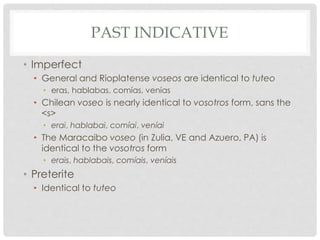
PAST INDICATIVE
• Imperfect
• General and Rioplatense voseos are identical to tuteo
• eras, hablabas, comías, venías
• Chilean voseo is nearly identical to vosotros form, sans the
<s>
• erai, hablabai, comíai, veníai
• The Maracaibo voseo (in Zulia, VE and Azuero, PA) is
identical to the vosotros form
• erais, hablabais, comíais, veníais
• Preterite
• Identical to tuteo
PRESENT SUBJUNCTIVE
• In Central America (regions that follow the general voseo),
Bolivia, and some parts of Colombia: – ir and –er verbs take –
ar ending (–ás) and –ar verbs take –er ending (–és)
• In stem changing verbs, the ‹e›→ ‹i› verbs and ‹e›→ ‹ie› verbs go to just
‹i›; ‹o›→‹u› and ‹o›→ ‹ue› go to just ‹u›
• seas, hablés, comás, vengás
• In Rioplatense Spanish, it is very common to use the tú form
• Stem changing is different: querer becomes quierás or querás
• seas, hablés, comás, vengás/vengas
• In Chile, it is the same as the vosotros conjugation of the
subjective, sans the <s> (except –ar verbs, which take the –ir
vosotros conjugation with the <s>)
• seái, hablís, comái, vengái
• The Maracaibo voseo is the same as the vosotros conjugation
• seáis, habléis, comáis, vengáis
CONDITIONAL
• General and Rioplatense are identical to the tuteo
• serías, hablarías, comerías, vendrías
• Chilean is nearly identical to vosotros, but without
the <s>
• seríai, hablaríai, comeríai, vendríai
• Maracaibo voseo is exactly identical to vosotros
• seríais, hablaríais, comeríais, vendríais
PAST SUBJUNCTIVE
• General and Rioplatense are identical to the tuteo
• fueras, hablaras, comieras, vinieras
• Chilean is nearly identical to vosotros, but without
the <s>
• fuerai, hablarai, comierai, vinierai
• Maracaibo voseo is the same as the vosotros
conjugation
• fuerais, hablarais, comierais, vinierais

El voseo

  • 1.
  • 2.
    NOTES ON ABBREVIATIONSAND STYLE • Lat. – Latin • Sp. – Spanish • Viz. – vidilicet- namely • Pers. – Person • Sing. – Singular • Pl. – plural • Refl. – reflexive • Prep. – preposition(al) • Obj. – object • ‹◌› – quotation marks for Spanish • <◌> – Orthographical representation • /◌/ – phonemic representation (underlying sound) • [◌] – phonetic representation (exactly what was pronounced)
  • 3.
    HISTORY • Latin secondperson plural = vos • Used to refer to people with respect in many offshoots of Latin • Vous of French • Both for informal 2nd pers. pl. and for formal 2nd pers. sing. • Vós of Portuguese • Portuguese system much more complicated; varies greatly w/ region • Contrasted in other languages by keeping the direct descendant of Lat. vos for the respectful form and adding the descendant of alterī to it (viz. Sp. vosotros) for the intimate form of the 2nd person pl. • Genitive form used in combination with descendant of mercēs for 2nd pers. sing. formal in some Romance languages (viz. Sp. Usted<Usarced<Vuestra Merced<vestra mercēs) • In Spanish speaking countries there is wide variance regarding the usage; some use it as the informal pronoun, some as the semi-formal pronoun, and in Ladino* it is used for strangers and people who merit respect (and is conjugated the same as vosotros) *- Ladino is the language of the Sephardic Jews of Spain
  • 4.
    VERBAL VS. PRONOMINAL •Verbal • Conjugation of verbs is different from regions with the tuteo • In Chile, it is common to hear vos conjugations with the tú pronoun • Elsewhere, verbal voseo is concurrent with the pronoun vos • Pronominal • Use of the pronoun, regardless of verb combination • In older Spanish, it was a respectful form, but much like English “you,” it has become an intimate form
  • 5.
    PRONOUN* • Nominative- vos •Direct Obj. (Accusative)- te • Indirect Obj. (Dative)- te • Prep. Obj. (Ablative)- (de, a, etc.) vos • Fused with con- con vos • Refl. Obj.- te • Refl. Prep. Obj.- (de, a, etc.) vos (mismo) • Refl. fused with con- con vos *- There are some regional variations, but the most significant one is that Chileans commonly use the non vos-based pronouns (i.e., the tú-based pronouns) as well
  • 6.
    PRESENT TENSE • Nostem-changing • Stress on the last syllable • ser→sos • ir→vas • ver→ves • Thematic vowel for all verb categories (yes, including –ir) • sos, hablás, comés, venís
  • 7.
    LADINO • Vos=2nd pers.sing.; vosotros=2nd pers. pl. • Conjugated the same • Orthography is different, to match phonetics • Word-final <s> becomes <sh> • sosh, favlásh (equivalent of hablás), komésh, benís
  • 8.
    CHILE • Multiple levels;from least to most formal: verbal and pronominal voseo, verbal tuteo and pronominal voseo, verbal and pronominal tuteo, verbal 3rd person and pronominal Usted • Ser has six 2nd pers. sing. Forms; from least to most formal: vos soi, vos eri(s), tú soi, tú eri(s), tú eres, Usted es • Vosotros endings, sometimes without the final <s> • -er verbs take –ir endings • soi/eri(s), hablái(s), comí(s), vení(s) • Use of any type of voseo is seen as “lowly” in prescriptive grammars
  • 9.
    ZULIA, VENEZUELA ANDAZUERO, PANAMA • Called the Maracaibo voseo • Pronominal voseo • Verbal vosotros • sois, habláis, coméis, venís
  • 10.
    IMPERATIVE • vos conjugationwithout the <s> • Irregular ser (sé), ir (andá, refl. andate), estar (está, estate) • In Chile, the imperative uses the verbal* tuteo and there are extra irregulars • ir uses andar for suppletion instead of Lat. vado • hacer, salir, poner → hace, sale, pone • sé, hablá, comé, vení *- also sometimes pronominal, as discussed earlier
  • 11.
    PAST INDICATIVE • Imperfect •General and Rioplatense voseos are identical to tuteo • eras, hablabas, comías, venías • Chilean voseo is nearly identical to vosotros form, sans the <s> • erai, hablabai, comíai, veníai • The Maracaibo voseo (in Zulia, VE and Azuero, PA) is identical to the vosotros form • erais, hablabais, comíais, veníais • Preterite • Identical to tuteo
  • 12.
    PRESENT SUBJUNCTIVE • InCentral America (regions that follow the general voseo), Bolivia, and some parts of Colombia: – ir and –er verbs take – ar ending (–ás) and –ar verbs take –er ending (–és) • In stem changing verbs, the ‹e›→ ‹i› verbs and ‹e›→ ‹ie› verbs go to just ‹i›; ‹o›→‹u› and ‹o›→ ‹ue› go to just ‹u› • seas, hablés, comás, vengás • In Rioplatense Spanish, it is very common to use the tú form • Stem changing is different: querer becomes quierás or querás • seas, hablés, comás, vengás/vengas • In Chile, it is the same as the vosotros conjugation of the subjective, sans the <s> (except –ar verbs, which take the –ir vosotros conjugation with the <s>) • seái, hablís, comái, vengái • The Maracaibo voseo is the same as the vosotros conjugation • seáis, habléis, comáis, vengáis
  • 13.
    CONDITIONAL • General andRioplatense are identical to the tuteo • serías, hablarías, comerías, vendrías • Chilean is nearly identical to vosotros, but without the <s> • seríai, hablaríai, comeríai, vendríai • Maracaibo voseo is exactly identical to vosotros • seríais, hablaríais, comeríais, vendríais
  • 14.
    PAST SUBJUNCTIVE • Generaland Rioplatense are identical to the tuteo • fueras, hablaras, comieras, vinieras • Chilean is nearly identical to vosotros, but without the <s> • fuerai, hablarai, comierai, vinierai • Maracaibo voseo is the same as the vosotros conjugation • fuerais, hablarais, comierais, vinierais