The title, in meaning Touch me
John 20:17 in
tried to touch
not, refers to
the
as
the newly risen , He said
"Touch me not; for I am not yet
ascended to my Father."
The TITLE


JOSE RIZAL preferred that the
prospective novel expresses the
backward, anti-progress and
anti-intellectual way Filipino
culture was.

On JUNE 2, 1884, Rizal
proposed the writing of a
novel about the Philippines
written by a group of
Filipinos.

His proposal was unanimously
approved by the Filipinos present at
the party, among whom
were Pedro, Maximino and Antonio
Paterno,Graciano López
Jaena, Evaristo Aguirre, Eduardo de
Lete, Julio Llorente and Valentin
Ventura.

Rizal finished the novel in December
1886.
Rizal feared the novel might not be
printed, and that it would remain unread.
A financial aid came from a friend named
Máximo Viola which helped him print his
book at a fine print media in Berlin named
Berliner Buchdruckerei-
Aktiengesellschaft.
PUBLICATION

Son of a Filipino
businessman, Don Rafael
Ibarra, he studied in Europe
for seven years. Ibarra is also
María Clara's fiancé. Several
sources claim that Ibarra is
also Rizal's reflection.

 Ibarra's fiancée. She was
raised by Capitán Tiago and
is the most beautiful and
widely celebrated girl in San
Diego.
 an illegitimate daughter of
Father Dámaso.
María Clara
Santiago de los Santos, known by his
nickname Tiago
title Capitán Tiago
and political
is a Filipino
businessman and the cabeza de
barangay or head of barangay of the
town of San Diego. He is also the
known father of María Clara.
Capitan Tiago

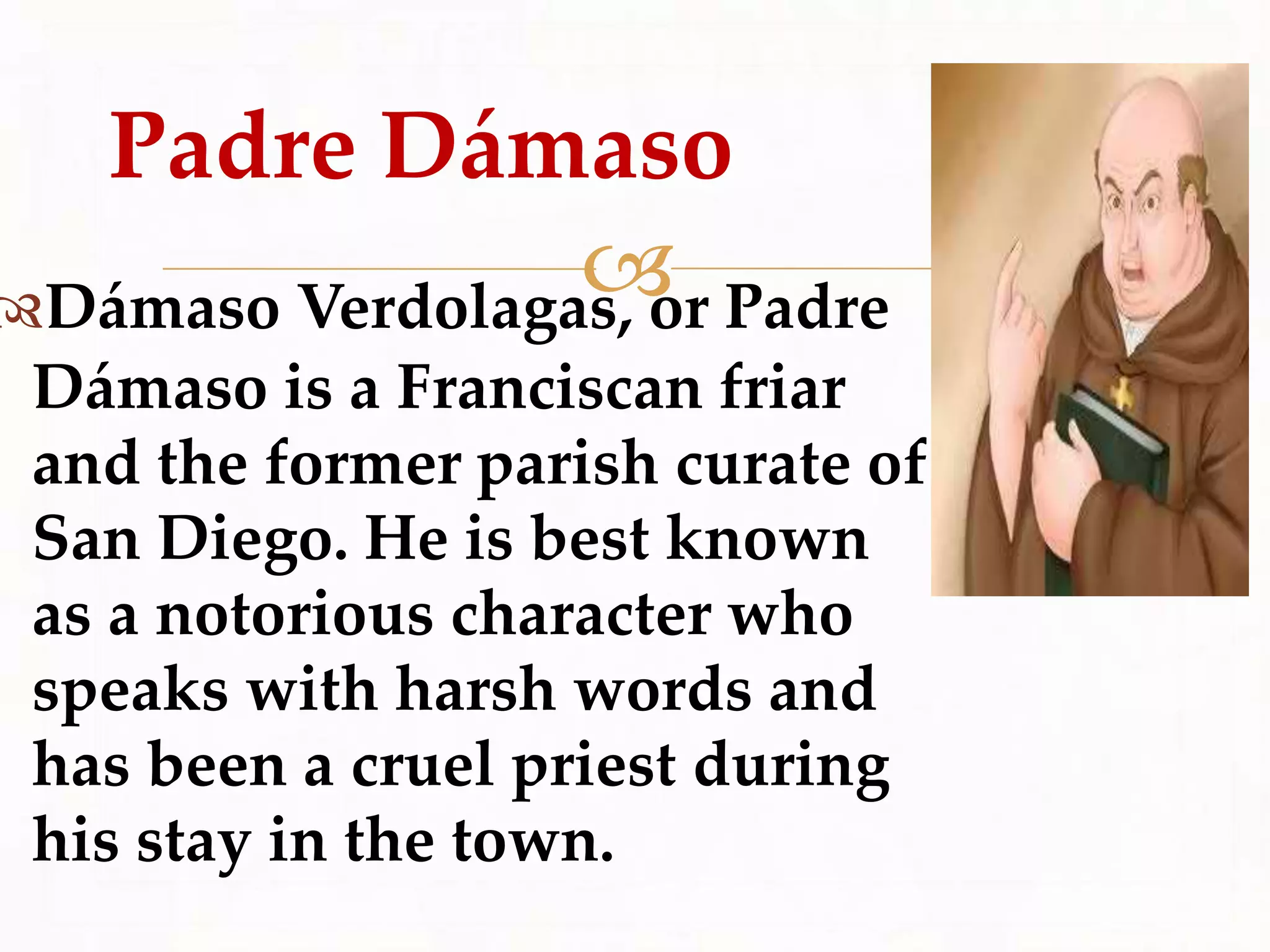
Dámaso Verdolaga
s, or Padre
Dámaso is a Franciscan friar
and the former parish curate of
San Diego. He is best known
as a notorious character who
speaks with harsh words and
has been a cruel priest during
his stay in the town.
Padre Dámaso

 Elías is Ibarra's mysterious
friend and ally. He wants to
revolutionize the country and to
be freed from Spanish
oppression.
Elias
DON ANAST
ASIO: Seeking for
reforms from the government, he
expresses his ideals in paper written
in a cryptographic alphabet "that the
future generations may be able to
decipher it" and realized the abuse
and oppression done by the
conquerors.
Pilosopong Tacio
Doña Victorina de los Reyes de
Espadaña, is an ambitious Filipina
who classifies herself as a Spanish
and mimics Spanish ladies by
putting on heavy make-up.
Doña Victorina


Narcisa or Sisa is the deranged
mother of Basilio and Crispín.
Described as beautiful and
young, although she loves her
children very much, she can not
protect them from the beatings of
her husband, Pedro.
Sisa, Crispín, and
Basilio
Crispín is Sisa's 7-year-old son. An
altar boy, he was unjustly accused
of stealing m
o
n
e

y
from the church.
After failing to force Crispín to
return the money he allegedly
stole, Father Salví and the head
sacristan killed him. It is not
directly stated that he was
killed, but the dream of Basilio
suggests that Crispín died during
his encounter with Padre Salvi and
his minion.
Basilio is Sisa's 10-year-old son. An
acolyte tasked to ring the church bells
for the Angelus, 
he faced the dread of
losing his younger brother and the
descent of his mother into insanity. At
the end of the novel, Elías wished
Basilio to bury him by burning in
exchange of chest of gold located on his
death ground. He will later play a
major role in El Filibusterismo.

Having completed his studies
in Europe,
comes back to
the Philippines after a 7-year
absence.

In his honor,
family friend,
together party,
a
threw a get-
which was
other
attended by friars and
prominent figures.

One of the guests, former San
Diego curate
belittled and
slandered Ibarra.

The next day, Ibarra visits
, his love, the
beautiful daughter of
Captain Tiago and affluent
resident of Binondo.

love was
Their long-standing
clearly manifested in this
meeting, and María Clara cannot
help but reread the letters her
sweetheart had written her before
he went to Europe.

Before Ibarra left
Diego,
for San
Lieutenant
Guevara, a Civil Guard, reveals
to him the incidents preceding
the death of his father,
, a
rich hacendero of the town.

According to Guevara, Don Rafael
was unjustly accused of being a
heretic, in addition to being a
subversive — an allegation brought
forth by Dámaso because of Don
Rafael's non-participation in the
Sacraments, such as Confession
and Mass.

Dámaso's animosity against Ibarra's
father is aggravated by another
incident when Don Rafael helped
out on a fight between a tax
collector and a child fighting, and
the former's death was blamed on
him, although it was not on
purpose.

thought ill
Suddenly, all of those who
of him surfaced
with additional complaints. He
was imprisoned, and just when
the matter was almost
settled, he died of sickness in
jail.

Revenge was not in Ibarra's
plans, instead he carried through his
father's plan of putting up a
school, since he believed that education
would pave the way to his country's
progress (all over the novel the author
refers to both Spain and the Philippines
as two different countries as part of a
same nation or family, with Spain seen
as the mother and the Philippines as the
daughter).

During the inauguration of the
school, Ibarra would have been
killed in a sabotage had
— a mysterious man who had
warned Ibarra earlier of a plot
to assassinate him — not saved
him. Instead the hired killer
met an unfortunate incident
and died.
After the inauguration, Ibarra
hosted a luncheon during which
Dámaso, gate-crashing the
luncheon, again insulted him. Ibarra
ignored the priest's insolence, but
when the latter slandered the
memory of his dead father, he was
no longer able to restrain himself
and lunged at Dámaso, prepared to
stab him for his impudence
As a
consequence, Dámaso excommun
icated Ibarra, tak

ing this
opportunity to persuade the
already-hesitant Tiago to forbid his
daughter from marrying Ibarra.
The friar wished María Clara to
marry Linares, a Peninsular who
had just arrived from Spain.
With the help of the
Governor-General, Ibarra's
excommunication
nullified and
was
the
Archbishop decided to
accept him as a member of
the Church once again.
Meanwhile, in Capitan
Tiago's residence, a party was
being held to announce the
upcoming wedding of María
Clara and Linares. Ibarra, with
the help of Elías, took this
opportunity to escape from
prison.
Before leaving, Ibarra spoke to
María Clara and accused her of
betraying him,
thinking that she
gave the letter he wrote her to the
jury. María Clara explained that she
would never conspire against him,
but that she was forced to surrender
Ibarra's letter to Father Salvi, in
exchange for the letters written by
her mother even before she, María
Clara, was born.
María Clara, thinking that
Ibarra had been killed in the
shooting incident, was
greatly overcome with grief.
Robbed of
severely disillusioned,
hope and
she
asked Dámaso to confine
her into a nunnery.
Dámaso reluctantly agreed
when she threatened to take
her own life, demanding, "the
nunnery or death!“
Unbeknownst to her, Ibarra
was still alive and able to
escape. It was Elías who had
taken the shots.
It was Christmas Eve when
Elías woke up in the forest
fatally wounde

d, as it is here
where he instructed Ibarra to
meet him. Instead, Elías
found the altar boy Basilio
cradling his already-dead
mother, Sisa.
The latter lost her mind
when she le
arned that
her two sons, Crispín
and Basilio, were chased
out of the convent by the
sacristan mayor on
suspicions of stealing
sacred objects.
Elías, convinced that he
would die soon, instructs
Basilio to builda funeral pyre
and burn his and Sisa's
bodies to ashes. He tells
Basilio that, if nobody reaches
the place, he come back later
on and dig for he will find
gold.
He also tells him (Basilio) to
take the gold

he finds and go
to school. In his dying
breath, he instructed Basilio
to continue dreaming about
freedom for his motherland
with the words:

“I shall die without seeing the
dawn break upon my
homeland. You, who shall see
it, salute it! Do not forget
those who have fallen during
the night”

Elías died thereafter.
Tiago became addicted to
opium and was seen to
frequent the opium house
in Binondo to satiate his
addiction.
EPILOGUE

María Clara became a nun
where Salví, who has
lusted after her from the
beginning of the
novel, regularly used her
to fulfill his lust.
EPILOGUE

One stormy evening, a
beautiful crazy woman was
seen at the top of the convent
crying and cursing the
heavens for the fate it has
handed her.
EPILOGUE

While the woman was
never identified, it is
insinuated that the said
woman was Maria
Clara.
EPILOGUE

Thirteen years after leaving the
Philippines, Crisostomo Ibarra returns as
Simoun, a rich jeweler sporting a beard and
blue-tinted glasses, and a confidant of the
Captain-General. Abandoning
idealism, he becomes a
his
cynical
saboteur, seeking revenge against the Spanish
Philippine system responsible for his
misfortunes by plotting a revolution.
EL FILIBUSTERISMO

Simoun insinuates himself into
Manila high society and
influences every decision of the
Captain-General to mismanage
the country’s affairs so that a
revolution will break out.
He cynically sides with the
upper classes,
encouraging
them to commit abuses
against the masses to
encourage the latter to
revolt against the
oppressive Spanish colonial
regime.
This time, he does not attempt to
fight the authorities through legal
means, but throu

gh violent
revolution using the masses.
Simoun has reasons for instigating
a revolution. First is to rescue
María Clara from the convent and
second, to get rid of ills and evils
of Philippine society.
His true identity is
discovered by

a now
grown-up Basilio while
visiting the grave of his
mother, Sisa, as Simoun
was digging near the grave
site for his buried
treasures.
Simoun spares Basilio’s life and
asks him to join

in his planned
revolution against the
government, egging him on by
bringing up the tragic
misfortunes of the latter's
family. Basilio declines the offer
as he still hopes that the
country’s condition will
improve.
Basilio, at this point, is a
graduating student of medicine at
the Ateneo Mun
icipal de Manila.
After the death of his
mother, Sisa, and the
disappearance of his younger
brother, Crispín, Basilio heeded
the advice of the dying
boatman, Elías, and traveled to
Manila to study.
Basilio was adopted by Captain
Tiago after María Clara entered
the convent. WithCaptain Tiago’s
help, Basilio was able to go
to Colegio de San Juan de
Letrán where, at first, he is
frowned upon by his peers and
teachers not only because of the
color of his skin but also because
of his shabby appearance.
Captain Tiago’s confessor, Father
Irene is making Captain Tiago’s
health worse by g
iving him opium
even as Basilio tries hard to prevent
Captain Tiago from smoking it. He
and other students want to establish
a Spanish language academy so that
they can learn to speak and write
Spanish despite the opposition from
the Dominican friars of
theUniversidad de Santo Tomás.
With the help of a reluctant Father
Irene as their mediator and Don
Custodio’s decisi

on, the academy is
established; however they will only
serve as caretakers of the school not
as the teachers. Dejected and
defeated, they hold a mock
celebration at a pancitería while a
spy for the friars witnesses the
proceedings
Simoun, for his part, keeps in close
contact with the bandit group of
Kabesang Tales,
a former cabeza de
barangay who suffered misfortunes
at the hands of the friars. Once a
farmer owning a prosperous
sugarcane plantation and a cabeza
de barangay (barangay head), he
was forced to give everything to the
greedy and unscrupulous Spanish
friars.

From the characters;

Rizal Noli Me Tangere.pptx

  • 2.
    The title, inmeaning Touch me John 20:17 in tried to touch not, refers to the as the newly risen , He said "Touch me not; for I am not yet ascended to my Father." The TITLE 
  • 3.
     JOSE RIZAL preferredthat the prospective novel expresses the backward, anti-progress and anti-intellectual way Filipino culture was.
  • 4.
     On JUNE 2,1884, Rizal proposed the writing of a novel about the Philippines written by a group of Filipinos.
  • 5.
     His proposal wasunanimously approved by the Filipinos present at the party, among whom were Pedro, Maximino and Antonio Paterno,Graciano López Jaena, Evaristo Aguirre, Eduardo de Lete, Julio Llorente and Valentin Ventura.
  • 6.
     Rizal finished thenovel in December 1886. Rizal feared the novel might not be printed, and that it would remain unread. A financial aid came from a friend named Máximo Viola which helped him print his book at a fine print media in Berlin named Berliner Buchdruckerei- Aktiengesellschaft. PUBLICATION
  • 7.
     Son of aFilipino businessman, Don Rafael Ibarra, he studied in Europe for seven years. Ibarra is also María Clara's fiancé. Several sources claim that Ibarra is also Rizal's reflection.
  • 8.
      Ibarra's fiancée.She was raised by Capitán Tiago and is the most beautiful and widely celebrated girl in San Diego.  an illegitimate daughter of Father Dámaso. María Clara
  • 9.
    Santiago de losSantos, known by his nickname Tiago title Capitán Tiago and political is a Filipino businessman and the cabeza de barangay or head of barangay of the town of San Diego. He is also the known father of María Clara. Capitan Tiago 
  • 10.
    Dámaso Verdolaga s, orPadre Dámaso is a Franciscan friar and the former parish curate of San Diego. He is best known as a notorious character who speaks with harsh words and has been a cruel priest during his stay in the town. Padre Dámaso
  • 11.
      Elías isIbarra's mysterious friend and ally. He wants to revolutionize the country and to be freed from Spanish oppression. Elias
  • 12.
    DON ANAST ASIO: Seekingfor reforms from the government, he expresses his ideals in paper written in a cryptographic alphabet "that the future generations may be able to decipher it" and realized the abuse and oppression done by the conquerors. Pilosopong Tacio
  • 13.
    Doña Victorina delos Reyes de Espadaña, is an ambitious Filipina who classifies herself as a Spanish and mimics Spanish ladies by putting on heavy make-up. Doña Victorina 
  • 14.
     Narcisa or Sisais the deranged mother of Basilio and Crispín. Described as beautiful and young, although she loves her children very much, she can not protect them from the beatings of her husband, Pedro. Sisa, Crispín, and Basilio
  • 15.
    Crispín is Sisa's7-year-old son. An altar boy, he was unjustly accused of stealing m o n e  y from the church. After failing to force Crispín to return the money he allegedly stole, Father Salví and the head sacristan killed him. It is not directly stated that he was killed, but the dream of Basilio suggests that Crispín died during his encounter with Padre Salvi and his minion.
  • 16.
    Basilio is Sisa's10-year-old son. An acolyte tasked to ring the church bells for the Angelus,  he faced the dread of losing his younger brother and the descent of his mother into insanity. At the end of the novel, Elías wished Basilio to bury him by burning in exchange of chest of gold located on his death ground. He will later play a major role in El Filibusterismo.
  • 17.
     Having completed hisstudies in Europe, comes back to the Philippines after a 7-year absence.
  • 18.
     In his honor, familyfriend, together party, a threw a get- which was other attended by friars and prominent figures.
  • 19.
     One of theguests, former San Diego curate belittled and slandered Ibarra.
  • 20.
     The next day,Ibarra visits , his love, the beautiful daughter of Captain Tiago and affluent resident of Binondo.
  • 21.
     love was Their long-standing clearlymanifested in this meeting, and María Clara cannot help but reread the letters her sweetheart had written her before he went to Europe.
  • 22.
     Before Ibarra left Diego, forSan Lieutenant Guevara, a Civil Guard, reveals to him the incidents preceding the death of his father, , a rich hacendero of the town.
  • 23.
     According to Guevara,Don Rafael was unjustly accused of being a heretic, in addition to being a subversive — an allegation brought forth by Dámaso because of Don Rafael's non-participation in the Sacraments, such as Confession and Mass.
  • 24.
     Dámaso's animosity againstIbarra's father is aggravated by another incident when Don Rafael helped out on a fight between a tax collector and a child fighting, and the former's death was blamed on him, although it was not on purpose.
  • 25.
     thought ill Suddenly, allof those who of him surfaced with additional complaints. He was imprisoned, and just when the matter was almost settled, he died of sickness in jail.
  • 26.
     Revenge was notin Ibarra's plans, instead he carried through his father's plan of putting up a school, since he believed that education would pave the way to his country's progress (all over the novel the author refers to both Spain and the Philippines as two different countries as part of a same nation or family, with Spain seen as the mother and the Philippines as the daughter).
  • 27.
     During the inaugurationof the school, Ibarra would have been killed in a sabotage had — a mysterious man who had warned Ibarra earlier of a plot to assassinate him — not saved him. Instead the hired killer met an unfortunate incident and died.
  • 28.
    After the inauguration,Ibarra hosted a luncheon during which Dámaso, gate-crashing the luncheon, again insulted him. Ibarra ignored the priest's insolence, but when the latter slandered the memory of his dead father, he was no longer able to restrain himself and lunged at Dámaso, prepared to stab him for his impudence
  • 29.
    As a consequence, Dámasoexcommun icated Ibarra, tak  ing this opportunity to persuade the already-hesitant Tiago to forbid his daughter from marrying Ibarra. The friar wished María Clara to marry Linares, a Peninsular who had just arrived from Spain.
  • 30.
    With the helpof the Governor-General, Ibarra's excommunication nullified and was the Archbishop decided to accept him as a member of the Church once again.
  • 31.
    Meanwhile, in Capitan Tiago'sresidence, a party was being held to announce the upcoming wedding of María Clara and Linares. Ibarra, with the help of Elías, took this opportunity to escape from prison.
  • 32.
    Before leaving, Ibarraspoke to María Clara and accused her of betraying him, thinking that she gave the letter he wrote her to the jury. María Clara explained that she would never conspire against him, but that she was forced to surrender Ibarra's letter to Father Salvi, in exchange for the letters written by her mother even before she, María Clara, was born.
  • 33.
    María Clara, thinkingthat Ibarra had been killed in the shooting incident, was greatly overcome with grief. Robbed of severely disillusioned, hope and she asked Dámaso to confine her into a nunnery.
  • 34.
    Dámaso reluctantly agreed whenshe threatened to take her own life, demanding, "the nunnery or death!“ Unbeknownst to her, Ibarra was still alive and able to escape. It was Elías who had taken the shots.
  • 35.
    It was ChristmasEve when Elías woke up in the forest fatally wounde  d, as it is here where he instructed Ibarra to meet him. Instead, Elías found the altar boy Basilio cradling his already-dead mother, Sisa.
  • 36.
    The latter losther mind when she le arned that her two sons, Crispín and Basilio, were chased out of the convent by the sacristan mayor on suspicions of stealing sacred objects.
  • 37.
    Elías, convinced thathe would die soon, instructs Basilio to builda funeral pyre and burn his and Sisa's bodies to ashes. He tells Basilio that, if nobody reaches the place, he come back later on and dig for he will find gold.
  • 38.
    He also tellshim (Basilio) to take the gold  he finds and go to school. In his dying breath, he instructed Basilio to continue dreaming about freedom for his motherland with the words:
  • 39.
     “I shall diewithout seeing the dawn break upon my homeland. You, who shall see it, salute it! Do not forget those who have fallen during the night”
  • 40.
  • 41.
    Tiago became addictedto opium and was seen to frequent the opium house in Binondo to satiate his addiction. EPILOGUE 
  • 42.
    María Clara becamea nun where Salví, who has lusted after her from the beginning of the novel, regularly used her to fulfill his lust. EPILOGUE 
  • 43.
    One stormy evening,a beautiful crazy woman was seen at the top of the convent crying and cursing the heavens for the fate it has handed her. EPILOGUE 
  • 44.
    While the womanwas never identified, it is insinuated that the said woman was Maria Clara. EPILOGUE 
  • 45.
    Thirteen years afterleaving the Philippines, Crisostomo Ibarra returns as Simoun, a rich jeweler sporting a beard and blue-tinted glasses, and a confidant of the Captain-General. Abandoning idealism, he becomes a his cynical saboteur, seeking revenge against the Spanish Philippine system responsible for his misfortunes by plotting a revolution. EL FILIBUSTERISMO 
  • 46.
    Simoun insinuates himselfinto Manila high society and influences every decision of the Captain-General to mismanage the country’s affairs so that a revolution will break out.
  • 47.
    He cynically sideswith the upper classes, encouraging them to commit abuses against the masses to encourage the latter to revolt against the oppressive Spanish colonial regime.
  • 48.
    This time, hedoes not attempt to fight the authorities through legal means, but throu  gh violent revolution using the masses. Simoun has reasons for instigating a revolution. First is to rescue María Clara from the convent and second, to get rid of ills and evils of Philippine society.
  • 49.
    His true identityis discovered by  a now grown-up Basilio while visiting the grave of his mother, Sisa, as Simoun was digging near the grave site for his buried treasures.
  • 50.
    Simoun spares Basilio’slife and asks him to join  in his planned revolution against the government, egging him on by bringing up the tragic misfortunes of the latter's family. Basilio declines the offer as he still hopes that the country’s condition will improve.
  • 51.
    Basilio, at thispoint, is a graduating student of medicine at the Ateneo Mun icipal de Manila. After the death of his mother, Sisa, and the disappearance of his younger brother, Crispín, Basilio heeded the advice of the dying boatman, Elías, and traveled to Manila to study.
  • 52.
    Basilio was adoptedby Captain Tiago after María Clara entered the convent. WithCaptain Tiago’s help, Basilio was able to go to Colegio de San Juan de Letrán where, at first, he is frowned upon by his peers and teachers not only because of the color of his skin but also because of his shabby appearance.
  • 53.
    Captain Tiago’s confessor,Father Irene is making Captain Tiago’s health worse by g iving him opium even as Basilio tries hard to prevent Captain Tiago from smoking it. He and other students want to establish a Spanish language academy so that they can learn to speak and write Spanish despite the opposition from the Dominican friars of theUniversidad de Santo Tomás.
  • 54.
    With the helpof a reluctant Father Irene as their mediator and Don Custodio’s decisi  on, the academy is established; however they will only serve as caretakers of the school not as the teachers. Dejected and defeated, they hold a mock celebration at a pancitería while a spy for the friars witnesses the proceedings
  • 55.
    Simoun, for hispart, keeps in close contact with the bandit group of Kabesang Tales, a former cabeza de barangay who suffered misfortunes at the hands of the friars. Once a farmer owning a prosperous sugarcane plantation and a cabeza de barangay (barangay head), he was forced to give everything to the greedy and unscrupulous Spanish friars.
  • 56.