www.ecologic.eu


How to unleash the transformative potential of local communities

Sustainable Economy Forum – SITRA
Hotel Berlin, November 8, 2012


                                                       Dr. Ralph Piotrowski
                                                           Ecologic Institute
                                             ralph.piotrowski@ecologic.eu
                                                           www.ecologic.eu
www.ecologic.eu


Overview

  Starting point: Research interest, basic assumptions and characteristic of supportive
  environments.
  Research project: InContext - Supportive environments for sustainable living.
  First experiences & Reflections
  Policy recommendations: top down for bottom up


                         Dr. Ralph Piotrowski – Ecologic Institute – ralph.piotrowski@ecologic.eu   2
www.ecologic.eu


Ecologic’s Research on Transition and Behavioural Change

•   What can be learned from human nature and psychology
    to foster sustainable behaviour?
•   Applying insights from humanistic psychology (like Carl Rogers) to support behavioural
    change

    ( i. e. to create spaces that enable humans
    to apply strategies to successfully
    fulfill their basic human needs.)


                             Dr. Ralph Piotrowski – Ecologic Institute – ralph.piotrowski@ecologic.eu   3
www.ecologic.eu


Assumptions based on humanistic psychology

  Second order learning (reframing the values, assumptions and policies that lead to
  actions) necessary for behavioral change
  Non-directive approaches create spaces that allow for second order learning.
  Second order learning is facilitated if humans enter a space in which they
  experience unconditional positive regard.


                                                   http://www.dortherindbo.dk/workshops.aspx


                         Dr. Ralph Piotrowski – Ecologic Institute – ralph.piotrowski@ecologic.eu   4
www.ecologic.eu


Characteristics of supportive environments
The role of the facilitator is to create an environment, which people experience as a
means for self-reflection and ‘personal development.’
Characteristics:
 Unconditional positive regard
 Non-directivity
 Open ended process with no clear aim
Objective:                                                                          Photo: http://www.freiraumschule.at/

 Fostering the ability of people to connect to their
needs and to enable them to choose successful
strategies to fulfill them.
 Empowerment: Nurturing the ability of people to take
responsibility for their local environment and their
chosen lifestyle.

                           Dr. Ralph Piotrowski – Ecologic Institute – ralph.piotrowski@ecologic.eu                        5
www.ecologic.eu


Overview

  Starting point: Research interest, basic assumptions and characteristic of supportive
  environments.
  Research project: InContext - Supportive environments for sustainable living.
  First experiences & Reflections
  Policy recommendations: top down for bottom up


                         Dr. Ralph Piotrowski – Ecologic Institute – ralph.piotrowski@ecologic.eu   6
www.ecologic.eu


InContext – Individuals in Context

•   Analyze three case studies of collective
    alternative practices.
•   Conduct and accompany transition processes
    in three local communities.
•   Formulate policy recommendations on creating
    supportive environments.


                                                                                    visit: www.incontext-fp7.eu

                           Dr. Ralph Piotrowski – Ecologic Institute – ralph.piotrowski@ecologic.eu               7
InContext Partners
http://www.incontext-fp7.eu/partners
       www.ecologic.eu


                    Dr. Ralph Piotrowski – Ecologic Institute – ralph.piotrowski@ecologic.eu   8
www.ecologic.eu


Overview

  Starting point: Research interest, basic assumptions and characteristic of supportive
  environments.
  Research project: InContext - Supportive environments for sustainable living.
  First experiences & Reflections
  Policy recommendations: top down for bottom up


                         Dr. Ralph Piotrowski – Ecologic Institute – ralph.piotrowski@ecologic.eu   9
www.ecologic.eu


How to unleash transformative potentials

•   Open spaces for self-reflection and experiments.
•   Talk about human needs and ways to fulfil them. Don’t talk about
    sustainability.
•   Work with frontrunners – don’t try to be representative.
•   Try to fully understand what motivates people and be
    appreciative of their (potentially unsustainable) actions.
•   Avoid paternalism. Don’t blame people or make them feel guilty.


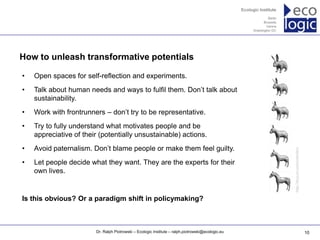
                                                                                                      http://tinyurl.com/cnlm9nv
•   Let people decide what they want. They are the experts for their
    own lives.


Is this obvious? Or a paradigm shift in policymaking?


                           Dr. Ralph Piotrowski – Ecologic Institute – ralph.piotrowski@ecologic.eu                                10
www.ecologic.eu


Reflections

  Any educational effort that implies the notion of critique, judgment or guilt is
  counter-productive - especially if it comes from people who do not live a
  sustainable lifestyles themselves.
  Better: Joint reflection of what we want, how to improve quality of life
  and why we find it sometimes difficult.
  Nevertheless: Trusting an open-end process with no pre-determined outcome is
  perceived as unusual by citizens and the methodological approach is not easily
  understood by everybody (visioning and back-casting etc.).


                          Dr. Ralph Piotrowski – Ecologic Institute – ralph.piotrowski@ecologic.eu   11
www.ecologic.eu


Overview

  Starting point: Research interest, basic assumptions and characteristic of supportive
  environments.
  Research project: InContext - Supportive environments for sustainable living.
  First experiences & Reflections
  Policy recommendations: top down for bottom up


                         Dr. Ralph Piotrowski – Ecologic Institute – ralph.piotrowski@ecologic.eu   12
www.ecologic.eu


Policy recommendations: top down for bottom up

  Establishing and maintaining the infrastructure needed for transition experiments,
  weighing the public benefits of these initiatives against the potential income from
  selling or renting the space to private investors.
  Opening mental spaces for alternative practices during kindergarten, school,
  university and professional education, e.g., by maintaining spaces that allow for
  experimentation and experience (e.g., maintaining a school garden)
  Creating or improving legal models for collective ownership.
  Giving financial support to initiatives or facilitators who support alternative
  experiments.
  Removing bureaucratic requirements experiments and/or adapting enforcement
  and oversight procedures to specific needs of the respective initiative.
  Maintaining public spaces that can serve as meeting venues and places for
  exchange.


                          Dr. Ralph Piotrowski – Ecologic Institute – ralph.piotrowski@ecologic.eu   13
www.ecologic.eu


Additional slide


                       Dr. Ralph Piotrowski – Ecologic Institute – ralph.piotrowski@ecologic.eu   14
Transition levels
                     Macro-level: landscape
                     autonomous trends, paradigms,
                     slow changes


                     Meso-level: regime
                     Dominant structure, culture and
                     practices


                      Micro-level: niches
                      innovative ideas, projects,
                      technologies, niche actors


                    Based on Geels and Kemp, 2001

How to Unleash the Transformative Potential of Local Communities / Ralph Piotrowski

  • 1.
    www.ecologic.eu How to unleashthe transformative potential of local communities Sustainable Economy Forum – SITRA Hotel Berlin, November 8, 2012 Dr. Ralph Piotrowski Ecologic Institute ralph.piotrowski@ecologic.eu www.ecologic.eu
  • 2.
    www.ecologic.eu Overview Startingpoint: Research interest, basic assumptions and characteristic of supportive environments. Research project: InContext - Supportive environments for sustainable living. First experiences & Reflections Policy recommendations: top down for bottom up Dr. Ralph Piotrowski – Ecologic Institute – ralph.piotrowski@ecologic.eu 2
  • 3.
    www.ecologic.eu Ecologic’s Research onTransition and Behavioural Change • What can be learned from human nature and psychology to foster sustainable behaviour? • Applying insights from humanistic psychology (like Carl Rogers) to support behavioural change ( i. e. to create spaces that enable humans to apply strategies to successfully fulfill their basic human needs.) Dr. Ralph Piotrowski – Ecologic Institute – ralph.piotrowski@ecologic.eu 3
  • 4.
    www.ecologic.eu Assumptions based onhumanistic psychology Second order learning (reframing the values, assumptions and policies that lead to actions) necessary for behavioral change Non-directive approaches create spaces that allow for second order learning. Second order learning is facilitated if humans enter a space in which they experience unconditional positive regard. http://www.dortherindbo.dk/workshops.aspx Dr. Ralph Piotrowski – Ecologic Institute – ralph.piotrowski@ecologic.eu 4
  • 5.
    www.ecologic.eu Characteristics of supportiveenvironments The role of the facilitator is to create an environment, which people experience as a means for self-reflection and ‘personal development.’ Characteristics:  Unconditional positive regard  Non-directivity  Open ended process with no clear aim Objective: Photo: http://www.freiraumschule.at/  Fostering the ability of people to connect to their needs and to enable them to choose successful strategies to fulfill them.  Empowerment: Nurturing the ability of people to take responsibility for their local environment and their chosen lifestyle. Dr. Ralph Piotrowski – Ecologic Institute – ralph.piotrowski@ecologic.eu 5
  • 6.
    www.ecologic.eu Overview Startingpoint: Research interest, basic assumptions and characteristic of supportive environments. Research project: InContext - Supportive environments for sustainable living. First experiences & Reflections Policy recommendations: top down for bottom up Dr. Ralph Piotrowski – Ecologic Institute – ralph.piotrowski@ecologic.eu 6
  • 7.
    www.ecologic.eu InContext – Individualsin Context • Analyze three case studies of collective alternative practices. • Conduct and accompany transition processes in three local communities. • Formulate policy recommendations on creating supportive environments. visit: www.incontext-fp7.eu Dr. Ralph Piotrowski – Ecologic Institute – ralph.piotrowski@ecologic.eu 7
  • 8.
    InContext Partners http://www.incontext-fp7.eu/partners www.ecologic.eu Dr. Ralph Piotrowski – Ecologic Institute – ralph.piotrowski@ecologic.eu 8
  • 9.
    www.ecologic.eu Overview Startingpoint: Research interest, basic assumptions and characteristic of supportive environments. Research project: InContext - Supportive environments for sustainable living. First experiences & Reflections Policy recommendations: top down for bottom up Dr. Ralph Piotrowski – Ecologic Institute – ralph.piotrowski@ecologic.eu 9
  • 10.
    www.ecologic.eu How to unleashtransformative potentials • Open spaces for self-reflection and experiments. • Talk about human needs and ways to fulfil them. Don’t talk about sustainability. • Work with frontrunners – don’t try to be representative. • Try to fully understand what motivates people and be appreciative of their (potentially unsustainable) actions. • Avoid paternalism. Don’t blame people or make them feel guilty. http://tinyurl.com/cnlm9nv • Let people decide what they want. They are the experts for their own lives. Is this obvious? Or a paradigm shift in policymaking? Dr. Ralph Piotrowski – Ecologic Institute – ralph.piotrowski@ecologic.eu 10
  • 11.
    www.ecologic.eu Reflections Anyeducational effort that implies the notion of critique, judgment or guilt is counter-productive - especially if it comes from people who do not live a sustainable lifestyles themselves. Better: Joint reflection of what we want, how to improve quality of life and why we find it sometimes difficult. Nevertheless: Trusting an open-end process with no pre-determined outcome is perceived as unusual by citizens and the methodological approach is not easily understood by everybody (visioning and back-casting etc.). Dr. Ralph Piotrowski – Ecologic Institute – ralph.piotrowski@ecologic.eu 11
  • 12.
    www.ecologic.eu Overview Startingpoint: Research interest, basic assumptions and characteristic of supportive environments. Research project: InContext - Supportive environments for sustainable living. First experiences & Reflections Policy recommendations: top down for bottom up Dr. Ralph Piotrowski – Ecologic Institute – ralph.piotrowski@ecologic.eu 12
  • 13.
    www.ecologic.eu Policy recommendations: topdown for bottom up Establishing and maintaining the infrastructure needed for transition experiments, weighing the public benefits of these initiatives against the potential income from selling or renting the space to private investors. Opening mental spaces for alternative practices during kindergarten, school, university and professional education, e.g., by maintaining spaces that allow for experimentation and experience (e.g., maintaining a school garden) Creating or improving legal models for collective ownership. Giving financial support to initiatives or facilitators who support alternative experiments. Removing bureaucratic requirements experiments and/or adapting enforcement and oversight procedures to specific needs of the respective initiative. Maintaining public spaces that can serve as meeting venues and places for exchange. Dr. Ralph Piotrowski – Ecologic Institute – ralph.piotrowski@ecologic.eu 13
  • 14.
    www.ecologic.eu Additional slide Dr. Ralph Piotrowski – Ecologic Institute – ralph.piotrowski@ecologic.eu 14
  • 15.
    Transition levels Macro-level: landscape autonomous trends, paradigms, slow changes Meso-level: regime Dominant structure, culture and practices Micro-level: niches innovative ideas, projects, technologies, niche actors Based on Geels and Kemp, 2001