Emotional intelligence; is
that all there is?
New proposals for the EI
assessment


    Edgar Bresó Esteve Ph.D.

         Associate Professor
 Emotionally Intelligent Organization Research Group
LOGO
Model/Hypothesis
LOGO
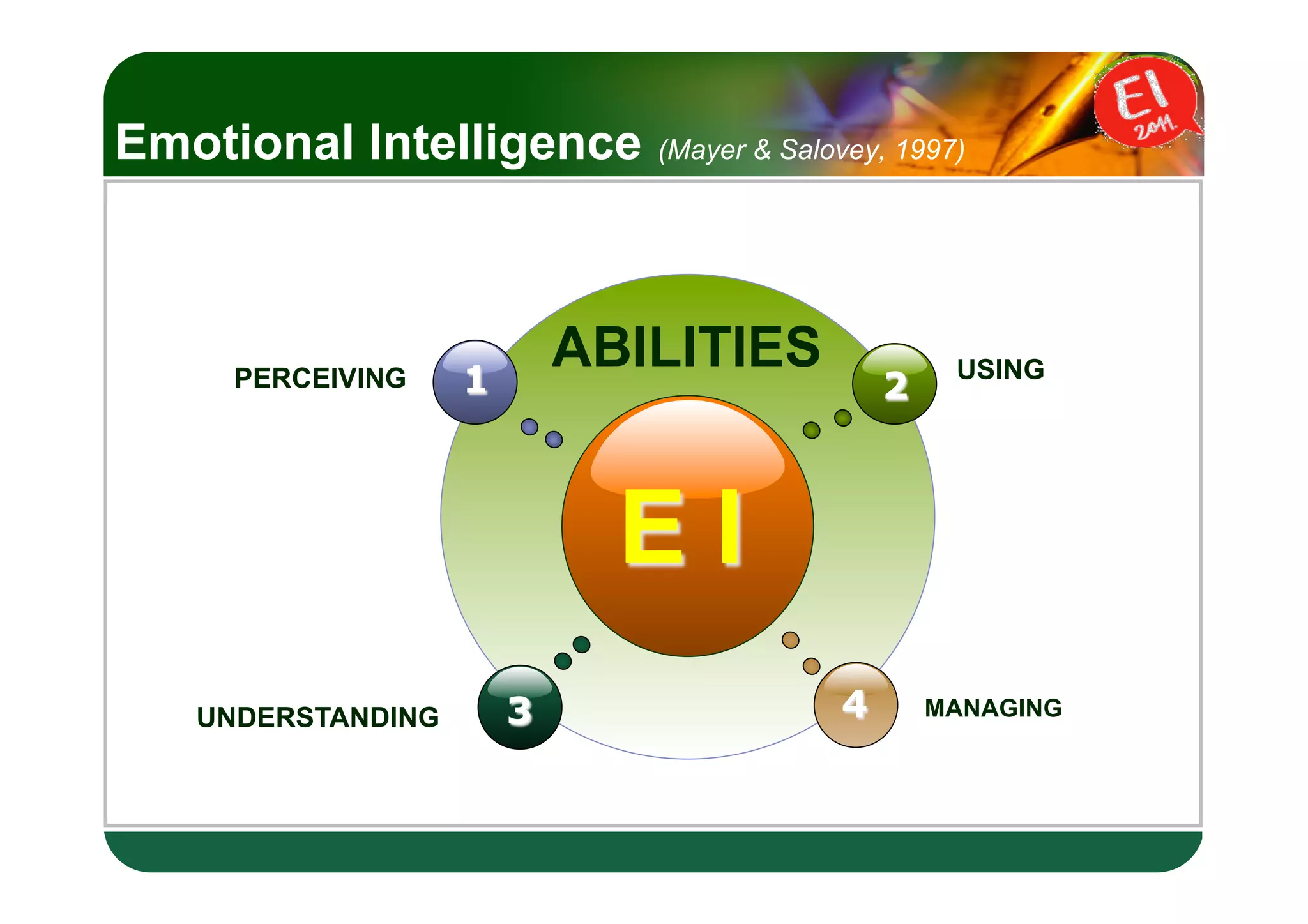
Emotional Intelligence        (Mayer & Salovey, 1997)


                   1
                           ABILITIES                USING
     PERCEIVING                                2


                             EI
   UNDERSTANDING       3                   4       MANAGING
LOGO
 EI Assessment
Emotional Quotient Inventory (EQ-i)
Trait Emotional Intelligence Questionnaire (TEIQue)
Genos Emotional Intelligence Inventory
Trait Meta-Mood Scale (TMMS-24)
Emotional Skills and Competence Questionnaire (ESCQ)

             Emotion Recognition
LOGO
EI Assessment
LOGO
Which one seems to be better…
LOGO
Output…
LOGO
Assesment #1 (n=152)
                              Correlations
                      1        2        3        4      5       6      7

   1. Emotional       -
   Intelligence
     2. VIGOR        -.06      -

3. DEDICATION        .10     .58**      -

4. EXHAUSTION       -.28**   .31**    -.20**     -

 5. DEPERSON.        -.10    -.56**   -.38**   .21**    -

6. PER. ACOMP.       -.14    .63**    .51**    -.23** -.51**     -

7. PERFORMANCE       .18     .38**    .19**    -.31** -.19**   .31**   -

Note: All α ≥ .70
LOGO
Assesment #2 (n=116)
                              Correlations
                      1        2        3        4      5       6      7

   1. Emotional       -
   Intelligence
     2. VIGOR        .13       -

3. DEDICATION        .09     .58**      -

4. EXHAUSTION       -.12**   .31**    -.20**     -

 5. DEPERSON.        -.10    -.56**   -.38**   .21**    -

6. PER. ACOMP.       .12     .63**    .51**    -.23** -.51**     -

7. PERFORMANCE       .10     .38**    .19**    -.31** -.19**   .31**   -

Note: All α ≥ .70
LOGO
4th.   Branch (n=116)

                            Correlations
                    1        2        3        4      5       6      7

  1. EI (4th.)      -

   2. VIGOR       .21*       -

3. DEDICATION     .15**    .58**      -

4. EXHAUSTION     -.27**   .31**    -.20**     -

 5. DEPERSON.     -.19**   -.56**   -.38**   .21**    -

6. PERSONAL AC.    .14     .63**    .51**    -.23** -.51**     -

7. PERFORMANCE    .16*     .38**    .19**    -.31** -.19**   .31**   -
LOGO
 1st.   vs   4th.   Branch (n=116)

                          Correlations


                              1            2    3

        1. EI (1st.)          -

        2. EI (4th.)        .39*           -

        3. Empathy*          21+         57**   -


*Empathy Quotient (Baron & Wheelwright, 2003)
LOGO
   EI Assessment (Other surveys)

v POFA (Pictures of Facial Affect) Ekman & Fresen, 1976.
v JACBART (Japanese and Caucasian Brief Affect Recognition
  Test) Matsumoto et. al, 2000.
v METT       (Micro-expressions Training Tool) Ekman, 2004.


Roberts, 2006: Do not correlate* with the 1st scale of MSCEIT

… The MSCEIT method of rating the extend of emotions in a still
  photo of a face seems to capture a different skill from multiple-
  choice assessment of facial expression presented for only a
  fraction of second (as in the JACBART)…


 *Correlation ≅
LOGO
LOGO
 Interviews… (n=97)

v  This is the best assessment method I have
   ever used.
v  Is not very boring, not long, useful, etc.

      BUT… (Respondents told me…)
1.- Pictures were not enough to make me feel…
2.- I was not very “involved” in the task (less than into
the other three)
3.- Probably in the next time I would answer
differently
4.- Honestly, I do not believe on its reliability
LOGO
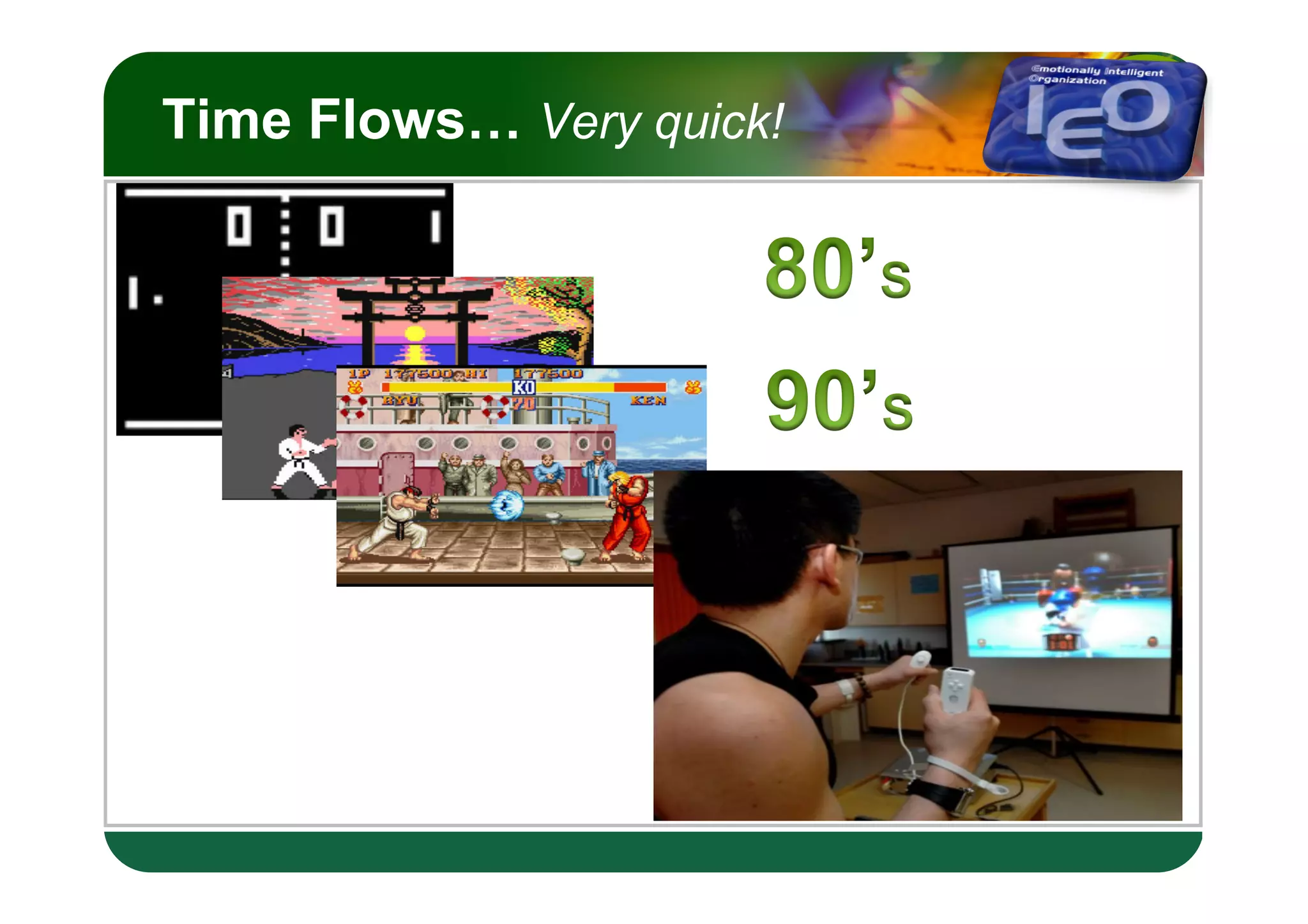
Time Flows… Very quick!
LOGO
Speculations…

v Faces are NOT SPANISH… so the
   Spanish population do not understand
   their emotions

1.- This survey has been already tested by
  Extremera & Berrocal, 2009.
2.- Facial expression of emotions is
  universal (Ekman, 1970).
3.- The real problem was not about faces…
LOGO
Speculations…

v In the 21st. Century, pictures are not
   enough. People don t feel anything by
   pictures. We are used to other
   technologies… it seems artificial…


-  But, in other contexts pictures work… Or
   not?
-  Have you had similar problems?
LOGO
Speculations…


v An Emotionally Intelligent person is
   not (only) a person who is able to
   give the “right” answer…


-  He/She must be able to find the answer at
   the first attempt, and quickly.
LOGO
 Conclusions…


v On the other hand, if the perception is
   actually an important branch, and it needs to
   be assessed, maybe I could design a new
   assessment method for this branch.
LOGO
 Conclusions…
v If I want to develop and implement an
   intervention based on the four branches model,
   I need to be sure that each branch is assessed
   properly.

v  An alternative could be forgetting the four
   branches and focus just on the management of
   emotions (the fourth branch).

v Thus, we should speak about the Management
   of Emotions instead of the Emotional
   Intelligence and the intervention should be
   developed for increasing just this competence.
LOGO
Proposals…


         v  The importance of TIME
                    Control.

         v  Possibility for correcting/
                changing answers

             v  Less artificial , more
                      dynamic .
jjjjjjjj
jjjjjjjj
jjjjjjjj
jjjjjjjj
jjjjjjjj
jjjjjjjj
jjjjjjjj

breso@uji.es
 Edgar Breso
 jjjjjj

Ei assessment

  • 1.
    Emotional intelligence; is thatall there is? New proposals for the EI assessment Edgar Bresó Esteve Ph.D. Associate Professor Emotionally Intelligent Organization Research Group
  • 2.
  • 3.
    LOGO Emotional Intelligence (Mayer & Salovey, 1997) 1 ABILITIES USING PERCEIVING 2 EI UNDERSTANDING 3 4 MANAGING
  • 4.
    LOGO EI Assessment EmotionalQuotient Inventory (EQ-i) Trait Emotional Intelligence Questionnaire (TEIQue) Genos Emotional Intelligence Inventory Trait Meta-Mood Scale (TMMS-24) Emotional Skills and Competence Questionnaire (ESCQ) Emotion Recognition
  • 5.
  • 6.
    LOGO Which one seemsto be better…
  • 7.
  • 8.
    LOGO Assesment #1 (n=152) Correlations 1 2 3 4 5 6 7 1. Emotional - Intelligence 2. VIGOR -.06 - 3. DEDICATION .10 .58** - 4. EXHAUSTION -.28** .31** -.20** - 5. DEPERSON. -.10 -.56** -.38** .21** - 6. PER. ACOMP. -.14 .63** .51** -.23** -.51** - 7. PERFORMANCE .18 .38** .19** -.31** -.19** .31** - Note: All α ≥ .70
  • 9.
    LOGO Assesment #2 (n=116) Correlations 1 2 3 4 5 6 7 1. Emotional - Intelligence 2. VIGOR .13 - 3. DEDICATION .09 .58** - 4. EXHAUSTION -.12** .31** -.20** - 5. DEPERSON. -.10 -.56** -.38** .21** - 6. PER. ACOMP. .12 .63** .51** -.23** -.51** - 7. PERFORMANCE .10 .38** .19** -.31** -.19** .31** - Note: All α ≥ .70
  • 10.
    LOGO 4th. Branch (n=116) Correlations 1 2 3 4 5 6 7 1. EI (4th.) - 2. VIGOR .21* - 3. DEDICATION .15** .58** - 4. EXHAUSTION -.27** .31** -.20** - 5. DEPERSON. -.19** -.56** -.38** .21** - 6. PERSONAL AC. .14 .63** .51** -.23** -.51** - 7. PERFORMANCE .16* .38** .19** -.31** -.19** .31** -
  • 11.
    LOGO 1st. vs 4th. Branch (n=116) Correlations 1 2 3 1. EI (1st.) - 2. EI (4th.) .39* - 3. Empathy* 21+ 57** - *Empathy Quotient (Baron & Wheelwright, 2003)
  • 12.
    LOGO EI Assessment (Other surveys) v POFA (Pictures of Facial Affect) Ekman & Fresen, 1976. v JACBART (Japanese and Caucasian Brief Affect Recognition Test) Matsumoto et. al, 2000. v METT (Micro-expressions Training Tool) Ekman, 2004. Roberts, 2006: Do not correlate* with the 1st scale of MSCEIT … The MSCEIT method of rating the extend of emotions in a still photo of a face seems to capture a different skill from multiple- choice assessment of facial expression presented for only a fraction of second (as in the JACBART)… *Correlation ≅
  • 13.
  • 14.
    LOGO Interviews… (n=97) v This is the best assessment method I have ever used. v  Is not very boring, not long, useful, etc. BUT… (Respondents told me…) 1.- Pictures were not enough to make me feel… 2.- I was not very “involved” in the task (less than into the other three) 3.- Probably in the next time I would answer differently 4.- Honestly, I do not believe on its reliability
  • 15.
  • 16.
    LOGO Speculations… v Faces are NOTSPANISH… so the Spanish population do not understand their emotions 1.- This survey has been already tested by Extremera & Berrocal, 2009. 2.- Facial expression of emotions is universal (Ekman, 1970). 3.- The real problem was not about faces…
  • 17.
    LOGO Speculations… v In the 21st.Century, pictures are not enough. People don t feel anything by pictures. We are used to other technologies… it seems artificial… -  But, in other contexts pictures work… Or not? -  Have you had similar problems?
  • 18.
    LOGO Speculations… v An Emotionally Intelligentperson is not (only) a person who is able to give the “right” answer… -  He/She must be able to find the answer at the first attempt, and quickly.
  • 19.
    LOGO Conclusions… v On theother hand, if the perception is actually an important branch, and it needs to be assessed, maybe I could design a new assessment method for this branch.
  • 20.
    LOGO Conclusions… v If Iwant to develop and implement an intervention based on the four branches model, I need to be sure that each branch is assessed properly. v  An alternative could be forgetting the four branches and focus just on the management of emotions (the fourth branch). v Thus, we should speak about the Management of Emotions instead of the Emotional Intelligence and the intervention should be developed for increasing just this competence.
  • 21.
    LOGO Proposals… v  The importance of TIME Control. v  Possibility for correcting/ changing answers v  Less artificial , more dynamic .
  • 22.