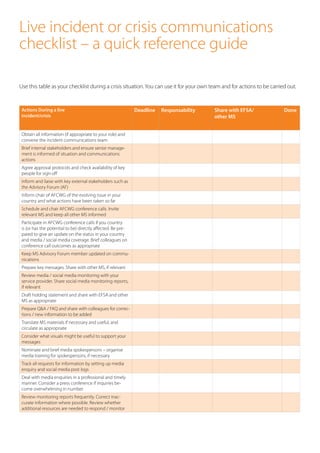
Live incident or crisis communications
checklist – a quick reference guide
Use this table as your checklist during a crisis situation.You can use it for your own team and for actions to be carried out.
Actions During a live
incident/crisis
Deadline Responsability Share with EFSA/
other MS
Done
Obtain all information (if appropriate to your role) and
convene the incident communications team
Brief internal stakeholders and ensure senior manage-
ment is informed of situation and communications
actions
Agree approval protocols and check availability of key
people for sign-off
Inform and liaise with key external stakeholders such as
the Advisory Forum (AF)
Inform chair of AFCWG of the evolving issue in your
country and what actions have been taken so far
Schedule and chair AFCWG conference calls. Invite
relevant MS and keep all other MS informed
Participate in AFCWG conference calls if you country
is (or has the potential to be) directly affected. Be pre-
pared to give an update on the status in your country
and media / social media coverage. Brief colleagues on
conference call outcomes as appropriate
Keep MS Advisory Forum member updated on commu-
nications
Prepare key messages. Share with other MS, if relevant
Review media / social media monitoring with your
service provider. Share social media monitoring reports,
if relevant
Draft holding statement and share with EFSA and other
MS as appropriate
Prepare Q&A / FAQ and share with colleagues for correc-
tions / new information to be added
Translate MS materials if necessary and useful, and
circulate as appropriate
Consider what visuals might be useful to support your
messages
Nominate and brief media spokespersons – organise
media training for spokespersons, if necessary
Track all requests for information by setting up media
enquiry and social media post logs
Deal with media enquiries in a professional and timely
manner. Consider a press conference if inquiries be-
come overwhelming in number
Review monitoring reports frequently. Correct inac-
curate information where possible. Review whether
additional resources are needed to respond / monitor
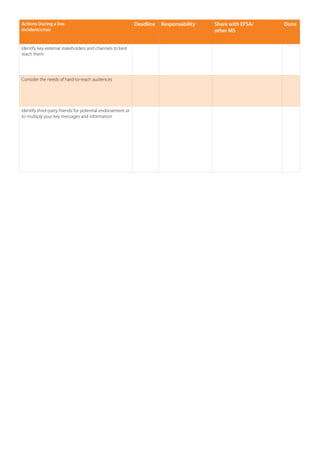
Actions During a live
incident/crisis
Deadline Responsability Share with EFSA/
other MS
Done
Identify key external stakeholders and channels to best
reach them
Consider the needs of hard-to-reach audiences
Identify third-party‘friends’for potential endorsement or
to multiply your key messages and information
Date: Time: Social media comment & location
(include hyperlink)
Response
(if any)
Social media comments log template
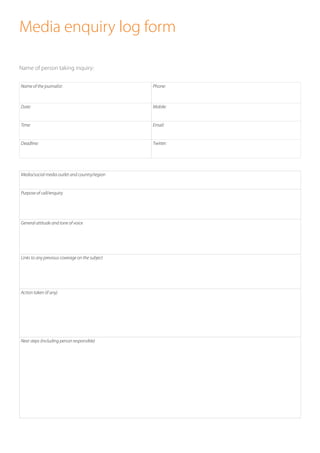
Media enquiry log form
Name of person taking inquiry: 	
	
 
Name of the journalist: Phone:
Date: Mobile:
Time: Email:
Deadline: Twitter:
Media/social media outlet and country/region
Purpose of call/enquiry
General attitude and tone of voice
Links to any previous coverage on the subject
Action taken (if any)
Next steps (including person responsible)

Efsa live incident

  • 1.
    Live incident orcrisis communications checklist – a quick reference guide Use this table as your checklist during a crisis situation.You can use it for your own team and for actions to be carried out. Actions During a live incident/crisis Deadline Responsability Share with EFSA/ other MS Done Obtain all information (if appropriate to your role) and convene the incident communications team Brief internal stakeholders and ensure senior manage- ment is informed of situation and communications actions Agree approval protocols and check availability of key people for sign-off Inform and liaise with key external stakeholders such as the Advisory Forum (AF) Inform chair of AFCWG of the evolving issue in your country and what actions have been taken so far Schedule and chair AFCWG conference calls. Invite relevant MS and keep all other MS informed Participate in AFCWG conference calls if you country is (or has the potential to be) directly affected. Be pre- pared to give an update on the status in your country and media / social media coverage. Brief colleagues on conference call outcomes as appropriate Keep MS Advisory Forum member updated on commu- nications Prepare key messages. Share with other MS, if relevant Review media / social media monitoring with your service provider. Share social media monitoring reports, if relevant Draft holding statement and share with EFSA and other MS as appropriate Prepare Q&A / FAQ and share with colleagues for correc- tions / new information to be added Translate MS materials if necessary and useful, and circulate as appropriate Consider what visuals might be useful to support your messages Nominate and brief media spokespersons – organise media training for spokespersons, if necessary Track all requests for information by setting up media enquiry and social media post logs Deal with media enquiries in a professional and timely manner. Consider a press conference if inquiries be- come overwhelming in number Review monitoring reports frequently. Correct inac- curate information where possible. Review whether additional resources are needed to respond / monitor
  • 2.
    Actions During alive incident/crisis Deadline Responsability Share with EFSA/ other MS Done Identify key external stakeholders and channels to best reach them Consider the needs of hard-to-reach audiences Identify third-party‘friends’for potential endorsement or to multiply your key messages and information
  • 3.
    Date: Time: Socialmedia comment & location (include hyperlink) Response (if any) Social media comments log template
  • 4.
    Media enquiry logform Name of person taking inquiry:   Name of the journalist: Phone: Date: Mobile: Time: Email: Deadline: Twitter: Media/social media outlet and country/region Purpose of call/enquiry General attitude and tone of voice Links to any previous coverage on the subject Action taken (if any) Next steps (including person responsible)