Efficient Project
Delivery Methods
for Repair,
Renovation,
Sustainability,
Construction
Prepared for Pentagon/WHS-FSD| October 2014
Peter Nicholas Cholakis
Leading Software Developer/Marketer
Decades of Owner/Contractor Experience
RSMeans Data Experts
Thought Leadership/Education
“In the long history of humankind,
those who learned to collaborate and
improvise most effectively have
prevailed.”
– Charles Darwin
Today’s Topics
 Importance and currently available collaborative
project delivery methods
 Description of key characteristics of a
collaborative project delivery method
 Roles and responsibilities of Owners, AE’s,
Contractors
 Importance of standardized information and
supporting technology
Economic and Environmental Drivers
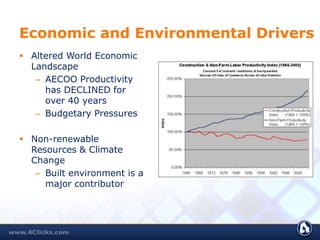
 Altered World Economic
Landscape
– AECOO Productivity
has DECLINED for
over 40 years
– Budgetary Pressures
 Non-renewable
Resources & Climate
Change
– Built environment is a
major contributor
Construction - Fundamental Change
Owners pay the bills:
Thus, it’s the Owner’s responsibility to drive/require LEAN
management processes, education/awareness, and the
adoption of supporting technologies to improve construction
productivity.
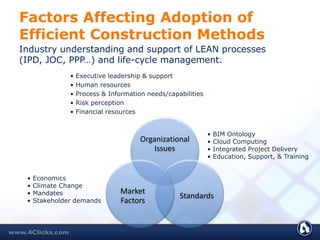
Industry understanding and support of LEAN processes
(IPD, JOC, PPP…) and life-cycle management.
Factors Affecting Adoption of
Efficient Construction Methods
• Executive leadership & support
• Human resources
• Process & Information needs/capabilities
• Risk perception
• Financial resources
Organizational
Issues
Standards
Market
Factors
• Economics
• Climate Change
• Mandates
• Stakeholder demands
• BIM Ontology
• Cloud Computing
• Integrated Project Delivery
• Education, Support, & Training
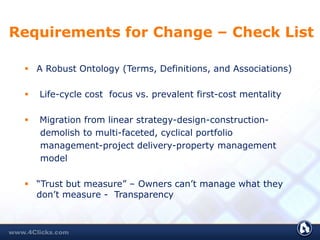
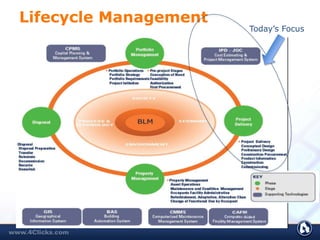
Requirements for Change – Check List
 A Robust Ontology (Terms, Definitions, and Associations)
 Life-cycle cost focus vs. prevalent first-cost mentality
 Migration from linear strategy-design-construction-
demolish to multi-faceted, cyclical portfolio
management-project delivery-property management
model
 “Trust but measure” – Owners can’t manage what they
don’t measure - Transparency
Lifecycle Management
Today’s Focus
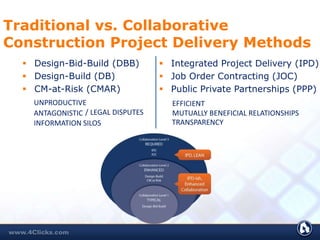
Traditional vs. Collaborative
Construction Project Delivery Methods
 Design-Bid-Build (DBB)
 Design-Build (DB)
 CM-at-Risk (CMAR)
UNPRODUCTIVE
ANTAGONISTIC / LEGAL DISPUTES MUTUALLY BENEFICIAL RELATIONSHIPS
 Integrated Project Delivery (IPD)
 Job Order Contracting (JOC)
 Public Private Partnerships (PPP)
INFORMATION SILOS TRANSPARENCY
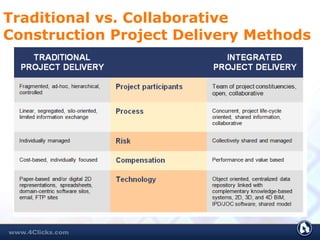
Traditional vs. Collaborative
Construction Project Delivery Methods
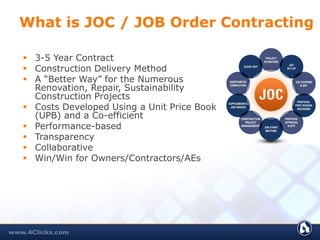
What is JOC / JOB Order Contracting
 3-5 Year Contract
 Construction Delivery Method
 A “Better Way” for the Numerous
Renovation, Repair, Sustainability
Construction Projects
 Costs Developed Using a Unit Price Book
(UPB) and a Co-efficient
 Performance-based
 Transparency
 Collaborative
 Win/Win for Owners/Contractors/AEs
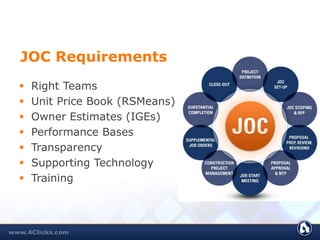
JOC Requirements
 Right Teams
 Unit Price Book (RSMeans)
 Owner Estimates (IGEs)
 Performance Bases
 Transparency
 Supporting Technology
 Training
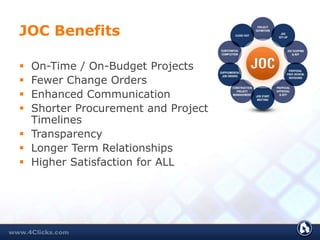
JOC Benefits
 On-Time / On-Budget Projects
 Fewer Change Orders
 Enhanced Communication
 Shorter Procurement and Project
Timelines
 Transparency
 Longer Term Relationships
 Higher Satisfaction for ALL
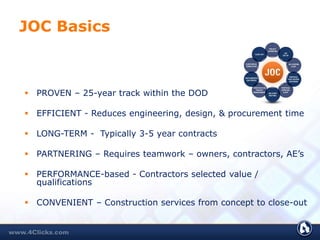
 PROVEN – 25-year track within the DOD
 EFFICIENT - Reduces engineering, design, & procurement time
 LONG-TERM - Typically 3-5 year contracts
 PARTNERING – Requires teamwork – owners, contractors, AE’s
 PERFORMANCE-based - Contractors selected value /
qualifications
 CONVENIENT – Construction services from concept to close-out
JOC Basics
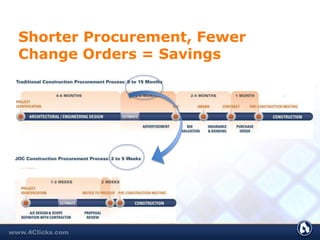
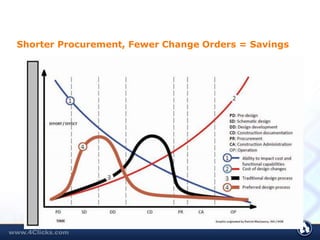
Shorter Procurement, Fewer
Change Orders = Savings
Shorter Procurement, Fewer Change Orders = Savings
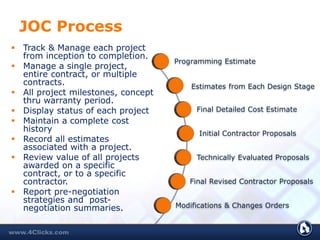
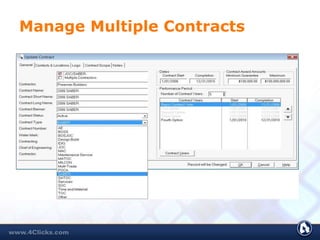
 Track & Manage each project
from inception to completion.
 Manage a single project,
entire contract, or multiple
contracts.
 All project milestones, concept
thru warranty period.
 Display status of each project
 Maintain a complete cost
history
 Record all estimates
associated with a project.
 Review value of all projects
awarded on a specific
contract, or to a specific
contractor.
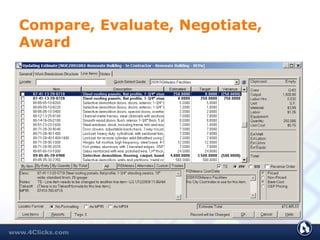
 Report pre-negotiation
strategies and post-
negotiation summaries.
Programming Estimate
Estimates from Each Design Stage
Final Detailed Cost Estimate
Initial Contractor Proposals
Technically Evaluated Proposals
Final Revised Contractor Proposals
Modifications & Changes Orders
JOC Process
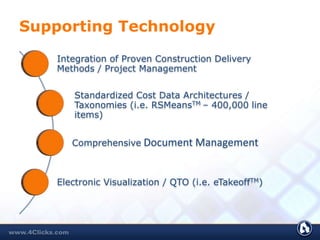
Supporting Technology
Integration of Proven Construction Delivery
Methods / Project Management
Standardized Cost Data Architectures /
Taxonomies (i.e. RSMeansTM – 400,000 line
items)
Comprehensive Document Management
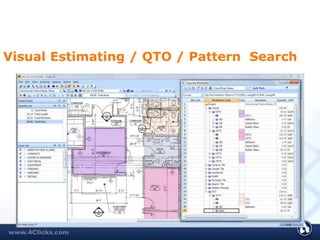
Electronic Visualization / QTO (i.e. eTakeoffTM)
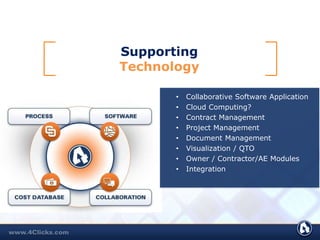
Supporting
Technology
• Collaborative Software Application
• Cloud Computing?
• Contract Management
• Project Management
• Document Management
• Visualization / QTO
• Owner / Contractor/AE Modules
• Integration
Manage Multiple Contracts
Compare, Evaluate, Negotiate,
Award
Visual Estimating / QTO / Pattern Search
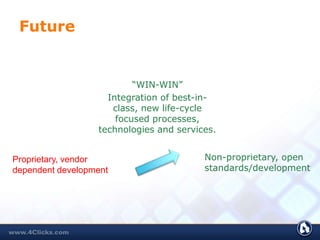
Future
“WIN-WIN”
Integration of best-in-
class, new life-cycle
focused processes,
technologies and services.
Proprietary, vendor
dependent development
Non-proprietary, open
standards/development
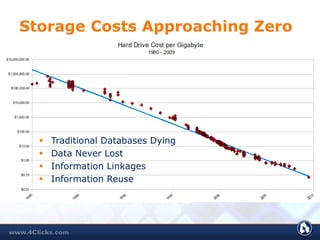
Storage Costs Approaching Zero
 Traditional Databases Dying
 Data Never Lost
 Information Linkages
 Information Reuse
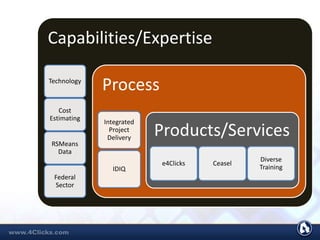
Capabilities/Expertise
Technology
Cost
Estimating
RSMeans
Data
Federal
Sector
Process
Integrated
Project
Delivery
IDIQ
Products/Services
e4Clicks Ceasel
Diverse
Training
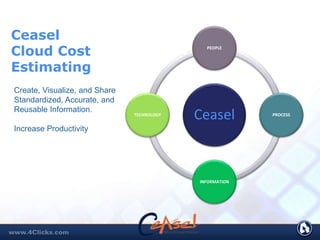
Ceasel
Cloud Cost
Estimating
Ceasel
PEOPLE
PROCESS
INFORMATION
TECHNOLOGY
Create, Visualize, and Share
Standardized, Accurate, and
Reusable Information.
Increase Productivity
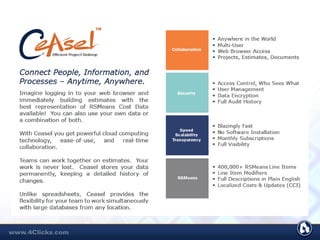
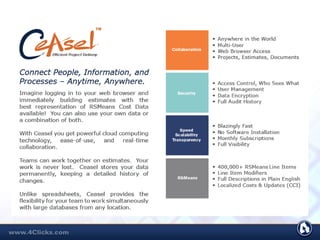
What is Ceasel?
 The BEST electronic presentation of
RSMeans Cost Data
 Collaborative Line Item Cost Estimating
Solution – Microsoft Azure Cloud
 Blazing Fast with Multiple Patents Pending
 A Tool for Connecting People, Information,
and Process, Anytime, Anywhere
28
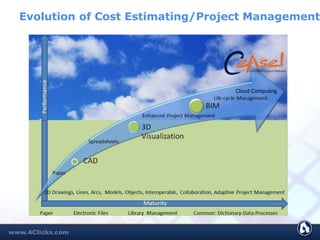
Evolution of Cost Estimating/Project Management
Cloud Computing
Benefits – Ceasel Cloud Computing Architecture
 Collaboration - users work concurrently on projects
in real-time…virtually anyone, anywhere, anytime.
 Data Integrity – Information is NEVER deleted.
Changes can be “rolled back” at any time by
authorized administrators.
 Data Protection – You determine how, when, and
where to publish data: your private area, as read
only to specified members within a private cloud,
all members in a private cloud, or publish
information to all members in public cloud.
Benefits of Ceasel’s Cloud Computing Architecture
 Visualization – Project participants see data earlier
in the project life-cycle, driving fewer change
orders, faster project timelines, and virtual
elimination of legal disputes.
 Agility – Rapid deployment, monitoring, and the
ability to quickly update processes and policies.
 Virtually no resource required of internal “IT” for
deployment or applications specific changes,
computing power, storage space, etc.
Benefits of Ceasel’s Cloud Computing Architecture
 Mobility – Resources can accessed from multiple
locations.
 Centralization of Information – While information
can be gather from distributed locations,
consolidation and global oversight is supported to
assure mission success.
 Business Continuity –Internet access is sole
requirement. Data centers provide multiple
redundancies.
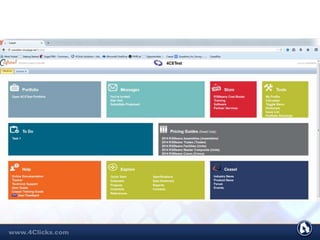
Ceasel’s Metro Interface
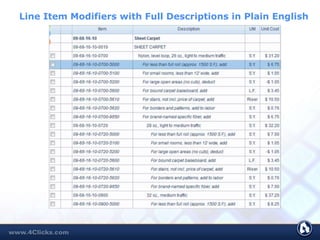
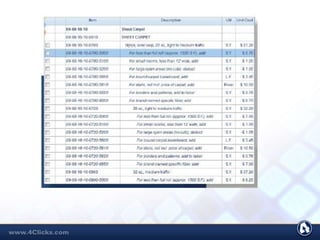
Line Item Modifiers with Full Descriptions in Plain English
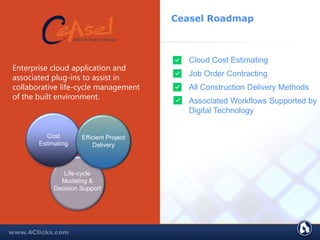
Ceasel Roadmap
Cloud Cost Estimating
Job Order Contracting
All Construction Delivery Methods
Associated Workflows Supported by
Digital Technology
Enterprise cloud application and
associated plug-ins to assist in
collaborative life-cycle management
of the built environment.
Cost
Estimating
Life-cycle
Modeling &
Decision Support
Efficient Project
Delivery
Ceasel Availability
Module1 – RSMeans line item estimating at
estimate and project level. Beta Now!
Module2 – Full Program, Project, and Document
management for JOC, SABER, IDIQ, SATOC,
MATOC, MACC, POCA, BOA. (2015)
39
40
“In the long history of humankind,
those who learned to collaborate and
improvise most effectively have
prevailed.”
– Charles Darwin
Q&A
Peter Nicholas Cholakis
4Clicks Solutions
www.4clicks.com
pcholakis@4Clicks.com
Presenter Bio
 Chief Marketing Officer for 4Clicks Solutions
(www.4clicks.com), leading provider of cost estimating
and project management software and solutions to the
DOD Sector, and software provider for RSMeans
JOCWorks.
 Former Senior Consultant for RS Means / Reed Business
Information – Strategic partnering with BIM and cost
estimating software OEMs as well as large end users.
 Established VFA as thought leader in the facilities
consulting and condition assessment industry.
 Defined the CPMS (Capital Planning and Management
Solutions) strategic concept effectively bringing it to a
market that VFA dominated for years including the higher
education and government segments
 Exceptional domain knowledge and expertise in facilities
lifecycle costs and total cost of ownership applicable to
various market segments including corporate and
healthcare
 Seminal thinker on TCO (total cost of ownership)
applicable to construction and facilities industry
associations including FFC, APPA, NASFA and IFMA

Efficient project delivery joc focus - 20141030

  • 1.
    Efficient Project Delivery Methods forRepair, Renovation, Sustainability, Construction Prepared for Pentagon/WHS-FSD| October 2014 Peter Nicholas Cholakis Leading Software Developer/Marketer Decades of Owner/Contractor Experience RSMeans Data Experts Thought Leadership/Education
  • 2.
    “In the longhistory of humankind, those who learned to collaborate and improvise most effectively have prevailed.” – Charles Darwin
  • 3.
    Today’s Topics  Importanceand currently available collaborative project delivery methods  Description of key characteristics of a collaborative project delivery method  Roles and responsibilities of Owners, AE’s, Contractors  Importance of standardized information and supporting technology
  • 4.
    Economic and EnvironmentalDrivers  Altered World Economic Landscape – AECOO Productivity has DECLINED for over 40 years – Budgetary Pressures  Non-renewable Resources & Climate Change – Built environment is a major contributor
  • 5.
    Construction - FundamentalChange Owners pay the bills: Thus, it’s the Owner’s responsibility to drive/require LEAN management processes, education/awareness, and the adoption of supporting technologies to improve construction productivity.
  • 6.
    Industry understanding andsupport of LEAN processes (IPD, JOC, PPP…) and life-cycle management. Factors Affecting Adoption of Efficient Construction Methods • Executive leadership & support • Human resources • Process & Information needs/capabilities • Risk perception • Financial resources Organizational Issues Standards Market Factors • Economics • Climate Change • Mandates • Stakeholder demands • BIM Ontology • Cloud Computing • Integrated Project Delivery • Education, Support, & Training
  • 7.
    Requirements for Change– Check List  A Robust Ontology (Terms, Definitions, and Associations)  Life-cycle cost focus vs. prevalent first-cost mentality  Migration from linear strategy-design-construction- demolish to multi-faceted, cyclical portfolio management-project delivery-property management model  “Trust but measure” – Owners can’t manage what they don’t measure - Transparency
  • 9.
  • 10.
    Traditional vs. Collaborative ConstructionProject Delivery Methods  Design-Bid-Build (DBB)  Design-Build (DB)  CM-at-Risk (CMAR) UNPRODUCTIVE ANTAGONISTIC / LEGAL DISPUTES MUTUALLY BENEFICIAL RELATIONSHIPS  Integrated Project Delivery (IPD)  Job Order Contracting (JOC)  Public Private Partnerships (PPP) INFORMATION SILOS TRANSPARENCY
  • 11.
  • 12.
    What is JOC/ JOB Order Contracting  3-5 Year Contract  Construction Delivery Method  A “Better Way” for the Numerous Renovation, Repair, Sustainability Construction Projects  Costs Developed Using a Unit Price Book (UPB) and a Co-efficient  Performance-based  Transparency  Collaborative  Win/Win for Owners/Contractors/AEs
  • 13.
    JOC Requirements  RightTeams  Unit Price Book (RSMeans)  Owner Estimates (IGEs)  Performance Bases  Transparency  Supporting Technology  Training
  • 14.
    JOC Benefits  On-Time/ On-Budget Projects  Fewer Change Orders  Enhanced Communication  Shorter Procurement and Project Timelines  Transparency  Longer Term Relationships  Higher Satisfaction for ALL
  • 15.
     PROVEN –25-year track within the DOD  EFFICIENT - Reduces engineering, design, & procurement time  LONG-TERM - Typically 3-5 year contracts  PARTNERING – Requires teamwork – owners, contractors, AE’s  PERFORMANCE-based - Contractors selected value / qualifications  CONVENIENT – Construction services from concept to close-out JOC Basics
  • 16.
  • 17.
    Shorter Procurement, FewerChange Orders = Savings
  • 18.
     Track &Manage each project from inception to completion.  Manage a single project, entire contract, or multiple contracts.  All project milestones, concept thru warranty period.  Display status of each project  Maintain a complete cost history  Record all estimates associated with a project.  Review value of all projects awarded on a specific contract, or to a specific contractor.  Report pre-negotiation strategies and post- negotiation summaries. Programming Estimate Estimates from Each Design Stage Final Detailed Cost Estimate Initial Contractor Proposals Technically Evaluated Proposals Final Revised Contractor Proposals Modifications & Changes Orders JOC Process
  • 19.
    Supporting Technology Integration ofProven Construction Delivery Methods / Project Management Standardized Cost Data Architectures / Taxonomies (i.e. RSMeansTM – 400,000 line items) Comprehensive Document Management Electronic Visualization / QTO (i.e. eTakeoffTM)
  • 20.
    Supporting Technology • Collaborative SoftwareApplication • Cloud Computing? • Contract Management • Project Management • Document Management • Visualization / QTO • Owner / Contractor/AE Modules • Integration
  • 21.
  • 22.
  • 23.
    Visual Estimating /QTO / Pattern Search
  • 24.
    Future “WIN-WIN” Integration of best-in- class,new life-cycle focused processes, technologies and services. Proprietary, vendor dependent development Non-proprietary, open standards/development
  • 25.
    Storage Costs ApproachingZero  Traditional Databases Dying  Data Never Lost  Information Linkages  Information Reuse
  • 26.
  • 27.
    Ceasel Cloud Cost Estimating Ceasel PEOPLE PROCESS INFORMATION TECHNOLOGY Create, Visualize,and Share Standardized, Accurate, and Reusable Information. Increase Productivity
  • 28.
    What is Ceasel? The BEST electronic presentation of RSMeans Cost Data  Collaborative Line Item Cost Estimating Solution – Microsoft Azure Cloud  Blazing Fast with Multiple Patents Pending  A Tool for Connecting People, Information, and Process, Anytime, Anywhere 28
  • 30.
    Evolution of CostEstimating/Project Management Cloud Computing
  • 31.
    Benefits – CeaselCloud Computing Architecture  Collaboration - users work concurrently on projects in real-time…virtually anyone, anywhere, anytime.  Data Integrity – Information is NEVER deleted. Changes can be “rolled back” at any time by authorized administrators.  Data Protection – You determine how, when, and where to publish data: your private area, as read only to specified members within a private cloud, all members in a private cloud, or publish information to all members in public cloud.
  • 32.
    Benefits of Ceasel’sCloud Computing Architecture  Visualization – Project participants see data earlier in the project life-cycle, driving fewer change orders, faster project timelines, and virtual elimination of legal disputes.  Agility – Rapid deployment, monitoring, and the ability to quickly update processes and policies.  Virtually no resource required of internal “IT” for deployment or applications specific changes, computing power, storage space, etc.
  • 33.
    Benefits of Ceasel’sCloud Computing Architecture  Mobility – Resources can accessed from multiple locations.  Centralization of Information – While information can be gather from distributed locations, consolidation and global oversight is supported to assure mission success.  Business Continuity –Internet access is sole requirement. Data centers provide multiple redundancies.
  • 34.
  • 35.
    Line Item Modifierswith Full Descriptions in Plain English
  • 38.
    Ceasel Roadmap Cloud CostEstimating Job Order Contracting All Construction Delivery Methods Associated Workflows Supported by Digital Technology Enterprise cloud application and associated plug-ins to assist in collaborative life-cycle management of the built environment. Cost Estimating Life-cycle Modeling & Decision Support Efficient Project Delivery
  • 39.
    Ceasel Availability Module1 –RSMeans line item estimating at estimate and project level. Beta Now! Module2 – Full Program, Project, and Document management for JOC, SABER, IDIQ, SATOC, MATOC, MACC, POCA, BOA. (2015) 39
  • 40.
    40 “In the longhistory of humankind, those who learned to collaborate and improvise most effectively have prevailed.” – Charles Darwin
  • 44.
    Q&A Peter Nicholas Cholakis 4ClicksSolutions www.4clicks.com pcholakis@4Clicks.com
  • 45.
    Presenter Bio  ChiefMarketing Officer for 4Clicks Solutions (www.4clicks.com), leading provider of cost estimating and project management software and solutions to the DOD Sector, and software provider for RSMeans JOCWorks.  Former Senior Consultant for RS Means / Reed Business Information – Strategic partnering with BIM and cost estimating software OEMs as well as large end users.  Established VFA as thought leader in the facilities consulting and condition assessment industry.  Defined the CPMS (Capital Planning and Management Solutions) strategic concept effectively bringing it to a market that VFA dominated for years including the higher education and government segments  Exceptional domain knowledge and expertise in facilities lifecycle costs and total cost of ownership applicable to various market segments including corporate and healthcare  Seminal thinker on TCO (total cost of ownership) applicable to construction and facilities industry associations including FFC, APPA, NASFA and IFMA

Editor's Notes

  • #7 A lot of innovative construction and FM practices and knowledge began within the DOD/Federal sector, and as been leveraged by higher education, healthcare and process-centric industry. (JOC developed by Army over 25 years ago)
  • #29 Exclusively enhanced 400,000 line item RSMeans cost database. Full descriptions and modifiers included as well as references, graphics, and specifications. Embedded project delivery process management from concept thru warranty. CEASAL can be viewed as a next generation “FACEBOOKTM” for collaborative, accurate, and transparent cost estimating and construction project management. CEASEL bridges the gap between Publics Sector Owners, Contractors, AE’s, & Oversight Groups enabling more consistent deployment of “best practices” from concept-thru-warrant, contained within an integrated, easy-to-use cloud-based application.
  • #32  1. Collaboration – True cloud computing (vs. cloud-washing or simply posting legacy applications to the cloud) lets users work concurrently on projects in real-time…virtually anyone, anywhere, anytime in multiple languages and currencies. 2. Data Integrity – Information is NEVER deleted. This is potentially the best form of security available. “Who” does “What” and “When” is always tracked and changes can be “rolled back” at any time by authorized administrators. 3. Data Protection – It is YOU, the user who determines how, when, and where to publish data. For example, you can maintain information in your private area, publish as read only to specified members within a private cloud…or publish to all members in a private cloud, or publish information to all members in public cloud and enable rights to use and modify data. 4. Visualization – DATA visualization and the associated development and implementation of collaborative construction delivery methods such as integrated project delivery – IPD, and job order contracting, JOC, enable shared information earlier in the project life-cycle and among more participants. This enable errors to be found and corrected and/or changes to be accomplished earlier in the project timeline. This results in few change orders, faster project timelines, and virtual elimination of legal disputes. Cloud computing will accelerate data visualization and transparency among all stakeholders of physical infrastructure and promote multiple forms of performance-based processes. 5. Agility – Our work and natural environments are changing at an accelerated pace. Rapid deployment, monitoring, and the associated continuous modification of processes and policies are becoming increasingly important. Cloud computing deploys processes faster than any other method currently available. There is no longer a need to rely upon internal “IT” for deployment or applications specific changes, computing power, storage space, etc. 6. Mobility – It is neither cost effective, nor efficient, to have everyone working in offices or specified work settings. Resources need to be tapped from multiple locations enabling use of “the best of the best”. Cloud computing allows direct, transparent access to local resources while also communicating centralized processes and procedures. 7. Centralization of Information – While information can be scattered among several data centers, it also can be instantly consolidated to provide global management in support of an organization’s mission as well as associated, efficient local action. 8. Business Continuity – While Internet access is required (unless you host the “cloud” internally), would you rather store your information at your location and risk catastrophic failure, or at a location with multiple redundancies? Give your team one tool Comprehensive databases Conceptual design to detailed line item estimate Planning, programming, engineering, maintenance
  • #33  1. Collaboration – True cloud computing (vs. cloud-washing or simply posting legacy applications to the cloud) lets users work concurrently on projects in real-time…virtually anyone, anywhere, anytime in multiple languages and currencies. 2. Data Integrity – Information is NEVER deleted. This is potentially the best form of security available. “Who” does “What” and “When” is always tracked and changes can be “rolled back” at any time by authorized administrators. 3. Data Protection – It is YOU, the user who determines how, when, and where to publish data. For example, you can maintain information in your private area, publish as read only to specified members within a private cloud…or publish to all members in a private cloud, or publish information to all members in public cloud and enable rights to use and modify data. 4. Visualization – DATA visualization and the associated development and implementation of collaborative construction delivery methods such as integrated project delivery – IPD, and job order contracting, JOC, enable shared information earlier in the project life-cycle and among more participants. This enable errors to be found and corrected and/or changes to be accomplished earlier in the project timeline. This results in few change orders, faster project timelines, and virtual elimination of legal disputes. Cloud computing will accelerate data visualization and transparency among all stakeholders of physical infrastructure and promote multiple forms of performance-based processes. 5. Agility – Our work and natural environments are changing at an accelerated pace. Rapid deployment, monitoring, and the associated continuous modification of processes and policies are becoming increasingly important. Cloud computing deploys processes faster than any other method currently available. There is no longer a need to rely upon internal “IT” for deployment or applications specific changes, computing power, storage space, etc. 6. Mobility – It is neither cost effective, nor efficient, to have everyone working in offices or specified work settings. Resources need to be tapped from multiple locations enabling use of “the best of the best”. Cloud computing allows direct, transparent access to local resources while also communicating centralized processes and procedures. 7. Centralization of Information – While information can be scattered among several data centers, it also can be instantly consolidated to provide global management in support of an organization’s mission as well as associated, efficient local action. 8. Business Continuity – While Internet access is required (unless you host the “cloud” internally), would you rather store your information at your location and risk catastrophic failure, or at a location with multiple redundancies? Give your team one tool Comprehensive databases Conceptual design to detailed line item estimate Planning, programming, engineering, maintenance
  • #34  1. Collaboration – True cloud computing (vs. cloud-washing or simply posting legacy applications to the cloud) lets users work concurrently on projects in real-time…virtually anyone, anywhere, anytime in multiple languages and currencies. 2. Data Integrity – Information is NEVER deleted. This is potentially the best form of security available. “Who” does “What” and “When” is always tracked and changes can be “rolled back” at any time by authorized administrators. 3. Data Protection – It is YOU, the user who determines how, when, and where to publish data. For example, you can maintain information in your private area, publish as read only to specified members within a private cloud…or publish to all members in a private cloud, or publish information to all members in public cloud and enable rights to use and modify data. 4. Visualization – DATA visualization and the associated development and implementation of collaborative construction delivery methods such as integrated project delivery – IPD, and job order contracting, JOC, enable shared information earlier in the project life-cycle and among more participants. This enable errors to be found and corrected and/or changes to be accomplished earlier in the project timeline. This results in few change orders, faster project timelines, and virtual elimination of legal disputes. Cloud computing will accelerate data visualization and transparency among all stakeholders of physical infrastructure and promote multiple forms of performance-based processes. 5. Agility – Our work and natural environments are changing at an accelerated pace. Rapid deployment, monitoring, and the associated continuous modification of processes and policies are becoming increasingly important. Cloud computing deploys processes faster than any other method currently available. There is no longer a need to rely upon internal “IT” for deployment or applications specific changes, computing power, storage space, etc. 6. Mobility – It is neither cost effective, nor efficient, to have everyone working in offices or specified work settings. Resources need to be tapped from multiple locations enabling use of “the best of the best”. Cloud computing allows direct, transparent access to local resources while also communicating centralized processes and procedures. 7. Centralization of Information – While information can be scattered among several data centers, it also can be instantly consolidated to provide global management in support of an organization’s mission as well as associated, efficient local action. 8. Business Continuity – While Internet access is required (unless you host the “cloud” internally), would you rather store your information at your location and risk catastrophic failure, or at a location with multiple redundancies? Give your team one tool Comprehensive databases Conceptual design to detailed line item estimate Planning, programming, engineering, maintenance
  • #40 Exclusively enhanced 400,000 line item RSMeans cost database. Full descriptions and modifiers included as well as references, graphics, and specifications. Embedded project delivery process management from concept thru warranty.