EFFICIENCY OF PROTEIN
UTILIZATION
Sonawane Akshay S
Efficiency of Utilization of Absorbed Amino Acids :-
The mixture of amino acids of dietary origin absorbed from the small
intestine (i.e. the truly digested amino acids) is utilized for the synthesis
of tissue protein.
The efficiency of this process, which depends upon the composition of
the mix relative to that of protein to be synthesized, is best represented
by its true biological value
This will in turn depend upon the biological values of the digested
undegraded dietary protein and the digested microbial protein, and upon
the relative proportion of each contributing to the mix.
Microbial protein is thought to have a relatively constant
biological value of about 0.8, where as that of dietary origin will
be variable and characteristic of the foods making up the diet.
Prediction of such dietary values is extremely difficult, since the
biological values of the individual proteins are no guide to their
value in combinations.
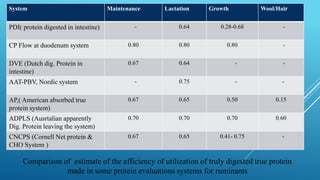
System Maintenance Lactation Growth Wool/Hair
PDI( protein digested in intestine) - 0.64 0.28-0.68 -
CP Flow at duodenum system 0.80 0.80 0.80 -
DVE (Dutch dig. Protein in
intestine)
0.67 0.64 - -
AAT-PBV, Nordic system - 0.75 - -
AP,( American absorbed true
protein system)
0.67 0.65 0.50 0.15
ADPLS (Ausrtalian apparently
Dig. Protein leaving the system)
0.70 0.70 0.70 0.60
CNCPS (Cornell Net protein &
CHO System )
0.67 0.65 0.41- 0.75 -
Comparison of estimate of the efficiency of utilization of truly digested true protein
made in some protein evaluations systems for ruminants
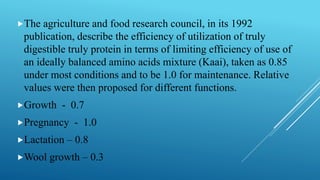
The agriculture and food research council, in its 1992
publication, describe the efficiency of utilization of truly
digestible truly protein in terms of limiting efficiency of use of
an ideally balanced amino acids mixture (Kaai), taken as 0.85
under most conditions and to be 1.0 for maintenance. Relative
values were then proposed for different functions.
Growth - 0.7
Pregnancy - 1.0
Lactation – 0.8
Wool growth – 0.3
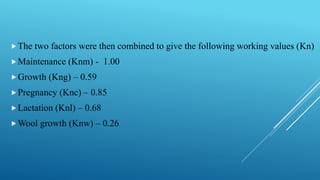
The two factors were then combined to give the following working values (Kn)
Maintenance (Knm) - 1.00
Growth (Kng) – 0.59
Pregnancy (Knc) – 0.85
Lactation (Knl) – 0.68
Wool growth (Knw) – 0.26
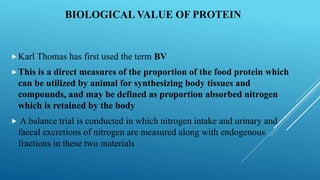
BIOLOGICAL VALUE OF PROTEIN
Karl Thomas has first used the term BV
This is a direct measures of the proportion of the food protein which
can be utilized by animal for synthesizing body tissues and
compounds, and may be defined as proportion absorbed nitrogen
which is retained by the body
 A balance trial is conducted in which nitrogen intake and urinary and
faecal excretions of nitrogen are measured along with endogenous
fractions in these two materials
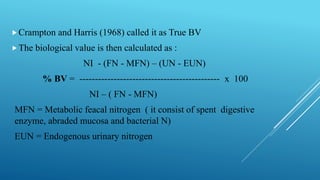
Crampton and Harris (1968) called it as True BV
The biological value is then calculated as :
NI - (FN - MFN) – (UN - EUN)
% BV = --------------------------------------------- x 100
NI – ( FN - MFN)
MFN = Metabolic feacal nitrogen ( it consist of spent digestive
enzyme, abraded mucosa and bacterial N)
EUN = Endogenous urinary nitrogen
The endogenous urinary nitrogen results from irreversible reactions
involved in the breakdown and replacement of various protein secretions
and structures within in the body
Thus both the faecal and urinary endogenous fractions represents
nitrogen which has been absorbed and utilized by the animal rather than
nitrogen which can not be so utilized

Efficiency of protein utilisation ppt

  • 1.
  • 2.
    Efficiency of Utilizationof Absorbed Amino Acids :- The mixture of amino acids of dietary origin absorbed from the small intestine (i.e. the truly digested amino acids) is utilized for the synthesis of tissue protein. The efficiency of this process, which depends upon the composition of the mix relative to that of protein to be synthesized, is best represented by its true biological value This will in turn depend upon the biological values of the digested undegraded dietary protein and the digested microbial protein, and upon the relative proportion of each contributing to the mix.
  • 3.
    Microbial protein isthought to have a relatively constant biological value of about 0.8, where as that of dietary origin will be variable and characteristic of the foods making up the diet. Prediction of such dietary values is extremely difficult, since the biological values of the individual proteins are no guide to their value in combinations.
  • 4.
    System Maintenance LactationGrowth Wool/Hair PDI( protein digested in intestine) - 0.64 0.28-0.68 - CP Flow at duodenum system 0.80 0.80 0.80 - DVE (Dutch dig. Protein in intestine) 0.67 0.64 - - AAT-PBV, Nordic system - 0.75 - - AP,( American absorbed true protein system) 0.67 0.65 0.50 0.15 ADPLS (Ausrtalian apparently Dig. Protein leaving the system) 0.70 0.70 0.70 0.60 CNCPS (Cornell Net protein & CHO System ) 0.67 0.65 0.41- 0.75 - Comparison of estimate of the efficiency of utilization of truly digested true protein made in some protein evaluations systems for ruminants
  • 5.
    The agriculture andfood research council, in its 1992 publication, describe the efficiency of utilization of truly digestible truly protein in terms of limiting efficiency of use of an ideally balanced amino acids mixture (Kaai), taken as 0.85 under most conditions and to be 1.0 for maintenance. Relative values were then proposed for different functions. Growth - 0.7 Pregnancy - 1.0 Lactation – 0.8 Wool growth – 0.3
  • 6.
    The two factorswere then combined to give the following working values (Kn) Maintenance (Knm) - 1.00 Growth (Kng) – 0.59 Pregnancy (Knc) – 0.85 Lactation (Knl) – 0.68 Wool growth (Knw) – 0.26
  • 7.
    BIOLOGICAL VALUE OFPROTEIN Karl Thomas has first used the term BV This is a direct measures of the proportion of the food protein which can be utilized by animal for synthesizing body tissues and compounds, and may be defined as proportion absorbed nitrogen which is retained by the body  A balance trial is conducted in which nitrogen intake and urinary and faecal excretions of nitrogen are measured along with endogenous fractions in these two materials
  • 8.
    Crampton and Harris(1968) called it as True BV The biological value is then calculated as : NI - (FN - MFN) – (UN - EUN) % BV = --------------------------------------------- x 100 NI – ( FN - MFN) MFN = Metabolic feacal nitrogen ( it consist of spent digestive enzyme, abraded mucosa and bacterial N) EUN = Endogenous urinary nitrogen
  • 9.
    The endogenous urinarynitrogen results from irreversible reactions involved in the breakdown and replacement of various protein secretions and structures within in the body Thus both the faecal and urinary endogenous fractions represents nitrogen which has been absorbed and utilized by the animal rather than nitrogen which can not be so utilized